CA Energy Code: When Garage Doors Count as Conditioned Space

Need Garage Door Help? Contact Us Now
Fast local service. Upfront pricing.
Get Your Free Quote
Tell us about your garage door and we'll get back to you within 30 to 60 minutes.
Key Takeaways
- A standard attached garage in California is unconditioned space, but adding HVAC, removing the shared wall, or converting the garage to living space reclassifies it as conditioned.
- When a garage becomes conditioned space, the garage door must meet California energy code building envelope requirements for insulation (minimum R-8 in Climate Zone 8) and air sealing.
- Triple-layer polyurethane-insulated garage doors (R-12 to R-18) are the most reliable option for passing conditioned space inspections in Irvine.
- City of Irvine inspectors check the manufacturer R-value label, weatherstripping, bottom seal, and CF-1R form match during energy code garage door inspections.
- Retrofit insulation kits can boost R-value but add weight and often lack manufacturer documentation - full door replacement is more reliable for code compliance.
- HOA communities like Turtle Rock and Northwood require doors that meet both energy code and association design standards - insulated doors are available in all standard styles and colors.
- A CF-1R Certificate of Compliance form must list the garage door's thermal specifications for any permitted conditioned space project.
- Urgent Garage Doors provides free on-site evaluations, insulated door installation, and manufacturer documentation for energy code projects across Irvine and Orange County.
In This Article
Imagine getting your garage conversion almost finished - new drywall, fresh flooring, maybe even a ductless mini-split humming away - only to have an energy code inspection flag your garage door as non-compliant. It happens more often than you might think in Irvine, especially in neighborhoods like Woodbridge, Northwood, and Turtle Rock where homeowners are converting garages into ADUs, home offices, and in-law suites at a rapid pace.
The issue boils down to one question: does your garage count as conditioned space under California's energy code? If it does, the garage door itself becomes part of the building envelope - and it needs to meet specific insulation and air-sealing standards. A standard single-layer steel door will not pass.
Let's break down exactly when California's energy code reclassifies a garage as conditioned space, what that means for the garage door, and how homeowners in Irvine can get compliant without wasting time or money. We will cover the code requirements, the inspection process at the City of Irvine building department, and the specific door types and R-values that pass muster in Climate Zone 8.
What the California Energy Code Says About Garages and Conditioned Space
The California energy code is the state's building energy efficiency standard, and it governs how every part of a building's shell - walls, roof, windows, and yes, garage doors - must perform thermally. The code draws a sharp line between conditioned and unconditioned space, and that distinction dictates what insulation and air-sealing requirements apply to the surfaces that border each space.
Most attached garages in Irvine have historically been classified as unconditioned. But certain remodeling projects and even simple HVAC additions can flip that classification overnight. Here is a quick overview of how the code sorts spaces:
| Space Type | Definition | Garage Door Requirement |
|---|---|---|
| Unconditioned | No mechanical heating or cooling; properly separated from conditioned areas | No insulation requirement for the garage door |
| Directly Conditioned | Space heated or cooled by an HVAC system (furnace, mini-split, etc.) | Garage door must meet envelope insulation and air-sealing standards |
| Indirectly Conditioned | Space not directly heated/cooled but shares uninsulated surfaces with conditioned areas | Garage door must meet envelope standards (same as directly conditioned) |
How California Defines Conditioned Space in the Energy Code
The California Energy Code defines directly conditioned space as any enclosed area that receives heating or cooling from a mechanical system. If there is an HVAC register, a mini-split, or even a portable heating unit permanently installed in the garage, the space is directly conditioned.
Indirectly conditioned space is a bit trickier. It refers to an enclosed area that is not intentionally heated or cooled but is connected to conditioned rooms through uninsulated walls, open doorways, or shared air. If the wall between your garage and kitchen has been removed - or if HVAC ducts pass through the garage without insulation - the garage may be classified as indirectly conditioned under the energy code garage standards.
In plain terms: if heated or cooled air can reach the garage, either on purpose or by accident, the code treats it as conditioned space.
Where Garages Normally Fall in the Code
A standard attached garage in Irvine - like the ones built throughout Portola Springs or along Irvine Boulevard in the 1990s and 2000s - is typically classified as unconditioned space. The wall between the garage and the house serves as the thermal envelope boundary. That wall is insulated, the door between the garage and house is weatherstripped, and there is no heating or cooling equipment in the garage itself.
Under this attached garage classification, the garage door has zero insulation requirement. It can be a bare single-layer steel panel, and it will pass inspection just fine. The code only cares about insulating the surfaces that separate conditioned rooms from unconditioned ones - and the garage door faces the outdoors on one side and unconditioned garage air on the other.
When a Garage Flips to Conditioned Space
Several common home improvement projects trigger a reclassification. Here are the most frequent scenarios we see across Irvine:
- HVAC in garage: Installing a mini-split, wall heater, or extending ductwork into the garage makes it directly conditioned.
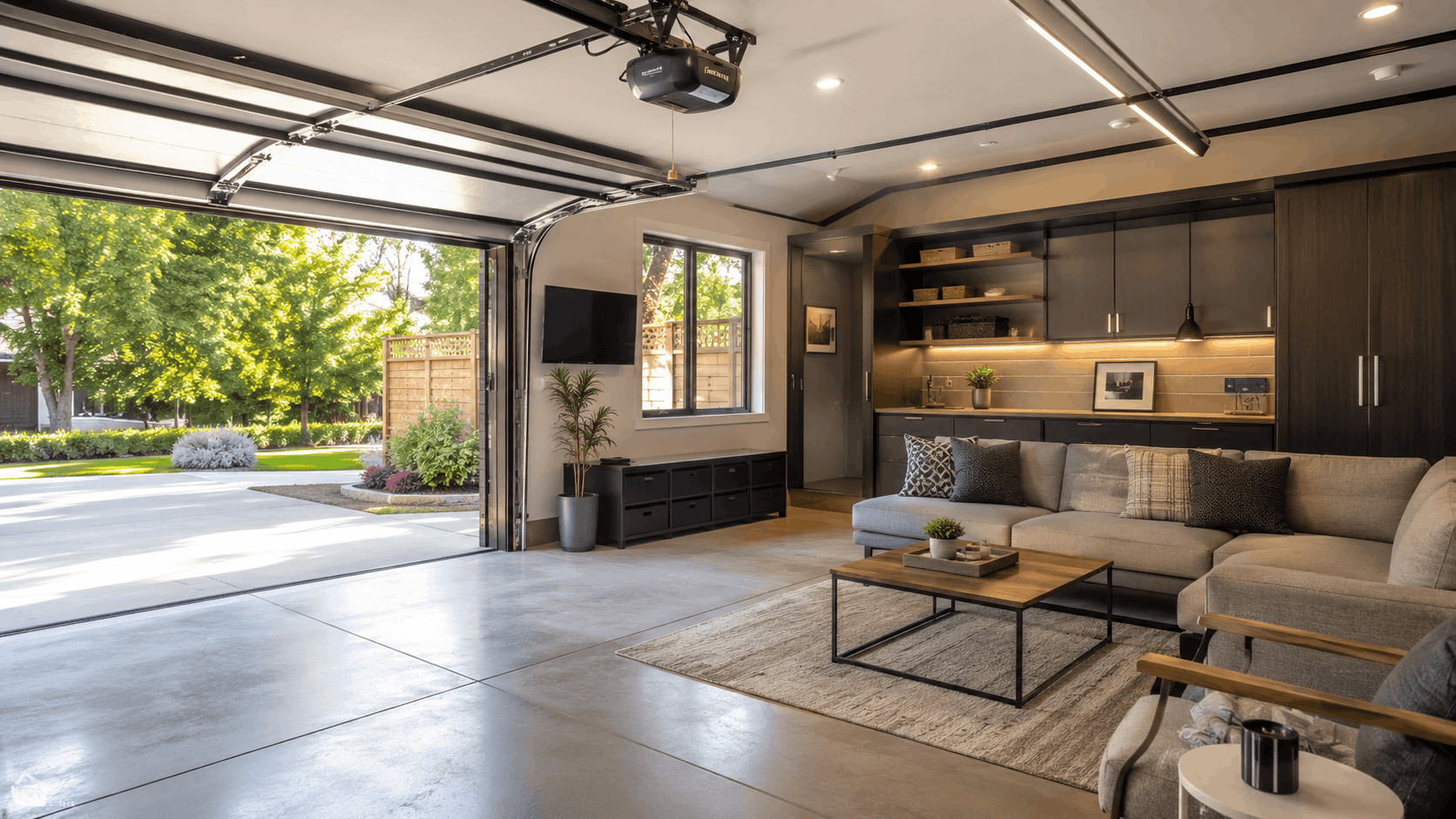
- Garage conversion conditioned: Converting the garage into a bedroom, ADU, or living area - even if the garage door stays in place - creates conditioned space.
- Removing the shared wall: Knocking out or opening up the wall between the garage and living area eliminates the thermal barrier. The garage becomes indirectly conditioned.
- HVAC ducts routed through the garage: Supply or return ducts running through an unconditioned garage can leak heated or cooled air, potentially triggering an indirectly conditioned classification.
Any one of these changes means the garage door is no longer an afterthought - it becomes a regulated part of the building envelope.
Get Your Free Quote
Tell us about your garage door and we'll get back to you within 30 to 60 minutes.
When Your Garage Door Becomes Part of the Building Envelope
Once a garage is classified as conditioned space, every surface that separates the interior from the outside must meet CA energy code garage door standards. That includes the garage door. Here are the specific circumstances where the garage door itself must meet insulation and air-sealing requirements:
- The garage has been converted to a habitable room (ADU, bedroom, office) but the garage door remains installed for vehicle access or aesthetics.
- A heating or cooling system has been added to the garage for any purpose - workshop, gym, storage climate control.
- The wall between the garage and living space has been partially or fully removed.
- Uninsulated HVAC ductwork runs through the garage, causing unintentional conditioning of the space.
In all of these cases, the garage door building envelope classification applies. The door must carry a documented R-value, proper weatherstripping, and a functional bottom seal. An insulated steel garage door is a common solution, but the specifics depend on the project.
Garage-to-Living-Space Conversions (ADU and Beyond)
The ADU garage conversion boom is the single biggest driver of conditioned space garage door issues in Irvine right now. Homeowners in University Park, Westpark, and across the city are turning attached garages into accessory dwelling units for rental income or multigenerational living. Many of these projects keep the garage door in place - sometimes for design reasons, sometimes because the homeowner wants the option to convert back later.
When the garage door stays on an ADU, it must meet insulated garage door requirement standards under the California energy code. The City of Irvine's ADU permit process, managed through the Community Development Department, requires a CF-1R energy compliance form that lists the thermal specs of every envelope component - including the garage door ADU Irvine projects rely on.
A standard non-insulated door will not pass the inspection. Homeowners need a factory-insulated door with manufacturer documentation showing R-value and U-factor ratings, plus proper perimeter seals. We handle many of these garage door installations for ADU projects across Irvine.
Conditioned Workshops, Home Gyms, and Bonus Rooms
Not every conditioned garage is a full conversion. A growing number of homeowners in Irvine's newer developments near Great Park - Beacon Park, Pavilion Park, and surrounding areas - are adding ductless mini-splits to their garages to create comfortable workshop spaces or home gyms. The thinking is simple: Southern California summers make an unconditioned garage miserable by mid-morning.
But even without tearing down a wall or pulling a major remodel permit, installing a conditioned garage workshop mini-split triggers the energy code. The moment that mini-split goes live, the garage is directly conditioned space. That means the garage door needs to meet the same insulation standards as any other exterior wall. We have seen homeowners get surprised by this during mini-split garage energy code inspections - they assumed the permit was only about the electrical work.
Ductwork and HVAC Supply Running Through the Garage
This one catches a lot of people off guard. If your home's HVAC system has supply or return ductwork through garage space - running along the ceiling to reach a bedroom above, for instance - that ductwork can leak conditioned air into the garage. If the ducts are not fully insulated and sealed, the energy code may classify the garage as an indirectly conditioned garage.
When that classification applies, the garage door must meet the same thermal performance standards as if the space were intentionally heated. Older homes along Culver Drive and in neighborhoods like Walnut and College Park often have ductwork routed through the garage from original construction. During a remodel, inspectors may flag this and require upgrades to both the ductwork and the garage door.
Need Help in Irvine?
Urgent Garage Doors serves Irvine and all of Orange County.
R-Value and U-Factor Requirements for Garage Doors in Conditioned Spaces
When a garage becomes conditioned space, the garage door R-value and U-factor requirements jump from zero to specific, documented thresholds. Here is what the current California energy code cycle demands, and what Irvine homeowners should aim for:
- R-value measures resistance to heat flow. Higher is better. A bare steel door has roughly R-0 to R-1.
- U-factor measures the rate of heat transfer through the door assembly. Lower is better.
- Both metrics must be documented by the manufacturer - inspectors will ask for proof.
The energy code insulation requirements for garage doors in conditioned spaces are not suggestions. They are pass-or-fail criteria tied to the permit and final inspection. A weatherseal and insulation retrofit can sometimes bridge the gap, but a full door replacement is often the cleaner path.
Minimum R-Value the Code Requires for Garage Doors
Irvine falls within Climate Zone 8 under the California Energy Commission's climate zone map. For garage doors serving as part of the building envelope in conditioned space, the minimum R-value is R-8. That said, many contractors and inspectors in Orange County recommend R-12 or higher for better thermal performance and a comfortable margin above the minimum.
To put that in perspective: a typical single-layer steel garage door has an R-value around R-0.5. Even a basic double-layer door with thin polystyrene insulation might only reach R-6 - still below the minimum. An R-8 garage door or higher requires either thick polystyrene panels or, more commonly, polyurethane foam injected between steel skins.
The R-value should be printed on the manufacturer's label affixed to the door. If there is no label, inspectors in Climate Zone 8 California will ask for a spec sheet.
U-Factor Ratings and How They Differ from R-Value
While R-value measures insulation resistance in the center of a panel, the U-factor garage door rating tells the whole story. U-factor accounts for the entire door assembly - panels, joints, seals, hardware, and framing. A door might have an R-12 panel, but if the joints and edges leak air, the overall U-factor will be worse than expected.
For conditioned space garage doors in Climate Zone 8, inspectors may request a U-factor no higher than approximately 0.20. A well-insulated triple-layer steel door typically delivers a U-factor between 0.10 and 0.15 - well within compliance. Manufacturers of quality insulated doors provide U-factor documentation with the garage door thermal performance specs that inspectors need to see.
Air Sealing and Weatherstripping Standards
Insulation alone is not enough. A conditioned-space garage door also needs to control air leakage. The code requires:
- Perimeter weatherstripping along both sides and the top of the door frame.
- Bottom seal - a flexible rubber or vinyl gasket that compresses against the garage floor when the door closes.
- Panel-joint seals between individual door sections to prevent air from passing through gaps.
In Irvine, garage door weatherstripping is especially relevant during Santa Ana wind events, when hot, dry gusts push through every crack and gap. Air sealing a garage door properly reduces energy loss and keeps dust and debris out of conditioned living space.
How Irvine Building Inspectors Check Garage Door Compliance
The City of Irvine takes energy code compliance seriously, and the inspection process for garage doors in conditioned space is more detailed than most homeowners expect. The Irvine Community Development Department oversees building permits and inspections from its offices on Civic Center Drive. Here is what to expect:
| Inspection Item | What the Inspector Checks | Common Failure Reason |
|---|---|---|
| Manufacturer Label | R-value and/or U-factor printed on the door | No label present or label removed |
| Insulation Type | Polyurethane or polystyrene, matching CF-1R specs | Single-layer door with no insulation |
| Bottom Seal | Flexible seal that compresses against the floor | Missing, cracked, or deteriorated seal |
| Perimeter Weatherstripping | Seals along sides and top of the frame | Gaps visible, stripping pulled away |
| CF-1R Match | Door specs match what was listed on the energy form | Wrong door installed vs. what was documented |
Permit Requirements for Garage Modifications in Irvine
A building permit from the City of Irvine is required anytime the work changes the thermal envelope - that includes converting a garage, adding HVAC, or replacing a garage door as part of a conditioned space project. The Irvine building department processes these permits through the Community Development Department.
For most garage-related energy code projects, a CF-1R form (Certificate of Compliance - Residential) must be submitted. This form documents the thermal specifications of every envelope component, including the garage door. The CF-1R form garage section needs to list the door's R-value, U-factor, and insulation type. Without this paperwork, the permit application will stall.
What Inspectors Look for on the Garage Door Itself
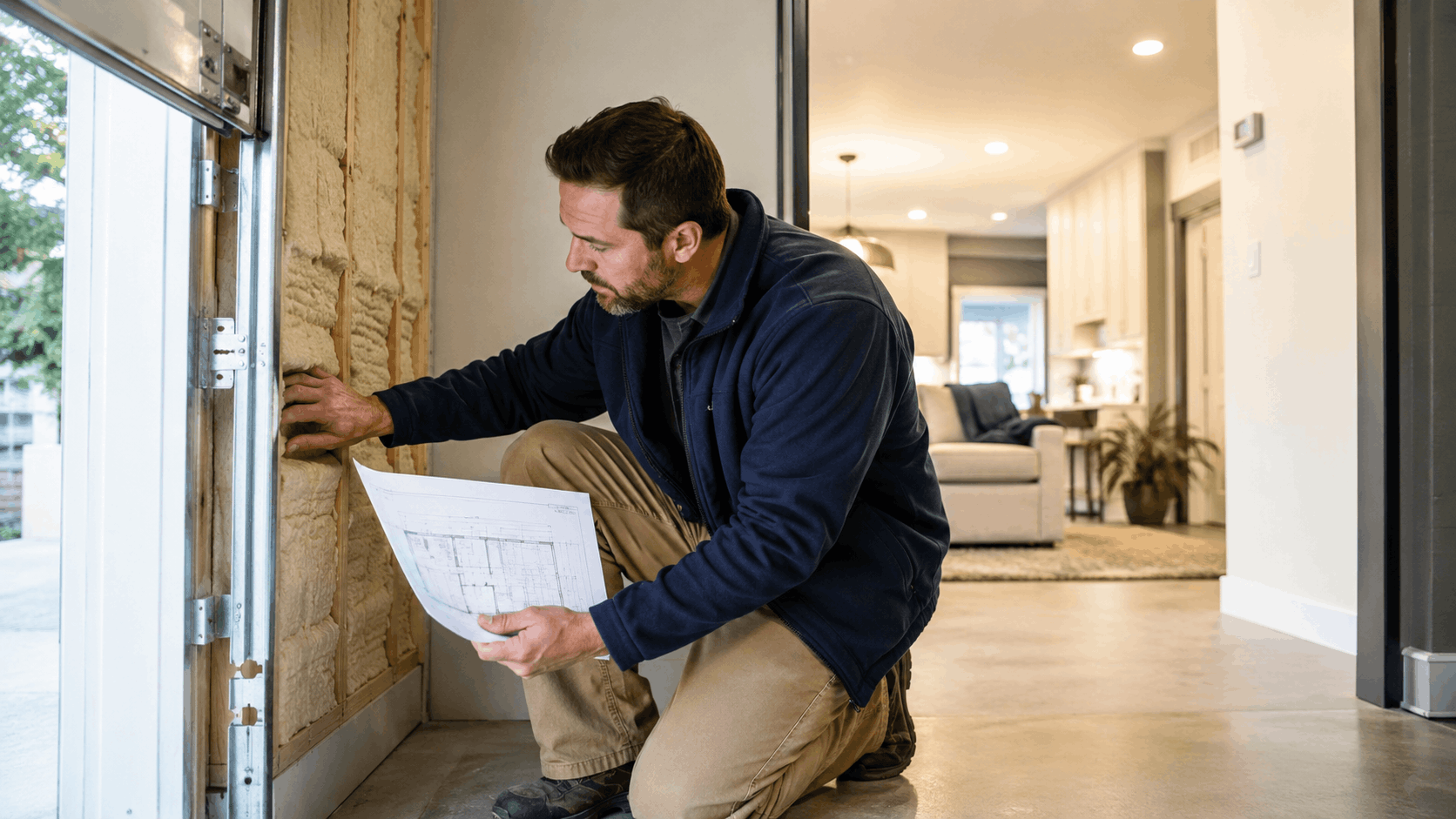
During an energy code review of the garage door, the inspector will physically check the door and compare it against the CF-1R form. They look for the manufacturer label - typically a sticker on the interior side of one of the top panels - showing the R-value or U-factor. They will run their hand along the bottom seal and perimeter weatherstripping to check for gaps.
The inspector also verifies that the installed door matches the energy compliance documentation submitted with the permit. If you listed a polyurethane-insulated R-12 door on the CF-1R but installed a polystyrene R-6 door, the inspection will fail. Our team at Urgent Garage Doors always provides the correct manufacturer spec sheets to match what goes on the form.
Common Reasons Garage Door Inspections Fail
We have been on plenty of service calls in Irvine neighborhoods where a homeowner or their general contractor got flagged during inspection. Here are a common failure reasons we see:
- No manufacturer documentation: The door has no label, and the homeowner cannot produce a spec sheet. Without proof of R-value, the inspector cannot pass it.
- Single-layer steel door: The original builder-grade door was never replaced. These have virtually no insulation value.
- Missing or damaged bottom seal: Old rubber seals crack and shrink, leaving a visible gap between the door and the floor.
- Perimeter gaps: Weatherstripping along the sides and top has pulled away or was never installed.
- Door does not match CF-1R: The contractor listed one door model on the compliance form but installed a different one.
A failed garage door inspection does not mean starting over, but it does mean the project cannot get final sign-off until the issue is corrected. If you are dealing with a same-day garage door repair situation tied to an inspection deadline, we can usually respond quickly.

Choosing the Right Insulated Garage Door for Code Compliance
Picking the right insulated garage door selection for a conditioned space project is about matching the code requirements to your budget and the look you want. Not all insulated doors are created equal, and not all of them will pass an energy code inspection. Here is a practical breakdown.
Single-Layer vs. Double-Layer vs. Triple-Layer Garage Doors
Garage doors come in three basic construction types, and the difference matters for code compliance:
- Single-layer: One sheet of steel (or aluminum). No insulation. R-value near zero. Will not pass inspection for conditioned space - period.
- Double-layer: Steel exterior with insulation bonded or placed behind it, but no interior skin. R-values range from R-6 to R-10 depending on insulation thickness. May or may not meet the R-8 minimum.
- Triple-layer garage door: Steel-insulation-steel sandwich construction. The insulation is fully enclosed between two metal skins. R-values typically range from R-12 to R-18. This is the safest bet for conditioned space compliance.
For any garage door insulation types project tied to a permit in Irvine, we recommend a triple-layer door. It clears the R-8 minimum with room to spare, and the enclosed insulation resists damage over time. Check out our custom garage door design and installation options to see what is available in triple-layer construction.
Polyurethane vs. Polystyrene Insulation in Garage Doors
The two main insulation materials in garage doors are polyurethane foam and polystyrene board:
- Polyurethane insulated garage door: The foam is sprayed as a liquid into the door panel, where it expands and bonds directly to the steel skins. This creates a solid, airtight insulation layer. R-values per inch are high - typically R-6.5 per inch - so a 2-inch thick panel can hit R-12 to R-18 depending on the manufacturer.
- Polystyrene garage door insulation: Rigid foam boards are cut and inserted between door layers. They do not bond to the steel. R-values are lower - around R-3.5 to R-4 per inch - meaning a polystyrene door often tops out around R-6 to R-10.
For conditioned space projects, polyurethane-filled doors are the stronger choice. They hit higher R-values in less thickness, bond to the panels for structural rigidity, and come with manufacturer documentation that inspectors accept without question.
Price Ranges for Code-Compliant Insulated Doors in Orange County
Budget matters, so here are realistic price ranges for a code-compliant insulated garage door in the Irvine area. These numbers are for a standard 16x7 double-car door, including professional installation:
- Double-layer polystyrene (R-6 to R-10): $1,200 to $1,800 installed. May or may not meet the R-8 minimum depending on the model.
- Triple-layer polyurethane (R-12 to R-18): $1,800 to $3,500 installed. The range depends on material (steel, wood composite, aluminum), color, window inserts, and hardware.
- Premium or custom-designed insulated doors: $3,500 and up for carriage house styles, modern glass garage doors with insulated panels, or wood-clad options.
Urgent Garage Doors provides free estimates across Irvine and the surrounding Orange County area. The insulated garage door cost Irvine homeowners pay varies by project, but we always recommend getting at least two quotes for comparison. Our garage door installation price Orange County rates include removal of the old door, installation, and all manufacturer documentation.
Need Help in Irvine?
Urgent Garage Doors serves Irvine and all of Orange County.
Neighborhoods in Irvine Where Conditioned Garage Issues Come Up Most
Irvine is a city of distinct neighborhoods, each with its own housing stock and common garage configurations. Some communities run into the conditioned space question far more than others. Here is what we see on the ground every week.
Older Homes in Woodbridge and El Camino Real
Woodbridge Irvine homes were built primarily in the late 1970s and 1980s. Many still have their original single-layer garage doors - thin steel panels with no insulation and worn-out bottom seals. These are the homes where ADU and in-law suite conversions are exploding right now, and nearly every one of them requires a garage door upgrade to meet conditioned space standards.
Along El Camino Real, similar-era homes face the same situation. The original builders never anticipated that someone would heat or cool the garage, so the doors were spec'd at the lowest cost. When homeowners at these addresses start a conversion project, the garage door is often the line item they did not see coming. Our Irvine CA garage door service team works in these neighborhoods regularly.
Newer Builds Near Great Park and Portola Springs
Great Park Irvine homes - including those in Beacon Park, Pavilion Park, and Portola Springs - typically come with insulated garage doors from the builder. These are often double-layer or triple-layer doors with R-values between R-8 and R-14. So the door itself may already meet the minimum.
The issue arises when homeowners add a mini-split or portable AC unit to the garage for workshop or gym use. The existing Portola Springs garage door might have enough R-value, but the weatherstripping and bottom seals may need upgrading to meet air-sealing standards for conditioned space. A quick maintenance and upgrade visit can address seals without a full door replacement.
HOA Considerations in Turtle Rock and Northwood
Turtle Rock and Northwood present a unique challenge: homeowners must satisfy both the California energy code and their HOA's design guidelines. Turtle Rock HOA garage door rules often specify approved colors, panel styles, and hardware finishes. Northwood Irvine HOA communities have similar restrictions.
The good news is that modern insulated garage doors come in virtually every style and color available in non-insulated versions. A carriage house garage door with polyurethane insulation looks identical to a non-insulated version from the street. Urgent Garage Doors helps homeowners in these HOA communities select doors that check both boxes - full energy code compliance and complete aesthetic alignment with association standards.
Steps to Bring a Garage Door Up to Code for Conditioned Space
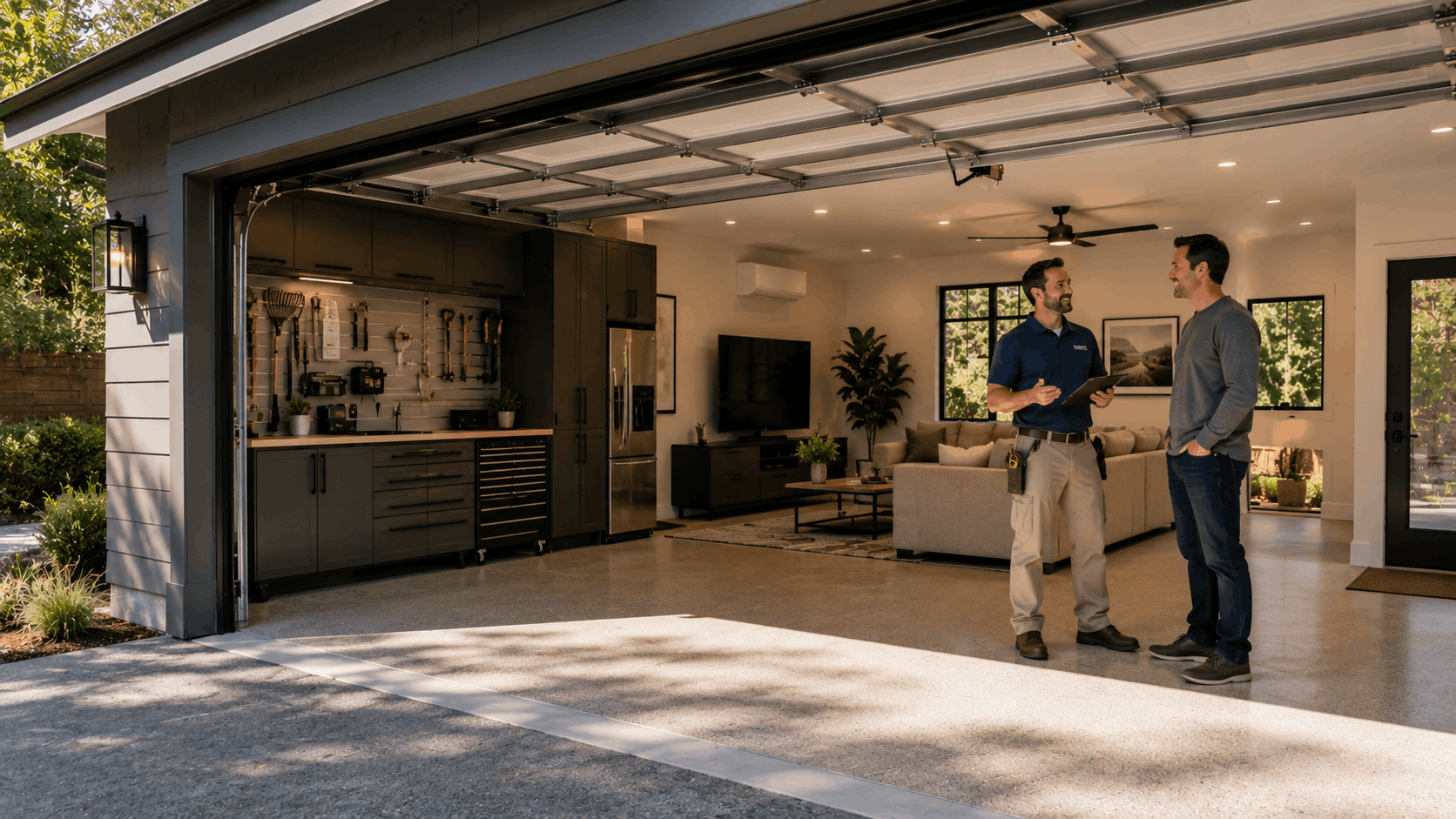
If your garage has become - or is about to become - conditioned space, here is a clear step-by-step process to get the garage door compliant. These steps apply whether you are doing a full ADU conversion or just adding a mini-split for your workshop.
Step 1 - Determine If the Space Is Actually Conditioned
Before spending any money, figure out whether the garage truly qualifies as conditioned space. Ask yourself these questions:
- Is there an HVAC register, mini-split, or any heating/cooling appliance in the garage?
- Has the wall between the garage and the house been opened, removed, or left uninsulated?
- Do HVAC ducts run through the garage space?
- Is there a direct, unsealed opening between the garage and a conditioned room?
If you answered yes to any of these, the garage likely qualifies as conditioned space. A conditioned space assessment does not need to be complicated - but if you are unsure, a professional can give you a definitive answer in about 15 minutes on site.
Step 2 - Get a Professional Assessment and Energy Calculation
For permitted projects, you will need an energy code calculation performed by a HERS rater (Home Energy Rating System) or a qualified energy consultant. This calculation determines the specific R-value and U-factor your garage door must achieve based on the project scope and Irvine's Climate Zone 8 designation.
Urgent Garage Doors can inspect the existing door and provide documentation of its current R-value, seal condition, and overall integrity. This information feeds directly into the HERS rater garage assessment and the CF-1R form. Having accurate door data upfront prevents mismatches between the compliance paperwork and the actual installation.
Step 3 - Replace or Retrofit the Garage Door
You have two options: full replacement with a factory-insulated door, or retrofitting the existing door with insulation kits and new weatherstripping.
Retrofit kits - foam board panels that stick to the inside of each door section - can boost R-value by R-4 to R-8. But they add 30 to 50 pounds of weight to the door, which may require a torsion spring replacement to handle the extra load. Retrofits also rarely come with manufacturer R-value labels, which makes passing inspection harder.
A garage door replacement vs retrofit comparison almost always favors replacement for conditioned space projects. A new factory-insulated door arrives with documented specs, proper labeling, and integrated seals. Urgent Garage Doors in Irvine handles both options, but we are straightforward with customers - replacement is the more reliable path to passing that energy code inspection on the first try.
Need Help in Irvine?
Urgent Garage Doors serves Irvine and all of Orange County.
How Urgent Garage Doors Helps Irvine Homeowners With Energy Code Projects
At Urgent Garage Doors, energy code compliance projects have become a growing part of our work across Irvine. Whether it is an ADU conversion in Westpark, a conditioned workshop near Quail Hill, or a homeowner in Northwood who needs to upgrade for an energy code inspection, our team handles the entire garage door side of the equation.
Free On-Site Evaluations for Energy Code Compliance
Our team visits homes across Irvine to assess whether the current garage door meets conditioned space requirements. During a free garage door evaluation Irvine visit, we check the manufacturer label for R-value documentation, test the bottom seal and perimeter weatherstripping for gaps, and evaluate the overall door condition. We then provide a written report that homeowners can share with their general contractor, HERS rater, or the Irvine building department.
This garage door compliance check takes about 20 minutes to half an hour and costs nothing. We would rather give an honest assessment upfront than have a homeowner buy the wrong door or get surprised at inspection. To schedule an evaluation, book an appointment online or call us directly.
Insulated Garage Door Installation and Permit Support
We supply and install insulated garage doors from major manufacturers - including Clopay, Amarr, and Wayne Dalton - with fully documented R-values and U-factors. Every door we install for a conditioned space project comes with the manufacturer spec sheets and labeling that homeowners need for the CF-1R form and inspection.
Our insulated garage door installation service covers removal of the old door, installation of the new one, adjustment of springs and hardware, and verification that all seals are properly seated. We also provide the garage door permit documentation package so there is no scramble when the inspector arrives. Urgent Garage Doors is based in Irvine and serves all of Orange County, including neighboring cities like Tustin, Lake Forest, and Mission Viejo.
Final Thoughts
California's energy code is not going to relax anytime soon, and garage door compliance is one of the most overlooked aspects of any project that involves conditioned garage space. Whether you are converting a garage in Woodbridge, adding a mini-split in a Portola Springs workshop, or navigating HOA rules in Turtle Rock, the garage door must meet documented insulation and air-sealing standards.
The best approach is to address the garage door early in the project - not the week before final inspection. Get the right door specified on the CF-1R form from the start, and installation day becomes a smooth step in the process rather than a last-minute scramble. If you are not sure where your garage door stands, our team at Urgent Garage Doors is here to help. Contact us for a free on-site evaluation anywhere in Irvine or the surrounding Orange County area.
Frequently Asked Questions
- Does a standard attached garage count as conditioned space in California?
- No. A standard attached garage with no heating or cooling system and a properly insulated wall separating it from the house is classified as unconditioned space under California's energy code. The garage only becomes conditioned when HVAC equipment is added to the space, when the thermal barrier to the house is removed or compromised, or when ductwork passes through the garage without proper insulation and sealing. Most builder-grade garages in Irvine start out unconditioned.
- What R-value does a garage door need for conditioned space in Climate Zone 8?
- In Climate Zone 8 - which covers all of Irvine and most of Orange County - the garage door needs a minimum R-value of R-8 when the space is classified as conditioned. Many local contractors and City of Irvine inspectors recommend installing a door rated R-12 or higher. A higher R-value provides a safety margin above the minimum threshold and delivers better real-world thermal performance, especially during summer heat and Santa Ana wind events.
- Can I add insulation to my existing garage door instead of replacing it?
- Retrofit insulation kits are available and can add R-4 to R-8 to an existing door. However, they increase the door's weight by 30 to 50 pounds, which may require spring adjustments or replacement. More importantly, retrofit kits rarely come with the manufacturer-certified R-value labels that City of Irvine inspectors look for during an energy code inspection. A factory-insulated replacement door is a more reliable way to document compliance and pass inspection.
- Do I need a permit in Irvine to convert my garage to conditioned space?
- Yes. Any modification that adds heating or cooling to a garage, removes or alters the wall between the garage and living space, or converts the garage into a habitable room requires a building permit from the City of Irvine. This includes all ADU conversions. Permits are processed through the Community Development Department, and a CF-1R energy compliance form documenting the garage door's thermal performance is required as part of the submission.
- What is a CF-1R form and do I need one for a garage door upgrade?
- The CF-1R is California's Certificate of Compliance form for residential projects. It documents that a building project meets California energy code standards. If the garage door is part of a permitted project that involves conditioned space - such as an ADU conversion or HVAC addition - the CF-1R must list the door's R-value, U-factor, and insulation type. Your energy consultant or HERS rater typically prepares this form using manufacturer specifications.
- Does putting a mini-split in my garage make it conditioned space?
- Yes. Installing any mechanical heating or cooling system in a garage - including a ductless mini-split - reclassifies the space as directly conditioned under California's energy code. Once that happens, the garage door becomes part of the building envelope and must meet the same insulation and air-sealing requirements as exterior walls. This applies regardless of whether the garage is used as a living space, workshop, or gym.
- How much does a code-compliant insulated garage door cost in Irvine?
- For a standard two-car (16x7) insulated garage door that meets conditioned space requirements, Irvine homeowners should budget between $1,200 and $3,500 installed. The price varies based on material (steel, wood composite, aluminum), insulation type (polyurethane vs. polystyrene), R-value, style, and hardware. Urgent Garage Doors provides free estimates and can walk homeowners through options at every price point across the range.
- Will my HOA in Irvine allow an insulated garage door that looks different?
- Most insulated garage doors from major manufacturers are available in the exact same styles, colors, and panel designs as their non-insulated counterparts. The insulation is inside the door - invisible from the street. Urgent Garage Doors works with homeowners in HOA communities like Turtle Rock and Northwood to find doors that satisfy both the energy code requirements and association design standards. We can provide sample images and spec sheets for HOA approval before ordering.
- What happens if I fail a garage door inspection for energy compliance?
- If the garage door does not meet the insulation or air-sealing standard during an energy code inspection, the inspector will document the deficiency on the inspection report. The project cannot receive final sign-off until the door is replaced or upgraded to meet the required specifications. For ADU conversions, this can delay occupancy. Homeowners should address the garage door early in the project to avoid holding up the final inspection.
- Does Urgent Garage Doors handle energy code garage door projects in Irvine?
- Yes. Urgent Garage Doors, based in Irvine, regularly works on insulated garage door installations tied to ADU conversions, garage remodels, and energy code compliance projects throughout Orange County. The team provides manufacturer documentation, supports the CF-1R form process, and coordinates with general contractors and inspectors. To get started, homeowners can contact Urgent Garage Doors for a free on-site evaluation.
Licensed garage door repair professionals serving Irvine and Orange County.
Licensed in California · License #1055150
Why trust Urgent Garage Doors?
Founded in 2017, Urgent Garage Doors is a licensed and insured garage door services serving Irvine and Orange County. All content is reviewed by our licensed technicians.
Need Help in Irvine?
Urgent Garage Doors serves Irvine and all of Orange County.
Related Articles

Best Garage Door Brands for Coastal Orange County
Discover the best garage door brands for coastal Orange County homes that resist salt air corrosion, handle marine layer moisture, and maintain performance despite coastal winds.

Insulated Garage Doors in Irvine: Comfort, Noise, and Energy Benefits
Discover how insulated garage doors provide energy savings, noise reduction, and improved comfort for Irvine homeowners in Orange County's climate.
Steel vs Wood vs Glass Garage Doors for Orange County Homes
Compare steel, wood, and glass garage doors for Orange County. Durability, maintenance, cost, and coastal considerations. Irvine to Newport Beach.