Torsion Spring Math: Why Your OC Door Needs a Specific Wire Size
Key Takeaways
- Torsion spring wire diameter is raised to the fourth power in the spring formula, meaning even a tiny change in wire size dramatically alters spring strength and cycle life.
- Common residential torsion spring wire sizes range from .207 to .283 inches, and the correct size depends on door weight, height, track type, and drum size - not just door dimensions.
- A standard 10,000-cycle spring lasts 7 to 12 years for average households but can fail in as few as 3 years for families that use the garage door 8 or more times daily.
- Coastal Orange County homes face salt air corrosion that reduces effective wire diameter over time, while inland homes deal with heat cycle fatigue that makes spring steel more brittle.
- Installing the wrong wire size can destroy your garage door opener, stretch cables, and create dangerous imbalances - costing far more than a properly sized spring replacement.
- Upgrading to a higher cycle life spring by going up one or two wire sizes typically costs only 30 to 50 percent more but can double or triple the spring's lifespan.
- DIY torsion spring replacement is one of the most dangerous home repair tasks due to the hundreds of foot-pounds of stored energy in a wound spring.
- A proper spring replacement in Orange County ranges from $180 to $500 depending on spring type and cycle rating, while a botched job can cascade into $600 to $1,200 in total repairs.
In This Article
It starts the same way almost every time. A homeowner in Woodbridge or Turtle Rock is heading to work on a Monday morning, and a loud bang echoes through the garage - like a gunshot. The garage door won't budge. The spring has snapped, and the car is stuck inside. It is one of the more common calls we get at Urgent Garage Doors, and it happens more often than people expect across Irvine and the surrounding Orange County communities.
What most homeowners don't realize is that the spring that just broke was likely the wrong size to begin with - or it was a generic replacement that wore out years ahead of schedule. The math behind torsion spring wire size is what determines whether a garage door operates smoothly for a decade or fails after just a few years. A difference of less than one-hundredth of an inch in wire diameter can cut a spring's life in half or double it.
Let's break down the actual calculations behind torsion spring sizing, explain why wire diameter matters more than most people think, and show how our team at Urgent Garage Doors selects the right spring for every door we service across Irvine and Orange County. Whether you live near Quail Hill or off Culver Drive in Northwood, the math applies to your door - and getting it right can save you hundreds of dollars in repairs down the road.
What Torsion Springs Actually Do on a Garage Door
A torsion spring is the heavy coil mounted on a steel shaft above your garage door opening. Its job is simple in concept but demanding in execution - it stores rotational energy when wound tight and releases that energy to lift the door. This is the garage door counterbalance system, and without it, your opener would have to lift the full weight of the door by itself. Most residential openers only produce about 10 to 15 pounds of lifting force. They are not designed to do the heavy lifting.
In neighborhoods like Northwood, Portola Springs, and the communities along Irvine Center Drive, two-car garage doors are the standard. These doors typically weigh between 130 and 200 pounds depending on the material and insulation. The torsion spring mechanics behind lifting that weight involve careful engineering. Spring energy must match the door's weight precisely, or the system either strains or becomes unsafe.
| Door Type | Typical Size | Approximate Weight | Common in These Irvine Areas |
|---|---|---|---|
| Single steel (non-insulated) | 8x7 or 9x7 | 80-110 lbs | Older homes near University Park |
| Double steel (non-insulated) | 16x7 | 130-155 lbs | Northwood, Woodbury tract homes |
| Double steel (insulated) | 16x7 | 155-185 lbs | Portola Springs, Stonegate |
| Double wood or carriage-style | 16x7 or 16x8 | 200-300 lbs | Turtle Rock, Shady Canyon custom homes |
How Stored Energy Lifts a 150-Pound Door
When a technician winds a torsion spring, they are storing rotational energy in the coiled wire. Each turn adds a specific amount of spring torque, measured in inch-pounds. That stored energy transfers through the torsion shaft to lifting drums at each end. Cables wrap around those drums and connect to brackets at the bottom of the door.
Here is how it works in practice with a standard 16x7 steel door - a common size in OC tract homes. If that door weighs 150 pounds and uses standard 4-inch drums, the spring needs to produce roughly 150 inch-pounds of torque to hold the door at any point along its travel. The rotational energy stored in the spring decreases as the door rises because the cables unwind from the drums, and the door's weight is increasingly supported.
This balance is precise. If the garage door weight doesn't match the spring's output, the door drifts open on its own or slams shut. Neither is safe, and both wear out the opener and hardware sooner than they should.
Why One-Size-Fits-All Springs Do Not Exist
Every garage door system has variables that affect spring sizing. Door height, door weight, track type (standard lift, low headroom, or high lift), and drum size all change the spring requirements. A 16x7 door in a home along Irvine Boulevard might weigh 140 pounds with single-layer steel panels, while a nearly identical-looking door in the Quail Hill area could weigh 180 pounds because of triple-layer insulated construction.
Custom spring selection means accounting for all of these garage door dimensions. Even within the same neighborhood, we see different door manufacturers, different insulation packages, and different hardware. A builder might install Clopay doors in one phase and Amarr doors in the next phase of the same development. The springs are not interchangeable between them.
This is why ordering a "replacement spring for a 16x7 door" online without measuring is a gamble. The spring sizing has to match your specific door - not a generic chart on the internet.
Get Your Free Quote
Tell us about your garage door and we'll get back to you within 30 to 60 minutes.
Wire Size and Why a Fraction of an Inch Changes Everything
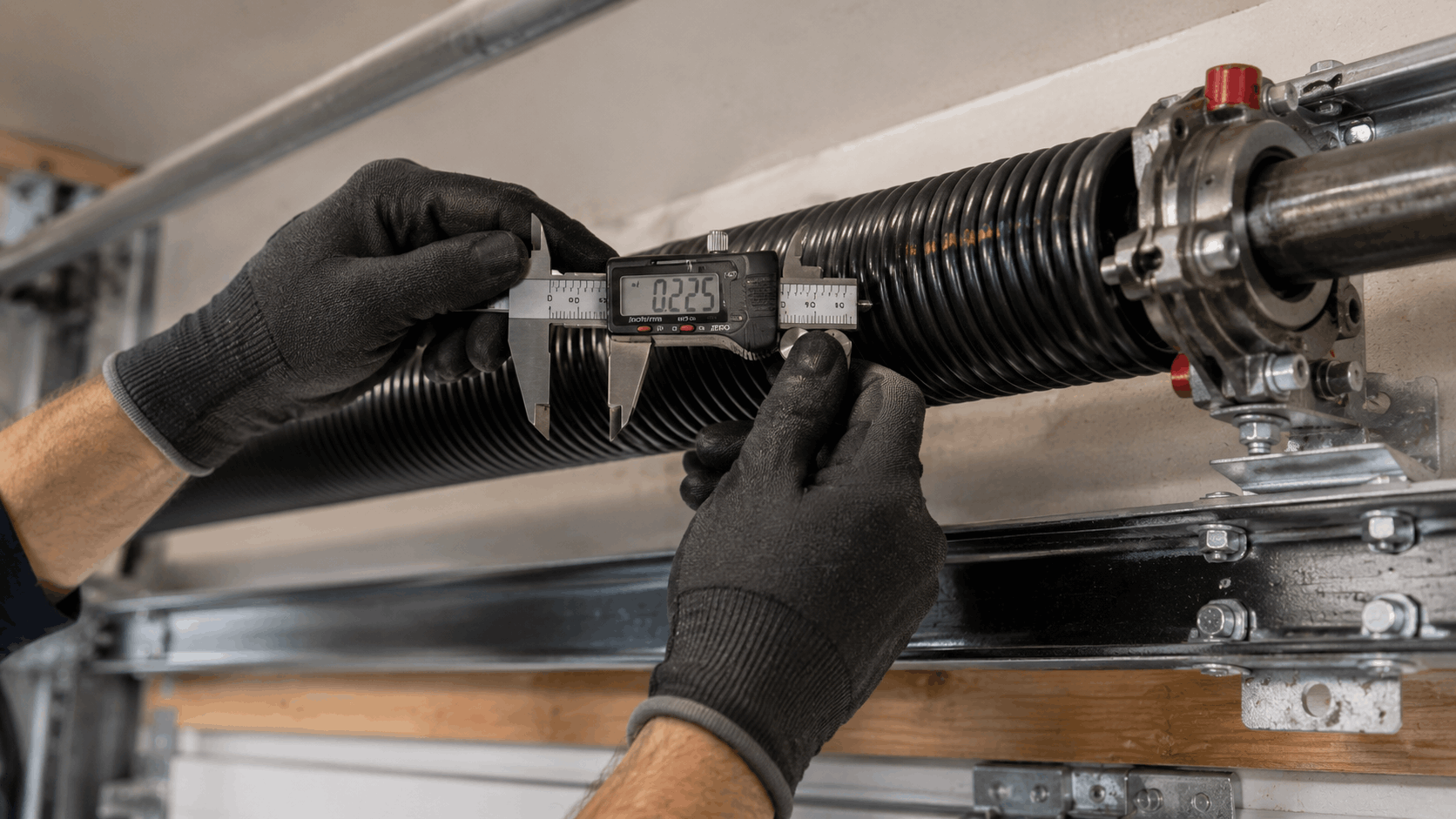
Torsion spring wire size refers to the diameter of the steel wire used to form the coil. It is measured in decimal inches, not by a standard gauge number like electrical wire. Common residential torsion spring wire sizes run from about .207 inches up to .283 inches. The wire diameter directly controls how stiff the spring is and how much force each winding turn produces.
Here is why a fraction of an inch matters so much with spring wire gauge measurements:
- A .225 wire and a .234 wire differ by only nine thousandths of an inch - less than the thickness of two sheets of paper.
- That tiny difference changes the spring rate by roughly 15 to 20 percent.
- It also affects cycle life by thousands of cycles, either extending or shortening how long the spring lasts.
- The wire diameter is raised to the fourth power in the spring formula, which amplifies small changes into large differences in performance.
Getting the torsion spring wire size right is not about being picky. It is about making the spring match the load. Too thin, and it wears out fast. Too thick, and it overpowers the door.
Common Wire Sizes for Residential Garage Doors
Across the hundreds of torsion spring replacements we do each year in Orange County, certain residential torsion spring sizes come up again and again. Here is a spring wire diameter chart showing a common sizes and what doors they typically fit:
- .207 wire - lightweight single-car doors, 70-100 lbs
- .218 wire - standard single-car steel doors, 90-120 lbs
- .225 wire - heavier single-car or light double-car doors, 110-140 lbs
- .234 wire - standard double-car steel doors, 130-160 lbs
- .243 wire - insulated double-car doors, 150-180 lbs
- .250 wire - heavy insulated or wood-look doors, 170-210 lbs
- .262 wire - solid wood or extra-heavy doors, 200-250 lbs
- .283 wire - custom wood doors or high-cycle upgrades, 230+ lbs
Our Urgent Garage Doors trucks carry the most frequently needed sizes at all times. The .225 through .250 range covers the majority of homes we service from Tustin to Lake Forest and everywhere in between.
What Happens When the Wrong Wire Size Gets Installed
We have seen this play out dozens of times in older Irvine homes near University Park and along Yale Avenue. A handyman or a previous repair company installs a spring that is close but not correct - maybe a .225 wire on a door that needs a .234. The door works, but it works poorly.
A wire too thin for the door means the spring is working harder than it should on every single cycle. Spring failure comes early - sometimes within two or three years instead of seven to ten. When it snaps, it goes with a bang that scares everyone in the house. A wire too thick makes the door fly up aggressively, strains the opener gears and motor, and puts excess stress on the bottom brackets and cables.
Wrong spring size is a garage door safety issue. A door that doesn't balance properly can fall on a person, a pet, or a car. The consequences of incorrect sizing go beyond inconvenience - they create real risk.
How Wire Size Relates to Spring Rate (Inch-Pounds per Turn)
The spring rate is the amount of torque a spring produces for each full turn of winding. It is measured in inch-pounds per turn. Wire diameter is one of the main variables that determines this rate. A thicker wire creates a stiffer coil, which produces more inch-pounds per turn.
Here is a simple torsion spring calculation example. A spring with .234 wire, a 2-inch inside diameter, and 18-inch length might produce about 17 inch-pounds per turn. Change only the wire to .243 - keeping everything else the same - and the spring rate jumps to roughly 21 inch-pounds per turn. That is a 24% increase from a wire change of just nine thousandths of an inch.
This relationship between wire size and spring rate is why every variable has to be calculated together. You cannot just swap in a thicker wire and expect better results without adjusting the coil count and spring length to match.
Need Help in Irvine?
Urgent Garage Doors serves Irvine and all of Orange County.
The Torsion Spring Formula Broken Down in Plain Language
This is where the garage door spring math gets real. The standard torsion spring formula used across the industry is:
Torque per turn = d⁴ x E / (10.18 x D x N)
Each variable represents a physical measurement of the spring. Here is what they mean in plain terms:
- d = wire diameter (in inches)
- E = modulus of elasticity of the steel (usually around 30,000,000 psi for spring steel)
- D = mean coil diameter (the outside diameter minus one wire diameter)
- N = number of active coils
- 10.18 = a constant derived from the geometry of torsion
The spring calculation tells us exactly how many inch-pounds of torque the spring will produce each time we add one full turn of winding. From there, we determine how many total turns are needed to counterbalance the door's weight. This torsion spring formula is the same one used by spring manufacturers, engineers, and trained technicians across the country.
Wire Diameter, Coil Diameter, and Number of Coils
Let's look at each variable individually. The wire diameter (d) is raised to the fourth power, making it by far the most influential factor. The coil diameter (D) is the average diameter of the coil - measured from the center of the wire on one side to the center on the opposite side. A larger coil diameter makes the spring softer, producing less torque per turn.
The number of active coils (N) also reduces the torque per turn as it increases. More coils create a longer, softer spring. Fewer coils create a shorter, stiffer spring. These three values - wire diameter, coil diameter, and active coils - work together to define the spring's behavior.
Changing just the wire diameter while holding the other values constant shifts the spring torque output dramatically. For example, going from .225 wire to .243 wire (an 8% increase in diameter) produces a 36% increase in torque per turn because of that fourth-power relationship.
A Real Calculation Example Using a Typical Irvine Garage Door
Let's run the numbers on a 16x7 insulated steel door - the type installed in thousands of homes in Woodbury, Stonegate, and the Great Park neighborhoods. This Irvine garage door weighs 160 pounds. It uses standard 4-inch drums and radius track.
Using the formula with a .234 wire, a 2-inch inside diameter (meaning a mean coil diameter of about 2.234 inches), and 120 active coils:
Torque per turn = (.234)⁴ x 30,000,000 / (10.18 x 2.234 x 120) = approximately 17.2 inch-pounds per turn.
To balance a 160-pound door on 4-inch drums, we need about 160 inch-pounds of total torque from each spring in a two-spring system (split between them). That means each spring needs about 80 inch-pounds, requiring roughly 4.6 turns plus pre-load. The spring calculation example confirms that a .234 wire in this configuration is a good match for this 16x7 garage door spring application.
How the Fourth Power of Wire Diameter Amplifies Small Differences
The fourth power relationship is the reason wire diameter impact is so dramatic. Let's compare .225 wire versus .234 wire directly.
.225 raised to the fourth power = .002563. And .234 raised to the fourth power = .002999. That means the .234 wire produces 17% more torque per turn than the .225 wire - from a difference you can barely see with your eyes. This spring strength difference compounds over the life of the spring.
If the .225 wire is slightly too weak for the door, it has to be wound tighter to compensate. Tighter winding means higher stress on every cycle, which means the spring wears out sooner. A wire that is just one size up - the .234 - might need fewer turns and will experience less stress per cycle, lasting thousands of cycles longer. The fourth power makes the math unforgiving in both directions.
How Orange County Climate and Salt Air Affect Spring Wire
Spring wire doesn't exist in a vacuum. The environment inside your garage affects how long that wire holds up. In Orange County, we deal with two distinct climate challenges that influence spring lifespan - coastal salt air corrosion and inland heat cycles. Both degrade spring wire over time, and both factor into the wire size decision.
Homes closer to the coast in Newport Beach and Laguna Beach deal with moisture-laden air that speeds up rust. Homes in inland areas like Tustin Ranch, North Irvine, and the Great Park neighborhoods face summer temperatures that push garage interiors above 120 degrees, then cool rapidly at night. Both conditions weaken spring steel.
| Location | Primary Climate Challenge | Effect on Spring Wire | Recommended Protection |
|---|---|---|---|
| Newport Beach, Laguna Beach, Corona del Mar | Salt air corrosion | Surface rust reduces effective wire diameter | Galvanized or oil-tempered wire; regular lubrication |
| Coastal Irvine (Quail Hill, Turtle Rock west side) | Moderate salt air | Gradual surface pitting | Oil-tempered wire; annual maintenance |
| Inland Irvine (Northwood, Woodbury, Portola Springs) | Heat cycling | Metal fatigue from expansion/contraction | High-cycle springs; proper cycle life rating |
| Tustin Ranch, North Irvine near the 261 | Extreme heat cycles | More metal fatigue | Upgraded wire size for longer cycle life |
Coastal Corrosion Near Newport and Laguna
Salt air is sneaky. It doesn't break a spring overnight, but it eats away at the wire surface over months and years. Coastal corrosion creates tiny pits in the steel that act as stress concentration points. Those pits grow into micro-cracks, and those cracks spread each time the spring cycles.
More importantly for our topic, corrosion reduces the effective wire diameter. A .234 spring that rusts down to .228 effective wire thickness loses about 10% of its torque output. The door starts feeling heavier, the opener works harder, and the spring fails earlier than its rated cycle life.
For homes within three to five miles of the coast, we recommend a galvanized torsion spring or at minimum an oil-tempered option with regular rust prevention maintenance. A preventive maintenance plan that includes spring lubrication twice a year can significantly extend spring life in these areas.
Heat Cycles in Inland Orange County
Inland OC garages get brutally hot in summer. Temperatures inside an uninsulated garage in the Great Park neighborhoods or along Portola Parkway can exceed 130 degrees on a July afternoon. By midnight, the temperature drops 50 or 60 degrees. That daily heat cycle fatigue stresses the spring steel through repeated expansion and contraction.
Metal fatigue from heat cycling is different from corrosion. It doesn't change the wire diameter - it changes the wire's internal structure. Over thousands of cycles, the steel becomes more brittle and less elastic. A spring that was rated for 10,000 cycles in a climate-controlled environment might only deliver 7,000 or 8,000 in an inland OC garage.
This is one reason we often recommend stepping up to a higher spring cycle life rating for homes in these areas. Adding insulation to the garage door also helps by moderating temperature swings inside the garage.
Cycle Life and How Wire Size Determines How Long a Spring Lasts
Every torsion spring has a rated cycle life - the number of open-and-close cycles it is expected to complete before it breaks. A standard 10,000-cycle spring is the baseline that most builders install. A high-cycle torsion spring might be rated for 25,000, 50,000, or even 100,000 cycles. Wire size is one of the main levers a technician uses to move between these ratings.
The relationship is straightforward. A larger wire size produces the same torque with less stress per cycle because each turn contributes more force - so fewer turns are needed, and each turn is less stressed. The spring cycle life goes up as the stress per cycle goes down. Choosing the right wire size for the desired cycle life is a core part of spring sizing, and it has a direct impact on how many years the spring will last in your garage.
What 10,000 Cycles Actually Means in Daily Use
A single cycle is one full open-and-close of the garage door. Most families open their garage door at least four times per day - once to leave in the morning, once to come home, and a couple more times for errands, kids, or deliveries. That adds up to about 1,460 garage door cycles per day annualized.
At 1,460 cycles per year, a 10,000-cycle spring lasts about 6.8 years. But a busy household in a neighborhood like Westpark - where the garage is the main entry point and multiple family members come and go - might hit 8 cycles per day. That is 2,920 cycles per year, and the 10,000-cycle spring only lasts 3.4 years.
The spring lifespan in years depends entirely on usage patterns. This is why we ask homeowners about their daily habits before recommending a spring. A family that uses the garage door as their front door needs a different spring than a retired couple who drives once a day.
Upgrading Wire Size to Double Your Spring Life
One of the best investments a homeowner can make is a high-cycle upgrade. By going up one or two wire sizes and adjusting the coil count and spring body length to compensate, we can double or triple the cycle life of a longer lasting spring. The cost increase is modest - usually 30 to 50 percent more than a standard spring - but the lifespan increase is dramatic.
For families who use their garage as a main entry, the spring upgrade pays for itself by eliminating a second or third replacement over the life of the door. We regularly recommend this for homeowners across Irvine who are already on their second or third spring replacement and are tired of the cycle.
The spring upgrade requires checking that the torsion shaft is long enough to accommodate the longer spring body. In most standard residential setups, there is enough room. Our technicians verify this during the measurement process before recommending the upgrade.
Need Help in Irvine?
Urgent Garage Doors serves Irvine and all of Orange County.
Why DIY Spring Replacement with the Wrong Wire Size Is Dangerous
The internet has made it easy to watch a 10-minute video and think you can handle a DIY spring replacement. And for many home repairs, that confidence is fine. Torsion springs are different. They store enough energy to cause serious injury or death when handled incorrectly, and installing the wrong wire size adds another layer of garage door spring danger to the equation.
We are not saying this to sell more service calls. The U.S. Consumer Product Safety Commission has documented thousands of garage door-related injuries each year, and a significant number involve springs. Spring safety is not something to take lightly, and the consequences of a mistake are immediate and severe.
The Real Injury Risk of a Wound Torsion Spring
A fully wound torsion spring on a standard two-car garage door stores roughly 200 to 300 foot-pounds of energy. That is comparable to the force of a car hitting a wall at 5 miles per hour - concentrated into a steel coil attached to a shaft. If a winding bar slips during installation or adjustment, that bar can spin with enough force to break bones, shatter teeth, or worse.
A torsion spring injury can also happen when a spring snaps during winding. If the coils separate, fragments can fly unpredictably. Winding bar safety requires using the correct size bars (typically 18 inches long and 1/2 inch diameter), maintaining firm grip at all times, and never standing directly in the path of the winding cone. Even experienced technicians treat every spring with respect.
The risk multiplies when the wrong wire size is involved. An under-sized spring wound extra tight to compensate creates even more stored stress and is more likely to fail during or shortly after installation.
Online Spring Calculators vs. a Trained Technician's Measurements
Free spring calculators online can get you in the right ballpark, but spring calculator accuracy depends entirely on the quality of the measurements entered. A common errors homeowners make include measuring the outside coil diameter instead of the inside, miscounting active coils (the end coils attached to the cones are not active), and forgetting to account for the weight of the cone hardware itself.
A trained technician doing professional spring sizing measures the door weight directly by disconnecting the opener and checking the door at mid-travel with a scale. This accounts for friction, worn hardware, and the actual condition of the door - not a theoretical weight from a manufacturer's spec sheet. The spring measurement taken in person beats any calculator estimate.
We have lost count of how many times we have been called to fix a DIY spring job where the homeowner ordered springs based on an online tool and received springs that were close - but not right. Close does not work with torsion springs.
When a Mismatched Spring Destroys Your Opener
A spring that is too weak for the door forces the garage door opener to pick up the slack. The opener motor strains on every cycle, the nylon gears inside the drive unit wear down sooner, and the circuit board overheats. Opener damage from a mismatched spring is one of the most expensive consequences of bad spring sizing.
A proper torsion spring should allow the door to stay at any point along its travel when the opener is disconnected. If the door crashes down when you let go, the spring is too weak and your opener is compensating every time it runs. That $50 spring replacement done correctly is far cheaper than a $300-$500 spring opener compatibility repair or full opener replacement down the line.
On the flip side, a spring that is too strong makes the door fly up and can rip the opener arm out of the trolley. Both scenarios end with a service call that costs more than doing it right the first time.
How Urgent Garage Doors Calculates the Right Spring for Each Door
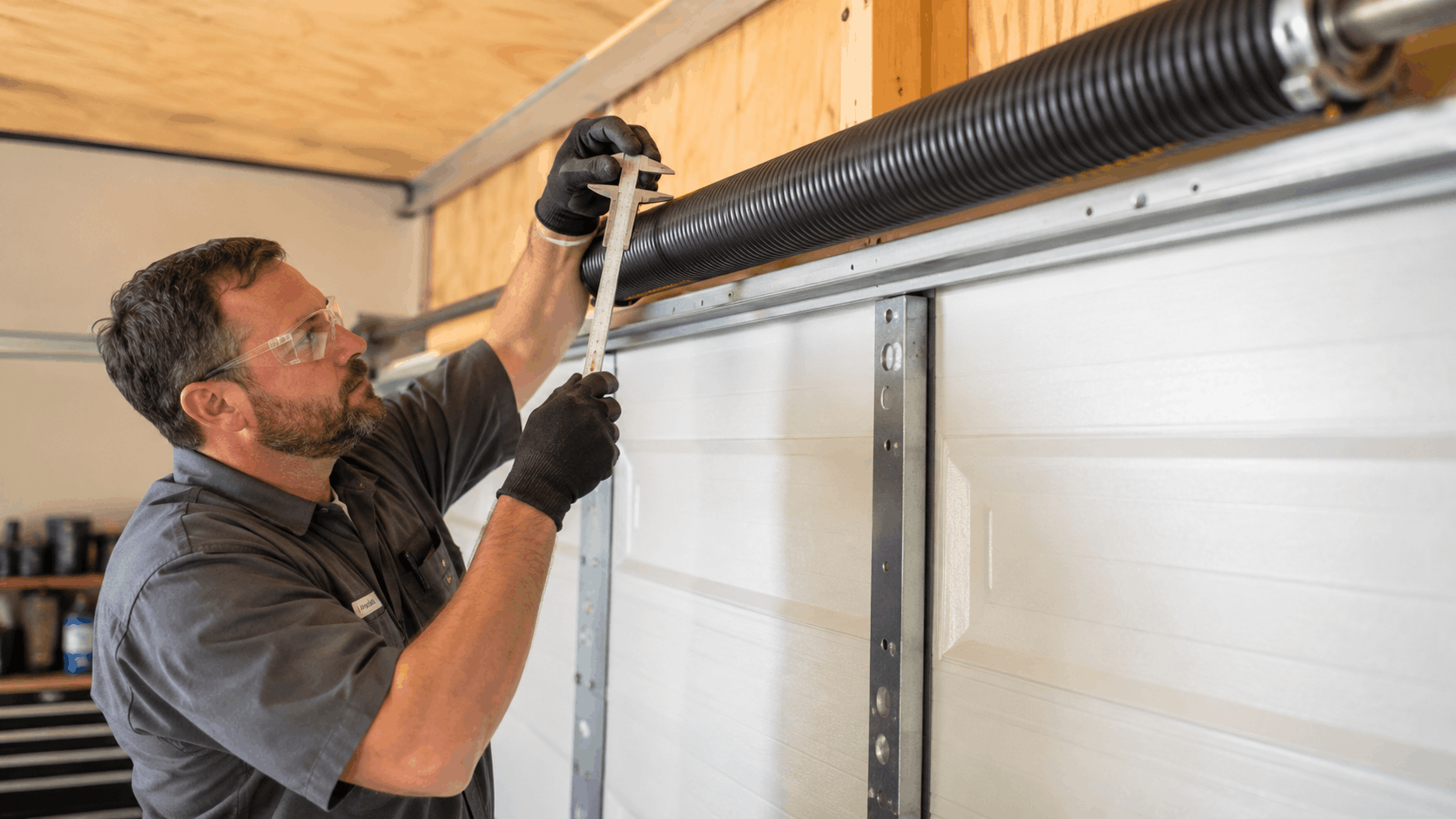
Our spring selection process is straightforward but precise. Every spring and cable repair call starts with hands-on measurements. We do not guess, and we do not rely on whatever label might be stamped on the old spring. Labels fade, get painted over, or were wrong in the first place.
Our service area covers all of Irvine and surrounding OC cities - from Costa Mesa to Laguna Hills, and from Santa Ana down to Rancho Santa Margarita. Wherever we go, the professional spring replacement process is the same: measure everything, run the math, and install the correct spring the first time.
Step-by-Step: Weighing the Door and Measuring the System
Here is exactly what our technicians do on a spring replacement call. First, they disconnect the opener from the door by pulling the emergency release cord. Then they manually lift the door to about waist height and check its balance. A door that crashes down is unbalanced and needs precise door weighing.
Using a calibrated scale at mid-travel, we get the actual weight of the door - not the number printed in a manual, but the real weight including any hardware, reinforcement struts, or weatherstripping that has been added over the years. Next, we measure the drum diameter, the torsion shaft measurement length and diameter, the track radius, and the available space for the spring body on the shaft.
In common Irvine home setups - particularly the tract homes built in the 2000s and 2010s across Woodbury, Cypress Village, and Orchard Hills - we typically find standard 1-inch shafts with 4-inch drums and standard lift track. But we verify every time because assumptions lead to mistakes.
Matching Wire Size to Your Door's Exact Specs
Once we have the measurements, we plug them into the torsion spring formula and determine the correct wire size, coil count, and spring length. Spring matching is about finding the combination that delivers the right torque with the right number of turns and the desired cycle life - all within the available space on the torsion shaft.
We stock a common sizes on our trucks at all times so we can provide same-day spring replacement across neighborhoods from El Camino Real to Jeffrey Road and from the 5 freeway to the 133 toll road. For unusual sizes - like springs for oversized custom doors in Shady Canyon or older single-car doors near the El Camino Real corridor - we order them from a supplier.
The goal of our Irvine garage door service is to match the spring to your door so well that you forget it's even there - until 10 or 15 years later when it's time for the next one.
Need Help in Irvine?
Urgent Garage Doors serves Irvine and all of Orange County.
Cost of Getting Spring Wire Size Right vs. Getting It Wrong
Homeowners are naturally cost-conscious, and we respect that. But torsion spring replacement cost is one of those areas where spending a little more upfront on the right spring saves a lot of money over time. The difference between a correctly sized spring and a cheap, incorrect one can be hundreds of dollars in cascading repairs.
Here is a realistic look at what a proper spring replacement costs in Orange County versus what a bad spring job can cost when things go wrong.
| Scenario | Typical Cost Range | What's Included |
|---|---|---|
| Single spring replacement (standard cycle) | $180 - $280 | Spring, labor, balancing, safety check |
| Double spring replacement (standard cycle) | $250 - $400 | Both springs, labor, balancing, hardware inspection |
| High-cycle spring upgrade (25,000+ cycles) | $300 - $500 | Premium springs, labor, balancing |
| Wrong spring + opener repair | $450 - $800 | Second spring replacement, opener gear/board repair |
| Wrong spring + cable + opener damage | $600 - $1,200+ | Spring, cables, opener, brackets, multiple service calls |
What a Proper Spring Replacement Costs in Orange County
A properly done spring replacement price in the OC area ranges from about $180 for a single standard-cycle spring to around $500 for a pair of high-cycle springs. The cost depends on the spring size, the wire diameter, the cycle life rating, and whether any additional hardware - like drums, cables, or bearing plates - needs replacing at the same time.
At Urgent Garage Doors, our OC garage door cost includes the spring itself, professional installation, door balancing, lubrication of all moving parts, and a safety inspection of the entire system. We don't charge separately for diagnostics on spring replacement calls. Transparency in pricing is something we take seriously - you know the cost before we start the work.
The Hidden Costs of a Cheap or Incorrect Spring
Cheap spring problems are expensive. The hidden repair costs from an incorrect or low-quality spring add up fast. Here is a typical scenario we see play out: a homeowner saves $50 by hiring an unlicensed handyman who installs the wrong wire size. Within a year, the spring fails. The unbalanced door during those months has also worn out the opener gears, stretched one cable, and bent a bottom bracket.
Now instead of one spring replacement at $250, the homeowner is looking at a spring replacement ($250), a cable replacement ($100-$150), opener gear repair ($200-$350), and a bottom bracket replacement ($75-$125). The total spring failure damage bill is $625 to $875 - plus the inconvenience of being stuck with a broken garage door multiple times.
Getting the wire size right the first time with quality steel and correct calculations avoids this entire chain of problems. It is the least expensive option in the long run, every single time.
Final Thoughts
Torsion spring wire size is not an obscure technical detail - it is the single most influential factor in whether your garage door spring works safely and lasts as long as it should. The math behind it is precise, and the consequences of getting it wrong range from a shortened spring life to a destroyed opener to a serious safety hazard.
For homeowners across Irvine and Orange County, the best path forward is simple: have a trained technician measure your door, run the calculations, and install the correct spring. At Urgent Garage Doors, that is exactly what we do on every call. If your spring has broken, is showing signs of wear, or was replaced by someone who may not have done the math, contact our team to schedule an inspection. We serve all of Irvine and the surrounding Orange County communities with same-day emergency service and honest, math-backed spring selection.
Frequently Asked Questions
- How do I know what wire size my garage door torsion spring needs?
- The correct wire size depends on your door's actual weight, height, track configuration, and drum size. There is no universal answer based on door size alone because construction materials and insulation vary widely. The most reliable way to determine spring wire size is to have a trained technician weigh the door, measure the hardware, and run the torsion spring formula. This produces an exact match rather than an educated guess from a chart online.
- Can I measure my old spring's wire size with a ruler?
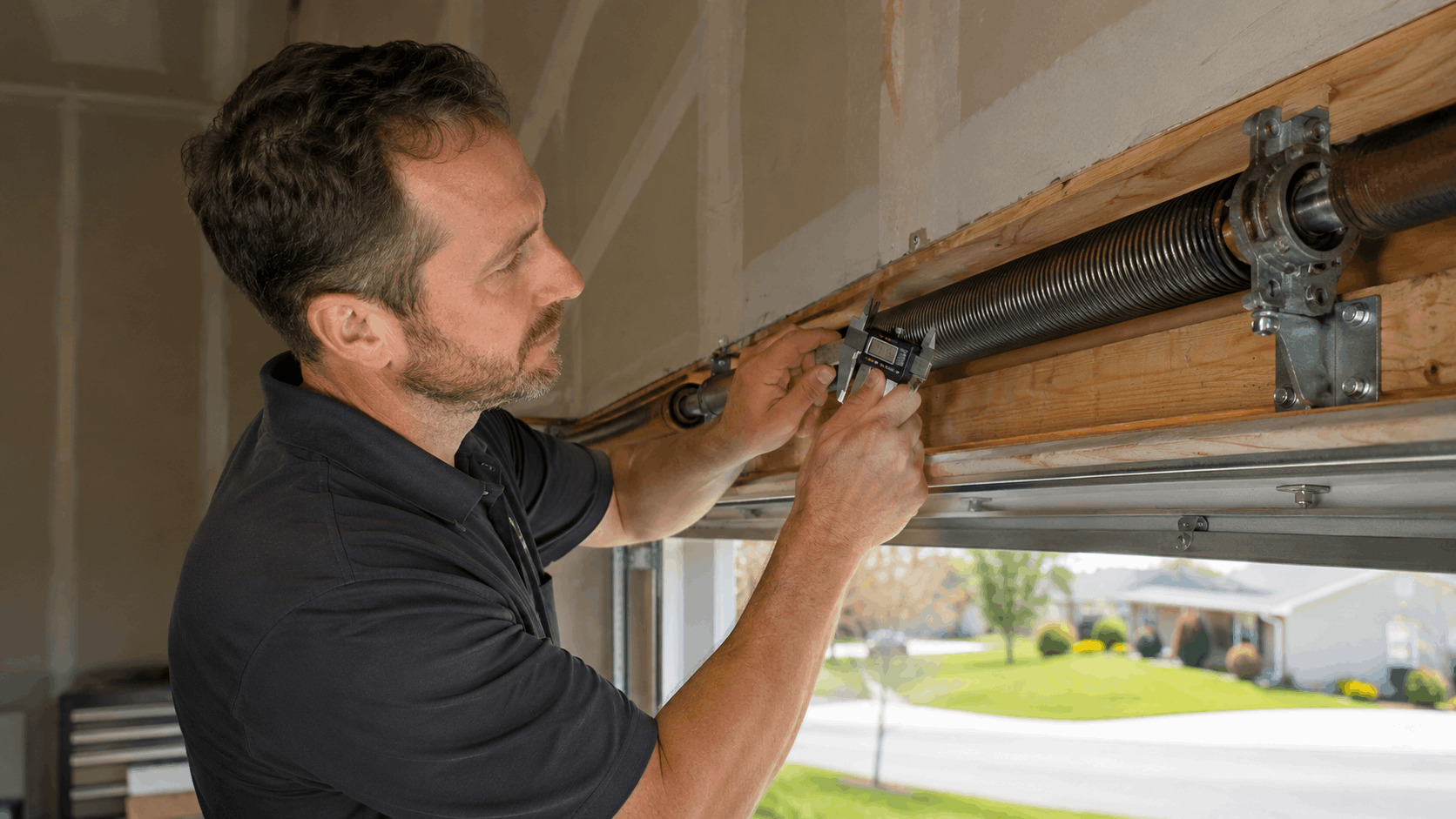
- The standard coil measurement method involves measuring across 10 or 20 tightly packed coils and dividing by the number of coils to get the wire diameter. A tape measure or ruler with 1/16-inch markings works for a rough estimate. However, worn or rusted springs may measure smaller than their original size because surface material has been lost. A digital caliper gives a more accurate reading, though even that may be misleading on a heavily worn spring.
- What is a common torsion spring wire size for a two-car garage door?
- For standard 16x7 two-car garage doors in Orange County, a common spring wire sizes fall in the .225 to .250 range. Non-insulated steel doors on the lighter end typically use .225 or .234 wire, while heavier insulated models need .243 or .250 wire. The specific size depends on the door's construction material, insulation type, and total weight. Even doors that look identical on the outside can require different springs based on their build.
- Does a thicker wire size mean a stronger spring?
- A thicker spring wire does produce more torque per turn, but that does not automatically make it the right choice. The spring also needs the correct number of coils and body length to match the door's weight and travel distance. Installing a spring with wire that is too thick without adjusting other dimensions will make the door too light on the opener side, potentially causing it to fly open or putting stress on the hardware. Thicker wire must be balanced with proper spring design.
- How long does a correctly sized torsion spring last in Orange County?
- A standard 10,000-cycle spring typically lasts 7 to 12 years for an average household that opens the door about 4 times per day. A high-cycle spring rated for 25,000 cycles can last 15 years or more under the same usage. In Orange County, local factors like coastal humidity and inland heat can reduce spring lifespan OC by 10 to 20 percent compared to climate-controlled environments. Regular lubrication and maintenance help how long springs last in real-world conditions.
- Why did my new spring break after only a year?
- A spring that broke early - within one to two years - is almost always the result of one of four problems: wrong wire size for the door weight, poor quality steel from a discount manufacturer, incorrect winding (too many or too few turns), or a door that is out of balance due to worn cables, rollers, or track issues. Premature spring failure should be investigated by a qualified technician, as the same problem will recur with a simple replacement if the root cause is not addressed.
- Should I replace both springs even if only one broke?
- On a two-spring system, we strongly recommend replacing both springs at the same time. If one spring reached its cycle limit and broke, the other one is statistically very close to failing as well - they were installed together and have cycled the same number of times. Replacing both springs during one service call saves the cost of a second trip and avoids being stuck with a broken door again in a few weeks or months. It is the more economical choice.
- Can I upgrade to a higher cycle life spring on my existing door?
- In most cases, yes. A high-cycle spring upgrade uses a larger wire size, which means the spring body is longer. The torsion shaft needs enough room to accommodate the longer spring. Most standard residential setups have sufficient space. Our technicians check shaft length during the measurement process and confirm whether the upgrade fits. For households that use the garage door frequently, a longer lasting spring upgrade is one of the best value improvements available. According to the Door and Access Systems Manufacturers Association (DASMA) , matching cycle life to expected usage is a recommended best practice.
- Does Urgent Garage Doors carry springs for older homes in Irvine?
- Yes. Our trucks carry a wide range of Urgent Garage Doors springs, including sizes for older doors commonly found in neighborhoods like Walnut Village, University Park, and along the El Camino Real corridor. Many of these older homes have single-car doors or early two-car models with non-standard shaft lengths. We stock the older home garage door spring sizes and can handle most replacements the same day. For uncommon configurations, we order the correct springs from a supplier.
- Is it safe to adjust the tension on my torsion spring myself?
- No. DIY spring tension adjustment is one of the most dangerous home repair tasks. A torsion spring under full tension stores hundreds of foot-pounds of energy. If a winding bar slips or the set screws fail, the cone can spin violently and cause severe injury. Even a quarter-turn adjustment requires proper tools and technique. We recommend calling a trained technician for any spring adjustment safety concern. The risk of injury far outweighs the cost of a professional service call, and our team can typically respond the same day across Irvine and surrounding cities. The National Institute for Occupational Safety and Health (NIOSH) classifies spring-loaded mechanisms among high-risk injury sources in residential settings.
Licensed garage door repair professionals serving Irvine and Orange County.
Licensed in California · License #1055150
Why trust Urgent Garage Doors?
Founded in 2017, Urgent Garage Doors is a licensed and insured garage door services serving Irvine and Orange County. All content is reviewed by our licensed technicians.

Need Help in Irvine?
Urgent Garage Doors serves Irvine and all of Orange County.
Related Articles

Garage Door Shaking or Jerking in Irvine: Rollers vs Tracks vs Springs
Learn to diagnose garage door shaking in Irvine - whether rollers, tracks, or springs cause the problem. Professional repair guidance, costs, and safety tips from local professionals.
Best Garage Door Size and Fit Guide for Orange County Homes
Garage door size and fit guide for Orange County. Single vs double, standard sizes, custom widths. Old Town Tustin narrow lots to Northwood Pointe 3-car.

Why Anaheim Hills Homes Need Heavy-Duty Garage Door Springs
Discover why Anaheim Hills homes require heavy-duty garage door springs due to extreme temperatures, heavy insulated doors, and unique climate challenges that cause standard springs to fail prematurely.