Maintenance
How Dana Point Salt Air Destroys Garage Door Hardware and How to Prevent It
Key Takeaways
- Homes within one mile of Dana Point Harbor, Doheny Beach, and bluff-top streets like Blue Lantern face the most aggressive salt air corrosion, with untreated hardware failing in as little as 2-4 years.
- Torsion springs are the fastest-corroding garage door component because tightly wound coils trap salt and moisture against bare steel, creating dangerous weak spots that can cause sudden, violent failures.
- Standard WD-40 is not appropriate for coastal garage door hardware - use white lithium grease for metal-on-metal contacts and silicone spray for rollers and plastic components.
- A monthly freshwater rinse of all visible hardware removes salt deposits before corrosion begins and is the single most effective low-cost step for Dana Point homeowners.
- Homes within half a mile of the coast should schedule professional maintenance twice per year; the cost of two routine visits is consistently less than a single emergency spring or cable replacement.
- Upgrading to galvanized, powder-coated, or 316 stainless steel hardware costs $50-$150 more per component but typically pays for itself through extended service life in Dana Point's marine climate.
- Spring and cable adjustment or replacement must always be handled by a trained professional - corroded springs are especially unpredictable and can fail violently without warning.
- Many Dana Point coastal communities including Niguel Shores and Monarch Beach require HOA architectural review before full door replacement, so planning ahead before hardware failure is always worth the effort.
In This Article
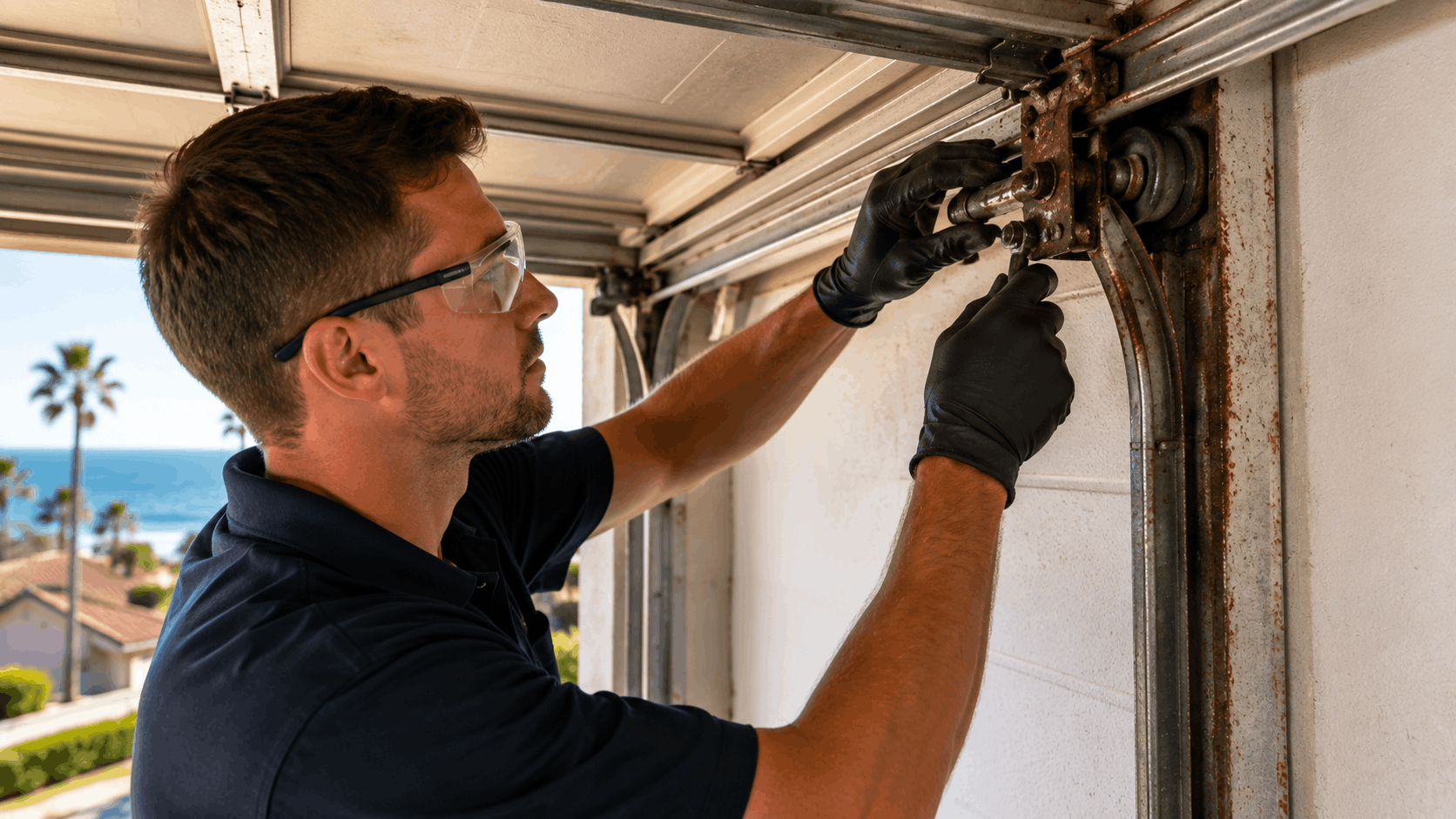
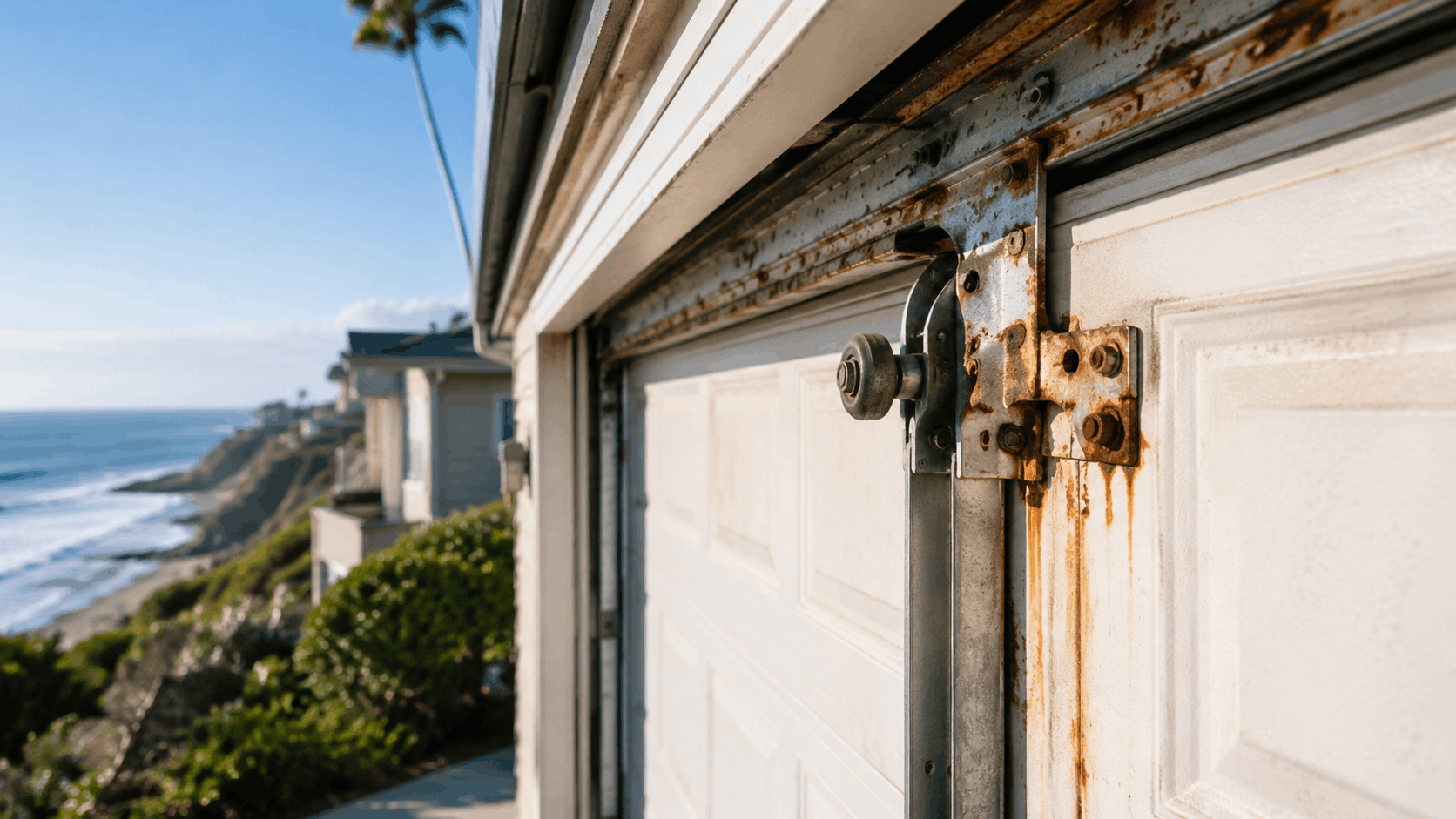
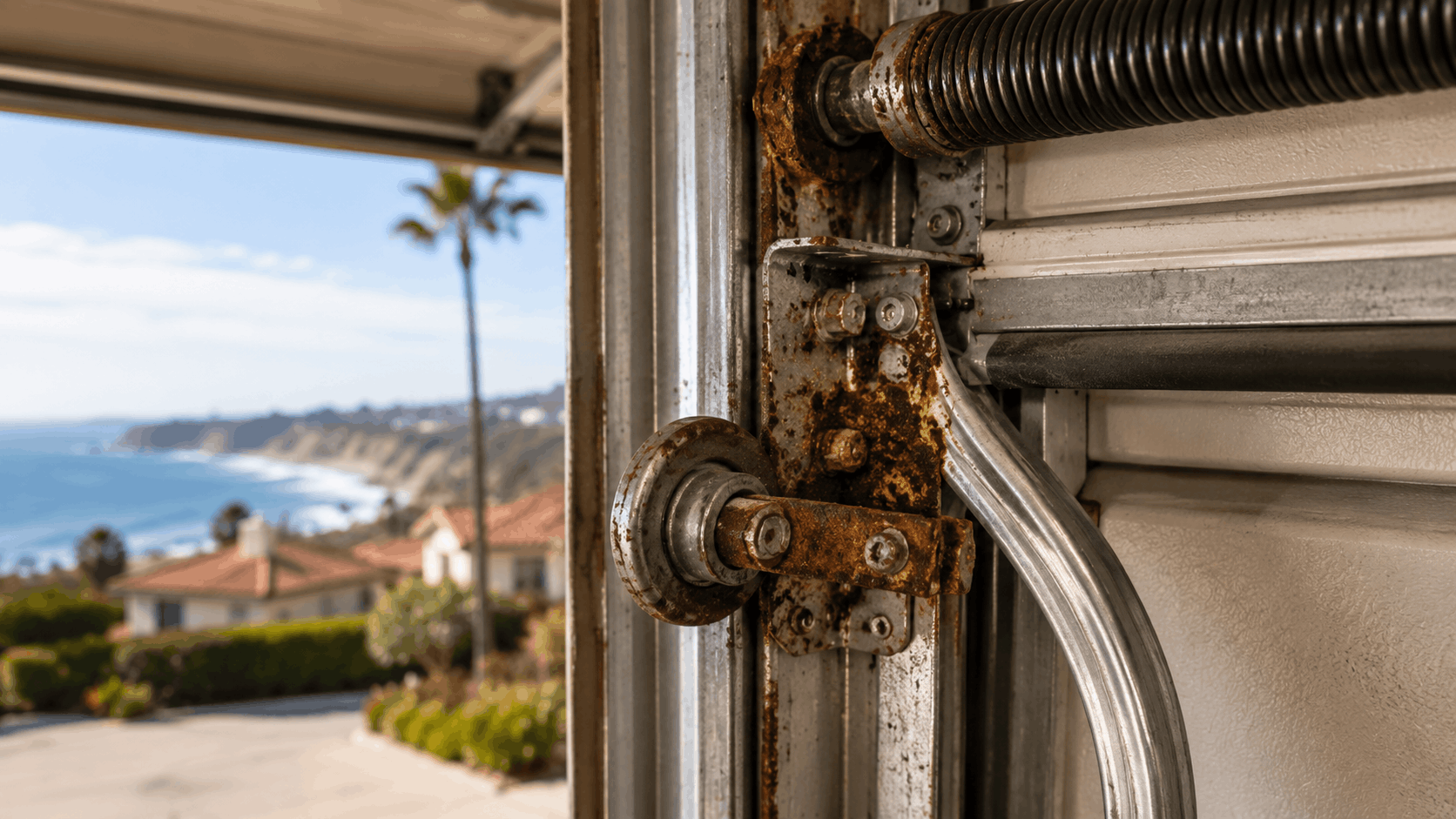
A homeowner on Blue Lantern Street in Dana Point noticed something strange last February - orange rust streaks running down the inside panel of her garage door. She had only moved in 18 months earlier, and the door looked fine at closing escrow. When she called Urgent Garage Doors, the technician found that both torsion springs above the door were already deeply pitted with rust, and one coil gap had begun to widen - a clear sign the spring was on its way to snapping. The culprit was not age. It was the salt air rolling in off Dana Point Harbor, just a few blocks away.
This pattern is one the Urgent Garage Doors team sees regularly across South Orange County. Homes along Pacific Coast Highway, in Monarch Beach, Lantern Village, and the Strand at Headlands face some of the most aggressive salt air conditions in the region. The hardware on a garage door - springs, cables, rollers, hinges, and track fasteners - was never designed to survive that environment without deliberate protection. When it does not get that protection, things fail fast and sometimes dangerously.
Why Dana Point's Coastal Air Is Especially Hard on Garage Door Hardware
Dana Point sits directly on the Pacific coast, and that geography matters more than most homeowners realize. The city is not just near the ocean - it is built on bluffs above it, with neighborhoods that face salt-laden air every single day. Unlike cities further inland, Dana Point has almost no natural buffer between the open ocean and residential streets.
Salt air corrosion happens when sodium chloride particles land on metal surfaces and begin drawing moisture to those spots. Salt is hygroscopic, meaning it pulls water from the surrounding air even on days that feel dry. That thin film of salt-saturated moisture is enough to start an electrochemical corrosion reaction on bare steel. The closer a home sits to the water, the more particles land on its hardware and the faster the reaction runs.
The table below compares corrosion exposure levels across different Dana Point zones, based on typical proximity to the ocean and observed hardware damage patterns from service calls in those areas.
| Zone | Distance from Coast | Corrosion Risk Level | Expected Untreated Hardware Life |
|---|---|---|---|
| Strand at Headlands, Ritz Cove | Under 0.2 miles | Extreme | 2-4 years |
| Lantern Village (Blue Lantern, Park Lantern) | 0.2 - 0.5 miles | Very High | 3-5 years |
| Monarch Beach, Niguel Shores | 0.5 - 1 mile | High | 4-6 years |
| Near Pacific Island Drive, Dana Hills area | 1.5 - 2.5 miles | Moderate | 6-9 years |
| Irvine (inland reference point) | 8+ miles | Low | 10-14 years |
How Salt Particles Travel From the Ocean to Your Garage
The marine layer that settles over Dana Point most mornings is not just fog - it is a suspension of microscopic salt particles carried inland from the surface of Dana Point Harbor and Doheny State Beach. Onshore breezes push this layer directly into residential streets, and it deposits salt on every exposed surface including garage door springs, cable drums, and track hardware.
Homes on bluff-top streets like Blue Lantern and Park Lantern face direct salt spray exposure because they sit above the ocean with very little obstruction. Properties in Monarch Beach or The Strand at Headlands face an even more concentrated environment because they are at sea level, surrounded on multiple sides by ocean air. The salt does not need a storm to reach these homes - a light onshore breeze on a Tuesday afternoon is enough.
This is why two identical garage doors installed on the same day can look completely different five years later, depending on whether the home is on Street of the Golden Lantern near the harbor or a few miles east toward Dana Hills High School. The distance truly makes the difference in how fast the damage runs.
The Role of Dana Point's Marine Climate in Speeding Up Rust
What makes Dana Point particularly hard on metal hardware is not just the salt - it is the combination of salt, ambient moisture, and mild temperatures that never allow surfaces to fully dry out. In a hot desert climate, metal surfaces bake dry between exposures. In Dana Point, the marine climate keeps humidity elevated year-round, which means the corrosion reaction never fully pauses.
The Urgent Garage Doors team operates out of Irvine, where the team also services many homes. Hardware in Irvine typically lasts 10 years or longer without serious corrosion issues. The same hardware installed on a home near the Dana Point coastline often shows deep rust pitting within 3-4 years if it receives no protective maintenance. That is a dramatic difference in service life driven almost entirely by climate.
The mild year-round temperatures in Dana Point also mean there is no cold winter to slow biological processes or freeze moisture out of coil gaps. Rust runs continuously, season after season, at a steady pace.
Seasonal Patterns That Make Winter and Spring the Worst Months
The marine layer in Dana Point thickens significantly between November and April, and rainfall during this period drives salt particles deep into coil gaps, cable strands, and hinge joints where lubrication cannot reach. Each rain event essentially carries dissolved salt directly onto metal surfaces that were already salt-coated from daily onshore breezes.
After a wet winter, the Urgent Garage Doors team typically sees a noticeable spike in broken spring calls from Dana Point homeowners in February and March. Springs that survived summer with surface rust often reach their breaking point after absorbing months of rain-driven salt exposure. The coils weaken unevenly because rust pitting creates thin spots that fail under the spring's own tension.
Homeowners who do a hardware inspection and lubrication in late October - before the rainy season begins - are consistently in better shape come March. Waiting until something breaks is always the more expensive path.
Get Your Free Quote
Tell us about your garage door and we'll get back to you fast.
The Garage Door Parts That Corrode First and Fastest
Not all garage door hardware corrodes at the same rate. Salt air attacks certain components much faster than others, based on the type of metal, the geometry of the part, and how much moisture the part traps in normal use. Knowing which parts fail first helps homeowners prioritize where to look and what to replace before it becomes a safety issue.
Below is a breakdown of the most vulnerable components, ranked roughly from fastest to slowest corrosion progression in a coastal Dana Point environment. The language here matches what homeowners actually say when they call - because that is exactly how most service calls start.
- Torsion and extension springs - First to fail; tightly wound coils trap salt and moisture at the metal-to-metal interfaces
- Lift cables - Develop invisible micro-fractures from salt corrosion before any visible fraying appears
- Steel rollers - Surface rust causes grinding and leaves orange staining on tracks
- Cable drums - Corrode where the cable wraps, causing uneven winding and cable skip
- Hinges - Galvanic corrosion seizes hinge pins, causing panels to bind and bend
- Track hardware and lag bolts - Rust causes fasteners to loosen, allowing track misalignment
- Bottom brackets - Often overlooked; rust here leads to cable anchor failure
- Torsion shaft and bearing plates - Corrode slower but damage here is expensive to correct
Torsion and Extension Springs: The First Thing Salt Air Destroys
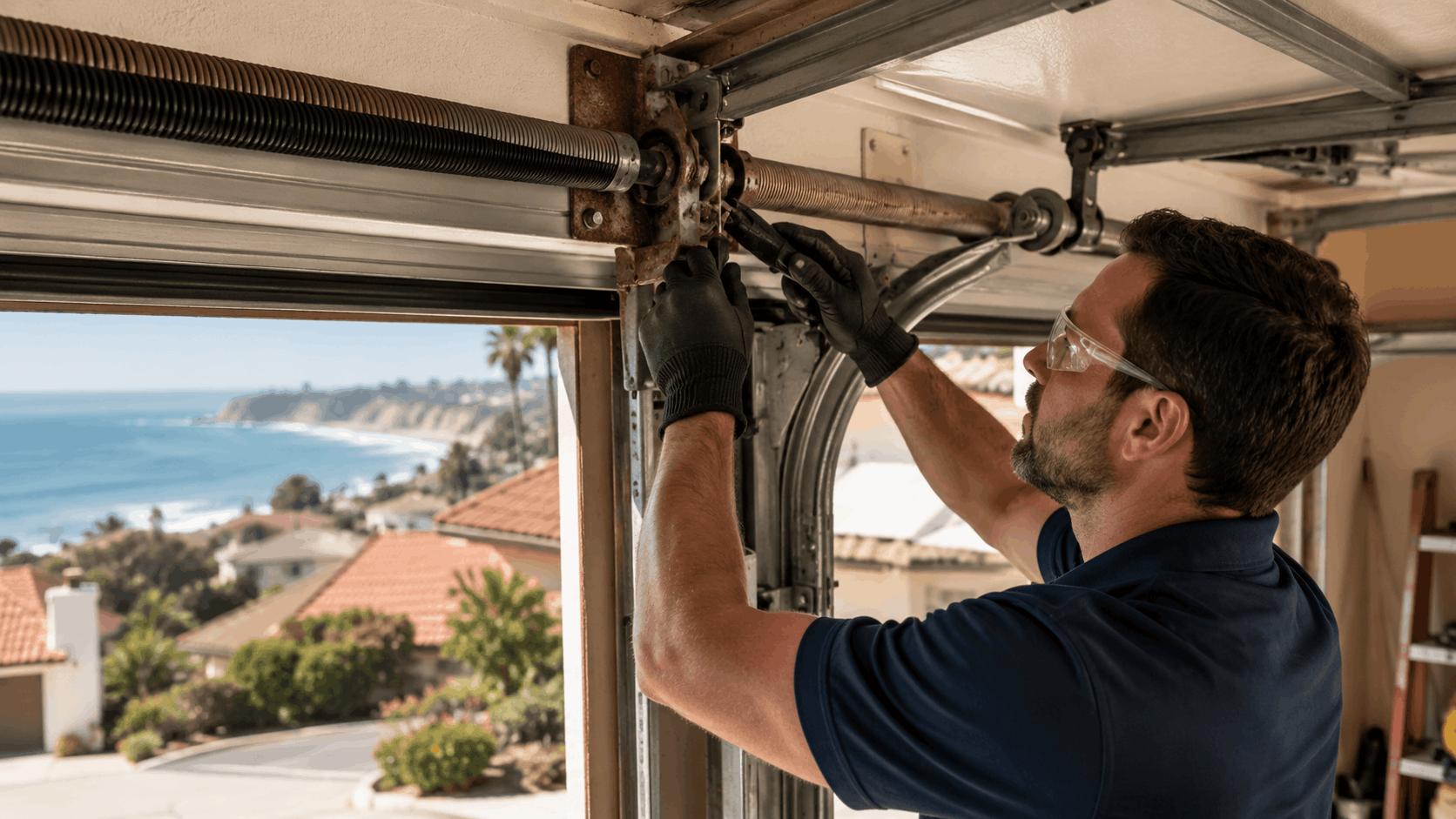
Steel torsion springs are almost always the fastest-corroding component on a coastal garage door. The reason is geometry - the tightly wound coils sit close together, and any moisture or salt that gets between them is trapped there. The coil gaps act like tiny reservoirs that hold salt-laden humidity against bare steel around the clock.
Homeowners near Lantern Village often notice orange rust flaking onto the garage floor or the top of the door panels. That orange dust is iron oxide breaking off the spring coils, and it is a direct sign that the spring is losing structural integrity. A corroded spring does not just wear out gradually - it develops weak spots that can cause a sudden, violent failure under full tension. That is genuinely dangerous, and it is why torsion spring replacement should never wait once corrosion is visible.
Extension springs, which run along the sides of the door on some older systems, corrode in a similar pattern. Salt attacks the exposed coils and the attachment hooks first. Homes along Cove Road near Baby Beach with older extension spring systems should be inspected at least twice a year.
Cables, Drums, and Rollers: The Hidden Corrosion Most Homeowners Miss
Steel lift cables are braided from multiple fine wire strands, and salt corrosion attacks each strand individually. The damage happens inside the cable before it shows on the outside. By the time a cable visibly frays, the internal strands have often been compromised for months. Homeowners in gated communities like Ritz Cove or Niguel Shores often discover cable damage only during an annual professional visit - because there was no external warning sign before the inspection.
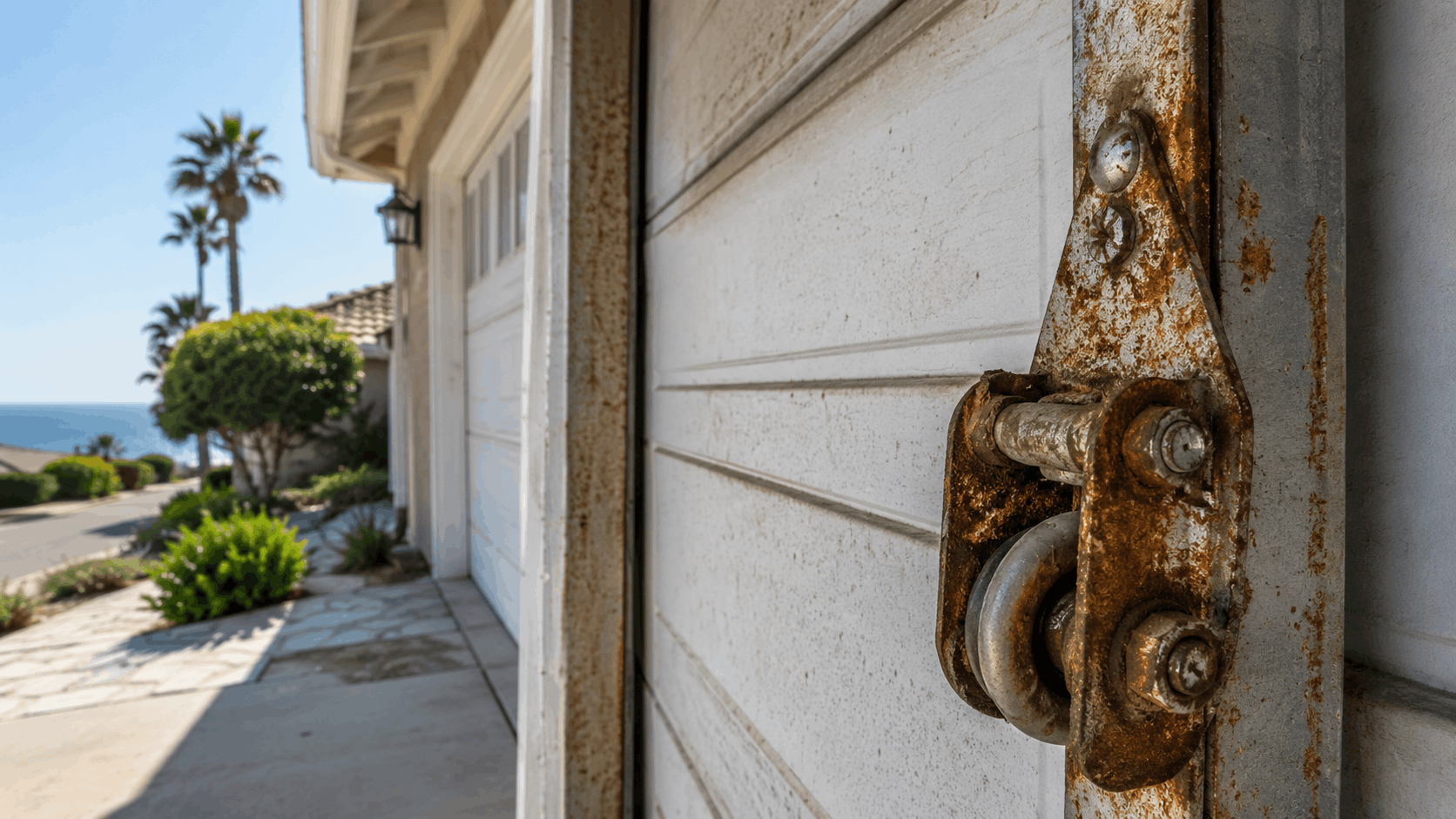
Rollers tell a more visible story. Steel rollers develop orange surface rust that transfers onto the tracks as the door moves, leaving streaks that confirm metal-to-metal abrasion is happening. Nylon or plastic rollers actually hold up better in coastal environments because they do not rust themselves - though their steel axles still corrode. Upgrading to nylon rollers is one of the simpler improvements for coastal homes, and the quiet roller hardware upgrade also reduces noise significantly.
Cable drums corrode where the cable wraps around the drum groove. Rust in that groove causes the cable to skip or wrap unevenly, which puts asymmetric stress on the door and can cause it to come off track.
Hinges, Tracks, and Hardware Fasteners: Slow Damage With Big Consequences
Hinges corrode more slowly than springs, but the consequences of seized hinges are significant. When hinge pins rust and seize, the door panels cannot flex properly as the door moves through its arc. The panel edges start binding, which bends the steel and eventually cracks the hinge mounting holes. This is a common complaint from homeowners in older homes along Cove Road near Baby Beach, where original hardware may never have been replaced.
Galvanic corrosion is especially common in hinge and track hardware because these assemblies often mix dissimilar metals - steel bolts in aluminum tracks, or zinc-plated screws against bare steel brackets. When two different metals contact each other in a salt-humid environment, the less noble metal corrodes faster than it would alone. The salt water acts as an electrolyte, completing the circuit for this electrochemical reaction.
Track lag bolts and anchor screws also suffer in coastal conditions. Rust expands the bolt shank, which loosens the fit in the wall anchor. Once a track section begins to shift, the door can go off-track - a situation that requires off-track garage door repair and is much more disruptive than a simple hardware swap would have been.
Need Help in Irvine?
Urgent Garage Doors serves Irvine and all of Orange County.
Warning Signs Your Garage Door Hardware Is Losing the Battle With Salt Air
Most homeowners do not inspect their garage door hardware regularly - they just press the button and hope it works. In Dana Point's environment, that approach leads to expensive surprises. The Urgent Garage Doors team arrives at many service calls in the area where the homeowner says the door just stopped working that morning, but the hardware shows months of obvious corrosion warning signs that were there to see.
These are the signs to watch for. Catching them early keeps a small problem from becoming an emergency call on a Saturday morning when the car is trapped inside.
Visual Red Flags: Rust Streaks, Orange Dust, and Flaking Metal
Orange rust streaking down the inside of a garage door panel is one of the earliest signs that something is corroding above. The spring sits directly above the door, and as rust flakes off the coils it lands on the panel surface and gets pushed down by door movement. By the time those streaks are visible, the spring is already compromised enough to warrant a professional inspection.
Orange dust on the garage floor beneath the spring is another clear signal. Light surface rust on a spring produces fine dust; heavier corrosion produces visible chips and flakes. Homeowners can run a dry cloth along the spring coils - if it comes back orange, that spring needs attention. If it comes back with chunks of metal, that spring needs immediate replacement before it snaps.
Visible brown staining on cables, white oxidation on any aluminum components, and reddish-brown pitting on hinge barrels are all signs that salt air corrosion is actively working through the hardware. None of these are cosmetic issues - they indicate structural degradation.
Performance Warning Signs: Grinding, Jerking, and Slow Movement
When a homeowner calls and says the door is grinding, the most common cause in a coastal area is steel rollers with surface rust dragging against the track walls. The rust increases friction dramatically and creates a harsh metal-on-metal sound that gets louder as the corrosion progresses. The grinding means the rollers are wearing the track at the same time.
Jerky movement - where the door hesitates, lurches, or moves unevenly as it opens - usually points to seized or stiff hinges. Corroded hinge pins resist rotation, so instead of smoothly flexing as each section passes through the bend, the panels bind momentarily and then release. That binding puts stress on the hinge mounting points and the cable attachment hardware.
A door that moves slower than usual, especially on the way up, may have a cable that is partially frayed or a drum that is not winding evenly due to rust in the cable groove. These performance symptoms are the door communicating that metal-on-metal friction from rust is wearing parts faster than normal use would. Ignoring them typically means a more expensive repair within weeks, not months. For immediate help with these symptoms, same-day garage door repair is available throughout the Dana Point area.
How to Protect Garage Door Hardware From Dana Point Salt Air
A neighbor on Street of the Violet Lantern recently asked what they should actually be doing to protect their hardware. The honest answer is: not much that is complicated, but it has to be done consistently. Salt air damage is cumulative. A monthly 20-minute maintenance routine beats an annual deep clean every time in this environment.
The table below lays out the recommended maintenance tasks, frequency, and whether they are DIY-friendly or require a professional.
| Task | Frequency (Coastal Zone) | DIY or Professional | Notes |
|---|---|---|---|
| Freshwater rinse of all hardware | Monthly (every 2 weeks Nov-Apr) | DIY | Low pressure; avoid soaking the opener |
| Lubricate hinges and rollers | Every 3 months | DIY | White lithium grease or silicone spray |
| Lubricate torsion spring shaft | Every 3 months | DIY (surface only) | Do not attempt to adjust spring tension |
| Inspect cable condition | Every 6 months | DIY visual / Professional for close inspection | Look for fraying, discoloration, uneven winding |
| Full hardware inspection and tension check | Twice yearly | Professional | Required for homes within 0.5 miles of coast |
| Weatherstripping replacement | Every 2-3 years or when cracked | DIY or Professional | Reduces salt air circulation inside garage |
The Right Lubricants for Coastal Hardware (And What Not to Use)
Standard WD-40 is not the right product for coastal garage door hardware. It works as a short-term water displacer, but it does not leave a lasting lubricating film. Worse, its light oil base attracts airborne salt and dust particles, which accelerate abrasion on moving parts. Many homeowners spray it thinking they are protecting the hardware, but they are actually speeding up wear.
The right products depend on the component. White lithium grease works well for metal-on-metal contact points - hinges, torsion spring shafts, and cable drums. It stays put under friction and does not wash away easily. Silicone-based spray is better for rollers, especially nylon rollers, because it does not attract grit. Some homeowners near Dana Point Harbor have had good results with marine-grade corrosion inhibitor sprays designed for boat hardware - these products are formulated specifically for salt environments and provide a more durable barrier than standard lubricants.
Apply lubricants after the freshwater rinse and drying period, not before. Lubricating over salt deposits seals them against the metal rather than removing them.
Cleaning and Rinsing Schedules That Actually Work in a Marine Environment
A freshwater rinse sounds simple, but most homeowners near the coast never do it. The goal is to dissolve and flush away the sodium chloride deposits that accumulate on metal surfaces between maintenance visits. Salt is water-soluble, so plain tap water does the job - no special cleaners needed.
For homes closest to the water - near Doheny State Beach, the harbor, or bluff streets in Lantern Bay - a monthly rinse during summer and a rinse every two weeks from November through April is the right cadence. After heavy fog events or high surf periods, a rinse within a day or two removes the concentrated salt deposits before they begin their corrosion work. Many homeowners in Monarch Beach who added a monthly rinse to their routine report hardware lasting noticeably longer before showing serious rust.
Use a garden hose at normal pressure. Avoid pressure washing directly at hinge joints or cable anchor points, as high pressure can force water into sealed bearing areas. After rinsing, let hardware air-dry before applying lubricant.
Upgrading to Corrosion-Resistant Hardware: What the Options Are
For homes within a half-mile of the Dana Point coastline, standard hardware with good maintenance is playing defense against a relentless opponent. At some point, upgrading to hardware built to resist corrosion makes more financial sense than repeated replacements. There are several options worth knowing about.
Galvanized springs and hardware have a zinc coating that provides a sacrificial barrier - the zinc corrodes before the steel underneath does. This buys meaningful additional time in coastal conditions. Stainless steel hardware, particularly 304 or 316 grade, offers substantially better corrosion resistance. Grade 316 includes molybdenum, which specifically improves salt water resistance and is the better choice for homes directly on the bluff or in waterfront communities. The upfront cost difference over standard hardware is typically $50 to $150 per component, but the extended service life in Dana Point's environment recouped that difference reliably.
Powder-coated hardware provides another layer of protection by encasing the metal in a durable polymer finish. Urgent Garage Doors stocks and installs corrosion-resistant hardware specifically for South Orange County coastal clients. The maintenance upgrades service covers hardware swaps, lubrication, and coastal-specific recommendations in one visit.
Professional Maintenance Plans vs. Waiting for Something to Break
The real cost comparison here is not complicated, but it is worth putting in plain numbers because many homeowners assume maintenance is an unnecessary expense. In Dana Point's environment, the math strongly favors prevention over reaction. A scheduled maintenance visit catches problems at the $80-$150 service stage before they become $250-$400 emergency repair situations.
The other cost that rarely gets calculated is the inconvenience cost - a car trapped in the garage on a weekday morning, a broken spring discovered at 7 AM when the kids need to be at school. Emergency service visits cost more than scheduled ones, and weekend rates add another layer to that expense.
What a Professional Coastal Inspection Actually Covers
A professional maintenance visit on a coastal Dana Point property covers more than a visual check from the floor. The Urgent Garage Doors team measures spring tension to check whether the springs are still within safe operating range, which requires a winding bar and torque awareness that is not safe to replicate as a DIY task. Spring coil gaps get inspected up close for rust pitting - surface discoloration looks different from structural pitting, and telling the difference requires hands-on assessment.
Cable condition gets checked along the full length, including where the cable wraps around the drum and where it attaches to the bottom bracket - the two points that corrode fastest and are hardest to see from ground level. Roller condition, hinge movement, track alignment, and hardware fastener tightness all get checked and corrected as needed. The visit ends with a full lubrication of all moving parts using products appropriate for a coastal environment.
The preventive maintenance plan from Urgent Garage Doors is designed for exactly this type of regular coastal service, and it covers the inspection checklist above plus priority scheduling for service calls.
Real Cost Comparison: Maintenance Versus Emergency Spring or Cable Replacement
A routine maintenance visit in the South Orange County area typically runs $80 to $150, depending on what the inspection finds and what lubrication or minor adjustments are needed. That covers a full inspection, hardware lubrication, and a written assessment of what is coming up in the near future.
Compare that to the cost of a broken torsion spring replacement, which ranges from $200 to $400 depending on spring size and whether it is a single or double spring system. An emergency garage door cable repair runs $150 to $350 or more, again depending on cable type and the condition of the drum and bracket hardware. Weekend or after-hours emergency service adds $50 to $100 on top of those figures in most cases.
A snapped spring on a Saturday morning in Lantern Village means waiting for service, paying weekend rates, and potentially having a car stuck in the garage for several hours. Two maintenance visits per year at $130 each costs $260 annually - less than the floor price on a single emergency spring replacement.
How Often Coastal Homeowners Should Schedule Professional Service
Homes within half a mile of the Dana Point coastline - near Doheny State Beach, Dana Point Harbor, or on bluff-top streets like Blue Lantern and Lantern Bay Drive - should have professional service twice per year. The corrosion rate in these zones is fast enough that an annual visit leaves too large a window for a spring or cable to progress from early corrosion to failure without being caught.
Homes further inland in Dana Point, closer to areas like Pacific Island Drive or along the Dana Hills corridor, typically hold up well with annual professional visits supplemented by the homeowner's own monthly rinsing and lubrication routine. The corrosion is still faster than in an inland city like Irvine, but the slower rate allows a longer inspection interval.
The right schedule for a specific home depends on its exact position relative to the ocean, the age of its current hardware, and whether it has already been upgraded to corrosion-resistant components. A technician who visits the property once can give a specific recommendation based on what the hardware actually looks like.
Need Help in Irvine?
Urgent Garage Doors serves Irvine and all of Orange County.
Garage Door Materials and Designs That Hold Up Better Near the Coast
The door panel itself - not just the hardware - affects how the whole system performs in a salt air environment. Many homeowners in Dana Point focus entirely on the hardware and overlook the fact that the door material changes how much moisture and salt circulates inside the garage, which in turn affects how fast the hardware corrodes even when the door is closed.
A door with poor seals, cracked panels, or a material that absorbs moisture acts as a pump - drawing humid, salt-laden air into the garage every time it cycles open and closed. Choosing the right door material for a coastal environment is worth thinking through carefully, especially when replacing a door on a home near the harbor or on the bluff.
Steel, Aluminum, Wood, and Fiberglass Doors in a Salt Air Environment
Steel doors are the most common choice, but they require quality paint sealing to prevent surface rust on the door panels themselves. A chip in the paint becomes a rust spot within weeks in a coastal environment. An insulated steel garage door with a factory-applied polyester finish holds up better than a field-painted door, but it still needs periodic inspection for paint damage. Many homes along Strand Vista Drive show the full range of outcomes - well-maintained steel doors that look clean for years beside neglected ones that are streaked with rust.
Aluminum resists corrosion better than steel because it forms a stable oxide layer rather than flaking rust. It dents more easily, which is a practical consideration for active households. Fiberglass doors hold up well against salt air and do not rust, but ultraviolet exposure from the Southern California sun causes the gel coat to fade and crack over time. Wood is the most maintenance-intensive choice in a coastal environment - it absorbs moisture, swells, and warps if not sealed regularly. A carriage house garage door in a composite or fiberglass material gives the same traditional look as wood without the moisture-driven warping problems.
Weatherstripping and Bottom Seals: How They Protect Hardware Too
Intact weatherstripping around the door perimeter and a good quality bottom seal do more than keep rain out - they reduce the constant exchange of salt-laden marine air between the outside and the inside of the garage. Every time the door closes, a tight seal traps a relatively lower-salt air volume inside rather than letting fresh coastal air cycle in. Over time, that difference adds up to meaningfully slower hardware corrosion.
Worn or cracked bottom seals on homes near the harbor allow salt air to flow freely under the door even when it is fully closed. The spring and cable system sits right above the door opening, making it directly exposed to that constant air movement. Replacing a cracked bottom seal costs very little compared to the hardware it protects. The weatherseal and insulation retrofit service addresses both the seals and the insulation value of the door in one visit, which is a good combination for coastal homes.
Side weatherstripping should be checked whenever the door inspection is done. The salt air infiltration through gaps on the sides of the door is just as significant as what comes in through the bottom.
What Dana Point HOA Rules Mean for Garage Door Maintenance and Replacement
A large portion of homes in coastal Dana Point sit within HOA-governed communities, and some of the most salt-exposed addresses - Niguel Shores, Monarch Beach resort area, Ritz Cove - have detailed architectural standards that govern how a garage door can look and what materials are acceptable. Choosing replacement hardware or a new door without checking HOA requirements can mean a compliance notice on top of a repair bill.
The good news is that most HOA requirements in these communities are focused on aesthetics - color, finish, and panel style - rather than specific material prohibitions. That leaves room to choose corrosion-resistant hardware that also meets the visual standards. The key is knowing the process before ordering parts or scheduling installation.
Common HOA Restrictions in Dana Point Coastal Communities
- Architectural review requirements: Niguel Shores and Monarch Beach HOAs often require an architectural review application before any full door replacement, even for a damaged door. This process can take two to four weeks, so planning ahead matters.
- Color and finish standards: Most coastal community HOAs in Dana Point specify approved door colors, typically aligned with the community's overall exterior palette. Bright or non-standard colors are rarely approved.
- Panel style consistency: Some HOAs require that replacement doors match the panel style (raised, recessed, flush) of other homes in the immediate area or of the original door specification for that community.
- Hardware visibility rules: A few communities have guidelines about exposed hardware finishes - chrome hardware may not be permitted in communities that require a brushed or matte finish standard.
- Material restrictions: Wood doors may be required or prohibited depending on the community. Some HOAs in Ritz Cove actually require wood or wood-look materials for historical consistency.
- Emergency replacement provisions: Most HOAs have a process for emergency replacement approval when a door is completely non-functional, but even these situations typically require documentation and retroactive review.
How to Choose Replacement Hardware That Meets HOA Standards and Resists Salt
Powder-coated hardware in standard colors - typically black, dark bronze, or galvanized grey - matches the aesthetic requirements of most Dana Point coastal community HOAs while providing a corrosion-resistant polymer barrier over the base metal. The powder coating seals the steel away from direct salt contact and is far more durable than painted finishes in a coastal environment.
Urgent Garage Doors has worked with multiple Dana Point HOA communities and can help homeowners select hardware finishes that will pass architectural review without sacrificing the corrosion protection that coastal hardware needs. The team knows which finishes and materials are commonly accepted in Niguel Shores and Monarch Beach, which saves homeowners the time of submitting a request only to have it rejected for a finish mismatch.
When in doubt, getting written HOA pre-approval before ordering any hardware is always worth the delay. A two-week wait for approval is much better than installing hardware and receiving a violation notice requiring removal.
When to Call a Professional Instead of Handling It Yourself
There is a clear line between maintenance tasks that any homeowner can safely do and repairs that require a trained technician with the right tools. That line is not about skill or intelligence - it is about the physics of what can go wrong when high-tension components fail unexpectedly. Being honest about where that line sits protects homeowners from serious injury.
Most of the routine maintenance described in this article is genuinely DIY-friendly. The work that is not - spring adjustment and replacement - is not DIY-friendly for reasons that are worth explaining clearly.
Safe DIY Maintenance Tasks Any Homeowner Can Handle
These tasks are safe, inexpensive, and genuinely effective when done consistently. Any Dana Point homeowner willing to spend 20 minutes a month can do all of them without professional help.
- Visual inspection: Walk around the inside of the garage and look for rust streaks, orange dust, or discoloration on springs, cables, and hinges.
- Freshwater rinse: Use a garden hose to flush all visible hardware surfaces, removing salt deposits before they embed in the metal.
- Lubricate hinges and rollers: Apply white lithium grease to hinge barrels and the torsion shaft bearing plates. Apply silicone spray to roller stems.
- Check weatherstripping: Run a hand along the bottom seal and side strips. Replace any sections that are cracked, torn, or compressed flat.
- Door balance test: Disconnect the opener and lift the door manually to waist height. It should stay there without rising or falling. If it does not, spring tension needs professional adjustment.
- Test safety reversal: Place a block of wood under the door and close it. The door should reverse when it contacts the block. If it does not, the safety sensor alignment needs professional attention.
Spring and Cable Work: Why This Is Not a DIY Job
Torsion springs are under extreme mechanical tension - a standard residential spring stores enough energy that a sudden release can throw hardware across a garage or cause serious impact injuries. This is not a risk that can be mitigated with caution or patience. It requires specific winding bars, a thorough understanding of tension management, and physical positioning away from the spring's failure path.
Corroded springs are even less predictable than new springs. Rust creates uneven weak spots throughout the coil, and the point of failure is impossible to predict by looking at the spring. A spring that appears to be only moderately rusted can snap without warning during adjustment. The Urgent Garage Doors team, which serves Dana Point from its Irvine base, handles these repairs with proper winding bars, safety protocols, and replacement parts on the truck. Torsion spring replacement is consistently one of the most common calls from Dana Point homeowners, and it is never a task the team recommends attempting without professional training.
Cable work carries similar risks. Cables under tension can snap and cause laceration injuries, and improper cable winding on the drum creates immediate operational problems that often result in a door coming off track.
Signs the Damage Has Already Gone Too Far for Maintenance Alone
Lubrication and rinsing are maintenance tools, not restoration tools. There are specific conditions where maintenance will not reverse the damage and replacement is the only safe option. Knowing these thresholds saves homeowners from putting effort into hardware that is already past its safe service life.
Coil pitting that goes deeper than surface discoloration - where the rust has eaten visible craters into the coil surface - means the spring cross-section is reduced and the spring cannot be trusted under tension. Cable strands that are visibly separated or broken, even just one or two strands in the braid, mean the cable should be replaced immediately. Rollers with flat spots or wobble, or rollers that leave a visible rust track on the door rail, are beyond what lubrication can fix. Catching these conditions during an inspection in early fall, before the November-April rainy season begins, is the right time to act. The emergency garage door repair service is available when these failures happen unexpectedly, but the goal is always to find them before they do.
Need Help in Irvine?
Urgent Garage Doors serves Irvine and all of Orange County.
Final Thoughts
Dana Point is one of the most beautiful places to live in Southern California, and the ocean proximity that makes it special is also the force that quietly works against garage door hardware every day. Salt air corrosion is not a dramatic event - it is a slow, steady process that compounds over months and years until a spring snaps or a cable frays at the worst possible moment.
The homes along Blue Lantern, Park Lantern, and the bluff communities of Monarch Beach and The Strand at Headlands face the most aggressive conditions, but any property within a mile or two of the coast benefits from taking corrosion seriously. A monthly freshwater rinse, the right lubricants, and twice-yearly professional inspections will keep most garage door systems running safely for years longer than neglected hardware survives in this environment.
Urgent Garage Doors serves Dana Point and the greater South Orange County area regularly. The team understands the specific conditions along the Pacific Coast Highway corridor and in coastal communities from the harbor area down to Doheny Beach. If the hardware on a Dana Point garage door has not been inspected recently, now - before the next rainy season - is the right time to schedule a visit. Book a coastal maintenance inspection with Urgent Garage Doors and get a clear picture of where the hardware stands before something fails.
Frequently Asked Questions
How far from the Dana Point coast does salt air damage become a serious problem?
Homes within about a mile of the shoreline - from the harbor area through Lantern Village and down to Doheny Beach - face the most aggressive corrosion conditions. Properties in that zone should treat coastal corrosion protection as a regular priority. Homes further inland, past Pacific Coast Highway toward the Dana Hills area, still benefit from corrosion-resistant hardware and regular rinsing, but the damage progression is meaningfully slower and standard hardware with proper maintenance can hold up reasonably well.
How long do garage door springs typically last in a coastal environment like Dana Point?
Standard torsion springs rated for 10,000 cycles may fail in 5 to 7 years in a salt air environment without maintenance, compared to 8 to 12 years in an inland city like Irvine. Regular lubrication and monthly rinsing can extend that life by a year or two in most cases. Upgraded galvanized or powder-coated springs start with better corrosion resistance and consistently outlast standard springs in Dana Point's marine climate.
What is the best lubricant to use on garage door hardware near the ocean?
Silicone spray is the right choice for rollers and any plastic or nylon components, as it does not attract grit and resists moisture well. White lithium grease works best for metal-on-metal contact points including hinges, torsion spring shafts, and cable drums. Petroleum-based sprays like standard WD-40 should be avoided because they attract salt and dust over time. Marine-grade corrosion inhibitor sprays designed for boat hardware also perform well in this environment and provide a longer-lasting protective barrier.
Can I upgrade just the springs and cables, or do I need to replace the whole door system?
Hardware replacement is typically done independently of the door panels unless the panels themselves are physically damaged from rust or impact. Most Dana Point homeowners can keep their existing door and simply upgrade to galvanized or stainless steel springs, cables, and hinges. Urgent Garage Doors handles these component-specific upgrades regularly for clients throughout South Orange County, and a hardware-only upgrade costs far less than a full door replacement while delivering the corrosion protection the coastal environment demands.
How often should I rinse my garage door hardware if I live near Dana Point Harbor?
For homes closest to the harbor and Doheny Beach, a freshwater rinse of all visible hardware at least once a month during summer is the baseline recommendation. From November through April, when the marine layer is heaviest and rainfall is more frequent, rinsing every two weeks is more appropriate. After unusually high surf events or extended heavy fog periods, rinsing within a day or two removes concentrated salt deposits before they have time to start working into the metal surface.
Does homeowner's insurance cover garage door damage from salt air corrosion?
Standard homeowner's insurance policies in California typically classify corrosion and rust as gradual deterioration, which is generally excluded from coverage. Sudden mechanical failure - such as a spring snapping - may qualify for coverage depending on the specific policy language, but corrosion-driven wear typically does not. Homeowners in Dana Point should review their policy with their carrier and document any damage that occurs during storm events separately from general wear, as storm-related claims are treated differently than maintenance-related deterioration.
Are stainless steel springs and cables worth the extra cost in Dana Point?
For homes within half a mile of the coast, the answer is yes. The price difference between standard and stainless steel or galvanized hardware is typically $50 to $150 per component. In Dana Point's salt air environment, that premium is recovered through extended service life - hardware that lasts three to four years longer before failing more than pays for the initial cost difference. For homes on the inland side of Pacific Coast Highway, standard hardware with consistent maintenance may be sufficient, though the upgrade still offers a meaningful buffer against faster-than-expected corrosion.
What happens if a corroded garage door spring breaks while the door is closed?
A broken torsion spring transfers the full weight of the door back to the opener and lifting mechanism, which most residential openers cannot handle safely. The door will feel extremely heavy or will not move at all when manually tested. Attempting to force the opener to lift a door without spring support can damage the opener motor and drive system. This is why a spring failure on a weekday morning means a car trapped inside the garage until a technician arrives - catching spring corrosion during a routine inspection prevents exactly this situation.
Does Urgent Garage Doors service Dana Point homes, or only Irvine?
Urgent Garage Doors is based in Irvine but regularly services homes throughout South Orange County, including Dana Point, San Clemente, San Juan Capistrano, Laguna Beach, and surrounding coastal communities. The team is familiar with the specific corrosion patterns and hardware demands of properties near Dana Point Harbor and Doheny Beach, and the service area covers the full range of coastal communities from Monarch Beach and Niguel Shores down through the harbor area and along Pacific Coast Highway. Contact Urgent Garage Doors to schedule service in the Dana Point area.
How can I tell if my garage door rollers are corroded versus just worn out?
Worn rollers produce a rhythmic clicking or thumping sound as the door moves and may show flat spots on the rolling surface from years of contact with the track. Corroded steel rollers show orange pitting on the roller body, leave rust-colored staining on the track, and produce a grinding or squealing sound from the increased friction. Picking up a corroded roller by hand will often transfer red-brown rust particles onto fingers. Nylon rollers do not rust themselves, but their steel axles can corrode in salt air, which is visible at the axle end where it contacts the hinge bracket.
From the team at Urgent Garage Doors: The homes we service most frequently in Dana Point are the ones where a homeowner called us after something broke. The ones we enjoy working with most are the ones who called before anything broke. In a salt air environment, that difference in timing is everything. A 20-minute monthly rinse and a twice-yearly professional visit is all it takes to stay on the right side of that line.
For more information on how corrosion affects coastal metal structures, the NACE International (now AMPP) corrosion resource center provides detailed technical background on marine corrosion mechanisms. The National Weather Service Los Angeles office publishes marine layer and coastal humidity forecasts that help homeowners track the heaviest salt air periods. The U.S. Department of Energy weatherization resources also include guidance on sealing and insulating garage structures to reduce exterior air infiltration.
Frequently Asked Questions
- How far from the Dana Point coast does salt air damage become a serious problem?
- Homes within about a mile of the shoreline - from the harbor area through Lantern Village and down to Doheny Beach - face the most aggressive corrosion conditions. Properties in that zone should treat coastal corrosion protection as a regular priority. Homes further inland, past Pacific Coast Highway toward the Dana Hills area, still benefit from corrosion-resistant hardware and regular rinsing, but the damage progression is meaningfully slower and standard hardware with proper maintenance can hold up reasonably well.
- How long do garage door springs typically last in a coastal environment like Dana Point?
- Standard torsion springs rated for 10,000 cycles may fail in 5 to 7 years in a salt air environment without maintenance, compared to 8 to 12 years in an inland city like Irvine. Regular lubrication and monthly rinsing can extend that life by a year or two in most cases. Upgraded galvanized or powder-coated springs start with better corrosion resistance and consistently outlast standard springs in Dana Point's marine climate.
- What is the best lubricant to use on garage door hardware near the ocean?
- Silicone spray is the right choice for rollers and any plastic or nylon components, as it does not attract grit and resists moisture well. White lithium grease works best for metal-on-metal contact points including hinges, torsion spring shafts, and cable drums. Petroleum-based sprays like standard WD-40 should be avoided because they attract salt and dust over time. Marine-grade corrosion inhibitor sprays designed for boat hardware also perform well in this environment and provide a longer-lasting protective barrier.
- Can I upgrade just the springs and cables, or do I need to replace the whole door system?
- Hardware replacement is typically done independently of the door panels unless the panels themselves are physically damaged from rust or impact. Most Dana Point homeowners can keep their existing door and simply upgrade to galvanized or stainless steel springs, cables, and hinges. Urgent Garage Doors handles these component-specific upgrades regularly for clients throughout South Orange County, and a hardware-only upgrade costs far less than a full door replacement while delivering the corrosion protection the coastal environment demands.
- How often should I rinse my garage door hardware if I live near Dana Point Harbor?
- For homes closest to the harbor and Doheny Beach, a freshwater rinse of all visible hardware at least once a month during summer is the baseline recommendation. From November through April, when the marine layer is heaviest and rainfall is more frequent, rinsing every two weeks is more appropriate. After unusually high surf events or extended heavy fog periods, rinsing within a day or two removes concentrated salt deposits before they have time to start working into the metal surface.
- Does homeowner's insurance cover garage door damage from salt air corrosion?
- Standard homeowner's insurance policies in California typically classify corrosion and rust as gradual deterioration, which is generally excluded from coverage. Sudden mechanical failure - such as a spring snapping - may qualify for coverage depending on the specific policy language, but corrosion-driven wear typically does not. Homeowners in Dana Point should review their policy with their carrier and document any damage that occurs during storm events separately from general wear, as storm-related claims are treated differently than maintenance-related deterioration.
- Are stainless steel springs and cables worth the extra cost in Dana Point?
- For homes within half a mile of the coast, the answer is yes. The price difference between standard and stainless steel or galvanized hardware is typically $50 to $150 per component. In Dana Point's salt air environment, that premium is recovered through extended service life - hardware that lasts three to four years longer before failing more than pays for the initial cost difference. For homes on the inland side of Pacific Coast Highway, standard hardware with consistent maintenance may be sufficient, though the upgrade still offers a meaningful buffer against faster-than-expected corrosion.
- What happens if a corroded garage door spring breaks while the door is closed?
- A broken torsion spring transfers the full weight of the door back to the opener and lifting mechanism, which most residential openers cannot handle safely. The door will feel extremely heavy or will not move at all when manually tested. Attempting to force the opener to lift a door without spring support can damage the opener motor and drive system. This is why a spring failure on a weekday morning means a car trapped inside the garage until a technician arrives - catching spring corrosion during a routine inspection prevents exactly this situation.
- Does Urgent Garage Doors service Dana Point homes, or only Irvine?
- Urgent Garage Doors is based in Irvine but regularly services homes throughout South Orange County, including Dana Point, San Clemente, San Juan Capistrano, Laguna Beach, and surrounding coastal communities. The team is familiar with the specific corrosion patterns and hardware demands of properties near Dana Point Harbor and Doheny Beach, and the service area covers the full range of coastal communities from Monarch Beach and Niguel Shores down through the harbor area and along Pacific Coast Highway. Contact Urgent Garage Doors to schedule service in the Dana Point area.
- How can I tell if my garage door rollers are corroded versus just worn out?
- Worn rollers produce a rhythmic clicking or thumping sound as the door moves and may show flat spots on the rolling surface from years of contact with the track. Corroded steel rollers show orange pitting on the roller body, leave rust-colored staining on the track, and produce a grinding or squealing sound from the increased friction. Picking up a corroded roller by hand will often transfer red-brown rust particles onto fingers. Nylon rollers do not rust themselves, but their steel axles can corrode in salt air, which is visible at the axle end where it contacts the hinge bracket. From the
U
Licensed garage door repair professionals serving Irvine and Orange County.
Licensed in California · License #1055150
Why trust Urgent Garage Doors?
Founded in 2017, Urgent Garage Doors is a licensed and insured garage door services serving Irvine and Orange County. All content is reviewed by our licensed technicians.

Need Help in Irvine?
Urgent Garage Doors serves Irvine and all of Orange County.
Related Articles
Maintenance
7 Signs Your Garage Door Spring Is About to Break
Torsion springs fail eventually. Learn the warning signs—uneven movement, loud noises, slow opening—before you're stuck. Orange County homeowners: act early.
Cost Guides
Garage Door Panel Replacement vs Full Door Replacement in Orange County
Should you replace one damaged garage door panel or the entire door? This guide covers costs, timelines, HOA rules, and local Orange County factors to help you decide.

Maintenance
How to Lubricate a Garage Door in Irvine Without Damaging Parts
Learn proper garage door lubrication techniques for Irvine's coastal climate. Prevent costly repairs with step-by-step guidance on products, safety, and maintenance schedules.