Tips & Advice
Mission Viejo Garage Door Problems: Settling Foundations and Track Misalignment

Key Takeaways
- Mission Viejo's expansive clay soils and seasonal dry-wet cycles cause slab foundations to shift, which directly pulls garage door frames out of square and misaligns tracks.
- Older tract homes built in the 1960s and 1970s along streets like Via Escolar and Melinda Road are especially vulnerable due to decades of accumulated soil movement.
- Clear warning signs of track misalignment include daylight gaps at door corners, grinding or jerky movement, doors stopping mid-travel, and hairline cracks near track brackets.
- A professional inspection measures diagonal corner dimensions, checks track plumb, and inspects rollers, cable drums, and lag bolts before any repair work begins.
- Repair costs range from $75-$150 for minor bracket adjustments to $150-$400 for full track section replacements or combined repairs including rollers and cable work.
- Standard track realignment does not require a City of Mission Viejo building permit, but structural header modifications or foundation work typically do require review.
- Monthly visual checks, white lithium grease applied every six months, and watching the garage floor for new cracks are the most effective homeowner prevention steps.
- Urgent Garage Doors dispatches from Irvine and reaches most Mission Viejo neighborhoods within 20-35 minutes, with trucks stocked for same-day completion of common repairs.
In This Article
Imagine pulling into the driveway off Olympiad Road on a Tuesday evening, pressing the garage door button, and hearing a low grinding sound instead of the smooth hum you expect. The door lurches up partway, stops, and sits crooked in the opening. A thin strip of daylight shows at the top left corner even after it finally closes. For homeowners in this part of Mission Viejo, this scenario is not unusual - and most assume the opener is failing or a spring has snapped.
The real cause is often underneath the house. Mission Viejo's soil conditions, combined with decades of wet winters and bone-dry Santa Ana wind seasons, cause ground movement that quietly shifts garage door frames over time. Older tracts off La Paz Road, hillside homes near the Casta del Sol community, and properties along Marguerite Parkway have all shown this pattern. The garage door frame tilts, the vertical tracks move with it, and suddenly the whole system is out of sync.
Let's talk about exactly why Mission Viejo foundation settling leads to track misalignment, how to spot it early, what a professional inspection covers, and how Urgent Garage Doors serves Mission Viejo homeowners from their base in Irvine. Whether the door is grinding, gapping, or simply refusing to close flush, the information below will help make sense of what is actually happening and what to do about it.
Why Mission Viejo Homes Are Prone to Foundation Settling
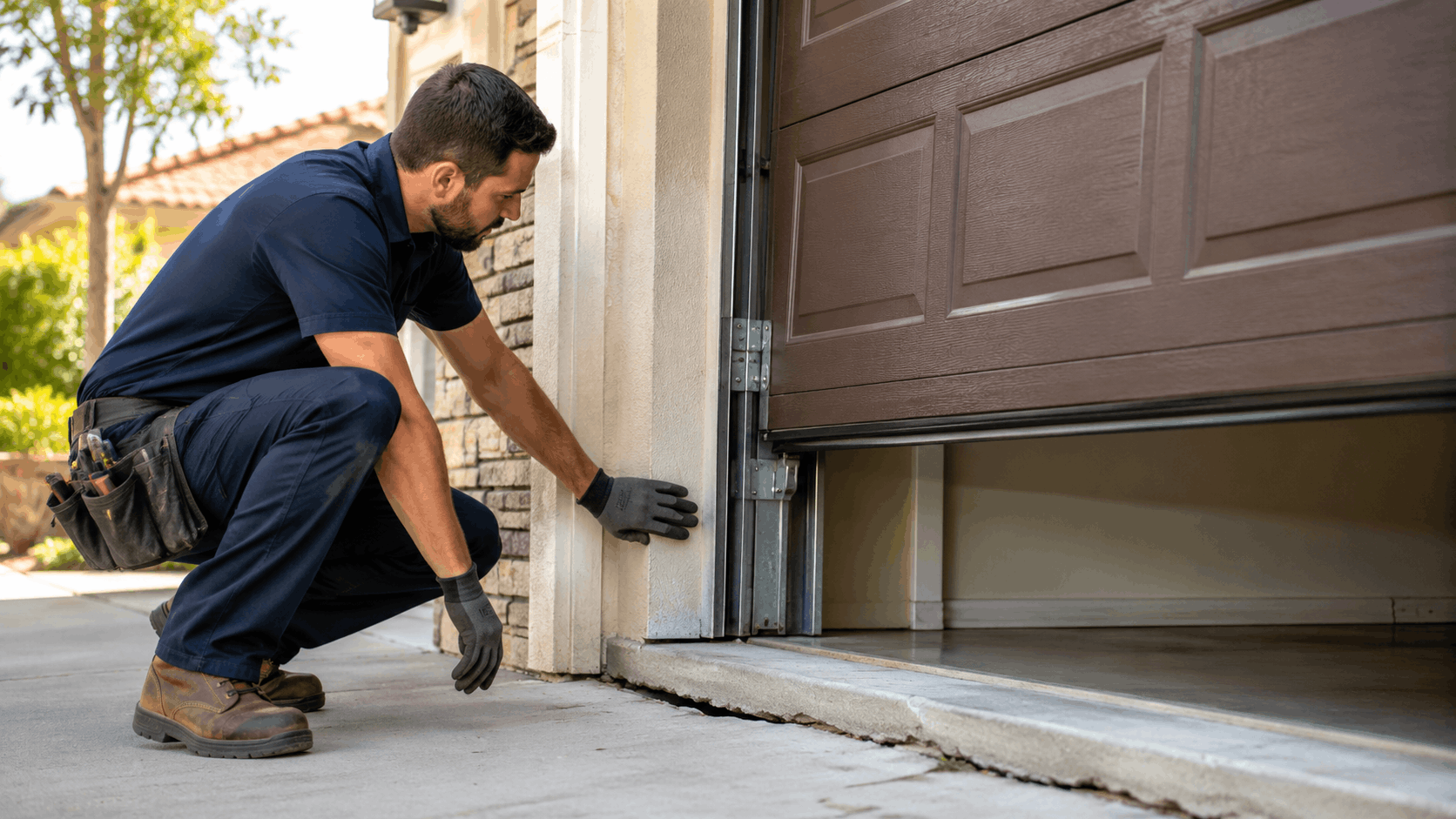
Mission Viejo sits on a mix of native soil types that create real challenges for slab foundations. The hillside neighborhoods like Canyon Crest and the corridors running along Marguerite Parkway contain high concentrations of expansive clay soil. This type of soil changes volume dramatically depending on how much water it holds, and that movement puts steady, uneven pressure on concrete slabs year after year.
Mission Viejo foundation settling is not a freak event - it is a slow, ongoing process that affects hundreds of homes across South Orange County. Expansive clay soil can exert thousands of pounds of force per square foot when it swells after rain. Over 20 to 40 years, that repeated stress lifts one corner of a slab slightly, drops another, and gradually pulls door frames out of square.
| Soil Type | Location in Mission Viejo | Risk Level for Foundation Movement |
|---|---|---|
| Expansive Clay | Canyon Crest, Marguerite Parkway corridors | High |
| Compacted Fill Dirt | Graded hillsides near Alicia Parkway, Casta del Sol | High - uneven compaction common |
| Sandy Loam | Lower elevations near Lake Mission Viejo | Moderate - moisture variation accelerates movement |
| Mixed Native | Older tracts off La Paz Road, Melinda Road | Moderate to High depending on lot grading |
According to the U.S. Geological Survey, expansive soils are among the most costly geological hazards in the United States, affecting structures across Southern California every year. South Orange County soil movement is a local version of a documented regional problem.
The Role of Orange County's Dry-Wet Cycle on Soil Stability
The pattern that does the most damage to Mission Viejo foundations is seasonal soil expansion. Every fall, the Santa Ana winds strip moisture from the ground, causing clay-heavy soil to shrink and crack. Then winter rains hit, sometimes heavily, and that same soil absorbs water and swells back up - but never quite returns to its original position.
Neighborhoods like Pacific Hills and the areas ringing Lake Mission Viejo go through this clay soil shrink-swell cycle repeatedly over decades. Each cycle leaves the soil a little more displaced than before. A slab sitting on top of this activity gradually loses uniform support.
The Santa Ana winds can push humidity down into the single digits for days at a time. When that kind of drying hits already-stressed clay soil, the shrinkage can open gaps under slab edges almost overnight. That is why homeowners sometimes notice new door problems appearing right after a dry spell, not just after rain.
Older Tract Homes and Their Vulnerability
Mission Viejo's original development boom in the late 1960s and 1970s produced thousands of homes along streets like Via Escolar and Melinda Road. The foundations on these older Mission Viejo homes were engineered to the standards of the era, which did not always account for decades of soil movement beneath a structure.
A 1970s tract housing slab that was poured flat and level has now been sitting on shifting clay for 50 years. Even small annual movements add up. By the time a homeowner notices a garage door frame shift, the slab corner may have moved a half inch or more from its original position.
These homes also tend to have original track hardware that has never been replaced. When the frame starts to move, old steel brackets with worn lag bolt holes have almost no ability to hold position. The combination of aged hardware and a shifting foundation makes track misalignment nearly inevitable in this housing stock.
How Hillside Grading Compounds the Problem
Homes built on graded hillsides near Alicia Parkway and within the Casta del Sol community sit on cut-and-fill lots. Contractors removed soil from one part of the hillside and placed it elsewhere to create a flat pad. That placed fill dirt compacts unevenly over time - the original cut side settles very little, while the fill side can drop significantly.
This differential settlement is what pulls a garage opening out of square at an angle rather than dropping it evenly. One corner of the frame might drop three-eighths of an inch while the opposite corner stays put. That diagonal shift is one of the hardest types of misalignment to correct because the entire opening has twisted rather than simply dropped.
Hillside foundation problems in Mission Viejo are well documented by local geotechnical firms. Fill dirt settling does not stop on a predictable schedule - some lots stabilize within 20 years, while others continue to move for much longer depending on soil composition and drainage patterns on the slope.
Get Your Free Quote
Tell us about your garage door and we'll get back to you fast.
How Foundation Settling Directly Causes Track Misalignment
The garage door track system is only as straight as the frame it is attached to. When South Orange County soil movement shifts a garage slab, the door frame shifts with it. The vertical tracks bolt directly to that frame, and the horizontal tracks attach to the ceiling joists above. When one side of the frame drops, the vertical track on that side drops too - pulling the roller path out of parallel with the other side.
The result is a system that was designed to have two perfectly parallel rails suddenly running at slightly different angles. Rollers that travel smoothly in a matched pair of rails start to bind, skip, or grind when those rails diverge even a quarter inch. This is the mechanical explanation behind a foundation shift garage door problem, and it happens gradually enough that homeowners often think the door is just getting old.
- The slab drops unevenly - One corner or one side of the garage slab settles more than the other due to soil movement beneath it.
- The door frame follows - The framed opening around the garage door is anchored to the slab, so any vertical shift in the slab tilts the frame.
- Vertical tracks lose alignment - The track sections bolted to the side frames of the opening tilt inward, outward, or drop on one side relative to the other.
- Track binding begins - Rollers that once moved freely now press against the inner lip of the rail, creating friction, noise, and resistance.
- The opener strains - The motor works harder to push through the resistance, increasing wear on the drive system and opener components.
- Secondary damage accumulates - Over time, the binding stresses cables, cracks roller stems, and can shear the heads off lag bolts holding track brackets to the wall.
For homeowners dealing with a door that has come off the track entirely, off-track garage door repair needs to happen before the door is operated again. Running a door on a misaligned track accelerates every other form of damage in the system.
What Happens to the Track When the Frame Moves
The vertical track anchor is the connection point where everything starts to go wrong. That anchor is a bracket bolted through the door frame into wood framing. When the frame drops or twists, the bracket goes with it. The vertical section of track - typically six to seven feet long - pivots at that anchor point and swings out of plumb.
The horizontal track sits at the top of the vertical section and runs back into the garage ceiling. When the vertical track shifts at the bottom, the angle where it meets the horizontal track changes. The roller must now make a sharper or shallower turn at that transition point. That is where roller jamming most often happens - right at the curve between vertical and horizontal travel.
Even a track that is out of parallel by a quarter inch at the bottom will be noticeably different at the top. The geometry of the problem magnifies with distance. A small shift at the foundation level becomes a significant deviation six feet up the track, which is why the problem is often most visible when the door is nearly at the top of its travel.
The Difference Between a Track Problem and a Spring Problem
Homeowners call about two symptoms that look similar from the outside but have very different causes. A door that moves unevenly - slower or louder on one side, struggling through part of its travel, or stopping mid-cycle - usually points to a track alignment issue from settlement. The garage door diagnosis starts by watching which side causes the problem.
A spring problem looks different. If the door will not lift at all, or if it suddenly drops fast when released manually, a broken torsion or extension spring is the more likely culprit. Springs carry the full weight of the door, and when one fails, the door becomes too heavy to move normally. That is a track vs spring problem distinction that changes the entire repair approach.
A simple test helps narrow it down: disconnect the opener and try lifting the door by hand. If the door is very heavy and will not budge, suspect the spring. If it moves but grinds more on one side, one-sided door movement points toward the track. Our technicians use this same test at every service call before picking up a single tool.

Need Help in Irvine?
Urgent Garage Doors serves Irvine and all of Orange County.
Warning Signs Mission Viejo Homeowners Should Watch For
The garage door gives clear signals before it fails completely. Most homeowners notice something is off but delay calling because the door still technically opens and closes. Catching track misalignment symptoms early saves money on secondary damage and avoids the situation where the door gets stuck in the open position overnight.
These warning signs are especially worth watching for in homes built before 1990 on any graded lot in Mission Viejo. The older the home and the more hillside grading involved, the sooner these symptoms tend to appear. A Mission Viejo garage door that shows two or more of the signs below deserves a professional look within the next few weeks, not months.
Visible Gaps, Bowing, and Daylight at the Corners
One of the clearest signs is light coming in at the top corners of a closed door. Stand inside the garage after dark with the lights off. If daylight or artificial light from outside shows at either top corner, the door panel is no longer sealing flush against the stop molding. That garage door gap daylight problem is a direct sign the frame has shifted out of square.
A door panel bowing slightly when the door is fully closed is a related sign. The panel is trying to conform to a frame that no longer matches the door's geometry. The panel flexes to bridge the gap, and that flex puts stress on the panel sections themselves, sometimes leading to cracked or split panels over time.
An out of square door frame does not always cause dramatic visible distortion. Sometimes the gap is just a quarter inch - barely noticeable unless the homeowner specifically looks. But that small gap is enough to let in water, pests, and wind, and it will grow larger as settlement continues.
Grinding Noises, Jerky Movement, and the Door Stopping Mid-Travel
A grinding garage door is rollers dragging against a track section that has bent inward or tilted out of alignment. The sound is usually more pronounced on one side and louder during upward travel than downward. Homeowners often describe it as a scraping or crunching sound that was not there a year ago.
A door that stops mid-travel is often a roller on bent track getting physically stuck at a pinch point. The opener's safety mechanism may trigger and reverse the door, or the motor may stall. Either way, forcing the door through that resistance risks snapping a cable or damaging the opener drive gear.
Jerky movement - where the door seems to hop or stutter every few inches during travel - usually means multiple rollers are binding at different points along a twisted track. This is a more advanced stage of misalignment and typically means the track has been carrying the stress for a long time. For doors stuck in this condition, professional help for a door that won't open or close should be the next call, not another attempt to force the door through its cycle.
Cracks in the Garage Wall or Ceiling Near the Track Brackets
Hairline cracks spreading from the upper corners of the garage opening are a direct physical record of foundation movement. These garage wall cracks foundation signs appear because the framing is being stressed in tension - the concrete slab below and the wood framing above are being pulled in different directions. Drywall and stucco crack at the points of highest stress, which are typically the corners of openings.
Cracks running along the wall where track bracket damage occurs are especially telling. The lag bolts holding the bracket to the wall framing act as stress concentrators. When the frame moves, those bolts try to hold the track in place while the wall moves around them. The result is cracked drywall or stucco in an arc pattern around each bracket.
These cracks are one of the clearest structural settlement signs available without opening a wall. If cracks appeared recently and are still widening, the foundation may still be actively moving. That matters because it changes the repair strategy - and is one situation where the tracks may not be the first thing to fix.
What a Professional Track Realignment Inspection Covers
When an Urgent Garage Doors technician pulls up to a home in Mission Viejo with a suspected alignment issue, the first 15 minutes are spent looking and measuring, not touching the tracks. A garage door inspection Mission Viejo homes need starts with the full picture - because fixing one part of a connected system without checking the rest often leads to a callback a month later.
The track realignment process is not just bending metal back into position. It involves understanding why the track moved in the first place, whether the hardware can support a realignment, and whether secondary damage has already occurred. Homeowners in neighborhoods like Pacific Hills and Canyon Crest consistently get better long-term results when the inspection is thorough before any repair work begins.
Measuring the Rough Opening and Checking for Square
The first measurement is a diagonal corner measurement across the rough opening. In a perfectly square opening, the diagonal from top-left to bottom-right should equal the diagonal from top-right to bottom-left. When those two numbers differ by more than a quarter inch, the opening is out of square and no amount of track adjustment will make the door sit flush unless the frame itself is addressed.
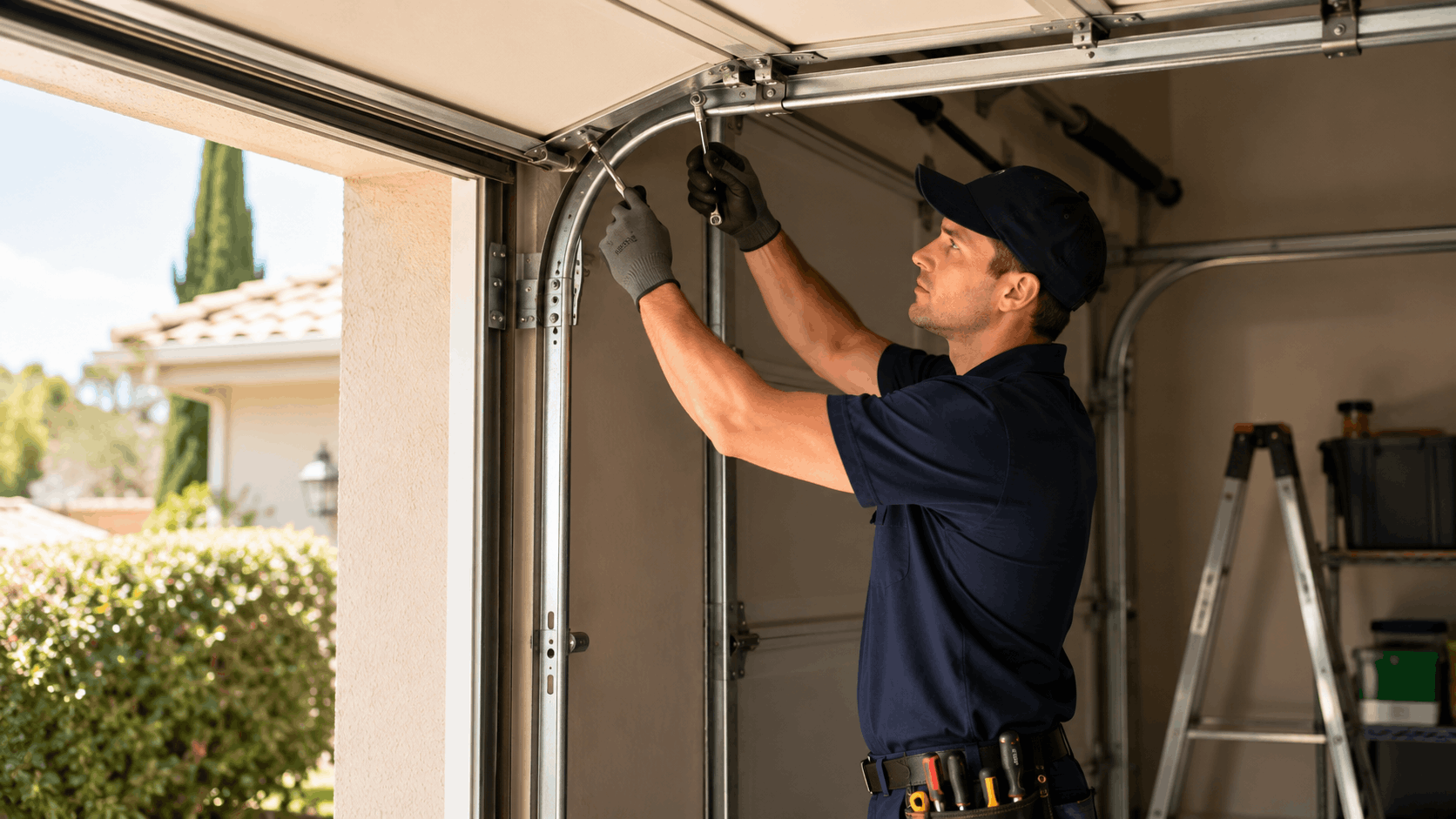
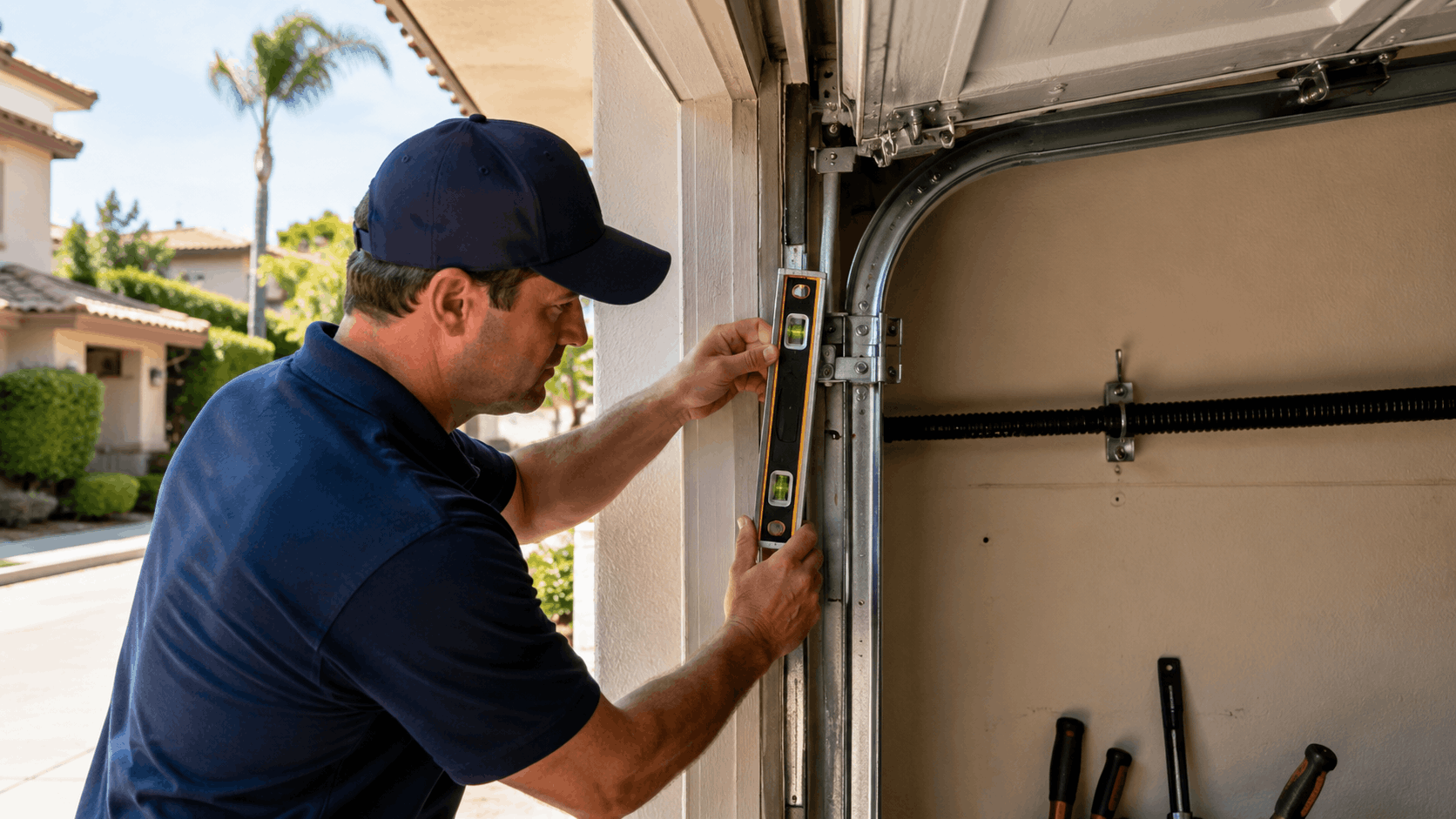
A 4-foot level goes on the vertical track next for the garage door level check. The track should be plumb within a very small tolerance - most manufacturers specify within one-eighth inch over the full height. If the track leans in or out more than that, rollers will not travel freely and the door will either bind going up or drift to one side going down.
When measurements show mild out-of-square conditions - less than three-eighths of an inch difference in diagonal - adjustment is usually achievable. When the difference exceeds three-quarters of an inch, the technician will have an honest conversation about whether a foundation contractor should review the structure before any track work is done. Realigning tracks on a foundation that is still moving is a short-term repair at best.
Inspecting Rollers, Brackets, and Cable Drums for Secondary Damage
A misaligned track chews through rollers faster than almost any other cause. A roller wear inspection checks whether the nylon wheels show flat spots or cracked edges - signs they have been grinding against a track lip instead of rolling freely. Steel rollers show scoring marks when they have been running against a pinched track section.
The cable drum alignment check looks at whether both drums sit at the same angle on the torsion bar above the door. When one track drops, the cable on that side winds unevenly on the drum, building up more tension on one side than the other. Over time, that uneven tension makes the door travel diagonally and accelerates wear on both the cable and the spring.
Bracket lag bolt inspection is the last check before any repair estimate is written. Lag bolts that have been pulled out and re-driven, or that spin without biting into solid wood, cannot hold a realigned track in position. These need to be replaced with larger diameter fasteners driven into fresh framing material. Skipping this step means the realignment fails within a few months.
When to Call a Foundation Specialist Before Touching the Tracks
There are situations where active foundation settlement makes track realignment a waste of money in the short term. If new stucco cracks appeared within the last three months, if the garage floor has a new visible slope toward the door, or if interior drywall cracks are growing in multiple rooms, the slab may still be moving. Adjusting the tracks while the frame is still shifting means the new alignment may be off within a season.
A garage door structural assessment in these cases points toward bringing in a structural engineer or licensed foundation contractor first. They can determine whether the movement is finished or ongoing, and what remediation - if any - is needed before the door work is done. This is not a common situation, but it does come up in Mission Viejo homes on steeper hillside lots where fill dirt compaction has not stabilized.
When the foundation specialist referral is warranted, our technicians communicate that clearly and in writing before leaving the property. There is no benefit in doing track work that will fail - for the homeowner or for us.
Track Realignment and Repair Options for Mission Viejo Homes
Not every misalignment requires a full track replacement. The right repair depends on how far the track has shifted, whether the existing rail is still structurally sound, and how much secondary damage has accumulated. The table below lays out the most common repair scenarios, typical timeframes, and realistic cost ranges for Mission Viejo garage repair work.
| Repair Type | When It Applies | Typical Cost Range | Time on Site |
|---|---|---|---|
| Minor bracket adjustment and track re-securing | Track shifted less than half an inch, rail undamaged | $75 - $150 | 45 - 90 minutes |
| Full track section replacement | Permanent kink or bend in rail, adjustment not possible | $150 - $300 | 90 - 150 minutes |
| Header bracket shimming and spring re-balance | Header beam has dropped, spring tension uneven | $120 - $200 | 60 - 120 minutes |
| Full track realignment with roller replacement | Advanced misalignment with worn rollers and loose brackets | $200 - $400 | 2 - 3 hours |
These are realistic garage door track repair cost estimates for South Orange County in 2024. Costs vary based on door size, track gauge, and whether additional hardware needs replacement during the same visit.
Minor Adjustments: Re-Securing Brackets and Bending Tracks Back
When settlement is minor and the track has shifted less than half an inch from its proper position, a minor track adjustment is often all that is needed. The technician loosens the mounting hardware, repositions the track section by hand or with a rubber mallet, and checks plumb with the level before re-fastening.
Track bracket re-fastening at this stage almost always includes a lag bolt upgrade. The original hardware typically uses half-inch diameter lag bolts. After any movement, those holes are slightly enlarged and the bolts will not hold with the original torque. Technicians use five-eighths or three-quarter inch lags driven into undamaged framing beside the original holes to get solid bite again.
This type of repair holds well when the foundation has stabilized. In homes along Via Escolar or other older tracts where settlement stopped years ago, a minor adjustment with upgraded fasteners can last a decade or more without any further work.
Full Track Section Replacement for Damaged or Bent Rails
A bent track replacement is needed when the rail itself has taken a permanent set - a kink, crease, or curve that cannot be straightened without compromising the metal's integrity. This is common in homes near Melinda Road where repeated soil movement has stressed the track bracket connections over many years, eventually buckling the rail itself.
The new garage door rail replacement section is matched to the door's weight, width, and spring type. A two-car door with a heavy wood or insulated steel panel requires a heavier gauge track than a lightweight single-car aluminum door. Using the wrong track gauge is one of the more common mistakes in DIY repairs - and it leads to accelerated wear or failure within months.
The replacement section drops into the existing curved bracket at the top of the vertical track and bolts to the header at the bottom. A full cable and roller check happens during the same visit because a bent track almost always damages the rollers riding inside it.
Re-Shimming the Header Bracket and Adjusting Spring Tension
The center header bracket is the anchor point for the horizontal track and the torsion spring tube. When the header beam above the garage opening drops - which happens when the top plate of the wall frame settles with the foundation - the center bracket drops with it. Header bracket shimming raises the bracket back to the correct height so the horizontal track slope is restored.
Spring tension adjustment is always part of this repair. The torsion spring is calibrated to the door's weight when it is installed. When the spring height changes because the header has dropped, the spring unwinds at a different rate and the door becomes unbalanced. A spring tension adjustment after center bracket relocation restores the correct counterbalance and prevents premature spring failure.
For more on how spring and cable repairs interact with track work, our spring and cable repair service page explains the full range of what we check and fix in these situations.
Need Help in Irvine?
Urgent Garage Doors serves Irvine and all of Orange County.
Mission Viejo HOA Rules and Permit Requirements for Garage Door Work
Many Mission Viejo neighborhoods operate under HOA oversight, and some garage door work intersects with city permit requirements as well. Getting the regulatory side right before starting repairs avoids fines, forced reversals of work, and complications when selling the home. The good news is that most standard track realignment work does not trigger permit requirements, but there are exceptions worth knowing.
The City of Mission Viejo Community Development Department handles building permits and inspections for structural work. HOAs handle appearance-related approvals for exterior modifications. These two channels are separate, and compliance with one does not automatically satisfy the other. A Mission Viejo HOA garage door situation may need both conversations before work begins.
Which Repairs Need a City of Mission Viejo Building Permit
Standard track realignment, roller replacement, and spring work do not require a building permit garage door Mission Viejo homeowners need to pull. These are maintenance repairs to existing hardware and do not change the structure of the home. The City of Mission Viejo's Community Development Department confirms that like-for-like hardware replacement falls under routine maintenance exemptions.
Permit requirements change when the work touches structural elements. Widening the garage opening, modifying or replacing the structural header, or doing any work connected to foundation repair all require review. Structural header modification is the most common trigger - if a dropped header needs to be sistered, raised, or replaced as part of addressing a settlement issue, a permit is required.
Homeowners can contact the City of Mission Viejo Community Development Department at the city's official development page to confirm permit requirements for specific work before it begins. This is always worth a quick call when the scope of work involves anything beyond the tracks and hardware themselves.
HOA Approval in Communities Like Casta del Sol and Pacific Hills
Casta del Sol HOA governs one of Mission Viejo's most well-known communities - a 55-plus neighborhood with specific architectural standards for all exterior modifications. Even when a garage door repair is driven entirely by a structural need, any change to the door's appearance requires written HOA approval before work starts. That includes replacing panels with a different color or texture, changing the door style, or altering exterior hardware finishes.
The Pacific Hills Mission Viejo area and several other planned communities throughout the city operate under similar rules. HOA exterior approval is not a rubber stamp - the committee reviews plans against the community's architectural guidelines, and turnaround times vary. Homeowners dealing with an urgent safety situation - like a door that will not close at all - can often request an expedited review by explaining the circumstances in writing.
Our technicians are familiar with the HOA landscape across Mission Viejo and can advise on which repairs are straightforward maintenance versus which ones should trigger an HOA conversation first.

How Urgent Garage Doors Serves Mission Viejo from Irvine
Urgent Garage Doors operates out of Irvine and has been working in Mission Viejo homes regularly enough to know the neighborhoods well. The drive down the 5 South to the Crown Valley Parkway exit, or down the 241 to connect to Oso Parkway, puts the team in the middle of Mission Viejo within 20 to 35 minutes depending on time of day. The Urgent Garage Doors Mission Viejo service area covers the full city - from the hillside tracts near Casta del Sol to the lower elevation neighborhoods off Alicia Parkway.
Same day garage door repair is the standard, not an upsell. Trucks are stocked with the most common track hardware, roller sets, cable drums, and bracket sizes because return trips waste everyone's time. The combination of Irvine garage door service proximity and a well-stocked truck means most calls are completed in a single visit.
Response Times from Irvine to Mission Viejo Neighborhoods
The Irvine to Mission Viejo drive time on a normal mid-morning runs about 20 to 25 minutes. Rush hour on the 5 adds 10 to 20 minutes, which is why the team often routes through Trabuco Canyon Road or Moulton Parkway when the freeway is backed up. La Paz Road service area calls - including homes in the older tracts south of Olympiad Road - are typically reachable within 30 minutes of dispatch during off-peak hours.
For homes near Marguerite Parkway or toward the Casta del Sol area, the approach is usually up Crown Valley Parkway from the 5. Those neighborhoods are at the southern end of the service window but still fall within the same day commitment. A call placed before noon almost always results in an afternoon arrival.
The truck inventory is checked and restocked daily. Standard track sections for 8-foot and 9-foot wide single-car doors, 16-foot wide two-car doors, and the associated bracket hardware are always on board. Roller sets in both nylon and steel, cable drums, and torsion springs in common weight ratings travel with the truck so same day garage service does not mean a partial fix followed by a parts order.
What to Expect During a Service Call
The garage door service call process starts with a visual walk-around before the technician touches anything. That first look often reveals things the homeowner has not noticed - stucco cracks near the track brackets, a cable sitting slack on one side, or a roller stem that has already cracked from repeated binding.
After the visual check comes the measurement phase described in the inspection section above. Once the technician has a clear picture of what is actually wrong, a written estimate is presented before any repair work begins. The estimate breaks down parts and labor separately and identifies any issues found that fall outside the scope of that visit - like a foundation concern that should be reviewed by a specialist.
The technician then explains what will and will not be fixed in that visit and why. Honest communication about scope prevents the frustration of expecting a full solution and getting a partial one. For homeowners who want to book a garage door service appointment directly, the process takes less than two minutes online.
Preventive Steps Homeowners Can Take Between Service Visits
Track misalignment caused by foundation movement is not something homeowners can stop - but they can slow the progression and catch problems before a repair becomes an emergency. Garage door maintenance Mission Viejo homes need is mostly about consistent observation and simple upkeep, not tools or technical knowledge. The homeowners who call us with small problems are always happier than the ones who call with a door stuck in the open position at midnight.
Homes near Lake Mission Viejo and the older neighborhoods off Marguerite Parkway are worth paying extra attention to, simply because the soil conditions and home ages in those areas create the right combination of risk factors. Track alignment prevention starts with knowing what to look for every month.
Monthly Visual Checks That Take Under Five Minutes
A monthly garage door check does not require any tools. Stand at the end of the driveway and watch the door go through a full open-and-close cycle. Look for any hesitation, any side that moves slower than the other, or any sounds that are new since last month. This visual inspection routine takes about 90 seconds and catches binding before it reaches the point of causing damage.
After the cycle, close the door and do the daylight gap check from inside the garage with the light off. Look at all four corners of the door. Any light visible at the top corners means the frame geometry has shifted. Bottom corner gaps are usually just a weatherseal issue, which is a much simpler fix.
Also glance at the vertical tracks on both sides. If either one has pulled away from the wall at a bracket point, or if a bracket looks twisted at an angle it did not have before, that is a sign the lag bolts are letting go and the track is starting to move. That finding warrants a call sooner rather than later.
Lubricating Rollers and Hinges to Reduce Stress on Misaligned Tracks
Garage door lubrication is one of the simplest things a homeowner can do to extend hardware life and reduce wear on a slightly misaligned track. Apply white lithium grease to the roller stems and hinge pivot points every six months. White lithium grease is the right product - WD-40 is a solvent, not a lubricant, and it will dry out roller bearings rather than protect them.
Proper lubrication reduces the friction load on a track that is slightly out of alignment. A roller that rolls smoothly does far less damage to a tilted track than a roller that grinds and drags. This does not fix the alignment problem, but it buys meaningful time before a professional adjustment is needed.
For a full roller hinge maintenance service that includes professional lubrication along with a hardware check, our quiet roller hardware upgrade service replaces worn rollers and lubricates the full system in a single visit.
Watching Your Garage Floor for New Cracks or Slope Changes
The garage floor is one of the best visible indicators of foundation activity. New cracks running toward the door opening - especially ones that appear in the last six months - suggest the slab is still moving. An active settlement monitoring check every few months means looking at the floor, not just the door.
A slab slope change is harder to notice without a reference point. Place a level on the garage floor every few months and note whether the bubble has shifted position compared to previous checks. If water starts pooling near the door after it did not before, the floor has tilted.
Garage floor cracks foundation signals should also be checked against cracks elsewhere in the home - particularly in drywall at interior door corners and stucco at exterior wall openings. If multiple cracks are appearing in multiple locations at the same time, that is a pattern suggesting active movement, and a foundation professional should be contacted before any garage door work is scheduled. For broader maintenance planning, our preventive maintenance plan includes periodic inspections that catch these changes before they become expensive repairs.
Need Help in Irvine?
Urgent Garage Doors serves Irvine and all of Orange County.
Final Thoughts
Mission Viejo garage door problems linked to foundation settling are not random bad luck - they are a predictable outcome of the local soil conditions, the dry-wet climate cycle, and the age of the housing stock. Homes on graded hillsides near Casta del Sol, older tracts off La Paz Road, and properties along Marguerite Parkway all sit on soil that moves. The garage door frame moves with it.
The good news is that most track misalignment caused by settled foundations is repairable, especially when it is caught before secondary damage to rollers, cables, and opener hardware accumulates. Regular monthly checks, timely lubrication, and a professional inspection every one to two years are enough to stay ahead of most problems in South Orange County's residential garages.
Urgent Garage Doors is available to Mission Viejo homeowners the same day in most cases, with trucks stocked for the most common repair scenarios. If the door is grinding, gapping, or stopping mid-travel, reach out to the team for an honest assessment and written estimate before the problem gets worse.
Frequently Asked Questions
Can I realign my garage door tracks myself if the problem is from foundation settling?
Minor track adjustments - tightening loose brackets, for example - are sometimes manageable as a DIY project. But when foundation movement is the root cause, the opening geometry is often too far out of square for a homeowner to correct safely with basic tools. Forcing a misaligned track can snap a cable under tension or crack a roller stem. DIY track alignment attempts in settlement situations frequently result in a service call anyway, plus the cost of additional damage.
How much does garage door track realignment typically cost in Mission Viejo?
Minor bracket adjustments and track re-securing run roughly $75 to $150 for most single or double car doors. A full track section replacement ranges from $150 to $300 depending on door width and track gauge. Mission Viejo garage repair price goes up when secondary damage is found during the inspection - broken rollers typically add $50 to $100, and frayed or kinked cables add another $100 to $150 depending on the extent of the damage found on site.
How do I know if the problem is my tracks or my garage door springs?
Disconnect the opener and lift the door manually by the handle. If it moves but grinds or resists more on one side, the spring vs track diagnosis points toward the track. If the door will not lift at all - or if it feels like it weighs twice what it should - a broken spring is the more likely cause. A door that slams down when released during the manual door lift test almost always has a failed spring, not a track problem.
Will my homeowner's insurance cover garage door damage from foundation settling in Mission Viejo?
Standard homeowner's insurance policies in California typically exclude damage from gradual settling because it is considered a maintenance issue rather than a sudden loss. Homeowner insurance garage door coverage for foundation settling is rarely triggered unless the settling happened as a result of a covered event like a burst pipe or earthquake. Check your specific policy language and photograph all visible damage - cracks, gaps, and track displacement - before any repair work begins to support any potential claim.
How long does a track realignment repair take?
Most track repair timeframes for standard single or double car doors run between 45 minutes and two hours from start to finish. Full track section replacement adds another 30 to 60 minutes to the garage door repair duration. When the visit also includes roller replacement, cable adjustment, or header bracket shimming, the total time on site may reach three hours. The technician will give a time estimate after the initial inspection, before any work begins.
My Mission Viejo garage door closes but leaves a big gap at one corner - is that a foundation issue?
An uneven gap - where one corner seals flush and the opposite corner shows daylight - is one of the clearest signs of an out of square opening. This out of square door frame problem is almost never caused by the door panel itself or by a spring failure. The frame has shifted, and the door is closing into an opening that is no longer the same shape as the door. An uneven door gap of this type typically points directly to foundation or frame movement.
Do I need to fix my foundation before getting the tracks realigned?
Not always. If the foundation is still actively moving, track realignment may only hold for a few months before the problem returns - making foundation repair before track work the smarter sequence. But if settling has stabilized, which is common in Mission Viejo homes that have been on site for 20-plus years on level lots, the track work will hold well long-term. Our technicians assess signs of active versus stable settling during every inspection and communicate that finding clearly before any repairs begin.
Are Mission Viejo homes near the lake more likely to have garage door settling problems?
Properties close to Lake Mission Viejo and low-lying areas off Alicia Parkway experience more soil moisture variation than hillside properties. That moisture variation speeds up the clay soil expansion and contraction cycle, which accelerates the rate of foundation movement. Lake Mission Viejo foundation activity tends to be more gradual than hillside settling, but it accumulates over decades. Hillside home settling from fill dirt compaction is a different pattern but equally common in graded neighborhoods throughout the city.
How often should garage door tracks be professionally inspected in Mission Viejo?
A professional look every one to two years is appropriate for most Mission Viejo homes, particularly those built before 1990 on graded lots or hillside properties. Garage door inspection frequency should increase if the home shows new stucco or drywall cracking, if the door develops any new sounds or resistance, or if a foundation contractor has noted ongoing movement. Mission Viejo preventive maintenance catches alignment drift early - when it is inexpensive to correct - rather than after rollers and cables have absorbed months of extra stress.
Can Urgent Garage Doors respond the same day for a stuck or off-track door in Mission Viejo?
Yes. Same day garage door service Mission Viejo homeowners need is the standard for Urgent Garage Doors, which dispatches from Irvine and regularly reaches locations near Olympiad Road, Marguerite Parkway, and the Casta del Sol area within a few hours of contact. The Urgent Garage Doors response time from Irvine varies by time of day, but most calls placed before early afternoon result in a same-day visit. The truck carries the hardware needed for the most common repairs so the job gets finished in a single trip. For immediate assistance, visit the 24/7 emergency garage door repair page for contact options.
Frequently Asked Questions
- Can I realign my garage door tracks myself if the problem is from foundation settling?
- Minor track adjustments - tightening loose brackets, for example - are sometimes manageable as a DIY project. But when foundation movement is the root cause, the opening geometry is often too far out of square for a homeowner to correct safely with basic tools. Forcing a misaligned track can snap a cable under tension or crack a roller stem. DIY track alignment attempts in settlement situations frequently result in a service call anyway, plus the cost of additional damage.
- How much does garage door track realignment typically cost in Mission Viejo?
- Minor bracket adjustments and track re-securing run roughly $75 to $150 for most single or double car doors. A full track section replacement ranges from $150 to $300 depending on door width and track gauge. Mission Viejo garage repair price goes up when secondary damage is found during the inspection - broken rollers typically add $50 to $100, and frayed or kinked cables add another $100 to $150 depending on the extent of the damage found on site.
- How do I know if the problem is my tracks or my garage door springs?
- Disconnect the opener and lift the door manually by the handle. If it moves but grinds or resists more on one side, the spring vs track diagnosis points toward the track. If the door will not lift at all - or if it feels like it weighs twice what it should - a broken spring is the more likely cause. A door that slams down when released during the manual door lift test almost always has a failed spring, not a track problem.
- Will my homeowner's insurance cover garage door damage from foundation settling in Mission Viejo?
- Standard homeowner's insurance policies in California typically exclude damage from gradual settling because it is considered a maintenance issue rather than a sudden loss. Homeowner insurance garage door coverage for foundation settling is rarely triggered unless the settling happened as a result of a covered event like a burst pipe or earthquake. Check your specific policy language and photograph all visible damage - cracks, gaps, and track displacement - before any repair work begins to support any potential claim.
- How long does a track realignment repair take?
- Most track repair timeframes for standard single or double car doors run between 45 minutes and two hours from start to finish. Full track section replacement adds another 30 to 60 minutes to the garage door repair duration. When the visit also includes roller replacement, cable adjustment, or header bracket shimming, the total time on site may reach three hours. The technician will give a time estimate after the initial inspection, before any work begins.
- My Mission Viejo garage door closes but leaves a big gap at one corner - is that a foundation issue?
- An uneven gap - where one corner seals flush and the opposite corner shows daylight - is one of the clearest signs of an out of square opening. This out of square door frame problem is almost never caused by the door panel itself or by a spring failure. The frame has shifted, and the door is closing into an opening that is no longer the same shape as the door. An uneven door gap of this type typically points directly to foundation or frame movement.
- Do I need to fix my foundation before getting the tracks realigned?
- Not always. If the foundation is still actively moving, track realignment may only hold for a few months before the problem returns - making foundation repair before track work the smarter sequence. But if settling has stabilized, which is common in Mission Viejo homes that have been on site for 20-plus years on level lots, the track work will hold well long-term. Our technicians assess signs of active versus stable settling during every inspection and communicate that finding clearly before any repairs begin.
- Are Mission Viejo homes near the lake more likely to have garage door settling problems?
- Properties close to Lake Mission Viejo and low-lying areas off Alicia Parkway experience more soil moisture variation than hillside properties. That moisture variation speeds up the clay soil expansion and contraction cycle, which accelerates the rate of foundation movement. Lake Mission Viejo foundation activity tends to be more gradual than hillside settling, but it accumulates over decades. Hillside home settling from fill dirt compaction is a different pattern but equally common in graded neighborhoods throughout the city.
- How often should garage door tracks be professionally inspected in Mission Viejo?
- A professional look every one to two years is appropriate for most Mission Viejo homes, particularly those built before 1990 on graded lots or hillside properties. Garage door inspection frequency should increase if the home shows new stucco or drywall cracking, if the door develops any new sounds or resistance, or if a foundation contractor has noted ongoing movement. Mission Viejo preventive maintenance catches alignment drift early - when it is inexpensive to correct - rather than after rollers and cables have absorbed months of extra stress.
- Can Urgent Garage Doors respond the same day for a stuck or off-track door in Mission Viejo?
- Yes. Same day garage door service Mission Viejo homeowners need is the standard for Urgent Garage Doors, which dispatches from Irvine and regularly reaches locations near Olympiad Road, Marguerite Parkway, and the Casta del Sol area within a few hours of contact. The Urgent Garage Doors response time from Irvine varies by time of day, but most calls placed before early afternoon result in a same-day visit. The truck carries the hardware needed for the most common repairs so the job gets finished in a single trip. For immediate assistance, visit the 24/7 emergency garage door repair page for
U
Licensed garage door repair professionals serving Irvine and Orange County.
Licensed in California · License #1055150
Why trust Urgent Garage Doors?
Founded in 2017, Urgent Garage Doors is a licensed and insured garage door services serving Irvine and Orange County. All content is reviewed by our licensed technicians.

Need Help in Irvine?
Urgent Garage Doors serves Irvine and all of Orange County.
Related Articles

Tips & Advice
Aliso Viejo Garage Door Trends: What Homeowners Are Installing
Discover which garage door styles, materials, smart tech upgrades, and colors Aliso Viejo homeowners are actually installing - with real cost ranges and HOA guidance.

Tips & Advice
Best Garage Door Brands for Coastal Orange County
Discover the best garage door brands for coastal Orange County homes that resist salt air corrosion, handle marine layer moisture, and maintain performance despite coastal winds.

Tips & Advice
Smart Garage Door Openers: Are They Worth It for OC Homeowners
Smart garage door openers offer OC homeowners remote access, real-time alerts, and auto-close features. Find out what they cost and whether the upgrade makes sense for your home.