Garage Door Opener Replacement for North Tustin Estates With Tall Garages
Key Takeaways
- Tall custom garages in Lemon Heights and Cowan Heights need an opener rated for the door's actual weight plus a longer rail or extension kit, not a reused standard unit.
- Jackshaft openers mount on the wall and drive the torsion bar directly, making them ideal where headroom is limited or the ceiling holds storage.
- SB 969 requires a battery backup on every residential opener installed or replaced in California since July 1, 2019, so it comes included on a compliant replacement.
- North Tustin is unincorporated Orange County, so permits run through OC Development Services, not the City of Tustin, and a North Tustin Specific Plan review layer may also apply.
- Doors that reverse for no visible reason are usually caused by debris or misalignment on the low-mounted photo eyes, common in the foothills from canopy and canyon wind.
- The correct license classification is C-61/D-28, not C-28, and the unlicensed-work exemption is now $1,000 under AB 2622 and fails if a permit is required.
- Opener installation typically runs $250 to $600 in Orange County, with belt drive costing more than chain and battery backup installation $200 to $400.
- Urgent Garage Doors offers 24/7 service with a 30 to 60 minute response window across Orange County and a written price before work begins.
In This Article
Drive the ridgeline streets of Lemon Heights or Cowan Heights and you notice it fast: the garages are bigger here. These are custom and semi-custom hillside homes on larger lots, built across several decades, and the garage openings often run taller than anything you would see in a tract development. A door that tall weighs more and travels farther, so the opener that works for a standard two-car garage down in the flats is frequently the wrong unit for a home up in the North Tustin foothills.
Replacing an opener on one of these doors is not a simple swap. The rail has to reach a taller header, the motor has to be rated for the real weight of the door, and California law now folds a battery backup into every residential replacement. On top of that, North Tustin is unincorporated Orange County, so the permit and inspection path runs through the county rather than the City of Tustin.
Why Tall Garages in North Tustin Need a Different Opener Approach?
North Tustin sits in the foothills above the City of Tustin, a community of larger custom and semi-custom lots rather than repeated tract floor plans. Because builders worked these hillside parcels one at a time over many years, the garages vary property to property. Ceiling heights differ, door sizes differ, and the weight of the door changes with its material and its height.
That variation is the whole reason a standard opener spec often does not fit. A unit sized for a lightweight sectional door on a flat lot can struggle with a heavier, taller custom door on a hillside home. Getting the match right starts with measuring the actual door, not assuming a model number that works elsewhere will work here.
Across the Tustin and North Tustin area, these estates frequently carry oversized doors that need springs and openers sized to real weight. A one-size answer does not hold up on the ridgeline.
What Counts as a Tall Garage Here
Most residential garage doors in tract housing top out around seven feet. In Cowan Heights, Lemon Heights and Panorama Heights, it is common to find doors taller than that, built into custom homes with higher ceilings and deeper garages. These are not standard openings, and they were not built to standard measurements.
The homes here span several decades of construction, and the custom nature of each build means the garage was shaped to the house rather than to a catalog spec. One property might have a tall single door for an RV or workshop; the next might have a pair of oversized doors feeding a long driveway. Ceiling height is the first thing to check because it sets how much rail and headroom you have to work with.
Before any opener is chosen, the real numbers matter: the height of the door, the clear ceiling above it, and the weight the door carries when it moves. A tall door with limited headroom is a different problem from a tall door with a cathedral ceiling, and the opener that suits each is not the same unit.
Getting those measurements first avoids the common mistake of ordering a unit that physically does not fit the rail path or cannot lift the door without straining. For these oversized doors, measurement comes before any product decision.
Why Door Height Changes the Opener and the Rail
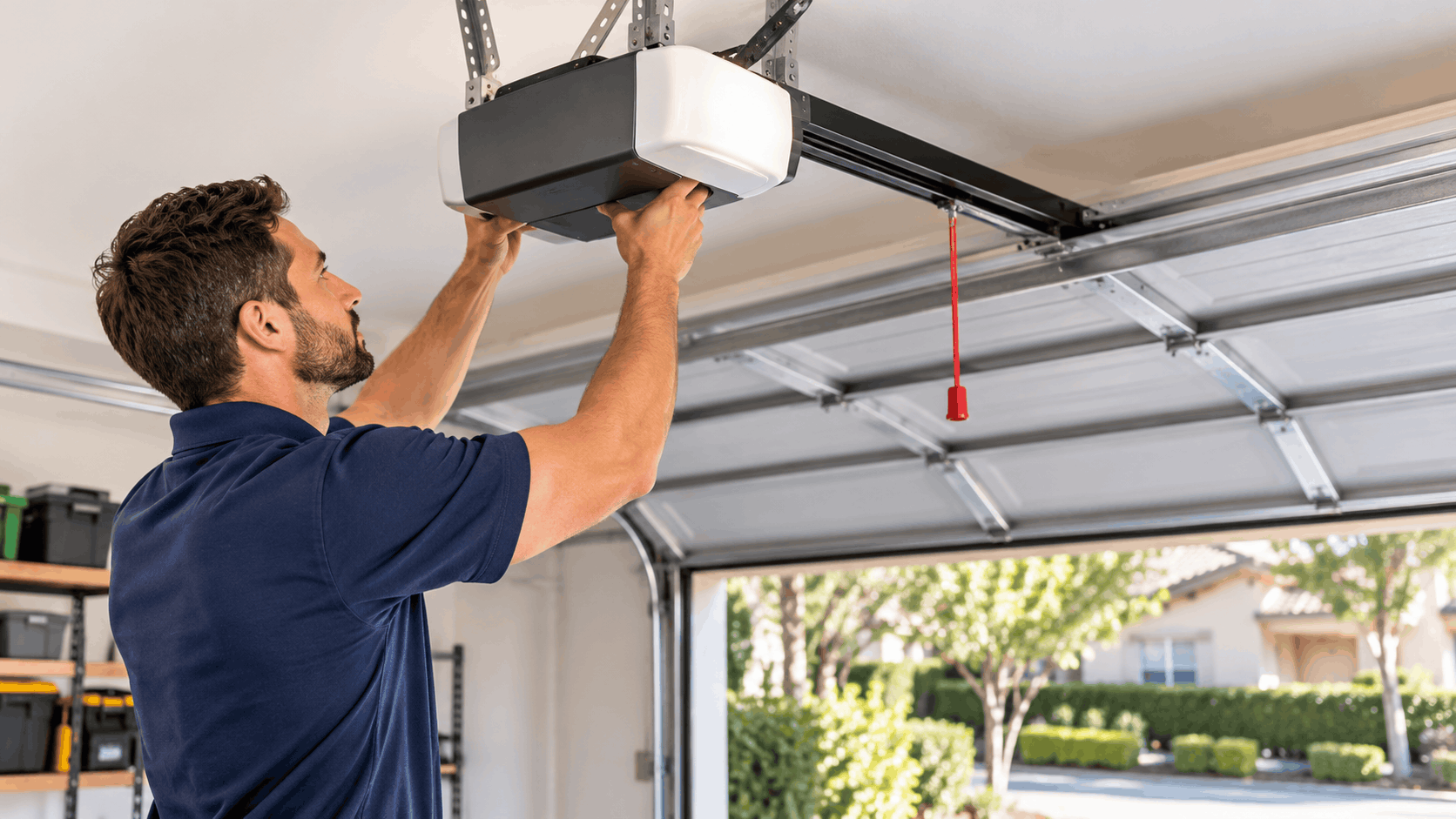
A taller door travels a longer distance from closed to fully open. That means the rail, the track the trolley rides along, has to be longer than a standard eight-foot rail. Manufacturers sell rail extension kits for exactly this reason, bridging the gap so the trolley can carry the door through its full height of travel.
Height also changes the weight the opener must move. A taller door has more panels and more material, and if it is built in a heavier material like solid wood or insulated steel, the weight climbs further. The opener has to be rated for that actual weight, measured on the door, not carried over from whatever unit was there before.
Reusing a standard opener on a heavier, taller door is how motors burn out early and how the door stops reliably sealing at the floor. The lifting force has to match the load. Pairing the right rail length with an opener rated for the real door weight is what keeps the system working for years rather than failing under strain.
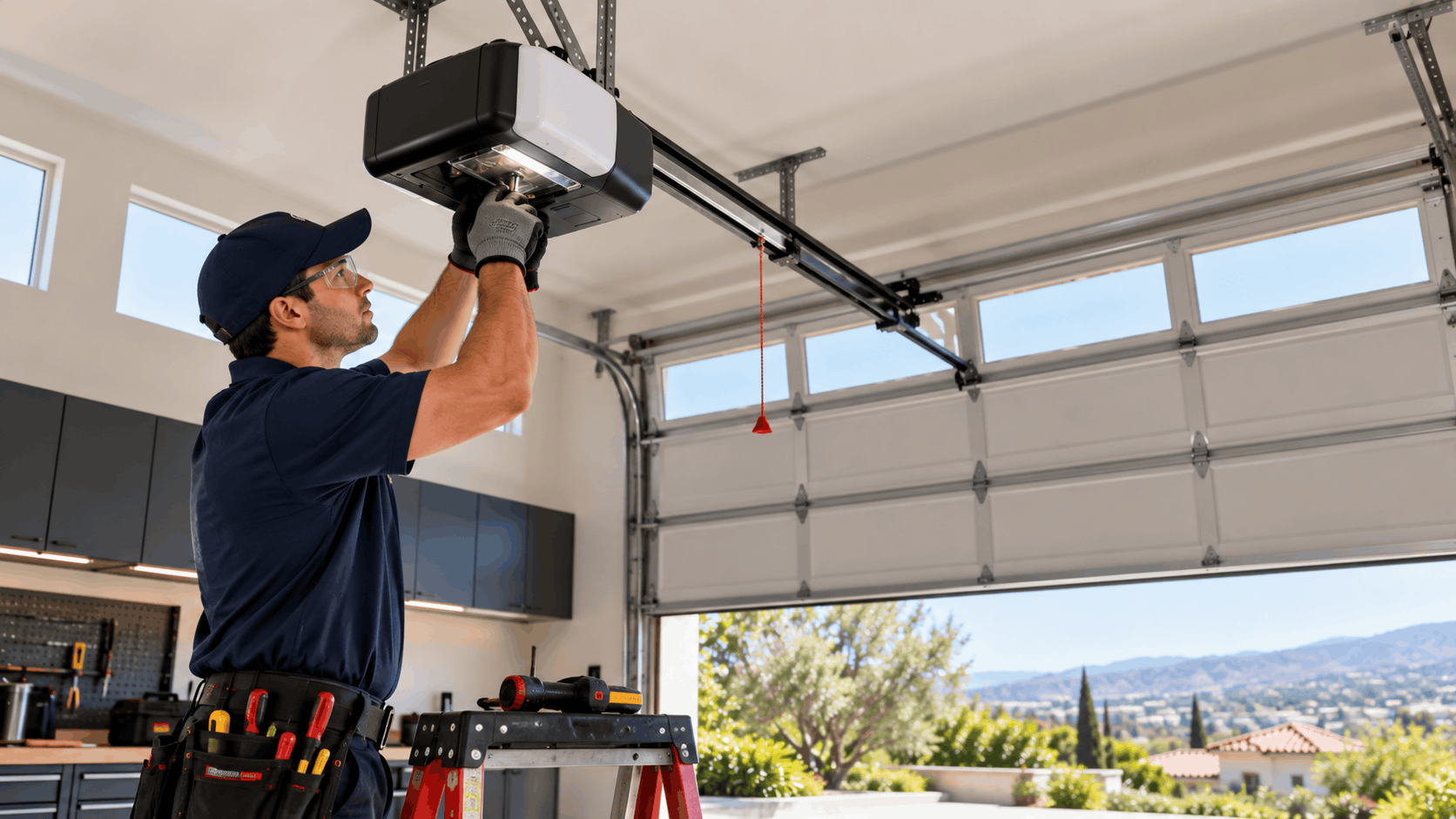
When our team sizes an opener for one of these homes, the door weight and the ceiling height drive the recommendation together. A longer rail with an underpowered motor is just as wrong as a strong motor on a rail that cannot reach the top of travel.
Detached Garages, Workshops and More Than One Opener
Foothill lots in North Tustin are large, and the driveways are often long and steep. Many of these properties include more than just an attached garage. Detached garages, workshops, barns and other outbuildings are common, each with its own door and its own opener.
That changes the shape of a replacement visit. One trip to a North Tustin estate can involve two or three doors and two or three openers, and they are rarely identical. A tall detached workshop door might take one drive type while the attached garage near the bedrooms takes another, quieter one.
Each door needs its own measurement and its own spec. The outbuilding doors are frequently older and heavier, and they may still carry openers that predate current safety standards. Walking the whole property matters so nothing gets missed and each opener is matched to the door it actually serves.
For owners with multiple structures, planning the work as a set rather than one door at a time usually makes for a cleaner, more consistent result across the property.
Get Your Free Quote
Tell us about your garage door and we'll get back to you within 30 to 60 minutes.
Choosing a Drive Type for a Tall Garage
There are three opener drive types, and the right one depends on your garage layout, your headroom and how close the garage sits to living space. Chain drive, belt drive and jackshaft each have a place, and on a tall custom garage the choice carries more weight than usual.
Chain drives pull the trolley with a metal chain and cost the least. Belt drives use a reinforced belt and run noticeably quieter. Jackshaft units skip the overhead rail entirely, mounting on the wall beside the door and driving the torsion bar directly. For a tall or headroom-limited garage, that last option solves problems the other two cannot.
Matching the drive to the space is the goal. The sections below break down where each one fits, and our opener and smart access team can help confirm which suits a specific garage.
Jackshaft Openers for Limited Headroom or Ceiling Storage
A jackshaft opener mounts on the wall to the side of the door rather than on the ceiling. Instead of a rail and trolley running back over the door, it drives the torsion bar directly, turning the shaft that winds and unwinds the springs. That design frees up the entire ceiling above the door.
On a tall custom garage, headroom above the open door is sometimes tight, and a ceiling-mounted rail unit simply has nowhere to go. The jackshaft solves that because it never uses the overhead space at all. The same applies when the ceiling is already full of storage racks, a loft or shelving, which is common in these larger foothill garages.
Many of the taller doors in Cowan Heights and Lemon Heights suit a wall-mounted unit well, both for the headroom and for the clean look it leaves overhead. It also tends to run smoothly because it works with the torsion system rather than pulling the door from a single point.
Where a garage has a high door and a ceiling someone wants to keep clear, the jackshaft is often the strongest fit. Our team can confirm whether the torsion setup on a given door supports one.
Belt Drive for Rooms Above the Garage
Belt drive openers replace the metal chain with a reinforced rubber belt, and the difference in noise is immediate. There is no metal-on-metal rattle as the door moves, just a smoother, quieter travel. For homes with living space above or beside the garage, that quiet matters.
Plenty of custom homes in the North Tustin foothills have a bonus room, office or bedroom over the garage. A chain drive under that floor sends vibration and noise straight up through the structure every time the door cycles. A belt drive keeps mornings and late nights far more peaceful for anyone in that room.
Belt units cost a little more than chain, which the section on pricing covers below. For a household that values quiet, especially where someone sleeps above the garage, that difference is usually worth it. The belt carries the same lifting duty as a chain, so on a properly sized unit there is no performance trade-off for the quieter operation.
When we recommend a drive type, a room above the garage pushes the answer toward belt or jackshaft nearly every time.
Chain Drive and When It Still Makes Sense
Chain drive is the oldest and lowest-cost of the three. It is reliable, strong and simple, and on the right garage it remains a sound choice. The main trade-off is noise, since the metal chain makes more sound as it pulls the trolley.
Where that noise does not reach anyone, the cost savings win. A detached garage or workshop set well away from the bedrooms is a natural fit for chain drive. Nobody is trying to sleep above it, so the extra sound simply does not matter the way it would on an attached garage below a bedroom.
On the large North Tustin lots, a detached structure at the far end of a long driveway is a common place for a chain unit. The door still needs an opener rated for its weight, so the drive type does not change the sizing rules, only the cost and the noise level.
For owners weighing budget against location, chain drive on an outbuilding and belt or jackshaft on the house is a sensible split that puts the money where the quiet is needed.
Noise, John Wayne Airport and Opener Selection
Aircraft noise from John Wayne Airport crosses parts of unincorporated Orange County, operating under departure noise limits and a voluntary nighttime curfew from 11pm to 7am. The county monitors that noise and maintains contour maps that affect residential building requirements.
For a household already dealing with aircraft noise, adding a loud chain drive opener under a bedroom is piling one noise source on another. A quieter belt or jackshaft drive makes more sense where the family is noise-sensitive to begin with. The opener runs several times a day, and on an attached garage below living space, that sound adds up.
The same curfew window is worth keeping in mind for scheduled work. Late-night opener testing on an attached garage is not ideal in a noise-aware neighborhood, so planning the install for daytime hours respects both the household and the surroundings.
Where quiet is a priority, we steer toward belt or jackshaft and away from chain on any door close to where people sleep.
Need Help in Irvine?
Urgent Garage Doors serves Irvine and all of Orange County.
Battery Backup Is the Law on Every Replacement
Here is the part many homeowners do not expect: a replacement residential opener in California comes with a battery backup because the law requires it. This is not an upsell or a premium tier. Since July 1, 2019, any residential automatic garage door opener installed or replaced in the state has to have a battery backup built to operate during a power outage.
That rule is SB 969, and it carries real weight in a foothill fire community. When the grid goes down, a heavy custom door is nearly impossible to lift by hand, and a battery backup keeps the opener working so a family can still get out.
Our battery backup installation is part of the replacement, because California does not allow it any other way.
What SB 969 Requires and When It Started
SB 969 was authored by Senator Dodd and signed in 2018 as Chapter 621 of that year's statutes. It requires every residential automatic garage door opener manufactured for sale, sold, offered for sale or installed in California on or after July 1, 2019, to have a battery backup designed to operate during an electrical outage.
The penalty for violating it is a $1,000 civil penalty. Since that date, a replacement residential garage door may not be installed connected to an opener that does not comply. That makes the backup a legal condition of the job, not an optional feature a homeowner can decline to save money.
One point worth being clear on: this is SB 969, not the energy code. It has nothing to do with Title 24 or Title 19. It is a standalone safety law about openers, and it applies statewide to residential units. Commercial operators are a separate matter and are not covered by it.
The law also does not force anyone to upgrade an opener that is simply sitting in place and working. It triggers on sale or installation, so it is the act of replacing the opener that brings the requirement into play.
Why It Matters More on a Fire-Zone Hillside
SB 969 was passed in response to deaths in the 2017 Northern California wildfires, where people could not open their garage doors during power cuts and could not evacuate. The grid went down, the openers stopped, and the doors were too heavy to lift by hand. The battery backup requirement exists to prevent that.
That origin is directly relevant in North Tustin. On March 24, 2025, CAL FIRE released an updated Fire Hazard Severity Zone map for the unincorporated areas of Orange County, and the Board of Supervisors adopted it by Ordinance No. 25-015 on August 26, 2025. Unincorporated Orange County contains extensive Very High Fire Hazard Severity Zones.
Canyon and hillside communities face the strictest building and vegetation requirements, and they also face the real possibility of grid outages during a fire event. An owner can check their own address on CAL FIRE's Fire Hazard Severity Zone viewer, and the Orange County Fire Authority is the local fire authority, reachable at 714-573-6000.
On a foothill lot where a power cut during a wildfire is a genuine risk, a working opener on battery is the difference between driving out and being stuck. The law and the terrain point the same direction here.
Battery Backup Is Included, Not an Add-On Tier
Because SB 969 makes the backup a legal requirement, a compliant replacement opener in California already has it. There is no version of the job where the backup is a separate upgrade a homeowner chooses to add or skip. It is part of the unit and part of the install.
This matters for how an owner reads a quote. The compliant opener is the only opener that can legally be installed as a replacement, so the backup is baked into the product rather than priced as an extra tier. The cost section below lists a typical range for battery backup installation, which applies where a backup is being added or serviced, but on a full replacement the compliant unit carries it by default.
The practical takeaway is simple. When replacing an opener in North Tustin, the battery backup comes with it. A homeowner is not choosing whether to have one; they are getting a unit that meets the law.
Any contractor suggesting a non-compliant replacement opener to save a few dollars is pointing a homeowner toward a unit that cannot legally be installed. The compliant opener is the floor, not the ceiling.
Safety Features Your New Opener Must Have
Modern openers carry entrapment protection that older units in these homes often lack. North Tustin's housing stock spans several decades, so replacing an opener frequently means swapping out a unit built before the current safety rules existed. The new opener brings those protections with it.
Entrapment protection means the door reverses before it can trap a person or pet underneath. It works on two layers: a contact reverse that triggers when the door hits something, and photo eyes that stop the door before it even touches an obstruction. Both are standard on any opener installed today.
If an old unit is being replaced, the new opener installation upgrades the garage to current entrapment protection as part of the work.
Old Openers That Predate the 1993 Mandate
Because North Tustin homes were built across many decades, some older properties still run openers made before the federal entrapment protection mandate. That federal requirement covers openers manufactured for the United States after January 1, 1993, so a unit built before that date predates it.
California actually moved first. AB 3600, authored by Polanco and enacted as Chapter 1336 of the 1990 statutes, required California openers to be manufactured with an automatic reverse device and sensor. Congress followed for openers manufactured for the country after 1993. So the honest line for an old opener is that units made before 1993 predate the federal mandate.
These older units lack the entrapment protection every modern opener carries. The manufacturer position, LiftMaster for example, is that pre-1993 openers should be replaced rather than repaired. Chasing parts for a unit that was never built to current safety standards is not a sound investment.
On the larger foothill lots, these aging openers often turn up on detached garages and workshops that get less daily attention than the main house. Replacing them brings the whole property up to the protection a modern door is required to have.
Photo Eyes and the Two-Second Reverse
UL 325 is the safety standard modern openers are built to, and it is satisfied two ways at once. First, the opener must reverse the door within two seconds of contacting an obstruction. Lay something in the door's path and the door should hit it, sense the resistance and back off within that window.
Second, nearly all openers add a non-contact system: the photo eyes. These are sensors mounted on each side of the opening, no higher than six inches off the floor. They project an invisible beam across the doorway, and if anything breaks that beam while the door is closing, the door stops and reverses before it ever makes contact.
Together these two layers protect against entrapment. The contact reverse catches anything the beam misses, and the photo eyes catch a child or pet before the door touches them at all. Both are required on a unit installed today, and both are checked when a new opener goes in.
The six-inch mounting height is deliberate: it puts the beam low enough to catch a small child or a crawling pet. Proper alignment of those eyes is what keeps the system working as intended.
Simple Tests a Homeowner Can Run After Install
After a new opener is in, two quick tests let a homeowner confirm the safety features work. The first is the photo-eye test. With the door closing, break the beam with an object, a broom handle works, and the door should stop and reverse immediately. If it keeps closing, the eyes are misaligned or faulty.
The second is the two-by-four test. Lay a 2x4 flat across the opening under the door. On closing, the door must reverse within two seconds of touching the board. This confirms the contact reverse is set correctly and the door is not pressing down with too much force.
Both tests take a minute and should be repeated periodically, not just at install. If either one fails, the door is not safe to run and the issue needs attention before anyone relies on the opener again. These are the checks our team runs before leaving a job, and they are the same ones a homeowner can run anytime.
One note on springs: these tests are safe for anyone to do, but adjusting or replacing a torsion spring is not. A torsion spring stores enough energy to cause serious injury, so that work stays with a trained technician.
Local Conditions That Affect Openers in the Foothills
The foothill setting around North Tustin brings heavy mature canopy, open-space edges and canyon wind along the ridgeline streets. All of that reaches driveways, door tracks and photo-eye lenses. The result is one of the most common service calls up here: a door that reverses for no visible reason.
Leaf litter, bark and dust blow in from the trees and the canyon edges. When that debris coats a photo-eye lens, it breaks the beam, and the opener reads a blocked beam as an obstruction and refuses to close. Owners often blame the opener when the real cause is a dirty sensor.
Because the setting makes debris a constant, cleaning and maintenance are the practical answer. Our sensor alignment and repair keeps those photo eyes reading clearly.
Mature Canopy, Protected Trees and Debris on the Lens
North Tustin's foothill neighborhoods carry heavy mature canopy and sit against open-space edges. That means a steady supply of leaf litter, bark and dust landing on driveways, in door tracks and across sensor lenses. Canyon wind on the ridgeline streets carries it all farther and packs it into places it does not belong.
A homeowner's first instinct might be to cut back or remove the tree that is shedding. In unincorporated Orange County, that is not always allowed. The zoning code establishes a Protected Tree Ordinance under which protected trees at or above five inches diameter at breast height cannot be removed without a permit, with replacement ratios applying.
So removing the cause is often off the table. That leaves the door itself as the place to manage the problem. Keeping the photo-eye lenses clean, clearing the tracks of packed debris and checking seals are what keep the door closing reliably when the canopy is dropping.
Private owners maintain their own trees at their own expense, and the county trims trees in public rights-of-way on its own cycle. For the shedding tree over a driveway, maintenance on the door beats fighting the tree.
Why a Door Reverses for No Visible Reason
When a door starts closing and then backs up on its own, the opener usually gets the blame. In most cases the opener is fine. Photo-eye faults, misalignment and blocked beams are the most common cause of a door that reverses for no visible reason.
The eyes sit low, six inches off the floor on each side, which is exactly where blowing debris, a stray leaf or a spider web tends to collect. A beam broken by any of that reads to the opener as an obstruction, and the door reverses to avoid crushing it. Nothing is wrong with the motor at all.
Misalignment is the other frequent culprit. A bump from a car, a trash can or a ladder can nudge an eye out of aim, and if the two eyes no longer point at each other, the beam never completes. Realigning them and cleaning the lenses usually solves the whole problem.
Up in the foothills, with canopy and canyon wind feeding debris onto those lenses, this is a recurring call. The fix is almost always the sensors, not a new opener.
Short-Term Rentals and Keypad Code Turnover
Unincorporated Orange County allows registered short-term rentals. Operators must register with the OC Treasurer-Tax Collector, which means there is a permitted short-term rental population in North Tustin that the City of Irvine, for instance, does not have in the same way.
That brings a specific kind of opener work: keypad and remote reprogramming. When codes change between guests, the exterior keypad code needs updating so a departing guest cannot get back in. Remotes get lost, swapped or reset, and the system has to be reprogrammed to keep access controlled.
For a rental host, code turnover between stays is routine security housekeeping. A keypad with a stale code is an open door to a former guest, so each turnover is a chance to reset the access cleanly. Our keypad and remote programming handles that reset.
Owners of larger properties with a guest unit or a rented outbuilding tend to run into this most, since each separate door with its own keypad is another access point to manage.
Need Help in Irvine?
Urgent Garage Doors serves Irvine and all of Orange County.
Permits, County Jurisdiction and Licensing in North Tustin
Here is the thing many North Tustin homeowners get wrong: this is not the City of Tustin. North Tustin is unincorporated Orange County, the largest unincorporated community and census-designated place in the county. Permits, inspections, zoning and code enforcement all run through the county, not the city whose name the area shares.
A homeowner who calls Tustin City Hall about a North Tustin address is calling the wrong agency. The right path is through Orange County, and for some work there is an added review layer specific to North Tustin on top of standard county permitting.
The permit position for any given job is confirmed by the county for the specific address, and our team works with that process rather than guessing at it.
Who Issues Permits for a North Tustin Address
OC Development Services oversees planning and development entitlement for the county's unincorporated areas. That includes permit processing, inspection services and management of zoning, building and code regulations. Building inspection, grading inspection and encroachment inspection are all delivered through this office for unincorporated Orange County, with code enforcement handled by its Neighborhood Preservation division.
For a garage door or opener replacement, the question of whether a permit applies is answered by the county, not by any city. A like-for-like opener swap is a different matter from structural work that alters the opening or the header, and the county building department is the authority on which applies to a given job.
Calling Tustin City Hall about a North Tustin property reaches an office with no jurisdiction over that address. The correct contact is OC Development Services. For properties in the surrounding incorporated cities, the city building department applies instead, so the address determines who to call.
Our team confirms the permit position with the county for the specific address before quoting work that touches the structure. That keeps the job on the right side of the process from the start.
The North Tustin Specific Plan Review Layer
North Tustin has a review layer of its own beyond standard county permitting. OC Development Services lists Specific Plan Review Boards for Coto de Caza, Foothill/Trabuco, North Tustin and Orange Park Acres. The North Tustin Specific Plan sets the zoning for the area, and the review board is a structure separate from both a homeowners association and a city design review.
What that means in practice is an extra step that can apply depending on the work. For exterior changes, the specific plan review may come into play on top of the building permit itself. The two are not the same process, and one does not substitute for the other.
Because that review can affect how long a project takes, an owner should confirm with the county whether specific plan review applies before expecting a particular timeline. A straightforward opener swap and a change that alters the exterior opening are very different cases here.
We work within that structure rather than promising a timeline that ignores it. The county is the authority on whether the specific plan review applies to a given job, and that answer comes first.
The Right License and the $1,000 Threshold
Garage door work in California is licensed by the Contractors State License Board under classification C-61/D-28, Doors, Gates and Activating Devices. That scope covers sectional and rolling doors, torsion and extension spring systems, operators, control boards, safety sensors and activating devices. It is the correct classification for opener replacement.
A common mistake is to cite C-28. That is Lock and Security Equipment and is not the garage door license. This work is also not Class B general building. A license is verified free at cslb.ca.gov, where classification, status, bond and workers compensation are all public record. Urgent Garage Doors holds California license #1055150.
On the licensing threshold, AB 2622 (Chapter 240, Statutes of 2024) raised the unlicensed-work exemption in Business and Professions Code section 7048 from $500 to $1,000, effective January 1, 2025. The exemption now also fails if the work requires a building permit of any kind or if the person employs anyone on the job, and a job cannot be split into sub-$1,000 slices.
That second condition ties back to permits. Because needing a permit removes the exemption, work that triggers county review in North Tustin falls outside the unlicensed carve-out regardless of its dollar value. For most opener replacements, licensed work is the straightforward and correct route.
What Opener Replacement Costs in Orange County?
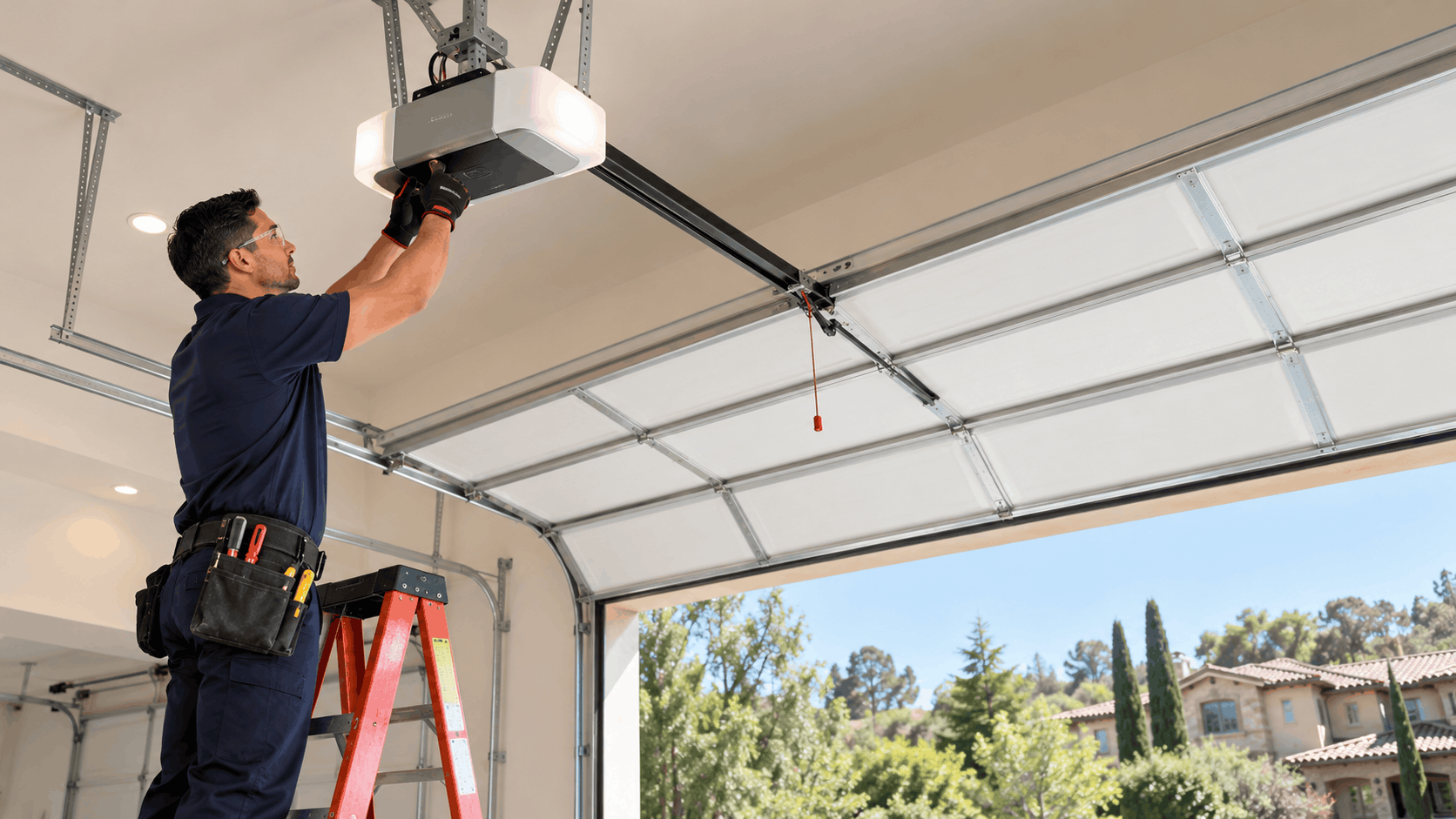
Opener work falls into predictable ranges across Orange County. The figures below are typical market ranges for the area, not a quote and not a fixed price. The actual price for a specific garage depends on that garage, and a written price is available before work begins.
These numbers give a homeowner a realistic sense of what to expect before the measuring even starts. A tall-garage job can land higher in the range for reasons the final subsection covers.
| Opener Work | Typical Orange County Range |
|---|---|
| Opener installation (belt costs more than chain) | $250 to $600 |
| Opener repair | $75 to $200 |
| Smart Wi-Fi opener and MyQ setup | $150 to $300 |
| Battery backup installation | $200 to $400 |
| Keypad and remote programming | $45 to $85 |
Typical Opener Installation and Repair Ranges
Opener installation runs $250 to $600 in Orange County, with belt drive costing more than chain drive. That spread reflects the drive type and the unit itself, so a quiet belt drive for a room above the garage sits higher in the range than a basic chain unit for a detached workshop.
Opener repair runs $75 to $200 where a fix makes more sense than a full replacement. For a unit that predates the 1993 entrapment mandate, replacement is the recommended path rather than chasing repairs on a unit that was never built to current safety standards.
Smart Wi-Fi opener and MyQ setup runs $150 to $300 for owners who want phone control and remote monitoring. On a property with multiple doors and outbuildings, being able to check and operate each door from a phone is a practical addition. Our smart Wi-Fi opener and MyQ setup covers that work.
These are typical ranges for the area, and the specific number for a given garage comes in writing before any work starts.
Battery Backup, Keypads and Remotes
Battery backup installation runs $200 to $400. Keep in mind that on a full opener replacement, the compliant unit already includes the backup because SB 969 requires it, so this range applies where a backup is being added or serviced rather than built into a new unit.
Keypad and remote programming runs $45 to $85. That covers resetting an exterior keypad code or syncing a new remote to the opener. For short-term rental hosts dealing with code turnover between guests, this is routine and inexpensive work that keeps access controlled.
Both of these are small line items next to a full opener replacement, but they come up often on these foothill properties. A rental with a guest unit, a lost remote or a changed keypad code is the kind of quick visit that keeps a property secure.
As with everything else, these are typical ranges, and the exact figure is confirmed in writing before the work begins.
What Pushes a Tall-Garage Job Up the Range
Several things can move a tall-garage opener job toward the higher end of the installation range. A longer rail or extension kit, needed because a taller door travels farther, adds parts and labor over a standard eight-foot rail setup.
A heavier custom door is the next factor. When the door's real weight calls for an opener rated to lift it, that stronger unit costs more than a basic model sized for a light tract door. The weight drives the spec, and the spec drives the price.
A jackshaft unit for limited headroom or ceiling storage is the third. These wall-mounted openers typically cost more than a standard overhead rail unit, but on a garage where headroom is tight or the ceiling is full, they solve a problem the cheaper options cannot. Where the ceiling has to stay clear, the jackshaft earns its place.
Any one of these, or a combination, moves a job up within the typical range. The measuring visit sorts out exactly which apply, and the written price reflects the real door rather than a generic estimate.
Need Help in Irvine?
Urgent Garage Doors serves Irvine and all of Orange County.
How Urgent Garage Doors Handles a North Tustin Opener Replacement
For a tall custom garage in the foothills, the work starts with getting the numbers right. Urgent Garage Doors was founded in 2017 and holds California license #1055150, verifiable free at cslb.ca.gov. The team works on all major brands, including LiftMaster, Chamberlain, Genie, Craftsman, Clopay, Amarr, Wayne Dalton and CHI.
The process is straightforward: measure the door and ceiling, confirm the weight, recommend the right drive and rail, and give a written price before work begins. For new installations there is a free on-site estimate, and removing and hauling away the old door is included when a full door is replaced.
Common torsion spring sizes ride on the trucks, so a related spring replacement is often finished on the same visit. The storefront is at 76 Ashford, Irvine, CA 92618.
Measuring the Garage and Sizing the Opener
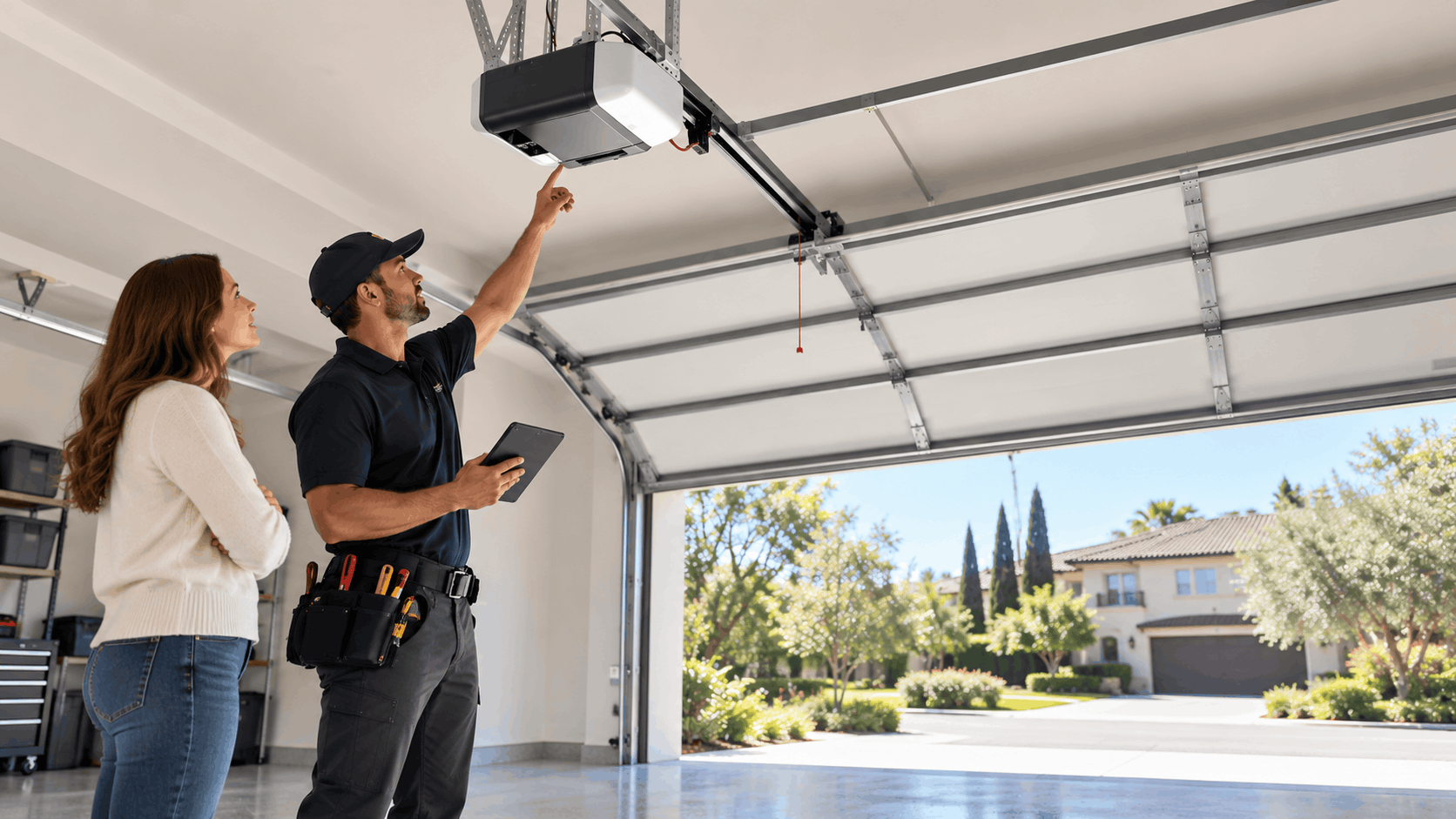
On a North Tustin estate, the first visit is about measurement, not sales. The team measures the door height and the ceiling height, checks the headroom above the open door and confirms the actual weight of the door. On these custom and oversized doors, those numbers vary house to house and set everything that follows.
From there, the recommendation falls into place. A tall door with tight headroom points toward a jackshaft unit. A door below a bonus room points toward a belt drive. The door weight sets the required motor rating, and the door height sets whether a rail extension is needed.
That sizing happens before any quote, because a spec built on guessed numbers leads to a unit that strains or a rail that does not reach. On a heavier custom door, matching the opener to the real load is what keeps the system reliable for years.
For properties with more than one door or outbuilding, each one gets its own measurement and its own spec rather than a single blanket recommendation.
Written Price and the Home Improvement Contract Rule
A written price is available before work begins, and for new door installations there is a free on-site estimate. That lets a homeowner see the number for their specific garage before committing to anything.
Separately, California Business and Professions Code section 7159 requires a written home improvement contract for work over $500. That is a legal requirement, not a company policy, and it is a different rule from the licensing threshold covered earlier. The two are easily confused but are not the same figure or the same thing.
So on most opener replacements, which sit above that $500 contract threshold, a written home improvement contract is part of how the law structures the job. The written price gives the homeowner clarity up front, and the contract puts the agreed terms in writing.
Together they mean a North Tustin owner knows the price and the scope before the first tool comes out, with the figure given in writing rather than quoted loosely on the spot.
24/7 Response Across Orange County
Urgent Garage Doors takes emergency calls and responds 24 hours a day, 7 days a week, every day of the year including holidays. When a door fails and a family cannot get a car out, that round-the-clock availability matters, especially on a steep foothill lot where the garage is often the only practical way out.
The response window is 30 to 60 minutes anywhere in Orange County, from the Irvine storefront out to the North Tustin foothills. The team works on all major brands, so an older LiftMaster, a Genie on a detached workshop or a Chamberlain on the main house are all covered.
That same emergency coverage backs up the 24/7 emergency repair work across the county. A door stuck open overnight on a hillside property is not something to leave until morning, and the crew responds any hour.
With common parts on the trucks, many jobs wrap up on the first visit rather than waiting on an ordered part.
Getting Your North Tustin Opener Replaced
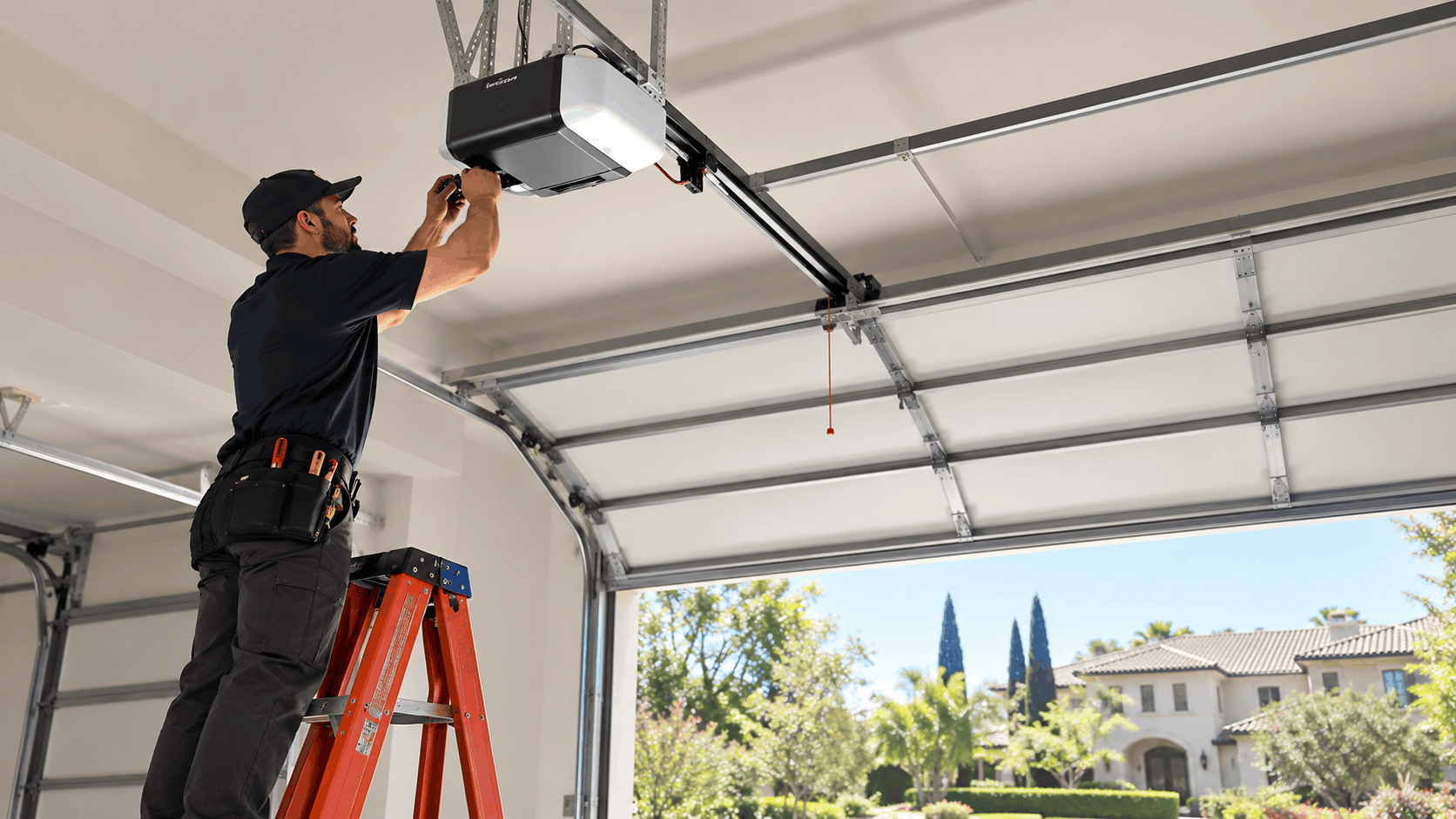
A tall custom garage in the foothills needs an opener sized to the real door, a rail long enough to reach it, and the battery backup the law requires. Urgent Garage Doors measures the door and ceiling, recommends the right drive type, and gives a written price before any work starts.
Call (949) 529-7743 to schedule a replacement or a free on-site estimate for a new installation anywhere in North Tustin and across Orange County.
Frequently Asked Questions
- Does a tall garage need a special opener?
- Yes. A taller door travels a longer distance, so it needs a longer rail or an extension kit to reach the top of its travel, plus an opener rated for the door's actual weight rather than a reused standard unit. Where headroom is limited or the ceiling holds storage, a wall-mounted jackshaft opener that drives the torsion bar directly is often the right fit, since it uses no overhead space at all.
- How much does opener replacement cost in Orange County?
- Opener installation typically runs $250 to $600 in Orange County, with belt drive costing more than chain drive. Battery backup installation runs $200 to $400, though on a full replacement the compliant unit already includes it. These are typical ranges for the area, not a quote. The actual price for a specific garage depends on the door, the rail length and the drive type, and it is given in writing before work begins.
- Do I have to get battery backup when I replace my opener?
- Yes. SB 969, signed in 2018 and operative July 1, 2019, requires every residential opener installed or replaced in California to have a battery backup designed to operate during a power outage, with a $1,000 civil penalty for violations. A replacement residential door may not be connected to a non-compliant opener. So the backup comes with the job, not as an optional upgrade. It is part of the compliant unit.
- Do I call the City of Tustin for a permit in North Tustin?
- No. North Tustin is unincorporated Orange County, not the City of Tustin, so permits, inspections and zoning run through OC Development Services rather than Tustin City Hall. A call to the city reaches an office with no jurisdiction over your address. Confirm the permit position with the county for the specific job, and note that a North Tustin Specific Plan review layer can also apply depending on the work.
- Which opener is quietest for a room above the garage?
- Belt drive openers run quieter than chain drives because a reinforced belt replaces the metal chain, removing the rattle that travels up through the floor. For a home with a bonus room, office or bedroom above the garage, a belt drive keeps that space far more peaceful. A wall-mounted jackshaft unit is another quiet option, and it also frees up the ceiling where headroom is tight or storage sits overhead.
- Why does my door reverse by itself before it closes?
- The most common cause is the photo eyes, not the opener. Those sensors sit six inches off the floor on each side, and if debris coats a lens or a bump knocks one out of alignment, the beam breaks and the opener reads it as an obstruction, reversing the door. In the North Tustin foothills, leaf litter and canyon-blown dust land on those lenses often. Cleaning and realigning the sensors usually solves it.
- Is my pre-1993 opener still legal to use?
- Openers made before 1993 predate the federal entrapment protection mandate, which covers units manufactured after January 1, 1993. California required auto-reverse earlier under AB 3600 in 1990. A pre-1993 unit is not illegal to own, but it lacks the entrapment protection every modern opener carries, and the manufacturer position is that these openers should be replaced rather than repaired. On older foothill properties, these units often turn up on detached garages.
- Is the garage door license C-28?
- No. The correct classification is C-61/D-28, Doors, Gates and Activating Devices, which covers sectional and rolling doors, spring systems, operators, control boards, safety sensors and activating devices. C-28 is Lock and Security Equipment and is not the garage door license, and this work does not require a Class B general building license. A license is verified free at cslb.ca.gov, where the classification, status, bond and workers compensation are public record.
- Can Urgent Garage Doors replace an opener the same day?
- Urgent Garage Doors offers 24/7 emergency service every day of the year, including holidays, with a 30 to 60 minute response window anywhere in Orange County. Common torsion spring sizes and parts ride on the trucks, so many jobs are completed on the first visit rather than waiting on an ordered part. The right answer for a specific opener depends on the unit and the door, which the team confirms on the visit.
- Can I get a written price before work starts?
- Yes. A written price is available before work begins, and for new door installations there is a free on-site estimate. Separately, California Business and Professions Code section 7159 requires a written home improvement contract for work over $500, which is a legal requirement rather than a company policy. For most opener replacements, which sit above that figure, the price and scope are set in writing before the first tool comes out.
Licensed garage door repair professionals serving Irvine and Orange County.
Licensed in California · License #1055150
Why trust Urgent Garage Doors?
Founded in 2017, Urgent Garage Doors is a licensed and insured garage door services serving Irvine and Orange County. All content is reviewed by our licensed technicians.

Need Help in Irvine?
Urgent Garage Doors serves Irvine and all of Orange County.
Related Articles
Garage Door Installation in Tustin Ranch: Two-Car Uniformity and Association Rules
A local guide to two-car garage door installation in Tustin Ranch, covering matching doors, HOA and ARC approval rules, materials, costs, and the install process.
Garage Door Opener Replacement Cost OC: LiftMaster vs Genie vs Chamberlain Pricing
Real garage door opener replacement cost in Orange County compared across LiftMaster, Genie, and Chamberlain, with installed pricing, features, and brand advice.
Garage Door Replacement Guide for Portola Springs Homeowners in Irvine
A local guide to garage door replacement for Portola Springs homeowners in Irvine - covering warning signs, materials, costs, HOA rules, and the install process.