What Back Bay Moisture Does to Eastside Costa Mesa Garage Door Springs, Cables and Hinges
Key Takeaways
- Higher humidity near Upper Newport Bay corrodes springs, cables and hinges, bringing them to the end of their cycle rating sooner than inland hardware.
- A standard torsion spring is rated around 10,000 cycles, roughly seven years at four cycles a day, and corrosion shortens the practical life.
- Cables corrode from the inside out near the water, so they fray before they snap, making a frayed cable a hidden hazard worth catching early.
- Never adjust or replace a torsion spring yourself; run the balance, 2x4 auto-reverse and photo-eye tests instead.
- Typical Orange County ranges include torsion spring replacement $150 to $300, cable repair $150 to $300 and a preventive maintenance visit $99 to $149.
- Detached alley garages behind Eastside cottages often need wiring for an opener, and access must be confirmed before dispatch.
- Urgent Garage Doors holds California license #1055150 (C-61/D-28), offers 24/7 service with a 30 to 60 minute response window, and gives a written price before work begins.
In This Article
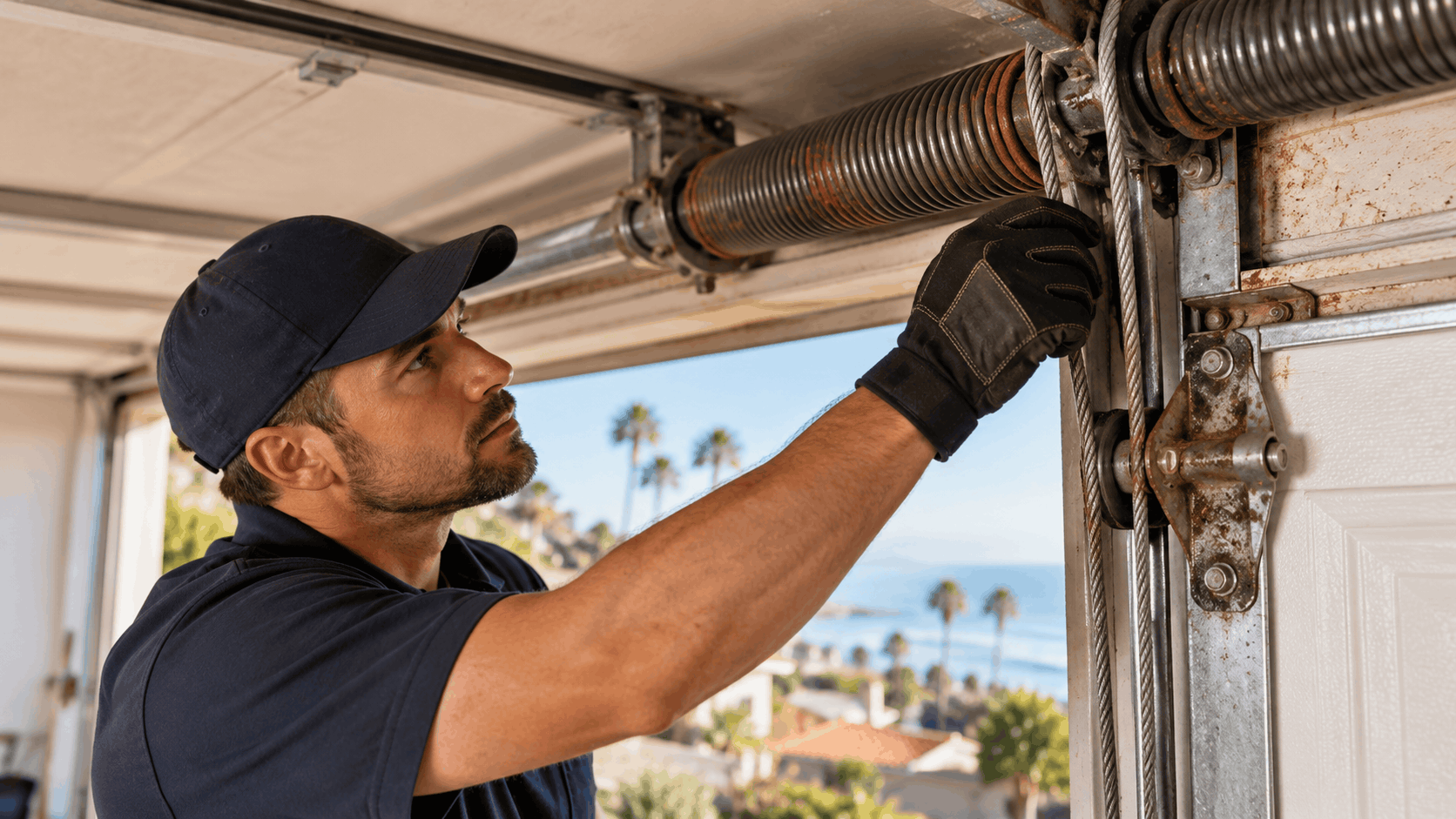
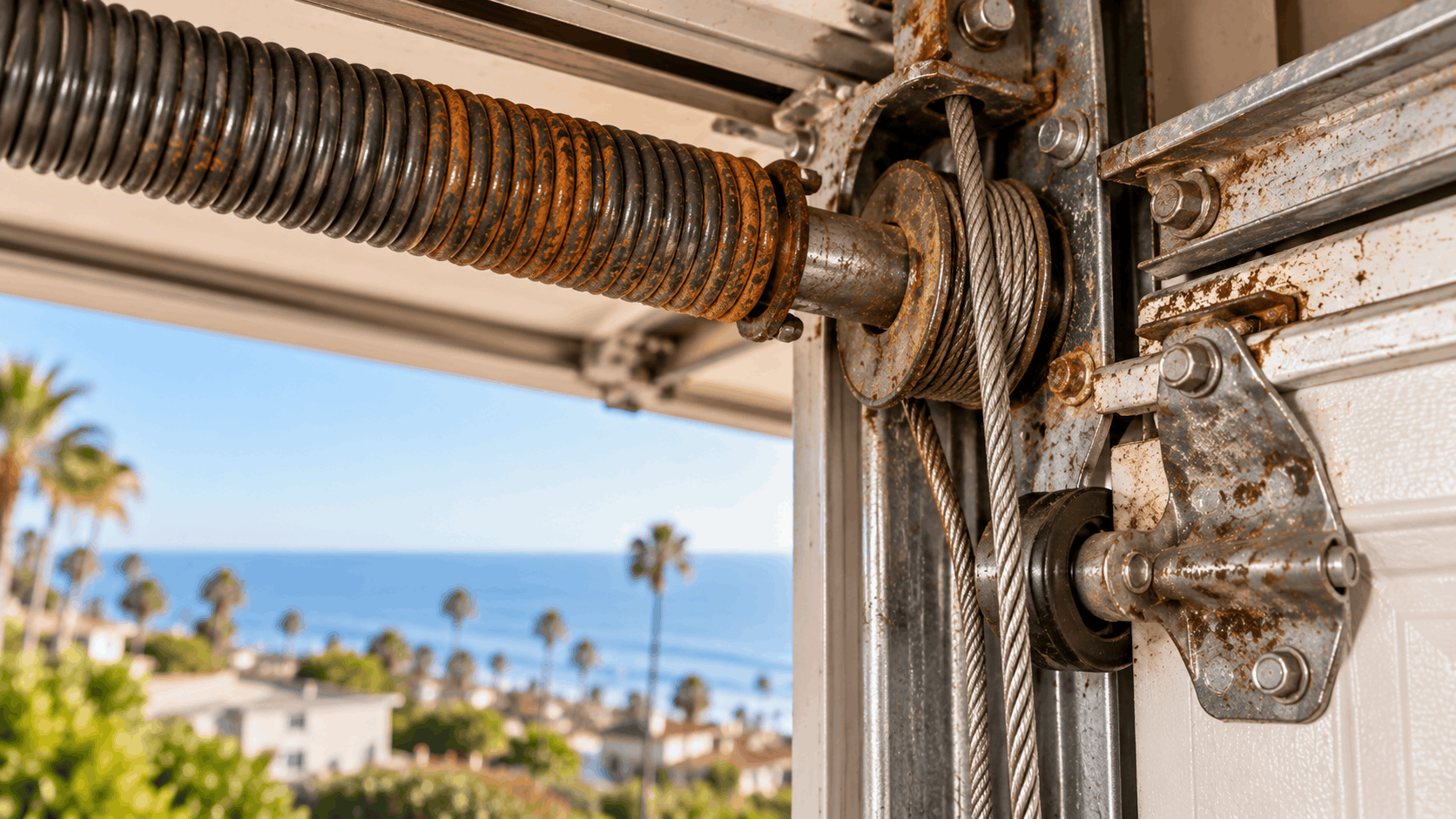
A homeowner off 17th Street walks into the garage one morning, flips on the light, and sees a reddish-brown bloom crawling across the torsion spring above the door. The coils that used to look clean and gray now wear a crust of rust. This is one of the first things people notice on the Eastside, and it is not cosmetic. It is the early sign that the single most loaded part of the door is aging on a faster clock than it would a few miles inland.
Here is the short answer to why that happens. Eastside Costa Mesa sits close to Upper Newport Bay, so the air here carries more moisture than the inland tracts of the same city. That humidity settles on bare and plated steel, and over time it corrodes the springs, cables and hinges. Corrosion does not change the manufacturer's cycle rating of a part, but it brings that part to the end of its rating sooner than a dry one would reach it.
Why Back Bay Air Reaches Eastside Garages in the First Place?
The reason Eastside hardware corrodes faster comes down to geography, not bad luck. The neighborhood runs along and south of the 17th Street corridor toward the Newport Beach border, close enough to Upper Newport Bay that the coastal air carries more water vapor than you find in the drier inland pockets of Costa Mesa. That difference in Back Bay humidity is small on any given day but constant across the years, and metal hardware feels the sum of it.
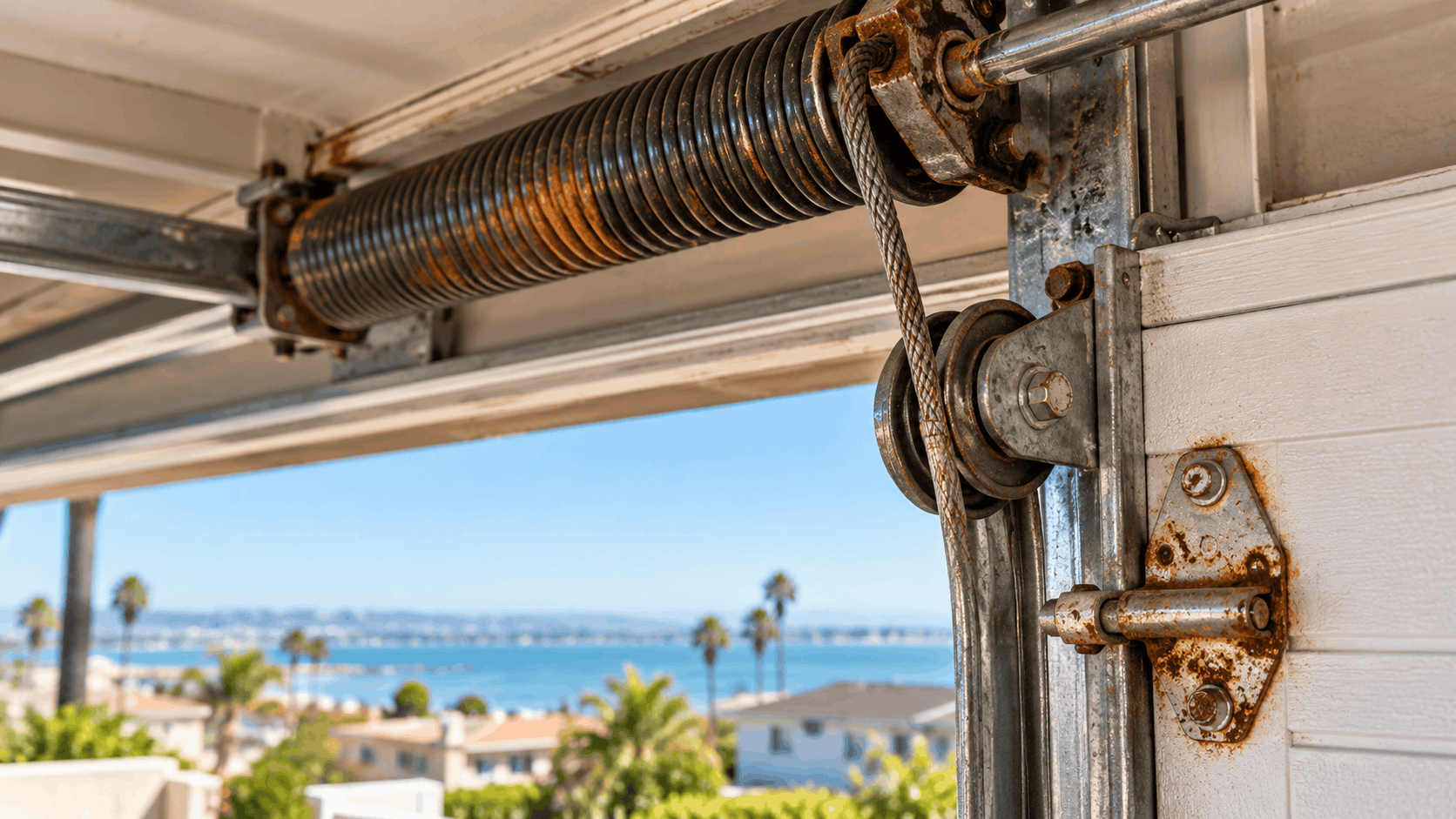
Corrosion is an electrochemical reaction. Moisture, oxygen and the iron in steel combine to form iron oxide, the flaky orange layer most people call rust. Each time that layer forms, it eats into the surface of the metal and then flakes away, exposing fresh steel underneath to start the cycle again. On a spring that is wound tight and cycled daily, that slow loss of healthy metal matters, because the part is carrying the full weight of the door every time it moves.
| Factor | Inland Costa Mesa tracts | Eastside near the Back Bay |
|---|---|---|
| Ambient humidity | Lower, drier air | Higher, closer to Upper Newport Bay |
| Surface condition of bare steel | Slower to bloom rust | Corrodes sooner |
| Parts most affected | All hardware, more gradually | Springs, cables, rollers show it first |
| What predicts it | Distance from the water | Distance from the water, not the city line |
How Close Eastside Sits to Upper Newport Bay
Eastside Costa Mesa lies east of Newport Boulevard, State Route 55, and west of Irvine Avenue, inside ZIP code 92627. The neighborhood is crossed by 17th Street, 19th Street, Orange Avenue, Santa Ana Avenue and Tustin Avenue, with the Newport Beach city line along its southern edge. Beyond Irvine Avenue to the southeast sits Upper Newport Bay, the Back Bay that gives the area its character and its damp air.
That proximity is the whole story. A garage a few blocks off Irvine Avenue breathes moister air than one near the 55 freeway, even though both sit in the same city and pay taxes to the same building department. The water is what drives corrosion, so the nearer a property sits to the bay, the more of it the hardware absorbs over a lifetime of open and close cycles.
The honest rule for Costa Mesa is that distance from the water, not the city line, predicts humidity exposure. Two houses on opposite ends of 92627 can age their springs on noticeably different timelines. When we quote a job on the Eastside, we read the hardware in front of us rather than assuming every garage in the ZIP is the same.
For owners near the Newport Beach border, the same coastal pattern carries across the line, which is why our work in Newport Beach deals with the same corrosion story. The bay does not stop at a municipal boundary.
What Humidity Does to Spring Steel and Cable Wire
Higher moisture shows up first and most clearly on springs, cables and rollers. These parts are made of spring steel and stranded steel wire, both of which rely on a clean, healthy surface to carry load and move freely. When humidity settles on them, the surface begins to oxidize, and the smooth finish turns to a rough, scaly crust.
On spring steel, that corrosion matters because the spring is under constant tension. Every pit and flake removes a tiny bit of the cross section that was carrying the load. The spring still works, but it is working with less healthy metal than the day it was wound, and the manufacturer's cycle rating was based on healthy metal. That is the mechanism, and it does not depend on any claimed multiplier of how much faster a part fails at a given distance from the coast.
Cable wire corrodes the same way, with an extra twist that we cover in detail below. The point for now is that the damp air does not care which part it lands on. Springs, cables and rollers all sit in the path of the moist air inside an unconditioned garage, and all three carry the marks of it sooner on the Eastside than on comparable hardware further inland.
What the repair solves is simple. Replacing corroded springs and cables with fresh, properly sized hardware resets the clock and restores the full load capacity the door was designed around.
Why Detached Alley Garages Catch It Worse
A large share of Eastside garages are alley-loaded or rear-loaded, and many are detached structures standing behind the cottage rather than attached to it. That building pattern is part of the neighborhood's postwar character, and it changes how much damp air the hardware sees.
A detached garage is an unconditioned box. It has no shared wall with heated living space, no furnace cycling nearby, and often no insulation to speak of. So the air inside tracks the outside air closely, which on the Eastside means it holds the Back Bay moisture through the cool, damp mornings common near the water. The hardware inside sits in that air around the clock.
An attached garage at least borrows a little warmth and air exchange from the house it shares a wall with. A detached one does not. That is why the springs, cables and hinges in a detached alley garage behind an Eastside cottage often show corrosion earlier than the same parts in an attached garage a street away.
Access is the other wrinkle. A detached, alley-loaded garage means a service truck works from a narrow lane, and that has to be confirmed before anyone drives out. We cover how we handle that later in this guide.
Get Your Free Quote
Tell us about your garage door and we'll get back to you within 30 to 60 minutes.
What Corrosion Does to Torsion and Extension Springs?
The spring is the part that does the heavy lifting, literally. A torsion spring mounted on the bar above the door, or a pair of extension springs running along the horizontal tracks, stores the energy that counterbalances the door's weight so the opener or your arm only has to nudge it. When corrosion attacks that spring, it is attacking the one component the whole door depends on.
Rust on a spring is not just ugly. It is lost material. A corroded spring has less healthy steel in each coil than it had when it was new, and because it is cycled tight every day, that loss pushes it toward failure earlier than a clean spring in dry air would reach the same point. The result is a spring failure that arrives ahead of schedule.
Cycle Rating and Why Rust Shortens It
Manufacturers rate springs in cycles, where one cycle is a single full open and close. A standard residential torsion spring is commonly rated around 10,000 cycles. For a door that runs about four times a day, that works out to roughly seven years of service before the spring reaches the end of its rating.
That rating assumes healthy steel working in reasonable conditions. Corrosion changes the condition. As rust pits and flakes the coils, the spring loses cross section and the metal fatigues against a surface that is no longer smooth. The 10,000-cycle number does not go down on paper, but the real spring reaches the end of that rating earlier than the calendar would suggest.
There is no honest multiplier that says a coastal spring lasts exactly half as long. What we can say plainly is that corrosion brings a spring to the end of its cycle rating sooner, and that on the Eastside we see it happen. When we inspect a spring, we read both its age and its condition, because a seven-year-old spring near the Back Bay may be further along than a seven-year-old spring inland.
This is why we state the rating and the age rather than guessing at a failure date. A torsion spring replacement gives the door a fresh cycle budget to spend.
The Signs an Eastside Owner Can See and Hear
The clearest early sign is the rust itself. Owners describe it as a reddish crust on the coils, and sometimes they see rust flaking off and settling on the garage floor below the spring. That flaking is the surface shedding corroded metal, and it means the spring is losing material.
A broken spring is impossible to miss. When a torsion spring lets go, it releases its stored energy all at once, and people describe it as a loud bang or a gunshot sound from the garage, sometimes while no one is even near the door. After a break you will often see a clear gap in the spring where the coils separated.
Before it breaks outright, a tired spring makes the door feel heavy. The opener may strain, the door may rise slowly or stop partway, and lifting it by hand suddenly takes real effort. That heavy door feeling is the counterbalance failing, and it is a cue to stop using the door and call for a look.
If you hear that bang or find a gap in the coils, treat the door as out of service. A door with a broken spring can be dangerously heavy and unpredictable, and that is squarely a job for our emergency repair team.
Why You Should Never Touch the Spring Yourself
A torsion spring stores enough energy to cause serious injury. It is wound tight against a fixed cone and held with winding bars, and all of that stored force is waiting to release if the spring is handled wrong. This is the one component on the door we tell every homeowner never to adjust, wind, unwind or replace.
The danger is not theoretical. The bars used to wind these springs can be thrown with real violence if they slip, and the spring itself can whip loose. People have been badly hurt trying to save a service call on a part that needs the right tools and training to handle safely.
Extension springs carry their own risk. They stretch along the tracks under heavy tension, and a failed extension spring can fly across a garage. Even on a door that uses extension rather than torsion springs, the safe answer for an owner is hands off.
Instead of touching the spring, run the safe checks we describe later, the 2x4 auto-reverse test and the photo-eye test. Those tell you whether the door is behaving safely without ever putting your hands near the stored energy.
High-Cycle Springs for Heavy or Daily-Use Doors
Not every door should go back on a standard 10,000-cycle spring. Where a garage serves as the household's main entrance and the door cycles many times a day, or where the door itself is heavy, high-cycle springs rated for more open-and-close cycles are available and often the smarter choice.
The math is straightforward. A door that cycles eight or ten times a day burns through a 10,000-cycle rating in a few years. Stepping up to a high-cycle spring spreads the same daily use over a longer service life, which matters more on the Eastside where corrosion is already shortening the practical life of whatever is installed.
Springs are always sized to the actual door, not pulled off a shelf at random. The weight and the height of the door set the spring's wire size, inside diameter and length. Get that match wrong and the door is either hard to lift or slams when it closes, and the spring wears out fast.
This is especially important after a door swap. We cover matching springs to a new, heavier door later, but the principle starts here: the spring has to fit the door it is lifting.
Need Help in Irvine?
Urgent Garage Doors serves Irvine and all of Orange County.
Why Cables Fail From the Inside Out Near the Water?
Lift cables are the quiet partners of the springs. They run from the bottom bracket of the door up to the drums on the torsion bar, translating the spring's stored energy into the smooth lift of the door. On the Eastside, these cables are one of the most under-watched casualties of the damp air.
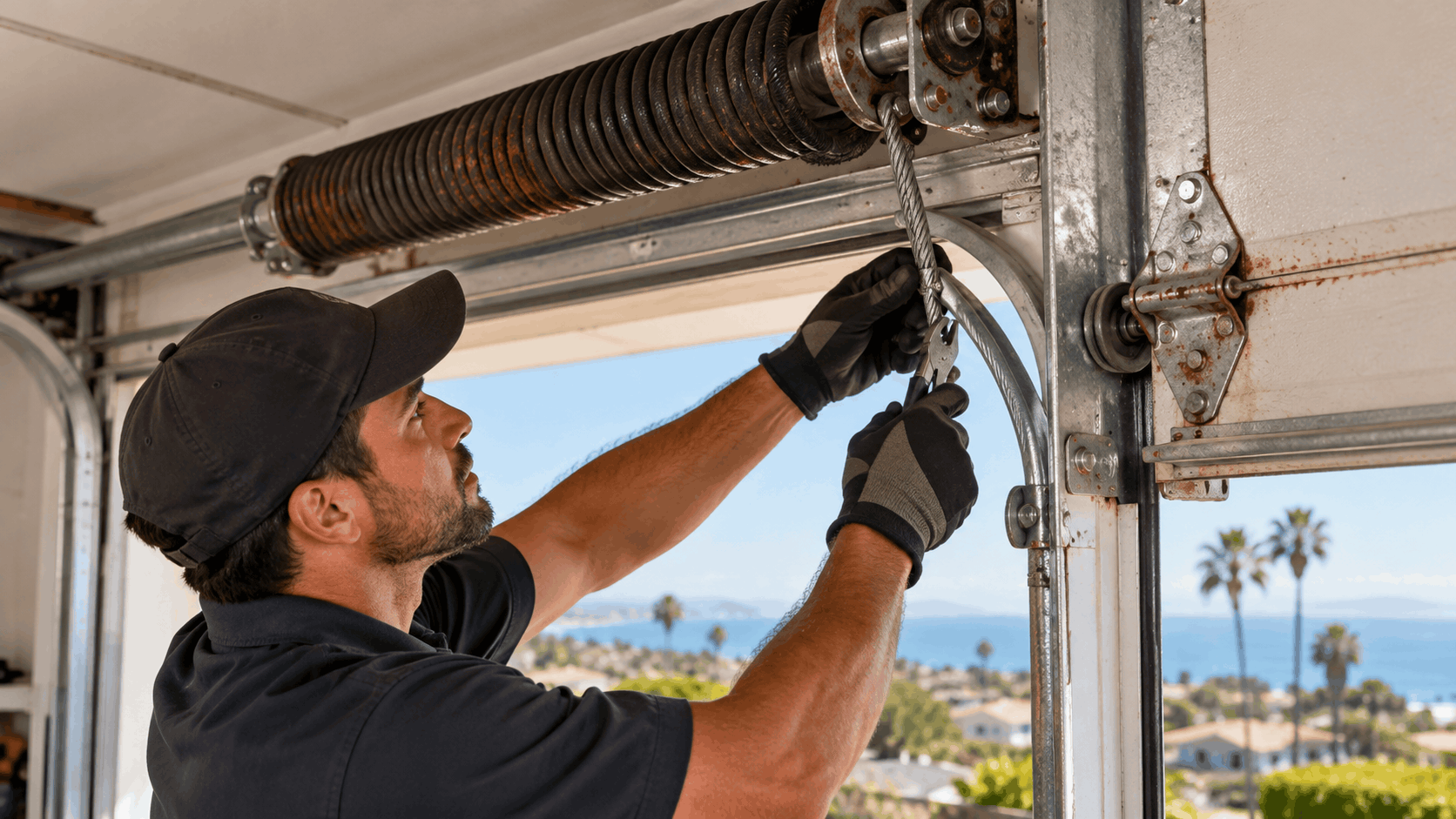
The trouble with a corroding cable is that it does not usually snap cleanly the way a spring does. Near the water, cables corrode from the inside out, and a corroded cable frays before it lets go. That makes a failing cable a hidden hazard, because the warning signs are subtle right up until the moment it gives way.
How Moisture Gets Into a Stranded Cable
A lift cable is not a solid rod. It is many thin steel wires twisted together into strands, and those strands twisted again into the finished cable. That construction gives the cable its strength and flexibility, but it also leaves tiny gaps between the wires.
Moisture works its way into those gaps. On the Eastside, the humid air reaches the inner strands where you cannot see them, and corrosion starts on the inside of the cable before it ever shows on the surface. By the time rust is visible on the outside, the interior may already be well along.
Because the damage begins inside, the cable frays rather than breaking in one clean piece. Individual inner wires rust through and pop, and you start to see broken whiskers of wire sticking out from the cable, a sign we call fraying. Each broken strand is load the remaining wires now have to carry.
That is why a cable near the water deserves attention before it looks dramatic. A few frayed strands mean the inside is further gone than the outside shows, and a cable repair caught at that stage is cheap insurance.
Why a Spring Job Must Include a Cable Check
Cables, drums, rollers and bearings all wear alongside the springs. They sit in the same damp air, they move through the same cycles, and they age together. Replacing a spring without inspecting the cables is how a second failure follows weeks later, when the fresh spring is suddenly pulling against a cable that was already on its way out.
We treat the spring and the cable as a system, not as two separate repairs. When we are up on a ladder swapping a corroded spring, the cables, drums and bearings are right there, and a few extra minutes of inspection catches a frayed cable before it becomes a callback and a second trip charge.
The drums deserve a look too. These grooved pulleys at each end of the torsion bar guide the cable as the door moves, and a corroded or worn drum chews up even a new cable. Checking them while the hardware is apart is simply good practice.
For the owner, the lesson is to ask that any spring job include a full cable inspection. It is the difference between one repair and two.
What a Broken Cable Does to a Door
When a cable fails, the door loses support on one side. The result is an off-track door, often hanging at an angle with one bottom corner dropped and the rollers pulled out of the track. It is an alarming sight and an unsafe one.
A door in that state can be heavy, jammed, and liable to fall or shift if someone tries to force it. The safe move is to stop using it and keep people and cars clear until it can be reset properly. Forcing an off-track door usually bends track and damages panels, turning a cable repair into a bigger bill.
A frayed cable found early is cheaper and safer than one that lets go on a closing door. When a cable snaps mid-close, the door can come down hard and crooked, and that is the scenario that damages panels and track. Catching the fray during a routine look avoids all of it.
If a door has already gone off its track, that is a job for our off-track repair service, which resets the door and replaces the failed cable in one visit.
Rollers, Hinges, Bearings and Tracks in Damp Air
The springs and cables get the attention because they carry the load, but a garage door is also a collection of smaller moving parts, and every one of them corrodes in humid air. Rollers, hinges, bearings and tracks are what turn a quiet, smooth door into a noisy, dragging one when corrosion sets in.
These parts are easy to ignore because they rarely fail dramatically. Instead they announce themselves slowly, with noise and roughness, and that noise is worth listening to. It is usually the first thing an owner notices before anything bigger goes wrong.
Why Hinges and Rollers Start Squealing
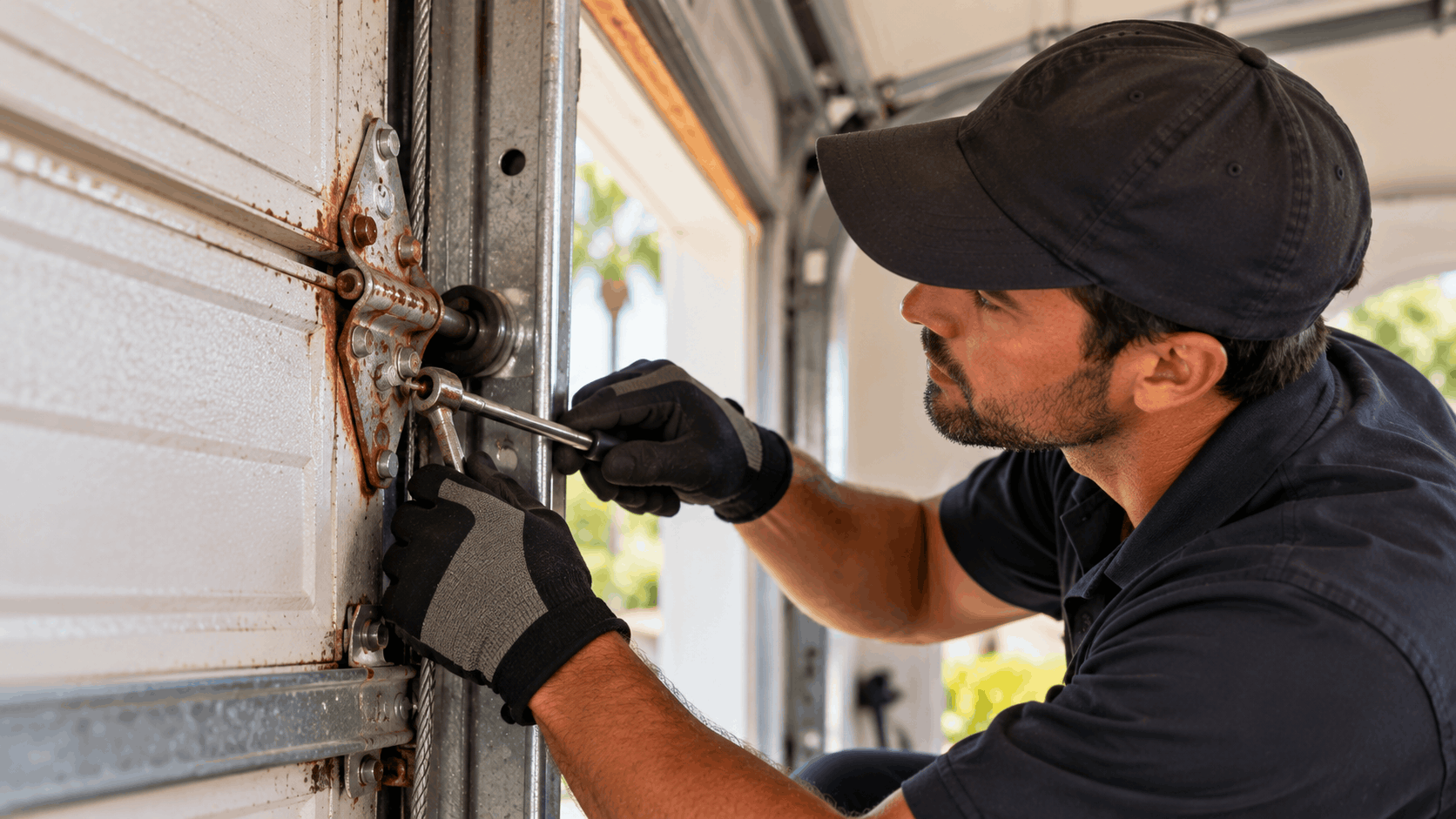
Each section of a sectional door is joined to the next by hinges, and the door rides up and down on rollers whose stems sit in those hinges and in bearings. When corrosion coats the hinge pins, the roller stems and the bearings, the metal-on-metal contact stops being smooth.
That is when a door starts squealing and grinding. Owners describe it as a chatter or a shriek, usually loudest in the morning when everything is cold and damp. The sound is friction, and friction is wear, so the noise is doing real harm each time the door moves.
The important thing to understand is that squealing hinges are an early warning, not just an annoyance. A door that grinds is telling you its moving parts are corroded and binding, and parts that bind wear out faster and can seize. Addressing it early with cleaning, lubrication or replacement of the worst rollers is far cheaper than waiting for a seizure.
On the Eastside, where the damp air keeps hinges and bearings corroding, this noise shows up sooner and comes back faster. It is one of the clearest signals that a door needs a maintenance look.
Rust and Debris in the Tracks
The tracks are the steel channels the rollers ride in, and they take a double hit on the Eastside. The damp air corrodes the inside of the track, and wind carries dust and plant debris in through the alley and the open door, where it settles and packs into the channel.
When rust and grit coat the track, the rollers bind. Instead of rolling freely, they drag, catch and skip. The door that used to glide now sticks, jerks, or stops partway up, and the opener strains against the resistance.
A binding door is not just inconvenient. The extra load falls back on the opener, the springs and the cables, so a neglected track quietly ages the parts around it. A door that stops partway can also be a sign that the opener's safety reverse is tripping on the resistance, which is worth checking.
Cleaning the track and realigning it where it has shifted restores the smooth travel, and that is the job of our track repair and realignment service. On the Eastside it is work that pays to repeat as part of regular maintenance.
Seals, Weatherstripping, and the Gap Under the Door
The bottom seal is the flexible strip along the base of the door that flattens against the slab to keep water, dust and pests out. In the alleys and lanes of the Eastside, wind carries grit into that seal, and over time the debris packs into it so it no longer flattens properly. A seal that cannot flatten leaves a gap.
That gap matters more in some parts of Costa Mesa than others. Portions of the city near the Santa Ana River, Fairview Park and the lower-lying neighborhoods fall within FEMA-designated Special Flood Hazard Areas. In a flood-prone pocket, the bottom seal, the threshold and the gap under the door are what stand between a wet driveway and a flooded garage floor.
For an owner in a mapped flood area, that changes the fix. Rather than just swapping a tired seal, it can be worth upgrading the threshold, the raised strip bonded to the slab that the seal presses against, to give the door a better chance of keeping water out. Owners can check their flood zone status at the FEMA Flood Map Service Center, and the city's Public Services Department can advise on local floodplain requirements.
Weatherstripping around the sides and top of the door does the same job against drafts and driven rain, and it ages the same way in the damp. Replacing seals and weatherstripping is handled under our weatherseal and insulation retrofit service.
Why Postwar Cottage Hardware Is Already Past Its Life
Eastside Costa Mesa is a neighborhood of postwar cottages, bungalows and ranch houses, many of them around seventy years old. The original springs, cables, drums, track, rollers and hinges on a garage that age are long past their design life, corrosion or not. Add the Back Bay air and the math only gets worse.
These older garages also carry undersized openings by modern standards. Fitting a current door can mean a custom width or reframing the opening, and the earliest door profiles are a particular problem because replacement panels for them are generally discontinued. When a single panel is damaged on a door that old, there may be no matching panel to buy.
That is why partial repair is often off the table on the oldest cottage doors. If the whole hardware set is corroded and past life and the panels cannot be matched, piecing the door back together costs more over time than replacing it and does not solve the underlying age problem.
Where a door can be saved, replacing the worn hardware restores it. Where it cannot, a full door installation is the honest answer, and we will tell an owner which situation they are in.
Safety Checks an Eastside Homeowner Can Run
There are three simple tests any homeowner can run to catch moisture-driven wear before a part fails, and none of them require touching the spring. They take a few minutes and tell you a lot about the health of the door. Run them a couple of times a year, and more often if you live close to the bay.
These are the same checks we run on every service visit, so they are a good way to know whether it is time to call. If a door fails any of them, stop using it until it has been looked at.
The Balance Test for Spring Health
The balance test tells you whether the springs are still doing their job. Start by closing the door, then pull the release cord to disconnect the opener so the door moves freely by hand. Lift the door to about waist height and let go.
A correctly balanced door stays put where you leave it. The springs are holding the weight, which is exactly what they are supposed to do. If the door holds, the counterbalance is healthy.
If the door drops to the floor or rises on its own, that is a spring problem, not an opener problem. The counterbalance has weakened, often because corrosion has aged the spring, and the door is no longer balanced. That is your cue to call for a look rather than relying on the opener to fight a heavy door.
When you are done, reconnect the opener by running the door through one cycle, and keep hands clear of the spring at all times. If the test fails, our door balancing and tension adjustment service sets it right.
The 2x4 Auto-Reverse Check
The contact-reverse system is what makes the door reverse when it hits something. To test it, lay a flat 2x4 across the opening on the floor, right in the door's path, then close the door with the opener.
When the bottom of the door touches the 2x4, it should reverse within two seconds. This is the manufacturer's safe check, and it confirms the door senses an obstruction and backs off rather than crushing it. A door that does not reverse, or that keeps pushing, has a safety fault that needs attention.
This matters because the contact-reverse is one of the two entrapment-protection systems every modern opener relies on. California has required openers to be built with an automatic reverse device and sensor since AB 3600 in 1990, and federal law covers openers manufactured after January 1, 1993. An opener that fails this test is not protecting anyone.
If the door fails the 2x4 check, do not keep using it with people or pets around. Have the opener and the door's travel limits checked so the reverse works as designed.
The Photo-Eye Test and What Trips It
The photo eyes are the small sensors mounted on each side of the opening, no higher than six inches off the floor, that project an invisible beam across the doorway. To test them, start the door closing and wave an object through the beam near the floor. The door should stop and reverse at once.
Photo-eye faults, misalignment and blocked beams are the most common cause of a door that reverses for no visible reason. On the Eastside, that often comes down to debris on the sensor lens. Wind carries dust and plant material onto the lenses, and a coated lens breaks the beam just as a real obstruction would, so the door refuses to close or reverses partway down.
The first fix is usually the simplest. Wipe each lens clean with a soft cloth and check that the two sensors are aimed at each other, with their indicator lights steady rather than blinking. A gentle bump can knock a sensor out of alignment, and damp conditions can corrode the brackets that hold them.
If cleaning and realigning do not restore normal operation, the sensors or their wiring may need service, which is handled by our safety sensor alignment and repair service.
Need Help in Irvine?
Urgent Garage Doors serves Irvine and all of Orange County.
What It Costs to Fix Corroded Springs, Cables and Hinges?
Knowing the typical ranges helps an Eastside owner plan before anyone picks up a wrench. The figures below are typical market ranges for garage door work in Orange County. They are not a quote and not a fixed price from us. The actual price for a specific garage depends on that garage, and it is given in writing before work begins.
We list them here so a reader can match a likely repair to a likely range and avoid sticker shock. Because corrosion tends to hit several parts at once near the water, more than one of these may apply to a single door.
| Repair | Typical Orange County range |
|---|---|
| Torsion spring replacement | $150 to $300 |
| Extension spring replacement | $150 to $250 |
| Spring conversion | $150 to $350 |
| Cable repair | $150 to $300 |
| Off-track door repair | $125 to $275 |
| Track repair and realignment | $125 to $300 |
| Quiet roller and hardware upgrade | $150 to $300 |
| Preventive maintenance visit | $99 to $149 per visit |
| Door balancing and tension adjustment | $75 to $150 |
| Weatherseal and insulation retrofit | $150 to $400 |
Spring Replacement Ranges
For springs, the typical Orange County ranges are torsion spring replacement $150 to $300, extension spring replacement $150 to $250, and spring conversion $150 to $350. A spring conversion is the job of changing a door from an extension-spring setup to a torsion-spring setup, which many owners choose for smoother, safer operation.
What moves a job within those ranges is the door itself. Springs are sized to the actual weight and height of the door, so a heavier door needs a heavier spring, and a wider door may need a longer one. Those differences in the hardware show up in the price.
On a door that has two springs, replacing both at once is usually the sensible call, because the second spring has lived the same corroded life as the first and is likely close behind. Doing them together avoids a second visit a short time later.
Whatever the configuration, the price for a specific door is confirmed in writing before the work starts, so there are no surprises once the job is underway.
Cable, Roller and Hardware Ranges
For the surrounding hardware, typical Orange County ranges are cable repair $150 to $300, off-track door repair $125 to $275, track repair and realignment $125 to $300, and a quiet roller and hardware upgrade $150 to $300. These are the parts that most often ride along with a corroded spring job on the Eastside.
A cable repair covers replacing the lift cables and setting them correctly on the drums. If a cable failure has already pulled the door off its track, the off-track repair resets the door and its rollers so it runs in the channel again.
The quiet roller and hardware upgrade is worth mentioning on this subject because corroded, worn rollers are a big part of what makes a door loud. Swapping them for nylon rollers and fresh hinges is one of the most satisfying upgrades on an older cottage door, and it directly addresses the grinding and chatter.
Where several of these overlap, bundling them into one visit is more efficient than separate trips. Our maintenance and upgrades service covers the roller, hinge and track side of the work.
Maintenance and Weatherseal Ranges
For upkeep, the typical ranges are a preventive maintenance visit $99 to $149 per visit, door balancing and tension adjustment $75 to $150, and a weatherseal and insulation retrofit $150 to $400. These are the jobs that slow corrosion-driven wear rather than reacting to a failure.
A preventive maintenance visit is the best value on this list for an Eastside owner, because it catches corrosion on multiple parts in one trip. Each visit includes a written report of what was found and what is recommended, so the owner has a clear record rather than a verbal rundown at the door.
The weatherseal and insulation retrofit covers the bottom seal, side and top weatherstripping, and insulation where it applies. For owners in the flood-prone pockets near the Santa Ana River, upgrading the threshold falls in this area of work.
As with every job, the price for a specific garage is given in writing before work begins. The ranges above tell you what to expect, not what you will pay to the dollar.
Keeping Moisture Damage From Coming Back
Replacing corroded parts fixes today's problem. Keeping the damage from coming back is a matter of regular maintenance, because the Back Bay air is not going anywhere. On the Eastside, a door that gets looked after on a schedule stays quiet, safe and reliable far longer than one left alone until something breaks.
The goal of maintenance here is to slow the corrosion-driven wear and catch the parts that are aging before they fail. A little attention a couple of times a year goes a long way against constant humidity.
What a Maintenance Visit Checks and Lubricates
A proper maintenance visit covers the whole moving system. We inspect and lubricate the springs, cables, rollers, hinges and bearings, so the metal parts move smoothly and the fresh lubricant helps shed moisture rather than letting it sit and corrode.
Cleaning is as important as lubrication on the Eastside. We clean the tracks of the rust and grit that make rollers bind, and we wipe the sensor lenses that debris loves to coat. A clean track and a clean lens prevent two of the most common nuisance faults in one pass.
Balance gets checked and adjusted too, because a door that has drifted out of balance puts extra strain on every part. Catching that early protects the springs and the opener from working harder than they should.
Every preventive maintenance visit ends with a written report of what was found and what is recommended, so the owner knows exactly where the door stands. Our preventive maintenance plan keeps that on a schedule.
Matching New Hardware to the Door
When a door is replaced with a heavier model, the springs have to match the new weight. A replacement door in a heavier material, insulated steel instead of a thin single-layer panel, for example, weighs more, and it needs springs sized to that weight rather than the old set reused.
Reusing an old spring set after a door swap invites early failure. The old springs were calculated for the old door's weight, so against a heavier door they are undersized, they struggle, and they wear out fast. It is a false economy that often leads to a broken spring within a season.
Matching springs to the door is a calculation based on the door's weight and height, not a guess. We weigh or calculate the door and fit springs rated for it, which is the only way the counterbalance works correctly and the door lasts.
This is a routine part of any insulated steel door installation, where the heavier panels make correct spring sizing non-negotiable.
When Repair Stops Making Sense on an Old Cottage Door
There comes a point on a seventy-year-old cottage door where repair stops adding up. When the panels for the earliest profiles are discontinued and cannot be matched, and the whole hardware set is corroded and past design life, a full replacement beats chasing one failure after another.
The signal is usually a combination. A broken spring on a door whose cables are frayed, whose rollers grind and whose panels cannot be sourced is telling you it has reached the end. Fixing one part just moves the next failure a few weeks down the line.
The Eastside wrinkle is the undersized openings common on postwar cottages. A current door may call for a custom width, and in some cases the opening has to be reframed to fit modern hardware. Reframing is structural work that can trigger a city permit, which we flag at the quote so there are no surprises.
When replacement is the right call, our sectional door replacement service handles the full job, including hauling away the old door.
Need Help in Irvine?
Urgent Garage Doors serves Irvine and all of Orange County.
How Urgent Garage Doors Handles Corroded Hardware on the Eastside
Working a corroded spring, cable and hinge job on the Eastside is not the same as working one in a newer tract with a wide driveway. The alleys, the detached garages and the age of the hardware all shape how we approach the visit, and getting those details right before we arrive makes the repair go smoothly.
Our aim is a clean diagnosis, an honest written price, and a repair that solves the underlying corrosion rather than patching one symptom. Here is how that works in this neighborhood.
Confirming Alley Access Before Dispatch
Because so many Eastside garages are rear-loaded, a service truck often has to work from a narrow lane rather than a driveway. That means limited turning room, and neighbors' bins and parked cars in play. We confirm access before the truck heads out so we are not stuck in a lane that cannot fit the vehicle.
A quick conversation about the alley, the width, where to park and whether anything blocks the approach, saves everyone time. It is a small step that prevents a wasted trip on a job that is otherwise straightforward.
Detached garages add a second question. Many detached cottage garages have no existing opener and no wiring run to the structure, so adding an opener is an electrical job as well as a door job. We raise that at quoting rather than surprising the owner on the day.
Knowing the access and the wiring situation up front lets us bring the right equipment and quote the real scope.
Diagnosis, Truck Stock, and Same-Visit Repairs
On arrival we check the springs, cables and hinges together, because on the Eastside they corrode as a set and reading one without the others leads to callbacks. The balance of the door, the condition of the cables and drums, and the state of the rollers all go into the diagnosis.
We carry common torsion spring sizes on the truck, so many spring jobs are completed on the same visit rather than waiting on a parts order. That is a real advantage for a household whose garage is the main way in and out, though the exact outcome depends on the door and the parts it needs.
Before any tools come out on the actual repair, we give a written price so the owner knows the cost before the work begins. Separately, California law requires a written home improvement contract for work over $500, which is a legal requirement rather than a company courtesy.
If the job turns out to need parts we do not stock for an unusual door, we say so and schedule the return rather than guessing.
Licensing, Response Window, and Service Area
Garage door work in California is licensed by the Contractors State License Board under classification C-61/D-28, Doors, Gates and Activating Devices. That scope covers sectional doors, torsion and extension spring systems, operators, control boards, safety sensors and activating devices. Urgent Garage Doors holds California license #1055150, which anyone can verify free at cslb.ca.gov, where the classification, status, bond and workers compensation are public record.
We run emergency calls 24 hours a day, 7 days a week, every day of the year including holidays, with a response window of 30 to 60 minutes anywhere in Orange County. We work out of the storefront at 76 Ashford in Irvine, which keeps the Eastside well within reach.
For the full picture of our emergency coverage, see our 24/7 emergency repair service. For broader coverage of our work across the county, the locations page lays out the service area.
Permits are decided by the city with jurisdiction over the specific address, so for anything that touches the opening we confirm the position for that property rather than assuming a county-wide rule.
Protect the Door Before the Next Rust Bloom
If the springs, cables or hinges on an Eastside garage are showing rust, running the door heavy, or grinding on damp mornings, have them read before a part lets go. Call Urgent Garage Doors at (949) 529-7743 and we will confirm alley access, diagnose the spring, cable and hinge system together, and give you a written price before the repair starts.
Frequently Asked Questions
- Does Back Bay humidity really corrode garage door springs faster?
- Yes. The higher humidity near Upper Newport Bay shows as faster corrosion on springs, cables and rollers than on comparable hardware further from the water. That corrosion eats into the metal, which brings the parts to the end of their manufacturer cycle rating earlier than a dry one would reach it. There is no fixed multiplier, but the pattern is real on the Eastside, and it is why distance from the water, not the city line, predicts the exposure.
- How long should a garage door spring last in Eastside Costa Mesa?
- A standard residential torsion spring is commonly rated around 10,000 cycles. At about four open-and-close cycles a day, that works out to roughly seven years before the spring reaches the end of its rating. Near the Back Bay, corrosion can bring a spring to the end of that rating sooner by pitting and weakening the steel. Checking the spring's age alongside its condition gives a far better read than the calendar alone.
- Can I replace a corroded spring myself?
- No. A torsion spring stores enough energy to cause serious injury and is wound with bars against a fixed cone, so an owner should never adjust, wind, unwind or replace one. The stored force can release violently if the spring is handled wrong. Instead, run the safe checks: lay a 2x4 flat in the door's path to confirm the door reverses on contact within two seconds, and test that the photo-eye beam stops the door. Leave the spring to trained hands.
- How do I know if my cables are rusting from the inside?
- Look for frayed strands, broken whiskers of wire sticking out of the cable, rust staining running down from the cable, and a door that hangs at an angle. Because cables are twisted strands of wire, moisture reaches the inner strands and corrosion starts inside, so the cable frays before it snaps cleanly. By the time rust shows on the outside, the interior may be further gone, which is why a corroded cable deserves a look before it looks dramatic.
- How much does it cost to replace springs and cables?
- Typical Orange County ranges are torsion spring replacement $150 to $300, extension spring replacement $150 to $250, and cable repair $150 to $300. These are typical market ranges for the area, not a quote. The price for a specific garage depends on the door's weight, height and configuration, and because springs are sized to the actual door, that detail affects the figure. The exact price is given in writing before any work begins.
- Why does my door squeal and chatter in the morning?
- Corroded rollers, hinges and bearings grind in the damp morning air, and that friction is what you hear as squealing and chatter. Debris packed into the tracks makes the rollers bind on top of it, so the door drags and jerks. The noise is loudest when everything is cold and damp. Treat it as an early warning rather than a nuisance, because binding parts wear faster and can seize if they are left alone.
- Should I just repair or replace an old cottage garage door?
- It depends on the door. Where the panels for the earliest profiles are discontinued and cannot be matched, and the whole hardware set is corroded and past its design life, a full replacement usually beats chasing one failure after another. On postwar cottages the openings are often undersized, so a current door may need a custom width or reframing of the opening. We inspect the door and tell you which situation you are in rather than guessing.
- Does a detached garage behind my cottage need an opener and wiring?
- Often, yes. Detached garages behind Eastside cottages frequently have no existing opener and no wiring run to the structure. That means adding an opener is an electrical job as well as a door job, not a simple bolt-on. We raise this at quoting rather than on the day, so the scope and the cost reflect the wiring work the structure actually needs.
- Do I need a permit to replace my garage door in Costa Mesa?
- Permits are decided by the city with jurisdiction over your specific address. Costa Mesa Building Safety runs permits through the TESSA portal and also operates an Insta-Permit program for certain simple projects, which is the route worth checking first before assuming a full plan check. A like-for-like swap and a job that reframes an undersized opening are very different, because reframing can trigger permitted structural work. Confirm the position for your address with the city, reachable at 714-754-5273.
- How fast can someone get to my Eastside garage?
- We offer a 30 to 60 minute response window anywhere in Orange County and run emergency calls 24 hours a day, 7 days a week, every day of the year. For alley-loaded and detached garages, we confirm access before dispatch so the truck can reach and work the lane, which keeps the visit efficient. Letting us know about the alley width and any parked cars up front helps us arrive ready to work.
Licensed garage door repair professionals serving Irvine and Orange County.
Licensed in California · License #1055150
Why trust Urgent Garage Doors?
Founded in 2017, Urgent Garage Doors is a licensed and insured garage door services serving Irvine and Orange County. All content is reviewed by our licensed technicians.

Need Help in Irvine?
Urgent Garage Doors serves Irvine and all of Orange County.
Related Articles
Does Costa Mesa Require a Permit to Replace a Garage Door? The City Portal Process
A like-for-like garage door swap in Costa Mesa generally needs no permit, but altering the opening or header does. Here is the city portal process, plus the Santa Ana Heights jurisdiction trap and association rules.
Garage Door Repairs Costa Mesa Buyers Ask For After a Home Inspection
The garage door repairs Costa Mesa buyers ask for after a home inspection, from photo-eye and spring fixes to battery backup, with local causes, costs and permit rules.
How Much Does Garage Door Spring Replacement Cost in Eastside Costa Mesa?
Garage door spring replacement cost in Eastside Costa Mesa depends on spring type, cycle rating and cable condition. Here is what drives the price near the Back Bay.