Smart Garage Door Openers: WiFi vs Cellular vs Z-Wave Reliability in OC
Key Takeaways
- WiFi openers are affordable and fit newer homes with strong internet, but they go offline whenever your router or internet does.
- Cellular openers use a mobile network for an independent connection that keeps working during power and internet outages, for a monthly fee of about 5 to 15 dollars.
- Z-Wave openers run through a local smart home hub, offering fast local control and tight integration with Ring, SmartThings, and Home Assistant.
- Detached garages with thick stucco walls in older Santa Ana and Tustin homes often need a mesh node or extender for reliable WiFi.
- Fire-season power shutoffs knock WiFi and Z-Wave smart features offline, so cellular plus battery backup is best for shutoff-prone foothill areas.
- OC heat in inland areas and salt air near the coast both stress opener electronics, batteries, and connectors over time.
- Strong, unique passwords and two-factor authentication protect smart openers more than the connection type itself.
- Urgent Garage Doors tests WiFi and cell signal on site before recommending an opener and serves Irvine plus nearby OC cities.
In This Article
Last August, a Woodbridge homeowner near Lake Woodbridge called us in a panic during a triple-digit heat wave. Her garage app had stopped responding, and she was stuck in her driveway off Barranca Parkway with groceries melting in the trunk. The opener still worked from the wall button, but her phone could not reach it. The culprit was a combination of weak WiFi in her detached garage and an internet hiccup from her provider that afternoon.
Stories like that play out across Orange County every summer. Smart garage door openers promise remote control, alerts, and automation, but the connection type behind that promise makes or breaks daily reliability. The three main paths are WiFi, cellular, and Z-Wave, and each behaves differently in OC heat, coastal moisture, and fire-season power shutoffs.
How Smart Garage Door Openers Actually Connect
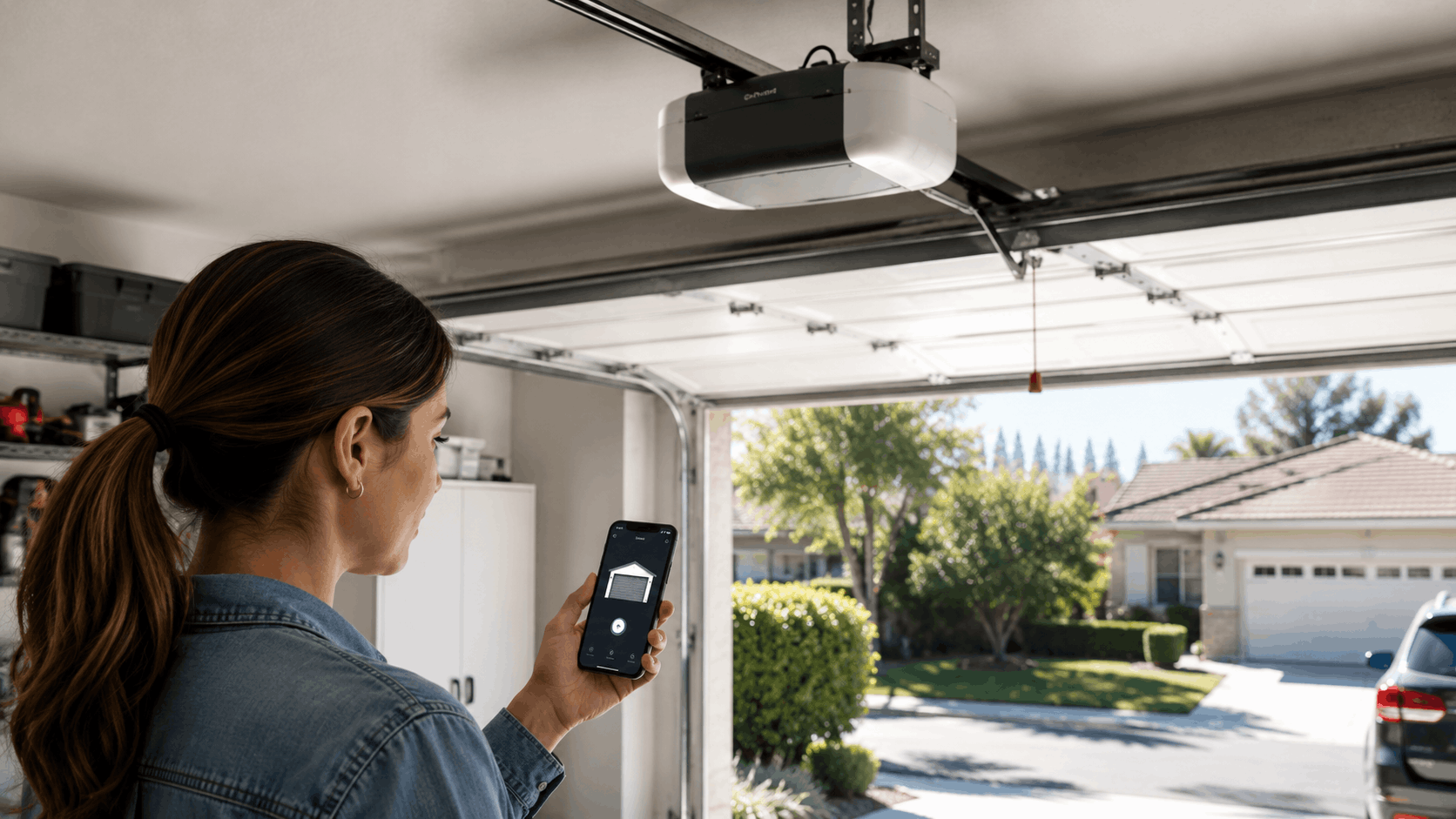
Before comparing brands, it helps to understand what a smart garage door opener is actually doing behind the scenes. The opener still lifts the door the same way. The smart part is the radio inside that talks to your phone or your home automation setup.
There are three common ways that connectivity happens. Each one routes your open and close commands through a different path, and that path decides how reliable your remote access feels day to day.
Here is a quick plain-language breakdown before we get into the details.
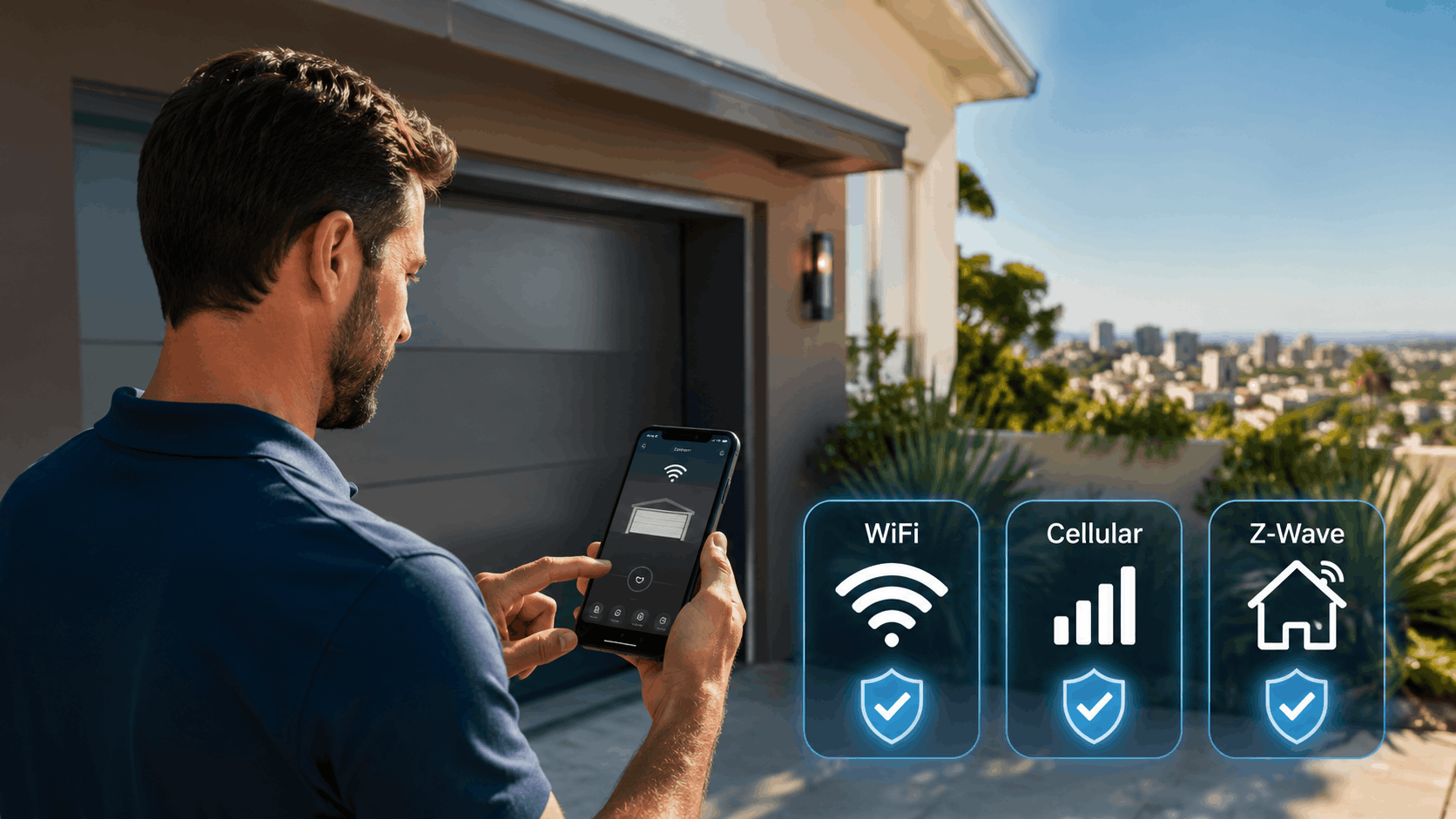
| Connection Type | How It Connects | Works Without Home Internet? | Best Fit |
|---|---|---|---|
| WiFi | Through your home router and internet provider | No | Newer homes with strong WiFi |
| Cellular | Through a mobile network like a phone | Yes | Rentals or homes with shaky internet |
| Z-Wave | Through a local smart home hub on a mesh network | Local control yes, remote needs internet | Smart home households |
WiFi Openers and Your Home Router
A WiFi opener joins your home network the same way your laptop or smart TV does. It grabs a signal from your home router, then sends your commands out through your internet provider. In Irvine, that usually means Cox or AT&T fiber carrying the traffic to the app on your phone.
This is a common type sold today, partly because it is cheap and partly because most people already have WiFi. Popular systems like myQ run this way, and our team handles plenty of smart WiFi opener and myQ setups for local families.
The catch is simple. If your router reboots, your internet drops, or the garage sits too far from the access point, the app stops working. The opener itself is fine, but the brains that connect it to your phone went quiet.
That dependence on your home network is the single biggest factor in WiFi opener reliability, and it is why router placement matters so much in OC homes with detached garages.
Cellular Openers and Backup Connections
A cellular opener skips your home internet entirely. Instead of using WiFi, it carries a small SIM card and talks to a mobile network, just like your phone does when you leave the house. That gives it an independent path that does not care if your router is down.
This matters more in Orange County than most people expect. When Cox has an outage in your zip code, a WiFi opener goes dark, but a cellular opener keeps reporting and responding. That backup connection is the whole selling point.
The tradeoff is cost. Because a cellular opener uses a mobile network, it usually carries a monthly subscription to keep the SIM active. We will cover those fees later, but plan on a recurring charge rather than a free app.
For homeowners who have lost faith in their internet, this independence often outweighs the monthly fee. It removes a common failure point from the equation.
Z-Wave Openers and Smart Home Hubs
Z-Wave is a different animal. It is a low-power wireless standard built for home automation, and it runs through a local hub rather than straight to the cloud. A Z-Wave controller on your garage door talks to a hub like SmartThings or a Ring base station inside the house.
The clever part is the mesh network. Each Z-Wave device can pass signals along to the next one, so a home with several smart plugs and switches builds a stronger web of coverage. The signal hops device to device until it reaches the hub.
Because the hub handles commands locally, a Z-Wave opener can respond instantly inside the home even if the internet is slow. Remote access from outside the house still needs internet, but the local automation keeps humming.
This setup appeals to people already running a smart home. If you have Ring cameras, smart locks, and a SmartThings hub, adding a Z-Wave garage controller ties everything together under one roof.
Why Connection Type Affects Daily Reliability
All this technical talk comes down to real moments in your driveway. The connection type decides whether you get a delivery alert on time, whether the door actually opens when you tap the app, and whether your bedtime automation closes the garage every night.
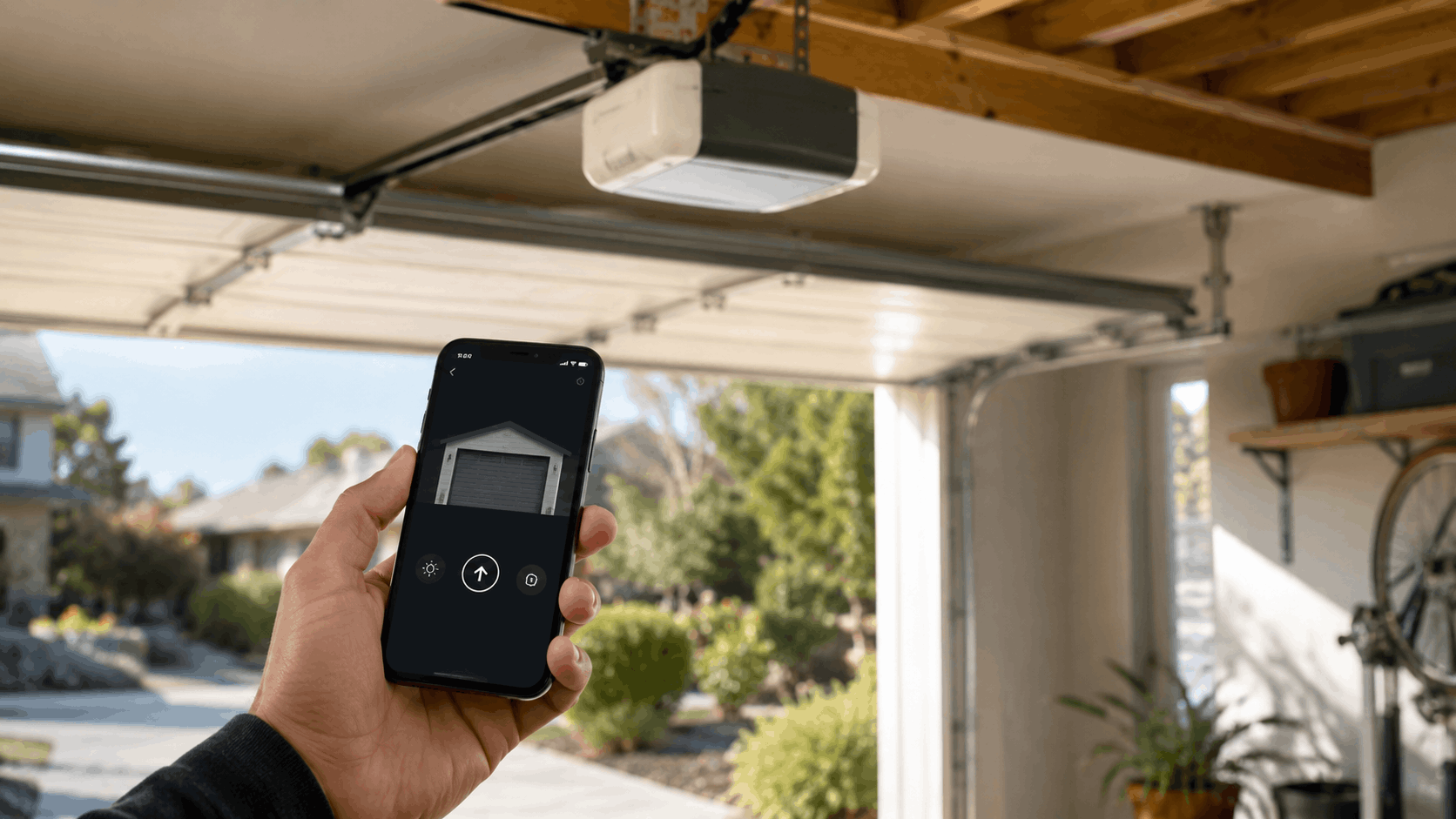
A WiFi opener with weak signal might show a delayed alert or fail to close on command, leaving you guessing. A cellular opener tends to respond even during a local outage, which is reassuring during fire season. A Z-Wave opener gives snappy local control but leans on the hub staying healthy.
Reliability is not just about the brand on the box. It is about how that opener reaches the internet or your hub, and how stable that path is at your specific address.
Our team sees the same patterns repeat across OC. Match the connection type to your home and your habits, and the smart features actually deliver instead of frustrating you.
Get Your Free Quote
Tell us about your garage door and we'll get back to you within 30 to 60 minutes.
WiFi Garage Openers in Orange County Homes
WiFi openers are the default choice for a reason. They are affordable, the apps are familiar, and most newer Orange County homes already have decent internet. For a lot of households, a WiFi garage opener is the right call.
But the experience varies wildly from one neighborhood to the next. The same model that runs flawlessly in a Portola Springs new build can stutter in an older detached garage across town. Here is how WiFi reliability breaks down locally.
| WiFi Opener Factor | Strong Setup | Weak Setup |
|---|---|---|
| Garage type | Attached, near router | Detached, far from house |
| Wall material | Drywall, open layout | Thick stucco, metal |
| Internet | Fiber, stable | Frequent outages |
| WiFi coverage | Mesh nodes in place | Single old router |
Where WiFi Signal Drops in Detached Garages
A common WiFi complaint we hear comes from homes with detached garages. Older neighborhoods in Santa Ana and Tustin often have the garage set back from the house or accessed off an alley. That distance alone can starve the opener of signal.
Building materials make it worse. Thick stucco walls, lath and plaster, and any metal in the structure all chew up a WiFi signal before it reaches the garage. A router sitting in a front living room may barely whisper to a garage 60 feet away.
We have stood in plenty of these garages watching the signal bars on a phone drop to one. The opener pairs fine during setup near the house, then loses its grip once it is mounted on the ceiling out back.
If your garage is detached and your only router lives on the other side of the property, plan for extra coverage hardware before you buy a WiFi opener. Otherwise the app will disconnect more than you would like.
Internet Outages and Why They Matter Here
WiFi openers live and die by your internet connection. When the service goes offline, so does your app and your remote control. The door still works from the wall button and the in-car remote, but the smart features vanish until the connection returns.
Orange County sees its share of outages. Storm season, infrastructure work along the 5 and 405 corridors, and provider maintenance all knock pockets of homes offline. Some older parts of Santa Ana and Orange deal with more frequent service interruptions than the newer fiber-served communities.
For most people a short outage is a minor annoyance. The problem comes when you are away from home and want to confirm the garage closed, only to find the app cannot reach it.
This is the exact gap that cellular openers fill, and it is the deciding factor for a lot of households we advise.
Best Fixes for WiFi Coverage in the Garage
The good news is that most WiFi coverage problems are fixable. A mesh network is the cleanest solution. Adding a mesh node in a back bedroom or near the garage wall pushes a strong signal out to the opener instead of relying on one tired router.
A range extender is a cheaper option that can work for homes near Northwood or Quail Hill where the garage is attached but tucked behind thick walls. Placement is a big part of the battle here. Moving the router higher and more central often solves more than people expect.
We also recommend checking the opener's mounting spot. Sometimes nudging the antenna or the bridge unit a few feet toward the house door makes the difference between a stable link and a flaky one.
When we install a smart opener, our team tests the actual signal at the ceiling mount before calling it done. If it is marginal, we say so and suggest a fix rather than leaving you to discover the problem later.
Who WiFi Openers Work Best For
WiFi openers are a great match for newer homes with an attached garage and solid internet. If you live in a community built in the last 15 years with fiber and an open floor plan, the router is probably close enough to keep the opener happy.
These homeowners get the full set of smart features without spending extra on coverage gear or monthly fees. The app works, alerts arrive on time, and automations fire reliably.
It is also the budget-friendly choice. There is no subscription, and the hardware is widely available. For many Irvine families, that combination is hard to beat.
If that describes your home, a WiFi opener paired with a clean garage door opener installation will serve you well for years.
Need Help in Irvine?
Urgent Garage Doors serves Irvine and all of Orange County.
Cellular Garage Openers and Their Edge in OC
Cellular openers solve the one weakness WiFi cannot. They keep working when your home internet does not. That single trait gives them a real edge in Orange County, where power and internet both take hits during fire season.
They are not perfect for everyone, though. Coverage gaps and monthly fees factor into the decision. Here is where cellular openers earn their keep and where they fall short.
- Independent connection: They use a mobile network, so a Cox outage does not take them down.
- Outage resistance: Paired with a battery backup, they stay online during power shutoffs.
- Coverage dependent: Performance drops in hilly canyon spots with weak cell signal.
- Subscription required: Expect a monthly fee to keep the SIM active.
Staying Online During Power and Internet Outages
The headline benefit is staying connected when everything else goes dark. During a PSPS event, your router loses power and your WiFi opener goes silent. A cellular opener with a battery backup keeps reporting and accepting commands.
This matters during wildfire season in the inland and foothill parts of OC. When Southern California Edison cuts power to reduce fire risk, neighborhoods near Lake Forest and the canyon edges can sit dark for hours or longer.
For a family trying to get the kids out the door or confirm the garage is closed before evacuating, that independent connection is genuine relief. The door becomes a reliable part of your plan instead of another thing that failed.
If outage resistance is your top concern, cellular paired with battery backup is the strongest option we recommend. Pairing it with our emergency garage door repair coverage gives you a full safety net.
Cell Coverage Gaps in Hilly Areas
Cellular openers are only as good as the signal at your garage. In flat, open areas like central Irvine or Costa Mesa, coverage is usually strong and steady. In hilly terrain, things get spotty.
Parts of Turtle Rock sit against slopes that block signal, and homes near the Lake Forest foothills can see weaker bars depending on which carrier the opener uses. Canyon roads and ridge-line lots are the usual trouble spots.
Before recommending a cellular opener, our team checks the actual cell signal strength at the garage, not just at the curb. A unit that shows two bars at the ceiling mount may struggle, especially inside a closed metal-roofed garage.
If the signal is weak, a different carrier or an external antenna can help. Sometimes a WiFi or Z-Wave path simply makes more sense for that specific hillside address.
Subscription Costs to Expect
The monthly fee is the main downside. Cellular openers typically run somewhere between 5 and 15 dollars per month depending on the brand and plan. Over a few years, that adds up compared to a free WiFi app.
The fee covers the data the SIM uses to stay connected and the cloud service that powers alerts and remote control. Some brands bundle extra features like video or guest access into higher tiers.
When we walk homeowners through the math, we frame it honestly. If your internet is reliable, the subscription may not be worth it. If you have lost the garage app during three outages this year, the fee buys you a connection that actually holds.
There is no universal right answer. It depends on how much the independent connection is worth to your household.
Who Should Choose a Cellular Opener
Cellular shines for a few specific groups. Rental property owners love it because the tenant's internet, or lack of it, never affects the opener. The landlord keeps control through an independent connection that does not rely on someone else's router.
Homes with genuinely unreliable internet are the other big winner. If you live in an older pocket of Santa Ana or Orange where the service drops weekly, a cellular opener sidesteps the whole problem.
Vacation homes and second properties also benefit. When you are checking on a place you do not visit often, you want a connection that works without depending on a router you cannot easily reboot.
For these owners, the monthly fee buys reliability they cannot get any other way. That is a fair trade for many of our customers across OC.
Z-Wave Garage Openers and Smart Home Integration
Z-Wave is the choice for households that already think in terms of smart home scenes and routines. Instead of a standalone app, the garage door becomes one more device under a central hub. That integration is the whole point.
It comes with its own quirks around hub dependency and setup. For the right person, though, Z-Wave delivers fast local control and tight automation that WiFi and cellular cannot match.
How Z-Wave Mesh Networks Hold Up
The Z-Wave mesh is its strongest feature. Every mains-powered Z-Wave device acts as a repeater, passing signals along to its neighbors. The more smart plugs, switches, and sensors you have, the stronger and more reliable the network becomes.
This works well in larger OC homes where a single signal would struggle to reach the garage. In a two-story house in Northwood with smart switches throughout, the garage controller has plenty of hops to ride on.
The mesh is also self-healing. If one device goes offline, the network reroutes signals through other devices automatically. There is no single wire to break, which gives Z-Wave a quiet kind of resilience inside the home.
That said, the mesh only helps if you have enough devices. A home with just one Z-Wave gadget gets none of these benefits, so the standard works best in a developed smart home.
Hub Dependency and Single Points of Failure
The flip side of the hub model is the hub itself. Everything routes through that one box, so if it loses power or its firmware fails, the whole system can stall. That is the single point of failure to plan around.
We have seen hubs lock up after a botched firmware update, leaving the homeowner unable to control any Z-Wave device until a reboot. A power outage hits the hub the same way it hits a router, so battery backup matters here too.
The wall button and physical remote on the opener always work, of course. But the smart layer depends entirely on a healthy hub, so keeping it powered and updated is part of the deal.
Picking a reliable hub and putting it on a small battery backup reduces this risk a lot. It is the one piece of the puzzle we tell Z-Wave owners not to skimp on.
Pairing Z-Wave With Existing Systems
The real magic is integration. A Z-Wave garage controller drops neatly into platforms many Irvine homeowners already run. SmartThings, Ring, and Home Assistant all speak Z-Wave with the right hub or bridge.
That opens up genuinely useful routines. Your garage can close automatically when your Ring system arms for the night, or send a notification through the same app that runs your cameras and locks. Everything lives in one place.
Home Assistant fans get even more control, with local automations that run on a server in the house and never touch the cloud. That keeps response times fast and data private.
For households already invested in one of these ecosystems, Z-Wave avoids yet another standalone app. It folds the garage into a setup you already use every day.
Who Z-Wave Openers Suit Best
Z-Wave suits the tech-comfortable homeowner who already runs a smart home hub. If you enjoy building automations and you have a handful of Z-Wave devices, adding the garage is a natural next step.
These owners value local control and lower lag. Because commands run through the hub inside the house, the door responds quickly without a round trip to a distant server.
It is not the right pick for someone who just wants a simple app to open the garage. The setup takes more effort and assumes you have a hub in place.
But for the smart home enthusiast in a Woodbury or Stonegate household, Z-Wave brings the garage into the fold with the responsiveness and integration they expect. Our team can help with the install and the opener and smart access side of the project.
Need Help in Irvine?
Urgent Garage Doors serves Irvine and all of Orange County.
Side by Side Reliability Comparison for OC
With the three types explained, here is how they stack up head to head. We graded each one on the factors Orange County homeowners actually ask us about, from outage performance to security.
No single option wins every category. The right pick depends on your home, your internet, and how much you value an independent connection.
| Factor | WiFi | Cellular | Z-Wave |
|---|---|---|---|
| Outage performance | Weak | Strong | Local only |
| Response speed | Good | Good | Fast (local) |
| Setup difficulty | Easy | Easy | Advanced |
| Ongoing cost | Free app | Monthly fee | Free app, needs hub |
| Best for | Newer homes | Rentals, weak internet | Smart homes |
Performance During Outages
Outage performance is where the three diverge most. WiFi openers rank last here because they go offline the moment your internet or power drops. During an OC fire-season shutoff, that means no app and no remote alerts.
Cellular ranks first. With a battery backup, it keeps uptime through both internet and power loss because it relies on neither. That is the connection you want when Edison cuts power to your neighborhood.
Z-Wave sits in the middle. Local control survives an internet outage as long as the hub has power, but remote access from outside the home still needs the internet back. A power loss takes both the hub and opener down unless they are on backup.
For households focused on power loss resilience, cellular plus battery backup is the clear winner. The other two need internet or hub power to deliver their smart features.
Response Speed and Lag
Speed is about how quickly the door reacts when you tap open or close. WiFi and cellular both send your command up to a cloud server and back, which usually takes a second or two on a healthy connection.
Z-Wave feels the snappiest for local commands because the hub handles them inside the house. Tap the button while you are home and the door often moves almost instantly, with no cloud round trip.
Lag creeps in when signal is weak. A WiFi opener in a far detached garage can take several seconds or time out entirely. A cellular opener in a low-signal canyon spot shows the same kind of delay.
For most people on a solid connection, all three feel responsive enough. The difference shows up at the edges, where weak signal turns a quick tap into a frustrating wait.
Setup Difficulty and Ongoing Cost
WiFi and cellular are both easy to set up. You mount the unit, connect it to the network or activate the SIM, and pair the app. Most homeowners could manage it, though we handle the mounting and testing to be sure the signal holds.
Z-Wave takes more effort. You need a compatible hub, and pairing the device into the mesh involves more steps. It rewards patience but is not a five-minute job.
On cost, WiFi is cheapest over time with a free app. Cellular carries that monthly fee of roughly 5 to 15 dollars. Z-Wave has no recurring opener fee but assumes you already own a hub, which is its own purchase.
Looking past the sticker price matters. A cheap WiFi opener that needs a mesh upgrade can cost more than expected, while a cellular unit's value depends on how much you use that independent connection. A proper maintenance and upgrades plan keeps any of them running well.
Security Differences Between the Three
All three modern systems use solid security when set up correctly. Garage door openers have long used rolling codes, which change the access code every time you use the remote so it cannot be copied and replayed.
WiFi and cellular openers add encryption on the connection between the opener and the cloud. As long as you use a strong account password and enable two-factor login, they are tough to break into.
Z-Wave includes its own encryption layer called S2, which protects commands across the mesh. Because much of the control stays local, there is less data traveling over the open internet for an attacker to target.
The weakest link in any of these is usually a reused or simple password, not the technology itself. The CISA Secure Our World guidance on strong passwords and two-factor authentication applies just as much to a garage app as to your email.
OC Climate and Neighborhood Factors That Affect Openers
Orange County's climate is gentle compared to most places, but it still puts stress on garage electronics. Heat, salt air, and fire-season shutoffs each shorten the life of a smart opener if you ignore them.
Neighborhood quirks matter too, from HOA appearance rules to older home wiring. Here is what we see affecting openers across different parts of the county.
Heat Buildup in Garages During Summer
Garages get brutally hot inland. In places like Anaheim Hills and the eastern stretches of Orange, a closed garage can climb well past 110 degrees on a summer afternoon. That heat is hard on electronics and batteries.
Battery backups suffer the most. High heat shortens their lifespan and can cut their capacity, so a backup that should last hours during an outage may run down sooner than expected. We check backup health during service for exactly this reason.
The opener's circuit board and radio also work harder when baking. Over years, repeated heat cycles can degrade components and lead to dropped connections or random reboots.
Good attic ventilation, a little airflow, and keeping the unit out of direct sun where possible all help. So does a seasonal tune-up to catch heat-stressed parts before they fail.
Coastal Moisture and Corrosion Near the Beach
The coast brings a different problem. Homes near Newport Beach and Huntington Beach sit in salt air that slowly corrodes metal connectors and circuit boards. You can smell the difference in the air, and the openers feel it too.
Salt-laden moisture creeps into connection points and antenna terminals. Over time it builds up resistance, weakens signal, and can cause intermittent faults that are maddening to track down.
We see corroded contacts on coastal openers far more often than on inland ones. Springs, cables, and hardware corrode more here as well, which is why spring and cable repair calls run higher near the water.
Sealed enclosures, protective coatings, and regular inspection slow the damage. For beach-area homes, building corrosion checks into your maintenance routine pays off.
HOA Rules and Older Home Wiring
Many OC communities sit under strict HOAs. Planned neighborhoods around Irvine, from Woodbridge to Great Park, often have appearance rules that limit visible exterior antennas or hardware. That can steer your opener choice.
A cellular opener with an external antenna might run into approval issues in these communities, while a tidy WiFi or Z-Wave setup stays hidden. We help homeowners pick options that keep the HOA happy.
Older homes bring the opposite challenge. Houses in established parts of Santa Ana and Orange sometimes have outdated wiring or a single garage outlet that complicates a smart install. An older opener may not even support modern smart add-ons.
In those cases we assess the wiring first. Sometimes a small electrical update or a full opener replacement is the cleaner path than forcing smart features onto aging equipment.
Fire Season Power Shutoffs and Smart Openers
Public Safety Power Shutoffs are a real part of OC life now. During dry, windy stretches, Southern California Edison cuts power in fire-prone areas to prevent ignitions. Those shutoffs can last hours or stretch across a day.
A WiFi opener is useless during a shutoff because the router has no power. A Z-Wave hub fails the same way unless it is on backup. Only a cellular opener with a charged battery keeps its smart features alive.
Even then, the opener itself needs battery backup to move the door without grid power. Senate Bill 969 has required battery backup on residential openers sold or installed in California since 1 July 2019 for this reason, so most new units include it. You can read more about state energy and outage planning at the California Energy Commission.
For homes in higher-risk zones near the foothills, planning for shutoffs is part of choosing an opener. We always factor it into our recommendation.
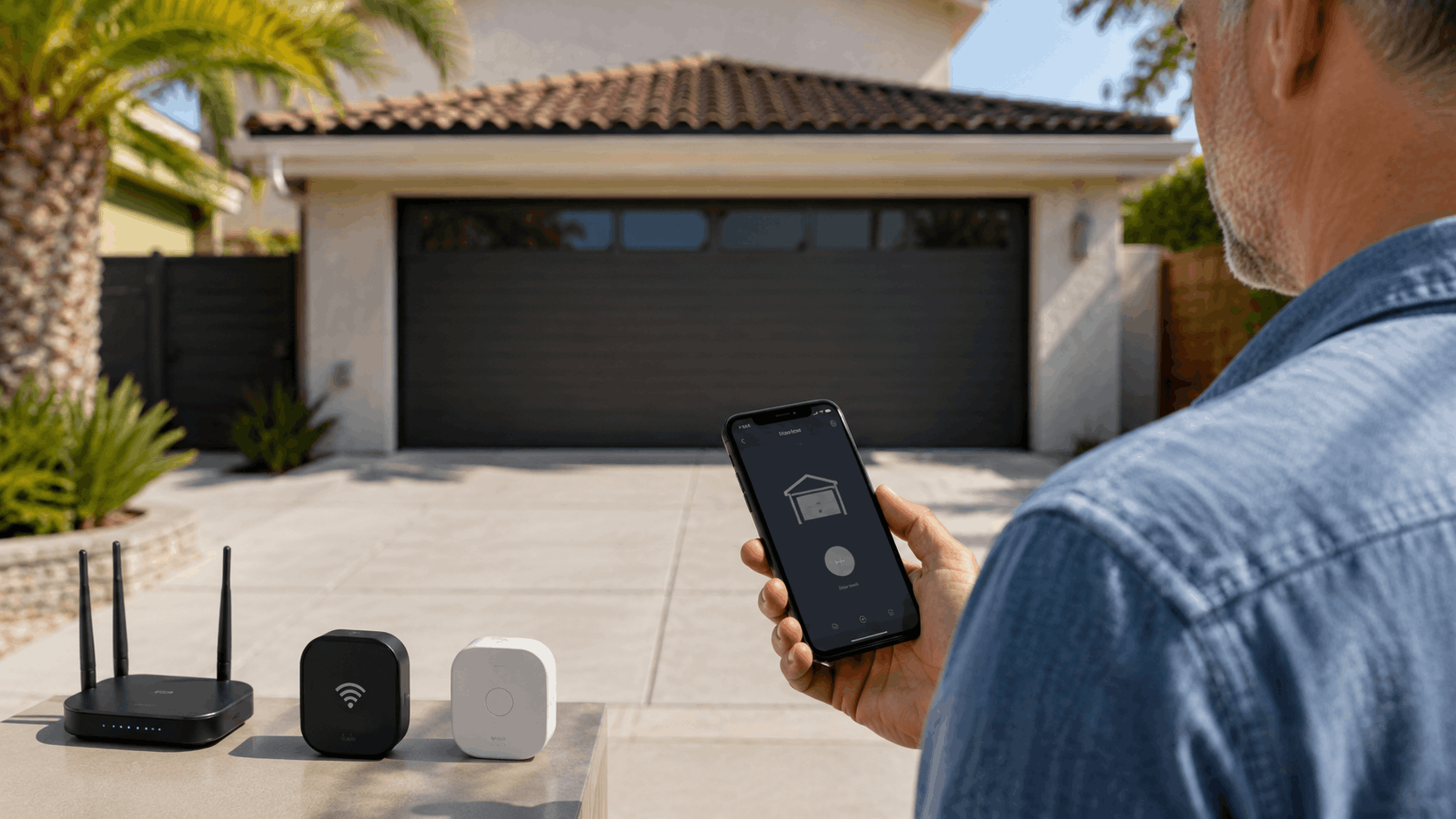
Need Help in Irvine?
Urgent Garage Doors serves Irvine and all of Orange County.
How Urgent Garage Doors Helps OC Homeowners Choose and Install
Picking the right smart opener is easier with someone who has installed hundreds across the county. Our Irvine team knows which neighborhoods have signal trouble and which homes need extra coverage gear before the opener even ships.
We handle the whole process, from the on-site check to the install and the years of support after. Here is how we guide local families to the right choice.
On-Site Signal and Coverage Checks
Before we recommend anything, we test the actual signal where the opener will live. That means standing at the ceiling mount and measuring both WiFi and cell strength, not guessing from the driveway.
This catches problems early. A detached garage off an alley in Tustin might show strong WiFi at the house and almost none at the mount. A canyon-edge home in Lake Forest might have weak cell bars that rule out a cellular unit.
That on-site coverage test saves you from buying the wrong opener and fighting disconnections later. We would rather find the issue with a meter than have you discover it during a heat wave.
Based on the readings, we tell you honestly which connection type will hold and whether you need a mesh node or antenna to make it work.
Matching the Opener to the Home and Family
Beyond signal, we weigh how your household actually lives. A rental owner has different needs than a smart home hobbyist or a family that just wants reliable alerts when the kids get home.
We factor in your garage type, internet quality, and any existing smart home gear. If you already run Ring and SmartThings, Z-Wave might fit best. If your internet drops weekly, cellular earns its fee.
The goal is a recommendation that fits your real life, not the most expensive unit on the shelf. Sometimes the right answer is a simple WiFi opener with a better-placed router.
We explain the tradeoffs in plain language so you can decide with confidence. You can always reach out through our contact page to start that conversation.
Same-Day Repair and Replacement Across OC
When something fails, fast service matters. Our routes run from Irvine out to Tustin, Lake Forest, Costa Mesa, and beyond, so we reach most of the county quickly.
We offer same-day garage door repair for the moments when a door will not open and you are stuck in the driveway. A dead opener or a snapped spring does not wait for a convenient time.
Replacement is just as quick when an old unit is past saving. We carry common smart opener models and can swap one in the same visit in many cases.
Living in Irvine puts us close to most OC neighborhoods, which keeps our response times short whether you are in Costa Mesa or up in Yorba Linda.
Ongoing Maintenance and Support
Smart openers run best with a little regular care. We offer tune-ups that check the door balance, lubricate hardware, test the battery backup, and confirm the smart connection is still solid.
Firmware questions come up often, and we help with those too. Updating an opener or reconnecting it after an internet change is the kind of small fix that keeps the whole system reliable.
A preventive maintenance plan catches heat and corrosion damage before it becomes a breakdown. For OC's heat and salt air, that scheduled attention extends the life of your opener.
Our support does not end at install. We stay available for troubleshooting so your smart opener keeps working for years, not just months.
Final Thoughts
The best smart garage door opener for your home depends on three things: your internet, your garage layout, and your tolerance for outages. WiFi fits newer homes with strong signal, cellular wins for outage resistance, and Z-Wave suits households already running a smart home hub.
Orange County's heat, coastal salt air, and fire-season shutoffs all shape that choice in ways a generic buying guide would miss. A unit that thrives in a Quail Hill new build may struggle in an older detached garage across town.
Our Irvine team is ready to test your signal, talk through the tradeoffs, and install the opener that actually holds. Call Urgent Garage Doors or reach out through our contact page to schedule a consultation and get the right smart opener for your home.
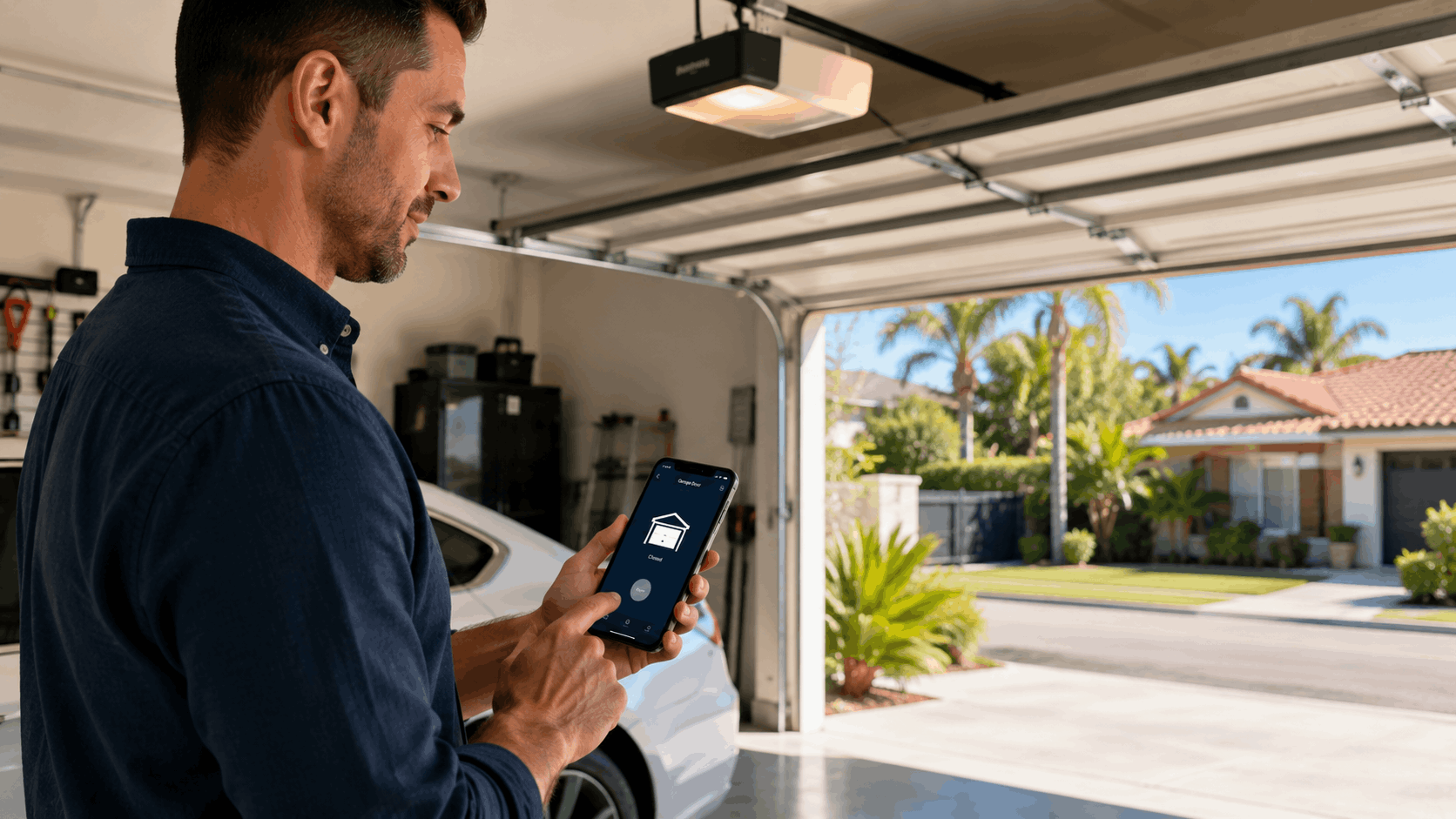
Frequently Asked Questions
- Which smart garage door opener is most reliable in Orange County?
- It depends on your internet quality and outage risk. For homes with stable fiber and an attached garage, a WiFi opener is reliable and affordable. For homes that lose internet often or sit in fire-shutoff zones, a cellular opener with battery backup usually wins because it stays online when power and internet drop. Z-Wave is strong for local control in established smart homes.
- Will a WiFi garage opener still work if my internet goes down?
- The door itself keeps working. Your wall button and in-car remote operate normally even with the internet down. What stops working is the app and remote control through your phone, plus any alerts. Without internet, a WiFi opener cannot reach the cloud, so you lose the smart features until service returns. This is the main gap that cellular openers are built to close.
- How much do smart garage door openers cost to install in Irvine?
- A smart opener with professional installation typically runs from around 400 to 800 dollars depending on the model, horsepower, and whether old hardware needs replacing. Cellular models add a monthly subscription of roughly 5 to 15 dollars. Detached garages that need a mesh node or antenna can cost a bit more. We give a firm quote after checking your garage and signal on site.
- Do cellular garage openers require a monthly fee?
- Yes, most do. The fee usually falls between 5 and 15 dollars per month and covers the data the SIM uses to stay connected plus the cloud service for alerts and remote control. Some brands offer higher tiers with extra features like video or guest access. That recurring cost is the tradeoff for an independent connection that does not rely on your home internet.
- Is Z-Wave better than WiFi for a smart garage door?
- It depends on your setup. Z-Wave needs a smart home hub like SmartThings or Ring, which WiFi does not. In return, Z-Wave offers quicker local control and lower lag because commands run through the hub inside your house. If you already own a hub and several smart devices, Z-Wave integrates better. If you just want a simple app, WiFi is easier and cheaper to start.
- Why does my garage door app keep disconnecting?
- A common cause is weak WiFi reaching a detached or far garage, often made worse by thick stucco walls. Other culprits include an aging router that needs a reboot, internet outages from your provider, or outdated opener firmware. Moving the router, adding a mesh node, or updating the firmware usually fixes it. Our team can test the signal at the mount and pinpoint the exact issue.
- Can I add smart features to my existing garage door opener?
- Often yes. Add-on controllers like myQ or Z-Wave relay kits work with many openers made in the last 20 years, especially those with safety sensors. They tap into the existing wiring and add app control without replacing the whole unit. Very old openers without sensors may not be compatible. We can check your model and tell you whether an add-on or a full replacement makes more sense.
- How do power shutoffs during fire season affect smart openers?
- During a Public Safety Power Shutoff, your router and any smart home hub lose power, so WiFi and Z-Wave smart features go offline. The opener also cannot move the door without grid power unless it has battery backup, which Senate Bill 969 has required on new residential openers sold or installed in California since 1 July 2019. A cellular opener with a charged battery keeps both the connection and the door working, making it the strongest pick for shutoff-prone areas.
- Are smart garage door openers safe from hackers?
- Modern openers are quite secure when set up right. They use rolling codes that change every use and encryption on the cloud connection, and Z-Wave adds its own S2 encryption. The weakest link is usually a reused or simple account password. Using a strong, unique password and enabling two-factor authentication protects your opener far more than the technology choice itself does.
- Does Urgent Garage Doors service my area in Orange County?
- Yes. We are based in Irvine and serve homes across the surrounding area, including Tustin, Lake Forest, Costa Mesa, Newport Beach, Santa Ana, Orange, and Yorba Linda. Our central location keeps response times short for both installs and emergency repairs. Reach out through our contact page or give us a call to schedule a visit and we will confirm coverage for your address.
Licensed garage door repair professionals serving Irvine and Orange County.
Licensed in California · License #1055150
Why trust Urgent Garage Doors?
Founded in 2017, Urgent Garage Doors is a licensed and insured garage door services serving Irvine and Orange County. All content is reviewed by our licensed technicians.

Need Help in Irvine?
Urgent Garage Doors serves Irvine and all of Orange County.
Related Articles
Aliso Viejo Garage Door Trends: What Homeowners Are Installing
Discover which garage door styles, materials, smart tech upgrades, and colors Aliso Viejo homeowners are actually installing - with real cost ranges and HOA guidance.

Best Garage Door Brands for Coastal Orange County
Discover the best garage door brands for coastal Orange County homes that resist salt air corrosion, handle marine layer moisture, and maintain performance despite coastal winds.

Smart Garage Door Openers: Are They Worth It for OC Homeowners
Smart garage door openers offer OC homeowners remote access, real-time alerts, and auto-close features. Find out what they cost and whether the upgrade makes sense for your home.