Belt vs Chain vs Screw vs Wall-Mount Jackshaft Drives - The Real OC Noise and Reliability Comparison
Key Takeaways
- The garage door springs do most of the lifting, so drive type and spring balance both decide how quiet and long-lasting an opener is.
- Belt and wall-mount jackshaft drives are the quietest at 40 to 50 decibels, ideal for Irvine homes with bedrooms above an attached garage.
- Chain drives are the loudest at 55 to 65 decibels but the cheapest, making them a smart pick for detached garages and rentals.
- Screw drives sit in the middle on noise and price, and Irvine's mild climate avoids the temperature-stall issues older models had.
- Jackshaft drives cost the most but last 15-plus years, free up ceiling space, and suit tall or custom doors in newer builds like Portola Springs.
- Nylon rollers, tightened hardware, and vibration isolation pads can quiet almost any drive without replacing the opener.
- Proper door balance and yearly maintenance matter more than drive type for keeping any opener quiet and extending its lifespan.
- Urgent Garage Doors evaluates door weight, balance, and layout on-site across Irvine to recommend and install the right drive.
In This Article
Last spring, a family in Woodbridge called us at 6 a.m. Their garage door had been waking the baby every time Dad left for work, and the nursery sat right above the garage. The rattle came up through the ceiling like a freight train. They were ready to move the crib until we explained the real fix was the drive on their opener.
That story plays out across Irvine more than you would think. Homes here are built tight, with bedrooms and bonus rooms sitting directly over attached garages. When the wrong drive type is bolted to the ceiling, the whole house feels it.
How Garage Door Drive Systems Actually Work
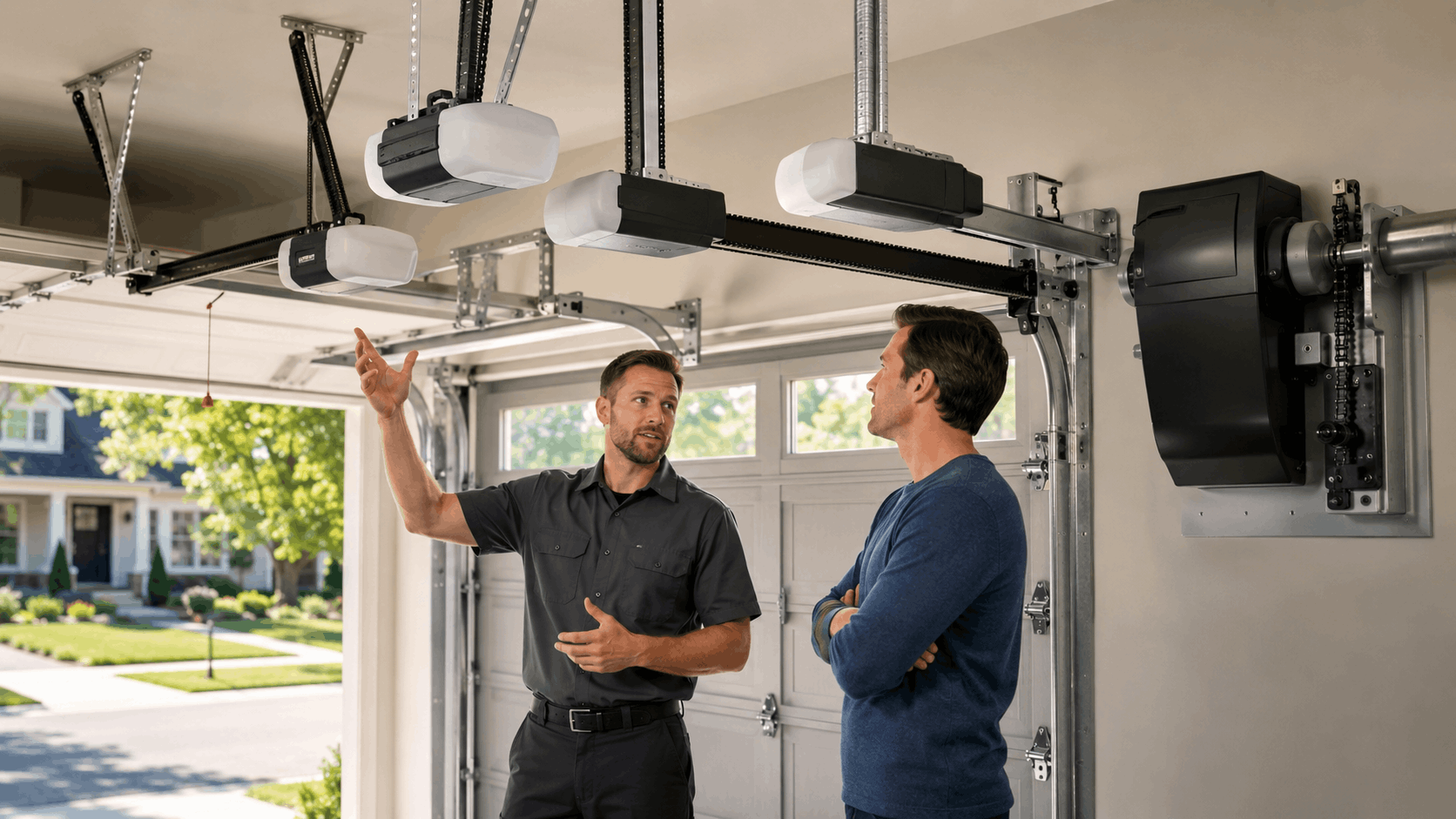
Before comparing the four drive types, it helps to know what an opener really does. A lot of homeowners think the motor lifts the door. It does not, and that misunderstanding leads to a lot of noise complaints and burned-out units.
The Job Every Opener Has to Do
A single-car steel door can weigh 130 pounds, and a big two-car insulated door can push past 300. Your garage door opener does not muscle that weight up on its own. The torsion spring above the door stores energy and does most of the lifting.
The motor and drive system just guide the door and provide a nudge. That is why most residential openers only need half to three-quarter horsepower. If someone tries to sell you a giant motor horsepower rating as the answer to a heavy door, be skeptical.
When the springs are balanced correctly, the opener barely strains. When they are worn or mismatched, the motor works overtime, gets loud, and dies years early. So the drive type matters, but spring balance matters just as much.
We tell customers to think of the opener as a driver and the springs as the engine. Get both right and the door glides. Get either wrong and you hear about it every single day.
Where the Noise Comes From
Garage door noise is rarely one thing. It comes from the drive mechanism itself, from vibration traveling through the mounting brackets, and from the door hardware like rollers and hinges. Each part adds its own sound.
The drive is the biggest single source. A metal chain slapping a metal rail is loud by design. But even a quiet belt can seem noisy if the vibration transfers straight into the ceiling joists and turns your floor above into a drum.
That is why attached-garage homes across Irvine feel it more than detached ones. In neighborhoods like Woodbridge and Quail Hill, the living space sits right over the garage, so noise transfer through the ceiling has nowhere to go but up. A detached garage on a back lot can be much louder and nobody notices.
Old dry rollers and loose bolts add a rattle on top of everything. So even the best drive needs solid hardware and isolation to stay quiet. We look at all of it during a service call, not just the motor.
Why Drive Type Affects How Long It Lasts
Reliability comes down to how many moving parts a drive has and how much tension they carry. More parts under load means more places to wear out. A chain stretches, a belt can fray, a screw thread needs its rail greased.
Maintenance needs differ too. Some drives want lubrication twice a year, others almost never. Skip that upkeep in Irvine's dry climate and parts wear out sooner than the label promises.
Over a 10 to 15 year window, those differences add up. A well-kept belt or jackshaft can outlast a neglected chain by half a decade. The drive you pick sets the ceiling for lifespan, but your habits decide where you land under it.
We have pulled 25-year-old chain openers that still ran because the owner greased them every fall. We have also replaced 6-year-old units that never got touched. Drive type is the starting point, not the whole story.
Get Your Free Quote
Tell us about your garage door and we'll get back to you within 30 to 60 minutes.
Chain Drive Openers: The Workhorse Standard
The chain drive is the opener most people picture. It has been around for decades, it is the cheapest to buy, and it just works. For a lot of Irvine homeowners it is still the right call.
A chain drive uses a metal chain, much like a bicycle chain, to pull the trolley along a rail. That trolley pushes and pulls the door open and closed. Simple, proven, and easy to repair when something goes wrong.
| Feature | Chain Drive |
|---|---|
| Noise level | Loud (55-65 dB) |
| Upfront cost | Lowest |
| Lifespan | 10-15 years |
| Maintenance | Lube twice a year |
| Best for | Detached garages, rentals, budget jobs |
How Loud Chain Drives Really Are
A chain drive runs around 55 to 65 decibels at close range. That is louder than a normal conversation, closer to a running dishwasher with a rattle mixed in. You hear the metal-on-metal clatter as the chain rides the rail.
The sound gets worse as the unit ages and the chain loosens. A slack chain slaps against the rail and vibrates the whole assembly. That is the classic clunk-and-grind that wakes people up.
For homes in Northwood with bedrooms above the garage, this is the deal breaker. Chain noise travels straight up through the joists. If someone sleeps over that garage, a chain drive will remind them every morning.
Detached garages are a different world. Out there the chain rattle is background noise nobody notices. The layout of your home decides whether the sound is a problem or a non-issue.
Reliability and Maintenance Needs
Chains are tough. The metal handles heat, cold, and heavy doors without complaint. The main enemy is chain stretch, where the chain slowly loosens over years of use and needs a simple tension adjustment.
Lubrication is the other must-do. A chain wants light grease on the links about twice a year. In Irvine's dry air, a neglected chain runs dry, wears fast, and screeches. Ten minutes with a rag and lube keeps it happy.
The upside is huge on repairs. Chain parts are cheap and every technician knows the system cold. A worn chain or sprocket is a quick, low-cost fix compared to specialty drives. That durability and easy service is why chains still dominate.
With basic care, a chain drive lasts 10 to 15 years. Our preventive maintenance plan keeps chains tensioned and greased so they hit the top of that range instead of the bottom.
Best Situations for a Chain Drive in OC
A chain makes the most sense when noise does not travel into living space. Detached garages are the obvious fit, like the ones behind older homes off Culver Drive in Irvine's original village neighborhoods.
Rental properties are another strong case. Landlords want a reliable opener that costs little to buy and even less to repair. A chain drive fits that budget math perfectly and any handyman can service it.
Workshops, storage garages, and side doors that rarely open near bedrooms also do fine on a chain. If nobody is trying to sleep through the cycle, spending extra for silence is money wasted.
We install plenty of chain drives across Orange County and never talk anyone out of one when it fits. The trick is matching the drive to the layout, not just picking the cheapest box on the shelf.
Need Help in Irvine?
Urgent Garage Doors serves Irvine and all of Orange County.
Belt Drive Openers: The Quiet Choice
When a customer says they want silence, we point them to a belt drive. It is the go-to for quiet operation and the single best upgrade for homes with rooms over the garage.
Instead of a metal chain, a belt drive uses a reinforced rubber belt to move the trolley. That one swap changes everything about how the opener sounds. Same lifting job, far less racket.
| Feature | Belt Drive |
|---|---|
| Noise level | Very quiet (40-50 dB) |
| Upfront cost | Higher than chain |
| Lifespan | 12-15 years |
| Maintenance | Low |
| Best for | Attached garages, bedrooms above |
Why Belt Drives Run So Quietly
The reinforced rubber belt is the whole reason. Rubber does not clatter against the rail the way metal does. It absorbs vibration instead of creating it, so the loud metal-on-metal sound disappears.
Belt drives run around 40 to 50 decibels, roughly the level of a quiet library or soft rain. Compare that to a chain at 55 to 65 and the difference is dramatic. Many owners say they can barely tell the door is moving from inside the house.
The vibration reduction is the part people underrate. Because the belt does not shake the rail, far less energy travels into the ceiling. That quiet operation is exactly what stops noise from reaching the bedroom above.
Pair a belt drive with nylon rollers and isolation pads and you get near-silent cycling. It is the closest thing to a whisper-quiet garage door most homes can get without going wall-mount.
Reliability and What Can Go Wrong
Modern belts are steel-reinforced and hold up well. Belt lifespan usually runs 12 to 15 years, matching or beating a chain. The rubber does not stretch like a chain, so it needs almost no tension adjustment.
Heat resistance is a fair question in Southern California. A garage in Irvine can hit well over 100 degrees on an August afternoon. Today's belts are built for that heat and handle daily use in attached garages without cracking or softening.
The main failure point is age. After many years a belt can fray or lose tension, but that is a straightforward replacement, not a total unit failure. Reliability is on par with chain drives for most homes.
We do recommend keeping the door well balanced so the belt is not fighting a heavy, dragging door. A tuned door through our door balancing and tension adjustment service lets the belt last its full life.
When a Belt Drive Is Worth the Extra Cost
A belt drive costs more up front than a chain, usually by a modest margin. The question is whether the quiet is worth it, and for a lot of Irvine homes the answer is an easy yes.
The ideal buyer has living space above the garage. Families in Woodbridge and Turtle Rock with bedrooms over an attached garage feel the difference every morning. No more rattle waking the kids, no more shaking floor upstairs.
Anyone who leaves early or comes home late benefits too. A quiet opener means you can slip in and out without announcing it to the whole street. That daily comfort adds up over a decade of use.
If you are already replacing an opener, the belt upgrade is small money for a big quality-of-life gain. Our garage door opener installation team fits belt drives across Irvine every week for exactly this reason.
Screw Drive Openers: The Middle Ground
The screw drive sits between chain and belt on both noise and price. It works differently from the other two, and in Irvine's mild climate it holds up better than its old reputation suggests.
Rather than a chain or belt, a screw drive uses a threaded steel rod. The trolley rides along the thread as the rod spins. Fewer separate parts move, which is part of the appeal.
| Feature | Screw Drive |
|---|---|
| Noise level | Moderate (50-60 dB) |
| Upfront cost | Mid-range |
| Lifespan | 10-15 years |
| Maintenance | Grease rail occasionally |
| Best for | One-piece doors, fast lifting |
How Screw Drives Operate
A screw drive turns a long threaded rod, and that rotation drives the trolley up and down the rail. There is no chain to stretch and no belt to fray. The threaded rod does the work directly.
Fewer moving parts is the headline benefit. With less to loosen or wear, the system can need less upkeep over its life. Many owners like the mechanical simplicity of it.
Screw drives also tend to lift fast. The direct thread action moves the trolley quickly, so the door opens with less delay than some chain setups. For a busy household that quick cycle is a nice touch.
The rail itself does need attention, though. The thread rides on a lubricated track, and that grease has to stay in place for smooth motion. Let it dry out and the whole thing gets loud and sluggish.
Noise and Temperature Sensitivity
On noise, screw drives land in the middle at roughly 50 to 60 decibels. Quieter than a rattling chain, louder than a smooth belt. You hear a steady hum rather than a clatter.
Older screw drives had a real weakness with temperature. In freezing cold or extreme heat the grease could thicken or thin, and the drive would stall or slow down. That gave the design a rough reputation in harsh climates.
Irvine's mild weather largely erases that problem. We almost never see freezing temperatures here, so the cold-stall issue is off the table. Summer heat is the only concern, and modern screw drives handle it fine with the right lubricant.
Newer models also use temperature-tolerant grease and better housings. For Orange County's climate, a modern screw drive runs steady year round. The old horror stories mostly came from snow-country garages, not Southern California.
Reliability Over the Long Haul
Screw drives are known for low maintenance between service visits. There is no chain tension to chase, so the main task is keeping the rail greased once a year or so. That simplicity appeals to hands-off owners.
Lifting speed stays strong across the unit's life, which many families appreciate. A screw drive typically lasts 10 to 15 years, right in line with chain and belt drives when it is cared for.
The failure points are the rail lubrication drying out and the plastic trolley wearing over time. Both are manageable with routine service. Neglect the rail grease and you will hear grinding before anything breaks.
We service screw drives across Irvine and often recommend our maintenance and upgrades visit to keep the rail properly lubricated. Done yearly, a screw drive delivers solid durability for the price.
Wall-Mount Jackshaft Drives: The Space-Saver
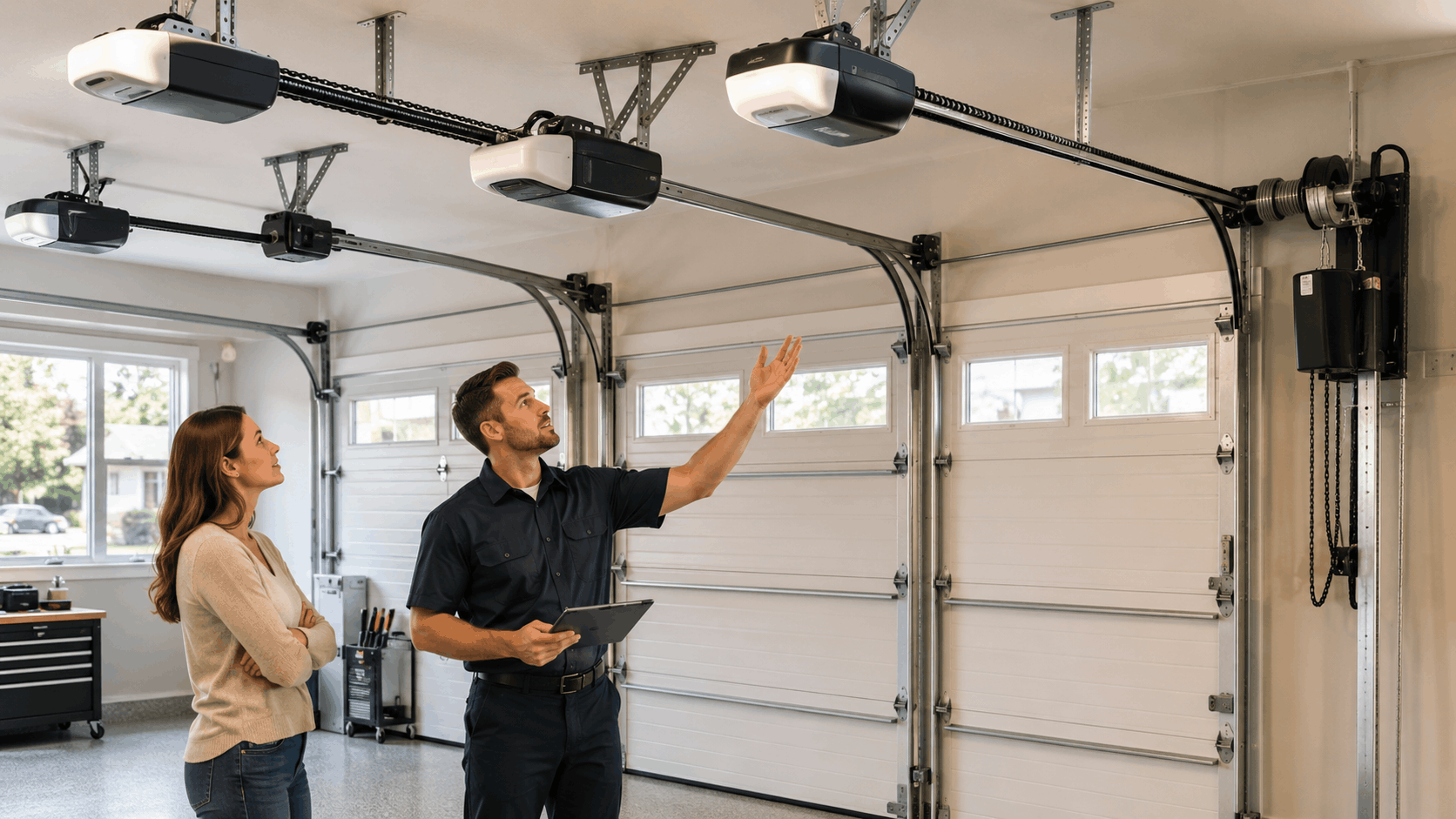
The jackshaft drive is the newest option and the one we install more of every year in newer Irvine builds. Instead of hanging from the ceiling, it mounts on the wall beside the door.
That side-mount design changes the whole feel of the garage. No big motor overhead, no long rail down the middle of the ceiling. It runs quiet and opens up the space above the car.
| Feature | Jackshaft Drive |
|---|---|
| Noise level | Very quiet (40-50 dB) |
| Upfront cost | Highest |
| Lifespan | 15+ years |
| Maintenance | Low |
| Best for | High ceilings, custom doors, storage |
How Jackshaft Openers Mount and Work
A jackshaft opener bolts to the wall next to the door, off to one side of the torsion bar. Instead of pushing a trolley along a ceiling rail, the motor turns the torsion bar directly to raise and lower the door.
Because there is no overhead unit or rail, the ceiling stays completely clear. That frees up ceiling space for overhead storage racks, a car lift, or just a cleaner look. Homeowners with high ceilings love reclaiming that room.
The design suits tall and custom doors especially well. Some oversized doors will not work with a standard rail opener at all. A jackshaft solves that by driving the torsion bar no matter how tall the door is.
It also pairs naturally with modern smart features. Many jackshaft units include a battery backup and Wi-Fi built in, which fits well with our smart Wi-Fi opener and MyQ setup service.
Noise Levels and Why They Feel Different
Jackshaft drives run quiet, around 40 to 50 decibels like a good belt. But the reason they feel even quieter is where the motor sits, not just how loud it is.
With no motor bolted to the ceiling joists and no rail overhead, there is very little vibration traveling into the floor above. The sound and shaking that a ceiling-mounted opener sends upstairs mostly vanishes. That low vibration is the real trick.
For homes with rooms directly above the garage, this matters more than raw decibels. Even a quiet ceiling opener can transfer a hum into the bedroom. A wall-mount unit skips that path almost entirely.
Owners often say the door feels like it moves on its own. No overhead clunk, no rail vibration, just the door gliding up. It is the quietest real-world experience of the four drive types.
Reliability, Cost, and Ideal Homes
The trade-off is price. A jackshaft drive is the most expensive of the four, both for the unit and the install. You are paying for the design, the quiet, and the reclaimed space.
Reliability is strong, often 15 years or more, but it depends heavily on door balance. Because the motor drives the torsion bar directly, a poorly balanced door strains the unit fast. Correct spring setup is non-negotiable with a jackshaft.
The best fit is newer homes with tall or custom garage doors. We see this a lot in the Great Park Neighborhoods and Portola Springs, where high ceilings and premium doors are common. A jackshaft matches those builds perfectly.
If you have a custom garage door or want overhead storage, this premium opener earns its cost. For a standard door with plenty of ceiling room and no rooms above, a belt drive usually makes more sense.
Need Help in Irvine?
Urgent Garage Doors serves Irvine and all of Orange County.
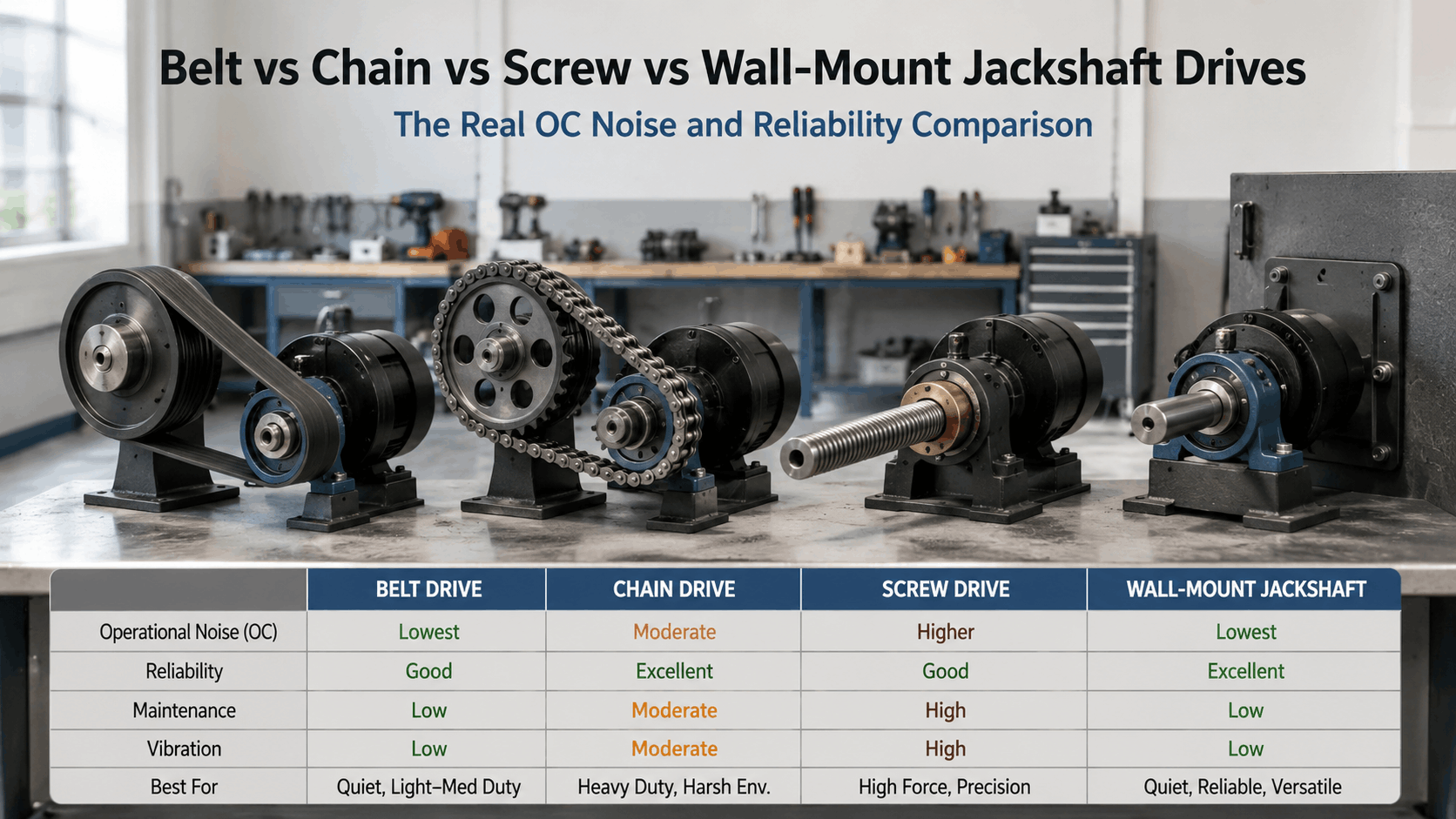
Side-by-Side Noise and Reliability Comparison
Now that each drive stands on its own, here is the direct comparison. This is how we rank them for noise, reliability, and cost when we advise Irvine homeowners.
| Drive | Noise (dB) | Lifespan | Relative Cost |
|---|---|---|---|
| Belt | 40-50 | 12-15 yrs | $$ |
| Jackshaft | 40-50 | 15+ yrs | $$$ |
| Screw | 50-60 | 10-15 yrs | $$ |
| Chain | 55-65 | 10-15 yrs | $ |
Ranking the Drives by Noise
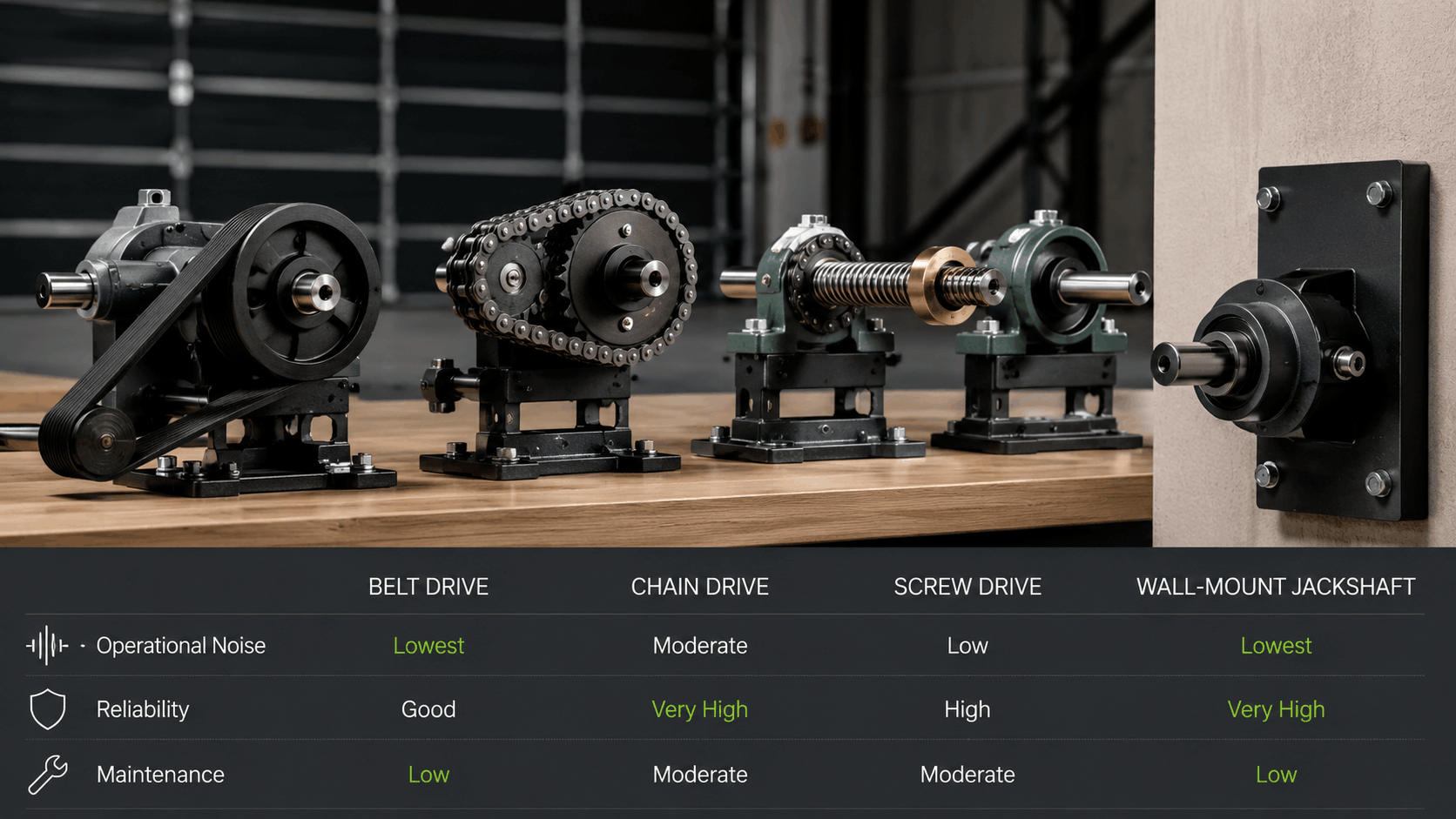
From quietest to loudest, the order is jackshaft, belt, screw, then chain. The jackshaft and belt are close on paper at 40 to 50 decibels, but the jackshaft edges ahead because it sends almost no vibration into the ceiling.
A belt drive is the quietest opener you can hang from the ceiling. At 40 to 50 decibels it sounds like soft rain or a quiet room. Most people cannot hear it from inside the house.
The screw drive sits in the middle at 50 to 60 decibels, a steady hum you notice but tolerate. The chain drive at 55 to 65 is the loudest, with that classic metal rattle. This decibel comparison is the clearest way to choose for a noise-sensitive home.
For any home with bedrooms over the garage, we steer people to the top two. The quietest opener you can afford pays off every single day.
Ranking the Drives by Reliability and Lifespan
All four can last a long time, but the jackshaft usually leads on lifespan at 15 years or more when the door is balanced right. Belts follow closely at 12 to 15 years thanks to the low-stretch reinforced rubber.
Chain and screw drives both land in the 10 to 15 year range. Chains need the most routine attention with tensioning and lube, while screw drives mainly want the rail greased. Neglecting either shortens their life fast.
Common failure points differ by type. Chains stretch and sprockets wear, belts eventually fray, screw rails dry out, and jackshafts suffer when door balance is off. Matching the drive to how much maintenance you will actually do is smart.
The honest truth is that maintenance frequency matters more than the drive label. A serviced chain beats a neglected jackshaft. Regular care from our maintenance plan keeps any drive near the top of its range.
Ranking by Cost and Long-Term Value
On upfront price, chain is the cheapest, followed by screw and belt in the middle, with jackshaft at the top. Installed, a chain drive typically runs the least and a jackshaft the most, with belt and screw between them.
But value is about more than the sticker. A belt drive costs a bit more than a chain and delivers years of quiet mornings in an attached garage. For most Irvine families that comfort is worth the small premium.
A jackshaft is the priciest but returns reclaimed ceiling space, the longest life, and the quietest operation. For custom doors and high ceilings it is often the only drive that truly fits. The value is real for the right home.
For a detached garage or rental where noise does not reach anyone, the chain wins on value hands down. The best value depends entirely on your layout, which is why we look at each home before recommending a drive.
Picking the Right Drive for Your Irvine Home
Choosing an opener comes down to three things: your garage layout, your budget, and how sensitive you are to noise. Irvine's mix of two-story homes and tight HOA communities makes those factors bigger here than in a lot of cities.
Homes With Bedrooms Above the Garage
Two-story homes with a bedroom over the garage are everywhere in Woodbridge and Quail Hill. In these layouts, noise travels straight up through the ceiling into the room above. A loud opener becomes a daily alarm clock.
For these homes, a belt or jackshaft drive is the clear pick. The quiet drive keeps early departures and late arrivals from waking anyone. The difference between a chain and a belt in this setup is the difference between a jolt and a hush.
The jackshaft goes one step further by removing the ceiling-mounted motor entirely. If the bedroom sits directly over the door, cutting that vibration path is the surest way to protect sleep. It is the reason we install so many in newer two-story builds.
We have swapped countless chain drives for belts in these homes and the feedback is always the same. Families are shocked how much quieter the mornings get after one afternoon of work.
HOA Rules and Noise Considerations
Irvine is full of tight-knit HOA communities where homes sit close together. Along streets off Jeffrey Road and throughout the villages, your neighbor's bedroom window can be feet from your garage. A loud opener is not just your problem.
Some HOA rules touch on noise and courtesy, and even where they do not, being considerate keeps the peace. A quiet belt or jackshaft opening at 6 a.m. respects the neighbors sleeping nearby. It is a small thing that matters in dense communities.
Close-set homes also mean sound bounces between walls and driveways. A chain rattle can echo across a shared motor court. Choosing a quiet drive is a simple courtesy in these neighborhoods.
We know the community layouts across Irvine well and factor them into every recommendation. If your home shares a wall or a close driveway, we lean toward the quieter options.
Budget vs Long-Term Comfort
The budget opener is the chain drive, and there is no shame in choosing it when it fits. If your garage is detached or nobody sleeps above it, the savings are smart money.
But for an attached garage with living space above, weigh that lower price against 10-plus years of daily noise. The belt drive costs a little more once and pays you back in quiet every morning. Over a decade the upgrade is easy to justify.
Think about how long you will stay in the home too. If this is your long-term house, the comfort of a quiet drive compounds year after year. If you are selling soon, a belt drive is also a nice selling point for the next buyer.
We never push the priciest unit on anyone. We lay out the real cost difference and the daily comfort trade so you can decide with clear numbers.
When to Call a Local Pro for Help Deciding
Sometimes the right drive is not obvious until someone measures the door. Door weight, spring balance, ceiling height, and rail clearance all change the answer. That is where a professional assessment saves money.
Our team evaluates all of it on-site across Irvine before recommending anything. We check whether the door is balanced, how much the panels weigh, and how the space is used. A heavy custom door might rule out one option and point straight to another.
We also look at whether your existing springs can support the new opener. A jackshaft in particular demands proper balance, so we inspect the torsion setup first. Getting that right protects the whole investment.
If you are unsure which drive fits, a quick visit answers it fast. Reach out through our contact page or call, and we will match the drive to your home and budget with no guesswork.
Need Help in Irvine?
Urgent Garage Doors serves Irvine and all of Orange County.
Installation and Upkeep Tips for a Quieter, Longer-Lasting Opener
No matter which drive you choose, how it is installed and maintained decides how quiet and long-lasting it stays. A few habits make any opener run better for years.
Simple Fixes That Cut Noise Fast
The fastest noise win is swapping old steel rollers for nylon rollers. Steel rollers grind and rattle in the track, while nylon glides quietly. This single change can transform a noisy door, and our quiet roller hardware upgrade handles it in one visit.
Tightening loose hardware is next. Over years, bolts and brackets on the door and track work loose and start to buzz. A round of tightening with a socket wrench quiets a lot of the rattle for free.
Vibration isolation pads are the third quick win. Placing rubber isolators between the opener mount and the ceiling joists stops vibration from traveling into the room above. For a bedroom over the garage, these pads make a real difference.
Together these three fixes can quiet almost any drive, even a chain. We often do all three at once when a customer wants the most improvement for the least money.
A Maintenance Schedule That Adds Years
A simple schedule keeps any opener healthy. Twice a year, lubricate the drive and the rollers, hinges, and springs with a proper garage door lubricant. Irvine's dry air pulls grease out fast, so do not skip it.
Once a year, do a spring inspection and check the door balance. Lift the door halfway by hand with the opener disconnected. If it drifts up or slams down, the springs need attention through our spring and cable repair team.
Test the safety sensors every few months too. Wave an object through the beam as the door closes and confirm it reverses. Misaligned safety sensors are a common and dangerous fault that is easy to catch early.
Seasonally, wipe the tracks clean and listen for new sounds. A change in noise is usually the first warning that something needs care. Catching it early keeps a small fix from becoming a full replacement.
Why Proper Installation Matters Most
Here is the part homeowners miss most: a poorly balanced door makes any opener loud and short-lived. If the springs are not carrying the weight, the motor strains, overheats, and wears out years early.
Professional installation gets the door balanced first, then mounts the opener with proper isolation and alignment. A rushed install with an unbalanced door will make even a jackshaft sound rough. The setup matters more than the brand.
Correct installation also protects your warranty. Many manufacturers require professional setup, and a botched DIY job can void coverage. Doing it right the first time keeps that protection intact.
Our team balances the door, isolates the mount, and tests the full cycle before we leave. Whether it is a fresh garage door installation or an opener swap, that care is what makes the quiet last.
Final Thoughts
The right drive depends on your home, not on which unit is cheapest or fanciest. Chain drives win on price for detached garages and rentals. Belt and jackshaft drives win on quiet for homes with rooms above the garage, and screw drives split the difference.
Whichever you pick, proper spring balance and regular maintenance decide how quiet and long-lasting it stays. Match the drive to your layout, keep up the upkeep, and any of these four will serve you well for a decade or more.
If a noisy door is waking your family in Woodbridge, Turtle Rock, or anywhere across Irvine, our team can help. We evaluate your door on-site, recommend the right drive for your home and budget, and install it so it runs quiet from day one. Call Urgent Garage Doors or reach out through our contact page for a consultation.
Frequently Asked Questions
- Which garage door drive is the quietest?
- Belt and wall-mount jackshaft drives are the quietest, both running around 40 to 50 decibels. The jackshaft feels even quieter because it mounts on the wall and removes the overhead motor and rail entirely, so almost no vibration reaches rooms above the garage. For a home with a bedroom over the garage, the jackshaft is the top choice for silence.
- How long does each type of garage door opener last?
- With proper maintenance, a chain drive lasts 10 to 15 years, a screw drive 10 to 15 years, a belt drive 12 to 15 years, and a jackshaft 15 years or more. Lifespan depends heavily on door balance and regular lubrication. A well-maintained unit reaches the top of its range, while a neglected one can fail years early regardless of type.
- Is a belt drive worth the higher price?
- For homes with living space above the garage, yes. A belt drive costs a modest amount more than a chain but delivers quiet operation every day for a decade or more. If your bedroom sits over the garage in a neighborhood like Woodbridge, the comfort of silent mornings easily justifies the price difference. For a detached garage, the extra cost matters less.
- Do screw drive openers have problems in hot weather?
- Older screw drives were sensitive to temperature swings and could stall in extreme cold or heat. Modern models use temperature-tolerant grease and better housings that handle Irvine's mild climate without trouble. Since freezing weather is not a concern here, a current screw drive runs steady year round as long as the rail stays properly lubricated.
- What is a wall-mount jackshaft drive and who needs one?
- A jackshaft drive mounts on the wall beside the door and turns the torsion bar directly instead of pushing a trolley along a ceiling rail. It frees up ceiling space and runs very quietly. It fits homes with high ceilings, tall or custom doors, or plans for overhead storage, common in newer Irvine builds like Portola Springs and the Great Park Neighborhoods.
- Can a loud garage door opener be made quieter without replacing it?
- Often, yes. Swapping steel rollers for nylon rollers, lubricating the drive and hardware, tightening loose bolts and brackets, and adding vibration isolation pads between the opener and the ceiling can dramatically cut noise. These fixes quiet even a chain drive and cost far less than a new opener. We handle all of them in a single service visit.
- How much does opener installation cost in Irvine?
- Installed pricing varies by drive type and door. Chain drives are the most budget-friendly, screw and belt drives fall in the middle, and jackshaft drives are the premium option including parts and labor. Final cost depends on your door weight, spring condition, and any hardware upgrades. We provide clear on-site quotes so you know the full price before any work begins.
- Which drive is best for a detached garage or rental?
- A chain drive is usually the practical pick for detached garages and rental properties. When noise does not reach anyone's living space, the chain's low cost and cheap, easy repairs make it the smart budget choice. It handles heavy doors reliably and any technician can service it quickly, which keeps ongoing costs down for landlords.
- How often should a garage door opener be serviced?
- Plan on a professional check once a year, plus simple seasonal upkeep you can do yourself. Lubricate the drive, rollers, and springs twice a year, test the safety sensors every few months, and check the door balance annually. Irvine's dry climate dries out grease sooner, so consistent lubrication is the single most helpful habit for a long opener life.
- Does Urgent Garage Doors help pick and install the right drive?
- Yes. Our local team assesses each home in Irvine on-site, checking door weight, spring balance, ceiling height, and layout before recommending a drive. We match the right chain, belt, screw, or jackshaft opener to your home and budget, then install it with proper balance and isolation so it runs quiet and lasts. Reach out through our contact page to schedule a visit.
Licensed garage door repair professionals serving Irvine and Orange County.
Licensed in California · License #1055150
Why trust Urgent Garage Doors?
Founded in 2017, Urgent Garage Doors is a licensed and insured garage door services serving Irvine and Orange County. All content is reviewed by our licensed technicians.

Need Help in Irvine?
Urgent Garage Doors serves Irvine and all of Orange County.
Related Articles

Best Quiet Opener Choice for Turtle Rock and Hillside Irvine Homes
Discover the best quiet garage door openers for Turtle Rock and Hillside Irvine homes. Compare belt vs chain drives, explore top models, and learn installation tips.
Garage Door Cable Replacement Cost Orange County: Why Pricing Varies by Neighborhood
Garage door cable replacement cost in Orange County varies by neighborhood. Learn why prices differ, real cost ranges, and how to get a fair, accurate quote.
Liftmaster vs Genie vs Chamberlain: 10-Year Reliability Data
Liftmaster, Genie, and Chamberlain compared using 10 years of real Irvine service data on lifespan, repair frequency, costs, and how coastal air affects each brand.