Spring Replacement on Custom and Wood Doors in OC - Why Heavy Doors Need Engineered Setups
Key Takeaways
- Solid wood and custom doors can weigh 400 to 800 pounds, three to five times more than a standard 130 to 160 pound steel door.
- Heavy doors need engineered torsion systems, not extension springs, with wire size, diameter, and length calculated from the door's true measured weight.
- Most solid wood doors require dual high-cycle springs rated for 25,000+ cycles to share the load safely and last longer.
- Undersized springs on heavy doors fail early, fray cables, burn out openers, bend tracks, and create serious falling-door hazards.
- Our Irvine team weighs each door on a digital scale and checks track radius, headroom, and drum type before ordering any parts.
- Coastal salt air near Newport Coast and Corona del Mar swells wood and corrodes hardware, so those doors need corrosion-resistant parts and a weight margin.
- Engineered dual high-cycle spring systems typically run $450 to $850, with custom-wound springs taking two to five days to order.
- Torsion spring work on heavy doors is not a safe DIY task due to stored energy and injury risk - call a professional.
In This Article
A homeowner near Turtle Rock called our team on a Sunday morning after her garage door came down hard and refused to lift again. Her solid wood carriage door had dropped several inches overnight, and one of the springs had snapped clean in two. She had paid for a spring swap a year earlier, but the installer had used a standard spring meant for a lightweight steel door.
That single mistake cost her a bent track, a strained opener, and a full weekend without a working garage. It also taught her something most people never think about: a heavy wood door is a completely different animal from a builder-grade steel one. The spring system has to be built around the exact weight, balance, and use of the door.
Why Custom and Wood Doors Are So Much Heavier
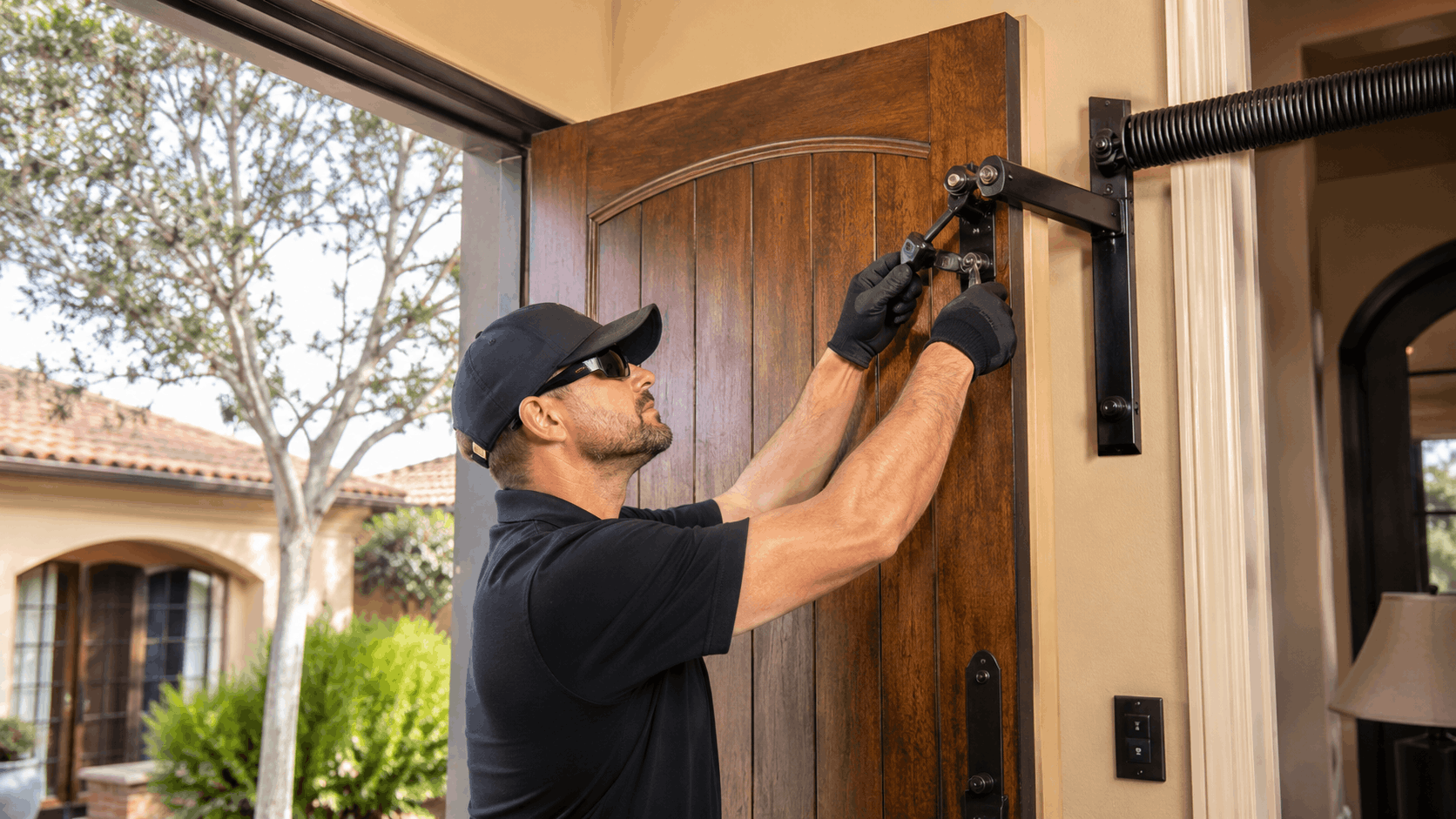
The weight difference between a standard door and a custom build is not small. It often triples or quadruples the load the springs have to hold. That extra weight changes every part of the system, from the spring wire size to the drums and cables.
Here is a quick look at how the numbers stack up across common door types found in Orange County homes.
| Door Type | Typical Weight | Spring System Needed |
|---|---|---|
| Builder-grade steel | 130 - 160 lbs | Single torsion spring |
| Insulated steel | 170 - 220 lbs | Single or dual torsion |
| Wood overlay on steel | 250 - 400 lbs | Dual torsion |
| Solid wood carriage | 400 - 800 lbs | Engineered dual high-cycle |
Steel vs. Solid Wood: The Weight Gap
A typical steel sectional door weighs somewhere between 130 and 160 pounds. That is light enough that a single properly sized torsion spring can lift and hold it for years without strain. Most of the doors on tract homes across Irvine fall into this range.
A solid wood door is a different story. Depending on the species and thickness, these doors can weigh anywhere from 400 to 800 pounds. That is a four- to fivefold jump in door weight, and it means the spring system carries a load most standard parts were never rated for.
This door weight comparison matters because springs are engineered around a specific number. A solid wood door pushing 600 pounds needs springs wound with thicker wire and a larger inside diameter than anything on a stock shelf. When the weight is guessed instead of measured, the whole system runs on borrowed time.
We see the gap firsthand every week. A homeowner assumes a spring is a spring, but the physics of holding 150 pounds versus 600 pounds could not be more different. The heavier the door, the less room there is for error.
Overlay, Cladding, and Carriage-Style Builds
A lot of the weight on a custom garage door comes from parts you cannot see from the street. Decorative overlays, thick cladding, and heavy hardware all add pounds that never show up on a spec sheet. A wood overlay door built over a steel base can easily double the base weight.
Carriage house doors are especially common on OC estates, and they carry serious mass. Real wood stiles, thick rails, hand-forged handles, and iron strap hinges add up fast. A carriage house door that looks graceful from the driveway may be one of the heaviest doors in the neighborhood.
Cladding is another hidden factor. Some homeowners add reclaimed wood or thick plank facing to a lighter door for a rustic look. That upgrade can push a mid-weight door into heavy territory, which means the original springs are suddenly undersized.
When our team installs a carriage house garage door, we weigh the finished build rather than trusting the manufacturer estimate. The real number is almost always higher than expected once all the trim and hardware go on.
How Local Humidity and Coastal Air Change Weight Over Time
Wood is not a fixed weight. It swells and shrinks with moisture, and that changes how a door balances against its springs. In the drier inland parts of Orange County the swing is smaller, but near the coast it can be dramatic.
Salt air near Newport Coast and the marine layer that rolls through much of the year push moisture into unsealed wood. As the wood absorbs water, the door gains weight and shifts its balance point. A door that was perfectly tuned in August can feel heavy and sluggish by February.
The Orange County climate also drives seasonal cycles. Wet winters swell the wood, dry summers shrink it, and the springs feel that push and pull all year. Over time this constant flexing wears springs more than a stable indoor environment would.
Because of coastal humidity and wood swelling, we build in a small margin when we spec springs for waterfront homes. A system tuned only for the lightest dry-season weight will feel out of balance the moment the wood soaks up moisture.
Get Your Free Quote
Tell us about your garage door and we'll get back to you within 30 to 60 minutes.
What an Engineered Spring Setup Actually Means
An engineered spring setup starts with real measurements, not a guess from a chart. It means the door is weighed, the geometry is checked, and every part is matched to the actual load. A guessed setup skips those steps and hopes a close-enough spring will hold.
For heavy custom doors, close enough is never good enough. The right setup keeps the door balanced, protects the opener, and lasts for years instead of months.
Torsion Springs vs. Extension Springs on Heavy Doors
There are two main spring types, and they are not interchangeable on a heavy door. A torsion spring mounts on a shaft above the door and unwinds to lift the weight in a smooth, controlled way. An extension spring stretches along the tracks and is far better suited to light doors.
On a several-hundred-pound wood door, extension springs are a poor choice. They store energy in a way that becomes dangerous when they fail, and they offer less control over a heavy load. That is why we do not recommend them for custom builds.
Torsion systems carry heavy doors more safely because the tension stays contained on the shaft. If a torsion spring breaks, the failure is loud but far more controlled than a snapped extension spring flying across the garage. For heavy doors, the safety difference alone settles the question.
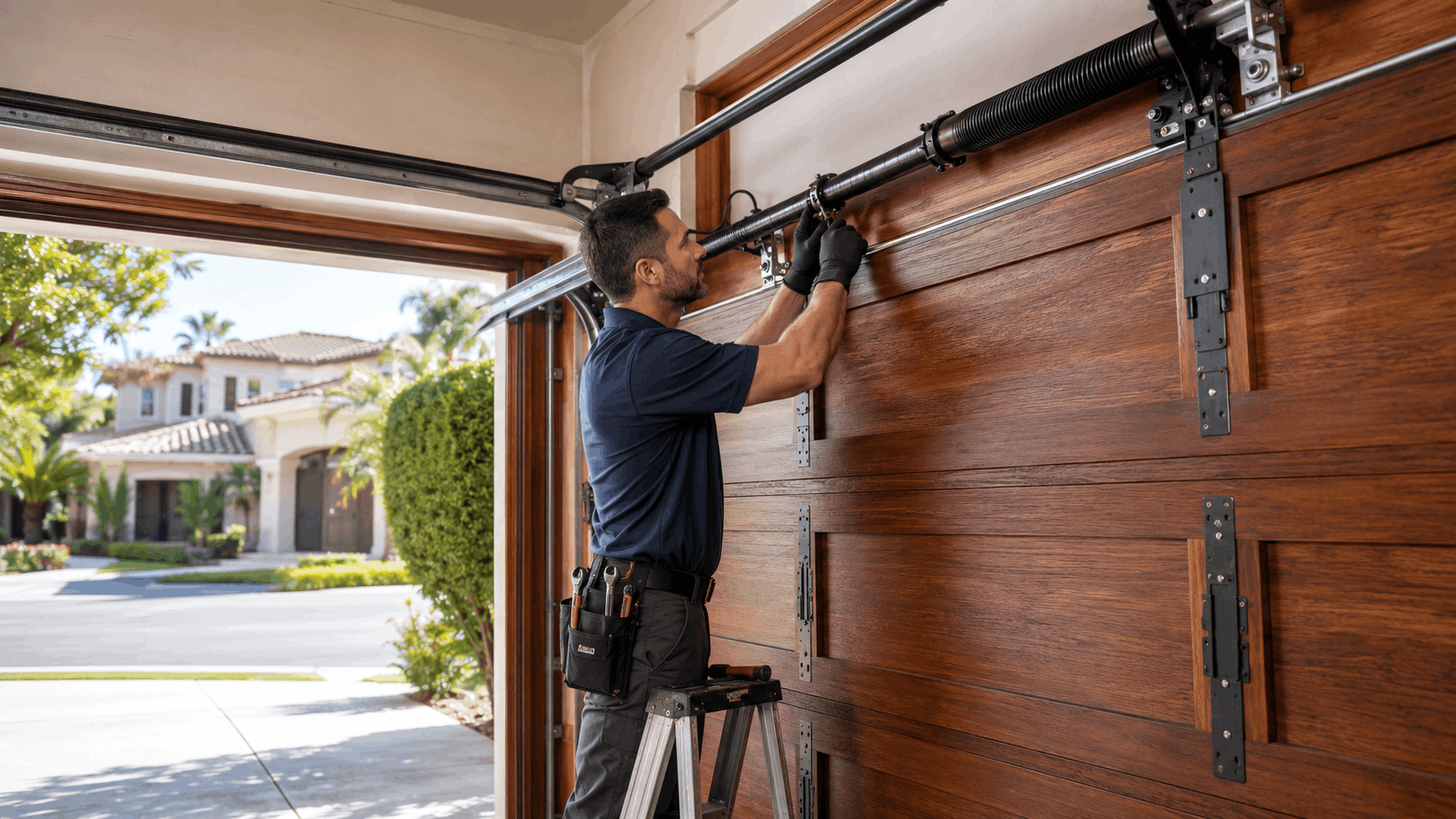
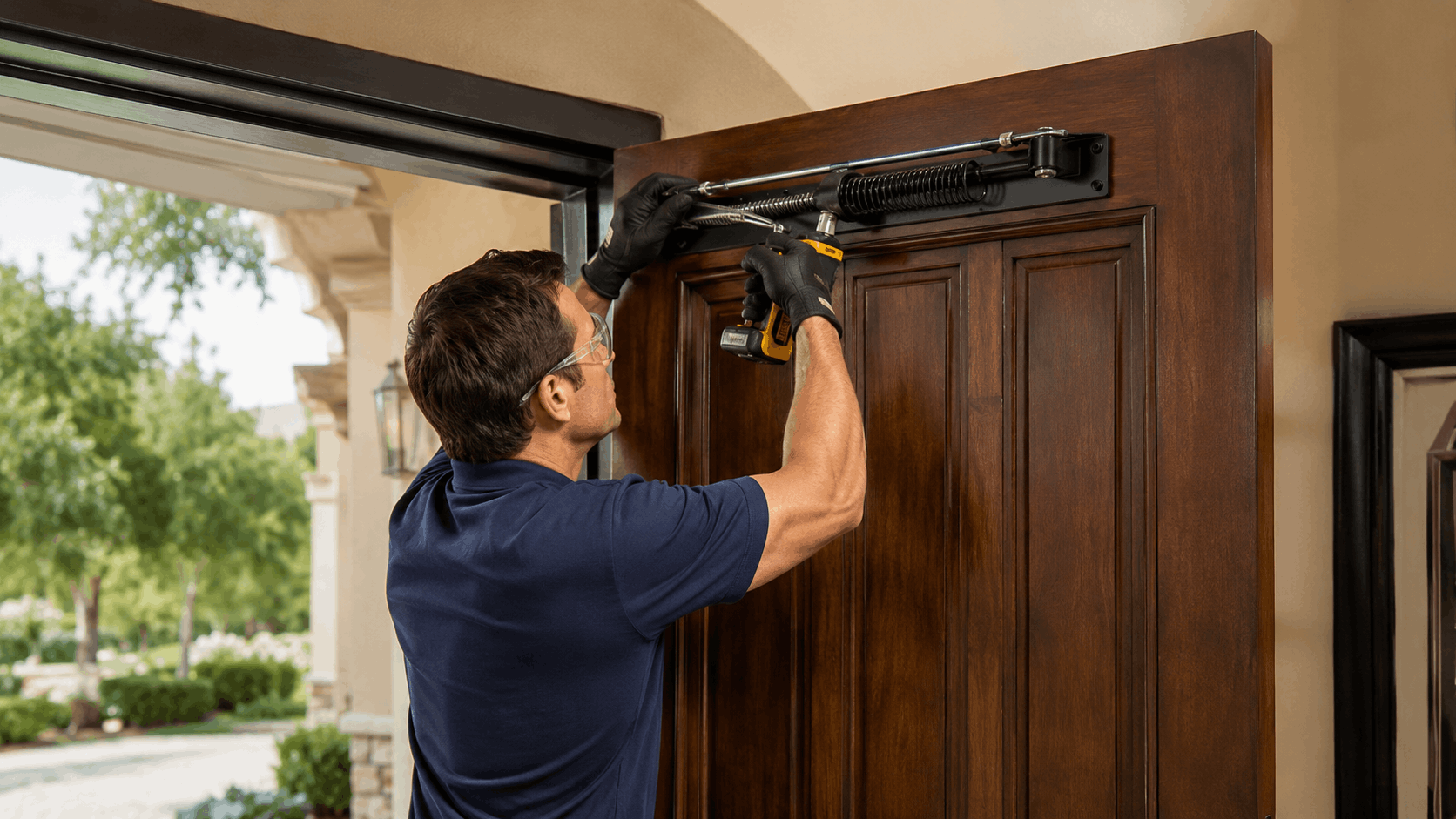
Our team handles torsion spring replacement on custom doors regularly, and we also perform spring conversion upgrades when an older heavy door was wrongly set up with extension springs.
Wire Size, Inside Diameter, and Length Calculations
Three measurements decide how much a torsion spring can lift. Those are the spring wire size, the inside diameter, and the length of the spring. Get any one wrong and the door either feels heavy or the spring wears out early.
The wire size is the thickness of the steel used to wind the spring. Heavier doors need thicker wire because thin wire simply cannot hold the load without over-stressing. The inside diameter and length work together to set the number of coils and the total lifting force.
Installers use a figure called IPPT, or inch-pounds per turn, to calculate the exact force a given spring produces. When the door weight is measured accurately, the IPPT math tells us precisely which spring to wind. A small error in that calculation is what causes premature failure.
This spring calculation is where guesswork ruins heavy doors. A spring that is 10 percent undersized might feel fine on day one, then break within a few months as it cycles under a load it was never built for. Correct math is the difference between a spring that lasts years and one that fails by spring.
Dual-Spring and High-Cycle Systems
Most heavy custom doors need two springs, not one. A dual spring system splits the load across both springs, which reduces stress on each one and adds a safety buffer. If one spring breaks, the second helps hold the door instead of letting it slam down.
Cycle rating is the other half of the equation. A standard spring is rated for around 10,000 cycles, which is roughly seven years of average use. A high cycle spring rated at 25,000 cycles or more is built for the daily wear a heavy door puts on the system.
For a busy family garage where the door goes up and down many times a day, high-cycle springs make sense on a heavy build. The upfront cost is higher, but the door goes far longer between service visits. On a 600-pound door, that longevity is worth paying for.
We spec dual high-cycle systems on most solid wood doors we service. The combination of shared load and higher cycle life is what keeps these doors running smoothly for a decade or more.
Matching Drums, Cables, and Shafts to the Load
Springs are only part of the picture. The cable drums, lift cables, and torsion shaft all have to be rated for the heavier weight too. Putting a heavy-duty spring on a system with light drums just moves the weak point somewhere else.
Cable drums come in different capacities and lift types. A heavy door often needs a stronger drum than the stock part, and coastal homes sometimes benefit from high-lift geometry to keep the door balanced. The drum choice ties directly into the track and headroom setup.
Lift cables are rated by breaking strength, and a heavy wood door demands thicker, stronger cable. We have seen thin cables fray and snap under a load they were never meant to carry. Matching the cable to the door weight prevents that failure.
The torsion shaft itself can flex or twist if it is undersized for a heavy door. On the heaviest builds we upgrade to a stronger shaft so the whole assembly stays rigid. Our spring and cable repair team checks all of these parts together, never in isolation.
Need Help in Irvine?
Urgent Garage Doors serves Irvine and all of Orange County.
What Happens When Heavy Doors Get the Wrong Springs
When a standard spring is forced onto a custom door, the failures follow a predictable pattern. We get called out to fix the same set of problems again and again. Almost all of them trace back to a spring system that was never engineered for the door's weight.
The damage rarely stops at the spring. An unbalanced heavy door strains every other part of the system until something else gives way.
Early Spring Breakage and Snapped Cables
An undersized spring on a heavy door wears out fast. Instead of lasting years, it can fail within months because it is working past its rated load on every cycle. The broken spring is usually the first sign a homeowner notices.
The strain does not stay in the spring alone. As the spring weakens, the cables take on more load than they should. Over time those cables fray, and a frayed cable eventually becomes a snapped cable.
A snapped cable on a heavy door is a serious event. The door can jam sideways, come off its track, or drop on one side. We handle garage door cable repair often on doors that were set up with the wrong springs from the start.
The pattern is always the same. A too-small spring overworks, the cables carry the overflow, and the whole system fails earlier than it should. Correct sizing at the start prevents the entire chain of damage.
Burned-Out Openers and Bent Tracks
A garage door opener is built to guide a balanced door, not to lift dead weight. When the springs are undersized, the door is out of balance and the opener has to muscle the extra load. That constant overwork burns out the motor early.
We have replaced many openers that failed years before their time simply because the door was never balanced. The homeowner assumes the opener was defective, but the real cause was the spring system underneath it. A proper balance would have saved the motor.
An unbalanced heavy door also warps the hardware. The tracks can bend under the uneven load, and panels can twist or crack. A bent track then causes the door to bind, which puts even more strain on everything else.
Once a track bends, the fix gets expensive. Our track repair and realignment team sees plenty of this damage on heavy doors that ran too long on the wrong springs.
Safety Risks: Falling Doors and Injury
The most serious risk is a falling door. A wood door weighing several hundred pounds carries enormous force when it drops. If the springs fail and the cables cannot hold, that weight comes down fast.
A falling door can crush anything in its path, including cars, pets, and people. This is not a rare hypothetical. It is exactly why the U.S. Consumer Product Safety Commission has issued guidance on garage door and spring hazards over the years.
Garage door safety is the whole reason engineered setups exist. Proper springs, rated cables, and a balanced door mean the weight is always under control. When one part fails on a well-built system, the redundancy keeps the door from crashing down.
For a household with kids running in and out of the garage, that margin of safety is not optional. The heavier the door, the higher the stakes if the system is wrong.
How Our Team Measures and Weighs a Custom Door in Irvine
Before we order a single spring for a custom or wood door, we measure everything on site. Guessing from a manufacturer chart is how doors end up with the wrong springs. Real numbers come from real testing.
Here is the process our Irvine crew follows on every heavy door.
| Step | What We Check | Why It Matters |
|---|---|---|
| Weigh the door | True weight on a digital scale | Sets the spring force needed |
| Measure geometry | Track radius, headroom, drum type | Determines lift type and spring size |
| Document setup | Wire size, cycle rating, cable specs | Speeds up future service |
Using a Digital Scale to Get True Door Weight
The only reliable way to know a door's weight is to weigh it. We disconnect the door from the opener and springs, then set it on a digital scale to read the true number. That single figure drives the entire spring calculation.
Charts and manufacturer estimates are a starting point at best. A door with added cladding, thick overlays, or years of moisture swell will weigh more than any chart predicts. The door weight test removes all the guesswork.
On a recent Turtle Rock job, the manufacturer listed a door at 420 pounds, but our scale read 510. That 90-pound difference would have doomed a spring sized off the chart. Weighing the door is a small step that saves the whole system.
Once we have the true weight, we know exactly which wire size, diameter, and length to specify. No approximations, no crossed fingers. The number decides the spring.
Checking Track Radius, Headroom, and Drum Type
Weight alone does not finish the picture. We also measure the track radius and the headroom above the door to confirm the lift geometry. These measurements decide which drums and spring sizes will fit and function.
Low headroom garages, common in some older Orange County homes, sometimes need special hardware. If there is not enough room for a standard setup, we may recommend a high lift configuration with matched drums. That keeps a heavy door balanced in a tight space.
The drum type ties directly to the cable and spring choice. A high-lift drum winds cable differently than a standard drum, so the spring has to be calculated for that specific geometry. Skipping this check leads to a door that binds or feels off.
Getting the geometry right is what makes the finished door feel effortless. When headroom, track radius, and drum type all match the load, the door glides instead of struggling.
Documenting the Setup for Future Service
After the install, we write down every spec. The spring wire size, inside diameter, length, cycle rating, and cable specifications all go into our service records. That documentation makes future service fast and accurate.
When a spring eventually reaches the end of its cycle life, we do not have to re-measure from scratch. We pull the record and wind or order the exact replacement. That saves the homeowner time and avoids repeat mistakes.
Spring documentation also protects against future guesswork by anyone else. If another tech ever looks at the door, the specs are right there instead of hidden inside a sealed spring. It is a small habit that pays off for years.
For homeowners on a preventive maintenance plan, these records let us track the door's history and catch wear before it becomes a failure.
Need Help in Irvine?
Urgent Garage Doors serves Irvine and all of Orange County.
Custom Door Communities and Homes Across Orange County We Serve
Heavy custom and wood doors show up in specific pockets across Orange County. We have worked on hundreds of them, and we know which neighborhoods tend to have which door styles. That local knowledge helps us spec the right system quickly.
Here is where these doors turn up most often in our service area.
Estate Homes in Shady Canyon and Turtle Rock
Irvine's Shady Canyon and Turtle Rock estates are full of large custom wood and carriage doors. Many of these homes have oversized two- and three-car doors built from solid wood, and the weight can climb well past 500 pounds. These are exactly the doors that demand engineered dual-spring systems.
The gated Shady Canyon community in particular favors handcrafted carriage designs with heavy iron hardware. Those decorative touches add real weight, so we always weigh the finished door rather than trusting the spec. The extra pounds change the spring math every time.
In Turtle Rock, we service a mix of custom builds and older upgraded doors. When one of these heavy doors fails, homeowners need it handled correctly the first time. Our Turtle Rock garage door repair team knows the neighborhood and the doors well.
Because these are premium homes, the doors are often architectural centerpieces. Getting the spring system right protects both the door and the home's curb appeal.
Coastal Wood Doors in Newport Coast and Corona del Mar
Along the coast in Newport Coast and Corona del Mar, wood doors face a tougher environment. Salt air and constant marine moisture attack both the wood and the springs. A coastal wood door gains and loses weight with the seasons as it absorbs humidity.
That moisture cycle wears springs more than it would inland. Salt also speeds up corrosion on springs, cables, and hardware. We often spec coated or corrosion-resistant components for doors this close to the water.
Homes near Big Canyon in Newport Beach and the surrounding coastal areas need springs built with a margin for the added moisture weight. A system tuned only for dry conditions falls out of balance the moment the marine layer settles in.
We build coastal setups with the environment in mind. That means slightly stronger springs, better corrosion resistance, and more frequent balance checks over the year.
Older Custom Builds Near Old Towne Orange and Villa Park
The older neighborhoods around Old Towne Orange and Villa Park have plenty of legacy wood doors. Some of these doors are decades old and were built heavier than anything sold today. When their original springs finally fail, the system usually needs to be re-engineered from scratch.
Many of these homes still run on hardware that predates modern torsion standards. We frequently convert them to properly sized torsion systems with correct drums and cables. That upgrade brings an old door up to a safe, balanced standard.
Villa Park's larger lots often feature custom oversized doors that add even more weight. Our Orange Park Acres service team works on these legacy doors across the area. Re-engineering them correctly extends their life for years.
These older doors have real character worth preserving. The right spring system keeps them working without forcing a homeowner to replace a beautiful original door.
Costs, Timelines, and What to Expect
Engineered spring work on a heavy door costs more than a standard swap, and that is fair. The parts are stronger, the calculation takes more care, and the install is more involved. Here is an honest look at what to expect.
| Service | Typical Range | Timeline |
|---|---|---|
| Single high-cycle spring (heavy door) | $300 - $550 | Same day if in stock |
| Dual high-cycle system | $450 - $850 | Same day to 2 days |
| Custom-wound springs | $550 - $1,200+ | 2 - 5 days to order |
Price Ranges for Engineered Spring Systems
A single high-cycle spring on a heavier door typically runs between $300 and $550 installed. A dual high-cycle system usually falls between $450 and $850, depending on the door weight and parts needed. Custom-wound springs for the heaviest doors can run higher.
The spring cost is higher than stock because heavy doors need thicker wire and higher cycle ratings. High-cycle pricing reflects springs built for 25,000 cycles or more instead of the standard 10,000. You pay more upfront but replace the springs far less often.
The door weight is the biggest factor in the final number. A 300-pound wood overlay door costs less to spring than a 700-pound solid wood carriage door. More weight means stronger, more expensive parts.
These are ballpark ranges, and the true figure comes after we weigh the door. We give a firm quote once we know the real weight and geometry, not before.
Lead Times for Custom-Wound Springs
Many spring sizes are in stock, and we can handle those the same day. For a common heavy-door setup, we often carry the right springs on the truck and finish the job in one visit. That is the fastest path for homeowners.
Some heavy doors need a custom spring order because the wire size or length falls outside common stock. Those custom-wound springs usually take two to five days to arrive. We install a temporary safe setup when possible so the door is not stuck.
The lead time depends on how unusual the specs are. A slightly oversized common spring ships fast, while a fully custom coastal-rated spring takes longer. We tell homeowners the honest timeline up front.
For urgent situations, our same-day garage door repair team can often secure the door safely until the custom parts arrive. No one has to leave a heavy door in a dangerous state.
What Warranty and Cycle Rating Buys You
Paying for a higher cycle rating is usually the smarter long-term choice on a heavy door. A 25,000-cycle spring may cost more than a 10,000-cycle one, but it lasts far longer under daily use. On a heavy door that gets used many times a day, the cycle rating value adds up fast.
A good spring warranty also protects the investment. If a properly rated spring fails early, the warranty covers the replacement. That matters more on heavy doors where the parts and labor cost more.
Think of it as cost per year rather than cost today. A high-cycle spring that lasts 12 years often costs less per year than a cheap spring replaced every three or four years. The heavier the door, the more that math favors quality parts.
We walk every homeowner through the tradeoff before recommending a setup. For a light door the standard spring is fine, but for a heavy door the upgrade almost always pays off.
Need Help in Irvine?
Urgent Garage Doors serves Irvine and all of Orange County.
Maintenance Tips to Extend Spring Life on Heavy Doors
An engineered system still needs upkeep to reach its full lifespan. A few simple habits protect the springs and catch small problems early. Here is what we tell our heavy-door homeowners to do.
Seasonal Balance Checks
A balance test takes two minutes and tells you a lot. With the opener disconnected, lift the door halfway by hand and let go. A balanced door stays roughly in place, while an unbalanced one drifts up or slams down.
On heavy wood doors in Orange County, we recommend a seasonal check because humidity swings shift the balance. Do it once when the wet season starts and again when it dries out. Those are the moments the wood weight changes most.
If the door no longer holds its position, the springs are losing tension or the balance has drifted. That is the signal to call for a door balancing and tension adjustment before the problem grows. Catching it early protects the opener and the door.
Never force a heavy door that feels wrong during the test. If it drops fast or feels unstable, stop and let a professional handle it.
Lubrication and Hardware Inspection
Proper lubrication keeps a heavy door moving smoothly and reduces spring strain. Use a garage-door-specific lubricant on the springs, rollers, hinges, and bearings. Skip WD-40, which is a cleaner and not a long-term lubricant.
While you lubricate, inspect the hardware. Look at the cables for fraying, check the rollers for wear, and watch for rust on any part near the coast. A frayed cable or a worn roller is a warning worth acting on.
On coastal doors near Newport Coast and Corona del Mar, hardware inspection matters even more because salt speeds up corrosion. Wipe down metal parts and watch for rust streaks. Early rust is easy to address before it becomes a failure.
A quick monthly look during lubrication catches most problems. Heavy doors punish neglected hardware more than light ones, so the routine pays off.
When to Call a Professional Instead of DIY
Lubrication and balance checks are safe for a homeowner. Torsion spring work on a heavy door is not. A wound torsion spring holds enormous stored energy, and releasing it wrong can cause severe injury.
On a several-hundred-pound door, the DIY risk is simply too high. The springs, cables, and shaft are all under massive load, and a single mistake can send parts flying or drop the door. This is a job for trained hands and the right tools.
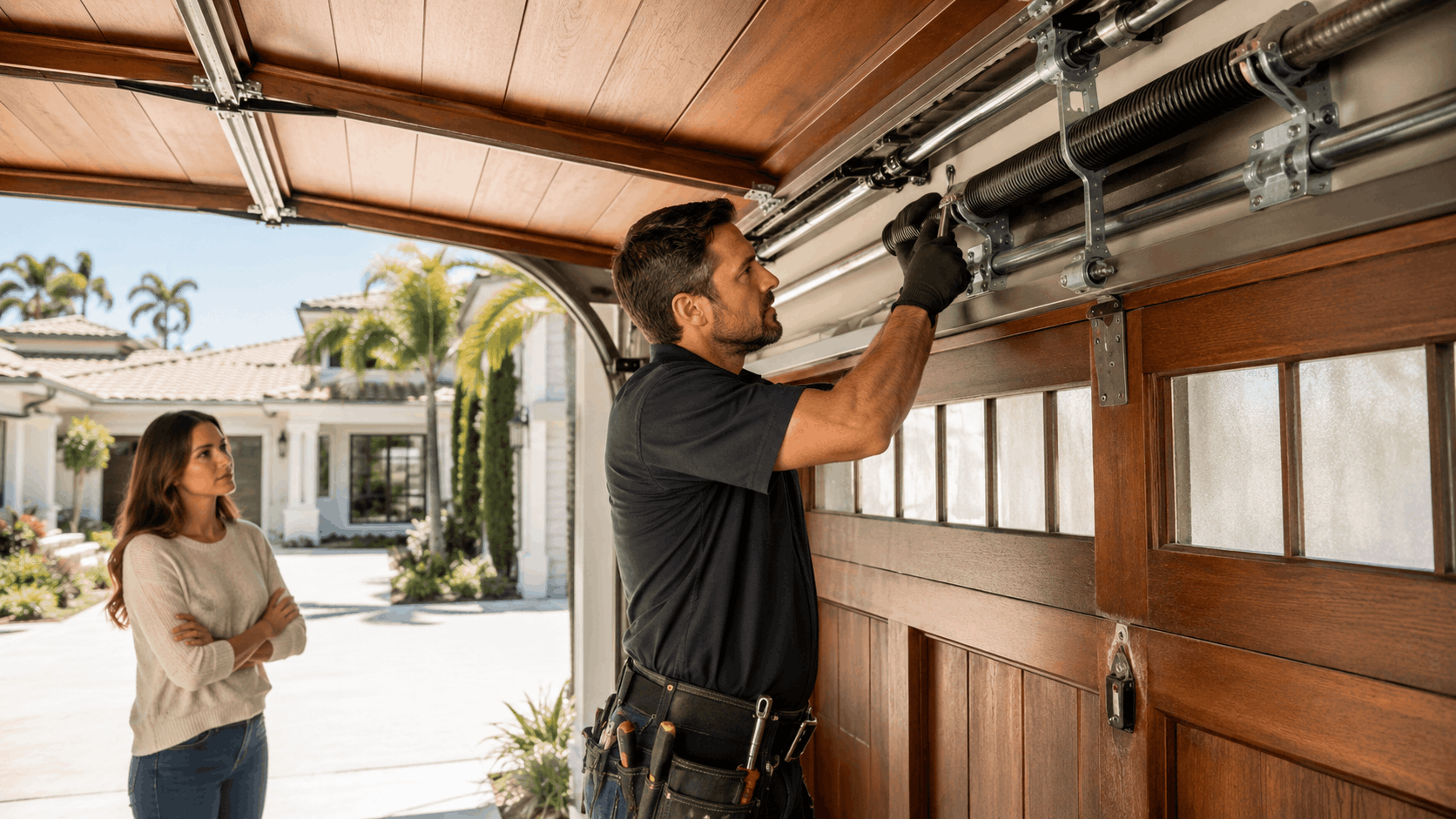
Our Irvine team handles this work every day and carries the specialized winding bars and safety gear the job requires. When a heavy door needs spring service, calling a professional is the safe path. The Occupational Safety and Health Administration documents how dangerous stored-energy components can be.
If you are unsure whether a task is safe, it is not worth guessing. Reach out to our team and we will tell you honestly whether it is a DIY job or one for us.
Final Thoughts
A heavy custom or wood door is not a candidate for a quick, standard spring swap. The weight changes everything about the spring system, from wire size to cables to drums. Getting it right means weighing the door, running the math, and matching every part to the real load.
Skipping those steps leads to early failures, burned-out openers, bent tracks, and real safety risks. Doing them right gives a homeowner a door that runs smoothly and safely for years. That is the difference between a guessed setup and an engineered one.
If you own a heavy wood or custom door anywhere in Orange County, our team can weigh it, spec the right springs, and build a system that lasts. Call Urgent Garage Doors in Irvine today for a consultation, or reach our emergency repair line if your door has already failed. We serve heavy-door homeowners across Irvine and the surrounding communities.
Frequently Asked Questions
- How heavy is a typical custom wood garage door?
- Most solid wood garage doors weigh between 400 and 800 pounds, compared to 130 to 160 pounds for a standard steel door. The exact number depends on the wood species, thickness, and how much decorative overlay and hardware the door carries. Carriage-style designs with iron straps and thick cladding sit at the heavy end. We weigh every custom door on a digital scale before ordering springs.
- Can a standard spring work on a heavy wood door?
- No, a standard spring cannot safely carry a heavy wood door. It is sized for a light door, so it works past its rated load on every cycle and fails within months. That overload also strains cables, burns out the opener, and creates a real risk of the door dropping. Heavy doors need an engineered spring system sized to their measured weight.
- Why does a heavy door need two springs?
- A dual spring system splits the door's weight across both springs, so each one carries less strain and lasts longer. It also adds a safety margin. If one spring breaks, the second helps hold the door instead of letting several hundred pounds crash down. For most solid wood and heavy custom doors, we consider dual springs the correct setup for both longevity and safety.
- How long do engineered springs last on a heavy door?
- Spring life is measured in cycles, where one cycle is one full open and close. A high-cycle spring rated at 25,000 cycles lasts far longer than a standard 10,000-cycle spring. For a typical Orange County family that opens the door four to six times a day, high-cycle springs on a heavy door often last 10 to 15 years with proper maintenance.
- How much does spring replacement cost on a custom door in OC?
- A single high-cycle spring on a heavy door usually runs $300 to $550 installed, and a dual high-cycle system falls around $450 to $850. Fully custom-wound springs for the heaviest doors can exceed $1,000. The final price depends on the measured door weight, cycle rating, and whether cables, drums, or the shaft also need upgrading. We quote firmly after weighing the door.
- Does coastal air near Newport Coast affect my springs?
- Yes, salt air along the coast affects both the springs and the door. Salt speeds up corrosion on springs, cables, and hardware, shortening their life. Marine moisture also swells the wood, which adds weight and shifts the door's balance against the springs. For coastal homes we spec corrosion-resistant parts and build in a weight margin for the humidity.
- Can I replace a torsion spring myself?
- We strongly advise against it, especially on a heavy door. A wound torsion spring holds enormous stored energy, and releasing it incorrectly can cause serious injury or worse. On a several-hundred-pound door the load on the springs, cables, and shaft is extreme. This job needs proper winding bars, training, and safety experience. Please call a professional rather than risking it.
- How fast can your Irvine team come out?
- We offer same-day and next-day service across Orange County for most spring and cable issues. If the correct spring is in stock, we often finish a heavy-door job in a single visit. When custom-wound springs are needed, we secure the door safely and return once the parts arrive. Call our Irvine team and we will give you an honest arrival window.
- Will heavier springs damage my opener?
- No, correctly sized springs protect the opener rather than harm it. When the springs are matched to the door weight, the door is balanced and the opener only guides it, doing almost no lifting. Damage happens when springs are undersized and the door is heavy on the opener, forcing the motor to overwork. A balanced door extends opener life.
- What signs mean my heavy door needs new springs?
- Watch for a door that sags on one side, moves in a jerky or uneven way, or feels much heavier than usual. A loud bang from the garage often means a spring has snapped. If the door will not stay put during a balance test or the opener strains to lift it, the springs are failing. Call before the door drops.
Licensed garage door repair professionals serving Irvine and Orange County.
Licensed in California · License #1055150
Why trust Urgent Garage Doors?
Founded in 2017, Urgent Garage Doors is a licensed and insured garage door services serving Irvine and Orange County. All content is reviewed by our licensed technicians.

Need Help in Irvine?
Urgent Garage Doors serves Irvine and all of Orange County.
Related Articles
Coto de Caza Garage Door Repair: Custom Estate Doors and Emergency Service
Skilled garage door repair for Coto de Caza estates - custom wood door restoration, emergency service through the gate, spring and opener replacement, and local maintenance.
Shady Canyon Garage Door Service: Custom Estate Doors and Authorized Repair
A local guide to custom estate garage doors and authorized repair in Shady Canyon, covering materials, repairs, HOA rules, and maintenance for Irvine's heavy custom doors.
Yorba Linda Estate Garage Doors: Oversized and Custom Service
A local guide to oversized and custom garage doors for Yorba Linda estate homes, covering sizing, materials, HOA rules, openers, repairs, and maintenance.