Broken Garage Door Spring in Cowan Heights and What Happens in the Next Two Hours
Key Takeaways
- A broken spring leaves the door carrying its full weight with no support, so never lift it by hand or run the opener; leave it where it sits and call for service.
- A torsion spring is wound under tension and can cause serious injury, so no homeowner should ever adjust, wind, unwind, or replace one.
- Springs are rated in cycles, commonly around 10,000, which is roughly seven years at four cycles a day; age and daily use, not a sudden event, wear them out.
- Typical Orange County ranges are $150 to $300 for torsion spring replacement and $150 to $250 for extension spring replacement, with a written price given before work begins.
- Cables and rollers wear on the same clock as springs and get inspected during the repair to prevent a second failure weeks later.
- North Tustin is unincorporated Orange County, so permits run through OC Development Services, not the City of Tustin, and a like-for-like spring repair needs no permit.
- If a replacement opener is installed, SB 969 requires battery backup as a legal requirement, and pre-1993 openers predate the federal entrapment protection mandate.
- Urgent Garage Doors offers 24/7 emergency service with a 30 to 60 minute response across Orange County and holds California license #1055150.
In This Article
A spring breaks with a sound you do not forget. Homeowners along Cowan Heights describe it as a gunshot or a sharp crack from the garage, often in the quiet of early morning or late at night. The next thing they notice is a door that will not lift, a car stuck inside, and a steep driveway that makes the whole problem worse.
Here is the short answer. A broken garage door spring is not a do-it-yourself fix. The door is now dangerous to force by hand or run with the opener, and a torsion spring stores enough energy to cause serious injury. Emergency help reaches North Tustin in 30 to 60 minutes, any hour of the day.
The first two hours matter. Done right, the spring gets replaced and the door runs safely again the same visit. Done wrong, a simple spring job turns into bent tracks, snapped cables, and a bigger bill. This guide walks through how to confirm it is the spring, what to do and avoid in that first window, why springs fail in these foothill streets, and what a proper repair covers.
How to Tell Your Spring Is Actually Broken?
Before anyone touches the mechanism, it helps to confirm the problem is a spring and not the opener, the tracks, or something else. The good news is that most of the signs are easy to spot from the driveway without laying a hand on the hardware. A broken torsion spring tends to announce itself in a way few other failures do.
When a garage door won't open and the opener seems to be working, people often blame the motor first. More often than not, the opener is fine and the spring is the real culprit. The table below lays out the common spring signs next to what each one usually means, so a homeowner can tell the difference before calling.
| What You Notice | What It Usually Means |
|---|---|
| Loud bang from the garage, then nothing moves | A torsion spring snapped under tension |
| A two to three inch gap in the coil above the door | The spring is broken, not just loose |
| Opener hums or runs but the door stays put | Motor is fine, spring is not carrying the weight |
| Door opens a few inches then stops or jerks | Spring or cable problem, stop and leave it |
| Door feels extremely heavy if you try to lift it | No spring support, the full weight is on you |
The Bang, the Gap, and the Dead Opener
The loud bang is the first clue, and it is the one homeowners remember. A torsion spring is wound tight, and when the metal fatigues and fractures, that stored energy releases all at once. The sound echoes through the garage and sometimes through the house, which is why people often think something fell or someone broke in.
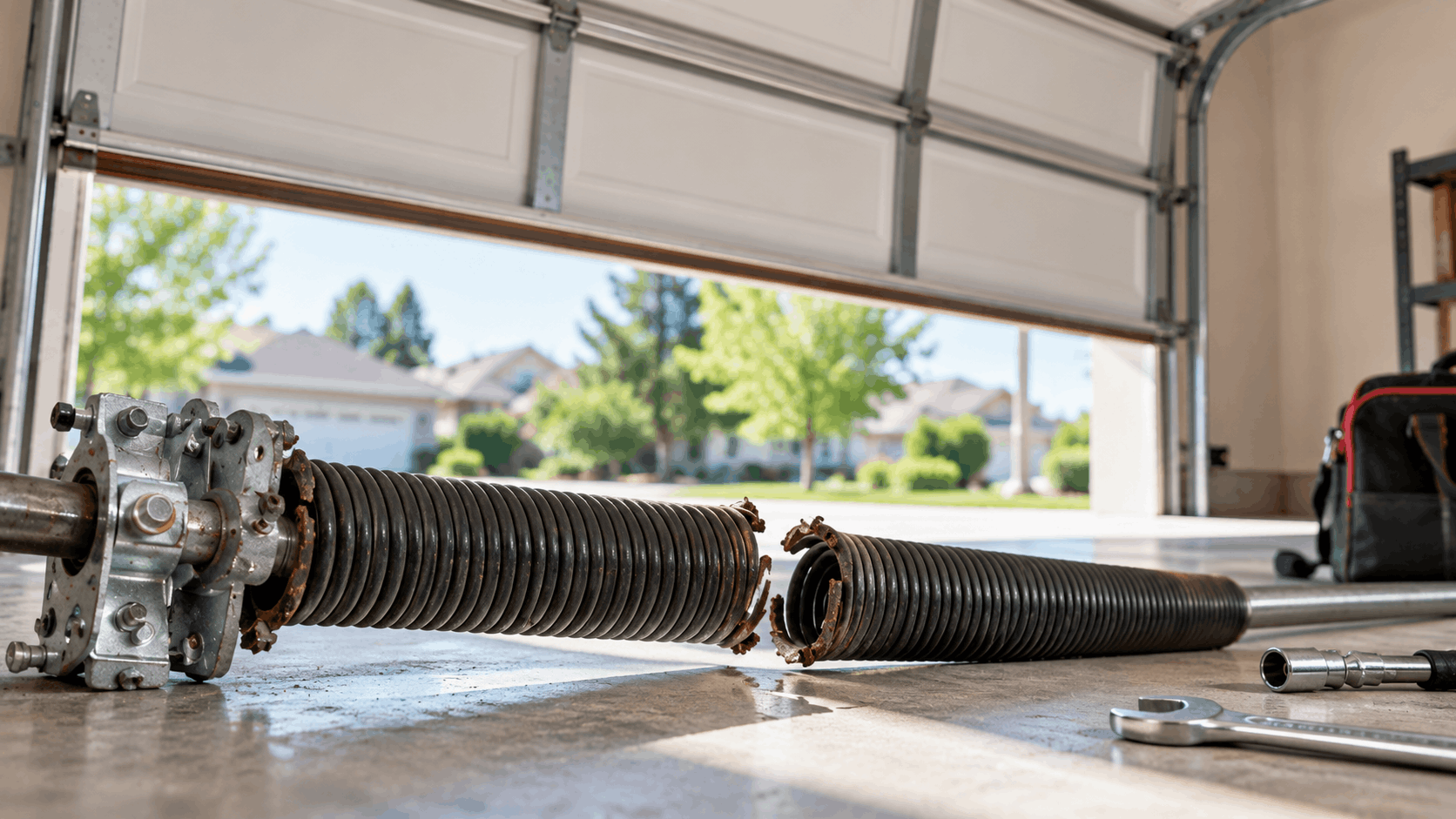
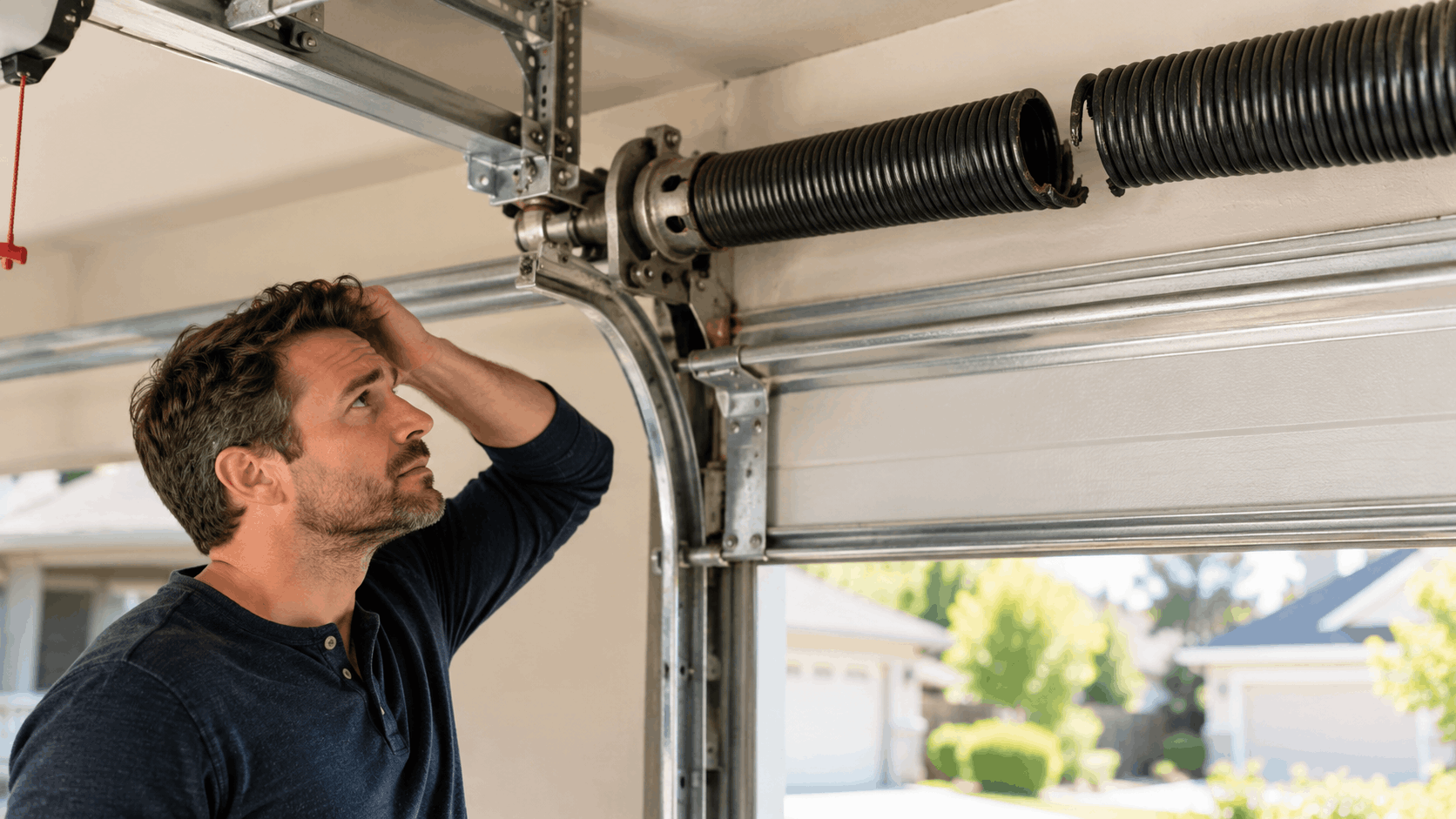
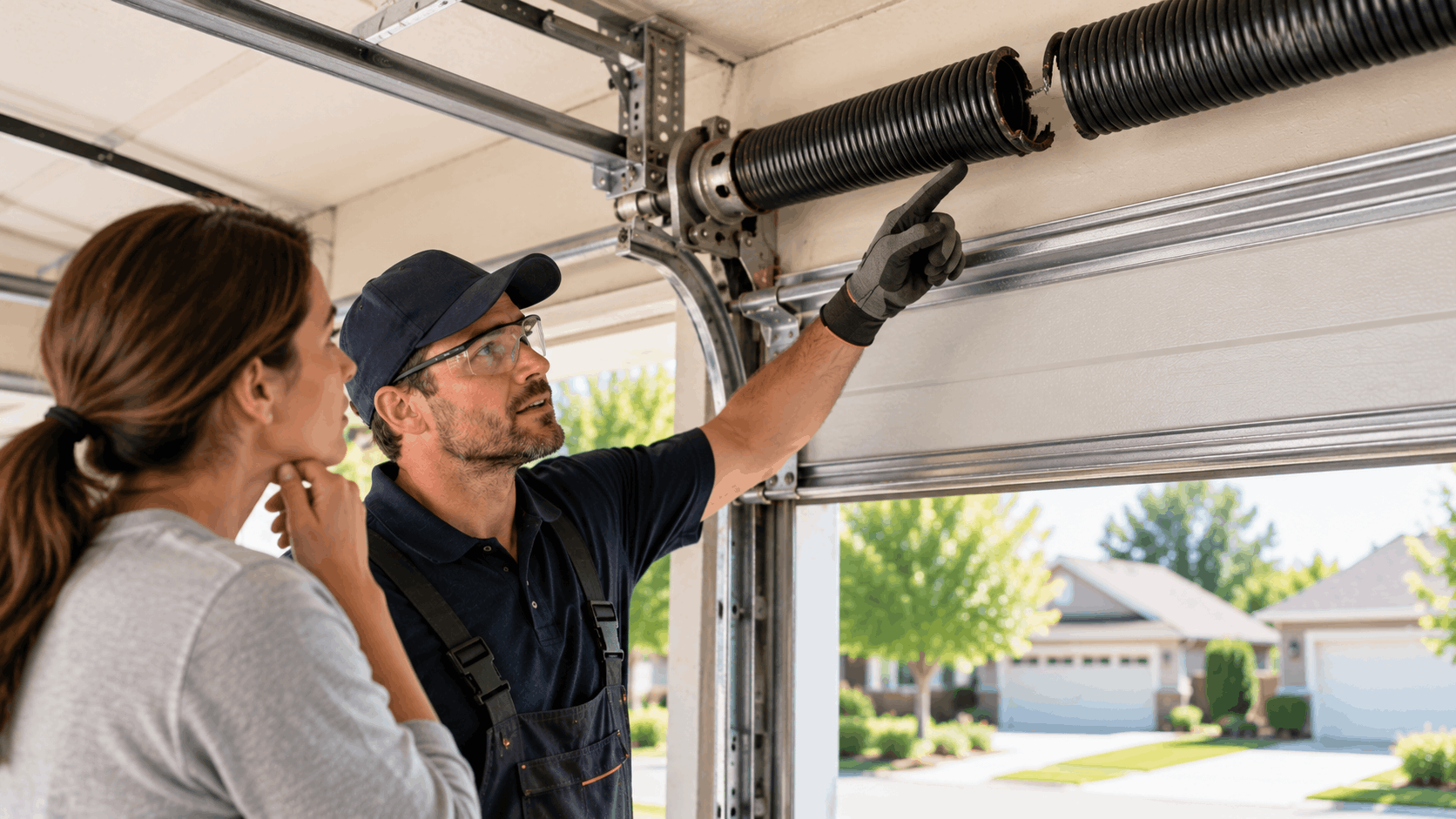
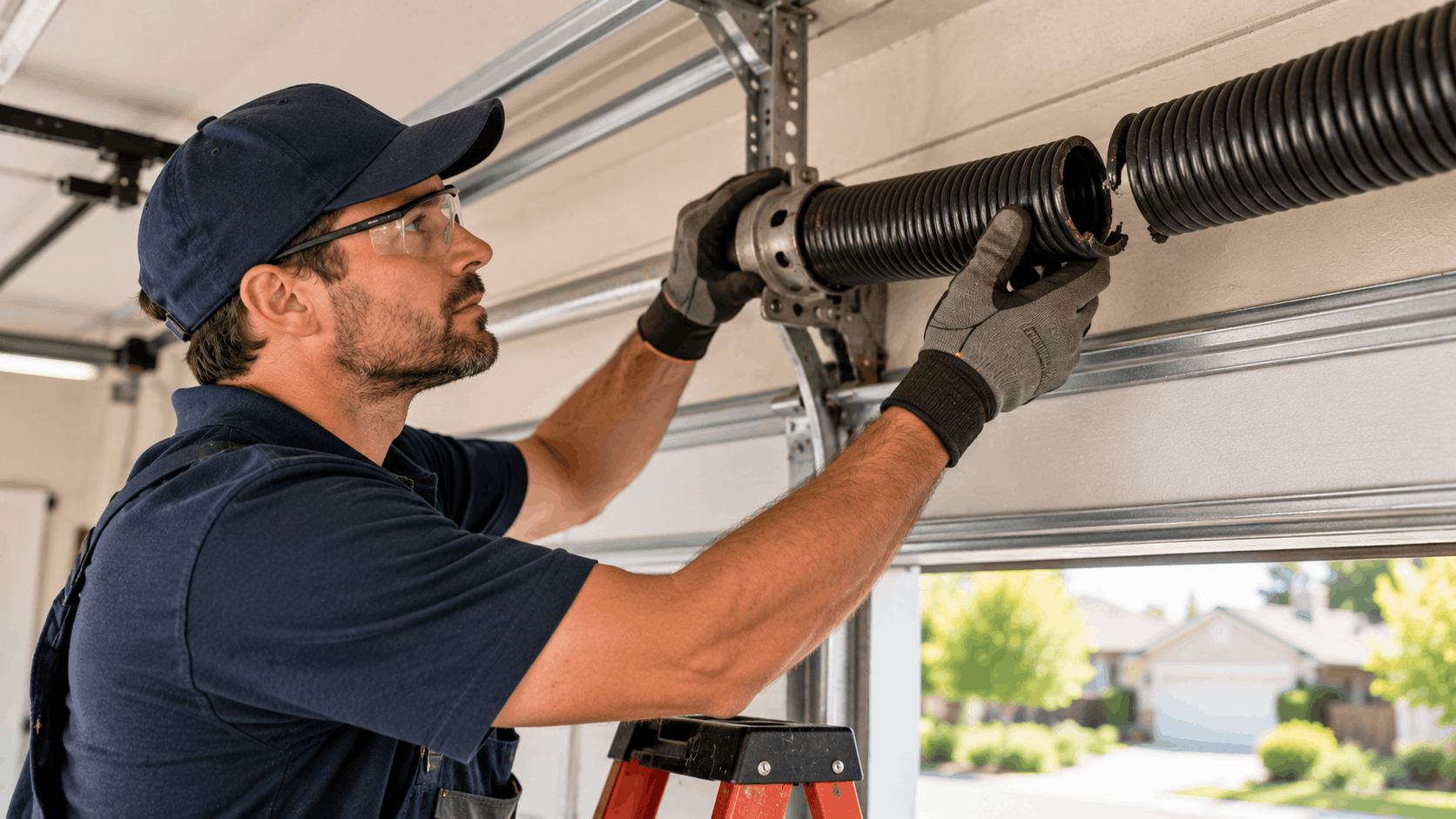
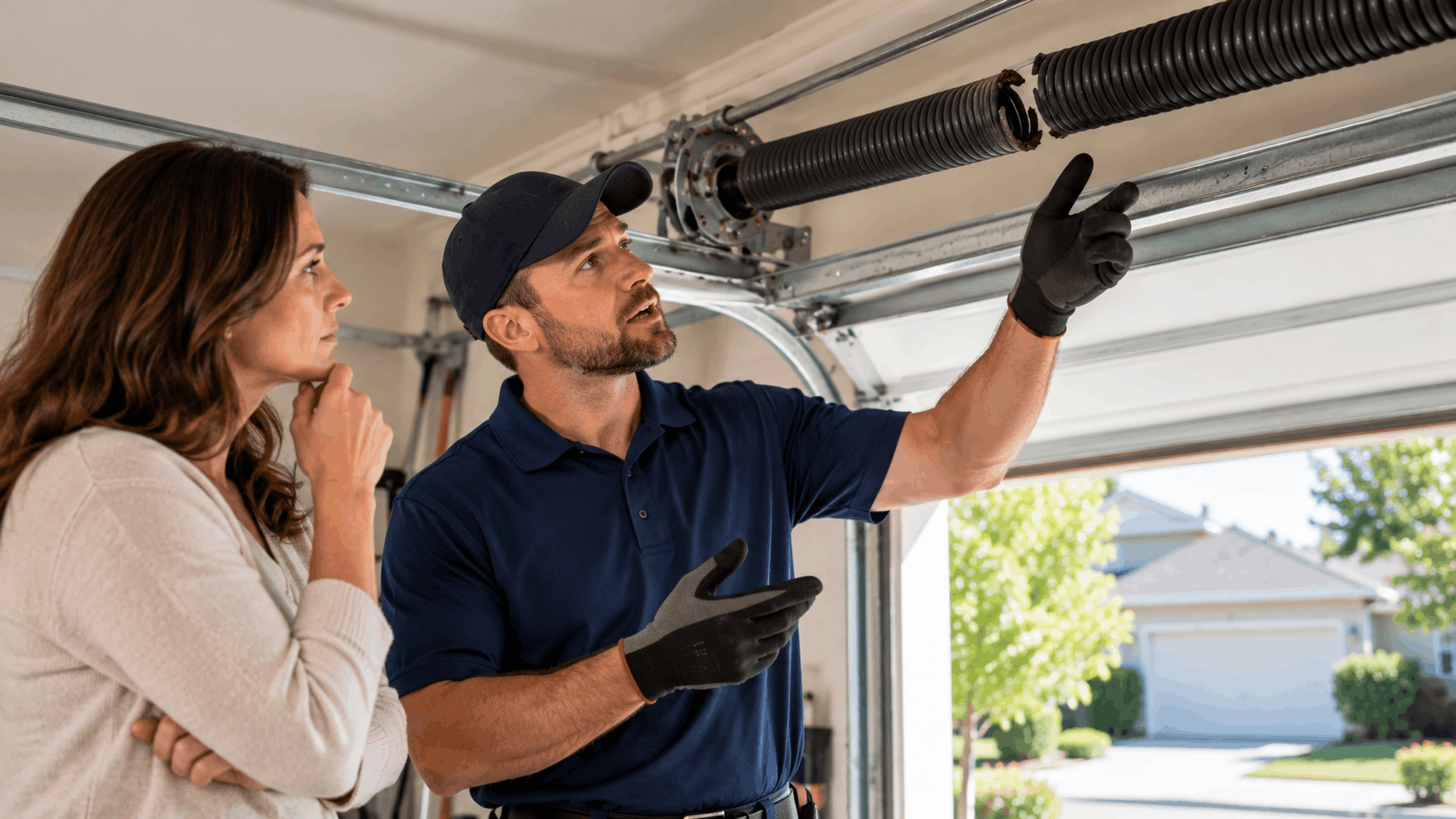
After the bang, look at the spring itself. On a torsion system the spring sits on a metal bar above the door opening. A healthy spring is one continuous tight coil, but a broken one shows a clear gap, usually around two to three inches, where the two broken ends have separated. That gap in the spring coil is the single clearest sign you are dealing with a spring and nothing else.
Then there is the opener. Many people hit the wall button or the remote and hear the motor hum or run through its cycle, yet the door does not budge. That is because the opener was never built to lift the full weight of the door on its own. The spring does the heavy lifting, and the opener just guides the door along. With the spring gone, the motor strains against a load it cannot move.
If you see the gap and hear the opener working while the door sits still, you have your answer. There is no need to test it further or keep trying the button. The next steps are about protecting the door and the hardware until help arrives.
Torsion Spring vs Extension Spring on a Cowan Heights Garage
Garage doors run on one of two spring systems, and knowing which you have helps you understand the repair. A torsion spring mounts on a horizontal bar above the door and twists to store energy. An extension spring runs along the horizontal tracks on each side of the door and stretches as the door closes.
Torsion springs are the more common choice on heavier doors because they offer smoother, more controlled motion and better balance. Extension springs are often found on lighter, older doors and on some narrower single-car setups. Both wear out, both are rated in cycles, and both are dangerous to work on, but they look and mount differently.
In the hillside homes of Cowan Heights, Lemon Heights, and Panorama Heights, the doors are frequently custom or oversized rather than standard tract sizes. These larger, heavier doors almost always run torsion systems sized to the actual weight of the door. That is an important point, because the spring has to match the door it serves rather than being pulled off a generic shelf.
If you are not sure which type you have, that is fine. A technician confirms it on site in seconds. What matters for now is that neither type is something a homeowner should attempt to handle once it fails. You can read more about how these systems are serviced on our spring and cable repair page.
The Balance Test and What It Tells You
There is one safe test that separates a spring problem from an opener problem, and it does not involve touching the spring. It is called the balance test, and it is worth knowing even when nothing is wrong, because it tells you how healthy your system is.
Start by pulling the release cord, the red handle that hangs from the opener rail. This disconnects the door from the opener so you can move it by hand. With the opener disconnected, lift the door slowly to about waist height and let go. Watch what happens next.
A correctly balanced door with a healthy spring stays roughly where you leave it. If the door drops to the floor or shoots upward, the spring is no longer carrying the weight the way it should. A door that won't hold position is a spring problem, plain and simple, not an opener problem. That distinction saves people from replacing a perfectly good motor.
One caution. If the spring is already clearly broken, with the telltale gap in the coil, skip the test entirely. The door will be dangerously heavy and could crash down. The balance test is for diagnosing a suspected problem, not for confirming one you can already see. Once you know it is the spring, your job is simply to leave the door alone and call for service.
Get Your Free Quote
Tell us about your garage door and we'll get back to you within 30 to 60 minutes.
The First Two Hours: What to Do and What Not to Do
What happens in the window right after a spring breaks decides how big the repair becomes. A broken spring, left alone, is a straightforward fix. A broken spring that someone keeps fighting with can turn into a cables, tracks, and panels job. So the single best advice on broken spring what to do is to slow down and protect the hardware.
Think of it as a garage door emergency where the smartest move is to stop touching things. The door is in a vulnerable state, and every attempt to force it open or closed adds strain somewhere. The steps below are the ones our team walks homeowners through over the phone every day while they wait for a truck.
Stop Pressing the Opener Button Right Now
The first instinct when a door will not move is to press the button again. And again. That is exactly what you want to avoid. Running the opener with a broken spring forces the motor to drag the full weight of the door with no help, and that strain goes straight into the weakest parts of the system.
When the opener fights a dead spring, it can pull the door crooked in its tracks. That bends the track, jams the rollers, and can snap the lift cables. A job that was a spring replacement an hour ago becomes a spring, cable, and track realignment job, which costs more and takes longer. The opener motor itself can also burn out under that load.
So stop using the opener the moment you suspect a broken spring. Unplug it if that helps you resist the temptation, or at least keep everyone away from the wall button and remotes. If the door is already partway open and hanging, do not try to run it the rest of the way with the motor.
Leave the door where it sits. A door resting in place is safe. A door being yanked by a straining motor is how a small problem grows into an off-track door repair on top of the spring work.
Why You Should Not Try to Lift It by Hand
The second instinct is to grab the door and muscle it up yourself. On a light door you might manage it, but even then it is risky, and on the custom doors common in these foothill homes it is a genuine danger. The spring is what carries the door's weight, and with it gone, that full weight lands on whoever is lifting.
A heavy custom or oversized door can weigh a couple hundred pounds with no spring support behind it. That is far more than most people expect, and it does not warn you before it gets away from you. People strain backs, crush fingers, and lose their grip trying to hold a door that was never meant to be lifted raw.
The worse danger is the door coming down. If you get it partway up and lose control, that weight drops fast, and anything underneath it, including a hand, a foot, or a child, is in harm's way. This is not a case of being careful enough. The load is simply too much and too unforgiving.
If the door is down, leave it down. If it is partly up and stable, do not try to move it in either direction. Keep kids and pets clear of the opening and wait for a technician who has the tools to secure the door and release the tension safely.
Get the Car Out, Then Make the Call
The real urgency for most people is the car trapped inside, especially on a morning when someone needs to leave. Here is how to handle it without making things worse. If the door is down and the car is inside, resist the urge to wrestle the door up to free the vehicle. A trapped car is inconvenient, but a crushed hand or a bent door is worse.
If the door happens to be partly up and the car can clear it, you may be able to back out carefully, but only if the door is stable and not likely to drop. Never prop a heavy door open with a broom, a jack, or anything that was not made to hold it. Those props fail, and the door comes down on the car or a person.
Once the immediate situation is as safe as you can make it, make the call. We run a 24/7 emergency line every day of the year, holidays included, and our response window is 30 to 60 minutes anywhere in Orange County. That covers the Cowan Heights and Lemon Heights streets as well as the rest of North Tustin.
When you call, describe what you see. The gap in the spring, whether the car is in or out, and whether the door is up, down, or stuck halfway. That lets the technician arrive ready for your exact situation. Our 24/7 emergency repair service exists for exactly this moment.
The One Thing You Must Never Touch
Everything above is about protecting the door and yourself. This part is about the one component that deserves its own warning. A torsion spring stores an enormous amount of energy, enough to cause serious injury or worse, and it is wound under tension against a fixed cone on the bar above the door.
No homeowner should ever adjust, wind, unwind, or replace a torsion spring. The winding bars used to set the tension can kick back violently if they slip, and the stored energy does not care that the spring looks still. People have been badly hurt reaching for a spring that appeared harmless.
This is not a case where careful hands or good instructions make it safe. The tools, the technique, and the experience to control that tension are what keep the job from going wrong, and that is why it belongs to trained technicians. The cost of a professional spring replacement is small next to a trip to the emergency room.
If you take one thing from this whole section, let it be this. Look, confirm, and call, but keep your hands off the spring. The safe tests you can run, like the auto-reverse and photo-eye checks, never involve touching it. Everything that does belongs to us.
Need Help in Irvine?
Urgent Garage Doors serves Irvine and all of Orange County.
Why Springs Break in Cowan Heights and the Foothill Streets?
Springs do not break at random, and they rarely break because of one dramatic event. They wear out on a schedule set by how the door is built and how often it is used. In the foothill neighborhoods around Cowan Heights, a few local realities push that schedule along in predictable ways.
Understanding the cause helps a homeowner see why the repair is more than swapping one part. These are hillside lots with larger, custom homes, heavy mature trees, and canyon wind, and all of that touches the hardware that surrounds the spring. The fix addresses the whole system, not just the broken piece.
Cycle Rating Is the Real Clock
The honest explanation for most broken springs is the cycle rating. Springs are rated by the manufacturer for a number of cycles, where one cycle is the door going up once and coming down once. A standard residential spring is commonly rated around 10,000 cycles.
Do the math on a busy household. A door that cycles four times a day reaches 10,000 cycles in roughly seven years. For a garage that serves as the main way in and out of the house, with teenagers, commuters, and errands, the real number of daily cycles can be higher, and the spring reaches the end of its life sooner.
So when a spring breaks on a door that seemed fine, it usually is not a defect or bad luck. It is age plus daily use catching up with the rating. The spring did the job it was built to do and simply ran out of cycles. That is why a technician asks how old the door is and how often it gets used.
Knowing the rating also informs the replacement. If the old spring lasted seven years at heavy use, a homeowner planning to stay in the house may want a higher-cycle spring the second time around. The clock is real, and planning around it beats being surprised by it.
Long Steep Driveways and Detached Garages
Cowan Heights, Lemon Heights, and Panorama Heights sit on larger hillside lots, and that shapes the garage picture in a way tract neighborhoods do not. Driveways here are often long, steep, or both, which makes a stuck car inside a closed garage a bigger headache than it would be on a flat suburban street.
Many of these properties also have more than one garage. It is common to find a detached garage, a workshop, a barn, or an outbuilding in addition to the attached garage on the house. Each of those doors has its own opener and its own spring, and each spring is on its own clock.
That means a single property can be running three or four spring systems of different ages, installed at different times, used at different rates. The main garage door that cycles several times a day wears faster than the workshop door opened once a week. One breaking does not mean the others are safe, and it often signals that the busy ones are near their limit too.
When we service one door on a foothill property, it is worth checking the age and condition of the others while the truck is there. A spring that is clearly close to the end can be replaced on the same visit rather than becoming the next emergency call a few weeks later.
Mature Canopy, Canyon Wind, and the Hardware Around the Spring
The foothill setting is beautiful, and it is also hard on garage hardware in specific ways. Heavy mature canopy and open-space edges drop leaf litter, bark, twigs, and dust onto driveways and into garage openings. Canyon wind is a near-constant on the ridgeline streets, and it carries that debris straight into the tracks and onto the rollers.
What debris does is mechanical, not mysterious. Leaf litter and grit pack into the tracks, where they get between the rollers and the metal and add friction every time the door moves. Dust and bark coat the photo-eye lenses and can break the safety beam, which makes a door reverse for no reason the owner can see. None of this is sudden, but it adds load and resistance to a system that was balanced for clean operation.
There is a wrinkle that makes cleaning the practical answer rather than removing the source. Orange County runs a Protected Tree Ordinance for unincorporated areas, and protected trees at or above five inches in diameter at breast height cannot be removed without a permit, with replacement ratios in play. A homeowner cannot simply cut down the oak that keeps dropping onto the driveway.
So the realistic plan is to keep the tracks clear, keep the photo-eye lenses clean, and keep the seals in good shape so grit does not collect. Our track repair and realignment work handles the mechanical side when debris has already done its work. Regular cleaning keeps the whole system moving the way it was set up to move.
Why Cables and Rollers Get Checked at the Same Time
A spring never works alone. It sits in a system with cables, drums, rollers, hinges, and bearings, and those parts wear alongside the spring because they share the same workload and the same years of service. When a spring reaches the end of its cycle life, the cables that lift the door have usually seen the same number of cycles.
This is why replacing a spring without inspecting the cables is a shortcut that backfires. A frayed cable that was already near failure will often give out within weeks of a fresh spring going in, and then the homeowner is making a second emergency call for a problem that could have been caught the first time.
Rollers wear too, especially in these foothill garages where grit works into the bearings. Worn rollers drag, bind, and put extra strain back onto the new spring, shortening its life before it should. Drums and bearings have their own wear patterns that a trained eye reads during the repair.
That is why a proper spring job includes a look at everything around the spring. Catching a worn cable or a failing roller during the same visit is far cheaper and safer than a repeat failure. Our cable repair work is often paired with spring replacement for exactly this reason.
What a Proper Spring Replacement Covers
Not all spring jobs are equal. A proper spring replacement is about matching the new spring to the real door and checking the parts that work with it, so the door runs safely and does not come back as a repeat problem. Here is what good work looks like, so a homeowner can judge the job.
The core idea is simple. The spring has to be sized to the actual door, the surrounding hardware has to be inspected, and the safety systems have to be tested before the technician leaves. Each of those steps protects the homeowner from a door that fails again or runs in a way that is no longer safe.
Springs Sized to Your Actual Door
Springs are not one-size-fits-all. They are sized to the real weight and height of the door they serve, because the spring has to counterbalance that exact load. Too light and the door is heavy and sluggish, straining the opener. Too heavy and the door wants to fly up on its own, which is its own hazard.
In the foothill homes of North Tustin, this matters more than in a tract neighborhood. Doors here are often custom or oversized, built from heavier materials and cut to non-standard dimensions. A standard set of springs pulled from a generic parts bin does not apply to a door like that.
A heavier door needs springs matched to its weight, full stop. That is why a technician often weighs or measures the door rather than guessing, especially on a custom install where the original paperwork is long gone. Getting the sizing right is the difference between a door that works smoothly for years and one that is fighting its own hardware from day one.
If a property has had a door replaced in a heavier material at some point, the springs need to match the new door, not the old one. Reusing an existing set on a heavier door is a common mistake that leads to early failure. Matching the spring to the actual door is the foundation of the whole repair.
High-Cycle Springs for Doors That Work Hard
For doors that carry a heavy daily load, a standard spring may not be the smartest choice the second time around. Where a door is the main entrance to the house and cycles several times a day, high-cycle springs rated higher than the standard 10,000 are available and often worth the difference.
The logic follows the cycle math. If a standard spring lasts about seven years at four cycles a day, a household that opens the door eight or ten times a day burns through that rating faster. A high-cycle spring rated to a larger number of cycles pushes the replacement date further out and reduces the odds of another emergency call.
These make the most sense on busy foothill properties where the garage is the primary way in and out, and on heavier custom doors where a failure is more disruptive. The upfront difference is modest next to the cost and hassle of a repeat breakdown.
Not every door needs them. A workshop door opened once a week is fine on a standard spring. The decision comes down to how hard the door works, and that is a conversation worth having when the spring is being replaced rather than after the next failure.
Common Spring Sizes on the Truck
One of the practical advantages of calling a stocked local team is speed. We carry common torsion spring sizes on our trucks, which means many replacements are completed on the same visit rather than requiring a second trip to order and return with the part.
For a homeowner with a car trapped inside or a door stuck open, that matters. The difference between finishing today and waiting several days for a part is the difference between a minor disruption and a real problem, especially on a steep driveway where the car cannot easily be parked elsewhere.
Truck stock covers the sizes most doors use, so the majority of standard and many oversized doors can be handled on the first visit. That said, a truly custom or unusual spring may need to be sourced, and a heavily oversized foothill door can fall into that category.
The technician confirms what your door needs during the on-site diagnostic and tells you honestly whether the parts are on the truck or need to be ordered. Either way, you get a clear answer rather than a surprise. You can learn more about this work on our torsion spring replacement page.
The Safety Checks That Come With the Fix
A spring replacement is not finished when the new spring goes on. The door has to be tested before it is handed back to the homeowner, and there are three checks that confirm it is safe to run again.
The photo-eye test comes first. With the door closing, a technician breaks the beam between the two sensors mounted low on each side of the opening, and the door must stop and reverse. Blocked or misaligned photo eyes are a frequent cause of a door that reverses for no visible reason, so this check matters in debris-prone foothill garages.
The two-by-four test confirms the contact reverse. A 2x4 laid flat across the opening gives the door something to hit on closing, and a properly working door reverses within two seconds of contact. This is the auto-reverse feature that federal and California law require on modern openers, and it is the last line of defense against a door closing on something underneath it.
Finally, the balance recheck. After the new spring is set to the right tension, the technician disconnects the opener and confirms the door holds position at waist height, the same test a homeowner can run. A balanced door proves the spring is sized and tensioned correctly. With all three checks passed, the door is safe to run again. You can read about the sensor side of this on our safety sensor alignment page.
What a Broken Spring Costs in North Tustin
Cost is the question on everyone's mind once the panic settles. The figures below are typical market ranges for garage door work in Orange County, presented so a homeowner knows what to expect. They are ranges for the area, not a quote, and the actual price for a specific garage is given in writing before work begins.
Spring work falls into a fairly predictable band for standard doors, with the custom and oversized doors common in these foothill homes sitting toward the higher end. The table lays out the common spring and repair ranges, and the sections below explain what moves a job within them.
| Service | Typical Orange County Range |
|---|---|
| Torsion spring replacement | $150 to $300 |
| Extension spring replacement | $150 to $250 |
| Spring conversion | $150 to $350 |
| Cable repair | $150 to $300 |
| Emergency repair | $150 to $350 |
| Same-day repair | $150 to $350 |
Typical Spring and Cable Ranges
For the core spring work, torsion spring replacement typically runs $150 to $300 in Orange County. Extension spring replacement typically runs $150 to $250. These cover the standard doors you find across most of the region.
Some homeowners take the opportunity to upgrade an older extension setup to a torsion system, which is a spring conversion, typically $150 to $350. A torsion conversion often makes sense on a door that has outgrown its original lighter setup or where the owner wants smoother, more balanced operation.
Cable repair typically runs $150 to $300. Because cables wear on the same clock as springs, it is common for a spring job to include cable work when the inspection turns up fraying or wear. Bundling the two during one visit is cheaper than two separate trips.
These figures are typical ranges for the area, not a fixed price for any one garage. The real number depends on the specific door, which is why a written price comes before the work starts. You can see the related services on our spring conversion page.
Emergency and Same-Day Service
When a spring breaks at a bad time, the job often falls into the emergency or same-day window. Emergency repair typically runs $150 to $350, and same-day repair typically runs $150 to $350 as well. These reflect the urgency and the need for a fast dispatch rather than a scheduled appointment days out.
What usually pushes a spring job into that emergency window is a practical problem. A car trapped inside the garage, or a door stuck fully open overnight, cannot wait for a slot next week. On the steep driveways common in Cowan Heights, a car stuck in the garage is not easily worked around.
A door stuck open is also a security and weather concern, leaving the garage and anything connected to the house exposed. That is the kind of situation our 24/7 line exists to handle, with a technician dispatched to your address rather than a callback the next business day.
Not every spring break is an emergency. If the car is out and the door is safely down, a scheduled same-day or next-day visit may work fine and sits in the same range. The urgency is about your situation, not the part itself. See our same-day repair page for more.
What Can Change the Final Figure
A few things move a spring job within or above the typical range. The biggest in these neighborhoods is door size and weight. Oversized or custom doors need springs matched to the heavier weight, and a high-cycle spring for a busy main-entrance door costs more than a standard one.
Condition of the surrounding hardware is the other main factor. If the on-site inspection turns up worn cables, failing rollers, or damaged drums, addressing those during the same visit adds to the work but prevents a repeat failure. Catching them now is cheaper than a second call.
A written price is available before work begins, so there are no surprises once the technician has seen the door. For any home improvement work over $500, California Business and Professions Code section 7159 requires a written home improvement contract, which is a legal requirement that protects the homeowner.
The takeaway is that the ranges above are a reliable starting point, and the written price turns them into a real number for your specific garage. The permit and licensing position is covered in the next section, and the full price picture is worth confirming for your address.
Need Help in Irvine?
Urgent Garage Doors serves Irvine and all of Orange County.
Permits, County Rules, and Fire Zones That Touch Your Garage
North Tustin carries a surprise for many homeowners when it comes to permits and rules. This is unincorporated Orange County, not the City of Tustin, and that changes which agency has authority over work on the property. For a spring repair the rules are light, but for anything larger they matter a great deal.
Each point below is tied to why it affects your garage door. The jurisdiction question, the fire hazard zone question, and the licensing question all come up on foothill garage work, and knowing the answers saves time and avoids missteps.
North Tustin Is County, Not the City of Tustin
North Tustin is the largest unincorporated community and census-designated place in Orange County, bordered by the City of Tustin on three sides and the City of Orange to the north. Despite the name and the surrounding streets, it is not part of the City of Tustin, and that is the single most important fact for any exterior work.
Permits, inspections, zoning, and code enforcement for these addresses run through Orange County, specifically OC Development Services, not Tustin City Hall. A homeowner who calls the city about a North Tustin address is calling the wrong agency. The county also runs a North Tustin Specific Plan that sets zoning for the area, and a Specific Plan Review Board exists as a review layer on top of county permitting.
For a spring repair, the good news is simple. A same-size spring replacement is a like-for-like repair, not new construction, so it is treated as a repair rather than permitted work. Structural work, such as widening an opening or altering the header, is what typically triggers a permit.
Because the position depends on the exact job and address, the right move is to confirm the permit question with the county for your specific property before any structural work. For a straightforward spring swap, there is nothing to file. Our Tustin area service page covers the surrounding region, and we handle North Tustin's county addresses within it.
If You Are in a Very High Fire Hazard Zone
North Tustin's foothill and canyon setting puts parts of it in mapped fire hazard zones, and that becomes relevant if a spring failure leads to a full door replacement. CAL FIRE released an updated Fire Hazard Severity Zone map for unincorporated Orange County on March 24 2025, and the Board of Supervisors adopted it by Ordinance No. 25-015 on August 26 2025.
If your address sits in a mapped Very High Fire Hazard Severity Zone and the job becomes a door replacement rather than a repair, the door material, bottom seal, and gaps around the frame turn into code questions. Buildings in Very High zones must use the fire-resistive features in California Building Code Chapter 7A and California Residential Code section R327, which cover materials and construction for exterior wildfire exposure.
The reason is that a garage door is a large exterior opening on a wildfire exposure path. Embers find gaps, so the seal at the bottom and the gaps around the frame are part of keeping fire out, not just keeping weather out. For a spring repair none of this applies, but for a replacement in a Very High zone it shapes the door you can install.
Homeowners can check their own address on CAL FIRE's Fire Hazard Severity Zone viewer. The Orange County Fire Authority is the local fire authority for these addresses and can be reached at 714-573-6000. Confirming your zone before a replacement keeps the project on the right side of the code.
Licensing You Can Verify Before Anyone Touches the Spring
Given the danger of spring work, it is worth knowing who is allowed to do it and how to check. California garage door work is licensed by the Contractors State License Board under classification C-61/D-28, Doors, Gates and Activating Devices. That scope covers sectional and rolling doors, torsion and extension spring systems, operators, control boards, safety sensors, and activating devices.
A common point of confusion is worth clearing up. C-28 is Lock and Security Equipment, and it is not the garage door license. Garage door work does not require a Class B general building license either. If someone describes this work under the wrong classification, that is a sign to look closer.
A license can be verified free at cslb.ca.gov, where the license number, classification, status, bond, and workers compensation are all public record. It takes a minute and tells you whether the company working on your home is properly licensed for the task.
Urgent Garage Doors holds California license #1055150, verifiable at cslb.ca.gov. Checking a license before anyone touches a spring is a small step that protects your home and gives you recourse if something is not right.
Should You Fix the Spring or Look at the Whole System
Sometimes a broken spring is just a broken spring, and the fix is a clean replacement. Other times it is a prompt to look at the whole system, especially the opener, because the homes here span several decades and some of that equipment predates the safety rules every modern system follows.
This decision is framed around safety dates and the battery backup law. It is not about upselling. It is about whether the rest of the system is current and safe, and whether a replacement opener would bring the garage up to standards an older one never met.
Openers Made Before 1993 in Older Foothill Homes
Homes in Cowan Heights, Lemon Heights, and Panorama Heights were built across many decades, and the older properties sometimes still run openers that predate the January 1 1993 federal entrapment protection requirement. If your garage has a spring breaking on a very old opener, it is worth knowing where that opener stands.
California was ahead of the federal rule here. AB 3600, signed in 1990, required California openers to be manufactured with an automatic reverse device and sensor. The federal mandate followed, covering openers manufactured for the United States after 1993. So a unit made before 1993 predates the entrapment protection mandate entirely.
An opener that old lacks the auto-reverse and external sensor protection that every modern opener carries. It is not illegal to own, but it does not meet the safety standards a current opener must. Manufacturer positions, LiftMaster among them, are that pre-1993 openers should be replaced rather than repaired.
If a spring job coincides with an opener that old, replacing both makes sense. You get a safe, current opener at the same time the door is already being serviced. Our opener installation page covers what a modern unit brings.
SB 969 Battery Backup on Any Replacement
If the spring job does turn into an opener replacement, California law determines part of what you get. SB 969, signed in 2018 and operative July 1 2019, requires every residential automatic garage door opener sold or installed in California on or after that date to have a battery backup designed to operate during an electrical outage.
That means a replacement opener includes battery backup as a legal requirement, not an optional upgrade tier. Violations carry a $1,000 civil penalty, and a replacement residential door may not be installed connected to a non-compliant opener. It is built into the price of any new opener in the state.
The reason behind the law is directly relevant to foothill and canyon living. It was passed after deaths in the 2017 Northern California wildfires, where people could not open their garage doors during power cuts and could not evacuate. The backup lets a door open when the grid is down.
For a home in a fire-exposed area, that function is more than a convenience. It is the difference between leaving on your own power and being stuck behind a heavy door during an outage. If your spring job becomes an opener job, the backup comes with it. Our battery backup installation page has more.
Quiet Drives for Homes Near the Airport Noise Contours
One more consideration comes into play if the opener is being replaced. Parts of unincorporated Orange County sit under John Wayne Airport noise contours, and for a household that is already noise-sensitive, the type of opener drive is worth a thought.
Opener drives come in chain, belt, and jackshaft types. A belt drive runs noticeably quieter than a chain drive, which matters most where a room sits above the garage. A jackshaft unit mounts on the wall and drives the torsion bar directly, useful where headroom is limited or ceiling storage is in play.
For a noise-sensitive home near the airport contours, a belt drive or jackshaft unit may be the better pick when the opener is being replaced alongside the spring. It is a small decision that affects daily quiet for years.
This only comes up if you are already replacing the opener. On a straightforward spring job with a sound existing opener, there is no need to change anything. See our opener and smart access page for the drive options.
Need Help in Irvine?
Urgent Garage Doors serves Irvine and all of Orange County.
How Urgent Garage Doors Handles a Broken Spring Call
Knowing what to expect from the call to the finished repair takes the stress out of a bad morning. Here is how we actually handle a broken spring in North Tustin, start to finish, using the real process our technicians follow.
The Call and the Response Window
We answer emergency calls 24 hours a day, 7 days a week, every day of the year, holidays included. A spring that breaks at 6 a.m. on a holiday gets the same response as one on a Tuesday afternoon, because the car trapped inside does not care what day it is.
Our response window is 30 to 60 minutes anywhere in Orange County. That covers the Cowan Heights, Lemon Heights, and Panorama Heights streets as well as the rest of North Tustin and the surrounding cities. The hillside location does not put you outside the window.
When you call, describing what you see helps the technician arrive prepared. The gap in the spring, whether the car is in or out, and the door's position all tell us what to bring. A clear picture on the phone means a faster fix on arrival.
For the full emergency picture, our emergency garage door repair page lays out how the service runs across Orange County.
Diagnostic, Written Price, and the Repair
On arrival, the technician runs an on-site diagnostic to confirm the spring is the problem and to inspect the cables, rollers, drums, and bearings around it. That inspection catches a worn cable or a failing roller before it becomes the next emergency call, which is the whole point of checking the system rather than just the one broken part.
A written price is available before work begins, so you know the number before any tools come out. The diagnostic turns the typical ranges above into a real figure for your specific door, including any surrounding hardware that needs attention.
Because we carry common torsion spring sizes on the truck, many replacements are completed on the same visit. For a standard or many oversized doors, that means the repair is done and the door is running again before we leave, rather than a second trip to order a part.
If a truly custom spring needs to be sourced, the technician tells you plainly and sets the return. Either way, you get honesty about the timeline rather than a vague promise. Our door balancing and tension adjustment work rounds out the repair so the door runs smoothly.
All Brands, Verified and Covered
Our team works on all garage door brands, including LiftMaster, Chamberlain, Genie, Craftsman, Clopay, Amarr, Wayne Dalton, and CHI. Whatever brand came with your foothill home, the spring and hardware work is within our scope, and we are not limited to one manufacturer's parts.
The license backing that work is public. California license #1055150 is verifiable free at cslb.ca.gov, where you can confirm the classification, status, bond, and workers compensation yourself before anyone touches the door.
Our Google Local Services listing carries the Google Guarantee badge, which is Google's own vetting of the business. Between the verifiable license and the badge, a homeowner can check who is coming before the truck arrives.
That combination, all brands serviced plus a license and listing you can verify, is what lets a North Tustin homeowner call with confidence during a stressful moment. You are not guessing about who shows up.
Get Your Broken Spring Handled the Right Way
A broken spring is a bad moment, but it is a fixable one when the door is left alone and the right people are called. Our technicians run an on-site diagnostic to confirm the spring and inspect the cables and rollers around it, give you a written price before work begins, and carry common torsion spring sizes on the truck so many repairs finish the same visit.
Call Urgent Garage Doors at (949) 529-7743 for 24/7 emergency service across North Tustin, with a 30 to 60 minute response anywhere in Orange County. Leave the door where it sits and let a licensed technician handle the spring safely.
Frequently Asked Questions
- Can I still open my garage door with a broken spring?
- No. With the spring broken, the door is carrying its full weight with no support, which can be a couple hundred pounds on a custom foothill door. Do not lift it by hand and do not run the opener, since both strain the hardware and risk the door crashing down. Leave the door where it sits and call for service rather than forcing it.
- How much does a broken spring cost to replace in North Tustin?
- Typical Orange County ranges are $150 to $300 for torsion spring replacement and $150 to $250 for extension spring replacement. The custom and oversized doors common in these foothill homes need springs matched to the heavier weight, and worn cables found during inspection can add to the work. A written price is available before work begins, so you know the real figure for your door first.
- How fast can someone get to Cowan Heights for an emergency?
- Our response window is 30 to 60 minutes anywhere in Orange County, and that includes the Cowan Heights, Lemon Heights, and Panorama Heights streets. We take emergency calls 24 hours a day, 7 days a week, every day of the year including holidays. A trapped car or a door stuck open on a steep driveway is exactly the kind of call that line exists to handle.
- Can I replace the spring myself to save money?
- No. A torsion spring stores enough energy to cause serious injury and is wound under tension against a fixed cone above the door. The winding bars can kick back violently, and the stored energy does not care that the spring looks still. No homeowner should ever adjust, wind, unwind, or replace a spring. The cost of professional work is small next to the risk of doing it yourself.
- How long should a new spring last?
- Springs are rated in cycles, commonly around 10,000 for a standard spring, where one cycle is one full open and close. A door cycled four times a day reaches that in roughly seven years. For a door used as the main entrance that cycles more often, high-cycle springs rated higher are available and can push the replacement date further out, which is worth considering on busy foothill properties.
- Do I need a permit to fix a spring in North Tustin?
- A like-for-like spring repair is treated as a repair, not permitted work, so there is nothing to file for a straightforward swap. Structural work, such as widening the opening or altering the header, is what triggers a permit. Permits for these addresses run through Orange County via OC Development Services, not the City of Tustin, so confirm the position with the county for your specific address before any structural job.
- Why did my spring break if the door seemed fine?
- A spring reaches the end of its cycle rating with age and daily use, not because of a sudden event. At four cycles a day a standard spring runs out in about seven years, and busy main-entrance doors reach it sooner. The foothill setting adds strain too, since leaf litter, bark, and dust from the mature canopy pack into the tracks and onto the rollers, loading the whole system every time the door moves.
- Should I replace both springs if only one broke?
- On a two-spring door, yes, replacing both at once is usually the sensible call. The second spring is the same age and has seen the same number of cycles, so it is near the end of its life even if it has not broken yet. Replacing just one often means a second emergency call within months. Cables get inspected at the same time, since they wear on the same clock.
- Does a new opener in California have to include battery backup?
- Yes. SB 969 requires every residential automatic garage door opener sold or installed in California on or after July 1 2019 to have a battery backup designed to operate during a power outage. It is a legal requirement with a $1,000 civil penalty, not an optional upgrade. The law came after the 2017 Northern California wildfires, where people could not open their garage doors during power cuts.
- What brands do you work on?
- We work on all garage door brands, including LiftMaster, Chamberlain, Genie, Craftsman, Clopay, Amarr, Wayne Dalton, and CHI. Whatever brand your foothill home came with, the spring, cable, and opener work falls within our scope, and we are not tied to a single manufacturer's parts. Our California license #1055150 is verifiable free at cslb.ca.gov before anyone touches your door.
Licensed garage door repair professionals serving Irvine and Orange County.
Licensed in California · License #1055150
Why trust Urgent Garage Doors?
Founded in 2017, Urgent Garage Doors is a licensed and insured garage door services serving Irvine and Orange County. All content is reviewed by our licensed technicians.

Need Help in Irvine?
Urgent Garage Doors serves Irvine and all of Orange County.
Related Articles
Broken Garage Door Spring on Balboa Island and What Happens in the Next Two Hours
A broken garage door spring on Balboa Island needs a safe diagnosis, a balance check and a matched replacement. Here is why springs fail sooner here and what the next two hours involve.
What Happens in the Hours After One Spring Breaks on a Two-Spring Door
A broken torsion spring on a two-spring door in Irvine brings a loud bang, a heavy stuck door, and a second spring under stress. Here is what to do next.
SB-969 Battery Backup on Tustin Legacy Garage Door Openers and What You Already Have
If your Tustin Legacy garage door opener was installed on or after July 1 2019, it already has an SB-969 battery backup. Here is the law, who complies, and the cost.