SB-969 Battery Backup on Tustin Legacy Garage Door Openers and What You Already Have
Key Takeaways
- SB-969 requires a battery backup on any residential garage door opener sold or installed in California on or after July 1 2019, with a $1,000 civil penalty for non-compliant installs.
- Most Tustin Legacy openers already comply because the villages were built new after the base closed in 1999, and openers installed since mid-2019 carry a backup by law.
- The law applies when an opener is installed or replaced, not to one already sitting in service, so an older working opener with no backup is legal to keep.
- Battery backup is not an optional upgrade on a new residential opener in California; it is standard equipment on any compliant unit.
- Battery backup installation typically runs $200 to $400 in Orange County, and a full opener installation runs $250 to $600, with belt drive costing more than chain drive.
- SB-969 is separate from the older auto-reverse and photo-eye rules, which came from AB 3600 in 1990 and federal law in 1993 and protect against a door closing on an object.
- Garage door work is licensed under C-61/D-28, not C-28, and the permit position is confirmed per address since part of the Legacy footprint sits in the City of Irvine.
- Urgent Garage Doors offers 24/7 service, a 30 to 60 minute Orange County response window, a written price before work begins, and haul-away on new door installs.
In This Article
If you own a home in Columbus Square, Columbus Grove, Greenwood or any of the other villages at Tustin Legacy and you are wondering whether your garage door opener needs a battery backup, here is the short answer. If your opener was installed or replaced on or after July 1 2019, it already has one, because California law requires it. And because Tustin Legacy is a new community, built out over the 2000s and 2010s on the former Marine Corps Air Station Tustin, most openers here either already carry a backup or will the moment they are replaced.
Nothing in this part of Tustin predates the base closure in 1999. That build history matters, because it means there are no ancient openers from the 1980s sitting in Legacy garages. The hardware profile is first-generation builder equipment reaching its first round of failures, which is a very different situation from an old pre-1993 opener that never had modern safety gear at all.
What SB-969 Actually Requires?
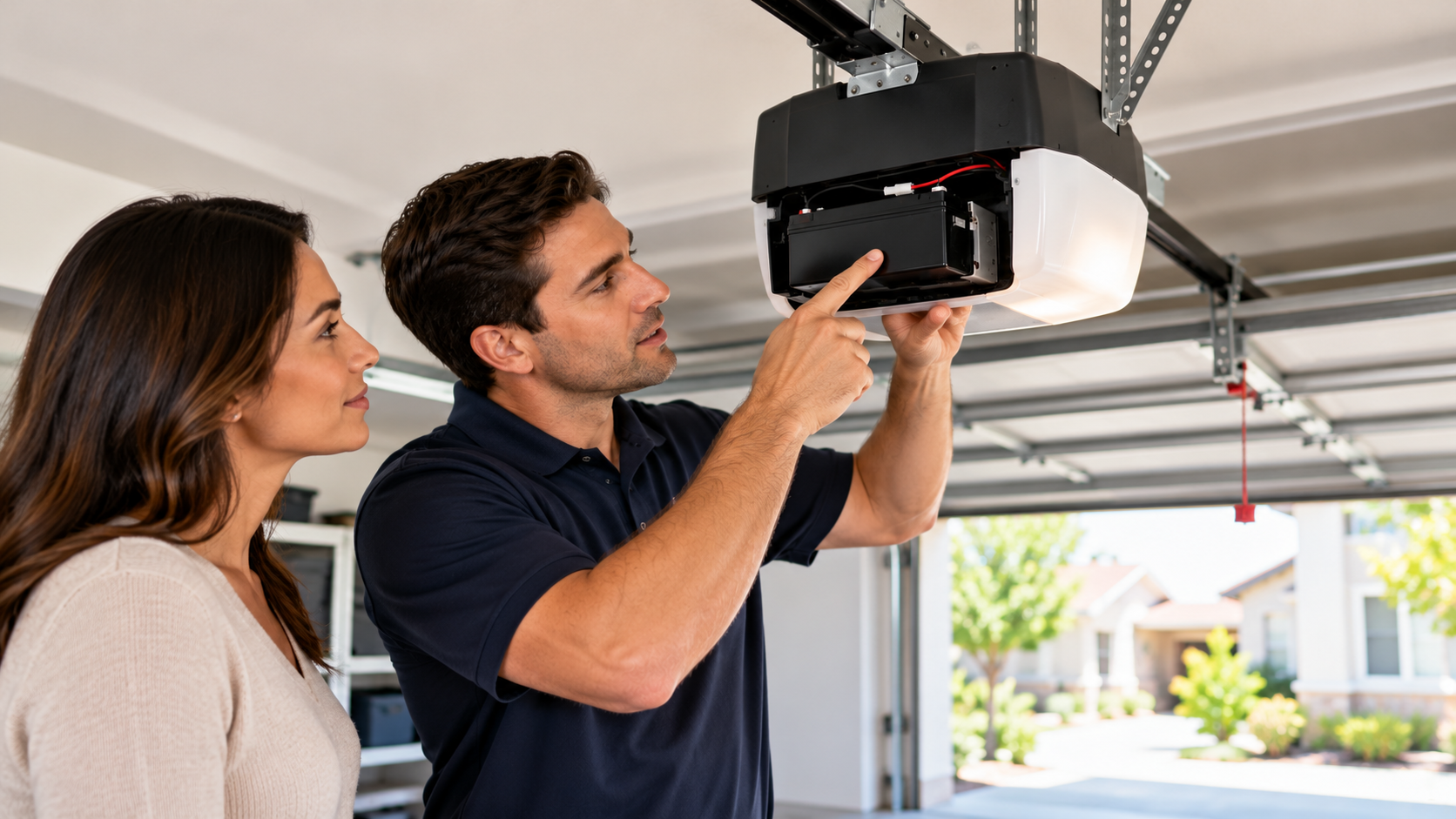
SB-969 is a California law about keeping your garage door usable when the power is out. It requires a battery backup on residential garage door openers sold or installed in the state on or after July 1 2019. That date is the line that divides openers with a backup from openers without one, and it is the single most useful fact a Legacy homeowner can hold onto.
The reason the law reaches almost every newer garage in Tustin Legacy is simple. The villages here were built and sold after the base closed, with most openers installed either during original construction or during a later replacement. Any of those openers that went in from mid-2019 onward had to comply, and the ones installed earlier will comply the day they are swapped out.
The Law in One Sentence
SB 969 (Dodd, Chapter 621, Statutes of 2018) requires every residential automatic garage door opener manufactured, sold, offered for sale or installed in California on or after July 1 2019 to have a battery backup that works during an electrical outage. That is the whole rule in plain terms, and it is worth reading twice because each verb matters.
Manufactured, sold, offered for sale and installed each carry their own weight. A unit cannot be sold new in California without the backup, and it cannot be installed here without one either. So when a contractor puts a new opener on a Legacy garage, the backup is built into the machine. It is not a separate box the homeowner picks from a menu.
The backup is designed to keep the opener running during an electrical outage for a limited number of cycles. That means when the grid goes down, the motor still has enough stored power to lift and lower the door from the remote or wall button. The purpose is to make sure a resident is not trapped behind a heavy door when the lights go out.
Because the law is written around the moment of install or sale, it does not reach backward in time to every opener already hanging in a garage. That distinction is where most of the confusion lives, and we cover it fully below.
Why the Law Exists
SB-969 was passed in direct response to the 2017 Northern California wildfires. During those fires, people died because they could not open their garage doors when the power was cut and they needed to evacuate. A garage door is often the main way a car leaves a property, and when the opener has no power, the door does not move on its own.
A modern insulated or steel sectional door is heavy. Lifting it by hand against its own weight, in the dark, in a hurry, is not something every resident can do, especially older adults. In Tustin, persons 65 and over make up a meaningful share of the population, so the group least able to muscle a dead door open is a real part of the community.
The evacuation purpose is the heart of the law. When the power fails during a wildfire, an earthquake or any grid outage, a battery backup lets a resident open the door and get a vehicle out without wrestling with a release cord and a hundred-plus pounds of door. The battery buys time when time is the one thing a family evacuating does not have.
Understanding that origin helps explain why the rule is so firm. It is not a convenience feature. It came out of a loss of life, and the state treated it as a basic safety requirement on new residential openers statewide.
What It Does Not Cover
SB-969 is statewide and residential, and violations carry a $1,000 civil penalty. That penalty attaches to selling or installing a non-compliant residential opener, not to a homeowner living with an old unit. The distinction protects owners who already have an opener in place.
The law does not apply to commercial operators. A rolling steel door on a warehouse or a commercial overhead door at a retail bay is a different product under a different set of rules, so the backup mandate does not reach those units. For residential garages, though, it is the standard across the state.
Just as important, SB-969 does not force an owner to replace an opener that is simply sitting in service and working. If your original Legacy opener from 2008 still runs fine and has no backup, you are not breaking any law by keeping it. The rule governs the act of selling or installing, not the act of owning.
So an older working opener in Columbus Square or Columbus Grove can stay exactly where it is, with no backup, legally, for as long as it keeps running. The homeowner only steps into the rule when that opener gets replaced or a new one goes in.
What It Is Not: Not the Energy Code, Not a Fire-Zone Rule
A lot of homeowners assume battery backup comes from the energy code. It does not. SB-969 is not Title 24, which is the California Building Standards Code, and it has nothing to do with the energy provisions in Part 6 that govern conditioned space. Battery backup is its own statute, separate from the code that sets insulation and envelope rules.
It is also not Title 19 and it is not a fire-zone rule. People hear that the law came out of the wildfires and assume it only applies in high-fire areas or that a local fire district wrote it. Neither is true. SB-969 applies statewide, in every city and county, regardless of fire risk.
It is not an HOA rule either. The Greenwood, Columbus Square and Columbus Grove associations have their own architectural review for exterior changes, but the battery backup requirement does not come from them. It is state law on residential openers, full stop.
Keeping these straight saves money and confusion. When a contractor tells a Tustin Legacy homeowner the new opener comes with a backup, that is the law talking, not an upsell and not a local overlay.
Get Your Free Quote
Tell us about your garage door and we'll get back to you within 30 to 60 minutes.
Why Most Tustin Legacy Openers Already Have Battery Backup?
Tie the law to the dirt under the houses and the answer gets obvious. Tustin Legacy is the redevelopment of the former MCAS Tustin, which closed July 3 1999. Everything residential here was built after that, which means there are no pre-1993 openers and no end-of-life original doors from the era before modern safety gear existed.
Because the whole community is new, the openers skew new too. Many went in after July 1 2019 and already carry a battery backup under SB-969. The ones installed earlier are first-generation builder units that will comply the day they are swapped. This is a very different landscape from older Orange County neighborhoods.
The Legacy Build Timeline
The site is the former Marine Corps Air Station Tustin, which officially closed on July 3 1999 after 57 years. The City of Tustin took over 1,153 acres for redevelopment under the MCAS Tustin Specific Plan, and residential construction rolled out in phases over the next two decades.
The phasing is easy to trace. Tustin Field completed in 2006, Villages of Columbus completed in 2013, and Greenwood finished in 2017. Each phase went up under one specific plan but was delivered by different builders, so door packages and elevations vary village to village while the overall framework stays common.
What that timeline rules out is as useful as what it confirms. There are no pre-1993 openers here, none of the discontinued early door profiles, and no original doors that have reached the end of their life from sheer age. The oldest hardware in the community is reaching first failure, not last gasp.
For a homeowner, that means the conversation is almost never about an opener too old to have any safety gear. It is about first-generation builder equipment, springs and rollers at the ten to twenty year mark, and sensor or wiring faults from the original install.
Newer Villages Delivered After July 2019
Any opener installed or replaced from July 1 2019 onward falls under SB-969, so most newer Legacy openers already carry a battery backup. Villages and phases delivered or re-equipped after that date had the backup built in from day one, because a contractor could not legally install anything else.
Photo eyes are standard throughout the Legacy footprint as well. Those are the small sensors mounted low on each side of the door opening that stop and reverse the door if something breaks the beam while it is closing. They come from an older set of safety rules, but they are present on effectively every opener in these villages.
So a homeowner in one of the newer Legacy phases usually has two separate safety systems working at once. The photo eyes handle obstructions during closing, and the battery backup handles power outages. Both are present, both do different jobs, and both are standard on modern openers sold for California.
Move-in activity is constant in the newer phases, which is when remotes, keypads and app access often need setting up all at once. That is a keypad and remote programming job rather than a compliance job, since the opener already meets the law.
Older Legacy Homes From the 2000s and Early 2010s
Homes in Columbus Square and Columbus Grove that were built before mid-2019 may have an original opener without a battery backup. Those are the established communities within the Legacy footprint, within walking distance of retail, and their first-generation openers predate the July 1 2019 line.
That is perfectly legal. An original opener sitting in service with no backup breaks no rule, because SB-969 governs selling and installing, not owning. A Columbus Square homeowner whose 2008 opener still runs is under no obligation to add anything.
The moment the rule applies is replacement. When that original opener finally fails, or the homeowner decides to upgrade, the new unit must comply, and the battery backup comes standard with it. There is no way to buy a new residential opener in California without one.
These older villages are exactly where springs and rollers tend to hit their cycle limit first. A torsion spring rated around 10,000 cycles reaches that mark in roughly seven years on a door cycled four times a day, so a first-generation Columbus Grove door is right in the window for its first spring replacement.
Living Space Above the Garage
Living space above the garage is common in the attached product across Tustin Legacy. Townhomes and flats were built dense and walkable by design, and a bedroom or loft sitting directly over the garage is a frequent layout in these villages.
That layout drives a specific upgrade request. A chain-drive opener grinding away under a bedroom floor is loud, so homeowners with rooms above the garage often ask for a quiet belt-drive unit instead. Belt drives run noticeably quieter, which matters a lot when someone is trying to sleep above the motor.
When that belt-drive opener goes in as a replacement, it comes with a battery backup under SB-969 just like any other new residential opener. The homeowner gets the quiet operation they wanted and the backup the law requires, in one install.
A jackshaft opener is another option where headroom is tight or storage fills the ceiling, since it mounts on the wall and drives the torsion bar directly. Whichever drive type a Legacy owner chooses, a new install carries the backup by law. You can read more about the options on our opener installation page.
Need Help in Irvine?
Urgent Garage Doors serves Irvine and all of Orange County.
How to Tell If Your Opener Has a Battery Backup
Before calling anyone, a homeowner can usually figure out what they already have in a few minutes. The checks are simple and specific to the common brands you find on Tustin Legacy garages. Start at the motor head, then confirm the brand and model, then test it if the chance arises.
Here is a quick reference for what to look for, by method:
| Check | What to look for | What it tells you |
|---|---|---|
| Battery light on the motor head | A green or amber status light, sometimes chirping | A backup battery is present and reporting its state |
| Brand and model label | LiftMaster, Chamberlain, Genie or Craftsman unit sold for CA since mid-2019 | Likely shipped with backup built in |
| Power-outage test | Door still opens and closes with the grid off | The backup is working |
| No battery, grid off | Door will not move until you pull the release cord | No backup, or a dead backup battery |
Look at the Opener Head and Battery Light
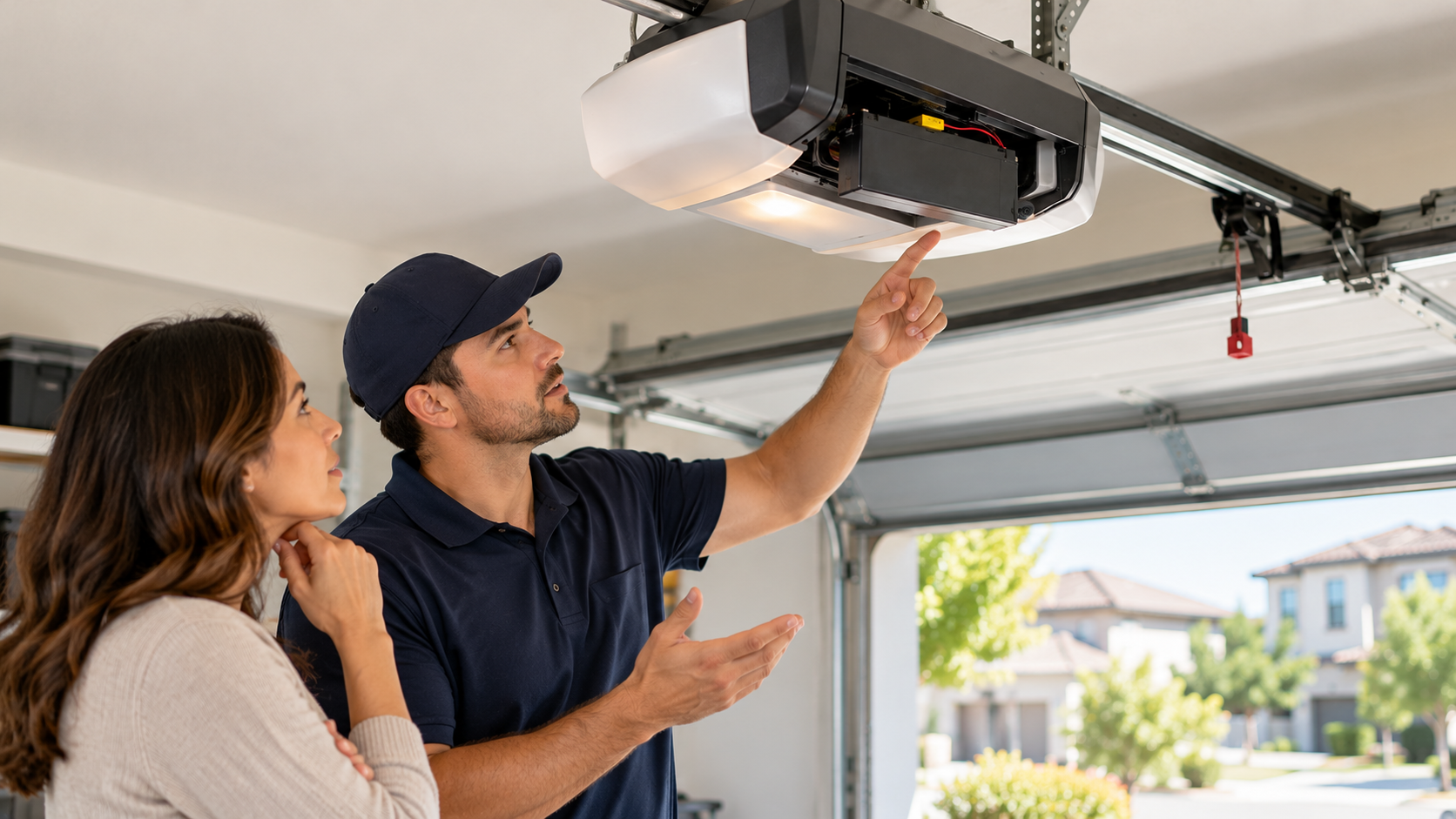
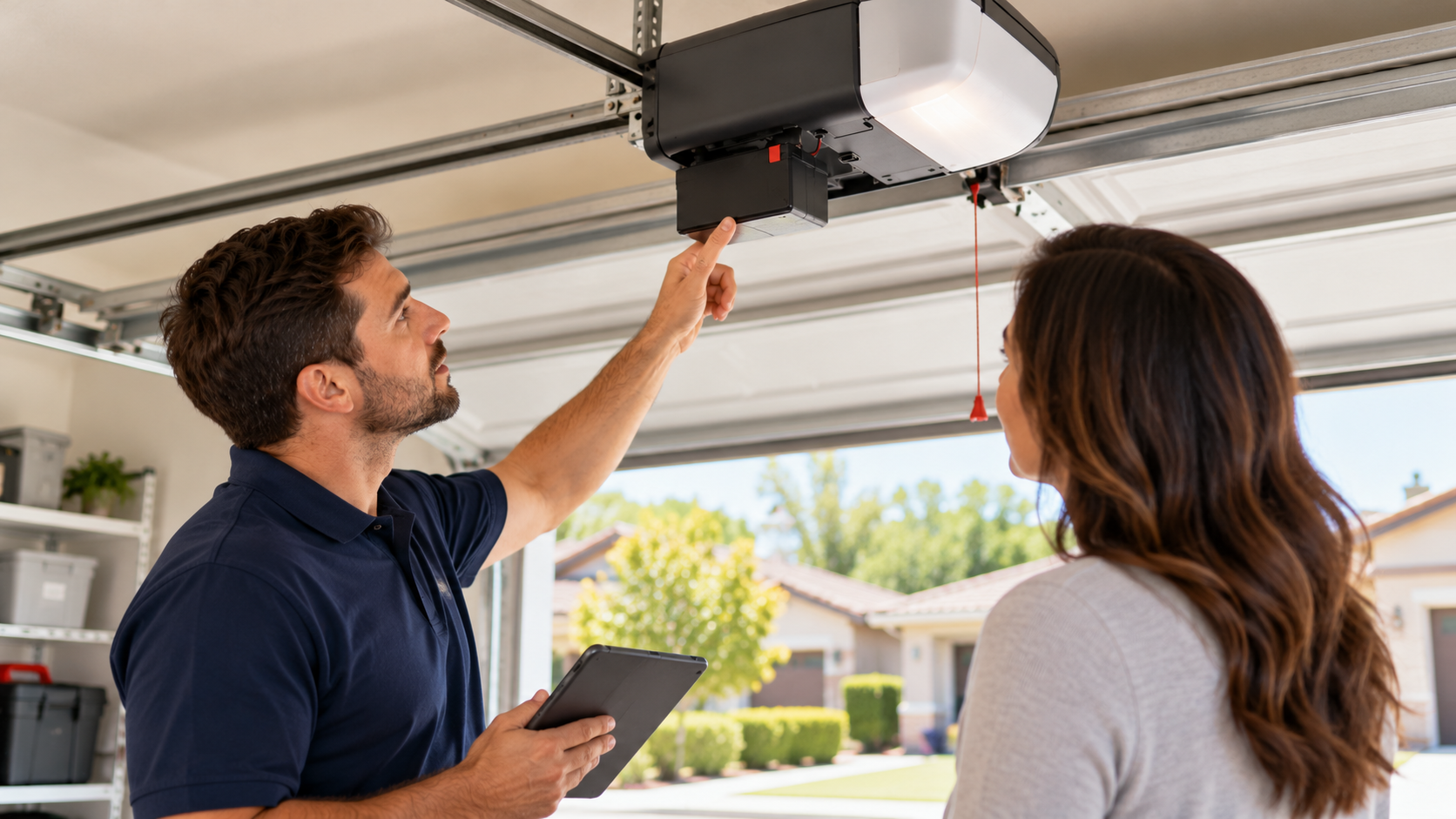
Start at the motor head, the box bolted to the ceiling or wall that drives the door. Many modern openers carry a small battery indicator light right on the housing, often near the learn button and the control panel. That light is the quickest tell.
A green or amber light usually signals battery status on units that have a backup. A healthy backup typically shows a steady light, while a unit whose battery is failing often chirps or flashes to tell the owner the battery needs attention. A chirp every so often is the opener asking for a new battery, not a sign the whole unit is dying.
If there is no battery indicator anywhere on the head, that is a clue the opener may predate the backup requirement. Not every pre-2019 unit has a battery, and the absence of any battery light is often the first sign you are looking at an older opener.
Looking at the head also tells you the drive type. A belt or chain running along a rail overhead is a trolley opener, while a unit mounted beside the torsion bar on the wall is a jackshaft. Both can carry a backup, so the drive type does not change the compliance question, only the noise and the headroom.
Check the Brand and Model
The brand and model label settles a lot. LiftMaster, Chamberlain, Genie and Craftsman units sold for California since mid-2019 ship with the backup built into the machine, because they have to. If your opener is one of those brands and went in after mid-2019, the backup is almost certainly there.
Find the model label on the unit itself, usually printed on the side or back of the motor housing or just inside the light lens cover. The model number tells a technician exactly which generation of opener you have and whether that model came with an integrated battery.
Brand alone does not prove compliance, because the same brand made both backup and non-backup units over the years. The combination of brand, model and install date is what gives a clear answer. A LiftMaster from 2012 may have no battery, while a LiftMaster from 2021 will.
These are the brands we see most across Tustin Legacy garages, and our team services all of them along with Clopay, Amarr, Wayne Dalton and CHI. Knowing the model before a visit lets us bring the right battery or the right replacement on the truck.
Test It During a Power Outage
The surest test is the one the law is built around. With the power off, a compliant opener still opens and closes the door from the remote or wall control for a limited number of cycles. If the grid is down and the door still runs on its own, you have a working backup.
You do not have to wait for an outage to try this safely. You can flip the breaker that feeds the garage opener circuit, then press the remote. A unit with a charged backup battery will still cycle the door. A unit with no backup, or a dead one, will not move at all.
If the door will not run with the power off, the fallback is the manual release cord, the red handle hanging from the trolley. Pulling it disconnects the door from the opener so it can be lifted by hand. Every opener has this cord, backup or not, and it is the mechanism that gets a door open when all else fails.
The catch is weight. A heavy insulated door is a real effort to lift by hand, which is the exact problem SB-969 set out to solve. The release cord works, but it is not a graceful solution during an emergency, which is why the backup matters.
When the Backup Battery Itself Is Dead
Backup batteries have a service life, and they wear out well before the opener does. Over a few years the battery loses its ability to hold a charge, and eventually it will not run the door during an outage even though the opener is otherwise fine.
This is where homeowners sometimes overreact. A compliant opener that will not run on battery usually needs a new battery, not a new opener. The motor, the logic board and the safety sensors can all be in perfect shape while the battery is simply spent. Replacing a sealed backup battery is a modest job compared with swapping the whole unit.
The chirp or warning light mentioned earlier is often the battery asking to be replaced. Ignoring that chirp for a year or two is usually what leads to a dead battery and a door that will not move when the power goes out. Catching it early keeps the opener compliant and ready.
If you are not sure whether your issue is the battery or the opener itself, that is a quick diagnostic for a technician. A failing battery and a failing control board can look similar from the driveway, and sorting them out before buying parts saves money.
When a Replacement Triggers the Backup Requirement
The practical moment SB-969 matters is when an opener is installed or replaced. A homeowner replacing an opener is buying a backup unit whether or not they asked for one, because the law does not allow a non-compliant residential opener to be sold or installed in California.
That single moment is the trigger. Owning an old opener never puts you on the wrong side of the rule. Installing or replacing one does. Knowing that helps a Legacy homeowner plan, because it tells them exactly when the backup becomes part of the bill.
Replacing a Failed Opener
When an original Legacy opener finally fails, the replacement must comply, so the backup comes standard with the new opener. There is no compliant and non-compliant version to choose between at the register. Every new residential opener sold for California has the battery built in.
Openers fail for a handful of common reasons. The control board can give out, the motor can wear, the drive gear can strip, or the logic can simply stop talking to the remote. When any of those pushes a homeowner into a full opener replacement, the new machine arrives with the backup.
This is why a failed opener in Columbus Square or a worn-out unit in Tustin Field quietly brings the garage up to the current standard. The homeowner was replacing a dead opener, and the backup came along as part of a compliant new unit. There is nothing extra to request.
It is worth separating a true opener failure from a simple photo-eye or sensor fault, because the two feel similar. A door that reverses for no reason is usually a sensor problem, not a dead opener, and that is a far smaller fix than a full replacement.
Installing a New Door
A replacement residential garage door may not be installed connected to a non-compliant opener. So when a homeowner puts on a new door, the opener often has to comply too. If the existing opener has no backup, a new door install is the point where that gets addressed.
This matters because door and opener work often happen together. A homeowner upgrading to an insulated steel door, a carriage-house look or a modern glass door is frequently touching the opener in the same project. The law connects the two so a new door does not end up hung on an old, non-compliant machine.
In Tustin Legacy, SB 969 also reaches down from the state alongside the local approval tracks. A new door is usually a street-facing or alley-facing exterior change that needs HOA architectural review, and the opener attached to it must meet the backup rule. Both the exterior approval and the compliance apply.
If you are planning a sectional door replacement on a Legacy home, it is worth confirming at the start whether your current opener already has a backup. That tells you whether the opener is part of the project or stays as is.
Keeping an Opener Already in Service
The law does not force an owner to upgrade an opener that is simply sitting there working. SB-969 applies to install and replace, not to leaving an existing unit in place. A functioning opener with no backup can keep running indefinitely without breaking any rule.
This is the reassuring part for owners of older Legacy homes. A Columbus Grove opener from 2010 that opens and closes reliably does not have to be touched. There is no deadline, no inspection, and no penalty for the homeowner who keeps it.
That said, there is a practical reason many owners choose to add a backup anyway, and it is the same reason the law exists. During a power outage, a working opener with no battery is just as stuck as any other. The choice to keep an old unit is legal, but it leaves the door dependent on the grid.
For owners who want the outage protection without a full opener swap, adding a standalone backup is an option in the right setups. That keeps a good opener in service while gaining the safety the battery provides.
Battery Backup Is Not an Upsell
On a new residential opener in California, the battery backup is a legal requirement, not a paid upgrade tier a homeowner can decline. When a contractor quotes a new opener, the backup is part of the compliant unit, the same way the safety sensors are.
This is worth saying plainly because the pricing can make it look optional. It is not. A homeowner cannot choose a cheaper, non-compliant version of a new residential opener to save money, because that version cannot legally be sold or installed in the state.
So if anyone presents the backup as an add-on you can skip on a brand-new residential opener, that is not how the law works. The $1,000 civil penalty attaches to installing a non-compliant unit, which is why reputable installers simply include it.
The honest framing is that the backup is standard equipment on a new residential opener here, like the photo eyes and the auto-reverse. A homeowner is not paying for an upgrade, they are paying for an opener that meets the law.
What SB-969 Work Costs in the Tustin Legacy Area
Opener and backup work in Tustin Legacy falls into the typical Orange County ranges below. These are typical market ranges for the area, not a quote and not a fixed price. The actual number depends on the specific garage, and a written price is available before work begins.
Knowing the ranges up front helps a homeowner decide whether they are looking at a small battery job or a full opener replacement. The spread between the two is significant, so sorting out which one you need is the first step.
Battery Backup Installation
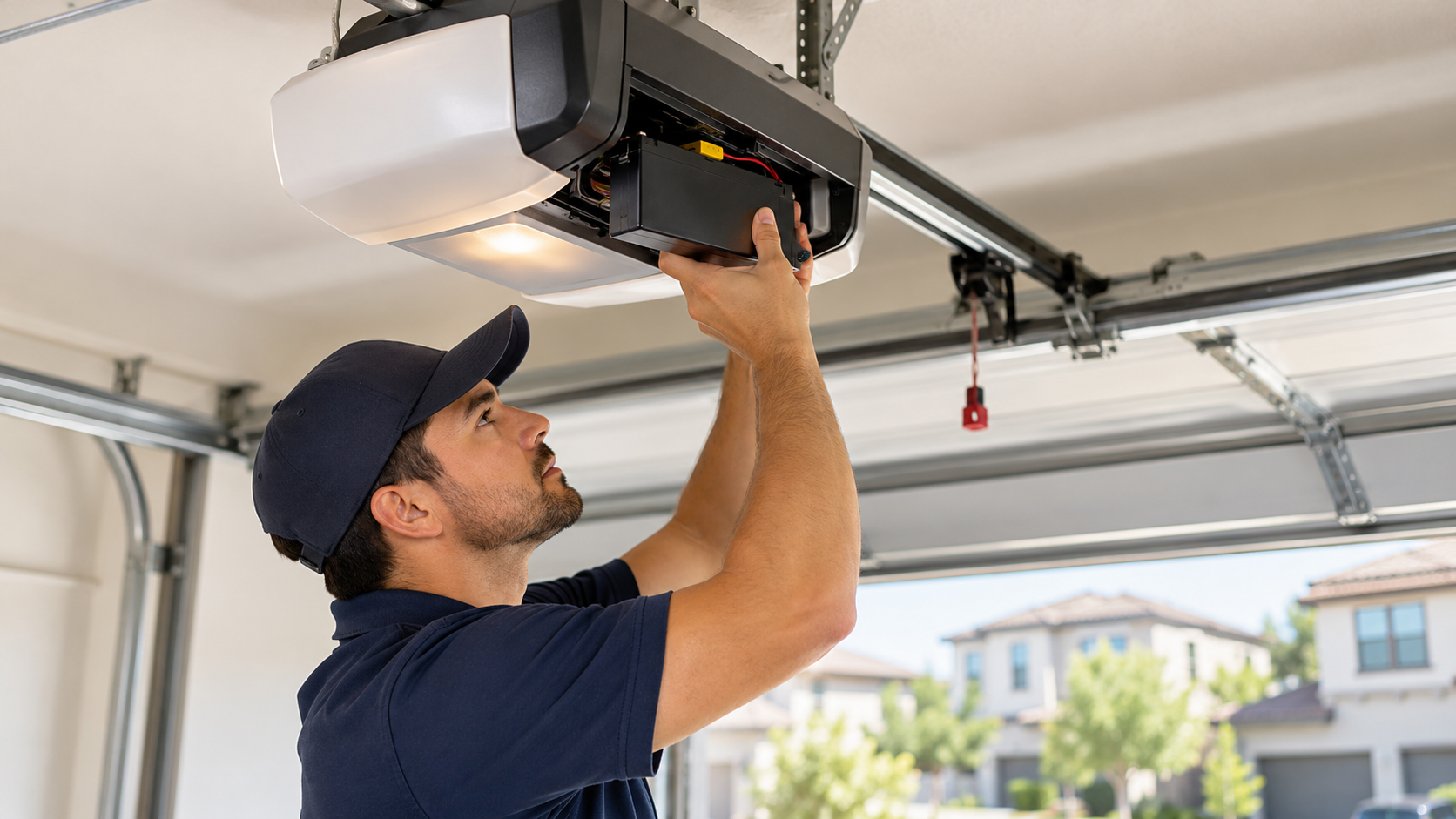
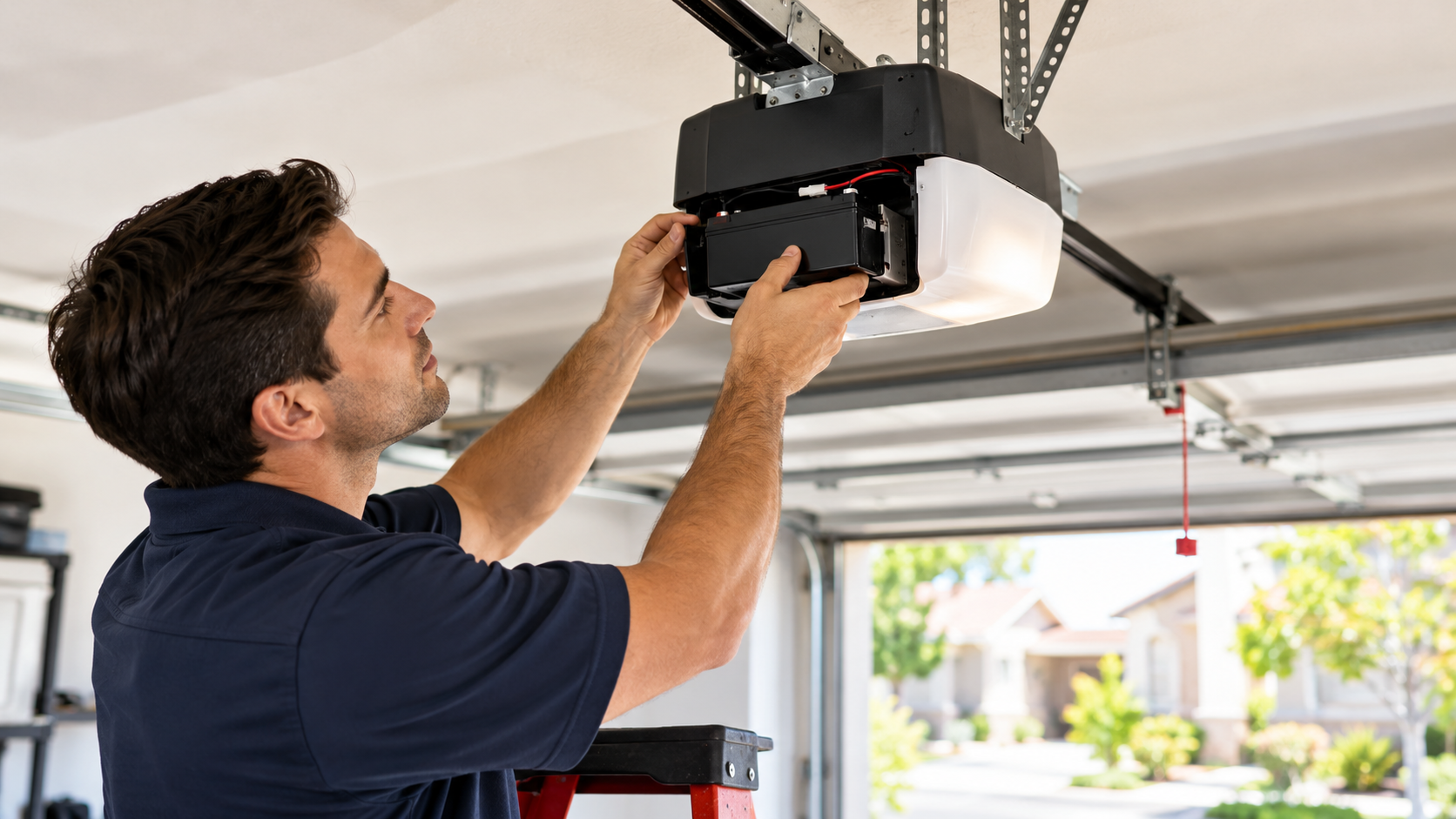
Battery backup installation runs $200 to $400 as a typical Orange County range. That figure covers adding or servicing a backup on a setup where the opener itself is in good shape and compliant, including replacing a worn-out backup battery on a unit that already has the housing for one.
This is the range to expect when the opener is fine and only the battery side needs attention. A compliant opener that will not run during an outage usually sits in this band, because the fix is the battery rather than the machine.
For a Legacy homeowner whose newer opener chirps and will not run on battery, this is almost always the relevant number. The opener stays, the battery gets handled, and the garage is back to meeting the outage standard.
The exact spot within $200 to $400 depends on the opener model and the battery it takes. Some units use a standard sealed battery that is quick to source, while others take a model-specific pack.
Full Opener Installation
Opener installation is $250 to $600, with belt drive costing more than chain drive. That difference is directly relevant in Tustin Legacy, where so many attached homes have living space above the garage and owners choose the quieter belt drive to keep the noise out of the bedroom above.
A full install replaces the whole motor unit, and on a new residential opener the battery backup is included in that machine by law. So a homeowner paying for a full install is already paying for a compliant, backup-equipped opener. There is no separate backup line to add on a new unit.
Belt drives sit toward the upper end of the range because the belt and the smoother drive mechanism cost more than a chain. For a townhome with a loft over the garage, that premium usually buys itself back in quiet operation every time the door runs.
Where headroom is tight or ceiling storage is in the way, a jackshaft wall-mount opener is the alternative, and pricing varies with the unit. Whatever drive type fits the garage, the install brings the opener up to current standard.
Related Opener Services
Not every opener issue is a full replacement. Opener repair runs $75 to $200 for faults like a worn gear, a bad capacitor or a control problem that can be fixed without swapping the whole unit. For a first-generation Legacy opener, a targeted repair is often all that is needed.
Smart Wi-Fi opener and MyQ setup runs $150 to $300. This is the service for homeowners who want phone control, remote monitoring and app access on their opener, and it is a frequent request given how connected the newer Legacy homes are. You can see the details on our smart Wi-Fi and MyQ setup page.
Keypad and remote programming runs $45 to $85. This is the small but constant job in the newer Legacy phases, where move-in activity is steady and new residents need remotes, keypads and app access all set up at once. Buyers often arrive with a new opener already in place and just need it configured.
Each of these is a different job with a different range, so the right starting point is figuring out whether you need a repair, a programming visit or a new unit. That diagnosis keeps a homeowner from paying for more than the problem calls for.
What the Price Depends On
The actual price depends on the specific garage, the drive type, and whether the opener is brand new or just needs a battery. A chirping backup on a compliant opener lands in one range, while a dead opener needing a quiet belt-drive replacement lands in another entirely.
Drive type is a real cost factor in this community because of the rooms over the garages. A homeowner who wants belt-drive quiet will pay more than one who is fine with a chain, and that choice sits inside the install range rather than being a separate charge.
The condition of the surrounding hardware matters too. If the door is off balance or the springs are at the end of their cycle rating, those are separate items that can come up during an opener visit. Replacing a spring without checking the cables is how a second failure follows weeks later.
A written price is available before work begins, so a homeowner knows the number before any tools come out. That is the point to confirm exactly what the job includes for your specific garage.
Need Help in Irvine?
Urgent Garage Doors serves Irvine and all of Orange County.
Where Battery Backup Fits With the Other Safety Rules
SB-969 is one rule among several, and homeowners mix it up with the entrapment-protection rules constantly. Each is a separate law, with its own date and its own purpose. Keeping them apart makes it clear what your opener actually has and why.
The short version is that auto-reverse and photo eyes protect against a door closing on something, while battery backup protects against a power outage. They solve different problems and they came from different laws passed decades apart.
Auto-Reverse and Photo Eyes Came First
California required openers to be manufactured with an automatic reverse device and sensor under AB 3600 (Polanco, Chapter 1336, Statutes of 1990). Federal law followed for openers manufactured for the United States after January 1 1993. So the entrapment-protection rules predate the battery backup rule by nearly thirty years.
Those devices are built to UL 325, the safety standard that approved photoelectric eyes and edge sensors as acceptable entrapment-protection devices. In practice a modern opener satisfies the standard two ways at once. It reverses the door within two seconds of hitting an obstruction, and it adds photo eyes mounted low on each side of the opening.
Photo eyes are standard throughout Tustin Legacy, because every home here was built after those rules took effect. There are no pre-1993 openers in the community, so the question of an opener too old to have any entrapment protection simply does not come up in these villages.
The honest line for any old opener elsewhere is that units made before 1993 predate the federal mandate. In Legacy, that is moot, because nothing here is that old. Every garage in these villages has the auto-reverse and sensor gear as standard.
Battery Backup Is a Later, Separate Rule
SB-969 from 2018 is a separate, later law, and it is about power outages, not about contact reversal. The two should never be merged into one rule or one date. Auto-reverse keeps a door from crushing an object. Battery backup keeps a door working when the grid is down. Different jobs entirely.
The dates make the separation clear. AB 3600 is 1990, the federal rule is 1993, and SB-969 takes effect July 1 2019. Nearly three decades separate the entrapment rules from the backup rule, which is a good reminder that they are not the same requirement with two names.
A homeowner can have one without the other. An older Legacy opener might have photo eyes and auto-reverse, because those came with every opener built after 1993, yet have no battery backup, because it predates July 2019. That combination is common on first-generation units in Columbus Square.
When that older opener gets replaced, the new one brings both systems current in a single machine. The entrapment protection and the backup both come standard on a new residential opener sold for California.
The Safety Checks a Legacy Owner Can Run
There are two tests any homeowner can run safely. The photo-eye test: with the door closing, break the beam with an object, and the door must stop and reverse. The two-by-four test: lay a 2x4 flat across the opening under the door, and on closing the door must reverse within two seconds of contact.
Photo-eye faults, misalignment and blocked beams are the most common cause of a door that reverses for no visible reason. In the dense Legacy layout, alley dust and debris can coat a sensor lens or nudge a bracket out of line, which breaks the beam and makes the door refuse to close. A quick lens wipe and an alignment check often fixes it, and if not, a sensor alignment and repair visit sorts it out.
Never touch the torsion spring. A torsion spring stores enough energy to cause serious injury and is wound with bars against a fixed cone. Adjusting, winding, unwinding or replacing one is not a homeowner job, and the safe tests above are the only hands-on checks to recommend.
If a door will not hold position during the balance test, that points to a spring problem, not an opener problem. The balance test is to disconnect the opener with the release cord, raise the door to waist height, and see if it stays put. A door that falls or rises needs a spring looked at by a technician, not a backup battery.
Getting Service Done in Tustin Legacy: Access, HOA and Permits
Getting a job done in the Legacy footprint has a few local wrinkles that a homeowner anywhere else would not think about. The garages sit on alleys, the villages have their own architectural review, part of the site is in a different city, and the licensing rules all apply. Sorting these out before dispatch saves a wasted trip.
These are the logistics that shape an opener visit in Tustin Legacy specifically. None of them change the law, but they change how the job gets scheduled and who signs off on it.
Alley and Motor-Court Access
The Legacy plan is dense and walkable by design, with townhomes and flats whose garages sit behind the homes on alleys and motor courts rather than on the street frontage. That is a deliberate feature of the specific plan, meant to keep garage doors off the main street face.
For a service truck, that means the work happens from a rear lane, not the front curb. A technician needs the rear access confirmed before dispatch, because an address on a street frontage often tells you nothing about how to reach the actual garage door on the alley side.
Motor courts add their own quirk. Several garages can share a small shared court, and knowing which court serves your unit, and whether a truck can turn and park there, matters for scheduling. A quick note about alley access when you call keeps the visit moving.
This is a daily reality across the community, not an occasional one. The whole point of the layout is that cars and garages live behind the homes, so confirming rear access is simply part of booking a Legacy job.
HOA Review and the Jurisdiction Split
Villages like Greenwood, Columbus Square and Columbus Grove sit under their own homeowners associations with their own architectural review. An exterior change, such as a new door with a different look, typically needs association approval before it goes in. That is a separate track from any city permit.
There is also a jurisdiction split worth knowing. The City of Tustin states that roughly 1,600 acres of the former base sit in Tustin and roughly 95 acres sit in the City of Irvine. Tustin Legacy is not wholly within one city, so the building department with authority is confirmed per address rather than assumed from the name.
Association approval and a city permit are two different tracks, and clearing one does not clear the other. For planning questions, the City of Tustin Planning Division can be reached at 714-573-3140, and permits and inspections run through the EnerGov CSS portal. The city with jurisdiction over your specific address confirms the permit position for the job.
For a straightforward opener swap, the HOA track usually matters more than a permit, since a new opener is not an exterior change the same way a new door is. Still, confirming both before work keeps a Legacy homeowner out of trouble with the association.
Licensing and the Unlicensed-Work Rule
Garage door work in California is licensed under classification C-61/D-28, Doors, Gates and Activating Devices. That scope covers sectional and rolling doors, torsion and extension spring systems, operators, control boards, safety sensors and activating devices. C-28 is Lock and Security Equipment and is not the garage door license.
The unlicensed-work exemption in Business and Professions Code section 7048 rose from $500 to $1,000 under AB 2622, effective January 1 2025. The exemption also fails, at any value, if the work requires a building permit of any kind or if the person employs anyone on the job. A job cannot be split into sub-$1,000 slices to get around it.
A separate rule is often confused with it. Business and Professions Code section 7159 requires a written home improvement contract for work over $500. That is a contract requirement, not a licensing threshold, and the two figures should not be merged.
A license is verified free at cslb.ca.gov, where classification, status, bond and workers compensation are all public record. Urgent Garage Doors holds California license #1055150.
Renters and Who Authorizes the Work
About half of Tustin homes are rented. Census figures put the owner-occupied rate at 48.8 percent, which means 51.2 percent of homes here are rented. That share includes a good number of the apartments, condos and townhomes in the Legacy villages.
On a rented property, a renter usually calls the landlord or the property manager about a failed opener, not the contractor directly. The person living behind the door is often not the person who authorizes or pays for the repair, which changes how a service call gets set up.
For a technician, that means confirming who is approving the work before parts go on. A renter can report the problem and let a crew in, but the decision to replace an opener or install a backup usually runs through the owner or management company.
This is worth flagging when you call. If you rent in a Legacy village and your opener has failed, knowing whether your landlord or property manager handles these calls saves a round of back-and-forth and gets the right person authorizing the fix.
Need Help in Irvine?
Urgent Garage Doors serves Irvine and all of Orange County.
How Urgent Garage Doors Handles SB-969 Opener Work
For Tustin Legacy homeowners, the job usually starts with one question: does the opener already comply, or does it need work? Our team sorts that out first, then matches the fix to what the garage actually needs. We work on all the brands you find in these villages and across Orange County.
The Diagnostic and Written Price
The first step is checking whether the opener is compliant, whether it needs a new backup battery, or whether it needs a full replacement. A chirping backup on a good opener is a very different job from a dead motor, and sorting that out up front keeps a homeowner from paying for more than the problem calls for.
That diagnostic also catches the things a homeowner cannot easily see. A door that reverses for no reason is often a photo-eye fault, and a door that will not hold position points to a spring, not the opener. Naming the real cause keeps the repair on target.
A written price is available before work begins, so you know the number before any tools come out. For new garage door installations, we offer a free on-site estimate, which lets us look at the opening, the opener and the hardware together before quoting.
For a replacement door, California Business and Professions Code section 7159 requires a written home improvement contract on work over $500, which is a legal requirement and part of how the job is documented.
Truck Stock and Same-Visit Work
Our trucks carry common torsion spring sizes, so many spring jobs finish on the same visit rather than waiting on a parts run. That matters in the older Legacy villages, where first-generation springs are reaching their cycle limit and often turn up during an opener call.
We work on all garage door brands, including LiftMaster, Chamberlain, Genie, Craftsman, Clopay, Amarr, Wayne Dalton and CHI. Those first four are the opener brands that ship with a California-compliant backup when sold since mid-2019, which covers most of what is installed in these villages.
Carrying stock does not mean every single job finishes on the first trip, since some parts are model-specific and have to be matched exactly. But for common springs and standard opener work, the goal is to handle it in one visit.
Each preventive maintenance visit also includes a written report of what was found and what is recommended, so a Legacy homeowner knows the condition of the springs, cables, rollers and opener rather than guessing when the next thing will fail.
Response and Availability
We take emergency calls and respond 24 hours a day, 7 days a week, every day of the year including holidays. A stuck door is not a business-hours problem, so emergency service is available whenever it happens.
Our response window is 30 to 60 minutes anywhere in Orange County, which covers all of the Tustin Legacy villages and the rest of Tustin. The storefront is at 76 Ashford, Irvine, CA 92618, close enough to reach the Legacy footprint quickly.
On a new door installation, removing and hauling away the old door is included. A homeowner upgrading a first-generation Legacy door does not have to deal with disposing of the old panels, since that is part of the install.
Our Google Local Services listing carries the Google Guarantee badge, and the license can be checked free at cslb.ca.gov under number #1055150. For emergency work across the Legacy villages, our 24/7 emergency repair service is there every day.
Confirm What Your Opener Has, Then Decide
If you are not sure whether your Tustin Legacy opener already has a backup, our team checks whether it is compliant, whether it just needs a new battery, or whether it is time for a full replacement, and you get a written price before any work starts. Call Urgent Garage Doors at (949) 529-7743 to book a visit, and have your rear alley or motor-court access ready so we can reach the garage on the first trip.
Frequently Asked Questions
- Does my Tustin Legacy garage door opener already have a battery backup?
- If your opener was installed or replaced on or after July 1 2019, it does, because California law requires a backup on any residential opener sold or installed from that date. Because Tustin Legacy is a newer community built out over the 2000s and 2010s, most openers in the newer villages already carry a backup. Older first-generation units from Columbus Square or Columbus Grove may not, which is legal, but a replacement brings the backup in.
- What is SB-969 and when did it take effect?
- SB 969 (Dodd, Chapter 621, Statutes of 2018) is a California law requiring a battery backup on residential automatic garage door openers manufactured, sold, offered for sale or installed in the state on or after July 1 2019. It was passed after deaths in the 2017 Northern California wildfires, where people could not open heavy garage doors by hand during power outages. The backup keeps the door running during an outage so a resident can evacuate.
- Do I have to replace my old opener to comply with SB-969?
- No. SB-969 applies when an opener is installed or replaced, not to an opener already sitting in service. An existing working opener with no backup can stay exactly where it is, legally, for as long as it keeps running. There is no deadline, no inspection and no penalty for keeping an older unit. The rule only reaches your garage at the moment that opener is swapped out for a new one.
- How much does battery backup installation cost in Orange County?
- Battery backup installation runs $200 to $400 as a typical Orange County range, which covers adding or servicing a backup on a compliant setup, including replacing a worn-out backup battery. A full opener installation runs $250 to $600, with belt drive costing more than chain drive. These are typical area ranges, not a quote. The actual price depends on your specific garage and opener, and a written price is available before work begins.
- Is battery backup an optional upgrade I can skip on a new opener?
- No. On a new residential opener in California, the battery backup is a legal requirement, not a paid upgrade tier you can decline. A non-compliant residential opener cannot be sold or installed in the state, and violations carry a $1,000 civil penalty. When a contractor quotes a new opener, the backup is part of the compliant unit, the same way the photo eyes and auto-reverse are. You are not paying for an add-on.
- What brands come with a California-compliant backup?
- LiftMaster, Chamberlain, Genie and Craftsman units sold for California since mid-2019 ship with the backup built into the machine. The model label on the opener, combined with the install date, gives a clear answer on whether yours has one. Our team works on all brands, including those four plus Clopay, Amarr, Wayne Dalton and CHI, so whatever opener is on your Legacy garage, we can check its compliance and service it.
- Is SB-969 the same as the auto-reverse or photo-eye rule?
- No. Auto-reverse and photo eyes come from AB 3600, a 1990 California law, and from federal rules covering openers manufactured for the United States after January 1 1993. Those protect against a door closing on an object. SB-969 is a separate, later law from 2018 about keeping the door working during a power outage. The dates and the purposes are different, and the two should never be merged into one rule.
- Do I need an HOA approval or a permit to replace my opener in Tustin Legacy?
- Villages like Greenwood, Columbus Square and Columbus Grove have their own associations with architectural review for exterior changes, and a city permit may apply depending on the work. The permit position is confirmed by the city with jurisdiction over your specific address, since roughly 95 acres of the former base sit in the City of Irvine while the rest is in Tustin. The City of Tustin Planning Division can be reached at 714-573-3140.
- My backup opener will not run during an outage. Does it need a new opener?
- Usually not. Backup batteries have a service life and wear out well before the opener does, so a compliant opener that will not run on battery most often needs a new battery, not a new opener. The motor, control board and sensors can all be fine while the battery is simply spent. A chirp or warning light is often the battery asking to be replaced, and catching it early keeps the opener ready for the next outage.
- Can I open my garage door by hand if the power is out and I have no backup?
- Yes, using the manual release cord, the red handle hanging from the trolley, which disconnects the door from the opener so it can be lifted by hand. The catch is weight. A heavy insulated door is a real effort to lift, which is exactly why SB-969 exists. During an evacuation, when time and strength are short, a battery backup makes the difference between a door that opens on its own and one you have to wrestle.
Licensed garage door repair professionals serving Irvine and Orange County.
Licensed in California · License #1055150
Why trust Urgent Garage Doors?
Founded in 2017, Urgent Garage Doors is a licensed and insured garage door services serving Irvine and Orange County. All content is reviewed by our licensed technicians.

Need Help in Irvine?
Urgent Garage Doors serves Irvine and all of Orange County.
Related Articles
California SB 969: The Garage Door Opener Battery Backup Law (And What It Means When a Spring Breaks)
SB 969 requires battery backup on every residential garage door opener sold or installed in California since 1 July 2019. It sets no rules about springs, but a broken spring often starts the conversation.
Power Outage With No Battery Backup: Opening Your OC Garage Door Safely by Hand
A local guide for Irvine homeowners on safely opening a garage door by hand during a Southern California Edison outage when there is no battery backup.
What Our Tustin Garage Door Calls Show About Old Town, the Ranch and Legacy
What our Tustin garage door calls reveal district by district, from Old Town approvals and North Tustin county permits to high-wear Tustin Ranch springs and the state rules behind every opener swap.