Safety & Prevention
Broken Garage Door Spring on Balboa Island and What Happens in the Next Two Hours
Key Takeaways
- A broken torsion spring shows a loud bang, a visible gap in the coil, and a door that will not lift while the opener strains; the spring carries the weight, not the motor.
- Never adjust, wind or replace a torsion spring yourself, as it stores enough energy to cause serious injury even when the door is closed.
- Balboa Island sits in Newport Harbor with constant salt air, which corrodes springs, cables and hardware and brings them to the end of their cycle rating earlier than inland.
- Cables near the water fray from the inside out before they snap, so a spring call should always include a cable and hardware inspection to prevent a second failure.
- Narrow alleys, undersized openings and the May 15 to September 15 parking restrictions shape every island job, so access is confirmed before dispatch.
- A replacement opener in California must have SB 969 battery backup and meet entrapment protection requirements; a like-for-like spring repair generally does not require a permit.
- Garage door work is licensed under C-61/D-28, not C-28, and can be verified free at cslb.ca.gov, where Urgent Garage Doors holds license #1055150.
- Urgent Garage Doors offers 24/7 emergency response in 30 to 60 minutes across Orange County, with a written price available before work begins.
In This Article
It usually starts with a sound like a gunshot in the garage. A torsion spring, wound tight above the door, lets go all at once, and the crack echoes down a narrow alley off Marine Avenue. The car is parked inside, the door will not lift, and the owner is already late for the ferry or a booking turnover.
Here is the short answer. A broken garage door spring is not a quick fix an owner should attempt. The next two hours should involve a safe diagnosis, a balance check, and a spring matched to the exact weight and height of the door. The spring carries the full weight of the door, not the motor, so forcing the opener only risks more damage.
On Balboa Island, this happens more often than inland, and for a clear reason. The island sits in Newport Harbor with water on every side, so salt air and humidity are constant. That corrosion brings springs, cables and hardware to the end of their service life earlier than the same parts a few miles inland. This guide walks through what a broken spring looks like, why it fails here, and what the repair actually solves.
The First Thirty Minutes: What a Broken Spring Actually Looks Like?
When a door suddenly stops working, most owners assume the opener died. On an island full of older cottages and daily-use rental doors, the spring is far more often the culprit. Knowing the difference in the first thirty minutes helps an owner describe the problem accurately and avoid a dangerous mistake while they wait.
The Bang, the Gap, and the Door That Won't Budge
The first clue is the sound. A broken torsion spring usually announces itself with a loud bang, sometimes mistaken for something falling off a shelf or even a minor collision in the alley. That noise is the stored energy releasing in a fraction of a second as the steel coil snaps.
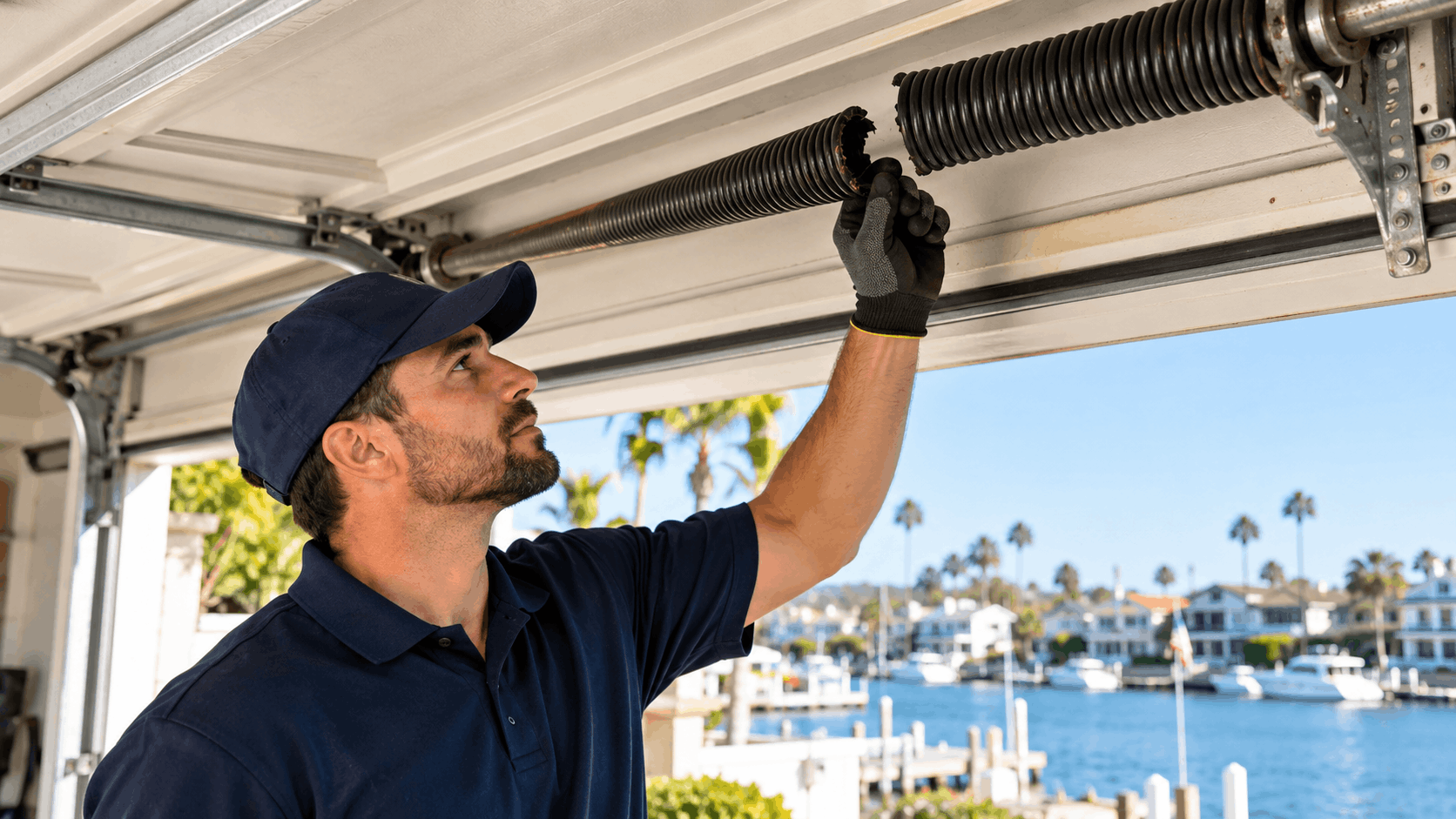
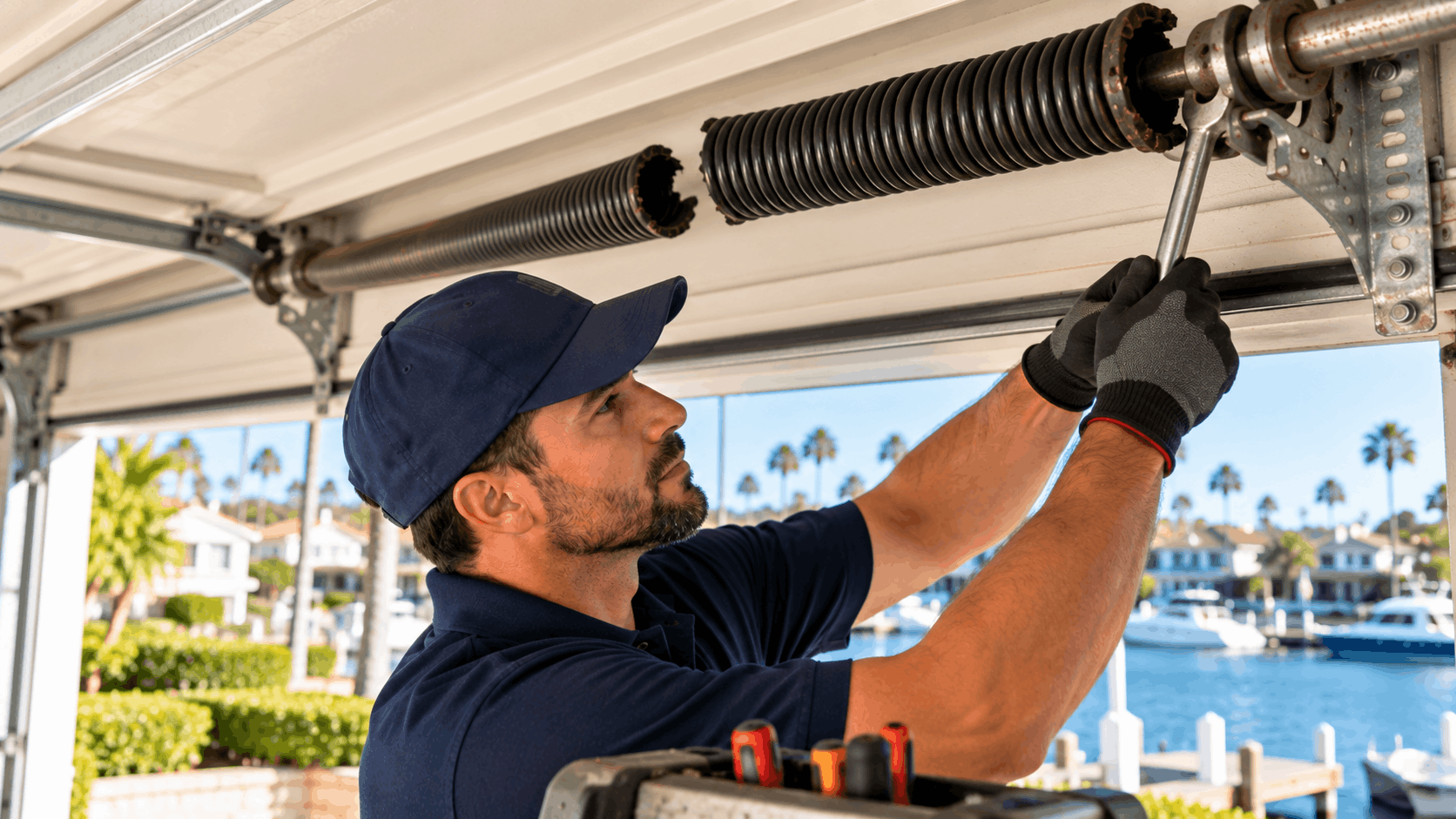
The next clue is visual. If an owner looks at the spring mounted on the shaft above the door, a broken one shows a clear gap in the coil, a two-inch or so separation where the metal used to be continuous. A healthy torsion spring is one tight, unbroken coil from end to end.
The third clue is behavior. When the garage door won't open and the opener strains, hums or clicks but the door barely moves, that broken torsion spring is almost always the reason. The motor is trying to lift a door that suddenly weighs far more than it was ever meant to pull on its own.
Some openers will lift the door a few inches and stop, then reverse. Others pull the chain or belt while the door sits flat on the floor. In every case, the strain on the opener is a warning, not a problem to push through.
Why the Spring, Not the Opener, Is Almost Always the Problem
Here is the simplest way to think about it. The spring carries the weight of the door. The opener only guides the door up and down and holds it in position. A typical sectional door is heavy, and the counterbalance spring does the real lifting every single cycle.
That is why the spring vs opener question usually answers itself with one test. If an owner pulls the release cord to disconnect the opener and then tries to raise the door by hand, a door with a healthy spring lifts fairly easily and stays put at waist height. This is the balance test, and a well-balanced door holds position rather than slamming down or drifting up.
A door that will not lift by hand, or crashes back down the moment it is raised, has a spring problem, not an opener problem. No new motor fixes that. The opener was never built to haul the full dead weight of the door, and asking it to do so burns out the unit and strips the drive gear.
When our team hears a door that hums but won't move, we expect to find a spring at the end of its life. Confirming it on site is quick, and it points the repair at the right part the first time. If you want the full picture of how balance works, our door balancing and tension adjustment work covers the same mechanics.
The One Thing an Owner Must Never Touch
A torsion spring stores an enormous amount of energy, even when the door is closed and sitting still. It is wound under tension with steel winding bars against a fixed cone, and that tension does not disappear when the spring breaks. There can still be dangerous force in the remaining coils.
For that reason, an owner should never try to adjust, wind, unwind or replace a torsion spring. The winding bars can kick back with enough force to break bones or worse if a cone slips or a bar is seated wrong. This is the single most dangerous component on the whole door.
This is not caution for its own sake. Spring work is exactly where the risk lives on a garage door, which is why it belongs with a trained technician carrying the right bars and the right replacement spring. The money saved attempting it is never worth the injury risk.
If the spring is already broken, leave the winding cones and bars alone and keep hands, fingers and the car well clear of the door. Our torsion spring replacement service handles the wind-up safely so nobody in the household has to.
The Safe Check You Can Run While You Wait
There is one useful thing an owner can safely do while waiting for a technician, and it has nothing to do with the spring. It is the manufacturer's auto-reverse check, which confirms the door's safety features still work once the spring is fixed. Lay a flat 2x4 on the floor in the door's path, directly under where the door comes down.
With the door working, closing it onto that board should make it reverse within two seconds of contact. This 2x4 test is the contact-reverse safety every modern opener must provide. If the spring is broken and the door won't move, note this for after the repair instead.
The other safe check is the photo-eye beam. Two small sensors sit on each side of the opening, no higher than six inches off the floor. They should face each other cleanly, with nothing blocking the invisible beam between them. A blocked or misaligned beam makes a door refuse to close or reverse for no obvious reason.
On Balboa Island, salt grit and airborne debris coat those lenses over time, which is a common reason a door starts acting up. Wiping the lenses clean and confirming they are aligned is safe and genuinely useful. Everything involving the spring itself should wait for the crew.
Get Your Free Quote
Tell us about your garage door and we'll get back to you fast.
Why Springs Fail Faster on Balboa Island Than Inland
A spring in an inland tract home and a spring on an alley garage off Agate Avenue are the same part doing the same job. The difference is the air they live in. Understanding that difference tells an owner what the repair really needs to solve, and why cutting corners on the island invites a repeat failure.
Water on Every Side and Constant Salt Air
Balboa Island sits in Newport Harbor with water on every side, from the Marine Avenue bridge across to Little Balboa Island and Collins Isle. That means humidity and airborne salt are constant here, not a seasonal visitor that shows up with the marine layer and burns off by noon.
Salt air is hard on steel. It accelerates corrosion on springs, cables, drums, rollers, hinges, fasteners and track, the same parts that would last longer a few miles inland in Tustin or Irvine. The result is that hardware reaches the end of its usable life earlier than the catalog cycle rating would suggest in a dry inland garage.
This is not about one magic number. It is about rust forming on surfaces that were never meant to carry it, roughening the steel and weakening the metal where it flexes under load. A spring that corrodes along its coils fatigues sooner than a clean one.
Because the exposure is continuous, the honest answer for island owners is that salt simply moves every steel part toward replacement on a shorter timeline than inland. The fix is to inspect more often and choose hardware built to resist corrosion.
Cables That Fray From the Inside Before They Snap
Lift cables are the quiet twin of the spring, and on the island they deserve just as much attention. A cable is braided from many thin steel wires, and near the harbor those wires corrode from the inside out. The strand looks intact on the surface while it is weakening within.
That is why a cable here tends to fray before it fails outright, with small broken wire ends poking out of the braid like a whisker. Catching that fray during an inspection is the difference between a planned fix and a cable letting go under load. A snapped cable can send a door crashing down crooked.
When a spring breaks, there is a strong chance the cable alongside it is the same age and has lived in the same salt air. Replacing the spring and ignoring a tired cable is how a second failure shows up weeks later, usually at the worst possible moment during a rental turnover.
This is exactly why cable inspection matters more on Balboa Island than almost anywhere else we work. Our garage door cable repair work goes hand in hand with spring replacement so the whole lifting system gets checked at once.
Cycle Rating, Not Guesswork
A torsion spring is rated by its manufacturer in cycles, where one cycle is a single full open and close. A standard residential spring is commonly rated around 10,000 cycles. High-cycle springs are available and rated higher for doors that see heavy use.
Those cycles translate roughly into years based on how often the door moves. A door cycled about four times a day reaches 10,000 cycles in roughly seven years. On a door that serves as the main entrance and moves many times daily, that same spring is used up far sooner on the calendar.
Salt air does not add a mysterious multiplier to this math. What corrosion does is bring a spring to the end of its cycle rating earlier, because rust and metal fatigue combine to shorten how many clean cycles the steel can actually deliver. The rating is still the honest anchor.
So the useful questions are the spring's rating and the door's age and daily use, not a made-up figure about coastal wear. Knowing a seven-year-old daily-use door is simply due is better information than a guess about the ocean.
Rust at the Base of Older Cottage Doors
Balboa Island carries a century of building history, from original cottages through mid-century rebuilds, and many older steel doors show their age at the bottom. The bottom section of a steel door rusts from the base upward, because that edge sits closest to damp ground and standing moisture in the alley.
Once rust takes hold at the base, it eats into the panel, loosens the bottom seal retainer and weakens the point where the lift cable attaches. A corroded bottom bracket under spring and cable tension is a real hazard, not just a cosmetic blemish on an old door.
This is why a spring call on the island is a good moment to look at the whole door, not just the broken part. The same salt that killed the spring has been working on the panels, the retainer and the hardware for years.
When our technicians are already on site for a spring, inspecting the bottom section and seals adds little time and catches problems before they become the next emergency. A weatherseal retrofit often pairs well with spring work on an older cottage door.
Need Help in Irvine?
Urgent Garage Doors serves Irvine and all of Orange County.
The Alley Problem: Getting to Your Garage in the First Place
A spring repair on Balboa Island starts long before anyone touches a winding bar. It starts with getting a service vehicle and the right parts to a garage that opens onto a narrow alley. This is the part that catches off-island companies off guard, and it shapes the entire two-hour window.
Garages Off the Alleys, Not the Street
Balboa Island was dredged into being between 1908 and 1909 by William S. Collins, and the grid of small lots he laid out survives today. Standard lots run 30 by 85 feet, which is tiny by modern standards and leaves little room for a garage.
Because of that layout, garages sit off the alleys rather than off the street frontage. A technician does not pull up to a driveway on the street. They work from the alley side, where the openings are undersized and the clearances are tight.
The density is the whole story. Cottages and rebuilt homes sit shoulder to shoulder on those small footprints, served almost entirely by alleys reached from a handful of narrow streets. There is no spreading out, no driveway apron, no spare curb space to stage tools.
For a spring job, that means the crew plans to carry the replacement spring, winding bars and any cable or roller stock down the alley on foot. It is a different workflow from a mainland tract garage, and planning for it keeps the job on schedule.
Why a Full-Size Truck Cannot Always Get In
The alleys and streets on Balboa Island are narrow enough that a full-size vehicle cannot always get in, turn or work safely. The City of Newport Beach's own guidance on temporary street use notes that some tight residential areas, Balboa Island specifically, cannot accommodate larger vehicles.
That is why confirming alley width and access before dispatch matters so much here. Sending the wrong vehicle means a crew stuck at the end of a street unable to reach the garage, which burns the response window for nothing. A smaller vehicle is often the right call.
Expecting to carry material further than on a mainland job is simply normal island work. The crew brings what the job needs to the door rather than backing a truck up to it. Measuring and confirming beats assuming on the day.
None of this is a reason to delay a repair. It is a reason to plan the approach before leaving Irvine, so the team arrives ready for the island instead of discovering the constraint at the bridge.
Summer Parking and Why It Decides the Appointment
Parking on public streets in the restricted residential zone is limited from May 15 to September 15 each year. During that window, only vehicles displaying a valid permit may park, and permit holders must still comply with all other parking rules, including the 72-hour ordinance.
The practical effect from mid-May to mid-September is that the streets are effectively full and a service vehicle has nowhere legitimate to sit. A technician cannot simply find a spot near the alley to stage the work during peak season.
Newport Island residents may purchase up to three permits per residence in any combination of permanent and guest permits, with proof of residence required. That helps a resident, but it does not solve where a contractor's vehicle sits during a summer repair.
The honest advice is to book island work outside that season where possible, or early in the morning within it, before the streets fill. That timing is often the difference between a smooth job and a parking ticket on top of a repair bill.
The Marine Avenue Bridge and the Ferry
There are two ways onto the island, and both affect timing on an emergency call. The Marine Avenue bridge carries vehicle traffic onto Balboa Island, and the three-car Balboa Island Ferry runs across the harbor as the other route.
On a two-hour emergency job, the approach route is part of the clock. The bridge is the practical path for a service vehicle carrying parts, and it feeds directly into the island's narrow street grid and the alleys beyond.
The ferry only holds three cars at a time, so it is not a reliable way to move a service vehicle quickly during busy periods. Knowing the real access points lets the team plan a realistic arrival rather than promising a window that traffic and parking will not support.
All of this is why an island spring call benefits from a crew that already knows the territory. For urgent situations, our 24/7 emergency repair team plans access first so the two hours are spent fixing the door, not sorting out where to park.
Matching the Right Spring to Your Door
A torsion spring is not a generic off-the-shelf part. The wrong spring on a door is not just ineffective, it causes a second failure and can throw the door out of balance in a way that stresses every other component. Getting the match right is the core of a lasting repair.
Springs Are Sized to Your Door's Weight and Height
Springs are sized to the actual weight and height of the door they counterbalance. The wire diameter, the inside diameter of the coil and the length of the spring all combine to produce a specific lifting force matched to that specific door.
That is why a replacement set has to be calculated, not grabbed from a shelf. A heavier door, or a replacement door built in a heavier material, needs springs matched to its weight rather than a reuse of the old set that fit a lighter panel.
Reusing a mismatched spring is a common shortcut that backfires. Too weak, and the door is hard to lift and strains the opener. Too strong, and the door tries to fly open and will not stay closed. Neither is safe or durable.
On the island, where older cottage doors often got replaced over the decades, the current door may not be what the original springs were sized for. Measuring and weighing the door before choosing the spring is how the repair holds up.
High-Cycle Springs for Heavy-Use Island Doors
Where a door sees heavy duty, high-cycle springs rated well above the standard 10,000 cycles are available. On Balboa Island, that matters for vacation rentals and daily-use doors that cycle many times a day as guests and owners come and go.
A higher cycle rating means more full open-and-close cycles before the spring reaches the end of its service life. For a rental door that works hard through the summer season, stepping up to a high-cycle spring can stretch the time between replacements.
Coated springs also help against the island's constant salt exposure. A protective coating slows the corrosion that would otherwise roughen bare steel and bring the spring to the end of its cycle rating earlier in this environment.
Pairing a high-cycle, coated spring with galvanized or stainless hardware is a sensible setup for a property surrounded by harbor water. Our spring and cable repair work includes talking through which spring rating fits how the door is actually used.
Why We Inspect Cables, Drums, Rollers and Bearings Too
Replacing a spring in isolation is how a second failure follows within weeks. Cables, drums, rollers, hinges and bearings all wear alongside the spring, because they share the same load and the same years of use. A fresh spring on worn supporting hardware is a half-finished repair.
The cable is the most important of these to check, especially near the harbor where it corrodes from the inside and frays before it snaps. A cable at the end of its life will fail soon after a new spring goes in, undoing the repair.
Drums guide the cable and can develop grooves or corrosion that chew through a cable. Rollers and bearings that have rusted or seized add drag that the new spring then has to fight, which shortens its life and makes the door noisy and rough.
That is why our technicians inspect the whole lifting and guide system during a spring call. Catching a tired cable or a seized bearing at the same visit saves an island owner a second emergency trip across the bridge. Related work, like track repair and realignment, often surfaces during that same inspection.
Low-Headroom and Custom-Width Island Garages
Island garages are small, often single-bay, with low headroom and limited backroom behind the opening. A standard off-the-shelf door and a standard ceiling-mounted opener frequently do not fit the space the original builder left.
Low-headroom track kits are a normal solution here rather than an exception. These kits run the door up with less clearance above the opening, which suits a tight alley garage where there is no room for a conventional high-lift track.
Jackshaft openers are the other common answer. Instead of a motor on a ceiling rail, a jackshaft unit mounts beside the torsion bar on the wall and drives the shaft directly. That frees up ceiling space and works where headroom is scarce or storage fills the overhead area.
Because openings here are often undersized by modern standards, custom-width doors come up regularly too. Measuring before quoting is the rule on Balboa Island, since assuming a standard opening is how a job goes wrong on the day the parts arrive.
If the Opener Comes Up Too: What the Law Requires
A spring call often reveals an opener that has quietly aged past its prime, especially in the island's older cottage stock. If a replacement opener enters the picture, California law sets clear requirements an owner should understand before anything is installed.
Pre-1993 Openers in the Older Island Stock
Many openers in the island's older stock predate the January 1, 1993 federal requirement for external entrapment protection, which came from the Consumer Product Safety Improvement Act of 1990. Units manufactured before that date predate the federal mandate for a photo eye or edge sensor.
California actually moved first on auto-reverse. AB 3600, passed in 1990, required California openers to be manufactured with an automatic reverse device and sensor, and Congress followed for openers made for the United States after 1993.
California Health and Safety Code section 19890 has required entrapment protection sensors on openers as of January 1, 1993. So an opener from the island's older building era may well lack the external sensor protection that every modern opener carries.
An old opener without external sensors is not illegal to own, but it does not have the protection modern units provide. When one of these turns up during a spring call, replacement rather than repair is the manufacturer's position for pre-1993 units.
Battery Backup Is Required on a Replacement Opener
When a residential opener is replaced in California, battery backup is not an optional extra. SB 969, signed in 2018 and operative July 1, 2019, requires every residential automatic garage door opener sold or installed in California on or after that date to have a battery backup designed to run during an electrical outage.
The law carries a $1,000 civil penalty, and since that date a replacement residential garage door may not be installed connected to a non-compliant opener. It is a legal requirement, not a paid upgrade tier a customer can decline to save money.
SB 969 was passed in response to deaths in the 2017 Northern California wildfires, where people could not open their garage doors during power cuts. The purpose is evacuation when the grid is down and a resident cannot lift a heavy door by hand.
On Balboa Island, that matters in a very concrete way. A power cut and a jammed door leave a car stuck in a narrow alley with nowhere to go. Our battery backup installation keeps a replacement opener compliant and keeps the door working when the lights go out.
Photo Eyes and the Auto-Reverse Everyone Should Have
Modern entrapment protection works on two layers at once. The first is contact reverse, where the door must reverse within two seconds of hitting an obstruction. The second is the non-contact system, the photo eyes mounted on each side of the opening no higher than six inches off the floor.
Those photo eyes project an invisible beam across the opening. If anything breaks the beam while the door is closing, the door must stop and reverse before it can touch whatever is there. Both layers together satisfy the UL 325 safety standard.
Photo-eye faults, misalignment and blocked beams are the single most common cause of a door that reverses for no visible reason. A bumped sensor, a stored box, or a dirty lens is usually behind a door that refuses to close.
On the island, salt grit coating a lens is a frequent offender, since airborne debris settles on the sensors over time. Wiping the lenses and checking alignment is part of our work, and our safety sensor alignment repair handles the ones that need more than a wipe.
Need Help in Irvine?
Urgent Garage Doors serves Irvine and all of Orange County.
Permits, Licensing and the Coastal Zone on Balboa Island
Regulation on the island deserves an honest picture, neither overstated nor waved away. A like-for-like spring repair is a very different proposition from changing the opening, and nearly every property here sits in the Coastal Zone, which adds a layer most mainland jobs never see.
A Spring Repair Versus Changing the Opening
Structural work is generally what triggers a building permit, not a like-for-like door or spring job. Widening an opening or altering the header is the kind of change that pulls in the building department. Replacing a broken spring in an existing door does not alter the structure.
That distinction keeps most spring repairs in the simple category. The door, the opening and the header all stay exactly as they were. The repair swaps a worn counterbalance part for a new one matched to the door.
Permits are decided by the city or county with jurisdiction over the specific address, not by a single regional rule. For Balboa Island, that is the City of Newport Beach, and the permit position should be confirmed for the exact property.
Needing a permit also matters for who can legally do the work, because a job that requires a permit loses the unlicensed-work exemption entirely. For a straightforward spring replacement, confirming with the city is the clean answer rather than assuming either way.
The Coastal Zone Layer in Newport Beach
Balboa Island is entirely within the Coastal Zone, and nearly every property in Newport Beach sits inside it. Work in the Coastal Zone can require a Coastal Development Permit before or alongside a building permit, and anything touching exterior walls or openings is the kind of change that draws coastal review.
This is where the spring-versus-structure line matters again. Replacing a door in an existing opening with a door of the same dimensions is different from changing the opening size or altering the structure around it. It is the second that pulls a project into the longer coastal process.
Coastal timelines are measured in weeks and months rather than days, so a structural change needs planning well ahead of any booking deadline. An owner should not assume a quick turnaround on anything that touches the opening itself.
The Newport Beach Address Search Tool tells an owner whether their property is in the Coastal Zone, and city staff guide applicants through the documentation. The Permit Center is at 100 Civic Center Drive, 949-644-3309. Check the address and ask the city rather than assuming.
The Right License and the Work Threshold
Garage door work in California is licensed by the Contractors State License Board under classification C-61/D-28, Doors, Gates and Activating Devices. That scope covers sectional and rolling doors, torsion and extension spring systems, operators, control boards, safety sensors and activating devices.
C-28 is a different classification entirely. It is Lock and Security Equipment, and it is not the garage door license. Any claim that garage door work is C-28, or that it needs a Class B general building license, is simply wrong.
The unlicensed-work exemption in Business and Professions Code section 7048 rose from $500 to $1,000 under AB 2622, effective January 1, 2025. That covers combined labor, materials and other costs, and a job cannot be split into smaller slices to dodge it.
The exemption also fails outright if the work requires a building permit of any kind or if the person employs anyone on the job. A separate rule, often confused with this one, is that a written home improvement contract is required for work over $500 under section 7159, which is a contract requirement rather than a licensing threshold.
Verifying a Contractor Before They Reach the Alley
An owner can verify any contractor's license free at cslb.ca.gov before work begins. The license number, classification, status, bond and workers compensation are all public record, so there is no reason to take a company's word for it.
Checking the classification matters as much as checking the status. A valid license in the wrong classification does not cover garage door work. The one to look for is C-61/D-28, Doors, Gates and Activating Devices.
Urgent Garage Doors holds California license #1055150, which anyone can look up on the Contractors State License Board site in a minute. A legitimate contractor welcomes that check.
On a dense island where a crew is working in a tight alley near the car and the home, confirming the license, bond and insurance status beforehand is simple protection. It takes less time than the drive across the bridge.
Vacation Rentals and Absentee Owners on the Island
A large share of island calls come from people who are not standing in the garage when the spring breaks. Balboa Island carries a substantial short-term and seasonal rental population, and in Newport Beach almost half of homes are rented. That changes how a broken spring gets handled.
When the Caller Isn't the Person in the House
On a rented property, the person who authorizes and pays for the repair is often not the person living there. Census figures for Newport Beach put the owner-occupied rate at 52.1 percent, which means 47.9 percent of homes are rented, and many island rentals are short-term on top of that.
So the call frequently comes from a property manager or an absentee owner handling the problem remotely. They need the door fixed without being on site to open the garage or point out the alley.
Coordinating access to an alley garage from a distance is part of the job here. That might mean a lockbox code, a neighbor meeting the crew, or a keypad combination shared ahead of the visit. Clear access arrangements keep a remote job moving.
Our team is used to working with managers who juggle several island properties. Confirming the access plan when the call comes in avoids a wasted trip to a garage nobody can open.
Changeover Days and a Door That Must Work Before a Booking
Rental calls cluster on changeover days in season, when one set of guests leaves and another arrives. A broken spring on a changeover day is not a minor inconvenience. It is a door that must be made operable before the next guest pulls into the alley.
Often the need is not a full door replacement at all. It is getting the door working again fast, whether that means a matched spring, a fresh cable or a keypad code reset between guests. The pressure is the turnover clock, not a remodel.
A stuck door in a tight alley can hold up a whole turnover, leaving a car trapped or a new guest without garage access on arrival. Managers feel that pressure acutely during the busy summer window.
That is why fast, repeatable repairs matter on the island. For a door that simply has to open before check-in, our same-day repair keeps a booking from falling apart over a failed spring.
Keeping an Older Rental Door Reliable Year-Round
A twice-yearly maintenance cycle is defensible on this island in a way it would not be in a dry inland tract. The constant salt exposure means hardware needs checking more often, and a rental door that works hard through summer earns that attention.
Inspecting cables and springs ahead of the season beats discovering a problem in the middle of a turnover. A frayed cable or a spring near its cycle limit, caught in a scheduled visit, becomes a planned swap instead of an emergency callout.
For rental owners and managers, preventive inspection is simply cheaper and less disruptive than an in-season failure. The parts most likely to go, springs and cables, are exactly the ones a scheduled check catches early.
A preventive maintenance plan built around the island's salt exposure keeps an older rental door reliable through the busy months. It is the opposite of waiting for the bang in the alley on a changeover morning.
Need Help in Irvine?
Urgent Garage Doors serves Irvine and all of Orange County.
How Our Team Handles a Broken Spring Call on Balboa Island
From the moment the phone rings to the finished door, an island spring call follows a clear sequence. Here is what the next two hours actually look like when our team takes a Balboa Island emergency.
Confirming Access Before We Dispatch
Before anyone leaves Irvine, we confirm alley width and access for the specific address. On an island the city itself says cannot accommodate larger vehicles, this step is not optional. It decides which vehicle makes the trip.
We plan for a smaller vehicle where the alley demands it, and we plan to carry the spring, winding bars and any cable or roller stock to the garage on foot. That way the crew arrives ready for the island instead of stranded at the end of a narrow street.
During summer, we factor in the May 15 to September 15 parking restrictions and aim for timing that gives a service vehicle somewhere to work. Early morning within the season often works best when streets are otherwise full.
We also plan the route by the Marine Avenue bridge, since that is the practical path for a vehicle carrying parts. Confirming all of this up front is how an emergency call stays on schedule rather than stalling at access.
The Diagnostic and Full Hardware Check
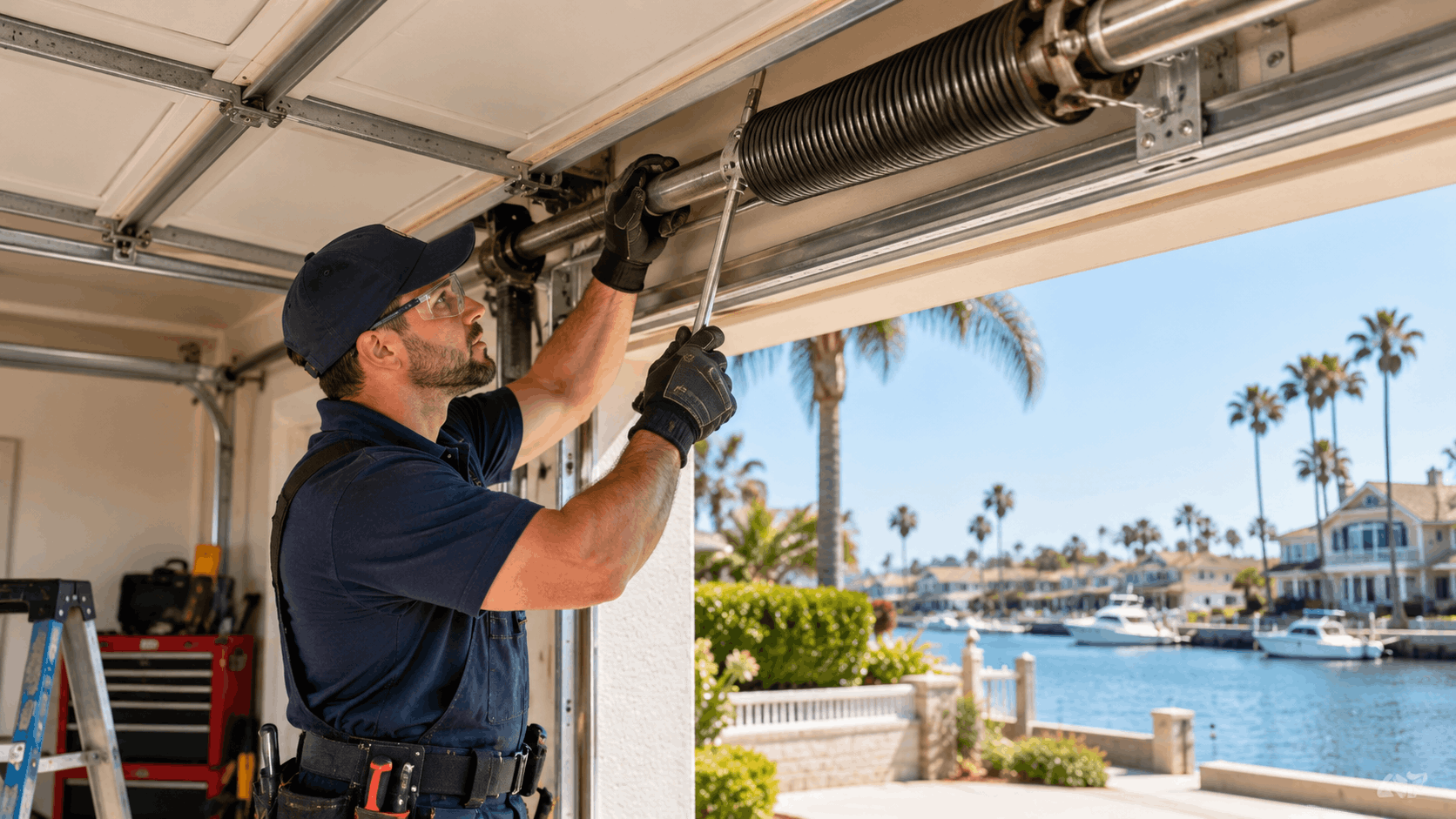
On site, the first job is confirming the diagnosis. We verify the spring is the failed part, look for the gap in the coil, and run the balance test by disconnecting the opener and checking how the door behaves by hand.
Once the door is working again, we confirm the auto-reverse with a flat 2x4 on the floor and check the photo-eye beam is aligned and clear of salt grit. Those safety checks confirm the door is not just moving but moving safely.
Because this is the harbor, we inspect the cables, drums, rollers and bearings for the corrosion that is common near the water. A frayed cable or a seized bearing caught now prevents the second failure that otherwise follows a spring swap.
This full hardware check is what separates a lasting island repair from a quick patch. The salt that killed the spring has been working on everything else, and we look at all of it while we are there.
A Written Price Before Work Begins
A written price is available before work begins, so an owner or property manager knows the number before any tools come out. We provide it when the job calls for it or when the customer asks.
This is useful on a remote rental call, where a manager approving the repair from off-island wants the figure in writing before giving the go-ahead. It removes the guesswork from authorizing a fix they cannot stand over.
Separate from company practice, California Business and Professions Code section 7159 requires a written home improvement contract for work over $500. That is a legal requirement, and it protects the homeowner regardless of who performs the work.
Between the written price and the required contract, an island owner has a clear record of what is being done and what it costs before the first spring comes off the shaft.
24/7 Response Across Orange County
Urgent Garage Doors takes emergency calls 24 hours a day, 7 days a week, every day of the year including holidays. A spring does not wait for business hours, and neither do we.
The response window is 30 to 60 minutes across Orange County, dispatched from our storefront at 76 Ashford in Irvine. On the island, access via the bridge or ferry and summer parking can affect the exact timing, which is why we plan the approach when the call comes in.
We work on all garage door brands, including LiftMaster, Chamberlain, Genie, Craftsman, Clopay, Amarr, Wayne Dalton and CHI. Whatever is hanging in the alley garage, we carry the parts and knowledge to match it.
For an island owner or manager facing a stuck car and a broken spring, that round-the-clock coverage is the difference between a solved problem and a ruined day. Our emergency garage door repair team is built for exactly this call.
Getting Your Island Door Moving Again
A broken spring on Balboa Island is a same-day problem with a safe, standard fix: a confirmed diagnosis, a balance and auto-reverse check, a cable and hardware inspection, and a spring matched to your door. The salt air is why it happened, and a full check at the same visit is what keeps it from happening again.
Call Urgent Garage Doors at (949) 529-7743 when the spring lets go. We confirm alley access, bring the right parts across the bridge, and give you a written price before any tools come out.
Frequently Asked Questions
- Can I open my garage door with a broken spring?
- Not safely. With a broken spring, the door loses its counterbalance and becomes too heavy to lift by hand, since the spring carries the weight, not the motor. Forcing the opener only strains the unit and risks stripping the drive or burning out the motor. Leave the door down, keep the car and people clear, and call a technician to replace the spring properly.
- Why did my spring break if the door worked fine yesterday?
- Springs are rated in cycles, commonly around 10,000 for a standard spring, and they fail at the end of that rating rather than giving warning. A door cycled four times a day reaches that in roughly seven years. Near Newport Harbor, constant salt air corrodes the steel and brings the spring to the end of its cycle rating earlier. So a spring that worked yesterday was simply at the end of its life.
- Should I replace one spring or both?
- Replacing in pairs is common practice when a door has two springs. Both were installed at the same time, carry the same load and have lived in the same salt air, so a second spring near the same age and exposure is likely close to failure too. Springs are matched to the door's weight and height, so replacing both keeps the counterbalance even and avoids a repeat callout within weeks.
- Can I replace a torsion spring myself?
- No. A torsion spring stores enough energy to cause serious injury and is wound under tension with steel bars against a fixed cone. That force does not disappear when the spring breaks. An owner should never adjust, wind, unwind or replace one. This is the single most dangerous part on the door, and it belongs to a trained technician with the right winding bars and a correctly sized replacement spring.
- How fast can someone reach Balboa Island for an emergency?
- Our response window is 30 to 60 minutes across Orange County, and we take emergency calls 24 hours a day, 7 days a week, including holidays. On the island, access by the Marine Avenue bridge or the three-car ferry and the summer parking restrictions from May 15 to September 15 can affect timing, which is why we confirm access and plan the route when the call comes in.
- Do I need a permit to replace a garage door spring on the island?
- A like-for-like spring repair generally does not trigger a building permit, because it does not alter the structure or the opening. Structural work such as widening an opening or changing the header is what usually requires one. Permits are decided by the City of Newport Beach for your specific address, so confirm the position there. The Coastal Zone matters mainly for structural change, which can require a Coastal Development Permit.
- Will I need a new opener when the spring is replaced?
- A spring and an opener are separate parts, so a spring replacement does not require a new opener. But if an aging opener turns up and gets replaced, it must have battery backup under SB 969 for any residential opener sold or installed since July 1, 2019, and it must meet entrapment protection requirements with a photo eye or edge sensor and auto-reverse.
- Why does the opener light flash and the door reverse after a repair?
- Photo-eye misalignment and blocked or salt-coated beams are the most common cause of a door reversing for no visible reason. The two sensors sit no higher than six inches off the floor on each side of the opening and must face each other with a clear beam between them. On the island, salt grit coats the lenses, so wiping them clean and confirming alignment usually fixes it.
- What license should a Balboa Island garage door contractor hold?
- The correct classification is C-61/D-28, Doors, Gates and Activating Devices, which covers spring systems, operators, sensors and activating devices. It is not C-28, which is Lock and Security Equipment and does not cover garage door work. Verify any contractor free at cslb.ca.gov, where classification, status, bond and workers compensation are public record. Urgent Garage Doors holds California license #1055150.
- Can I get a written price before the work starts?
- Yes, a written price is available before work begins, which is helpful for rental owners and managers approving a repair from off-island. We provide it when the job calls for it or when the customer asks. Separately, California Business and Professions Code section 7159 requires a written home improvement contract for work over $500, which protects the homeowner regardless of who performs the work.
U
Licensed garage door repair professionals serving Irvine and Orange County.
Licensed in California · License #1055150
Why trust Urgent Garage Doors?
Founded in 2017, Urgent Garage Doors is a licensed and insured garage door services serving Irvine and Orange County. All content is reviewed by our licensed technicians.

Need Help in Irvine?
Urgent Garage Doors serves Irvine and all of Orange County.
Related Articles
Cost Guides
Broken Garage Door Spring Repair Cost Newport Beach vs Anaheim: Why Pricing Varies
Compare broken garage door spring repair costs in Newport Beach vs Anaheim, why coastal prices run higher, and how to read quotes without getting overcharged.
Safety & Prevention
California Garage Door Spring Replacement Law: Why DIY Is Often Illegal
California law lets you fix your own garage door spring but not pay an unlicensed worker. Learn the CSLB rules, spring dangers, Irvine permits, and how to hire right.
Safety & Prevention
What Happens in the Hours After One Spring Breaks on a Two-Spring Door
A broken torsion spring on a two-spring door in Irvine brings a loud bang, a heavy stuck door, and a second spring under stress. Here is what to do next.