Custom Garage Door Design in Orange County: The Process, Lead Times, and What Drives $8k-20k Builds
Key Takeaways
- Custom garage doors in Orange County typically cost $8,000 to $20,000, driven by size, material, opener, and site work.
- Expect a six to twelve week timeline from order to install, with wood and glass taking longer than steel.
- Coastal homes near Newport and Corona del Mar do best with aluminum or composite to resist salt-air corrosion.
- HOA approval in communities like Woodbury and Northwood should be submitted early to avoid weeks of delay.
- Design style should match the neighborhood - modern glass in Great Park, carriage house in Turtle Rock, coastal contemporary near the beach.
- Oversized and non-standard openings require custom sizing and often structural reinforcement.
- Always hire a licensed, insured, local installer and confirm warranty and service coverage before signing.
- Urgent Garage Doors handles custom builds from its Irvine base with design help, HOA support, and fast local service across Orange County.
In This Article
A homeowner in Turtle Rock stands in the driveway after a six-month remodel. The stucco is fresh, the landscaping is new, and the front door has a hand-rubbed finish. Then their eyes drift to the garage door - a builder-grade steel panel from 1998 that no longer belongs to the house it sits on.
This is one of the more common calls our team gets across Irvine and Newport Coast. People invest in their homes, and the garage door becomes the one piece that drags the whole front elevation down. A stock replacement rarely solves it, which is why so many local homeowners move toward a custom build.
Why Homeowners in Orange County Choose Custom Garage Doors
Custom door projects start for different reasons, but they share a common thread. The homeowner wants the garage door to match the rest of the property instead of fighting it. In many other markets a stock door is fine, but Orange County homes come with expectations that push people past the shelf options.
The most frequent motivations we hear on-site include:
- A finished remodel that left the old door looking out of place
- A desire to boost curb appeal before listing or refinancing
- Strict HOA design rules that stock doors cannot satisfy
- Oversized or odd-shaped openings that off-the-shelf doors will not cover
- A specific architectural style the homeowner wants echoed in the door
Each of these turns a simple swap into a design conversation. A custom garage door is not just a bigger purchase - it is a piece of the home's face, and Orange County homes tend to treat the front elevation as part of the property's identity.
Matching the Architecture of Coastal and Hillside Homes
Drive through Turtle Rock and you see Spanish revival roofs, arched entries, and warm earth tones. A flat white steel door looks wrong on those homes almost immediately. The architectural style demands carriage-house lines, wood tones, or wrought-iron accents that stock doors simply do not carry.
Newport Coast tells a different story. Many homes there lean modern, with clean horizontal lines and large glass expanses. A modern garage door with aluminum framing and frosted glass fits those elevations, while a raised-panel steel door would clash with the whole design language of the street.
Craftsman homes in older pockets need their own treatment too, with square framing and detailed hardware. When the house has a strong architectural point of view, the door has to speak the same language. That is the single biggest reason coastal homes and hillside properties end up in custom builds rather than catalog picks.
Our team photographs the full front elevation on the first visit so the design starts from the actual house, not a generic template. That approach keeps the door in conversation with the roofline, the entry, and the window trim.
Resale Value and First Impressions
A garage door often covers a third of a home's front face. On a two-car or three-car frontage, it can be the largest single visual element a buyer sees from the curb. That makes it a major driver of first impressions in competitive Orange County neighborhoods.
Real estate agents in Irvine and Newport Beach tell us the same thing repeatedly. A dated door signals deferred maintenance, even when the rest of the home is spotless. Buyers notice, and they price that impression into their offers.
Upgrading the door is one of the higher-return exterior improvements a homeowner can make. It lifts curb appeal without the cost of a full facade remodel, and it changes how the whole property photographs online. In markets where listings live or die on their first ten photos, that matters.
We have seen homes sit and then sell after a door upgrade shifted the street presence. It is not magic, but the effect on home value and buyer perception is real and consistent.
HOA Rules That Shape Design Choices
Master-planned communities like Woodbury, Northwood, and Coto de Caza run tight design guidelines. They often dictate color, style, panel type, and sometimes even the finish sheen a homeowner can use. Ignoring those rules leads to rejected submissions and wasted weeks.
Homeowners in these communities bring their HOA packet to us early, and that is exactly the right move. The community rules become part of the design brief from day one, so nothing gets drawn that the board will later reject. We build the design to pass approval on the first pass whenever possible.
Some HOAs approve a short list of styles or require doors that match neighboring homes within a certain range. Others allow more freedom on wood tones or hardware. Knowing the exact rulebook before design saves everyone frustration.
When a client is in a governed community, we treat HOA approval as a design constraint, not an afterthought. That keeps the project moving instead of stalling at the board stage.
When Stock Doors Just Don't Fit
Plenty of Orange County homes have openings that no stock door covers. Older custom homes near University Park sometimes have oversized single openings, while newer estates carry extra-tall doors for RV or lifted-truck clearance. A standard panel simply will not span those.
Non-standard heights are common on hillside builds where the garage sits below the main living level. Detached garages on larger lots also tend to have unusual proportions. In each case the opening dictates a custom-sized build rather than an off-the-shelf option.
Measuring these openings correctly is where a lot of DIY plans fall apart. A door that is even an inch off will not seal, track, or operate right. Custom sizing removes that risk because the door is built to the real dimensions of the opening.
When we see an oversized door or a non-standard opening, we know structural questions are coming too, which we cover later in the cost breakdown.
Get Your Free Quote
Tell us about your garage door and we'll get back to you within 30 to 60 minutes.
The Custom Design Process From First Call to Install
People often assume a custom garage door means guesswork and surprises. In practice, a good design process runs on clear stages with sign-off at each step. Here is how our team handles a project from the first call to the finished door.
| Stage | What Happens | Typical Time |
|---|---|---|
| Consultation | On-site visit, measuring, photos | 1 day |
| Material Selection | Choose species, finish, hardware | 1-2 weeks |
| Design Approval | Drawings, HOA and permit submittal | 2-4 weeks |
| Fabrication | Shop build and finishing | 4-8 weeks |
| Install | Delivery, mounting, opener setup | 1 day |
Each stage feeds the next, and skipping steps is where projects go wrong. The value of the design process is that the homeowner sees and approves the door before a single panel is cut.
The In-Home Consultation and Measurement
The consultation always happens at the home, never over the phone. Our team measures the opening width, height, headroom, and side room, because those numbers drive what is even possible. A quick eyeball estimate is how doors end up not fitting.
During the same visit we photograph the front elevation from several angles. Those photos let us design the door around the actual house, matching trim colors and rooflines. It also gives the client a reference when we present options later.
We check the opening size against the tracks, the ceiling structure, and any obstructions like light fixtures or ductwork. On detached garages we look at the electrical supply too. All of this shapes both the design and the eventual quote.
By the end of the consultation, the homeowner knows the constraints and the possibilities. That honest starting point keeps the rest of the project realistic.
Choosing Materials, Finishes, and Hardware
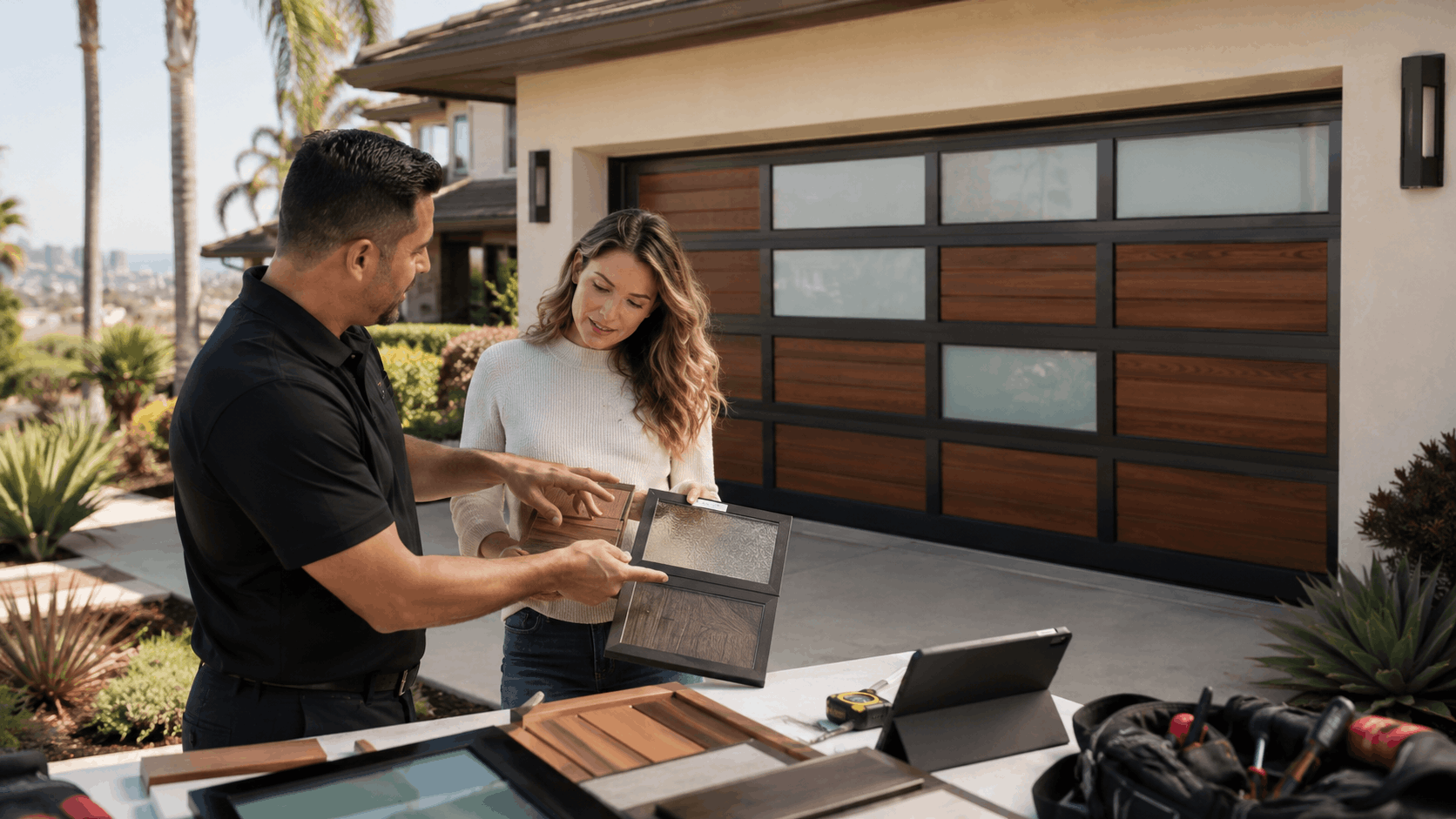
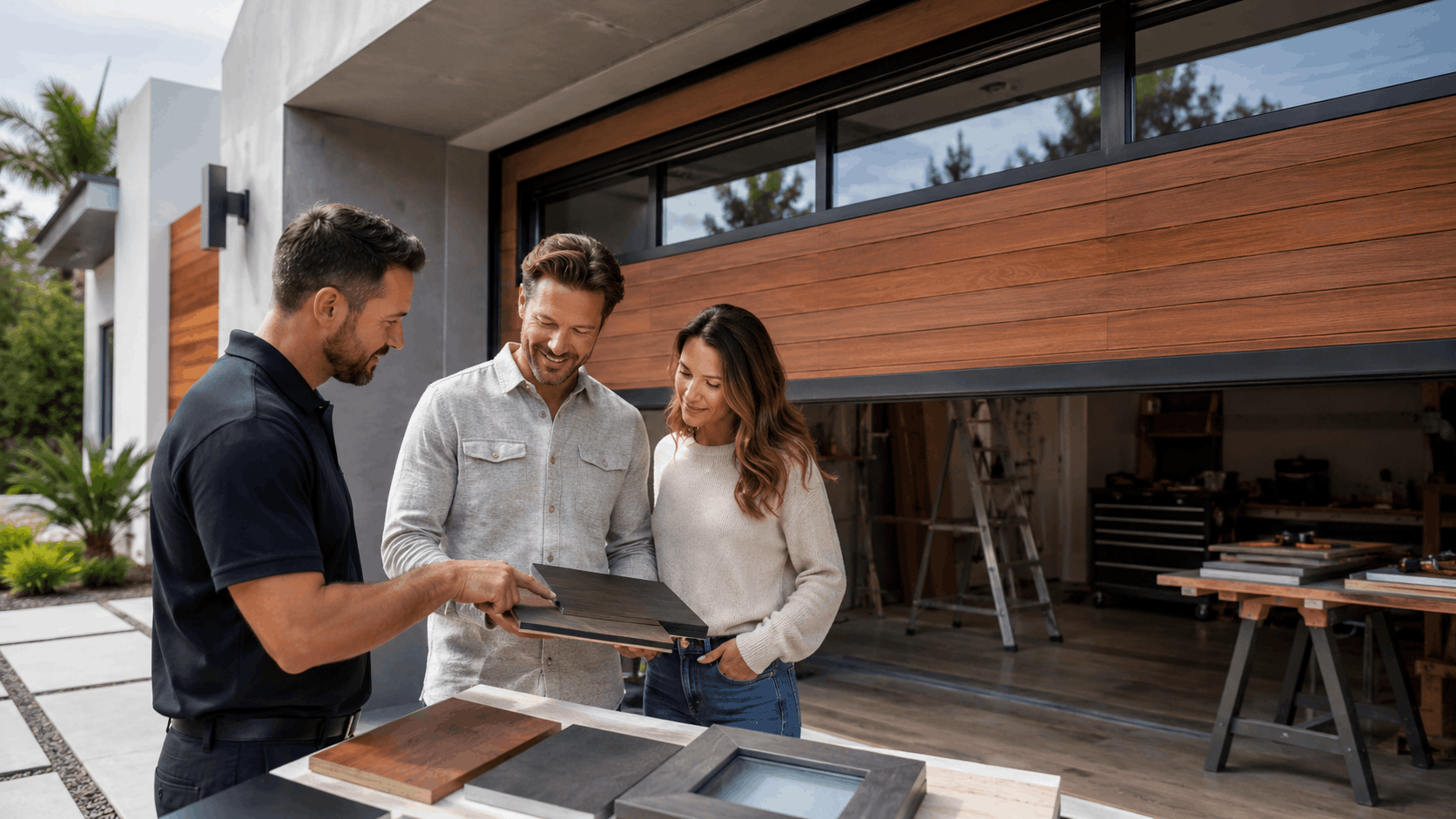
Material selection is where the design starts to feel real. We walk clients through wood species like cedar and mahogany, powder-coated steel, aluminum framing, and glass options. Each carries a different look, weight, and maintenance profile.
Finishes come next, from stained wood tones to matte or satin powder coats. Coastal homeowners often lean toward finishes that hide salt-air wear, while inland clients have more freedom. We show physical samples so the choice is not based on a screen.
Decorative hardware ties the look together. Handles, hinges, and clavos on carriage-house designs, or hidden hardware on modern flush doors, all get chosen here. These small details often decide whether a door reads as custom or as a dressed-up stock panel.
We keep the HOA and climate constraints in view during this stage so nothing selected later gets rejected or fails early near the coast.
Design Approval and Shop Drawings
Once materials are set, we produce shop drawings or renderings for the homeowner to approve. This is the point where the door exists on paper with exact dimensions, panel layout, and hardware placement. Nothing goes to fabrication without that sign-off.
For clients in governed communities, we prepare the submittal package for HOA approval at the same time. That often includes elevations, color samples, and material specs the board requires. Getting this right the first time avoids a second round of review.
When a project involves structural changes, we handle permit drawings for the City of Irvine or the relevant building department. Most straight replacements do not need a permit, but header work or opening changes do. We flag that early so there are no surprises.
The rendering also gives the homeowner a chance to adjust before it is too late. Changing a stain tone on paper costs nothing. Changing it after fabrication costs weeks.
Fabrication, Delivery, and Installation Day
With approval in hand, fabrication begins. Solid wood and specialty glass doors take longer than steel, and we set that expectation up front. The shop builds the door, applies the finish, and preps the hardware during this window.
Delivery to the home is scheduled once the door passes final finishing. On install day our team removes the old door, mounts the new panels, and sets the tracks and springs to the door's exact weight. Heavier custom doors need careful balancing, which is where door balancing and tension adjustment earns its place.
Opener setup follows, including programming remotes, keypads, and any smart controls. We test the safety sensors, run the door through several full cycles, and confirm the seals close tight against the frame. A proper opener installation matters more on a heavy custom door than a light stock one.
Before we leave, the homeowner sees the door operate and gets a walk-through on care and warranty. That final testing step is where a quality install separates itself from a rushed swap.

Need Help in Irvine?
Urgent Garage Doors serves Irvine and all of Orange County.
Materials That Define a Custom Build
Material choice shapes both how a door looks and how it holds up in the Orange County climate. The right pick balances appearance against the upkeep a homeowner is willing to do. Here is how the main options compare.
| Material | Best For | Upkeep | Coastal Rating |
|---|---|---|---|
| Solid Wood | Spanish, Craftsman looks | High | Fair |
| Steel | Insulated, budget-friendly | Low | Good |
| Aluminum & Glass | Modern designs | Low | Very Good |
| Composite | Wood look, low upkeep | Low | Very Good |
No single material wins for every home. A wood door in Corona del Mar behaves very differently than the same door in Northwood, three miles inland. Location drives the smart choice as much as taste does.
Solid Wood and Wood-Look Options
Solid wood carries a warmth that nothing else fully copies. Cedar and mahogany are the two species we specify most often, both for their grain and their stability. On a Spanish or Craftsman home, a real wood garage door completes the elevation in a way steel cannot.
The trade-off is maintenance. Wood needs refinishing over time, and near the coast that cycle speeds up. Salt air and sun break down finishes sooner in places like Balboa Peninsula than they do inland.
Faux-wood and composite finishes have improved enough to fool most eyes from the curb. They give the cedar or mahogany look with a fraction of the upkeep. For clients who love the wood aesthetic but travel often or dislike maintenance, this is a strong middle path.
We are honest with coastal clients about what real wood asks of them. Some embrace the ritual of refinishing, and others are happier with a wood-look composite that shrugs off the salt air.
Steel, Aluminum, and Glass for Modern Designs
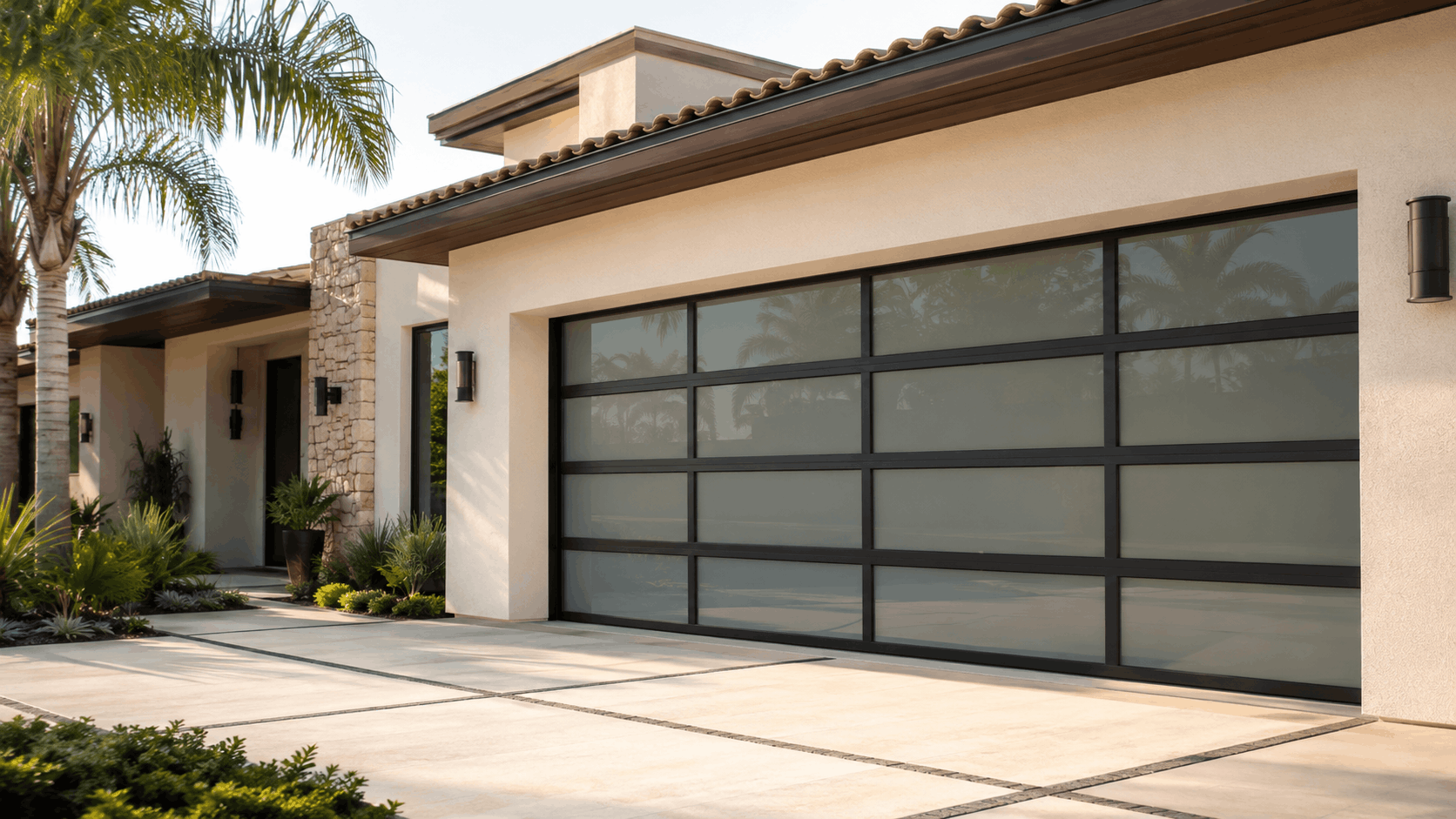
Full-view aluminum and glass doors have become the signature of modern Irvine and Newport homes. An aluminum door with large glass panels floods the garage with light and reads clean against a contemporary facade. Homeowners in Portola Springs and Newport Coast request these constantly.
The strengths are obvious - light, style, and low upkeep. Aluminum resists corrosion far better than steel near the water, and glass wipes clean. Our modern glass garage door builds are among the frequently requested custom projects we handle.
The trade-offs are worth knowing. Glass offers less insulation than a solid panel, and clear glass gives up privacy, which pushes many clients toward frosted or tinted options. Full-view doors also cost more than a basic steel panel.
Insulated steel remains a smart pick for clients who want durability and a clean look without the glass premium. An insulated steel garage door handles temperature swings well and keeps costs in check.
Composite and Insulated Cores
Composite panels combine a wood look with weather resistance that real wood cannot match. They will not rot, warp, or need refinishing, which makes them a favorite for busy households. The material has matured a lot in recent years.
Insulation matters more than ever because so many garages now double as gyms, offices, or living space. An insulated core with a higher R-value keeps those rooms usable year-round. It also cuts the noise transfer that bothers people working near the door.
For garages converted to workout rooms in warmer inland areas like Lake Forest, insulation is not optional. It keeps the room from turning into an oven by midafternoon. We match the R-value to how the space actually gets used.
Adding insulation or upgrading seals later is possible too. A weatherseal and insulation retrofit can improve an existing door without a full replacement.
How Coastal Air Affects Material Longevity
Homes near the water in Corona del Mar and along the coast face heavier corrosion than inland properties. Salt air attacks metal hardware, hinges, and untreated steel over time. What lasts twenty years inland often shows wear far sooner near the beach.
This is why material choice carries more weight in coastal zones. Aluminum and stainless or coated hardware resist salt-air corrosion far better than standard steel. Composite panels also hold up well because they do not corrode at all.
Wood can still work near the coast, but it demands a committed maintenance schedule. Skipping refinishing lets moisture and salt break the finish down, and the damage compounds. We tell coastal clients exactly what upkeep their chosen material will need.
Getting this right at the design stage protects the investment. A door built for coastal durability costs a bit more up front but avoids expensive corrosion repairs later.
What Actually Drives the $8k to $20k Price Range
This is the section most homeowners came for. A custom garage door cost of $8,000 to $20,000 sounds wide, so it helps to see what moves a project along that range. Here is an honest breakdown of the price factors.
| Cost Factor | Adds to Price | Notes |
|---|---|---|
| Oversized/heavy build | $1,500-$4,000 | Stronger tracks, opener, header work |
| Solid wood or full glass | $3,000-$7,000 | Material and finish premium |
| Smart opener & automation | $400-$1,500 | Belt-drive or jackshaft plus controls |
| Removal & site work | $300-$2,000 | Old door, electrical, tight access |
Every quote is built from these pieces, not pulled from thin air. When a client understands the budget drivers, the number stops feeling arbitrary and starts making sense.
Size, Weight, and Structural Needs
Bigger and heavier doors need more than just more material. An oversized door demands stronger tracks, heavier-duty springs, and often a more powerful opener to lift the weight safely. Those components add real cost.
Some openings need header reinforcement before a heavy door can hang correctly. On older homes near University Park, the existing framing may not support a modern wood or glass door without structural support work. That is a real line item, not an upsell.
A three-car single-panel door weighs far more than two smaller doors, which changes the whole hardware spec. The heavier the door, the more the supporting system costs. This is why size is one of the first questions we ask.
Getting the structure right protects the door and the people using it. Cutting corners here leads to sagging, binding, and premature failure of the springs and cables.
Material and Finish Premiums
Material is the single largest swing in the quote. A basic insulated steel panel sits at the low end, while solid mahogany or a full-view glass door adds thousands. The jump from steel to premium wood or glass often accounts for most of the spread between an $8k and a $16k build.
Custom finishes add cost too. Multi-step stains, custom powder-coat colors, and matched trim tones all take extra shop time. Those finishes are also what make a door look genuinely custom rather than mass-produced.
Decorative and corrosion-resistant hardware factors in as well. Stainless hardware for a coastal home costs more than standard steel, but it lasts far longer near the salt air. The material cost difference is an investment in longevity, not just looks.
We help clients weigh where premium spending pays off and where a smart substitute delivers nearly the same result for less.
Openers, Automation, and Smart Features
The opener is easy to overlook until a heavy door needs one. Quiet belt-drive openers suit most homes, while jackshaft openers mount on the wall beside the door and free up ceiling space. Heavier custom doors often call for the stronger jackshaft option.
Battery backup keeps the door working during outages, which matters during fire-season power shutoffs common across Orange County. Smart controls let homeowners monitor and operate the door from a phone. These features add convenience and a modest cost.
Smart Wi-Fi openers with app control have become a standard request. A smart Wi-Fi opener and MyQ setup lets clients grant access remotely and get alerts when the door opens. That combination of security and convenience is worth the upgrade for many households.
We match the opener to the door's weight and the homeowner's tech preferences, not to a one-size spec. The right pairing keeps a heavy custom door running quietly for years.
Labor, Removal, and Site Complications
Labor covers more than mounting the new door. Removing and hauling the old door, adjusting tracks, and fine-tuning the balance all take skilled time. On a custom build that time is well spent.
Site complications add cost in older neighborhoods. Tight driveways near Old Town Tustin or narrow side access can slow delivery and installation. Detached garages sometimes need new electrical runs to power a modern opener.
Electrical work is a common surprise for clients converting a garage or adding a smart opener where no outlet exists. That is a licensed task and factors into the final quote. We identify it during the consultation so it does not appear as a late add-on.
Being upfront about installation complexity keeps the number honest. Nobody likes a quote that grows on install day, so we surface these items early.

Need Help in Irvine?
Urgent Garage Doors serves Irvine and all of Orange County.
Realistic Lead Times for Custom Doors in Orange County
Homeowners want the door yesterday, especially when a remodel is nearly done. Custom work does not move on that clock, and pretending otherwise sets everyone up for frustration. Here is what actually drives the timeline.
The short version: plan for six to twelve weeks from order to install on most custom projects. That range covers design, approval, fabrication, and scheduling. Rush jobs exist, but they usually mean compromising on material or finish.
Typical Timeline From Order to Install
A realistic custom door timeline runs six to twelve weeks for most builds. The first week or two goes to design and material selection. Fabrication then takes the largest chunk, usually four to eight weeks depending on the material.
Delivery and install scheduling adds a few days on top once the door is finished. We book the install date as fabrication nears completion so there is no idle gap. That keeps the project from to install stalling at the finish line.
Simple steel builds can finish sooner, sometimes in four to six weeks. Solid wood and specialty glass push toward the longer end. Knowing where a project falls helps homeowners plan around the rest of their remodel.
We give a specific window at the quote stage rather than a vague promise. That way the timeline is something a client can actually build a schedule around.
How Material Choice Affects the Wait
Material is the biggest driver of lead time after design. Stock steel panels are readily available and move quickly through the shop. Solid wood, custom glass, and specialty finishes take longer to source and build.
Mahogany and other premium species sometimes carry their own sourcing wait before fabrication even starts. Specialty glass with specific tints or textures adds time too. Those material lead times are outside anyone's control once the order is placed.
Custom powder-coat colors can add a week if the finish has to be batched. It is a small delay, but it stacks with the others. We fold these realities into the timeline estimate up front.
Choosing a readily available material is one honest way to shorten the wait. When a client needs the door fast, we point them toward options that fabricate quickly without gutting the design.
HOA and Permit Delays to Plan For
HOA approval time is the delay homeowners forget about most often. Boards in master-planned communities like Woodbury or Northwood may meet only monthly. A submission that misses one meeting waits weeks for the next.
City of Irvine permits add time when a project involves structural changes. Straight replacements usually skip permitting, but header work or opening changes trigger it. The permit delay depends on the department's current backlog.
These approvals happen in parallel with early design when possible, so they do not stack onto fabrication time. Submitting the HOA package the moment the design is approved is the single best way to protect the schedule. You can read general permitting guidance from the California Building Standards Commission to understand what building codes govern.
We handle the submittals so clients are not chasing paperwork. Still, board calendars are outside our control, so early submission matters.
Ways to Keep Your Project on Schedule
The fastest projects share a few habits. Homeowners who submit their HOA package early avoid the biggest common delay. Getting the design approved and into the board queue quickly keeps the clock running in your favor.
Quick decisions on finishes and hardware help too. Every week a client sits on a stain choice is a week the door is not being built. We present curated options rather than an overwhelming catalog to speed that call.
Confirming measurements and structural questions during the first visit avoids mid-project surprises. A discovery that the header needs work is far easier to plan for early than to react to late. Front-loading those checks keeps the timeline honest.
Staying reachable during the design phase matters more than people expect. A client who answers approval questions quickly can shave a week or two off the total.
Design Styles That Work Best in Local Neighborhoods
The right garage door style depends heavily on where the home sits. What looks perfect in Great Park would feel out of place in Turtle Rock. Here is how we match design to specific Orange County neighborhoods.
Knowing the streets matters. Our team has worked across enough of these communities to read the pattern of each area at a glance. That neighborhood design knowledge shapes every recommendation we make.
Modern Flush and Glass Looks in Irvine
Newer Irvine builds lean clean and contemporary. Homes in Great Park, Portola Springs, and Cypress Village favor flat-panel and glass designs that match their crisp modern lines. A raised-panel carriage door would look dated on those elevations.
Flush doors with horizontal grooves or full-view glass sit naturally against the light stucco and metal accents of these homes. The look is minimal and architectural. Frosted glass keeps privacy while still reading modern.
We install a lot of aluminum and glass doors across Portola Springs for exactly this reason. The style fits the neighborhood, and the material handles Irvine's climate well.
Homeowners in these areas usually want the door to disappear into the design rather than stand out. A clean modern flush door does that job perfectly.
Spanish and Tuscan Styles in Established Areas
Established neighborhoods call for warmth and detail. Carriage-house and arched-panel doors suit homes in Turtle Rock, Northwood, and Tustin Ranch. Those styles echo the Spanish and Tuscan roots of the architecture.
A carriage house garage door with decorative hardware and wood tones anchors these homes beautifully. The hinges, handles, and clavos complete the look. Stock flat doors miss that character entirely.
In Turtle Rock, the Spanish style is nearly universal, so the door needs to honor it. We steer clients toward warm stains and arched detailing that match the roofline and entry.
These designs reward attention to detail. The difference between a good carriage door and a great one usually lives in the hardware and the finish.
Coastal Contemporary Near Newport and Corona del Mar
Coastal luxury homes blend modern lines with materials that survive salt air. Near Newport Coast and Corona del Mar, we favor aluminum framing, frosted glass, and corrosion-resistant hardware. That combination handles the environment and the aesthetic at once.
The coastal design look is clean and bright, letting the ocean setting do the talking. Frosted or tinted glass keeps privacy on tight lots. Stainless or coated hardware resists the corrosion that plagues standard steel near the water.
Homes in Big Canyon and along the coast often pair aluminum and glass doors with matching entry systems. The result feels cohesive and high-end.
Material choice does double duty here, serving both style and durability. That is why coastal builds almost always steer away from untreated steel and real wood.
Blending Old and New in Older Communities
Older communities like University Park and Woodbridge have their own street character. Updating a door there means modernizing without clashing with the neighbors. A jarring modern door on a 1970s street draws the wrong kind of attention.
The goal is design blending - a door that feels current but still belongs. That often means a clean panel style in a color that ties to the existing trim. Subtle wins over flashy in these areas.
Woodbridge homes near the lakes tend to reward warm, understated designs. We help clients refresh their frontage while keeping the street's cohesion intact. The upgrade should feel like a natural evolution, not a rebellion.
These projects prove custom does not always mean dramatic. Sometimes the best custom door is the one people notice only as an improvement, not a statement.
Need Help in Irvine?
Urgent Garage Doors serves Irvine and all of Orange County.
Choosing the Right Installer for a High-End Project
A custom door is a serious investment, and the installer matters as much as the door itself. A quick-swap crew and a quality custom shop are not the same thing. Here is how to protect a $10,000-plus build.
The gap shows up in the details - measuring, structural work, finishing, and service after the sale. A cheaper install that fails early costs more than doing it right once.
Licensing, Insurance, and Local Track Record
On a high-end build, licensing and insurance are non-negotiable. A licensed contractor carries the training and accountability the work requires. Insurance protects the homeowner if something goes wrong during the install.
You can verify any California contractor's license through the Contractors State License Board before signing anything. It takes two minutes and prevents a lot of trouble. Skipping that check is a risk not worth taking on a large project.
Local experience matters too. An installer who has worked across Orange County knows the HOA rules, the coastal material issues, and the permit process. That knowledge keeps the project smooth from the first call to the final test.
Our team is Irvine-based with hundreds of local installs behind it. That track record shows up in how we handle the unexpected.
Questions to Ask Before You Sign
A few direct questions reveal a lot about an installer. Ask what the warranty covers and for how long, on both the door and the labor. Vague answers here are a red flag.
Ask about the realistic timeline and what could stretch it. A straight answer about lead times signals honesty, while an unrealistic promise signals trouble ahead. Get the schedule in writing.
Ask who handles service after the install. Some crews disappear once the check clears, leaving the homeowner to find help later. A shop with its own maintenance and service team stands behind the work.
Finally, ask for references or recent local projects. A confident installer shares them without hesitation.
Warranty and Ongoing Maintenance Support
A solid warranty covers the door, the hardware, and the labor for a defined period. It should spell out what happens if a panel warps, a finish fails, or the opener acts up. Read it before signing, not after a problem appears.
Ongoing maintenance keeps a custom door running for years. Springs, cables, and rollers wear over time, and coastal hardware needs periodic attention. A preventive maintenance plan catches small issues before they become expensive repairs.
Local service near Irvine means help arrives fast when something needs attention. A distant installer cannot offer that. Proximity is part of what protects the long-term investment.
We view the install as the start of the relationship, not the end. That is why we keep service close and responsive across the county.
How Urgent Garage Doors Handles Custom Builds
Urgent Garage Doors runs custom projects out of our Irvine base, covering all of Orange County. We start with design help at the consultation and stay involved through fabrication, install, and service. Clients work with one team from start to finish.
Our process is built around clear stages and honest timelines. We handle HOA submittals, permit drawings when needed, and the structural questions that come with heavy custom doors. Nothing gets buried in fine print.
Because we are local, service after the install is quick. Whether a home is in Irvine or out near the coast, help is close. That responsiveness is a big part of why homeowners trust us with high-end builds.
We treat every custom door as a piece of the home's face, because that is exactly what it is. Getting it right is the whole point.
Final Thoughts
A custom garage door is one of the higher-impact upgrades a homeowner can make to a front elevation. It matches the architecture, lifts curb appeal, and satisfies the HOA rules that stock doors cannot. The $8,000 to $20,000 range comes down to size, material, opener choice, and site work - not guesswork.
Plan for six to twelve weeks, submit HOA paperwork early, and choose a licensed local installer who stands behind the work. Do those things, and the project runs smoothly from the first measurement to the final test.
If a builder-grade door is dragging down your remodel, our Irvine team is ready to help design something that fits the house. Contact Urgent Garage Doors to schedule a consultation and get an honest quote for your custom build.
Frequently Asked Questions
- How much does a custom garage door cost in Orange County?
- Most custom builds land between $8,000 and $20,000. A door reaches the high end through oversized dimensions, solid wood or full-glass materials, premium finishes, structural reinforcement, and smart opener automation. Simpler builds with insulated steel and standard sizing sit near the low end. The exact price depends on the material, the opening, the opener, and any site complications we identify during the on-site consultation.
- How long does a custom garage door take to build and install?
- Plan for six to twelve weeks from order to install on most projects. Design and material selection take a week or two, fabrication takes four to eight weeks, and install scheduling adds a few days. Solid wood and specialty glass push toward the longer end, while insulated steel finishes sooner. HOA approval and permit review can add weeks if not started early in the process.
- Do I need HOA approval for a new garage door in Irvine?
- Most master-planned Irvine communities, including Woodbury, Northwood, and Portola Springs, require HOA approval before installation. Boards typically dictate color, style, and material. We prepare the submittal package with elevations, samples, and specs so it passes on the first review whenever possible. Because boards often meet monthly, submitting early is the best way to avoid weeks of delay on your project timeline.
- What material lasts longest near the coast?
- Aluminum and composite hold up best in salt air. Aluminum resists corrosion far better than standard steel, and composite panels do not corrode at all while mimicking a wood look. Real wood can work near Corona del Mar or Balboa Peninsula but needs committed refinishing to fight moisture and salt. For coastal durability with low upkeep, aluminum and composite are the smart choices.
- Can a custom door fit an oversized or non-standard opening?
- Yes. Custom builds exist precisely for oversized openings, extra-tall doors, and unusual proportions that stock panels cannot cover. Older homes near University Park and hillside builds often have non-standard openings. During the consultation we measure the width, height, headroom, and side room exactly, then build the door to those real dimensions so it seals, tracks, and operates correctly.
- Is a permit required for a garage door replacement?
- A straight replacement usually does not need a City of Irvine permit. A permit applies when the project involves structural changes, such as reinforcing the header or altering the opening size. On older homes that need framing work to support a heavy wood or glass door, we handle the permit drawings and submittal so the work stays code-compliant and inspected.
- What opener should I choose for a heavy custom door?
- Heavier custom doors need a stronger motor than a light stock panel. Quiet belt-drive openers suit most homes, while jackshaft openers mount on the wall beside the door, free up ceiling space, and handle heavy doors well. We match the opener to the door's actual weight and often recommend battery backup for outages and smart Wi-Fi controls for remote access.
- Does a custom garage door add home value?
- Yes. The garage door covers up to a third of a home's front face, so it strongly shapes first impressions and curb appeal. In competitive Orange County markets, a dated door signals deferred maintenance and can lower offers. A custom door lifts the street presence and improves how the home photographs online, which supports resale value at a lower cost than a full facade remodel.
- How do I maintain a wood or glass custom door?
- Wood doors need periodic refinishing to protect against sun and moisture, more often near the coast. Glass panels wipe clean with standard glass cleaner, and aluminum framing benefits from an occasional rinse to clear salt buildup. For all doors, keep the weather seals intact, lubricate the hardware, and have the springs and balance checked yearly to catch wear before it becomes a repair.
- Does Urgent Garage Doors serve all of Orange County?
- Yes. We are based in Irvine and serve the full county, from inland communities to coastal areas like Newport Beach and Corona del Mar. Our local base means fast service after the install, whether the home is in Turtle Rock, Portola Springs, or along the coast. Reach our team through the contact page to schedule a custom design consultation.
Licensed garage door repair professionals serving Irvine and Orange County.
Licensed in California · License #1055150
Why trust Urgent Garage Doors?
Founded in 2017, Urgent Garage Doors is a licensed and insured garage door services serving Irvine and Orange County. All content is reviewed by our licensed technicians.

Need Help in Irvine?
Urgent Garage Doors serves Irvine and all of Orange County.
Related Articles
Garage Door Cable Replacement Cost Orange County: Why Pricing Varies by Neighborhood
Garage door cable replacement cost in Orange County varies by neighborhood. Learn why prices differ, real cost ranges, and how to get a fair, accurate quote.
How Much Does a Garage Door Cost in Orange County (By Material)
See 2026 garage door costs in Orange County broken down by material - steel, wood, aluminum, fiberglass, and vinyl - with local pricing factors, style tips, and installation details.
Garage Door Panel Replacement vs Full Door Replacement in Orange County
Should you replace one damaged garage door panel or the entire door? This guide covers costs, timelines, HOA rules, and local Orange County factors to help you decide.