Power Outage With No Battery Backup: Opening Your OC Garage Door Safely by Hand
Key Takeaways
- Without a battery backup, a power outage disables the opener but the door can still be operated by hand using the red emergency release cord.
- Always release the door only when it is fully closed, and stop immediately if you see a broken spring or the door feels heavy.
- Clear the door's travel path and keep kids and pets away before pulling the release.
- Use vise grips or C-clamps on the track to hold a disconnected door open safely.
- Lock the manual slide lock or clamp the track to keep the home secure during a long outage.
- Reconnect the opener by pulling the cord toward the motor, then run a test cycle and check the safety sensors.
- California law requires battery backup on new openers, and upgrading prevents getting stuck during future Edison outages.
- Urgent Garage Doors provides same-day service across Woodbridge, Northwood, Turtle Rock, and the Great Park area of Irvine.
In This Article
It is a warm evening in Woodbridge, and a Southern California Edison outage has just knocked out the whole street. The car is trapped inside the garage, the electric opener is dead, and there is no battery backup humming away in the corner. This is one of the more common calls our team gets during the summer heat and winter storm season across Irvine.
The good news is that most garage doors can be opened by hand, even with the power completely out. There is a simple mechanism built into nearly every opener that lets homeowners disconnect the door and lift it manually. The trick is doing it safely so nobody gets hurt and the door does not crash down.
Below, our team walks through why the door stops working, the safety checks to run first, how to use the emergency release, how to lift and secure the door by hand, and how to put everything back together once the lights return. We will also share when it is smarter to stop and call a pro.
Why Garage Doors Stop Working During a Power Outage?
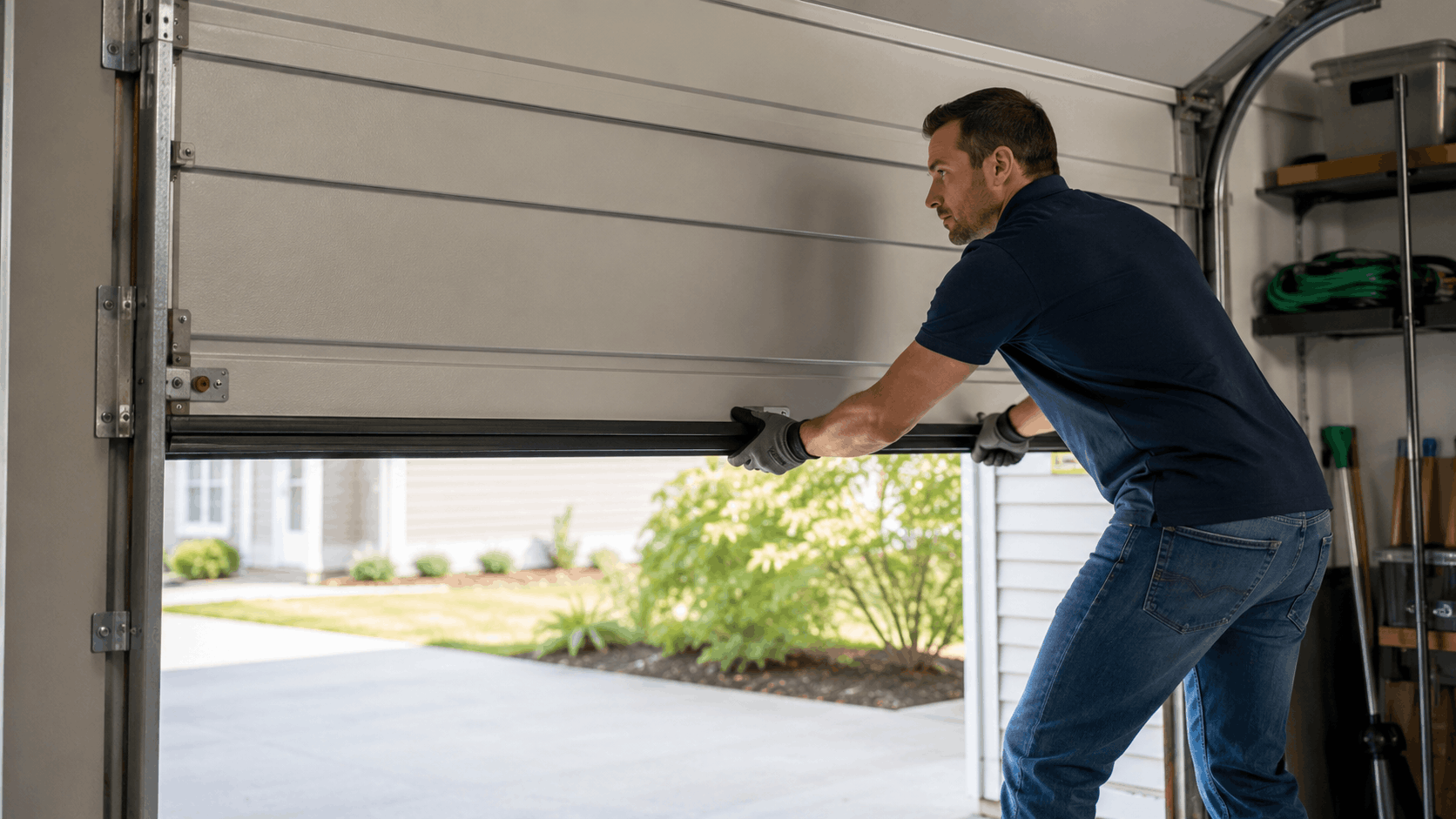
When a power outage hits, the first thing many homeowners notice is that the wall button and remote do nothing. That is because the garage door opener is an electric machine, and without power it has nothing to pull the door up or down. Homes without a battery backup lose all automatic door function the moment the grid goes down.
- The garage door opener runs entirely on household electricity
- No power means the motor cannot turn the drive system
- Without a battery backup, the remote and wall button stop responding
- The door itself is still fine - it just needs to be operated by hand
How the Electric Opener Actually Moves the Door
People often think the opener does the heavy lifting of the door, but that is only part of the story. The opener motor is a small electric unit mounted to the ceiling, and its job is to move a trolley back and forth along a rail. The trolley connects to the door arm, which pushes and pulls the door open and closed.
That trolley rides on a drive system, which is usually a chain, a belt, or a screw. When power flows, the opener motor spins and moves the trolley, and the door follows. Cut the power, and the motor sits idle with no way to move that trolley an inch.
Here is the part that surprises people. The springs on the door do most of the lifting work, not the opener. The opener just guides and controls that movement, which is why a healthy door feels light when you disconnect it and lift by hand.
What a Battery Backup Would Have Done
A battery backup unit is a rechargeable battery built into or attached to the opener. When the power drops, the backup unit takes over and keeps the opener running for a limited number of cycles. That means the door still opens with the remote during an outage, at least for a while.
California actually requires this feature on newer installs. Under state law, garage door openers sold or installed in California must include a battery backup so families are not trapped during blackouts and wildfire evacuations. You can read more about the requirement from the California Energy Commission.
If a home has an older opener from before this rule, it likely has no backup unit at all. That is exactly why so many Irvine homeowners find themselves stuck. Our garage door opener installation team upgrades these older units to models with a built-in battery backup.
Common Outage Causes Across Orange County
Outages here are not rare, and they hit certain neighborhoods harder than others. Southern California Edison serves most of Irvine, and its circuits can drop during heat waves when demand spikes across Woodbridge and Northwood. Rolling outages and equipment faults are a normal part of summer.
Santa Ana winds are another big cause. When those dry gusts roar through the canyons in fall, they knock branches into lines and trigger Public Safety Power Shutoffs. Homes near the hills and open corridors feel this the most.
Aging grid infrastructure adds to the problem. Some older Irvine tracts still run on circuits that were built decades ago, and a single blown transformer can darken a whole cul-de-sac. When that happens, every home without a battery backup loses its opener at the same time.
Get Your Free Quote
Tell us about your garage door and we'll get back to you within 30 to 60 minutes.
Safety Checks Before You Touch the Door
Before anyone grabs the release cord, it is worth slowing down for a moment. A garage door weighs between 130 and 350 pounds, and all that weight is held in balance by springs under heavy tension. Garage door safety starts with a few quick checks that take less than a minute.
| Safety Check | Why It Matters |
|---|---|
| Door fully closed | Prevents a partially open door from slamming down after manual release |
| Clear travel path | Keeps cars, boxes, kids, and pets out of the door's way |
| Inspect the torsion spring | A broken spring makes manual lifting dangerous |
| Test the door feel | A heavy door signals a spring or balance problem |
Make Sure the Door Is Fully Closed First
The single most important rule is to release the door only when it is all the way down. If the door is stuck halfway open and you pull the manual release, gravity takes over instantly. A door with a healthy spring may drift down slowly, but a door with a weak or broken spring can drop like a guillotine.
That door slam is not just loud, it can crush a hand, a foot, or anything left in the path. We have seen dented cars and cracked concrete from doors that came down hard. It is simply not worth the risk.
If the door happened to stop partway when the power died, do not disconnect it. Instead, call our team for help. A broken spring hiding behind a stuck door is a repair for a trained tech, not a homeowner in the dark.
Clear the Path and Keep Kids and Pets Away
Before touching anything, look at the full travel path of the door. Move the car out from under it if you can reach it safely, and slide any boxes, bikes, or trash cans clear. A door that comes down onto a bicycle can bend, jam, or come off its track.
Kids and pets are naturally curious about a garage that suddenly works differently. Keep them well back while you operate the door by hand, ideally inside the house or at the far side of the garage. A curious toddler under a heavy door is every parent's nightmare.
Good garage safety also means having light. Grab a flashlight or headlamp before you start, since the overhead lights are out too. Working blind around springs and cables is how small mistakes turn into injuries.
Check for Signs of a Broken Spring
Take a few seconds to look up at the torsion spring, which is the long metal coil mounted on a bar above the door. If you see a clear gap in the coil, like someone sliced it in two, the spring is broken. Do not attempt to lift the door.
Other warning signs include a loud bang earlier in the day, since a snapping spring sounds like a gunshot. Maybe the door felt unusually heavy the last time it moved, or it slammed the last few inches. These are all red flags.
If any of these warning signs show up, stop and step back. Our torsion spring replacement service handles these fast, and lifting a door with a broken spring by hand can lead to serious injury.
Need Help in Irvine?
Urgent Garage Doors serves Irvine and all of Orange County.
How to Use the Emergency Release Cord
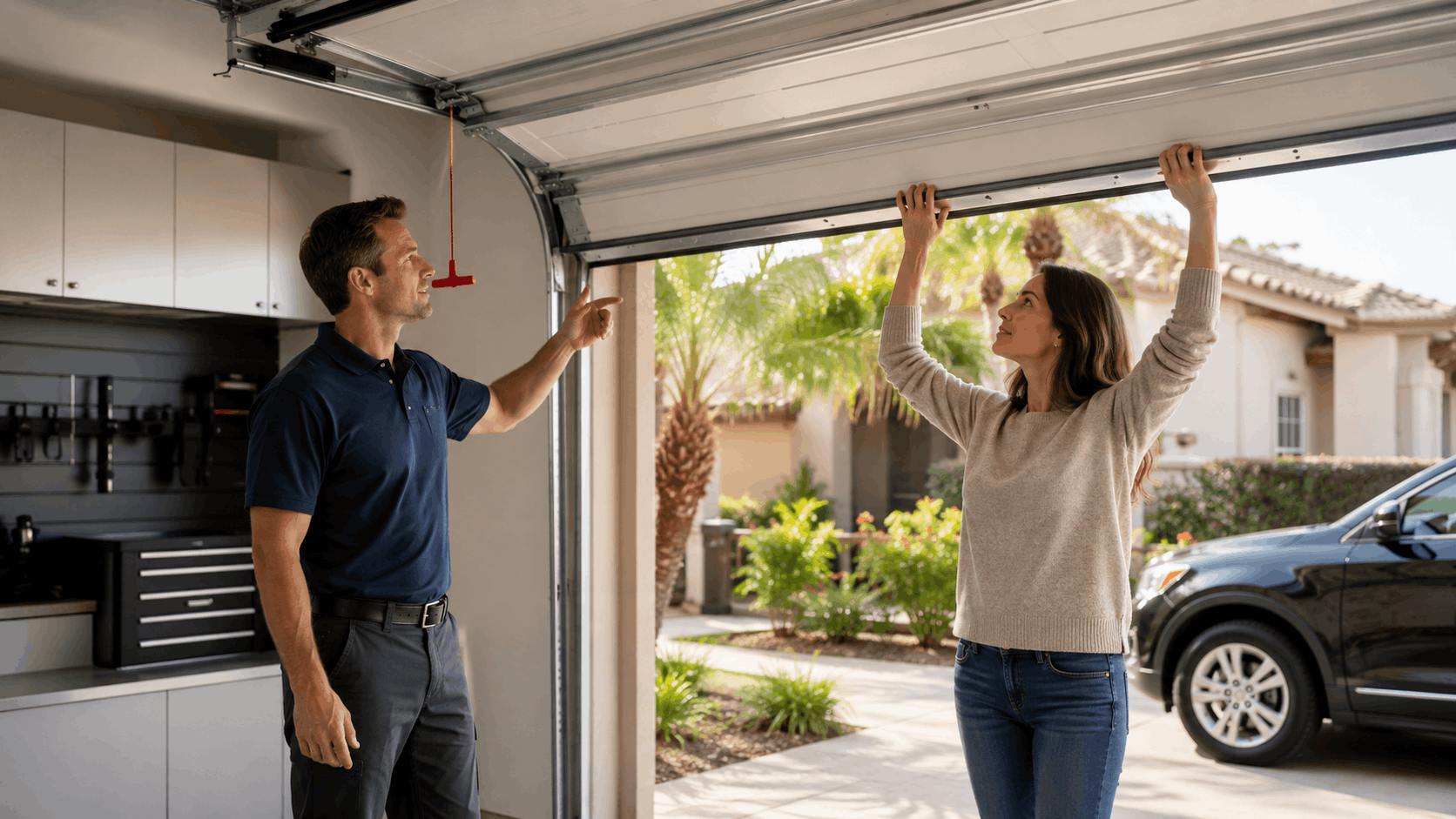
Every automatic opener has a built-in escape hatch called the emergency release cord. This is the red handle that lets you disconnect the door from the opener so you can move it by hand. It is the manual disconnect that turns your automatic door back into a simple lift-up door.
Finding the Red Handle on Your Opener
Look up at the rail that runs from the opener motor toward the door. Hanging from the trolley on that rail, you will see a red cord with a plastic handle on the end. That red cord is your emergency release, and it is standard on nearly every opener brand.
On LiftMaster, Chamberlain, and Genie units, the handle usually hangs about six to seven feet off the floor near the middle of the garage. Some models tuck it a little closer to the door. If the ceiling is tall, you may need a step stool to reach it comfortably.
The handle is almost always red for a reason - it is meant to stand out in an emergency. If yours is faded or gray from age, it still works the same way. Just look for the cord dangling from the trolley release near the center rail.
Pulling the Cord the Right Way
To release the trolley, pull the red handle straight down and slightly back toward the opener motor. You should hear a click as the trolley disconnects from the drive system. That click means the door is now in manual mode and free to move by hand.
Do not yank the cord sideways or at a sharp angle. Pull it in one firm, controlled motion. A hard sideways jerk can damage the release lever or the trolley, which creates a repair problem on top of the outage.
Once you pull the release, the door is fully disconnected from the opener. It will no longer respond to the wall button or remote until you reconnect it, even if the power comes back mid-process. That is normal and expected.
What to Do if the Cord Is Missing or Stuck
In some older homes near Turtle Rock or University Park, we find release cords that were cut short, painted over, or removed entirely by a previous owner. If the cord is gone, you can sometimes reach the trolley release lever directly and pull it back by hand or with a hook tool.
A stuck release often happens when the door is under tension because it stopped partway, or when the mechanism is old and gummed up. Never force a stuck release with all your weight, since something is usually binding for a reason. Forcing it can snap the lever.
If the cord is missing or the release will not budge, that is a good moment to call for help. Our Turtle Rock emergency team handles stuck releases on older openers all the time and can get the door open without damaging it.
Lifting the Door by Hand Step by Step
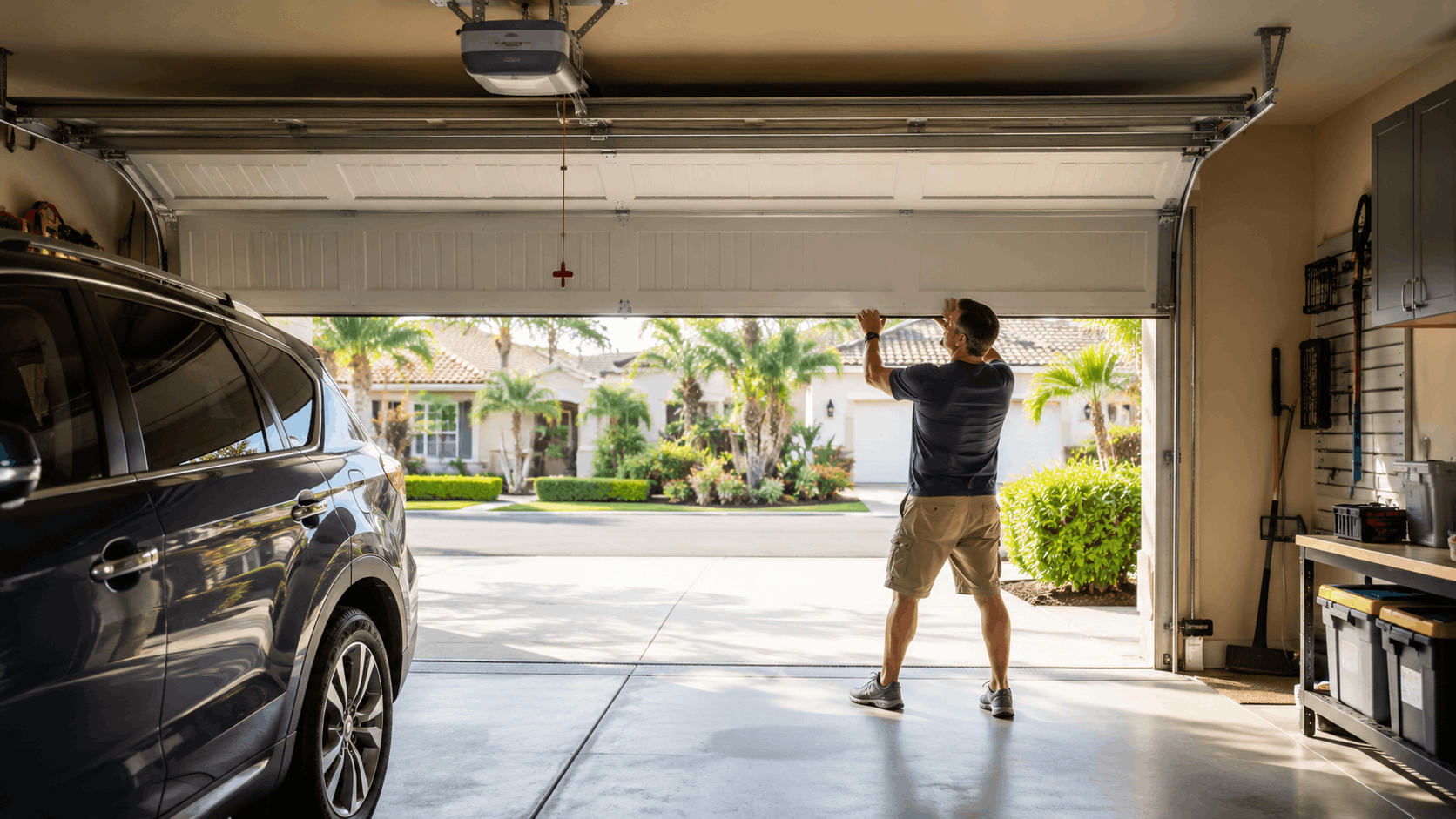
Once the trolley is disconnected, you are ready to lift the garage door by hand. A properly balanced door should feel surprisingly light, often no more than 10 pounds of effort. Manual operation is straightforward when the springs are doing their job.
| Step | What to Do |
|---|---|
| 1. Grip low | Place both hands at the bottom edge or a handle |
| 2. Lift with legs | Bend knees and push up in a steady motion |
| 3. Raise fully | Push the door all the way up until it stops |
| 4. Secure it | Clamp the track so it cannot slide down |
Proper Lifting Technique and Grip
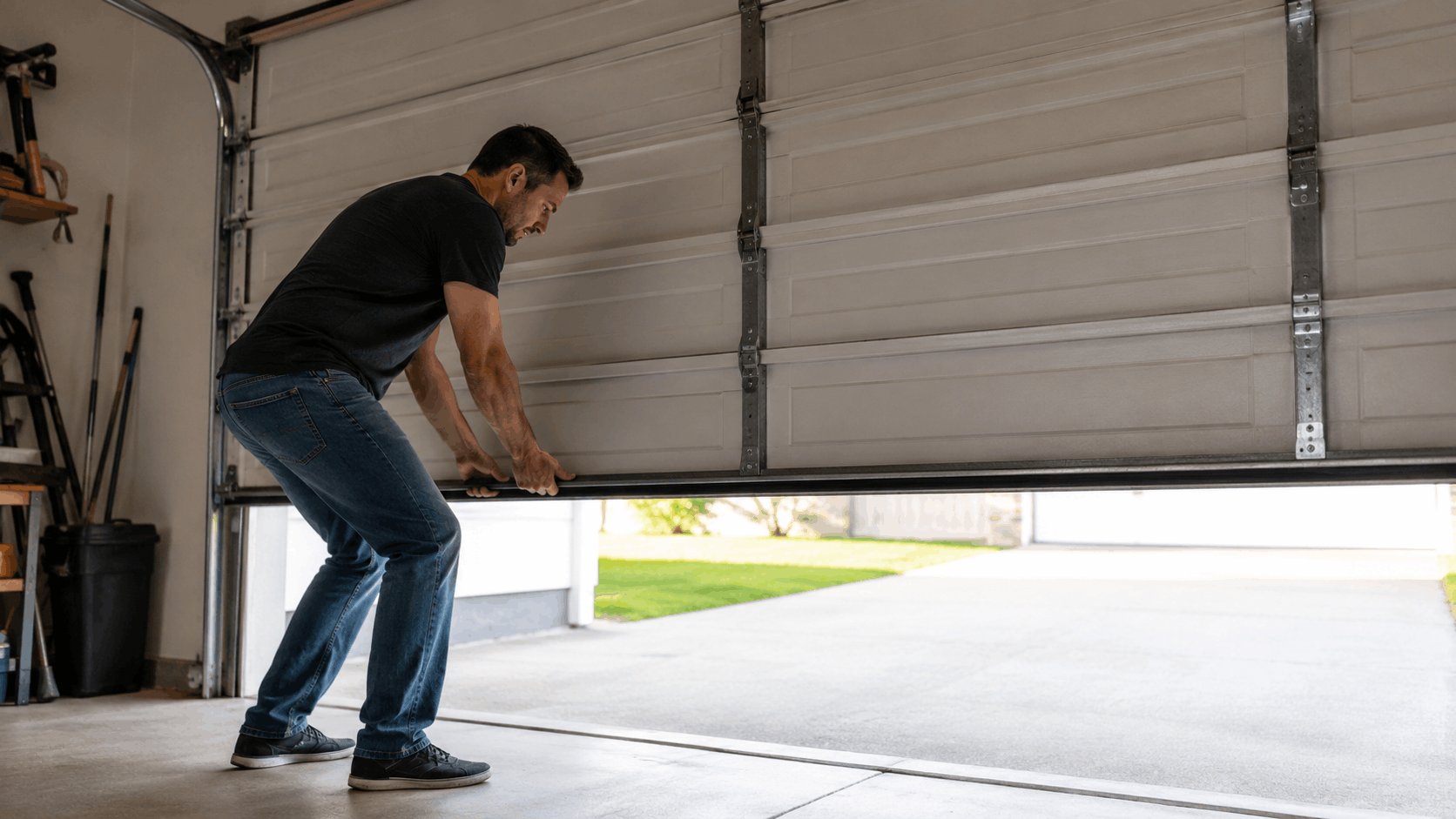
Stand centered in front of the door and grab it low, either at the bottom edge or by a built-in handle if it has one. Keep your fingers on the outside face, not tucked into gaps between panels where they could get pinched. Then bend your knees and lift with your legs, not your back.
A balanced door will rise smoothly and stay wherever you leave it. Push it up in one steady motion until it reaches the top of the track. It should feel light, almost like the door wants to float up on its own.
Keep your body out from directly under the door as it moves. Move to the side once it is up, rather than standing beneath the full weight. Good grip and good technique keep this a two-second job instead of an injury.
Keeping the Door Open Without It Sliding Down
A disconnected door has nothing holding it in the open position except the springs. If the balance is even slightly off, it can drift down while the car is halfway out. To hold the door open safely, clamp the track.
Vise grips or C-clamps work perfectly for this. Clamp one firmly onto the vertical track just below one of the bottom rollers on each side. With the clamps in place, the door physically cannot slide down past them, even if the springs are weak.
This little step matters most when you are driving a car in or out. The last thing anyone wants is a heavy door coming down onto the roof of the car mid-exit. Two clamps and thirty seconds prevent an expensive dent.
What to Do if the Door Feels Too Heavy
Here is the clearest warning sign of trouble. If the door feels heavy, refuses to budge, or takes two people straining to lift, stop right there. A balanced door is light, so a heavy door almost always points to a spring problem.
Lifting a door with a broken or weak spring is dangerous and can strain your back or drop the door on your feet. It is not a power issue at that point, it is a mechanical one. No amount of pulling will make an unsprung door safe to lift.
When the door feels wrong, leave it down and call a pro. Our spring and cable repair crew can diagnose the balance issue and get the door moving safely again, usually the same day.
Closing and Securing the Door Manually
Getting the door open is only part of the job. During a long outage, homeowners also need to close the door by hand and lock it so the house stays secure. Closing a garage door manually is simple, but doing it in a controlled way keeps everyone safe.
Lowering the Door Slowly and Safely
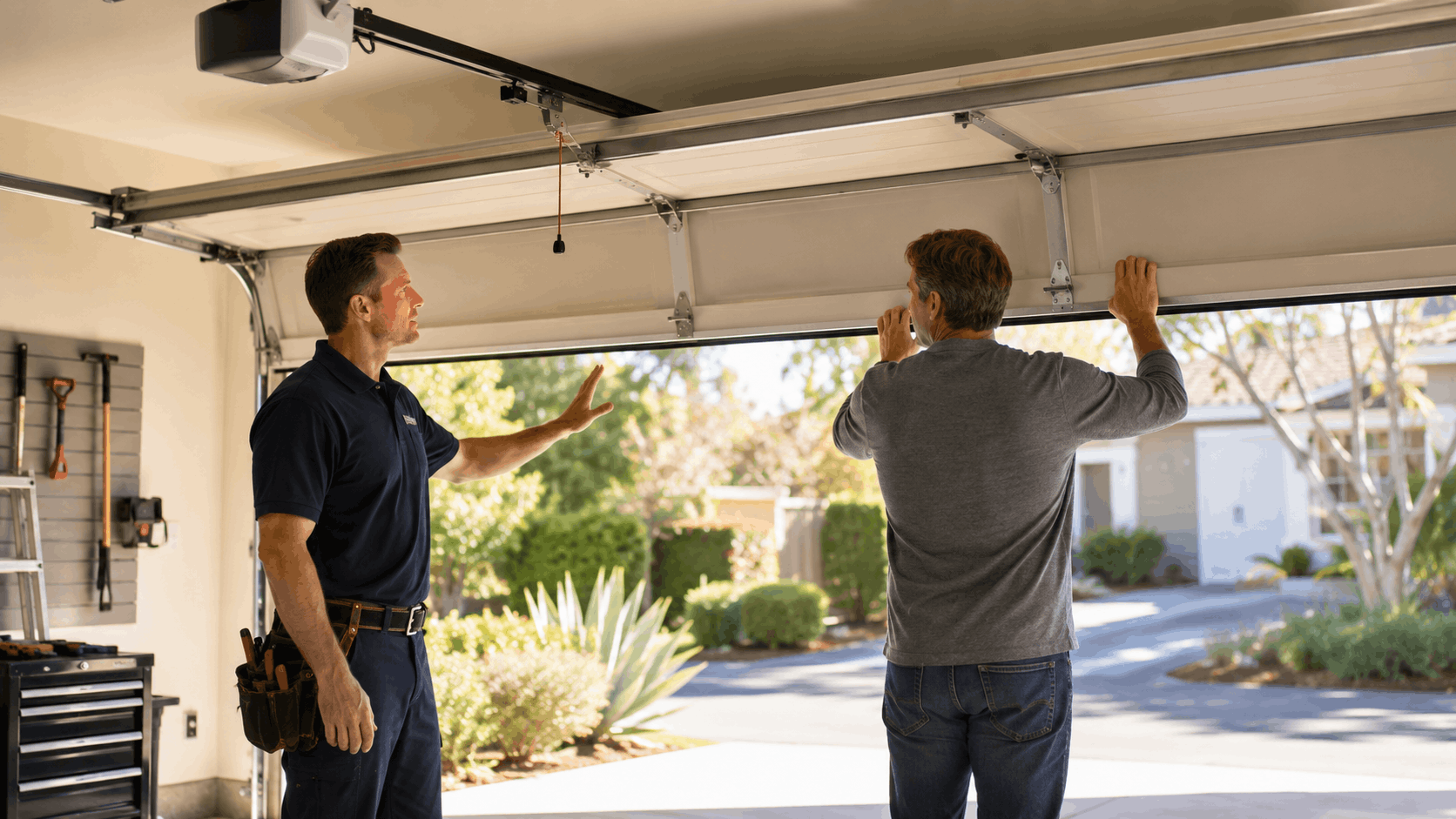
To close the door, grip it the same way you did to lift it and guide it down with steady, even pressure. Do not just let go and let it fall. A controlled close keeps the door from dropping fast or jamming a panel against the track.
Guide it down evenly on both sides so it does not rack or bind. If one side lags, the door can twist and pop a roller out of the track. A slow, even descent takes only a few seconds and protects the hardware.
Once the door is all the way down, remove any track clamps you set earlier. Make sure the door is seated flat on the floor with no gaps. If it does not sit flush, the door may be off its track and need a look from our off track garage door repair team.
Locking the Door From the Inside
With the opener disconnected, the automatic lock feature no longer holds the door shut. That means the door can potentially be lifted from outside during an outage. To prevent this, use the manual slide lock built into most doors.
The slide lock is a metal bar on the inside of the door that slides into a slot on the track. Push it into the locked position on one or both sides, and the door physically cannot be raised from outside. This is the same manual lock that came with most sectional doors.
If your door does not have a working slide lock, a track clamp does the same job in a pinch. Just clamp the track firmly above a roller so the door cannot rise. Either method keeps the garage secure while the power is out.
Keeping Your Home Secure Overnight
Extended outages that stretch overnight raise the stakes for garage security. In gated HOA communities around Northwood and Woodbridge, the neighborhood gate itself may lose power, so do not assume the community is sealed off. Treat the garage as a real entry point.
Lock the interior door between the garage and the house as well, since that is the door a burglar would target next. For open neighborhoods without a gate, the manual slide lock on the garage door is your main defense. Set it before bed.
If a storm or wind event is expected to keep the power out for a day or more, consider parking the car outside and locking the empty garage down completely. That way you are not lifting the door in the dark repeatedly. A little planning keeps the home secure through a long outage.
Need Help in Irvine?
Urgent Garage Doors serves Irvine and all of Orange County.
Reconnecting the Opener After the Power Returns
When Edison finally restores power, the door will not automatically go back to normal. You still need to reconnect the opener by re-engaging the trolley. This is a quick step, and once power is restored the automatic door works exactly as before.
Pulling the Cord Toward the Opener to Reconnect
To reconnect, pull the red release cord back toward the opener motor. On many models, this snaps the trolley lever back into the ready position. You may hear or feel a click as it re-engages.
Some openers reconnect automatically the next time you press the remote. After you pull the cord toward the opener, the trolley carriage will lock back onto the drive system as the door moves. Either way, the goal is to get that trolley clicked back into place.
If the door was left open, lower it by hand first, then reconnect. If it was closed, just pull the cord toward the opener and you are set. The reconnect motion is the reverse of the release you did earlier.
Running a Test Cycle
Before you trust the opener again, run one full test cycle. Press the remote or wall button and watch the door travel all the way up, then all the way down. A smooth operation with no grinding or hesitation means the reconnect worked.
If the door stops short, reverses, or sounds rough, disconnect and check that the trolley seated correctly. Sometimes it takes one manual cycle to fully re-engage. Watch that first opener test closely rather than walking away.
A clean test cycle also confirms the outage did not damage the opener. Power surges when the grid comes back can occasionally trip a control board. If the opener acts strange after power returns, our opener repair and troubleshooting team can check it out.
Checking Safety Sensors and Settings
After an outage, take a look at the two small photo eye sensors near the bottom of the tracks. These safety sensors shine an invisible beam across the door opening and stop the door from closing on anything in the way. Confirm both are lit and aligned.
If the door reverses right after touching the floor, or refuses to close and the lights blink, the sensors may have shifted or lost alignment. A gentle nudge back into line usually fixes it. Our safety sensor alignment repair service handles stubborn cases.
Some openers also reset their force settings after a power loss, which controls how hard the door pushes. If the door feels like it is straining or stopping oddly, the force settings may need a quick readjustment. This keeps the door closing gently and safely.
Preventing This Problem in the Future
Getting stuck once is enough to make most homeowners want a real fix. A little outage preparation and regular garage door maintenance go a long way. Here is how Irvine homeowners keep this from happening again.
Installing a Battery Backup Opener
The simplest fix is a modern opener with a built-in battery backup. When the power drops, the backup battery keeps the opener running for around 20 cycles, so the door still works with the remote during a blackout. No more manual releases in the dark.
This matters most for homes on Edison circuits that go down often, like parts of Woodbridge and the older Northwood tracts. A battery backup opener also satisfies current California law for new installs. It is the upgrade we recommend most for outage-prone streets.
Newer smart openers add remote alerts too, so you know the door status from your phone. Our opener and smart access team can match the right unit to your door and install it in a single visit.
Regular Spring and Balance Checks
A door that lifts easily by hand is a door with healthy springs. Annual maintenance keeps that balance right, so if you ever do need to lift by hand during an outage, it stays light and safe. This is one of the best reasons to keep up with a spring check.
During a balance check, our tech disconnects the door and lifts it manually to feel how it moves. A door that drifts down or feels heavy gets a tension adjustment. Catching a worn spring early prevents a snapped spring at the worst moment.
We fold this into our preventive maintenance plan, which covers springs, rollers, cables, and door balance once a year. It is cheaper than an emergency repair and keeps the whole system reliable.
When to Call Urgent Garage Doors in Irvine
Some jobs are simply not do-it-yourself work, and that is fine. A broken spring, a stuck release, a door off its track, or an opener that will not reconnect all call for a trained hand. That is what our team is here for.
Urgent Garage Doors offers same-day service across Irvine, including Woodbridge, Northwood, Portola Springs, and the Great Park area. We keep trucks stocked so we can fix most stuck doors on the first visit. Our emergency garage door repair line stays open for exactly these situations.
Whether you need a quick spring fix or a full battery backup upgrade, our local crew knows the neighborhoods and the common issues on each street. Reach out through our contact page or call for same-day help when a door leaves you stuck.
Need Help in Irvine?
Urgent Garage Doors serves Irvine and all of Orange County.
Why Your Next Opener Will Have a Battery Backup by Law
There is a reason newer Irvine homes ride out an outage while older ones end up pulling the red cord. In 2018 California passed Senate Bill 969, and since 1 July 2019 every residential automatic garage door opener manufactured for sale, sold, offered for sale or installed in the state has had to include a battery backup designed to work during a power cut.
The law came out of the 2017 Northern California wildfires, where people died because they could not get electric garage doors open once the power went out. A violation carries a $1,000 civil penalty, and since that date a replacement garage door may not be installed connected to an opener that does not comply.
What That Means for You Right Now
Three practical points, because the law is often explained badly:
- You are not breaking any rule by keeping your current opener. SB 969 applies when an opener is sold or installed. An older unit already in service can stay exactly where it is.
- If you replace the opener, backup comes with it. There is no cheaper non-compliant option to choose from; every compliant residential unit sold in California includes it.
- If you are replacing the door, the opener matters too. A new door cannot legally be connected to an opener that does not meet the requirement, so the two decisions travel together.
It applies statewide and to residential openers. It is not a California energy code rule, not a fire-zone rule, and not something an association invented, three things we hear repeated often enough to be worth correcting.
If tonight is the second or third time you have lifted the door by hand, that is the honest signal that an opener upgrade is worth pricing. It is not an upsell so much as the reason the law exists.
Final Thoughts
A power outage with no battery backup does not have to trap anyone in the garage. With the door fully closed, the path clear, and the springs healthy, the red emergency release cord lets almost any door open by hand in seconds. The whole process comes down to a few careful, controlled steps.
The one rule that matters most is to stop if the door feels heavy or the spring looks broken. That is a sign to step back and call a pro rather than risk an injury. For everything else, a steady hand and a couple of track clamps get the job done.
When you are ready for a battery backup upgrade or need same-day help with a stuck door, our team across Irvine is a phone call away.
Frequently Asked Questions
- Can every garage door be opened by hand during a power outage?
- Most doors can be opened by hand using the red emergency release cord, which disconnects the door from the opener. The exception is a door with a broken or badly worn spring. Without a working spring, the door becomes far too heavy to lift safely and can slam down. If the door feels heavy or you see a gap in the coil, stop and call our team instead of forcing it.
- Where is the emergency release cord on my garage door?
- Look up at the rail that runs from the opener motor toward the door. Hanging from the trolley on that center rail, you will find a red cord with a plastic handle, usually six to seven feet off the floor. That red handle is standard on LiftMaster, Chamberlain, Genie, and most other brands. Pull it straight down and slightly back to disconnect the door for manual operation.
- Why is my garage door so heavy to lift by hand?
- A balanced door should feel light, often around 10 pounds of effort, because the springs carry the weight. If your door feels extremely heavy, the problem is almost always a broken or worn spring, not the power outage itself. The opener never did the real lifting - the springs did. A heavy door is a clear signal to stop lifting and call for a spring repair before someone gets hurt.
- Is it safe to open my garage door manually by myself?
- Yes, one person can safely open a balanced door by hand after using the emergency release, as long as the door is fully closed first and the springs are healthy. Lift with your legs and keep your body out from under the door. If it takes two people straining to move the door, that points to a spring problem, and you should stop and get professional help.
- How do I keep my garage door open without power?
- Once the door is lifted, use vise grips or C-clamps on the vertical tracks just below the bottom rollers on each side. The clamps physically block the door from sliding back down, even if the springs are weak. This is especially important while driving a car in or out, so the door cannot come down on the roof. Remove the clamps before closing the door.
- How do I reconnect the opener after the power comes back?
- Pull the red release cord back toward the opener motor to re-engage the trolley, and listen for a click as it locks onto the drive system. On many models, pressing the remote afterward snaps it fully back into place. Then run one full test cycle, watching the door open and close completely and smoothly. If it hesitates or reverses, check the trolley and the safety sensors.
- Does California require a battery backup on garage door openers?
- Yes. California law requires that garage door openers sold or installed in the state include a battery backup, so homes are not trapped during blackouts and wildfire evacuations. For Irvine homes, this means any new opener installation comes with a backup that keeps the door running for a limited number of cycles during an outage. Older openers installed before the rule often have no backup at all.
- Can I get locked out if I open the door manually?
- You can avoid a lockout by planning ahead. Before closing a manually operated door, make sure you have a house key or another way in, since the garage door will not respond to the remote while disconnected. Use the manual slide lock to secure the door from inside overnight. If you must leave, secure the door and keep a spare key handy so you are not stuck outside.
- How much does it cost to add a battery backup opener in Irvine?
- A new opener with a built-in battery backup typically runs between $400 and $700 installed, depending on the model, horsepower, and features like smart wifi control. Heavier or oversized doors may need a stronger unit at the higher end of that range. We provide a clear quote before any work starts, and the upgrade also brings your setup in line with current California requirements.
- Does Urgent Garage Doors offer same-day help for stuck doors?
- Yes. Our team offers same-day service across Irvine and nearby Orange County areas, including Woodbridge, Northwood, Portola Springs, Turtle Rock, and the Great Park area. We keep our trucks stocked with springs, cables, rollers, and openers so we can fix most stuck doors on the first visit. Call us or reach out through our contact page, and we will get a technician out fast.
Licensed garage door repair professionals serving Irvine and Orange County.
Licensed in California · License #1055150
Why trust Urgent Garage Doors?
Founded in 2017, Urgent Garage Doors is a licensed and insured garage door services serving Irvine and Orange County. All content is reviewed by our licensed technicians.

Need Help in Irvine?
Urgent Garage Doors serves Irvine and all of Orange County.
Related Articles
Garage Door Replacement in Woodbridge and Turtle Rock Irvine: Village Standards and HOA Approvals
A local guide to garage door replacement in Woodbridge and Turtle Rock Irvine, covering village standards, HOA approvals, city permits, door choices, and real cost ranges.

Garage Door Safety Sensors: How to Test and Fix Alignment in Your OC Home
Learn how to test and fix garage door safety sensor alignment issues in your Orange County home with this comprehensive guide covering troubleshooting, maintenance, and repair.

Orange County Garage Door Permit Requirements: When You Need One
A clear guide to Orange County garage door permit requirements: when you need one, when you do not, permit costs, HOA rules, inspections, and how to stay compliant.