How-To Guides
Garage Door Insurance Claims in California: What's Covered After Wind Damage
Key Takeaways
- Most California HO-3 policies cover garage door wind damage because wind is a named covered peril.
- Santa Ana winds push against large door surfaces and cave in panels, especially in canyon-adjacent areas like Turtle Rock and Quail Hill.
- Insurers commonly deny claims for wear and tear, cosmetic-only dents, pre-existing damage, or repairs below your deductible.
- Strong documentation matters: take timestamped photos, pull local weather reports, get a written estimate, and keep damaged parts.
- Compare repair cost to your deductible before filing, since small repairs may cost less than the deductible.
- You have the right to choose your own licensed local contractor, and a detailed estimate can reverse a denial or raise a low payout.
- Emergency same-day repairs secure your home while the claim processes and usually count toward reimbursement when documented.
- Reinforcement kits, wind-rated doors, heavy-duty hardware, and seasonal tune-ups reduce the risk of future wind damage.
In This Article
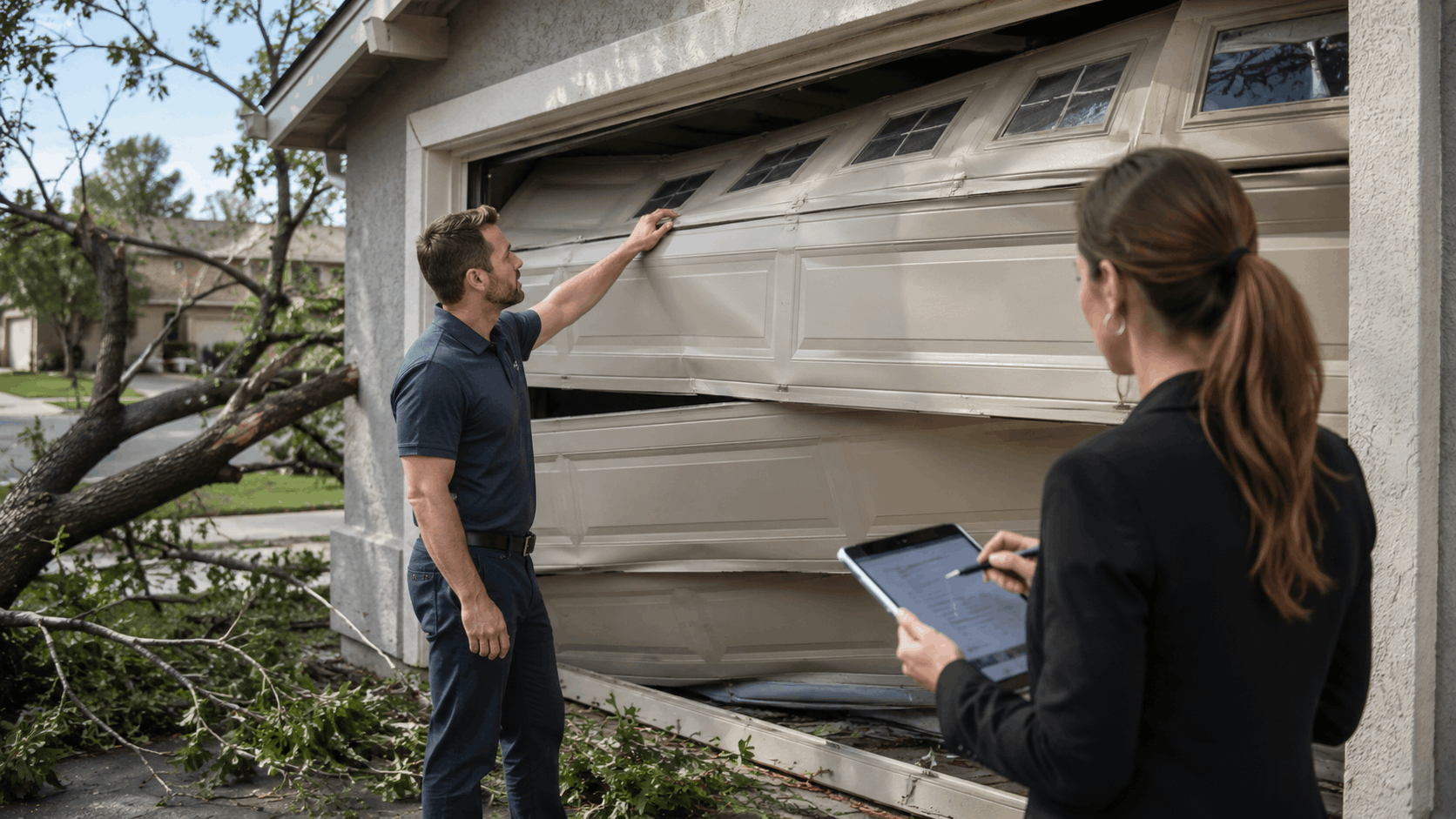
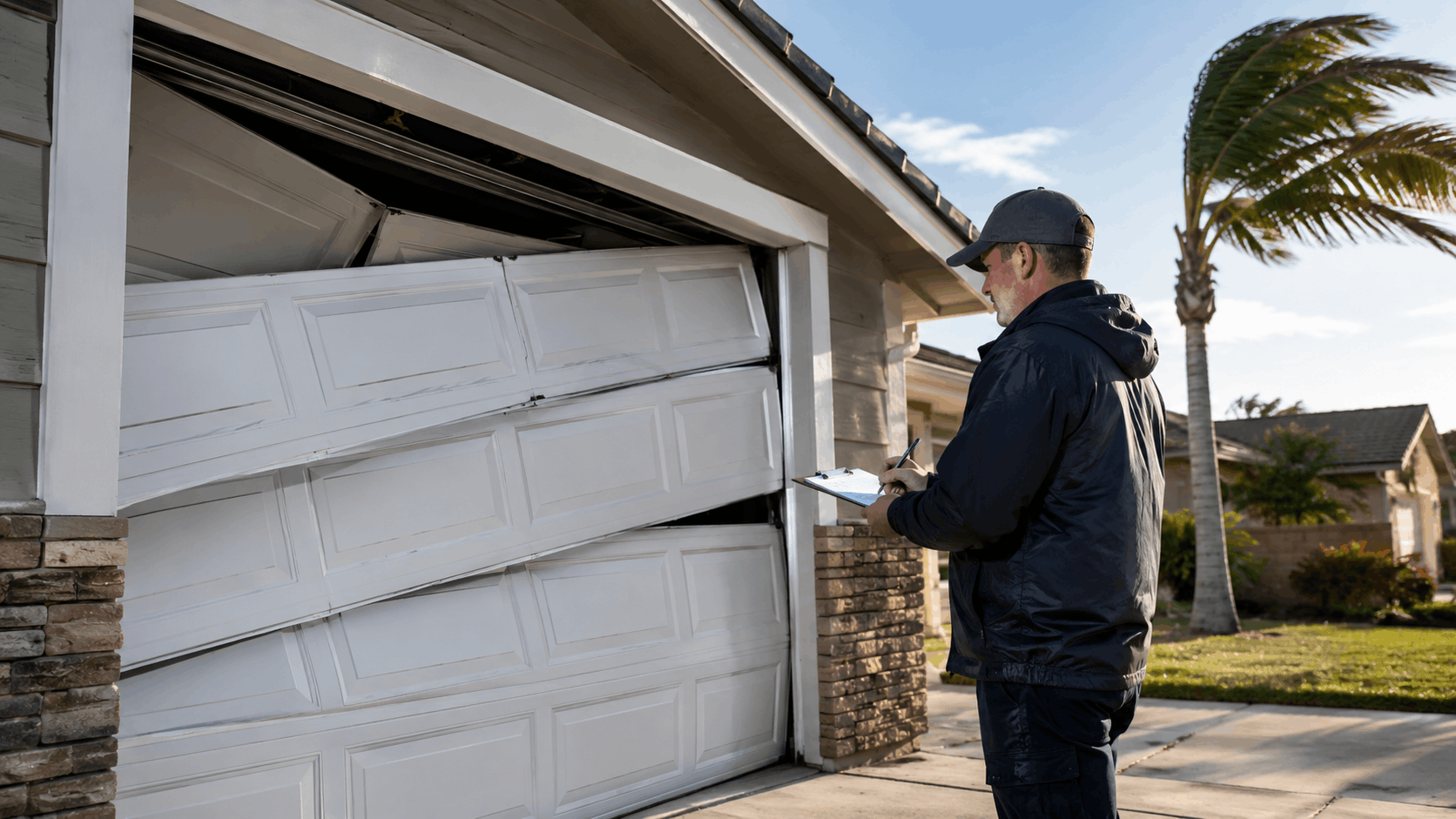
The Santa Ana winds have a way of announcing themselves. One October night in the hills above Turtle Rock, a homeowner heard a deep metallic groan from the garage around 2 a.m. By morning, the middle panels of the door had caved inward, the door hung crooked on one track, and the opener refused to lift it. That scene plays out every wind season across Irvine, and most homeowners have no idea whether their insurance will pay for the repair.
Wind damage to garage doors is one of the most common storm-related claims our team handles across Orange County. The good news is that most California homeowners policies treat wind as a covered event. The complicated part is knowing what your policy actually pays for, how to prove the damage came from the storm, and how to get your home secure while the claim moves through processing.
How Wind Damages Garage Doors in Southern California?
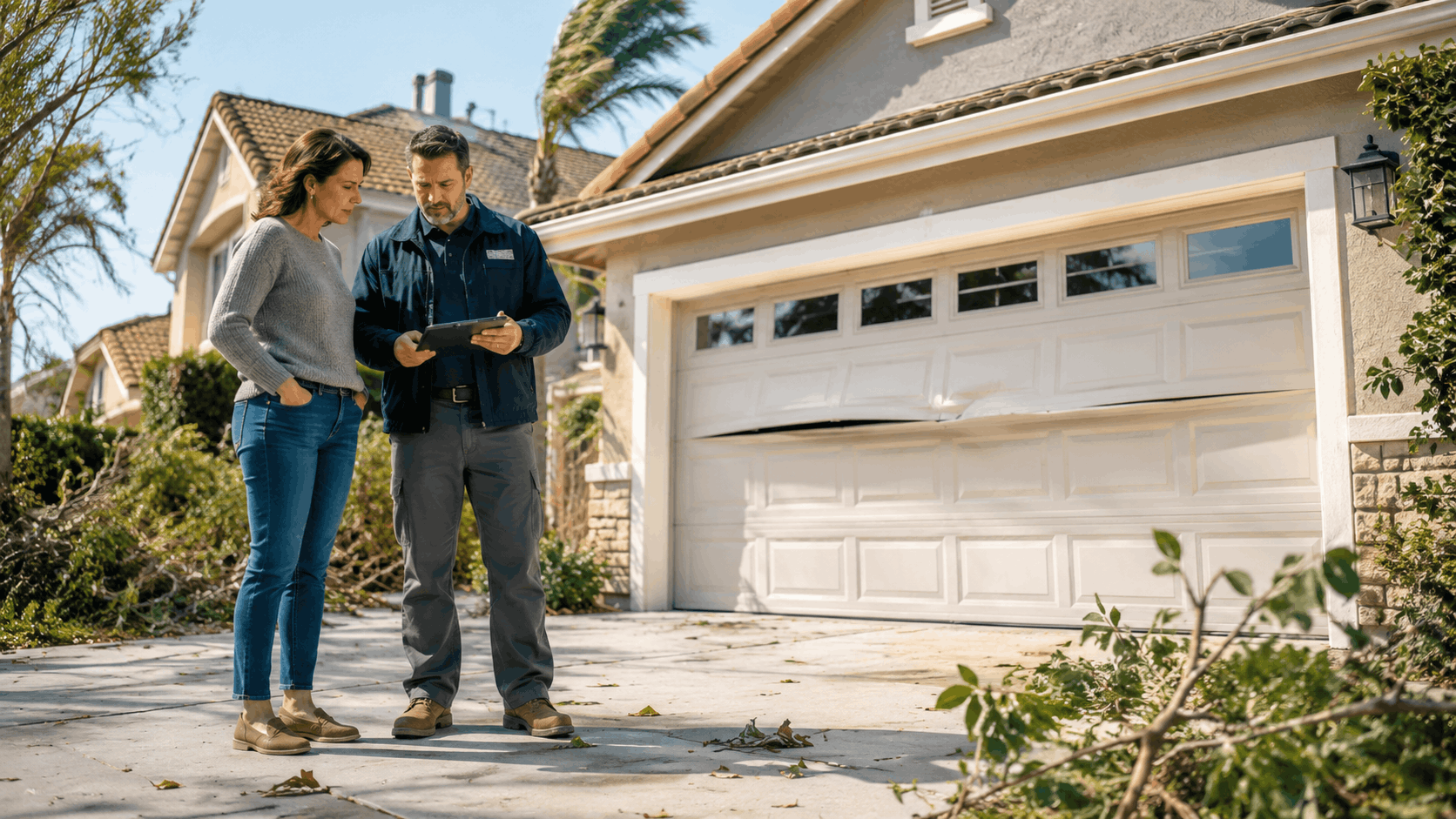
Garage doors are the largest moving surface on most homes, and that makes them the most exposed to high wind. In Irvine, the pressure that builds against a two-car door during a strong gust can equal hundreds of pounds pushing on a thin steel skin. When people ask why their door failed overnight, the answer usually traces back to a mix of local geography and weather.
Irvine weather is calm most of the year, but the seasonal Santa Ana winds change everything. These dry, fast gusts funnel down through canyons and open corridors, and homes near those paths take the hardest hits. The table below breaks down the main ways wind causes garage door wind damage in our area.
| Damage Type | Common Cause | Typical Repair |
|---|---|---|
| Bent or caved panels | Direct wind pressure on the door face | Panel or full door replacement |
| Off-track door | Gusts twisting the door in its frame | Track realignment, roller replacement |
| Debris dents | Flying branches or patio items | Panel repair or cosmetic fix |
| Broken springs or cables | Strain from a shifted or jammed door | Spring and cable replacement |
| Opener failure | Motor strain lifting a damaged door | Opener repair or replacement |
Santa Ana Winds and Their Effect on Panels
Santa Ana winds are the main driver of garage door claims we see each fall and winter. They blow from the inland deserts toward the coast, and they gain speed as they squeeze through mountain passes and canyons. By the time they reach the neighborhoods near Turtle Rock and Quail Hill, gusts of 50 to 70 miles per hour are common.
A large door surface acts like a sail in that kind of wind. The pressure pushes hardest on the center of the door, where the panels have the least support. That is exactly where we find bent panels after a storm, with the steel folded inward like a soda can.
Canyon-adjacent homes take the worst of it. Properties that back up to open space or sit at the mouth of a canyon feel wind that has been funneled and accelerated for miles. If your garage faces one of these wind corridors, the door is doing a lot of quiet work every time the Santa Anas kick up.
Once a panel bends, the whole door is compromised. The bend changes how the door rides the tracks, and it puts uneven load on the springs and rollers. That is why a single dented panel often turns into a bigger repair if it is not addressed quickly.
Track, Roller, and Opener Failures From Gusts
Wind does not just dent doors. It twists them. A strong gust can push one side of the door harder than the other, and that flexing pops rollers out of the track. The result is an off-track door that hangs at an angle and will not move properly.
An off-track door is one of the most common calls we get after a windstorm. Sometimes the door is stuck halfway, sometimes it is jammed against the frame, and sometimes it has come off on just one side. Our off-track garage door repair team sees this pattern repeat every wind season.
Openers take a beating too. When a door binds or shifts, the opener tries to force it up or down against the resistance. That strain burns out motors, strips gears, and trips safety systems, which is how a healthy opener suddenly dies after a storm.
Springs and cables suffer from the same chain reaction. A door that jams under wind load puts sudden stress on the torsion springs, and a spring that was already near the end of its life will snap. When that happens, the door becomes dead weight that neither you nor the opener can lift safely.
Debris and Flying Objects During Storms
Not all wind damage comes from the wind itself. A lot of it comes from what the wind picks up and throws. Patio chairs, umbrellas, trash bins, and tree branches all become projectiles when gusts hit 60 miles per hour.
We see a lot of debris damage in the newer developments around the Great Park area. Construction is still active in parts of these neighborhoods, and loose material from job sites can travel surprising distances in a strong Santa Ana. A stray two-by-four or a sheet of plywood leaves ugly dents on a garage door.
Trees are another common culprit across older, more established parts of Irvine. Mature landscaping looks beautiful, but dead limbs and heavy branches come down hard during storms. A falling branch can dent a panel or crack the door face outright.
Storm dents range from cosmetic to serious. A shallow dent that does not affect operation is one thing, but a deep impact that bends the panel structure or knocks the door off balance is a functional problem. Knowing the difference matters a lot when it comes time to file a claim.
Why Older Irvine Homes Are More Vulnerable
Age is a big factor in whether a door survives a windstorm. Older homes near Woodbridge and University Park often still have their original steel doors from decades ago. That steel is thinner, the hardware is worn, and the whole system has less margin to absorb a sudden gust.
Aging hardware fails first. Rollers wear flat, hinges loosen, and springs lose tension over the years. When a strong wind hits a door that is already tired, the weak points give way faster than they would on a newer, well-maintained system.
We also find that older doors were built to older standards. Wind-rating and reinforcement bracing were not common features on doors installed in the 1980s and 1990s. That leaves a lot of Irvine homes with doors that were never designed for the pressures the Santa Anas can produce.
None of this means an older door is doomed. It does mean these homes benefit most from a tune-up before wind season, and they are the ones most likely to need a full replacement after a serious storm. We keep this in mind whenever we service an older neighborhood.
Get Your Free Quote
Tell us about your garage door and we'll get back to you fast.
What California Homeowners Insurance Typically Covers
Here is the part most homeowners actually want to know. When a windstorm wrecks your garage door, will your policy pay for it? For most people in California, the answer is yes, but the details depend on your specific coverage and your deductible.
Standard homeowners insurance in California is usually written as an HO-3 policy. That is the most common form, and it covers your home structure against a broad list of perils, including wind. The garage is part of your dwelling, so a wind-damaged door generally falls under that same protection. You can read more about how homeowners policies are structured through the National Association of Insurance Commissioners.
Wind as a Covered Peril
Wind is almost always a named covered peril in California homeowners policies. That means the policy specifically lists wind and windstorm as events it will pay for. When a Santa Ana caves in your panels, the storm itself is exactly the kind of event your coverage was built for.
A named peril policy pays only for the causes it lists, but wind is standard on virtually every HO-3. So a garage door bent by a documented windstorm usually meets the basic test for coverage. The trick is proving the wind caused the damage, which we cover later.
There are a few conditions to watch. Your policy has to be active on the date of the storm, and the damage has to be sudden and accidental rather than gradual. A door that failed the night of a big wind event checks those boxes cleanly.
Coastal and high-wind areas sometimes carry special wind or windstorm deductibles, though these are more common near the immediate coast than in inland Irvine. It is worth reading your declarations page so you know whether a separate wind deductible applies to your home.
Repair vs. Full Replacement Coverage
One of the biggest questions is whether insurance pays to fix one panel or replace the entire door. The answer depends on the damage and on how your policy handles matching. If only one section is damaged and a matching panel is available, the insurer often pays for a panel replacement rather than a whole new door.
Sometimes a single panel cannot be matched. Older doors get discontinued, colors fade, and styles change over the years. When a matching panel is not available, a strong case can be made for full door replacement so your garage does not end up with a mismatched patch job.
The other major factor is how your policy values the loss. Replacement cost coverage pays what it takes to install a new door of similar quality today. That is the better coverage, and it means less money out of your pocket at the end.
Actual cash value works differently. It pays replacement cost minus depreciation for age and wear, so an older door yields a smaller check. Knowing which type of coverage you have before you file helps you set realistic expectations about the payout.
Damage to the Opener and Attached Systems
Your garage door is more than the panels. The opener, springs, cables, and tracks are all part of the system, and wind can damage any of them. When a covered wind event breaks these parts, they are generally included in the claim.
Opener coverage usually applies when the motor was damaged as a direct result of the storm. For example, if a door came off its track and the opener burned out trying to move it, that damage traces back to the wind event. A smart opener knocked out by the same chain of events falls under the same logic.
Spring damage is treated the same way when it stems from the storm. A torsion spring that snapped because the door jammed under wind pressure is part of the covered loss. Our spring and cable repair team documents these failures so the connection to the storm is clear.
The important distinction is cause. Insurance covers parts that failed because of the wind, not parts that were already worn out. That is why a clear repair report matters, since it separates storm damage from normal aging.
How Deductibles Affect Your Payout
Your deductible is the amount you pay before insurance pays anything. In California, homeowners deductibles commonly run from 500 to 2,500 dollars, with 1,000 being a frequent choice. That number has a direct effect on whether filing a claim makes sense.
Say your total repair comes to 1,400 dollars and your deductible is 1,000. Insurance would pay only 400 dollars in that case, minus any depreciation. For a repair that small, many homeowners decide to pay out of pocket and skip the claim entirely.
A full door replacement changes the math. When the repair runs several thousand dollars, the deductible becomes a smaller share of the total and filing clearly pays off. The bigger the loss, the more a claim works in your favor.
We give every customer an honest written estimate before they decide. If the repair is likely to land below your deductible, we will tell you straight so you can make the right call for your budget.
Need Help in Irvine?
Urgent Garage Doors serves Irvine and all of Orange County.
What Insurance Usually Will Not Cover
Coverage is real, but so are the limits. A lot of denied claims come as a surprise to homeowners who assumed the whole repair was covered. Setting honest expectations up front saves a lot of frustration during the claims process.
Most insurance exclusions around wind damage fall into a few predictable categories. The table below shows the most common reasons a garage door claim gets reduced or denied in California.
| Reason for Denial | What It Means | How to Avoid It |
|---|---|---|
| Wear and tear | Damage from age, rust, or worn parts | Keep up regular maintenance |
| Cosmetic only | Dents that do not affect function | Document any operational problems |
| Below deductible | Repair costs less than your deductible | Get an estimate before filing |
| Pre-existing damage | Damage that existed before the storm | Repair issues promptly |
| Coverage gap | Policy lapsed or was inactive | Keep your policy current |
Wear, Tear, and Neglected Maintenance
Insurance covers sudden events, not slow decline. If your door failed because the rollers were worn out and the springs were rusted, an adjuster may call that wear and tear rather than wind damage. That is one of the most common maintenance denials we see.
The line between the two can be blurry. A door that was already struggling might have gone down in the next mild breeze regardless of the storm. Adjusters look for signs of neglect, and rust, frayed cables, and dried-out hardware all suggest the problem predated the wind.
This is why a maintenance history helps you. When you can show that your door was in good shape before the storm, it strengthens the argument that the wind caused the failure. Regular service records are quiet proof that the damage was sudden.
Our preventive maintenance plan keeps hardware sound and gives you a paper trail. That record can be the difference between an approved claim and a denied one when an adjuster is deciding what caused the failure.
Cosmetic Dents Without Functional Damage
Not every dent gets paid for. If a branch left a shallow dent in your door but the door still opens and closes fine, many carriers treat that as cosmetic damage. Cosmetic-only losses are frequently excluded or heavily depreciated.
The reasoning is that the door still does its job. Insurance is meant to restore function and protect your home, not to make a working door look brand new. A minor dent that has no effect on operation often falls outside what the policy will pay.
That said, appearances can be deceiving. A dent that looks minor on the surface may have bent the panel structure enough to throw off the door balance. If that is the case, the damage is functional, and it should be treated as a covered loss.
We inspect dents carefully for exactly this reason. When a dent affects the tracking, balance, or seal of the door, we note it clearly so the adjuster understands it is more than a scratch.
Damage Below Your Deductible Amount
This one trips up a lot of homeowners. When the repair costs less than your deductible, filing a claim brings you no money at all. A small repair simply is not worth a claim on your record.
Picture a bent roller and a realigned track that together cost 350 dollars to fix. If your deductible is 1,000 dollars, the insurance pays nothing, and you have used up a claim for no reason. In that situation, paying out of pocket is almost always the smarter move.
Filing an unnecessary claim can also work against you later. Some insurers count the number of claims you file, even small ones, when deciding on renewals and rates. Keeping a minor repair off your record protects your standing with the carrier.
This is why we quote before you commit to anything. A quick estimate tells you whether the repair is above or below your deductible, so you can decide with real numbers in front of you.
Pre-Existing Damage and Policy Gaps
Insurance covers new damage, not old problems. If your door had a dent or a bent panel before the storm, the carrier will not pay to fix what was already there. Pre-existing damage is one of the cleaner reasons for a denial.
Adjusters are trained to spot the difference. Rust around a dent, faded paint on a scrape, or old repair marks all suggest the damage came before the wind event. That is why fixing small issues promptly protects your ability to claim later.
Policy gaps cause denials too. If your coverage lapsed for nonpayment or you were between policies when the storm hit, there is no active protection to pay the claim. A coverage gap of even a few days can leave you fully exposed.
The lesson is simple. Keep your policy current and address damage as it happens, rather than letting problems stack up until a storm makes them worse. A well-kept door under an active policy is the strongest position to file from.
How to Document Wind Damage for a Claim
Strong documentation is what separates an approved claim from a fight. Adjusters were not there the night of the storm, so your evidence tells the story for you. The better your records, the smoother the whole process goes.
The good news is that documenting damage is straightforward if you do it right away. A phone camera and a few notes are usually enough to build a solid case. Here is how we coach Irvine homeowners to capture what they need.
Photos and Video From Multiple Angles
Start with pictures, and take more than you think you need. Wide shots show the whole door and where it sits on the house, while close-ups capture the detail of each dent, crack, and broken part. Both types matter to an adjuster.
Get every angle. Photograph the front of the door, the inside where the tracks and rollers live, and any section that came off track. If a panel is bent, shoot it from the side so the depth of the damage is visible.
Video helps a lot too. A short clip of the door trying to open and stalling, or hanging crooked on the track, shows the functional problem in a way a still photo cannot. Narrate what the camera is seeing as you record.
Make sure your photos carry a timestamp. Most phones record the date and time automatically, and that timestamp ties your damage photos to the storm date. Do not clean up or move anything before you shoot, since the raw scene is the most convincing evidence.
Recording the Date and Weather Conditions
Your claim needs to connect the damage to a specific event. Write down the date and time you noticed the damage, and note what the weather was doing. A short written record of the storm date carries real weight.
Back it up with official data. The National Weather Service publishes wind reports and storm records for the Irvine area, and those reports confirm that high winds hit on the day in question. Printing or saving that report gives the adjuster independent proof.
Local wind data is especially useful here. Santa Ana events are well documented, and a report showing 60 mile per hour gusts on the night your door failed makes the cause hard to dispute. That kind of weather record turns your claim from a story into a fact.
Keep everything together in one place. A simple folder on your phone or computer with photos, the weather report, and your notes keeps the timeline clear. When the adjuster asks questions, you will have every answer ready.
Getting a Written Repair Estimate
A detailed written estimate from a licensed local company gives your claim structure. It lists each damaged part, the labor to fix it, and the total cost in terms the adjuster can review line by line. That document often becomes the backbone of the claim.
Our estimates spell out exactly what the storm damaged and what it takes to restore the door. We separate storm damage from any unrelated wear, so the adjuster sees a clean, honest breakdown. That transparency builds trust and speeds approval.
A professional estimate also anchors the value of your claim. If the insurer's first offer comes in low, your written estimate gives you a concrete number to point to. It is a lot easier to negotiate when you have a licensed contractor's figures on paper.
Get the estimate before you accept any settlement. Once you know the real cost of the repair, you can tell whether the insurer's offer is fair or whether it falls short of what the job actually requires.
Keeping Damaged Parts as Proof
Do not throw away the broken pieces. A snapped torsion spring, a shattered roller, or a chunk of bent panel is physical evidence of what happened. Adjusters sometimes want to see these parts before they finalize a claim.
Set the damaged parts aside somewhere safe until the claim is settled. Label them if you can, noting which part came off the door and when. This is simple to do and it closes the door on any dispute about whether the damage was real.
Broken springs and cables tell a clear story. The way a spring fractures often shows whether it failed from sudden stress or slow fatigue, which supports the case that the storm caused the break. Holding onto that part preserves the evidence.
Once your claim is approved and paid, you can dispose of the old parts. Until then, keeping them costs you nothing and protects you if the adjuster asks for one more look.
Need Help in Irvine?
Urgent Garage Doors serves Irvine and all of Orange County.
Filing Your Garage Door Insurance Claim Step by Step
Filing a claim feels overwhelming the first time, but it follows a predictable path. Once you know the steps, each one becomes manageable. Here is how the process runs from your first phone call to the final payout.
Move quickly, stay organized, and keep your documentation handy. The homeowners who get paid fastest are the ones who report promptly and hand the adjuster a clean file. We help our customers through every stage of this.
Contacting Your Insurer Quickly
Call your insurance company as soon as your home is safe. Most policies have a reporting window, and filing early keeps you well inside it. Prompt reporting also signals that the damage really did come from the recent storm.
Have your information ready before you call. You will need your policy number, the date of the storm, a description of the damage, and your photos. The smoother that first call goes, the faster your claim gets a number and an adjuster.
Write down who you spoke with and when. Insurance claims involve a lot of back and forth, and a simple log of your calls keeps everything straight. Note any claim number they give you right away.
Ask about your deductible and coverage type during that first call. Knowing whether you have replacement cost or actual cash value coverage, and what your deductible is, helps you understand the numbers before the adjuster ever arrives.
Working With the Insurance Adjuster
After you file, the insurer sends an adjuster to inspect the damage. The adjuster's job is to confirm what happened and estimate the cost to repair it. This visit is where your documentation pays off.
Be present for the adjuster visit if you can. Walk them through the damage, point out each affected part, and show them your photos and weather records. A homeowner who presents a clear, organized case makes the inspection go smoothly.
Do not exaggerate, but do not undersell the damage either. Show the adjuster everything the storm affected, including parts that may not be obvious, like a strained opener or a bent track. A thorough inspection now prevents disputes later.
If you have a repair estimate from our team, share it with the adjuster during the visit. Comparing your estimate to their assessment on the spot often resolves any gaps in the numbers before they become a problem.
Choosing a Repair Company the Adjuster Approves
In California, you get to choose who repairs your door. The insurance company may suggest a contractor, but you are free to hire your own licensed local company. That is your right as the homeowner.
We coordinate directly with adjusters on approved repairs all the time. Our Irvine team provides the documentation the insurer needs, matches the scope of work to the claim, and keeps the paperwork clean so nothing stalls. You can reach us through our contact page to get that process started.
Working with a licensed contractor protects you. Licensed work meets code, comes with a warranty, and gives the insurer confidence in the repair. That combination keeps the claim moving and the final result solid.
Whether you need a single panel replaced or a full new door installed, we handle the repair and the claim coordination together. That takes a big load off your plate during an already stressful time.
What to Do If Your Claim Is Denied
A denied claim is not always the end of the road. Denials get reversed more often than people expect, especially when the original inspection missed something. You have the right to appeal.
Start by asking why the claim was denied in writing. Once you know the reason, you can address it directly. If the insurer called the damage cosmetic but the door will not close, a second inspection can correct that finding.
A detailed contractor estimate is one of the best tools for a claim appeal. When our written assessment shows functional damage the first adjuster overlooked, it gives you concrete grounds to request another look. Facts on paper are hard to dismiss.
If the appeal stalls, you can contact the California Department of Insurance for guidance on your rights as a policyholder. Most disputes resolve well before that point when the documentation is strong.
Emergency Repairs While Your Claim Is Processing
Insurance claims take time, but a broken garage door does not wait. A door that will not close leaves your home open to theft, weather, and animals. Getting the home secure while the claim processes is often the first priority.
We handle a lot of these gap situations across Irvine. The goal is to make your home safe right away, then let the claim catch up. Here is how local homeowners bridge that window.
Securing an Open or Off-Track Door
An open or off-track door is a security problem the moment it happens. If the door will not close, your garage and often your home interior sit exposed. The first step is getting the home secured, even temporarily.
There are a few ways to secure a garage in the short term. Manual locks, bracing the door in place, and blocking the opening can all hold things over until a proper repair. We never recommend forcing an off-track door, since that can cause more damage or injury.
If the door is jammed halfway, leave it and call for help. Trying to muscle a bound door back onto the track often snaps a cable or bends a panel further. A quick professional visit gets it secured the right way.
Our team can brace and secure a door on the first visit, then complete the full repair once the claim is approved. That two-step approach keeps you safe without rushing the insurance process.
Same-Day Service Across Irvine Neighborhoods
Wind events do not schedule themselves, so we run same-day garage door repair across the city. After a storm, our phones light up, and we route trucks to reach the hardest-hit areas fast. Speed matters when your home is standing open.
We cover the full spread of Irvine neighborhoods, from Northwood in the north down to the hills around Turtle Rock. Knowing these streets means we get to you quickly instead of hunting for addresses. We also serve nearby communities like Portola Springs when storms sweep through.
Same-day service is about more than convenience after a windstorm. An exposed garage is a real risk, and closing that gap the same day protects your property and your family. We treat storm calls as the priority they are.
If you are unsure whether we reach your area, our Irvine service page lays out the neighborhoods we cover. Odds are strong that we work your street already.
Coordinating Emergency Work With Your Claim
Emergency repairs and insurance claims work together when you document them right. The cost of an emergency repair usually counts toward your claim reimbursement, as long as you keep the paperwork. Do not let the urgency cost you the coverage.
Save every receipt and invoice from the emergency work. Photograph the damage before we touch it, so the record shows the original condition. That way the insurer sees exactly what the storm caused, even after the temporary fix is done.
We provide detailed invoices that separate emergency securing work from the full repair. That breakdown helps your adjuster credit the emergency cost toward the total claim. Clear paperwork keeps the reimbursement on track.
Communicate with your insurer before major work when you can. Most carriers understand the need for emergency measures and expect them, but a quick heads-up keeps everyone on the same page and avoids surprises at payout.
Safety Risks of a Damaged Spring or Cable
A broken spring or cable is genuinely dangerous, and this is not a place for do-it-yourself repairs. Torsion springs hold enormous tension, and a spring that snaps or is handled wrong can cause serious injury. This is the one part of a garage door we urge everyone to leave to professionals.
The danger is in the stored energy. A wound torsion spring holds hundreds of pounds of force, and if it releases suddenly, it can break bones or worse. Cables under load carry similar risk when they let go.
A door with a broken spring is also unpredictable. It can slam down without warning if someone tries to lift it manually. Keeping people and cars clear of a door in that condition is the safe move until help arrives.
Our torsion spring replacement team has the tools and training to handle these safely. We swap the spring, check the balance, and make sure the door operates correctly before we leave.
Need Help in Irvine?
Urgent Garage Doors serves Irvine and all of Orange County.
Preventing Future Wind Damage to Your Garage Door
The best claim is the one you never have to file. A little preparation goes a long way toward keeping your door standing through the next Santa Ana. These steps reduce your risk and often lower your repair costs over time.
We build a lot of this prevention into our regular service. Whether you upgrade the door itself or just keep the hardware in shape, the goal is a door that shrugs off the wind instead of buckling under it.
Reinforcement Kits and Wind-Rated Doors
A reinforcement kit adds bracing to the back of your existing door. These struts stiffen the panels so they resist bending under wind pressure. For a lot of Irvine homes, a bracing kit is an affordable way to boost wind resistance without buying a whole new door.
Wind-rated doors take it further. These doors are engineered and tested to hold up against specific wind speeds, and they use heavier materials and stronger bracing from the factory. In canyon-adjacent areas, a wind-rated door is worth the investment.
The difference shows up during a storm. A braced or wind-rated door flexes far less, which protects the panels, the tracks, and the opener all at once. Less flexing means fewer of the chain-reaction failures we described earlier.
We install both reinforcement kits and full wind-rated doors through our insulated steel garage door options. We can walk you through which choice fits your home and your exposure.
Regular Maintenance That Protects Coverage
Maintenance does double duty. It keeps your door working smoothly, and it protects your ability to file a claim later. A well-maintained door is far less likely to be denied as wear and tear.
A seasonal tune-up catches small problems before they become failures. We tighten hardware, check spring tension, lubricate moving parts, and inspect the tracks and rollers. That keeps everything sound heading into wind season.
The service record you build matters too. When you can show an adjuster that your door was maintained and in good shape before the storm, it strengthens the case that the wind caused the damage. Maintenance becomes proof.
Our maintenance and upgrades service keeps your door in top condition year-round. A tune-up costs a fraction of a repair, and it pays off both in reliability and in claim readiness.
Upgrading Tracks, Rollers, and Hinges
The hardware holding your door together makes a big difference in a storm. Stronger tracks, heavy-duty rollers, and solid hinges keep the door in place when the wind tries to twist it off. Upgrading these parts reduces the chance of an off-track failure.
Heavy-duty rollers ride the track more securely than the lightweight plastic rollers many doors come with. They handle side load better, which is exactly the force a gust puts on a door. A roller hardware upgrade is a small change with a real payoff.
Track upgrades matter for older homes especially. Thin, dented, or loose tracks are the first thing to give way under wind pressure. Reinforced tracks anchored properly to the frame keep the door where it belongs.
Strong hinges tie the whole system together. When the panels, rollers, tracks, and hinges are all up to the job, the door works as one solid unit that resists the wind far better than a worn-out system.
Preparing Before Storm Season Hits
Wind season in Irvine ramps up in the fall and runs through winter. Getting your door ready before the first big Santa Ana beats scrambling after damage is done. A short checklist covers the basics.
Start by testing your door. Open and close it a few times, listen for grinding or straining, and watch for jerky movement. Any of those signs means the door needs attention before storm season.
Next, secure the area around the garage. Bring in patio furniture, trim dead tree limbs near the door, and clear loose objects that could become projectiles. A lot of debris damage is preventable with a quick yard sweep.
Finally, schedule a pre-season tune-up. Having our team inspect and service the door before the winds arrive catches weak points while there is still time to fix them. That one visit can save you a claim and a lot of stress.
Final Thoughts
Wind damage to garage doors is one of the more common storm claims in Irvine, and most California homeowners policies cover it as a named peril. The difference between a smooth claim and a frustrating one usually comes down to documentation, deductibles, and knowing what your policy actually pays for.
Photograph everything, pull the local weather report, get a written estimate, and keep your damaged parts until the claim settles. Those simple steps stack the odds in your favor and often turn a denied claim into an approved one.
When the next Santa Ana hits and your door buckles, our team is ready to secure your home the same day and coordinate the repair with your adjuster. Call Urgent Garage Doors or reach out through our contact page for a consultation, and we will help you get your door and your claim handled fast.
Frequently Asked Questions
- Does homeowners insurance cover garage door wind damage in California?
- Yes, most standard HO-3 policies in California cover wind as a named peril, which includes garage door damage from a windstorm. The damage must be sudden and caused by the storm rather than by age or neglect. Your policy also has to be active on the date of the event. As long as you can document that the wind caused the failure, the claim generally qualifies for coverage under your dwelling protection.
- How much does it cost to replace a wind-damaged garage door?
- A single panel repair in the Irvine area typically runs a few hundred dollars, depending on the door style and whether a matching panel is available. A full door replacement usually falls between 1,200 and 4,000 dollars or more for larger or higher-end doors. Openers, springs, and track repairs add to the total. We provide a detailed written estimate so you know the real cost before deciding whether to file a claim.
- Should I file a claim or pay out of pocket?
- Compare the repair cost to your deductible first. If the repair is less than or close to your deductible, paying out of pocket usually makes more sense and keeps a claim off your record. For a full door replacement that runs several thousand dollars, filing clearly pays off. We give you an honest estimate up front so you can weigh the cost against your deductible and any effect on your rates.
- How long do I have to file a wind damage claim?
- Most California policies require you to report damage promptly, and many have a reporting window measured in days to a year depending on the carrier. Acting fast helps in two ways. It keeps you inside the reporting window, and it strengthens the link between the damage and the specific storm. Call your insurer as soon as your home is safe, and document everything before you clean up or start repairs.
- Can I choose my own garage door repair company?
- Yes. In California, you have the right to choose your own licensed contractor for the repair, even if the insurer suggests one. You are not required to use the company the insurance offers. Our Irvine team coordinates directly with adjusters, provides the documentation they need, and matches the repair scope to your claim. That keeps the process smooth while you work with a local company you trust.
- What if the adjuster's estimate is too low?
- A low estimate is negotiable. Get a detailed written estimate from a licensed local company that breaks down each damaged part and the labor to fix it. When your contractor's numbers exceed the adjuster's, you have concrete grounds to request a review. Our estimates often reveal functional damage the first inspection missed, which supports a higher payout. Facts on paper are the best tool for correcting a low offer.
- Will my premium go up after a wind damage claim?
- Weather-related claims are treated differently from at-fault claims by many insurers. A single wind damage claim tied to a documented storm is less likely to raise your premium than a claim where you were at fault. That said, filing multiple claims in a short period can affect your rates or renewal. This is one reason we help you decide whether a small repair is even worth filing.
- Does insurance cover a garage door opener damaged by wind?
- Usually yes, when the opener was damaged as a direct result of the covered wind event. For example, if a door came off its track in the storm and the opener burned out trying to move it, that damage traces back to the wind. Smart openers are covered under the same logic. The connection to the storm has to be clear, which is why a detailed repair report matters for opener claims.
- How fast can Urgent Garage Doors respond to storm damage in Irvine?
- We offer same-day and emergency response across Irvine, from Northwood down to Turtle Rock, Quail Hill, and Portola Springs. After a windstorm, we route trucks to the hardest-hit areas first because an exposed garage is a real security risk. We can secure your home right away, then complete the full repair once your claim is approved. Call us as soon as the damage happens and we will move quickly to help.
- Can I get a wind-rated door to lower future risk?
- Yes. Wind-rated doors are engineered and tested to hold up against high wind speeds, using heavier materials and factory bracing. For homes in canyon-adjacent areas like Turtle Rock and Quail Hill, they are a smart upgrade. If a full new door is not in the budget, a reinforcement kit adds bracing to your existing door. We can walk you through both options and recommend the right fit for your home's wind exposure.
U
Licensed garage door repair professionals serving Irvine and Orange County.
Licensed in California · License #1055150
Why trust Urgent Garage Doors?
Founded in 2017, Urgent Garage Doors is a licensed and insured garage door services serving Irvine and Orange County. All content is reviewed by our licensed technicians.

Need Help in Irvine?
Urgent Garage Doors serves Irvine and all of Orange County.
Related Articles

How-To Guides
Garage Door Safety Sensors: How to Test and Fix Alignment in Your OC Home
Learn how to test and fix garage door safety sensor alignment issues in your Orange County home with this comprehensive guide covering troubleshooting, maintenance, and repair.
How-To Guides
Ladera Ranch Garage Door Service: HOA-Approved Replacement Options
A local guide to HOA-approved garage door replacement in Ladera Ranch, covering village rules, the approval process, materials, costs, and matching your village style.
Tips & Advice
Orange County Building Code for Garage Door Wind Load: Title 24 Updates
Learn how 2022 Title 24 updates affect Orange County garage door wind load requirements, permitting steps, and how to get a compliant installation in Irvine.