Tips & Advice
Anaheim Hills Garage Door Repair: Hillside Foundation Settling Issues
Key Takeaways
- Expansive clay soil under Anaheim Hills swells and shrinks with moisture, moving garage slabs and racking door frames out of square.
- Warning signs of settling include a slanted gap under the door, sticking that returns after lubricating, diagonal cracks, and a straining opener.
- Our inspection measures frame square, track plumb, floor slope, and hardware wear to separate settling from normal wear.
- Repairs range from quick track realignment to jamb shimming, reframing, or full door replacement with a flexible bottom seal.
- Managing drainage with downspout extensions and keeping soil moisture steady slows the clay movement that damages doors.
- Severe settling should be addressed by a foundation specialist before final door work so the repair lasts.
- Urgent Garage Doors serves all of Anaheim Hills from Irvine with same-day emergency service for stuck doors.
In This Article
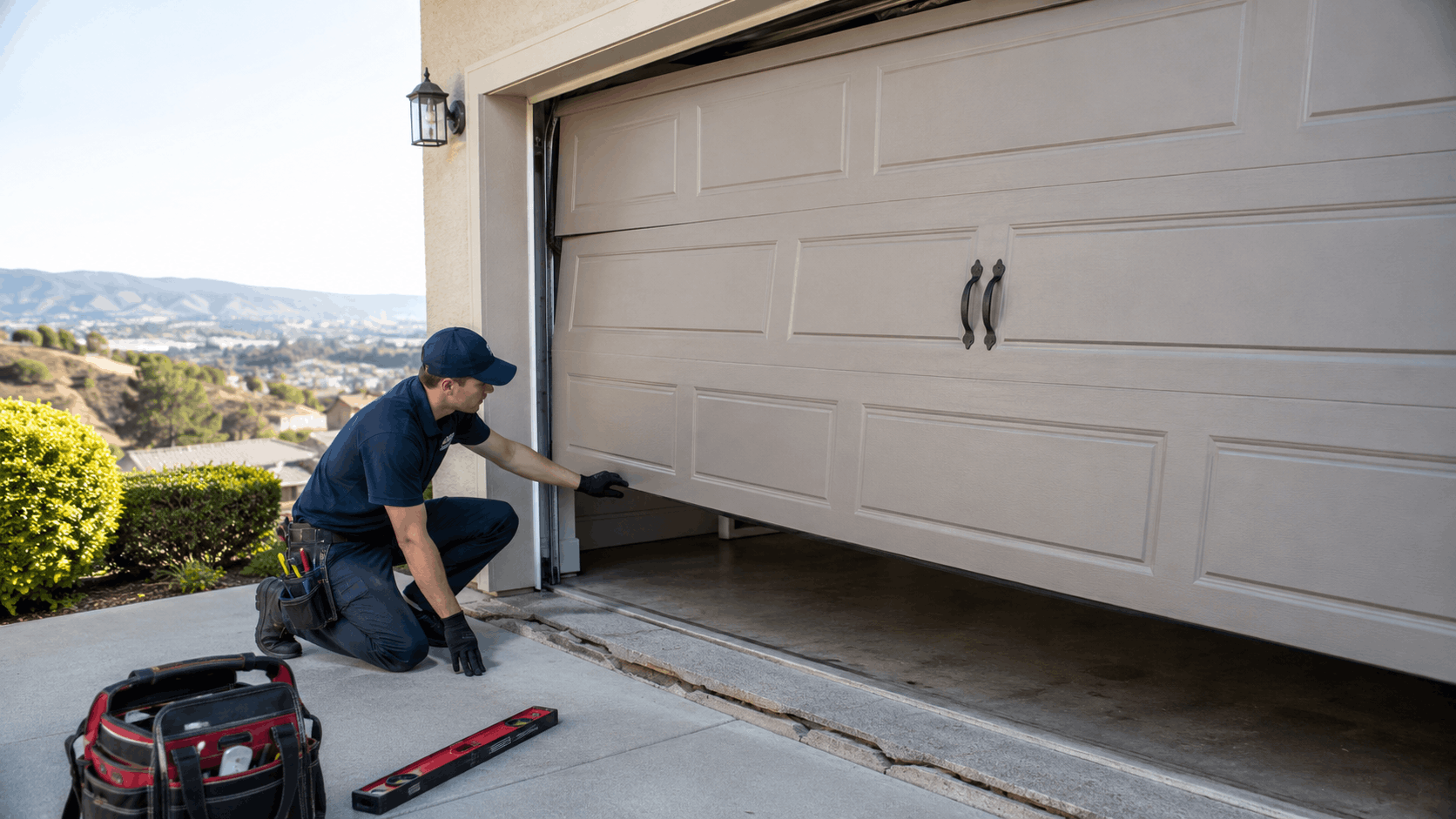
It usually starts the same way. An Anaheim Hills homeowner walks out to the garage one morning after a wet week, hits the wall button, and the door groans, sticks halfway, then jerks the rest of the way up. Or maybe they notice the bottom of the door no longer sits flat against the floor, leaving a slanted gap that lets in cold air and the occasional spider.
What looks like a simple worn part is often something deeper. Homes built on the hillsides above Nohl Ranch Road and around Weir Canyon sit on soil that moves. After heavy winter rains, that movement speeds up, and the garage door is one of the first places it shows.
Why Hillside Homes in Anaheim Hills See More Garage Door Trouble
Anaheim Hills was carved into sloped terrain, and that terrain comes with a tradeoff. The views are great, but the ground underneath shifts more than it does on the flat lots down in the valley. We see the results of that shifting almost every week on garage doors across the area.
Foundation settling is the slow process of a slab dropping or tilting as the soil beneath it changes. When the slab moves, the garage door frame anchored to it moves too. That is why so many garage door problems in Anaheim Hills trace back to the ground, not the door itself.
How Expansive Clay Soil Shifts Under Hillside Properties
The soil along the hills near Nohl Ranch Road is heavy with expansive clay. This kind of clay acts almost like a sponge. When it soaks up water during the rainy months, it swells and pushes upward and outward against anything resting on it.
When summer comes and the clay dries out, it shrinks and pulls back down. That cycle of swelling and shrinking happens year after year, and it slowly lifts and drops different parts of a garage slab at different rates. One corner might rise while another sinks.
A garage floor that moves unevenly does not stay level for long. The frame bolted to that slab follows it, and a door that was perfectly square when the home was built starts to tilt. We have measured slabs in Anaheim Hills that dropped more than half an inch on one side over a few seasons.
The trouble is that expansive clay soil does not announce itself. Homeowners rarely see the slab move. They just notice the door acting up, and the real cause is hidden under the concrete the whole time.
Slope Grading and Drainage Around Older Anaheim Hills Homes
How a property is graded decides where rainwater goes. On streets like Canyon Rim Road and Serrano Avenue, many older lots were graded decades ago, and the slope sometimes directs runoff straight toward the house instead of away from it.
When drainage points water at the foundation, the soil right next to the slab stays wet far longer than it should. That concentrated moisture makes the clay swell more in those spots, which speeds up settling and tilting right under the garage.
We often find clogged or missing downspout extensions on these homes. Water pours off the roof, hits the ground a foot from the foundation, and soaks in. Over a few rainy seasons, that single weak spot can rack a garage door frame noticeably.
Good grading should slope away from the structure on all sides. On hillside lots, that is harder to achieve, which is one reason garage door issues cluster on certain streets and certain older neighborhoods more than others.
How a Settling Foundation Pulls a Garage Door Out of Square
A garage door is built to run in a perfect rectangle. The two vertical tracks must stay parallel and plumb, and the opening must stay square for the rollers to glide smoothly. Settling breaks that geometry.
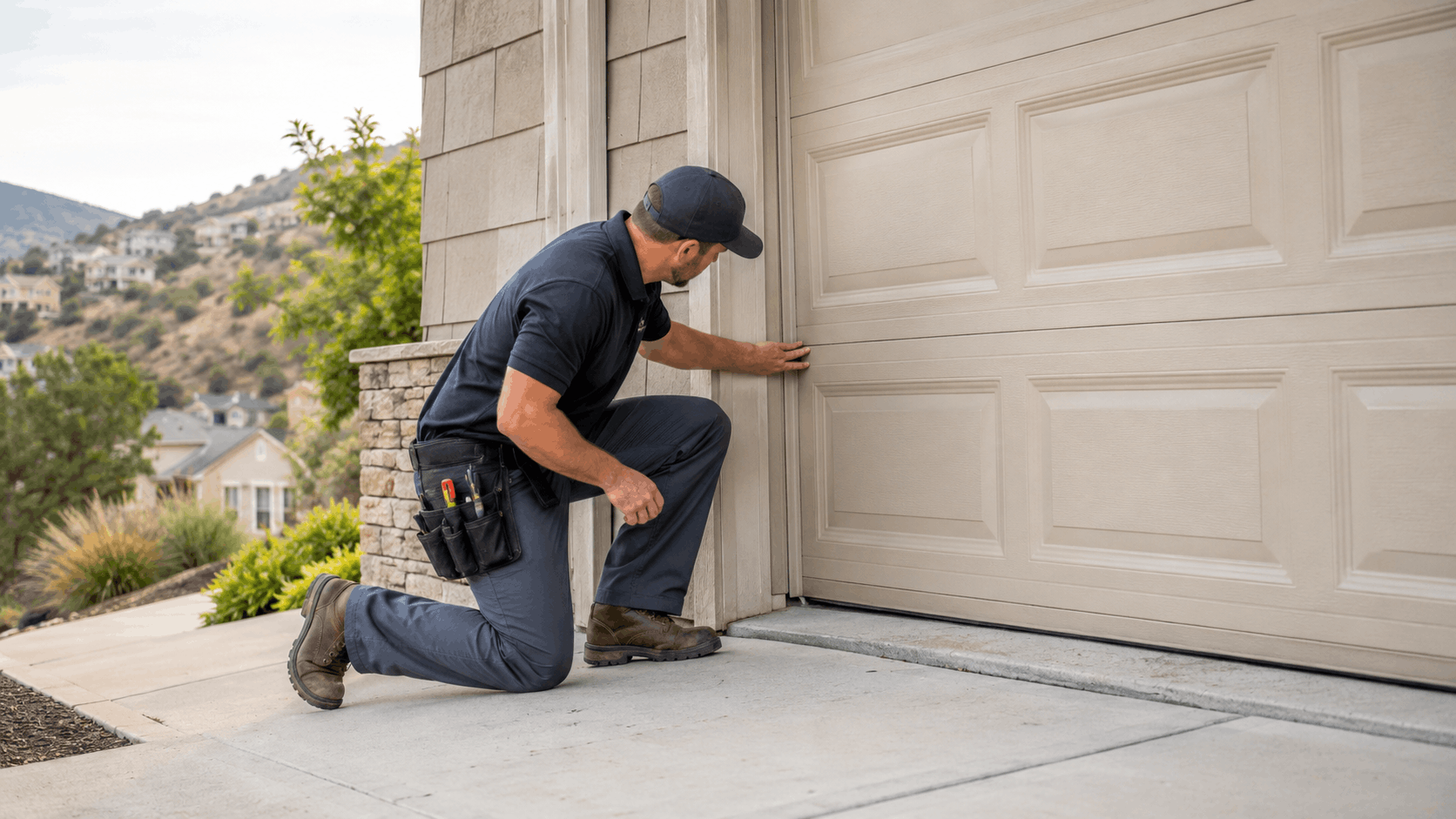
When one side of the slab drops, the door frame attached to it twists. The opening goes out of square, which means the door panels no longer match the shape of the space they fill. One corner binds while the opposite corner gaps.
That twist travels right into the tracks. Track misalignment forces the rollers to push against the metal instead of rolling freely. The door starts to scrape, stick, or hesitate at the same spot every time.
Left alone, the racked frame keeps stressing the hardware. Rollers wear out faster, hinges bend, and the cables can start to fray because the door is no longer pulling straight. What began as a slab shift becomes a chain of failing parts.
Why the Wet Season Makes Problems Worse
Most of our settling-related calls come in late winter and early spring. That is no accident. The wet season dumps months of rain into clay soil that has been bone dry since the previous summer.
Runoff from the higher slopes above many Anaheim Hills neighborhoods adds even more water. A home lower on the hill can receive drainage from several properties uphill, all funneling toward the same patch of ground near the garage.
That sudden flood of moisture triggers fast soil movement. The clay swells quickly, and a door that worked fine in October suddenly sticks in February. We get calls from the same streets every storm season for exactly this reason.
Because the movement is seasonal, some homeowners assume the door fixed itself when summer comes and it eases up. The frame is still stressed, though, and each cycle leaves a little more damage behind.
Get Your Free Quote
Tell us about your garage door and we'll get back to you fast.
Warning Signs That Foundation Settling Is Affecting Your Garage Door
The earlier a homeowner spots the warning signs, the cheaper the fix tends to be. Settling-related garage door problems show a pattern, and once you know what to look for, the foundation cause becomes a lot easier to recognize.
Here is a quick reference our team uses when we talk a homeowner through what they are seeing over the phone.
| Symptom | Likely Settling Cause | How Soon to Act |
|---|---|---|
| Slanted gap under closed door | Tilted slab or frame | Within weeks |
| Door sticks or stops halfway | Track misalignment from racking | Soon |
| Cracks in floor or header | Active slab movement | Inspect promptly |
| Opener straining or reversing | Added friction from misalignment | Soon |
Uneven Gaps Along the Bottom of the Door
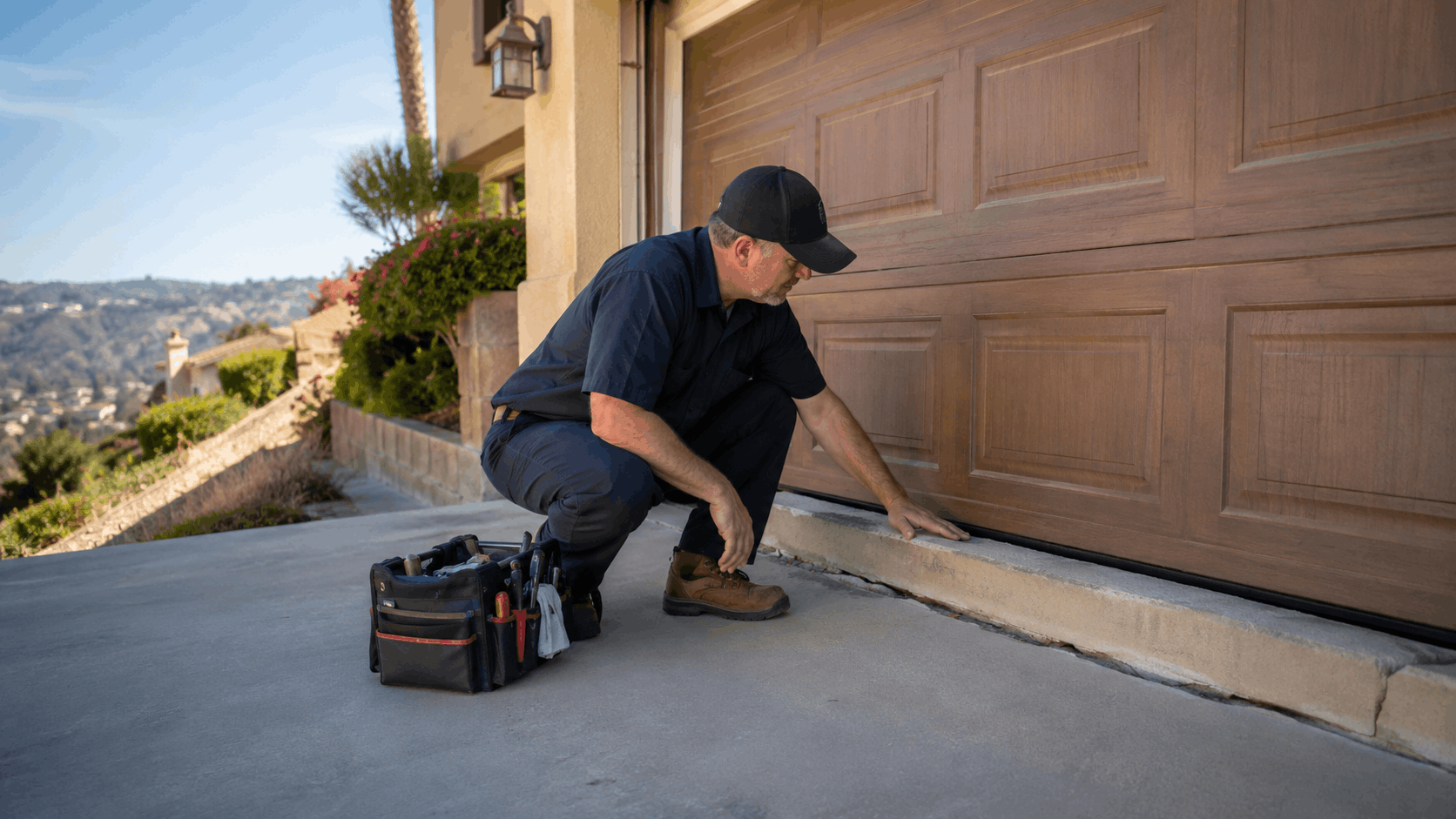
One of the clearest signals is an uneven gap at the bottom of a closed door. A healthy door meets the floor in a straight, even line. When the slab tilts, the door bottom sits flush on one side and shows daylight on the other.
Homeowners often notice this gap when they feel a draft or spot water creeping in during a storm. The seal cannot fill a slanted opening because it was made to press against a level floor.
If the gap grows wider over a few months, that points to ongoing slab movement rather than a flattened seal. A worn seal looks even across the whole width; a settling gap is lopsided.
We always measure that gap at both ends and the middle. The difference between those numbers tells us how far the floor has dropped on one side.
Doors That Stick, Bind, or Stop Halfway
A sticking door is the complaint we hear most. The door climbs partway, then drags, hesitates, or stops as if something is holding it back. In settling cases, that something is the frame itself pinching the track.
Binding rollers are usually behind it. When the frame racks out of square, the rollers no longer line up with the track channel. They grind against the side of the track at the same height every cycle.
You can often hear it before you see it. A rhythmic scraping or a sharp pop at one point in the travel means the door is fighting the track. Many homeowners spray lubricant on the rollers, which helps for a day or two, then the sticking returns.
That return is the giveaway. Lubricant masks friction but cannot fix a frame that has physically moved. If the binding keeps coming back to the same spot, the opening has likely shifted.
Cracks in the Garage Floor, Walls, or Header
Concrete cracks near the garage door often appear right alongside the door trouble. A diagonal crack running from a corner of the opening is a classic sign that the slab and frame are moving in different directions.
Header cracks above the door deserve attention too. The header carries the weight above the opening, and when the supporting walls shift, it can crack or pull away from the framing. We look closely at these during any settling inspection.
Floor cracks that run across the garage slab, especially ones with a slight lip where one side sits higher than the other, confirm active slab movement. A pen tip caught on that lip is a simple test homeowners can do themselves.
Cracks alone are not always urgent, but cracks combined with a sticking door point firmly at settling. That combination tells us the foundation, not just the door, needs a look.
The Opener Straining or Reversing on Its Own
When the frame racks and the door binds, the opener has to push harder to move the same door. That opener strain shows up as a louder motor, slower travel, or the unit struggling at the spot where the door sticks.
Modern openers have a safety feature that reverses the door when they sense too much resistance. A racked door can trip that auto reverse partway down, sending the door back up for no obvious reason. Homeowners often blame the sensors first.
The real cause is the extra friction load. The opener reads the binding as an obstruction and protects itself by stopping or reversing. Replacing the opener will not solve it because the new unit faces the same friction.
An opener forced to fight a misaligned door wears out years early. If a fairly new opener is already straining, we check the door balance and frame before anyone spends money on a replacement motor. Our opener repair and troubleshooting work always starts with that check.
Need Help in Irvine?
Urgent Garage Doors serves Irvine and all of Orange County.
How Our Team Diagnoses Settling-Related Garage Door Damage
A good diagnosis separates a true settling problem from ordinary wear. We have walked enough hillside garages in Anaheim Hills to know that jumping straight to parts replacement wastes a homeowner's money if the frame is the real issue.
Our inspection follows the same order every time so nothing gets missed. It usually takes 30 to 45 minutes and gives the homeowner a clear picture of what is going on.
Checking the Frame and Track for Square and Plumb
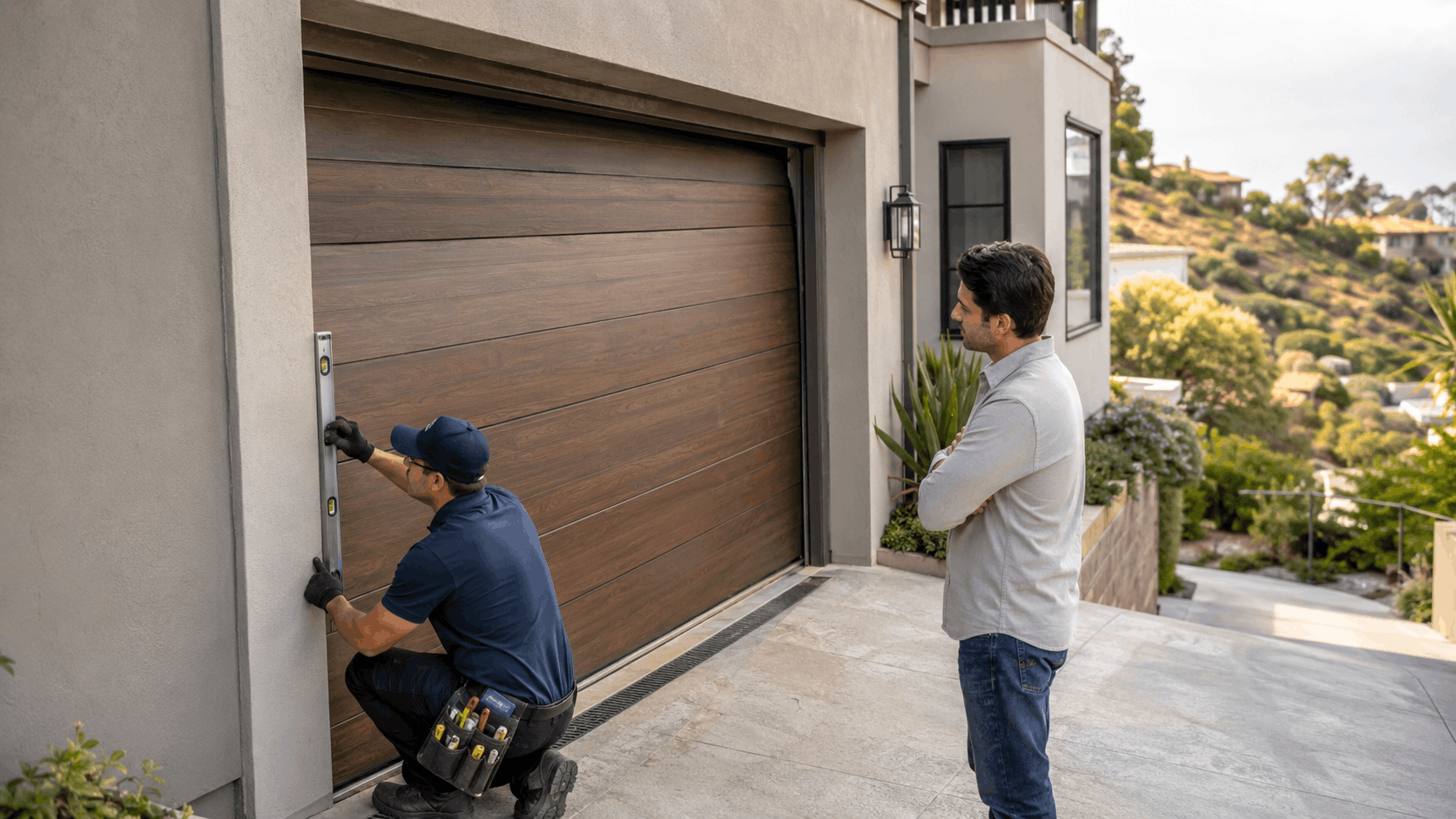
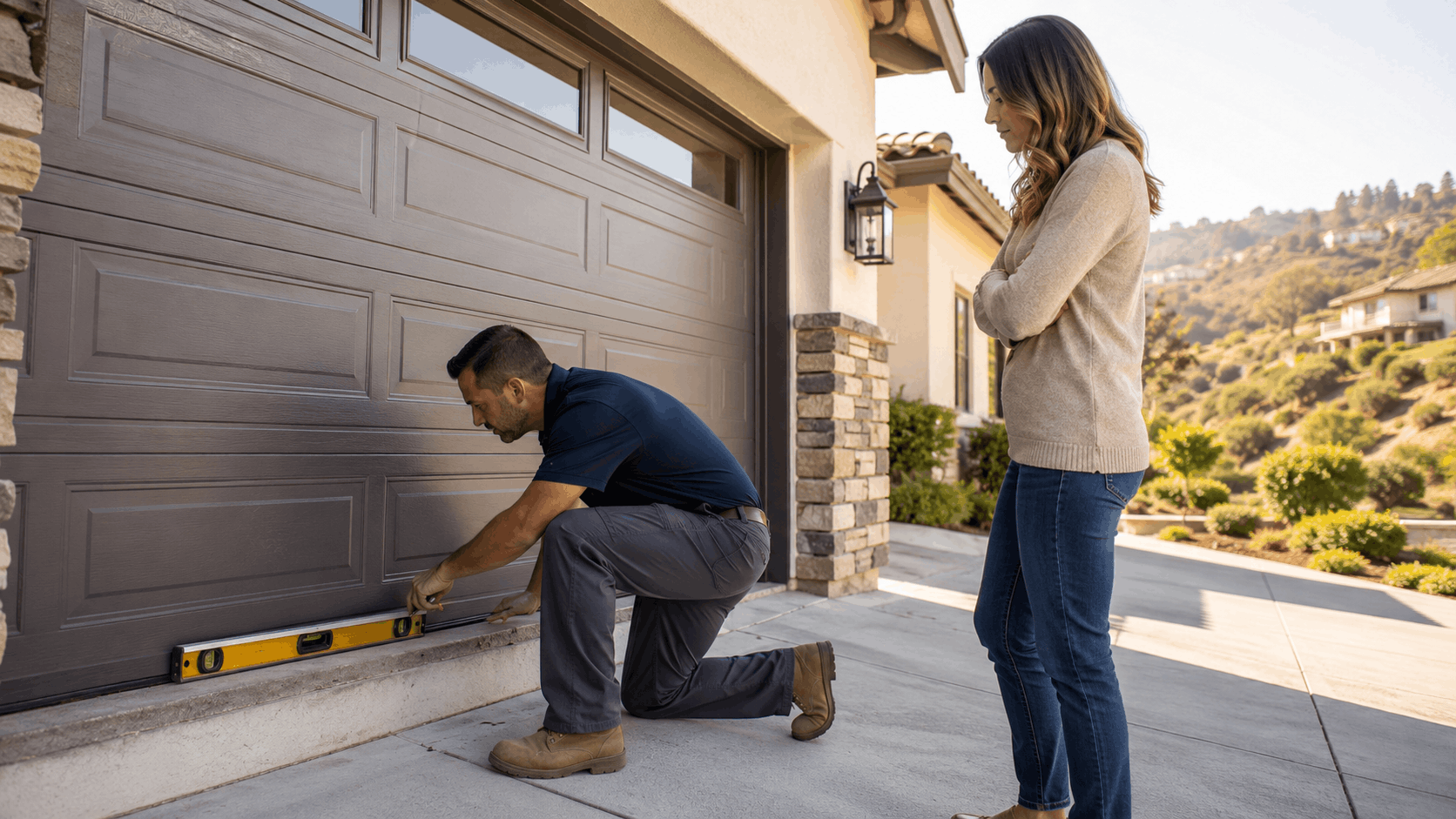
We start with a level and a tape measure on the door frame and tracks. A plumb check on each vertical track tells us if either side is leaning, which is the first clue that the opening has shifted.
Then we measure the opening diagonally, corner to corner. On a square frame, both diagonal measurements match. When they differ by more than a quarter inch, the opening has racked, and we know settling is in play.
We also sight down each track to spot bows or kinks. A track that bends inward at one height usually marks where the frame moved and pinched the metal. These measurements give us hard numbers, not guesses.
Writing those numbers down matters because soil keeps moving. When we return for a follow-up, comparing the old and new measurements shows whether the settling is still active or has stabilized.
Measuring Floor Slope and Slab Movement
Next we check the floor itself. Using a long level and a slope gauge, we measure how much the slab tilts from one side of the opening to the other. A small slope is normal for drainage; a steep or uneven one points to settling.
We pay attention to where the low point sits. If the slab dips toward the same corner where the door binds and the gap appears, the story lines up and confirms slab movement as the cause.
For homes with visible cracks, we note their width and whether the two sides sit at different heights. A vertical offset across a crack is strong evidence that the slab has actually dropped, not just cracked from curing.
These floor readings help us advise the homeowner on whether the movement is mild enough to work around or severe enough to need a foundation professional first.
Testing Spring Balance, Rollers, and Hardware
A racked frame wears parts faster, so we test the whole system. We disconnect the opener and lift the door by hand to check spring balance. A door that will not hold its position or feels heavy on one side often has springs strained by the misalignment.
We inspect every roller for flat spots, cracked wheels, and bent stems. Rollers from a settling door frequently show wear on one side because they have been grinding against the track. Worn rollers get replaced as part of the fix.
Hinges, brackets, and cables come next. Bent hinges and frayed cables tell us the door has been pulling crooked for a while. Our spring and cable repair team handles these parts so the door pulls straight again.
Testing hardware also reveals which problems came from settling and which are just age. That distinction keeps the repair honest and the bill fair.
Knowing When to Call a Foundation Specialist
Sometimes the settling is too severe for us to solve with door work alone. If the slab has dropped more than an inch, or if we see wide structural cracks, we tell the homeowner straight that a foundation specialist should look first.
Fixing the door before the foundation is stabilized often means doing the work twice. The frame will keep moving and undo our adjustments within a season or two. We would rather give honest advice than chase a moving target.
We can recommend reputable foundation contractors and coordinate the timing so the door repair happens after any structural repair is complete. The state's Contractors State License Board is a good place for homeowners to verify any foundation pro's license.
For minor settling, full foundation work is overkill, and we can adjust the door to live with a slightly shifted opening. Knowing where that line sits comes from years of seeing both outcomes on hillside homes.
Repair Options for Garage Doors Damaged by Settling
Once we know how far the frame has moved, we lay out the repair options. They range from a quick adjustment to a full reframe, and the right choice depends on how far things have shifted and whether the slab is still moving.
We always start with the smallest fix that will genuinely solve the problem. Here is how those settling fixes break down.
Realigning Tracks and Adjusting the Door for a Shifted Opening
For mild settling, track realignment is often all the door needs. We loosen the track brackets, reposition the tracks to match the new shape of the opening, and re-secure them so the rollers run clean again.
This door adjustment lets the door work with a frame that has moved a small amount. We reset the spacing between the door and the track, fine-tune the spring tension, and check the travel from top to bottom.
A proper realignment also resets the bottom seal contact so the door sits more evenly on the tilted floor. It will not fully close a large slanted gap, but it improves the seal a great deal. Our track repair and realignment service covers this work.
Realignment is the most common fix we perform on hillside homes with early settling. It is affordable, fast, and buys the door years of smooth operation if the slab has stabilized.
Reframing or Shimming the Door Jamb
When the frame has racked too far for a simple track reset, we shim or rebuild the jamb. Jamb shimming uses tapered wood or composite shims behind the track brackets to bring the opening back toward square.
Shimming works well for moderate movement. It lets us straighten the track path without tearing out the whole frame, which keeps the cost down while restoring proper door travel.
For severe racking, reframing is the real fix. We remove the damaged jamb, re-plumb the framing, and install new lumber that gives the tracks a true vertical surface to mount against. This rebuilds the geometry the door depends on.
Reframing takes longer and costs more, but on a badly twisted opening it is the only lasting answer. We pair it with new weatherstripping so the rebuilt frame seals tight against the floor.
Replacing Bent Hardware and Worn Rollers
A settling door usually leaves a trail of bent hardware behind it. We replace bent hinges, twisted brackets, and any worn rollers that have been grinding against the track for months.
New rollers make an immediate difference. Once the frame is straightened and fresh rollers go in, the door that used to grind and stick glides quietly. Many homeowners are surprised how much smoother it feels.
We also check the cables and springs since these take extra strain on a crooked door. Frayed cables get replaced before they snap, which prevents a far more dangerous failure down the road.
Swapping these parts during the same visit means the homeowner does not face a second repair a month later when a stressed part finally gives out. We catch them all at once.
Full Door Replacement and Weather Sealing for a New Slab Line
Sometimes the door itself is too far gone, or the floor has dropped so much that no seal will close the gap. In those cases, full door replacement plus a custom bottom seal makes the most sense.
A new door lets us fit a thicker or adjustable bottom weather seal that conforms to an uneven floor. These flexible seals press into the low spots and keep water and pests out even when the slab is no longer level.
Replacement also gives the homeowner a chance to upgrade to an insulated steel door that handles the temperature swings of the hills better. Our insulated steel garage door options are popular for exactly this reason.
We only suggest replacement when the math favors it, such as when repair costs approach the price of a new door. For a door with old panels and heavy settling damage, a fresh install often costs less over time. Explore the full range on our garage door installation page.
Need Help in Irvine?
Urgent Garage Doors serves Irvine and all of Orange County.
Preventing Future Settling Damage to Your Garage Door
Repairing the door is only half the job. If the soil keeps moving the way it did before, the same problem returns. A few prevention steps slow that movement and protect the door for years.
Most of these come down to one idea: keep the water around the foundation steady and controlled. The clay reacts to moisture, so managing moisture manages the clay.
Managing Water and Drainage Around the Foundation
The single best thing a homeowner can do is move roof water away from the slab. Downspouts should carry water at least four to six feet from the foundation, not dump it right at the base of the garage wall.
Downspout extensions are cheap and easy. We have seen them stop active settling on homes near Canyon Rim Road simply by ending the constant soaking next to the garage.
Foundation drainage also means keeping gutters clear so they do not overflow during storms. A clogged gutter sends a sheet of water down the wall and straight into the soil at the worst possible spot.
For lots that catch uphill runoff, a surface drain or swale that channels water around the house helps a great deal. The EPA's rainwater management guidance offers practical ideas homeowners can apply.
Keeping a Consistent Moisture Level in the Soil
It sounds backward, but letting the soil dry out completely is just as harmful as soaking it. The clay swelling and shrinking cycle is what does the damage, so keeping moisture steady reduces movement.
During long dry stretches, a little consistent watering near the foundation keeps the clay from shrinking and pulling away. A simple soaker hose run on a timer for short periods works well for many hillside homes.
The goal is balance, not flooding. Wildly wet in winter and bone dry in summer is the pattern that racks frames. Evening out those extremes keeps the slab more stable year round.
Homeowners should avoid heavy irrigation right against the garage, though, since too much water brings back the swelling problem. Steady and moderate is the target.
Routine Door Tune-Ups That Catch Movement Early
A yearly tune-up catches small alignment changes before they turn into stuck doors. During door service, we measure the frame, check track alignment, and note any drift from the previous visit.
Catching a quarter-inch shift early lets us make a tiny adjustment instead of a major repair later. It is the difference between a 20-minute tweak and a frame rebuild.
We also lubricate rollers, tighten hardware, and test the spring balance during each tune-up. On hillside homes prone to movement, this regular attention pays off. Our preventive maintenance plan is built for exactly these conditions.
For homes that have already had settling repairs, regular service is the best insurance that the fix holds as the soil continues its slow seasonal motion.
Watching for HOA and Hillside Maintenance Rules
Many Anaheim Hills neighborhoods sit within HOA communities that have slope and drainage rules. These HOA rules often govern grading, retaining walls, and where water can be directed off a property.
Before changing drainage or adding a swale, homeowners should check their HOA guidelines. Some communities require approval for grading work, and following the rules avoids fines and disputes.
Hillside maintenance responsibilities sometimes extend to shared slopes between properties. Knowing who maintains the slope above your home helps you address uphill runoff that affects your garage.
We are happy to document the drainage conditions we find so homeowners have something concrete to share with their HOA board when they request approval for improvements.
Why Anaheim Hills Homeowners Trust Urgent Garage Doors
We have spent years working garage doors on the hillsides and in the canyons across this part of Orange County. That local experience shapes how we approach every settling call.
Based out of Irvine, our team reaches Anaheim Hills quickly and knows the neighborhoods, the soil, and the seasonal patterns that drive these repairs.
Local Experience With Hillside and Canyon Properties
We have repaired doors on homes near the Anaheim Hills Golf Course, up around Weir Canyon, and along the winding streets that branch off Nohl Ranch Road. Each area has its own quirks, and we have learned them firsthand.
Canyon properties deal with more runoff and steeper grading, which means we expect more frame movement there. Knowing that ahead of time, we inspect more thoroughly on those homes.
This experience is not theory. It comes from measuring hundreds of openings across the hills and seeing how the same soil behaves under different lots and slopes.
When a homeowner describes a sticking door on a familiar street, we often have a strong idea of the cause before we even arrive. That head start saves time and money.
Fast Response From Our Irvine Base
Our Irvine base gives us quick access to Anaheim Hills. A run up the 241 toll road or across the 91 puts our technicians at most homes in the hills within a reasonable window, even during busy storm seasons.
Fast response matters most when a door is stuck and a car is trapped inside. We schedule hillside calls with those drive times in mind so homeowners are not left waiting half a day.
Because we serve the whole region, we keep common parts stocked on our trucks. That means many settling repairs get finished on the first visit instead of waiting for parts. You can learn more on our Irvine location page.
Quick arrival paired with a stocked truck is why so many hillside homeowners call us first when a door acts up after a storm.
Honest Recommendations, Not Upsells
Our habit is to recommend the smallest fix that truly solves the problem. If a track realignment will handle the settling, we are not going to push a full reframe the door does not need.
Honest pricing means we explain what we found, show the measurements, and lay out the options with real numbers. The homeowner decides with full information.
If a repair will only last a season because the slab is still moving, we say so. We would rather give a straight recommendation than do work we know will not hold.
That approach has earned us repeat customers across the hills who call us back and refer their neighbors. Trust is built one honest visit at a time.
Coordinating With Foundation and HOA Pros
When settling runs deep, the door is only one piece. We work alongside foundation contractors so the structural repair happens first and our door work lasts.
We can time our visit to follow the foundation crew, then re-square the opening and reset the door once the slab is stable. That coordination spares the homeowner from paying for door work twice.
We also help document conditions for HOA approvals when drainage changes are needed. Having a clear record from a contractor strengthens a homeowner's request to their board.
Pulling these pieces together is part of how we solve the root problem, not just the symptom. A settling repair done right involves more than the door alone.
Need Help in Irvine?
Urgent Garage Doors serves Irvine and all of Orange County.
What to Expect During a Settling-Related Repair Visit
Homeowners like to know what is coming before they book. Here is how a typical Anaheim Hills settling repair visit plays out, from the first measurements to the final test.
We aim to give clear cost ranges and timelines up front so there are no surprises when the work is done.
Typical Cost Ranges for Adjustments vs. Reframing
Minor work like track realignment and a door adjustment usually falls in the lower hundreds of dollars, depending on how far the frame has shifted and what hardware needs replacing.
Jamb shimming sits in the mid range, since it involves more labor and materials. A full reframe of a badly racked opening costs more because it includes new lumber, re-plumbing the frame, and resetting the door and tracks.
Full door replacement is the largest expense, with the price driven by door size, material, and whether an insulated model is chosen. We give a firm quote after the inspection so the repair cost is clear before any work starts.
Every home is different, so these are general price ranges. The inspection numbers tell us which category a given door falls into.
How Long Repairs Usually Take
A track realignment or hardware swap often wraps up the same day, frequently within an hour or two. These quicker repairs are the most common outcome for early settling.
Jamb shimming and roller replacement typically take a few hours. We can usually complete them in a single visit if the parts are on the truck, which they usually are.
A full reframe or door replacement runs longer, sometimes a half day or more, because the framing and seals need to be set correctly. We schedule those with enough time to do the job right rather than rush it.
For urgent situations, we prioritize getting the door functional fast even if some finishing work follows on a second visit.
Same-Day and Emergency Service for a Stuck Door
A door jammed shut with a car trapped inside is an emergency, and we treat it that way. We offer same-day and emergency service for stuck doors across Anaheim Hills.
When a settling-racked door binds completely, our first goal is to get it moving safely so the homeowner can use the garage again. We then plan the full repair around that.
Storm seasons bring a spike in these calls, so we keep emergency slots open during wet weeks. Our garage door won't open or close service covers exactly these jams.
If the door is stuck open and the home is exposed, that is just as urgent. We respond quickly to secure the property. See our emergency garage door repair options for details.
Warranty and Follow-Up After Settling Repairs
We back our parts and labor with a warranty so homeowners are covered if something we installed fails. The specifics depend on the parts used, and we explain them at the time of service.
Because hillside soil keeps moving, we also offer follow-up checks. A quick re-measure a season or two later tells us whether the settling has continued and lets us make small adjustments early.
That follow-up is especially valuable after a reframe, since we want to confirm the new frame is holding square as the next wet season passes.
Standing behind the work and checking back is how we make sure a settling repair actually solves the problem for the long run. Reach out through our contact page to schedule a visit.
Final Thoughts
Hillside foundation settling is a quiet problem with loud symptoms. The slab moves out of sight, but the sticking door, the slanted gap, and the straining opener make the issue impossible to ignore.
The good news is that most settling-related garage door problems in Anaheim Hills are fixable, often with a simple realignment if caught early. Managing drainage and keeping soil moisture steady slows the movement that causes them in the first place.
If your garage door has started sticking, gapping, or fighting the opener after a wet stretch, our team at Urgent Garage Doors is ready to help. Call us or reach out through our website for an inspection, and we will give you an honest read on whether you are facing simple wear or hillside settling.
Frequently Asked Questions
- Can foundation settling really damage my garage door?
- Yes. When the slab beneath your garage drops or tilts, the door frame anchored to it twists out of square. That racked frame pushes the tracks out of alignment, forces the rollers to bind, and stresses the springs and cables. The door starts sticking and gapping. The damage is real, and it traces straight back to the shifting foundation rather than a single worn part.
- Why does my garage door stick more after it rains in Anaheim Hills?
- The hills sit on expansive clay soil that swells when it absorbs water. After heavy winter rain, the clay expands and pushes against the garage slab, moving the frame. Runoff from uphill properties adds even more moisture near the foundation. That sudden swelling racks the opening just enough to make the door bind. When summer dries the soil, the movement often eases, but the underlying stress remains.
- Should I fix the garage door or the foundation first?
- If the settling is severe, with wide cracks or a slab drop over an inch, address the foundation first. Repairing the door before the structure is stable means the frame keeps moving and undoes the work within a season. For minor settling, we can adjust the door to live with a slightly shifted opening. Our inspection measures the movement so you know which path makes sense.
- How much does it cost to fix a garage door affected by settling?
- Minor track realignment and adjustments usually run in the lower hundreds of dollars. Jamb shimming with roller replacement sits in the mid range. A full reframe of a badly racked opening costs more because of the lumber and labor involved, and full door replacement is the largest expense. We give a firm quote after measuring the frame so you see real numbers before any work begins.
- How can I tell if it is settling or just a worn part?
- Look for clues that point past the door itself. An uneven, slanted gap along the bottom, cracks running diagonally from the opening corners, and a header that has pulled away all signal settling. A worn part tends to cause even wear, while settling causes lopsided symptoms. If lubricating the rollers only helps for a day or two, the frame has likely moved.
- Do you serve all of Anaheim Hills from your Irvine location?
- Yes. From our Irvine base we cover all of Anaheim Hills, including the neighborhoods near the Anaheim Hills Golf Course, Weir Canyon, and the streets off Nohl Ranch Road. A quick run up the 241 toll road or across the 91 gets our technicians to most hillside homes promptly, even during the busy storm season when settling calls spike.
- How long does a settling-related repair take?
- A track realignment or hardware swap often finishes the same day, usually within an hour or two. Jamb shimming and roller replacement take a few hours. A full reframe or door replacement can run a half day or longer because the framing and seals must be set correctly. We carry common parts on the truck so most repairs are completed in a single visit.
- Will improving drainage stop my garage door from shifting again?
- Better drainage is one of the most effective ways to slow soil movement. Moving roof water away from the foundation with downspout extensions and keeping gutters clear stops the soil right next to the slab from staying soaked. Combined with steady moisture during dry months, this reduces the clay swelling and shrinking that racks the frame, protecting the door over time.
- Can a misaligned door damage my opener?
- It can. A racked frame and binding rollers add friction, forcing the opener to push harder on every cycle. That extra load wears the motor and gears out years early. It can also trip the auto reverse safety, sending the door back up partway. Replacing the opener will not help because the new unit faces the same friction. We fix the door first.
- Do you offer same-day service for a door stuck from settling?
- Yes. A door jammed shut with a car trapped, or stuck open leaving the home exposed, is an emergency, and we offer same-day and emergency service across Anaheim Hills. We keep emergency slots open during wet weeks when settling jams spike. Our first goal is to get the door moving safely, then we plan the full repair around restoring the opening properly.
U
Licensed garage door repair professionals serving Irvine and Orange County.
Licensed in California · License #1055150
Why trust Urgent Garage Doors?
Founded in 2017, Urgent Garage Doors is a licensed and insured garage door services serving Irvine and Orange County. All content is reviewed by our licensed technicians.

Need Help in Irvine?
Urgent Garage Doors serves Irvine and all of Orange County.
Related Articles
Tips & Advice
Mission Viejo Garage Door Problems: Settling Foundations and Track Misalignment
Mission Viejo's expansive clay soils and hillside fill dirt cause foundation settling that misaligns garage door tracks. Learn the signs, repairs, and how Urgent Garage Doors can help.
Tips & Advice
Quail Hill Irvine Garage Door Repair: Common Failures in 2000s Construction
Quail Hill homes built in the 2000s share predictable garage door failures. Learn the common problems with springs, cables, rollers, openers, and panels - and how to fix them.

Safety & Prevention
Why Anaheim Hills Homes Need Heavy-Duty Garage Door Springs
Discover why Anaheim Hills homes require heavy-duty garage door springs due to extreme temperatures, heavy insulated doors, and unique climate challenges that cause standard springs to fail prematurely.