Garage Door Repairs Costa Mesa Buyers Ask For After a Home Inspection
Key Takeaways
- The repairs most flagged on Costa Mesa reports are photo-eye and auto-reverse failures, worn springs, frayed cables, off-track doors, and a replaced opener missing battery backup.
- The marine layer hits Westside and river-adjacent streets hardest, so corrosion brings springs and cables to the end of their cycle rating earlier there than inland.
- Both safety systems must work: contact reverse within two seconds of hitting an obstruction, and photo eyes mounted no higher than six inches off the floor.
- SB 969 requires battery backup on residential openers sold or installed on or after 1 July 2019, carrying a $1,000 civil penalty, but does not force an upgrade on an opener left in place.
- Springs store enough energy to cause serious injury and are never a DIY item; the safe homeowner checks are the beam-break test, the 2x4 contact-reverse test and the balance test.
- Typical Orange County ranges include torsion spring replacement $150 to $300, safety sensor alignment $75 to $150, off-track repair $125 to $275, and battery backup installation $200 to $400.
- Garage door work is licensed under CSLB classification C-61/D-28, not C-28, and the permit authority is confirmed from the parcel, since Santa Ana Heights near the airport runs through Newport Beach.
- Urgent Garage Doors holds California license #1055150, offers a written price before work begins, free estimates on new doors, and 24/7 response of 30 to 60 minutes across Orange County.
In This Article
A buyer under contract on a Mesa Verde ranch home or an Eastside cottage opens the inspection report and finds the garage door flagged, right as the escrow clock is running. It happens all the time here. The repairs that show up most on Costa Mesa inspection reports are photo-eye and auto-reverse failures, worn springs and frayed cables, doors off the track, and a replaced opener missing the battery backup that California law now requires.
Each of those findings has a clear fix, and most are quick for a licensed crew to resolve before closing. The tricky part is knowing which items are safety flags, which are negotiating points, and which laws actually apply to a garage door in this city.
Why Garage Doors Land on Costa Mesa Inspection Reports?
A home inspection in Costa Mesa covers the garage door as both a safety device and a moving mechanical system, and inspectors here flag it often because the housing stock runs from postwar tract homes to 1980s condos. A general inspector is not a garage door technician, but the checks are consistent: do the safety systems work, does the door move the way it should, and is the hardware worn or corroded.
Costa Mesa's location does the rest. The marine layer reaches the western neighborhoods harder than the inland streets near the 405, so corrosion on springs, cables and tracks is a west-side conversation first. Inland, seasonal temperature swing is what warps wood doors and stresses older hardware. The result is a short list of findings that repeat across neighborhoods and eras.
| Common Inspection Finding | Why It Happens in Costa Mesa | What the Repair Solves |
|---|---|---|
| Door reverses for no reason | Photo-eye misalignment or a dirty, blocked beam | Restores reliable close and passes the safety check |
| Worn or broken spring | Cycle rating reached on daily-use doors | Returns the door to balanced, safe operation |
| Frayed cable | Corrosion on west-side and river-adjacent streets | Prevents a sudden drop and a second failure |
| Door off the track | Grit and debris jamming travel, worn rollers | Returns the door to safe, aligned travel |
| No battery backup on a replaced opener | SB 969 applies to installs since 1 July 2019 | Brings the opener into legal compliance |
What the Inspector Looks At
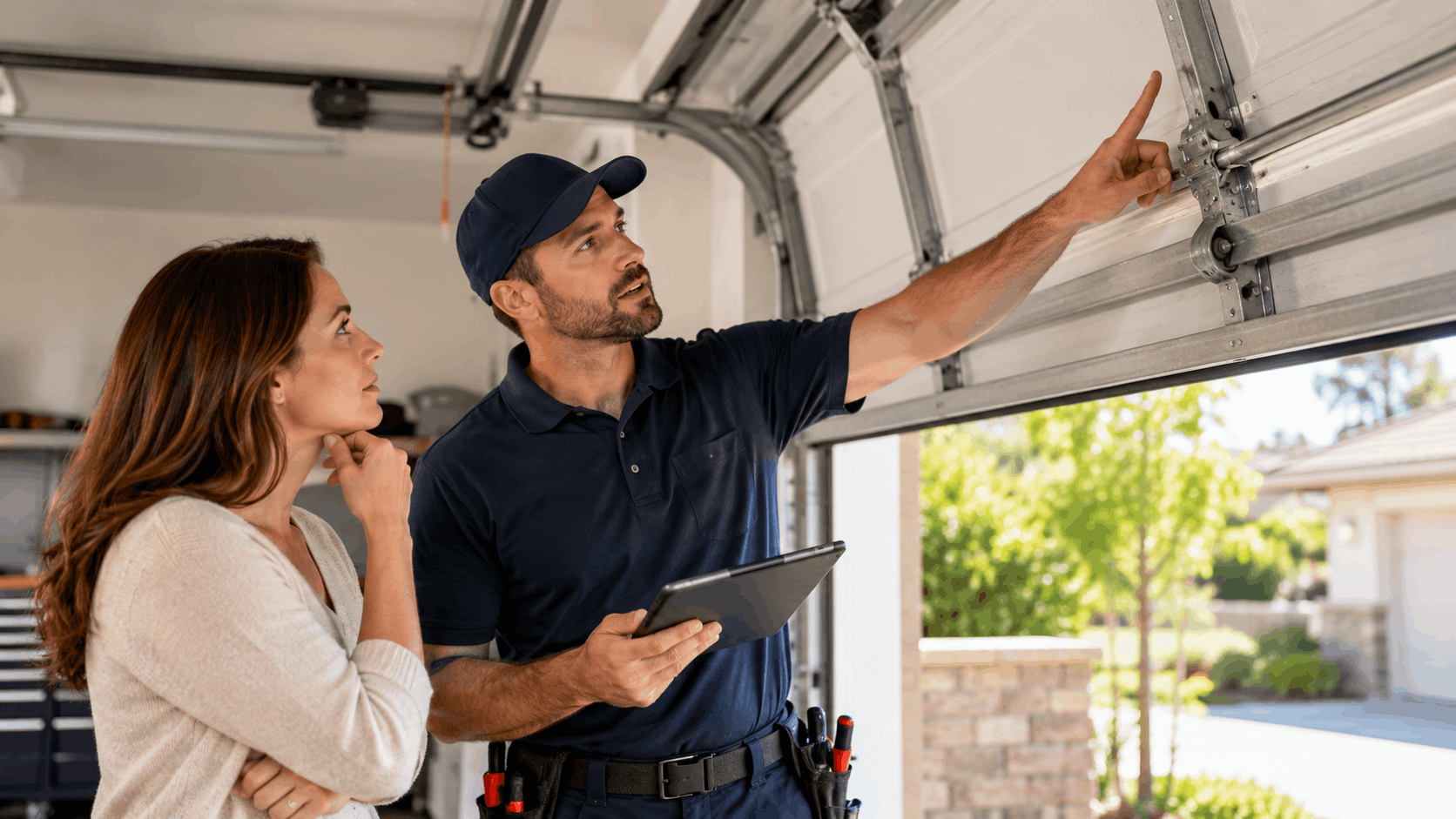
A general inspector runs function and safety checks, not a teardown. They test the photo-eye beam by breaking it while the door closes, and the door should stop and reverse. They check the auto-reverse by watching the door respond to contact with an obstruction. These two systems are separate, and both have to work.
Next comes the balance test and a look at the hardware. The inspector may disconnect the opener and lift the door to see whether it holds position, which tells them whether the springs are doing their job. They scan the visible condition of springs and cables for fraying, rust or a snapped coil.
Finally, on a newer or replaced opener, they note whether battery backup is present. None of this is destructive. It is a snapshot of whether the door is safe to operate and whether it moves the way a buyer should expect. When any one item fails, it lands on the report as a repair request.
Because inspectors follow a repeatable inspection checklist, the same handful of items show up again and again. That predictability is good news for a seller, since each flag maps to a known fix with a typical price range.
How Costa Mesa's Build Eras Shape the Findings
The era a home was built in largely decides what the report says about its garage door. In College Park, Halecrest and the Baker Street tracts northeast of the city near Orange Coast College, you find 1950s and 1960s flat-street tract housing with attached garages. Many still carry original or long-serving hardware, so springs, rollers and cables are commonly at or past their service life.
Eastside, south of 17th Street toward the Newport Beach border, is postwar cottages and ranch houses on larger lots. Alley and rear-loaded garages are common here, and a share of garages sit detached behind the house. A rear-loaded garage that the family uses as the main entrance cycles more often, which brings spring wear forward.
South Coast Metro, the dense quarter around South Coast Plaza, is overwhelmingly 1970s and 1980s attached condos and townhomes with tuck-under and tandem parking. Shared driveways and motor courts mean noise and vibration matter more, and reports on these units often note worn rollers and binding tracks. Each era produces its own version of the same findings.
Knowing the neighborhood tells our team what to expect before the truck arrives. A Mesa Verde mid-century home with a front-facing attached garage is a different job from a South Coast Metro condo with living space above the garage.
Why the West Side Sees More Corrosion
The marine layer is the single biggest reason west-side garage doors get flagged for corrosion. It rolls in off the coast and reaches the Westside and the streets toward the Santa Ana River harder than the inland tracts near the 405. Salt-laden moisture settles on steel springs, cables and tracks and works on the metal over time.
Corrosion does not create a new failure mode. What it does is bring a part to the end of its cycle rating earlier than it would reach it in drier air. A torsion spring rated for a set number of cycles corrodes, loses strength and breaks before it would have in an inland garage. Cables corrode strand by strand and fray.
That is why our crews treat the Westside and river-adjacent streets as a corrosion-first area. We inspect cables and spring coils closely even when the reported problem is something else, because rust that has started on one part has usually started on the others nearby.
For a buyer, a corrosion flag on a west-side home is rarely a reason to walk. It is a known condition with a clear repair. Replacing the corroded part and inspecting the neighboring hardware returns the door to safe operation.
Inland Heat and Older Wood Doors
Move inland toward Mesa Del Mar and Mesa Woods, the 1960s middle of the city along Newport and Harbor Boulevards, and the story changes. The marine layer is weaker here, so corrosion is less of a conversation. Seasonal temperature swing takes its place as the condition that stresses doors and hardware.
Wood doors are the ones that feel it most. Heat and the repeated swing between warm days and cool nights make wood expand and contract, and over years that movement warps panels. A warped panel sticks against the jamb or the track, and the door binds as it travels.
On a report, that shows up as a door that sticks, drags or hesitates partway through its travel. It can also show as hardware that has loosened or bent as the door fights its own binding. An inspector notes the symptom, and the fix depends on how far the warp has gone.
A minor bind can often be corrected with hardware and track adjustment. A badly warped wood panel on an older Costa Mesa door may be past repair, which moves the conversation toward a replacement door and the ranges that go with it.
Get Your Free Quote
Tell us about your garage door and we'll get back to you within 30 to 60 minutes.
Photo-Eye and Auto-Reverse Failures
This is one of the most misread flags on a report. A buyer sees "garage door does not reverse" or "safety sensor fault" and worries the whole door is bad, when usually it is a sensor out of alignment. Understanding the two separate safety systems, and the dates behind them, tells a buyer exactly what the report means.
Entrapment protection is the umbrella term for both systems. California required auto-reverse and an external sensor under AB 3600 in 1990, and the federal mandate followed for openers manufactured for the United States after 1 January 1993, built to the UL 325 standard. When either system fails a check, the door is not meeting the protection every modern opener must provide.
The Two Safety Systems Every Modern Door Needs
The first system is contact reverse. If the door hits an obstruction while closing, it must reverse within two seconds of contact. This is the opener sensing resistance and backing off, and it is tested with a flat board on the floor in the door's path.
The second system is the non-contact photo eyes. These are the small sensors mounted on each side of the opening, no higher than six inches off the floor. They project an invisible beam across the opening, and if anything breaks that beam while the door is closing, the door stops and reverses before it reaches the object.
UL 325 is the standard those devices are built to, and the law expects both to work together. The photo eyes catch a child or a pet before the door ever touches them, and contact reverse is the backup if something slips under after the door is already moving. An inspector checks both because a door with only one working system is not compliant.
When a report flags a safety sensor problem, it is almost always the photo eyes rather than the opener's internal reverse. That distinction matters for the repair and the cost.
Why the Door Reverses for No Reason
The most common cause of a door that reverses with nothing in the way is a photo-eye fault. The two sensors have to point directly at each other, and if one is knocked even slightly out of alignment, the beam misses its target and the opener reads it as a blocked path. The door refuses to close or reverses partway.
Dirt is the other usual culprit. Wind carries dust, plant debris and grit onto the sensor lens, and a coated lens breaks the beam just as surely as an object in the opening would. A spider web or a stray leaf across one eye is enough to stop the door.
On Costa Mesa streets where wind pushes debris into the garage, the lenses need periodic wiping. A sensor that was fine last year can fail a check this year simply because the lens has slowly fogged with grime.
Because the fix is often realignment and cleaning rather than new parts, this is one of the cheaper items on a report. A technician squares the sensors, confirms the indicator lights are steady, cleans the lenses and retests the beam. The door then closes reliably again.
Pre-1993 Openers Flagged as Missing Sensors
Some older Costa Mesa garages still run an opener that predates the entrapment-protection era entirely. Openers made before 1993 predate the federal mandate, and in California the auto-reverse and external sensor requirement came in under AB 3600 in 1990. An opener from before that period may have no photo eyes at all.
When an inspector finds no sensors on the opening, that is what they are looking at. It is not illegal to own a pre-1993 opener, but it lacks the entrapment protection every modern opener is built to provide. For a buyer with children or pets, that is a meaningful gap.
The manufacturer position, LiftMaster being one example, is that pre-1993 openers should be replaced rather than repaired. Bolting modern sensors onto a decades-old unit is not the intended fix. The reliable path is a new opener, which arrives compliant and, in California, with battery backup built in.
Replacing the opener also resolves several report items at once. A new opener installation clears the missing-sensor flag, satisfies the battery backup requirement, and often runs quieter than the old unit it replaces.
The Safe Test a Buyer Can Run Before Closing
A buyer can run the same safety checks an inspector does, and it is worth doing before the inspection to know what to expect. For the photo eyes, start the door closing and wave an object through the beam near the floor. The door should stop and reverse immediately. If it keeps going or will not close, the sensors need attention.
For contact reverse, lay a flat 2x4 across the opening on the floor in the door's path. Close the door and watch what happens when the bottom edge meets the board. The door must reverse within two seconds of contact. If it keeps pressing down or stops without reversing, the auto-reverse is not working.
Both tests are safe for anyone to run because they involve only the door and an object, never the hardware under tension. They take a few minutes and tell a buyer whether the safety systems pass.
What a buyer should never do is go beyond these function checks into the springs or cables. Those store energy and are a technician's job. The 2x4 test and the beam-break test are the limit of safe homeowner checks.
Need Help in Irvine?
Urgent Garage Doors serves Irvine and all of Orange County.
Springs, Cables and the Balance Test
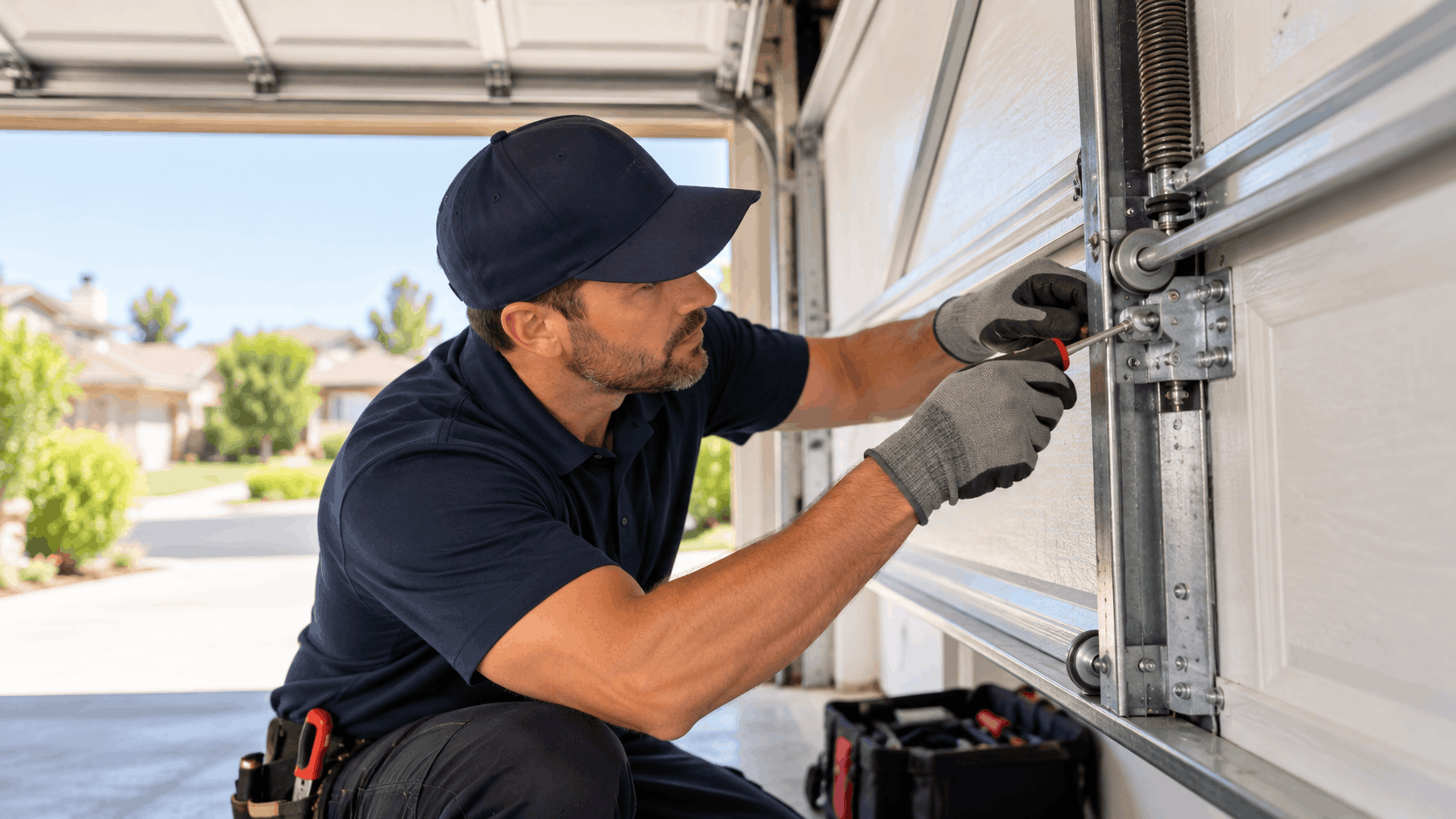
Spring and cable wear shows up on report after report, and it is the one finding an owner must never try to fix. Springs do the heavy lifting that makes a door liftable, and they hold enough energy to injure someone badly. Inspectors flag worn springs and frayed cables as both a function and a safety concern.
For a sale, this matters because a failing spring can take the door out of service entirely, and a buyer wants it resolved before they own it. The fix is straightforward for a licensed crew, and it is the clearest example of why garage door work belongs with a professional.
How Springs Wear and Why They Get Flagged
Torsion and extension springs are rated in cycles, not years. One cycle is one full open and close, and a standard residential spring is commonly rated around 10,000 cycles. A door opened about four times a day reaches that in roughly seven years.
That math explains why usage matters more than age. On an Eastside home with a rear-alley garage that the family uses as the main entrance, the door may cycle well more than four times a day. Those cycles add up faster, and the spring reaches its rated life sooner than it would on a door used only on weekends.
An inspector flags a spring when it shows wear, a gap in the coil or an outright break. A broken spring usually means the door will barely move under the opener or will not move at all, because the opener is sized to lift a counterbalanced door, not the door's full dead weight.
When springs are replaced, they have to be matched to the actual weight and height of the door. That is why a heavier replacement door needs its own spring set rather than a reuse of the old one. Our team handles torsion spring replacement sized to the specific door.
Corroded Cables Near the Water
On Westside and river-adjacent streets, the local corrosion mechanism hits cables hard. Lift cables are steel strand, and marine-layer moisture works into the strands and corrodes them from within. They fray before they snap, which is exactly what an inspector catches when they spot broken strands at the drum or along the cable.
A frayed cable is a warning, not a nuisance. If it lets go while the door is up, one side drops and the door can come off the track or crash down. That is why a flagged cable is a request to repair now rather than later.
Cables also tie directly into spring work. Cables, drums, rollers, hinges and bearings all wear alongside springs, and replacing a spring without inspecting the cables is how a second failure follows weeks later. A new spring on a tired, corroded cable solves half the problem.
For that reason our crews inspect cables as a matter of course during any cable repair or spring job near the water. Catching a corroded cable during the same visit saves the buyer a repeat call.
The Balance Test and What a Failed One Means
The balance test tells you whether the springs are carrying the door's weight the way they should. To run it, disconnect the opener with the release cord, then lift the door by hand to about waist height and let go. A correctly balanced door stays put where you leave it.
A door that falls back down or drifts upward on its own has failed the test. That is a spring problem, not an opener problem. The springs have lost the tension that counterbalances the door, and no amount of opener adjustment fixes it.
This distinction saves buyers from chasing the wrong repair. A door that "will not stay open" or "slams shut" sounds like an opener fault, but the balance test points straight at the springs. Diagnosing it correctly means the right part gets replaced the first time.
A buyer can safely run the balance test because it only involves the release cord and lifting the door by hand. The adjustment that follows a failed test is where it stops being a homeowner task and becomes a job for professional balancing and tension work.
Why Springs Are the One Thing to Leave Alone
A torsion spring stores enough energy to cause serious injury, and it releases that energy instantly if a winding bar slips. This is not a cautious overstatement. A loaded spring under a mishandled winding bar can break bones or worse, and it happens in a fraction of a second.
That is why no buyer or seller should adjust, wind, unwind or replace a spring. The temptation to save a service call is real, especially when a sale is on the line, but spring work is the clearest line between a safe homeowner check and a dangerous one.
The same caution applies to the cables, which run alongside the springs and are under their own tension. Loosening the wrong part releases force in an unpredictable direction.
Spring and cable work goes to a licensed contractor with the right bars, tools and experience. A technician winds the spring to the correct tension for the door's weight, then confirms the balance before calling the job done. That is the repair a report is asking for when it flags a spring.
Off-Track Doors, Rollers, Hinges and Panels
Beyond springs and sensors, inspectors flag the mechanical parts that let a door travel smoothly: the tracks, the rollers and hinges, and the panels themselves. These findings range from a quick realignment to a question of whether the whole door has reached the end of its life.
Each repair solves a specific problem, and knowing which is which helps a buyer judge whether the garage door is a minor fix or a real negotiating point. Most mechanical flags are repairable without replacing the door.
Doors That Have Jumped the Track
A door comes off the track when a roller leaves its channel, usually after an impact, a broken cable, or worn hardware that lets the door shift. Once one roller is out, the door binds, hangs crooked, and cannot travel safely. An inspector flags it as both a safety and an operation item because an off-track door can fall or jam.
Debris is a quieter cause. Wind carries dust and plant material into the garage, and grit packs into the track channel. Over time that buildup narrows the path the rollers run in, and the door fights its travel until a roller pops free.
On Costa Mesa streets where the garage faces an open driveway or an alley, that debris load is higher. Keeping the tracks clear is part of why the door stays in its channel.
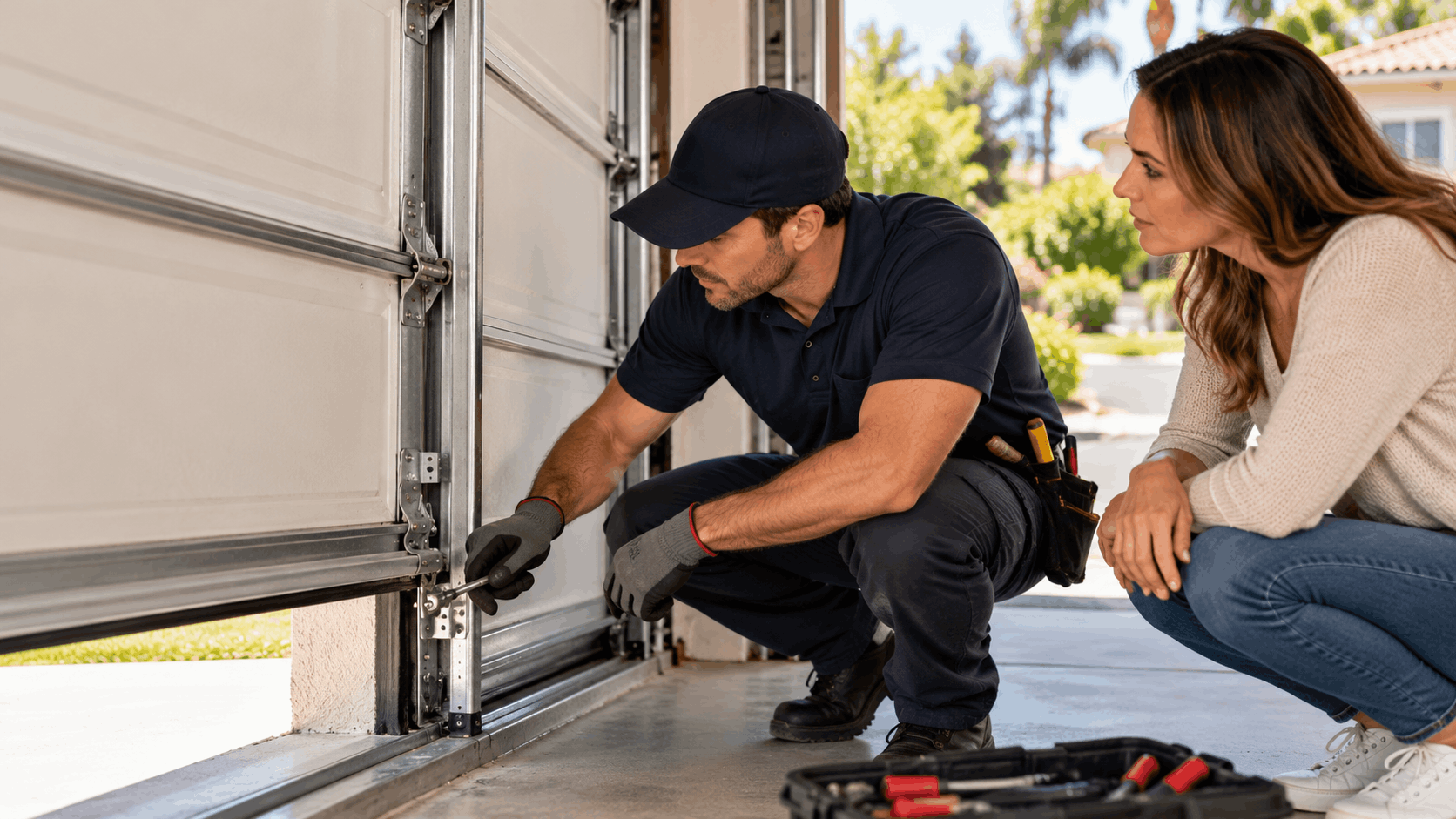
The fix is to reseat the door, straighten or replace any bent track section, and confirm the rollers run freely. Our off-track door repair also checks the cause, because a door that jumped the track from a broken cable needs that cable addressed too.
Worn Rollers, Hinges and Bearings
Rollers, hinges and bearings wear alongside the springs because they move every time the door does. Worn rollers develop flat spots or loose bearings, hinges loosen and bend, and the whole door starts to sound rough and run unevenly. Inspectors note a noisy or binding door because those sounds point to hardware near the end of its service.
Worn hardware is more than a noise complaint. A failing roller can bind enough to pull the door out of true, and a loose hinge stresses the panel it connects. Left alone, worn rollers and hinges accelerate wear on the parts around them.
In South Coast Metro, where many condos and townhomes have living space directly above the garage, noise is a real quality-of-life issue. A rumbling door at 6 a.m. carries straight into the bedroom overhead.
That is where a quiet roller and hardware upgrade pays off. Swapping worn steel rollers for quieter nylon ones and replacing tired hinges returns the door to smooth, quiet travel and clears the noise flag on the report.
Dented or Damaged Panels
A dented panel is a common cosmetic and structural flag. The question an inspection raises is whether a single panel can be replaced or whether the door has reached the end of its life. A single dented section on an otherwise sound door is often a straightforward swap.
Panel replacement works best when the door model is still available and the rest of the door is in good shape. The replacement section matches the existing panels and restores both the look and the structure. For one damaged panel on a recent door, this is the economical choice.
The calculus changes when the door is old, the panels are weathered, or multiple sections are damaged. Finding a matching panel for a discontinued door is difficult, and a mismatched section stands out on a street-facing garage. At that point the cost of chasing panels approaches a new door.
For the negotiation, this matters. A single panel replacement is a small line item, while a full door is a larger one. Knowing which applies lets a buyer and seller settle the garage door credit fairly.
One-Piece Tilt-Ups in Older Garages
Some older Costa Mesa garages still carry one-piece tilt-up doors. These are a different product from the sectional doors common today, and they use different hardware. A tilt-up swings out and up as a single slab, where a sectional door bends over a curved track in panels.
A report may flag a tilt-up for upgrade rather than a specific fault. The hardware is older, parts can be harder to source, and the swing-out motion needs clearance in front of the door. For a buyer, that note is a heads-up that the door is of an earlier generation.
Tilt-ups are more common in pre-1960s garages, and a share of Eastside and Westside properties still have them. They work, but they lack the features and the easy parts supply of a modern sectional.
When a tilt-up reaches the point of frequent repair, the usual path is conversion to a sectional garage door. That brings modern hardware, easier future service and the clearance of a door that lifts straight up rather than swinging out.
Battery Backup: The Opener Requirement Buyers See on Reports
A battery backup flag confuses many buyers because it sounds like an optional feature. It is not. California law requires battery backup on residential openers sold or installed since mid-2019, and a replaced opener without it is out of compliance. Here is the one law that governs it, with its real dates.
Getting this right matters because the rule is often blamed on the wrong code. Battery backup comes from a single statute, SB 969, and nothing else. It is not an energy-code item and not a local fire rule.
What SB 969 Requires
Since 1 July 2019, SB 969 has required a battery backup on every residential garage door opener manufactured for sale, sold, offered for sale or installed in California. The battery backup is designed to operate the door during an electrical outage. Violations carry a $1,000 civil penalty.
The law also states that a replacement residential garage door may not be installed connected to an opener that does not comply. So pairing a brand-new door with an old, non-compliant opener is not allowed.
SB 969 followed the 2017 Northern California wildfires, where people could not open their garage doors during power cuts and could not evacuate. The battery backup exists so a resident can still raise the door when the grid is down.
For a Costa Mesa sale, this means a battery backup installation is part of bringing a replaced opener up to the standard the law sets. It is a legal requirement, not a feature to debate.
Why It Comes Up in a Sale
The rule applies to installation and replacement, so the moment anyone replaces the opener, they are getting a battery backup unit as a matter of law. A buyer or seller installing a new opener as part of the sale is buying a compliant unit whether or not they asked for one.
That is why it surfaces during a transaction. An inspection may note that a recently replaced opener lacks battery backup, or a seller replacing a failed opener before listing finds the new unit includes it. Either way, the compliance point is tied to the install.
The flip side is just as important. SB 969 does not force an owner to upgrade an opener that is simply sitting there working. An older opener left in place is not required to be retrofitted.
So the practical reading is simple: leave a working opener alone and there is no obligation, but the day it gets replaced, the replacement opener must comply. In a home sale, replacements happen often enough that buyers see it on reports regularly.
Not a Fire-Zone Rule or a Paid Upgrade
Battery backup is statewide and residential. It is not a Costa Mesa ordinance, not an association rule and not something that applies only in a fire zone. It applies to residential openers everywhere in California, not commercial ones.
It is also not an upgrade tier a contractor sells on top of the opener. Because the law requires it on any opener sold or installed since 1 July 2019, a compliant opener includes it. Presenting it as an extra-cost option would misread the law.
The confusion usually comes from mixing it up with the energy code or a local wildfire measure. SB 969 is its own law, passed in response to a specific event, and it stands alone.
For budgeting, battery backup installation runs a typical $200 to $400 in Orange County as a range. On a new opener it is already built in, so that range applies mainly when adding backup capability to a setup that needs it.
Need Help in Irvine?
Urgent Garage Doors serves Irvine and all of Orange County.
Typical Costs for the Repairs Buyers Request
Cost is the first question after a report lands, so here are the typical Orange County ranges for the garage door repairs that show up most on Costa Mesa inspection reports. These are typical market ranges for the area, not a quote or a fixed price. The actual price for a specific garage depends on that garage and is given in writing before work begins.
| Repair | Typical Range |
|---|---|
| Torsion spring replacement | $150 to $300 |
| Extension spring replacement | $150 to $250 |
| Spring conversion | $150 to $350 |
| Cable repair | $150 to $300 |
| Safety sensor alignment and repair | $75 to $150 |
| Opener repair | $75 to $200 |
| Opener installation | $250 to $600 |
| Battery backup installation | $200 to $400 |
| Keypad and remote programming | $45 to $85 |
| Off-track door repair | $125 to $275 |
| Track repair and realignment | $125 to $300 |
| Panel replacement | $250 to $800 per panel |
| Door balancing and tension adjustment | $75 to $150 |
| Quiet roller and hardware upgrade | $150 to $300 |
Springs and Cables
Spring and cable work is the most common repair request on these reports, and the ranges are approachable. Torsion spring replacement is a typical $150 to $300, and extension spring replacement runs $150 to $250 in the area.
If a door is being moved from an extension setup to a torsion system, spring conversion is a typical $150 to $350. Cable repair, for the frayed or corroded cables common on the west side, runs $150 to $300.
Remember that cables and springs are often addressed together, since replacing a spring without inspecting cables invites a second failure. Doing both in one visit is usually the better value even when only one was flagged.
These are typical ranges for Orange County. The written price for a specific door is given before any work starts.
Sensors, Openers and Battery Backup
Sensor and opener items are often the cheapest on a report. Safety sensor alignment and repair is a typical $75 to $150, which covers the common reversing-door fix of squaring and cleaning the photo eyes.
Opener repair runs $75 to $200, while a full opener installation is $250 to $600, with belt drive costing more than chain drive. For the older pre-1993 units that need replacing rather than repairing, the installation range is what applies.
Battery backup installation is a typical $200 to $400, and keypad and remote programming runs $45 to $85. On a new compliant opener the battery backup is already included.
These ranges help a buyer price a report line by line before negotiating a credit with the seller.
Tracks, Panels and Balancing
Track and panel work covers the mechanical flags. Off-track door repair is a typical $125 to $275, and track repair and realignment runs $125 to $300.
Panel replacement is $250 to $800 per panel, which is why the single-panel-versus-whole-door decision matters so much to the total. A door balancing and tension adjustment is a typical $75 to $150.
For the noisy condos in South Coast Metro, a quiet roller and hardware upgrade runs $150 to $300 and often clears a noise flag at the same time it smooths the door's travel.
Each of these is a defined repair with a known range, which makes a mechanical flag easier to settle in escrow.
When a Full Door Replacement Makes More Sense
When repair costs stack up, or the door is old and weathered, replacement can be the better value. A sectional garage door replacement is a typical $800 to $2,500, and an insulated steel garage door runs $900 to $2,500 in the area.
A carriage-house garage door is a typical $1,200 to $4,500, for buyers who want a specific street-facing look. These ranges are worth weighing against a stack of per-panel and hardware repairs on a tired door.
A real advantage of replacement is what is included. Removal and haul-away of the old door is part of a new door installation, so the old slab does not become the buyer's problem.
Our team provides a free on-site estimate for a new garage door installation, which lets a buyer compare the repair total against a replacement before deciding.
Permits, Associations and Licensing in Costa Mesa
Before any repair goes ahead, a buyer or seller should know the approval and licensing points that apply to a Costa Mesa address. These decide who can do the work and whether a permit or an association sign-off is needed first. Getting the order right avoids a job being redone or torn out.
Two caveats stand out here and should be confirmed for the specific property: whether a permit applies, and which city actually has jurisdiction over the parcel.
When a Permit Applies
For addresses inside the city, permits, plan check and inspections run through the City of Costa Mesa building division. Whether a door or opener replacement needs a permit is confirmed for the specific address, because the answer depends on the scope of work.
A like-for-like replacement that alters no structure generally does not trigger a permit. Swapping a worn door for a new one in the same opening, without touching the framing, is usually a straightforward job.
Altering the opening or the header is what changes that. Widening the opening or modifying the structural header is the kind of work that generally triggers a permit, since it affects the building's structure.
The safe approach is to let the Costa Mesa building division confirm the position for the job at hand. It also matters for licensing, because a permitted job loses the unlicensed-work exemption regardless of size.
The Santa Ana Heights Jurisdiction Trap
Santa Ana Heights, the area between Upper Newport Bay, Santa Ana Avenue, Bristol Street and Bayview Terrace near John Wayne Airport, is commonly listed as a Costa Mesa area. For permits, that listing can be misleading.
Permits there run through the City of Newport Beach or whichever jurisdiction the parcel record shows. The postal town does not decide the permitting authority; the parcel does.
This matters because a permit pulled from the wrong city does not cover the address. A seller who assumes Costa Mesa jurisdiction and permits accordingly could find the work is not properly authorized.
The fix is simple: confirm the authority from the parcel record, not the mailing address. For a property near the airport, that one check prevents a permit problem down the line.
Association Review on Governed Streets
Many Costa Mesa streets, especially the 1970s and 1980s attached communities in and around South Coast Metro, are governed by associations. These operate under California's Davis-Stirling Common Interest Development Act, which sets how architectural review works.
Architectural review typically covers the door's style, panel design, color and visible hardware. A new door on a governed street usually needs written approval before it goes in, so the association can confirm the look fits the community standard.
The order of operations is firm: approval before the order. A door fitted without the required approval can be ordered removed at the owner's cost, which turns a straightforward replacement into an expensive do-over.
For a buyer, this means a cosmetic door change in a governed community runs on the association's timeline as well as the contractor's. Starting the approval early keeps a sale from stalling on a door.
The Right License for the Work
Garage door work in California is licensed under CSLB classification C-61/D-28, Doors, Gates and Activating Devices. That classification covers sectional and rolling doors, torsion and extension spring systems, operators, control boards, safety sensors and activating devices.
A point that trips up buyers: C-28 is Lock and Security Equipment, and it is not the garage door license. Garage door work is not a Class B general building job either. The correct classification is C-61/D-28, and any license can be verified free at cslb.ca.gov, where classification, status, bond and workers compensation are all public record. Urgent Garage Doors holds California license #1055150.
The unlicensed-work exemption in Business and Professions Code section 7048 was raised from $500 to $1,000 by AB 2622, effective 1 January 2025. That exemption also fails if the work requires a building permit of any kind or if the person employs anyone on the job.
So a permitted job goes to a licensed contractor whatever its size. A separate rule is often confused with this one: Business and Professions Code section 7159 requires a written home improvement contract for work over $500, which is a contract requirement, not a licensing threshold.
Need Help in Irvine?
Urgent Garage Doors serves Irvine and all of Orange County.
How Urgent Garage Doors Handles Inspection Repairs
When a Costa Mesa buyer or seller hands us an inspection report, we work it as a list rather than guessing at one problem. Each flagged item gets checked, diagnosed and priced so nothing on the report is left hanging when escrow closes. Here is how that goes.
- We work across every Costa Mesa neighborhood, from Mesa Verde and Eastside to College Park, Halecrest and South Coast Metro.
- We service all major brands, including LiftMaster, Chamberlain, Genie, Craftsman, Clopay, Amarr, Wayne Dalton and CHI.
- We hold California license #1055150, verifiable free at cslb.ca.gov.
Working the Report Item by Item
We start at the top of the report and check each flag against what the door is actually doing. The photo-eye alignment and the auto-reverse get tested the same way an inspector tests them, then we move to the springs, cables and tracks.
When spring work is on the list, we inspect the cables in the same visit. Replacing a spring without checking the cables is how a second failure follows weeks later, and on west-side homes near the water those cables are often the next thing to go.
Our trucks carry common torsion spring sizes, so a spring replacement is often completed on the same visit rather than waiting on a parts order. We cannot promise every replacement finishes on the first trip, but carrying the common sizes means many do.
- Test the photo eyes and the contact reverse against the two-second standard.
- Run the balance test to separate a spring problem from an opener problem.
- Inspect cables, rollers, hinges and bearings alongside any spring work.
A Written Price and a Free Estimate for New Doors
A written price is available before work begins, so a buyer or seller knows the number ahead of the job. That is also a legal point on larger work: Business and Professions Code section 7159 requires a written home improvement contract for work over $500.
For a new garage door installation, we offer a free on-site estimate. That lets a buyer compare a stack of repairs against the cost of a replacement before deciding which way to go.
Removal and haul-away of the old door is included in a new door installation. The old slab leaves with us rather than sitting in the driveway during the sale.
- Written price available before work starts.
- Free on-site estimate for new door installs.
- Old door removed and hauled away with a new installation.
Response Window and 24/7 Availability
Sale timelines are tight, and a flagged door should not be the thing that delays a closing. We take emergency calls 24 hours a day, 7 days a week, every day of the year including holidays.
Our emergency response is 30 to 60 minutes anywhere in Orange County, which matters when a report lands days before a closing date. Our storefront is at 76 Ashford in Irvine, and we cover Costa Mesa from there.
We work on all major brands, so whatever opener or door the home has, we can diagnose and repair it.
- 24/7 emergency calls, including holidays.
- 30 to 60 minute response across Orange County.
- Irvine storefront at 76 Ashford, serving all of Costa Mesa.
Clearing the Garage Door Off Your Report
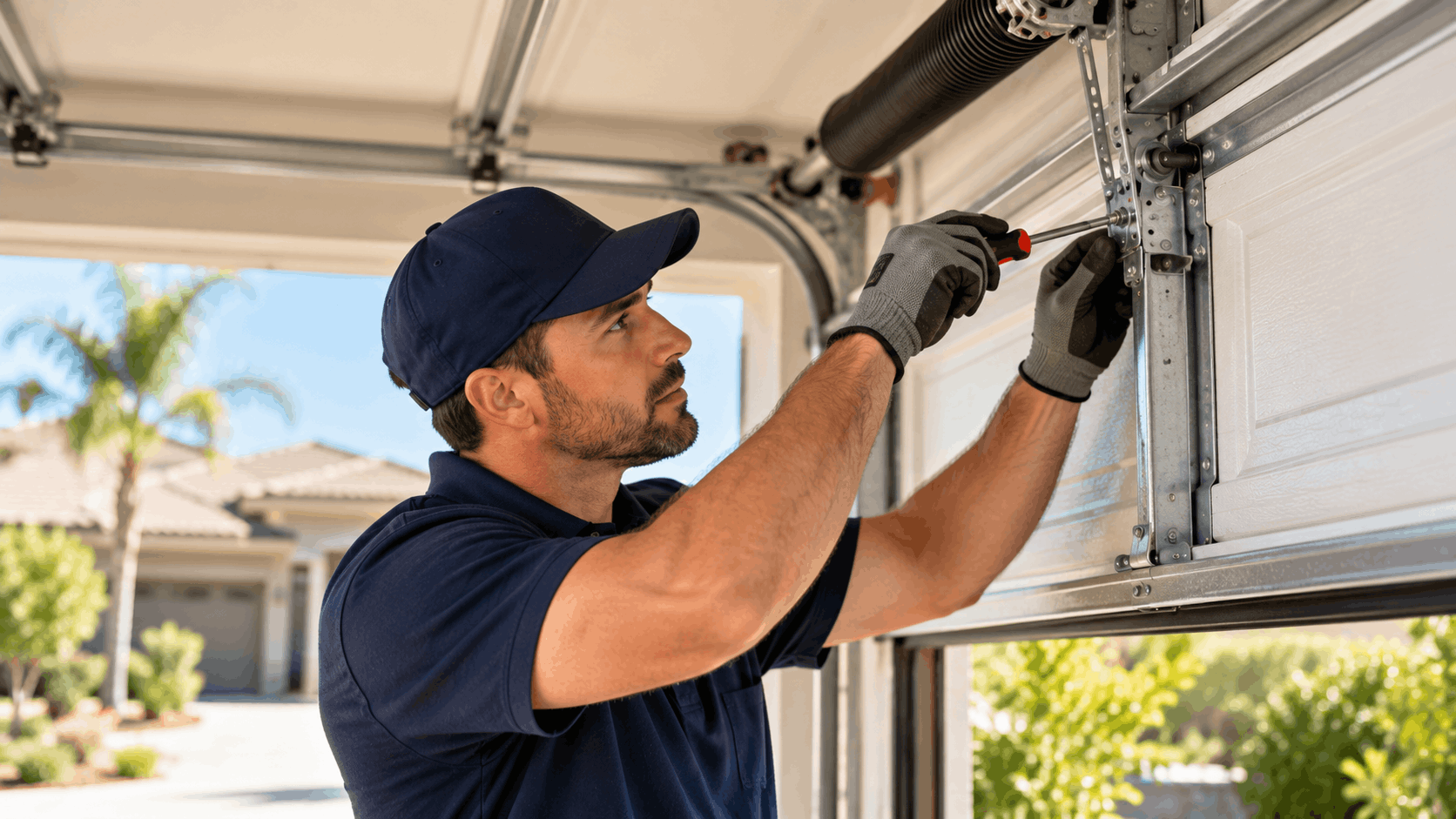
A flagged garage door rarely needs to hold up a Costa Mesa sale. Our team checks each item on the report, gives you a written price before work begins, and often finishes spring and sensor repairs in a single visit thanks to the common sizes on our trucks.
Call Urgent Garage Doors at (949) 529-7743 to get on the schedule before your closing date, with 24/7 emergency calls and a 30 to 60 minute response across Orange County.
Frequently Asked Questions
- What garage door repairs show up most on a Costa Mesa inspection report?
- The common flags are photo-eye and auto-reverse failures, worn or broken springs, frayed cables, doors off the track, dented or damaged panels, and a replaced opener missing battery backup. On west-side homes near the water, corroded cables and springs appear more often, while inland homes with wood doors show sticking panels and binding tracks from seasonal temperature swing. Each of these maps to a defined repair with a typical price range.
- Does my old opener need battery backup to pass?
- An opener simply left in place is not forced to upgrade. SB 969 does not require retrofitting a working opener that is sitting there. The rule applies to installation and replacement, so any opener sold or installed on or after 1 July 2019 must have battery backup, carrying a $1,000 civil penalty. If the opener is being replaced as part of the sale, the new unit must comply and will include battery backup.
- My opener was made before 1993. Is it a problem?
- A pre-1993 opener predates the federal entrapment-protection mandate, and it may have no external photo eyes at all. It is not illegal to own, but it lacks the protection every modern opener provides. The manufacturer position, LiftMaster being one example, is that pre-1993 openers should be replaced rather than repaired. Replacing it clears the missing-sensor flag and, in California, brings battery backup with the new unit.
- How much does a spring replacement cost in Costa Mesa?
- Typical Orange County ranges are torsion spring replacement $150 to $300 and extension spring replacement $150 to $250. Springs are sized to the actual weight and height of the door, so the exact figure depends on the door. A written price is given before work begins. Because cables wear alongside springs, we inspect them during the same visit so a second failure does not follow weeks later, especially on west-side homes.
- Why does the door reverse when nothing is in the way?
- The most common cause is a photo-eye fault: the two sensors are out of alignment, or the lens is blocked by dust, plant debris or grit. A coated or misaligned eye breaks the beam, and the opener reads it as a blocked path and reverses. Safety sensor alignment and repair runs a typical $75 to $150 in the area, which covers squaring the sensors, cleaning the lenses and confirming the beam.
- Can I test the door myself before the inspection?
- Yes, three checks are safe for anyone. For the photo eyes, wave an object through the beam near the floor while the door closes and confirm it stops and reverses. For contact reverse, lay a flat 2x4 across the opening and confirm the door reverses within two seconds of touching it. For balance, pull the release cord, lift the door to waist height and see if it holds. Springs are never a DIY item.
- Do I need a permit to replace the garage door in Costa Mesa?
- For addresses inside the city, a like-for-like replacement that alters no structure generally does not need a permit, while altering the opening or the header generally does. Permits, plan check and inspections run through the City of Costa Mesa building division, and they confirm the position for the specific address. Confirm it before the job, because a permitted job also loses the under-$1,000 unlicensed-work exemption and must go to a licensed contractor.
- My home is listed as Costa Mesa but near the airport. Who issues the permit?
- That is the Santa Ana Heights jurisdiction trap. The area near John Wayne Airport is commonly listed as Costa Mesa, but permits run through the City of Newport Beach or whichever jurisdiction the parcel record shows. The postal town does not decide the authority. Confirm it from the parcel record, because a permit pulled from the wrong city does not cover the address.
- Who is licensed to do this work in California?
- Garage door work is licensed under CSLB classification C-61/D-28, Doors, Gates and Activating Devices, which covers sectional and rolling doors, spring systems, operators, control boards, safety sensors and activating devices. C-28 is Lock and Security Equipment and is not the garage door license, nor is a Class B general building license. Any license can be verified free at cslb.ca.gov, where classification, status, bond and workers compensation are public record.
- How fast can someone come out before my closing date?
- We take emergency calls 24 hours a day, 7 days a week, every day of the year including holidays, with a 30 to 60 minute response anywhere in Orange County. That window matters when a report lands days before closing. Because our trucks carry common torsion spring sizes, many repairs finish on the same visit, though we cannot promise every job completes on the first trip.
Licensed garage door repair professionals serving Irvine and Orange County.
Licensed in California · License #1055150
Why trust Urgent Garage Doors?
Founded in 2017, Urgent Garage Doors is a licensed and insured garage door services serving Irvine and Orange County. All content is reviewed by our licensed technicians.

Need Help in Irvine?
Urgent Garage Doors serves Irvine and all of Orange County.
Related Articles
The 19th Street and Triangle Pockets: Garage Door Access on Costa Mesa's Busiest Blocks
Garage door access, build era and the west-side marine layer shape door work on Costa Mesa's busiest blocks near 19th Street and the Triangle. Costs, rules and fixes.
Garage Doors That Suit Mesa Verde's Mid-Century Open-Beam Homes
Flush and long-panel doors suit Mesa Verde's mid-century open-beam homes. A guide to door styles, sixty-year-old hardware, opener safety law, permits and cost in Costa Mesa.
The Orange County Garage Door Guide by Home Era: 1950s Tract, 70s-80s South County, 90s Irvine, 2010s Great Park
A garage door guide for Orange County by home era - 1950s tract homes, 70s-80s South County, 90s Irvine villages, and 2010s Great Park builds.