Garage Doors That Suit Mesa Verde's Mid-Century Open-Beam Homes
Key Takeaways
- Flush, long-panel, and modern glass-and-aluminum doors suit Mesa Verde's low, horizontal open-beam homes, while raised-panel doors with decorative hardware read wrong on these 1960s elevations.
- Match the door to the home's current remodeled frontage, not the original 1960s look, because many Mesa Verde homes have been changed over sixty years.
- Springs are sized to the actual door weight, so a heavier new door needs matched springs, and sixty-year-old springs, cables, rollers and hinges are past design life and should be inspected together.
- A 1960s original opener predates the January 1, 1993 federal entrapment protection rule and has no photo eyes; any opener installed or replaced since July 1, 2019 must have battery backup under SB 969.
- A standard torsion spring is rated around 10,000 cycles, roughly seven years at four cycles a day, and an owner must never adjust or replace one themselves.
- HOA review in Mesa Verde tracts does not replace a Costa Mesa city permit; the city with jurisdiction confirms the permit position for the specific address, and western Costa Mesa lots near the Santa Ana River may fall in a FEMA flood zone.
- Garage door work requires CSLB classification C-61/D-28, not C-28; verify any contractor free at cslb.ca.gov. Urgent Garage Doors holds California license #1055150.
- Typical Orange County ranges run from $150 to $300 for a torsion spring to $800 to $4,500 for most new doors; the actual price is given in writing before work begins.
In This Article
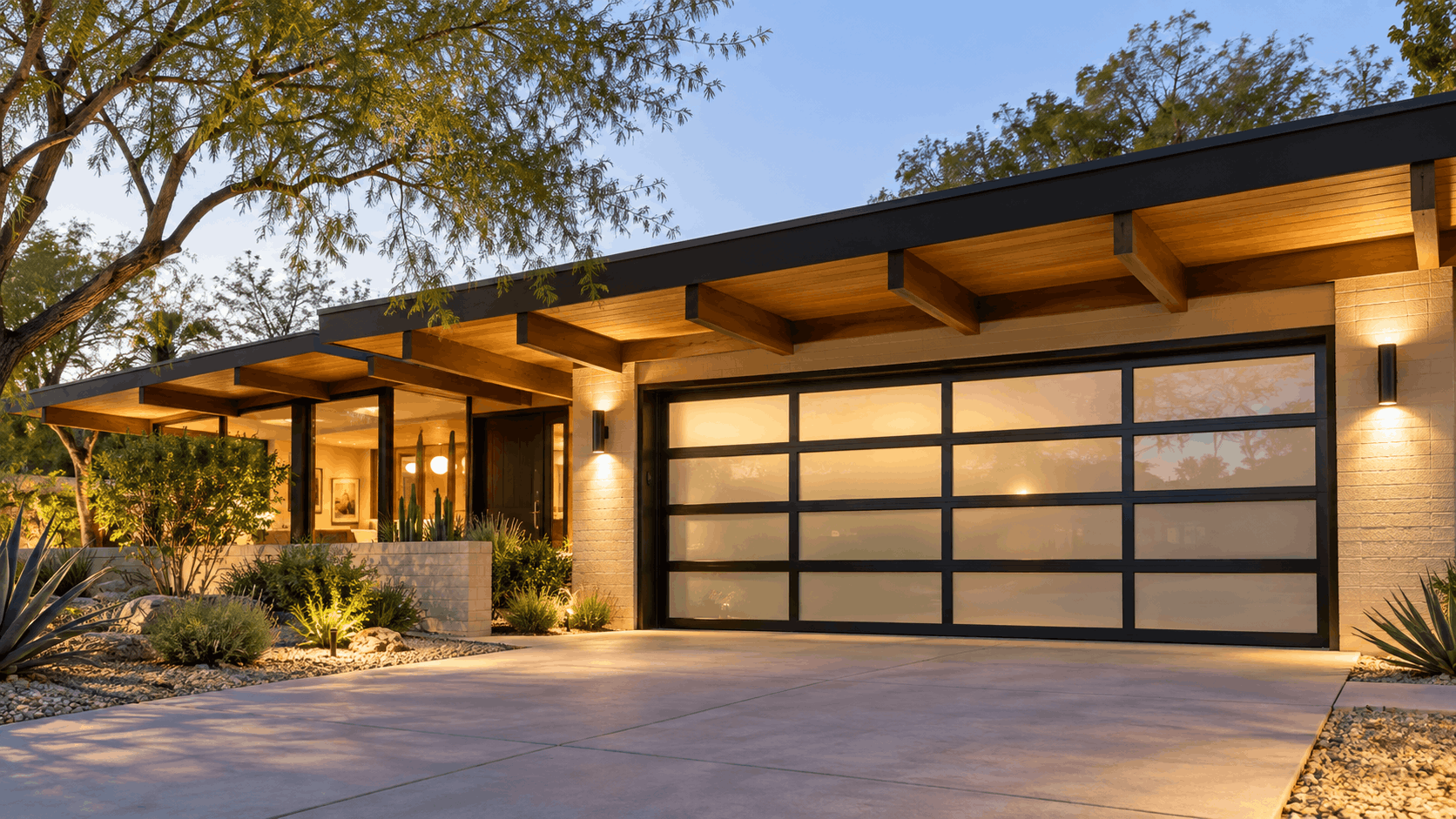
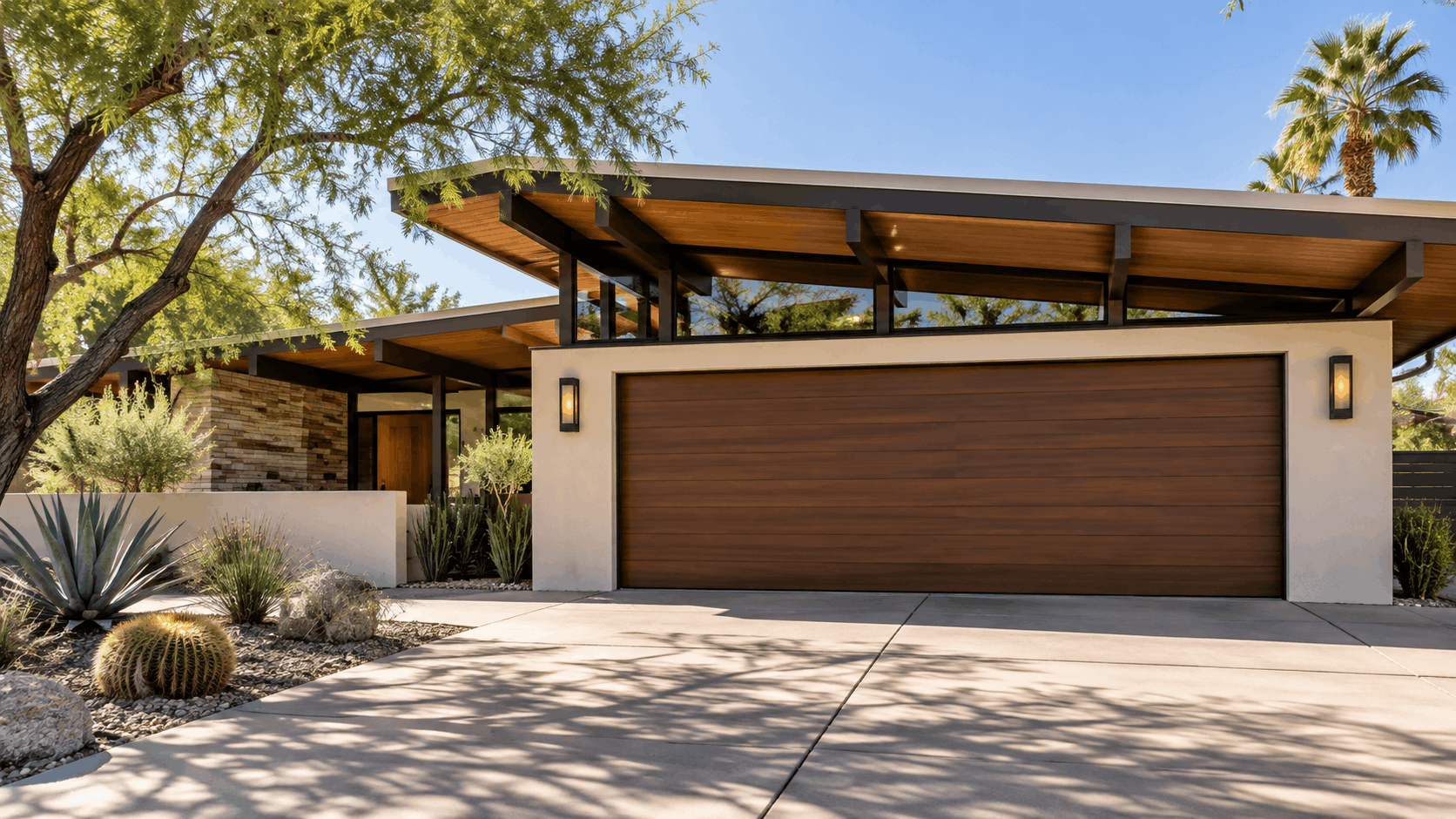
Drive the curving streets around Mesa Verde Drive, past the country club golf course, and you see the same shape over and over: a long, low home that sits close to the ground, with the garage door taking up a big slice of the front. On a single-story, open-beam house from the early 1960s, that door is not a small detail. It is one of the largest flat surfaces a person sees from the curb, so the style on it either belongs to the house or fights it.
That is why door selection on these homes deserves more thought than a two-story colonial would need. The wrong profile stands out immediately on a wide, horizontal frontage, while the right one disappears into the architecture and lets the house read the way the original builder intended. Mesa Verde's mid-century tracts have been remodeled for sixty years, so the front you are matching today may not be the front from 1960.
Why Door Choice Matters More on a Mesa Verde Home?
A mid-century garage door is doing more visual work than it does almost anywhere else in Costa Mesa. Mesa Verde sits on the west side of the city around the private Mesa Verde Country Club course, and it is the city's mid-century tract neighborhood, known for open-beam layouts and a long history of remodeling. The lots are generous by Costa Mesa standards, and most homes have real driveways with attached front-facing garages.
That setup makes access easy for the installer, but it also puts the door front and center. On these open-beam homes the garage is often the single biggest element of the street-facing elevation, so a door that clashes with the architecture is impossible to ignore. Getting the choice right is the difference between a frontage that looks finished and one that looks patched.
What Open-Beam Mid-Century Homes Look Like Here
Mesa Verde's 1960s tracts around the country club share a common vocabulary. The homes run low and wide, with strong horizontal lines and a flat or low-pitch roof that keeps the whole profile close to the ground. Open-beam interiors often carry that same horizontal logic through to the ceilings.
This is a deliberate mid-century look, not an accident of age. The design leans on long, clean lines and simple planes rather than vertical emphasis or heavy ornament. The eye travels sideways across the frontage, not up.
Because the roof sits low and the elevation spreads wide, every element on the face has to agree with that horizontal direction. A tall, busy, vertically broken-up door interrupts the line the whole house is built around. The architecture sets the rules, and the door has to follow them.
Many of these homes sit on curving streets rather than a grid, which changes how the frontage is seen. A door is often viewed at an angle as someone approaches, which makes a clean, uninterrupted surface read better than a fussy one.
The Door Is a Big Part of the Frontage
On a two-story house the garage is one feature among several, with a second floor, more windows and more wall above and around it. On a single-story Mesa Verde home there is no second floor to balance it out. The door can occupy a large share of the entire face.
That proportion is the whole reason style matters more here. When a surface is that large relative to the house, any mismatch is magnified. A door that would pass unnoticed on a big two-story elevation becomes the first thing a visitor sees on a low-slung mid-century home.
The flip side is good news. Get the door right and it does real work for the whole house, carrying the horizontal line and reinforcing the clean mid-century look. A well-chosen door on one of these homes improves the frontage far more than it would on a taller house.
This is also why a cheap, generic choice shows so clearly on these streets. The door is simply too prominent to hide a poor fit behind landscaping or trim.
Why Raised-Panel Doors Read Wrong
The default garage door in most of America is a short raised-panel steel door, often dressed up with decorative strap hardware and faux handles. On a traditional or Spanish-style home that can work fine. On a mid-century open-beam home it reads wrong, in the same way it would on an Eichler.
The problem is the grid of small raised rectangles. It breaks the surface into busy little boxes that fight the long horizontal lines the house is built on. The decorative hardware adds another layer of visual clutter that has nothing to do with mid-century design.
Mid-century architecture favors simple planes and clean lines, so a door covered in traditional detailing looks bolted on from a different era. It is a common mismatch on remodeled tracts, where an owner replaces a failed door with whatever the big-box store had in stock and ends up with a profile that does not belong.
The fix is to choose a door whose face follows the architecture rather than decorating against it. Flush and long-panel designs do exactly that, which is why they suit these homes.
Match the Door to the Current Elevation, Not 1960
Mesa Verde's original tracts are 1960s, but very few of these homes look exactly as they did when they were built. Many have been remodeled or extended over sixty years, sometimes several times, so the front elevation today may be quite different from the original.
That matters for door selection because you are matching the door to the house as it stands now, not to a 1960s photo. A home that was reclad, re-windowed or extended may call for a slightly different door than the original builder would have hung. The honest first step is to look at what the front of the house actually looks like today.
We ask owners to describe or show the current frontage rather than assume the door should match a generic 1960s template. A remodel that leaned modern wants a different door than one that stayed close to the original ranch look. The door should agree with the elevation in front of it.
This is where a garage door installation conversation starts with the house, not the catalog. The right choice follows the frontage you have now.
Get Your Free Quote
Tell us about your garage door and we'll get back to you within 30 to 60 minutes.
Door Styles That Suit the Architecture
A few door families fit mid-century open-beam homes well, and the common thread is that they carry the low, horizontal look rather than breaking it up. Flush and long-panel designs lead the list, with modern glass and aluminum doors a strong option where the elevation suits them. The table below summarizes the fit.
| Door Style | Why It Fits Mid-Century Homes | Watch For |
|---|---|---|
| Flush panel | Smooth, uninterrupted surface carries the horizontal line | Shows dents on a prominent frontage |
| Long-panel | Wide horizontal sections echo the low elevation | Match section proportion to the opening width |
| Modern glass and aluminum | Clean frame and glass read as mid-century | Choose frosted or clear glass to suit privacy |
| Insulated steel | Durable, available in flush and long-panel faces | Heavier, so springs must be sized to the door |
Flush and Long-Panel Designs
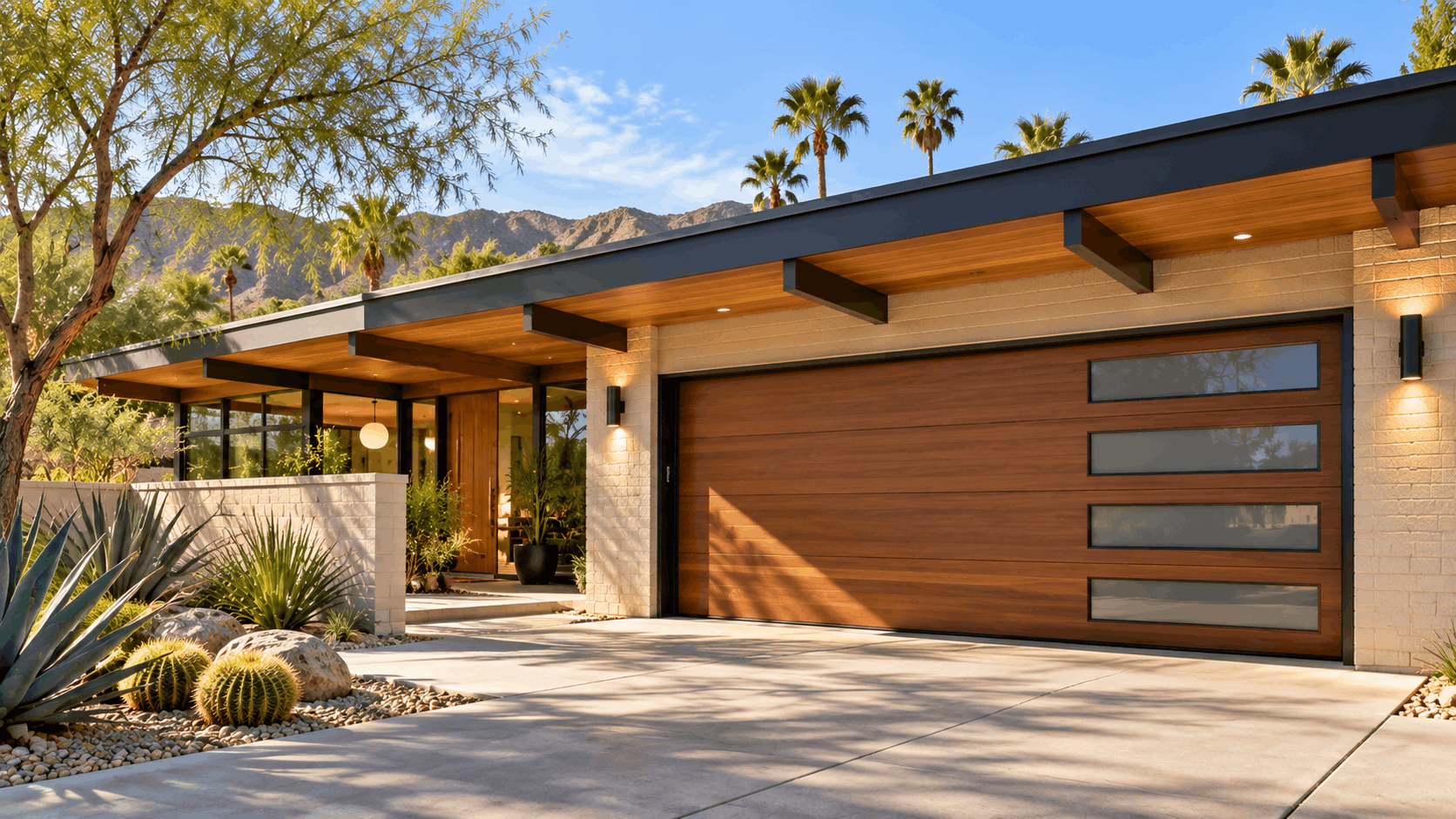
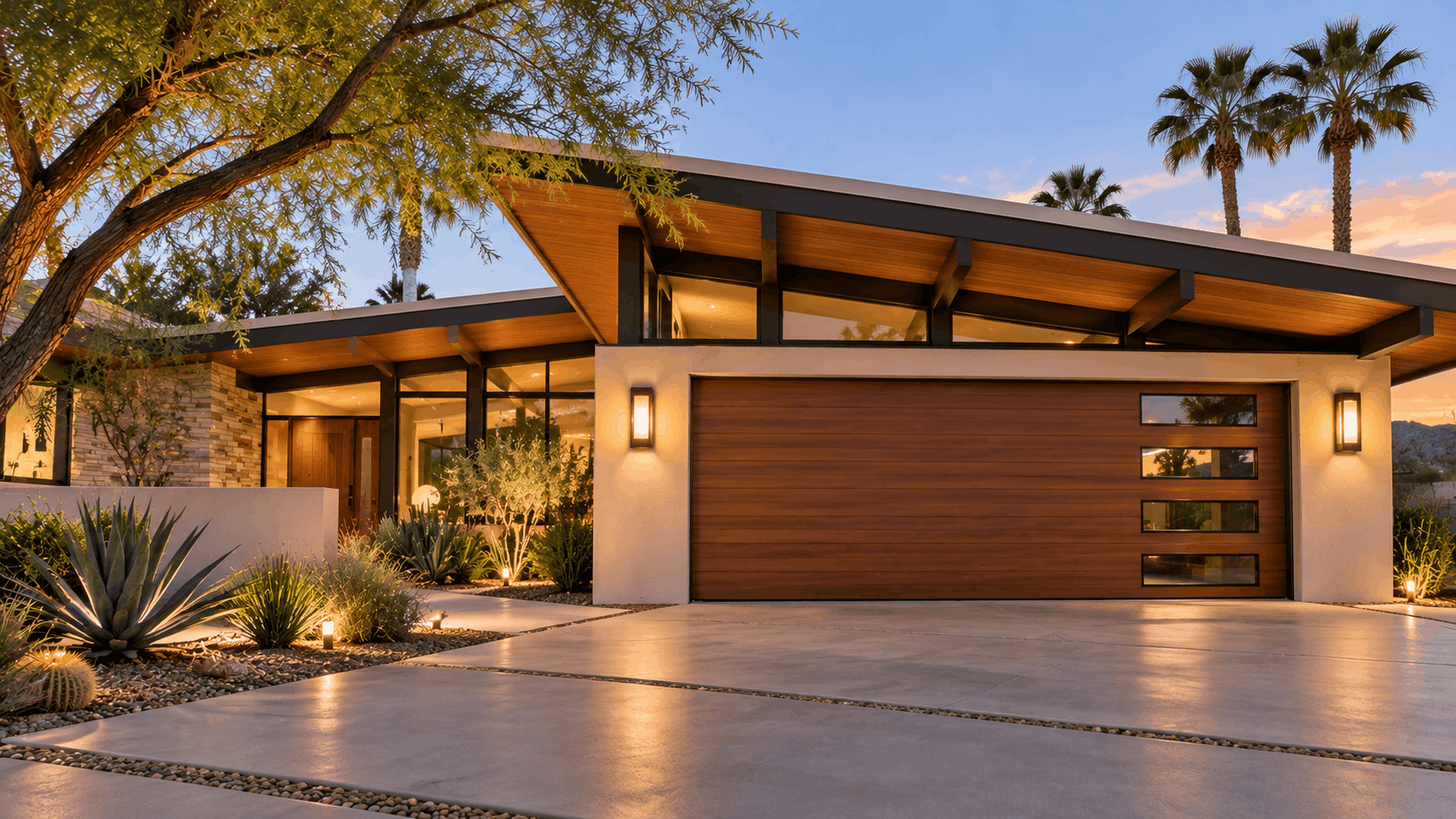
A flush door has a smooth, nearly flat face with no raised boxes. That clean plane is exactly what a mid-century frontage wants, because it carries the horizontal line across the opening without visual clutter. It is the closest thing to a blank, modern surface a garage door offers.
Long-panel doors use wide horizontal sections rather than a grid of small squares. Those long bands echo the low, wide proportions of the house and keep the eye moving sideways. On a low-pitch mid-century elevation that horizontal emphasis looks correct.
Both designs avoid the busy detailing that makes a raised-panel door look out of place. The simplicity is the point, not a compromise. These are the profiles that let a prominent door blend into the architecture instead of shouting over it.
When we spec one of these for a Mesa Verde home, the section proportion matters. On a wide opening the panel height and the number of horizontal bands should be chosen so the door reads balanced across the span, not stretched or squashed.
Glass and Aluminum Options
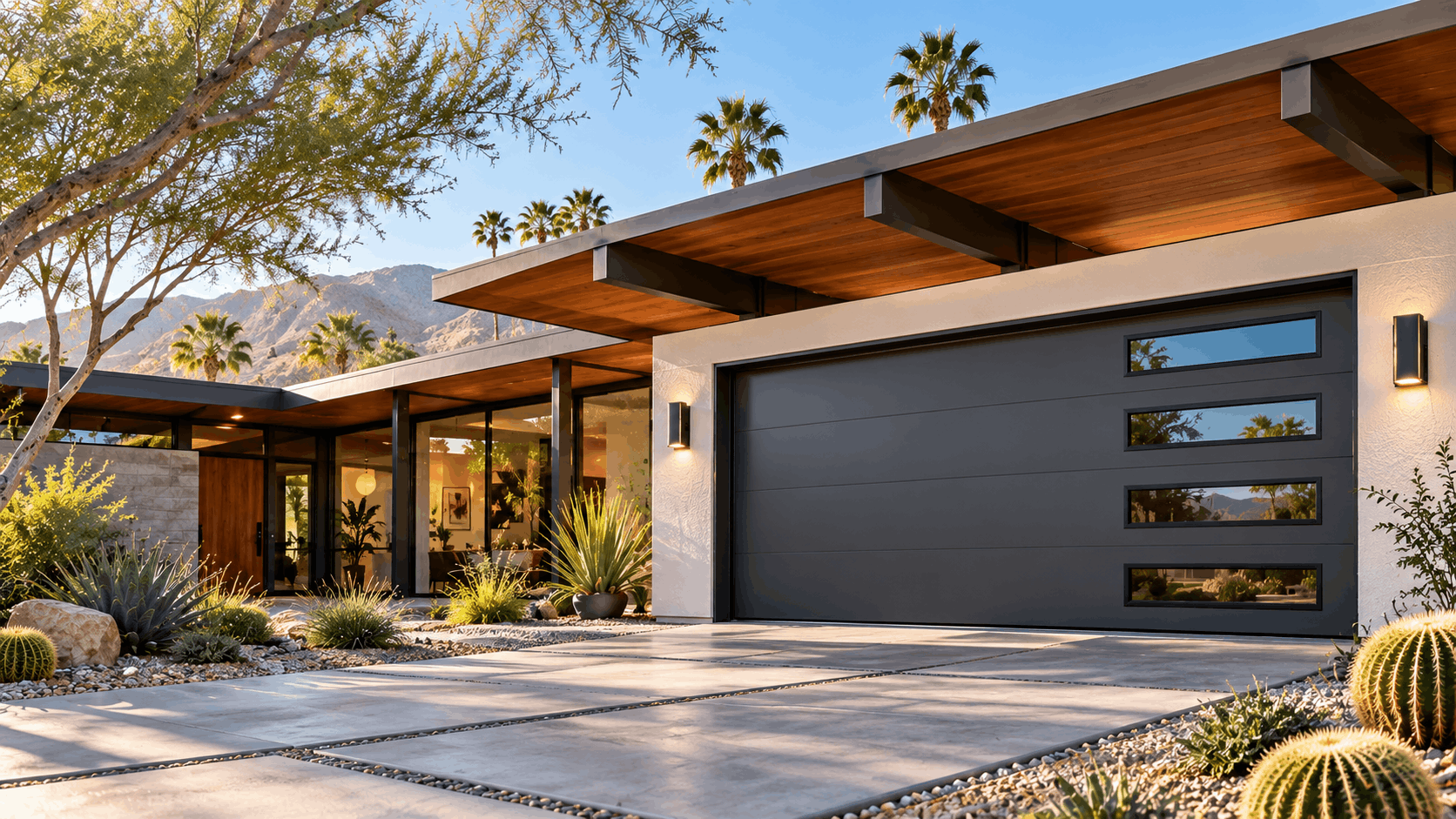
A modern glass garage door is one of the strongest fits for mid-century design. The slim aluminum frame and the glazed panels read as clean and contemporary, which agrees with the open-beam look. Full-view aluminum and glass doors suit the architecture better than almost any other style.
The glass itself is the main decision. Clear glass brings light into the garage and shows the most modern face, while frosted or tinted glass keeps the clean look without putting the garage interior on display. The right choice depends on the elevation and how much the owner wants to see in.
Aluminum frames are light and resist corrosion, which suits Mesa Verde's milder inland position well away from the sand. The trade-off is that glass panels can break, which matters on homes fronting the golf course where a stray ball can find an insert.
Where privacy or heat is a concern, frosted or insulated glass addresses it without abandoning the mid-century aesthetic. The frame does the architectural work and the glass choice fine-tunes the result.
Material Choices and Weight
Insulated steel is a practical material that comes in both flush and long-panel faces, so an owner can get the mid-century look with better durability and an R-value where the garage is conditioned or shares a wall with living space. An insulated steel garage door suits owners who want low maintenance and a solid door.
The important mechanical point applies to every material. Springs are sized to the actual weight and height of the door. A heavier material, a thicker insulated door or a full glass-and-aluminum unit changes the weight the springs have to balance.
That means you cannot simply reuse the old spring set when you hang a heavier door. Springs matched to the new door are part of the job, not an afterthought. Reusing undersized springs leaves the door unbalanced and burns through the spring life faster.
When we quote a new door we weigh the choice against the opening and spec the springs to it. That is the only way the door opens smoothly and the hardware lasts the way it should.
Wider Openings on Mid-Century Garages
Mesa Verde's mid-century garages often have wider openings than newer tract homes. A wider opening means a physically larger, heavier door, and that weight drives the spring sizing even harder. A wide door needs springs rated to balance the real load across the full span.
Width also affects which styles span the opening cleanly. A long-panel or flush door reads well across a wide span because the horizontal lines carry the whole way. A busy raised-panel grid looks even more cluttered when it is stretched across a wide double opening.
The wider the door, the more the hardware has to be right. Drums, cables and the torsion bar all have to be matched to the span and the weight, not just the springs. A mismatch anywhere in that chain shows up as a door that sags, binds or runs unevenly.
Getting the sizing right on a wide mid-century opening is where experience pays off. We measure the opening, weigh the intended door and build the hardware package to suit, so the new door moves the way it should from day one.
Need Help in Irvine?
Urgent Garage Doors serves Irvine and all of Orange County.
Sixty-Year-Old Hardware Behind the Door
When a Mesa Verde owner plans a new door, the conversation cannot stop at the panels. The springs, cables, drums, track, rollers and hinges behind an original 1960s door are long past their design life. Hardware from the original build has been cycling for decades, and worn hardware behind a brand-new door is a failure waiting to happen.
Replacing the visible door while leaving sixty-year-old mechanics in place is false economy. The new door is only as reliable as the system that lifts it. A proper job inspects and replaces the worn parts alongside the door.
Springs Rated in Cycles, Not Years
A torsion spring is rated by the manufacturer in cycles, where one cycle is a full open and close. A standard residential spring is commonly rated around 10,000 cycles. That rating, not the calendar, is what determines spring life.
The math is simple. A door cycled four times a day reaches 10,000 cycles in roughly seven years. A sixty-year-old original spring is far beyond any reasonable cycle rating, which is why original springs on these homes are living on borrowed time.
High-cycle springs are available where the door is heavy or the garage is used as a main entrance and cycles many times a day. For a wide, heavy mid-century door, a higher cycle rating can be worth specifying up front. The right rating depends on the door weight and how often the household uses it.
One rule overrides everything here: an owner must never touch a torsion spring. It stores enough energy to cause serious injury and is wound under tension with bars against a fixed cone. Spring work belongs to a trained technician, and our torsion spring replacement service handles it safely.
Cables, Drums, Rollers and Track
Springs do not wear alone. The cables, drums, rollers, hinges and bearings all wear alongside them, because they are all part of the same lifting system that has been cycling for decades. When one component is at the end of its life, the others usually are too.
This is why replacing a spring without inspecting the cables invites a second failure. A technician who swaps the spring and leaves a frayed sixty-year-old cable in place sets up a callback within weeks. The whole lifting path has to be checked, not just the part that broke.
Cables in particular deserve attention. They run under tension every cycle, and a cable that has started to fray will eventually snap, dropping the door or throwing it off balance. Our garage door cable repair work catches this before it becomes an emergency.
Drums, rollers, hinges and bearings all show their age in how the door runs. Worn rollers chatter in the track, tired bearings make the door run rough, and worn drums can let cables jump. Inspecting the full set when a spring goes is the difference between one repair and two.
Discontinued Panel Profiles
A specific problem on Mesa Verde's original tracts is that replacement panels for early 1960s door profiles are frequently discontinued. The exact section pattern a sixty-year-old door used may simply no longer be manufactured. That changes the repair math.
When a single panel is damaged on an older door, the first question is whether a matching panel can still be sourced. If the profile is discontinued, a single-panel repair may be impossible because a new panel will not match the rest of the door. At that point a full replacement becomes the realistic option.
This is not a reason to default to replacement on every older door. Where the door line is still made, a panel repair saves money. Where it is not, the owner needs to know early so the budget and the decision reflect reality.
We check panel availability before recommending a path. If the profile is still produced, a panel replacement keeps costs down. If it is discontinued, we say so rather than chasing a part that no longer exists.
Golf Course Frontage and Panel Damage
Homes fronting the Mesa Verde Country Club course carry a specific exposure: stray golf ball strikes. A ball off line can dent a steel panel or break a glass insert, which is why owners along the course see panel damage that homes elsewhere do not. The insurance question often follows.
The good news is that a single damaged section can often be replaced on its own, where the door line is still manufactured. There is no need to replace the whole door for one dented or cracked panel if a matching section is available. That is a genuine cost saving worth raising before anyone quotes a full replacement.
The catch loops back to the discontinued-profile problem. On an older door with a profile that is no longer made, a single-panel fix may not be possible, and the course-side damage may push toward replacement. On a newer door the panel swap is usually straightforward.
For course-fronting homes with glass-insert doors, this is worth weighing at purchase time. A door line that stays in production longer protects the ability to do single-panel repairs down the road.
The Opener and Modern Safety Rules
A new door is also the moment to look hard at the opener. A sixty-year-old original opener predates federal entrapment protection entirely, and California has its own layered requirements that apply the moment an opener is replaced. An owner should understand what the law actually requires before the new door goes up.
These rules are not optional extras or local quirks. They are state and federal requirements tied to specific dates, and they shape what a compliant installation looks like today.
Old Openers Have No Photo Eyes
Openers of the original 1960s vintage predate the January 1, 1993 federal requirement for external entrapment protection, established under the Consumer Product Safety Improvement Act of 1990 and the CPSC rules that followed. California Health and Safety Code section 19890 has required entrapment protection sensors since that same date. A sixty-year-old Mesa Verde opener running its original equipment has no photo eyes at all.
Photo eyes are the small sensors mounted on each side of the opening, no higher than six inches off the floor. With the door closing, breaking the beam must stop and reverse the door. An original opener with no beam has nothing to catch a child, pet or object in the door's path.
California actually required auto-reverse and a sensor before the federal government did, under AB 3600 in 1990, with Congress following for openers made after 1993. The honest line for a sixty-year-old opener is that it predates all of it. Units made before 1993 simply were not built to these standards.
When a new door goes on an old opener, this is the point where we recommend addressing the opener too. A modern unit brings the external entrapment protection the original never had, and our garage door opener installation covers it.
Battery Backup Is Now the Law
SB 969, signed in 2018 and operative July 1, 2019, requires every residential automatic garage door opener sold or installed in California on or after that date to have a battery backup designed to operate during an electrical outage. Violations carry a $1,000 civil penalty. Since that date a replacement residential garage door may not be installed connected to a non-compliant opener.
This law was passed after deaths in the 2017 Northern California wildfires, where people could not open their garage doors during power cuts and could not lift heavy doors by hand. The backup lets a resident get the door open when the grid is down. It is a statewide residential rule.
It is important to be clear about what SB 969 is and is not. It is not a fire-zone rule, not a city ordinance and not an HOA requirement, and it is not Title 24 energy code. It applies everywhere in California to residential openers.
It is also not a paid upgrade tier. When a Mesa Verde owner replaces a door and the opener, a compliant opener with battery backup is simply what the law requires. Our battery backup installation meets that requirement.
Drive Types and Single-Story Homes
Openers come in three drive types: chain, belt and jackshaft. Chain drives are the traditional, economical option. Belt drives run quieter, which matters most where there is living space above the garage. Jackshaft units mount on the wall and drive the torsion bar, which suits garages with limited headroom or ceiling storage.
On single-story Mesa Verde homes there is no living space above the garage, so the quiet-opener argument is weaker here than in a two-story village where a bedroom sits over the garage. A chain drive that would wake a sleeper upstairs in Woodbridge is not disturbing anyone on a low-slung mid-century ranch.
That said, a belt drive is still worth considering for comfort, especially near a living room or a home office that shares a wall with the garage. The choice comes down to noise tolerance and budget rather than a structural necessity.
A jackshaft unit earns its place where headroom is tight or the ceiling is used for storage, which happens on remodeled garages. We match the drive type to the garage and how the owner uses it rather than defaulting to one option.
Safety Tests an Owner Can Run
There are three tests a Mesa Verde owner can run safely at home. The first is the 2x4 auto-reverse test: lay a flat 2x4 across the opening under the door, and on closing the door must reverse within two seconds of contacting it. If it does not reverse, the contact-reverse system needs service.
The second is the photo-eye test. With the door closing, break the beam with an object and the door must stop and reverse. Misaligned, blocked or dirty photo eyes are the most common cause of a door that reverses for no visible reason, so checking that the beam is aligned and the lenses are clean solves many nuisance problems.
The third is the balance test. Disconnect the opener with the release cord, raise the door to waist height and let go. A correctly balanced door stays put. A door that falls or rises on its own has a spring problem, not an opener problem, which tells you where the real fault lies.
These tests are the safe limit of what an owner should do. Spring and tension adjustments are not DIY work, and when a balance test fails our door balancing and tension adjustment service handles it.
Permits, HOA Approval and Flood Zone Status
Before a new door goes in, a Mesa Verde owner often has two separate approvals to think about, plus a flood question that is specific to this side of town. Many homes here need both HOA sign-off and a city permit position confirmed for their address. The rule the city states plainly is that HOA approval does not replace a city permit, and a city permit does not guarantee HOA approval.
So an owner may need both where both apply. Confirming each one up front avoids the delay of discovering a missing approval after the door is ordered.
HOA Review in Mesa Verde Tracts
Many neighborhoods in Costa Mesa, and the Mesa Verde area in particular, are governed by homeowner associations with their own architectural review requirements. In practice Mesa Verde's associations are looser than the master associations of an Irvine village. They may request plan review, but they do not run the kind of formal committee with published color palettes and fee schedules that a Woodbridge or Quail Hill owner deals with.
That does not mean an owner can skip the step. A street-facing garage door is an exterior change, and the tract's CC&Rs are the authority on whether review applies. The practical guidance is to check your own tract's CC&Rs rather than assume there is no review or that it will be onerous.
Because the rules vary tract by tract, there is no single Mesa Verde answer. Some associations will want to see the door before it goes up, others will not care about a like-for-like style. The CC&Rs tell you which situation you are in.
Critically, an HOA approval does not substitute for a city permit where one is needed. The two are separate tracks, and clearing one does not clear the other. An owner handles both where both apply.
The Costa Mesa Permit Process
Costa Mesa Building Safety runs permits through the TESSA portal and operates an Insta-Permit program for certain simple projects with a limited scope of work. That is worth checking before assuming a full plan check, because a simple project may move through a lighter path. Questions go to Costa Mesa Building Safety at 714-754-5273 or buildingpermit@costamesaca.gov.
The counter runs Monday to Friday, 8am to 5pm, with alternating Fridays closed. That means the effective review week is shorter than five days, so an early-week submission moves faster than a late-week one. Timing the submission well can shave days off the process.
Whether a permit is required for a specific door or opener replacement is decided by the city with jurisdiction over the address, not by a single regional rule. A like-for-like swap position should not be assumed one way or the other. The building department is the authority on any given job, so confirm the position for your address.
Replacing a door in the existing opening is a different proposition from widening the opening or altering the header. The city can tell an owner which category their job falls into before they commit.
Structural Work Versus a Like-for-Like Swap
Widening an opening or altering the header is structural work, and that is what generally triggers a fuller permit process rather than a like-for-like door swap. Changing the structure of the opening brings the building code into play in a way that simply hanging a new door in the existing frame does not.
This is where Title 24 Part 2 comes in correctly. Title 24 Part 2 is the California Building Code, and it does cover structural provisions including wind load. If a project alters the header or widens the opening, those structural provisions apply to the structural work. That is a real and legitimate code reference for structural changes.
It is worth being precise, because Title 24 is often misapplied in this trade. Part 2 covers structure. Part 6, the energy code, governs conditioned space. An unconditioned garage door is not an energy-envelope component, because the energy boundary is the wall between the garage and the living space, not the garage door itself.
So a straightforward door swap on an unconditioned garage is not an energy-code matter, while a structural change to the opening is a Part 2 matter. The distinction decides which process a job follows.
Flood Zone and the Door Threshold
Flood status matters on this side of town. Portions of Costa Mesa near the Santa Ana River, Fairview Park and lower-lying neighborhoods fall within FEMA-designated Special Flood Hazard Areas, and Mesa Verde sits on the western side of the city closest to the river and Fairview Park. The neighborhood is bounded on the west by the Santa Ana River itself.
Owners can check their status at the FEMA Flood Map Service Center at FEMA. Projects in a Special Flood Hazard Area can require an elevation certificate prepared by a licensed surveyor, and new construction or substantial improvement must meet floodplain management standards. The city's Public Services Department advises on local floodplain requirements.
For a garage door specifically, this is a ground-level question. The bottom seal, the threshold and the gap under the door are the barrier between a driveway and a garage floor. For a mapped property, a threshold upgrade is a reasonable recommendation rather than an upsell.
A good weatherseal and bottom-seal retrofit closes the gap that lets driveway water reach the garage floor. On a mapped Mesa Verde lot near the river, that detail is worth getting right.
Need Help in Irvine?
Urgent Garage Doors serves Irvine and all of Orange County.
Who Is Licensed to Do the Work
Hiring the right contractor starts with the license. Garage door work in California is licensed under a specific classification, and the unlicensed-work threshold changed at the start of 2025. Knowing both protects an owner from the wrong contractor and from a penalty.
A few minutes of checking before the work starts is the cheapest insurance an owner can buy on a job like this.
The Correct Classification Is C-61/D-28
Garage door work is licensed by the Contractors State License Board under classification C-61/D-28, Doors, Gates and Activating Devices. That scope covers installing, modifying and repairing residential, commercial and industrial doors, including overhead assemblies, power-activated doors and gates, and low-voltage or manually operated door hardware.
In practice that means sectional doors, rolling doors, torsion and extension spring systems, operators, control boards, safety sensors and activating devices. The full garage door system falls under this one classification. It is the right license for every part of the work discussed in this article.
C-28 is a different classification entirely. C-28 is Lock and Security Equipment, and it is not the garage door license. Garage door work should never be described as C-28 or as requiring a Class B general building license.
If a contractor cites C-28 for garage door work, that is a sign something is off. The classification an owner should look for is C-61/D-28.
Verifying a License Free
A license is verified free at the Contractors State License Board website, cslb.ca.gov. The classification, status, bond and workers compensation coverage are all public record. An owner can look up any contractor in a few minutes and confirm the license is active and carries the right classification.
Checking the bond and workers compensation matters as much as the classification. A lapsed license or missing coverage is a red flag worth catching before anyone starts work. The public record exists precisely so homeowners can check.
Urgent Garage Doors holds California license #1055150, and an owner can verify it at that same site. We encourage it. A contractor who stands behind their license has no reason to object to being checked.
Verification is quick, free and worth doing on any contractor. It is the simplest way to confirm the person working on the door is who they say they are.
The $1,000 Threshold and the Written Contract Rule
Assembly Bill 2622, effective January 1, 2025, raised the unlicensed-work exemption in Business and Professions Code section 7048 from $500 to $1,000 in combined labor, materials and other costs. Below that figure, limited unlicensed work can be legal, but the exemption now fails in two more situations.
It fails if the work requires a building permit of any kind. It also fails if the person employs anyone on the job. And a job cannot be split into sub-$1,000 slices to stay under the limit. For most real garage door work, those conditions mean a licensed contractor is the right answer.
A separate rule is often confused with this one. Business and Professions Code section 7159 requires a written home improvement contract for work over $500. That is a contract requirement, not a licensing threshold, and the two figures should not be merged.
So there are two different numbers doing two different jobs: $1,000 for the unlicensed-work exemption and $500 for the written-contract requirement. Both matter, and they are not the same rule.
What a New Door Costs in This Part of Costa Mesa
Owners always want a sense of cost before they call. The figures below are typical market ranges for garage door work in Orange County, presented as ranges rather than a quote. The actual price for a specific Mesa Verde garage depends on that garage, and it is given in writing before work begins.
Use these to set expectations, not as a fixed price. A wide, heavy mid-century door with matched springs sits differently in a range than a standard single door.
| Work | Typical Orange County Range |
|---|---|
| Sectional garage door replacement | $800 to $2,500 |
| Insulated steel garage door | $900 to $2,500 |
| Carriage-house garage door | $1,200 to $4,500 |
| Modern glass garage door | $1,800 to $4,500 |
| Custom garage door projects | $1,800 to $6,500+ |
| Opener installation | $250 to $600 |
| Battery backup installation | $200 to $400 |
| Torsion spring replacement | $150 to $300 |
| Panel replacement | $250 to $800 per panel |
New Door Installation Ranges
For a new door, sectional garage door replacement typically runs $800 to $2,500, and an insulated steel garage door $900 to $2,500. These cover the flush and long-panel steel doors that suit most mid-century frontages, and the range reflects size, material and finish.
A carriage-house garage door typically runs $1,200 to $4,500, though that traditional style is usually the wrong fit for an open-beam home. A modern glass garage door, which suits these elevations well, typically runs $1,800 to $4,500 depending on the frame, the glass and the size of the opening.
Custom garage door projects typically run $1,800 to $6,500 or more. That range applies where an owner wants a one-off design matched to a remodeled Mesa Verde frontage. A custom door design and install fits homes where the elevation calls for something specific.
A wide mid-century opening pushes toward the upper part of each range, because the door is larger and the matched springs and hardware cost more. The written price reflects the actual door and opening, not the category alone.
Opener and Battery Backup Costs
Opener installation typically runs $250 to $600, with belt drive costing more than chain drive. Opener repair typically runs $75 to $200 where the existing unit is worth keeping. A smart Wi-Fi opener and MyQ setup typically runs $150 to $300.
Battery backup installation typically runs $200 to $400. Remember that on any residential opener installed or replaced since July 1, 2019, battery backup is required by SB 969, so on a new install it is part of a compliant opener rather than an optional line item.
Keypad and remote programming typically runs $45 to $85. That covers setting up the access devices once the opener is in. A smart Wi-Fi opener and MyQ setup adds phone control for owners who want it.
On a single-story Mesa Verde home, the drive choice is more about comfort than necessity, so an owner can weigh the belt-drive premium against the fact that no one is sleeping above the garage.
Spring, Cable and Panel Costs
Torsion spring replacement typically runs $150 to $300, and extension spring replacement $150 to $250. A spring conversion, moving from extension to torsion, typically runs $150 to $350. Cable repair typically runs $150 to $300.
On a sixty-year-old Mesa Verde door, these are the repairs that keep an otherwise sound door running, provided the panels are still in good shape. Because the springs and cables wear together, it is common to address both in one visit rather than returning for a second failure.
Panel replacement typically runs $250 to $800 per panel. That is the number to weigh against a full replacement when a golf ball dents one section, and it only applies where the door line is still manufactured.
Weatherseal and insulation retrofit typically runs $150 to $400. For a flood-mapped lot near the Santa Ana River, a bottom-seal and threshold upgrade falls in that range and addresses the ground-level water path directly.
Need Help in Irvine?
Urgent Garage Doors serves Irvine and all of Orange County.
How Urgent Garage Doors Handles a Mesa Verde Job
Our approach on a Mesa Verde door starts with the house and the hardware, not a catalog. We look at the current frontage, assess the sixty-year-old mechanics behind the door and factor in the permit, HOA and flood questions specific to this western side of Costa Mesa. The goal is a door that fits the architecture and a system that runs reliably.
Here is how the work actually flows, using what we offer on these jobs.
Free On-Site Estimate and Haul-Away
We offer a free on-site estimate for new garage door installations. Coming to the home matters on a Mesa Verde job because the frontage has often been remodeled, the opening may be wide, and we need to see the actual door and hardware to spec it correctly.
On site we can confirm the opening width, check the condition of the existing springs, cables and track, and talk through which flush, long-panel or glass door suits the current elevation. That is far more accurate than a guess over the phone.
Removing and hauling away the old door is included in a new door installation. An owner does not have to deal with disposing of a heavy sixty-year-old door. We take it when the new one goes up.
That keeps the job clean from start to finish. The owner ends up with a new door and an empty driveway, not a pile of old panels to get rid of.
Written Price and Truck Stock
A written price is available before work begins, and we provide one when the job calls for it or the customer asks. On work over $500, California Business and Professions Code section 7159 requires a written home improvement contract, which is a legal requirement separate from any company practice.
We carry common torsion spring sizes on our trucks, so a spring replacement is often completed on the same visit. On a sixty-year-old Mesa Verde door with a failed spring, that often means the problem is solved in one trip rather than waiting on parts.
That truck stock does not mean every single replacement finishes on the first visit, since an unusual spring size or a discontinued panel can require ordering. But for the common failures on these homes, same-visit completion is frequently possible.
Each preventive maintenance visit includes a written report of what was found and what is recommended. On an older door that lets an owner see the condition of the springs, cables and rollers and plan ahead, which our preventive maintenance plan covers.
Service Across Orange County From Irvine
Our storefront is at 76 Ashford, Irvine, CA 92618, and we serve Mesa Verde and the wider Costa Mesa area from there. We also cover the rest of Orange County, so a Mesa Verde owner is well within our regular service range. Mesa Verde owners can also see our local maintenance and upgrade service for the neighborhood.
We take emergency calls and respond 24 hours a day, 7 days a week, every day of the year including holidays. Emergency response is 30 to 60 minutes anywhere in Orange County. A door stuck open at night on a curving Mesa Verde street gets a fast response rather than a next-day slot.
We work on all garage door brands, including LiftMaster, Chamberlain, Genie, Craftsman, Clopay, Amarr, Wayne Dalton and CHI. Whatever opener or door is on a Mesa Verde home, our team works on it. Our Google Local Services listing carries the Google Guarantee badge.
From springs and cables to a full new door, we handle the whole system. Founded in 2017, we have more than eight years working these Orange County neighborhoods, and our 24/7 emergency garage door repair covers the urgent calls.
Getting Your Mesa Verde Door Right
A new door on an open-beam Mesa Verde home starts with a free on-site estimate, moves to a written price before work begins, and includes hauling away the old door when the new one goes up. We carry common torsion springs on the truck, so many spring repairs finish on the same visit, and emergency calls across Orange County get a 30 to 60 minute response, day or night.
Call Urgent Garage Doors at (949) 529-7743 to set up your estimate, or reach us through our contact page.
Frequently Asked Questions
- What garage door style suits a mid-century open-beam home in Mesa Verde?
- Flush and long-panel designs suit these homes best. Their smooth surfaces and wide horizontal sections carry the low, horizontal lines of a mid-century open-beam frontage without visual clutter. Modern glass and aluminum doors also fit the architecture well. Raised-panel doors with decorative hardware read wrong on these elevations, the same way they would on an Eichler, because the busy grid fights the clean horizontal look the house is built around.
- Can I reuse my old springs with a new, heavier door?
- No. Springs are sized to the actual weight and height of the door, so a heavier replacement door needs springs matched to it rather than a reuse of the old set. A thicker insulated steel door or a full glass-and-aluminum unit weighs more than an old lightweight door, and undersized springs leave the door unbalanced and wear out faster. Matched springs are part of a proper new-door installation, not an optional add-on.
- Does my new door need a battery backup in California?
- Yes. SB 969 requires every residential automatic garage door opener installed or replaced in California on or after July 1, 2019 to have a battery backup designed to operate during a power outage, with a $1,000 civil penalty for violations. A replacement residential door may not be connected to a non-compliant opener. So when you install a new opener with your door, a battery backup comes with it as a legal requirement, not an upgrade tier.
- My 1960s opener has no photo eyes, is that a problem?
- Openers from the 1960s predate the January 1, 1993 federal entrapment protection requirement, so they have no external photo-eye sensors. Modern openers must have that external protection, mounted no higher than six inches off the floor, which stops and reverses the door when the beam is broken. An original opener with no photo eyes lacks the safety every modern opener must have. When a new door goes on, that is the moment to address the opener as well.
- Do I need a permit to replace my garage door in Costa Mesa?
- The city with jurisdiction confirms the position for the specific job, so the honest answer is to check with Costa Mesa Building Safety at 714-754-5273 for your address. Structural work such as widening the opening or altering the header triggers a fuller process, while a like-for-like swap in the existing opening is a different proposition. Costa Mesa runs permits through the TESSA portal and has an Insta-Permit program for simple projects worth checking first.
- Does my Mesa Verde HOA have to approve the door?
- Many Mesa Verde tracts have homeowner associations with their own architectural review, though they are looser than an Irvine master association. A street-facing garage door is an exterior change, so review may apply. Check your own tract's CC&Rs rather than assume either way. Importantly, HOA approval does not replace a city permit, and a city permit does not guarantee HOA approval, so you may need both where both apply.
- A golf ball dented one panel, do I need a whole new door?
- Not necessarily. Single-panel replacement is often possible where the door line is still manufactured, which can save considerably over a full replacement. This is a common situation on homes fronting the Mesa Verde Country Club course, where stray ball strikes dent panels or break glass inserts. The catch is that replacement panels for early 1960s profiles are frequently discontinued, so on a very old door a matching panel may not exist and replacement becomes the realistic path.
- Is my property near the Santa Ana River in a flood zone?
- Parts of western Costa Mesa, including areas near the Santa Ana River and Fairview Park, fall within FEMA-designated Special Flood Hazard Areas, and Mesa Verde sits on the western side of the city closest to the river. Check your status at the FEMA Flood Map Service Center at msc.fema.gov. For a mapped property, a threshold and bottom-seal upgrade is a reasonable recommendation, because the gap under the door is the barrier between the driveway and the garage floor.
- How long do garage door springs last?
- A standard torsion spring is rated around 10,000 cycles, where one cycle is a full open and close. At four cycles a day that reaches 10,000 cycles in roughly seven years. The rating, not the calendar, determines spring life, and high-cycle springs are available for heavy doors or heavy use. A sixty-year-old original spring is far past any reasonable rating. An owner should never adjust, wind or replace a torsion spring, because it stores enough energy to cause serious injury.
- What license should a garage door contractor hold in California?
- Garage door work is licensed under classification C-61/D-28, Doors, Gates and Activating Devices, which covers sectional doors, spring systems, operators, control boards, safety sensors and activating devices. C-28 is Lock and Security Equipment and is not the garage door license, so be wary of anyone citing it. You can verify any contractor's license free at cslb.ca.gov, where classification, status, bond and workers compensation are public record. Urgent Garage Doors holds California license #1055150.
Licensed garage door repair professionals serving Irvine and Orange County.
Licensed in California · License #1055150
Why trust Urgent Garage Doors?
Founded in 2017, Urgent Garage Doors is a licensed and insured garage door services serving Irvine and Orange County. All content is reviewed by our licensed technicians.

Need Help in Irvine?
Urgent Garage Doors serves Irvine and all of Orange County.
Related Articles
Newport Beach and Corona Del Mar: Custom Garage Doors for Ocean-Front Homes
A local guide to custom garage doors for ocean-front homes in Newport Beach and Corona Del Mar, covering coastal materials, styles, salt protection, and HOA rules.
Shady Canyon Garage Door Service: Custom Estate Doors and Authorized Repair
A local guide to custom estate garage doors and authorized repair in Shady Canyon, covering materials, repairs, HOA rules, and maintenance for Irvine's heavy custom doors.
Urgent Garage Doors Service Area Map: Every OC Neighborhood Covered
See every Orange County neighborhood Urgent Garage Doors covers, from Irvine and the coast to north and south OC, plus service details and how to confirm your street.