Garage Door Service for Tustin Property Managers and HOA Boards
Key Takeaways
- On attached communities like Peppertree and Laurelwood, the CC&Rs decide whether the door is a common element the HOA maintains or a unit-owner item, so confirm ownership before dispatch.
- Architectural approval under Davis-Stirling covers door style, panel design, color and visible hardware, and comes before the order because a non-approved door can be required to come out at the owner's cost.
- North Tustin is unincorporated county land, not part of the City of Tustin, so its permits are Orange County permits, not City of Tustin permits.
- The correct contractor classification is C-61/D-28, not C-28, and license status, bond and workers compensation can be verified free at cslb.ca.gov.
- SB 969 has required battery backup on residential openers sold or installed since July 1, 2019, with a $1,000 civil penalty; it is a legal requirement, not an upgrade tier.
- Torsion springs are rated in cycles, commonly around 10,000, reached in roughly seven years at four cycles a day, so high-traffic Tustin Ranch doors from the late 1980s are at end of rating.
- Typical Orange County ranges include torsion spring replacement $150 to $300, opener installation $250 to $600, and sectional door replacement $800 to $2,500, with a written price before work begins.
- Urgent Garage Doors, CSLB #1055150, confirms jurisdiction per address, offers 24/7 emergency response in 30 to 60 minutes, and carries common spring sizes on its trucks.
In This Article
A garage door jams open on a shared driveway in Tustin Ranch, a resident is stranded, and the manager's phone rings. The first three questions are not about the spring or the opener. They are: who is allowed to authorize the repair, who pays for it, and does the association need to sign off before a new door goes up. Get those wrong and a simple fix turns into a billing dispute or a door that has to come back out.
Managed property in Tustin adds layers that a single-family repair never touches. Some streets fall under the City of Tustin, others sit in unincorporated North Tustin where the county issues permits. Attached and semi-attached communities split door ownership between the unit owner and the association. On top of that, California law sets hard requirements for battery backup and entrapment protection that every opener on a portfolio must meet.
Who Actually Owns the Door on a Tustin Managed Property?
Before a technician is dispatched, the door ownership question has to be answered. On a single-family home it is obvious. On managed and association property it is not, and treating it as an assumption is how a repair ends up billed to the wrong party.
The property manager sits in the middle of this. They field the call, but they are not always the one with authority to approve the spend. Sorting out HOA responsibility versus unit-owner responsibility up front keeps the job moving and keeps the invoice clean.
Attached and Semi-Attached Product in Peppertree and Laurelwood
Peppertree and Laurelwood are built as attached and semi-attached product, which is exactly why ownership of the door is the first question on any job there rather than an assumption. When units share walls and structures, the line between what the owner controls and what the association maintains is drawn in the governing documents, not by common sense.
The CC&Rs for each community decide who pays. In some associations the garage door is treated as a common element the association maintains, repairs and replaces. In others it is a unit-owner item, and the owner carries the cost even though the door faces a shared street. There is no single answer that covers every attached community, which is why the document controls.
For a board, this matters at the reserve-planning stage as much as the repair stage. If doors are a common element, their replacement cycle belongs in the reserve study. If they are owner items, the association's job is review and approval, not funding. Laurelwood sits in the city's own historic resources survey as a 1973 district, so door decisions there carry an added layer beyond ownership alone.
A manager scoping a request in one of these communities should pull the relevant CC&R section before anything is ordered. That one step settles who signs the work order and who the invoice goes to, and it prevents the awkward call where an owner is handed a bill they believed the association owed.
Renter, Owner, or Association: Who Places the Call
In Tustin, 48.8 percent of homes are owner-occupied, which means 51.2 percent are rented. On that majority share, the person living behind the door is a tenant, and a tenant with a stuck door calls the landlord or the property manager, not the contractor directly.
That changes the authorization chain. The tenant reports the problem, the manager or owner approves the work, and the contractor takes direction from whoever holds that authority. A technician who arrives to find the resident has no power to approve the repair has made a wasted trip, and the resident is left waiting longer.
Billing follows the same logic. On a rented unit the invoice runs to the owner or the management company, not to the tenant, even though the tenant was the one on the phone. Confirming that routing before dispatch keeps the paperwork straight and avoids a tenant being asked to pay for something that is not theirs.
For a management company running several Tustin properties, having the authorization and billing contact logged per unit is the difference between a same-day fix and a stalled job. The faster the right approver is reached, the faster a stranded resident gets their door working again.
Why Confirming Ownership First Saves Time and Money
Confirming whether the door is a unit-owner item or a common element before a truck rolls prevents the dispute that otherwise lands after the work is done. Once a spring is replaced and the door is working, nobody wants to be the one arguing over which party owes the bill.
It also avoids a second trip. If a technician arrives and no one with authority can approve the scope of work, the job stops. That is a return visit, more time, and a longer outage for the resident. A clear ownership answer up front lets the work be approved in a single pass.
Scope matters too. A manager who knows the door is a common element can authorize a full inspection along with the repair, catching worn cables or rollers in the same visit. If it is an owner item, the manager's role shifts to coordinating approval and passing the cost responsibility to the right party.
The practical move is simple: before requesting service, the manager confirms ownership against the CC&Rs, identifies the approver, and states the billing contact. That turns a vague "the door is broken" call into a work order a contractor can act on immediately.
Get Your Free Quote
Tell us about your garage door and we'll get back to you within 30 to 60 minutes.
Architectural Review and Approval Before the Door Order
On association-governed streets, written architectural approval comes before the door is ordered. A door fitted without it can be required to come out at the owner's cost, so boards and managers need the sequence locked in before anyone picks a style.
This is not optional paperwork. Architectural review exists to keep the streetscape consistent, and it has teeth. The safe path is approval first, order second, install third.
What Davis-Stirling Review Covers on a Street-Facing Door
Association-governed communities in California operate under the Davis-Stirling Common Interest Development Act. Under that framework, architectural review of a street-facing garage door typically covers the door style, the panel design, the color and the visible hardware.
Those are the elements that read from the curb. A board reviewing a replacement is checking that the new door matches the look the community has agreed to maintain, so a raised-panel steel door in the approved color is not swapped for a carriage-house design with decorative strap hinges without sign-off.
For a manager, the useful part is knowing what the committee will actually look at. Mechanical choices behind the door, the opener, the springs, the drive type, are not usually a design-review matter. The review is about appearance, so the submission should spell out style, panel layout, color and any visible hardware.
Submitting those details clearly the first time speeds approval. A vague request bounces back for more information, which delays the order and extends any outage. A complete submission with the door's appearance fully described gives the committee what it needs to say yes.
Old Town Tustin and the Certificate of Appropriateness
Old Town Tustin sits inside the city's Cultural Resources District, a preservation overlay centered on Main Street and El Camino Real. Within that district, a Certificate of Appropriateness is a no-fee permit required before or concurrent with other approvals for structures in the district, and for a designated cultural resource outside it.
On a period cottage with an original narrow single-car opening, that Certificate of Appropriateness governs what the replacement door may look like. The approval comes before the order, not after, because it sets the constraints the new door has to meet.
The sequence on a historic cottage runs in a specific order: confirm the property's status, secure the Certificate of Appropriateness, then select and order a door that fits what the approval allows. Ordering a modern sectional door before that review risks buying something the district will not permit.
For managers handling older Tustin properties, the fact that this permit carries no fee is worth knowing, but it is still a required step with its own timeline. Building that review window into the project schedule keeps the install from stalling once the door arrives.
Historic Survey Districts: Laurelwood and Tustin Meadows
Laurelwood is a 1973 master-planned district in the city's historic resources survey, bounded by Tustin Ranch Road, Walnut Avenue, the Santa Ana Freeway and an irrigation channel. Tustin Meadows is a 1968 planning district in the same survey, bounded by Red Hill, Walnut, Tustin Ranch Road and an irrigation channel, with its sole entrance on Sycamore from Red Hill, and it is identified as a potential historic resource.
Being named in a historic resources survey means door style decisions in these neighborhoods carry weight beyond the association's own guidelines. The survey status is a signal that the community's original character is on the record, which can shape what replacements are appropriate.
For a board in Tustin Meadows or Laurelwood, the practical takeaway is to treat door appearance as a reviewed decision rather than a free choice. A door that preserves the look of the era is the safer path, and confirming the position for the specific address avoids a surprise later.
Managers should flag any property inside these districts before ordering. The build era and survey listing together mean a like-for-like appearance is usually the goal, and getting that confirmed up front protects both the budget and the community's standing.
Why Approval Comes Before the Order, Not After
A door installed without approval can be required to come out at the owner's cost. That single fact is why the approval timing drives the whole project, and why no board should let an install run ahead of the paperwork.
The removal risk is real money. If a non-approved door has to be taken down and replaced with a compliant one, the association or owner pays twice, once for the wrong door and again for the right one. Approval first removes that exposure entirely.
This is where a manager coordinates timing. Association review can add several weeks, and a Certificate of Appropriateness in Old Town adds its own step. The order should be placed only after approval is in hand, so the door that arrives is the door that stays.
Budget protection comes from sequencing, not from hoping. Boards that approve the style, document the sign-off, then release the order keep their reserve and owner costs predictable. Our team times the install around that approval rather than pushing a door up before the committee has spoken.
Need Help in Irvine?
Urgent Garage Doors serves Irvine and all of Orange County.
Permits in Tustin Versus North Tustin: Getting the Jurisdiction Right
The biggest trap in this area is treating North Tustin as part of the City of Tustin. Permits and jurisdiction depend on the exact address, and getting it wrong means a permit that does not cover the property.
North Tustin is unincorporated county land. The City of Tustin is a separate incorporated city. A door job spanning a portfolio can touch both, so the jurisdiction has to be confirmed per address.
| Area | Jurisdiction | Permit authority |
|---|---|---|
| North Tustin | Unincorporated Orange County | County of Orange (OC Public Works) |
| Central Tustin | City of Tustin | City of Tustin Planning Division |
| Tustin Ranch (ZIP 92782) | City of Tustin | City of Tustin Planning Division |
| Tustin Legacy | City of Tustin | City of Tustin Planning Division |
| Old Town Tustin | City of Tustin (Cultural Resources District) | City of Tustin, plus Certificate of Appropriateness |
North Tustin Is County Land, Not City Land
North Tustin is an unincorporated community in Orange County, not part of the City of Tustin. It is both the largest census-designated place and the largest unincorporated community in the county, with 25,718 people at the 2020 census across 6.6 square miles at roughly 256 feet elevation.
Because it is unincorporated, its permits are county permits. A permit pulled from the City of Tustin does not cover a North Tustin address, and that mismatch is the most common mistake available in this area.
The confusion is understandable. The name says Tustin, the mail says Tustin, and neighbors treat the whole area as one place. But for permitting, the line between city and county is the line that matters, and it decides which department has authority.
For a manager with properties across the area, logging the correct jurisdiction per address prevents a job from being delayed or a permit from being invalid. When in doubt, the address determines the authority, and a North Tustin address points to the county.
City Addresses and the Planning Division
For city addresses in Central Tustin, Tustin Ranch, Tustin Legacy and other City of Tustin land, permits, plan check and inspections run through the City of Tustin. The Planning Division is reached at 714-573-3140.
Central Tustin is the postwar and mid-century belt between Old Town and Tustin Ranch, running along Red Hill Avenue, First Street and Newport Avenue. It is city land, so City of Tustin permits apply there. Tustin Ranch, annexed to the city in 1986 and forming ZIP 92782, is city land as well.
Tustin Legacy, the redevelopment of the former Marine Corps Air Station Tustin that closed on July 3, 1999, is also inside the city. Across all of these, the Planning Division is the office that confirms whether a given door or opener job needs a permit.
Naming the division beside its number matters because a manager calling to confirm a position needs the right desk. The City of Tustin Planning Division at 714-573-3140 is the authority for city addresses, and that number belongs to the city, not to any contractor.
When a Permit Removes the Under-$1,000 Exemption
California's unlicensed-work exemption in Business and Professions Code section 7048 lets small jobs be done without a contractor's license, but that exemption fails if the work requires a building permit of any kind. When a permit is in play, the job goes to a licensed contractor whatever its dollar value.
This matters for board decisions because it removes a shortcut. A board might think a small door-related job could be handled cheaply by a handyman under the exemption, but if the city or county requires a permit, that path closes and a licensed C-61/D-28 contractor is required.
The exemption also fails if the person doing the work employs anyone on the job, and a job cannot be split into smaller slices to stay under the threshold. So the permit question and the licensing question are linked: a permitted job is a licensed job, full stop.
For managed property, hiring licensed is the safer call regardless, because the association is contracting for work on property it is responsible to residents for. But the permit rule makes it a legal requirement, not just good practice, whenever a permit applies.
Confirm the Permit Position for the Specific Address
Whether a door or opener replacement needs a permit is decided by the city or county with jurisdiction over the specific address, not by one regional rule. There is no single county-wide answer a manager can apply to every property.
Structural work such as widening an opening or altering the header is generally what triggers a permit, rather than a like-for-like door swap. But the position varies by jurisdiction, so the building department with authority is the final word on any given job.
For a portfolio, this means confirming the permit position per address rather than assuming. A city property runs through the City of Tustin; a North Tustin property runs through the county. A manager who checks each one avoids the invalid-permit trap and keeps the project clean.
Our team confirms the correct jurisdiction and permit position for each address before scheduling, so a job in Tustin is matched to the right authority from the start. That check is part of scoping the work, not an afterthought.
Licensing and Contracts for Managed and Association Work
Boards and managers hire contractors to work on other people's property, so the license, the contract and the verification carry more weight than on a single owner-occupied home. A few checks before signing protect the association and its residents.
The right classification, a verified status, and the correct written contract are the three things to confirm. Each is public record or a legal requirement, so there is no guesswork involved.
The Correct Classification Is C-61/D-28
Garage door work in California is licensed by the Contractors State License Board under classification C-61/D-28, Doors, Gates and Activating Devices. It is a subclassification of the C-61 Limited Specialty category, and it is the correct license for this trade.
The C-61/D-28 scope covers installing, modifying and repairing residential, commercial and industrial doors, including overhead assemblies, power-activated doors and gates, and low-voltage or manually operated door hardware. In practice that means sectional and rolling doors, torsion and extension spring systems, operators, control boards, safety sensors and activating devices.
C-28 is a different classification entirely. C-28 is Lock and Security Equipment, and it is not the garage door license. A board should not accept C-28 as proof of the right qualification, and garage door work should never be described as requiring a Class B general building license.
Confirming the classification is the first check because it tells the board the contractor is licensed for the actual work. A contractor holding C-61/D-28 is cleared for the full range of spring, opener and door jobs a managed portfolio generates.
How to Verify a License Free at cslb.ca.gov
Any California contractor's license can be verified free at cslb.ca.gov, where the license number, classification, status, bond and workers compensation are all public record. For managed work, a board should check all four before issuing a work order.
The classification confirms the contractor holds C-61/D-28. The status confirms the license is active and in good standing rather than expired or suspended. Those two together tell the board the contractor is legally cleared to do the job today.
The bond and workers compensation matter because the work happens on association or owner property. A bond gives recourse if work is not completed properly, and workers compensation coverage protects the association from liability if a worker is injured on site. Skipping that check leaves the board exposed.
The whole process is free and takes minutes. For a management company bringing on a contractor across several properties, running that verification once and keeping the record on file is a simple step that holds up if a question ever arises.
Written Contracts Over $500 and the $1,000 Threshold
Two separate figures get confused here, and keeping them distinct matters for board record-keeping. Business and Professions Code section 7159 requires a written home improvement contract for work over $500. That is a contract requirement, not a licensing threshold.
The other figure is the unlicensed-work exemption in Business and Professions Code section 7048, which Assembly Bill 2622 raised from $500 to $1,000 effective January 1, 2025. That exemption governs when work can be done without a license, and it also fails if a permit is required or if anyone is employed on the job.
So the two rules do different things at different dollar amounts. The $500 figure is about having a written contract. The $1,000 figure is about whether a license is required at all. A great deal of older published advice still prints $500 for the licensing threshold, but the current number is $1,000.
For a board, the practical result is that almost any real door job should have a written contract, and a licensed contractor should be used whenever a permit applies or the work exceeds the exemption. Keeping both figures on record avoids merging them in meeting minutes or reserve documents.
Safety and Legal Requirements Boards Cannot Skip
Managed property carries liability, so entrapment protection and battery backup are legal obligations rather than options. Every opener across a portfolio has to meet them, and a board that overlooks them is accepting risk it does not need to carry.
These are statewide laws with specific dates and penalties. Knowing what each one requires lets a board plan compliance into its maintenance schedule instead of discovering a gap after an incident.
Battery Backup Under SB 969 Is a Legal Requirement
Since July 1, 2019, SB 969 has required a battery backup on every residential garage door opener manufactured for sale, sold, offered for sale or installed in California. It applies statewide to residential openers, and violations carry a $1,000 civil penalty.
The law followed the 2017 Northern California wildfires, where people could not open garage doors during power cuts and could not evacuate. The battery backup is designed to operate the door when the electrical utility service fails, so a resident can get out when the grid is down.
For managed property, the rule bites on replacement. A replacement residential garage door may not be installed connected to an opener that does not comply. So when an association replaces a door, a compliant opener with battery backup comes with it as part of meeting the law.
Battery backup is a legal requirement, never a paid upgrade tier. A board should treat battery backup installation as part of compliance on any opener replacement, not as an optional extra a contractor can leave off to lower a quote. SB 969 is the source of this rule, and it is statewide and residential, not a fire-zone or local rule.
Entrapment Protection: The Right Dates for Older Openers
California required openers to be manufactured with an automatic reverse device and sensor under AB 3600 in 1990. The federal requirement followed for openers manufactured for the United States after January 1, 1993, built to the UL 325 standard, which approved photoelectric eyes and edge sensors as acceptable external entrapment-protection devices.
UL 325 is satisfied two ways at once. The opener must reverse the door within two seconds of contacting an obstruction, and nearly all openers add photo eyes mounted on each side of the opening no higher than six inches off the floor to stop the door on a broken beam.
On a long-held association property, an opener manufactured before 1993 predates the federal entrapment-protection mandate. That is the honest line for an old unit: it predates the requirement, not that it was banned in some later year. The manufacturer position, LiftMaster for example, is that pre-1993 openers should be replaced rather than repaired.
For a board, the takeaway is that any opener on the portfolio that predates these requirements lacks protection every modern opener must have. Replacing it brings the door up to current safety and, on a residential replacement, pulls in the SB 969 battery backup requirement at the same time.
Simple Safety Tests a Manager Can Run Across a Portfolio
Two safe checks let a manager spot a problem door without touching anything dangerous. The first is the 2x4 auto-reverse test: lay a flat 2x4 on the floor in the door's path, run the door down, and confirm it reverses within two seconds of contact. A door that does not reverse has a fault that needs a technician.
The second is the photo-eye check. With the door closing, break the beam between the two sensors with an object, and the door should stop and reverse. Confirming the beam is aligned and unobstructed catches the most common cause of a door that reverses for no visible reason.
Both tests are quick and safe for staff to run across a portfolio. They tell a manager which doors are working as required and which need professional attention, which helps plan service before a door fails on a resident.
Springs are the one thing no one on staff should touch. A torsion spring stores enough energy to cause serious injury and releases it instantly if a winding bar slips. Staff should never adjust, wind, unwind or replace a spring; that work goes to a licensed technician every time. Safety sensor alignment and repair is a job for the contractor, not for maintenance staff with a ladder.
Need Help in Irvine?
Urgent Garage Doors serves Irvine and all of Orange County.
What Fails on Tustin Doors and Why It Happens Here
Across the city, door failures cluster by build era. A manager who knows the pattern can plan repairs into a maintenance budget instead of reacting to emergencies one stranded resident at a time.
The age of the community, the daily cycle count on shared driveways, and which components wear together all shape what breaks. Here is what shows up on the ground in Tustin's neighborhoods.
Tustin Ranch Sectional Doors Deep Into Their High-Wear Years
Tustin Ranch was a land preserve until The Irvine Company decided to build it in 1982. The County of Orange approved construction in 1986, and it was annexed to the City of Tustin the same year, forming ZIP 92782. Its two and three-car sectional doors are now deep into their high-wear years.
Doors from that build-out have been cycling for decades. Springs, cables, rollers and hinges all accumulate wear with every open and close, and a door that is nearing the end of its original hardware life starts producing the calls that strand residents.
Two and three-car sectional doors are heavier and larger, which puts more demand on the spring system and the rollers. On a high-traffic household or a driveway used several times a day, that demand adds up faster than on a door that opens once in the morning and once at night.
For a board managing Tustin Ranch streets, this is the moment to think about planned replacement and preventive maintenance rather than waiting for failures. Doors built in the late 1980s and early 1990s are at the stage where proactive service beats emergency calls.
Spring Life Stated in Cycles, Not Years
A torsion spring is rated in cycles, not years, one cycle being one full open and close. Standard residential springs are commonly rated around 10,000 cycles. A door opened four times a day reaches that in roughly seven years.
On a high-traffic association driveway, the cycle count climbs faster. A door used as the main entrance, opening and closing many times a day, reaches its cycle rating in far less than seven years. The spring is not failing early; it is simply hitting the number of cycles it was built for sooner because it is used more.
Corrosion and undersizing bring the end of rating forward. A spring sized to a lighter door and reused on a heavier replacement works harder than it was built to. Grit and moisture that reach the spring can bring it to the end of its cycle rating earlier than clean, dry conditions would.
For a board, the useful frame is the rating and the age, not an invented climate multiplier. A spring approaching its cycle count on a well-used Tustin Ranch door is a planned torsion spring replacement waiting to happen, and scheduling it beats a snapped spring on a Monday morning.
Photo-Eye Faults and Why Doors Reverse for No Reason
Photo-eye faults, misalignment and blocked beams are the most common cause of a door that reverses for no visible reason. The sensors sit low on each side of the opening, no higher than six inches off the floor, which puts them right in the path of anything on the driveway.
On a shared driveway, that exposure is constant. Wind carries dust and plant debris into the sensor lenses, and debris coating a sensor breaks the beam. A bumped bracket knocks a sensor out of alignment, and once the two eyes no longer see each other, the door refuses to close or reverses partway.
Residents often read this as the opener failing, when the fix is a lens wipe or a bracket realignment. A manager who knows to check the photo eyes first can rule out the simple cause before escalating, which saves time and a service call.
When the fault is more than a dirty lens, a technician realigns the sensors and confirms the beam. On a portfolio of doors, keeping sensor lenses clear and brackets straight is a small maintenance item that prevents a long list of "the door won't close" complaints.
Cables, Rollers and Bearings Wear Alongside Springs
Cables, drums, rollers, hinges and bearings wear alongside springs. They share the load and the cycle count, so a door that has worn out its spring has usually put the same miles on everything else in the system.
Replacing a spring without inspecting the cables is how a second failure follows weeks later. A frayed cable that was ignored during a spring job snaps soon after, the door comes off track, and the resident is calling again. That repeat call is avoidable.
A full inspection at the time of repair catches the cable, roller or bearing that is close to failing. On managed property, that single-visit thoroughness matters more than on a private home, because a repeat failure means another dispatch, another outage and another entry on the maintenance log.
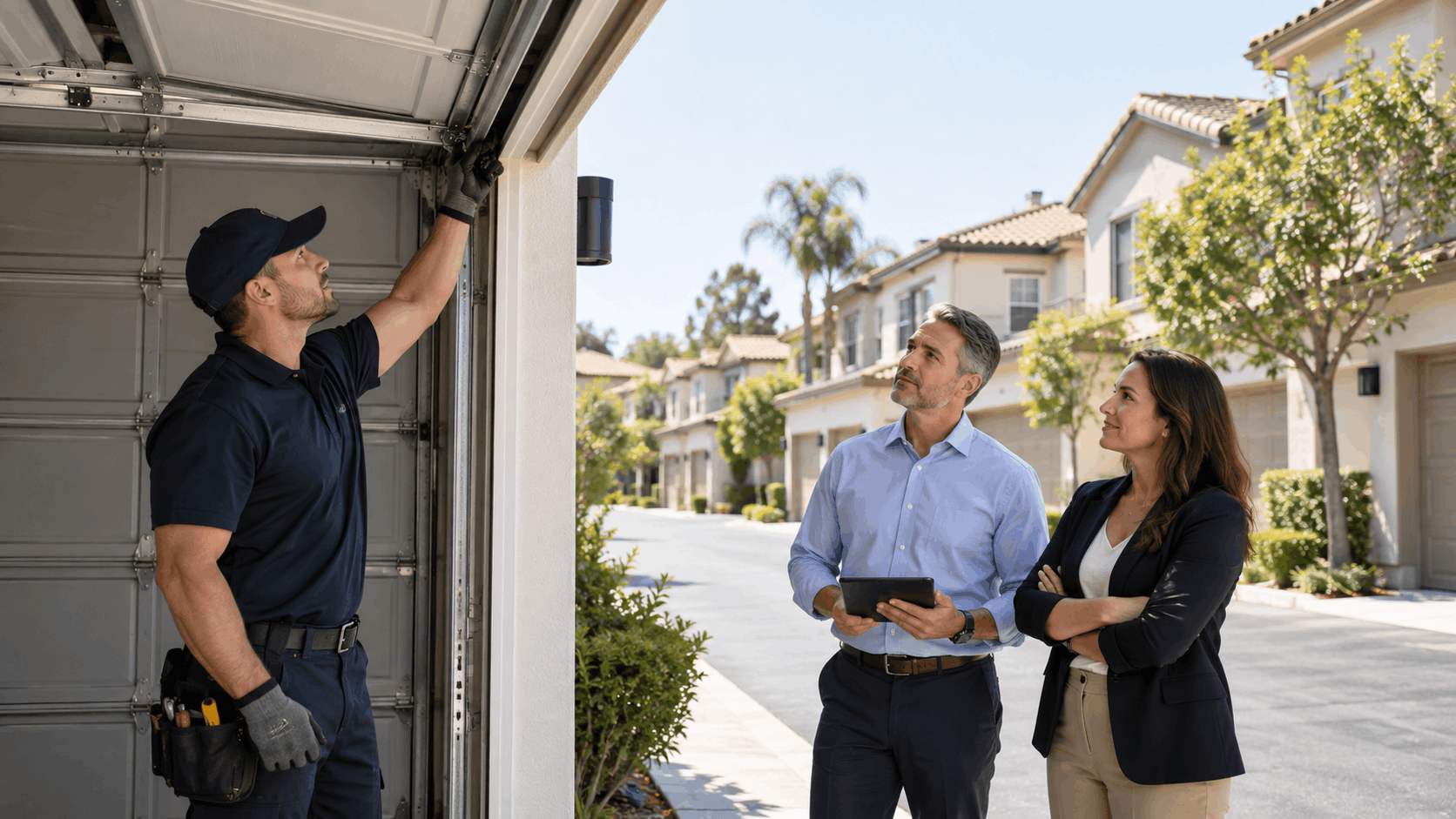
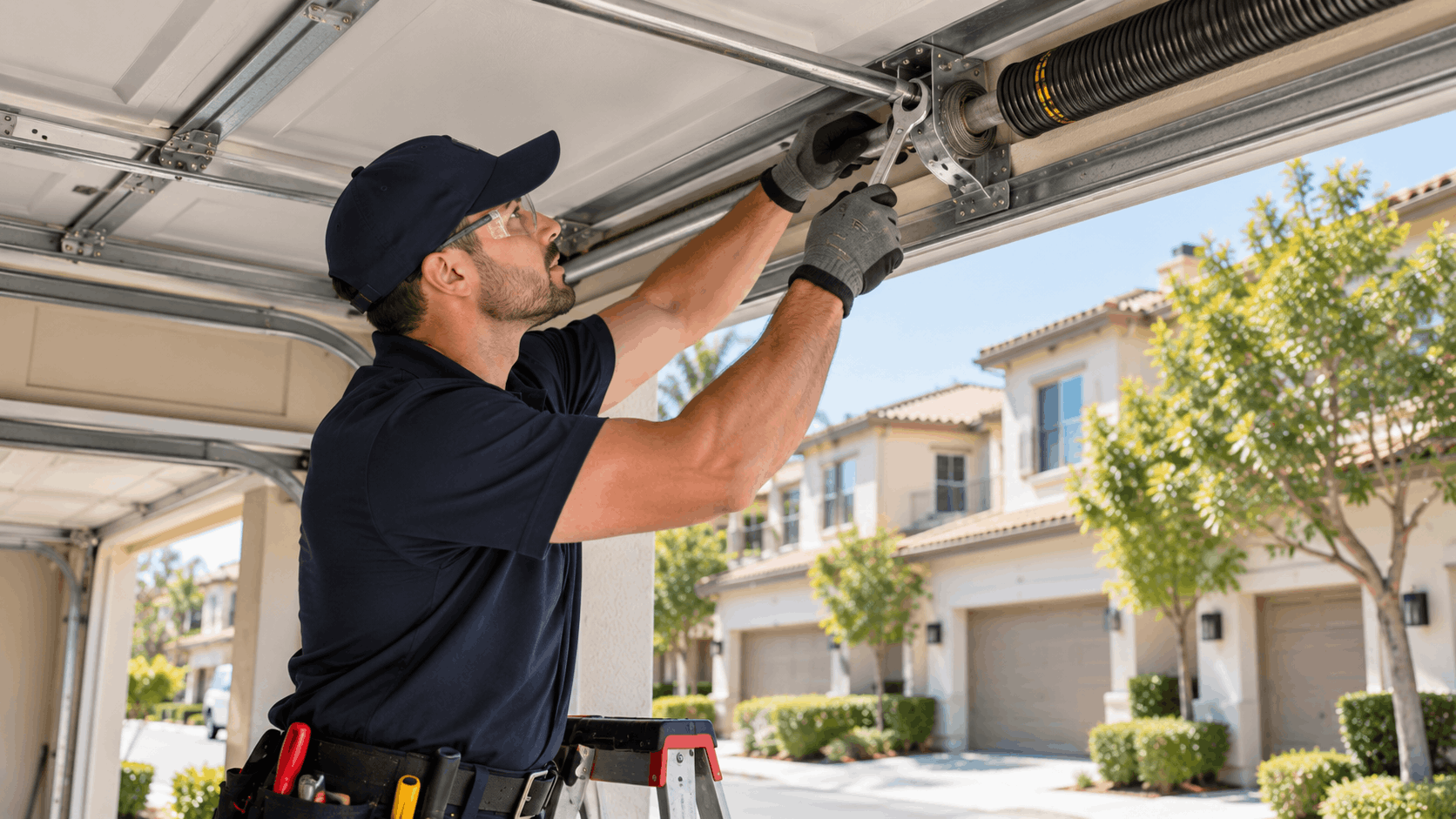
Our technicians inspect the cables and rollers when handling a spring job, so a worn component gets caught before it strands a resident. A door that comes off track is an emergency; off-track repair and cable repair done together with a spring prevent the second call.
What Garage Door Service Costs on Tustin Managed Property
Boards and managers need numbers before the meeting. The figures below are typical Orange County ranges, not a quote, and the price for a specific door is given in writing before work begins. They are useful for budgeting and reserve planning.
| Service | Typical range |
|---|---|
| Torsion spring replacement | $150 to $300 |
| Extension spring replacement | $150 to $250 |
| Cable repair | $150 to $300 |
| Off-track door repair | $125 to $275 |
| Track repair and realignment | $125 to $300 |
| Opener installation | $250 to $600 |
| Battery backup installation | $200 to $400 |
| Sectional garage door replacement | $800 to $2,500 |
| Panel replacement | $250 to $800 per panel |
| Preventive maintenance visit | $99 to $149 per visit |
Common Repair Ranges: Springs, Cables and Off-Track Doors
For the repairs that come up most on aging portfolios, the typical Orange County ranges are: torsion spring replacement $150 to $300; extension spring replacement $150 to $250; cable repair $150 to $300; off-track door repair $125 to $275; and track repair and realignment $125 to $300.
These are the calls that strand residents on shared driveways, so they are the ones a board sees most often on older doors. A spring at the end of its cycle rating and a frayed cable are the usual culprits behind a door that will not open.
Presenting these as typical ranges for the area rather than fixed prices keeps a budget honest. The actual figure depends on the specific door, its weight, the hardware it needs, and what the inspection finds, which is why a written price comes before the work.
For reserve planning, a board can use these ranges to estimate the annual repair load across a portfolio of aging doors. The cost of catching a worn cable during a spring job is small next to the cost of a second emergency dispatch weeks later.
Opener, Battery Backup and Sensor Pricing
On the opener side, the typical ranges are: opener installation $250 to $600, with belt drive costing more than chain drive; opener repair $75 to $200; battery backup installation $200 to $400; safety sensor alignment and repair $75 to $150; and keypad and remote programming $45 to $85.
Belt drives run quieter than chain drives, which matters on units with living space above or beside the garage. For attached communities where a bedroom sits over the garage, the quieter belt drive is worth the difference, so the drive choice affects both comfort and cost.
Battery backup is where the law and the budget meet. On a replacement opener, battery backup is a legal requirement under SB 969, not an add-on a board can decline to save money. The $200 to $400 range for battery backup belongs in any opener replacement estimate for a residential unit.
Sensor work is the cheapest fix on the list and often solves the most complaints. When a door reverses for no reason, opener repair and troubleshooting starts with the photo eyes, and a sensor alignment at $75 to $150 frequently settles the problem.
New Door and Panel Replacement Ranges for Uniform Communities
For full replacements, the typical ranges are: sectional garage door replacement $800 to $2,500; insulated steel garage door $900 to $2,500; carriage-house garage door $1,200 to $4,500; and panel replacement $250 to $800 per panel.
In a uniform community, matching an approved style is where the budget decision happens. A carriage-house door costs more than a plain sectional, so if the association's approved style is a carriage-house design, the higher range applies across every door that gets replaced.
Panel replacement is the budget-friendly option when only one or two sections are damaged on an otherwise sound door. At $250 to $800 per panel, replacing a dented section on a backed-into door often beats a full replacement, as long as the panel still matches the approved look.
When a full door is needed, matching the architectural review requirements the community has set keeps the install from being rejected. A board planning a sectional door replacement program across a street should budget to the approved style, not the cheapest door, so every unit stays consistent and approvable.
Preventive Maintenance Across a Portfolio
A preventive maintenance visit runs $99 to $149 per visit, and a quiet roller and hardware upgrade runs $150 to $300. Scheduled across a portfolio, these visits turn surprise failures into planned work.
Each maintenance visit includes a written report of what was found and what is recommended. For a board, that report is the raw material for reserve planning: it flags which doors are near end of rating, which cables are fraying, and which sensors need attention before they cause a complaint.
On aging communities like Tustin Ranch, where doors are deep into their high-wear years, a regular maintenance schedule catches worn components while they are still a $150 fix rather than an emergency. The written report gives the board a documented basis for when to budget a replacement.
A quiet roller and hardware upgrade is worth considering on units with living space above the garage, where noise carries. Rolling the preventive maintenance plan and a roller upgrade into one visit keeps the door quiet and the hardware sound across the community.
Need Help in Irvine?
Urgent Garage Doors serves Irvine and all of Orange County.
How Urgent Garage Doors Handles Managed and Association Jobs
Managers and boards need a contractor who coordinates with approval timelines, covers multiple properties, and responds when a door strands a resident. Here is how our team works across the city and North Tustin.
The job is not just the repair. It is confirming jurisdiction, timing the install around review, carrying the right stock, and being reachable when a resident is stuck. That is how we run managed and association work.
Serving City of Tustin and North Tustin Addresses
We are based at 76 Ashford in Irvine, CA 92618, and we work across both the City of Tustin and unincorporated North Tustin. Because the jurisdiction depends on the exact address, we confirm the correct permit position for each property before scheduling.
That means a Central Tustin property along Red Hill Avenue, First Street or Newport Avenue is handled as City of Tustin work, while a North Tustin address is handled as county work. Getting that right up front avoids the invalid-permit trap that catches contractors who treat the whole area as one city.
For Tustin Ranch streets in ZIP 92782, where the sectional doors are deep into their high-wear years, we know the hardware and the common failures. Our familiarity with the city's neighborhoods, from Old Town cottages to Laurelwood and Tustin Meadows, means we flag the review and permit considerations before they become delays.
A management company with properties spread across the area gets one contractor who tracks which addresses answer to the city and which to the county. That saves the manager from having to sort jurisdiction on every work order.
Written Prices, Free Estimates and Truck-Stocked Springs
A written price is available before work begins, and we provide one when the job calls for it or the customer asks. Separately, Business and Professions Code section 7159 requires a written home improvement contract for work over $500, which is a legal requirement that applies regardless.
For new door installations, we offer a free on-site estimate. The estimate covers the door, the approved style, and what the install involves, which gives a board the figure it needs for a decision before committing.
When we install a new door, removing and hauling away the old door is included. That keeps the association from having to arrange disposal separately, which is one less line item and one less vendor for a manager to coordinate.
We carry common torsion spring sizes on our trucks, so a spring replacement is often completed on the same visit rather than requiring a return trip. On a stranded-resident call, that truck stock is the difference between a working door that afternoon and a wait for parts.
24/7 Emergency Response Across Orange County
We take emergency calls 24 hours a day, 7 days a week, every day of the year including holidays. The response window is 30 to 60 minutes anywhere in Orange County.
On managed property, that availability matters because a stuck door on a shared driveway affects more than one household. A door stranded open is a security concern for the unit, and a door stuck down can trap a resident's vehicle, so the clock on a fix runs faster than on a private home.
A resident who cannot get out of their garage during a power outage is exactly the situation SB 969's battery backup addresses, but when hardware fails outright, a fast technician is what gets the door working. Our 24/7 emergency repair covers those calls across the county.
For a manager, knowing a contractor answers after hours and on holidays removes the scramble of finding someone when a door fails on a Sunday. The 30 to 60 minute window across Orange County means a Tustin or North Tustin address gets a technician moving quickly.
License, Brands and Coordinating Association Approvals
We hold California license CSLB #1055150, which a board can verify free at cslb.ca.gov along with our classification, status, bond and workers compensation. Our Google Local Services listing carries the Google Guarantee badge.
We work on all major brands, including LiftMaster, Chamberlain, Genie, Craftsman, Clopay, Amarr, Wayne Dalton and CHI. That range matters on a portfolio where different buildings were fitted with different equipment over the years, so one contractor can service the whole community.
On association jobs, we time the install around the architectural approval rather than pushing a door up before the committee has signed off. That keeps a non-approved door from being required to come out at the owner's cost, which protects both the association and the owner.
From spring and cable work through opener installation to full door installation, we handle the range a managed portfolio generates, licensed for the work under C-61/D-28.
Getting Your Tustin Portfolio Handled
When a door fails on a managed Tustin property, call Urgent Garage Doors at (949) 529-7743 and we confirm the jurisdiction and permit position for the address, provide a written price before work begins, and bring the right spring stock to finish most repairs on the first visit.
For a planned program across a community, a free on-site estimate on new installs and a maintenance visit with a written report give a board the documentation it needs for reserve planning. You can verify our license, CSLB #1055150, free at cslb.ca.gov before you schedule.
Frequently Asked Questions
- Does an HOA or the unit owner pay for a garage door repair in Tustin?
- It depends on the CC&Rs and whether the door is a common element the association maintains or a unit-owner item. There is no single answer across communities. In attached and semi-attached neighborhoods like Peppertree and Laurelwood, ownership is the first question on any job, because the shared structure makes the line between owner and association responsibility one the governing documents draw. Confirming that section before dispatch settles who pays.
- Do we need architectural approval before replacing a door on an association street?
- Yes. On association-governed streets, review under California's Davis-Stirling Common Interest Development Act typically covers door style, panel design, color and visible hardware. Approval should come before the door is ordered, not after, because a door installed without approval can be required to come out at the owner's cost. Submitting the style, panel layout, color and hardware details clearly speeds the committee's decision and keeps the order from being placed on a design the association will reject.
- Is a property in North Tustin covered by City of Tustin permits?
- No. North Tustin is an unincorporated community in Orange County, not part of the City of Tustin, so its permits are county permits, not city permits. This is the most common mistake available in the area, because the name and the mail both say Tustin. A City of Tustin permit does not cover a North Tustin address, so the jurisdiction has to be confirmed by the exact address before any permitted work begins.
- Does a like-for-like door replacement need a building permit?
- Whether a door or opener replacement needs a permit is decided by the city or county with jurisdiction over the specific address, not by one regional rule. Structural work such as widening an opening or altering the header is generally what triggers a permit rather than a same-size swap, but the position varies by jurisdiction. A manager should confirm the permit position for each property with the building department that has authority over that address.
- What license should a garage door contractor hold in California?
- The correct classification is C-61/D-28, Doors, Gates and Activating Devices, which covers sectional and rolling doors, torsion and extension spring systems, operators, control boards, safety sensors and activating devices. C-28 is Lock and Security Equipment and is not the garage door license, so a board should not accept it as proof of qualification. Any license can be verified free at cslb.ca.gov, where classification, status, bond and workers compensation are all public record.
- Is battery backup required on replacement openers in our community?
- Yes. Since July 1, 2019, SB 969 has required a battery backup on every residential garage door opener sold or installed in California, with a $1,000 civil penalty for violations. A replacement residential door may not be installed connected to an opener that does not comply. It is a legal requirement on any opener replacement, not a paid upgrade tier, and it applies statewide to residential openers. It was passed after the 2017 Northern California wildfires.
- How often do the shared driveway doors in older communities need service?
- A torsion spring is rated in cycles, commonly around 10,000, which a door opened four times a day reaches in roughly seven years. On a high-traffic shared driveway, the cycle count climbs faster from heavier use, so doors reach the end of their rating sooner. In older-era communities like Tustin Ranch, built out from 1986, the two and three-car sectional doors are deep into their high-wear years, which makes scheduled service worthwhile over waiting for failures.
- Can staff test the doors ourselves between service visits?
- Staff can safely run two checks. The 2x4 auto-reverse test: lay a flat 2x4 in the door's path and confirm the door reverses within two seconds of contact. The photo-eye test: break the beam while the door closes and confirm it stops and reverses, with the sensors aligned and unobstructed. Springs are the one thing no one on staff should ever adjust, wind, unwind or replace, because a torsion spring releases enough energy to cause serious injury.
- Do you provide a written price before work starts?
- A written price is available before work begins, and we provide one when the job calls for it or the customer asks. Separately, California Business and Professions Code section 7159 requires a written home improvement contract for work over $500, which is a legal requirement rather than a company policy. For new door installations, we also offer a free on-site estimate so a board has the figure it needs before making a decision.
- How fast can you respond when a door strands a resident?
- We take emergency calls 24 hours a day, 7 days a week, including holidays, with a 30 to 60 minute response window anywhere in Orange County. We carry common torsion spring sizes on our trucks, so a spring replacement is often completed on the same visit rather than requiring a return trip. On managed property, that speed matters because a stuck door on a shared driveway affects security and access for the whole unit.
Licensed garage door repair professionals serving Irvine and Orange County.
Licensed in California · License #1055150
Why trust Urgent Garage Doors?
Founded in 2017, Urgent Garage Doors is a licensed and insured garage door services serving Irvine and Orange County. All content is reviewed by our licensed technicians.

Need Help in Irvine?
Urgent Garage Doors serves Irvine and all of Orange County.
Related Articles
Emergency Garage Door Repair in Newport Coast: Same-Day Service for Pelican Hill and Crystal Cove
A local guide to emergency garage door repair in Newport Coast, covering common failures, same-day service for Pelican Hill and Crystal Cove, costs, and prevention.
Garage Door Won't Open in Newport Beach: Same-Day Emergency Service
A garage door that won't open in Newport Beach usually means a broken spring, opener failure, or salt-air rust. Learn the causes, safety checks, costs, and same-day fixes.
Rancho Mission Viejo Garage Door Repair: New Master-Planned Community Service
Garage door repair guide for Rancho Mission Viejo homeowners - common new-build problems, HOA rules, maintenance tips, costs, and same-day service across Esencia, Sendero, and Rienda.