Garage Door Repair in Newport Coast with Same-Day Gated-Community Service
Key Takeaways
- Same-day repair is available in Newport Coast with 24/7 response in 30 to 60 minutes across Orange County, once gate access is arranged ahead of the visit.
- On guard-gated communities like Pelican Hill, Pelican Crest and Crystal Cove, the homeowner usually authorizes the visit with the gate, and some associations keep vendor lists or require insurance on file.
- Heavy custom doors need springs sized to the measured door weight; reusing an old set causes a door that will not hold position, premature failure and an overworked opener.
- A door that reverses only in the afternoon is usually a west-facing photo eye washed out by low ocean sun, a sensor diagnosis rather than a broken part.
- Newport Coast was built largely from the 1990s, so first-generation springs, cables, rollers and openers are now at the age where they fail, making it a replacement-cycle market.
- SB 969 requires battery backup on any residential opener sold or installed in California since July 1 2019, so a replacement door cannot be connected to a non-compliant opener.
- Garage door work is licensed under C-61/D-28, not C-28; Urgent Garage Doors holds California license #1055150, verifiable free at cslb.ca.gov.
- Typical Orange County torsion spring replacement runs $150 to $300, presented as a typical area range, with a written price available before work begins.
In This Article
A heavy clad-timber door stops halfway at a Pelican Hill motor court, the opener straining against it, and the gate guard is still waiting on a vendor check-in before anyone can even reach the driveway. That is the Newport Coast version of a stuck garage door, and it plays out the same way across the ridge communities above Pacific Coast Highway. The door is bigger, the access is controlled, and the fix cannot start until someone clears the gate.
Here is the short answer for anyone searching right now. Same-day repair is available in Newport Coast with 24/7 emergency response in 30 to 60 minutes anywhere in Orange County, once gate access is arranged ahead of the visit. On these guard-gated estates the gate is the first step, not the last, so a quick call to authorize the visit keeps the clock moving.
How Same-Day Service Works Behind the Guard Gates?
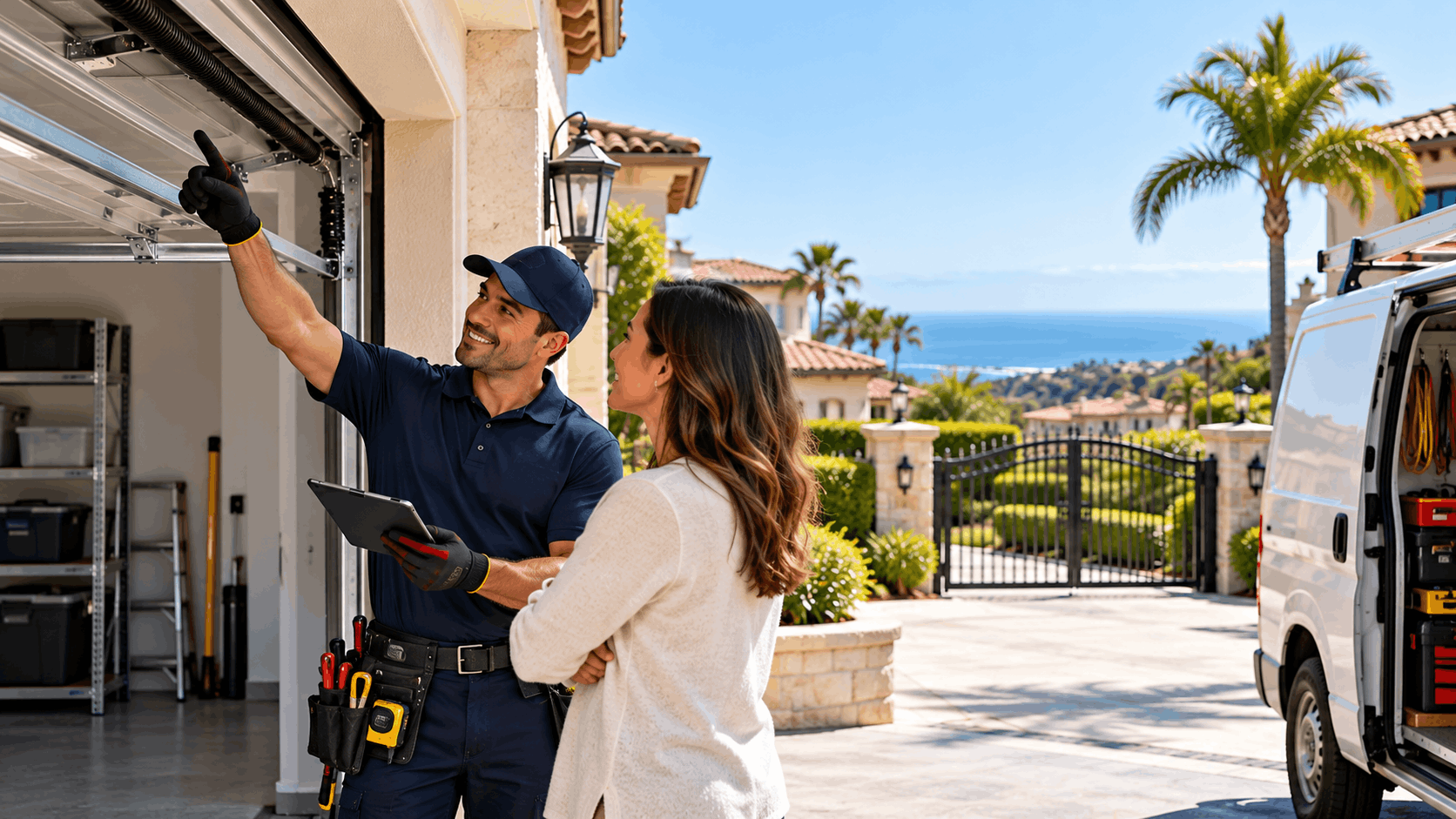
Almost every community in Newport Coast is guard gated with contractor check-in, so a repair truck cannot simply pull to the curb and start work. Pelican Hill, Pelican Crest and Crystal Cove all sit behind controlled entries, and the job really begins at that gate. Planning the gate comes before planning the repair itself.
Long private driveways and motor courts mean the working position is often well inside the property. On the ridge lots reached from Newport Coast Drive and San Joaquin Hills Road, the driveway grade is steep enough to change how the vehicle parks and how material gets moved. None of that stops same-day repair, but it shapes the visit from the first phone call.
Arranging Gate Access Before the Truck Rolls
Contractor check-in is standard in communities like Pelican Hill, Pelican Crest and Crystal Cove. In most cases the homeowner needs to authorize the visit with the gate ahead of time, so the guard has the name and company on the list when the truck arrives. Without that step, a technician who could be fixing the door is parked at the entrance instead.
Some associations go a step further and keep approved vendor lists or require insurance documentation on file before a contractor is allowed through. That is worth knowing at the first call, because it can add a short step for a community the crew has not visited before. Where a vendor is already cleared, the check-in is quick.
The practical rule for Newport Coast is simple: plan the gate before planning the job. A homeowner who calls the gate to clear the visit at the same time they call for the repair removes the most common delay on these properties. It is the difference between a truck that rolls straight to the motor court and one that waits for a phone to be answered.
For owners inside ZIP 92657, that single piece of coordination is what keeps a same-day repair truly same-day. The repair work itself is no slower here than anywhere else. The access is the variable, and it is one a homeowner controls.
The 30 to 60 Minute Response Window
Urgent Garage Doors takes emergency calls 24 hours a day, 7 days a week, including holidays, with a response window of 30 to 60 minutes anywhere in Orange County. For a door stuck open overnight or a spring that let go on a Sunday, that round-the-clock coverage matters as much as the speed. A garage left open on an estate lot is a security concern, not just an inconvenience.
On a gated property the response window and the gate step work together. The quickest arrival happens when the gate authorization is already in place by the time the truck reaches 92657, so the guard waves the technician through rather than holding them at the entrance. A few minutes spent clearing the gate early protects the whole window.
Ridge communities above Pacific Coast Highway are reached from Newport Coast Drive, San Joaquin Hills Road, Ridge Park Road and the State Route 73 toll road. Those routes are familiar territory, so the drive time is predictable once access is sorted. You can read more about 24/7 emergency garage door repair and how after-hours calls are handled.
The honest framing is that the 30 to 60 minute figure is the drive and dispatch window across the county. On these estates, the gate is the only extra variable, and it is the one the homeowner can clear in advance.
Working Inside Motor Courts and on Steep Ridge Driveways
These are custom and semi-custom estates on view lots with motor courts, three and four-car garages and long private driveways. The working position is frequently deep inside the property rather than at the street, which means tools and replacement parts travel farther from the truck to the door. That is normal here and it is planned for, but it is part of why the layout matters.
On ridge lots the driveway grade is steep enough to affect how a vehicle is parked safely and how heavy material such as a torsion assembly or a full panel is moved up or down the slope. A technician reads the grade before unloading, both for safety and to avoid scuffing a high-end driveway surface. Motor court doors also tend to be wider and heavier, which changes how the work is staged.
None of this is a reason the repair takes longer in a way that affects the homeowner. It simply means the crew arrives ready for a property where the garage is not three steps from the curb. Knowing the working position in advance helps the right equipment come off the truck first.
For owners comparing their options across the city, the broader Newport Beach service area page covers how coastal and hillside properties are handled.
Get Your Free Quote
Tell us about your garage door and we'll get back to you within 30 to 60 minutes.
The Most Common Repairs on Newport Coast Estate Doors
The failures on these hillside estates track closely with the build era and the type of door. Custom doors here are heavy, the hardware is now decades old, and the marine environment works on every metal part. That combination produces a predictable set of calls: broken springs, frayed cables, off-track doors, opener faults and the odd door that reverses only at a certain hour.
The table below sums up what breaks, why it happens on estate doors specifically, and the usual fix. Each item is expanded in the subsections that follow.
| Common Failure | Why It Happens on Estate Doors | Typical Fix |
|---|---|---|
| Broken torsion spring | Heavy custom door weight; springs undersized or reused on a heavier door | Spring sized to the measured door weight |
| Frayed cable, worn roller | Marine humidity corrodes hardware; cycle rating reached earlier | Replace cable, inspect alongside spring, specify coated or stainless parts |
| Off-track door | Tall openings, roller or track wear, impact | Realign track, correct opener type for the opening |
| Opener fault on tall garage | Ceiling rail wrong for high ceilings or overhead storage | Jackshaft opener at the torsion bar |
| Door reverses at one time of day | Low afternoon sun washes out west-facing photo eye | Sensor diagnosis, realignment, clean lens |
Broken Springs on Heavy Custom Doors
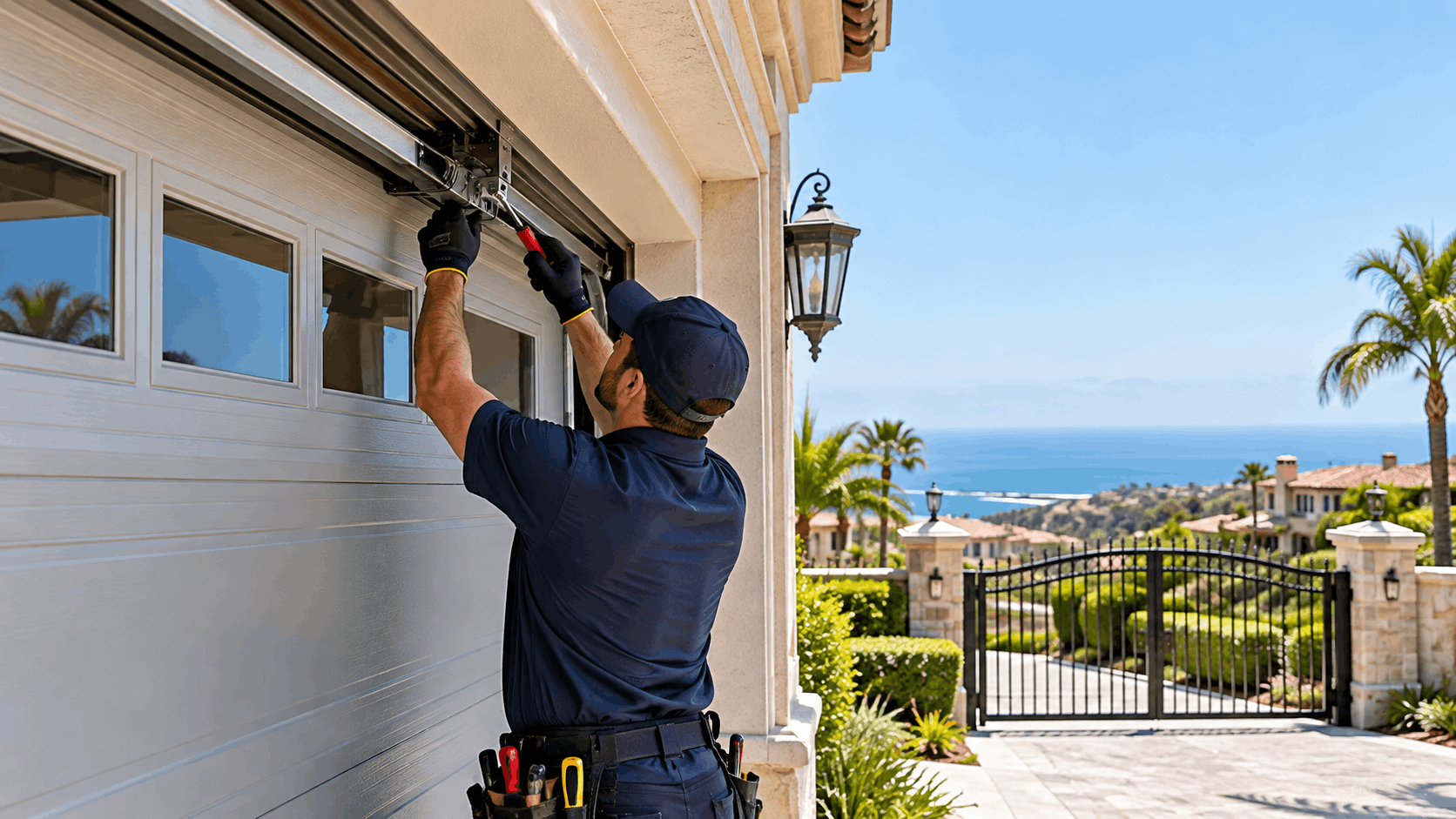
Solid or clad timber, oversized widths, taller openings and glass-and-steel designs all weigh far more than a standard insulated steel door. That weight is the whole story with springs on these estates. A torsion spring has to be sized to the actual measured weight and height of the door, not to a nominal size pulled off a shelf.
The classic mistake is reusing an existing spring set on a heavier replacement door. When the spring is undersized for the weight, the door will not hold position, the spring fails prematurely, and the opener is left straining against a load it was never meant to lift. All three problems come from the same root cause.
On a custom door the correct approach is to weigh the door and engineer the spring to it. That is why an estate spring job is a measurement job first and a parts job second. Getting the sizing right is what keeps the door balanced and the opener working within its rating.
Owners dealing with a dropped or stuck door can see how torsion spring replacement is handled on heavier doors, where engineered springs replace a one-size assumption.
Frayed Cables and Worn Rollers from Marine Humidity
The coast brings a persistent marine layer carrying salt-laden humidity, so hardware corrodes faster than inland even at Newport Coast's elevation. Salt air does not care how expensive the door is. It settles on cables, rollers, hinges and bearings and works on them from the surface in.
Corrosion does not invent a new failure mode so much as bring a part to the end of its cycle rating earlier. A cable that might have gone the distance inland frays sooner here because the strands are pitting from the salt. That is why coated or stainless components are worth specifying on a coastal estate door rather than plain steel.
There is a sequencing lesson that matters more than any single part. Cables, drums, rollers, hinges and bearings all wear alongside springs, so replacing a spring without inspecting the cables is how a second failure follows weeks later. A proper spring visit includes a look at everything the spring works against.
If a cable is already frayed or has slipped off the drum, cable repair addresses it, and inspecting both at once is the way to avoid a repeat call. On exposed coastal hardware, that combined inspection is the saving.
Off-Track Doors and Opener Faults
Tall openings on three and four-car garages are more prone to coming off track, especially when rollers or track sections have worn or taken an impact. A door off its track is a stop-everything situation because forcing it only bends track and damages panels. It needs to be realigned properly, not muscled back into place.
Opener choice is the other piece on these tall garages. On a garage with high ceilings or storage above, a jackshaft unit mounted at the torsion bar is the right answer rather than a ceiling-mounted rail. The jackshaft drives the torsion bar directly and frees the ceiling, which is exactly what you want where headroom is tight or the overhead is used for storage.
Matching the opener to the door also protects the rest of the system. An underpowered or wrongly mounted opener on a heavy door fights the weight every cycle and wears out early. The correct drive type, rated for the door, keeps the whole assembly running the way it should.
For a door that has jumped the track, off-track repair gets it realigned, and opener questions on tall garages are covered under opener repair and troubleshooting.
The Door That Reverses Only at Certain Times of Day
A door that reverses at a particular hour and works fine the rest of the day is one of the more confusing faults an owner can face. On west-facing openings in Newport Coast, low afternoon sun off the ocean can wash out the photo-eye beam. The sensor reads the glare as a blocked beam and refuses to let the door close.
This is a diagnosis worth knowing because it saves replacing parts blindly. An owner who swaps the opener or the sensor over a problem that only appears at sunset has spent money on a fault that is really about the angle of the light. Recognizing the pattern is half the fix.
Photo-eye faults, misalignment and a blocked or dirty beam are the most common causes of a door that reverses for no visible reason. Debris on the lens, a bumped bracket, or a sensor knocked slightly out of alignment all produce the same behavior. Cleaning and realigning the eyes often resolves it.
When the cause is the sensors rather than the door itself, safety sensor alignment and repair is the targeted fix. It restores the auto-reverse behavior without touching parts that were never broken.
Need Help in Irvine?
Urgent Garage Doors serves Irvine and all of Orange County.
Why These Estates Are a Replacement-Cycle Market
Newport Coast is a different kind of market from an older tract neighborhood. The housing stock was built largely from the 1990s onward, which puts the first generation of garage door hardware right at the age where it fails. That timing is why owners here increasingly face a repair-versus-replace decision rather than a simple fix.
The build era sets the whole context. Understanding the age of the hardware and the cycle rating of the springs tells you more about why a door failed than any guess about weather. Below, the three factors that drive those decisions.
Housing Built From the 1990s Onward
Newport Coast was annexed to the city of Newport Beach in 2002 and built largely from the 1990s onward across its guard-gated hillside tracts. That means much of the original garage hardware is now twenty-five to thirty years old. Springs, cables, rollers and openers from the first install are reaching the end of their service life at roughly the same time.
When an entire community goes in within a decade, the hardware tends to age on a similar schedule. The first generation of springs and openers was never meant to last forever, and three decades is well past the window for a heavily used door. That is why the calls here lean toward end-of-life failures rather than one-off defects.
For owners, the useful takeaway is that a failure on a 1990s-built estate door is often the start of a cluster. A spring that goes may be followed by a cable or a tired opener, simply because they all have similar mileage. Looking at the whole system when one part fails is the realistic approach.
This is the profile of a replacement-cycle market: a build era that is now old enough that original hardware is retiring, and a housing stock valuable enough that doing the work right matters.
Understanding Cycle Ratings and Spring Age
A torsion spring is rated in cycles by the manufacturer, one cycle being a full open and close. A standard residential spring is commonly rated around 10,000 cycles. A door cycled four times a day reaches that 10,000-cycle mark in roughly seven years, which is well within the life of a 1990s-built home.
Where the door is a main entrance and cycles several times daily, the spring arrives at the end of its rating faster still. High-cycle springs exist for exactly that heavy-duty situation and for unusually heavy doors. Matching the spring rating to how the door is actually used is how you avoid a repeat failure.
Coastal corrosion factors in by bringing a spring to the end of its cycle rating earlier than it would inland. Salt air pits the metal and shortens the working life the manufacturer rated it for. The honest way to predict failure is to look at the spring's age and the door's daily use, not to guess at a weather multiplier.
Stating the rating and the age gives a real basis for the repair-or-replace conversation. A seven-year-old spring on a door that cycles four times a day has essentially used its budget, and that is useful information before the next one lets go.
When Repair Beats Replacement and When It Does Not
On a very expensive custom door, single-panel replacement is a genuine saving when the door line is still manufactured and the matching panel can be ordered. Replacing one damaged section instead of the whole door keeps a high-value door intact for a fraction of the cost. That is the best-case outcome and worth checking for first.
The picture changes when the line is discontinued. If the panel can no longer be ordered, the conversation turns to replacing the whole door or fabricating a matching section. Either path costs more and takes longer than a stock swap, which is why identifying the door line early matters.
Made-to-order doors and matching panels carry real lead times. A damaged panel on a custom door is not a same-day fix, and an owner should be told that at the first call rather than discovering it later. Setting that expectation up front avoids frustration on a door that simply cannot be sourced overnight.
When a panel can be matched, panel replacement is the economical route, and when the door needs replacing, custom garage door design and install covers the made-to-order path.
Safety Tests a Newport Coast Homeowner Can Run
There are a few checks any homeowner can safely run before calling, and one thing that should always be left to a professional. These tests tell you whether the entrapment protection is working and whether a problem is the spring or the opener. They take a few minutes and cost nothing.
Run them in daylight when you have time, not in a hurry as you leave. If anything fails, that is the information to pass along when you call, and it often speeds the diagnosis.
The Photo-Eye and 2x4 Reverse Tests
The photo-eye test is simple. With the door closing, break the beam by passing an object through it near the floor. The door must stop and reverse. If it keeps closing, the non-contact entrapment protection is not doing its job and the sensors need attention.
The two-by-four test checks the contact reverse. Lay a 2x4 flat across the opening under the door, then close the door. When the door hits the board, it must reverse within two seconds of contact. A door that keeps pressing down on the board instead of backing off has a force or reverse setting that is out of spec.
Both tests confirm the entrapment protection that modern openers are built to provide. The photo eyes are the non-contact system, mounted on each side of the opening no higher than six inches off the floor, and the contact reverse is the mechanical backup. Together they are what keeps a closing door from trapping a person or pet.
If either test fails, do not keep using the door on automatic until it is corrected. These are safety systems, not conveniences, and a failed test is a reason to call rather than to keep cycling the door.
The Balance Test and What a Failing Spring Looks Like
The balance test tells you whether a problem is the spring or the opener. Disconnect the opener using the release cord, then raise the door by hand to about waist height and let go. A correctly balanced door stays put where you leave it.
If the door falls shut or drifts upward on its own, that is a spring problem, not an opener problem. The spring is no longer carrying the weight of the door the way it should, which is exactly what happens as a spring nears the end of its cycle rating. No amount of opener work fixes an unbalanced door.
On a heavy custom door this test also shows just how much weight the springs are managing. A door that drops hard when released is a warning, because that same force is what the opener and the spring fight every cycle. An unbalanced door overworks everything attached to it.
When the balance test points to the springs, door balancing and tension adjustment is the service that restores it. Re-engaging the opener after the test is as simple as pulling the release cord back or running the door once.
Why Springs Are the One Thing to Leave Alone
A torsion spring stores enough energy to cause serious injury. It is wound under high tension with winding bars against a fixed cone, and that stored force does not care whether the person handling it has done it before. This is the one component a homeowner should never adjust, wind, unwind or replace.
On a heavy custom door the stored force is even greater, because a heavier door needs more tension to balance it. The margin for error shrinks as the door weight climbs. What might be a bad injury on a standard door can be far worse on an oversized estate door.
The safe tests to recommend are the ones above: the photo-eye check, the flat 2x4 reverse test and the balance test. Those tell you what you need to know without going near the spring. Anything involving the spring itself belongs to a technician with the right bars and training.
If a test shows a spring at fault, the fix is a professional job every time. The energy involved is not a place to learn on the job, and that is true for every door, custom or standard.
California Rules That Affect Repair and Replacement Here
A handful of California laws bear directly on garage door work in Newport Coast, and getting them right matters when work is done. They cover battery backup, auto-reverse, licensing and the permit question on coastal property. Each is stated here with the correct law and dates so there is no confusion.
These are not optional extras. They are the legal backdrop to any repair or replacement, and a licensed contractor works to all of them.
Battery Backup on Any Replaced Opener (SB 969)
SB 969, signed in 2018 and operative July 1 2019, requires every residential automatic garage door opener manufactured for sale, sold, offered for sale or installed in California on or after that date to have a battery backup that operates during an electrical outage. The law was passed in response to deaths in the 2017 Northern California wildfires, where people could not open garage doors during power cuts. Violations carry a $1,000 civil penalty.
What this means in practice is that a replacement residential garage door may not be connected to an opener that does not comply. A homeowner replacing an opener in California is getting a battery backup unit as part of the installation, whether or not they asked for one. It is a legal requirement, not an add-on tier.
The flip side is equally clear. SB 969 does not force an owner to upgrade an opener that is simply sitting there in service. An existing, working opener can stay. The requirement attaches to selling, installing or replacing, not to leaving an old unit in place.
When an opener is replaced, battery backup installation is part of bringing it into compliance. On a wildfire-exposed hillside, the ability to open the door during a grid outage is exactly what the law was written to protect.
Auto-Reverse and Entrapment Protection Dates
California required openers to be manufactured with an automatic reverse device and sensor under AB 3600, passed in 1990, ahead of the federal rule. Federal law under the Consumer Product Safety Improvement Act covers openers manufactured for the United States after January 1 1993, built to the UL 325 standard. So the honest line for an old opener is that a unit made before 1993 predates the federal entrapment-protection mandate.
For Newport Coast that history is reassuring. Because the housing was built largely from the 1990s onward, the openers here postdate the 1993 federal requirement, so photo eyes are present throughout the community. California Health and Safety Code section 19890 has required those entrapment protection sensors since January 1 1993 as well.
The photo eyes are the external, non-contact part of the system, mounted low on each side of the opening. The opener's contact reverse is the second layer. Together they are what UL 325 asks for, and they are the reason a door is supposed to stop and back off rather than crush an obstruction.
If an estate here still runs a genuinely pre-1993 opener somewhere, the manufacturer position is that such units should be replaced rather than repaired, because they lack the entrapment protection every modern opener provides. For most Newport Coast garages, though, the sensors are already in place and simply need to work.
Licensing: C-61/D-28, Not C-28
California garage door work is licensed by the Contractors State License Board under classification C-61/D-28, Doors, Gates and Activating Devices. That scope covers sectional and rolling doors, torsion and extension spring systems, operators, control boards, safety sensors and activating devices. It is the correct classification for every repair discussed here.
There is a common mix-up worth clearing. C-28 is Lock and Security Equipment, and it is not the garage door license. Nor does garage door work require a Class B general building license. If a contractor cites C-28 for this work, that is a red flag about their licensing.
A license is verified free at cslb.ca.gov, where the license number, classification, status, bond and workers compensation are all public record. Checking takes a minute and it is the single best way to confirm who is coming to work on a high-value door. Urgent Garage Doors holds California license #1055150.
For owners who want to confirm it directly, the Contractors State License Board lookup shows the full record. On an estate property, verifying the license is time well spent before anyone touches the door.
Permits and Coastal Review in Newport Beach
Nearly every property in Newport Beach sits in the Coastal Zone, and that layer shapes what work needs review. Work in the Coastal Zone can require a Coastal Development Permit before or alongside a building permit, and work touching exterior walls or openings is the kind of change that draws coastal review. Replacing a door in an existing opening at the same dimensions is a different matter from changing the opening size or altering the structure around it.
Whether a permit is required for a given job is decided by the city with jurisdiction over the specific address, not by a single regional rule. Owners can confirm status with the Newport Beach Address Search Tool and city staff who guide them through documentation. The Newport Beach Permit Center is at 100 Civic Center Drive, and its number is 949-644-3309.
On top of the city process, each gated community has its own architectural review. In practice the association review decides what the door looks like while the city decides whether the work is permitted. Both paths can apply to the same project, and a street-facing door change usually needs written architectural approval before installation.
Permit status also interacts with licensing. Where a job requires a building permit of any kind, the under-$1,000 unlicensed-work exemption in Business and Professions Code section 7048 does not apply at all. The practical advice is to confirm the permit position for the specific address with the city before work begins. You can learn more about the Newport Coast service area and how coastal and gated-community work is handled.
Need Help in Irvine?
Urgent Garage Doors serves Irvine and all of Orange County.
What Garage Door Repair Costs in the Newport Coast Area
These are typical market ranges for garage door work in Orange County. They are presented as typical area ranges so an owner knows what to expect, never as a quote or a fixed price. The actual price for a specific garage depends on that garage, and a written price is available before work begins.
Estate doors can land at the higher end of these ranges, and often need engineered parts that a standard door does not. The table groups the most common repair types, with each area expanded below.
| Repair Type | Typical Orange County Range |
|---|---|
| Torsion spring replacement | $150 to $300 |
| Extension spring replacement | $150 to $250 |
| Spring conversion | $150 to $350 |
| Cable repair | $150 to $300 |
| Opener repair | $75 to $200 |
| Battery backup installation | $200 to $400 |
| Safety sensor alignment and repair | $75 to $150 |
| Off-track door repair | $125 to $275 |
| Track repair and realignment | $125 to $300 |
| Door balancing and tension adjustment | $75 to $150 |
| Emergency repair | $150 to $350 |
| Same-day repair | $150 to $350 |
| Door that will not open or close | $85 to $250 |
| Panel replacement | $250 to $800 per panel |
Spring and Cable Repair Ranges
Typical Orange County ranges for spring and cable work are torsion spring replacement $150 to $300, extension spring replacement $150 to $250, spring conversion $150 to $350, and cable repair $150 to $300. These are the figures for standard residential work and they are a useful starting reference.
Heavy custom doors change the picture because they need engineered springs sized to the measured weight of the door. A spring matched to an oversized timber or glass-and-steel door is not an off-the-shelf part, and the sizing work is part of the job. That is why an estate spring replacement can sit toward the upper end.
The important point is that the spring must be correct for the door, not simply cheap. An undersized spring saves nothing because it fails early and overworks the opener. On a door this valuable, the right spring is the economical choice over its service life.
Converting from extension to torsion where appropriate is another option covered under spring conversion, and full spring and cable work is explained under spring and cable repair.
Opener, Sensor, and Off-Track Repair Ranges
For opener and alignment work, the typical Orange County ranges are opener repair $75 to $200, battery backup installation $200 to $400, and safety sensor alignment and repair $75 to $150. Sensor work is often the fix for the afternoon-reverse problem described earlier, and it is at the lower end of these figures.
Track and off-track work runs off-track door repair $125 to $275, track repair and realignment $125 to $300, and door balancing and tension adjustment $75 to $150. A door that has come off its track on a tall estate opening falls into this group, and the realignment is what gets it running true again.
Battery backup installation at $200 to $400 is the figure to keep in mind whenever an opener is replaced, since SB 969 makes it part of the job. It is a legal requirement on a replacement, not an optional upgrade, so it belongs in any cost estimate for a new opener.
These ranges cover standard work. On a heavy custom door the opener needs to be rated for the weight, which can push toward the upper figures, and the correct drive type matters as much as the price.
Emergency, Same-Day, and Panel Replacement Ranges
Emergency repair and same-day repair both run $150 to $350 in typical Orange County ranges, and a door that will not open or close runs $85 to $250. These cover the urgent calls where a door is stuck and the property is exposed, which is exactly the overnight or weekend situation a gated estate wants resolved quickly.
Panel replacement runs $250 to $800 per panel. That figure is for a panel that can be sourced and swapped, and it is a real saving against replacing a whole expensive door. Where a matching panel is available, it is the sensible route.
The caveat for Newport Coast is lead time. The panel price does not reflect a same-day fix on a made-to-order door, because custom and matching panels carry real lead times. A damaged panel on a custom door is a scheduled repair once the part arrives, not an overnight one.
Fast calls are handled under same-day garage door repair, and a door stuck shut or open is addressed under a door that will not open or close.
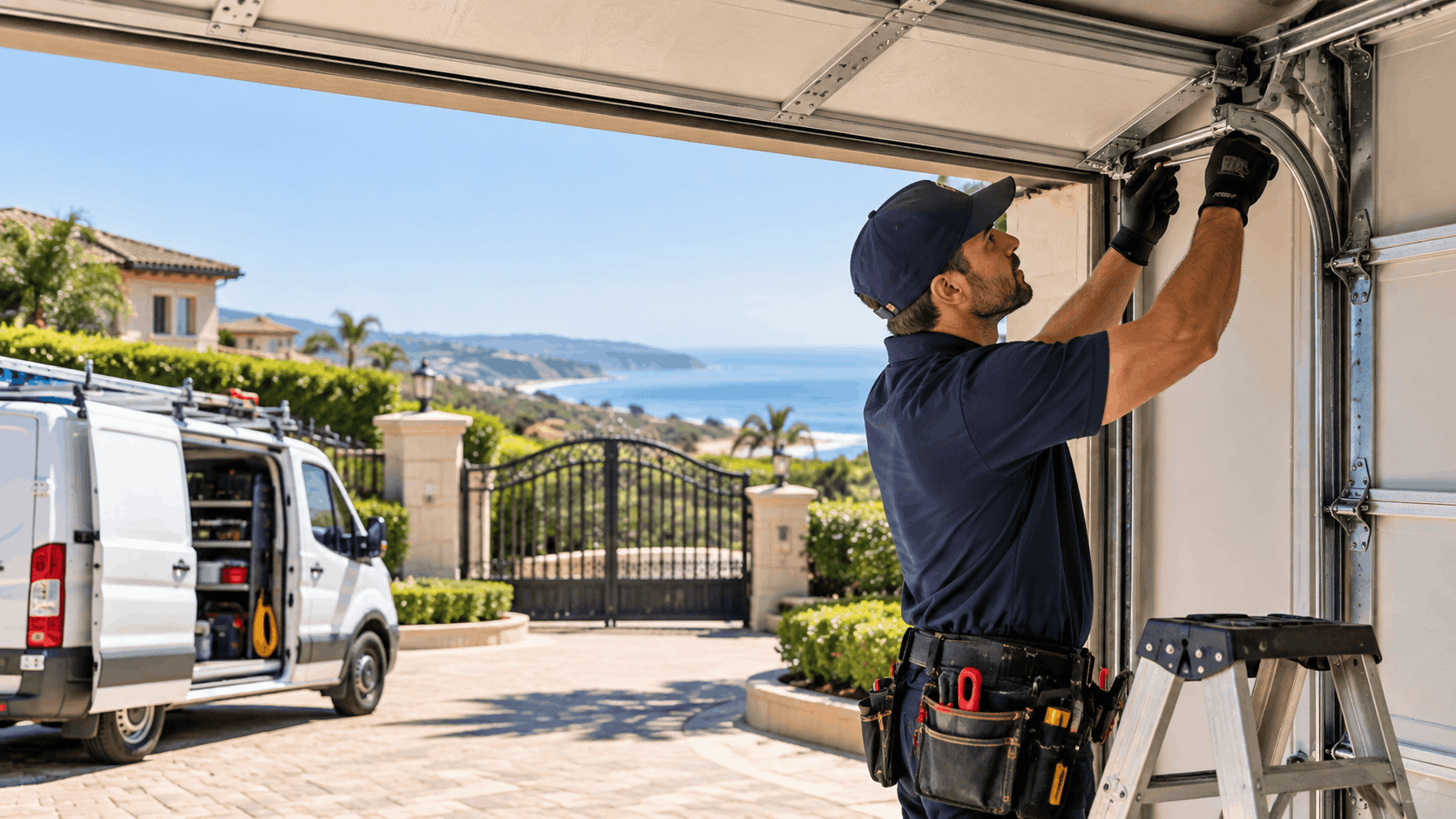
Extra Care Custom and High-Value Estate Doors Need
Beyond a standard repair, Newport Coast's view-lot estates call for a few extra steps. These doors are expensive, exposed to ridge wind and marine air, and often sit in mapped fire terrain. Handling those details well is part of doing the work right on a high-value property.
Each of the following is distinct from the repair itself. They are about protecting the door, the property and the owner over the long run.
Documenting Condition Before Work Starts
Condition documentation before work starts is worth doing on high-value properties. Recording the state of the door, the panels and the surrounding finishes protects both the homeowner and the technician, and it is simply good practice on a door worth what these are. It removes any question later about what was already there.
It matters most when a damaged custom panel may need fabrication rather than an off-the-shelf swap. Documenting the exact panel, its profile and any existing marks helps when a matching section has to be ordered or made. On a discontinued line, that record can be the reference a fabricator works from.
For owners, the takeaway is that documentation is not bureaucracy on an estate door. It is how a complex, expensive repair stays accountable from the first assessment through to the finished work. A clear before-picture is worth having.
This fits naturally with the written price available before work begins, so the owner has both a record of condition and a clear scope before anything starts.
Ridge Wind, Seals, and Debris in the Tracks
Ridge wind is constant on the upper streets of Newport Coast, so seals, struts and door rigidity matter for keeping a door quiet and stable. A door that rattles on a windy ridge is not just annoying; the movement works on the hardware over time. Good seals and adequate bracing keep it tight.
Wind also carries dust and plant debris into tracks, seals and photo-eye lenses. Grit packs into a seal so it stops flattening against the slab, debris coats a sensor and breaks the beam, and material builds up in the track where rollers run. All of that comes straight from the exposure on these open lots.
That is why seals and sensor lenses need checking on exposed ridge properties. A clean lens keeps the photo eye reading correctly, and a seal clear of grit keeps weather and debris out. These are small maintenance items that prevent larger faults.
Retrofitting or renewing seals is covered under weatherseal and insulation retrofit, and clearing or realigning the track falls under track repair and realignment.
Fire Hazard Zone Considerations on the Hillside
Newport Coast is hillside terrain against open space and canyon, which is exactly the profile CAL FIRE Fire Hazard Severity Zone maps target. California Government Code section 51178 requires CAL FIRE to map these zones, classified Moderate, High and Very High. An owner should check their own address on the CAL FIRE viewer rather than assume, and the Orange County Fire Authority is the local fire authority.
For a garage door the consequence is concrete. The door is a large exterior opening on a wildfire exposure path. In a mapped Very High zone, the door material, the bottom seal and the gaps around the frame become code questions on permitted work under California Building Code Chapter 7A and California Residential Code section R327.
That means a replacement in a Very High zone is not purely an aesthetic decision. The materials and construction methods for exterior wildfire exposure come into play, and those are set by code rather than preference. Knowing the zone before specifying a door avoids a costly rework.
Owners can confirm their classification through the CAL FIRE hazard zone viewer. Checking the address first makes the rest of the door decision much clearer.
Need Help in Irvine?
Urgent Garage Doors serves Irvine and all of Orange County.
How Urgent Garage Doors Handles a Newport Coast Repair
On a gated-community estate, the process is built around getting a correct diagnosis, carrying the right parts, and being clear on price before anything starts. Here is how a Newport Coast repair actually runs, from the first call through to the work itself.
The aim on these properties is to arrive ready for a custom door behind a controlled gate, diagnose the real fault, and fix it right the first time where parts allow.
Diagnostic and Written Price Before Work Begins
A technician diagnoses the actual problem first rather than swapping parts on a guess. On an estate door that distinction matters, because the afternoon-reverse fault and a tired opener can look similar from the driveway but call for completely different fixes. The diagnosis drives the repair.
A written price is available before work begins when the job calls for it or the customer asks. That gives the owner a clear scope and figure before a tool comes out, which is exactly what you want on a high-value door. There are no surprises partway through.
California law supports this too. Business and Professions Code section 7159 requires a written home improvement contract for work over $500, so the paperwork is a legal requirement on larger jobs, not merely a courtesy. On an estate repair that threshold is easily met.
The free on-site estimate for new door installations works the same way, giving the owner a figure to consider before committing to the work.
Truck Stock for Same-Visit Spring Repairs
The trucks carry common torsion spring sizes, so a spring replacement is often completed on the same visit. For a standard-sized spring that means a door that failed in the morning can be back in service the same day. It is the fastest path for the most common failure.
Alongside the spring, cables, rollers and hinges are inspected so a second failure does not follow weeks later. Replacing a spring without looking at what it works against is how an owner ends up making a second call for a related part. The combined inspection is the point.
Honesty about limits matters here. Not every job finishes in a single visit, particularly on heavy custom doors that need engineered springs sized to the measured weight, or on doors needing a made-to-order panel. Those are scheduled once the correct part is in hand.
Each preventive maintenance visit also includes a written report of what was found and what is recommended, which is covered under the preventive maintenance plan.
24/7 Emergency Coverage Across Orange County
Urgent Garage Doors takes emergency calls 24 hours a day, 7 days a week, every day of the year including holidays, with a 30 to 60 minute response window across Orange County. For a Newport Coast estate with a door stuck open at night, round-the-clock coverage is as valuable as the speed of arrival.
The team works on all garage door brands, including LiftMaster, Chamberlain, Genie, Craftsman, Clopay, Amarr, Wayne Dalton and CHI. That range matters on estate doors that often pair a custom panel with a name-brand operator, where the door and the opener come from different makers.
The storefront is at 76 Ashford, Irvine, CA 92618, which keeps the crew close to the Newport Coast communities reached from the State Route 73 toll road and Pacific Coast Highway. The proximity is part of what keeps the response window realistic for ZIP 92657.
Emergency coverage across the county is detailed under emergency garage door repair, and brand-specific opener work under opener and smart access.
Getting Your Newport Coast Door Back in Service
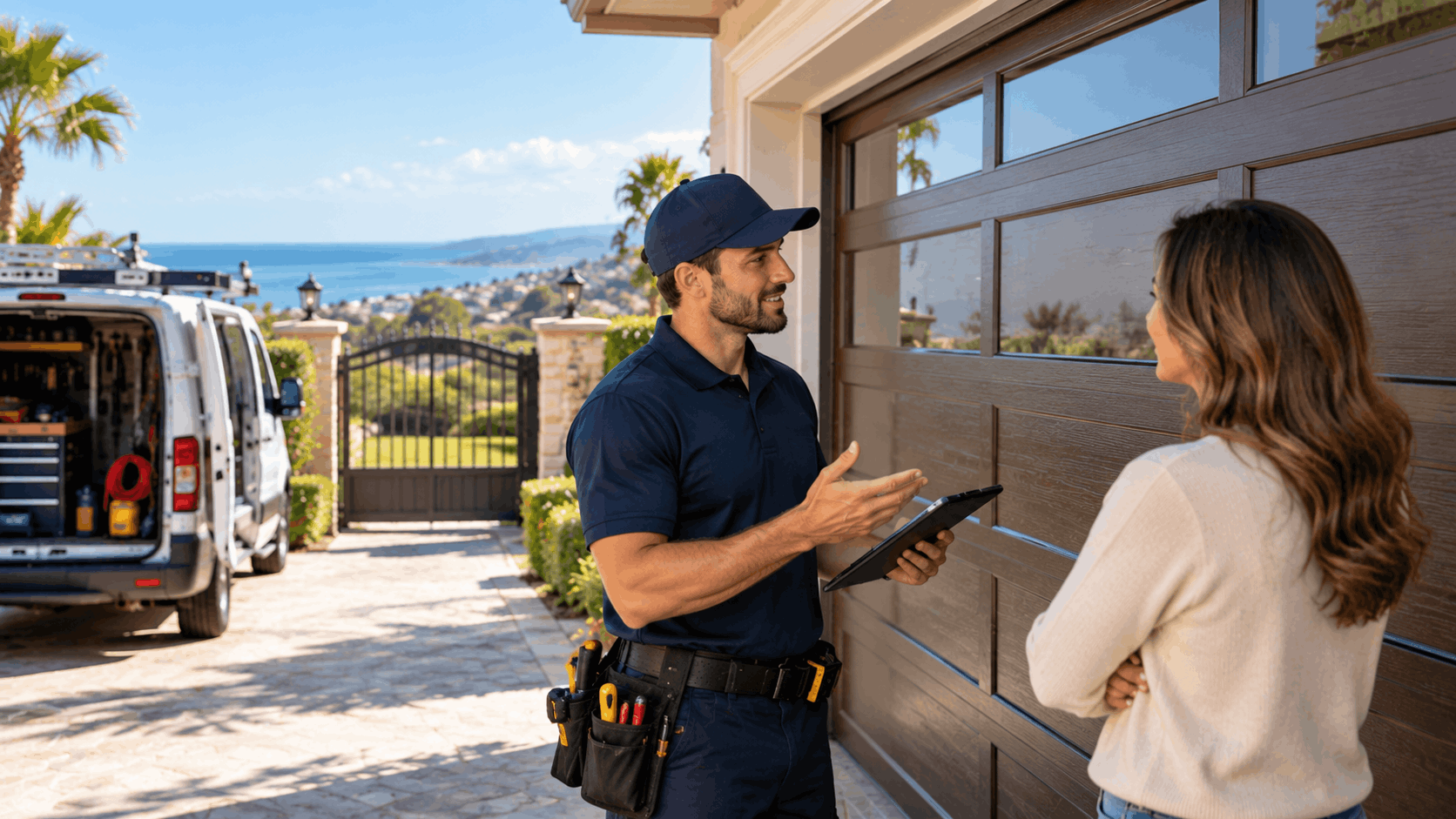
A technician diagnoses the actual fault, carries common torsion spring sizes for same-visit spring work, and can provide a written price before work begins. Emergency calls are answered 24/7 with a 30 to 60 minute response across Orange County, once the gate check-in is arranged.
To schedule a repair or a free on-site estimate for a new door, call Urgent Garage Doors at (949) 529-7743, and have your community gate ready to clear the visit.
Frequently Asked Questions
- Can you get same-day repair done inside a guard-gated Newport Coast community?
- Yes. With 24/7 service and a 30 to 60 minute response window across Orange County, same-day repair inside communities like Pelican Hill, Pelican Crest and Crystal Cove is routine, as long as gate access is arranged ahead of time. The homeowner usually authorizes the visit with the gate, and some associations keep approved vendor lists or want insurance documentation on file. Clearing the gate at the same time you call keeps the response window on track.
- Why does my heavy custom door need special springs?
- Timber, oversized and glass-and-steel doors weigh far more than a standard insulated steel door, so the springs must be sized to the actual measured weight of the door. Reusing an old spring set on a heavier door is the classic mistake. It leads to a door that will not hold position, premature spring failure and an overworked opener. On estate doors the correct approach is to weigh the door and engineer the spring to it rather than fit a nominal size.
- Why does my garage door only reverse in the afternoon?
- Low afternoon sun off the ocean can wash out the photo-eye beam on west-facing openings, so the sensor reads the glare as a blocked beam and reverses the door. That is why it happens at one time of day and works fine otherwise. It is usually a sensor diagnosis rather than a broken part, so cleaning and realigning the photo eyes often resolves it. Recognizing the pattern saves replacing an opener or sensor that was never the problem.
- How much does a torsion spring replacement cost here?
- Torsion spring replacement runs a typical Orange County range of $150 to $300. That is a typical area range, not a quote, and the actual figure depends on the specific door. Heavy estate doors use engineered springs sized to the measured weight, which can sit toward the upper end of the range. A written price is available before work begins, so you know the figure for your door before any work starts.
- Do I need a permit to repair or replace my garage door in Newport Coast?
- The permit position is decided by the city with jurisdiction over your address, not by a regional rule. Nearly every Newport Coast property sits in the Coastal Zone, where work touching the opening can draw coastal review, while replacing a door in an existing opening at the same dimensions is a different matter from changing the opening size. Confirm your address with the Newport Beach Permit Center at 100 Civic Center Drive, 949-644-3309. Each gated community also has its own architectural review for the door's appearance.
- Does a replacement opener have to include battery backup?
- Yes. Under SB 969, every residential automatic opener sold or installed in California on or after July 1 2019 must have a battery backup that operates during an electrical outage, with a $1,000 civil penalty for violations. A replacement residential door cannot be connected to a non-compliant opener. An opener already in service, though, is not forced to change. The law attaches to selling, installing or replacing, not to leaving an existing working unit in place.
- Can a broken custom panel be fixed the same day?
- Usually not. Made-to-order panels carry real lead times, so a damaged panel on a custom door is not a same-day fix. Where the door line is still manufactured, single-panel replacement is a genuine saving against replacing the whole door. Where the line is discontinued, the conversation turns to replacing the door or fabricating a matching section. You will be told the lead-time situation at the first call rather than discovering it later.
- How do I know my repair contractor is properly licensed?
- The correct classification for garage door work is C-61/D-28, Doors, Gates and Activating Devices, which covers spring systems, operators, control boards and safety sensors. C-28 is Lock and Security Equipment and is not the garage door license, so be cautious if a contractor cites it. The license number, classification, status and bond are public record, verifiable free at cslb.ca.gov. Urgent Garage Doors holds California license #1055150, which you can confirm there directly.
- What can I safely test myself before calling?
- You can run three checks safely. The photo-eye test: break the beam while the door closes and confirm it stops and reverses. The flat 2x4 test: lay a board across the opening and confirm the door reverses within two seconds of contact. The balance test: disconnect the opener with the release cord, raise the door to waist height and see if it stays put. Never adjust, wind, unwind or replace a torsion spring, because of the stored energy involved.
- Do you work on all garage door brands?
- Yes. The team works on all brands, including LiftMaster, Chamberlain, Genie, Craftsman, Clopay, Amarr, Wayne Dalton and CHI. That matters on estate doors, which often mix a custom-built panel with a name-brand operator, so the door and the opener come from different manufacturers. Working across every brand means the diagnosis and repair cover the whole system rather than just one maker's parts.
Licensed garage door repair professionals serving Irvine and Orange County.
Licensed in California · License #1055150
Why trust Urgent Garage Doors?
Founded in 2017, Urgent Garage Doors is a licensed and insured garage door services serving Irvine and Orange County. All content is reviewed by our licensed technicians.

Need Help in Irvine?
Urgent Garage Doors serves Irvine and all of Orange County.
Related Articles
Emergency Garage Door Repair in Newport Coast: Same-Day Service for Pelican Hill and Crystal Cove
A local guide to emergency garage door repair in Newport Coast, covering common failures, same-day service for Pelican Hill and Crystal Cove, costs, and prevention.
Garage Door Won't Open in Newport Beach: Same-Day Emergency Service
A garage door that won't open in Newport Beach usually means a broken spring, opener failure, or salt-air rust. Learn the causes, safety checks, costs, and same-day fixes.
Pelican Crest Newport Coast: Custom Estate Garage Door Service
A local guide to custom estate garage door service in Pelican Crest, Newport Coast - covering heavy wood doors, coastal air, HOA rules, repair, and installation.