What Our Tustin Garage Door Calls Show About Old Town, the Ranch and Legacy
Key Takeaways
- Tustin door problems split by build era: Old Town cottages, mid-century Central Tustin, 1980s Tustin Ranch, and the newer Tustin Legacy on the former MCAS site.
- North Tustin is an unincorporated county community, not the City of Tustin, so its permits run through the County of Orange, not the city.
- Old Town sits in the Cultural Resources District, where a no-fee Certificate of Appropriateness must be approved before a replacement door is ordered.
- Tustin Ranch doors from the 1980s are deep into their wear years; torsion springs rated around 10,000 cycles reach that in roughly seven years at four cycles a day.
- Since 1 July 2019, SB 969 requires a battery backup on every residential opener sold or installed in California, with a $1,000 civil penalty, and it is never an optional upgrade.
- Garage door work is licensed under CSLB classification C-61/D-28, not C-28; Urgent Garage Doors holds license #1055150, verifiable free at cslb.ca.gov.
- Typical Orange County repair ranges include torsion spring replacement $150 to $300 and cable repair $150 to $300, with the actual price given in writing before work begins.
- A torsion spring stores dangerous energy and should never be adjusted by an owner; the safe checks are the 2x4 auto-reverse test and a photo-eye alignment check.
In This Article
A call from Old Town Tustin and a call from Tustin Ranch rarely sound alike. On a period cottage near Main Street, the owner usually wants a door that fits an original narrow single-car opening and still passes the look rules. Out in Tustin Ranch, the problem is almost always a wide two or three-car sectional that has run through its hardware after decades of daily use.
That split is not an accident. Tustin grew in distinct waves, and each wave left behind its own door type, its own opening size, and its own set of parts that wear out on a schedule. The address also decides who issues the permit, whether an association reviews the style, and whether a preservation overlay governs the design.
Why the Calls Change From One Tustin District to the Next?
Tustin is not one kind of neighborhood, so the door problems split by build era and build type. A Tustin garage door on a 1920s cottage is a different animal from one hung in a 1980s tract home, and the repairs follow that history rather than the city as a whole.
The patterns in our calls track each district's origin story. The year a home was framed decides the opening size, the door style, the opener generation, and the hardware now reaching the end of its life. Knowing the era tells us most of what to expect before we pull into the driveway.
Old Town, Central Tustin, the Ranch and Legacy Are Different Eras
Old Town sits at the city's historic center, a cluster of period cottages built when a single car and a narrow opening were the norm. These homes carry the oldest door footprints in the city, and many still use openings sized for a vehicle far smaller than today's SUV.
Central Tustin is the postwar and mid-century belt between Old Town and Tustin Ranch, running along Red Hill Avenue, First Street, and Newport Avenue. The doors here reflect mid-century construction, often with older opener setups and hardware that predates modern safety features.
Tustin Ranch is the 1980s story. It was part of the historic Irvine Ranch and stayed a land preserve until The Irvine Company decided to build it in 1982, with the County of Orange approving construction in 1986. Tustin Legacy is the newest layer, built on the redeveloped former Marine Corps Air Station Tustin site.
Each era drives the door type and the hardware beneath it. A narrow cottage opening calls for a different approach than a wide 1980s sectional, and newer Legacy product arrives already built to current California standards. The era is the first clue in any diagnosis.
What the Original Builder Installed Still Shapes the Repair
The first door and opener put in decades ago decide what wears now. A builder who hung a single-car door on a cottage set the opening width and the spring size, and that choice still governs what fits when the door finally needs replacing.
On the wide tract homes of Tustin Ranch, the original builder installed two and three-car sectional doors with springs sized to that original panel weight. Those springs have been cycling for years, and the hardware around them has aged at the same pace.
Opening size matters more than owners expect. A narrow single-car opening limits panel choices and hardware, while a wide opening carries more weight and puts more load on every spring, cable, and roller. The builder's original spec is the frame every later repair has to work within.
When an owner upgrades to a heavier material, the original springs no longer match the door. A heavier replacement door needs springs sized to its actual weight, not a reuse of the old set. That is why a straight swap is rarely as simple as it looks from the driveway.
Who Actually Owns the Door Changes the Call
Attached and semi-attached product in places like Peppertree and Laurelwood makes ownership of the door the first question on any job. On shared-wall homes, the line between what the owner controls and what the association controls is not always obvious, so we confirm it before we recommend anything.
Tustin's housing mix adds another layer. Census figures put the owner-occupied rate at 48.8 percent, which means 51.2 percent of homes here are rented. On that share of properties, a failed door is a call to the landlord or property manager, not the person living there.
That changes how the work gets authorized and paid for. A renter who wants a fast fix still needs the owner or manager to approve the job, and on an association street the style may need review on top of that. Sorting out who signs off keeps the repair from stalling.
For attached product, the association documents often define whether the door is a common element or an owner responsibility. Getting this straight at the first call avoids a situation where the wrong party orders a door that another party has to approve.
Get Your Free Quote
Tell us about your garage door and we'll get back to you within 30 to 60 minutes.
North Tustin Is Not the City of Tustin, and That Trips People Up
The single most common address mistake in this area is treating North Tustin as part of the City of Tustin. It is not. North Tustin is an unincorporated county community, so its permits run through the county, not the city.
Getting that wrong means a permit that does not cover the address. We flag it early because the fix is simple once the jurisdiction is clear, and the headache is real when it is not.
What North Tustin Actually Is
North Tustin is the largest census-designated place and the largest unincorporated community in Orange County. The 2020 census counted 25,718 people, up from 24,917 in 2010, spread across 6.6 square miles of land at about 256 feet elevation.
Those numbers describe a community larger than many incorporated towns, yet it has no city hall of its own. It is county land, governed and permitted by the County of Orange rather than by any neighboring city.
That distinction matters the moment a job touches anything a building department reviews. The address may carry a Tustin mailing designation, but the authority over construction there is the county, and treating it as city land sends paperwork to the wrong office.
For owners in North Tustin, the practical takeaway is to confirm the county handles their address before any permitted work begins. It is the kind of detail that is invisible until it blocks a project, and it is worth getting right up front.
Permits Are County, Not City
For North Tustin addresses, permits, plan check, and inspections run through the County of Orange. For addresses inside the City of Tustin, the same work goes through the city, where the Planning Division is reached at 714-573-3140.
Mixing those up is how a permit ends up not covering the property. A permit issued by the wrong authority is worthless for the job, and the error can surface at inspection rather than at application, which is the worst possible time to learn about it.
We confirm jurisdiction for the specific address rather than assuming based on the mailing label. Two homes a few streets apart can fall under different authorities, so the only reliable answer comes from checking where the property actually sits.
The building department with jurisdiction is the authority on any given job. Whether that is the city or the county, confirming it first keeps the permit valid and the inspection clean.
When a Permit Comes Into Play at All
Structural work is what typically triggers a permit. Widening an opening or altering the header changes the framing, and that is the kind of change a building department wants to review. A like-for-like door swap in the existing opening is a different situation.
The position on a plain door or opener replacement is confirmed for the specific address with the authority that has jurisdiction. The rule varies, so the honest answer is to check rather than to state a blanket county-wide policy that may not hold.
A permit also carries a licensing consequence. When a job requires a building permit of any kind, it loses the under-$1,000 unlicensed-work exemption in Business and Professions Code section 7048. A permitted job goes to a licensed contractor whatever its dollar size.
So the permit question answers two things at once: whether the paperwork is needed, and who is allowed to do the work. That is why we settle it before anything else on a job that touches the structure.
Need Help in Irvine?
Urgent Garage Doors serves Irvine and all of Orange County.
Old Town Tustin: The Approval Comes Before the Door
Old Town calls almost always involve a period cottage with an original narrow opening. The look of the replacement is governed by a preservation overlay, and that approval has to happen before the door is ordered, not after it arrives.
Owners here cannot simply pick a door off a showroom floor. The district's rules shape what the replacement may look like, so the approval step comes first in the sequence every time.
The Cultural Resources District and the No-Fee Certificate
Old Town Tustin sits inside the city's Cultural Resources District, a preservation overlay centered on Main Street and El Camino Real. The district exists to protect the historic character of the area, and it governs changes to structures within its boundaries.
A Certificate of Appropriateness is a no-fee permit required for structures within that district, or for a designated cultural resource outside it. It is required prior to or concurrent with other approvals, so it slots in at the start of the process rather than being tacked on later.
The fact that it carries no fee does not make it optional. It is a required approval, and on a period cottage with an original opening it governs what the replacement door may look like. That makes it the gatekeeper for the whole project.
Because the certificate covers the appearance of the structure, it is the document that decides the design direction. Owners confirm the certificate position with the city for their specific property before committing to a door.
Narrow Single-Car Openings and What Fits
Period cottages in Old Town commonly have original narrow single-car openings. These were built for the vehicles of their era, and the width constrains both the panel choices and the hardware that can be used.
The district approval governs panel design, color, and visible hardware before the order goes in. That means the look of the door is settled by the certificate, not by whatever happens to be in stock. Owners who want a particular style run it past the approval first.
This is why owners cannot just grab any door and hang it. A door that clears the opening mechanically can still be the wrong style for the district, and a style that passes the district still has to fit the narrow opening. Both tests have to pass together.
A carriage-house style often suits a period cottage, but even that choice runs through the approval. The goal is a door that honors the original character while meeting modern safety requirements underneath.
Why Approval First Saves a Second Order
Ordering a door before the approval risks a door that cannot be installed as chosen. If the style does not clear the district review, the owner is left holding a door that has to be returned or replaced, and that is a delay and a cost nobody wants.
Approval first protects the order. Once the design is cleared, the door can be sized, built, and installed without the worry that the look will be rejected at a later stage. The sequence is the safeguard.
Owners confirm the approval position with the city for their specific property. Each cottage is a little different, and a designation or boundary detail can change what applies, so the city is the reliable source for the exact address.
With the approval settled, the install goes smoothly because every decision has already been signed off. That is the payoff for doing the paperwork before the order rather than after the door is on the truck.
Tustin Ranch: Two and Three-Car Doors Deep Into Their Wear Years
Tustin Ranch was built in the 1980s on the former Irvine Ranch land, and its wide sectional doors are now well past a decade of daily use. The calls here are mostly worn springs, cables, and hardware reaching the end of their cycle life.
These are busy doors on busy homes, and the physics of a wide panel on an aging spring set catches up with them. The pattern is consistent enough that we know what to look for before we open the panel.
A 1980s District Reaching Its High-Wear Stage
Tustin Ranch was a land preserve until The Irvine Company decided to build it in 1982. The County of Orange approved construction in 1986, and it was annexed to the City of Tustin that same year, forming ZIP code 92782.
That timeline puts the original doors well into their high-wear years. A door hung in the late 1980s or early 1990s has been opening and closing for decades, and the two and three-car sectionals common here carry more weight and more moving parts than a single-car door.
Wider doors mean longer springs, more cable length, and more rollers riding the track. Every one of those parts has been cycling the whole time, and on a main-entrance garage the count adds up faster than owners realize.
We see the results of that history on service calls across the Ranch. The doors are not failing because they were built poorly. They are failing because they have done their job for a long time, and that is exactly what a cycle-rated part is expected to do.
How Spring Cycle Life Works on a Busy Door
A torsion spring is rated in cycles, not years. One cycle is one full open and close. A standard residential spring is commonly rated around 10,000 cycles, and a door opened four times a day reaches that in roughly seven years.
On a main-entrance door that cycles more often, that number comes sooner. A household that runs the garage as its primary way in and out can blow through ten or twelve cycles a day, which shortens the calendar life of the spring considerably.
Corrosion and undersizing bring the rating forward too. A spring that was sized a little light for the door, or one that has picked up rust, reaches the end of its usable life before the cycle count alone would suggest. The rating is the ceiling, not a guarantee.
This is why age plus usage tells the story better than age alone. A twelve-year-old Ranch door that opens a dozen times a day has already passed through more cycles than its springs were built for, and a torsion spring replacement is the predictable next step.
Why Cables and Rollers Get Replaced Alongside Springs
Springs do not wear in isolation. Cables, drums, rollers, hinges, and bearings all age alongside them, carrying the same load over the same years. When one part reaches the end, the others are usually not far behind.
Replacing a spring without inspecting the cables is how a second failure follows weeks later. A frayed cable that was overlooked during the spring job will let go soon after, and the owner is calling again for a problem that could have been caught the first time.
That is why we check the cables and rollers whenever we handle a spring. The inspection is quick, and it turns a single repair into a lasting one rather than the first of two visits.
Heavier replacement doors raise the stakes. A door in a heavier material needs springs matched to its actual weight and height, not the old set carried over. Sizing the springs to the real door is what keeps the whole system balanced and the cables under the right tension.
The One Thing an Owner Should Never Touch
A torsion spring stores enough energy to cause serious injury and releases it instantly if a winding bar slips. This is the one component an owner should never adjust, wind, unwind, or replace. The risk is immediate and severe.
We mean that literally. A spring under tension holds the energy that lifts the entire door, and a tool that slips during winding can strike with enough force to break bones. The job calls for the right bars, the right technique, and the right springs sized to the door.
What owners can safely do is test the system. Lay a flat 2x4 across the opening in the door's path, and on closing the door should reverse within two seconds of contact. Also check that the photo-eye beam is aligned and unobstructed.
The balance test is safe too: with the opener disconnected by the release cord, raise the door to waist height, and a correctly balanced door stays put. A door that falls or rises points to a spring problem that belongs to a technician, not the homeowner.
Central Tustin, Tustin Legacy and the Association Streets
Central Tustin brings mid-century repairs, Tustin Legacy brings newer product on the former MCAS site, and both can sit on association-governed streets. Who approves the door changes the timeline as much as the door itself does.
These three threads often cross on a single job. The era sets the hardware, and the association, where one exists, sets the style rules. We sort both before a door gets ordered.
Central Tustin: Mid-Century Doors on City Land
Central Tustin is the postwar and mid-century belt between Old Town and Tustin Ranch, running along Red Hill Avenue, First Street, and Newport Avenue. It is city land, so City of Tustin permits apply to work there.
The doors reflect their era. Mid-century homes often carry older hardware and opener setups, some of which predate modern entrapment protection entirely. An opener that old may lack the external safety devices every current unit must have.
That makes Central Tustin a common place for opener upgrades alongside door work. When a pre-1993 opener comes up, the manufacturer position is replacement rather than repair, because those units predate the federal entrapment-protection mandate.
On these homes we look at the whole system, not just the symptom. An old chain-drive opener on a mid-century door is often due for a modern replacement that brings the safety features and the battery backup the current law requires.
Tustin Legacy on the Former MCAS Tustin Site
Tustin Legacy is the redevelopment of the former Marine Corps Air Station Tustin. A portion of the base was selected for closure in 1991, with more in 1993, and the station closed on 3 July 1999, 57 years after it opened.
The homes built on that site are among the newest in the city. Their doors and openers are current product, which generally means fewer age-related failures than the Ranch or Central Tustin see, at least for now.
Newer does not mean exempt. The same California requirements that apply to any residential door and opener apply here, including battery backup on any opener sold or installed since mid-2019. A replacement in Legacy meets the same standards as one anywhere else in the state.
As this district ages, its doors will move through the same cycle life every door follows. For now the calls tend toward installation, smart opener setup, and the occasional adjustment rather than the heavy spring work the older districts generate.
Laurelwood, Tustin Meadows and Davis-Stirling Review
Association-governed streets operate under California's Davis-Stirling Common Interest Development Act. Architectural review under that framework typically covers door style, panel design, color, and visible hardware, and approval should come before the order.
Laurelwood is a 1973 master-planned district in the city's own historic resources survey, bounded by Tustin Ranch Road, Walnut Avenue, the Santa Ana Freeway, and an irrigation channel. Tustin Meadows is a 1968 planning district in the same survey, bounded by Red Hill, Walnut, Tustin Ranch Road, and an irrigation channel.
Both districts show how association rules and historic survey status can overlap. On attached product in these areas, the first question is who owns the door, and the second is what the association allows for its appearance.
Because review covers the visible details, an owner who picks a door without checking the rules can run into a style that is not permitted. Confirming the association's requirements before ordering keeps the project moving and the door compliant with the neighborhood's standards.
Why a Door Fitted Without Approval Can Come Out
A door installed without required association approval can be ordered out at the owner's cost. That is the hard consequence of skipping review, and it turns a finished job into a do-over that the owner pays for twice.
Review comes first for that reason. The approval protects the investment, because a door that has been signed off cannot be challenged on style grounds after the fact. The paperwork is cheaper than the removal.
We tell owners to confirm the style rules with their association before ordering. The association holds the current standards, and those can change, so the reliable answer comes from the people who enforce them rather than from a guess.
Once the style is approved, the install proceeds with confidence. The owner gets the door they chose, the association gets a compliant street, and nobody is tearing out a panel that was wrong from the start.
Need Help in Irvine?
Urgent Garage Doors serves Irvine and all of Orange County.
The California Rules Behind Every Tustin Replacement
Whatever the district, a few state rules apply to any residential opener and door swap in Tustin. These cover entrapment protection, battery backup, and who is licensed to do the work, and they hold whether the home is a cottage or a Legacy new-build.
None of these are local rules or association rules. They are California law, and they shape every replacement across the city the same way.
Battery Backup Is Required, Not an Upgrade
Since 1 July 2019, SB 969 has required a battery backup on every residential garage door opener manufactured for sale, sold, offered for sale, or installed in California. It carries a $1,000 civil penalty, and a replacement door may not be connected to a non-compliant opener.
The law followed the 2017 Northern California wildfires, where people could not open garage doors during power cuts and could not evacuate. The purpose is a door that still works when the grid goes down. It is statewide and residential.
Because it is a legal requirement, battery backup is never a paid upgrade tier or an optional extra. An owner replacing an opener in California is getting a compliant unit whether or not they asked for one, and a battery backup install is simply part of meeting the law.
It is not a fire-zone rule, a city rule, or an association rule, and it does not force an owner to upgrade an opener that is simply sitting there. It applies when an opener is sold or installed, which is exactly when a replacement happens.
Auto-Reverse and Photo Eyes on Older Openers
California required openers to be manufactured with an automatic reverse device and sensor under AB 3600 in 1990. Congress followed for openers manufactured for the United States after 1 January 1993, and UL 325 is the standard those devices are built to.
In practice, compliance works two ways at once. The opener must reverse the door within two seconds of contacting an obstruction, and nearly all openers add a non-contact system: the photo eyes, mounted on each side of the opening no higher than six inches off the floor.
Those photo eyes are also the most common cause of a door that reverses for no visible reason. A misaligned or blocked beam reads an obstruction that is not there and stops the door, which is why sensor alignment is a frequent fix.
Openers made before 1993 predate this entrapment-protection mandate. They are not illegal to own, but they lack the external safety devices every modern opener carries, and the manufacturer position is to replace rather than repair them.
The License That Covers Garage Door Work
Garage door work in California is licensed under CSLB classification C-61/D-28, Doors, Gates and Activating Devices. It is a subclassification of the C-61 Limited Specialty category, and it covers sectional and rolling doors, torsion and extension spring systems, operators, control boards, safety sensors, and activating devices.
C-28 is a different license entirely. C-28 is Lock and Security Equipment, and it is not the garage door license. Garage door work is also not Class B general building work, so an owner checking credentials should look for C-61/D-28 specifically.
Any license is verified free at cslb.ca.gov, where the license number, classification, status, bond, and workers compensation are all public record. It takes a minute and tells an owner exactly who they are hiring.
Urgent Garage Doors holds California license #1055150. An owner can look it up and confirm the classification and status before any work starts, which is the simplest way to know the contractor is cleared for the job.
The $1,000 Exemption and the Written Contract Rule
AB 2622 rewrote Business and Professions Code section 7048 effective 1 January 2025, raising the unlicensed-work exemption from $500 to $1,000 in combined labor, materials, and other costs. A great deal of older advice still prints $500, but the current figure is $1,000.
The exemption also fails at any value under two conditions: if the work requires a building permit of any kind, or if the person employs anyone on the job. A job also cannot be split into sub-$1,000 slices to slip under the line.
A separate rule is often confused with this one. Business and Professions Code section 7159 requires a written home improvement contract for work over $500. That is a contract requirement, not a licensing threshold, and the two figures belong to two different rules.
For owners, the practical point is simple. Most meaningful door and opener work clears these thresholds, and any permitted job goes to a licensed contractor regardless of cost, so the license check matters on nearly every real job.
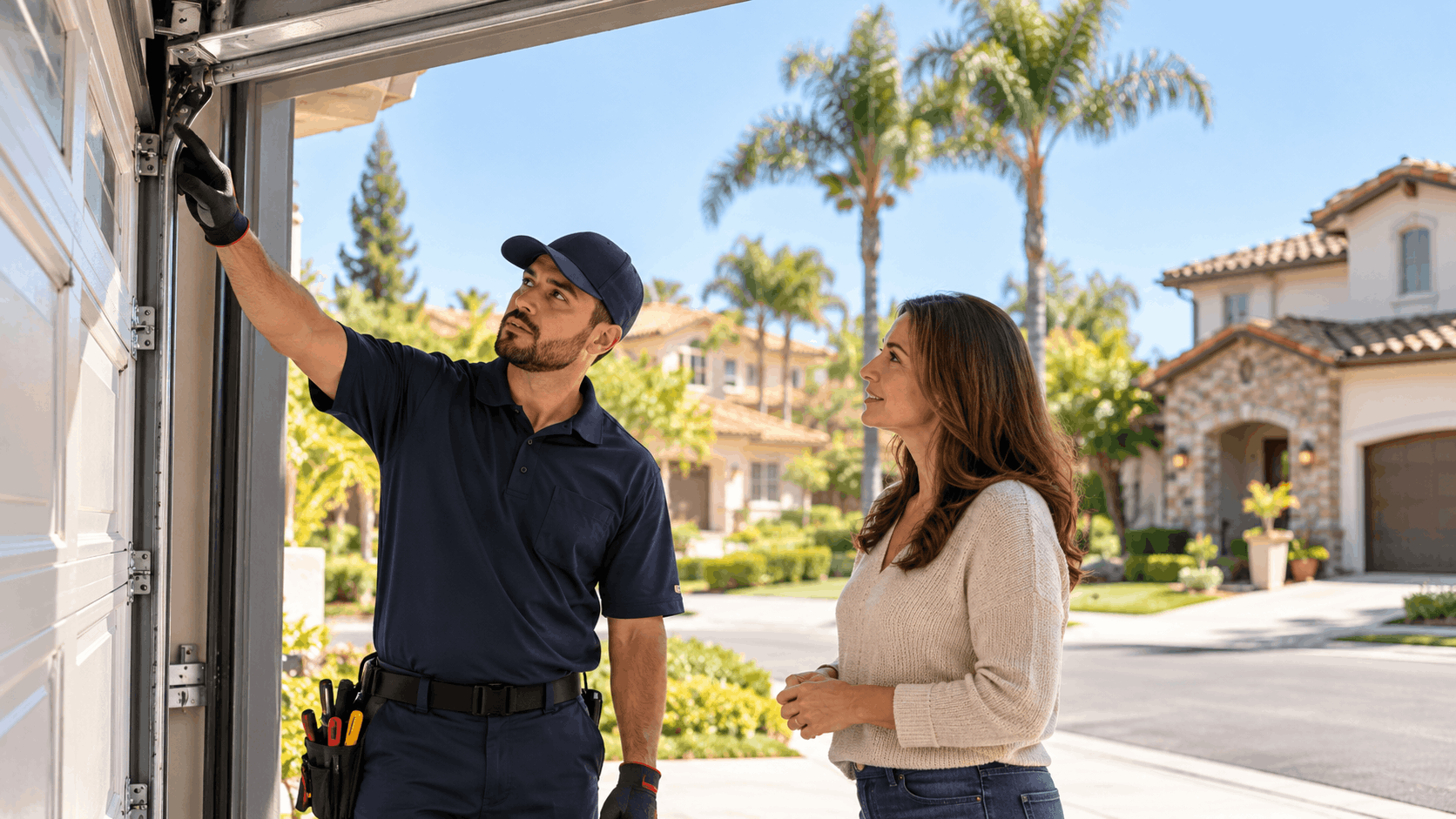
What a Tustin Door or Opener Job Typically Costs
Owners want a sense of the range before anyone shows up. The figures below are typical Orange County ranges, not a quote. The actual price for a specific garage depends on that garage and is given in writing before work begins.
These ranges help an owner plan. They are not a fixed price from Urgent Garage Doors, and they are presented as typical market ranges for the area.
New Doors by Style
Door style drives a large part of the price because the material, the design, and the hardware all change with it. A plain sectional sits at the lower end, while glass and custom work reach the top.
| Door Type | Typical Range |
|---|---|
| Sectional garage door replacement | $800 to $2,500 |
| Insulated steel garage door | $900 to $2,500 |
| Carriage-house garage door | $1,200 to $4,500 |
| Modern glass garage door | $1,800 to $4,500 |
| Custom garage door projects | $1,800 to $6,500+ |
For an Old Town cottage, the carriage-house range is often the relevant one once the district approval settles the style. For a wide Ranch opening, a sectional or insulated steel door is the more common replacement.
Where a garage shares a wall or ceiling with living space, insulation rated in R-value matters more, which can nudge the choice toward an insulated door. The right range depends on the opening, the material, and the look the home calls for.
Springs, Cables and Common Repairs
Repairs are where the aging Ranch and Central Tustin doors generate most calls. Spring and cable work dominates, with track and panel repairs close behind.
| Repair | Typical Range |
|---|---|
| Torsion spring replacement | $150 to $300 |
| Extension spring replacement | $150 to $250 |
| Cable repair | $150 to $300 |
| Off-track door repair | $125 to $275 |
| Panel replacement | $250 to $800 per panel |
| Safety sensor alignment and repair | $75 to $150 |
| Door balancing and tension adjustment | $75 to $150 |
On a Ranch door, a spring job often comes with a cable inspection, because replacing one without the other is how a second failure shows up. An off-track door on a wide opening is another common Ranch call.
A single damaged panel can sometimes be swapped rather than replacing the whole door, which keeps the cost at the per-panel range instead of a full door.
Openers and Battery Backup
Opener work spans a wider range because drive type and smart features change the price. A belt drive costs more than a chain drive, and the quieter belt is worth it where a room sits above the garage.
| Opener Work | Typical Range |
|---|---|
| Opener installation | $250 to $600 |
| Opener repair | $75 to $200 |
| Smart Wi-Fi opener and MyQ setup | $150 to $300 |
| Battery backup installation | $200 to $400 |
| Keypad and remote programming | $45 to $85 |
On Central Tustin homes with pre-1993 openers, a full install is often the path, and that install includes the battery backup the law requires. A smart Wi-Fi setup is a common add for owners who want phone control.
Where headroom is tight or storage fills the ceiling, a jackshaft unit that mounts on the wall and drives the torsion bar is an option, though drive type is one of the things that shifts the final figure.
What Moves the Price on a Specific Garage
Door weight and material move the price first. A heavier door needs springs sized to its actual weight, and that sizing is not optional, so the spring cost tracks the door you choose rather than the door that was there before.
Whether the cables and rollers need replacing matters next. If the hardware around the spring is worn, replacing it at the same time avoids a return visit, and that is reflected in the quote rather than hidden in a later call.
The opener is the third factor. Any new or replacement opener has to meet SB 969 with a battery backup, so that cost is built into an opener job in California. There is no version of the work that skips it.
A free on-site estimate is offered for new installations, and removing and hauling away the old door is included in a new door install. The specific price for a garage is given in writing before work begins.
Need Help in Irvine?
Urgent Garage Doors serves Irvine and all of Orange County.
How Urgent Garage Doors Handles a Tustin Call
How the team works a job runs from the first call through the repair, and the approach fits the district it is working in. An Old Town approval, a high-wear Ranch spring, and a Legacy opener each call for a slightly different path.
The steps below are the same core process, adjusted to what the address needs.
The Diagnostic and Written Price
The team diagnoses the door and opener before recommending anything. On a reversing door, that means checking the photo eyes and alignment first, because a blocked or misaligned beam is the most common cause and the cheapest fix.
A written price is available before work begins, and a free on-site estimate is offered for new installations. For an owner weighing a repair against a replacement, having the number in hand makes the decision clearer.
California requires a written home improvement contract for work over $500 under Business and Professions Code section 7159. That is a legal requirement, and it means larger jobs come with the paperwork the law calls for.
The diagnostic also catches the parts an owner cannot see. A spring that tests fine today but sits next to a fraying cable gets flagged, so the owner can decide on the full fix rather than a partial one.
Truck Stock and Same-Visit Spring Work
Common torsion spring sizes are carried on the trucks, so a spring replacement is often completed on the same visit. For the busy Ranch doors that cycle many times a day, that turnaround matters because the garage is often the main way in and out.
Carrying stock means the diagnosis and the fix can happen in one trip for the most common jobs. It does not mean every job finishes on the first visit, since an unusual spring size or a custom part can need a follow-up.
For a wide two or three-car Ranch door, the right spring has to match the actual door weight and height. Having the standard sizes on the truck covers the bulk of those jobs without a wait for parts.
When a job does need a part that is not on board, the team sizes it correctly rather than forcing a mismatch. A spring that is close but wrong shortens its own life and throws off the door's balance.
24/7 Response Across Orange County
The company takes emergency calls 24 hours a day, 7 days a week, every day of the year including holidays. A door stuck open overnight or a broken spring before a morning commute does not wait for business hours.
The response window is 30 to 60 minutes anywhere in Orange County. For a Tustin owner with a car trapped behind a dead door, that window is the difference between a ruined day and a quick fix.
The team works on all major brands, including LiftMaster, Chamberlain, Genie, Craftsman, Clopay, Amarr, Wayne Dalton, and CHI. Whatever the original builder installed on a Ranch or Central Tustin home, the parts and know-how are there.
The Google Local Services listing carries the Google Guarantee badge, and the license is public at cslb.ca.gov for any owner who wants to check before calling. An emergency repair is a call away at any hour.
Preventive Maintenance and the Written Report
A preventive maintenance visit runs $99 to $149 per visit and includes a written report of what was found and what is recommended. For aging doors, that report is how a worn cable or a tired roller gets caught before it fails.
On a Ranch door deep into its cycle years, maintenance is where the second failure gets prevented. The visit looks at the springs, cables, rollers, hinges, and bearings together, so a problem is spotted while it is still cheap to fix.
Central Tustin's older hardware benefits the same way. A mid-century door with original parts shows its wear slowly, and a scheduled look at the system keeps small issues from turning into a stuck door on a workday morning.
The written report gives the owner a record to act on. It lays out what is fine, what is wearing, and what is recommended, so the owner decides on the timing rather than being surprised by a breakdown. A maintenance plan fits the aging doors across both districts.
Getting Your Tustin Door Handled
Every Tustin job starts with a diagnostic and a written price before work begins, with a free on-site estimate for new installations and the old door hauled away on a replacement. Emergency calls are answered 24/7 with a 30 to 60 minute response window across Orange County.
Call Urgent Garage Doors at (949) 529-7743 to get your door looked at, or reach the team through the contact page. You can also see the full Tustin service area and what the team covers there.
Frequently Asked Questions
- Does a garage door replacement in Tustin need a building permit?
- The permit position is decided by the city or county with jurisdiction over the specific address. Structural work such as widening an opening or altering the header typically triggers a permit. North Tustin addresses go through the County of Orange, while City of Tustin addresses go through the city, reachable at the Planning Division on 714-573-3140. Confirm the position for your exact address before any permitted work begins.
- Is my address in the City of Tustin or North Tustin?
- North Tustin is an unincorporated county community and is not part of the City of Tustin, even though it is the largest unincorporated community in Orange County. That means its permits are county permits, handled by the County of Orange rather than the city. Confirming which jurisdiction covers your address avoids a permit that does not cover the property, which can surface at inspection and stall the job.
- What approval do I need for a door in Old Town Tustin?
- Old Town sits inside the city's Cultural Resources District, centered on Main Street and El Camino Real. A Certificate of Appropriateness, which is a no-fee permit, is required for structures in that district prior to or concurrent with other approvals. It governs panel design, color, and visible hardware, so it comes before the door order. Confirm the certificate position with the city for your specific property.
- How long do garage door springs last in Tustin Ranch?
- A standard torsion spring is rated around 10,000 cycles, which a door opened four times a day reaches in roughly seven years. On a main-entrance door that cycles more often, that comes sooner, and corrosion or undersizing brings it forward. Tustin Ranch homes built in the 1980s are deep into their high-wear years, so their original springs have often already passed through more cycles than they were built for.
- Do I need a battery backup when I replace my opener?
- Yes. Since 1 July 2019, SB 969 has required a battery backup on every residential garage door opener sold or installed in California, with a $1,000 civil penalty for non-compliance. A replacement door may not be connected to an opener that does not comply. It is a statewide legal requirement passed after the 2017 Northern California wildfires, not an optional add-on or a paid upgrade tier.
- Can I replace a garage door spring myself?
- No. A torsion spring stores enough energy to cause serious injury and releases it instantly if a winding bar slips, so an owner should never adjust, wind, unwind, or replace one. The safe checks are the auto-reverse test, where you lay a flat 2x4 in the door path and confirm the door reverses on contact, and checking that the photo-eye beam is aligned and unobstructed.
- What license should a Tustin garage door contractor hold?
- The correct classification is C-61/D-28, Doors, Gates and Activating Devices, which covers sectional and rolling doors, spring systems, operators, control boards, safety sensors, and activating devices. C-28 is Lock and Security Equipment and is not the garage door license, and the work is not Class B general building work. Any license is verified free at cslb.ca.gov, where classification, status, bond, and workers compensation are public record.
- How much does a garage door repair cost in Tustin?
- Typical Orange County ranges are: torsion spring replacement $150 to $300, cable repair $150 to $300, same-day repair $150 to $350, and off-track door repair $125 to $275. These are typical market ranges for the area rather than a quote. The actual price for a specific garage depends on that garage and is given in writing before work begins, with a free on-site estimate offered for new installations.
- Why does my garage door reverse for no reason?
- Photo-eye faults, misalignment, and blocked beams are the most common cause of a door that reverses for no visible reason. The sensors mount on each side of the opening no higher than six inches off the floor, and anything breaking or crossing that beam stops the door. Before calling, an owner can check that the beam is aligned and that nothing is blocking either sensor lens.
- Do I need association approval before changing my door?
- On association-governed streets, yes. These communities operate under California's Davis-Stirling Common Interest Development Act, and architectural review typically covers door style, panel design, color, and visible hardware. Approval should come before the order, because a door fitted without required approval can be ordered out at the owner's cost. Confirm the current style rules with your association before ordering so the door meets the neighborhood's standards.
Licensed garage door repair professionals serving Irvine and Orange County.
Licensed in California · License #1055150
Why trust Urgent Garage Doors?
Founded in 2017, Urgent Garage Doors is a licensed and insured garage door services serving Irvine and Orange County. All content is reviewed by our licensed technicians.

Need Help in Irvine?
Urgent Garage Doors serves Irvine and all of Orange County.
Related Articles
Garage Door Installation in Tustin Ranch: Two-Car Uniformity and Association Rules
A local guide to two-car garage door installation in Tustin Ranch, covering matching doors, HOA and ARC approval rules, materials, costs, and the install process.
Garage Door Service for Tustin Property Managers and HOA Boards
A guide for Tustin property managers and HOA boards on garage door ownership, Davis-Stirling review, permits by address, SB 969, licensing and typical OC price ranges.
Nellie Gail Ranch Laguna Hills: Estate-Sized Garage Door Service
Estate-sized garage door service for Nellie Gail Ranch homes in Laguna Hills, covering repair, custom installation, materials, openers, and upkeep for large doors.