Garage Doors in Huntington Harbour and SeaCliff - Waterfront Hardware Packages
Key Takeaways
- Salt air can make standard garage door springs fail in 3-5 years near the water versus 8-12 years inland.
- Canal-front homes on Humboldt Island and Trinidad Lane face constant salt moisture and need coated hardware most.
- A waterfront hardware package includes galvanized or stainless springs, nylon rollers, powder-coated tracks, and upgraded seals.
- Aluminum and glass doors resist rust best, coated steel works with proper finishes, and composite beats real wood for low upkeep.
- Monthly freshwater rinses and silicone lubricant every two to three months slow corrosion between service visits.
- A full corrosion-resistant hardware swap runs about $450 to $900 and often costs less than replacing standard parts one by one.
- Never DIY spring or cable work - the high tension is dangerous and should be left to a technician.
- Urgent Garage Doors serves Huntington Harbour and SeaCliff from Irvine via the 405 and PCH with same-day and emergency response.
In This Article
A Huntington Harbour homeowner walked into her garage last February and noticed something new. Orange streaks ran down the wall behind her garage door springs. After one salty winter, the metal that looked fine in the fall had started to rust. She wondered how the springs went bad so fast when her sister's door in Riverside had lasted twelve years without a spot.
The answer sits in the air. Homes along the water in Huntington Harbour and SeaCliff breathe in salt every day. That salt attacks standard steel parts far sooner than anything a few miles inland. Springs weaken, rollers grind, and tracks pit before their time.
Why Waterfront Homes Need Different Garage Door Hardware
Salt air is hard on metal. The same garage door that lasts fifteen years in a dry inland tract might show trouble in three or four years near the water. That gap is why coastal garage doors need hardware built to fight corrosion from day one.
Standard steel parts were made for average conditions, not for salt spray drifting in off the ocean. When you live on a canal or a few blocks from the beach, waterfront hardware is the difference between a door that ages gracefully and one that fails early. The table below shows the rough gap.
| Component | Standard Part (Coastal Life) | Coated Part (Coastal Life) |
|---|---|---|
| Torsion springs | 3-5 years | 8-12 years |
| Steel rollers | 2-4 years | Nylon lasts 10+ years |
| Bare steel tracks | 4-6 years | Powder-coated 10-15 years |
| Hinges | 3-5 years | Galvanized 8-12 years |
How Salt Air Breaks Down Standard Steel Parts
Rust is a chemical reaction. Iron in steel meets oxygen and water, and it forms iron oxide, the flaky orange stuff you see on old hardware. Salt speeds that reaction up because it holds moisture and lets electricity move between metal spots more easily. On the coast, that means rust forms and spreads much sooner than it would in a dry climate.
Your garage door has three parts that suffer most from salt corrosion. Steel springs carry huge tension and rust weakens the coils from the inside. Tracks develop pits where the rollers ride. Hinges seize up as rust builds in the joints.
Near the water, we start seeing inland-grade springs fail in three to five years. That same spring can run past a decade in Turtle Rock or Portola Springs. The salt simply eats through the metal on a shorter clock.
Once rust takes hold on steel springs, it does not stop. Small surface stains become pits, pits become weak spots, and weak spots snap under load. That is why coastal homes see so many broken springs compared to inland ones.
The Difference Between Huntington Harbour and Inland Irvine Conditions
The marine layer that rolls over Huntington Harbour most mornings carries damp, salty air. It settles on every metal surface in the garage and takes hours to burn off. That daily cycle of wet and dry is brutal on unprotected steel.
The Irvine climate a few miles inland is much drier. Homes around Turtle Rock and the University area still get some morning fog, but far less salt reaches them. Lower humidity and less salt spray mean the same door can last years longer.
Think of it as a slow soak versus a quick dry-off. Waterfront hardware deals with moisture that clings for hours, while inland parts dry out fast. Higher humidity keeps a thin film of water on coastal metal almost all the time.
This is why we never recommend the same hardware package for a Humboldt Island home that we would put on a house near the Irvine Spectrum. The conditions are not close. A door built for the coast needs coated parts that a dry inland home can skip.
What Waterfront Damage Looks Like Early On
The first warning sign is usually orange staining. Rust stains show up around spring anchors, hinge pins, and the bottom of the tracks. If you see orange streaks on the wall or door, corrosion has already started.
Squeaky rollers are the next clue. When the sealed grease dries out or metal rollers start to rust, they grind and squeal as the door moves. That noise means the bearings are wearing and the roller is on its way out.
Pitted hardware is a more serious sign. Run your finger along a hinge or track and feel for rough, cratered spots. Pitting means the metal has lost material and the part is weaker than it looks.
Flaking paint rounds out the list. When the finish bubbles or peels, salt and moisture reach the bare steel underneath and the door skin starts to corrode. Catching these signs early lets you swap parts before a spring snaps or a panel rots through. Our maintenance and upgrade team can spot these problems on a quick visit.
Get Your Free Quote
Tell us about your garage door and we'll get back to you within 30 to 60 minutes.
Coastal Conditions in Huntington Harbour and SeaCliff
These are two of the most beautiful waterfront communities in Orange County, and they are also two of the hardest on garage doors. The layout of the streets, the canals, and the open ocean exposure all play into how fast a door wears. Coastal wear here follows patterns we have learned street by street.
Huntington Harbour wraps around a network of canals and islands, so many homes sit right on the water. SeaCliff climbs the bluffs above the beach near the golf course. Each area has its own version of the salt-air problem.
Canal-Front Homes Along Humboldt Island and Trinidad Lane
Homes on Humboldt Island and along Trinidad Lane sit directly on the water. Their garages face constant moisture rising off the canals. That water is saltwater, so the air around these homes carries salt around the clock, not just during the marine layer.
Canal homes with a garage facing the water take the worst hit of all. Wind pushes damp, salty air straight at the door and hardware. On these properties, we routinely find rust starting within a year or two on standard parts.
The docks make it worse. Reflected moisture off the water surface keeps the whole garage area damp. Tools, bikes, and anything metal stored inside picks up that salt film too.
For canal-front owners, waterfront moisture is a daily fact of life. We tell these homeowners that coated hardware is not optional if they want the door to last. Our Huntington Harbour repair crew knows these canal streets well.
SeaCliff Properties Near the Golf Course and Palm Avenue
SeaCliff homes near the bluffs and along Palm Avenue deal with a steady ocean breeze. The wind off the water carries salt even though these homes are not on a canal. Fog rolls up from the beach and settles over the neighborhood most mornings.
The tracts here mix older and newer construction. Some homes near the golf course date back decades and still have original hardware that has been fighting salt for years. Newer builds often came with better finishes but not always true coastal-grade parts.
The ocean breeze is gentler than direct canal exposure, but it still adds up over time. A door on Palm Avenue will not rust as fast as one on Humboldt Island, but more than one in Irvine. The salt load falls somewhere in the middle.
We service SeaCliff often, and homeowners there can find our SeaCliff garage door service when a spring or roller gives out. Knowing the bluff conditions helps us match the right hardware to each home.
How Wind and Fog Off Bolsa Chica Affect Door Longevity
The Bolsa Chica wetlands and coastline sit just north of these neighborhoods. Prevailing winds carry salt spray off the open water and the wetlands inland. That salt does not stop at the beachfront homes.
Wind exposure spreads the salt several blocks in from the water. Homes that feel like they are far from the ocean still get a light salt coating on windy days. Over months and years, that thin layer does real damage to unprotected hardware.
Fog makes the salt cling longer. When the marine layer is thick, salty moisture stays on metal surfaces well into the afternoon. The longer the salt sits wet, the more damage it does.
This is why we treat almost every home in these zip codes as a coastal job. Even a house a few blocks off the water in the wind path from Bolsa Chica sees more corrosion than an inland home. The salt spray reaches farther than most people expect.
HOA and Coastal Design Rules to Know
Many SeaCliff and Huntington Harbour communities have HOA rules that control garage door style and color. Before you order a new door or even swap out visible hardware, check your community guidelines. Some tracts require specific panel styles or approved color lists.
The rules exist to keep the coastal design consistent across the neighborhood. That can limit your choices, but it also protects home values. A door that clashes with the tract can trigger a violation notice.
Door color matters more than people expect on the coast. Darker colors absorb more heat, which can affect how coatings age in the sun and salt. Some HOAs steer owners toward lighter tones that hold up better.
We help homeowners work within these rules all the time. Before we quote a new door, we ask about the HOA so the finished job passes review the first time. It saves everyone the hassle of a rejected install.
Need Help in Irvine?
Urgent Garage Doors serves Irvine and all of Orange County.
What a Waterfront Hardware Package Includes
A waterfront hardware package swaps the standard steel parts for corrosion-resistant versions built to survive salt air. Every piece is chosen to slow rust and last longer near the water. Here is what you are actually paying for.
These packages combine galvanized parts, stainless steel, nylon, and better seals into one upgrade. Bought as a set, they cost less than replacing failed standard parts one at a time over the years. Below is a look at each component.
Galvanized and Stainless Steel Springs
Torsion springs carry the full weight of the door, so they matter most. A galvanized coating puts a layer of zinc over the steel that takes the corrosion instead of the spring itself. That coating buys years of extra life in salt air.
Stainless springs go a step further and resist rust at the metal level. They cost more up front but hold up best on canal-front homes where salt is constant. For many waterfront owners, the longer lifespan is worth it.
The lifespan difference is real. A standard spring might last three to five years on the coast, while a galvanized or stainless spring can run eight to twelve. That is often the gap between one replacement and three over the same period.
Because spring work is dangerous, we always install and adjust these ourselves. Our torsion spring replacement service handles the high-tension parts safely so you never have to touch them.
Nylon Rollers and Sealed Bearings
Metal rollers rust and grind near salt water. Nylon rollers avoid that problem because the wheel itself does not corrode. They roll smoothly for years even in damp coastal garages.
Sealed bearings are the second half of the upgrade. The seal keeps salt and moisture out of the bearing race, so the roller keeps spinning freely instead of seizing. Standard open bearings pack with salt grit and fail fast on the coast.
There is a nice bonus too. Nylon rollers with sealed bearings run much quieter than metal ones. If your door sounds like a freight train every morning, this upgrade alone makes a noticeable difference.
We often bundle rollers into a broader tune-up. Ask about our quiet roller hardware upgrade if noise and rust are both on your mind.
Powder-Coated Tracks and Hinges
Bare steel tracks fail early on the water. The rollers ride the same path over and over, and any rust in that path turns into pits that catch and bind. A powder-coated track adds a tough baked-on barrier against salt and moisture.
Powder coating is thicker and more durable than paint. It seals the steel so salt cannot reach the metal directly. Coated tracks routinely last ten to fifteen years where bare tracks fail in four to six.
Coated hinges get the same benefit. The joints where the door panels fold are prime spots for rust to lock things up. A corrosion barrier keeps them moving and stops the orange staining that spreads down the door.
When tracks do bend or pit past the point of coating, we can realign or replace them. Our track repair and realignment service gets a coastal door running true again.
Weather Seals and Bottom Astragals for Damp Air
Upgraded weather seals keep humid, salty air out of the garage. The seals run along the sides and top of the door, and they block the blowing salt spray that would otherwise drift inside. A tight seal protects everything stored in the garage.
The bottom astragal is the rubber strip along the base of the door. On the coast it does double duty, blocking both water and damp air from creeping under the door. A worn astragal lets moisture pool inside every foggy morning.
Good moisture control matters for more than the door. Tools rust, cars corrode, and stored boxes get musty when salt air moves freely through the garage. Sealing the door helps keep the whole space drier.
We include seal upgrades in most coastal jobs. Our weatherseal and insulation retrofit is a common request for waterfront homes.
Choosing the Right Garage Door Material for the Coast
The hardware fights rust, but the door itself matters too. Some garage door materials shrug off salt air while others need constant care. Here is how the main options compare for coastal doors.
Waterfront buyers should weigh looks against upkeep. A door that looks stunning on a dock-side home is worthless if it rots in five years. Below we break down aluminum, steel, wood, and composite.
Aluminum and Glass Doors for Waterfront Looks
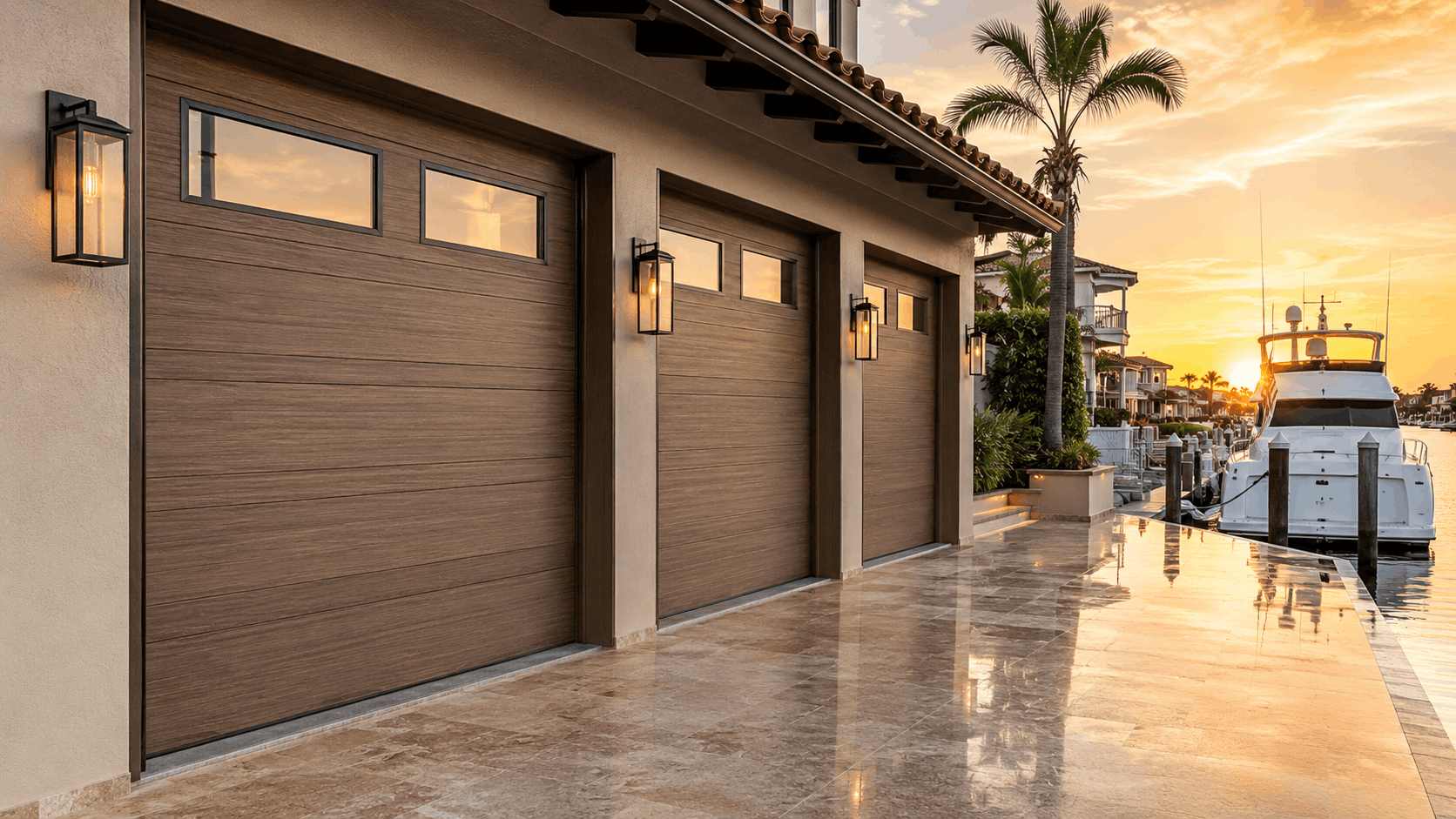
Aluminum doors are popular in Huntington Harbour for good reason. Aluminum does not rust the way steel does, so it stands up to salt air with far less trouble. The frames stay clean and strong for years near the water.
Glass doors pair with aluminum frames for a modern waterfront look. Many canal-front and dock-side homes want that open, contemporary style, and the aluminum-and-glass combo delivers it. The glass shrugs off salt while the frame resists corrosion.
These doors also match the design many HOAs favor in newer tracts. They read as clean and current, which fits the harbor setting. The trade-off is cost, since aluminum and glass run higher than basic steel.
If a sleek look is your goal, our modern glass garage door installs are a strong coastal choice. They combine rust resistance with the harbor aesthetic.
Steel Doors With Coastal Finishes
Steel doors can work near the water, but only with the right protection. A quality coastal finish and coated hardware make a steel door viable a few blocks off the beach. Without those, steel corrodes fast in salt air.
The coating is what makes the difference. A baked-on multi-layer finish seals the steel from salt and moisture. Cheaper uncoated steel doors are a poor bet on the coast and will show rust within a couple of years.
Insulated steel doors add another benefit. The extra layer helps with temperature swings in the garage and adds rigidity. For homes set back from the direct salt spray, a good coated steel door balances cost and durability.
We stock coastal-grade options and warn against the bargain uncoated ones. Our insulated steel garage door installs use finishes made to handle marine conditions.
Wood and Composite Options and Their Trade-Offs
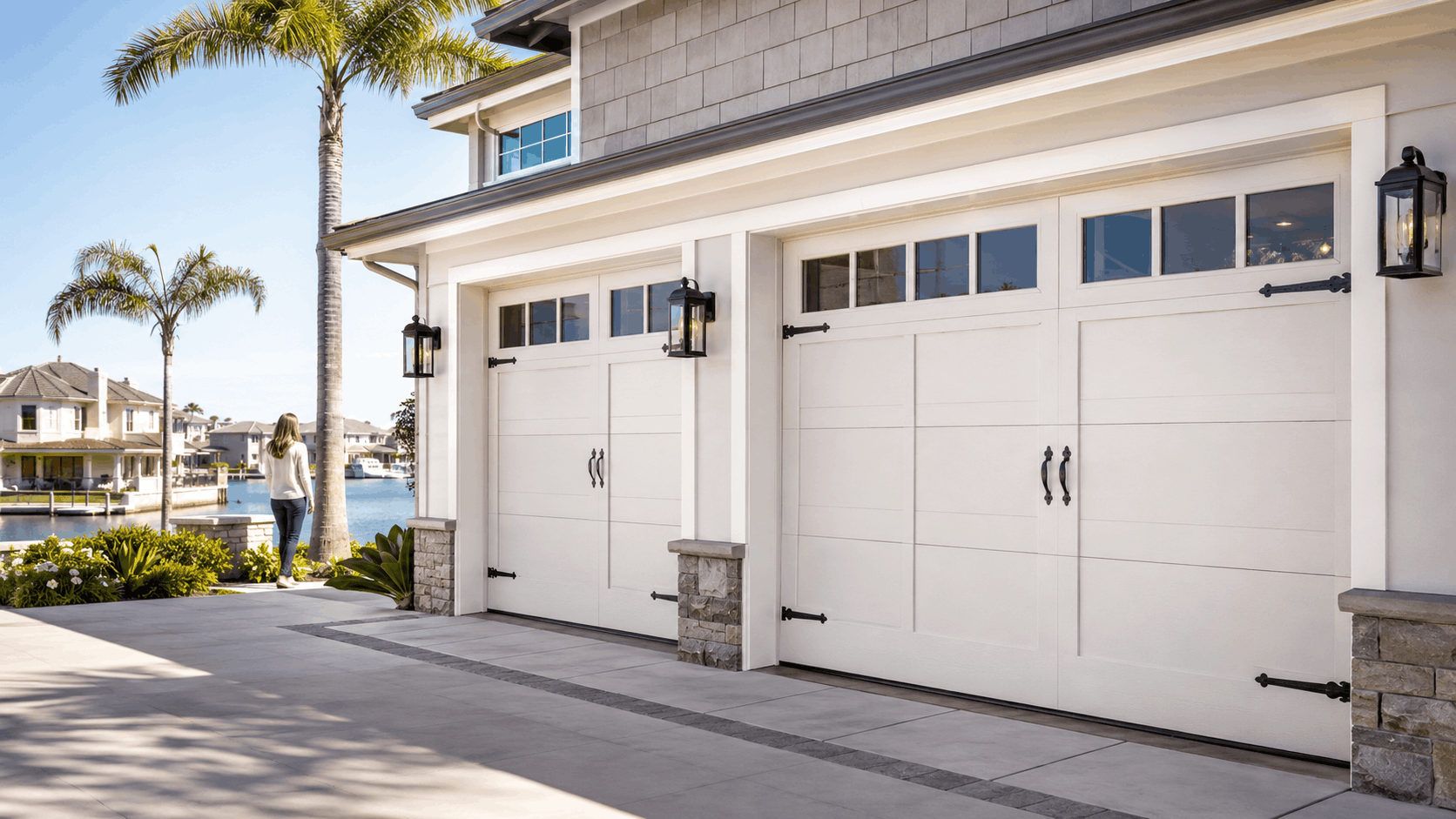
Wood-look doors have real appeal in SeaCliff, where the bluff-top homes suit a warmer, classic style. Natural wood brings a look that steel and aluminum cannot match. The catch is maintenance near the ocean.
Wood needs regular sealing and refinishing to survive salt and fog. Skip that upkeep and the wood cracks, warps, and rots. On a canal home, real wood can be a lot of work to keep looking good.
Composite doors solve much of that. They mimic the wood look but resist moisture and rot with far less care. For coastal owners who love the wood style but not the maintenance, composite is the smart middle path.
We can walk you through both in person and show samples. Our carriage house door installs come in wood and composite versions to fit the SeaCliff look.
Need Help in Irvine?
Urgent Garage Doors serves Irvine and all of Orange County.
Maintenance Tips for Waterfront Garage Doors
Good hardware lasts even longer with a little upkeep. A few simple habits between service visits slow corrosion and keep a coastal door running smoothly. None of these take much time.
Coastal upkeep is about staying ahead of the salt. Rinse it off, keep parts lubricated, and check the door each season. Here is how to do each step right.
Rinsing Salt Buildup Off Hardware
A monthly freshwater rinse is the single best habit for coastal doors. Salt builds up on tracks, hinges, and springs, and a rinse washes it away before it can eat the metal. Plain tap water from a hose does the job.
Here is the simple routine. Close the door, spray the tracks, hinges, rollers, and springs with fresh water, then wipe down what you can reach with a rag. Let it dry, and you are done.
On canal-front homes near Humboldt Island, we suggest rinsing every two to three weeks. The salt load there is heavier, so more frequent cleaning pays off. SeaCliff homes can usually stick to a monthly rinse.
Do not use pressure washers on the hardware. High pressure drives water into bearings and past seals, which causes its own problems. A gentle hose spray is all you need to clear salt buildup.
The Right Lubricant for Salty Environments
Not all lubricants suit the coast. Standard grease is sticky and actually attracts salt and grit, turning into a grinding paste over time. Near the water, that does more harm than good.
Silicone lubricant or a marine-grade product is the better choice. These resist salt, repel water, and keep moving parts smooth without collecting grime. A light spray on rollers, hinges, and springs works well.
On the lubrication schedule, coastal doors need attention more often than inland ones. We suggest every two to three months for waterfront homes. If the door starts squeaking sooner, that is your cue to lube it again.
Apply lightly and wipe off the excess. A thin, even coat protects better than a heavy glob that catches dust and salt. Focus on the pivot points and the roller stems.
Seasonal Inspection Checklist
A quick seasonal maintenance check catches small problems early. Once a season, look over the springs, rollers, seals, and door balance. It takes ten minutes and can save you a big repair bill.
Here is a short inspection checklist. Check the springs for orange staining or gaps in the coils, spin the rollers to feel for grinding, press the seals to confirm they are still soft, and test the door balance by lifting it halfway by hand.
Tie the schedule to the marine layer months. Late spring through summer brings the thickest fog and the most salt exposure along the coast. A check before and after that stretch keeps you ahead of the damage.
Write down what you find. If a roller was fine last season and grinds now, that trend tells you it is time for a service call. A quick note each season makes the pattern easy to spot.
When to Call a Pro Instead of DIY
Some tasks are safe for homeowners and some are not. Rinsing, lubricating, and visual checks are fine to do yourself. They are low-risk and keep the door healthy between professional visits.
Spring work is the big exception. Torsion springs hold enormous tension, and a spring that lets go can cause serious injury. This is never a DIY job, no matter how many videos say otherwise.
Cable repair, track realignment, and door balance adjustments also call for a technician. These involve the same high-tension system as the springs and take the right tools to do safely. Our spring and cable repair team handles all of it.
The rule of thumb is simple. If a part is under tension or holds the door up, leave it to a pro. If it is just cleaning or light lubrication, go ahead and do it yourself.
Cost of Waterfront Hardware Packages and Upgrades
Coastal-grade work costs more than standard, and it should. The parts are better and they last longer, which saves money over the life of the door. Here are honest ranges so you can budget.
Several things drive the price of a coastal package. Door size, the parts you choose, and whether you swap everything at once all move the number. The table below gives a starting point.
| Service | Typical Range |
|---|---|
| Full waterfront hardware package | $450 - $900 |
| Galvanized/stainless spring set | $250 - $500 |
| Nylon rollers (set) | $100 - $200 |
| Powder-coated tracks | $200 - $400 |
| New coastal-rated door installed | $1,800 - $5,000+ |
Typical Price Ranges for Hardware Upgrades
A full corrosion-resistant hardware swap usually runs between $450 and $900 for a standard two-car door. That covers coated springs, nylon rollers, powder-coated tracks and hinges, and upgraded seals. Doing it all at once is the best value.
Replacing parts one at a time costs more over the years. A single spring set might run $250 to $500, and rollers another $100 to $200. Buying piece by piece as each part fails adds up fast on the coast.
Door size changes the estimate. A larger or custom door needs bigger springs and more track, which raises the total. Single-car doors sit at the lower end of every range.
We give a firm quote after seeing the door. A quick look tells us what condition the current hardware is in and what the coastal conditions demand. That way there are no surprises on the invoice.
New Coastal Door Installation Costs
A full coastal-rated door with installation generally runs from $1,800 to $5,000 or more. Basic coated steel sits at the low end, while aluminum and glass or custom wood-look doors climb higher. The coastal hardware is built into these installs.
Features raise the total. Insulation, window sections, glass panels, and premium finishes all add cost. So does a custom size or a design that needs HOA approval and special ordering.
Aluminum and glass doors for waterfront homes tend to land in the upper half of the range. They cost more than steel but pay back in rust resistance and looks. For canal-front homes, that trade often makes sense.
Our garage door installation team quotes coastal doors with the right hardware included from the start. No bolting cheap parts onto an expensive door.
Long-Term Savings From Corrosion-Resistant Parts
Spending more up front cuts repair calls down the road. A standard spring that fails every three to four years near the water means multiple replacements over a decade. A coated spring might last the whole ten years on one install.
Run the rough numbers. Three standard spring replacements at $300 each is $900 over ten years. One galvanized set at $450 covers the same span at a lower total cost, plus fewer service trips and less downtime.
The same math applies to rollers, tracks, and seals. Every part that lasts longer means fewer repair costs and less hassle. On the coast, the corrosion-resistant route almost always wins over time.
There is value beyond dollars too. A door that works reliably every morning is worth a lot on a busy street. Fewer breakdowns mean fewer emergency calls and fewer mornings stuck with a car trapped in the garage.
Need Help in Irvine?
Urgent Garage Doors serves Irvine and all of Orange County.
How Urgent Garage Doors Serves Huntington Harbour and SeaCliff
We work these coastal neighborhoods week in and week out. Our team knows the streets, the canals, and the salt-air problems that come with them. Here is how we serve Huntington Harbour and SeaCliff from our Irvine base.
Coastal work is different, and we treat it that way. Every quote factors in the salt exposure of your specific home. That is the difference between a door that lasts and one that rusts out early.
Serving Coastal Neighborhoods From the Irvine Base
Our home base is in Irvine, and the drive out to the coast is a straight shot. We take the 405 north and cut over toward the water, or run PCH along the coastline into Huntington Harbour and SeaCliff. The trip is routine for our crews.
We know these local streets. From Trinidad Lane and Humboldt Island to Palm Avenue near the golf course, we have worked homes on most of them. That familiarity means we show up ready for the conditions.
Being based in Irvine lets us cover a wide stretch of the coast and inland cities alike. Homeowners can see our full Irvine service area and coastal coverage on our site. The 405 and PCH keep us close to the water.
Coastal service is a core part of what we do, not an afterthought. We stock coated hardware on our trucks so we can handle salt-air jobs the same day when possible. No waiting for special parts to ship.
Coastal Repair and Replacement Services
Our core coastal services line up with the problems salt air causes. Spring replacement is a common call, since coastal springs rust and snap sooner than inland ones. We install coated springs built to last near the water.
Hardware upgrades come next. When a homeowner is tired of replacing rusted rollers and pitted tracks, we swap the whole system for a waterfront package. It solves the recurring rust problem in one visit.
Full door installation rounds out the list. When a door has corroded past repair, we replace it with a coastal-rated model and matching hardware. Our sectional door replacement service handles those bigger jobs.
Every service ties back to the salt-air issue. We do not just fix the symptom. We match the parts to the coastal conditions so the same problem does not come back in a year.
Same-Day and Emergency Coastal Response
A snapped spring on a canal-front home is an emergency, and we treat it like one. When a spring breaks, the door often will not open, trapping a car inside. We respond fast to get you moving again.
Same-day service is available for most coastal breakdowns when you call early enough. Our trucks carry the common coated parts, so we can often fix a broken spring in one trip. That saves a second visit and another day of a stuck door.
Realistic response times from Irvine to the coast depend on traffic on the 405 and PCH. On a normal day we reach Huntington Harbour and SeaCliff quickly. We give you an honest arrival window when you call.
For after-hours breaks, our 24/7 emergency repair line is ready. A broken spring on a weekend does not have to wait until Monday.
Final Thoughts
Waterfront living in Huntington Harbour and SeaCliff comes with salt air that wears garage doors down sooner than anywhere inland. The fix is straightforward: coated springs, nylon rollers, powder-coated tracks, and good seals built to fight corrosion. Pair that hardware with a rust-resistant door material and simple upkeep, and your door will last for years.
Our team drives from Irvine to these coastal neighborhoods every week and knows exactly what the salt does to metal. Whether you need a broken spring fixed today or a full waterfront hardware package, we are ready to help. Contact Urgent Garage Doors for a coastal consultation, or call us for same-day service when a spring gives out.
Frequently Asked Questions
- How long do standard garage door springs last near the water?
- Standard springs often fail in three to five years on the coast, compared to eight to twelve years inland. Salt air speeds up rust, which weakens the coils from inside until they snap. Galvanized or stainless coated springs last much longer near the water because the coating takes the corrosion first. On canal-front homes, the coated upgrade is worth it. For more, see our torsion spring page .
- What is a waterfront hardware package?
- A waterfront hardware package is a set of corrosion-resistant parts built for salt air. It includes galvanized or stainless springs, nylon rollers with sealed bearings, powder-coated tracks and hinges, and upgraded weather seals. Bought together, these parts cost less than replacing failed standard components one at a time. The whole point is to slow rust and keep a coastal door running reliably for years instead of failing early.
- Do I really need special hardware in Huntington Harbour?
- If your home is on a canal or within a few blocks of the water, yes. Homes on Humboldt Island, Trinidad Lane, and similar streets face constant salt moisture that eats standard steel fast. Coated hardware pays for itself by cutting repeat repairs and replacements over the years. Even homes set back from the water get salt on windy days off Bolsa Chica, so the upgrade helps most waterfront properties.
- How often should coastal garage doors be serviced?
- We recommend a professional service visit every six to twelve months for waterfront homes, more often than the yearly check we suggest inland. Salt air causes more wear, so more frequent inspections catch rust and worn parts early. Between visits, rinse the hardware monthly and lubricate every two to three months. A preventive maintenance plan keeps a coastal door on a steady schedule.
- Which garage door material holds up best on the coast?
- Aluminum holds up best because it does not rust like steel, which makes it a favorite for Huntington Harbour homes. Coated steel works well when it has a quality finish and coastal hardware, but avoid cheap uncoated steel. Composite is a strong choice for the wood look with far less upkeep than real wood. Real wood looks great but needs regular sealing to survive salt and fog near the ocean.
- Can I clean and maintain my coastal door myself?
- Yes, for the safe tasks. Rinsing salt off the tracks and hinges with fresh water and applying silicone lubricant are both fine to do yourself. Visual checks for rust and squeaks are safe too. Leave anything under tension to a pro, especially springs and cables. Those hold enough force to cause serious injury, so they are never a DIY job. When in doubt, call our team for the tension work.
- How much does it cost to upgrade to waterfront hardware?
- A full corrosion-resistant hardware swap usually runs $450 to $900 for a standard two-car door. That covers coated springs, nylon rollers, powder-coated tracks and hinges, and upgraded seals. Door size, the specific parts chosen, and the condition of the existing hardware all affect the total. Larger or custom doors cost more. We give a firm quote after a quick look so there are no surprises on your bill.
- Will HOA rules in SeaCliff limit my door choices?
- Often, yes. Many SeaCliff and Huntington Harbour communities have HOA rules on garage door style and color to keep the coastal design consistent. Some tracts require specific panel styles or approved color lists. Check your community guidelines before ordering a new door or visible hardware so the finished job passes review. We help homeowners work within these rules so the install clears the HOA the first time.
- Do you serve homes outside Irvine like Huntington Harbour?
- Yes. We are based in Irvine but serve Huntington Harbour, SeaCliff, and the surrounding coastal neighborhoods regularly. Our crews take the 405 and PCH out to the water and know the local streets from Humboldt Island to Palm Avenue. Coastal service is a core part of our work, and our trucks carry coated hardware for salt-air jobs. Reach out and we will confirm coverage for your specific address.
- What should I do if my spring breaks on a weekend?
- Do not try to force the door open. A broken spring means the door is heavy and can slam down, and forcing it can damage the opener or cause injury. Leave the door as it is and call for emergency service. Our 24/7 emergency line covers weekends, and we carry coated springs on our trucks to fix most breaks in one visit.
Licensed garage door repair professionals serving Irvine and Orange County.
Licensed in California · License #1055150
Why trust Urgent Garage Doors?
Founded in 2017, Urgent Garage Doors is a licensed and insured garage door services serving Irvine and Orange County. All content is reviewed by our licensed technicians.

Need Help in Irvine?
Urgent Garage Doors serves Irvine and all of Orange County.
Related Articles
Coto de Caza Garage Door Repair: Custom Estate Doors and Emergency Service
Skilled garage door repair for Coto de Caza estates - custom wood door restoration, emergency service through the gate, spring and opener replacement, and local maintenance.

Insulated Garage Doors in Irvine: Comfort, Noise, and Energy Benefits
Discover how insulated garage doors provide energy savings, noise reduction, and improved comfort for Irvine homeowners in Orange County's climate.
Shady Canyon Garage Door Service: Custom Estate Doors and Authorized Repair
A local guide to custom estate garage doors and authorized repair in Shady Canyon, covering materials, repairs, HOA rules, and maintenance for Irvine's heavy custom doors.