High-Cycle Springs Explained: 10,000 vs 25,000 vs 50,000 Cycles and Who Should Pay for More
Key Takeaways
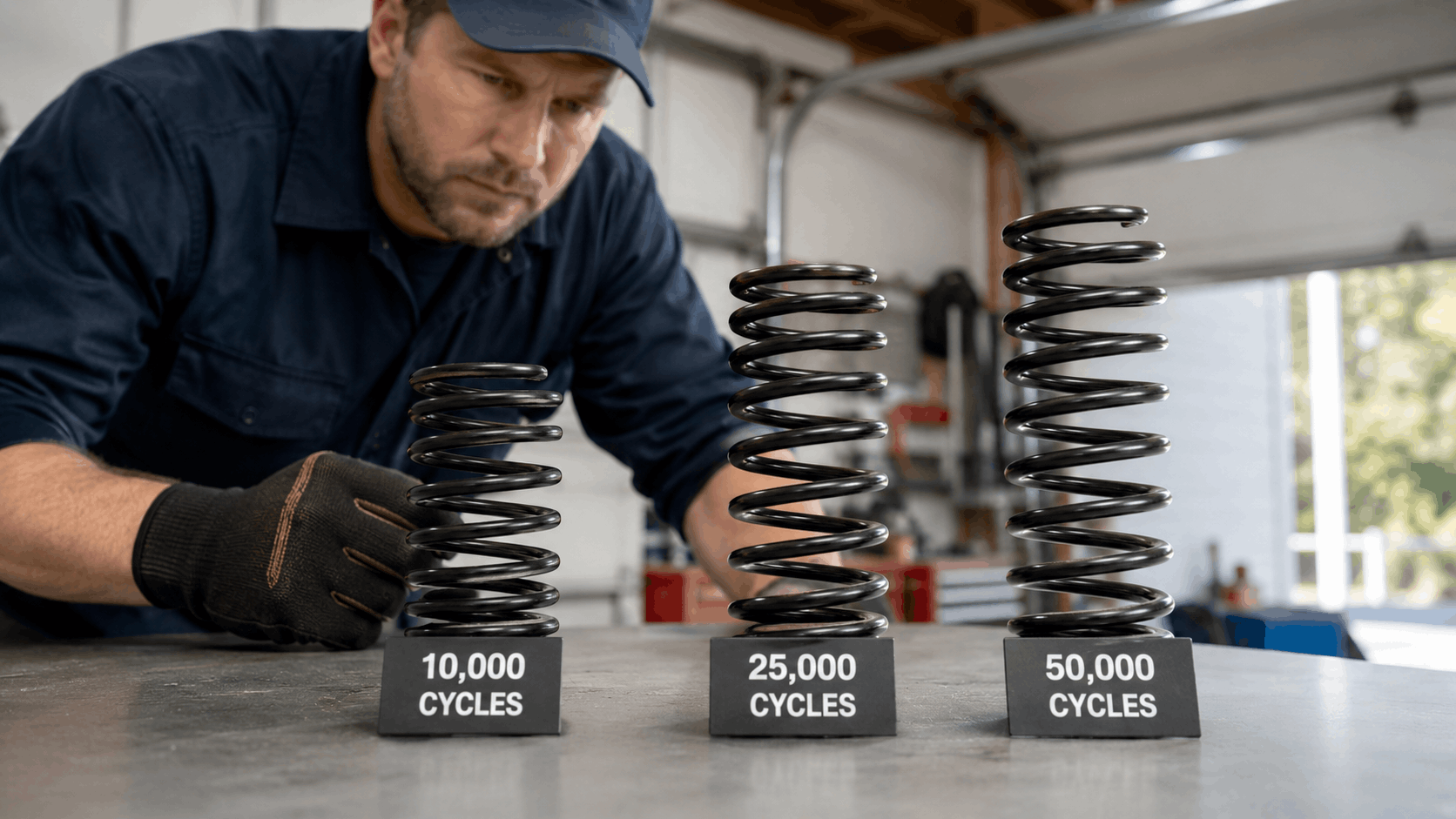
- One cycle equals one full open and close, and a spring's cycle rating is how many of those trips it can handle before wearing out.
- A typical Irvine two-car family runs about 1,460 cycles a year, while garage-entry and rental homes can hit 3,000 to 5,000.
- The 10,000 cycle builder spring lasts about 6-7 years for average use and is best for light users or short-term sellers.
- The 25,000 cycle mid-grade spring is the sweet spot for most families, roughly doubling lifespan for a small upgrade cost.
- The 50,000 cycle high-cycle spring fits heavy users, long-term owners, and heavy custom doors, often lasting 15-30 years.
- Long-term homeowners and landlords usually save money upgrading, while light users on tight budgets are fine with the base spring.
- Coastal moisture, poor door balance, and skipped maintenance can shorten any spring's life below its rated cycles.
- Both springs on a dual-spring door should be replaced together, and spring work should always be done by a trained technician.
In This Article
A homeowner in Woodbury called us on a Tuesday morning last spring. Her garage door would not budge, and she had heard a loud bang the night before that sounded like a gunshot. Her house was only four years old. The spring that came with the home had already worn out.
She was frustrated, and honestly, she had every right to be. Nobody told her the spring on her brand-new home was the cheapest one available. That is a common story across Irvine, from Portola Springs to Turtle Rock, and it is exactly why cycle ratings matter so much.
What a Spring Cycle Actually Means?
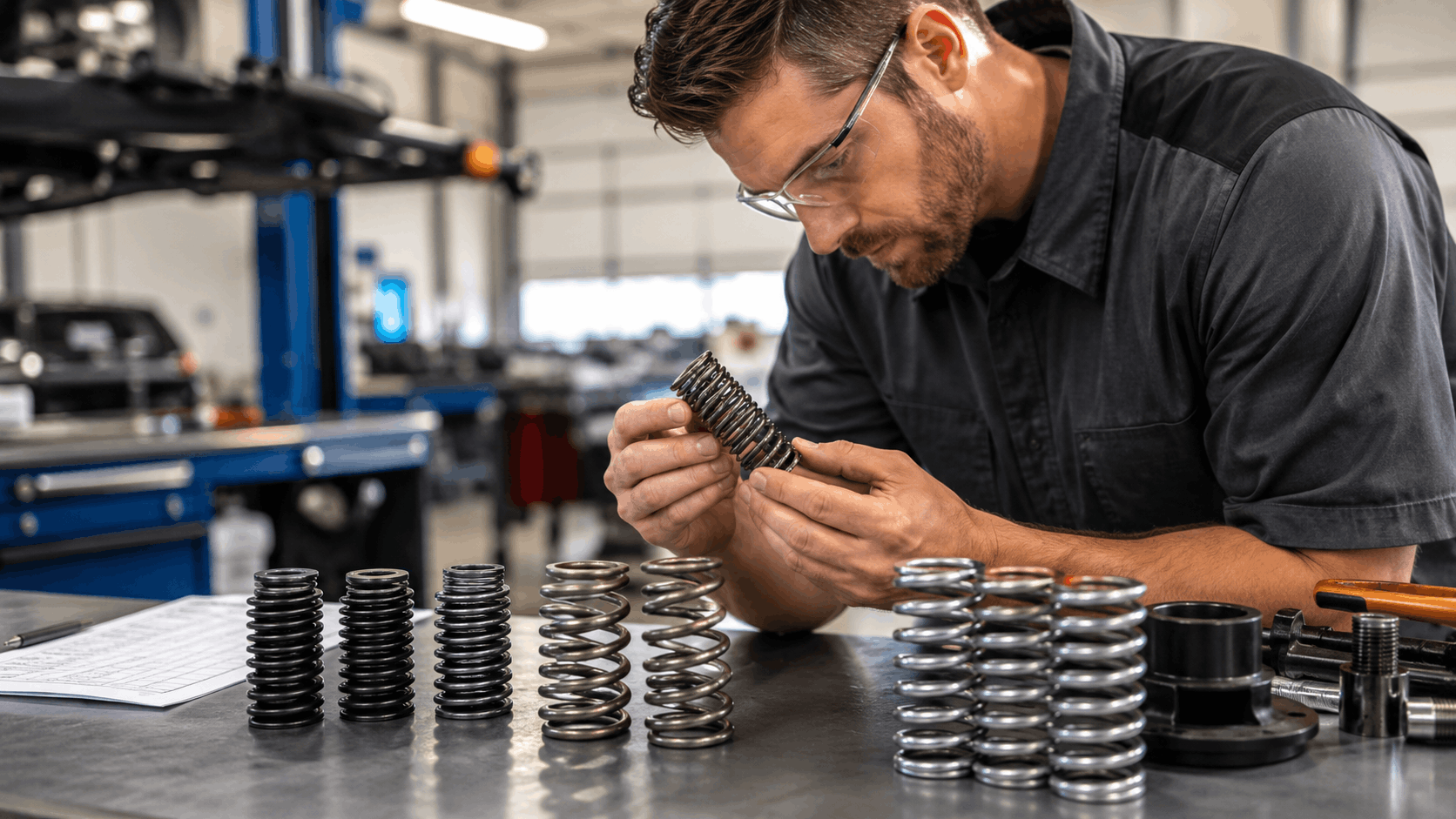
Before anyone can decide how much to spend, they need to understand what they are actually buying. A garage door spring is not a simple coil of metal. It is a carefully wound piece of hardware that holds an enormous amount of stored energy.
The cycle rating is the number printed on the spec sheet that tells you how much life that spring has. It is the single biggest factor in how long your door will run before you need a repair. Let us break down the basics so the rest of this guide makes sense.
One Cycle Equals One Open and One Close
One cycle is simple to picture. It is one full trip up and one full trip back down. When your garage door opens in the morning and closes behind you, that counts as a single cycle.
Those cycles add up sooner than most people think. A family that leaves for work, comes home for lunch, runs errands, and returns in the evening can easily hit four to six cycles a day. Add in kids, guests, and weekend trips, and the number climbs quickly.
Here is the part that surprises folks. A garage door spring rated for a set number of cycles is counting every single open and close over its entire life. Once it hits that number, metal fatigue takes over and failure is close behind.
Understanding this one idea helps everything else click into place. If you know roughly how many times your door moves each day, you can predict how many years a given spring will last for your household.
Torsion Springs vs Extension Springs
Irvine homes use two main spring types. A common is the torsion spring, which sits on a metal shaft above the door and winds up tight to lift the weight. The other is the extension spring, which stretches along the tracks on either side.
Most newer homes in communities like Great Park and Northwood use torsion springs because they are safer, quieter, and last longer. Older homes and lighter doors sometimes still run on extension springs. If you have questions about which one you have, our team can identify it during an inspection of your springs and cables.
Cycle ratings almost always refer to torsion springs. When someone talks about a 10,000 or 50,000 cycle spring, they are usually describing a torsion setup. Extension springs have a lifespan too, but they are measured and replaced a little differently, and we handle extension spring replacement as well.
Knowing your spring type matters because it changes the repair and the price. A torsion system gives you far more upgrade options when you want a higher cycle count.
Why Springs Wear Out, Not Just Break
People often think a spring snapped because of a sudden failure. The truth is more gradual. Every time the spring winds and unwinds, the metal flexes a tiny bit and loses a small amount of strength.
This slow weakening is called metal fatigue. Think of bending a paperclip back and forth. It does not break on the first bend, but after enough flexing it snaps. A spring works the same way over thousands of cycles.
By the time you hear that loud bang, the spring had been wearing down for years. The rating simply tells you how many bends the manufacturer expects before spring failure becomes likely. It is a durability estimate, not a hard promise.
This is why two identical homes can have very different results. A door that opens twice a day will outlast one that opens ten times a day, even with the same spring installed.
Get Your Free Quote
Tell us about your garage door and we'll get back to you within 30 to 60 minutes.
How Many Cycles a Typical Irvine Home Uses Per Year
The smartest way to pick a spring is to match it to your real usage. Guessing leads to overpaying or replacing springs too often. A little math goes a long way here.
Let us walk through how cycles per year add up for different Irvine households. Garage door usage varies a lot depending on family size, habits, and how you use the space.
| Household Type | Daily Cycles | Yearly Cycles |
|---|---|---|
| Light user (single person) | 2 | ~730 |
| Average two-car family | 4 | ~1,460 |
| Busy family with teens | 6-8 | ~2,190-2,920 |
| Garage as main entrance | 8-12 | ~2,920-4,380 |
| Multi-tenant or ADU | 10-15 | ~3,650-5,475 |
The Average Family Usage Math
Let us start with a standard two-car household. Most families open the door in the morning, close it, open it in the evening, and close it again. That is four cycles on a normal weekday.
Multiply four daily cycles by 365 days and you land at roughly 1,460 yearly cycles. That is the baseline number for a typical Irvine family. Weekends often add a few extra trips for errands and activities.
With that number in hand, the math becomes easy. A 10,000 cycle spring divided by 1,460 cycles a year gives you around seven years of use. A 25,000 cycle spring pushes that closer to seventeen years.
Every home is different, so treat these as starting points. If your daily count is higher, your years drop. If you barely touch the door, your spring lasts much longer.
High-Traffic Homes Near Woodbury and Northwood
Larger families run their doors harder than anyone. In neighborhoods like Woodbury and Northwood, we see plenty of homes with three or four drivers sharing the garage. Each driver adds their own set of trips.
When you have teenagers heading to school, sports practice, and part-time jobs, the door never stops moving. Six to eight cycles a day is common in these high traffic households. Some hit even more during busy seasons.
At eight cycles a day, a home racks up nearly 3,000 cycles a year. A builder-grade spring in that house might only survive three years. That is why we often recommend an upgrade for larger families.
We have driven the streets around Woodbury Town Center enough to know these are active households. Matching the spring to that activity level saves real money over time.
When the Garage Is the Main Entrance
Here is a habit that changes everything. Many Irvine homeowners rarely use their front door. They pull into the garage, walk inside, and use the garage as the main entrance for daily life.
This single habit can double or triple your cycle count. Every trip to grab something from the car, take out the trash, or let the dog out becomes another cycle. Those small trips add up fast.
A home using the garage entry for everything can easily hit eight to twelve cycles a day. That is 3,000 to 4,300 cycles a year. A base spring in that setting might not last two full years.
If this sounds like your household, be honest about it when choosing a spring. The convenience of garage entry is worth keeping, but it demands a tougher spring to back it up.
Rentals, ADUs, and Multi-Family Setups
Irvine has seen strong growth in accessory dwelling units and rental conversions. When multiple tenants share one door, usage climbs to the top of the chart. An ADU with its own tenants adds a whole extra household to the count.
Rental properties are tough on springs for a simple reason. Tenants have no incentive to baby the hardware, and more people means more trips. Ten to fifteen cycles a day is realistic for a busy rental.
At that pace, a cheap spring becomes a headache. Landlords end up fielding repair calls and paying for service trips far too often. The math strongly favors a higher cycle spring here.
We work with plenty of property owners across Irvine who learned this lesson the hard way. Spending a little more upfront cuts down on the phone calls at 9 PM.
Need Help in Irvine?
Urgent Garage Doors serves Irvine and all of Orange County.
The 10,000-Cycle Spring: The Builder Standard
This is the spring most people never chose. It came with the house. The 10,000 cycle spring is the builder grade spring, and it is the default on nearly every new construction home in Orange County.
It is not a bad spring. It is just the minimum that meets the standard. Let us look at how it performs and who it actually fits.
| Usage Level | Yearly Cycles | Expected Lifespan |
|---|---|---|
| Light use | ~730 | 12-14 years |
| Average use | ~1,460 | 6-7 years |
| Heavy use | ~3,000 | 3-4 years |
How Long It Really Lasts
The honest answer depends entirely on how much you use the door. For a light user opening the door twice a day, a 10,000 cycle spring can last twelve years or more. That is a genuinely long lifespan for a low-use home.
For an average family at 1,460 cycles a year, expect six to seven years of use. That matches what we see most often during service calls across Irvine. It is a reasonable run for the lowest-cost option.
Heavy users are where this spring struggles. At 3,000 cycles a year, you might get only three to four years before it fails. That short window is why so many newer homeowners are surprised by an early break.
These numbers are averages, not promises. Coastal moisture, poor balance, and skipped maintenance can shorten any of these figures. We will cover those factors later in this guide.
Why New Construction Homes Come With Them
Builders watch every dollar on a project. When they are constructing dozens of homes in developments like Great Park and Portola Springs, small savings on each door add up to big numbers. The cheapest spring that passes inspection is the obvious pick.
That is why almost every new construction home ships with a 10,000 cycle spring. It meets code, it works fine on day one, and it keeps the build cost down. The homeowner rarely knows the difference until years later.
We service a lot of homes in these newer Irvine communities. The pattern is clear. Around year five to seven, the original builder springs start failing across an entire neighborhood built the same year.
If you bought a newer home, it helps to know what you are working with. Checking your spring now lets you plan ahead instead of getting caught by surprise.
Who This Spring Works Fine For
The base spring is not a trap for everyone. For light use households, it is a perfectly reasonable budget option. A single person or a couple who mostly uses the front door may never wear it out.
If your door opens twice a day and you keep the hardware clean, the cheapest spring can serve you for over a decade. There is no reason to overspend when your usage is low. Paying for 50,000 cycles you will never use is money wasted.
Vacation homes and rarely-used third-car garages also fit this category. Low activity means the spring simply is not stressed enough to fail early. The economics favor the base spring in these cases.
The trouble only starts when a busy family runs a base spring hard. Then the low price becomes a false savings, and the repeat repairs pile up.
The 25,000-Cycle Spring: The Middle Choice
This is the spring we recommend most often. The 25,000 cycle spring, or mid grade spring, hits a sweet spot for the majority of Irvine families. It roughly doubles the life of the base spring for a small added cost.
For most homeowners, this is the smart middle ground. Let us look at why it works so well.
| Usage Level | Yearly Cycles | Expected Lifespan |
|---|---|---|
| Light use | ~730 | 25-30 years |
| Average use | ~1,460 | 15-17 years |
| Heavy use | ~3,000 | 7-8 years |
The Sweet Spot for Most Families
The average family in Irvine runs about 1,460 cycles a year. A 25,000 cycle spring divided by that number gives roughly seventeen years of service. That is more than double what the builder spring offers.
Seventeen years often means you never replace the spring while you own the home. For families planning to stay in their house long term, that is a strong reason to upgrade. One repair now saves several down the road.
Even busy families see a real jump. At 3,000 cycles a year, the mid grade spring still delivers seven to eight years. That is roughly double the life a base spring would give the same household.
This tier matches how most people actually live. It is why our technicians reach for it as the default recommendation on a standard door.
The Cost Difference vs the Base Spring
The best part of this upgrade is how small the price gap is. Moving from a 10,000 cycle spring to a 25,000 cycle spring usually adds only a modest amount to the total repair. In many cases the upgrade price is a fraction of the labor cost.
Since a technician is already at your home doing the work, the added spring cost is the main difference. You are paying for a slightly better part, not a whole new visit. That makes the cost difference easy to justify.
When you divide the small upgrade price across the extra years of life, the value is obvious. You are buying roughly ten extra years for a small bump in price. Few home upgrades offer that kind of return.
Our team always presents both options clearly. Most families choose the mid grade spring once they see the math laid out.
How the Wire Size Changes
Higher cycle ratings are not magic. They come from a physical change in the spring itself. A higher cycle spring typically uses thicker wire and a larger spring diameter to spread the stress across more metal.
Thicker wire flexes less on each cycle, so it fatigues more slowly. That is the whole secret behind the extra durability. The spring is simply built stronger to handle more work.
This change means the new spring may look a bit different from your old one. A longer or wider spring is normal for an upgrade. Our technicians calculate the right wire size and diameter based on your specific door weight.
Getting this calculation right matters. The wrong spring size will not balance the door properly, which brings its own problems. That is why a proper weight check comes before any spring install.
The 50,000-Cycle Spring: Built for Heavy Use
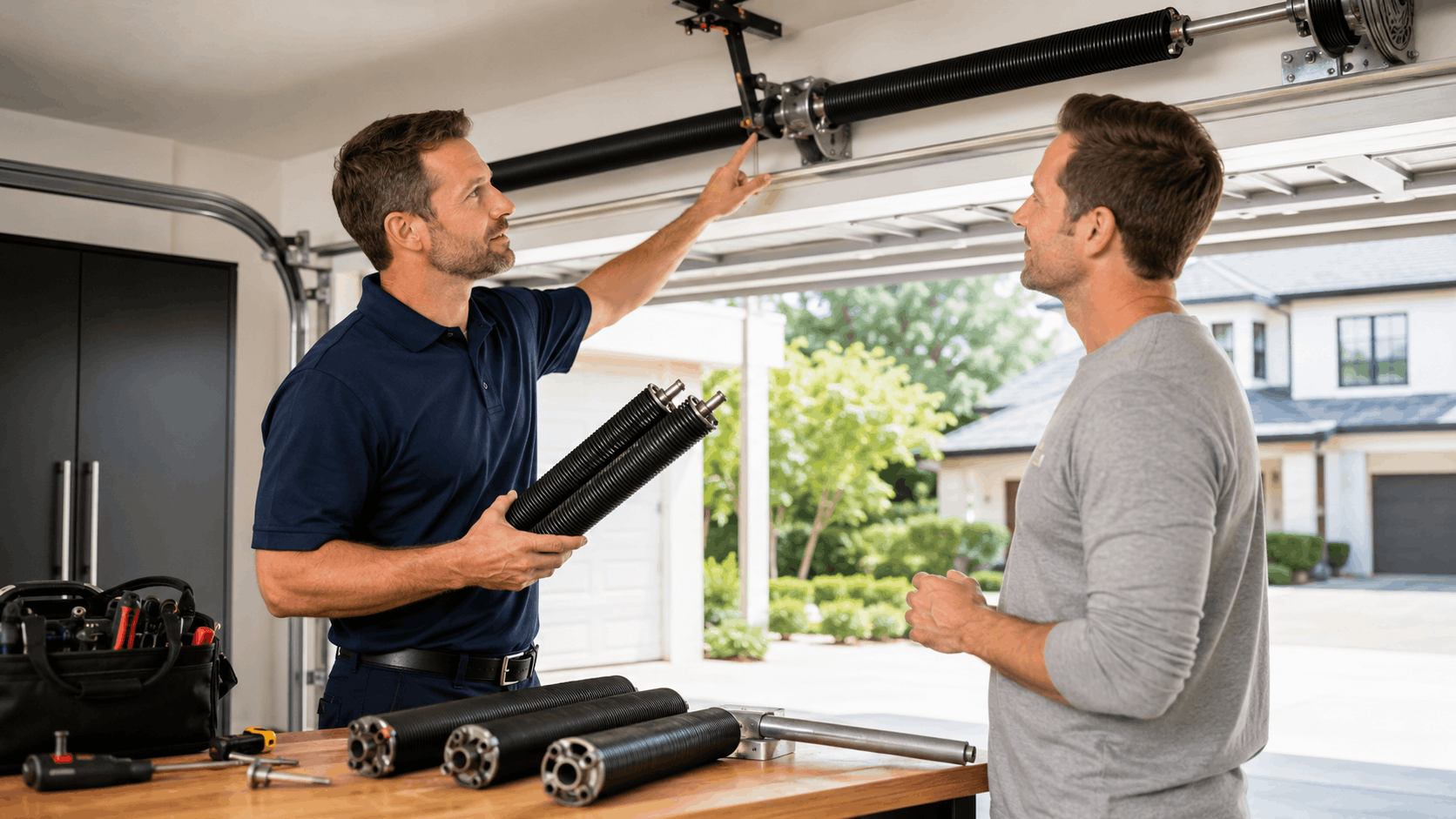
This is the top tier. The 50,000 cycle spring, also called a high cycle spring, is built for homes that run their doors hard or owners who never want to think about springs again. It is heavy duty hardware for the right situation.
It is not for everyone, but for the right home it pays off handsomely. Let us look at where it shines.
| Usage Level | Yearly Cycles | Expected Lifespan |
|---|---|---|
| Light use | ~730 | 50+ years |
| Average use | ~1,460 | 30+ years |
| Heavy use | ~3,000 | 15-17 years |
Decades of Life for the Right Home
The numbers on this spring are impressive. For an average family, 50,000 cycles translates to over thirty years of use. That is longer than most people own their home.
Even for a heavy-use household at 3,000 cycles a year, this spring delivers fifteen to seventeen years. That long lifespan means the spring often outlives the door panels and the opener. You install it once and forget about it.
For homeowners who hate surprise repairs, this peace of mind is worth a lot. A high cycle spring removes spring failure from your worry list for the foreseeable future. That reliability has real value beyond the dollars.
This heavy duty spring is overkill for a light user. But for the right home, it is the last spring they will ever buy.
Best Fit for Busy Households and Long-Term Owners
We see the strongest case for this spring among long-term owners. Families in established neighborhoods like Turtle Rock and University Park often plan to stay for decades. They are not flipping the house in two years.
For a long-term owner, spending once on the best spring makes sense. Over twenty years, they avoid multiple replacement visits. The upfront cost gets spread across a very long lifespan. We handle plenty of garage door service in Turtle Rock and hear the same thing often: they want it fixed once and done right.
Busy households with many drivers also benefit. When the door runs eight or more times a day, only the top tier keeps up without frequent failures. The high cycle spring matches that heavy demand.
If you plan to stay put and use the door hard, this is your spring. The combination of long life and fewer repairs fits that lifestyle perfectly.
Heavy Doors and Custom Wood Panels
Door weight changes the equation too. Upscale Irvine communities often feature custom doors with solid wood panels or thick insulated steel. These doors weigh far more than a basic aluminum model.
A heavy door puts more strain on the spring with every cycle. That extra load speeds up metal fatigue on a lighter spring. The top tier is often the right match for these premium doors.
We install and service a lot of custom doors in Irvine's higher-end neighborhoods. A beautiful custom garage door installation deserves a spring that can carry its weight for years. Pairing a heavy door with a cheap spring is a recipe for early failure.
When we weigh a door and find it on the heavier side, we often recommend the 50,000 cycle option. It simply holds up better under the constant load.
The Upgrade Cost and Return on Investment
The price premium for a high cycle spring is real but reasonable. It costs more than the mid grade option, though the gap is still smaller than most people expect. You are paying for the thickest wire and largest spring available.
The return on investment shows up over time. Each avoided service call saves you the labor cost of a technician visit. Over twenty years, skipping two or three replacements more than covers the upgrade cost.
There is also the value of never being stranded. A broken spring can trap your car in the garage on a workday morning. Avoiding that disruption has worth beyond the repair bill.
For the right home, the math clearly favors the upgrade. We always run the numbers with homeowners so they can decide with clear eyes.
Need Help in Irvine?
Urgent Garage Doors serves Irvine and all of Orange County.
Side by Side: Comparing the Three Cycle Ratings
Sometimes a direct comparison makes the choice obvious. Here is a spring comparison across all three cycle ratings so you can see them together. Use it to match your situation quickly.
| Factor | 10,000 Cycle | 25,000 Cycle | 50,000 Cycle |
|---|---|---|---|
| Upfront cost | Lowest | Small upgrade | Highest |
| Average family lifespan | 6-7 years | 15-17 years | 30+ years |
| Heavy use lifespan | 3-4 years | 7-8 years | 15-17 years |
| Best for | Light users | Most families | Heavy use, long-term |
| Replacements over 20 years | 3-4 times | 1-2 times | 0-1 time |
Cost Now vs Cost Over Time
The upfront price tells only part of the story. A base spring looks cheapest on day one, but the long term cost tells a different tale. Over twenty years, an average family might replace a 10,000 cycle spring three or four times.
Each of those replacements includes labor, not just the part. Add them up and the total cost of the cheap spring can exceed the price of a single high cycle spring. The savings disappear fast.
The 25,000 cycle spring usually needs one or two replacements over that same period. The 50,000 cycle spring might need none for an average family. When you count the full timeline, the upgrade often costs less overall.
This is the part homeowners miss when they only look at the sticker price. Thinking in decades instead of days changes the smart choice.
Lifespan by Usage Level
Your usage level decides everything. For a light user, even the base spring lasts over a decade, so the cheapest option makes sense. There is little reason to upgrade when the door barely moves.
For an average family, the 25,000 cycle spring hits the ideal balance at around seventeen years. That lifespan covers most of a typical ownership period. It is the recommendation we make most often.
For heavy users, the picture shifts toward the top tier. A base spring lasting only three years becomes a constant nuisance. The 50,000 cycle spring stretches that to fifteen years or more, which is a completely different experience.
Match the spring to your real usage and the right answer becomes clear. This lifespan chart is the fastest way to narrow your choice.
Convenience and Fewer Service Calls
Money is not the only factor. There is real value in not dealing with a stuck door. A broken spring almost always happens at the worst time, like a busy weekday morning.
Fewer repairs mean fewer disruptions to your routine. Every service call requires you to be home, wait for the technician, and pause your day. Higher cycle springs cut that inconvenience way down.
For families juggling work and school schedules, that reliability matters. Knowing the door will just work for the next fifteen years removes a small but real stress. Convenience like that is hard to put a price on.
When we weigh this factor with homeowners, many decide the upgrade is worth it for the reduced hassle alone. Time and predictability count for something.
Who Should Pay for More Cycles and Who Should Not
Not everyone needs to spend more. A good spring upgrade decision depends on your plans, your usage, and your budget. Here is honest guidance on who should pay for the higher tier and who should stick with the base.
We would rather give you the right advice than sell you the most expensive spring. Let us break it down by situation.
Long-Term Homeowners vs Sellers Moving Soon
Your timeline in the home is the first question to ask. If you plan to stay for many years, the upgrade almost always pays off. You capture the full benefit of the longer lifespan and skip future repairs.
A long-term homeowner who buys a 25,000 or 50,000 cycle spring may never touch it again. That is the ideal outcome. The extra cost spreads across a decade or two of trouble-free use.
If you are selling your home within a year or two, the calculus changes. A base spring keeps costs down, and the next owner inherits the door. There is little reason to invest in cycles you will not use.
That said, a working door with a fresh spring can help a sale go smoothly. If your spring is already broken, a mid grade replacement is a fair middle ground even for sellers.
Landlords and Investment Properties
Landlords should almost always upgrade. An investment property sees more tenants and more usage than an owner-occupied home. That heavier load wears out cheap springs quickly.
Every spring failure at a rental means a tenant complaint call and a service trip. Those calls eat into your time and profit. A higher cycle spring cuts down on the number of times you hear from tenants about the door.
For landlords with multiple Irvine rentals, the savings multiply. Spending a bit more on each door reduces maintenance headaches across the whole portfolio. It is a simple way to lower the ongoing cost of ownership.
We work with many property owners who standardized on 25,000 cycle springs for exactly this reason. Fewer calls and longer intervals between repairs make the upgrade an easy call.
Tight Budgets and Light Users
If money is tight, the base spring is nothing to be ashamed of. For a light user, the cheapest spring can last well over a decade. Paying more for cycles you will never reach makes no sense.
A single person or a couple who mostly uses the front door falls squarely in this group. Two cycles a day means the base spring may outlast the opener. The budget option is the right financial move here.
We never pressure light users to upgrade. When your usage is low, the standard spring is genuinely the smart choice. Our job is to tell you that honestly.
If your budget is the deciding factor today, the base spring gets your door working reliably at the lowest cost. You can always choose a higher tier next time if your usage grows.
How Our Team Helps Irvine Homeowners Decide
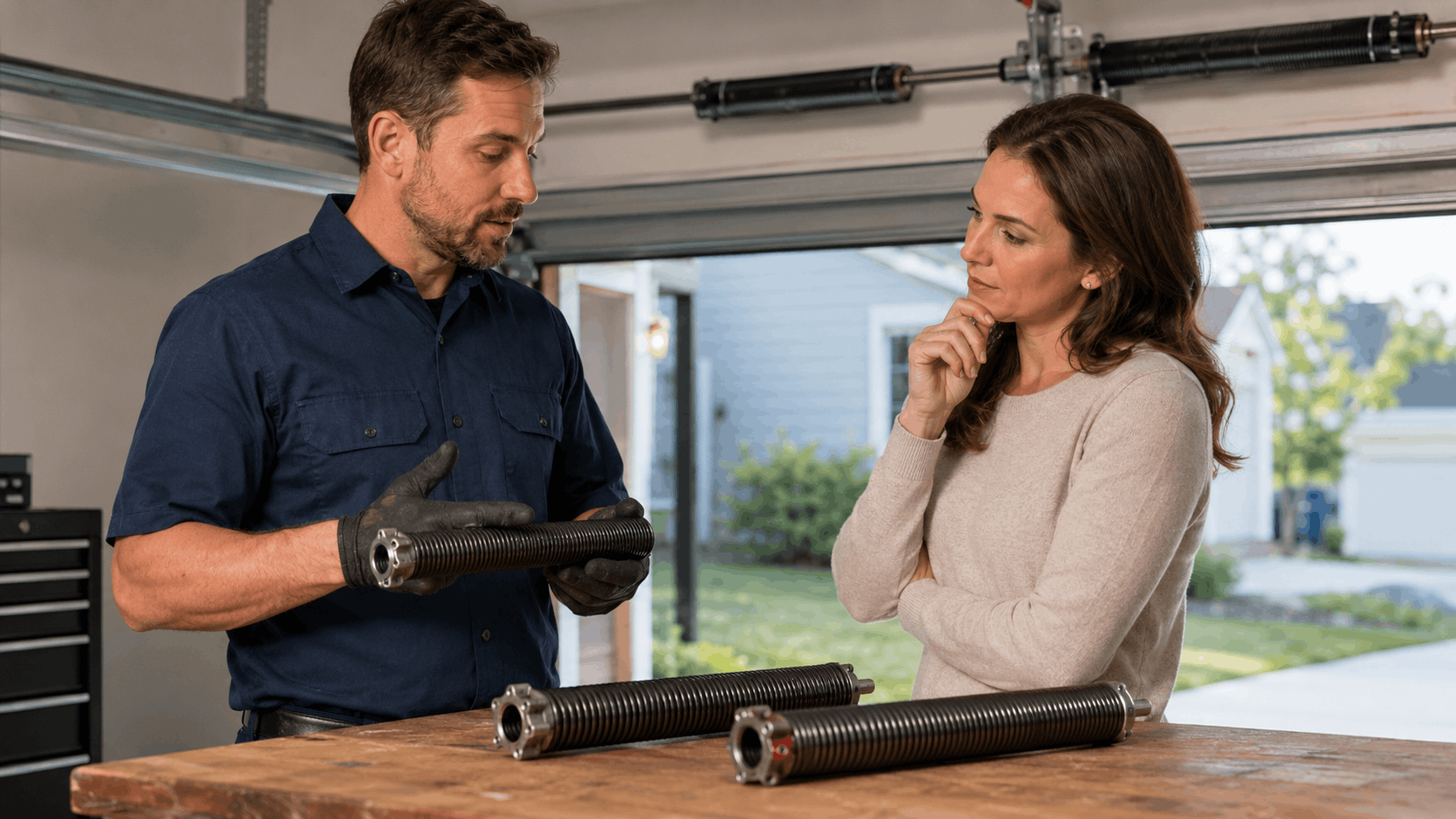
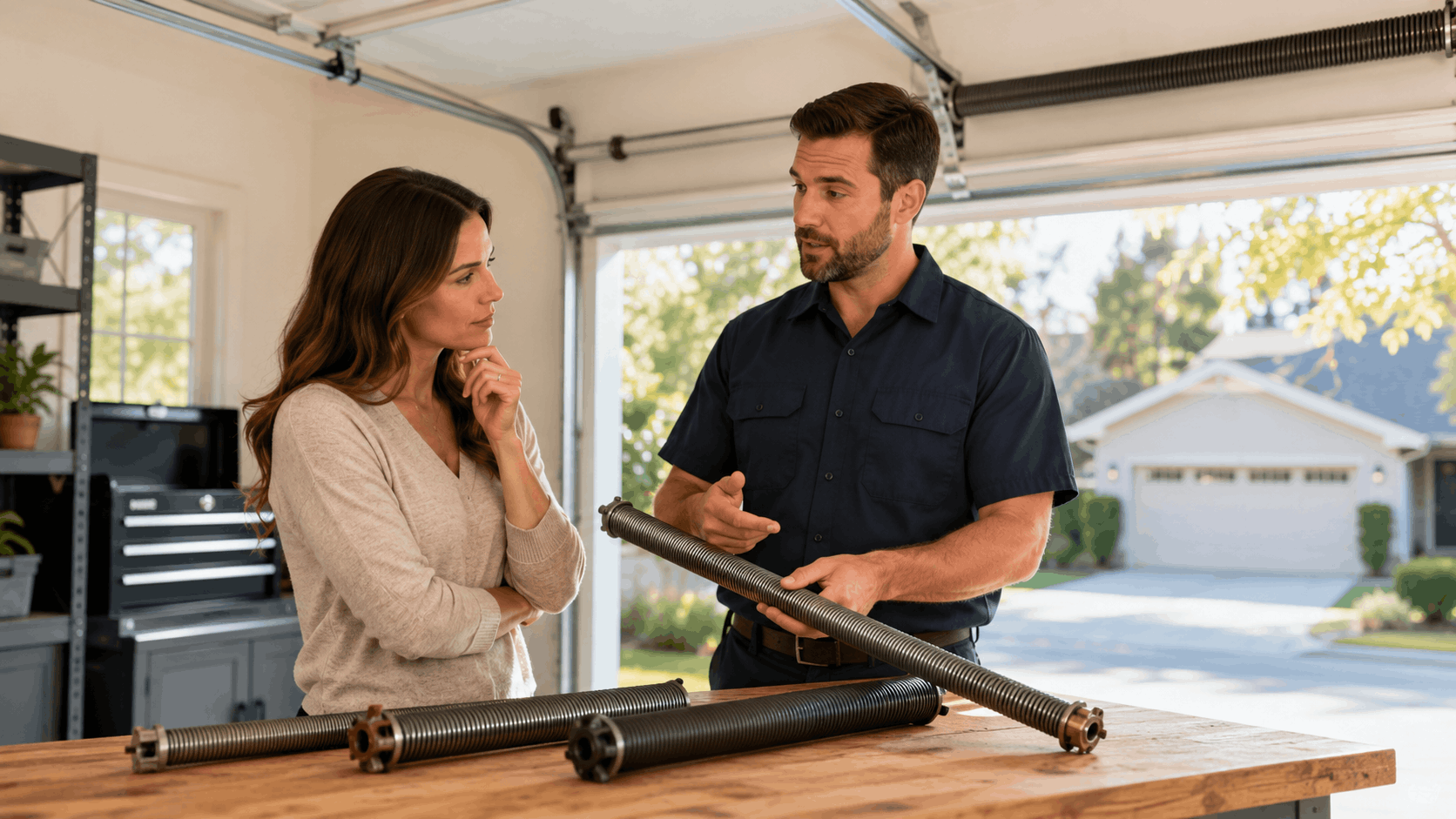
Every recommendation starts with a real look at your door. Our technicians at Urgent Garage Doors physically weigh the door and check its balance before suggesting a spring. Guessing leads to the wrong part.
We ask about your daily usage, how long you plan to stay, and your budget. From there we lay out the options with honest numbers. You see the cost and expected lifespan for each tier side by side.
We service homes across every Irvine neighborhood, from Portola Springs to Turtle Rock to Woodbury. That local experience means we know how different communities use their doors. Whether you need torsion spring replacement or advice on a whole system, we tailor the recommendation to your home.
The final choice is always yours. Our role is to give you the information to make it with confidence. Reach out through our contact page and we will walk you through it.
Need Help in Irvine?
Urgent Garage Doors serves Irvine and all of Orange County.
What Affects Spring Life Beyond the Cycle Rating
A cycle rating is an estimate, not a promise. Several outside factors can shorten spring life no matter which tier you buy. Good spring maintenance protects your investment and helps any spring reach its rated life.
Knowing these spring life factors helps you get the most from your purchase. Let us cover the big ones we see in Irvine.
Coastal Air and Rust in Irvine
Irvine sits close enough to the coast that salt air reaches many homes. That moisture is an enemy of steel springs. Over time, coastal air can cause rust that weakens the metal and shortens spring life.
Rust creates rough spots on the coils that speed up metal fatigue. A rusty spring fails sooner than a clean one, even at the same cycle count. Homes closer to the water see this effect more strongly.
The fix is simple maintenance. A light coat of proper lubricant creates a barrier against moisture. Wiping down and re-coating the spring once or twice a year makes a real difference in humid coastal conditions.
We check for early rust during every service visit. Catching it before it eats into the metal helps your spring reach its full lifespan.
Proper Balance and Door Weight
A balanced door is a spring's best friend. When the door is properly balanced, the spring carries the weight evenly and works no harder than it must. An unbalanced door forces the spring to strain on every cycle.
That extra strain adds wear and leads to early failure. You can spot a balance problem when the door feels heavy by hand or slams shut. Those are signs the spring is fighting the door weight.
Door weight itself matters too. A heavier custom or insulated door needs a spring matched to its load. The wrong spring will wear out fast under a heavy door.
Our team checks balance and adjusts tension as part of a proper setup. Good door balancing and tension adjustment keeps the spring working within its limits.
Lubrication and Regular Tune-Ups
Simple upkeep extends the life of any spring tier. Lubrication reduces friction on the coils and moving parts. A well-lubricated spring flexes more smoothly and fatigues slower.
A regular tune-up catches small problems before they become failures. During a tune-up we lubricate the spring, check balance, tighten hardware, and inspect the cables. These small steps add years to the system.
Most homeowners skip maintenance until something breaks. That is a missed opportunity, since a little care goes a long way. A yearly service visit is cheap compared to an emergency repair.
Our preventive maintenance plan keeps your door running smoothly and helps your spring hit its rated life. It is the easiest way to protect your upgrade.
Final Thoughts
Choosing a spring comes down to matching the cycle rating to your real usage and your plans. Light users are fine with the base spring, most families do best with the 25,000 cycle option, and heavy users or long-term owners benefit from the 50,000 cycle spring.
The cheapest spring is not always the cheapest over twenty years. Counting the full cost, including future service calls, often makes the upgrade the smarter buy. But there is no single right answer for every home.
If your spring recently broke or you want honest advice on the right tier, our team is ready to help. We serve every Irvine neighborhood with same-day service and clear recommendations. Call Urgent Garage Doors or reach out through our spring and cable repair page to get started.
Frequently Asked Questions
- What does the cycle rating on a garage door spring mean?
- The cycle rating is the number of open and close cycles the spring is built to handle before it wears out. One cycle equals the door going all the way up and all the way back down. A 25,000 cycle spring is designed to survive 25,000 of those full trips. It is a durability estimate based on metal fatigue, not an exact prediction of failure.
- How many years does a 10,000-cycle spring last?
- For an average Irvine family opening the door about four times a day, a 10,000 cycle spring lasts roughly five to seven years. Light users who open the door twice daily may get twelve years or more. Heavy-use homes running eight cycles a day might only see three to four years. Your real number depends entirely on how often the door moves.
- Is it worth upgrading to a 25,000 or 50,000-cycle spring?
- For most families, yes. The upgrade cost is small compared to the extra years of life you gain. A jump from a 10,000 to a 25,000 cycle spring roughly triples the lifespan for a modest price bump. If you plan to stay in your home or use the door heavily, the upgrade usually costs less over twenty years than repeat replacements of the cheap spring.
- How much more does a high-cycle spring cost?
- The price gap is usually smaller than homeowners expect since the labor is the same regardless of spring choice. Moving from a base spring to a 25,000 cycle spring often adds a modest amount to the total. The 50,000 cycle spring costs more still but remains reasonable. We provide exact pricing after weighing your door, so you see the real numbers before deciding.
- Can I put high-cycle springs on any garage door?
- Most doors can be fitted with higher-cycle springs after a proper weight and size check. Higher cycle springs use thicker wire and a larger diameter, so the technician must confirm the door weight and available space first. Once we weigh your door and measure the setup, we can match the right high cycle spring to it. This check protects your door balance and safety.
- How do I know if my spring is about to break?
- Watch for warning signs like a loud bang, a door that suddenly feels very heavy, or a door that will not open. A visible gap in the coil of a torsion spring is a clear sign of failure. Jerky movement, loud noises, or a door that opens crooked also point to spring trouble. If you notice any of these, stop using the door and call a technician.
- Should both springs be replaced at the same time?
- On a dual-spring door, yes, replacing both at once is the smart move. Both springs have the same age and cycle count, so if one failed the other is close behind. Replacing only one often means a second service call within months. Doing both together saves you a repeat visit and keeps the door balanced and safe.
- Does Irvine weather affect how long my spring lasts?
- Yes. Irvine's proximity to the coast means salt air and moisture reach many homes. That humidity can cause rust on the springs, which weakens the metal and shortens spring life. Homes closer to the water see this more. Regular lubrication and a yearly tune-up create a barrier against moisture and help your spring reach its rated life.
- Can I replace a garage door spring myself?
- We strongly advise against it. A garage door spring holds a huge amount of stored tension, and a mistake can cause serious injury. The tools and technique required to safely wind and mount a torsion spring take training. A trained technician can do the job safely and correctly in a short time. The risk of DIY is not worth the small savings.
- How fast can Urgent Garage Doors replace a broken spring in Irvine?
- We offer same-day service across Irvine neighborhoods, from Portola Springs to Turtle Rock to Woodbury. Most spring replacements take about an hour once our technician is on site. We carry common spring sizes on our trucks so we can finish the job in one visit. Call us when your spring breaks and we will get your door working again fast.
Licensed garage door repair professionals serving Irvine and Orange County.
Licensed in California · License #1055150
Why trust Urgent Garage Doors?
Founded in 2017, Urgent Garage Doors is a licensed and insured garage door services serving Irvine and Orange County. All content is reviewed by our licensed technicians.

Need Help in Irvine?
Urgent Garage Doors serves Irvine and all of Orange County.
Related Articles
Garage Door Panel Replacement vs Full Door Replacement in Orange County
Should you replace one damaged garage door panel or the entire door? This guide covers costs, timelines, HOA rules, and local Orange County factors to help you decide.
Why You Should Never Pull the Emergency Release With a Broken Spring - The Crash Risk Explained
Pulling the emergency release with a broken spring can send a heavy garage door crashing down. Learn the crash risk, spring mechanics, and safe steps for Irvine homes.
Northpark Irvine Garage Door Service: 1990s-Era Spring Replacement Costs
What 1990s-era garage door springs cost to replace in Northpark Irvine, why they fail, warning signs to watch for, and how to choose an honest local service.