Sectional vs Roll-Up vs Tilt: Mechanical Differences for OC Climate
Key Takeaways
- Sectional doors distribute Santa Ana wind load across multiple panels and tracks, making them significantly more stable than tilt-up doors during high-wind events in Irvine and hillside OC communities.
- Tilt-up doors act as a single flat sail in wind events and absorb solar heat unevenly, leading to pivot hardware stress and panel warping - problems seen regularly in older Woodbridge and University Park homes.
- OC's temperature swings from 55F winter nights to 100F+ September afternoons shorten torsion spring lifespan to 5-7 years in sun-exposed garages, compared to the rated 10,000-cycle lifespan in moderate climates.
- Salt air near Newport Coast and western Irvine adds corrosion on springs, cables, and tracks compared with drier inland OC areas, making twice-yearly lubrication and inspection a practical necessity.
- Garage door insulation in OC is primarily about blocking summer heat gain, not retaining winter warmth - a polyurethane-core sectional door can reduce garage interior temps by 20F or more on hot September days.
- Most Irvine HOA communities will reject roll-up doors for residential use due to architectural design guidelines, and switching from a tilt-up to a sectional may require both a City of Irvine building permit and written HOA approval.
- Residential sectional doors in OC run $800-$2,500 installed with roughly $500-$900 in 10-year maintenance costs, while tilt-up doors cost more to maintain over a decade despite lower upfront replacement prices.
- A new sectional door is one of the better-returning exterior upgrades for Irvine properties - particularly in premium neighborhoods like Orchard Hills and Lambert Ranch where curb appeal directly affects sale speed and price.
In This Article
Imagine pulling into the driveway of a home near Woodbridge or Quail Hill after a week of dry, relentless Santa Ana winds. The garage door that worked fine last month now grinds, hesitates, or refuses to close all the way. The hardware looks fine from the outside, but something is clearly off. That scenario plays out dozens of times every fall across Irvine, and the cause almost always traces back to how the door's mechanical design interacts with Orange County's specific climate conditions.
Not all garage doors are built the same, and not all of them respond the same way to OC's combination of UV-heavy summers, coastal salt air, and wind events that funnel through the Santa Ana canyon system. The three main door types - sectional, roll-up, and tilt-up - each have a distinct mechanical design that creates both advantages and vulnerabilities depending on what the local weather throws at them.
How Each Door Type Actually Works
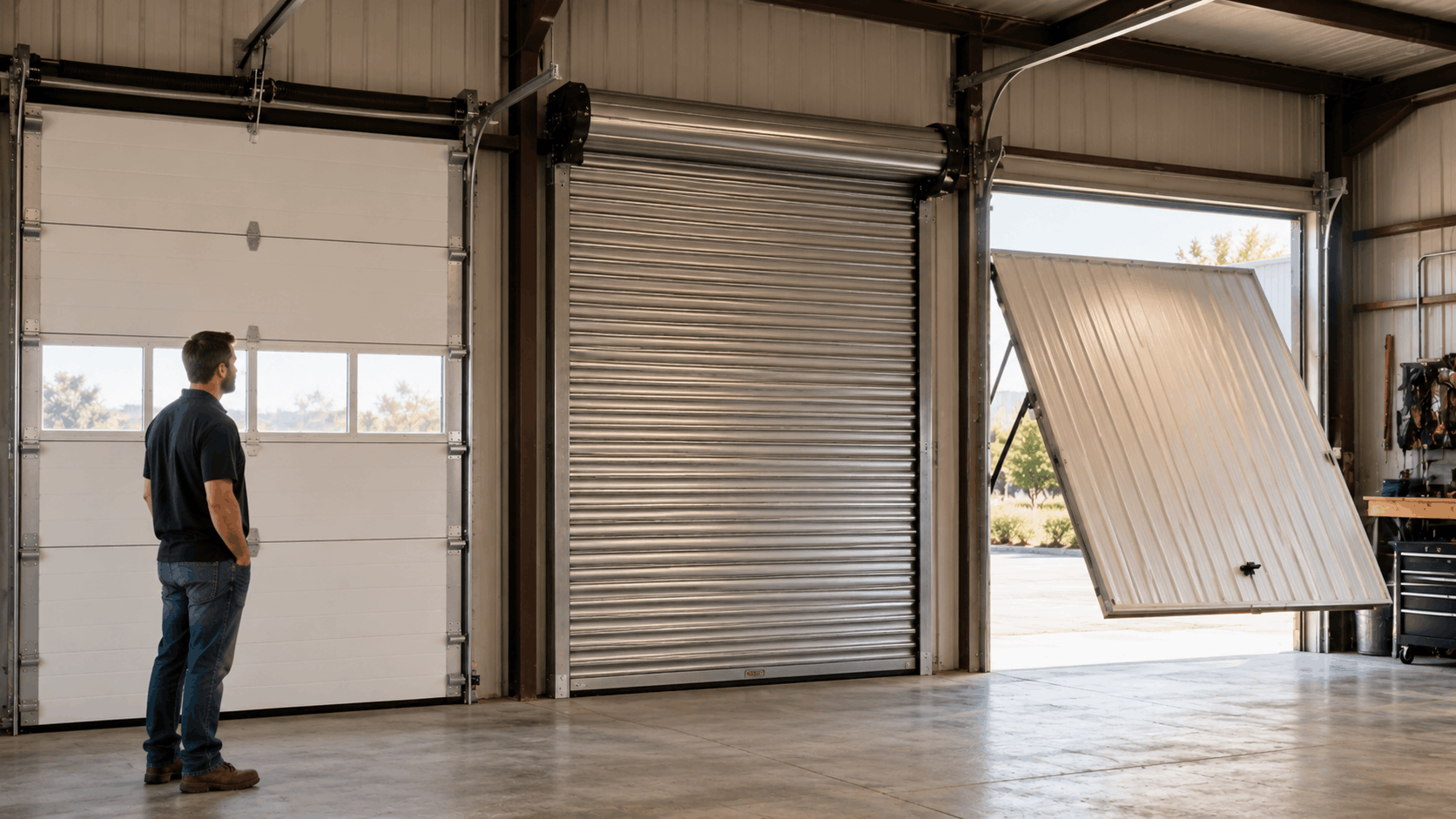
Before comparing performance under OC conditions, it helps to know exactly what is happening mechanically every time someone hits the button. The three door types look similar from the street but move in completely different ways - and those differences matter a lot once the Santa Ana winds kick up or a long summer starts baking the hardware.
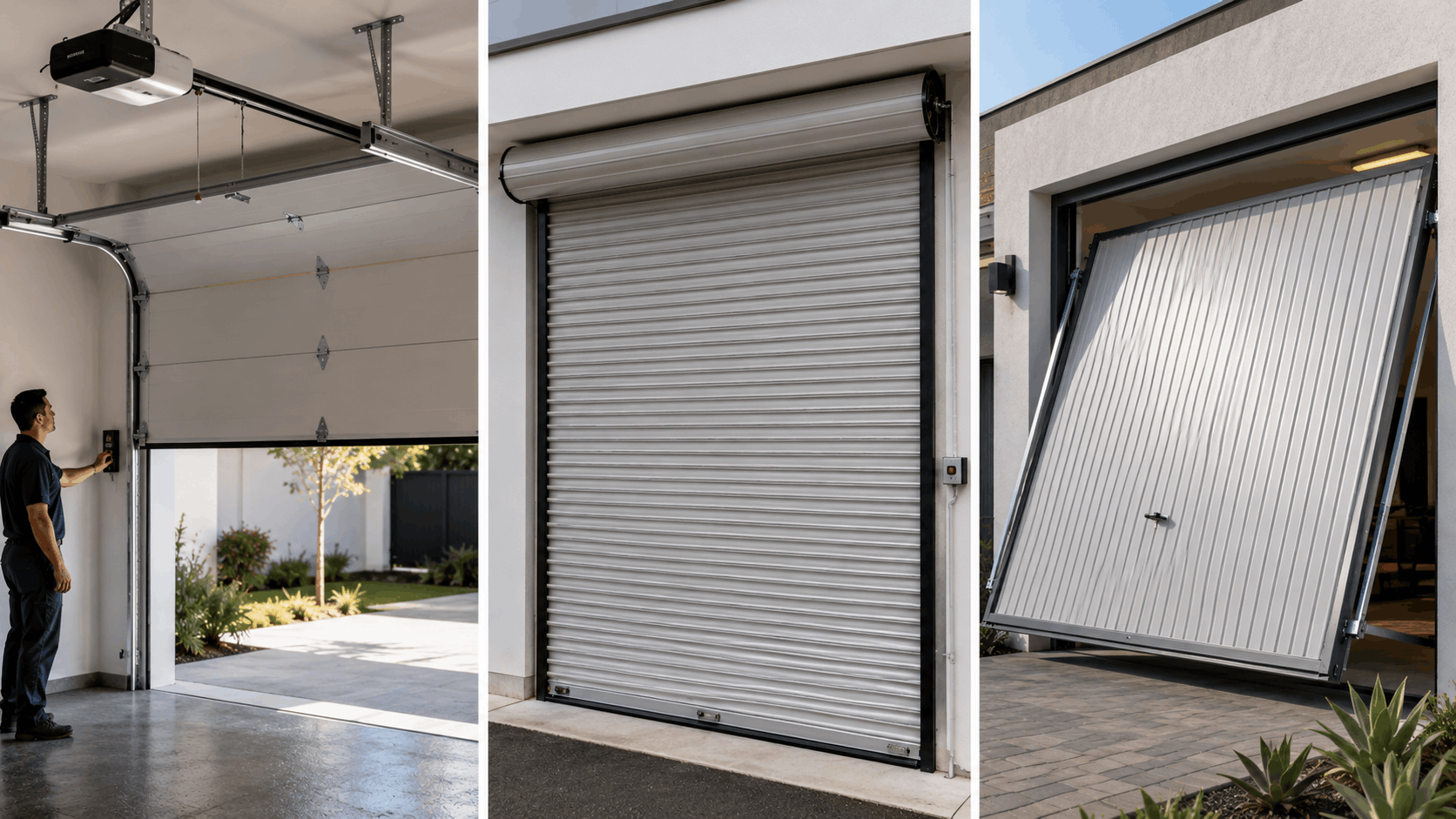
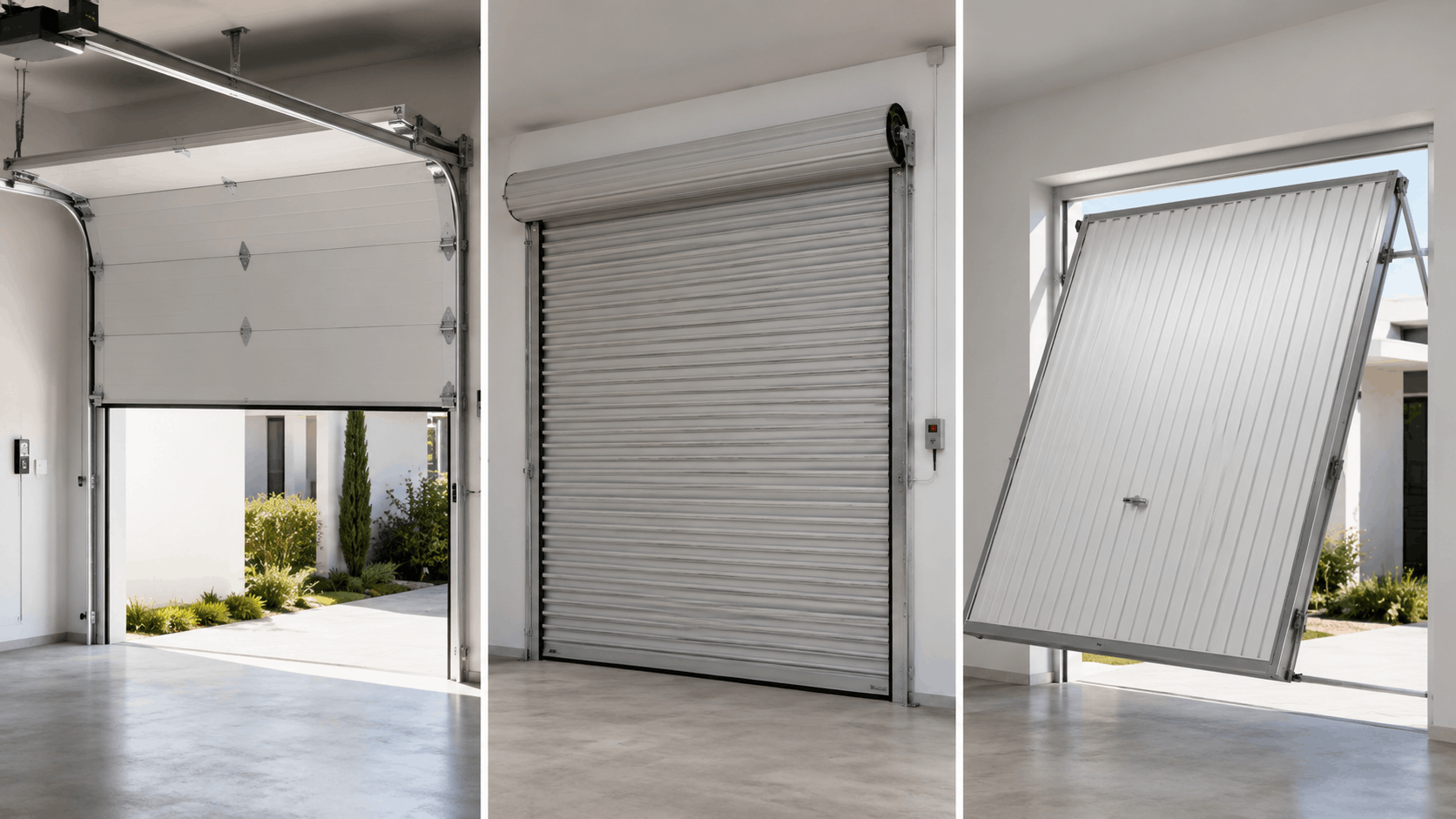
| Door Type | Movement Style | Spring System | Panel Count | Common Use in Irvine |
|---|---|---|---|---|
| Sectional | Panels rise vertically, then slide horizontally along ceiling tracks | Torsion spring above door | 4-6 horizontal panels | Most newer Irvine neighborhoods |
| Roll-Up | Steel slats coil around drum above the opening | Counterbalance spring inside barrel | Multiple interlocking slats | Commercial zones, Irvine Spectrum area |
| Tilt-Up | Single panel pivots outward, then slides into horizontal position | Extension or counterbalance springs | 1 solid panel | Older homes in Woodbridge, University Park |
Sectional Doors: Panels, Hinges, and Tracks
A sectional garage door is built from four to six horizontal panels connected to each other by hinges. Each panel edge has roller brackets that sit inside a vertical track on each side of the opening, then curve into a horizontal track running along the ceiling.
When the door opens, the rollers travel up the vertical section of the track, curve through the bend, and then move horizontally until the door is flat overhead. The sectional door panels stay inside the garage opening the entire time - they never swing outward into the driveway.
This design is the standard across most homes from Northwood to Portola Springs. The multi-panel format allows each section to flex slightly through the curved track bend, which is part of why sectional garage door replacement is a common installation job the team at Urgent Garage Doors handles across Irvine.
Roll-Up Doors: Coil and Drum Systems
A roll-up door replaces the panel-and-track system with a series of interlocking steel slats that wrap around a drum mounted above the opening. When the door opens, the slats coil tightly around the drum. When it closes, they uncoil and drop back down into a flat curtain.
The drum system includes a torsion spring mounted inside the barrel, which provides the counterbalancing force needed to lift the door's weight. Roll-up doors take up almost no ceiling space, which makes them popular in commercial and industrial settings.
In Irvine, these doors are common along Alton Parkway, Yale Avenue business corridors, and throughout the Irvine Spectrum industrial parks. Residential roll-up doors exist but are rare in planned communities. For businesses needing a commercial overhead door, the coil design is often the first choice.
Tilt-Up Doors: Single Panel Swing
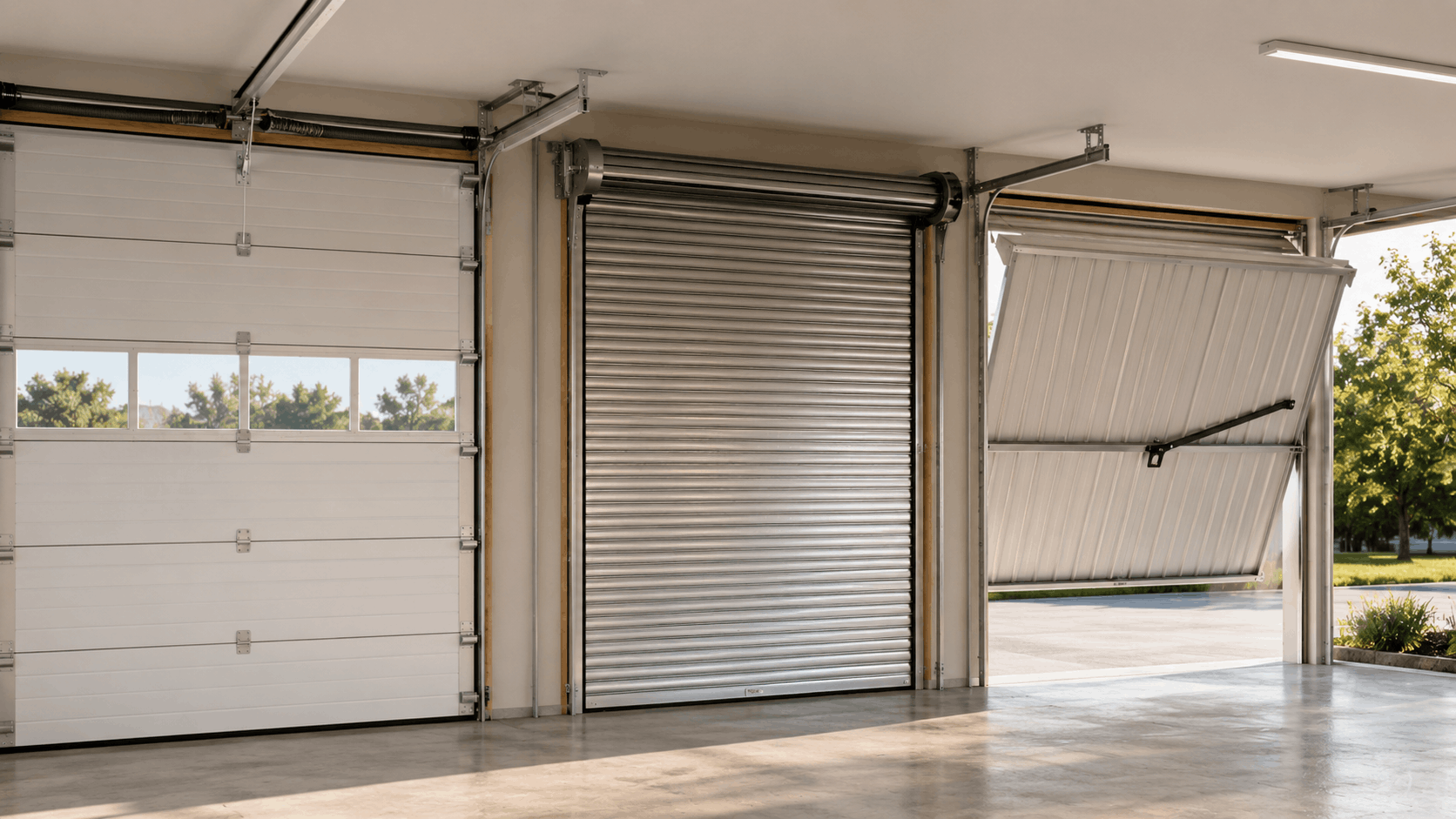
A tilt-up garage door is one solid panel attached to a set of pivot arms on each side of the opening. When the door opens, the bottom of the panel swings outward past the driveway, and then the whole panel tilts up into a horizontal position just above the opening.
The pivot mechanism uses either extension springs or a counterbalance system mounted along the sides of the garage opening to help lift the panel's weight. This design was common in construction throughout the 1970s and 1980s, and it still appears on older homes along the El Camino Real corridor and throughout University Park and Walnut Village.
Tilt-up doors have no tracks inside the garage ceiling, which made them appealing in older construction where headroom was tighter. The tradeoff is a single large panel that moves as one rigid unit - a mechanical characteristic that creates real problems in high-wind conditions.
Get Your Free Quote
Tell us about your garage door and we'll get back to you within 30 to 60 minutes.
Orange County Climate Conditions That Affect Garage Doors
Orange County is often described as having perfect weather, and for the most part that reputation holds. But from a garage door hardware perspective, OC's climate is genuinely tough on mechanical components in ways that homeowners from out of state rarely anticipate. The combination of intense UV, dry heat, occasional strong winds, and coastal salt air creates wear patterns that differ from what manufacturers engineer their products for in milder, more humid climates.
The issues are not hypothetical. Urgent Garage Doors handles service calls across Irvine and surrounding cities year-round, and the problems that keep appearing trace back to these specific local conditions rather than simple age or product defects.
Santa Ana Wind Events and Door Stability
Santa Ana wind events arrive from the northeast and push through inland passes before sweeping across the Irvine plateau. Through the 241 corridor near Foothill Ranch and down through the hills above Shady Canyon, gusts regularly hit 40 to 55 mph, and peak events have been recorded above 70 mph.
That wind load presses directly against the flat face of a garage door. For a standard 16-foot wide double-car door, a 50 mph gust generates several hundred pounds of lateral force across the panel surface. How that force gets distributed through the door's structure depends entirely on which type of door it is.
Sectional doors spread that force across multiple panels and two full-length tracks. Tilt-up doors take the full load on a single pivot system. The difference in how the hardware responds - and how quickly it fails - is significant, particularly for homes on elevated lots in communities like Turtle Rock or along the ridgelines above Quail Hill.
UV Exposure and Heat Stress on Hardware
South-facing and west-facing garages in communities like Turtle Rock, Shady Canyon, and Orchard Hills take direct afternoon sun for five to seven hours a day during summer months. Garage interior temps in those conditions regularly exceed 100 degrees Fahrenheit by mid-September, and the door surface itself gets hotter still.
That heat does real damage. Weather seals dry out and crack within a few years. Panel surfaces - especially painted steel - expand and contract with daily temperature cycles, loosening fasteners and fatiguing hinge metal over time. Torsion springs, which operate through metal fatigue resistance, wear out sooner when they are cycling through extreme temperature swings every single day.
UV exposure is a separate issue from heat. The ultraviolet component of direct sun breaks down rubber weather seals, degrades plastic rollers, and fades and oxidizes painted surfaces sooner than shaded doors. A door on a north-facing garage in Woodbury might last years longer than an identical door on a south-facing garage in Northwood Pointe, simply due to sun angle.
Coastal Moisture and Salt Air Corrosion
Properties within a few miles of the coastline - including Newport Coast neighborhoods just west of Irvine and communities near the UCI campus close to the 405 - experience measurably higher salt content in the air compared to drier areas further inland. That salt settles on metal hardware and speeds up rust in ways that happen slowly but add up over years.
Springs, cables, and track hardware on doors in these zones show surface rust one to two years earlier than comparable doors in drier inland areas of OC like Tustin or Lake Forest. The effect is more pronounced on components that are not regularly lubricated or inspected. A homeowner near Newport Beach who skips annual maintenance is likely to face spring replacement two to three years sooner than a homeowner in a drier inland neighborhood.
Salt air corrosion is one of the most overlooked factors in coastal OC garage door maintenance. Most homeowners do not notice the damage until a spring snaps or a cable frays - by then the hardware has been weakening for years.
Need Help in Irvine?
Urgent Garage Doors serves Irvine and all of Orange County.
Sectional Door Performance in OC Conditions
Sectional doors dominate new construction across Irvine for good reason. They fit neatly inside the garage opening, leave driveway space free, and work with a wide range of opener systems. But how they hold up under OC's specific climate stresses is a more detailed story than most installation brochures tell. The team at Urgent Garage Doors has seen the full range of sectional door performance from Rancho San Joaquin to Stonegate, and the pattern is consistent.
| Factor | Sectional Door Performance in OC | Notes |
|---|---|---|
| Wind resistance | Good - distributes load across multiple panels and tracks | Wind-rated models available for hillside properties |
| UV/heat stress | Moderate - hinges and seals degrade sooner on sun-facing doors | Insulated models reduce interior temp fluctuations |
| Salt air corrosion | Moderate - steel hardware vulnerable without regular lubrication | Galvanized hardware recommended near coast |
| Lifespan (door panels) | 15-25 years | Shorter for sun-exposed, uninsulated doors |
| Lifespan (springs) | Rated in cycles, commonly around 10,000 | Heavy use and high heat use them up sooner |
Strengths: Wind Resistance and Panel Flex
The multi-panel design of a sectional door is its single biggest advantage during Santa Ana wind events. Rather than presenting one flat rigid surface to the wind, the sectional door distributes incoming lateral pressure across multiple panels, each braced by the track system on both sides of the opening.
When Irvine building departments issue permits for new garage doors, the wind load rating requirement is typically 130 miles per hour equivalent pressure for newer construction in designated wind exposure zones - a standard that most modern sectional doors meet off the shelf. Reinforced sectional doors with added horizontal strut bracing are available for properties on exposed hillside lots in areas like Shady Canyon or the ridges above Quail Hill.
Panel flex through the curved track section also absorbs some of the stress that would otherwise transfer directly into the frame. This makes sectional doors noticeably more stable in gusty conditions compared to tilt-up doors of the same age and material.
Common Failure Points We See in Irvine
Hinge corrosion is the most frequent issue on older sectional doors near Rancho San Joaquin and other neighborhoods with homes from the late 1980s and early 1990s. The hinge knuckles seize up, forcing the rollers off their normal path and creating the grinding or jerking movement homeowners notice before anything looks visibly wrong.
Track misalignment is another common problem. Irvine sits on expansive clay soils in several areas, and minor soil movement over the years shifts the garage framing just enough to throw vertical tracks out of alignment. A door that seemed fine for a decade can suddenly start sticking or creating uneven gaps along the sides.
Torsion spring fatigue rounds out the top three. Daily temperature cycling in garages that face direct sun speeds up metal fatigue in the spring steel, and the team at Urgent Garage Doors regularly handles torsion spring replacement calls on 8 to 10 year old sectional doors that appear otherwise undamaged.
Lifespan Expectations With OC Maintenance
A quality sectional door installed in Irvine should last 15 to 25 years if the panels are maintained and the hardware receives regular attention. The door panels themselves rarely fail - it is the hardware around them that determines useful lifespan.
Springs are the predictable weak link. Most torsion springs on residential sectional doors are rated for 10,000 cycles. At four open-close cycles per day, that is roughly seven to ten years. In a sun-exposed Irvine garage with interior temps that regularly exceed 100 degrees in September, real-world spring life often lands closer to five to seven years.
Rollers, cables, and weather seals each have their own maintenance timeline. Scheduling annual preventive maintenance catches these items before they become failures rather than after.
Roll-Up Door Performance in OC Conditions
Roll-up doors are built for commercial and industrial environments, and Orange County has plenty of both. The Irvine Spectrum business parks, the warehouse zones along Barranca Parkway, and the mixed-use industrial corridors near Alton Parkway all use roll-up doors extensively. Their performance in OC's climate is generally strong for the applications they are designed for - but there are specific maintenance challenges that owners of these doors need to plan for, especially near the coast.
Why Coil Tension Changes With OC Temperature Swings
Steel expands when it heats up and contracts when it cools. In a roll-up door, the steel coil wraps around the drum under a precise tension that is calibrated to balance the door's weight. When that coil temperature changes significantly, the tension shifts - and the door balance shifts with it.
In Irvine, garage interior temperatures can swing from 55 degrees Fahrenheit on a cool January night to over 100 degrees on a hot September afternoon. That is a 45-degree swing or more. Steel expands roughly 0.0000065 inches per inch per degree Fahrenheit, and across a full roll-up coil that math adds up to measurable changes in coil diameter and tension.
The practical result is a door that may feel heavier or lighter depending on the time of year, and that may need door balancing and tension adjustment more frequently than equivalent doors in moderate-climate regions. Twice-yearly inspections are a reasonable schedule for commercial roll-up doors in OC.
Residential vs. Commercial Roll-Up Applications in Irvine
True roll-up doors on residential homes in Irvine are uncommon. Most of Irvine's planned communities were developed with sectional doors as the standard, and HOA architectural guidelines in neighborhoods like Columbus Grove, Stonegate, and Northwood Pointe generally require panel-style doors that match the neighborhood aesthetic.
The commercial picture is different. Yale Avenue business zones, the industrial parks near Jamboree Road, and properties throughout the Irvine Spectrum area rely heavily on roll-up doors for daily operations. The mechanical needs of these doors differ from residential sectional setups - higher cycle counts, heavier gauge steel, and more frequent lubrication requirements.
Business owners considering a commercial garage door installation should factor in the increased maintenance frequency that OC's climate demands, particularly for properties near the coast or in sun-exposed locations.
Corrosion Risk on Coil Components Near the Coast
One of the structural differences between roll-up doors and sectional doors is how exposed the spring hardware is. On a sectional door, the torsion spring sits close to the wall above the opening, partially sheltered by the door panels themselves when closed. On a roll-up door, the coil drum and barrel brackets sit above the opening and are exposed to whatever air flows through the building.
Near Newport Coast or in western Irvine neighborhoods close to the 405, that air carries measurable salt content. The drum, barrel brackets, and coil spring on roll-up doors in these areas show more surface corrosion compared to identical doors installed ten miles inland. Regular lubrication with a silicone or lithium-based spray - at least every six months - extends hardware life noticeably in these locations.
Ignoring coil corrosion is not just a maintenance issue - a corroded coil spring under full tension is a safety hazard. Any business along Barranca Parkway or near the UCI campus area should have their roll-up door hardware inspected annually at minimum.
Tilt-Up Door Performance in OC Conditions
Many older Irvine homes still have their original tilt-up doors. They were built to last, and in some cases they have - but decades of OC sun, wind, and temperature cycling have taken a real toll on the hardware that keeps them balanced and safe. An honest look at tilt-up door performance in Orange County today involves acknowledging that this design was not built with the modern understanding of local climate stress that engineers bring to sectional door design.
Why Tilt-Up Doors Struggle With Wind Load
A tilt-up door works like a sail in a wind event. The single solid panel presents its full face area to any wind coming from the front, and all of that pressure concentrates on two pivot arm assemblies - one on each side. There is no track system distributing that load, no multi-panel flex to absorb gusts.
During strong Santa Ana events, the pivot hardware on tilt-up doors takes a beating. The pivot arms flex and the spring hardware at the top of the frame - which is under tension even when the door is closed - gets stressed in ways it was not designed for. The result is pivot hardware bending out of alignment, doors that pop partially out of their pivot brackets, or doors that jam in the half-open position after a wind event.
Homes on elevated lots in communities near the hills above University Park or along the Shady Canyon perimeter are particularly vulnerable during high-wind nights. If the door starts moving stiffly or making new sounds after a Santa Ana event, that is a sign the pivot mechanism needs inspection before the next big wind arrives.
Panel Warping From Sun Exposure in South-Facing Garages
The solid single panel of a tilt-up door absorbs solar heat unevenly. The center of the panel heats up more quickly than the edges, which are partially shaded by the door frame. Over time, that uneven heating creates differential expansion across the panel surface, which leads to warping along the top or bottom edge.
The team at Urgent Garage Doors sees this regularly on older homes in the Village of Woodbridge and University Park. A warped panel does not sit flush in the frame when closed, creating gaps that let in dust and insects during Santa Ana events and reducing whatever weather-sealing ability the door originally had.
Panel warping on a tilt-up door is not repairable in any meaningful way. Once the warp exceeds a quarter inch across the panel width, the door no longer seals properly and replacement is the practical answer. Patching or shimming the frame around a warped panel is a short-term fix that creates new problems.
When to Repair vs. Replace an Older Tilt-Up in Irvine
The repair-versus-replace decision on a tilt-up door comes down to how much useful life remains in the panel itself and what the homeowner plans to do with the property. Minor spring or cable work - pivot arm hardware, cable replacement, or a spring adjustment under $200 - is generally worth doing if the panel is flat and in good structural shape.
When the panel is warped, the pivot hardware has been stressed by multiple wind events, or the cables show visible fraying, the math shifts toward replacement. A new sectional garage door installation in Irvine typically runs $800 to $2,500 and delivers a door that handles OC conditions better at every level.
For homeowners considering resale in competitive Irvine HOA communities like Northwood Pointe or Stonegate, replacing an aging tilt-up with a modern sectional door is one of the few exterior upgrades that genuinely moves the needle on both appraised value and first-impression curb appeal.
Need Help in Irvine?
Urgent Garage Doors serves Irvine and all of Orange County.
Spring Systems Compared: Torsion vs. Extension vs. Counterbalance
The spring system is the mechanical heart of any garage door. It provides the counterbalancing force that makes a 150 to 400 pound door feel light enough to lift with one hand. Different door types use different spring designs, and each one responds differently to OC's heat, UV exposure, and coastal moisture. Knowing what type of spring is behind a door - and what its failure signs look like - is practical knowledge for any Irvine homeowner.
Torsion Springs on Sectional Doors in Hot Garages
Torsion springs mount horizontally above the door opening on a steel shaft. They store energy through twisting - when the door closes, the spring winds tighter, and when the door opens, that stored energy helps lift the panel weight. The spring sits close to the wall and is partially sheltered from direct weather exposure.
In hot Irvine garages that face south or west, torsion springs cycle through larger temperature swings than springs in shaded garages. The metal fatigue that eventually causes spring failure accumulates sooner under those conditions. A spring inspection every three to four years is a reasonable schedule for sun-exposed garages in communities like Turtle Rock or Orchard Hills.
Torsion springs last longer than extension springs in OC conditions because the coil design keeps stress more evenly distributed across the spring length. When replacement time does come, torsion spring replacement is a job that requires proper tools and training - a torsion spring under full tension stores enough energy to cause serious injury if released incorrectly.
Extension Springs and the Coastal Rust Problem
Extension springs are the older design - they run horizontally along the top of the door tracks on each side and stretch under tension as the door closes. They are common on older tilt-up doors and on some budget-level sectional installations from the 1990s and early 2000s.
The problem with extension springs in coastal OC is their exposure. They sit along the side tracks with no housing or cover, collecting dust, moisture, and salt air particles directly. Homes in western Irvine near the 405, in the UCI campus area, or in parts of Newport Beach see these springs rust from the outside in over five to eight years.
A rusted extension spring does not snap cleanly - it frays and develops stress cracks that can cause sudden failure under load. Regular lubrication and annual inspection slow the process, but homes with original extension springs from the 1980s should seriously consider a spring conversion upgrade to a torsion system, which offers better longevity and safer failure characteristics.
Counterbalance Systems in Commercial Roll-Up Doors
Roll-up doors use a counterbalance system where the torsion spring sits inside the barrel drum above the door opening. This enclosed position actually provides meaningful protection from the outdoor environment - the spring is not exposed to direct salt air or rain the way extension springs are.
For commercial properties along Barranca Parkway or in the Irvine Spectrum industrial parks, this enclosed spring design holds up reasonably well in OC's coastal air conditions compared to exposed residential spring systems. The main maintenance concern shifts from rust prevention to proper lubrication of the barrel bearings and drum hardware, which do sit in the open air.
Counterbalance spring replacement on a commercial roll-up door is a more involved job than residential torsion spring work due to the higher spring tensions involved. A qualified spring and cable repair technician with commercial door experience should handle any adjustments or replacements on these systems.
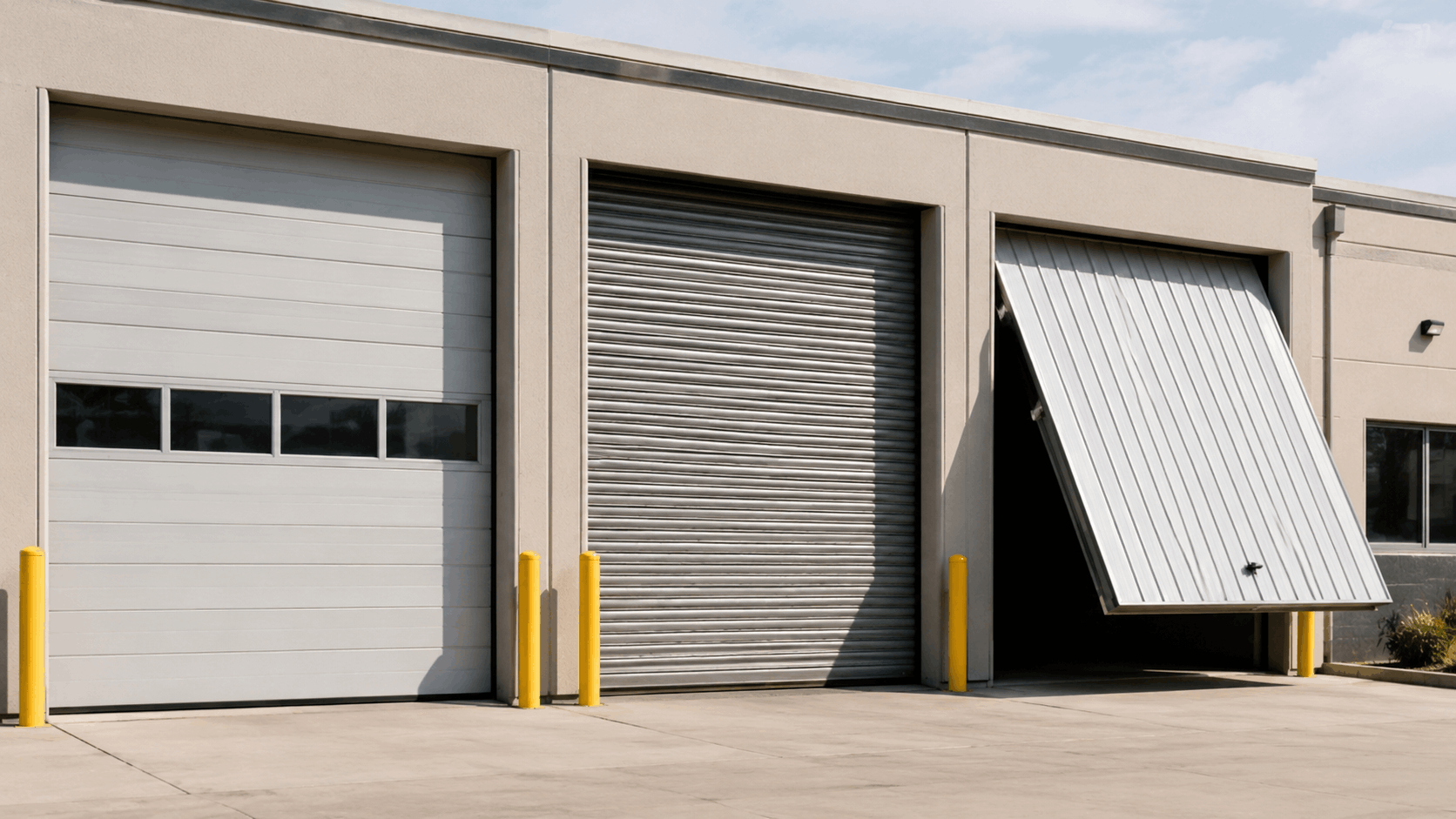
How Tilt-Up Garage Doors Work and Why They Present Challenges in OC
A tilt-up door is one rigid panel, usually wood or a wood frame with a skin, mounted on pivot arms at each side of the opening. As it opens, the bottom swings outward and up while the top moves back into the garage, until the whole panel sits horizontally overhead. Springs on the side brackets counterbalance the weight, and there are no hinged sections or full-length ceiling tracks.
That simplicity brings practical problems on older Orange County homes, where many pre-1960s garages still carry one. The door swings out past the face of the garage, so anything parked close to it or anyone standing on the driveway is in its path. Because the panel moves as one piece, a warped wood door pulls the pivot arms out of line and the door starts to bind. Santa Ana winds carry dust and debris into the pivot hardware, so stiff or noisy movement after a windy spell is worth checking.
Tilt-up hardware is different from sectional hardware, which makes matching parts harder, so on an older home it is worth weighing repair against replacement. A sectional garage door replacement typically runs $800 to $2,500 in Orange County, as a market range rather than a quote, and Urgent Garage Doors gives a free on-site estimate for new doors with haul-away of the old one included.
Roll-Up vs Tilt-Up Garage Doors: How They Compare for OC Homeowners
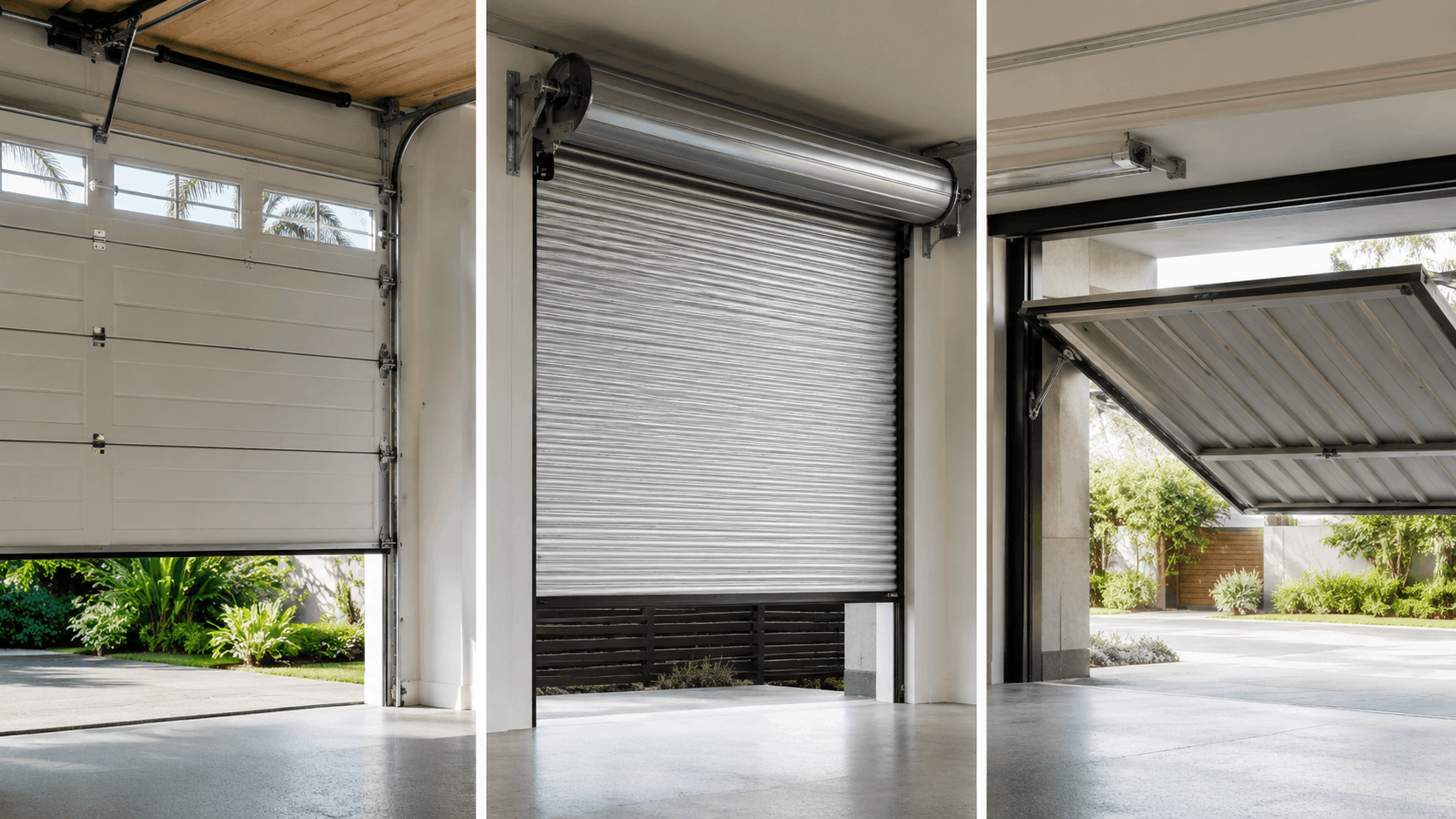
Roll-up and tilt-up doors solve the same problem in opposite ways. A roll-up door is made of narrow interlocking slats that coil around a drum above the opening, while a tilt-up door is a single panel that pivots outward and up. Sectional doors, the standard on most homes, sit between the two, with hinged panels that run back along ceiling tracks.
The differences that matter at home are space and clearance. A roll-up coils into a compact roll above the opening, so it leaves the ceiling free for storage and never swings out onto the driveway, which helps where the driveway is short. A tilt-up needs clear space in front of the garage as it opens and occupies the ceiling area just inside the opening when it is up. Roll-ups are widely used on commercial buildings and storage units and are less usual on houses, while tilt-ups appear mostly on older garages.
Both designs collect wind-blown dust and plant debris in their moving parts, the coil and side guides on a roll-up and the pivot arms on a tilt-up, so keeping them clean matters after a Santa Ana wind event. On association-governed streets, a change of door style usually needs architectural approval before ordering, and whether a permit applies is confirmed by the building department for your city.
Insulation and Energy Efficiency in OC's Climate
Insulation in an Irvine garage door matters more than most homeowners realize - but the reason is different from what people in colder climates expect. The goal in Orange County is not keeping warmth inside during winter. The goal is blocking the intense heat that builds up inside a garage during long Southern California summers, particularly in newer developments like Portola Springs, Great Park Neighborhoods, and the newer phases of Orchard Hills where garage-adjacent living spaces are common.
R-Value Differences Between Door Types
R-value measures a material's resistance to heat flow. A higher R-value means better insulation. The three door types vary significantly in what R-values they can practically achieve.
Sectional doors lead the field - quality insulated sectional doors range from R-6 on the lower end to R-18 or higher on premium models with polyurethane foam cores. Roll-up doors typically fall between R-3 and R-10 depending on slat thickness and whether an insulation kit has been added. Tilt-up doors are almost universally uninsulated or minimally insulated, with effective R-values of R-2 or less in real-world conditions after years of weatherseal degradation.
For a homeowner in Irvine with an attached garage that shares a wall with a living space, the difference between a tilt-up door at R-2 and an insulated steel garage door at R-16 translates directly to lower air conditioning load and a more comfortable room on the other side of that shared wall.
How OC's Mild Winters Change the Insulation Math
In states where winter temperatures drop below freezing, garage door insulation is primarily about heat retention - keeping expensive heated air from escaping. In Irvine, where overnight lows rarely drop below 45 degrees Fahrenheit even in January, that calculus is different.
The real value of garage door insulation in OC is heat rejection in summer. A dark-painted steel door facing west in Turtle Rock can reach surface temperatures of 150 degrees Fahrenheit or more on a September afternoon. Without insulation, that heat radiates directly into the garage interior. With a polyurethane core, the thermal mass of the foam slows that heat transfer significantly.
Reflective coatings and light-colored finishes help on the exterior surface, but they address only radiated heat. Foam core insulation - particularly injected polyurethane, which bonds directly to the steel skins - handles both radiated and conducted heat. The combination is more effective than either approach alone for Irvine's summer heat profile.
Weather Seal Maintenance for Each Door Type
Weather seals are the gaskets and strips that close the gaps between the door and the surrounding frame. All three door types use them, but they degrade at different rates and in different ways under OC's UV environment.
Sectional door bottom seals are typically vinyl or rubber and sit on direct concrete contact every time the door closes. In direct sun, the UV exposure dries and cracks these seals within three to five years. The side and top astragal seals on the door frame last a bit longer but should be inspected annually for brittleness or gaps.
Tilt-up doors present a more significant problem. Most original tilt-up installations have no side seals - the panel swings out from the opening rather than sliding past a stationary seal, which makes side sealing difficult by design. This creates gaps along the sides that let in dust, debris, and insects during Santa Ana events. A weatherseal and insulation retrofit can improve this on tilt-up doors, but the improvement is limited compared to what a properly sealed sectional door achieves.
HOA Rules and City of Irvine Permit Considerations
Choosing a new garage door in Irvine is not just a mechanical decision - it is often a regulatory one too. Homeowners in villages like Northwood Pointe, Columbus Grove, and Stonegate answer to both their HOA architectural committee and the City of Irvine building department. Getting either of those approvals wrong can mean installing a door that needs to come back out. Urgent Garage Doors has navigated this process enough times across Irvine to know exactly where the friction points are.
When a Permit Is Required for Garage Door Replacement in Irvine
The City of Irvine generally does not require a building permit for a simple like-for-like sectional door replacement on an existing residential opening. However, when the replacement involves a significant change in door weight, type, or opener system - such as switching from a lightweight tilt-up to a heavy insulated sectional with a new electric opener - a permit review is typically required.
The city's Community Development Department handles these reviews, and the permit process exists partly to verify that the garage framing can support the new door's weight and that the opener electrical work meets code. Most straightforward replacements move through the process without issue, but the paperwork takes time and the job cannot start without approval in hand.
Homeowners who skip the permit step on a change that required one can face complications at resale when the buyer's home inspector or the title company pulls the permit history. Working with a licensed contractor who handles the permit filing as part of the installation process protects the homeowner from that exposure.
HOA Design Guidelines That Limit Door Choices
Irvine's HOA communities often have architectural guidelines that go well beyond just color approval. Many are managed by organizations like FirstService Residential and maintain detailed design standards that specify panel style, hardware finish, and door texture. Carriage house panel styles, flush modern panels, and traditional raised-panel designs are each approved or restricted differently depending on the neighborhood.
Switching from any residential door type to a roll-up design will almost always be rejected by residential HOA architectural committees. The visual profile of a roll-up door - a flat steel curtain with no panel definition - does not match the residential character that Irvine's planned communities require. Even switching from one sectional style to another may require a written application and committee review.
The process typically requires submitting product specifications, a color sample, and sometimes a photo simulation showing how the new door will look on the home. Getting that submission right on the first try saves weeks of back-and-forth.
Working With Urgent Garage Doors on Permit-Ready Installations
Urgent Garage Doors handles the permit documentation and HOA submission materials as part of the installation process for Irvine homeowners. The team provides the product cut sheets, wind load certifications, R-value documentation, and installer license information that city inspectors and HOA architectural committees ask for.
This matters because a permit application that is missing the right technical specifications gets kicked back, adding two to four weeks to the timeline. Getting it right the first time means the homeowner's new door goes in on schedule without surprise delays. For HOA submissions, having professional documentation rather than a printed manufacturer brochure typically moves the approval process more smoothly through the committee review cycle.
Homeowners can start the process by reaching out through the contact page to discuss their specific community's requirements before any product is ordered.
Need Help in Irvine?
Urgent Garage Doors serves Irvine and all of Orange County.
Cost Comparison and Long-Term Value in OC
Getting honest numbers on garage door costs in Orange County requires knowing what the local market actually charges - not national averages from a home improvement website written for homeowners in Ohio. The prices below reflect what Urgent Garage Doors actually charges in Irvine and the surrounding service area, and they account for the hardware and material choices that OC's climate conditions demand.
Upfront Installation Costs for Each Door Type
Residential sectional door installations in OC typically run $800 to $2,500 fully installed, with the range driven primarily by door width, insulation level, and panel style. A basic single-car non-insulated sectional on the low end, a double-car polyurethane-insulated carriage house panel on the high end. Mid-range double-car doors with R-12 insulation and steel construction land around $1,200 to $1,800 installed.
Tilt-up replacements, where a homeowner simply wants the existing type maintained rather than upgraded, run $600 to $1,200. That lower cost reflects the simpler mechanism and smaller hardware package. However, a tilt-up replacement in 2024 does not make long-term economic sense for most Irvine homeowners when the sectional upgrade price difference is $200 to $400.
Commercial roll-up doors for businesses along Irvine's commercial corridors range from $1,500 for a small single-car opening to $5,000 or more for large industrial openings with heavy-gauge steel curtains and high-cycle counterbalance systems. The garage door installation service page has current pricing for specific configurations.
10-Year Maintenance Cost Differences in OC
Sectional doors require the least maintenance spending over a decade when properly installed. Expect one torsion spring replacement around year seven to ten at $150 to $300, annual lubrication and inspection at $75 to $120 per visit, and a bottom seal replacement every three to five years at $60 to $100. Total ten-year maintenance cost: roughly $500 to $900 depending on inspection frequency.
Tilt-up doors cost more to maintain over the same period. Cable and spring work comes up every four to six years rather than seven to ten. Each service event runs $100 to $200. Add in the higher frequency of pivot hardware adjustments and seal work, and a tilt-up door's ten-year maintenance spend lands at $600 to $1,200 - more than a sectional door while delivering less performance.
Commercial roll-up doors have higher per-visit service costs. Coil tension adjustments and drum bearing lubrication run $200 to $400 per visit. High-cycle commercial doors should be serviced every six months, which adds up to $400 to $800 per year in planned maintenance. That cost is a normal operating expense for a business property but would be unreasonable for a residential installation.
Resale Value Impact for Irvine Properties
Irvine's real estate market is among the most competitive in Southern California. Homes in Orchard Hills, Lambert Ranch, and Shady Canyon regularly trade above $1.5 million, and first impressions - including the garage door, which occupies a large portion of a home's front facade - factor into how quickly a listing moves and whether buyers negotiate down from the asking price.
Real estate agents who work Irvine neighborhoods consistently cite a new garage door as one of the better-returning exterior upgrades before listing. A modern insulated sectional door with a coordinating carriage house panel style can return 70 to 90 percent of its installed cost in added resale value, according to national remodeling industry data - and in Irvine's premium market, that return can be even higher when the door complements the home's overall architectural style.
Replacing an aging tilt-up with a new carriage house garage door before listing is one of the more straightforward ways to update a home's exterior without a major remodel. The visual impact is immediate and the installation is typically a one-day job.
Final Thoughts
The choice between a sectional, roll-up, or tilt-up garage door is not just about aesthetics or price - it is about matching the door's mechanical design to the specific demands of Orange County's climate. Santa Ana winds, intense UV exposure, coastal salt air, and summer temperature extremes all stress different parts of each door type in different ways. Knowing those vulnerabilities before choosing a door saves real money and prevents avoidable repairs down the road.
For most Irvine homeowners, a quality insulated sectional door is the clear choice for residential use. It handles wind load better than a tilt-up, provides meaningful insulation against summer heat, and lasts longer with less maintenance in OC's conditions. Roll-up doors remain the right answer for commercial applications but belong in industrial and business settings, not in residential neighborhoods where HOA guidelines and aesthetic standards apply.
Urgent Garage Doors works across every Irvine neighborhood - from Northwood and Woodbury to Turtle Rock and the Great Park Neighborhoods - and handles everything from single spring replacements to full permit-ready door installations. If a door is struggling after a recent wind event or has been showing signs of wear through the summer heat, contact the team at Urgent Garage Doors for an honest assessment and a straightforward quote. Same-day service is available for urgent situations, and the team can walk through the permit and HOA process with any homeowner who needs that guidance.
Frequently Asked Questions
- Which garage door type handles Santa Ana winds the best?
- Sectional doors with reinforced horizontal bracing handle Santa Ana wind pressure better than tilt-up doors. The multi-panel design spreads wind load across two full-length tracks and multiple hinge points rather than concentrating it on two pivot arms. Wind-rated sectional doors designed for 130 mph equivalent pressure are available and are the right choice for properties on hillside lots near Shady Canyon or above Quail Hill where gusts are strongest during northeast wind events.
- Are roll-up doors allowed on residential homes in Irvine?
- Roll-up doors are technically not prohibited by city code, but most Irvine HOAs will reject them for residential use because they do not match neighborhood architectural standards. Communities managed by FirstService Residential and similar organizations maintain strict design guidelines that require panel-style doors consistent with the neighborhood's visual character. The City of Irvine may also require a permit review for any non-standard door type that deviates from the original construction specifications.
- How often do garage door springs need replacing in Orange County?
- Most residential torsion springs are rated for 10,000 cycles, which equals roughly seven to ten years at four open-close cycles per day. In OC's UV and heat environment - particularly in south or west-facing garages in neighborhoods like Turtle Rock or Orchard Hills - that lifespan can shorten to five to seven years. Scheduling an inspection every three to four years lets a technician catch spring fatigue before a break happens at an inconvenient time.
- Can I convert my tilt-up door to a sectional without major construction?
- Most tilt-up to sectional conversions in Irvine go smoothly in a single day. The opening dimensions stay the same, so no structural framing work is typically needed. The main variables are headroom clearance above the opening - sectional doors need at least 10 to 12 inches of headroom for the track curve - and whether the existing side jambs and header are in sound condition. The Urgent Garage Doors team checks all of these during the initial visit before any product is ordered.
- Does garage door insulation matter if Orange County winters are mild?
- Yes - but for summer heat, not winter cold. Garages in Irvine regularly hit 110 degrees Fahrenheit or more inside during September, and an insulated sectional door with a polyurethane foam core can reduce that interior temperature by 20 degrees or more. For homes with living spaces that share a wall with the garage - common in newer Great Park Neighborhoods and Portola Springs construction - that temperature reduction directly lowers air conditioning load and improves comfort in adjacent rooms.
- What is a common garage door repair in Irvine?
- Broken torsion springs are the single most frequent repair call Urgent Garage Doors handles across Irvine, followed by snapped cables and worn rollers. All three failure types are made worse by UV exposure and the daily temperature cycling that characterizes OC's dry climate. Most broken spring calls come in during fall and spring when temperature swings are largest - the rapid shift from cool nights to warm afternoons puts additional cyclic stress on already-fatigued spring steel.
- How do I know if my older tilt-up door is a safety risk?
- Warning signs to watch for include a door that drops more quickly than normal when closing, visible rust or kinking on the cables, cracks along the top or bottom panel edge, a spring that appears extended or sitting at an odd angle when the door is closed, and any pivot arm hardware that looks bent or shifted out of position. Any of these signs on a tilt-up door in an older Woodbridge or University Park home warrants an immediate inspection - do not wait for the door to fail completely, particularly since a falling tilt-up panel poses a real injury risk.
- Does Urgent Garage Doors serve all of Irvine and the surrounding OC areas?
- Urgent Garage Doors serves all Irvine neighborhoods, including Northwood, Woodbury, Turtle Rock, University Park, Stonegate, Portola Springs, and the Great Park Neighborhoods. The service area extends to surrounding cities including Lake Forest , Tustin, and Newport Coast . For locations outside Irvine, the locations page lists the full service area across Orange County.
- How long does a garage door installation take in Irvine?
- A standard sectional door swap on a single-car garage typically takes two to three hours from arrival to cleanup. A double-car door replacement runs three to four hours. A tilt-up to sectional conversion that includes removing the old hardware and installing a new opener adds another one to two hours to either timeframe. Same-day installations are available for in-stock door models, and the team carries common sizes on the truck for many standard Irvine garage opening dimensions. For scheduling, contact Urgent Garage Doors directly through the same-day repair service page .
- Are there specific door materials that hold up better in coastal OC neighborhoods?
- Steel doors with galvanized coatings and fiberglass doors both outperform plain painted steel in salt-air environments like Newport Coast and western Irvine near the 405. Galvanized steel resists surface rust significantly longer than standard steel with a baked enamel finish. Fiberglass doors do not rust at all, though they can fade and become brittle with prolonged UV exposure if the outer surface is not maintained. Aluminum doors, while lightweight and corrosion-resistant in theory, develop more pitting and oxidation than galvanized steel in coastal salt air. For authoritative guidance on corrosion standards for garage door hardware, the Door and Access Systems Manufacturers Association (DASMA) publishes material specifications that address salt spray resistance ratings for door components. For additional reading on California building codes affecting garage doors, the California Building Standards Commission maintains the current California Building Standards Code requirements, including wind load provisions relevant to garage door installations. The California Energy Commission also publishes guidance on building envelope insulation requirements that apply to attached garages in new
Licensed garage door repair professionals serving Irvine and Orange County.
Licensed in California · License #1055150
Why trust Urgent Garage Doors?
Founded in 2017, Urgent Garage Doors is a licensed and insured garage door services serving Irvine and Orange County. All content is reviewed by our licensed technicians.

Need Help in Irvine?
Urgent Garage Doors serves Irvine and all of Orange County.
Related Articles

Best Garage Door Brands for Coastal Orange County
Discover the best garage door brands for coastal Orange County homes that resist salt air corrosion, handle marine layer moisture, and maintain performance despite coastal winds.
CA Energy Code: When Garage Doors Count as Conditioned Space
Learn when California's energy code classifies a garage as conditioned space, what insulation and air-sealing requirements apply to the garage door, and how Irvine homeowners can get compliant.

Insulated Garage Doors in Irvine: Comfort, Noise, and Energy Benefits
Discover how insulated garage doors provide energy savings, noise reduction, and improved comfort for Irvine homeowners in Orange County's climate.