Tustin Ranch Garage Doors by Phase From the Late 1980s Through the 2000s
Key Takeaways
- Tustin Ranch was built in waves from the late 1980s through the 2000s, so the build year predicts spring age, opener safety features and door weight more than the street name does.
- Openers in 1988 and 1989 homes may predate the January 1, 1993 federal entrapment-protection mandate and lack the low-mounted photo eyes that newer neighbors have.
- A standard torsion spring is rated around 10,000 cycles, about seven years at four cycles a day, so original springs across the 1990s tracts are well past rating and should be replaced with cables inspected at the same time.
- SB 969 requires battery backup on any residential opener sold or installed in California since July 1, 2019, so a replacement door brings a compliant opener whether or not the owner asked.
- Lakeside and golf-frontage homes see more corrosion from local humidity and ball damage, while eucalyptus and Peters Canyon park-edge streets deal with debris in tracks, seals and photo-eye lenses.
- A new door needs both community association architectural approval and, where structural work is involved, a City of Tustin building permit; clearing one does not clear the other.
- Garage door work is licensed under C-61/D-28, not C-28, and Urgent Garage Doors holds California license #1055150, verifiable free at cslb.ca.gov.
- Typical Orange County ranges run from $150 to $300 for torsion spring replacement to $800 to $2,500 for a sectional door, with the actual price given in writing before work begins.
In This Article
Tustin Ranch did not rise all at once. The Irvine Company began the master plan in 1982, construction was approved in 1986, and homes went up in waves from the late 1980s through the 1990s, with some infill continuing into the 2000s. That span of roughly two decades means a garage door on a 1988 street and a door on a 2003 street are rarely the same job.
The year a home was built tells you a great deal about what its garage door, springs and opener need now. It predicts how old the original springs are, whether the opener was built with the safety features modern code requires, and how heavy the door is likely to be. On the earliest streets, an opener may predate the federal entrapment-protection rule entirely. On the newest, battery backup is already in the picture.
Why the Build Year Matters More Than the Street Name?
Tustin Ranch occupies the eastern part of the City of Tustin under the 92782 ZIP code, set between the Tustin foothills and North Tustin on the north, Irvine on the south and the Lomas Ridge preserve on the east. The community was built on 2,257 acres of the former Irvine Ranch agricultural preserve. It did not go up in a single year, and that matters for every door here.
The build era predicts three things that drive the work: the age of the springs, the safety features built into the opener, and the weight of the door itself. A standard torsion spring is rated in cycles, not years, so a door that opens and closes several times a day reaches the end of its rating far faster than a door on a quiet street. The opener's safety features depend on the manufacture date, and the door's weight depends on the product the builder installed.
Knowing the build timeline lets our team walk up to a door and make a short list of what to check before the ladder even comes off the truck. A late-1980s home gets a careful look at the opener's safety hardware. A 1990s home gets attention to spring age and elevation matching. A larger tract home gets a spring-sizing check against the actual door weight.
From Citrus Ranch to Planned Community: The Timeline
The land under Tustin Ranch was a citrus ranch before the 1980s. The Irvine Company decided to build the planned community in 1982, the County of Orange approved it for construction in 1986, and the area was annexed to the City of Tustin in 1986, forming the 92782 ZIP code. Almost all the community streets are named after components of the former ranch, even though no citrus remains on the plan itself.
Development ran primarily through the late 1980s and 1990s. Some infill continued into the 2000s on parcels that filled in later. That gives the community a spread of roughly twenty years between its oldest and newest homes, which is wider than many Orange County communities that were built out in a single decade.
For door work, that span is the most useful fact there is. It means no two tracts in Tustin Ranch are guaranteed to share the same opener era or the same original door. The Tustin service area covers that full range, from the earliest streets to the latest infill, so the diagnostic starts with the build year of the specific home.
Most of the Stock Is Now Thirty to Forty Years Old
The bulk of the housing in Tustin Ranch is now thirty to forty years old. That puts original doors, springs, cables, track and openers at or past their design life across whole tracts at once. When an entire neighborhood was built in the same two or three years, the hardware in it tends to reach the end of its rating in the same stretch of time.
This is a different pattern from newer Irvine communities. In places like the Great Park or Portola Springs, the work is mostly first-failure maintenance on hardware that is still well inside its rating. In Tustin Ranch, the work is often replacement of original parts that have simply run out their cycles.
What that means in practice is that a spring failure on a thirty-year-old door is rarely a surprise, and it is rarely the only part near the end. Cables, drums, rollers and bearings wear alongside the springs on these older doors. Replacing one worn part while ignoring the rest is how a second failure follows weeks later.
Why One Community Holds Many Different Doors
Tustin Ranch is not one housing product. It ranges from townhomes and condominiums through single-family homes to golf course estates fronting the Tustin Ranch Golf Club. Door size, weight and price band vary enormously inside the single community, which is why a quote depends on the tract and the product rather than on the name Tustin Ranch.
A townhome door is a different animal from a three-car estate door. The townhome may carry a single-width sectional door on a modest spring. The estate may carry a wide, heavy door that needs springs sized to its actual weight. The same community name covers both.
For the homeowner, the takeaway is that there is no single Tustin Ranch answer on price or parts. The honest answer comes from looking at the specific door, measuring it, weighing the realistic load on the springs, and checking the condition of everything that moves. That is where any accurate estimate starts.
Get Your Free Quote
Tell us about your garage door and we'll get back to you within 30 to 60 minutes.
The Earliest Tracts: Late-1980s Homes That Straddle the 1993 Line
The oldest homes in Tustin Ranch were built in 1988 and 1989, right before a major federal safety rule took effect. Openers manufactured for the United States after January 1, 1993 had to include external entrapment protection. An opener installed in a 1988 home may predate that mandate entirely, while a 1995 neighbor's opener was built to meet it.
That one date change is the single biggest safety difference between the earliest Tustin Ranch tracts and everything built after. Here is how the pieces line up:
| Build Era | Likely Opener Safety Status | What to Check |
|---|---|---|
| 1988-1989 homes | May predate the 1993 federal entrapment rule | Look for photo eyes near the floor; run the auto-reverse test |
| Early 1990s | Straddles the 1993 line depending on manufacture date | Confirm photo eyes present and aligned |
| Mid-to-late 1990s | Built after the federal mandate | Photo eyes present; age pushes toward replacement |
Openers in 1988 and 1989 Homes May Have No Photo Eyes
An opener in a 1988 or 1989 Tustin Ranch home may have no photo eyes at all. These are the small sensors mounted on each side of the opening, no higher than six inches off the floor, that stop and reverse the door when something breaks the beam. A neighbor in a 1995 home almost certainly has them, because that opener was built after the rule took effect.
Units made before 1993 predate the federal entrapment-protection mandate. They are not illegal to own, but they lack the external safety device that every modern opener carries. The manufacturer position, from brands like LiftMaster, is that pre-1993 openers should be replaced rather than repaired.
If a Tustin Ranch home still has its original late-1980s opener, the safest path is a modern replacement. A new unit brings the photo eyes, meets current standards, and on any California install since mid-2019 includes battery backup. Our garage door opener installation work covers that swap from the old unit to a compliant new one.
What California and Federal Auto-Reverse Rules Actually Require
California moved ahead of the federal government on auto-reverse. AB 3600, signed in 1990, required California openers to be manufactured with an automatic reverse device and sensor. Congress followed for openers manufactured for the United States after 1993. UL 325 is the standard those safety devices are built to.
In practice, UL 325 is satisfied two ways at once. The opener must reverse the door within two seconds of contacting an obstruction, and nearly all openers add the non-contact photo-eye system mounted low on each side of the opening. Both systems working together is what keeps a door from closing on a child, a pet or a car.
Two tests let any homeowner check these systems. For the photo-eye test, start the door closing and break the beam with an object; the door must stop and reverse. For the two-by-four test, lay a 2x4 flat across the opening and close the door; it must reverse within two seconds of contact. If either test fails on an old Tustin Ranch opener, the safety system needs attention.
Photo-eye faults, misalignment and blocked beams are the most common reason a door reverses for no visible cause. Our safety sensor alignment and repair service handles sensors that are knocked out of line or coated with debris.
Original Springs and Cables on the Oldest Doors
A standard residential torsion spring is rated around 10,000 cycles, where one cycle is a single open and close. A door cycled four times a day reaches 10,000 cycles in roughly seven years. A spring that has never been replaced since the late 1980s is far past its rating, often several times over.
That is why spring failures cluster on the oldest Tustin Ranch doors. The spring did not fail early. It did its job for decades and reached the end of a metal fatigue curve that was always going to end this way. High-cycle springs are available where a door is heavy or used as a main entrance that cycles many times a day.
The important point on an old door is that the spring is never the only worn part. Cables, drums, rollers, hinges and bearings wear alongside it. Replacing a spring without inspecting the cables is how a second failure follows weeks later. Our team inspects the cables and rollers at the same time, and the cable repair and torsion spring replacement work is handled together so one visit resolves the real condition of the door.
Need Help in Irvine?
Urgent Garage Doors serves Irvine and all of Orange County.
The 1990s Core: Mission Revival Elevations and Matched Doors
The main body of Tustin Ranch was built in the 1990s. Openers on these homes mostly postdate the January 1, 1993 federal requirement, so most already carry photo eyes. The bigger concern on a 1990s home is usually matching a new door to a Mission Revival or Mediterranean elevation that an architectural committee will review.
Here is how the 1990s core differs from the earliest tracts:
| Feature | 1990s Core Homes | Why It Matters |
|---|---|---|
| Opener safety | Mostly built after the 1993 rule | Photo eyes usually present already |
| Architecture | Mission Revival and Mediterranean | Panel profile must suit warm stucco under red tile |
| Layout | Many two-story homes with rooms above the garage | Drives the quiet-opener upgrade request |
Matching a Door to Warm Stucco Under Red Tile
The housing in Tustin Ranch is contemporary Mission Revival and Mediterranean in character. It is known for warm colors, red-tiled roofs, stucco facades and small front patios, on curved streets lined with palms, pines and lemon-scented gum trees. A garage door here has to read correctly against that warm stucco under red tile.
A panel profile that reads wrong against a Mission Revival elevation is the usual reason an architectural submission comes back. This is the same matching problem as Westpark in Irvine, where doors sit against warm Mediterranean stucco, rather than the painted-wood problem of Woodbridge with its very different look.
Choosing the right panel style up front saves a round of rejection and resubmission. Our garage door installation team looks at the elevation before recommending a profile, so the door suits the home and stands a better chance of clearing review the first time.
Openers Built After the 1993 Entrapment Rule
Because the 1990s core postdates the January 1, 1993 federal requirement for external entrapment protection, most of these doors already have the photo-eye system. The sensors sit low on each side of the opening, and the opener carries the contact-reverse feature required by UL 325. That part of the safety picture is usually already in place.
Age still matters, though. An opener built in the mid-1990s has been running for close to three decades. Logic boards, drive components and the motor itself wear over that span, and parts for older units get harder to source. Even a compliant opener can reach a point where replacement makes more sense than repair.
When a 1990s opener does need work, our opener repair and troubleshooting service sorts out whether a repair is worth it or whether a replacement unit is the better call. Any replacement installed now in California brings battery backup with it, which the older unit never had.
Two-Story Homes and the Quiet Opener Request
Two-story homes with living space above the garage are common in Tustin Ranch. That layout drives a frequent upgrade request: a quieter opener. When a bedroom or bonus room sits directly over the garage, a chain-drive opener's noise carries straight up through the floor.
Belt-drive openers are quieter than chain drives, which makes them the usual choice for rooms above the garage. The belt reduces the vibration and clatter that a chain sends through the structure. For a light sleeper in a room over the garage, the difference is noticeable every time someone comes home late.
Where headroom is limited or storage occupies the ceiling, a jackshaft opener is the answer. A jackshaft mounts on the wall and drives the torsion bar directly, keeping the ceiling clear. Our opener and smart access work covers belt, chain and jackshaft units depending on what the home and the room above it call for.
The 2000s Infill and the SB 969 Battery Backup Line
Some Tustin Ranch homes filled in during the 2000s on parcels developed later than the main build-out. The newer build year matters less than a rule that applies to every replacement regardless of when the home was built: SB 969 battery backup. Any opener installed or replaced in California from July 1, 2019 onward must have it.
Here is how the battery backup line cuts across build years:
| Situation | Battery Backup Status | What Applies |
|---|---|---|
| Opener installed before July 1, 2019 | Not required to have it, may stay in service | No forced upgrade on an opener left in place |
| New opener installed after July 1, 2019 | Must include battery backup | SB 969, statewide, residential |
| Door replaced after July 1, 2019 | May not connect to a non-compliant opener | Replacement triggers a compliant opener |
What SB 969 Requires on Any Replacement
SB 969 requires every residential automatic garage door opener manufactured for sale, sold, offered for sale or installed in California on or after July 1, 2019 to have a battery backup designed to operate during an electrical outage. Violations carry a $1,000 civil penalty. Since that date, a replacement residential garage door may not be installed connected to an opener that does not comply.
The law was passed after deaths in the 2017 Northern California wildfires, where people could not open their garage doors during power cuts. The purpose is evacuation when the grid goes down and a resident cannot lift a heavy door by hand. A battery backup keeps the opener working through the outage.
What this means for a Tustin Ranch homeowner is simple. If the door is being replaced, the opener connected to it has to comply, so a compliant unit comes into the picture. Our battery backup installation work covers that requirement on any qualifying job.
Why This Is Not an Upgrade You Choose
Battery backup is a legal requirement on new and replacement installs, not an optional upgrade tier a homeowner opts into or declines. SB 969 is a statewide, residential rule. It is not a Title 24 energy-code provision, not a fire-zone rule, and not an association requirement.
Because it is the law rather than a sales line, a replacement opener in California comes with battery backup whether or not the customer asked for it. A homeowner buying a replacement is buying a compliant unit by default. There is no version of the job where a non-compliant opener goes on a replacement door.
The one thing SB 969 does not do is force an owner to tear out an opener that is simply sitting there working. An existing opener installed before July 1, 2019 can stay in service. The rule bites at the moment of sale or installation, not on hardware already in place.
Three-Car Garages and Heavier Doors on the Larger Tracts
The larger Tustin Ranch tracts, including the golf course estates, carry three-car garages with wider, heavier doors. A heavier door needs springs sized to its actual weight and height, not a standard set pulled off a shelf. Getting the spring sizing wrong leaves a door that is hard to lift or that wears its hardware out faster.
This matters most on a door replacement where the new door is a heavier material than the old one. A move from a light panel to an insulated steel or carriage-house door changes the load. The springs have to be matched to the new door rather than reused from the old set.
Our team weighs the realistic load before specifying springs on an estate door. Whether the project is an insulated steel door or a heavier custom build, the springs are sized to what the door actually weighs. That is what keeps the door balanced and the hardware inside its rating.
Local Conditions That Shape Door Work by Street
Tustin Ranch is not a uniform environment. The communities wind around the Tustin Ranch Golf Club and its man-made lakes, eucalyptus parkways run down from the hillside, and Peters Canyon Regional Park sits at the northeastern edge. Each of these puts a different stress on door hardware depending on where a home sits.
What a local condition does is physical and specific. It is not a vague claim that hardware wears out faster in one spot. It is debris in a track, grit in a seal, or humidity that brings a corroding spring to the end of its cycle rating sooner than a dry street would.
Golf-Frontage Homes and the Man-Made Lakes
Nearly all the communities within Tustin Ranch surround the Tustin Ranch Golf Club, an 18-hole championship course designed by Ted Robinson Sr. and opened in 1989. Homes fronting the course carry the usual golf-frontage issue: stray ball damage to panels and glass inserts, and the insurance question that follows a dented or cracked panel.
Panel damage on a golf-frontage door often does not need a whole new door. A single damaged section can be swapped where the door model is still available. Our panel replacement service handles that section-by-section repair.
The course is dotted with several man-made lakes, and those lakes add local humidity for the homes closest to them. Higher humidity shows up as corrosion on springs, cables and rollers, and corrosion brings those parts to the end of their cycle rating earlier. On a lakeside street, the spring and cable inspection matters more because corroded steel fatigues sooner than clean steel.
Eucalyptus Parkways and Debris in the Tracks
The community's landscape identity is reinforced by informal eucalyptus plantings that extend down from the hillside along the parkways into the neighborhoods. Those eucalyptus drop bark and leaf litter into driveways and door tracks on the streets they line. It is the same mechanism we see in Northwood in Irvine.
Bark and leaf litter in a track interferes with the rollers and can throw the door off its smooth travel. Grit worked into the track wears the roller surfaces and makes the door noisier and harder on its hardware over time. Keeping the tracks clean is a basic but real part of maintenance on a eucalyptus-lined street.
The same debris coats a photo-eye lens and breaks the beam. When the beam is blocked, the opener reads an obstruction and refuses to close, or the door reverses partway down. A homeowner who sees a door that will not close on a eucalyptus street should check the sensor lenses first. Our track repair and realignment work addresses tracks that have taken on debris and fallen out of true.
Homes on the Peters Canyon Park Edge
Peters Canyon Regional Park sits at the northeastern edge of Tustin Ranch, a 340-acre park of coastal scrub, marshes and meadows around Peters Canyon Reservoir. Homes on the park edge take wind off the canyon and dust and plant debris from the open space. On those streets, seals, struts and track cleanliness come up more often than on the interior tracts.
Canyon wind carries dust and plant debris into tracks, seals and photo-eye lenses. When grit packs into a weather seal, the seal stops flattening against the slab the way it should, and the door no longer closes out drafts and debris at the bottom. A seal that cannot seat is a seal that needs service.
Wind-driven debris also finds its way into the photo-eye beam on these streets, the same blocked-beam problem as the eucalyptus parkways. For park-edge homes, our weatherseal and insulation retrofit service restores the bottom seal and the weatherstripping so the door seats cleanly again.
Need Help in Irvine?
Urgent Garage Doors serves Irvine and all of Orange County.
HOA Approval and City Permits Before the Door Goes Up
A new garage door in Tustin Ranch runs on two separate tracks: the community association's architectural review and, where it applies, a City of Tustin building permit. Clearing one does not clear the other. The first practical step is finding which association covers the specific address, because everything from the approved palette to the submission route changes with it.
Finding Which Association Covers Your Address
Tustin Ranch is governed by community associations rather than by one single village body. Named associations include the San Miguel Community Association among others, and each has its own architectural review and CC&Rs. The approved panel styles and the submission route change with the association, so the address determines the rules.
Most Orange County master-planned communities treat a street-facing garage door as an exterior modification requiring written architectural approval before installation. Tustin Ranch follows that pattern, so a new door usually needs the association's sign-off on the design before it goes up. HOA dues and Mello-Roos special taxes are both standard throughout the area.
Several gated communities sit inside Tustin Ranch, which adds contractor clearance as a scheduling variable. Gate access has to be arranged so the crew can reach the home on the day. Identifying the right association and confirming its process is the first move on any new-door job here.
When the City of Tustin Needs a Permit
A city building permit may apply separately from the association approval. The City of Tustin Planning Division can be reached at 714-573-3140, and permits and inspection requests run through the EnerGov CSS portal. Association approval and a city permit are two different tracks, and clearing one does not clear the other.
Structural work is generally what triggers a permit rather than a like-for-like door swap. Widening an opening or altering the header changes the structure and is the kind of work that typically needs a permit. The position varies by job, so the city with jurisdiction confirms whether a permit applies to a specific project.
Because the position depends on the exact work, the safest approach is to let the building department rule on it. For a straightforward door replacement in an existing opening, confirm the permit question with the City of Tustin before assuming anything either way.
How a Permit Changes the Licensing Picture
Garage door work in California is licensed by the Contractors State License Board under classification C-61/D-28, Doors, Gates and Activating Devices. That scope covers sectional and rolling doors, torsion and extension spring systems, operators, control boards, safety sensors and activating devices. C-28 is Lock and Security Equipment and is not the garage door license, and this work does not require a Class B general building license.
The unlicensed-work exemption in Business and Professions Code section 7048 was raised from $500 to $1,000 by AB 2622, effective January 1, 2025. That exemption also fails, at any value, if the work requires a building permit of any kind or if the person employs anyone on the job. So a permitted job removes the exemption entirely, which is another reason the permit question matters.
A separate rule is often confused with that threshold. Business and Professions Code section 7159 requires a written home improvement contract for work over $500. That is a contract requirement, not a licensing threshold, and the two figures should not be merged. A license can be verified free at cslb.ca.gov, where classification, status, bond and workers compensation are all public record.
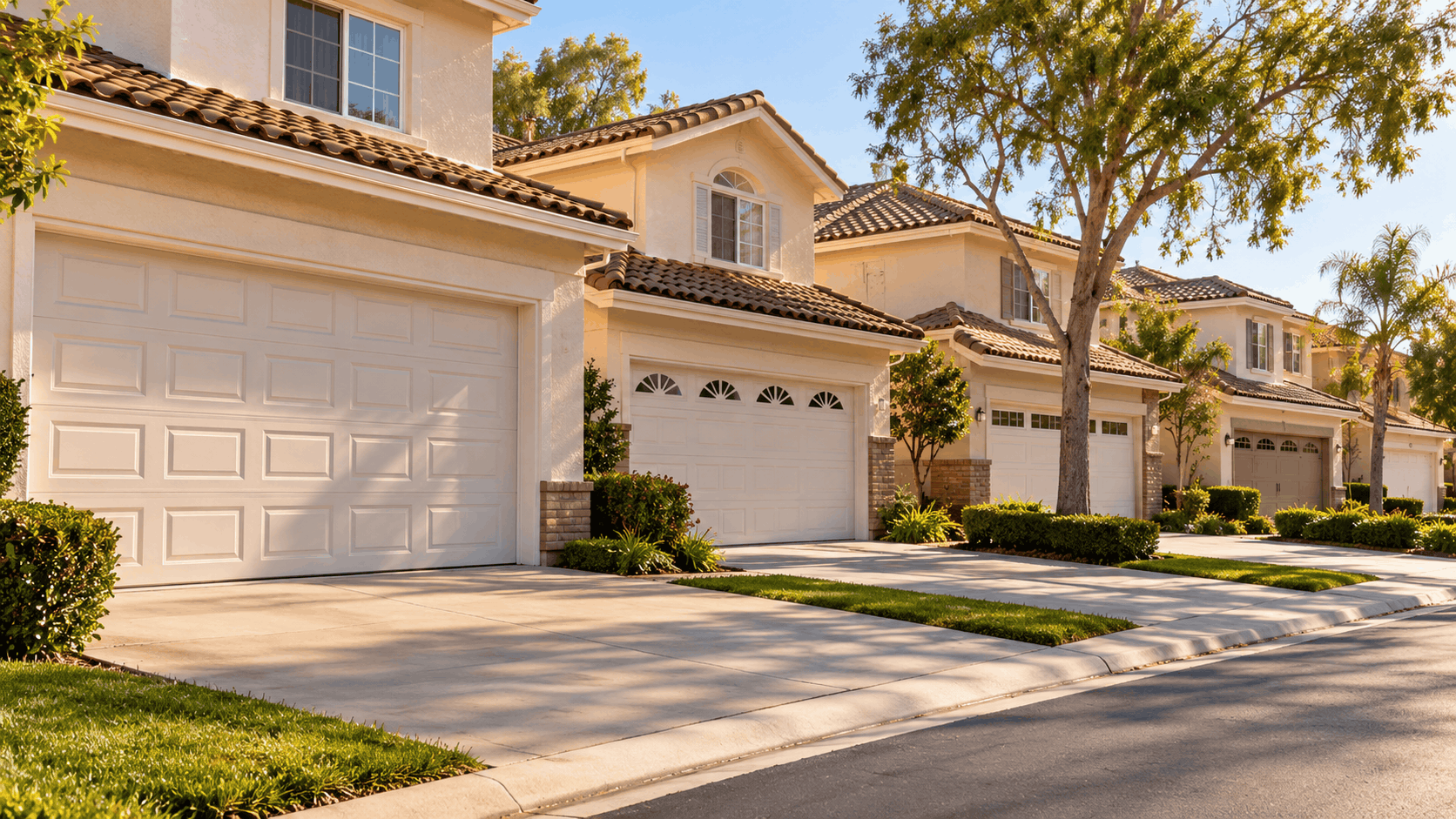
What Garage Door Work Costs in Tustin Ranch by Job
Cost depends on the specific door, the build phase and the condition of the hardware, so the figures below are typical Orange County ranges rather than a quote. They give a reader a sense of what to expect by job type. The actual price for a specific garage is given in writing before work begins.
| Job | Typical Orange County Range |
|---|---|
| Torsion spring replacement | $150 to $300 |
| Cable repair | $150 to $300 |
| Opener installation | $250 to $600 |
| Battery backup installation | $200 to $400 |
| Sectional door replacement | $800 to $2,500 |
| Panel replacement | $250 to $800 per panel |
Springs, Cables and Common Repairs
Spring and cable work is the most common job on Tustin Ranch's older doors because so many original parts are past their cycle rating. Typical Orange County ranges run as follows: torsion spring replacement $150 to $300; extension spring replacement $150 to $250; spring conversion $150 to $350; and cable repair $150 to $300.
Other common repairs fall in similar bands. Off-track door repair runs $125 to $275, which comes up on debris-heavy streets where the door has jumped its track. Safety sensor alignment and repair runs $75 to $150, the fix for a blocked or knocked-out photo eye. Door balancing and tension adjustment runs $75 to $150.
These are typical ranges, not a quote, and the real figure depends on the door. A corroded cable on a lakeside home or a heavy estate spring can sit at the upper end of its band. Our spring and cable repair work covers all of these jobs, with the written price given before work starts.
Openers and Battery Backup
Opener work spans a wider range. Typical ranges are: opener installation $250 to $600, with a belt drive costing more than a chain drive; opener repair $75 to $200; smart Wi-Fi opener and MyQ setup $150 to $300; battery backup installation $200 to $400; and keypad and remote programming $45 to $85.
The belt-drive premium ties directly to the two-story upgrade request so common in Tustin Ranch. When a room sits over the garage, the quieter belt drive is worth the difference to many homeowners, so the opener installation lands toward the higher end of its range for that choice.
Battery backup is folded into any compliant replacement opener under SB 969, so on a replacement it is part of the job rather than a separate line a customer declines. A smart Wi-Fi opener and MyQ setup is a common add-on when the opener is being replaced anyway.
New Doors and Panel Replacement
New door ranges vary with material and style. Typical ranges are: sectional garage door replacement $800 to $2,500; insulated steel $900 to $2,500; carriage-house $1,200 to $4,500; modern glass $1,800 to $4,500; and custom projects $1,800 to $6,500 and up. Panel replacement runs $250 to $800 per panel.
Panel replacement is the fit for golf-frontage ball damage. When a stray ball dents or cracks a single section, swapping that panel is usually cheaper than a full door, provided the model is still available. On an estate door fronting the course, the glass-insert sections are the ones most often hit.
Carriage-house and custom ranges suit the Mission Revival estates where the door has to match a high-end elevation. A carriage-house garage door or a custom design and install project is priced to the specific door, and the actual figure is given in writing before work begins.
Need Help in Irvine?
Urgent Garage Doors serves Irvine and all of Orange County.
How Urgent Garage Doors Handles a Tustin Ranch Job
Working on a door in Tustin Ranch starts with the build phase and the specific condition of the hardware, then moves through the estimate, the parts on the truck and the response window. Here is how our team actually runs a job here.
The Visit, the Estimate and the Written Price
Urgent Garage Doors offers a free on-site estimate for new garage door installations. The visit is where the door gets measured, the elevation gets looked at for the right panel profile, and the condition of the existing hardware gets checked. A written price is available before work begins, and for a home improvement contract over $500 that written contract is a legal requirement in any case.
Removing and hauling away the old door is included in a new door installation. The homeowner does not have to arrange separate disposal of the old sections. That is part of the installation rather than an extra line.
For maintenance work, each preventive maintenance visit includes a written report of what was found and what is recommended. On a thirty-year-old Tustin Ranch door, that report is where worn cables, corroding springs and misaligned sensors get flagged before they fail. Our preventive maintenance plan covers that written walkthrough of the door's condition.
Truck Stock and Same-Visit Spring Replacement
Our trucks carry common torsion spring sizes, so a spring replacement is often completed on the same visit. That matters in Tustin Ranch, where whole tracts of original late-1980s and 1990s springs are past their rating and failures come in clusters. Carrying the common sizes means a failed spring on a standard door usually does not need a second trip.
Heavier estate doors and unusual sizes can need a spring ordered to the door's actual weight, so not every replacement finishes on the first visit. The spring sizing is done to the real load, which is what keeps the door balanced and the hardware inside its rating.
The company works on all garage door brands, including LiftMaster, Chamberlain, Genie, Craftsman, Clopay, Amarr, Wayne Dalton and CHI. That brand coverage matters across a community with twenty years of build phases, where the opener and door brand vary tract by tract.
Response Window and 24/7 Availability
Emergency response is 30 to 60 minutes anywhere in Orange County. The company takes emergency calls 24 hours a day, 7 days a week, every day of the year including holidays. A door stuck open overnight or a spring that failed with the car trapped inside does not have to wait for business hours.
Urgent Garage Doors holds California license #1055150, verifiable free at cslb.ca.gov, where the classification, status, bond and workers compensation are all public record. The storefront is at 76 Ashford, Irvine, CA 92618, a short drive from Tustin Ranch via the 5 and the 261.
Whether the job is a failed spring on a 1989 street or a new carriage-house door on a golf course estate, the work starts with a look at the specific door and the build phase behind it. Our 24/7 emergency repair service covers the urgent calls across the community.
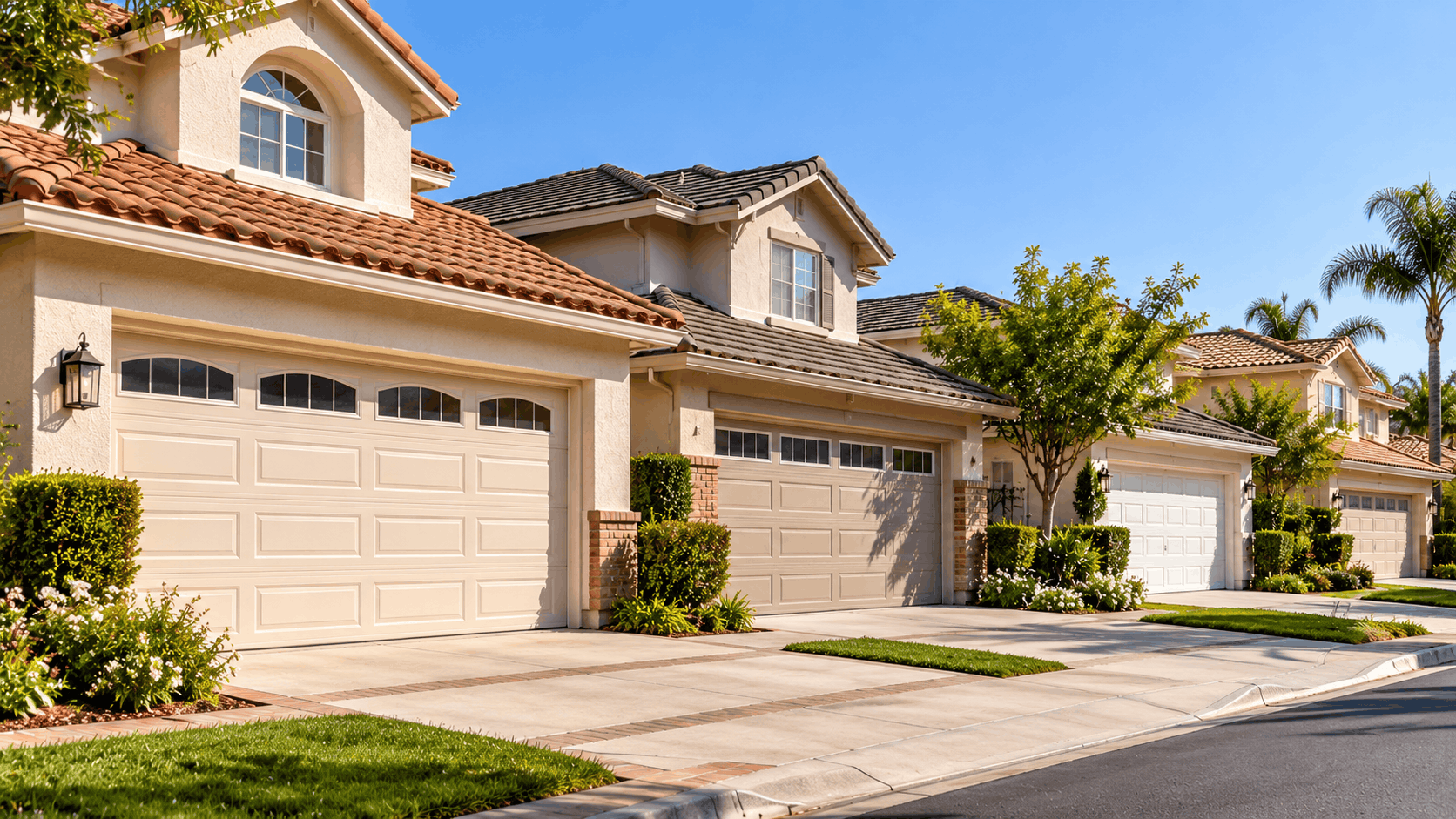
Get Your Tustin Ranch Door Checked by Phase
Whether the home sits on a 1988 street with an opener that may predate photo eyes, or a larger tract with a heavy three-car door, the work starts with a look at the specific door and a written price before any tools come out. Call Urgent Garage Doors at (949) 529-7743 to schedule a visit or a free on-site estimate for a new door. Our team covers Tustin Ranch from the Irvine storefront, 24 hours a day, every day of the year.
Frequently Asked Questions
- How do I tell if my Tustin Ranch opener has no photo eyes?
- Openers in 1988 and 1989 Tustin Ranch homes may lack photo eyes, while a newer neighbor's opener has them. Look for small sensors mounted on each side of the opening, no higher than six inches off the floor. Then run two tests: break the beam while the door is closing, and lay a 2x4 flat across the opening. A safe door stops and reverses in both cases.
- Do I need a battery backup if I replace my door in Tustin Ranch?
- Yes. Under SB 969, a replacement residential garage door may not be connected to a non-compliant opener in California. Since July 1, 2019, a replacement opener comes with battery backup whether or not the owner asked for it. The rule is statewide and residential, passed after the 2017 Northern California wildfires, and carries a $1,000 civil penalty for violations.
- Why do my springs keep failing on a thirty-year-old door?
- A standard torsion spring is rated around 10,000 cycles, roughly seven years at four cycles a day. Original springs across the 1990s Tustin Ranch tracts are well past that rating, so failure is the expected end of a metal fatigue curve. Cables, drums and rollers wear alongside the springs and should be inspected together, because replacing one worn part leaves the others ready to fail next.
- Do I need HOA approval for a new garage door in Tustin Ranch?
- Most Tustin Ranch associations treat a street-facing door as an exterior modification requiring written architectural approval. The San Miguel Community Association is one of several, and the approved palette and submission route depend on the address. Association approval does not substitute for a city building permit, so the two tracks have to be cleared separately where both apply.
- Does a like-for-like door swap need a Tustin building permit?
- Structural work such as widening an opening or altering the header is generally what triggers a permit rather than a like-for-like swap. The position varies by job, so the City of Tustin Planning Division at 714-573-3140 confirms whether a permit applies to a specific project. Permits and inspection requests run through the EnerGov CSS portal.
- How much does a torsion spring replacement cost here?
- The typical Orange County range for torsion spring replacement is $150 to $300. That is a typical range for the area, not a quote, and the real figure depends on the door. A heavy estate spring or a corroded lakeside setup can sit toward the upper end. The actual price for a specific garage is given in writing before work begins.
- Which opener drive is best for a two-story Tustin Ranch home?
- Belt drives are quieter than chain drives, which makes them the usual choice for the two-story Tustin Ranch homes with living space above the garage. The belt reduces the vibration that carries up through the floor into a bedroom or bonus room. Where headroom is limited or storage fills the ceiling, a jackshaft unit that mounts on the wall is the better fit.
- Why do homes near the lakes and golf course see more corrosion?
- The man-made lakes around the Tustin Ranch Golf Club add local humidity for the closest homes. That humidity shows up as corrosion on springs, cables and rollers, and corrosion brings those parts to the end of their cycle rating earlier than on a drier street. Golf-frontage homes also see stray ball damage to panels and glass inserts, which panel replacement usually handles section by section.
- Is garage door work a C-28 license?
- No. Garage door work is licensed under C-61/D-28, Doors, Gates and Activating Devices. C-28 is Lock and Security Equipment and is not the garage door license, and this work does not require a Class B general building license. A license can be verified free at cslb.ca.gov, where the classification, status, bond and workers compensation are all public record. Urgent Garage Doors holds California license #1055150.
- How fast can someone reach my home in Tustin Ranch?
- Urgent Garage Doors responds in 30 to 60 minutes anywhere in Orange County and takes emergency calls 24 hours a day, 7 days a week, including holidays. From the Irvine storefront at 76 Ashford, Tustin Ranch is a short drive via the 5 and the 261. Gated communities may need contractor clearance arranged, which is a scheduling variable on those streets.
Licensed garage door repair professionals serving Irvine and Orange County.
Licensed in California · License #1055150
Why trust Urgent Garage Doors?
Founded in 2017, Urgent Garage Doors is a licensed and insured garage door services serving Irvine and Orange County. All content is reviewed by our licensed technicians.

Need Help in Irvine?
Urgent Garage Doors serves Irvine and all of Orange County.
Related Articles

Insulated Garage Doors in Irvine: Comfort, Noise, and Energy Benefits
Discover how insulated garage doors provide energy savings, noise reduction, and improved comfort for Irvine homeowners in Orange County's climate.
Quail Hill Irvine Garage Door Repair: Common Failures in 2000s Construction
Quail Hill homes built in the 2000s share predictable garage door failures. Learn the common problems with springs, cables, rollers, openers, and panels - and how to fix them.
What Our Tustin Garage Door Calls Show About Old Town, the Ranch and Legacy
What our Tustin garage door calls reveal district by district, from Old Town approvals and North Tustin county permits to high-wear Tustin Ranch springs and the state rules behind every opener swap.