UL 325 Safety Standard for Garage Door Openers: What OC Inspections Check
Key Takeaways
- UL 325 is a manufacturing safety standard requiring garage door openers to detect obstacles and reverse to prevent entrapment.
- All residential openers built after January 1993 must include photo-eye sensors and working auto-reverse.
- The two photo-eye sensors must be mounted no more than six inches off the floor and stay properly aligned.
- Inspectors test both contact reversal with a 2x4 board and non-contact reversal via the infrared beam.
- OC inspections also check the manual release cord, wall control height, warning labels, and grounded wiring.
- Older openers in Irvine villages like University Park and Northwood often predate the standard and need upgrades.
- Coastal moisture, Santa Ana winds, and dust from Great Park construction knock sensors out of alignment over time.
- A yearly professional tune-up plus monthly home reversal tests keep safety features compliant and reliable.
In This Article
A family in Woodbridge called us on a Tuesday morning after their teenage son reported that the garage door came down on his backpack and did not stop. The door had failed to reverse, and everyone in the house was suddenly worried about what could have happened if it had been a younger child or a family pet. That single failed reversal is exactly the kind of problem the UL 325 safety standard was written to prevent.
UL 325 is the safety rule that governs how garage door openers detect obstacles and reverse to avoid trapping people. It shapes every residential opener sold in the United States today, and Orange County inspectors rely on it when they check a door during a permit job or a home sale. For Irvine homeowners, knowing what an inspector looks for can save time, money, and worry.
What the UL 325 Safety Standard Actually Means
UL 325 is a manufacturing safety standard created by Underwriters Laboratories, an independent product safety group. It sets the rules that garage door opener makers must follow so their products protect people from being trapped by a closing door. Every opener you can buy at a hardware store or through an installer today is built to meet this standard.
The heart of the rule is entrapment protection. An opener has to sense when something is in the door's path and reverse before it causes harm. That single requirement changed the entire industry and made the modern garage door opener far safer than the units sold decades ago.
The table below breaks down the core elements of the safety standard in plain terms.
| UL 325 Element | What It Requires | Why It Matters |
|---|---|---|
| Photo-eye sensors | Two sensors near the floor that detect objects in the door path | Stops and reverses the door before contact |
| Auto-reverse force | Door must reverse when it meets resistance | Protects people and pets from crushing force |
| Manual release | A way to open the door by hand during a power loss | Lets people escape or enter safely |
| Warning labels | Clear safety stickers on the unit and near controls | Reminds users of proper safe operation |
A Quick History Behind the Rule
Before the early 1990s, garage door openers had far weaker safety features. Reports of children being pinned or injured by closing doors grew common enough that regulators stepped in. Those tragic cases pushed the industry toward a stronger, mandatory standard.
The 1993 requirement became the turning point. Starting in January of that year, every residential opener manufactured for sale in the United States had to include a secondary entrapment protection system, meaning photo-eye sensors or an edge sensor in addition to the force reversal. This opener history is the reason a modern door reverses when something crosses the beam.
That change did not happen by accident. It came from years of injury data and pressure to make a common household machine safer for families. The result is a standard that quietly protects millions of homes every single day.
Today most homeowners take the safety beam for granted, but it exists because of that hard-won reform. Knowing this history helps explain why inspectors treat these features so seriously.
Which Openers Must Meet UL 325
All residential garage door openers built after January 1993 must comply with UL 325. That means any compliant opener on the market includes the two photo-eye sensors and a working auto-reverse system. If a unit lacks those sensors, it predates the standard or has been tampered with.
Spotting an older non-compliant unit is usually straightforward. Look for the manufacture date on the motor housing label, and check whether there are sensor units mounted near the bottom of each door track. An opener with no floor-level sensors almost certainly does not meet the current rule.
Many homes across Irvine still run on original openers installed when the house was built. In a residential garage door setting, these aging units may still lift and lower the door but fail the entrapment protection tests an inspector runs. That gap between working and safe is where problems appear.
If you are unsure whether your opener complies, our team can check the date code and sensor setup in a few minutes. A quick look often tells us whether a retrofit or a full replacement makes more sense.
How UL 325 Differs From Local Building Codes
UL 325 is a manufacturing standard. It governs how the opener is built before it ever reaches your garage. It does not, by itself, verify that the unit was installed correctly in your home.
Orange County inspections handle the installation side. An inspector checks that a compliant opener was mounted, wired, and adjusted the way the manufacturer and the building code require. So even a brand-new opener can fail an inspection if the sensors are misaligned or the wiring is unsafe.
This is where the building code and the installation standard work together. The product must meet UL 325, and the finished install must meet local rules enforced by the city. Both have to line up for a door to pass.
For Irvine homeowners, that means buying a good opener is only part of the job. Correct setup and safety testing complete the picture, and that is the part inspectors focus on most.
Get Your Free Quote
Tell us about your garage door and we'll get back to you within 30 to 60 minutes.
The Photo-Eye Sensors: The Heart of the Standard
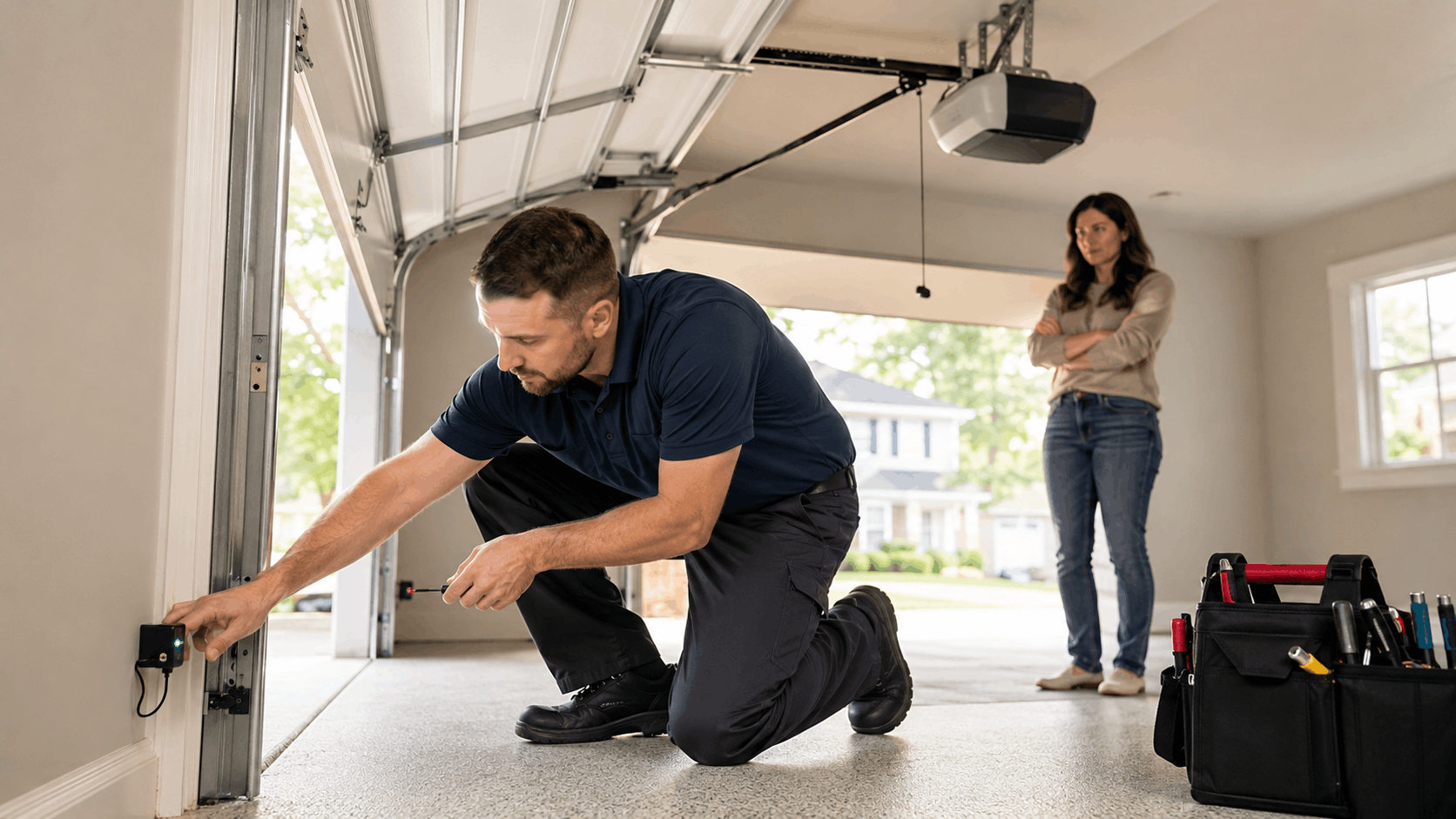
The two photo-eye sensors are the feature inspectors care about most. These small units sit on either side of the door near the floor and send an invisible infrared beam across the opening. When that beam is broken, the door refuses to close or reverses immediately.
Here is why these sensors matter so much during any inspection:
- They provide the non-contact protection required by UL 325
- They stop a closing door before it touches a person, pet, or object
- They are a common point of failure our technicians find in the field
- A misaligned pair is the number one reason a door will not close
How the Infrared Beam Protects Your Family
The safety beam runs a few inches off the ground, right at the height where a small child or a pet is most likely to be. As the door starts to close, the sensors keep watch across the entire opening. If anything crosses that line, the opener knows instantly.
The moment the beam is interrupted, the door stops and reverses back to the open position. This auto reverse function is what saved the Woodbridge family from a much worse outcome once we realigned their sensors. The whole reaction happens in a fraction of a second.
This non-contact protection is different from the force reversal built into the motor. The beam stops the door before contact, not after. That extra layer is exactly what the 1993 rule demanded.
Because the beam is invisible, homeowners often forget it is there until it stops working. A blinking opener light or a door that will not stay down usually points straight back to these sensors.
Correct Sensor Height and Alignment
UL 325 and manufacturer instructions call for the sensors to sit no more than six inches off the floor. This six inch rule keeps the beam low enough to catch a crawling child or a small pet. Mount them higher and the protection gap grows dangerous.
Sensor alignment matters just as much as height. The two eyes must point directly at each other so the beam connects cleanly. Even a slight bump from a trash can or a bike can knock one out of line and break the connection.
When alignment slips, the opener usually signals it with a blinking light on the motor unit. The door may start to close, then roll back up on its own. Homeowners often think the opener is broken when the real fix is a simple realignment.
Our technicians handle this with a quick safety sensor alignment repair that gets the beam locked back in and the door closing normally again. In many cases it takes only a few minutes once the cause is found.
Common Sensor Problems in Irvine Garages
Irvine garages face their own set of sensor headaches. Near the Great Park, ongoing construction and development kick up fine dust that settles on sensor lenses. A blocked sensor cannot send a clean beam, so the door quits closing until the lens is wiped clear.
Morning sun glare is another frequent culprit. Garages that face east catch direct light that can overwhelm the sensor eye and mimic a broken beam. Homeowners in neighborhoods with wide, open driveways report this more than most.
Loose brackets add to the trouble. Over time the small mounting brackets bend or shift, especially if something bumps them. That is when sensor troubleshooting turns into a hunt for a bracket that has drifted a fraction of an inch.
When we get these calls, we clean the lenses, check the brackets, and confirm the beam is solid before we leave. A little routine attention keeps these problems from returning during an inspection.
Need Help in Irvine?
Urgent Garage Doors serves Irvine and all of Orange County.
Auto-Reverse and Force Settings Inspectors Test
Beyond the sensors, UL 325 requires the door itself to reverse when it meets resistance. This is the second layer of entrapment protection, and inspectors test it directly. The two methods work together so that if one fails, the other still protects the family.
The first method is the non-contact photo-eye beam covered above. The second is the contact force reversal built into the motor. When the door presses against an object with too much force, it must stop and back off on its own.
The 2x4 Board Test Explained
The classic reversal test uses a simple piece of lumber. An inspector lays a 2x4 board flat on the floor in the center of the door opening. Then they press the button to close the door.
When the bottom of the door hits the board, it should stop and reverse back up within about two seconds. If the door keeps pushing, crushes the board, or stalls without reversing, it fails the 2x4 test. This reversal test is one of the quickest ways to prove the force settings are safe.
Homeowners can run this same check at home with any scrap board about that size. It is a fast way to confirm your door protects your family between professional visits. If your door does not reverse cleanly, stop using it and call for service.
We recommend running this test every month. It takes under a minute and gives you a real answer about your opener's safety.
Contact and Non-Contact Reversal
Contact reversal happens when the door physically touches an object, like the 2x4 board, and then backs off. The motor senses the added resistance and reverses to avoid crushing whatever is in the way. This is the force-based half of entrapment protection.
Non-contact reversal is the photo-eye beam doing its job before the door ever touches anything. The door stops and reverses the instant the beam breaks, with no contact at all. This is the preferred first line of defense because nothing gets hit.
UL 325 requires both systems to be present and working on a modern opener. An inspector checks that each one functions on its own. A door that passes the board test but has dead sensors still fails, and the reverse is also true.
Having both layers means a single failure does not leave your family unprotected. That redundancy is the whole point of the standard.
Adjusting Force Limits Safely
Force settings control how much pressure the opener applies before it decides something is in the way. Over time these settings drift. Cold mornings, aging springs, and normal wear all change how much force the door needs to move.
When the force limit drifts too high, the door pushes harder than it should before reversing. When it drifts too low, the door reverses at the slightest resistance and will not close. Both extremes fail an inspection and frustrate the homeowner.
Our team recalibrates the force limit adjustment carefully so the door moves smoothly but still reverses on contact. We never simply crank the force up to force a stubborn door closed, because that defeats the safety feature. Proper opener calibration balances reliable operation with true protection.
If your door has started slamming shut or refusing to close, the force settings are often the reason. Our opener repair and troubleshooting service dials these back into a safe range.
What Orange County Inspectors Look For
An OC inspection covers more than just the sensors and reversal. Inspectors run through a checklist that confirms the whole system is safe and installed to code. In Irvine, this ties directly into the city permitting process for opener and door work.
Here are the main items an Orange County inspector checks during a garage door inspection:
- Working photo-eye sensors mounted at the correct height
- Proper auto-reverse on both contact and non-contact
- A functioning manual release cord
- Wall control placement and warning labels
- A dedicated grounded outlet and safe wiring
Manual Release and Emergency Disconnect
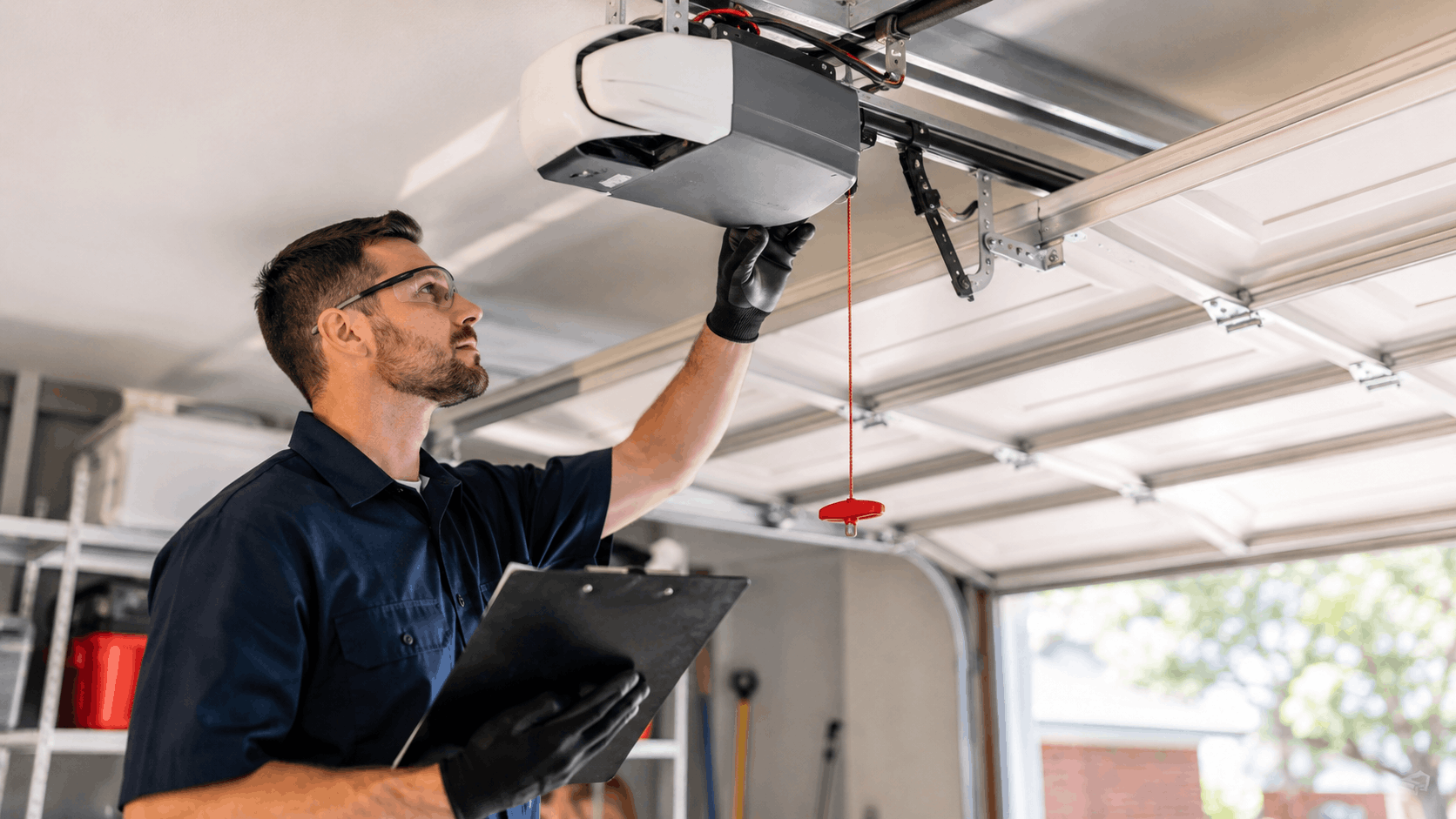
Every opener must have a manual release, usually a red cord hanging from the trolley. This emergency disconnect lets a person open the door by hand when the power is out. Inspectors always test that it works.
During a power outage, a family needs to get their cars out or get into the house. Pulling the red cord disconnects the door from the opener so it can be lifted manually. If that cord is missing, jammed, or disconnected, the inspection fails.
We check the release on every service call because it is simple to overlook. A frayed cord or a stuck trolley can leave a family trapped during an outage. Keeping it in working order is a small step with a big safety payoff.
Test yours by pulling the cord with the door closed and lifting by hand. The door should rise smoothly, and reconnecting should be just as easy.
Wall Control Placement and Warning Labels
The wall control button has to sit at least five feet off the floor. This wall control height rule keeps the button out of a small child's reach so kids cannot operate the door as a toy. Inspectors measure this during a check.
Warning labels are also required. The unit needs the manufacturer's safety stickers, and there should be a warning near the wall control reminding users to keep clear of a moving door. Missing labels are a common and easy failure.
Older homes sometimes have the wall button mounted too low from a past install. We relocate it to the proper height and add any missing labels during our prep work. These are minor fixes that inspectors flag surprisingly often.
Getting these details right ahead of time keeps a simple inspection from turning into a repeat visit. We handle them as part of every setup.
Wiring, Grounding, and Outlet Requirements
Openers need a dedicated grounded outlet, not an extension cord or a shared circuit. Inspectors confirm the unit plugs into a proper three-prong grounded outlet mounted near the motor. Improper wiring is both a code violation and a fire risk.
Older Turtle Rock homes often show wiring issues from decades of small changes. We frequently find openers powered through extension cords or outlets that were never grounded. That kind of setup fails inspection every time.
Our technicians check the opener wiring, the outlet, and the ground connection during prep. If a home in Turtle Rock needs an outlet upgrade, we point the homeowner toward the right electrical fix before the inspector arrives. Catching this early avoids a failed inspection.
Safe wiring protects more than the inspection result. It reduces fire risk and keeps the opener running reliably for years.
How Inspections Fit Irvine Permits and Home Sales
An inspection is usually triggered by one of two events. The first is a new opener install or a major door replacement that requires an Irvine permit. The second is a point of sale inspection when a home changes hands.
When you pull a permit for opener work, the city expects a final inspection to confirm the install meets code. Skipping this step can create headaches later when you try to sell. It is far easier to do it right the first time.
During a home sale in neighborhoods like Woodbridge or University Park, a buyer's inspector often flags a non-compliant opener. That can delay closing or force a last-minute repair. Handling it before listing keeps the sale on track.
Our team helps Irvine homeowners on both fronts, whether it is a fresh garage door opener installation that needs to pass or a point of sale check that came back with issues. We make sure the door meets the standard before the inspector signs off.
Need Help in Irvine?
Urgent Garage Doors serves Irvine and all of Orange County.
Older Openers That Fail UL 325 in Irvine Homes
Irvine has villages built across many different decades, and plenty of homes still run their original opener. An old garage door opener that predates 1993 almost never meets the current standard. Identifying these units early saves a homeowner from a failed inspection or a safety scare.
The good news is that a non-compliant opener is easy to spot once you know what to look for. In many cases, an opener replacement is more affordable than owners expect. It also brings modern safety and quieter operation.
Spotting Pre-1993 Units
Start with the manufacture date on the motor housing. Most openers carry a label with a date code or year of production. If it reads before 1993, the unit was built before the entrapment rule took effect.
The clearest sign is the absence of photo-eye sensors. Look at the bottom of each door track for the small sensor units. If there are no sensors near the floor, the opener cannot provide the non-contact protection UL 325 requires.
Opener age also shows in the remote and wall control. Very old units use large boxy remotes and simple single-button wall switches with no safety labels. These clues together confirm you are looking at a pre-standard opener.
If you find one of these units, it is worth having it checked. We can confirm the manufacture date and tell you whether it can be safely retrofitted or should be replaced.
Homes in University Park and Northwood
Established Irvine villages like University Park and Northwood have many original garage door setups. Homes there were built when older openers were standard, and a fair number still have those units running. It is common for us to find Northwood openers that predate the safety rule entirely.
These neighborhoods take pride in well-kept homes, but the opener is often the one part nobody thinks about. It lifts and lowers just fine, so owners assume it is safe. The missing sensors tell a different story.
When we service homes in these villages, we always check the opener date and sensor setup. Upgrading an original University Park unit brings the door up to modern safety and usually makes it much quieter too. Owners are often surprised how much smoother a new opener runs.
If your home in one of these older villages still has its first opener, a quick evaluation is worthwhile. It tells you whether an upgrade is needed before an inspection or a sale.
When Repair Is Not Enough
Some older openers can accept an add-on sensor kit, but this opener retrofit is not always the right call. If the motor is worn, the logic board is aging, and parts are hard to find, patching one problem often leads to another. At that point the money is better spent on a new unit.
A good rule of thumb is the cost balance. When a retrofit and needed repairs approach 50 percent of the replacement cost of a modern opener, replacement usually wins. A new unit comes with fresh safety features, a warranty, and quieter belt drive operation.
Replacement cost for a quality residential opener with professional installation typically runs a few hundred dollars, depending on the model and features. Smart Wi-Fi models cost a bit more but add convenience. We walk homeowners through the options honestly.
Our goal is to recommend the choice that actually serves the home, not the most expensive one. Sometimes a repair is fine, and sometimes a fresh install is the smarter spend.
How Our Team Prepares Irvine Doors for Inspection
Getting a door ready for an OC inspection does not have to be stressful. Our garage door service in Irvine includes a full inspection prep that catches problems before an inspector does. We treat the visit like our own pre-test so nothing gets missed.
The table below shows what our inspection prep covers.
| Prep Step | What We Check | Why It Matters |
|---|---|---|
| Sensor test | Beam alignment, lens cleanliness, height | Confirms non-contact reversal works |
| Reversal test | 2x4 board and force settings | Confirms contact reversal is safe |
| Manual release | Red cord and trolley function | Ensures the door opens during outages |
| Wiring check | Grounded outlet and connections | Meets code and reduces fire risk |
| Spring balance | Door balance and tension | Keeps auto-reverse accurate |
Our Pre-Inspection Safety Check
Our pre-inspection safety check runs point by point through everything an inspector reviews. We start with the sensors, confirming the beam is aligned and the height sits within the six inch rule. Then we run the reversal tests to prove both layers of protection work.
From there we move to the manual release, the wall control height, and the warning labels. Each item gets checked against the UL 325 requirements and local code. If something is off, we fix it on the spot when possible.
This safety check gives homeowners a clear picture before the official inspection. There are no surprises when the OC inspector arrives. That preparation is what keeps a first inspection from turning into a second one.
We document what we find and explain any needed repairs in plain language. You always know exactly where the door stands.
Sensor and Spring Adjustments
Two adjustments matter most for a clean auto-reverse: the sensors and the springs. We realign the photo-eyes and clean the lenses so the beam connects without fault. A solid sensor adjustment is often all a door needs to close reliably again.
Spring balance is just as important. When the springs are worn or out of tension, the door weighs on the opener unevenly and throws off the force settings. That can make the reversal test unpredictable.
Our technicians check the spring balance by disconnecting the opener and lifting the door by hand. A balanced door stays put at the halfway point. If it drops or springs up, we adjust or replace the springs with a proper door balancing and tension adjustment.
Getting both the sensors and springs right means the auto-reverse behaves the same way every time. That consistency is what an inspector wants to see.
Same-Day Service Across Irvine Villages
Inspections and home sales often come with tight deadlines. That is why we offer same-day service across Irvine when scheduling allows. Whether you are in Woodbridge, Quail Hill, or Portola Springs, we can usually reach you quickly for last-minute inspection prep.
We know these villages well and route our trucks to cut down on travel time. A call in the morning can often turn into a completed prep visit the same afternoon. That speed matters when an inspector or a buyer is on the way.
Our familiarity with Irvine neighborhoods lets us anticipate common issues before we even arrive. Woodbridge homes near the lakes deal with different conditions than newer builds in Portola Springs. We come prepared for both.
If you need help fast, our same-day garage door repair team is ready to get your door inspection-ready without delay.
Need Help in Irvine?
Urgent Garage Doors serves Irvine and all of Orange County.
Seasonal and Climate Factors That Affect Compliance
Irvine's climate is mild, but it still wears down opener safety features over time. Regular opener maintenance keeps the sensors, springs, and force settings within the safe range the standard demands. A little upkeep prevents the kind of climate wear that leads to a failed test.
Understanding the local conditions helps homeowners plan their garage door upkeep at the right times. The two biggest local factors are coastal moisture and seasonal winds.
Coastal Moisture and Rusted Components
Irvine sits close enough to the coast that the marine layer drifts inland most mornings. That moist air settles on metal parts and slowly corrodes them. Sensor brackets, wiring connections, and springs all feel the effect over the years.
Rust corrosion on a sensor bracket can shift the alignment just enough to break the beam. Corroded wiring connections cause intermittent faults that are hard to trace. These small problems build up quietly until the door stops closing.
We look for rust during every maintenance visit and treat or replace affected parts. Cleaning connections and protecting brackets keeps the sensors reading true. Catching corrosion early is far cheaper than replacing a rusted-through component later.
Homes closer to the coastal side of the county see this more, but even inland Irvine garages are not immune. Regular checks keep moisture damage from surprising you.
Santa Ana Winds and Debris
The dry Santa Ana winds bring their own trouble. Strong gusts carry dust, leaves, and debris straight into open garages. That grit settles on sensor lenses and packs into the door tracks.
A layer of dust on a sensor eye acts like a blocked sensor, stopping the beam and keeping the door from closing. Sensor debris is one of the more common calls we get after a windy stretch. A quick lens cleaning usually solves it.
Debris in the tracks causes the door to bind and drag. That extra resistance can trip the force settings and cause false reversals. Clearing the tracks restores smooth travel and accurate auto-reverse.
After a strong wind event, it is worth wiping the sensor lenses and glancing at the tracks. A few minutes of attention prevents a door that suddenly refuses to close.
The Best Time of Year for a Tune-Up
The best tune-up schedule catches problems before summer heat stresses the opener motor. We recommend a professional check in late spring, before the hottest months arrive. That timing keeps the motor and springs in good shape for peak use.
Annual maintenance is the baseline for most homes. One professional visit a year, paired with your own monthly reversal test, keeps the safety features working. Homes with older openers or heavy daily use may benefit from a second visit.
A yearly tune-up covers the sensors, springs, force settings, and lubrication all at once. It is the simplest way to stay ahead of both climate wear and inspection requirements. Our preventive maintenance plan makes this easy to keep on schedule.
Setting a regular date, like early spring each year, means the door is always ready. You never have to scramble before an inspection or a sale.
Final Thoughts
UL 325 exists for one reason: to keep families safe from a closing garage door. The photo-eye sensors, the auto-reverse force settings, and the manual release all work together to prevent the kind of failure that scared that Woodbridge family. Knowing what these features do helps every homeowner take their door's safety seriously.
Orange County inspectors check these systems carefully during permit work and home sales, and older openers in villages like University Park and Northwood often need attention to pass. A little preparation goes a long way toward a clean inspection and a safer home.
Our team at Urgent Garage Doors is here to get your Irvine door inspection-ready, whether you need a sensor realignment, a spring adjustment, or a full opener upgrade. Reach out to us today to schedule a pre-inspection safety check and keep your family protected. You can contact our team to book a visit across any Irvine village.
Frequently Asked Questions
- What is the UL 325 safety standard?
- UL 325 is a product safety standard from Underwriters Laboratories that governs how garage door openers protect people. Its main goal is entrapment protection, meaning the door must sense an obstacle and reverse before it can trap or injure someone. Every residential opener built after January 1993 must include photo-eye sensors and a working auto-reverse system. It shapes how every modern opener is built and tested.
- Does my older garage door opener need to meet UL 325?
- Openers made before January 1993 often do not comply with UL 325 because they predate the sensor requirement. If your unit has no photo-eye sensors near the floor, it likely does not meet the standard. These older openers can be a safety risk and often fail an inspection. We usually advise replacement when a retrofit costs close to 50 percent of the price of a new compliant opener.
- How do I test my auto-reverse feature at home?
- Lay a 2x4 board flat on the floor in the center of the door opening. Press the button to close the door and watch what happens when the bottom of the door reaches the board. A safe door will stop and reverse back up within about two seconds. If it keeps pushing or crushes the board, stop using the door and call for service right away.
- Why does my garage door refuse to close?
- A common reason is misaligned or blocked photo-eye sensors. If the beam between the two sensors is broken by dust, glare, or a bumped bracket, the opener will not let the door close. Check that both sensor lenses are clean and pointing at each other. If the opener light is blinking, that is a strong sign the sensors need realignment.
- Do I need a permit to replace my garage door opener in Irvine?
- Opener replacements and major door work in Irvine often require a permit and a final inspection from Orange County. The inspection confirms the install meets code and UL 325 safety requirements. Point of sale checks during a home sale can also trigger a review. Our team can advise on when a permit applies and help make sure the finished work passes.
- How high should the photo-eye sensors be mounted?
- The sensors should sit no more than six inches off the floor. This keeps the safety beam low enough to catch a crawling child or a small pet in the door's path. Mounting them higher creates a dangerous gap in protection. Inspectors check this height, so keeping the sensors at the correct level is part of any proper install.
- How much does an inspection-ready tune-up cost?
- A basic inspection-ready tune-up generally runs in the range of a standard service call, often around one hundred to two hundred dollars depending on what the door needs. Costs rise if springs, sensors, or wiring require repair or replacement. We give a clear estimate before starting any work. A tune-up is far cheaper than a failed inspection or an emergency repair later.
- What happens if my opener fails inspection?
- If your opener fails, the inspector notes the specific issues, such as dead sensors, a bad reversal, or unsafe wiring. You then repair or replace the affected parts and schedule a re-inspection to confirm the fixes. Our team can handle the repairs and get the door ready for the second visit. Preparing ahead of time usually avoids a failure in the first place.
- How often should garage door safety features be checked?
- Test your sensors and the 2x4 reversal at home once a month to confirm both protections work. Schedule a professional safety check once a year to catch wear you cannot see, like drifting force settings or aging springs. Homes with older openers or heavy daily use may benefit from a second yearly visit. Regular checks keep the door safe and compliant.
- Do you offer same-day service in my part of Irvine?
- Yes, we offer same-day service across the major Irvine villages when scheduling allows, including Woodbridge, Quail Hill, Turtle Rock, and Portola Springs. We route our trucks to reach neighborhoods quickly, and a morning call often turns into an afternoon visit. Response times vary with demand, but last-minute inspection prep is one of our specialties. Call us to check availability in your area.
Licensed garage door repair professionals serving Irvine and Orange County.
Licensed in California · License #1055150
Why trust Urgent Garage Doors?
Founded in 2017, Urgent Garage Doors is a licensed and insured garage door services serving Irvine and Orange County. All content is reviewed by our licensed technicians.

Need Help in Irvine?
Urgent Garage Doors serves Irvine and all of Orange County.
Related Articles
Garage Door Failure Modes in Earthquake Country: What Actually Breaks First
A local guide to how garage doors fail during earthquakes near Irvine, what breaks first, and how to prepare your door before the next tremor hits.

Garage Door Safety Sensors: How to Test and Fix Alignment in Your OC Home
Learn how to test and fix garage door safety sensor alignment issues in your Orange County home with this comprehensive guide covering troubleshooting, maintenance, and repair.

Why Anaheim Hills Homes Need Heavy-Duty Garage Door Springs
Discover why Anaheim Hills homes require heavy-duty garage door springs due to extreme temperatures, heavy insulated doors, and unique climate challenges that cause standard springs to fail prematurely.