Alley-Served Garage Doors in Corona del Mar: Clearance, Trash Days and Installation Timing
Key Takeaways
- Almost every Corona del Mar garage opens onto a narrow shared alley, so confirming access and avoiding trash collection days comes before any crew is dispatched.
- Original Flower Streets garages have narrow openings and low headroom, making custom-width doors, low-headroom track kits and jackshaft openers routine rather than exceptions.
- On the oldest cottage doors the panel profiles are discontinued, so a damaged section often means a full door, while rebuilds can usually take a single panel.
- Constant salt air off the harbor entrance brings springs, cables and hardware to the end of their cycle rating earlier; coated hardware and twice-yearly inspection address it.
- Corona del Mar is entirely in the Coastal Zone, so changing the opening size can draw coastal review while a same-size swap is confirmed with the Newport Beach Permit Center at 949-644-3309.
- Garage door work is licensed under C-61/D-28, not C-28; Urgent Garage Doors holds California license #1055150, verifiable free at cslb.ca.gov.
- SB 969 requires battery backup on any residential opener installed in California since July 1 2019, and pre-1993 cottage openers may have no photo eyes at all.
- Urgent Garage Doors offers a free on-site estimate, written price before work begins, included haul-away, stocked springs and 24/7 service with a 30 to 60 minute response window.
In This Article
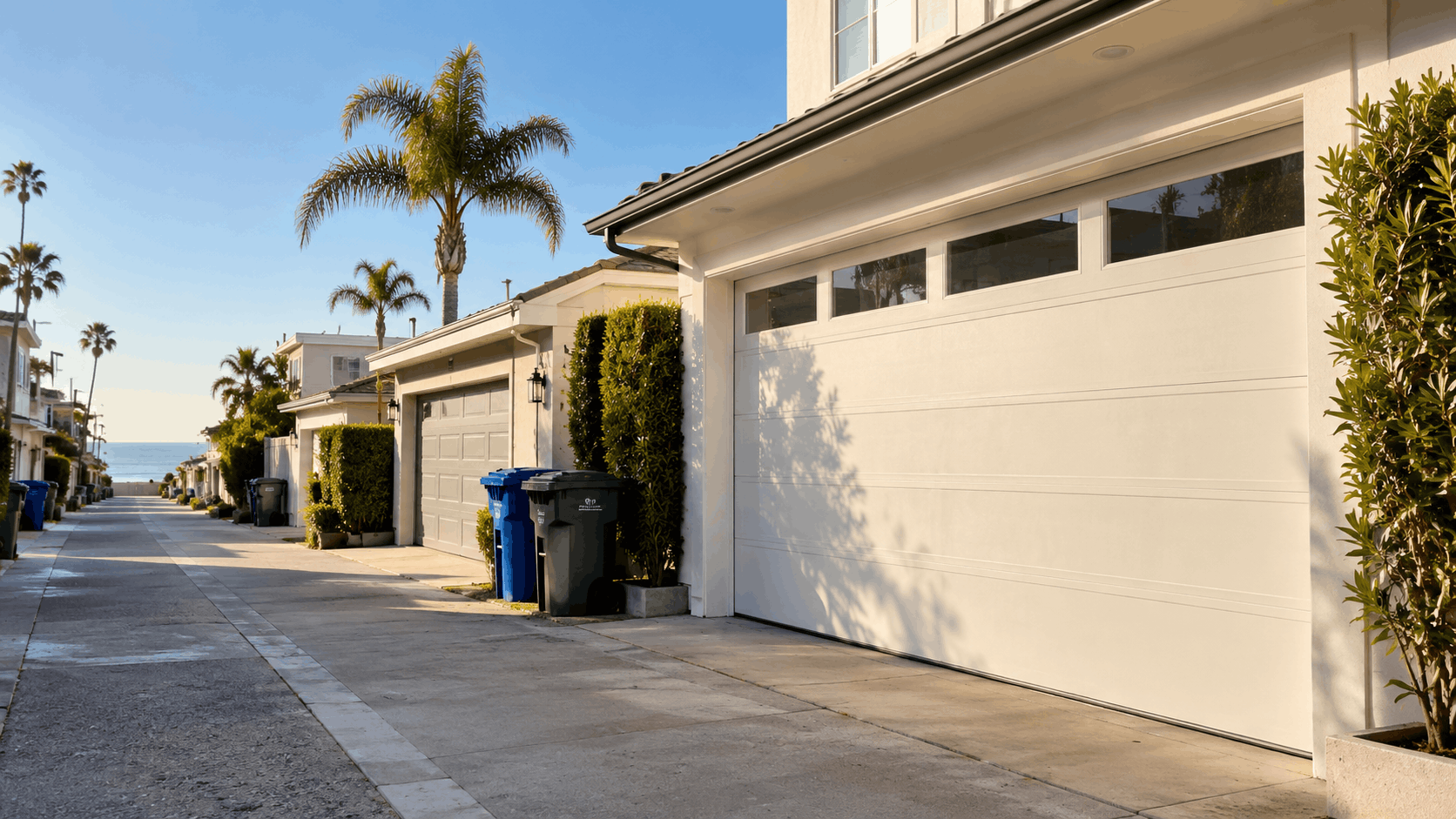
Ask anyone who works the Flower Streets and they will tell you the same thing: the garage door is the easy part. The hard part is the alley. A Corona del Mar garage opens straight onto a narrow shared lane behind the property, with resident cars, delivery vans and a refuse truck all needing the same strip of pavement on the same morning. Park a service vehicle there at the wrong hour and you have blocked three households before anyone has lifted a tool.
That is why a door install here starts with questions a tract neighborhood never asks. How much headroom is inside that cottage garage? Which day does the trash truck run this block? And when can a crew actually hold the alley long enough to pull the old door and set the new one?
Why Corona del Mar Garages Are Different From the Rest of Orange County?
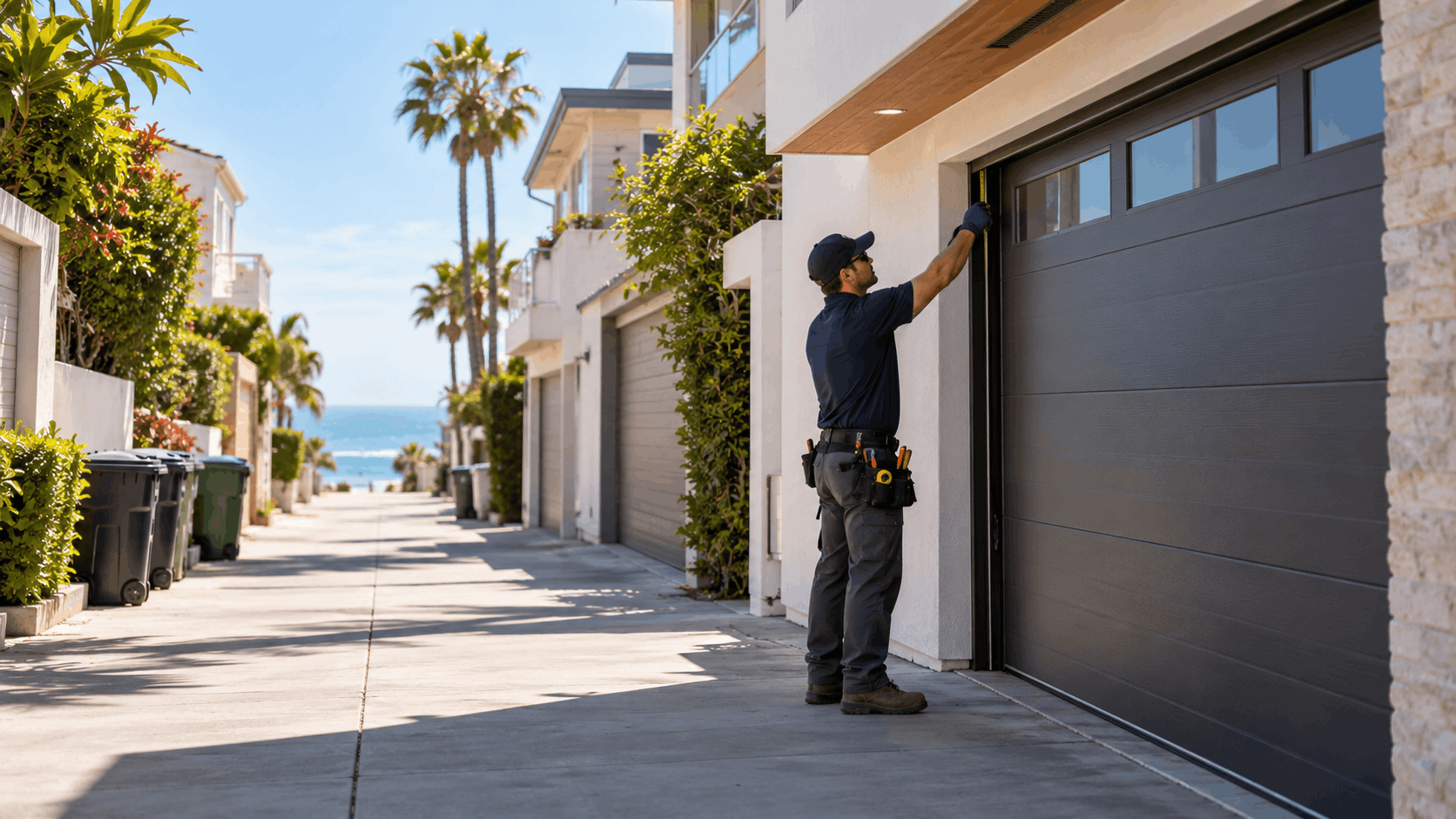
Corona del Mar is the village on the bluff south of Pacific Coast Highway, and it does not look or work like the rest of the county. The lots are small and narrow, the homes sit close together, and almost every garage is reached from an alley behind the property rather than from the street out front. That one fact changes how a door gets measured, ordered and installed.
The housing stock runs the full range. Original 1920s to 1950s cottages sit next to contemporary rebuilds on the very same footprints. A single alley can carry a cottage garage with hardware from another era right beside a rebuilt duplex with a modern opener. No two garages on the block are safe to assume, which is why alley access and a real measurement come before anything is ordered.
The Flower Streets Grid and Alley-Reached Garages
The village is laid out as a compact grid of numbered streets crossed by streets named after flowers. Marigold, Poppy, Orchid, Goldenrod and the rest give the neighborhood its nickname, the Flower Streets. The pattern is tight and regular, which is part of its charm and part of what makes service calls here a logistics problem.
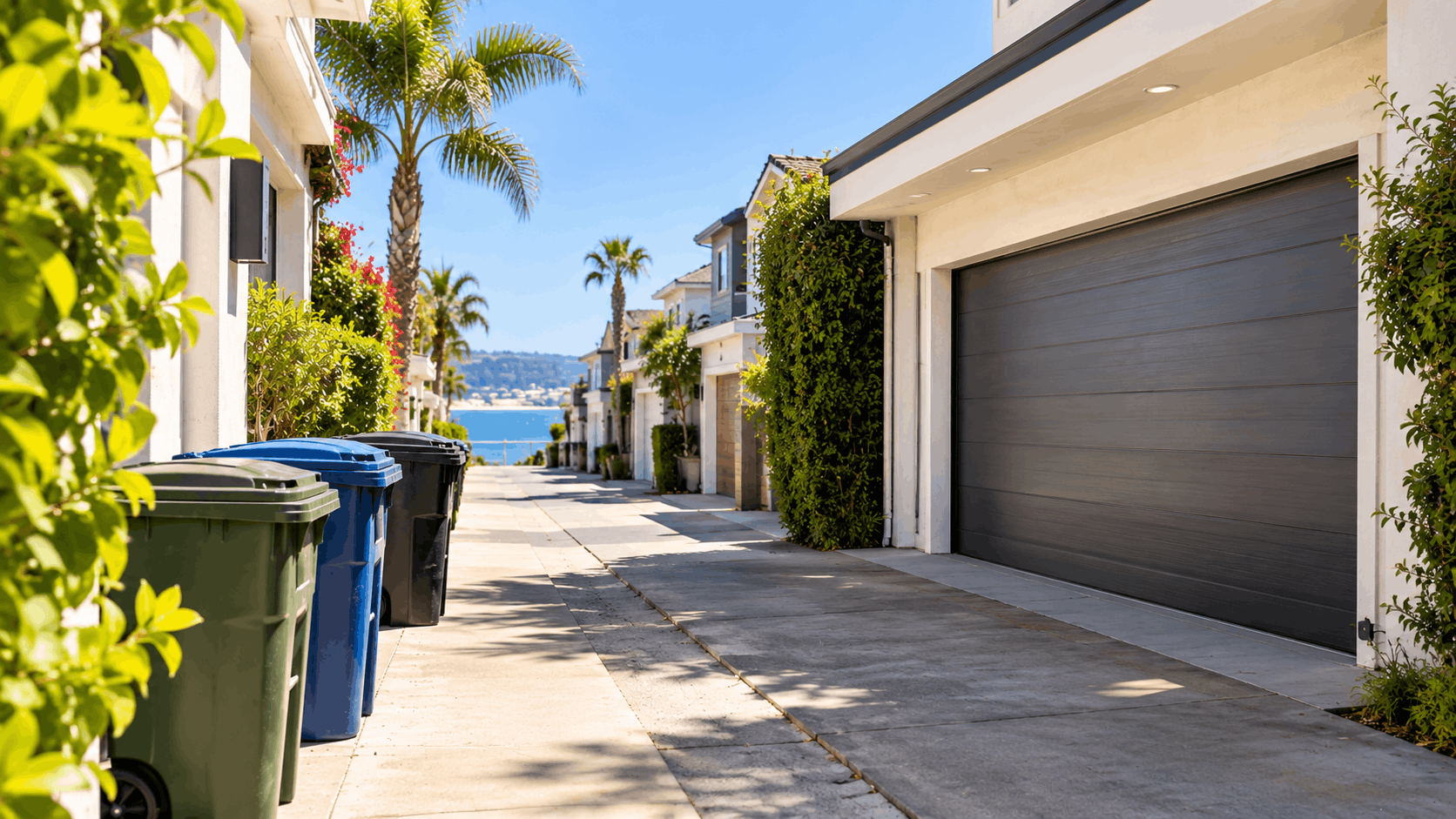
Behind that grid runs a network of alleys, and that is where the garages are. Rather than facing the street, almost every garage opens off the alley at the rear of the lot. The street frontage is the front door and the living space; the working life of the house happens in the lane behind.
For a door crew, this means the install is an alley operation from the first minute. There is no driveway apron to stage sections on and no street-facing opening to work from. The old door comes down and the new one goes up facing a shared lane that other people need to drive through.
Understanding the grid also helps with timing. Material often has to be carried in from the nearest cross street because the alley itself cannot be blocked for long. A crew that knows the village plans the walk-in before the truck ever rolls.
Cottages From the 1920s Next to Modern Rebuilds
The age spread in Corona del Mar is wider than almost anywhere else we work. Some garages date to the original cottage era of the 1920s through the 1950s. Others are contemporary rebuilds raised on the same lot footprint, often within the last decade or two.
That gap shows up in the hardware. A cottage-era garage may still carry an opener that predates modern safety rules, with narrow framing and small openings. A rebuild next door might have a tall wide opening, a modern belt-drive opener and a torsion bar sized for a heavier door.
Because neighboring garages on one alley can be decades apart, nothing transfers from one job to the next. The spring that fit the rebuilt duplex will not match the 1930s cottage two doors down. Each door gets measured, weighed and specified on its own.
This is also where repair gets interesting. On the newer rebuilds, parts are current and a partial fix is often possible. On the oldest doors, the profiles are discontinued, so a single damaged panel can force a full replacement. Establishing which kind of door you have changes the whole conversation.
Duplexes With Two Garages on One Lot
Corona del Mar carries a large share of duplex and income property. A single narrow lot often holds two units with two garages side by side on one alley frontage. That arrangement creates two problems at once.
The first is matching. When an owner replaces one door and wants both to look alike, the second door becomes part of the decision even if it is not being touched. On a visible alley frontage, a mismatched pair stands out, so matching matters to the owner.
The second is access. Work on one garage physically blocks the other, because the two openings share the same stretch of lane. The job has to be sequenced so the second garage is not trapped behind a crew and a half-installed door for hours.
There is also the question of who is calling. On a duplex, the owner may live elsewhere, a long-term tenant may hold one unit and a property manager may handle both. Sorting out who authorizes and who pays belongs at the first call, not on install day.
Get Your Free Quote
Tell us about your garage door and we'll get back to you within 30 to 60 minutes.
Clearance: What Actually Fits in a Flower Street Garage
The physical limits inside an original Corona del Mar garage drive the whole product choice. Narrow openings, low headroom and limited backroom mean the standard tract sizes rarely apply. Measuring is not a formality here; it is the difference between a door that fits and a door that has to go back.
Many of these garages were built for cars far smaller than what people park today. The opening is tight, the ceiling is low, and the space behind the opening where the tracks run is shallow. All three of those limits have standard solutions, but you have to know they apply before you order anything.
Narrow Openings Built for Smaller Cars
Original CdM garages have openings built for the cars of their day, and those cars were small. A door width that is standard in an inland tract neighborhood may be an inch or two too wide for a cottage opening on a numbered street near the beach.
Because of that, custom-width doors are routine here rather than the exception. The door is built to the actual rough opening instead of pulled off a shelf in a stock size. That is normal practice in the village and part of what a real measurement establishes.
This is exactly why on-site measuring matters more here than in a development where every garage is identical. A tape measure held to the opening catches the half-inch that decides whether a stock size works or a custom door build is the right call.
Getting the width right also protects the seal. A door forced into an opening it does not fit leaves gaps at the jambs, and on an alley that catches ocean damp, those gaps let moisture and debris in. The correct width is the first line of defense.
Low Headroom and Backroom Solutions
Low ceilings are the second constraint. Many cottage garages have little room between the top of the opening and the ceiling, which is where a conventional torsion assembly and tracks usually sit. When that space is short, standard hardware does not fit.
The fix is a low-headroom track kit, which reroutes the horizontal tracks and spring to run in a tighter space. It is a standard solution for exactly this situation, not a workaround invented on the spot. A crew that works the village carries this approach as a default option.
Where headroom is really tight, or where storage fills the ceiling, a jackshaft opener mounted at the torsion bar takes the place of a ceiling-mounted unit. Instead of a rail running back across the ceiling, the motor sits on the wall beside the door and drives the torsion bar directly. That clears the overhead space entirely.
Backroom, the depth behind the opening, is the third limit. Short backroom affects how far the tracks can run and which hardware fits. Measuring headroom and backroom together tells the installer which track kit and which opener the garage can actually accept.
Belt Drive for Garages Under Living Space
The contemporary rebuilds change the picture. Many have a garage tucked under a bedroom or other living space, which is common when a small lot is built up for square footage. That overhead living space makes opener noise a real consideration.
A chain-drive opener is reliable but it rattles, and that rattle carries straight up into the room above. A belt drive runs the door on a reinforced belt instead of a chain, which is noticeably quieter. Where someone is sleeping above the garage, that difference matters.
For that reason a belt drive is the sensible default on a rebuild with living space overhead. It is not a luxury add-on; it is matching the opener to the building. A quiet opener installation keeps the early morning door from waking the whole upper floor.
Pairing the belt drive with the right door also helps. A heavier insulated door on a quiet belt runs smoother and softer than a light door on a chain. On a rebuild under a bedroom, the opener and the door are chosen together, not in isolation.
Why Original Panels Often Cannot Be Repaired
Here is a cost distinction worth establishing before anyone talks price. On the oldest CdM doors, the panel profiles are generally discontinued. The manufacturer no longer makes the section, so there is nothing to swap in when one panel is dented or rusted through.
When a single panel cannot be matched, the repair is not a panel; it is a full door. That is a very different number than a panel replacement on a current door, and owners deserve to know which situation they are in before they expect a quick patch.
On the contemporary rebuilds the opposite is usually true. Those doors use current profiles, so a damaged section can often be replaced on its own without touching the rest of the door. Partial repair is frequently possible there.
This is one of the clearest reasons the age of the door matters so much in this village. The same dent means a cheap fix on one garage and a full replacement on the garage next door. Knowing which door you own saves a surprise later.
Need Help in Irvine?
Urgent Garage Doors serves Irvine and all of Orange County.
Trash Days and Alley Timing: Planning the Install Around the Block
The alley is shared and busy, and it does not belong to the garage being worked on. It carries resident vehicles, refuse collection, deliveries and contractors for every property on the block. Because of that, access and timing have to be confirmed before a crew is dispatched, not discovered on arrival.
Refuse collection days are worth avoiding entirely. A service vehicle and a trash truck cannot share one narrow lane, and one of them will lose. Planning the install around the block's collection schedule removes the single most predictable cause of a stalled job.
Why Refuse Collection Days Stall an Install
A service vehicle parked in a CdM alley blocks more than one household at a time. The lane is narrow and there is nowhere to pull aside. Add a refuse truck that needs the same lane to run the block and the whole thing jams.
Collection days are simply the wrong days to stage a door. The truck has a route and a schedule, and it will not wait for a crew that is mid-install with sections laid out across the pavement. That is a standoff nobody wins.
The fix is to know the block's collection day and schedule around it. It sounds small, but it is the difference between a smooth morning and a crew sitting idle while a truck works its way down the lane. Scheduling starts with that one piece of local knowledge.
This is why we treat the collection schedule as part of the job setup, not an afterthought. Confirming the day before dispatch keeps the install on track and keeps the crew from blocking the neighbors who are just trying to get their bins emptied.
Minimal Apron and No Room to Stage a Door
Garages in the village open directly onto the alley with little or no apron. There is no driveway slab out front to lay the old door on or spread the new sections across. The working space is the lane itself, and the lane is not yours to fill.
That lack of staging room changes how the crew moves. Sections cannot be spread out and assembled at leisure, and equipment cannot be parked in a wide arc around the opening. Everything has to be compact and sequenced so the lane stays passable.
Material often has to be carried in from the nearest cross street because the truck cannot sit at the opening the whole time. A new door, the tracks and the opener get walked in rather than unloaded at the door. That walk-in is planned, not improvised.
Knowing this ahead of time keeps the install efficient. A crew that expects no apron brings the right dollies and the right plan for carrying sections in, rather than arriving and realizing there is nowhere to work.
Two Garages, One Frontage: Sequencing Duplex Work
On duplex properties with two garages side by side, the two openings share the same stretch of alley. Work on one garage blocks the other, full stop. There is no way to service both at once without trapping one behind the crew.
That means the job has to be sequenced deliberately. One door is done, the lane is cleared, and then the second is started. If both doors are being replaced, the order and the timing are planned so neither tenant is stuck for an unreasonable stretch.
Both owners or tenants need to be informed before the day. If one unit's resident needs their car out before the crew blocks the frontage, that has to be known in advance. A surprise on install morning turns a smooth sequence into a standoff in the lane.
Matching adds a layer when the owner wants both doors to look alike. Sequencing the work also means the two doors are measured and ordered together so the pair comes out consistent. On a shared frontage, that consistency is what the owner is paying for.
Parking Reality in the Village
Street parking in Corona del Mar is not a backup plan for a work crew. The commercial blocks along Pacific Coast Highway are metered or time-limited, and residential curb space is effectively spoken for by residents and beach visitors. There is no empty stretch waiting for a service truck.
In practice, a CdM job is worked from the alley, not the street. The alley is where the garage is and where the door goes, so that is where the crew sets up. The street is for getting to the alley, not for staging the install.
That is exactly why alley access is the first question and not an afterthought. A crew that assumes it can park on the street and carry a door around to the back has misread the village. The lane behind the house is the whole working area.
Confirming access up front also respects the neighbors. The alley serves every property on the block, and a crew that plans its access and timing keeps disruption to the single garage being worked on rather than the entire lane.
Salt Air Two Blocks From the Sand: What Corrosion Does to Alley Doors
Corona del Mar sits on the bluff above the beach with the ocean on one side and the harbor entrance nearby. Salt-laden humidity is constant, and the alley at the back of the lot catches ocean air and morning damp. That exposure works on the hardware whether anyone notices or not.
Springs, cables, drums, rollers, hinges and fasteners all corrode faster than the same parts inland. Corrosion does not change the math of how a spring is built, but it brings a spring to the end of its cycle rating earlier. The fix is coated hardware and a steady inspection habit, justified here on the mechanics rather than as a sales pitch.
Cables That Fray From the Inside Before They Snap
Lift cables near the water have a particular failure pattern. They corrode from the inside out, so the damage starts in the core where you cannot see it. By the time a strand shows on the outside, the cable is already compromised.
That is why a cable near the harbor entrance frays before it snaps. The outer wires let go one at a time as the inside weakens, and a frayed cable is a warning that the real damage is further along than it looks. Catching it at the fray stage is the whole point of inspection.
This is also why cables get inspected alongside any spring work. Replacing a spring and ignoring the cables is how a second failure follows weeks later, after the first repair felt complete. The two wear together, so they get checked together during cable repair.
A frayed cable is not something to put off on a coastal door. When the core is corroding from the inside, the margin between a visible fray and a clean break is smaller than owners expect. On an alley that catches ocean damp, that margin is worth respecting.
Bottom Sections That Rust Upward From the Slab
On a steel door, the bottom section sits closest to the damp alley surface. That is where rust shows first, and it climbs upward from the base. The bottom of the door is the wettest part and the part that touches the slab, so corrosion starts there.
On an alley-facing door this is especially pronounced. The alley pavement holds morning damp, and the bottom section sits right against it every night. Over time the steel rusts up from the bottom edge, and the lower panel goes before anything above it.
Once the bottom section is rusted through, it is not a cosmetic issue. The structural edge of the door weakens, and on an older door with a discontinued profile, a rusted bottom section can mean the whole door. That brings the repair-versus-replace question back into play.
Spotting bottom rust early gives an owner options. On a newer door, the bottom section can often be addressed on its own. On an original cottage door, early detection is about planning the eventual replacement rather than chasing a part that no longer exists.
Galvanized Hardware and a Twice-Yearly Inspection
Because the salt exposure is constant, the hardware choice matters. Galvanized and coated hardware and stainless fasteners stand up to the damp air better than bare steel. On a bluff two blocks from the sand, that is a mechanical decision, not an upgrade for its own sake.
A twice-yearly inspection cycle is justified here on the same grounds. Springs, drums, rollers, hinges and fasteners all reach their cycle rating earlier when salt air is working on them, so checking them twice a year catches wear before it becomes a failure. The inspection is the early-warning system.
A preventive maintenance visit is where that inspection happens. The parts get looked at, the corrosion gets tracked, and the owner gets a written report of what was found and what is recommended. That report turns a vague worry about salt air into a specific list.
Coated hardware plus a steady inspection habit is the honest answer to coastal corrosion. It does not stop the salt air, but it slows the march and keeps a part from failing without warning. For an alley door that catches ocean damp every morning, that is the right approach.
Springs, Cycles and the Safety Tests You Can Run Yourself
Springs are the heart of how a garage door moves, and they are also the part owners most want to understand. The honest way to talk about spring life is cycles, not years, and the honest way to talk about salt air is that it brings a spring to the end of its cycle rating sooner, not that it halves the life by some made-up number.
There are safe checks an owner can run at home, and there is one job an owner should never touch. Knowing the difference keeps people safe and tells them when to call. Below is how the cycle math works, why springs are professional-only, and the three tests anyone can do.
How Cycle Rating Really Works
A torsion spring is rated in cycles by the manufacturer, where one cycle is one full open and close. A standard residential spring is commonly rated around 10,000 cycles. That number is the honest measure of spring life, far more useful than a vague span of years.
Turn that into real time and it depends entirely on use. A door cycled four times a day reaches 10,000 cycles in roughly seven years. Cycle it more and the spring arrives at the end of its rating sooner; cycle it less and it lasts longer.
In Corona del Mar, an alley garage is often the main way in and out of the house. When the garage is the primary entrance, the door cycles many times a day, and the spring reaches its rating faster than it would on a door used only on weekends. The usage pattern, not the calendar, sets the pace.
Where duty is heavy, high-cycle springs rated above the standard are available. Matching the spring rating to how the door is actually used is how a torsion spring replacement lasts rather than failing early on a hard-working alley door.
Springs Are the One Thing an Owner Must Not Touch
A torsion spring stores a large amount of energy when it is wound. It is held under tension with winding bars against a fixed cone, and that stored energy is enough to cause serious injury if it releases without control. This is not a part to experiment with.
For that reason, owners should never adjust, wind, unwind or replace a torsion spring themselves. The tools and the technique exist for a reason, and a spring that lets go during an amateur attempt can cause real harm. This is firmly a professional-only task.
The danger is the same whether the door is a 1920s cottage original or a modern rebuild. A spring under tension does not care how old the door is. If a spring is broken or sounds like it is failing, the right move is to stop using the door and call a technician.
What an owner can safely do is observe and report. A loud bang from the garage, a door that suddenly feels impossibly heavy, or a visible gap in the spring coil all point to a broken spring. Noting those signs and calling is the safe response, not reaching for a tool.
The 2x4, Photo-Eye and Balance Tests
There are three checks any owner can run safely. The first is the two-by-four auto-reverse test. Lay a flat 2x4 on the floor across the opening in the door's path, then close the door. It must reverse within two seconds of touching the board. If it does not, the force setting or the safety system needs service.
The second is the photo-eye test. With the door closing, break the beam between the two sensors with an object. The door must stop and reverse. Misaligned or blocked photo eyes are the most common cause of a door that reverses for no visible reason, so this check also explains a lot of odd behavior. A quick sensor alignment often clears it.
The third is the balance test. Pull the release cord to disconnect the opener, raise the door by hand to about waist height, and let go. A correctly balanced door stays put. If it falls or rises on its own, that is a spring problem, not an opener problem.
That last point is worth holding onto. Owners often blame the opener when the real issue is spring tension and balance. A door that will not hold position needs spring work, and recognizing that saves chasing the wrong fix.
Need Help in Irvine?
Urgent Garage Doors serves Irvine and all of Orange County.
Coastal Permits, Licensing and the Rules That Touch a CdM Door
Corona del Mar is entirely within the Coastal Zone, and nearly every property in Newport Beach sits inside it. That changes when exterior work needs review. Alongside the coastal layer, there are licensing rules and opener laws that touch a door install, and keeping each rule and date separate matters.
The short version: a like-for-like door swap in the same opening is a different animal from changing the opening size or altering the structure around it. The second is what pulls a project into a longer process. Who confirms it is the city with jurisdiction, for your specific address.
When a Door Draws Coastal Review
Work in the Coastal Zone can require a Coastal Development Permit before or concurrent with a building permit. What triggers that review is work touching exterior walls or openings. A visible exterior change is the kind of work that draws coastal attention in a village built around its established character.
Replacing a door in an existing opening at the same dimensions is a different matter from changing the opening size or altering the structure around it. It is the second that pulls a project into the longer coastal process. The size of the opening is the dividing line.
Owners confirm status with the Newport Beach Address Search Tool, and city staff guide them through the documentation. The city's Local Coastal Program also carries provisions aimed at the village's established character, so an owner planning a visible change should ask the city what applies to their parcel rather than assume.
For questions on a specific address, the Permit Center at 100 Civic Center Drive handles it, and the number is 949-644-3309. The city with jurisdiction confirms the position for the specific job, which is the honest answer for any CdM parcel.
Who Is Licensed to Do the Work
Garage door work in California is licensed by the Contractors State License Board under classification C-61/D-28, Doors, Gates and Activating Devices. That scope covers sectional and rolling doors, torsion and extension spring systems, operators, control boards, safety sensors and activating devices. It is the correct classification for this work.
A common mix-up is worth clearing up. C-28 is Lock and Security Equipment, and it is not the garage door license. Garage door work is also not Class B general building work. If a contractor's classification does not match, that is a flag.
A license can be verified free at cslb.ca.gov, where the license number, classification, status, bond and workers compensation are all public record. Checking takes a minute and tells you exactly who you are hiring.
Urgent Garage Doors holds California license #1055150. An owner, tenant or property manager can look that number up and confirm the classification and status before scheduling. On a coastal property where the work is visible and the stakes are real, that verification is worth doing.
Battery Backup, Auto-Reverse and Pre-1993 Openers
Three separate opener laws touch a CdM door, and they are not the same rule. SB 969, from 2018 and operative July 1 2019, requires every residential automatic garage door opener installed in California on or after that date to have a battery backup designed to operate during a power outage. Since then, a replacement residential door may not be connected to a non-compliant opener. It carries a $1,000 civil penalty and it is statewide, not a fire-zone or local rule.
California required openers to be manufactured with an automatic reverse device and sensor under AB 3600, passed in 1990. The federal entrapment-protection mandate covers openers manufactured for the United States after January 1 1993. Those are different dates for different jurisdictions, and they should not be merged.
What that means for the village is specific. A cottage-era CdM garage may have an opener made before 1993, which predates the federal mandate, so it may have no photo eyes at all. That opener lacks the entrapment protection every modern opener must have.
When an old opener is replaced, the new one comes with battery backup because the law requires it, and modern safety sensors come with it as standard. A battery backup install on a replacement opener is a legal requirement in California, not an optional tier.
The $1,000 Exemption and Who Pays on a Rental
The unlicensed-work exemption in Business and Professions Code section 7048 was raised from $500 to $1,000 by AB 2622, effective January 1 2025. Below that figure in combined labor, materials and other costs, unlicensed work is exempt. Above it, a license is required.
That exemption also fails in two other situations, at any value. It fails if the work requires a building permit of any kind, and it fails if the person employs anyone on the job. A job also cannot be split into sub-$1,000 slices to dodge the rule.
A separate rule is often confused with this one. Business and Professions Code section 7159 requires a written home improvement contract for work over $500. That is a contract requirement, not a licensing threshold, and the two figures should not be merged.
On a Corona del Mar duplex or rental, the person who authorizes and pays may be a landlord, a long-term tenant or a property manager, not the resident making the call. Establishing who authorizes and who pays belongs at the first call, especially where two doors share a frontage and matching matters to the owner.
What a New Alley Door Costs in Corona del Mar
Price depends on the specific garage, and in the village that means the opening, the headroom, the door age and the access. The figures below are typical market ranges for garage door work in Orange County, presented so a reader knows what to expect. They are not a quote or a fixed price from Urgent Garage Doors, and the actual price for a specific garage is given in writing before work begins.
| Job | Typical Orange County Range |
|---|---|
| Sectional garage door replacement | $800 to $2,500 |
| Insulated steel garage door | $900 to $2,500 |
| Carriage-house garage door | $1,200 to $4,500 |
| Modern glass garage door | $1,800 to $4,500 |
| Custom garage door projects | $1,800 to $6,500+ |
| Opener installation | $250 to $600 |
| Battery backup installation | $200 to $400 |
| Torsion spring replacement | $150 to $300 |
| Cable repair | $150 to $300 |
| Off-track door repair | $125 to $275 |
| Panel replacement | $250 to $800 per panel |
New Door Installation Ranges
For a new door, the range depends on the material and style. A sectional garage door replacement typically runs $800 to $2,500, and an insulated steel door runs $900 to $2,500. Those are the common choices for a straightforward alley door.
Styles that suit a rebuilt CdM home sit higher. A carriage-house door runs $1,200 to $4,500, and a modern glass door runs $1,800 to $4,500. Both are popular on contemporary rebuilds where the owner wants the alley frontage to match the architecture.
Custom garage door projects run $1,800 to $6,500 and up. In the village, a custom build is often not a style choice but a fit requirement, because original openings are narrow and off-standard. The custom range is where many cottage-garage doors land.
These are typical area ranges, not a price for your garage. The real number comes from the measurement and the door chosen, which is why an on-site look matters more than a phone estimate on a Flower Streets install.
Opener, Spring and Repair Ranges
On the opener side, an opener installation typically runs $250 to $600, with a belt drive costing more than a chain drive. A battery backup installation runs $200 to $400, and on a replacement opener in California it is part of the job by law rather than an extra.
For spring and cable work, a torsion spring replacement runs $150 to $300 and a cable repair runs $150 to $300. On a coastal door where cables corrode from the inside, the cable inspection that comes with spring work is part of keeping a second failure from following weeks later.
Common repairs have their own ranges. An off-track door repair runs $125 to $275, and that is a frequent call where a roller or track has worn. An off-track repair on a salt-exposed door often ties back to corroded rollers and hardware.
Panel replacement runs $250 to $800 per panel, but only where the panel can be matched. On an original cottage door with a discontinued profile, there is no panel to match, which pushes the job toward a full door and a different line on this table.
What Pushes a CdM Job Higher
Several local factors move the figure on a village install. Custom widths and low-headroom kits are common on original garages, and a custom door built to an off-standard opening costs more than a stock size pulled off a shelf. The fit requirement is a real cost driver here.
Discontinued panels are another. When a single damaged section cannot be matched on an old door, the repair becomes a full door. That turns what an owner hoped was a $250 to $800 panel into a full replacement in one of the new-door ranges above.
Salt-rated hardware adds to the parts cost but earns it back. Galvanized and coated hardware and stainless fasteners stand up to the constant damp air off the harbor entrance, so they belong on a coastal door even though they cost a little more than bare steel.
Access is the quiet cost. When the alley cannot be staged and material has to be carried in from the nearest cross street, and when a duplex frontage has to be sequenced around a second garage, the job takes longer. That labor and logistics reality is part of a CdM install that an inland tract job does not carry.
Need Help in Irvine?
Urgent Garage Doors serves Irvine and all of Orange County.
How Urgent Garage Doors Handles a Corona del Mar Alley Job
Working an alley-served install in the village is as much about logistics as it is about the door. Our approach starts before the truck rolls, with the questions that decide whether the day goes smoothly. From there it moves through an on-site look, a written price and haul-away of the old door.
The method is built around the realities of the Flower Streets: a shared lane, a trash schedule, duplex sequencing and off-standard openings. Getting those sorted up front is what keeps a CdM install from stalling in the alley.
Confirming Alley Access and Who Authorizes the Work
The first call does the heavy lifting. We establish alley access and timing around the block's trash collection day, because a service vehicle and a refuse truck cannot share one narrow lane. Confirming the collection schedule up front removes the most predictable cause of a blocked install.
On a duplex or a rental, we also sort out who authorizes and who pays before any crew is scheduled. The owner may live elsewhere, a long-term tenant may hold a unit, and a property manager may handle the whole property. Knowing who makes the call avoids a day wasted on install morning.
Where two garages share a frontage, we plan the sequence so work on one door does not trap the other. Both owners or tenants are informed before the day, so nobody is surprised to find their car blocked behind a crew. That coordination is part of the job, not an afterthought.
This front-end planning is why access is the first question in the village and not something handled on arrival. A crew that shows up without confirming the lane and the schedule is a crew that ends up idle. We settle it before dispatch.
Free On-Site Estimate and Written Price
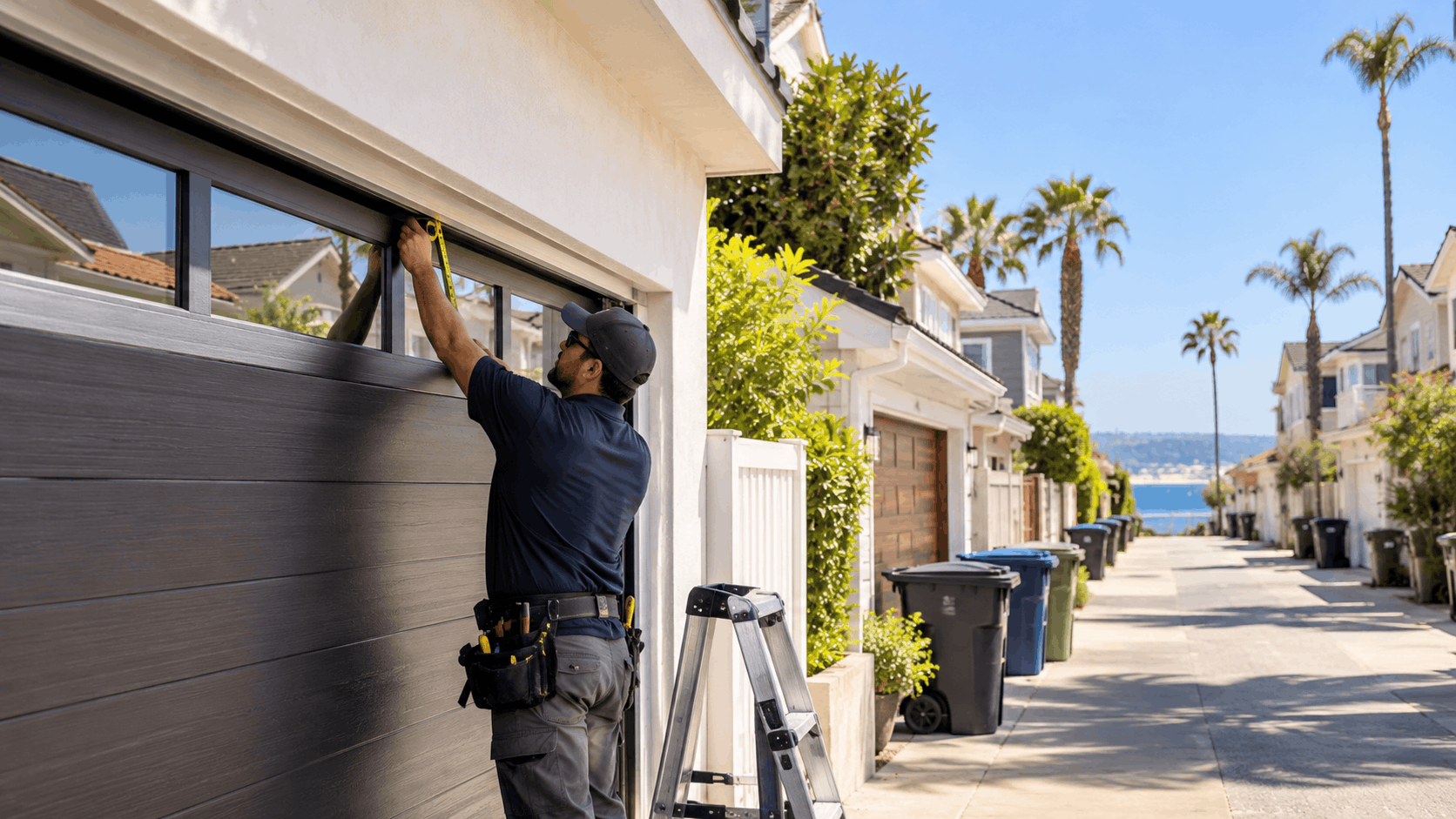
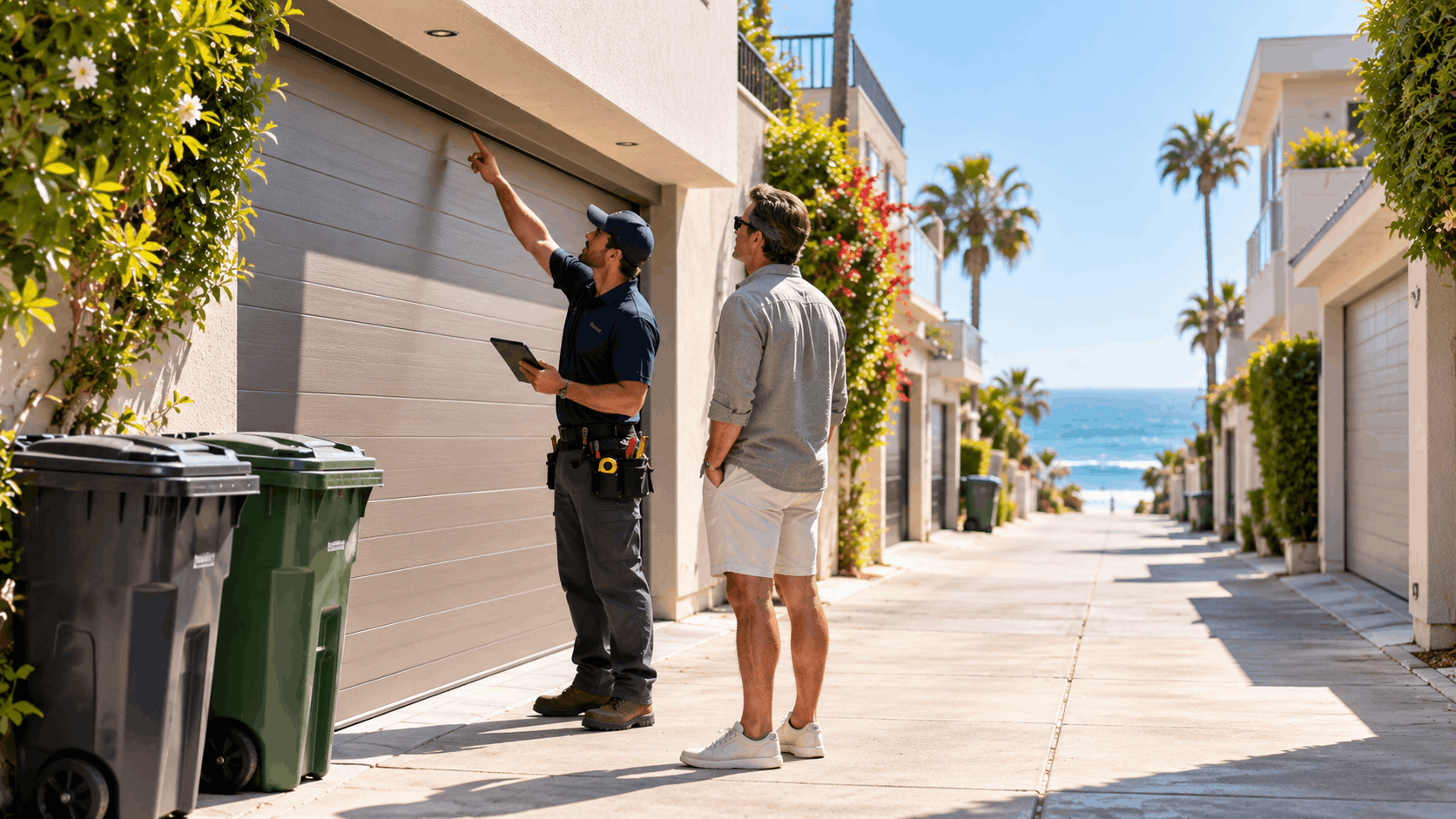
Because measuring matters so much on an off-standard opening, we offer a free on-site estimate for a new garage door installation. The on-site look captures the real opening width, the headroom and the backroom, which is exactly what a phone estimate cannot do on a cottage garage.
That measurement drives the product choice. It tells us whether a stock size fits or a custom width is needed, whether a low-headroom kit or a jackshaft opener is called for, and whether the door is an old profile that cannot be partially repaired. The estimate is where those questions get answered.
A written price is available before work begins, and we provide one when the job calls for it or the customer asks. For a home improvement job over $500, California also requires a written home improvement contract, so the paperwork is part of doing this correctly.
Removing and hauling away the old door is included in a new door installation. On an alley with no apron and nowhere to leave a dismantled door, that matters. The old door leaves with the crew rather than sitting in the lane.
Truck Stock, Same-Visit Springs and 24/7 Response
Our trucks carry common torsion spring sizes, so a spring replacement is often finished the same visit. On a coastal door where a spring has reached its cycle rating early, that means the repair does not always wait for a parts order. It is not a promise on every job, but it is common.
We answer emergency calls 24 hours a day, 7 days a week, every day of the year including holidays. A door that fails on a working alley is not something that can wait, so the line is open when you need it. The confirmed response window is 30 to 60 minutes anywhere in Orange County.
For planned upkeep, each preventive maintenance visit includes a written report of what was found and what is recommended. On a salt-exposed alley door, that report tracks corrosion on the springs, cables, rollers and hardware before any of it becomes a failure. It turns a vague worry into a specific list.
From the Irvine storefront at 76 Ashford, our team covers Corona del Mar and the rest of Orange County. Whether it is a full emergency repair or a scheduled install, the approach is the same: confirm access, measure the opening, price it in writing and get it done.
Getting Your Corona del Mar Alley Door Scheduled
An alley install in the Flower Streets comes down to confirming access and the trash schedule, measuring the real opening, and pricing it in writing before work starts. Our team covers Corona del Mar from the Irvine storefront with 24/7 emergency service and a 30 to 60 minute response across Orange County.
Call Urgent Garage Doors at (949) 529-7743 to book a free on-site estimate for a new door or to get an emergency call rolling. Tell us the alley access and your block, and we will handle the rest.
Frequently Asked Questions
- Do you work from the alley or the street in Corona del Mar?
- From the alley, nearly always. The garage opens onto the alley at the rear of the lot, and the street out front is not a staging area. Residential curb space is spoken for by residents and beach visitors, and the commercial blocks along Pacific Coast Highway are metered or time-limited. Because of that, a CdM job is worked from the alley, and we confirm alley access and timing before a crew is dispatched rather than discovering a blocked lane on arrival.
- Should I avoid scheduling on my trash collection day?
- Yes. A service vehicle and a refuse truck both need the same narrow alley lane, and they cannot share it. A truck working its way down the block will stall an install that has sections laid out across the pavement. We confirm your block's collection day and schedule around it as part of setting up the job, so the install is not caught behind the trash route on the morning the crew arrives.
- Will a standard door fit my original Flower Streets garage?
- Often not. Original CdM garages have narrow openings built for much smaller cars, along with low headroom and limited backroom. Custom-width doors are routine here rather than the exception, and low-headroom track kits or a jackshaft opener mounted at the torsion bar are standard solutions where overhead space is tight. That is exactly why on-site measuring matters so much. A real measurement of the opening, the headroom and the backroom tells us what will actually fit before anything is ordered.
- Can you repair just one panel on an old CdM door?
- It depends on the door's age. On the oldest cottage-era doors, the panel profiles are generally discontinued, so there is no matching section to swap in, and a damaged panel often means a full door replacement. On the contemporary rebuilds, the doors use current profiles, so a single damaged section can frequently be replaced on its own. Establishing which kind of door you have is the first step, because the same dent means a cheap fix on one garage and a full door on another.
- Do I need a permit to replace a garage door in Corona del Mar?
- The city with jurisdiction confirms the position for your specific address, so that is where to check. Corona del Mar is entirely within the Coastal Zone, and work touching exterior walls or openings can draw coastal review and a possible Coastal Development Permit. Replacing a door in the same opening at the same dimensions is different from changing the opening size, and it is the change in size that pulls a project into the longer process. The Newport Beach Permit Center at 100 Civic Center Drive handles it, 949-644-3309.
- Does my new opener have to have a battery backup?
- Yes. Under SB 969, every residential automatic garage door opener installed in California on or after July 1 2019 must have a battery backup designed to operate during a power outage. Since that date, a replacement residential garage door may not be connected to a non-compliant opener, and violations carry a $1,000 civil penalty. It is a statewide legal requirement, not an optional add-on or an upgrade tier. When your old opener is replaced, the new one comes with battery backup because the law requires it.
- My cottage opener has no photo eyes. Is that a problem?
- It means the opener lacks safety protection that modern units must have. Openers made before 1993 predate the federal entrapment-protection mandate for the United States, and a cottage-era CdM garage may have one with no photo eyes at all. California has required openers to be manufactured with an automatic reverse device and sensor under AB 3600 since 1990. An old opener without photo eyes does not meet the entrapment protection every modern opener carries, so replacement rather than repair is the manufacturer position on pre-1993 units.
- Why do cables and bottom sections fail faster near the water here?
- Corona del Mar sits on the bluff above the beach with the harbor entrance nearby, so salt-laden humidity is constant and the alley catches ocean air and morning damp. Cables corrode from the inside out, so they fray before they snap, which is why a frayed cable on a coastal door is a warning the core is already compromised. Steel bottom sections rust upward from the base where they sit closest to the damp alley slab. Coated hardware, stainless fasteners and a twice-yearly inspection address it.
- On a duplex, who schedules and pays for the work?
- It varies, which is why we establish it on the first call. Corona del Mar carries a large share of duplex and income property, so the owner may live elsewhere, a long-term tenant may hold a unit, and a property manager may handle the property. Any of them may be the one who authorizes and who pays. This matters especially where two doors share a frontage and matching the pair matters to the owner, because a decision on one unit can affect both.
- How fast can you get to Corona del Mar for an emergency?
- We answer emergency calls 24 hours a day, 7 days a week, including holidays, and the confirmed response window is 30 to 60 minutes anywhere in Orange County. Common torsion spring sizes ride on our trucks, so a spring replacement is often finished the same visit rather than waiting on a parts order. For an alley door that has failed on a working lane, that combination of a fast response and stocked trucks is what gets the door moving again quickly.
Licensed garage door repair professionals serving Irvine and Orange County.
Licensed in California · License #1055150
Why trust Urgent Garage Doors?
Founded in 2017, Urgent Garage Doors is a licensed and insured garage door services serving Irvine and Orange County. All content is reviewed by our licensed technicians.

Need Help in Irvine?
Urgent Garage Doors serves Irvine and all of Orange County.
Related Articles
Garage Door Cable and Drum Replacement on Heavy Newport Coast Doors
How cable and drum replacement works on heavy Newport Coast estate doors: why coastal hardware fails, warning signs, costs, guard-gate access and the right California license.
Newport Beach and Corona Del Mar: Custom Garage Doors for Ocean-Front Homes
A local guide to custom garage doors for ocean-front homes in Newport Beach and Corona Del Mar, covering coastal materials, styles, salt protection, and HOA rules.
Urgent Garage Doors Service Area Map: Every OC Neighborhood Covered
See every Orange County neighborhood Urgent Garage Doors covers, from Irvine and the coast to north and south OC, plus service details and how to confirm your street.