Garage Door Cable and Drum Replacement on Heavy Newport Coast Doors
Key Takeaways
- Lift cables run from the bottom bracket to grooved drums on the torsion bar, and on heavy custom Newport Coast doors those drums must be sized to the measured door height and weight, not a nominal part.
- Salt-laden marine layer, ridge wind-borne debris and a 25 to 30-year-old build era mean cables and drums here reach the end of their service life and are in a replacement cycle.
- Warning signs include a crooked or off-track door, rust stains and broken strands, slack cable at the bottom bracket, grinding noise and a door that will not hold position in the balance test.
- Cable and drum work is not DIY: the drums sit on a torsion bar under full spring tension, and an owner must never adjust or wind a spring. The only safe owner checks are the 2x4 auto-reverse and photo-eye tests.
- Typical Orange County ranges are cable repair $150 to $300, off-track door repair $125 to $275, torsion spring replacement $150 to $300 and door balancing $75 to $150, with estate doors at the higher end.
- Garage door work is licensed under C-61/D-28, not C-28, verifiable free at cslb.ca.gov; Urgent Garage Doors holds license #1055150.
- Almost every community is guard gated, so the homeowner authorizes the visit ahead; interior cable and drum work is different from the exterior changes that draw Coastal Zone review, and the city confirms any permit position.
- Urgent Garage Doors offers 24/7 emergency service with a 30 to 60 minute response across Orange County and carries common torsion springs on the truck for same-visit repairs.
In This Article
A homeowner on one of the ridge streets above Pacific Coast Highway hears a sharp snap from the garage, walks out, and finds one corner of a heavy custom door sagging while the other side still sits square. A lift cable has frayed through and dropped off its drum. On a standard steel door that is a nuisance. On a four-car motor court garage carrying a solid timber or glass-and-steel door, it is a several-hundred-pound panel hanging on one point of support.
Cables and drums are the quiet half of the lifting system. The springs store the energy, but the cables and drums are what actually carry the weight of the door up and down every cycle. When one fails on an oversized Newport Coast estate door, the whole balance of the door goes with it, and the door can jump the track or jam in the opening.
How Cables and Drums Work on a Heavy Door?
The lifting system on a sectional door is simpler than most owners think, and understanding it makes the failure obvious. The springs do the heavy lifting of storing energy, but the lift cables and the cable drum are what translate that energy into the door actually rising. On a heavy door, every part of that chain is working harder, so a weak link shows itself sooner.
What the Cables and Drums Actually Do
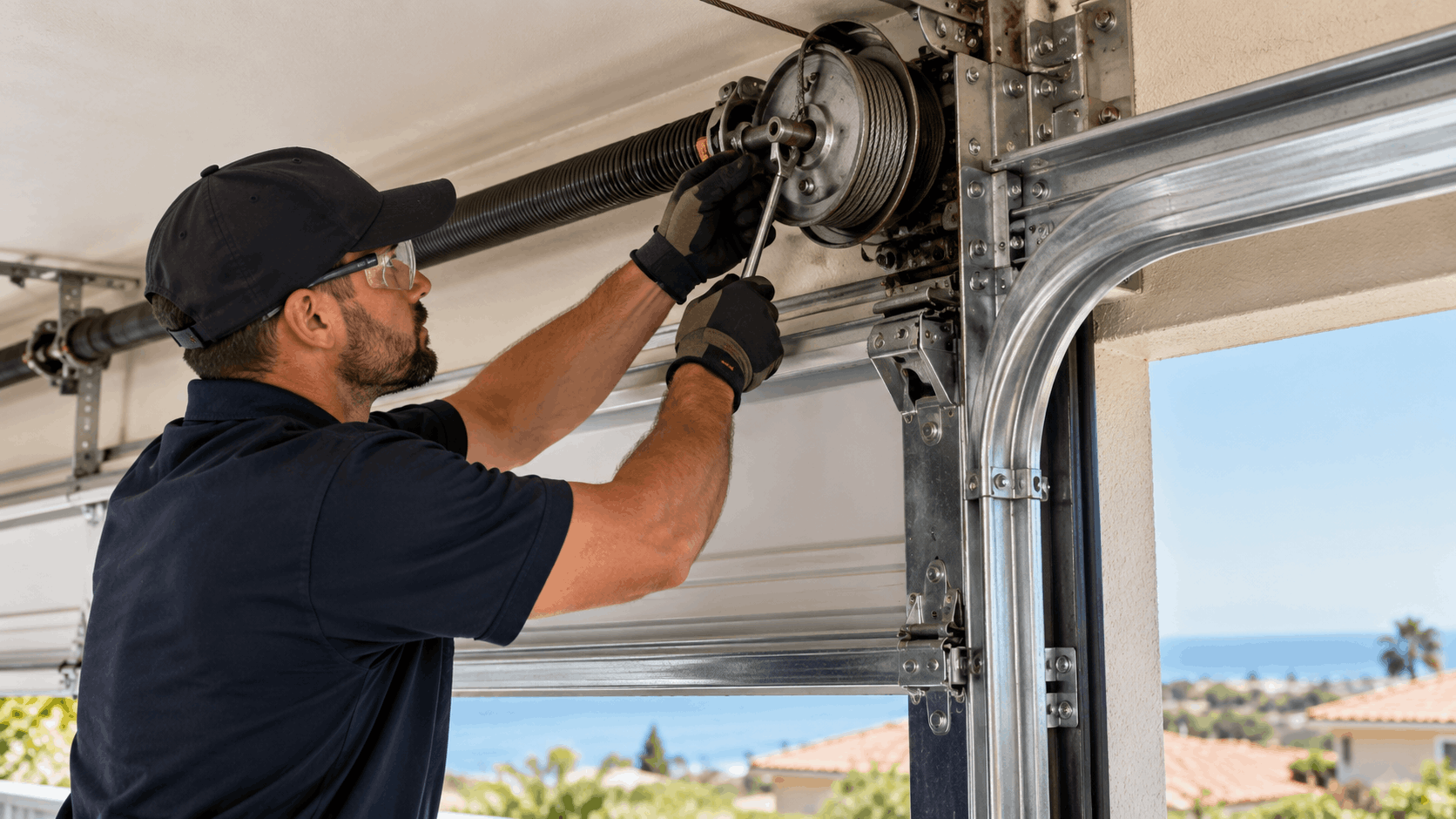
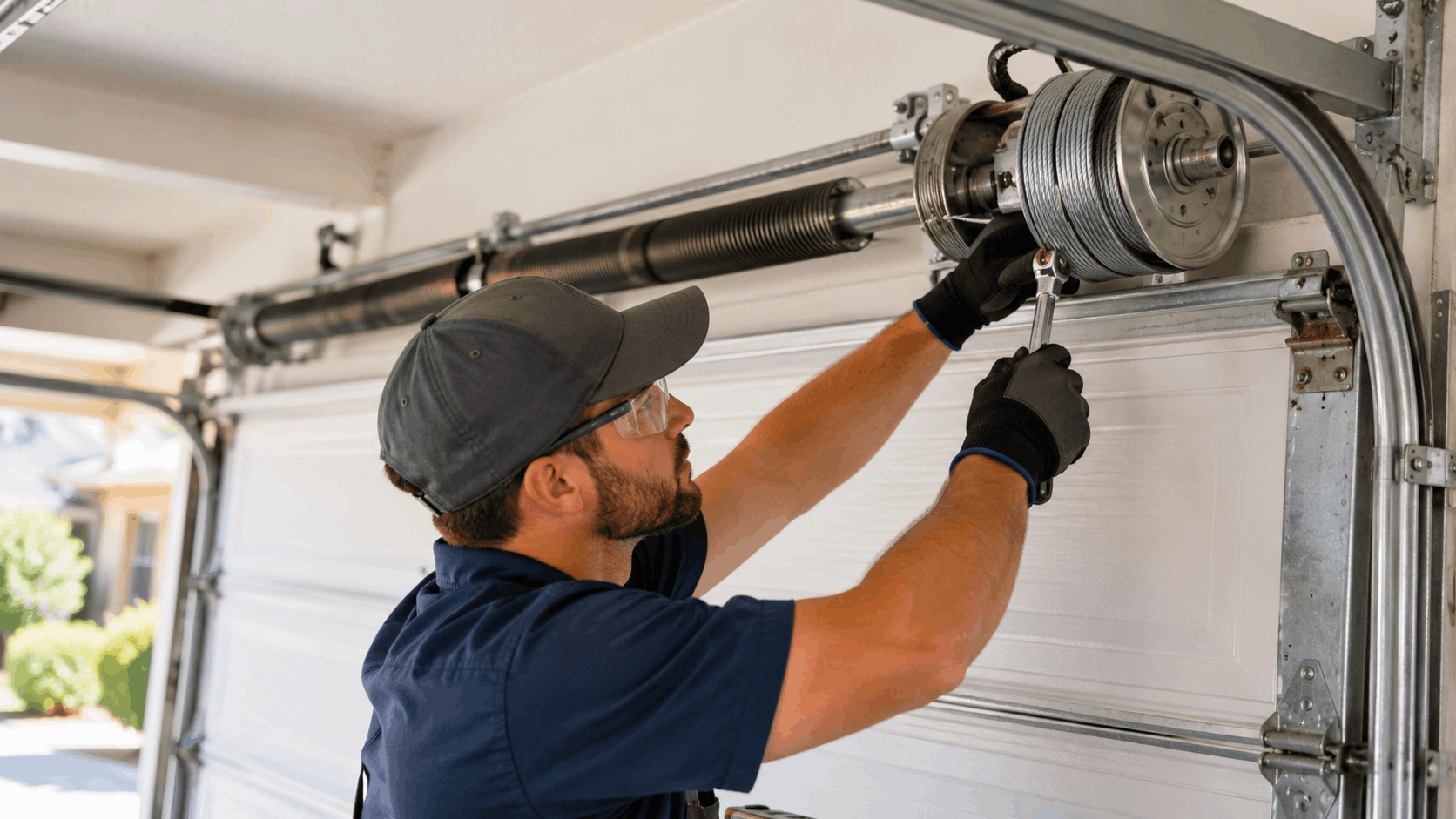
Each lift cable runs from the bottom bracket at the lowest corner of the door up to a grooved drum mounted on the torsion bar. When the springs unwind, they turn the torsion bar, the drums rotate, and the cables wind neatly into the grooves, pulling the door up. When the door closes, the cables feed back out and the springs rewind, storing energy for the next lift.
The load path is straightforward once you picture it. The weight of the door hangs on the bottom brackets, the cables carry that weight up to the drums, and the drums hand it off to the torsion bar and the springs. Every pound of door weight passes through those two thin steel cables, which is why they are stranded wire rather than solid wire, so they flex around the drum without cracking.
Because the bottom bracket is the anchor point for the whole cable, it sits under full spring tension at all times. That is the single most dangerous bolt on a garage door, and it is a big part of why cable work is not a casual repair. A cable that slips the drum or snaps at the bottom bracket releases that load suddenly and unevenly.
On these estate doors the same system is doing far more work. A heavy custom panel means more weight on the cables every single cycle, so the margin for a worn or corroded cable is thinner than it would be on a light builder-grade door.
Why Drum Sizing Matters More on Oversized Doors
Drums are not a one-size part. A standard drum is designed for a standard-height door, and its diameter and groove depth are matched to how many feet of cable it needs to wind. When the opening is taller, as many Newport Coast garages are, the door travels farther, so the drum has to be sized to that travel and that weight.
On tall openings a high-lift drum is often the right answer. These have a tapered or stepped profile so they can wind the extra cable a taller door needs while keeping the door tracking true. Put a standard drum on a tall, heavy door and the geometry is wrong from the first cycle, which strains the cable and the opener.
The classic failure from a mismatched drum is a door that will not hold its position. If the drum diameter is wrong for the weight, the balance the springs were set for never lands correctly, and the door drifts down or creeps up when you stop it partway. That is not the opener's fault and it is not the spring alone, it is the whole system being asked to work against mismatched geometry.
This is exactly why reusing old hardware on a heavier replacement door is a mistake. A door's drums and cables are part of a matched set sized to the door's measured height and weight, and swapping the panel without rematching them leaves the lifting system working outside its design.
Cables and Springs Fail as a System
Cables rarely fail in isolation. The springs, the drums, the end bearings and the cables all live in the same high-stress assembly on the torsion bar, and they all accumulate wear across the same cycles. When a spring reaches the end of its cycle rating and breaks, the cables beside it have seen the same years of service and the same coastal exposure.
Cable fraying often starts long before the spring lets go. A strand breaks, then another, and the cable runs rougher through the drum groove, which accelerates the next strand. By the time a spring snaps, the cables are frequently well into their own decline, which is why a spring-only repair so often leads to a second callout within weeks.
Bearing wear is the other quiet contributor. The end bearings and center bearing let the torsion bar spin freely, and when they dry out or corrode, the bar binds, the drums do not turn cleanly, and the cables take uneven load. A gritty or seized bearing puts extra stress on everything downstream.
The practical lesson is to inspect the full lift system whenever any one part fails. Our team treats a cable, a drum, a spring or a bearing failure as a reason to look at all four, because on a heavy door the cost of a second failure is a dropped panel. You can read more about how these parts work together on our spring and cable repair page.
Get Your Free Quote
Tell us about your garage door and we'll get back to you within 30 to 60 minutes.
Why Cables Fail Faster on the Newport Coast Hillside?
Newport Coast is a specific environment, and the hardware here lives a specific life. The combination of salt-laden marine air, constant ridge wind off the open space, and a housing stock built largely from the 1990s onward means the cables and drums on these doors face conditions that inland garages never see. The result is a hillside where cable and drum work is part of a normal replacement cycle rather than a rare event.
Salt-Laden Marine Layer Reaches the Ridge
The persistent marine layer that rolls in off the ocean does not stop at the shoreline. It carries salt-laden humidity up the hillside to Pelican Hill, Pelican Crest, Crystal Cove and the ridge communities above Pacific Coast Highway. That salt air reaches the hardware inside these garages even at elevation.
Salt humidity is what drives corrosion on steel cable and steel drums. The moisture settles on the strands, the salt holds it there, and oxidation works into the wire. A corroded cable loses strength from the inside and the surface at once, so it reaches the end of its service life earlier than the same cable would inland.
The honest way to frame it is that corrosion brings a cable to the end of its cycle rating sooner. The cable was built for a certain number of open-and-close cycles, and rust eats into that budget. It does not change the physics of the door, it just means the steel gives up before the cycle count alone would predict.
This is why specifying coated or stainless components is worth the money on a coastal property. A better cable and corrosion-resistant drums and hardware stand up to the salt far better than bare steel, which is a real consideration when the door they serve is a custom panel worth protecting.
Ridge Wind, Dust and Canyon Debris
The upper streets of Newport Coast get constant wind. These ridge lots sit against open space and canyon, and the wind carries dust and plant debris off that terrain straight toward the garage openings. Over time that grit works its way into the tracks, the rollers and the drum grooves.
Track debris is more than a cosmetic problem. When grit packs into a drum groove, the cable no longer seats cleanly as it winds. It rides over the debris, wears at an odd angle, and the strands abrade against the grit with every cycle. That is a direct path to premature cable fraying.
The same debris that fouls a drum groove also collects in the tracks and around the rollers, which is how a door starts to bind and track unevenly. A door fighting its way past grit in the tracks puts extra load back through the cables, so the wind-borne debris problem compounds itself across the whole lift system.
Keeping tracks and drum grooves clean is part of why maintenance matters up here, and it is the kind of thing a preventive visit catches before a cable frays through. Our track repair and realignment work often turns up debris-packed grooves on these ridge doors.
A 25 to 30 Year Replacement Cycle
Newport Coast was built largely from the 1990s onward, and the area was annexed to the city of Newport Beach in 2002. That build era is the single most useful fact for predicting hardware failures here. The first generation of cables, drums, rollers and openers went in when these homes were built, and that hardware is now 25 to 30 years old.
Hardware age is a hard limit. A cable or a drum that has cycled daily for a quarter century has done its job, and coastal exposure has been working on it the whole time. This is why Newport Coast reads as a replacement-cycle market rather than a repair-the-original one. The original parts are simply reaching the end of their useful lives together.
What this means for an owner is that a single failure is often a signal about the whole assembly. When one 28-year-old cable frays, its twin on the other side is the same age, the drums are the same age, and the springs are the same age. Replacing just the broken part on hardware this old is a short-term fix.
The upside is predictability. Because the build era is known, the age of the hardware is known, and a thorough inspection can tell an owner whether they are looking at one more season or a full lift-system refresh. That is a far better position than guessing.
Why Estate Doors Load Cables Harder
Custom doors on these view lots are heavy. Solid timber, clad timber, oversized widths, taller openings and glass-and-steel designs all weigh far more than a standard insulated steel door. That weight is not a detail, it is the central fact that shapes how the cables and drums perform.
Every extra pound of door is an extra pound the cables carry on every cycle. On three and four-car motor court garages with multiple heavy doors cycling daily as main-entrance doors, the cables are working hard every day. More load per cycle means the cable uses up its service life faster against the same corrosion and debris conditions.
Engineered springs are the correct partner for these doors. Because the door weight is custom, the springs have to be sized to the actual measured weight rather than a nominal rating, and the cables and drums are matched to that same weight. A door and its lifting hardware are a single engineered package.
Reusing a spring or cable set from a lighter door on a heavier replacement is the mistake that causes premature failure, a door that will not hold position and an overworked opener. The weight has to drive the hardware selection, not the other way around. For truly custom installations, our custom garage door design and install work sizes the whole package to the door.
Need Help in Irvine?
Urgent Garage Doors serves Irvine and all of Orange County.
Warning Signs an Owner Can Spot
Most cable and drum failures give warning before the door comes fully off track. An owner who knows what to look for can catch the problem while it is still a scheduled repair rather than an emergency with a door stuck half-open. The signs fall into three groups: how the door sits, what the cables look like, and what the door sounds and feels like.
| Warning Sign | What It Usually Means | What To Do |
|---|---|---|
| One side hangs lower than the other | Cable slipped off the drum or snapped on one side | Stop using the door, call for service |
| Door jumped the track | Cable failure pulled the door out of alignment | Do not force it, get it inspected |
| Rust stains or broken strands on the cable | Coastal corrosion and fraying near end of life | Schedule replacement before it snaps |
| Slack cable at the bottom bracket | Cable has come off the drum or a spring issue | Keep clear of the door, call a pro |
| Grinding or popping on travel | Worn drum groove or binding hardware | Inspect drums, bearings and cables |
| Door will not hold at waist height | Balance problem, spring or drum | Run the balance test, then call |
The Door Hangs Crooked or Sits Off Track
The most visible sign is a door that hangs crooked. One side drops lower than the other while the opposite corner stays up, giving the door a tilted look in the opening. That uneven door almost always means a cable has slipped the drum or snapped on the low side, so that corner lost its support.
When a cable comes off the drum, the drum keeps turning but the cable is no longer wound onto it, so that side of the door is held by nothing. The weight shifts, the door racks in its tracks, and it can jump the track entirely. An off-track door is both a repair problem and a safety problem.
The important thing for an owner is to stop using the door the moment it looks crooked or jumps the track. Running the opener against an off-track door can bend tracks, damage panels and put more load on the remaining good cable. Forcing it by hand is worse, because a heavy custom panel that is only half-supported can drop.
If the door has come off track, our off-track garage door repair service handles exactly this, resetting the door and finding the cable or drum that caused it.
Fraying, Rust and a Loose Cable
On a coastal property the cables themselves tell the story if you look. Rust stains streaking down from where the cable runs are an early sign the steel is corroding. Those stains mean salt and moisture have been working on the wire, and the strength is going whether or not the cable has broken yet.
Broken strands are the next stage. A healthy cable is smooth stranded wire, but a failing one develops frayed whiskers of broken strands sticking out along its length. You can often see this near the bottom bracket or where the cable passes over the drum, the two highest-stress points. Once strands are breaking, the cable is on a countdown.
Slack cable at the bottom bracket is a serious sign. When the cable goes loose at the bottom while the door is down, it usually means the cable has come off the drum or a spring has lost its tension. Either way the door is not properly supported, and it should not be operated until a professional has looked at it.
These are the classic warning signs on a Newport Coast door, and they are easy to spot with a flashlight while the door is down. What an owner should never do is try to re-seat a loose cable by hand, because the cable sits under spring tension and pulls hard once the door moves.
Grinding, Popping or a Door That Will Not Hold
Sound is a useful diagnostic. A grinding noise as the door travels often comes from a worn drum groove, where the cable is no longer seating cleanly and is dragging against a rough or debris-packed surface. Popping sounds can mean a cable jumping in the groove or a binding bearing on the torsion bar.
A door that will not hold its position is one of the clearest signs of a drum or spring issue. If you stop the door partway and it drifts down or creeps up, the balance is off. On a heavy custom door that drift is more dangerous, because the panel carries real weight if it decides to move on its own.
The safe way to check this is the balance test, and it is one of the few checks an owner can run. Disconnect the opener with the release cord, raise the door to about waist height by hand, and let go. A correctly balanced door stays put. A door that falls or rises has a spring or balance problem, not an opener problem.
If the door fails the balance test, that points to the springs, the drums or the cables rather than the opener, and it is a sign to call before the next cycle. Our door balancing and tension adjustment work starts exactly where that test leaves off.
Why This Is Not a DIY Job
Cable and drum work looks simple from the outside, which is precisely why it hurts people. The drums sit on the torsion bar, the torsion bar is under the full tension of the springs, and that tension does not go away just because the door is down. On a heavy estate door the stakes climb with the weight. This is licensed work for good reason.
Torsion Springs Store Enough Energy to Injure
A torsion spring stores a large amount of energy when it is wound, and it holds that energy whether the door is open or closed. The drums are mounted on the same torsion bar that the springs act on, so there is no way to change a cable or a drum without working right next to a wound spring under full load.
Winding and unwinding a torsion spring is done with steel winding bars against a fixed cone, and it has to be done in careful, controlled increments. A bar that slips, or a cone set screw that lets go, releases the spring's energy suddenly. People lose fingers and take bars to the face doing this without training. It is the single most dangerous part of any garage door.
Because the cable terminates at the bottom bracket, which is also under full tension, even the cable end an owner can reach is loaded. There is no safe point on this assembly for someone without the tools and the training. An owner must never adjust, wind, unwind or attempt to replace a torsion spring.
This is not caution for its own sake. It is the one component on a garage door that is capable of serious injury in the time it takes to make a single mistake, and it stands directly between an owner and the cable they might want to fix.
The Safe Test an Owner Can Run
There are safe checks an owner can and should run, and they do not involve touching a spring or a cable. The first is the auto-reverse test with a flat 2x4. Lay the board flat on the floor in the door's path, run the door down, and confirm it reverses when it contacts the board. That tests the contact-reverse safety.
The second is the photo-eye check. The sensors mounted low on each side of the opening should stop and reverse the door when the beam is broken. With the door closing, break the beam with an object and confirm the door stops and reverses. If it does not, the eyes may be misaligned, blocked or dirty, which is common on these breezy ridge lots.
These two tests tell an owner whether the door's safety systems are working without ever going near the high-tension hardware. They are the right checks to run periodically, and they are the limit of safe owner maintenance on a door like this.
Anything beyond those tests, including the balance test's follow-up, the cables, the drums and the springs, belongs to a technician. If a test fails, the correct next step is a call, not a tool. Our safety sensor alignment and repair service handles the photo-eye side when the beam check fails.
Heavy Custom Doors Raise the Stakes
Everything about the danger scales up on an oversized custom door. A solid timber or clad panel, or a glass-and-steel design, weighs far more than a standard door, and all of that weight is held in balance by the springs, cables and drums working together. Disturb one part incorrectly and the panel can drop.
A mis-sized drum or an untensioned cable on a heavy door does not just leave the door inoperable. It can let a very heavy panel come down fast, which is a hazard to anyone or anything underneath. The weight that makes these doors beautiful is the same weight that makes a botched repair dangerous.
This is why matching hardware to the measured door is not optional on an estate property. The drums have to be sized to the real weight and height, the cables rated to carry that load, and the springs engineered to the panel. Guessing with parts off a lighter door is how a heavy door ends up on the floor.
For owners of these doors, the right frame is simple: the heavier the door, the less room there is for error, and the more the job belongs to a licensed professional with the correct parts on hand. The cost of getting it wrong is measured in the price of a custom panel and the safety of the household.
How the Cable and Drum Replacement Is Done Right
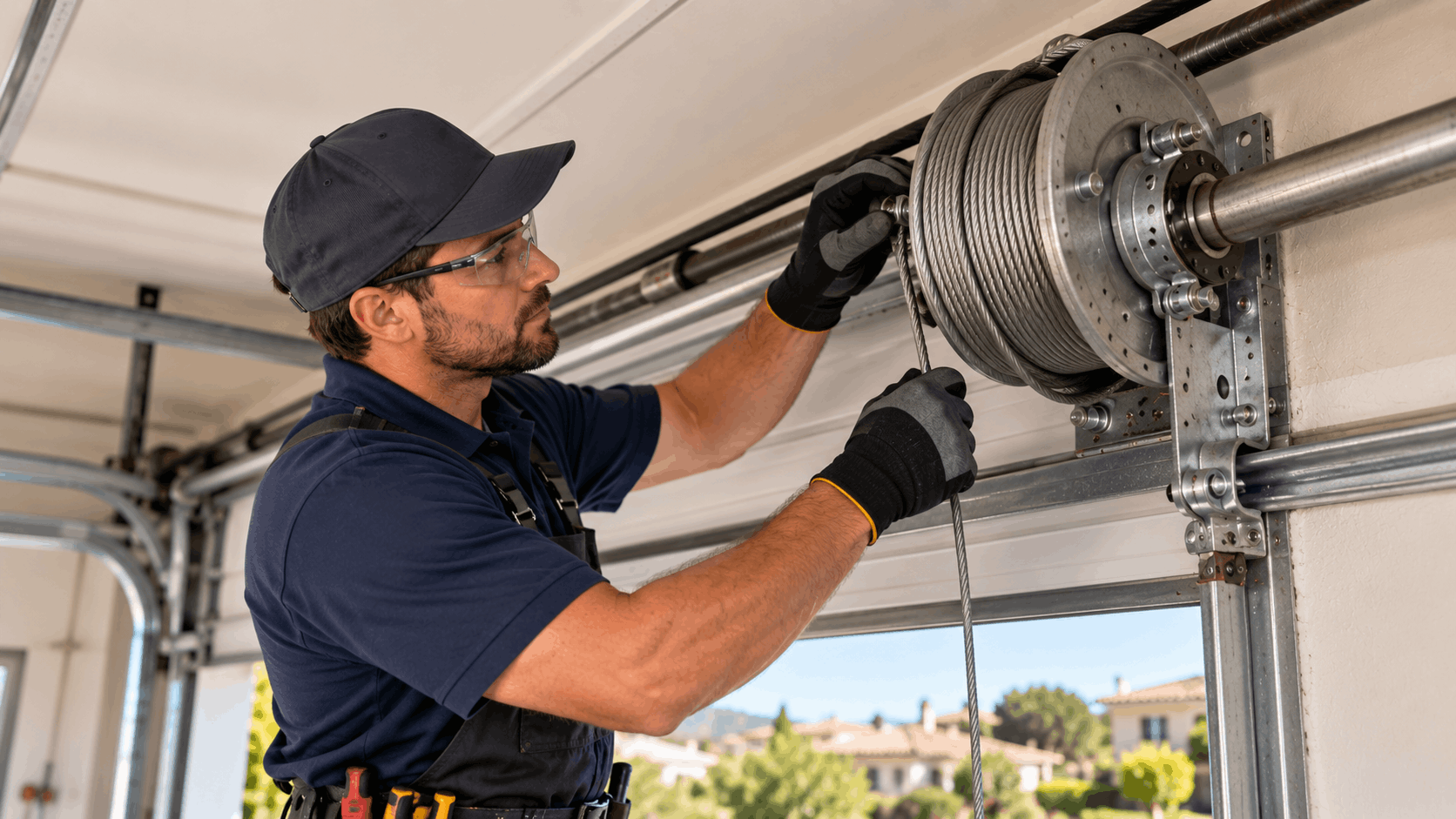
A proper cable and drum replacement on an estate door is a methodical job, not a parts swap. It starts with measuring the actual door, moves through inspecting the whole lift system, and finishes with the door balanced and its safety systems confirmed. Done right, it solves the failure and prevents the next one.
Matching Drums and Cables to the Measured Door
The job begins with the door, not the parts bin. A technician measures the actual height and weighs or calculates the weight of the specific door, because that is what determines the correct drum size and cable rating. On a custom Newport Coast door, those numbers are rarely the same as a catalog standard.
Drums are selected to the door height and weight so the cable winds correctly across the full travel of the opening. On a tall door that often means a high-lift drum profile. The cable is then rated to carry the measured load with margin, so it is not running at the edge of its capacity on every cycle.
Reusing parts from a lighter door is the error that causes repeat failures, and it is avoided here by sizing everything to the door in front of the technician. A heavier replacement door gets a drum and cable set matched to it, never a hand-me-down from the original lighter panel.
This matching step is what separates a lasting repair from a temporary one. When the drums and cables are correct for the measured door, the balance lands, the opener works within its rating, and the hardware lives out its full cycle life instead of fighting the door's geometry.
Inspecting Springs, Rollers, Bearings and Tracks
Because a cable rarely fails alone, the whole lift system gets inspected during the job. The springs are checked for their cycle wear and any sign of fatigue, since a spring the same age as a failed cable is often close behind. Replacing the cable while ignoring a spring at end of cycle just sets up the next callout.
Rollers, bearings and tracks all get looked at too. The end bearings and center bearing are checked for corrosion and binding, because a seized bearing throws load onto the cables and drums. Rollers that are worn or gritty from ridge debris get flagged, and tracks that have collected canyon dust get cleaned and checked for alignment.
On a coastal property the inspection pays special attention to corrosion. Hardware that has taken years of salt air is replaced with coated or stainless components where that helps the door last, because putting bare steel back into the same marine environment just restarts the clock.
This system-wide inspection is the difference between fixing a symptom and fixing the door. It is also what lets a technician give an owner an honest picture of what is sound, what is marginal and what should be replaced now while the assembly is already apart.
Resetting Tension and Balancing the Door
Once the new cables and drums are on, the springs are wound to the correct tension for the door's weight and the door is balanced. Spring tension is set so the door holds position at any point in its travel, which is the goal the whole repair works toward. On a heavy door this tension setting is precise work.
The balance is then confirmed with the door disconnected from the opener. Raised by hand to waist height, a correctly balanced door stays put rather than drifting up or down. That is the same balance test an owner can run, and it is the technician's final proof that the springs, cables and drums are working as a set.
With the balance confirmed, the opener is reconnected and checked under load. A properly balanced door means the opener is lifting a door that is nearly weightless at the top of each pull, so it is not overworked. An opener fighting a poorly balanced door wears out early, so getting the balance right protects the opener too.
This is the step where a mismatched drum or an untensioned cable would reveal itself, and it is why it comes before the job is called done. A door that holds position and an opener that runs easy are the signs the lifting system is correct.
Confirming Safety Sensors and Auto-Reverse
The last step is confirming the safety systems. The photo-eye beam is checked for alignment and the auto-reverse is tested so the door stops and reverses on an obstruction. These are the systems that protect people and pets, and they get verified before the technician leaves.
On west-facing ridge openings there is a known coastal diagnosis worth flagging. Low afternoon sun coming off the ocean can wash out a photo-eye beam, producing a door that reverses for no visible reason at a particular time of day and works perfectly the rest of the time. That is sensor glare, not a failing sensor.
Knowing that pattern saves an owner from replacing good parts. A door that only misbehaves in the late afternoon on a west-facing opening is often fighting glare, and the fix is shielding or repositioning the sensor rather than swapping it. It is the kind of thing that only shows up when you work these openings regularly.
With the auto-reverse confirmed and any glare issue noted, the door is returned to service balanced, quiet and safe. The full job is a lift-system repair, a balance set and a safety check, in that order.
Need Help in Irvine?
Urgent Garage Doors serves Irvine and all of Orange County.
Access, Permits and Rules in Newport Coast
Working in Newport Coast comes with practical hurdles that have nothing to do with the door itself. Almost every community is guard gated, the entire area sits in the Coastal Zone, and the licensing question matters as much here as anywhere. Getting these right is part of the job on this hillside.
Guard Gates and Contractor Check-In
Nearly every community up here is guard gated with contractor check-in. Pelican Hill, Pelican Crest, Crystal Cove and the ridge communities all run access control, so a technician cannot simply arrive at the door. The visit is arranged before the job, not on arrival, and the homeowner usually needs to authorize the visit with the gate ahead of time.
Some associations keep approved vendor lists or require insurance documentation on file before a contractor is admitted. That is worth checking when the appointment is booked, because an unlisted vendor can be turned away at the gate even with the homeowner expecting them. Planning the gate is part of planning the job.
Once inside, the work position is often well in from the street. Long private driveways and motor courts mean the garage can sit a good distance from the entry, and on ridge lots the driveway grade is steep enough to matter for how a vehicle is parked and how material is moved to the door.
None of this is a problem when it is planned for, and our team arranges gate access ahead of time for these communities. You can see our full coverage of this hillside on the Newport Coast service area page.
When the Coastal Zone and Permits Come Into Play
Nearly every property in Newport Beach sits in the Coastal Zone, and that layer sits on top of the city's normal permitting. Work in the Coastal Zone can require a Coastal Development Permit, and the kind of work that draws coastal review is work touching exterior walls or openings, not interior hardware.
Replacing cables and drums inside an existing door is interior lifting hardware. It does not change the exterior opening, the wall or the structure around the door, which is a different matter from changing the opening size or altering the header. A like-for-like hardware repair is not the kind of exterior change that typically draws coastal review.
That said, whether a permit applies to any specific job is decided by the city with jurisdiction over that address, not by a regional rule. Owners can confirm status with the Newport Beach Address Search Tool and city staff, and the Permit Center is at 100 Civic Center Drive, 949-644-3309. Confirm the position for the specific address rather than assuming.
On top of the city process, each gated community runs its own architectural review, and that review governs how the door looks rather than whether a hardware repair is permitted. For a cable and drum job inside an existing door, the association review is generally not the issue.
The Correct License for This Work
Garage door work in California is licensed by the Contractors State License Board under classification C-61/D-28, Doors, Gates and Activating Devices. That classification covers sectional and rolling doors, torsion and extension spring systems, cables, drums, operators, control boards, safety sensors and activating devices. It is the correct license for cable and drum replacement.
A point of confusion worth clearing up: C-28 is Lock and Security Equipment, and it is not the garage door license. Garage door work is also not a job that requires a Class B general building license. The classification to look for is C-61/D-28, and nothing else.
A license is public record and free to verify. Owners can check classification, status, bond and workers compensation at cslb.ca.gov before anyone touches the door. Urgent Garage Doors holds California license #1055150.
The unlicensed-work exemption in Business and Professions Code section 7048 was raised from $500 to $1,000 by AB 2622 effective January 1, 2025, and it also fails if the work requires a building permit of any kind or if the person employs anyone on the job. On a heavy estate door, licensed work is the only sensible choice regardless of the dollar figure.
What Cable and Drum Replacement Costs in Orange County
Owners want a sense of the numbers before they call, which is fair. The figures below are typical market ranges for garage door work in Orange County, presented as ranges for the area and not as a quote from our company. The actual price for a specific door depends on that door and is given in writing before work begins.
| Job | Typical Orange County Range |
|---|---|
| Cable repair | $150 to $300 |
| Off-track door repair | $125 to $275 |
| Track repair and realignment | $125 to $300 |
| Torsion spring replacement | $150 to $300 |
| Door balancing and tension adjustment | $75 to $150 |
Typical Ranges for Cable and Related Repairs
For the core job, cable repair runs a typical $150 to $300 in Orange County. That range covers the common cable work an owner calls about, and it is a market figure for the area rather than a fixed price.
When a cable failure has pulled the door off its track, off-track door repair runs a typical $125 to $275. These two jobs often go together, because a snapped cable is one of the most common reasons a door jumps the track in the first place.
If the tracks themselves need attention, track repair and realignment runs a typical $125 to $300. On these ridge lots, grit and debris in the tracks is a real contributor, so a cable job sometimes turns up tracks that need cleaning and realignment at the same time.
These are the ranges to expect for the related repairs around a cable and drum job. Where a door needs more than one of them, the work is quoted together rather than as separate visits.
Why an Estate Door Can Sit at the Higher End
Estate doors tend to land toward the top of these ranges, and there are concrete reasons why. An oversized or custom door needs drums matched to its height and weight, and a high-lift drum for a tall opening is a more involved part than a standard one. That specification work is part of what the figure reflects.
Coated or stainless hardware for a coastal property costs more than bare steel, and on a custom door that extra corrosion resistance is worth specifying. The parts that stand up to the marine layer are not the cheapest parts, which pushes the figure up relative to an inland builder-grade door.
Access is the other factor. Inside-the-property work on a long motor court driveway, behind a guard gate, with material moved up a steep ridge grade, is simply more involved than a curbside job. None of this inflates the price arbitrarily, it reflects the real work a heavy custom door on this hillside requires.
So an owner of a Pelican Hill or ridge-community door should expect the upper end of these ranges, while a lighter standard door in a flatter setting sits lower. The door and the setting drive the figure.
Spring and Full-System Work Priced Together
Because cables, drums, bearings and springs wear as a system, a cable job on aging hardware often includes spring work. Torsion spring replacement runs a typical $150 to $300, and door balancing and tension adjustment runs a typical $75 to $150. When these are done together with the cables, they are priced as one job rather than separate visits.
Doing the related work at once is usually the better value on 25 to 30-year-old hardware, because it avoids a second callout weeks later when the next tired part fails. A technician who already has the assembly apart can replace the springs and rebalance the door in the same visit.
One legal point to know on the paperwork side: California Business and Professions Code section 7159 requires a written home improvement contract for work over $500. On a full-system job that figure is easily reached, so the written contract is simply the law, not an upsell.
Our torsion spring replacement work is often done alongside cable and drum replacement for exactly this reason. One visit, one balanced door, one written price.
Need Help in Irvine?
Urgent Garage Doors serves Irvine and all of Orange County.
How Urgent Garage Doors Handles Cable and Drum Work
When an owner on the ridge calls about a dropped cable, here is how our team handles it. The process is built around the realities of these heavy doors and this gated hillside: a real diagnosis, a written price when the job calls for it, and parts on the truck so much of the work gets done the same visit.
Diagnosis and a Written Price Before Work Starts
The first thing our team does is inspect the whole lift system, not just the obvious failure. The cables, the drums, the springs, the bearings and the tracks all get looked at, because on hardware this age a single failure usually means the assembly is ready for more. That inspection is what a correct repair is built on.
From that diagnosis the owner gets a clear picture of what failed, what else is marginal, and what the repair involves. A written price is available before work begins when the job calls for it or the customer asks, so an owner knows the number before anyone starts.
On a heavy custom door this upfront step matters. It lets the owner decide whether to do just the cables or address the springs and bearings at the same time, with the facts in front of them rather than after the fact.
Emergency and 24/7 Response Across Newport Coast
A dropped cable on a main-entrance door is an emergency, and we treat it as one. Urgent Garage Doors takes emergency calls and responds 24 hours a day, 7 days a week, every day of the year including holidays. A door stuck open or off track does not wait for business hours.
Response is 30 to 60 minutes anywhere in Orange County, including the ridge communities above Pacific Coast Highway. For guard-gated communities, gate access is arranged ahead of time so the technician is not held at the check-in, which keeps the response window intact.
That combination of 24/7 availability and a fast response window is what an owner wants when a heavy door has failed. Our 24/7 emergency repair service covers exactly this kind of call.
Truck Stock, Brands and the Storefront
Common torsion spring sizes ride on our trucks, so spring work is often completed on the same visit rather than waiting on parts. Cable and drum work on standard sizes is frequently done the same visit too, though truly custom or oversized drum parts for an estate door may vary with the door.
Our team works on all major garage door brands, including LiftMaster, Chamberlain, Genie, Craftsman, Clopay, Amarr, Wayne Dalton and CHI. Whatever is on the ridge-community door, it is hardware our technicians work with regularly.
The storefront is at 76 Ashford, Irvine, CA 92618, and the company has been serving Orange County since 2017. Urgent Garage Doors holds California license #1055150, verifiable free at cslb.ca.gov, and carries the Google Guarantee badge on its Google Local Services listing.
Getting Your Newport Coast Door Back on Track
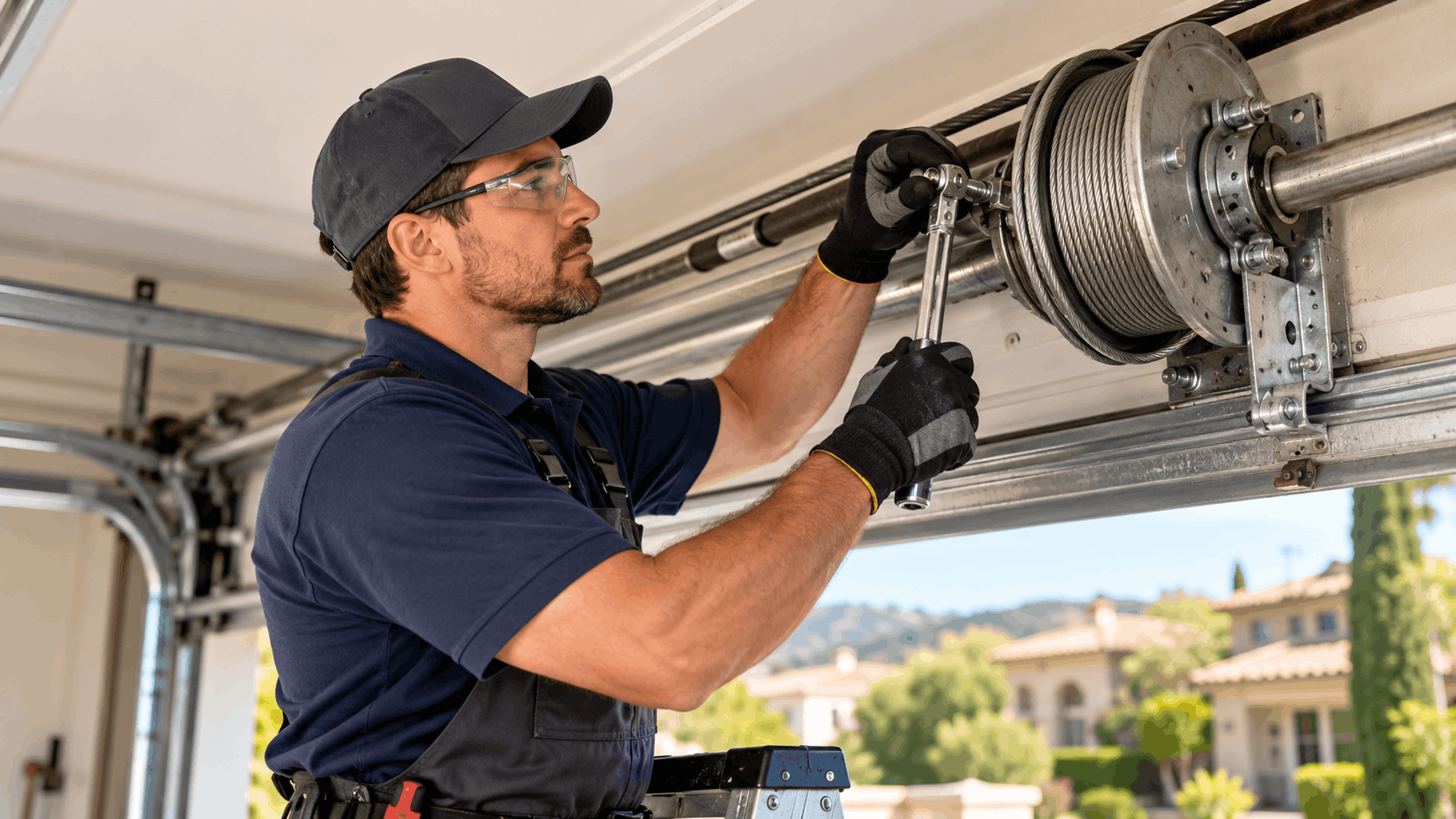
A frayed cable or a worn drum on a heavy ridge door is an emergency worth acting on quickly, and our team inspects the full lift system, gives a written price before work begins when the job calls for it, and carries common torsion spring sizes on the truck so much of the work is done the same visit. Call Urgent Garage Doors at (949) 529-7743 for 24/7 service across Newport Coast and all of Orange County. Have your gate authorization ready so our technician can reach the door without delay.
Frequently Asked Questions
- What causes a garage door cable to snap or fray?
- On the Newport Coast hillside, corrosion from the salt-laden marine layer is a major cause, since salt humidity reaches the ridge and works into the steel strands. Grit and canyon debris packing into a drum groove abrades the cable as it winds. Worn drums and cables that have simply reached the end of their service life finish the job, especially on heavy custom doors cycled daily as main entrances.
- How much does cable and drum replacement cost in Orange County?
- Typical ranges for the area are cable repair at $150 to $300 and off-track door repair at $125 to $275. These are market ranges for Orange County, not a quote. Estate doors on the Newport Coast ridge often sit at the higher end because they need drums matched to the door's height and weight, coated coastal hardware, and inside-the-property access. The actual price for a specific door is given in writing before work begins.
- Can I replace a garage door cable myself?
- No. The cables run under full spring tension on the torsion bar, and the bottom bracket where the cable anchors is loaded at all times. A torsion spring stores enough energy to cause serious injury, so this is not a safe DIY job. The only safe owner checks are the 2x4 auto-reverse test, where the door should reverse on contact, and the photo-eye beam check. Anything involving cables, drums or springs belongs to a licensed technician.
- Why is one side of my garage door hanging lower than the other?
- A cable has usually slipped off the drum or snapped on the low side, so that corner lost its support and the door racked in the tracks. On a heavy custom door this can pull the whole door off track, which is both a repair and a safety problem. Stop using the door and have it inspected before the next cycle, because running the opener against a crooked door can bend tracks and damage panels.
- Do I need a permit to replace cables and drums in Newport Coast?
- Replacing cables and drums inside an existing door is interior hardware, not a change to the exterior opening, so it is different from altering the opening size or structure, which is what draws coastal review in the Coastal Zone. Whether a permit applies to a specific job is decided by the city with jurisdiction over the address. Confirm the position for your address with the Newport Beach Permit Center at 100 Civic Center Drive, 949-644-3309.
- Should the springs be replaced at the same time as the cables?
- Often, yes. Cables, drums, bearings and springs wear as a system across the same cycles and the same coastal exposure, so a spring the same age as a failed cable is frequently close behind. Replacing a cable without checking the springs is how a second failure follows weeks later. On 25 to 30-year-old Newport Coast hardware, inspecting and addressing the whole lift system at once usually makes more sense than a single-part fix.
- Why does my door reverse only in the afternoon?
- On west-facing ridge openings, low afternoon sun off the ocean can wash out the photo-eye beam, producing a door that reverses for no visible reason at a particular time of day and works fine the rest of the time. That is sensor glare, not a failing sensor. Knowing this diagnosis saves replacing good parts, since the fix is usually shielding or repositioning the sensor rather than swapping it out.
- How do contractors get through the guard gate?
- The homeowner usually authorizes the visit with the gate ahead of time, since almost every Newport Coast community is guard gated with contractor check-in. Some associations keep approved vendor lists or require insurance documentation on file before admitting a contractor. Arranging gate access before the appointment keeps the response window intact and avoids a technician being turned away at check-in. Planning the gate is part of planning the job up here.
- What license should a garage door contractor hold in California?
- The classification is C-61/D-28, Doors, Gates and Activating Devices, which covers sectional and rolling doors, spring systems, cables, drums, operators and safety sensors. It is verifiable free at cslb.ca.gov, where classification, status, bond and workers compensation are public record. Note that C-28 is Lock and Security Equipment and is not the garage door license, and this work does not require a Class B general building license. Urgent Garage Doors holds license #1055150.
- Can the cable be fixed on the same visit?
- Often, yes. Common torsion spring sizes ride on our trucks, so spring work is frequently completed the same visit, and cable and drum work on standard sizes usually is too. Custom or oversized drum parts for an estate door may vary with the specific door, so a truly custom panel can need a sized part ordered. The diagnosis at the first visit tells an owner exactly what can be done that day.
Licensed garage door repair professionals serving Irvine and Orange County.
Licensed in California · License #1055150
Why trust Urgent Garage Doors?
Founded in 2017, Urgent Garage Doors is a licensed and insured garage door services serving Irvine and Orange County. All content is reviewed by our licensed technicians.

Need Help in Irvine?
Urgent Garage Doors serves Irvine and all of Orange County.
Related Articles
Emergency Garage Door Repair in Newport Coast: Same-Day Service for Pelican Hill and Crystal Cove
A local guide to emergency garage door repair in Newport Coast, covering common failures, same-day service for Pelican Hill and Crystal Cove, costs, and prevention.
Pelican Crest Newport Coast: Custom Estate Garage Door Service
A local guide to custom estate garage door service in Pelican Crest, Newport Coast - covering heavy wood doors, coastal air, HOA rules, repair, and installation.
Spring Replacement on Custom and Wood Doors in OC - Why Heavy Doors Need Engineered Setups
Heavy custom and wood garage doors in OC need engineered spring setups, not standard swaps. Learn why weight matters, what proper systems include, and how our Irvine team measures every door.