How Much Does Garage Door Spring Replacement Cost in Eastbluff or Newport Heights?
Key Takeaways
- Torsion spring replacement typically runs $150 to $300 and extension spring replacement $150 to $250 in Orange County, with the final price given in writing before work begins.
- The marine layer and morning fog off the Upper Newport Bay speed corrosion, bringing a spring to the end of its cycle rating sooner than in dry inland tracts.
- A standard spring is rated around 10,000 cycles, roughly seven years at four cycles a day; original 1960s and 1970s Eastbluff and Newport Heights hardware is long past design life.
- Cables, rollers, drums and bearings wear alongside springs, so skipping that inspection is how a second failure follows weeks later; cable repair runs $150 to $300.
- A wound torsion spring stores enough energy to cause serious injury and must never be adjusted or replaced by a homeowner; the balance test safely shows whether the spring or opener is at fault.
- On a two-spring door both springs share the same age and cycle count, so replacing both at once usually avoids a second service call.
- Easy access on these inland streets with real driveways and no alleys makes a job here faster than on the Peninsula or islands, with no summer parking restrictions.
- Urgent Garage Doors carries common torsion spring sizes for same-visit repairs, offers 24/7 service with a 30 to 60 minute response, and works on all major brands.
In This Article
It is a quiet morning on Vista del Oro, the fog still hanging over the Back Bay below, and a homeowner goes to leave for work. The remote clicks, the opener strains, and the door barely lifts an inch before it stops. A loud bang came from the garage the night before, and now there is a clear gap in the torsion spring coiled above the door. That bang was the spring letting go.
Here is the direct answer most people want first. In Orange County, torsion spring replacement typically runs $150 to $300, and extension spring replacement typically runs $150 to $250. Those are typical market ranges for the area, not a quote, and the final price depends on the specific door. A written price is given before work begins when the job calls for it.
What Garage Door Spring Replacement Costs in Eastbluff and Newport Heights?
Springs are not a one-size part, so the price moves within a band rather than sitting at a single number. The good news is that spring work is one of the more affordable garage door repairs, and the ranges below cover almost every residential door in these neighborhoods. Think of these as the Orange County price range a homeowner should expect, and use them to sanity-check any quote across the city.
The table lays out the figures copied exactly from current market ranges in the area. Match your door to the right row and you will know roughly where you stand before anyone picks up a tool.
| Spring Work | Typical Orange County Range |
|---|---|
| Torsion spring replacement | $150 to $300 |
| Extension spring replacement | $150 to $250 |
| Spring conversion | $150 to $350 |
| Cable repair | $150 to $300 |
These are typical ranges for the area and never a fixed price from us. The actual price for a specific garage depends on that garage and is given in writing before work begins. If your door uses a system not listed here, the closest matching job above is the honest starting point.
Torsion Spring Replacement: The Typical Range
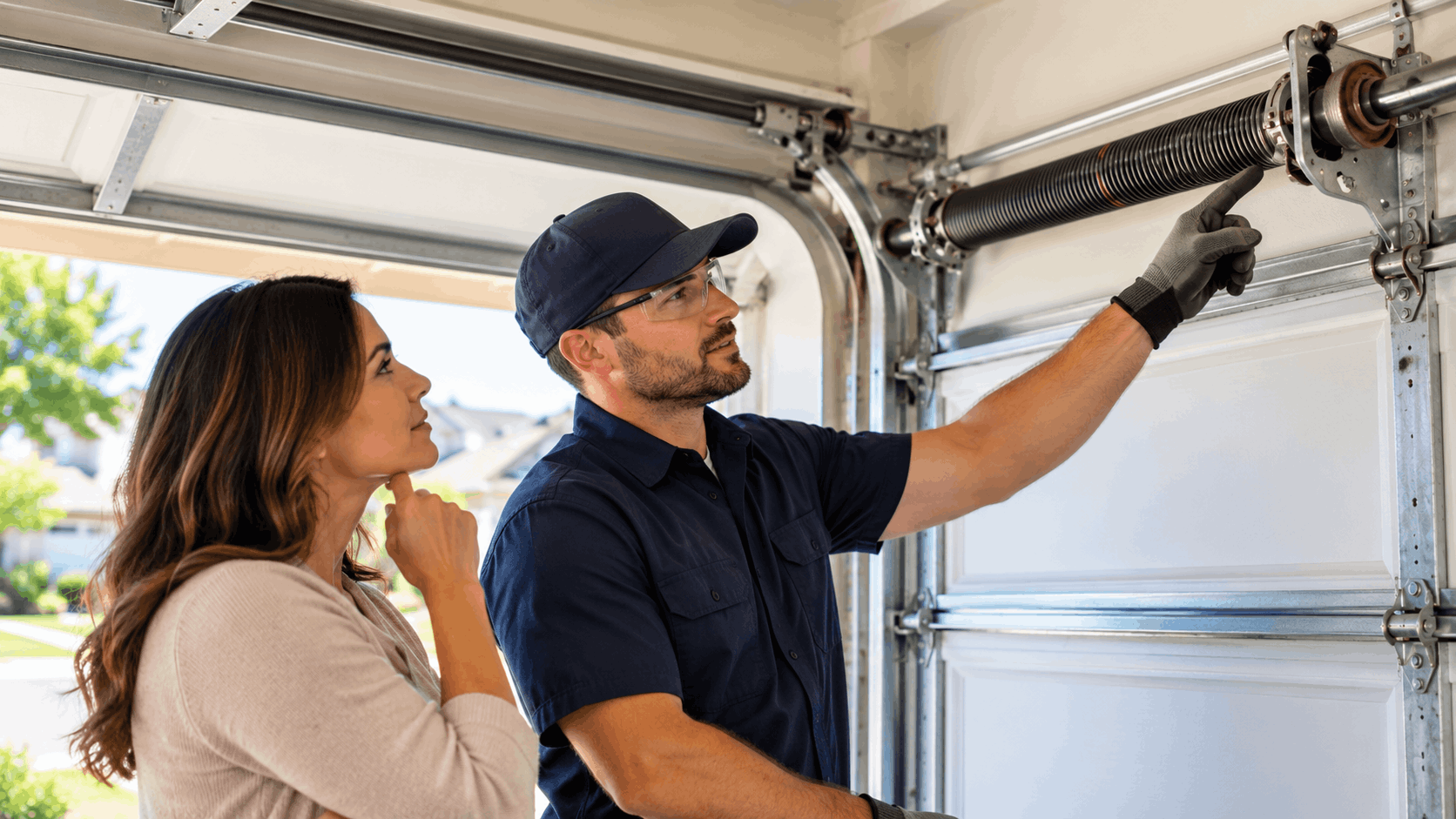
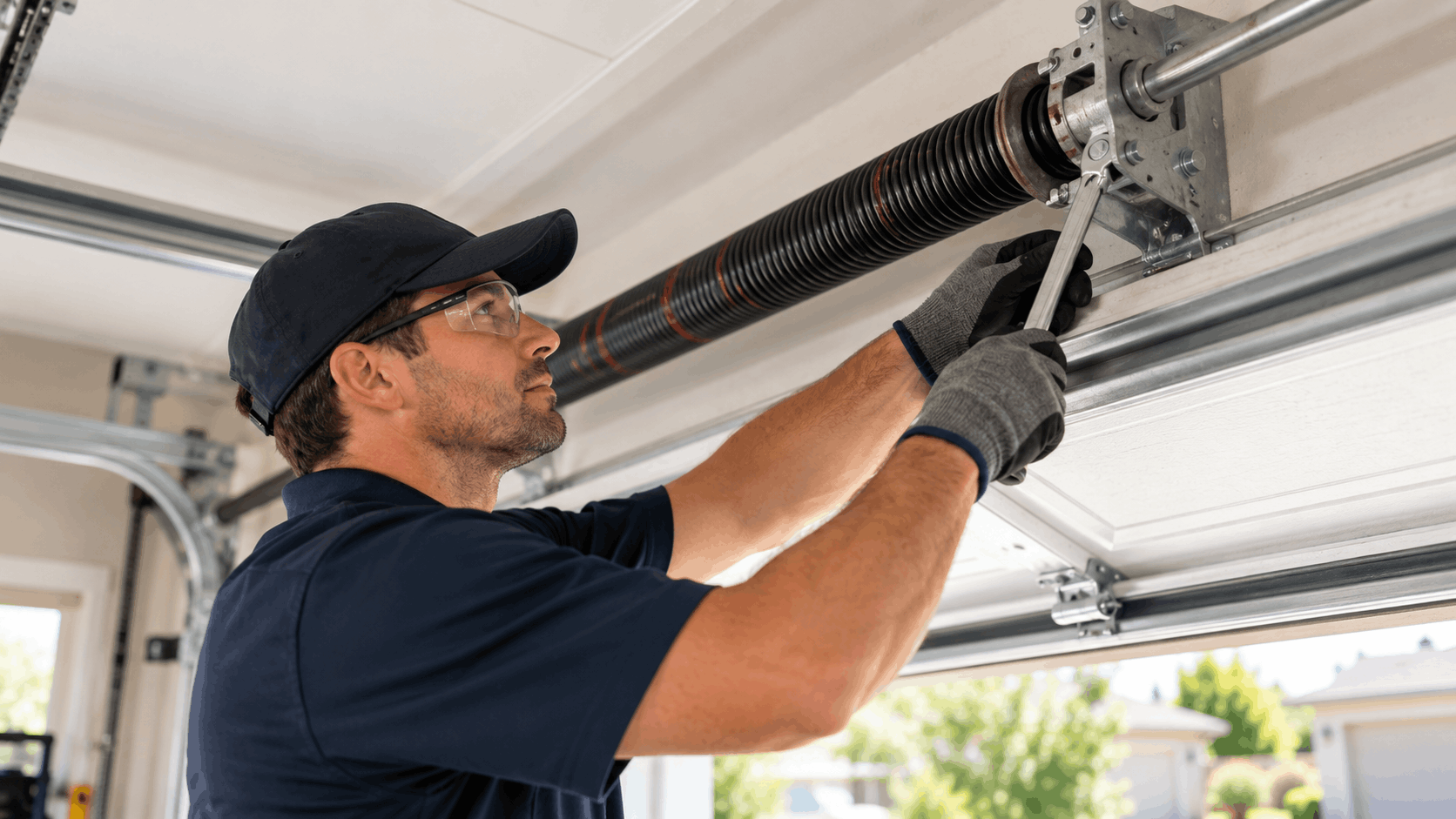
Torsion springs are the most common setup on the sectional doors found across Eastbluff and the rebuilt homes in Newport Heights. The torsion spring sits on a steel bar mounted horizontally above the door opening, and it winds and unwinds as the door moves. The typical range for replacing one is $150 to $300 in Orange County.
When a torsion spring breaks, the door becomes extremely heavy to lift because the spring was carrying almost all of its weight. That is why a door with a snapped torsion spring will often rise only an inch or two under opener power, or not at all. The opener is not designed to lift the full dead weight of the door on its own.
You can get a closer look at how this system works and what the repair covers on our torsion spring replacement page. The range you land in depends on the weight and height of your door and the cycle rating of the spring chosen, which the next sections explain.
Extension Spring Replacement and Spring Conversion
Older original garages in Newport Heights and Cliff Haven often run extension springs instead of torsion. These stretch and contract along the horizontal tracks on either side of the door rather than winding on a bar above it. Extension spring replacement typically runs $150 to $250 in Orange County.
Extension springs were the common choice on many homes built from the 1950s through the 1970s, so they turn up frequently on unmodernized doors here. They are an older design, and when one fails it is a good moment to consider whether the system should be updated. Our extension spring replacement service covers both the like-for-like swap and the questions that come with an aging setup.
Converting from extension springs to a torsion system is called a spring conversion, and that typically runs $150 to $350. A conversion can make an older door operate more smoothly and safely, and it is worth discussing on a door that still runs the original extension hardware. You can read more about it on our spring conversion upgrade page.
Why the Range, Not One Flat Price
No contractor can quote a single flat spring price sight unseen, and the reason is simple physics. Springs are sized to the actual door weight and height, so a heavy insulated steel door needs a stronger spring than a light single-car door from the 1960s. The spring that fits one garage on Eastbluff Drive may be wrong for the one next door.
The cycle rating chosen also moves the price. A standard spring is commonly rated around 10,000 cycles, while a high-cycle spring rated higher costs more up front but lasts longer on a door that runs many times a day. A homeowner who uses the garage as the main entrance may come out ahead paying for the higher rating.
Finally, the price depends on whether worn parts such as cables are replaced at the same time. Cables wear alongside springs, and addressing both in one visit is cheaper and safer than a return trip. That is why we give a written price before work begins once the door is in front of us and the full scope is clear.
Get Your Free Quote
Tell us about your garage door and we'll get back to you within 30 to 60 minutes.
Why Springs Fail Early Near the Upper Newport Bay?
Homeowners above the Back Bay often ask why their springs seemed to give out before their time. The honest answer ties the local air to the spring's rated life. Back Bay moisture speeds corrosion on steel hardware, and corrosion brings a spring to the end of its cycle rating sooner than it would reach in bone-dry inland air.
This is not a case of the coast cutting spring life in half. It is a gradient across the city. Island and beachfront properties face the worst exposure, the Back Bay and bluff streets sit in the middle, and inland tracts in Irvine and Costa Mesa are the mildest. Eastbluff and Newport Heights live in that middle band, harder on hardware than people expect from the distance to open water.
The Back Bay Fog and What It Does to Hardware
The Upper Newport Bay ecological reserve sits directly below Eastbluff, and the marine layer and morning fog push further inland here than the map would suggest. That damp air settles on springs, cables, rollers and track in the hours before the sun burns it off. Over years, that repeated cycle of moisture is what matters.
Steel exposed to that kind of humidity develops surface corrosion, and corrosion on a spring is not just cosmetic. It pits the metal and creates stress points where the coil is more likely to fatigue and crack. The spring is still doing its rated job, but the corroded surface shortens the time before a failure point forms.
Compared to the Peninsula or Balboa Island, where salt is constant and direct, the Upper Newport Bay air is milder. It is still harder on springs, cables and rollers than a sheltered tract several miles inland. That is the realistic framing for anyone comparing their garage to a relative's house in central Irvine.
Cycle Rating Explained in Plain Terms
A torsion spring is rated by the manufacturer in cycles, and one cycle is a single full open and close. A standard residential spring is commonly rated around 10,000 cycles. That number is the honest way to think about spring life, far better than any vague year count.
Do the arithmetic on daily use and it becomes clear. A door opened and closed four times a day reaches 10,000 cycles in roughly seven years. A household that comes and goes more often burns through cycles faster, and a garage used as the main entrance can run through a spring well before a lightly used one does.
Corrosion does not change the cycle count on the label. What it does is bring the spring to that end point earlier, because the pitted metal fatigues before a clean spring would. So in the damp air above the Back Bay, a 10,000-cycle spring may give out closer to the lower end of its expected service window.
Why Original Eastbluff and Newport Heights Springs Are Past Due
Eastbluff's first phase opened in 1963 as the first community built under the Irvine Company master plan, and Newport Heights homes date from the postwar decades. That means a garage still running its original hardware has springs, cables, drums and rollers that are long past design life. Nothing lasts sixty years on a door that moves every day.
On these original systems, the spring is rarely the only tired part. The cables have carried load the whole time, the rollers have run thousands of cycles in their tracks, and the bearings have spun in the same damp air. When one piece fails, the rest are usually close behind.
This is why an inspection matters on an older Eastbluff or Newport Heights garage. Replacing a single broken spring on a sixty-year-old system without looking at the rest is how a homeowner ends up calling again a few weeks later. The age of the neighborhood is a real factor in the scope of the work.
Need Help in Irvine?
Urgent Garage Doors serves Irvine and all of Orange County.
What Else Should Be Checked When a Spring Breaks
A broken spring is loud and obvious, but it rarely travels alone on an older door. Replacing the spring without inspecting the parts that wear beside it is how a second failure follows weeks later. A thorough spring visit includes a look at the cables, rollers, drums and bearings so the whole lifting system is sound.
None of this is upselling. It is the difference between fixing the symptom and fixing the system. The parts below all share the same age and the same damp Back Bay air as the spring that just broke.
Cables Wear Alongside Springs
The lift cables work hand in hand with the springs, carrying the door's weight as it travels up and down. They run under constant tension, and in the humid air off the Back Bay they corrode and fray over time. A frayed cable can look fine from a distance while being one load away from snapping.
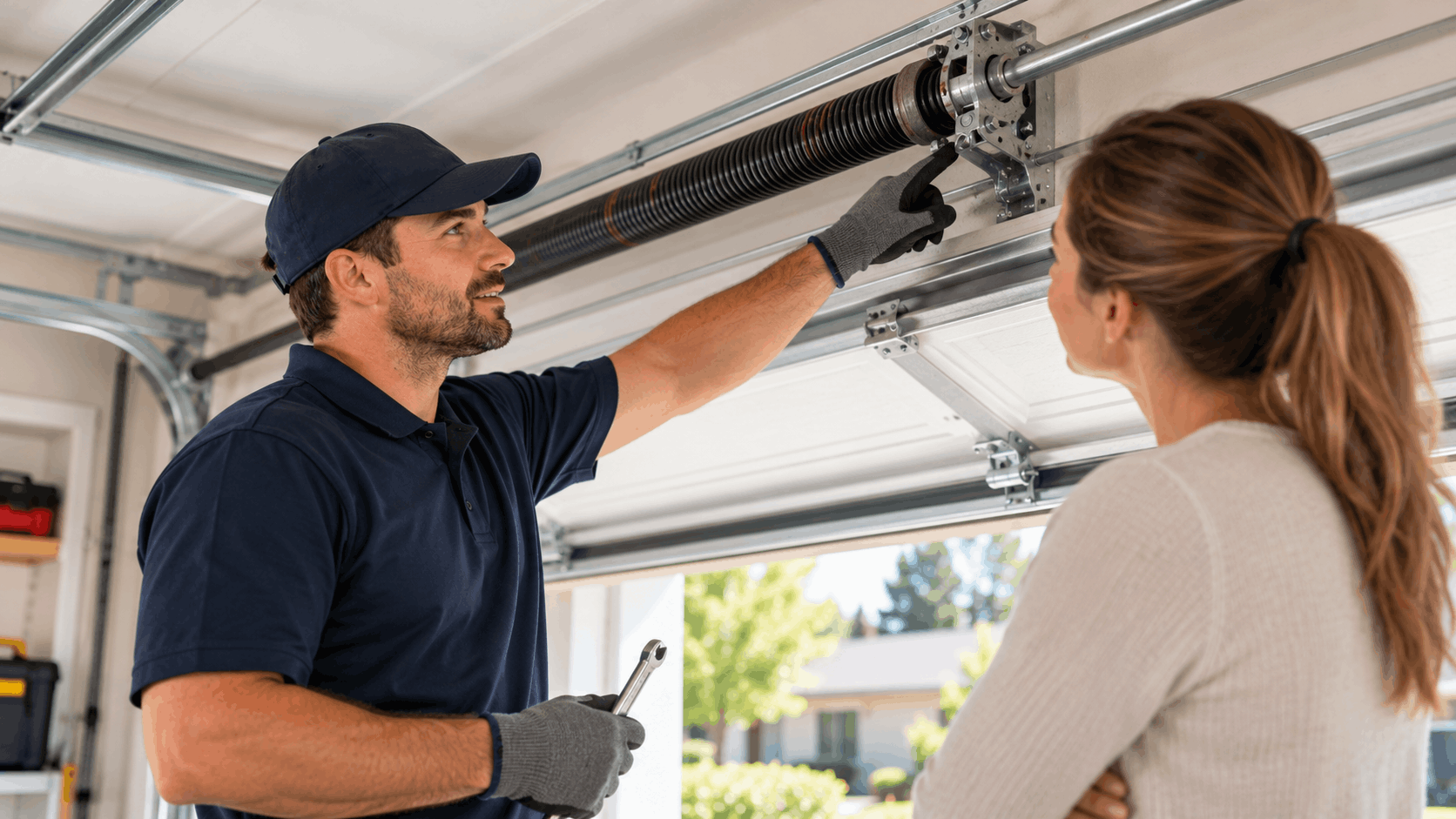
Replacing a spring without checking the cables is a classic way to invite a return trip. The new spring puts the system back under full tension, and a cable that was already weakened may give out soon after. Cable repair cost typically runs $150 to $300 in Orange County, and doing it alongside the spring saves a separate service call.
Our team inspects both every time, and you can read more on our garage door cable repair page. On a sixty-year-old Newport Heights door, treating the spring and cables as one job is simply the sensible approach.
Rollers, Drums, Hinges and Bearings
The drums at each end of the torsion bar wind the cables, and the rollers guide the door along the track. Over sixty years in the damp Back Bay air, both wear, and worn drums or rollers make the door run rough and put extra strain on a brand-new spring.
Hinges and bearings take the same beating. Bearings on the torsion bar can dry out and seize, and a seized bearing adds drag that shortens the life of the new spring. Hinges between the panels loosen and corrode, which can let the door flex and bind as it moves.
Inspecting these during a spring job is just good practice on an aging door. If a roller is cracked or a bearing is grinding, swapping it while the system is already apart is far cheaper than a separate visit later. A door that runs quietly and smoothly after a spring job is a door where the supporting parts were checked too.
The Balance Test and What It Tells You
There is one test that tells a homeowner whether they are dealing with a spring problem or an opener problem, and it is safe to run. It is called the balance test. Pull the release cord to disconnect the door from the opener, then lift the door by hand to about waist height and let go.
A correctly balanced door stays put at waist height. The springs are holding its weight, which is exactly their job. If the door slams down or shoots up instead of staying where you left it, the springs are no longer carrying the load properly.
That result points straight at the springs. A door that will not hold its position is a spring problem, not an opener problem, so there is no point replacing an opener to fix it. Run this test before you call, and you will already know which kind of repair you need.
Why a Spring Is the One Repair an Owner Must Not Attempt?
Garage doors have plenty of parts a handy homeowner can safely touch. The spring is not one of them. The torsion spring danger is real and serious, and this is the single repair we steer every owner away from doing themselves. There are, however, safe tests you can run, including the auto-reverse check.
The Stored Energy in a Wound Spring
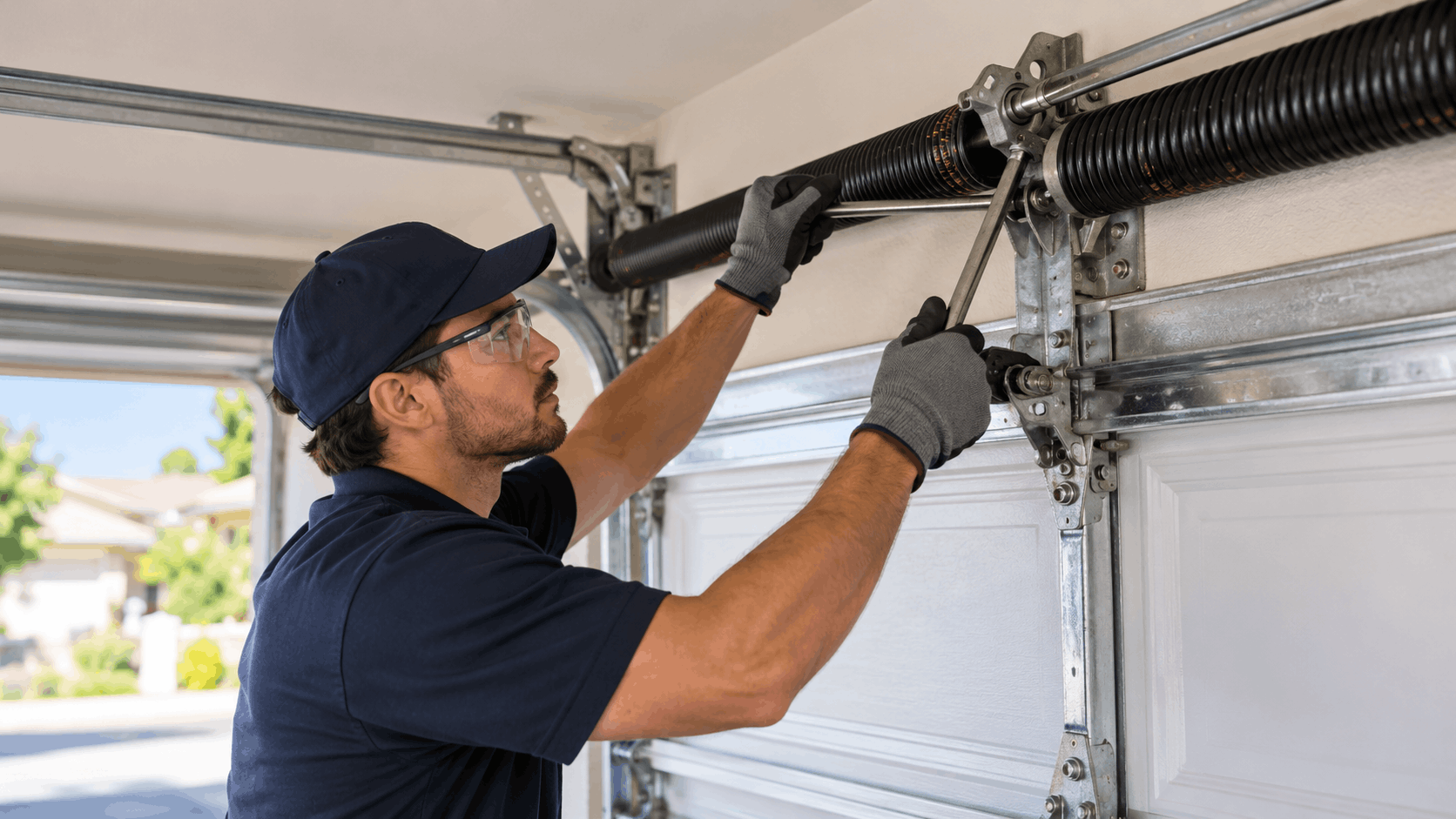
A wound torsion spring holds a tremendous amount of stored energy. It is wound tight with steel winding bars against a fixed cone, and all that energy is locked in place by that tension. The spring is essentially a loaded mechanism sitting above the door.
If that energy releases without control, it can cause serious injury. A slipped winding bar or a spring that lets go during adjustment moves with enormous force. This is not a scare tactic, it is the physics of how the part works.
For that reason, owners should never adjust, wind, unwind or replace a torsion spring themselves. The tools and the technique exist to do it safely, but they belong in trained hands. No money saved is worth the risk this particular part carries.
Safe Tests a Homeowner Can Run
There is plenty a homeowner can safely check without ever touching the spring. The 2x4 test confirms the door's auto-reverse is working. Lay a flat two-by-four on the floor in the door's path, then close the door. On contact with the board, a properly set door should reverse within two seconds.
The photo-eye test checks the non-contact safety system. With the door closing, break the beam between the two sensors near the floor with an object. The door should stop and reverse right away. If it does not, the sensors may be misaligned or a lens may be coated with the dust and debris the fog carries into the garage.
Both of these are genuine auto-reverse safety checks any owner can run in a couple of minutes. They tell you whether the door's safety features are working without going anywhere near the stored energy in the spring. Our safety sensor alignment and repair service handles it when a photo eye will not cooperate.
What a C-61/D-28 Licensed Contractor Covers
Garage door work in California is licensed under classification C-61/D-28, Doors, Gates and Activating Devices. That scope covers torsion and extension spring systems, operators, control boards, safety sensors and activating devices, so spring replacement falls squarely within it.
A licensed contractor gives a homeowner real recourse and confirms the work is done by someone trained in exactly this hazard. A license and its status, bond and workers compensation are all public record. You can verify any license free at cslb.ca.gov.
Urgent Garage Doors holds California license #1055150. Checking a license before hiring takes a minute and is a reasonable step with any contractor, especially for a repair involving the stored energy of a wound spring.
How Local Conditions in These Neighborhoods Affect the Job and the Price
The street a garage sits on shapes how a spring job runs and sometimes what it costs. Eastbluff, Newport Heights and Cliff Haven each bring their own factors: easy access on flat driveways, sloped bluff lots where track drifts out of line, detached garages with no wiring, and older framing around the opening. Here is how each one plays into the work.
Easy Access on the Inland Belt
These neighborhoods are the most straightforward part of Newport Beach to work in. They have real driveways, no alleys, and normal street parking, which is a world apart from the Peninsula and the islands. A truck can pull up right in front of the garage and get to work.
That ease of access means a job here often runs a faster job than the same repair on Balboa Island or in Corona del Mar. There is no hauling parts down a narrow alley or hunting for parking several blocks away. For a homeowner comparing quotes across the city, that is worth knowing.
There are also none of the summer parking restrictions that govern the Peninsula and islands from May 15 to September 15. A spring job in Eastbluff or Newport Heights usually does not have to be booked around the season, so scheduling is simpler year-round.
Sloped Driveways in Cliff Haven and Newport Heights
Cliff Haven and the bluff streets in Newport Heights sit on sloped lots, and that slope has a quiet effect on garage hardware over the decades. Ground movement and settling on a hillside gradually pull track alignment out of true. It happens slowly, so owners rarely notice until the door starts acting up.
When track drifts out of alignment, the door tends to bind at one point in its travel rather than failing all at once. A homeowner might describe a door that sticks or catches partway up or down. That symptom is often a track issue, not a spring issue, and it can be caught during a spring visit.
Because the technician already has the door open for the spring work, it is the right moment to check the track. If the door binds at a specific spot, a realignment may be the real fix. Our track repair and realignment service addresses exactly that on these sloped bluff lots.
Detached Garages and Older Framing
Some original Newport Heights and Cliff Haven properties have a detached garage at the rear of lot, often with no existing opener and no wiring to the structure. On those homes, adding an opener becomes an electrical job alongside the door work, and an owner should hear that at quoting rather than be surprised by it.
The older framing around the opening is also worth a look before anything heavier goes on. A door is only as sound as what it hangs from, and sixty-year-old framing may need attention before it carries a modern weight. This matters most when a homeowner is also considering a new door.
For a straightforward spring swap on an existing door, the framing rarely changes anything. But on these older rear garages, it is the kind of thing a careful technician notes so the scope is clear and the repair holds. Honest quoting means flagging these factors before the work starts.
Need Help in Irvine?
Urgent Garage Doors serves Irvine and all of Orange County.
Should You Replace Both Springs at Once?
On a two-spring door, this question comes up almost every time one breaks. The short version: if the door has two springs and one fails, the second is usually near the end too. Whether to replace both springs, step up to high-cycle springs, or install a matched set depends on your door and how hard it works.
One Broken, Both Worn
A two-spring door runs both springs together through every cycle. They were installed at the same time, they have the same age, and they have the same cycle count. So when one breaks, the other has lived the same life and is almost certainly close to failing too.
Replacing only the broken one often means a second service call within weeks or months when the survivor goes. That second trip costs another visit on top of the part. For most owners, replacing both springs at once is the more sensible choice on a two-spring system.
There is also a balance benefit. Two springs of the same age and condition keep the door's lift even. Pairing a brand-new spring with a worn one can leave the door pulling unevenly, which wears the new spring and the rest of the hardware faster.
When High-Cycle Springs Make Sense
Standard springs are commonly rated around 10,000 cycles, but high-cycle springs rated higher are available for doors that work hard. They cost more up front and last longer, so they can be the better value on the right door.
They make the most sense where the duty is heavy duty or the door is unusually heavy. A door that serves as the household's main entrance and cycles several times a day will burn through a standard spring faster than a lightly used door. On that kind of door, the extra cycles pay for themselves over time.
For a garage that opens a couple of times a day, a standard spring is usually fine. The decision comes down to how often the door actually moves, which is why we ask about daily use before recommending one over the other.
Matching Springs to the Actual Door
Spring sizing is not guesswork. Springs are matched to the real door weight and height of the specific door, and the wrong size will not balance the door correctly. This is why a replacement is never a generic part pulled off a shelf without measuring.
It matters most when the door itself changes. A heavier replacement door in a different material needs matched springs sized to it, not a reuse of the old set. Hanging a heavy insulated steel door on springs sized for a light original door leaves the system out of balance and strains the opener.
So if a spring job comes as part of a larger door project, the spring selection follows the new door's weight. Our spring and cable repair work always starts with matching the spring to the door in front of us, which is the only way to get a door that balances and lasts.
Permits, Associations and Who Pays in These Neighborhoods
A spring swap is a mechanical repair, so permits and approvals rarely enter into it. But a few local factors can affect timing or who authorizes the work here, and they are worth a quick word. Those are association approval in some pockets, the coastal zone, and the fact that many homes are rented.
Association Pockets vs Streets With No Association
Eastbluff contains association-governed pockets alongside streets with no association at all. Where an association governs, it operates under California's Davis-Stirling Common Interest Development Act, and the CC&Rs decide whether a garage door is separate interest or association-maintained and whether a visible change needs board approval.
A pure spring replacement is internal mechanical work, so it generally does not trigger any association pockets review. Nothing about the door's appearance changes when a spring is swapped. The approval question only comes up if a visible color or panel change is involved.
Newport Heights and Cliff Haven are largely without master associations, so an owner there generally chooses on merit with the city permit the only approval in play. The first question on any job is which applies to that specific address, because two neighboring homes can have completely different answers.
The Coastal Zone and When Permits Enter the Picture
Nearly every property in Newport Beach sits in the Coastal Zone, and the boundary runs through this part of the city rather than around it. So two homes a few streets apart can be in different positions, which is why the Address Search Tool on the city's site matters more here than in the island neighborhoods.
For spring work, this usually does not come into play. Replacing a spring in an existing setup is a different matter from changing an opening size or altering the structure. Work that touches exterior walls or openings is the kind of change that can draw coastal review and require a building permit, not a mechanical repair inside the door.
Permits are decided by the city with jurisdiction over the specific address, not by a single regional rule. The Newport Beach Permit Center, at 100 Civic Center Drive, 949-644-3309, confirms the position for a given job. For a straightforward spring swap, that call is rarely needed, but it is the right authority if a project grows.
When the Renter Is Not the One Who Calls
Almost half of Newport Beach homes are rented, with the owner-occupied rate at 52.1 percent. On a large share of properties here, the person living with the broken door is not the one who authorizes and pays for the repair.
On those rented homes, a tenant calls the landlord or the property manager, who then authorizes the work. That adds a step and sometimes a day to the timeline, because the decision-maker is not on site. It is worth knowing when a renter is trying to get a door fixed quickly.
For property managers handling multiple Newport Beach units, a direct line to a licensed contractor keeps these repairs moving. We work with both owners and managers, and the written price goes to whoever is authorizing the job.
Need Help in Irvine?
Urgent Garage Doors serves Irvine and all of Orange County.
How Urgent Garage Doors Handles a Spring Replacement
Knowing the price range is one thing. Knowing how the job actually runs is another. Here is how Urgent Garage Doors handles a spring replacement in Eastbluff, Newport Heights and Cliff Haven, from the truck stock to the response window and 24/7 coverage.
Common Spring Sizes Carried on the Truck
Our trucks carry common torsion spring sizes, so a same visit replacement is often possible rather than a return trip for parts. For the standard sectional doors across these neighborhoods, the right spring is frequently already on board. That saves the homeowner a second appointment in most cases.
Carrying common torsion sizes in stock is the difference between a door fixed today and a door waiting days for an ordered part. On an everyday residential door, that stock covers the large majority of calls. It is one of the reasons spring jobs here tend to move quickly.
That said, not every door uses a common size. An unusually heavy or custom door may need a spring brought in, and a spring conversion involves more parts. We confirm what the door needs before committing to a same-visit finish, so no job is left half done.
A Written Price Before Work Begins
A written price is available before work begins when the job calls for it or the customer asks. Once the door is in front of us and the full scope is clear, the homeowner knows the number before any tools come out. That keeps the repair transparent from the start.
Separately, California law backs this up. Business and Professions Code section 7159 requires a written home improvement contract for work over $500. That is a legal requirement rather than a company favor, and it protects the customer on larger jobs.
For a spring replacement that includes cable work or a conversion, having the price in writing removes any guesswork. The homeowner sees what is covered and agrees to it before the work starts.
Response Window and 24/7 Service
We offer 24/7 service, taking emergency calls and responding every day of the year, holidays included. A door that will not open with a snapped spring can trap a car in the garage, and that does not wait for business hours. Emergency response runs 30 to 60 minutes anywhere in Orange County.
We work on all brands, including LiftMaster, Chamberlain, Genie, Craftsman, Clopay, Amarr, Wayne Dalton and CHI. Whatever opener and door a home in Eastbluff or Newport Heights runs, the spring job is within our scope. Our 24/7 emergency garage door repair covers exactly these situations.
Our storefront is at 76 Ashford, Irvine, CA 92618, which keeps the drive to the Newport Beach inland belt short. For homeowners across the city, our Newport Beach service area page has more on how we cover these neighborhoods.
Get Your Spring Replaced the Right Way
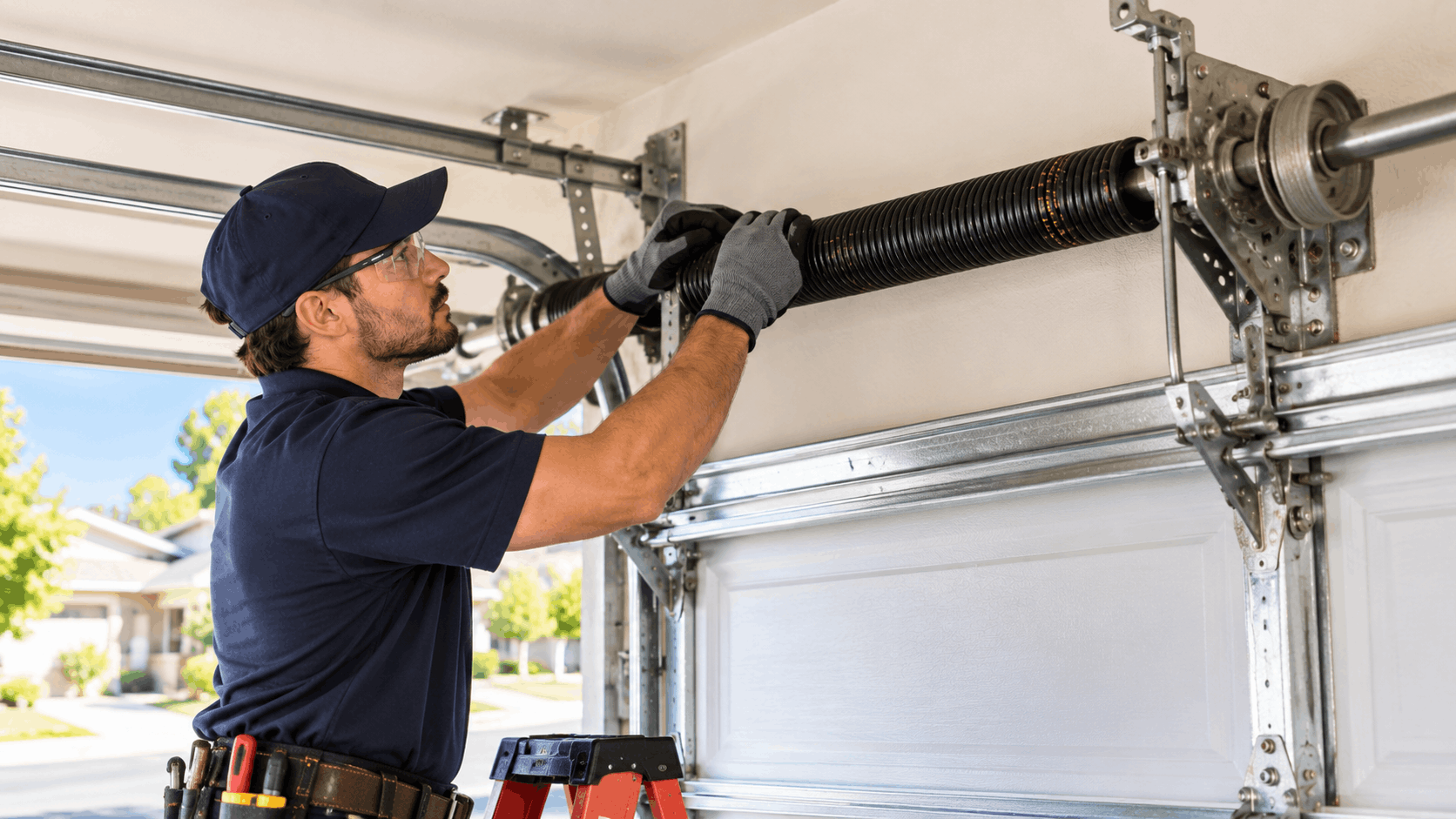
If your door dropped with a bang above the Back Bay, the next step is a quick diagnostic to confirm the spring and check the cables and track that live the same life. Call Urgent Garage Doors at (949) 529-7743 and we will get a technician to your Eastbluff, Newport Heights or Cliff Haven address, with the written price in hand before the work starts.
Frequently Asked Questions
- How much does garage door spring replacement cost in Eastbluff or Newport Heights?
- In Orange County, torsion spring replacement typically runs $150 to $300 and extension spring replacement typically runs $150 to $250. Those are typical market ranges for the area, not a quote. The final price depends on the door's weight, height and the cycle rating chosen, plus whether cables or other worn parts are replaced at the same time. A written price is given before work begins when the job calls for it.
- What is the difference between a torsion spring and an extension spring?
- A torsion spring sits on a steel bar mounted above the door opening and winds and unwinds as the door moves, which is the most common setup on sectional doors here. An extension spring runs along the horizontal track on either side of the door and stretches as the door closes, common on older setups. Converting from one system to the other, a spring conversion, typically costs $150 to $350 in Orange County.
- Can I replace a garage door spring myself?
- No. A wound torsion spring stores enough energy to cause serious injury and is wound with bars against a fixed cone. If that stored energy releases without control, it can hurt someone badly. Owners should never adjust, wind, unwind or replace a torsion spring. Safe things you can do include the 2x4 auto-reverse test and the photo-eye beam check, neither of which goes anywhere near the spring itself.
- How do I know if my spring is broken and not the opener?
- Run the balance test. Pull the release cord to disconnect the door from the opener, lift the door by hand to about waist height, and let go. A balanced door stays put because the springs are carrying its weight. If the door slams down or shoots up, the springs are the problem, not the opener. A door that will not hold its position is a spring problem, not an opener problem.
- Why do springs seem to wear out faster near the Back Bay?
- The marine layer and morning fog off the Upper Newport Bay reserve reach further inland than the distance suggests, settling moisture on steel hardware. That damp air speeds corrosion, and corrosion brings a spring to the end of its cycle rating earlier than it would reach in dry inland air. It is milder than the Peninsula or Balboa Island, but harder on springs than a sheltered tract in Irvine or Costa Mesa.
- Should I replace both springs when only one breaks?
- On a two-spring door, usually yes. Both springs were installed together, so they share the same age and the same cycle count. When one breaks, the other has lived the identical life and is almost certainly near the end too. Replacing only one often means a second service call within weeks when the survivor fails. Replacing both at once also keeps the door's lift balanced on a new, matched pair.
- How long do garage door springs last?
- Standard springs are commonly rated around 10,000 cycles, and one cycle is a full open and close. A door used four times a day reaches that in roughly seven years. A door that runs more often gets there sooner. High-cycle springs rated higher are available and last longer, which makes sense on a door used as the main entrance. Corrosion in damp air brings any spring to its end point earlier.
- Do I need a permit to replace a spring in Newport Beach?
- A mechanical spring swap in an existing door is a different matter from changing an opening size or altering the structure, which is the kind of work that can draw a building permit or coastal review. Permits are decided by the city with jurisdiction over the specific address. The Newport Beach Permit Center, at 100 Civic Center Drive, 949-644-3309, confirms the position for your job if a project grows beyond a straightforward repair.
- Can the spring be replaced on the same visit?
- Often, yes. Our trucks carry common torsion spring sizes, so a replacement is frequently completed on the same visit for the standard sectional doors across these neighborhoods. We cannot promise every job finishes on the first trip, because an unusually heavy or custom door may need a spring brought in, and a conversion involves more parts. We confirm what the door needs before committing to a same-visit finish.
- What else should be checked when a spring is replaced?
- Cables, rollers, drums and bearings all wear alongside springs, especially over sixty years in the damp Back Bay air. Replacing a spring without inspecting the cables is how a second failure follows weeks later, since a frayed cable can give out once the new spring puts the system back under full tension. A proper spring visit includes a look at all of these so the whole lifting system is sound, not just the part that broke.
Licensed garage door repair professionals serving Irvine and Orange County.
Licensed in California · License #1055150
Why trust Urgent Garage Doors?
Founded in 2017, Urgent Garage Doors is a licensed and insured garage door services serving Irvine and Orange County. All content is reviewed by our licensed technicians.

Need Help in Irvine?
Urgent Garage Doors serves Irvine and all of Orange County.
Related Articles
Broken Garage Door Spring Repair Cost Newport Beach vs Anaheim: Why Pricing Varies
Compare broken garage door spring repair costs in Newport Beach vs Anaheim, why coastal prices run higher, and how to read quotes without getting overcharged.
How Much Does Garage Door Spring Replacement Cost in Eastside Costa Mesa?
Garage door spring replacement cost in Eastside Costa Mesa depends on spring type, cycle rating and cable condition. Here is what drives the price near the Back Bay.
How Much Does Garage Door Spring Replacement Cost in Newport Coast?
Garage door spring replacement in Newport Coast runs $150 to $300 for torsion and $150 to $250 for extension, with heavy custom estate doors landing higher. Here is what drives the price.