Cost Guides
How Much Does Garage Door Spring Replacement Cost in Eastside Costa Mesa?
Key Takeaways
- Spring replacement cost depends on spring type, cycle rating, whether one or both springs are replaced, and the condition of cables and rollers, so a written price comes after an on-site diagnostic.
- Torsion pairs on wide or heavy doors cost more than a single extension spring, and replacing both springs at once usually prevents a second call weeks later.
- Standard springs are commonly rated around 10,000 cycles, roughly seven years at four cycles a day, and coastal Back Bay humidity brings that rating to an end sooner.
- Cables near the water corrode and fray from the inside, so replacing a spring without checking cables is how a second failure follows within weeks.
- A torsion spring stores enough energy to cause serious injury and must never be adjusted by an owner; the safe balance test tells whether the problem is the spring or the opener.
- Garage door work is licensed under C-61/D-28, not C-28, and the unlicensed-work exemption rose to $1,000 under AB 2622 effective January 1, 2025, failing at any value if a permit is required.
- A like-for-like spring swap generally needs no permit, but the Eastside faces city-level exterior design review even where no HOA exists.
- A spring failure is not an opener problem; openers made before 1993 predate the federal entrapment mandate, and any opener installed from July 1, 2019 must have battery backup under SB 969.
In This Article
A loud bang from a detached alley garage off the 17th Street corridor is a sound our team hears about often on the Eastside. The car is stuck inside, the door will not lift by hand, and the homeowner is standing in a narrow lane wondering what this is going to cost. In plain terms, a garage door spring replacement in Eastside Costa Mesa usually runs a few hundred dollars for a standard single-spring repair, with a matched torsion pair on a wider or heavier door landing higher.
The reason there is a range and not a flat number is simple. The final price depends on the spring type, the cycle rating of the spring you choose, whether one or both springs are replaced, and the condition of the cables, drums and rollers around them. A high-cycle spring on a busy rear-loaded garage costs more up front than a stock replacement, and corroded cables discovered during the job add to the work.
What Drives the Cost of a Spring Replacement Here?
A spring replacement is not a flat fee, and any honest quote reflects that. You are paying for the spring itself, the labor to size and wind it safely, and the condition of the hardware it works against. On a postwar Eastside cottage that has never been serviced, that surrounding hardware often carries as much weight in the final number as the spring.
The biggest single driver is which spring system the door uses and how heavy that door is. A single extension spring on a light one-piece door is a different job from a torsion pair on a wide, insulated sectional. The spring replacement cost also moves with the cycle rating you select and whether the cables need to come out at the same time.
| Factor | Effect on Price |
|---|---|
| Spring system (torsion vs extension) | Torsion setups on wide or heavy doors cost more than a single extension spring |
| One spring vs a matched pair | Replacing both at once costs more up front but avoids a second visit |
| Cycle rating | A high-cycle spring costs more than a standard 10,000-cycle spring |
| Door weight and width | Heavier or custom-width doors need larger, matched springs |
| Cable and roller condition | Corroded cables or worn rollers add parts and labor |
Because the pieces interact, the written price comes after an on-site look, not over the phone from a guess. Our spring and cable repair visits start with a measurement and an inspection so the number reflects the actual door.
Torsion Versus Extension Springs
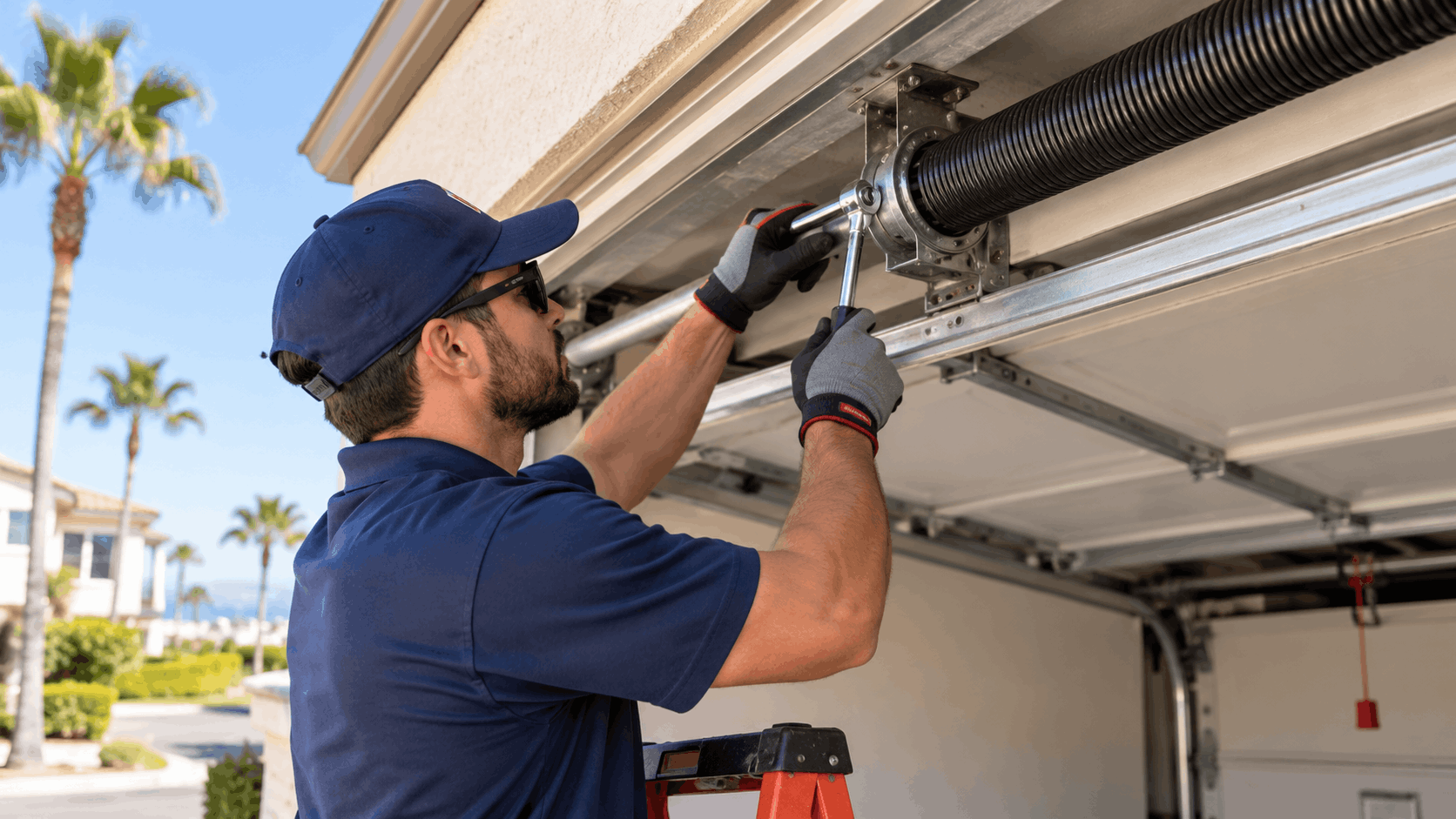
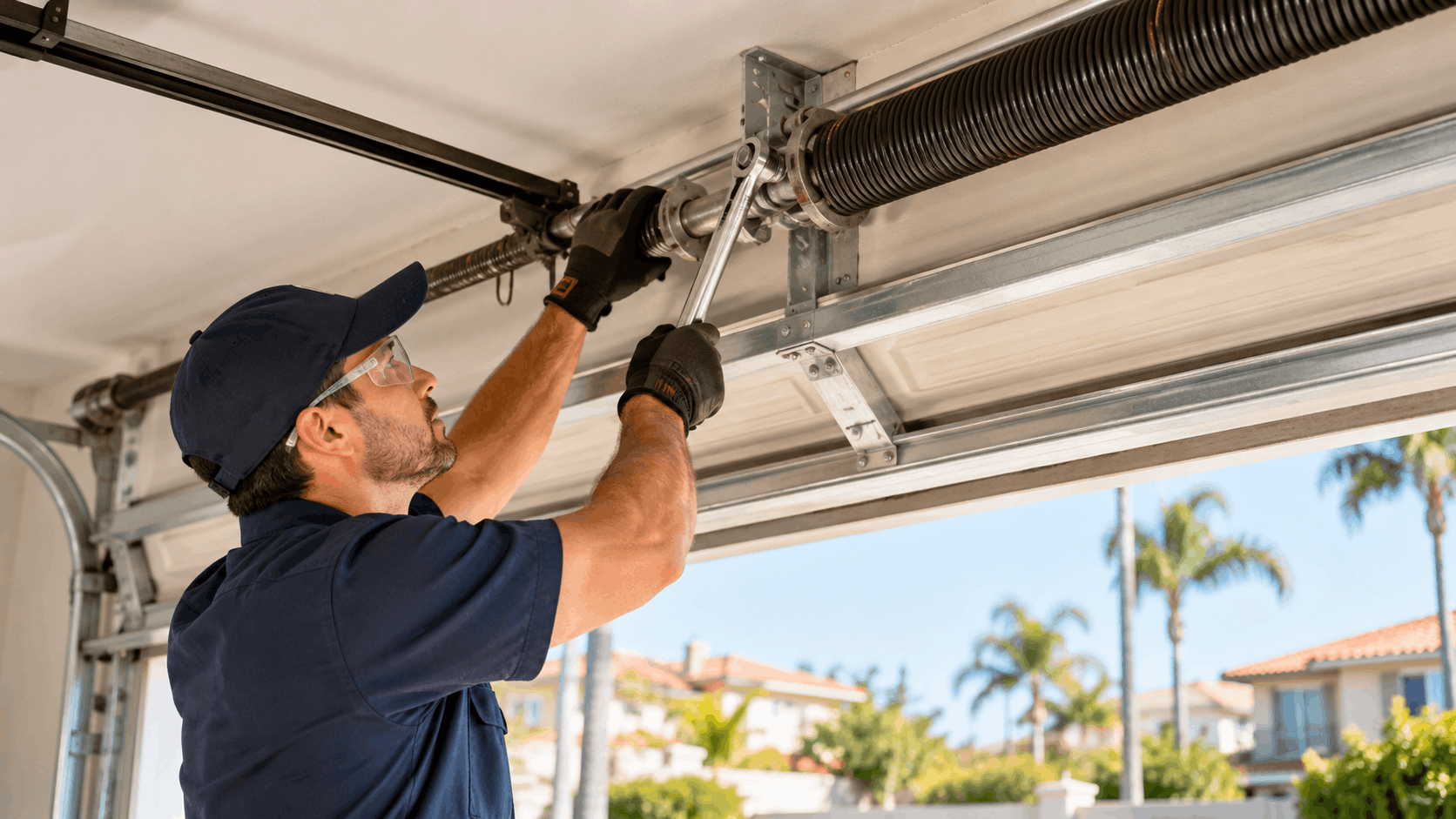
There are two spring systems on residential garage doors, and they mount in completely different places. A torsion spring sits on a metal bar above the door opening and stores energy by twisting as the door closes. An extension spring runs along the horizontal track on each side and stretches to hold the door's weight. On Eastside cottages you find both, since the neighborhood's build era and the mix of one-piece tilt-ups and later sectional doors produced a range of hardware.
Torsion systems are the more common setup on modern sectional doors and on the wider openings homeowners have added over the years. They are safer in operation and handle heavier doors better, but they cost more to replace because the spring is larger, must be sized precisely, and has to be wound under tension with bars. That winding step is skilled labor, and it is a large part of why a torsion job prices above a simple extension swap.
Extension springs show up on older and lighter doors, including some of the original tilt-up profiles still hanging on detached garages behind Eastside homes. A single extension spring on a light door is the least expensive spring to replace. The trade-off is that extension systems need safety cables run through them so a broken spring cannot become a projectile, and those cables should be checked at the same visit.
The size of the opening matters as much as the system. A wide double door carries far more weight than a single, so even within torsion systems, a two-car door will price above a single-car door because it needs larger or paired springs sized to that load.
Single Spring Versus a Matched Pair
When a door runs on two torsion springs and one breaks, the honest recommendation is usually to replace both. The reason is not upselling, it is arithmetic. Both springs were installed on the same day, they have carried the door through the same number of open-and-close cycles, and they share the same cycle rating. If one has reached the end of its life, the other is a short step behind it.
Replacing only the broken spring saves a little money that afternoon and often costs more within weeks. The surviving spring fails next, the door comes down again, and the homeowner pays a second service call and a second spring. On a detached alley garage where access is already awkward, a repeat visit is the last thing anyone wants.
A matched spring pair also keeps the door balanced. Two springs of the same age and rating share the load evenly, which is easier on the opener, the cables and the rollers. A fresh spring paired with a worn one pulls unevenly and wears the rest of the system faster.
On a single-spring door there is nothing to match, so the decision is simpler. The pair conversation only applies where two springs are present, and our technicians explain which situation a given door falls into before any work begins. Homeowners weighing a spring conversion upgrade often ask about this at the same visit.
Cycle Rating and Why It Changes the Quote
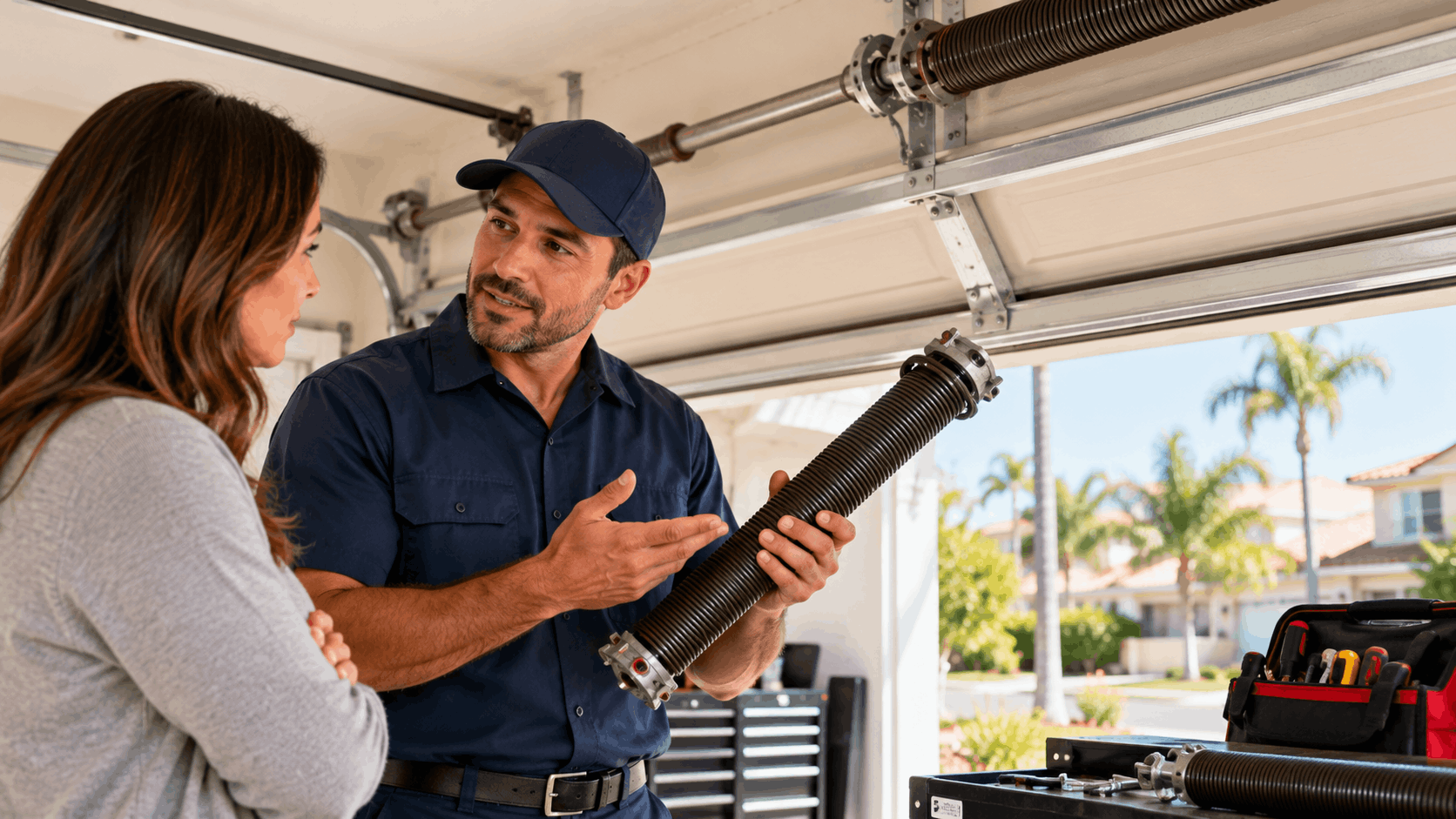
Every torsion spring is rated by the manufacturer in cycles, where one cycle is a single full open and close. A standard residential spring is commonly rated around 10,000 cycles. That rating is the honest measure of how long a spring should last, and it is far more useful than a vague year figure.
Translate that into daily life and the math is clear. A door cycled four times a day reaches 10,000 cycles in roughly seven years. A quiet garage used once a day stretches that out for many years, while a busy alley garage that serves as the main entrance and cycles many times daily burns through the rating much faster.
This is where a high-cycle spring earns its higher price. High-cycle springs are rated well above the standard 10,000 and suit exactly the kind of hard-working rear-loaded garage common on the Eastside, where the family comes and goes through the garage all day. They cost more up front, but for a heavily used door they push the next replacement years further out.
So the cycle rating a homeowner chooses directly changes the quote. A standard spring is the value option for a lightly used door, while the high-cycle option makes sense on a door that opens and closes constantly. Our team explains the age of the current spring and the rating options so the choice is informed rather than guessed.
Door Weight and Size Set the Spring Size
Springs are not one-size-fits-all. They are sized to the actual weight and height of the door, and getting that sizing right is the difference between a door that glides and one that fights the opener. A spring that is too light will not lift the door, and one that is too heavy slams it up and wears the hardware.
That matters a great deal on the Eastside, where postwar openings were built narrower than modern standards and many owners have since upgraded to heavier doors. An insulated steel door or a custom-width door on an old cottage opening weighs more than the original, so it needs springs matched to that weight rather than a reuse of the old set. Reinstalling old springs on a heavier door is a common shortcut that fails quickly.
This is why door weight and spring sizing are part of the diagnostic. The technician weighs or measures the door and reads the existing spring dimensions to spec the correct replacement. Guessing at spring size from the outside is how doors end up unbalanced.
If a homeowner is planning a heavier insulated steel garage door down the line, that decision changes the spring spec too. Springs and door are a matched system, and pricing one without the other leads to problems.
Get Your Free Quote
Tell us about your garage door and we'll get back to you fast.
Why Eastside Springs Wear Out Faster
There is a real, place-specific reason springs give out sooner on the Eastside than in the inland tracts of the same city. It comes down to where these homes sit. The Eastside runs along and south of 17th Street toward the Newport Beach border, close to the Back Bay and within a few miles of the ocean, and that location shapes what happens to the hardware.
The connection between coastal corrosion, Back Bay humidity and spring failure is direct. Salt-laden, humid air reaches steel springs, cables and rollers and starts working on them from the surface inward. The fix is not a magic coating, it is matched replacement parts and a proper inspection of everything the corrosion has touched.
Coastal Air Close to the Back Bay
The Eastside's Back Bay adjacency is the local premium that draws people to the neighborhood, and it is also what shortens hardware life. Sitting close to the Back Bay and within a few miles of the ocean means the air here carries more humidity than the drier inland parts of Costa Mesa. That moisture, combined with salt, is what drives corrosion.
Steel springs, cables and rollers are the parts that feel it first. Moisture settles on the coiled steel, and over repeated cycles the surface begins to pit and rust. A rusted spring loses strength and reaches the end of its useful life before a clean, dry spring of the same rating would.
What predicts corrosion here is distance from the sand, not the city line. A home a few blocks from the Back Bay sees more of this than one further inland, even within the same neighborhood. Two identical doors installed the same year can age at different rates purely because of where they sit relative to the water.
This is why our team treats coastal proximity as a real variable on the Eastside rather than a talking point. When we quote a spring job here, we expect to find corrosion on the surrounding hardware and we look for it, because ignoring it leads straight to a repeat failure.
Corrosion Ends the Cycle Rating Early
The honest way to describe what corrosion does is that it brings a spring to the end of its cycle rating earlier. It does not add a fixed number of years or subtract a set percentage. There is no published multiplier that says salt air cuts spring life in half or doubles the wear, and anyone quoting one is inventing it.
What actually happens is that a corroded spring reaches failure at a lower cycle count than its rating promised. A spring rated around 10,000 cycles might have delivered on that in a dry inland garage, but pitting and rust weaken the steel so it snaps sooner. The rating is the ceiling, and corrosion lowers the point at which the spring gives out.
The practical takeaway is to plan for earlier replacement near the water and to service the whole system rather than a single part. A homeowner who understands the cycle-rating frame is better equipped to decide between a standard and a high-cycle spring for their conditions.
Seventy Years of Hardware on Postwar Cottages
Many Eastside garages are attached to postwar cottages, bungalows and ranch houses, some built more than seventy years ago. On homes of that age, the original hardware is often still in place, and springs, cables, drums, track, rollers and hinges from that era are long past their design life.
When a spring fails on a garage like that, it is rarely an isolated event. The broken spring is usually the first part to go in a system where everything else is the same age and equally worn. Replacing the spring while ignoring the rest is treating a symptom and leaving the cause.
A spring that fails on a seventy-year-old cottage is a signal that the whole system deserves a look. The cables may be fraying, the rollers may be seized, and the drums may be grooved. A good technician reads the failed spring as a warning about the parts around it.
This is why our inspection on older Eastside homes goes beyond the spring. We check the parts that share the door's history, because on hardware this old, a second failure is often already forming when the first one happens.
Need Help in Irvine?
Urgent Garage Doors serves Irvine and all of Orange County.
The Parts That Fail Alongside the Spring
A spring rarely fails alone on an aging door. The cables, rollers and drums work together with the spring to raise and lower the weight, and they wear on the same timeline. A technician who replaces the spring without inspecting these parts is setting up a repeat call.
On Eastside garages near the water, this is not theory. Corrosion reaches all the steel components, and detached alley garages that have never been serviced often hide several worn parts behind a single broken spring. Understanding what fails alongside the spring explains why a thorough inspection is part of the job, not an add-on.
Cables That Fray From the Inside
The lift cables that run from the bottom of the door to the drums carry the full load along with the springs. Near the water, these cables corrode and fray before they snap. The individual steel strands begin to rust and break inside the cable, so it loses strength gradually rather than all at once.
The danger is that a fraying cable often looks intact from a distance. A homeowner sees a whole cable and assumes it is fine, while inside it is down to a fraction of its strength. Only a close cable inspection catches the fraying before the cable lets go.
Replacing a spring without inspecting the cables is how a second failure follows weeks later. The new spring works perfectly, then the tired cable snaps and the door drops or jams. The homeowner is back to square one, paying for a second visit that a five-minute cable check would have prevented.
This is why our technicians examine the cables at every spring visit. A garage door cable repair done at the same time as the spring is far cheaper than a separate emergency call, and on coastal Eastside hardware it is often the smart move.
Drums, Rollers, Hinges and Bearings
Beyond the cables, several other parts wear alongside the springs. The drums that the cables wind around, the rollers that guide the door in the track, the hinges between panels and the bearings the torsion bar spins in all age together with the spring.
On old detached alley garages that have never been serviced, these parts can be in rough shape. Rollers seize and drag, bearings dry out and squeal, and drums develop grooves that chew up cables. Any of these can add to the job cost, because replacing them at the same visit is both cheaper and smarter than coming back.
A worn roller or a dry bearing also puts extra strain on the new spring. If the door does not move freely, the fresh spring works harder than it should and its life is shortened. Fixing the friction points protects the investment in the new spring.
Our team inspects these components as part of the spring diagnostic and tells the homeowner what we find before touching anything. Some of it can wait, some of it should be done now, and a straight explanation lets the owner decide. A preventive maintenance plan keeps these parts from becoming emergencies.
Track and Panel Condition on Older Profiles
Sometimes the inspection turns up something bigger than a spring problem. On the earliest cottage-era door profiles, replacement panels are generally discontinued. The door was made decades ago, the manufacturer has moved on, and matching panels no longer exist.
That changes the conversation. If a panel is cracked or a section is rotted alongside the failed spring, partial repair is sometimes not possible because there is nothing to replace the damaged panel with. The homeowner faces a door decision rather than a spring decision.
The track matters too. Bent, rusted or misaligned track on an old door prevents a smooth run no matter how good the new spring is. On postwar garages, the track is often the original steel and may need realignment or replacement to let the door move freely.
When we run into a door where the spring is the least of the problems, we say so plainly. It is better for a homeowner to hear that a seventy-year-old door with discontinued panels may be past economical repair than to pay for a spring on a door that needs replacing. In those cases a new garage door installation is the honest path.
Why Springs Are Not a DIY Job
It is tempting to look up a video and try a spring swap to save money. This is the one garage door repair we tell every homeowner to leave alone. The reason is spring safety, and specifically the torsion spring danger that comes from the energy stored inside a wound spring.
Here is why this job belongs to a trained technician:
- A wound torsion spring holds enough force to cause serious injury or worse if it releases suddenly.
- The winding is done with bars against a fixed cone, and a slip sends those bars flying.
- Sizing the spring wrong leaves the door unbalanced and unsafe even if the install goes cleanly.
- The safe tests a homeowner can run do not require touching the spring at all.
The good news is that there are checks any owner can do safely to understand what is wrong before calling. Those tests tell the difference between a spring problem and an opener problem without any risk.
The Energy Stored in a Wound Spring
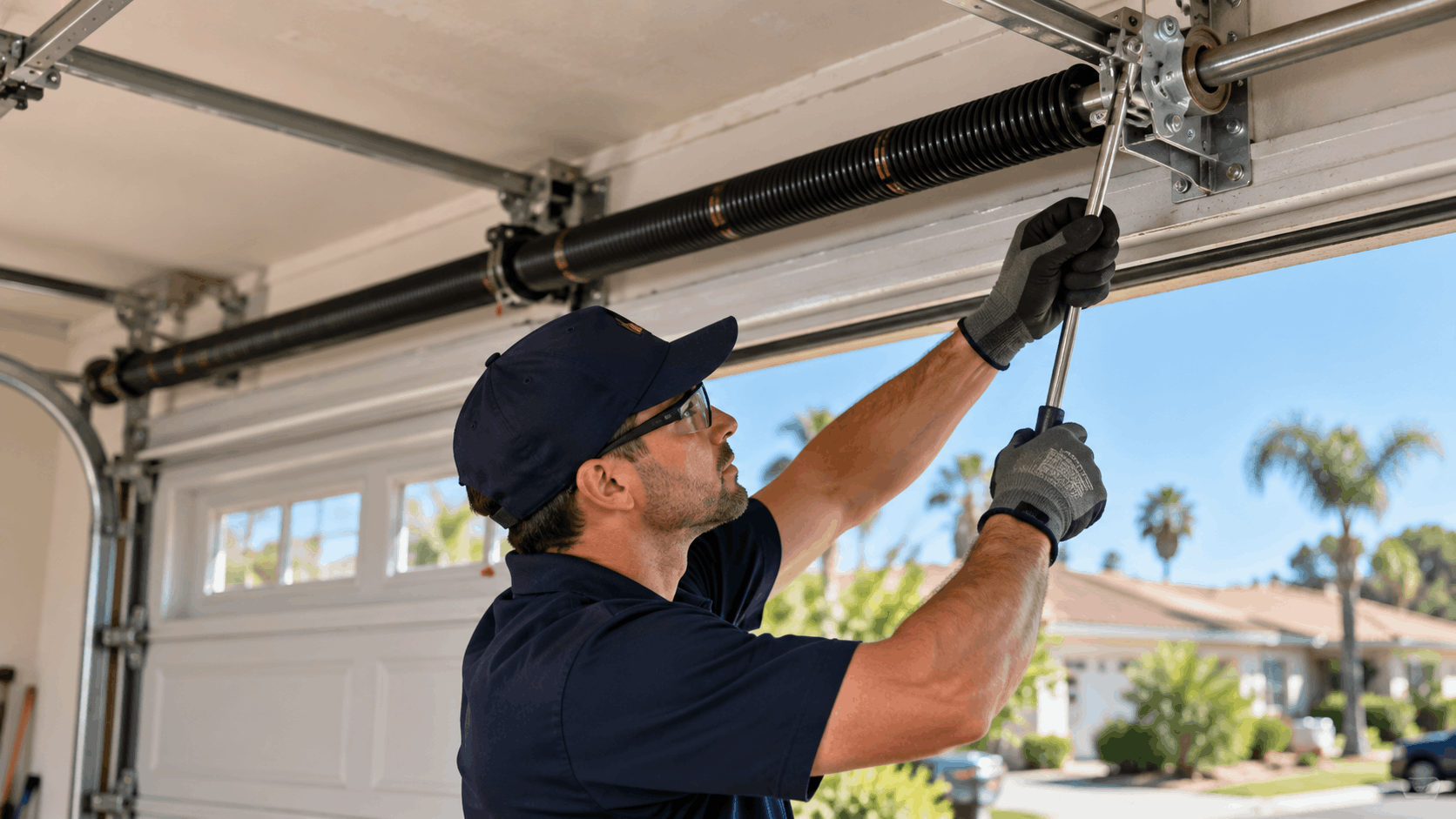
A torsion spring works by storing energy. As the door closes, the spring winds tighter, holding the tension that will lift the door's weight next time it opens. A fully wound spring on a two-car door holds a large amount of stored energy, all of it ready to release the moment something goes wrong.
That energy is wound and unwound with winding bars inserted into a cone on the spring, held against the tension while the installer turns it in precise increments. If a bar slips or the wrong tool is used, the spring can unwind violently. This is how people lose fingers and break bones attempting the job at home.
Because of that danger, an owner should never adjust, wind, unwind or replace a torsion spring. There is no safe shortcut and no household tool that makes it safe. The tension does not care how careful someone is being.
Our technicians do this work every day with the correct bars, proper stance and the training to control the tension through the whole process. Paying for that skill is paying to keep the energy in that spring under control. Our torsion spring replacement service exists precisely because this is not a DIY task.
The Balance Test You Can Run Safely
There is one test that tells a homeowner whether the springs are the problem, and it involves no tension work at all. It is the balance test. Start by pulling the release cord to disconnect the opener from the door, which lets the door move freely by hand.
With the opener disconnected, lift the door to about waist height and let go. A correctly balanced door stays put where you leave it. The springs are holding the door's weight the way they should, which means the springs are doing their job.
If the door falls to the floor or rises on its own, that is a spring problem, not an opener problem. The springs are no longer balancing the weight, and no amount of opener adjustment will fix it. This single test saves homeowners from replacing an opener when the real issue is the springs.
Run the test gently and keep hands and feet clear as you release the door. If the door will not hold position, stop using it and call for service, because a door that drops is a hazard. Our door balancing and tension adjustment visit addresses exactly this finding.
The Auto-Reverse and Photo-Eye Checks
Two more safe checks tell a homeowner whether the opener's safety systems are working. The 2x4 test checks the auto-reverse contact system. Lay a flat two-by-four across the floor in the door's path, then close the door with the opener. The door should reverse within two seconds of touching the wood.
The photo-eye test checks the non-contact system. With the door closing, wave an object through the beam between the two sensors mounted low on each side of the opening. The door should stop and reverse the moment the beam is broken.
What a failed check means depends on which test failed. A door that will not reverse on the 2x4 or ignores the photo eye points to an opener or sensor issue, not a spring issue. Misaligned or blocked photo eyes are the most common cause of a door that reverses for no visible reason.
These tests, together with the balance test, let a homeowner arrive at a call with a clear picture. If the balance test fails, it is springs. If the safety checks fail but the balance is fine, it is the opener or sensors. Our safety sensor alignment repair handles the photo-eye faults.
What the Repair Actually Involves in an Alley Garage
A spring job on an Eastside property does not always run like a job in a driveway-fronted tract home. The neighborhood's alley garage, rear-loaded garage and detached garage layouts change how the work happens and sometimes what it costs. Knowing this ahead of time keeps the visit smooth.
Alley and rear-loaded garages are common on the Eastside, and a share of garages here are detached structures behind the house rather than attached to it. Both facts shape the day, from where the truck parks to whether an opener needs wiring. Confirming these details at booking prevents surprises.
Narrow Lanes and Rear-Loaded Access
Many Eastside garages open onto an alley rather than a street. That means a service truck often works from a narrow lane with limited turning room, and neighbors' bins, parked cars and trash pickup all come into play. Alley access is a real logistics question, not an afterthought.
A rear-loaded garage down a tight lane can be hard to reach with a full-size truck, and blocking the alley while working is not always an option. This is why access should be confirmed before dispatch. Knowing the lane width and any obstructions lets us send the right vehicle and plan the approach.
When a homeowner tells us at booking that the garage is off an alley, we arrive ready for it. That might mean carrying parts and tools a short distance from a parked truck, or timing the visit around trash collection. The work is the same, but the setup takes local knowledge.
Homeowners can help by clearing bins and vehicles from the lane before the appointment where possible. A clear alley shortens the visit and gets the door working sooner, which matters when a car is trapped inside.
Detached Garages With No Wiring
Detached garages behind Eastside cottages frequently have no existing opener and no wiring run to the structure. The garage was built as a simple parking space, and power was never brought out to it. That changes the scope if an opener is part of the request.
If a homeowner wants an opener on a detached garage that has no wiring, the job becomes an electrical job as well as a door job. Power has to be run to the structure before an opener can be installed, and that is work an owner should be told about at quoting, not discovered on the day.
For a pure spring replacement, the lack of wiring does not matter, because springs are mechanical and need no power. The wiring question only comes up when someone wants to add motorized operation to a detached garage that has always been manual.
We flag this early so the quote is complete. A homeowner asking about a new garage door opener installation on a detached structure gets an honest picture of the electrical work involved up front.
Diagnostic, Measurement and Matched Springs
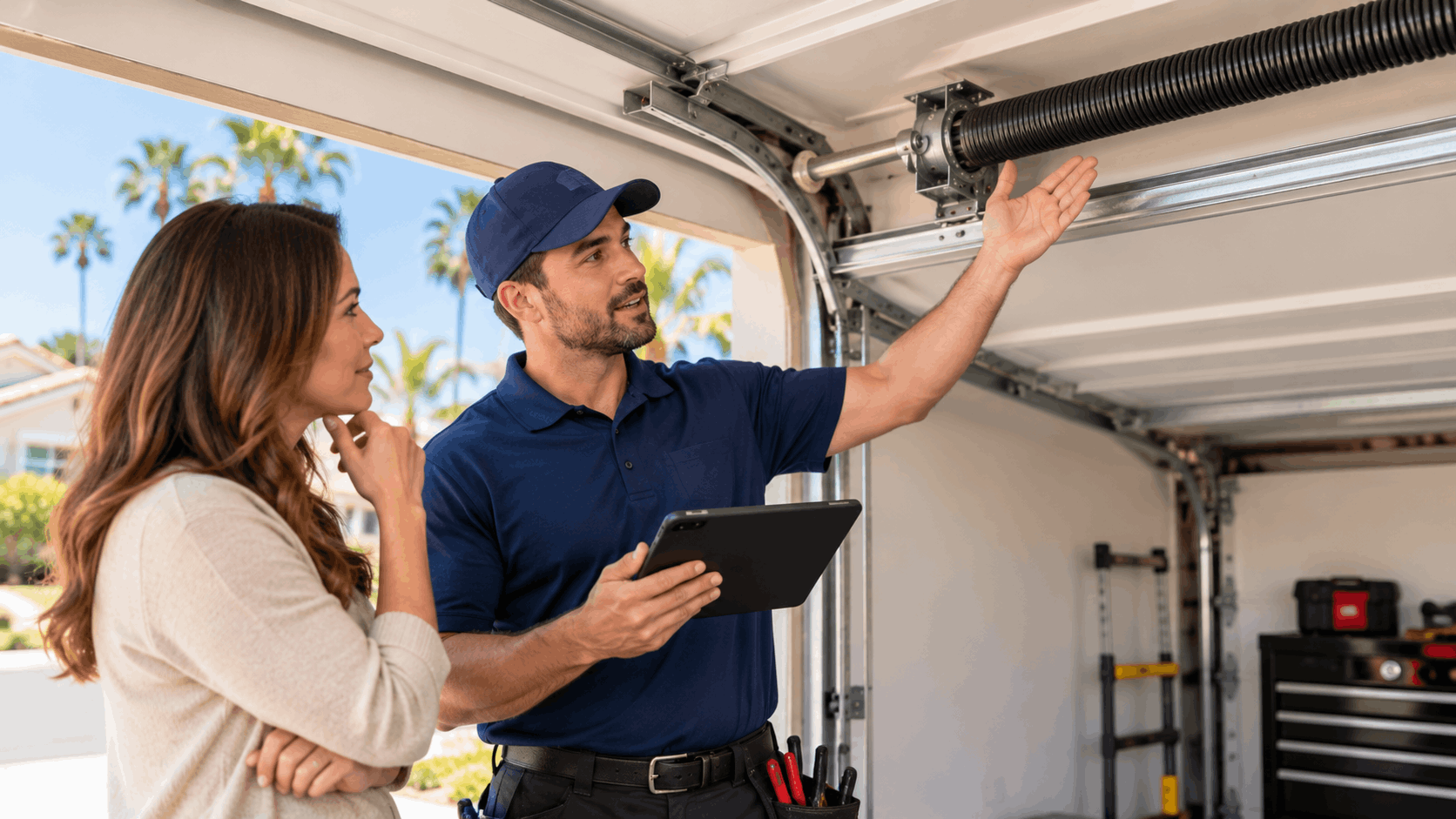
The repair itself follows a set sequence. It starts with a diagnostic, where the technician confirms the spring has failed, runs the balance check and inspects the cables, drums and rollers. This is where we catch a fraying cable or a seized roller before it becomes the next problem.
Next comes spring measurement. The technician measures the door weight and the dimensions of the existing spring to spec a matched replacement. This step is why the spring will fit and balance the door correctly rather than fighting it.
With the correct spring on hand, the old spring comes off and the new one is installed and wound to the right tension using winding bars. This is the skilled, high-tension part of the job that makes it a professional task rather than a DIY one.
Finally, the technician re-tests. The door is balanced by hand to confirm it holds position, and the auto-reverse and photo-eye systems are checked so the finished job is safe. Only when the door runs cleanly and the safety systems work is the visit complete.
Need Help in Irvine?
Urgent Garage Doors serves Irvine and all of Orange County.
Licensing, Contracts and the $1,000 Rule
Knowing the legal backdrop helps a homeowner tell a licensed contractor from someone working out of a van with no accountability. On a spring job, where a wound spring is dangerous and a botched install is a hazard, that distinction protects the homeowner. The terms to know are the C-61/D-28 classification, the CSLB, and the rules around unlicensed work.
These are not abstract details. They determine who is legally allowed to do the work, what paperwork you should receive, and what recourse you have if something goes wrong. A few minutes of understanding here saves real trouble later.
The Right License Classification
Garage door work in California is licensed by the Contractors State License Board under classification C-61/D-28, Doors, Gates and Activating Devices. That scope covers sectional and rolling doors, torsion and extension spring systems, operators, control boards, safety sensors and activating devices. Spring replacement sits squarely inside it.
A point of confusion worth clearing up: C-28 is Lock and Security Equipment, and it is not the garage door license. Anyone describing garage door work as C-28, or claiming it needs a Class B general building license, has it wrong. The correct classification for this work is C-61/D-28.
Urgent Garage Doors holds California license #1055150. Any homeowner can confirm that at the CSLB, where the classification, status, bond and workers compensation are all public record. License verification takes a minute and is worth doing before any contractor touches a spring.
You can check any license free at the Contractors State License Board. Looking up the number confirms the contractor is real, active and insured for the work.
The Unlicensed-Work Exemption Now Sits at $1,000
California has an exemption that lets very small jobs be done without a contractor license, and the figure recently changed. AB 2622 rewrote Business and Professions Code section 7048 effective January 1, 2025, raising the exemption from $500 to $1,000 in combined labor, materials and other costs.
A lot of older advice, including some of the board's own material, still prints $500. The current figure is $1,000, and a job cannot be split into smaller slices to stay under it. Most spring jobs with proper parts and safe installation reach a level where a licensed contractor is the right call anyway.
The exemption also fails at any value under two conditions. It does not apply if the work requires a building permit of any kind, and it does not apply if the person doing the work employs anyone on the job. Either condition removes the exemption regardless of the dollar figure.
For a homeowner, the takeaway is simple. Anyone offering to do meaningful garage door work should be licensed, and the small-dollar exemption is far narrower than most people assume.
The Separate Written-Contract Rule
There is a different rule that is often confused with the licensing threshold, and keeping them separate matters. Business and Professions Code section 7159 requires a written contract for a home improvement project over $500. That is a contract requirement, not a licensing threshold.
The two rules share a dollar figure in the old version but do different things. Section 7048 is about who may legally do the work. Section 7159 is about putting the deal in writing so both sides are protected. They should not be merged into a single rule.
In practice this means a spring job over $500 should come with a written agreement covering the scope, the parts and the price. That paperwork protects the homeowner and is a sign of a contractor doing things properly.
Our team provides a written price before work starts on every job, which covers this requirement and gives the homeowner a clear document to hold. There should never be a surprise number after the fact.
Permits and Design Review on the Eastside
Most spring jobs never touch the city, but Eastside homeowners face a wrinkle that many other neighborhoods do not. The city applies extra design scrutiny to exterior changes here, even where no association exists. Knowing when a repair triggers a Costa Mesa permit, when design review applies, and how the TESSA portal works keeps a project on track.
The permit position is always decided by the city for the specific address, not by a single county-wide rule. That is why we tell owners to confirm the requirement for their property rather than assume. For a straight spring swap, the answer is usually simple.
When a Spring Job Needs No Permit
A like-for-like spring replacement is generally not what triggers a permit. Swapping a broken spring for a matched replacement is a repair to existing equipment, and repairs of that kind typically fall outside permit territory.
What does trigger a permit is structural work. Widening the opening, altering the header or reframing the wall changes the building and brings the building department in. On postwar Eastside cottages with undersized openings, a homeowner who wants a wider modern door can cross into that structural territory.
The important thing is that the permit position is decided by the city for the specific address. A repair at one property and a reframe at the next are different animals, and the building department is the authority on any given job. We advise confirming before assuming either way.
For the common case, a homeowner with a broken spring and an existing door does not need to worry about permits. It is the door-widening and reframing projects that need the extra step, and those are a different job entirely.
The Costa Mesa Permit Process and Insta-Permit
When a permit is needed, Costa Mesa Building Safety runs permits through the TESSA portal. The city also operates an Insta-Permit program for certain simple projects with a limited scope of work, and that route is worth checking first for a like-for-like replacement before assuming a full plan check.
Timing helps. Counter hours are Monday to Friday, 8am to 5pm, with alternating Fridays closed, so a review week is effectively shorter than five days. Submissions early in the week move faster than one sent on a Thursday heading into a closed Friday.
Questions go to the building department at 714-754-5273 or by email at buildingpermit@costamesaca.gov. Checking whether a job qualifies as an Insta-Permit before assuming a full plan check can save a homeowner real time.
For most spring repairs none of this comes up, but for a homeowner planning a door change that touches the structure, knowing the TESSA route and the Insta-Permit option makes the process smoother. The Costa Mesa service page covers the local landscape in more detail.
Eastside Exterior Design Scrutiny
Here is the Eastside twist. Costa Mesa applies more stringent design review for exterior changes on the Eastside than elsewhere in the city, because of the cottage and bungalow character of the neighborhood. Additions and changes here are expected to match neighborhood character.
What makes this unusual is that it is a city-level expectation, not a homeowners association rule. Many Eastside pockets carry no association at all. So an owner can be in the position of having no HOA to satisfy while still facing exterior design scrutiny from the city, and a garage door is one of the most visible exterior elements on a cottage frontage.
This Eastside design review layer applies to appearance changes, not to a hidden spring repair. Replacing a spring behind an existing door changes nothing anyone can see from the street, so the cottage character review does not come into it.
It becomes relevant when a homeowner wants a new door with a different look. In that case, confirming with the city's Planning Division whether the address falls under the additional review is the right first step before promising any timeline. We flag this so owners are not caught off guard by design approval on a visible frontage.
How the Springs Connect to the Opener and Safety Law
A spring failure sometimes surfaces questions about the opener and about safety law, and this is where homeowners get sold the wrong story. The correct dates and laws matter. The terms to get right are entrapment protection, battery backup and SB 969, and they are three separate things that must not be merged.
On a seventy-year-old Eastside cottage with an old opener, all three can come up at once. Getting the facts straight lets an owner make an informed choice rather than being pushed into a full replacement they may not need.
Old Openers That Predate the Federal Mandate
Openers of the original cottage vintage predate the federal safety requirements entirely. The federal requirement for external entrapment protection covers openers manufactured after January 1, 1993. Anything installed before that date came without the photo eyes and edge sensors modern openers carry.
California moved first. Under AB 3600, passed in 1990, California required openers to be manufactured with an automatic reverse device and sensor, and Congress followed for openers made for the United States after 1993. So the state rule came before the federal one.
The honest line for an old opener is that units made before 1993 predate the federal mandate. Dates like 2011 or 1995 are simply wrong. An opener on a garage that has never been updated may well be one of these pre-1993 mandate units.
Owning a pre-1993 opener is not illegal, but it lacks the entrapment protection every modern opener has, and manufacturers take the position that these should be replaced rather than repaired. If a spring visit reveals an opener that old, replacement is worth discussing on safety grounds.
Battery Backup Under SB 969
SB 969, signed in 2018 and operative July 1, 2019, requires every residential automatic garage door opener manufactured for sale, sold, offered for sale or installed in California on or after that date to have a battery backup that operates during an electrical outage. It was passed after deaths in the 2017 Northern California wildfires, where people could not open their garage doors during power cuts.
This is a legal requirement, not a paid upgrade tier. When a residential opener is installed or replaced in California, the battery backup comes with it because the law requires it. A homeowner replacing an opener is buying a compliant unit whether or not they asked for one.
It is important to attribute this correctly. SB 969 is not the energy code, it is not Title 24, and it is not a fire-zone or local rule. It is a statewide residential law with a $1,000 civil penalty for violations.
It also does not force an owner to upgrade an opener that is simply sitting there working. The requirement applies at installation and replacement, not to leaving an existing opener in place. Our battery backup installation service handles this when an opener is replaced.
Springs First, Opener Only If Needed
The most useful thing to understand is that a spring problem is not an opener problem. They are separate systems. The springs balance the door's weight, and the opener drives the door up and down. A broken spring does not mean the opener is bad.
Run the balance test to see which one it is. If the door will not hold position with the opener disconnected, the springs are the issue. A homeowner with a balanced door and a working modern opener usually needs only springs, not an opener replacement.
Being sold a full opener replacement when the springs are the real fault is a common bad outcome. The door failed, so the pitch becomes a new opener, when a spring repair would have solved it for a fraction of the cost. The balance test cuts through that.
Our approach is springs first, opener only if the diagnostic shows the opener is the actual problem or is a pre-1993 unit worth replacing on safety grounds. We fix what is broken, not what pays best. If an opener does need attention, our opener repair and troubleshooting covers it.
Need Help in Irvine?
Urgent Garage Doors serves Irvine and all of Orange County.
How Urgent Garage Doors Handles a Spring Call
Here is how a spring job actually runs when a homeowner calls Urgent Garage Doors about an Eastside garage. It starts with a diagnostic, moves to a written price before any work, and finishes with matched springs, a cable check and a stated response window. No guesswork over the phone and no surprise numbers.
We work these Costa Mesa alleys regularly, so the local details of access and detached structures are part of how we plan the visit. That local knowledge is what keeps the job efficient.
The On-Site Diagnostic and Written Price
Every spring call begins with an on-site diagnostic. The technician measures the door, confirms which spring system it uses, runs the balance test and inspects the cables, drums and rollers. On coastal Eastside hardware, that inspection routinely catches corrosion that would cause a repeat failure.
Only after that look do we give a written price. Because the spring type, cycle rating and surrounding hardware all move the number, an honest price requires seeing the door. A phone quote before inspection would be a guess, and we do not work that way.
The written price lays out the parts and the work before anything begins, so the homeowner approves the number first. That covers the written-contract rule for jobs over $500 and gives the owner a clear document. There is no work started on a verbal maybe.
Homeowners can start the process through our contact page or by reaching the team for a diagnostic visit. The spring and cable repair service page covers what the visit includes.
Response Window Across the Eastside
When a car is trapped behind a failed door in an alley garage, speed matters. Our confirmed response window across the Eastside is 30 to 60 minutes. That gets a technician to a stuck door quickly so the day is not lost.
Alley access is the one thing we ask about at booking. Because so many Eastside garages open onto narrow lanes, confirming the access at booking lets the truck arrive ready for a narrow lane rather than discovering the constraint on arrival.
Telling us the garage is off an alley, and clearing bins and vehicles where possible, shortens the visit. We plan the approach around the lane so the technician can get to work as soon as they arrive.
For urgent situations, our 24/7 emergency garage door repair covers the times a door fails outside normal hours. A trapped car does not wait for business hours, and neither do we.
Matched Springs and Warranty
The springs we install are matched springs, sized to the actual weight and height of the door. That matched sizing is what makes the door balance correctly and run smoothly, and it is why we measure rather than grab a stock part off the truck.
At the same visit, we check the cables to prevent a repeat failure. On coastal Eastside hardware where cables corrode from the inside, that same-visit check is the difference between one repair and two. Catching a fraying cable now saves an emergency call in a few weeks.
The work carries a warranty, which we explain in the written price so the homeowner knows exactly what is covered before agreeing. We put the terms in writing rather than leaving them vague.
The result is a door that runs the way it should, with the parts most likely to fail next already inspected. That is what a proper spring job on a seventy-year-old Eastside garage looks like, and it is how we keep homeowners from calling back weeks later.
Getting an Eastside Spring Repaired the Right Way
A broken spring on a seventy-year-old cottage garage near the Back Bay is usually the first sign that aging, corroded hardware has reached the end of its cycle rating. The price depends on the spring type, the cycle rating, whether one or both springs go, and the condition of the cables and rollers, which is why the number comes after an on-site look rather than a phone guess.
Our work on an Eastside spring call runs the same way every time. The technician measures the door and inspects the cables, drums and rollers, then hands over a written price before any work begins. The springs go in matched to the door's weight and height, the cables get checked at the same visit to head off a repeat failure, and the door is re-balanced and safety-tested before we leave, with a warranty explained in that written price.
If a door in the 17th Street corridor will not lift or a spring has already snapped, reach the team at Urgent Garage Doors for a diagnostic. Confirm the alley access when you book so the truck arrives ready for the lane, and we will have a technician out within the 30 to 60 minute window to get the door working again.
Frequently Asked Questions
- How much does garage door spring replacement cost in Eastside Costa Mesa?
- The price depends on the spring type, the cycle rating you choose, whether one or both springs are replaced, and the condition of the cables and rollers around them. A standard single-spring repair runs lower, while a high-cycle torsion pair on a heavier door runs higher. Because these factors interact, we give a written price after an on-site diagnostic rather than a guess over the phone.
- Should both springs be replaced or just the broken one?
- When a door runs on two springs and one breaks, replacing both is usually the honest call. The surviving spring is the same age and shares the same cycle rating, so it is close behind the one that failed. Replacing only the broken spring often means a second service call within weeks. On an awkward alley garage, doing both at once saves a repeat visit and keeps the door balanced.
- How long do garage door springs last near the Back Bay?
- A standard spring is commonly rated around 10,000 cycles, which is roughly seven years at four cycles a day. Near the Back Bay, higher coastal humidity and salt bring a spring to the end of that rating sooner, because corrosion weakens the steel before it reaches its full cycle count. There is no fixed multiplier, so we frame it as a shortened rating rather than a set number of lost years.
- Can a homeowner replace a torsion spring themselves?
- No. A torsion spring stores enough energy to cause serious injury and is wound with bars against a fixed cone. A slip during winding sends those bars flying, and this is how people are badly hurt attempting the job at home. An owner should never adjust, wind, unwind or replace one. The safe checks a homeowner can run are the balance test, the 2x4 test and the photo-eye test, none of which touch the spring.
- How can someone tell if the problem is the spring or the opener?
- Run the balance test. Pull the release cord to disconnect the opener, then lift the door to about waist height and let go. A correctly balanced door stays put where you leave it. If the door falls to the floor or rises on its own, that is a spring problem, not an opener problem. This single test prevents homeowners from replacing an opener when the springs are the real fault.
- Does a spring replacement need a permit in Costa Mesa?
- A like-for-like spring replacement is generally not what triggers a permit, because it is a repair to existing equipment. Structural work such as widening the opening or altering the header is what brings the building department in. The permit position is decided by the city for the specific address, so we advise confirming with Costa Mesa Building Safety when a job goes beyond a straight repair.
- What license should a Costa Mesa spring contractor hold?
- The correct classification is C-61/D-28, Doors, Gates and Activating Devices, which covers spring systems, operators, sensors and activating devices. C-28 is Lock and Security Equipment and is not the garage door license, so a contractor describing the work as C-28 has it wrong. A license can be verified free at the Contractors State License Board, where the classification, status, bond and workers compensation are all public record.
- Why do springs corrode faster on the Eastside than inland?
- The Eastside sits close to the Back Bay and within a few miles of the ocean, so the air here carries more humidity and salt than the drier inland tracts of the same city. That moisture settles on steel springs, cables and rollers and speeds corrosion. Distance from the sand predicts corrosion more than the city line, so a home a few blocks from the water sees it faster than one further inland.
- Does a new spring job mean a new opener is required?
- No. A spring failure does not by itself require a new opener, since the springs and the opener are separate systems. If the door balances correctly and the opener is a working modern unit, you usually need only springs. That said, an opener installed or replaced from July 1, 2019 must have battery backup under SB 969, and openers made before 1993 predate the federal entrapment mandate and are worth replacing on safety grounds.
- How fast can a technician reach an Eastside alley garage?
- Our confirmed response window is 30 to 60 minutes across the Eastside. Because so many garages here open onto narrow alleys, confirming alley access at booking helps the truck arrive ready for a tight lane rather than discovering the constraint on arrival. Clearing bins and parked vehicles from the lane where possible also shortens the visit and gets the door working sooner.
U
Licensed garage door repair professionals serving Irvine and Orange County.
Licensed in California · License #1055150
Why trust Urgent Garage Doors?
Founded in 2017, Urgent Garage Doors is a licensed and insured garage door services serving Irvine and Orange County. All content is reviewed by our licensed technicians.

Need Help in Irvine?
Urgent Garage Doors serves Irvine and all of Orange County.
Related Articles
Cost Guides
Broken Garage Door Spring Repair Cost Newport Beach vs Anaheim: Why Pricing Varies
Compare broken garage door spring repair costs in Newport Beach vs Anaheim, why coastal prices run higher, and how to read quotes without getting overcharged.
Cost Guides
Garage Door Spring Replacement Cost Irvine: Single vs Double Torsion Pricing
Compare single vs double torsion spring replacement costs in Irvine, from honest price ranges to warning signs, DIY dangers, and how to spot a fair quote.
Cost Guides
Northpark Irvine Garage Door Service: 1990s-Era Spring Replacement Costs
What 1990s-era garage door springs cost to replace in Northpark Irvine, why they fail, warning signs to watch for, and how to choose an honest local service.