Emergency Garage Door Repair in Irvine Villages: Gate Codes, Association Quiet Hours, and Our Protocol
Key Takeaways
- Gated Irvine villages add gate access and quiet-hour steps that slow emergency repairs, so sharing access details up front saves real time.
- Provide your gate code, visitor PIN, or guest-list name during the intake call, and add technicians to the list for guarded gates like Turtle Rock and Shady Canyon.
- Most HOA quiet hours run around 10 p.m. to 7 a.m.; quiet fixes happen anytime while loud spring and panel work is saved for allowed hours.
- During quiet hours we secure the door overnight and return in the morning to finish noisy repairs, keeping homeowners within HOA rules.
- Our trucks stock springs, cables, rollers, and opener parts so most repairs finish in one trip without re-crossing the gate.
- Common Irvine emergencies include broken torsion springs, snapped cables, off-track doors, opener failures, and misaligned safety sensors.
- Coastal salt air, aging homes in villages like El Camino Real, newer insulated doors in Great Park, and Santa Ana winds each drive different wear patterns.
- Keep people and cars clear of a failing door, avoid pulling the release cord with a broken spring, and gather gate access and opener details before the crew arrives.
In This Article
It is 11:40 on a Tuesday night in Woodbridge. A homeowner backs their car into the garage after a late shift, hits the wall button, and hears a loud bang like a snapped rubber band. The door drops halfway and stops dead. The car is stuck inside, the spring is broken, and the 6 a.m. drive up the 405 is not going to wait.
Now add one more wrinkle that people outside Irvine rarely think about. That home sits behind a gated entrance, the association has quiet hours starting at 10 p.m., and the guard needs a name before anyone gets through. A simple garage door failure turns into a puzzle of gate codes, HOA rules, and timing.
Why Emergency Garage Door Repair Looks Different in Irvine's Gated Villages?
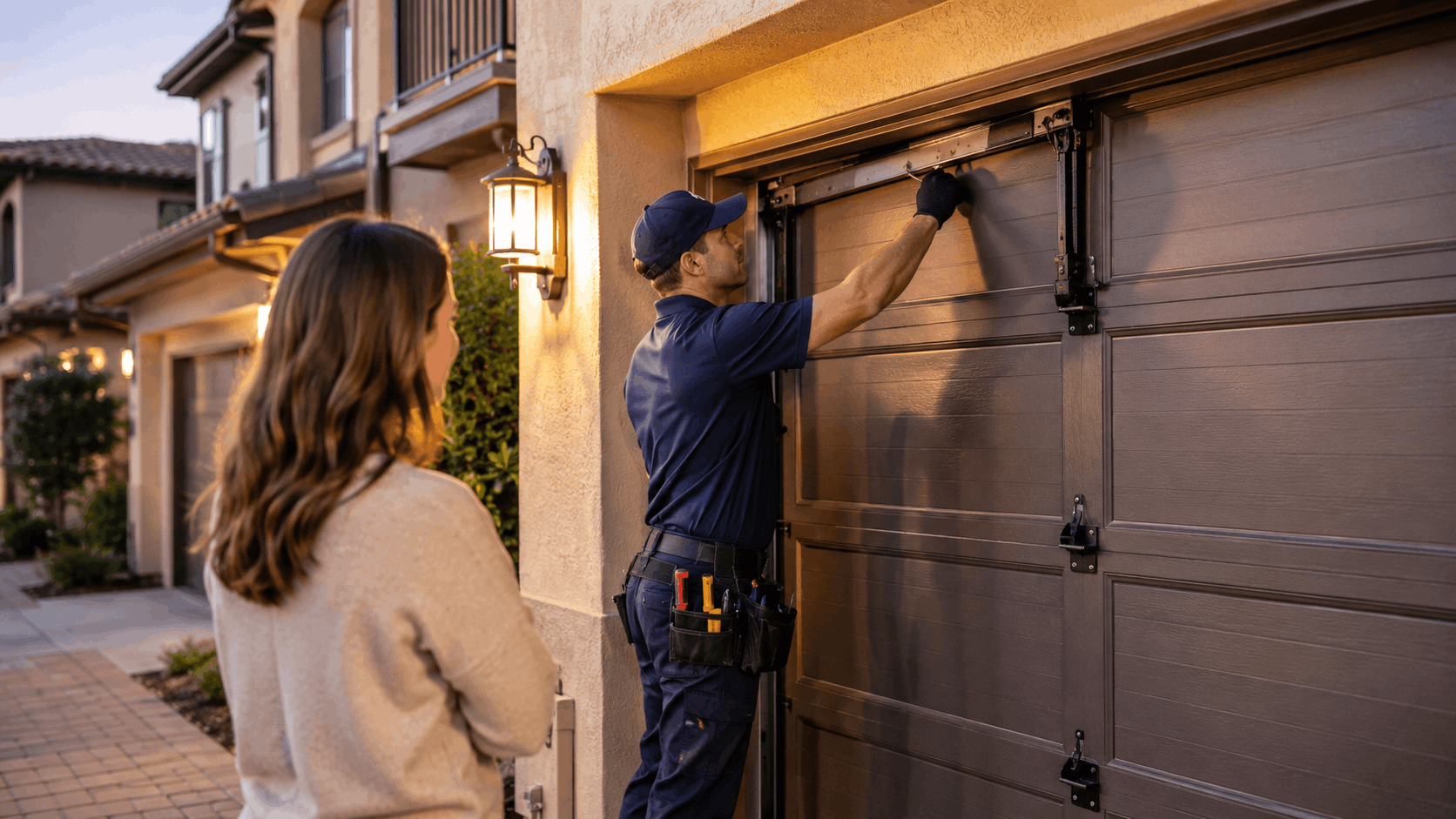
Emergency garage door repair in most cities is straightforward. You call, a truck shows up, and the crew gets to work in the driveway. In Irvine's master-planned villages, there are extra steps between the phone call and the first turn of a wrench.
These gated communities were built with controlled access, guard stations, and internal street loops that keep traffic calm and private. Those same features slow down any service call after dark. Add HOA quiet hours on top of that, and emergency garage door repair here takes planning that open neighborhoods never require.
How Master-Planned Communities Affect Response Time
Irvine villages were designed for privacy and order, which is great for daily living but tricky for urgent repairs. Many of them use guard gates, resident-only entrances, and winding internal streets that do not follow a simple grid. A truck cannot just pull up to the curb the way it would in an ungated tract.
Take Woodbridge as an example. The village wraps around two man-made lakes, and the internal roads curve and split in ways that confuse GPS. A guard gate at the entrance may need to verify a visitor before lifting the arm, and that verification can add several minutes when it is late and the booth is checking a guest list.
Oak Creek behaves similarly with its landscaped entries and interior loops. Our response time in these areas depends heavily on how quickly we clear the gate and find the right street. When homeowners share access details up front, we spend less time at the gate and more time on the failing door.
We have driven these streets for years, so our crews know that Alton Parkway feeds several village entrances and that certain cul-de-sacs near Barranca Parkway share one narrow access road. Local route knowledge matters as much as tools when the clock is running.
The Common After-Hours Failures We See
The calls that come in after dark tend to follow a pattern. A broken spring is the most frequent one. Torsion springs carry the entire weight of the door, and when one snaps, the door becomes far too heavy to lift by hand.
A snapped cable is another regular. When a cable frays and lets go, the door can hang crooked or jam in the tracks. That leaves the door stuck at an angle that no amount of button-pushing will fix.
Then there is the door stuck halfway problem. Sometimes it is a broken spring, sometimes a bad opener, and sometimes debris in the track. Whatever the cause, a door frozen partway is both a security gap and a trap for the car parked behind it. These are the three failures that pull our crews out after 10 p.m. most nights.
Why Homeowners Cannot Always Wait Until Morning
A stuck door is not just an inconvenience. It is a real security risk. A door frozen halfway open invites anyone walking by to look inside, and a home connected to the garage through an interior door is suddenly far easier to enter.
Then there is the trapped car problem. Plenty of Irvine residents leave early to beat traffic on the 405 or head north on Jamboree toward work. When the only car is locked behind a dead door, the whole morning falls apart before it starts.
That is why same-day repair, and often same-night service, matters so much here. Our team treats a jammed door as an urgent situation because it affects both safety and the next morning's routine. Waiting until business hours simply is not an option for many households. You can read more about our emergency garage door repair approach and how we prioritize these calls.
Get Your Free Quote
Tell us about your garage door and we'll get back to you within 30 to 60 minutes.
Getting Through the Gate: How Access Works in Irvine Communities
The single biggest delay in a gated-village call is the gate itself. Once our crew is past it, most repairs move quickly. So a large part of our protocol focuses on clearing that access point without wasted time.
Every village handles entry differently. Some use a keypad, some use a call box, and the upscale areas use a staffed guard booth with a guest list. Knowing which one applies to a given address lets us plan the approach before the truck even leaves.
| Access Type | Example Villages | What the Homeowner Should Provide |
|---|---|---|
| Keypad or PIN gate | Westpark, Oak Creek | Gate code or visitor PIN |
| Call box | Woodbridge, Northwood | Name listed at the call box |
| Staffed guard gate | Turtle Rock, Shady Canyon | Technician added to guest list |
| Shared driveway condo | Westpark, Oak Creek | Unit number and driveway directions |
Sharing a Gate Code or Visitor Pass Ahead of Time
When a homeowner books an emergency call, the fastest thing they can do is hand us the gate code during that first phone conversation. A four or six digit code at the entry keypad often gets our truck through in seconds instead of minutes.
Some villages use a rotating visitor PIN rather than a permanent code. If that is the case, the resident can generate one through the community app or front-desk system and read it to our dispatcher. We treat that number as private and use it only for the visit.
Other entrances rely on a call box where the technician dials a directory code and the homeowner buzzes the gate open remotely. In that setup, we just need the resident to keep their phone nearby and ready. A quick heads-up about which system is in place prevents the awkward scene of a truck idling at a gate it cannot open.
Guarded Entrances in Villages Like Turtle Rock and Shady Canyon
The upscale communities take access a step further with a staffed booth. In Turtle Rock, a guard often checks every non-resident vehicle against a list before raising the arm. If the technician is not on that list, the guard may refuse entry entirely, even during an emergency.
The fix is simple but has to happen in advance. The resident calls the guard station or uses the community portal to add our technician to the guest list for that night. Providing the crew member's name and the company name to the gate keeps things moving.
Shady Canyon runs one of the tightest security setups in the city, with a manned gate and strict logging of every visitor. We are used to this and will coordinate with the resident on exactly what the guard needs. For urgent night work in Turtle Rock, our emergency garage door repair in Turtle Rock service page covers how we handle these guarded entries.
The lesson from years of these calls is that the gate list is the bottleneck, not the repair. Handle the list first, and the rest goes smoothly.
Finding the Right Unit in Condo and Attached-Home Layouts
Attached homes and condos bring their own challenge. In Westpark, clusters of townhomes share interior loops and driveways that all look alike at night. A street address alone often is not enough to find the right garage.
A shared driveway can serve four or more units, and the garages may face an interior courtyard rather than the main street. Without a clear unit number and a quick note like "third garage on the left past the mailboxes," a crew can lose several minutes circling the complex.
Oak Creek has similar attached-home pockets where guest parking is limited and the garages tuck behind the main buildings. We ask for landmark directions because they beat GPS every time in these layouts. A porch light left on or a phone number to call on arrival speeds things up even more.
These details feel small, but at midnight they are the difference between a fifteen-minute arrival and a forty-minute one.
What We Bring So We Only Need One Trip Inside
Getting through a gate once is enough. Leaving to grab a part and coming back means clearing security all over again, so our trucks carry the common parts a job needs.
Each service truck stocks torsion springs in several sizes, replacement cables, rollers, hinges, and universal opener parts. We keep stocked parts for the door types common across Irvine villages, from the older sectional doors in the first neighborhoods to the heavier insulated doors in newer areas.
This lets us finish in one trip the large majority of the time. The crew can swap a broken spring, replace a snapped cable, and re-tension the door without ever leaving the property. Our spring and cable repair work almost always finishes on the first visit for this reason.
On the rare occasion a specialty panel or a discontinued opener board is needed, we secure the door and schedule a fast return. That plan keeps the home safe overnight without a second midnight gate crossing.
Need Help in Irvine?
Urgent Garage Doors serves Irvine and all of Orange County.
Association Quiet Hours and How They Shape a Late-Night Call
Gate access gets our crew in the door. Quiet hours decide what work we can actually do once we are there. Irvine associations take noise seriously, and we respect those rules on every call.
The goal is always the same: make the home safe tonight and finish any loud work at a time the HOA allows. Understanding the noise rules up front keeps our customers on good terms with their neighbors and their board.
Typical Quiet-Hour Windows Across Irvine Villages
Most Irvine associations set quiet hours that run overnight. A common range is 10 p.m. to 7 a.m., though the exact window varies from one village to the next. Some start at 9 p.m. on weeknights, and a few extend later on weekends.
These rules live in the association bylaws, and each board enforces them a little differently. Newer villages tend to have stricter language and quicker enforcement than the original neighborhoods built decades ago.
During the quiet-hour window, sustained loud noise like power tools or repeated door cycling can draw a complaint or a fine. We plan our late-night visits with that boundary in mind, so a repair never turns into an HOA headache for the homeowner.
Which Repairs Are Quiet and Which Ones Are Loud
Not every repair makes noise. A sensor alignment is nearly silent. Adjusting the photo-eye sensors at the base of the tracks takes a screwdriver and a few minutes, with no banging or grinding involved.
Other quiet tasks include tightening loose hardware, lubricating rollers, and resetting an opener. These keep the noise level low enough that they rarely bother anyone, even well after 10 p.m.
Then there are the loud jobs. A spring replacement involves winding bars, ratcheting, and testing the door through full cycles, which is far from quiet. Panel work and track hammering also carry across a quiet cul-de-sac. When a repair falls into the loud category during quiet hours, we shift our approach rather than push through and risk a complaint.
Securing the Door Now and Finishing Loud Work Later
Our standard move during quiet hours is a two-step plan. First we apply a temporary fix that makes the home safe for the night. That might mean manually lowering and locking a stuck door or securing a door with a broken spring so it cannot drop.
The point is to secure the door so the garage is closed, the car is protected, and the house is not exposed overnight. We can often do this quietly enough to respect the noise window while still solving the security problem right away.
Then we schedule a return visit during allowed hours, usually first thing the next morning after quiet hours lift, to complete the noisy work like spring winding or panel replacement. Homeowners get safety tonight and a proper fix at a neighbor-friendly hour. It is a balance that keeps everyone happy.
Checking Village-Specific Rules in Woodbury and Portola Springs
Newer villages run tighter ships. Woodbury and Portola Springs were built more recently with active associations that watch noise and visitor activity closely. Their bylaws often spell out quiet hours in detail and back them with real fines.
Before starting loud work in these areas, we confirm the rules with the homeowner or, when needed, check the posted community guidelines. We would rather ask first than trigger HOA enforcement after the fact.
Our familiarity with these communities helps here. We have handled enough calls in Portola Springs emergency garage door repair to know how their gates and noise rules work together. That local knowledge lets us plan a visit that respects the association from the first minute.
Every village is a little different, and treating them the same is how out-of-town companies end up with unhappy customers and angry boards.
Our Emergency Repair Protocol, Step by Step
Behind every fast, clean repair is a repeatable process. Our repair protocol runs the same way whether the call comes from Northwood at noon or Turtle Rock at midnight. Consistency is what keeps the emergency process smooth for the homeowner.
Here is the step by step path a call takes from the first ring to the moment our truck pulls away.
| Step | What Happens | What We Need From You |
|---|---|---|
| 1. Intake call | We gather symptoms, door type, and gate access | Gate code, address, problem description |
| 2. Arrival and diagnosis | Quiet approach, safety check, inspection | Clear path to the garage |
| 3. Upfront pricing | Written quote and your approval | A yes before we start |
| 4. Repair and testing | Fix, cycle test, balance check, cleanup | Nothing - we handle it |
The Intake Call and Access Questions We Ask
The intake call sets up everything that follows. Our dispatcher asks about the door symptoms first: Is the door stuck open or closed? Did you hear a loud bang? Is the car trapped inside?
Those answers tell us what likely broke. A loud bang usually means a spring. A door hanging crooked points to a cable. This lets the crew load the right parts before leaving the shop.
Then come the access questions. We ask about the gate type, the code or guest-list process, the unit number for condos, and where to park. Gathering all of it in one call means the crew arrives ready to work rather than ready to troubleshoot the gate.
We also confirm the opener brand and door age when the homeowner knows them, which helps us match parts on the first trip.
Arrival, Safety Check, and On-Site Diagnosis
Our crews arrive with a quiet approach, especially during evening hours. No slamming doors or revving engines in a sleeping cul-de-sac. The first thing on site is a safety check of the whole system.
The technician inspects the torsion spring, the cables, the rollers, the tracks, and the opener. A broken spring is obvious, but we look for the secondary damage too, like a bent track or a frayed second cable that is about to go.
Once the inspection is done, the technician gives a plain-language diagnosis. No jargon dumped on a stressed homeowner at midnight. Just a clear explanation of what failed, why, and what it takes to fix it. If the issue is a door that won't open or close, we walk through the exact cause before quoting anything.
Upfront Pricing Before Any Work Starts
Nobody likes surprise charges, least of all at night. We give upfront pricing in the form of a written quote before the crew touches the door. The homeowner sees the parts, the labor, and the total in one place.
That quote is the number the customer pays. We do not tack on hidden after-hours markups once the work is done. What we say at the door is what shows up on the invoice, with no surprise fees.
Only after the homeowner approves the quote does the repair begin. If someone wants to think it over or compare, that is fine. We would rather have an informed customer than a rushed one. This approach has earned repeat business across Northwood, Woodbridge, and beyond.
Repair, Testing, and Cleanup Before We Leave
With approval in hand, the crew makes the repair. For a spring, that means removing the broken one, installing a properly sized replacement, and winding it to the correct tension. For a cable, it means threading and seating a new one on both sides.
Then comes testing. We run a full cycle test, opening and closing the door several times to confirm smooth travel. We also do a balance check by lifting the door halfway to make sure it holds without drifting up or down.
Last is cleanup. We collect the old parts, sweep up any debris, and clear the shared driveway so the neighbors wake up to a clean space. A proper door balancing and tension adjustment is part of every spring job so the new part lasts. The truck leaves the site as tidy as we found it.
Need Help in Irvine?
Urgent Garage Doors serves Irvine and all of Orange County.
The Repairs We Handle Most in Irvine Neighborhoods
After years of garage door repair across the city, the same handful of problems show up again and again. Recognizing your situation in this list can help you describe it clearly when you call.
From a broken spring in an older Northwood home to an opener repair in a new Great Park townhome, here are the emergencies we see most.
Broken Torsion Springs and Snapped Cables
A torsion spring is the workhorse of the door. It winds and unwinds every time the door moves, and a typical spring is rated for around 10,000 cycles. A busy family that opens the door six or eight times a day can burn through that in five to seven years.
When the spring snaps, the door loses its counterweight and becomes a heavy slab. Trying to lift it by hand can strain your back or pinch fingers. This is why we warn homeowners against a DIY risk with springs.
Winding bars under tension can whip loose and cause serious injury if handled wrong. Cable repair carries similar dangers because a loaded cable stores a lot of energy. Our torsion spring replacement service handles the tension safely with the right tools.
Off-Track Doors and Bent Panels
An off-track door is a common sight in busy garages. It usually happens one of two ways. Someone backs a car into the door, or the rollers wear out and pop free of the track.
We see this a lot in Northwood and Woodbridge, where households run multiple vehicles in and out all day. A door that has jumped its track hangs crooked and can jam completely if forced.
Sometimes the impact also leaves a bent panel. A dented section can bind against the frame or throw off the door's alignment. Depending on the damage, we either straighten it or replace the affected panel. Our off-track garage door repair gets the door back on its rails and moving straight.
Opener and Motor Failures After Power Issues
Openers fail for their own set of reasons. A power surge from a storm or a grid blip can fry the opener's circuit board in an instant. One day the remote works, the next day nothing happens.
Motor failure also comes with age. Older openers wear down their gears and motors after a decade or more of daily use. A grinding sound or a door that starts and stops is often the warning sign.
Homes in western Irvine closer to the coast deal with humidity that can corrode contacts and shorten electronics life. When the opener is the culprit, our opener repair and troubleshooting pinpoints whether it is a board, a gear, or wiring. Sometimes an upgrade to a new smart unit makes more sense than repairing an aging one.
Sensor and Safety-Reverse Problems
The two little sensors near the floor cause more service calls than people expect. These photo-eye sensor units send an invisible beam across the opening. If the beam is broken or the sensors fall out of line, the door refuses to close.
You will usually see a blinking light on the opener and a door that starts down then reverses. That is the safety reverse feature doing its job, just triggered by a misaligned eye rather than a real obstruction.
Most of the time the fix is a quick alignment of the two sensors until their lights go solid. It is one of the quietest repairs we do, which makes it ideal for late-night calls during quiet hours. Our safety sensor alignment repair gets a stubborn door closing again in minutes.
How Irvine's Climate and Home Ages Affect Garage Doors
Where a home sits in Irvine tells us a lot about the wear we will find. The Irvine climate ranges from salty coastal air in the west to dry inland heat in the east. Combine that with homes built across five decades, and you get very different failure patterns.
Understanding the local conditions helps our team predict what parts to bring and what door wear to expect before we arrive.
Salt Air and Humidity Near the Coast
The western edge of Irvine sits close enough to the ocean to catch salt air. That moisture drifts inland on the marine layer most mornings. Over time it settles on metal parts and speeds up rust.
We see more corrosion on springs, hinges, and tracks in these areas. A spring that might last seven years inland can show rust and fail earlier when it breathes salty coastal humidity every morning.
The hardware takes the same hit. Bolts seize, rollers stiffen, and cable ends fray sooner. For coastal-side homes, we often recommend galvanized or coated parts that resist the salt better. A little extra rust protection goes a long way this close to the water.
Older Homes in Original Villages Like El Camino Real
El Camino Real is one of Irvine's first villages, and the homes there have been through a lot of door cycles. These older homes often still run original single-piece or early sectional doors that are heavier and less forgiving than modern ones.
The wear shows up in predictable spots. Springs fatigued from decades of use, tracks worn thin, and an aging opener that predates modern safety features. Some of these openers lack the reversing sensors that became standard in the early 1990s.
When we service these homes, we check the whole system rather than just the broken part. A 25-year-old opener that fails is often worth replacing outright. We help homeowners decide between a targeted repair and a full garage door installation when the door itself is at the end of its life.
Newer Construction in Great Park and Eastern Villages
The eastern villages tell a different story. Great Park and Cypress Village homes are recent builds with modern equipment. Many came with a smart opener that connects to Wi-Fi and a phone app right out of the box.
These homes also tend to have heavier insulated door panels. The extra weight is great for temperature control and quiet operation, but it puts more load on the springs and opener. A spring sized wrong for that weight will fail early.
When these newer systems act up, the issue is often electronic rather than mechanical. A firmware glitch, a Wi-Fi dropout, or a paired remote gone bad. Our team handles both sides, from a smart Wi-Fi opener and myQ setup to the heavier hardware these doors demand.
Santa Ana Winds and Sudden Temperature Swings
Fall and winter bring the Santa Ana winds roaring through the canyons. These hot, dry winds push hard against garage doors and drive dust into the tracks and rollers. A door that was smooth in summer can start binding once the winds arrive.
The temperature swings add another strain. A cool morning followed by a hot afternoon makes metal expand and contract. Over many cycles, that movement loosens hardware and shifts the door out of alignment.
Both effects throw off door balance. A door out of balance forces the opener to work harder and wears out the spring sooner. A seasonal tune-up before the windy months keeps the door running smoothly. Our preventive maintenance plan catches these balance problems before they turn into a midnight emergency.
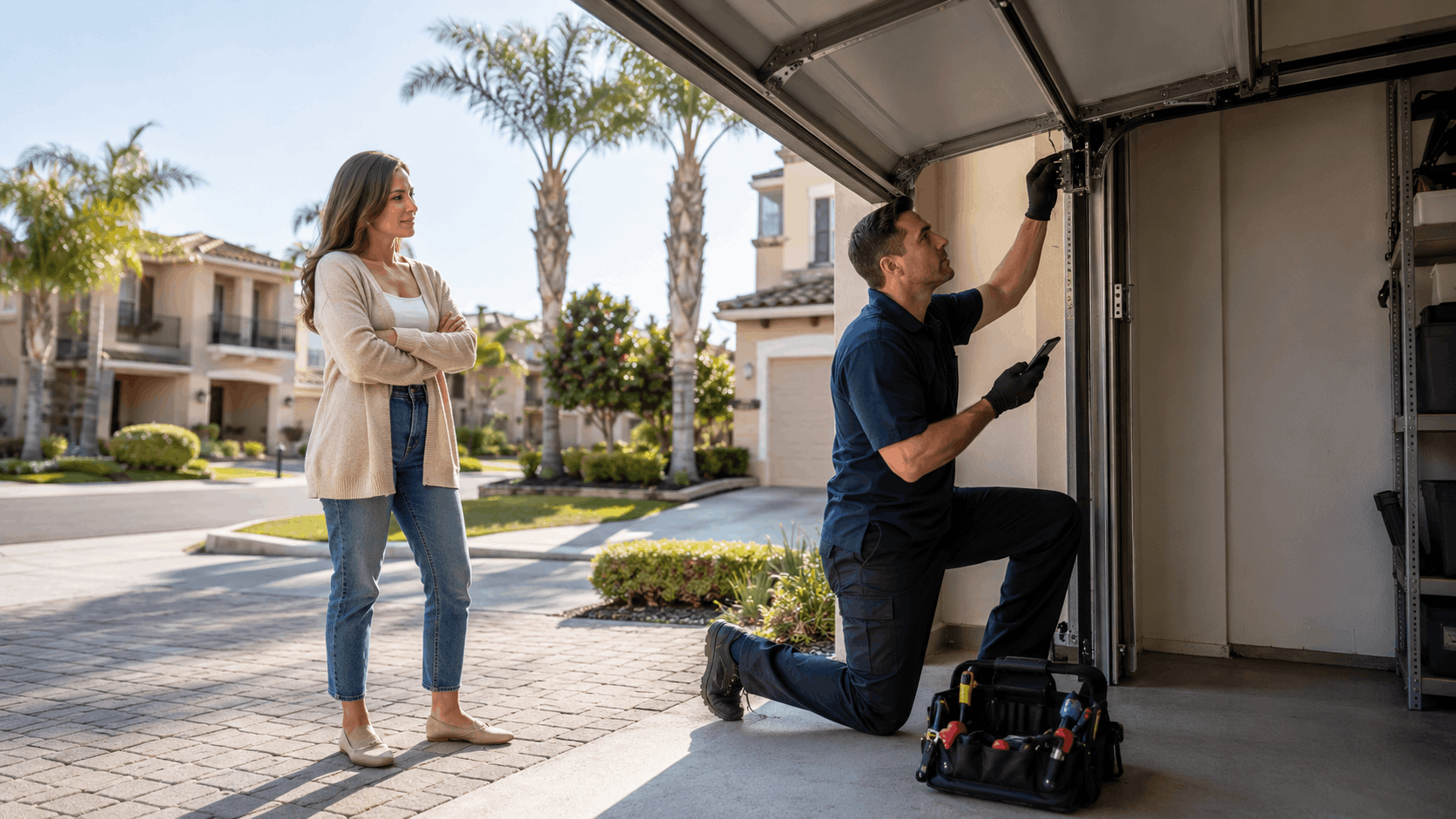
Need Help in Irvine?
Urgent Garage Doors serves Irvine and all of Orange County.
What Homeowners Can Do Before Our Truck Arrives
Waiting for a crew feels helpless, but there are safe steps residents can take. These homeowner tips keep everyone safe and help the repair go smoothly once we arrive.
The focus is always garage door safety first. None of these emergency steps involve tools or force. They are about staying clear of danger and gathering useful information.
Keeping People and Cars Away From a Failing Door
A door with a broken spring is a hazard. Without the spring's counterweight, the only thing holding the door up may be the opener or a strained cable. If that lets go, the door can slam down with tremendous force.
So the first step is to create a safety zone. Keep children and pets out of the garage entirely. Do not park a car under a door that is hanging halfway or looks off balance.
A falling door can crush a car hood or worse. If the door is stuck open, resist the urge to walk under it repeatedly to grab things. Wait for the crew, who can lock it in place safely before anyone moves through the opening.
When to Pull the Emergency Release Cord
Every opener has a red emergency release cord hanging from the trolley. Pulling it disconnects the door from the opener and puts it into manual mode so you can move it by hand.
The red cord is helpful when the opener is the problem and the door is otherwise balanced. In that case, you can pull it, lift the door, get the car out, and lower it back down.
But here is the warning. If the spring is broken, do not pull the release and try to lift the door. Without the spring, that door is dangerously heavy and can crash down. When in doubt, leave the cord alone and let the crew assess it first.
Gathering Gate Access and Model Details for the Crew
While waiting, a homeowner can gather a few details that speed up the visit. Start with gate access: the code, PIN, or the name to leave at the guard booth. Having that ready means the truck rolls straight in.
Next, note the opener brand stamped on the motor unit. Brands like LiftMaster, Chamberlain, or Genie each use different parts and remotes. Telling us the brand helps the crew bring the right components.
Finally, check for any error codes. Many openers flash a pattern of lights or show a code that points to the exact fault. Reading that pattern to our dispatcher can narrow down the problem before the truck even arrives. A quick photo of the door and opener helps too.
Final Thoughts
A broken garage door in a gated Irvine village involves more than a snapped spring. It involves a gate to clear, a guard list to join, and quiet hours to respect. Our protocol is built around all three so the repair goes smoothly no matter the neighborhood.
Share your gate access when you call, keep people away from a failing door, and let our stocked trucks handle the rest. From Woodbridge to Turtle Rock to Portola Springs, we know these communities and how to work within their rules.
If your door has failed and your car is trapped, reach out to our team any time. Call Urgent Garage Doors or contact us here for fast, honest emergency service across every Irvine village.
Frequently Asked Questions
- How fast can a technician reach a gated Irvine village?
- Emergency calls get our 30 to 60 minute response, and gate access details help the technician reach the door. The biggest variable is the gate. When a homeowner shares the gate code, visitor PIN, or guest-list name during the intake call, we clear the entrance without delay and shave real minutes off the arrival time at a gated village address.
- Do I need to give a gate code before the technician arrives?
- It helps a great deal. If your village uses a keypad, share the gate code or visitor pass PIN when you book so our truck rolls straight in. If a staffed guard controls entry, you will need to add our technician to the guest list by name in advance. You can read the code to our dispatcher on the phone, and we treat that number as private and use it only for your visit.
- Can loud repairs be done during HOA quiet hours?
- Usually not, and we respect that. During quiet hours , often 10 p.m. to 7 a.m., we do the quiet work like sensor alignment and secure the door so your home is safe overnight. Louder jobs such as spring winding or panel replacement are scheduled for the next allowed window. This keeps you within the association's noise limits and avoids complaints or fines from neighbors and the board.
- What counts as a garage door emergency?
- An emergency is anything that leaves your home unsafe or your day stalled. A trapped car behind a dead door, a door stuck open that exposes your home overnight, or a door that dropped and jammed all qualify. A broken spring or snapped cable also counts because the door cannot operate safely. If your security or morning commute is at risk, treat it as urgent and call.
- How much does emergency garage door repair cost in Irvine?
- Costs vary by the part and the job, but common repairs give a useful price range . A single torsion spring replacement often runs a few hundred dollars, cable repairs are typically lower, and opener repairs depend on the fault. After-hours service may carry a modest fee. Whatever the repair cost , you get a written quote and approve it before we touch the door, with no surprise charges.
- Can a broken spring be repaired the same night?
- Often yes. Our trucks carry torsion springs in common sizes, so a broken spring can usually be replaced the same night we arrive. The exception is quiet hours. Spring winding is loud, so if the failure happens late at night in a strict HOA village, we secure the door safely and return first thing in the morning to finish the noisy part within allowed hours.
- Is it safe to use the door with a broken spring or cable?
- No. A door with a broken spring or broken cable has lost its counterbalance and can weigh well over a hundred pounds. Trying to lift or run it can cause the door to crash down and damage a car or injure someone. For your own safety , keep people and vehicles clear, do not force the door, and wait for our crew to handle it properly.
- Do you work with condo and attached-home HOAs?
- Yes. We handle plenty of calls in condo HOA communities like Westpark and Oak Creek. We know how shared driveways, interior loops, and guest parking work in those layouts, and we ask for a unit number and quick directions so we find the right garage fast. We also respect the association's noise and access rules just as we would in any single-family village.
- What should I have ready when I call?
- Have your call info handy so we can dispatch the right parts. That means your full address and unit number, the gate code or guest-list details, and a clear description of the problem. If you can, tell us the opener brand stamped on the motor and any flashing error code. A quick note on whether the car is trapped helps us prioritize your call correctly.
- Do you service all Irvine villages?
- Yes. Our service area covers the full range of Irvine villages , from Woodbridge and Northwood to Turtle Rock, Great Park, Woodbury, and Portola Springs. We serve the original neighborhoods with older doors and the newest eastern communities with smart openers and insulated panels. You can view our full Irvine service area to confirm coverage for your specific village. For deeper reading on door safety, the U.S. Consumer Product Safety Commission and the International Door Association both publish helpful guidance.
Licensed garage door repair professionals serving Irvine and Orange County.
Licensed in California · License #1055150
Why trust Urgent Garage Doors?
Founded in 2017, Urgent Garage Doors is a licensed and insured garage door services serving Irvine and Orange County. All content is reviewed by our licensed technicians.

Need Help in Irvine?
Urgent Garage Doors serves Irvine and all of Orange County.
Related Articles
Coto de Caza Garage Door Repair: Custom Estate Doors and Emergency Service
Skilled garage door repair for Coto de Caza estates - custom wood door restoration, emergency service through the gate, spring and opener replacement, and local maintenance.
Emergency Garage Door Repair in Newport Coast: Same-Day Service for Pelican Hill and Crystal Cove
A local guide to emergency garage door repair in Newport Coast, covering common failures, same-day service for Pelican Hill and Crystal Cove, costs, and prevention.
Turtle Rock Irvine Garage Door Repair: Why HOA Approval Affects Color and Style
Learn why Turtle Rock Irvine garage door repair often involves HOA approval, how color and style rules work, and how to stay compliant before you fix or replace your door.