Garage Door Cable Drums and Fraying: The 2-Minute Monthly Look That Prevents the Snap
Key Takeaways
- A garage door weighs 150 to 300 pounds, and the cables, drums, and springs share that load together, so one weak part strains the whole system.
- A frayed cable can snap with a loud bang, drop the door, and injure people, pets, or damage cars parked below.
- The two-minute monthly look is done with the door closed and opener unplugged, scanning both cables for rust, fraying, and loose drum wraps.
- Broken wire strands or fish hooks mean stop using the door immediately and call for repair, since the cable can snap within days.
- Irvine's marine layer and coastal moisture near Turtle Rock and Quail Hill speed up cable rust, and busy Woodbridge and Great Park homes wear out cables sooner with heavy daily use.
- Cables are always replaced in matched pairs, and worn or cracked drums are swapped rather than reused.
- Cable and spring work is not a DIY job because of the dangerous stored tension and the need for winding bars and specialty tools.
- Clean tracks, twice-yearly balance tests, and a yearly professional tune-up extend cable and drum life significantly.
In This Article
It usually happens on a quiet morning in Irvine. A homeowner near Turtle Rock hits the button to leave for work, hears a loud bang from the garage, and watches the door hang crooked halfway down. That sound is often a cable letting go, and it almost never gives a warning the day it breaks.
The good news is that most cable failures leave clues for weeks or months before they snap. A frayed strand here, a little rust there, a wrap of cable slipping off a drum. If someone knows what to look for, those clues are easy to spot.
What Garage Door Cables and Cable Drums Actually Do
Before anyone can inspect a system, it helps to know the parts. A garage door is heavier than most people guess, often 150 to 300 pounds. It does not lift on muscle alone, and the opener is not doing the heavy work either.
The real lifting comes from a balanced team of springs, cables, and drums. When one part weakens, the whole team feels it. Here is a plain-language look at who does what.
| Part | Job | Where It Sits |
|---|---|---|
| Torsion springs | Store energy to counter the door's weight | On a shaft above the door |
| Cable drums | Wind and unwind the cables as the door moves | At each end of the torsion shaft |
| Lift cables | Carry the door's weight to the drums | Along both sides, bottom to top |
How the Lift Cables Carry the Door's Weight
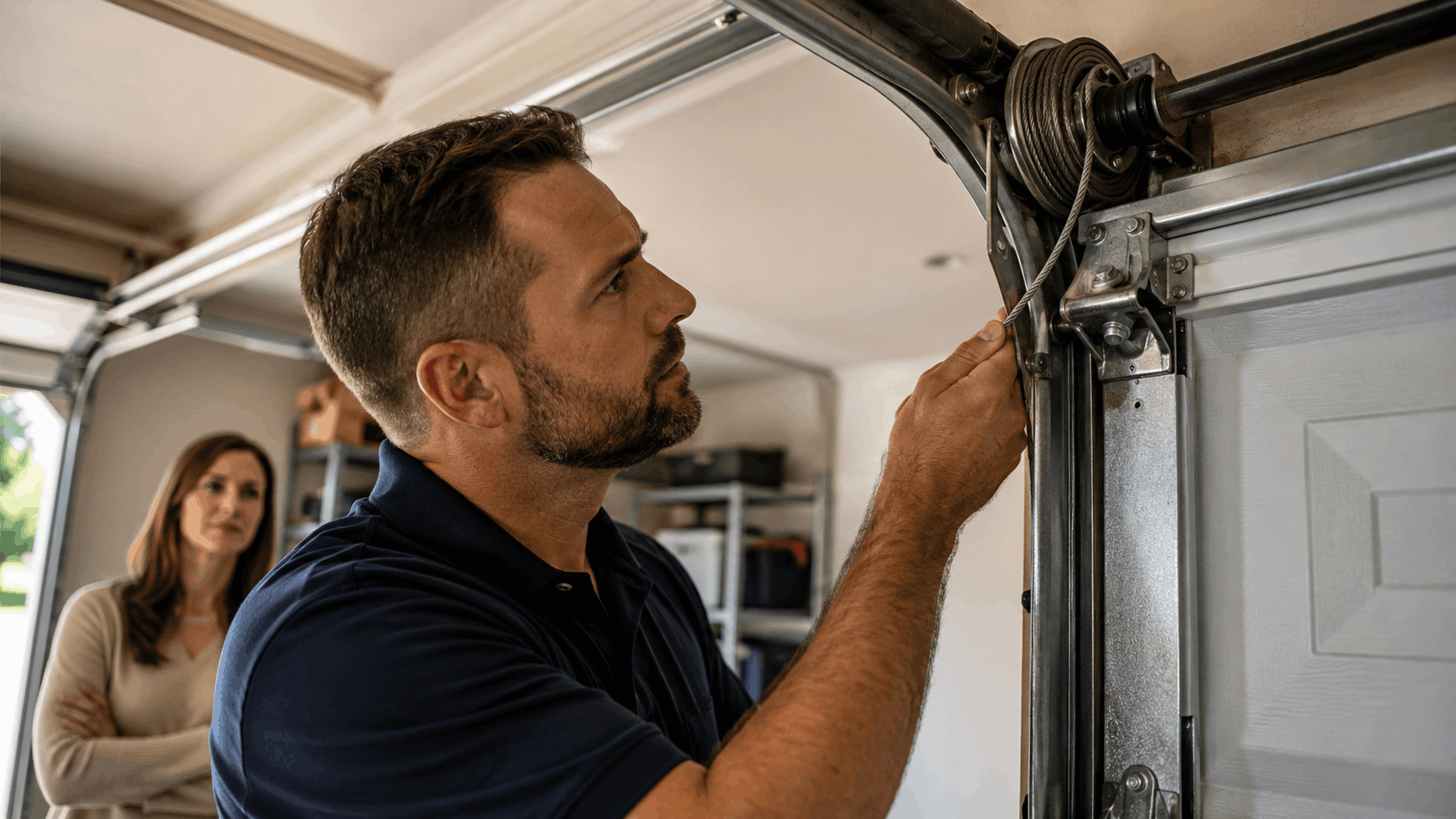
The lift cables are thin steel ropes, usually about an eighth of an inch thick. They run from a bracket at the bottom corner of the door up to the drum near the ceiling. Each cable is doing serious work, holding half of the door's weight under constant tension.
Think of them like the two ropes on a heavy elevator. When the door is closed, the cables are stretched tight and wound low on the drums. As the door opens, they wind up and take slack.
Because these cables hold hundreds of pounds of tension all day, any weak spot matters. A single strand starting to break is the first sign that the whole cable is under stress it cannot handle. That is why the cables get the closest look during a monthly check.
We see these steel cables handle tens of thousands of cycles over their life. But rust, grit, and a rough drum edge can chew through them long before that. The cable is often the first part to fail in the entire system.
Where the Drums Sit and Why the Winding Matters
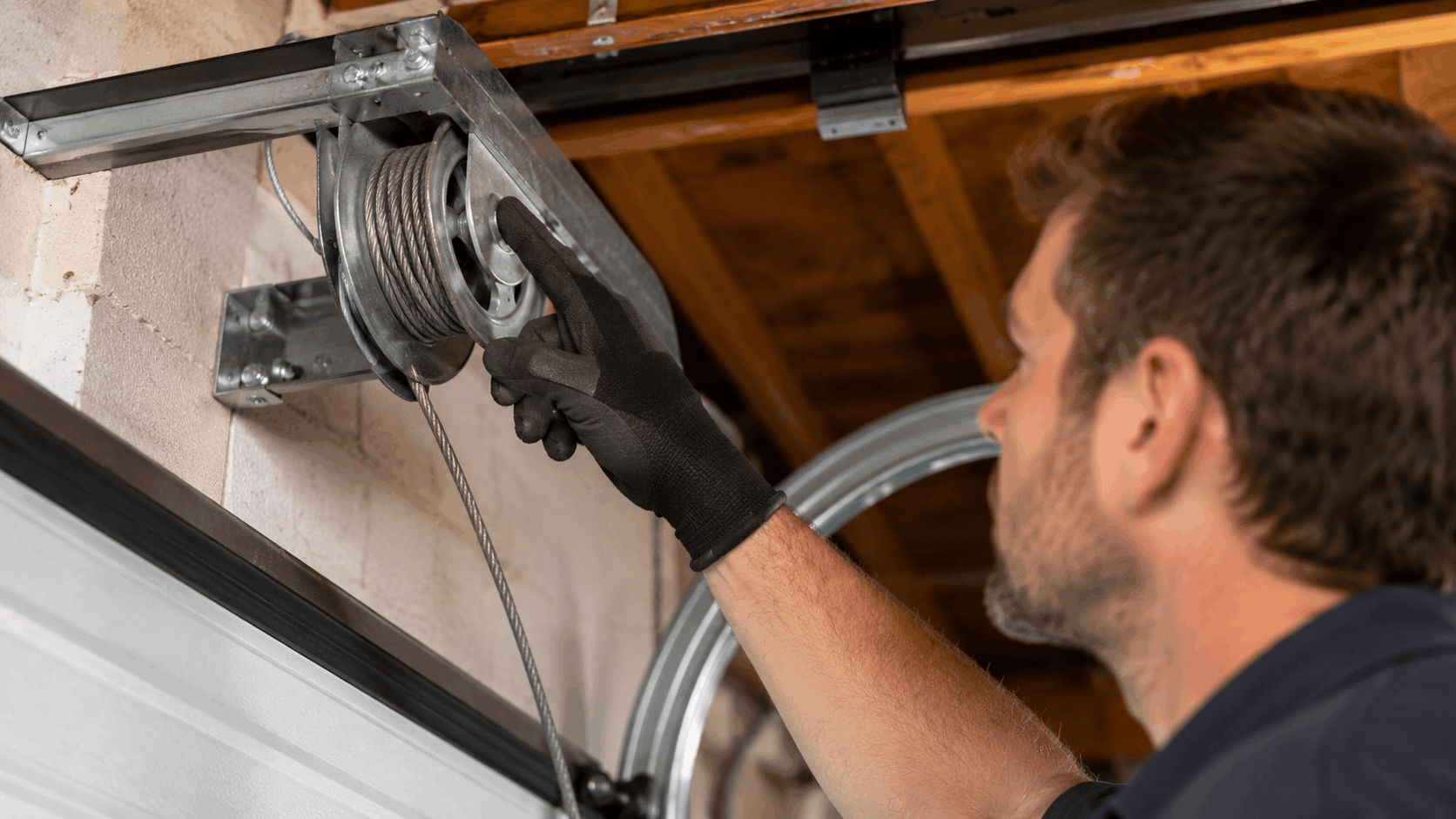
The cable drums are round grooved wheels mounted at each end of the torsion shaft. That shaft is the metal bar running across the top of the door. When the springs turn the shaft, the drums turn with it.
Each drum has a spiral groove machined into it. The cable sits in that groove and wraps neatly, one loop stacked next to the last. When everything is right, the cable climbs the drum in a clean, even spiral with no gaps and no overlap.
The cable grooves are what keep the door tracking straight. If a cable jumps its groove or wraps over itself, one side of the door will rise ahead of the other. That is when doors start hanging crooked or jamming in the tracks.
Drums are matched to the door's height and weight. A taller door needs a drum with more groove length to hold more cable. Using the wrong drum is a common mistake we find on doors that were repaired by someone in a hurry.
How Springs, Drums, and Cables Share the Load
The springs, drums, and cables work as one system. The torsion springs store the energy. The drums transfer that energy. The cables deliver it to the door. Take any one out and the other two cannot do their job.
When the load balance is right, the door feels almost weightless. The opener only has to nudge it. A properly balanced door will hold still halfway open without drifting up or down.
When one part weakens, the balance shifts and the other parts pick up strain they were not built for. A stretched cable makes a spring work harder. A worn drum makes a cable fray sooner. This is why a small problem in one spot ages the whole garage door system.
If you want a deeper look at how these parts connect, our spring and cable repair page covers the full assembly. Knowing how the load is shared makes the monthly inspection much more useful.
Get Your Free Quote
Tell us about your garage door and we'll get back to you within 30 to 60 minutes.
Why Fraying Cables Are Dangerous
A frayed cable is not just a maintenance chore to put off. It is a part under heavy tension that is slowly losing strength. When it finally gives, it does so fast and hard.
For Irvine families with kids, cars, and pets moving through the garage daily, a cable snap is a real safety concern. Understanding what happens when one fails makes the case for that two-minute look pretty clear.
The Sudden Snap and What It Sounds Like
Almost every homeowner who calls us about a broken cable describes the same thing. A loud bang, like a firecracker or a gunshot, coming from the garage. Sometimes they think something fell off a shelf.
The cable snap sound comes from all that stored tension releasing at once. One second the cable is holding hundreds of pounds, the next it is whipping loose. That energy has to go somewhere.
Right after the bang, the door usually looks wrong. It hangs crooked, with one bottom corner lower than the other. The broken cable side drops while the good side holds, leaving the door twisted in the tracks.
Some folks do not hear the snap at all and just find a crooked door the next morning. Either way, a door in that state should not be operated until a technician looks at it.
Risk to People, Cars, and Pets
The biggest danger is a door falling. When both cables fail, or a cable failure lets the door slip its tracks, the full weight can come down. That is 150 to 300 pounds dropping fast.
A falling door can crush the roof or hood of a car parked in the driveway or bay. We have seen dented cars and shattered rear windows from doors that came down on them. That is real property damage, not a minor fix.
The safety risk to people is worse. A child reaching under a door, a pet walking through, or an adult bending down at the wrong moment can be hurt badly. A door coming down with that force does not stop for a person.
This is why we treat cable calls as urgent. If a door is behaving strangely after a bang, keep people and pets away from it and reach out for emergency garage door repair right away.
How One Broken Cable Strains Everything Else
A single broken cable does more than stop the door. It throws off the door balance completely. Now one side is supported and the other is not, which twists the frame and the tracks.
That imbalance puts opener strain into the picture. The opener was built to guide a balanced door, not lift a lopsided one. Forcing it to keep working can burn out the motor or strip the gears in a matter of days.
The remaining good cable also suffers. It now carries load it was never meant to hold alone, which speeds up uneven wear and can make it the next part to break. One failure quickly becomes two.
Rollers, hinges, and the track itself take extra abuse too. What starts as a fifty dollar cable can turn into a much larger repair if the door keeps getting used. Stopping early keeps the damage small.
Need Help in Irvine?
Urgent Garage Doors serves Irvine and all of Orange County.
The 2-Minute Monthly Look: Step by Step
Here is the routine we teach every homeowner we visit. It takes about two minutes and needs no tools. The goal is a monthly inspection that catches problems while they are still cheap to fix.
This cable check is purely visual. You are looking and listening, not touching or adjusting anything under tension. Done once a month, it is one of the simplest pieces of garage door maintenance out there.
Start With the Door Down and Power Off
Always start with the door fully closed. When the door is down, the cables are stretched tight and easy to see along their full length. An open door hides most of the cable inside the coiled drum.
Next, unplug the opener or flip its breaker off. With the opener unplugged, there is no chance the door starts moving while you are looking at it. This is the single most important safety step.
A closed door with the power off means you can stand near the cables safely. Never put your hands near the springs or drums during this look. You are only using your eyes for the inspection.
Give yourself good light too. A phone flashlight works fine to see the cable near the bottom bracket and up along the track. Two minutes of clear viewing beats a rushed glance in the dark.
Run Your Eyes Along Each Cable
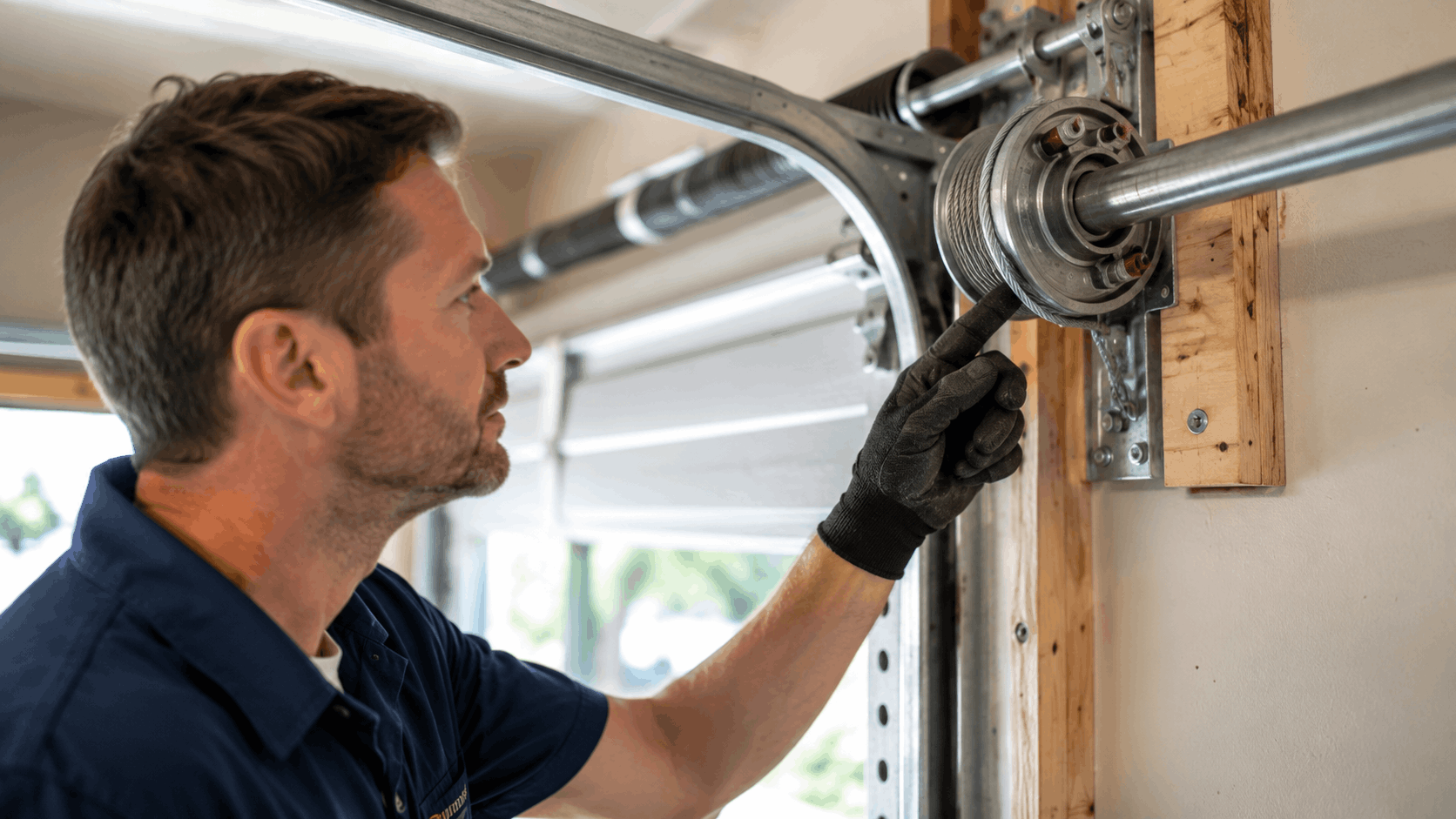
Start at the bottom bracket where the cable attaches to the door. Do a slow visual check up the cable toward the drum. Do this on both the left and right sides, since they wear differently.
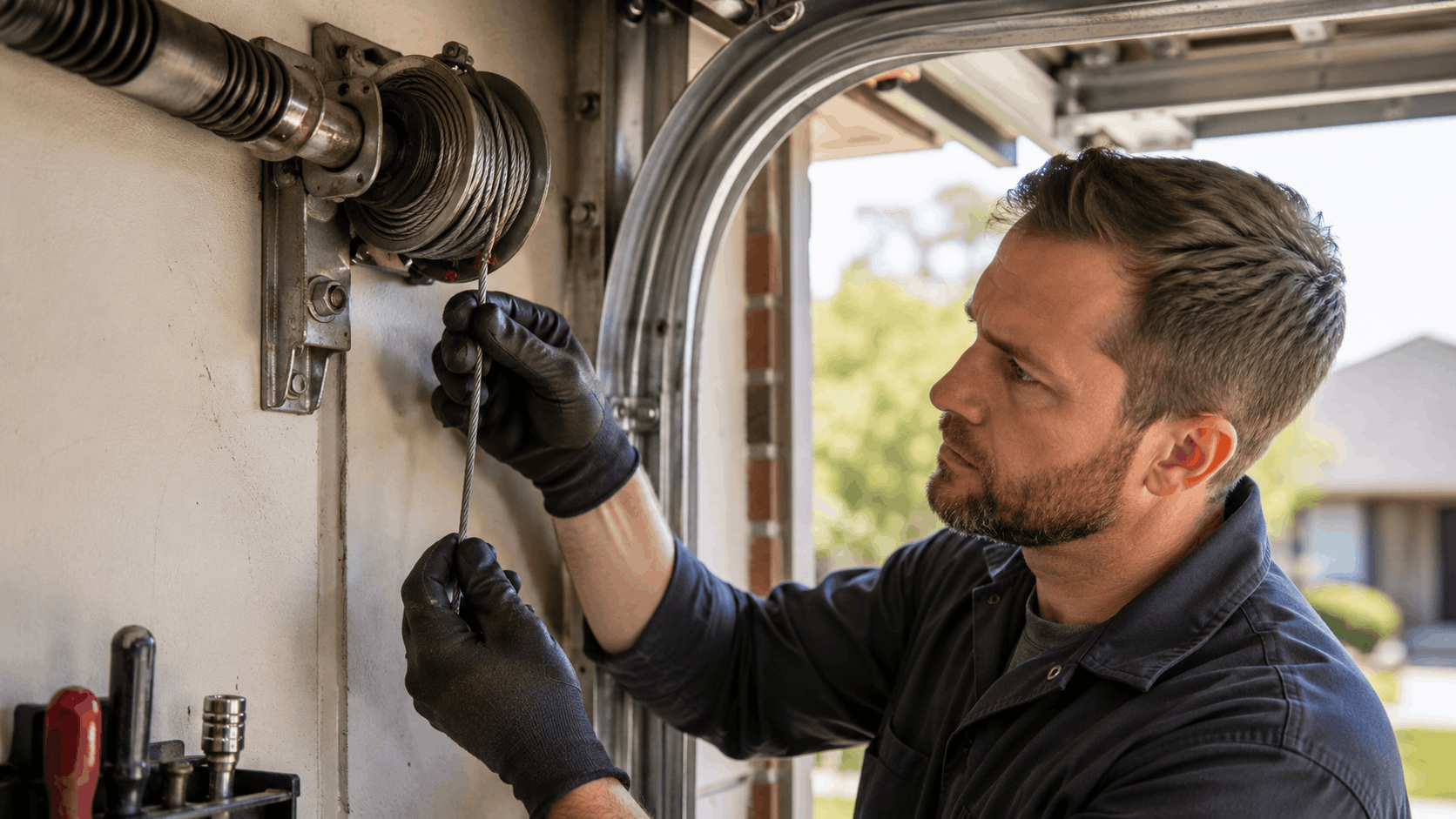
Look for rust first. In Irvine's coastal air, rust often shows as orange or brown discoloration on the steel. Rusty cables lose strength and fray sooner, so any rust is worth noting.
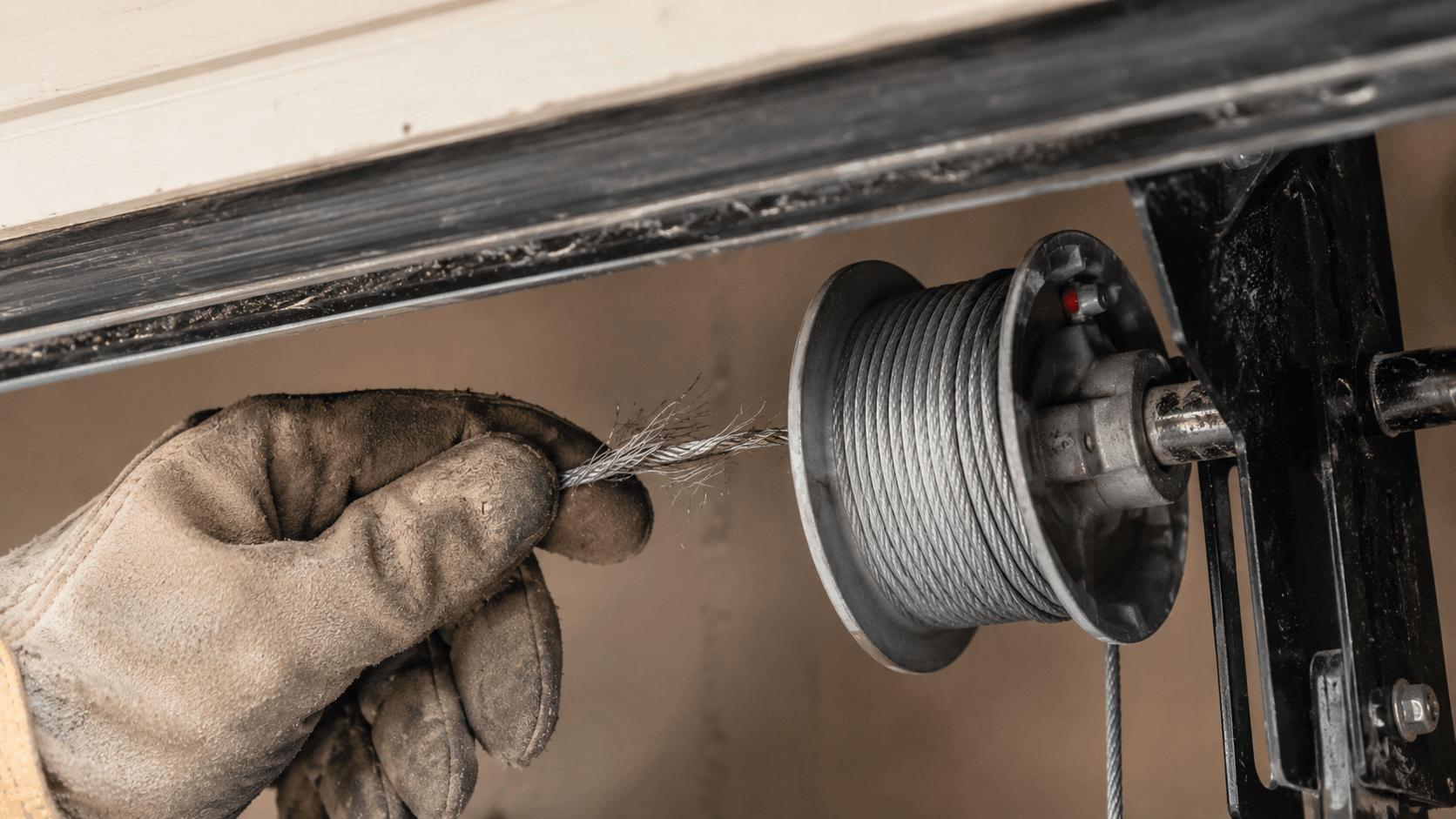
Then look for loose strands. A healthy cable is smooth and tight. If you see frizzy wires, tiny broken pieces sticking out, or a spot that looks thinner than the rest, the cable is failing.
Kinks and flat spots matter too. A cable that got pinched or jumped a groove may have a bent section. Any of these signs means it is time to stop using the door and book a garage door cable repair.
Check the Drums for Loose or Slipping Wraps
Now look up at the drums at each end of the shaft. A good drum check takes just a few seconds per side. You want to see the cable wrapped neatly in the grooves.
A properly wound drum has the cable stacked in a tidy spiral. Each loop sits snug in its groove with no gaps. The cable should look tight against the drum, not sagging.
A loose wrap is a red flag. If the cable looks slack, has gaps between loops, or you can see space where it should be tight, the winding has slipped. That often shows up as a door that closes crooked.
Cable overlap is another problem. If the cable rides up over itself instead of staying in its groove, it will wear fast and can jump off entirely. Any drum that does not look clean and even needs a professional to inspect it.
Watch the Door Move for Even Travel
Once the visual look is done, plug the opener back in and run the door up and down once. Stand back and watch how it moves. Smooth door travel is a good sign.
Watch for a jerking motion. If the door hesitates, stutters, or moves in small jumps, a cable or drum may be catching. A healthy door glides in one continuous motion.
Look for a tilting door as well. If one side rises ahead or the bottom edge is not level as it moves, one cable is slipping or stretched. That uneven travel points straight at a cable issue.
Also listen. New grinding, popping, or scraping noises during travel are worth investigating. If anything looks or sounds off, our door balancing and tension adjustment service can set it right.
Warning Signs You Should Never Ignore
Some cable issues are minor and can wait for a scheduled tune-up. Others mean stop using the door today. Knowing the difference protects both your family and your wallet.
These are the warning signs we tell every Irvine homeowner to watch for. When these garage door problems show up, the smart move is to stop and call a pro. Here is a quick reference.
| Warning Sign | What It Means | Action |
|---|---|---|
| Broken wire strands | Cable is losing strength | Stop use, call now |
| Crooked or sticking door | Slipping or stretched cable | Stop use, call soon |
| Grinding or popping | Drum or cable trouble | Inspect right away |
| Light surface rust | Early wear | Monitor, plan service |
Broken Wire Strands and 'Fish Hooks'
The clearest sign of cable failure is broken strands. A cable is made of many thin wires twisted together. When wires start to break, the ends spring outward.
Technicians call these fish hooks. They are tiny sharp wires poking out from the cable, and they can actually catch a glove or a finger. If you see even one, the cable has started to fail.
Fish hooks never get better on their own. Each broken strand puts more load on the ones still holding, so they break sooner over time. A cable with visible fish hooks can snap within days.
If your monthly look turns up broken strands, do not run the door again. Keep it closed and reach out for service. This is the sign that turns a routine check into a same-day repair.
A Door That Hangs Crooked or Sticks
A crooked door is one of the more common calls we get. The homeowner notices one bottom corner sitting lower than the other when the door is closed. That gap on one side is telling.
Uneven closing usually means a cable is slipping off its drum or has stretched over time. One side gets the right amount of cable and the other does not. The door literally sits lopsided.
A sticking door is related. If the door catches, drags, or stops partway, a cable that has jumped its groove may be binding the movement. The door fights itself instead of gliding.
Either symptom means the cable and drum need a look. Running a crooked door keeps stressing the springs and opener. Catching it early often means a simple rewind instead of a full replacement.
Grinding, Popping, or Loud Bangs
Sound is one of the best early warnings. A grinding noise during travel often means a cable is rubbing where it should not, or a drum is worn. Metal on metal is never normal.
A popping sound can mean the cable is skipping over a rough spot on the drum or jumping a groove under load. It may pop once per cycle in the same place. That repeat is a clue.
The loud bang is the worst of the three. That is usually the snap itself, a cable or spring letting go all at once. After a bang, the door often will not open evenly, if at all.
Any of these noises deserves attention before the door strands you. If your door will not open or close properly after a strange sound, get it checked before forcing it further.
Why Irvine's Climate Speeds Up Cable Wear
Cables everywhere wear out, but Irvine has conditions that push them along sooner. Salt in the air, morning fog, and heavy daily use all shorten cable life. Local homeowners often see rust sooner than the national average.
Understanding how the Irvine climate affects your hardware helps you time your checks. The marine layer and coastal moisture are the main culprits, and different neighborhoods feel them differently.
Marine Layer Moisture Near Turtle Rock and Quail Hill
The marine layer rolls in most mornings during late spring and summer. That gray fog carries damp, slightly salty air inland from the coast. It settles into garages long enough to leave moisture on metal parts.
Hillside neighborhoods like Turtle Rock and Quail Hill sit where that fog lingers. Homes tucked against the ridgelines stay damp later into the morning. That extra moisture is exactly what speeds up cable rust.
Steel cables and drums do not like sitting wet. Over months, the damp air pits the surface of the cable and eats into the strands. A cable that might last fifteen years elsewhere may show rust in ten here.
Homeowners in Turtle Rock should pay close attention to rust during their monthly look. Catching surface rust early lets us treat or replace the cable before it fails.
Older Homes in Northwood and El Camino Real
Irvine has plenty of established neighborhoods with homes built decades ago. Northwood and El Camino Real have many original owners and, sometimes, original hardware. Cables and drums do not last forever.
We regularly find original cables on doors that are twenty or thirty years old. They have cycled tens of thousands of times and rusted through more than one foggy season. They are living on borrowed time.
Older homes often had builder-grade parts installed to hit a price point. Those thinner cables and lighter drums wear out sooner than premium replacements. Age plus original parts is a combination worth watching.
If your Irvine home still has its first set of cables, a professional inspection is a smart move. A tech can tell you how much life is left and whether the drums are still in good shape.
Heavy Daily Use in Woodbridge and Great Park Neighborhoods
Cable life is measured in cycles, not just years. Every open and close is one cycle. Busy family neighborhoods burn through cycles fast.
Woodbridge and the newer Great Park neighborhoods are full of two-car, two-worker households. The garage door can cycle eight, ten, even twelve times a day between work, school runs, and errands. That adds up quickly.
At ten cycles a day, a door hits over 3,600 cycles a year. Many builder cables are rated for around 10,000 cycles. That means real wear in just a few years of normal family life.
Heavy daily cycles wear the cable where it bends over the drum most. Homeowners in these busy areas benefit from more frequent checks and a preventive maintenance plan to stay ahead of the wear.
Need Help in Irvine?
Urgent Garage Doors serves Irvine and all of Orange County.
Repair vs. Replacement: What the Right Call Looks Like
Not every cable problem needs the same fix. Sometimes a rewind and adjustment solves it. Other times the parts are too far gone and replacement is the safer choice.
Here is how our techs decide during a garage door repair in Irvine. The goal is always a door that is safe and balanced, not just a patch that fails again next month. This table shows the general logic.
| Situation | Typical Fix |
|---|---|
| Cable slipped its groove, no damage | Rewind and adjust |
| One cable frayed or broken | Replace both cables |
| Drum grooves worn or cracked | Replace the drum |
| Old door, multiple worn parts | Replace cables, drums, and springs together |
When Both Cables Should Be Replaced Together
When one cable fails, we almost always replace both. It surprises some homeowners, since the other cable may look fine. But there is solid reasoning behind it.
Both cables have the same age and the same matched wear. They cycled the same number of times in the same damp air. If one broke, the other is not far behind.
Replacing in pairs also keeps the door balanced. Two cables of the same age and stretch behave alike. A brand new cable paired with an old one creates uneven tension that wears both sooner.
The cost of the second cable is small compared to the labor of coming back later. Replacing the cable pair once saves a repeat visit and keeps the door tracking evenly for years.
Signs a Drum Is Cracked or Worn Out
Drums usually outlast cables, but they do fail. A worn drum shows grooves that have gotten deep, rough, or ragged from years of cable riding in them. Those rough edges shred cables.
A cracked drum is more serious. Cast aluminum drums can crack from stress or a hard impact, and a cracked drum can come apart under load. We replace those on sight.
Bent or chipped drums are also candidates for drum replacement. If the drum wobbles on the shaft or the flange is damaged, rewinding a cable onto it will not last. The new cable will just wear out on the bad surface.
During any cable job, we check both drums closely. Putting a fresh cable on a worn drum is a waste. Matching good cables with good drums is how a repair actually holds up.
Matching Cables and Drums to Your Door Weight
Cables and drums are not one-size-fits-all. They must match the door weight, the door height, and the spring setup. Using the wrong part is unsafe even if it physically fits.
A heavy insulated steel door needs stronger cables than a light aluminum one. A tall door needs a high-lift drum with more groove capacity. Guessing here leads to early failure or a door that will not balance.
The spring setup matters just as much. The springs, drums, and cables are engineered to work at a specific weight. Change one without matching the others and the load balance goes off.
Our techs weigh or calculate the door before selecting parts. That is how we make sure the matching parts carry the load correctly. If your door needs new springs too, our torsion spring replacement pairs perfectly with new cables.
Why This Job Is Not a DIY Project
We are big fans of homeowners doing their own monthly look. That part is safe and useful. But the actual repair is a different story, and we say that honestly, not to sell a service.
Cable and drum work happens right next to wound springs holding tremendous force. Getting it wrong causes serious injuries every year. This is one job worth leaving to a trained tech.
The Stored Tension That Can Cause Injury
A torsion spring is wound tight with a huge amount of stored force. When the door is closed, that spring is holding enough energy to lift the whole door. It does not care about your fingers.
To work on a cable, that spring tension has to be managed carefully. Loosen the wrong bolt and the shaft can spin violently. People have broken bones, lost fingers, and worse from springs letting go.
The cables themselves carry that same stored force. Releasing a cable improperly can whip it loose with real speed. The injury risk is not a scare tactic, it is basic physics.
This is why we never coach homeowners to adjust cables or springs over the phone. The stored force involved makes it a job for someone with training and the right gear.
The Right Tools and Winding Bars
Professionals use winding bars to control spring tension safely. These are solid steel rods sized to fit the winding cone. Most homeowners do not own them, and screwdrivers are a dangerous substitute.
We also use cable clamps, vise grips on the track, and locking pliers to hold everything steady while we work. These specialty tools keep the door from moving and the shaft from spinning. Without them, the job is a gamble.
Proper measuring tools matter too. We check drum size, cable length, and spring dimensions to get matched parts. Eyeballing it leads to the wrong replacement.
The combination of winding bars, clamps, and measuring gear is what makes a cable repair safe and lasting. It is the difference between a fix that holds and a hazard waiting to happen.
How Our Irvine Team Handles a Cable Call
When Urgent Garage Doors gets a cable call, we start with a full inspection. We look at both cables, both drums, the springs, the tracks, and the door balance. The goal is to find every issue, not just the obvious one.
Then we secure the door and manage the spring tension with proper winding bars. We replace the cables in pairs, swap any worn drums, and rewind everything to the correct settings. Every part is matched to your specific door.
Before we leave, we cycle the door several times and run a balance test. We want to see smooth, even travel and a door that holds its position when stopped halfway. That is what a proper cable service looks like.
Our Irvine team covers the whole city, from Portola Springs to Turtle Rock. You can learn more about our full range on the Irvine service page.
Need Help in Irvine?
Urgent Garage Doors serves Irvine and all of Orange County.
Simple Habits That Extend Cable and Drum Life
Beyond the monthly look, a few easy habits keep cables and drums healthy longer. None of these cost much or take real time. They just reduce the strain that ages your hardware.
Good garage door maintenance is mostly about reducing wear before it starts. Here are the cable care habits we recommend to every Irvine homeowner. Small steps, real payoff.
Keep the Tracks and Rollers Clean
Dirty tracks make the door harder to move. When rollers drag through grit and grime, the door meets resistance. That resistance travels straight into the cables and springs.
Wipe the tracks down a few times a year with a rag. You are not lubricating the track itself, just clearing out dirt, leaves, and cobwebs. Clean tracks let rollers glide freely.
Rollers deserve attention too. Worn or dry rollers stick and bind, forcing the cables to pull harder on every cycle. A light lithium-based lubricant on the roller bearings keeps them smooth.
Less friction means less strain, and less strain means cables that last. This simple cleanup reduces the load the whole system carries. Our quiet roller hardware upgrade is a nice option for older, noisy doors.
Test Door Balance Twice a Year
The balance test tells you if your springs and cables are sharing the load right. Do it with the opener disengaged, twice a year. It takes a minute.
Pull the manual release cord, then lift the door by hand to about waist height and let go. A balanced door will stay put. That means the springs and cables are carrying the weight properly.
If the door slams down or shoots up, the spring load is off. That imbalance stresses the cables and the opener every single cycle. It is a sign the system needs adjustment.
A failed balance test is a good reason to call before something breaks. Catching an imbalance early often prevents a cable from wearing out ahead of schedule.
Schedule a Yearly Professional Tune-Up
Even with good habits, a yearly professional tune-up catches what homeowners miss. A tech can spot early rust inside a drum groove or measure spring tension you cannot see. This annual visit pays for itself.
During a tune-up, we inspect and lubricate every moving part, check the cables and drums closely, and adjust the balance. We tighten hardware that vibration has loosened over the year. Small fixes prevent big failures.
For older Irvine doors, especially in Northwood or El Camino Real, yearly professional service matters even more. Aging parts fail without much warning, and a trained eye finds the trouble first.
A yearly inspection is the cheapest insurance against a snapped cable at the worst possible moment. Our maintenance and upgrades service keeps your door reliable year-round.
Final Thoughts
A snapped cable feels like it came out of nowhere, but it rarely does. The signs are usually there for weeks, waiting for someone to look. Two minutes a month is all it takes to spot them.
Run your eyes along the cables, check the drums, and watch the door move. If you see rust, fish hooks, a crooked door, or hear grinding, stop using the door and call a pro. That habit protects your family, your car, and your wallet.
When you need a hand, Urgent Garage Doors is here for Irvine. Reach out through our contact page or give us a call for a cable inspection or repair. We would rather fix a fraying cable today than clean up after a snap tomorrow.
For more on how cables age, the U.S. Consumer Product Safety Commission and the Door and Access Systems Manufacturers Association both offer solid safety guidance worth a read.
Frequently Asked Questions
- How often should someone check garage door cables?
- Do the quick two-minute visual look once a month with the door closed and the opener unplugged. Scan both cables for rust and fraying, check the drums, and watch the door move. On top of that, schedule a fuller professional inspection once a year. In Irvine's damp coastal air, monthly checks matter more since rust develops sooner here than in drier inland areas.
- How long do garage door cables usually last?
- Most garage door cables last around 8 to 15 years, but the range is wide. Cable lifespan depends heavily on how often the door cycles and how much moisture reaches the metal. A busy Woodbridge household cycling the door ten times a day wears out cables sooner than a lightly used home. Coastal humidity near Turtle Rock and Quail Hill can shave years off by causing early rust.
- Can a garage door still open with a broken cable?
- Sometimes, but it should not be used. With a broken cable, the door often opens crooked, with one side lagging behind the other. That imbalance strains the opener, the springs, and the remaining cable. It can also cause the door to jump the track or fall. Keep the door closed after a broken cable and call for service rather than risking more damage or injury.
- How much does cable and drum replacement cost in Irvine?
- Cable replacement in Irvine typically runs from about 150 to 350 dollars for parts and labor, depending on the door. Adding drum replacement or new springs raises the total. Final cost depends on door size, weight, whether both drums need swapping, and part quality. We always replace cables in pairs, which is included in the quote. Contact us for an exact price after a quick inspection of your door.
- What causes garage door cables to fray?
- A common fraying causes are rust from moisture, worn drum grooves that chew the cable, and misalignment that makes the cable rub where it should not. Age plays a role too, since decades of cycling weakens the steel. In Irvine, the marine layer and salty coastal air speed up rust. A cable riding over a chipped or worn drum edge frays quickly, which is why we check both parts together.
- Is a fraying cable an emergency?
- It can be. If you see broken strands or fish hooks poking out, treat it as a cable emergency and stop using the door immediately. A cable that far gone can snap within days and bring the door down. Light surface rust with no broken strands is less urgent, but still worth scheduling service. When in doubt, keep the door closed and call. It is safer than waiting for a snap.
- Why does the door look crooked when it closes?
- A crooked door usually points to a slipping or stretched cable, or uneven drum winding. When one cable feeds the wrong amount of cable off its drum, that side sits higher or lower than the other. The bottom edge no longer meets the floor evenly. This is an early warning that the cable or drum needs attention before it fails completely. Do not keep running a crooked door.
- Can both cables break at the same time?
- It is rare for both cables to break at the exact same moment, but it happens, especially on old doors where both cables are equally worn. More often one breaks first and the second follows soon after because it now carries extra load. That is exactly why we replace both cables together during any repair. Matched, fresh cables keep the door balanced and prevent a quick repeat failure.
- How long does a cable repair take?
- A straightforward cable and drum replacement usually takes about one to two hours for our technician. That includes inspecting the door, managing the spring tension safely, installing matched cables, checking or swapping drums, and testing the balance. Older doors with rusted or seized hardware can take longer. We always cycle the door several times before leaving to confirm smooth, even travel and proper balance.
- Does Urgent Garage Doors offer same-day service in Irvine?
- Yes. We offer same-day service across Irvine whenever our schedule allows, and we treat broken cables as urgent. Our team covers every neighborhood, from Portola Springs and Turtle Rock to Woodbridge, Northwood, and the Great Park communities. A frayed or snapped cable is not something to leave for next week. Call us and we will get a technician out to inspect and repair your door as quickly as we can.
Licensed garage door repair professionals serving Irvine and Orange County.
Licensed in California · License #1055150
Why trust Urgent Garage Doors?
Founded in 2017, Urgent Garage Doors is a licensed and insured garage door services serving Irvine and Orange County. All content is reviewed by our licensed technicians.

Need Help in Irvine?
Urgent Garage Doors serves Irvine and all of Orange County.
Related Articles
Garage Door Cable Replacement Cost Orange County: Why Pricing Varies by Neighborhood
Garage door cable replacement cost in Orange County varies by neighborhood. Learn why prices differ, real cost ranges, and how to get a fair, accurate quote.

Garage Door Failure Modes in Earthquake Country: What Actually Breaks First
A local guide to how garage doors fail during earthquakes near Irvine, what breaks first, and how to prepare your door before the next tremor hits.

Why Anaheim Hills Homes Need Heavy-Duty Garage Door Springs
Discover why Anaheim Hills homes require heavy-duty garage door springs due to extreme temperatures, heavy insulated doors, and unique climate challenges that cause standard springs to fail prematurely.