Garage Door Cable Replacement on Balboa Island After Salt Corrosion
Key Takeaways
- Balboa Island sits in Newport Harbor with water on every side, so constant salt air and humidity corrode garage door cables from the inside out, often before any damage shows on the surface.
- Watch for rust stains, broken strands, a crooked door, grinding, or a door off the drum, and stop using the door at the first sign since a snapped cable can drop a heavy door in a narrow alley.
- Cables, springs, drums, and bearings share the load and age together, so a tech inspects all of them; a standard torsion spring is rated around 10,000 cycles, roughly seven years at four cycles a day, and corrosion shortens that near the water.
- Cable repair typically runs $150 to $300 in Orange County, with torsion spring replacement $150 to $300 and off-track repair $125 to $275; the actual price is given in writing before work begins.
- Galvanized and stainless hardware, coated springs, and a twice-yearly inspection cycle are the practical answers to island salt exposure, with each maintenance visit including a written report.
- Small, low-headroom alley garages often need custom-width doors, low-headroom track kits, and jackshaft openers, so measuring before quoting is standard island practice.
- Garage door work is licensed under C-61/D-28, not C-28; cable work in an existing opening does not trigger coastal review, while changing the opening can, so confirm with the Newport Beach Permit Center.
- Urgent Garage Doors (CSLB #1055150) confirms alley access before dispatch, carries common spring sizes for same-visit work, and offers 24/7 emergency service with a 30 to 60 minute response across Orange County.
In This Article
Balboa Island packs cottages and rebuilt homes onto 30 by 85 foot lots, with garages tucked off narrow alleys instead of the street. Water sits on every side, so salt air and humidity never take a season off. That constant exposure goes after the steel cables that lift and lower the door, and those cables tend to corrode from the inside out. By the time an owner sees a problem on the surface, the core may already be weak.
A frayed cable is not a cosmetic issue. When one lets go, it can drop a heavy door, and in a tight alley that leaves a car stuck with nowhere to go. That is why cable inspection carries more weight here than almost anywhere else our team works across Orange County.
Why Garage Door Cables Corrode Faster on Balboa Island?
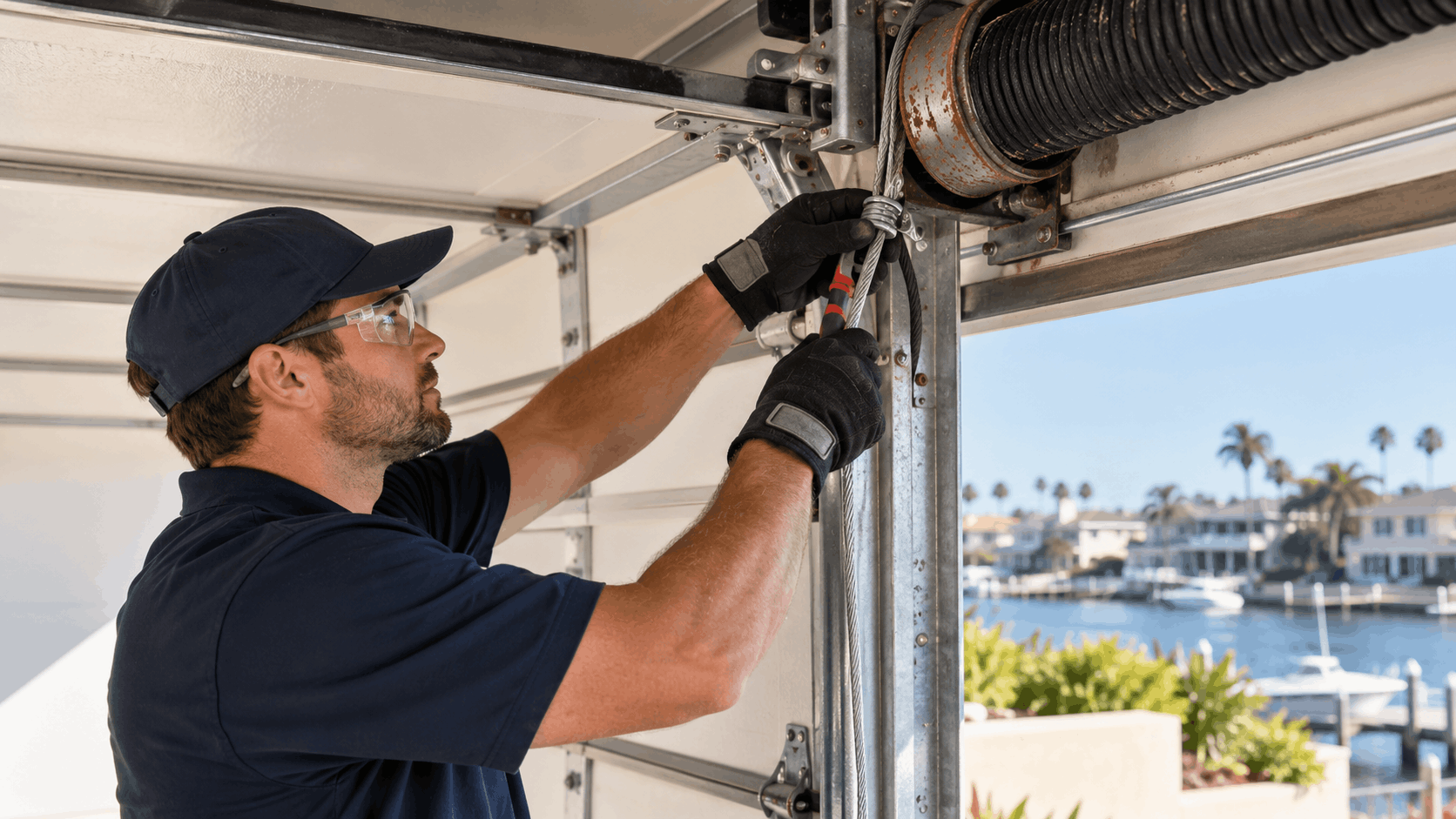
Garage door cables are twisted steel wire under heavy load every single day. They thrive in dry, stable conditions and suffer in wet, salty ones. Balboa Island offers the worst of the second kind. The island sits inside Newport Harbor with water on every side, so the air carries salt and moisture around the clock rather than during a single wet season. That environment is why cable corrosion shows up here sooner than on a comparable door a few miles inland.
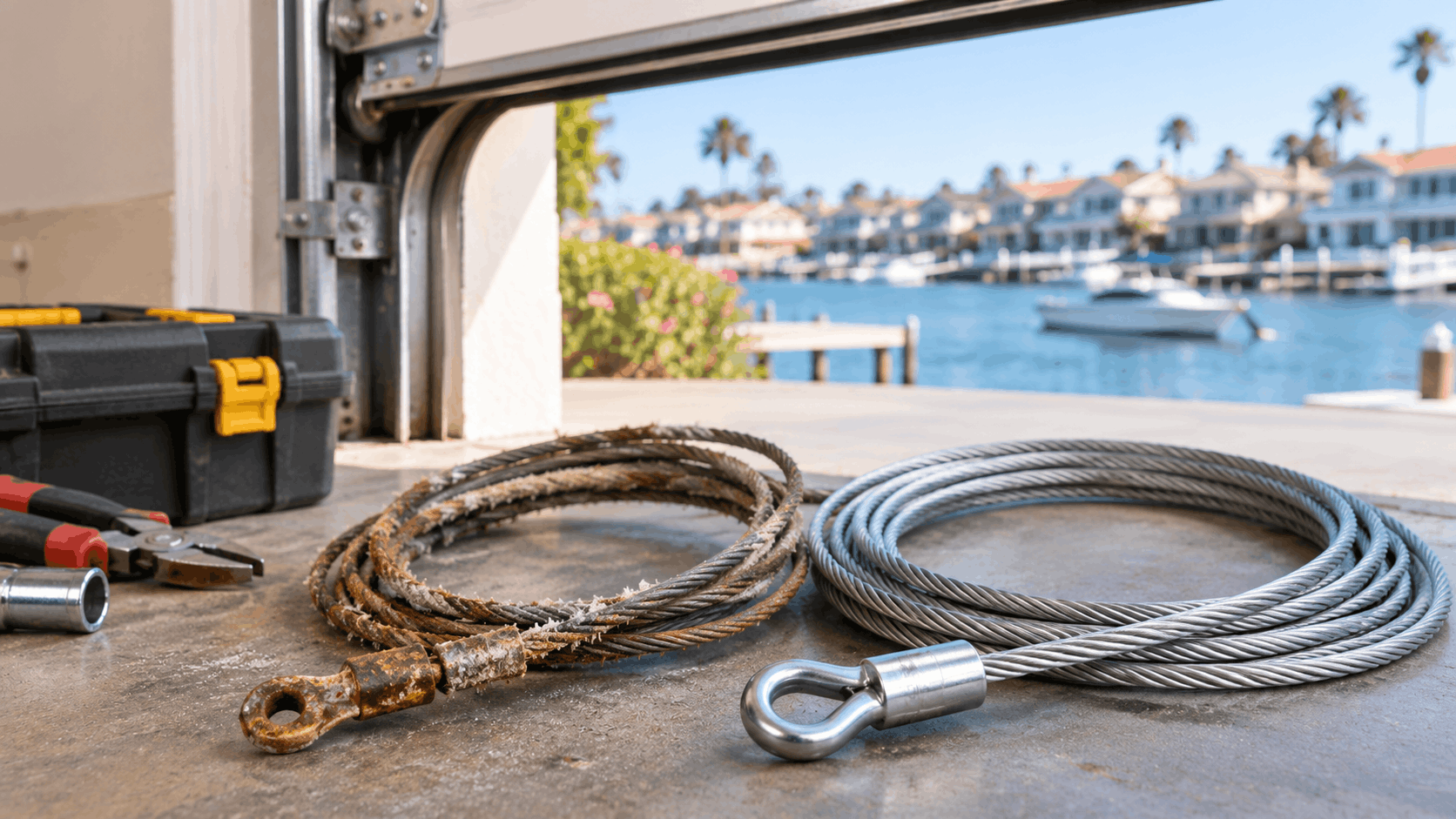
Salt accelerates the chemistry of rust. When salt-laden moisture settles into the lay of a steel cable, it works between the individual strands where the eye cannot follow it. Add the daily flexing of a door that opens and closes, and the metal fatigues while it rusts. The result is a cable that can look serviceable and still be far weaker than it should be.
Water on Every Side Means Constant Salt Exposure
Balboa Island was dredged into being between 1908 and 1909 by William S. Collins, and the small-lot grid he laid out still defines the place. Because it is really three islands, Balboa Island, Little Balboa Island, and Collins Isle, nearly every garage sits within a short walk of open water. That proximity is the single biggest reason hardware here lives a harder life than hardware anywhere dry and inland.
Humidity on the island does not clear out the way it does in a canyon neighborhood. The harbor keeps the air damp, and that dampness carries dissolved salt onto every metal surface in the garage. Even a closed garage breathes, so the air inside tracks the air outside over time.
Salt is hygroscopic, which means it pulls moisture out of the air and holds it against the steel. A thin, almost invisible salt film on a cable keeps a layer of damp in constant contact with the metal. On the island that film is simply part of the environment, not a one-off event after a storm.
That is why a cable that might run a decade without concern in a dry inland garage deserves closer attention here. The exposure is steady, so the wear is steady, and steady wear on a load-bearing part is exactly what owners want to catch before it fails.
Cables Fray From the Inside Before They Snap
The most dangerous part of island cable corrosion is that it often starts where nobody looks. Moisture and salt migrate into the center of the twisted strands, so the core begins rusting while the outer wires still look reasonable. An owner glancing at the cable sees intact steel and assumes all is well, while the real damage is hidden in the middle.
As the interior strands corrode and lose cross-section, the cable loses strength it will never get back. The remaining good wires carry more load than they were designed to, which speeds up the failure. Then one day a few strands pop, the rest follow quickly, and the door comes down on one side.
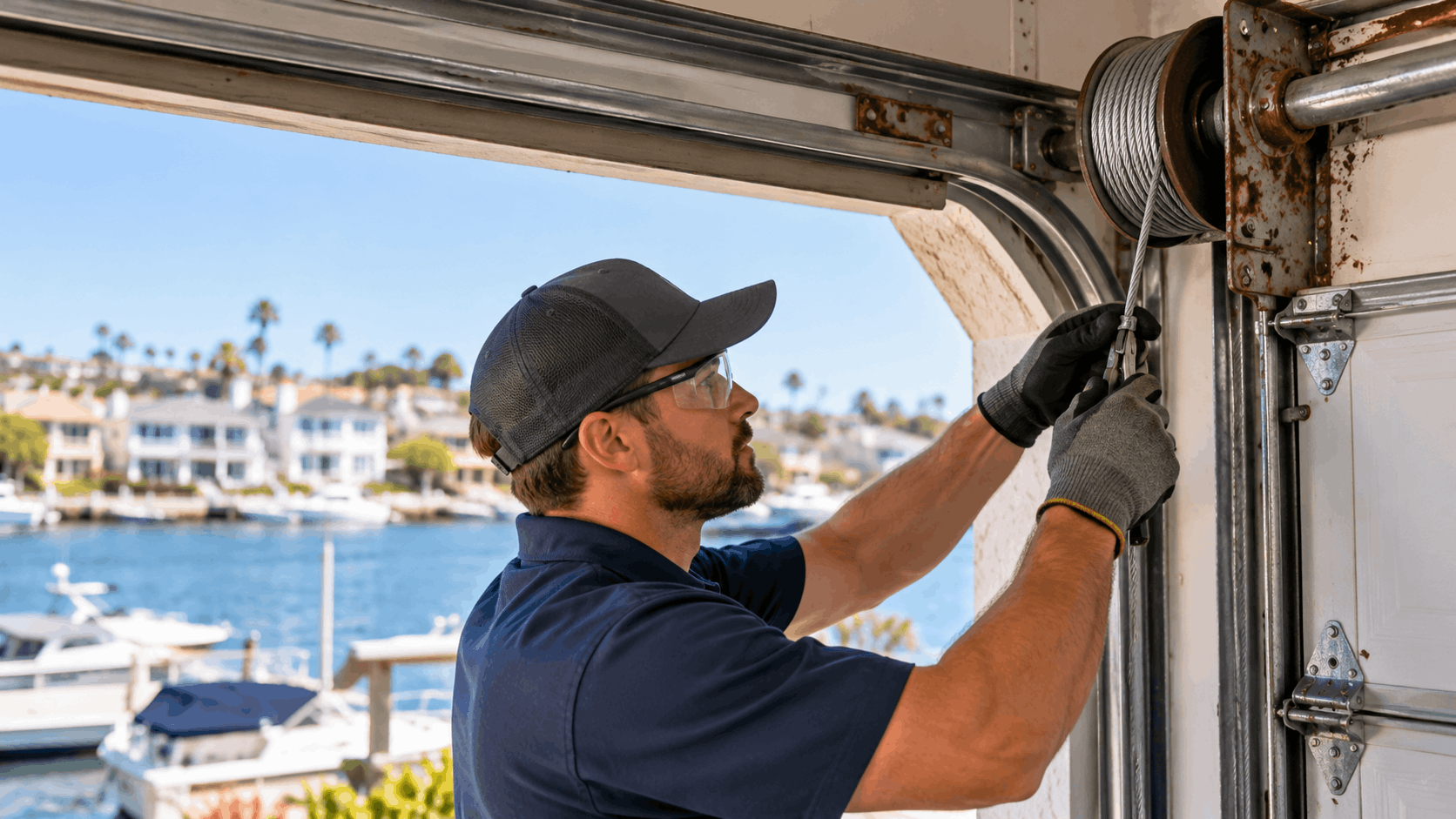
This inside-out pattern is why hands-on cable inspection matters more on Balboa Island than almost anywhere in the service area. A tech looks past the surface, flexes the cable, checks the lay near the drum and the bottom bracket, and feels for the soft, rusty give that signals a weakened core. A garage door cable repair that catches a corroded core before it snaps keeps a heavy door from dropping unexpectedly.
Because the warning signs can be subtle, island owners benefit from treating cables as a wear item to watch, not a set-and-forget part. A cable that looks fine from across the garage can still be most of the way to failure inside.
What Corrosion Does to the Rest of the Hardware
Cables are not the only steel in the system taking a beating from harbor air. Drums, rollers, hinges, fasteners, and track all corrode in the same salty, humid conditions. When one part rusts, it rarely rusts alone, because every piece shares the same garage and the same air.
Corroded drums develop rough spots that chew at a cable as it winds and unwinds. Rusty rollers drag in the track instead of rolling freely, which loads the cables and the opener harder than they should be. Stiff, corroded hinges put uneven stress across the door sections, and that stress travels back into the lift system.
Steel door bottom sections take a specific kind of hit on the island. They sit closest to the damp ground, so they rust from the base upward where moisture lingers against the panel. That bottom-up rust can reach the bottom bracket that anchors the cable, which turns a door problem into a cable and bracket problem.
The practical lesson is that cable work on Balboa Island is never only about the cable. A tech who replaces a cable while leaving a corroded drum or a rusting bottom section in place is setting up the next failure. Checking the whole chain is how a repair actually holds.
Get Your Free Quote
Tell us about your garage door and we'll get back to you within 30 to 60 minutes.
Signs Your Garage Door Cable Is Going Bad
Most owners do not inspect cables until something goes wrong, but the door usually gives warning before it fails. Learning the cable warning signs lets an island owner catch a weak cable while it is still a scheduled repair and not an emergency in a narrow alley. The symptoms fall into a few plain categories that anyone can watch for.
The table below lines up the common signs with what each one usually means, so an owner can match what they see to what is happening inside the system.
| What you notice | What it usually means |
|---|---|
| Rust bloom or orange staining on the cable | Active corrosion, possibly worse inside than out |
| Broken strands or a fuzzy, frayed look | Cable losing strength, near failure |
| Door hangs crooked or one side drops | A cable stretching, slipping, or already partly failed |
| Grinding or jerking during travel | Cable off the drum or binding on corroded hardware |
| Door off track | Cable or roller problem, not an opener fault |
Visible Fraying, Rust Stains and Kinks
Start with the cable itself. Look for rust stains and orange bloom along the length, especially near the bottom bracket and up at the drum where the cable bends and holds the most tension. Those are the spots where salt moisture collects and where corrosion tends to start on the island.
Broken outer strands are a clear flag. A healthy cable is smooth and tightly wound, so any wires sticking out, fraying, or a fuzzy texture means strands have already failed. A kink in the cable is just as serious, since a kinked spot cannot carry load evenly and becomes a weak point.
Remember the island catch: the outside can hide the inner damage. A cable that shows light surface rust may be far worse internally, because the core rusts first here. If an owner sees any fraying at all near the water, the safe assumption is that the cable is further gone than it looks.
Owners should never pull or tug on a cable to test it. The cable is under spring tension, and handling it is not a safe inspection. A visual check from a safe distance is enough to decide whether to call for service.
A Door That Hangs Crooked or Slips in the Track
When a cable stretches or starts slipping off its seat, it no longer holds its side of the door at the right height. One side drops lower than the other, and the door hangs crooked instead of level. That uneven lift is one of the most visible cable symptoms.
A crooked door also tends to bind in the track, because the sections are no longer square to the opening. Keep running it and the door can pull off track entirely, which turns a cable issue into a stuck, jammed door. On the island that means a door wedged in a tight alley opening.
This is a cable problem, not an opener problem, and the distinction matters for the repair. The opener only pushes and pulls the top of the door, while the cables and springs carry the actual weight and keep both sides even. If the door is crooked, the fix is in the lift system, and an off-track garage door repair often starts with the cable.
An owner who notices the door going out of level should stop using it. Each cycle on a crooked door stresses the hardware further and raises the odds of a full off-track failure.
Grinding, Jerking or a Cable Off the Drum
A cable can unwind off the drum or jump out of its groove, especially when corrosion has roughened the drum surface. When that happens, the door often grinds or jerks as it moves, because the cable is no longer feeding smoothly. The motion feels rough instead of steady.
A cable off the drum may bunch up, overlap itself, or hang slack on one side. That slack lets the door sag and can let it slam if the other cable then fails. The grinding sound is the hardware telling the owner something is out of place.
Running the door in that state makes it worse fast. Each cycle can fray the cable further against the drum, deepen the damage, or pull the door off track. What might have been a straightforward cable reseat and replacement can become a bigger off-track repair.
The right move is to stop using the opener and leave the door alone until a tech can look at it. Forcing a door that is grinding or jerking risks both the hardware and the person standing near it.
Why a Snapped Cable Is Not a Wait-and-See Problem
A garage door is heavy, and the cables and springs are what hold that weight in check. A snapped cable removes that support on one side, so the door can drop or lurch down hard. That is a real injury risk and a real property risk.
On Balboa Island the stakes get higher because of the alleys. A jammed or dropped door in a narrow alley traps a car with nowhere to maneuver, and the alleys are tight enough that even a service vehicle cannot always get in. A failed cable can leave an owner locked out of their own garage with a vehicle stuck inside.
To understand how heavy the door really is, owners can run the balance test, but only on the manufacturer's terms. With the opener disconnected by the release cord, a correctly balanced door raised to waist height should stay put. If it drops or rises on its own, the lift system is not doing its job and the door is unsafe to run.
Because the consequences of a snapped cable are immediate, this is not something to monitor for weeks. If the signs point to a failing cable, the door should come out of service until it is repaired.
Need Help in Irvine?
Urgent Garage Doors serves Irvine and all of Orange County.
Why Cable and Spring Need to Be Inspected Together?
Cables do not work alone. They are one half of a balanced lift system, paired with the torsion spring and running over drums and bearings that all age in the same conditions. Replacing a cable while ignoring the spring, the drums, or the bearings is how a second failure follows weeks later. On a salty island, every part in that chain is corroding on the same clock.
When a tech is already at the door with the system unloaded, inspecting the whole lift assembly is simply good practice. It costs far less in time and trouble to check and address a worn part during one visit than to come back after it fails. Spring and cable repair is treated as one job for this reason.
Cables and Springs Share the Same Load
The torsion spring and the cables carry the door's weight together as one system. The spring stores energy as it winds and unwinds, and the cables transfer that force to lift and lower the door evenly on both sides. Neither part does the job alone.
Because they share the load, they also share the aging. A door that has cycled enough to wear the cables has usually put the same miles on the spring, and corrosion on one is usually matched by corrosion on the other. They live in the same garage air, so they take the same salt and humidity.
That shared history is why a tech does not look at a failed cable in isolation. A corroded, stretched cable is often a sign the spring is near the end of its service life too. Catching both at once keeps the door balanced and avoids a repeat trip.
When the system is balanced, the opener works less and every part lasts closer to its rating. When one part is worn and the other is fresh, the mismatch loads the new part harder than it should be carried.
Cycle Rating Tells You Where the Spring Stands
Torsion springs are rated in cycles, where one cycle is a single full open and close. A standard residential torsion spring is commonly rated around 10,000 cycles. That number is the honest way to judge where a spring stands, rather than guessing from how old the door looks.
Do the math on real use and the picture gets clear. A door cycled four times a day reaches 10,000 cycles in roughly seven years. On the island, where a garage may be the main way in and out of a cottage, that pace is realistic, and for a heavier door a high-cycle spring may be the better choice.
Corrosion changes the timeline. Salt and humidity bring a spring to the end of its cycle rating earlier, because rust pits the steel and weakens each coil as it flexes. The rating still frames the expectation, but island conditions push a spring toward that limit sooner than a dry garage would.
Knowing the rating and the door's age and daily use lets a tech advise honestly on whether the spring should be replaced now while the system is already open. A torsion spring replacement done alongside the cable work saves a second service call.
Why Owners Should Never Touch the Spring
A torsion spring stores a large amount of energy when wound. It is held under tension and wound with bars against a fixed cone, and that stored energy is enough to cause serious injury if the spring is handled wrong. This is the one part of the door an owner must never attempt to adjust, wind, unwind, or replace.
Spring work requires the right winding bars, the right technique, and the discipline to control tension at every step. A slip can send a bar or a spring flying with force. There is no safe DIY version of this task, regardless of what a video might suggest.
This is exactly why cable work is a licensed job rather than a home project, since the spring has to be unloaded before the cables can come off. The work belongs with a C-61/D-28 licensed tech who handles springs every day. The license class exists for this kind of hazardous, specialized work.
The safe thing an owner can do is the manufacturer's auto-reverse check and the balance test described earlier, and then call a pro for anything involving the spring or cables. Knowing the line between an owner check and a tech job keeps people safe.
Drums, Rollers and Bearings Get Checked Too
The wear chain does not stop at cables and springs. Drums, rollers, hinges, and bearings all corrode in island air, and each one can shorten the life of a new cable if it is left worn. A cable swap that ignores these parts leaves a known weak link in the system.
Cable drums are a common culprit near the water. A corroded or grooved drum has a rough surface that abrades a cable as it winds, so a brand-new cable can start degrading on its first cycles. Checking the drum when the cable is off is the sensible time to catch that.
Rollers and bearings that have rusted or seized add drag and vibration. That extra resistance loads the cables and the opener harder and can pull the door out of smooth travel. Fresh rollers and clean bearings let the door move with less strain on every other part.
Inspecting the full assembly during a cable job is how a repair lasts on Balboa Island. The goal is a balanced, smooth-running door, not just a single new part bolted into a tired system.
What a Cable Replacement Actually Involves
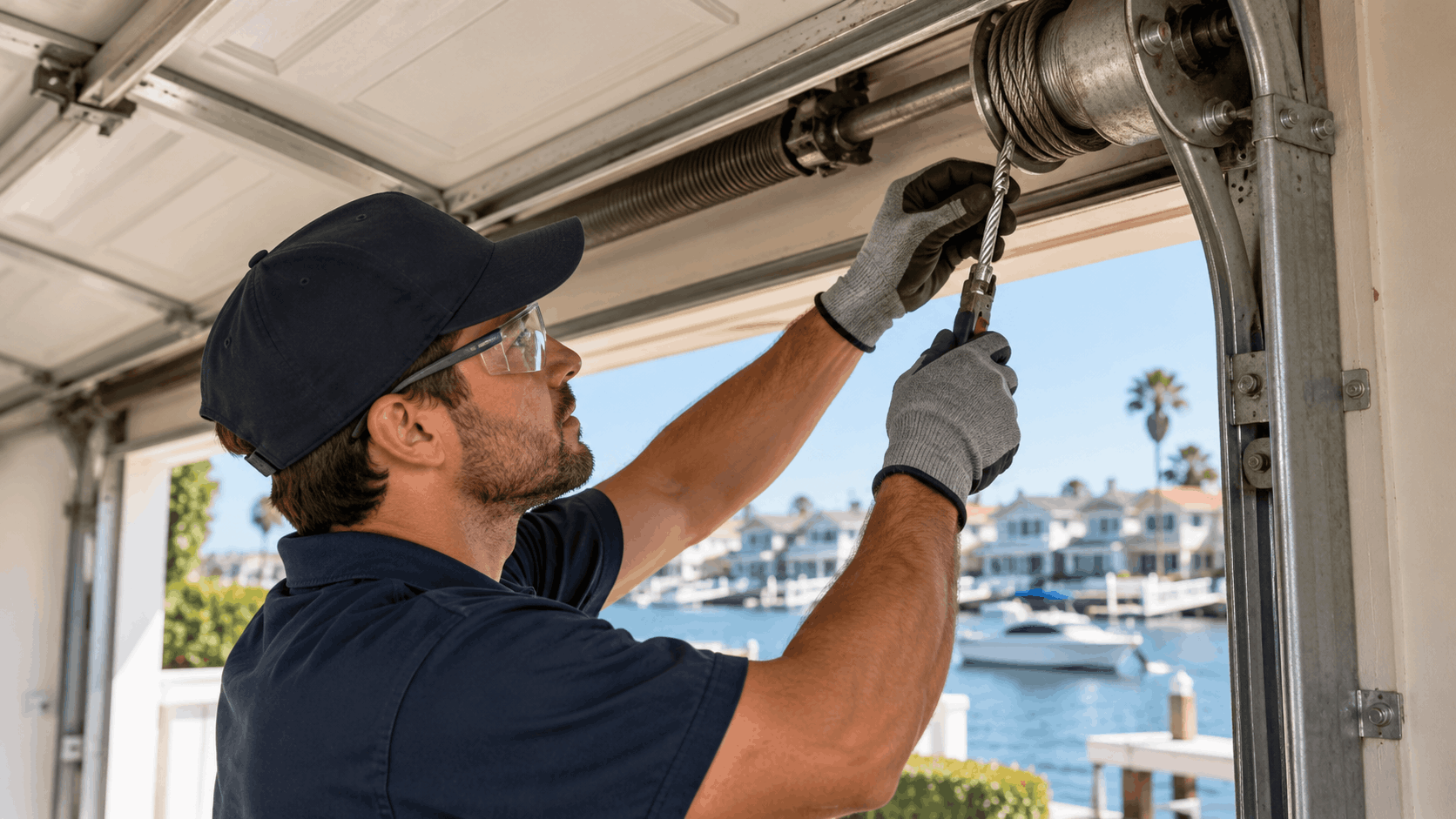
Owners often picture a cable swap as a quick clip-and-replace, but the real process is more involved because of the tension in the system. Done right, a cable replacement unloads the spring safely, fits the correct cable, resets tension, and confirms the door runs balanced and reverses as it should. Each step solves a specific part of the problem.
Understanding the sequence helps an owner see why this is skilled work and why shortcuts are dangerous. It also explains what the new cable actually buys: a door that lifts evenly and safely again.
Releasing Tension Safely First
The first real step is unloading the spring. The cables are held under the spring's tension, so that energy has to be controlled and released before the cables can come off. Skipping or rushing this is where serious injuries happen.
A tech uses proper winding bars to back the tension out of the torsion spring in a controlled way. The door is secured so it cannot drop while the system is unloaded. Only once the spring is safely slack can the old cables be removed from the drum and the bottom bracket.
This single step is the clearest reason cable replacement is a licensed job and not a DIY fix. The tools and the technique exist specifically to manage stored energy without letting it release all at once. It is not a task to improvise with household tools.
With the tension released and the door secured, the rest of the job can proceed safely. That controlled start is what makes everything after it work.
Matching New Cable to the Door and the Drum
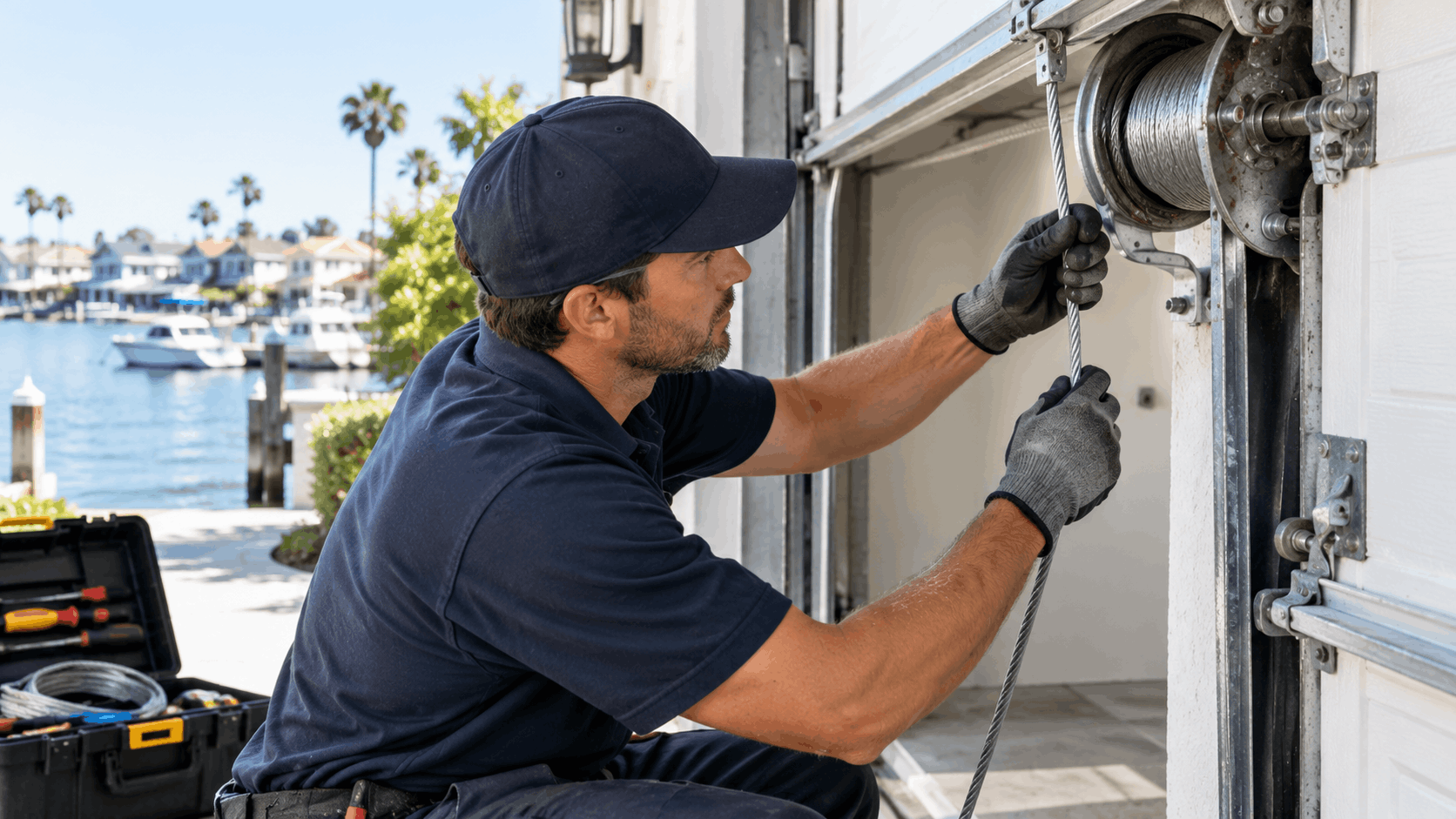
Cables are sized to the door. The correct cable length and diameter depend on the door's actual weight and height, so a replacement is matched to that specific door rather than grabbed off a shelf as a one-size part. The wrong size cable will not seat or wind correctly.
Seating the cable properly on the drum matters as much as the size. The cable has to sit in the drum grooves and anchor cleanly at the bottom bracket so it winds evenly through the full travel. A poorly seated cable jumps the drum and fails early.
For Balboa Island, material choice is the practical answer to salt exposure. Galvanized or stainless hardware resists corrosion better than bare steel, so coated and corrosion-resistant cables and fittings make sense where the air is always salty. It will not stop corrosion entirely, but it slows the process that runs faster here.
Matching the cable to both the door and the environment is what turns a repair into a lasting fix. On the island, the right material is part of getting the sizing right.
Resetting Tension and Running the Balance Test
Once the new cables are seated, the spring gets wound back to the correct tension. The tech brings the spring back up carefully and checks that both cables track evenly as the door moves. Even tracking means both sides lift together and the door stays square.
The balance test confirms the work. With the opener disconnected, the door is raised to waist height and should stay put on its own instead of falling or rising. A door that holds position is balanced; one that moves on its own needs tension adjusted. This is the same door balancing and tension adjustment that keeps the whole system healthy.
Proper balance protects every other part of the door. A balanced door puts less strain on the opener, the cables, and the spring, so the repair lasts and the hardware ages slower. An unbalanced door undoes the benefit of a new cable quickly.
Getting tension and tracking right is the quiet heart of a good cable job. It is the difference between a door that runs smooth for years and one that goes crooked again in months.
Confirming the Safety Features Still Work
A cable job is not finished until the door's safety features are verified. Modern openers must reverse the door, and the tech confirms both the contact reverse and the non-contact photo eyes work before leaving. These checks protect people and pets.
The 2x4 test checks contact reverse. A flat 2x4 is laid across the opening on the floor, and on closing the door must reverse within two seconds of touching it. That proves the opener senses an obstruction and backs off.
The photo-eye test checks the non-contact system. The photo eyes mount on each side of the opening no higher than six inches off the floor, and breaking the beam while the door closes must stop and reverse it. The tech confirms the beams are aligned and the lenses are clean, since a misaligned or dirty eye is a common cause of a door that reverses for no clear reason. A safety sensor alignment and repair is often part of wrapping up the visit.
Confirming these features closes the loop on the repair. The door is not just lifting evenly again; it is also stopping and reversing the way the safety standard requires.
What Cable Replacement Costs on Balboa Island
Owners want a number before they call, and the fair way to give one is a typical range for the area. The figures below are typical Orange County market ranges for garage door work, not a quote or a fixed price from our team. The actual price for a specific garage is given in writing before work begins.
Cable work sometimes stands alone and sometimes comes with spring or track work, so it helps to see the related ranges together. Island access can also affect timing, which we cover below.
| Job | Typical Orange County range |
|---|---|
| Cable repair | $150 to $300 |
| Torsion spring replacement | $150 to $300 |
| Extension spring replacement | $150 to $250 |
| Off-track door repair | $125 to $275 |
| Door balancing and tension adjustment | $75 to $150 |
Typical Cable Repair Ranges
For the cable itself, cable repair runs $150 to $300 as a typical Orange County range. That covers the labor to safely unload the spring, remove the old cables, fit and seat new ones, reset tension, and confirm the door runs balanced. It is a specialized job, which the range reflects.
If the spring also needs doing at the same time, torsion spring replacement is typically $150 to $300, and extension spring replacement is typically $150 to $250. Pairing the work on one visit is common when both parts have aged together in island air.
When a failing cable has already pulled the door off its track, off-track door repair typically runs $125 to $275. Catching a cable before it reaches that point keeps the repair on the simpler end of the scale. All of these are typical ranges for the area, not a set price.
Seeing the ranges together helps an owner budget for the realistic version of their job rather than the best-case single part. On the island, the combined scenario is worth planning for given how the hardware ages as a group.
What Changes the Final Price
Several factors move the final number. The biggest is scope: whether the spring, drum, or rollers also need replacing alongside the cable. A cable-only job sits at the lower end, while a cable plus spring and hardware refresh sits higher.
Cable type matters too. Corrosion-resistant hardware is the sensible choice near the water, and material choices factor into the work. The door's weight and size also set the cable specification, since a heavier or taller door needs a heavier cable.
Because every garage is different, the actual price for a specific door is given in writing before work begins. A written price lets an owner see the scope and the cost before any tools come out, with no surprises after. This is separate from the legal requirement for a written home improvement contract on work over $500.
The honest way to think about it is a range now and a firm written price after the door is looked at. The ranges set expectations, and the on-site look sets the actual figure.
How Island Access Affects a Repair Visit
Balboa Island's alleys are narrow, and the city's own guidance notes that some tight residential areas, Balboa Island specifically, cannot accommodate larger vehicles. That means our team confirms alley width and access before dispatch and plans for a smaller vehicle, often carrying material further than on a mainland job.
Scheduling also turns on the season. Street parking in the restricted residential zone is limited from May 15 to September 15, when only permit holders may park, so from mid-May to mid-September the streets are effectively full. Booking island work outside that window, or early in the morning within it, keeps a visit smooth and avoids a parking problem on the day.
Need Help in Irvine?
Urgent Garage Doors serves Irvine and all of Orange County.
Keeping Island Cables From Failing Early
Owners cannot change the harbor air, but they can slow its effect and catch problems before a cable drops the door. Preventive maintenance on Balboa Island is less about fancy products and more about a regular rhythm of inspection and corrosion-resistant parts. A few steady habits go a long way against constant salt.
Each step below does a specific thing, and together they keep the lift system healthy longer than it would last if left alone. Maintenance and upgrades are where this kind of corrosion prevention lives.
A Twice-Yearly Inspection Cycle Makes Sense Here
Inland, an annual check is often enough. On Balboa Island, a twice-yearly maintenance cycle is defensible in a way it would not be in a dry tract, because salt and humidity are constant rather than seasonal. The exposure never pauses, so the inspection schedule should keep pace.
A twice-yearly visit catches inside-out cable corrosion, drum roughness, and bottom-section rust while they are still small. Catching a weakening cable at a scheduled check beats discovering it when the door drops in the alley. The timing is matched to how fast the environment works on the hardware.
Each preventive maintenance visit from our team includes a written report of what was found and what is recommended. That report gives the owner a record of the door's condition over time and a clear basis for deciding what to address now versus later. A preventive maintenance plan keeps that rhythm on schedule.
For a property manager handling island rentals, that record is especially useful. It lets an off-site owner make informed calls about a door they cannot inspect themselves.
Galvanized and Stainless Hardware, Coated Springs
Material choice is the front line against island corrosion. Galvanized and stainless hardware resists rust far better than bare steel, so cables, fittings, and fasteners in those materials hold up longer in salty air. They are the practical answer to a problem the environment never stops creating.
Coated springs add the same kind of protection to the most heavily stressed part of the system. A coating slows the pitting and rust that bring a spring to the end of its cycle rating early near the water. It buys time against a process that runs fast on the island.
None of these materials make hardware immune. They slow corrosion rather than stop it, which is why they pair with regular inspection rather than replacing it. The combination of better materials and steady checks is what keeps a door reliable here.
When replacing worn parts on an island door, choosing corrosion-resistant versions is money well spent. Paying a little more for the right material avoids paying again sooner for a repeat failure.
Simple Safety Checks an Owner Can Run
There are three checks an owner can safely run between professional visits. The balance test, done with the opener disconnected, raises the door to waist height to see if it holds position; a door that falls or rises points to a spring or cable problem. This is the fastest way to sense trouble in the lift system.
The 2x4 test checks contact reverse by laying a board flat in the door's path and confirming the door reverses within two seconds of touching it. The photo-eye test breaks the beam during closing to confirm the door stops and reverses, and checks the lenses are clean and aligned. Both are quick and tell an owner whether the safety features are working.
These checks are the owner's safe lane. Anything involving adjusting, winding, or replacing the spring, or handling the cables, stays with a licensed tech because of the stored energy involved. Knowing where that line sits keeps an owner safe while still staying on top of the door.
Running these simple tests every few weeks is a reasonable habit on the island. They cost nothing and can flag a problem before it becomes an emergency.
Watching the Steel Door Bottom for Rust
Steel door bottom sections deserve a specific eye on the island. They rust from the base upward where they sit closest to the damp ground, so the bottom panel often shows corrosion before the rest of the door. That is the first place to look during an owner check.
Bottom-up rust is not only a cosmetic issue. The bottom bracket that anchors the cable lives in that same zone, so rust creeping up from the base can reach the bracket and compromise the cable attachment. Catching it early keeps a door problem from compounding into a cable and bracket problem.
An owner who spots rust along the bottom of a steel door should flag it at the next service visit. Addressing the panel and protecting the bracket early is far cheaper than dealing with a failed cable anchor later. Early action keeps a small problem small.
On the island, the bottom of a steel door is a reliable early warning. Watching it is one of the simplest ways to stay ahead of corrosion-driven failures.
Low-Headroom Alley Garages and the Right Hardware
Balboa Island garages are small, often single-bay, with low headroom and limited backroom. That building reality shapes cable and opener work as much as the salt air does, because the standard hardware that fits a mainland garage frequently does not fit here. Fitting the right parts to an undersized space is normal island work.
Understanding why standard kits fall short helps an owner avoid a job that goes sideways on the day. The right approach starts with measuring, not assuming.
Why Standard Kits Often Do Not Fit
The openings on the island are undersized by modern standards, a legacy of the small-lot grid laid out when the island was built. A standard off-the-shelf door sized for a modern garage often will not fit the opening, so custom-width doors are routine rather than special orders. The door has to be built to the space.
Low headroom is the other constraint. A standard torsion setup and track need vertical clearance above the opening that many island garages do not have. Low-headroom track kits exist for exactly this, letting the door and springs fit where the ceiling sits close to the top of the opening.
Limited backroom, the depth behind the opening, adds a third limit. Together these constraints mean the lift hardware has to be chosen for the specific garage, not pulled from a standard kit. A custom garage door design and install handles the odd sizes the island throws at it.
Owners planning a replacement should expect a custom approach. On the island, standard is the exception, not the rule.
Jackshaft Openers Beside the Torsion Bar
Where a ceiling-mounted opener will not fit, a jackshaft opener is the common island answer. It mounts on the wall beside the torsion bar and drives the torsion bar directly, rather than running a rail across the ceiling. That design frees up the overhead space a standard opener would need.
Jackshaft units suit two island situations well. They work where headroom is too limited for a ceiling rail, and they work where storage occupies the ceiling of a small garage. In a tight single-bay garage, keeping the ceiling clear is often the deciding factor.
Because the jackshaft drives the torsion bar, it ties directly into the same spring and cable system this whole article covers. Pairing a jackshaft opener with the right low-headroom track and corrosion-resistant hardware is a sensible island package. A garage door opener installation can include this type where the space calls for it.
For owners whose garage has never had room for a normal opener, a jackshaft often solves the problem cleanly. It is a standard tool for a non-standard space.
Measure Before Quoting, Every Time
Because openings are undersized and headroom varies garage to garage, measuring before quoting is not optional on the island. Assuming a standard opening is how a job goes wrong on the day, when the door or opener that was ordered simply does not fit the space.
A proper measurement captures the opening width and height, the headroom above, and the backroom behind, plus the condition of the existing track and hardware. Those numbers drive the right door, the right track kit, and the right opener for that garage. Guessing from a photo or a neighbor's door invites a wasted trip.
This is why our team treats measuring as the first real step on any island door or opener job. The few minutes spent measuring protect the whole project from a day-of surprise. On Balboa Island, that step earns its place every time.
Owners can help by noting anything unusual about their garage when they call. The more the team knows up front, the smoother the visit runs.
Permits, Licensing and the Coastal Zone on Balboa Island
Island garage door work sits inside a few rules worth understanding in plain terms: the right license class, the Coastal Zone layer, and when a permit comes into play. Cable work in an existing opening is usually the simplest case, but owners should know where the lines fall. Getting this right protects the owner as much as the contractor.
None of this should scare an owner off a needed repair. For a straightforward cable job, the rules are light; for structural changes, they matter more.
The Correct License Class for This Work
Garage door work in California is licensed under classification C-61/D-28, Doors, Gates and Activating Devices. That scope covers sectional and rolling doors, torsion and extension spring systems, operators, control boards, safety sensors, and activating devices. It is the correct class for cable and spring work.
A common mix-up is C-28, which is Lock and Security Equipment, not the garage door license. Garage door work is not C-28, and it does not require a Class B general building license either. Knowing the right class lets an owner check that whoever shows up is properly licensed for the job.
A license can be verified free at cslb.ca.gov, where the classification, status, bond, and workers compensation are all public record. Urgent Garage Doors holds California license #1055150, which an owner can look up in a minute. Verifying a license before work starts is a simple protection.
For a hazardous job like cable and spring work, the license class is not a formality. It signals the training behind the hands doing the work.
The Coastal Zone and When Review Applies
Balboa Island is entirely coastal, and nearly every property in Newport Beach sits in the Coastal Zone. Work in the Coastal Zone can require a Coastal Development Permit before or alongside a building permit, and work touching exterior walls or openings is the kind of change that draws coastal review. The zone status is a real layer here.
The distinction that matters for garage doors is simple. Replacing a door in an existing opening of the same dimensions is a different proposition from changing the opening size or altering the structure around it. It is the second that pulls a project into a longer coastal process measured in weeks and months.
For a cable repair, the structure and the opening do not change, so the heavy coastal review is not in play. Owners planning anything that changes the opening should check their address with the Newport Beach Address Search Tool and ask the city rather than assuming. City staff at the Permit Center guide applicants through the documentation.
The honest advice is to confirm the position for the specific address before planning any structural change. Coastal timelines reward owners who ask early.
When a Permit Enters the Picture
Permits are decided by the city with jurisdiction over the specific address, not by a single regional rule. For island properties, that is the City of Newport Beach, and structural work such as altering the opening or the header is generally what triggers a permit rather than a like-for-like repair.
Cable work in an existing opening does not change the structure, so it is not the kind of work that typically brings a permit into play. Still, the city is the authority on any given job, so an owner should confirm the position for their address. The Newport Beach Permit Center is at 100 Civic Center Drive, 949-644-3309.
The permit question also carries a second consequence worth knowing. When a job does require a permit, the unlicensed-work exemption no longer applies, so permitted work has to be handled by a licensed contractor regardless of cost. That makes the permit question and the license question connected.
For most cable repairs, none of this is a hurdle. It matters most when an owner is considering a change to the opening itself.
Battery Backup and Older Island Openers
Two opener rules can intersect with cable work when the opener is part of the picture. SB 969 requires every residential automatic garage door opener installed in California on or after July 1 2019 to have a battery backup designed to operate during an electrical outage, so a replacement opener on the island comes with that backup. On an island where a power cut and a jammed door can leave a car stuck in an alley, that backup has real value. A battery backup installation meets that requirement.
The other rule is about age. Openers made before 1993 predate the federal entrapment-protection mandate for external devices like photo eyes, and the island's century of mixed building stock means two neighboring garages can be decades apart in hardware. An owner with a very old opener should know it lacks the entrapment protection every modern opener carries. For any opener repair and troubleshooting, the age of the unit shapes what makes sense.
Need Help in Irvine?
Urgent Garage Doors serves Irvine and all of Orange County.
How Urgent Garage Doors Handles Cable Replacement on the Island
Working a cable job on Balboa Island takes a few extra steps that a mainland call does not. Our team plans for the alley, carries common parts, and confirms the door runs safely before leaving. Here is how that actually goes.
Confirming Alley Access Before Dispatch
Before a vehicle rolls, the team confirms alley width and access for the specific address. The city's own guidance notes that Balboa Island cannot always accommodate larger vehicles, so planning for a smaller vehicle is part of the setup. That check avoids a truck that cannot reach the garage.
Knowing the access up front also means planning to carry material further than on a mainland job. The garage sits off a narrow alley, so parts and tools come in on foot from wherever the vehicle can sit. Sorting this before dispatch keeps the visit on schedule.
This is the kind of local planning that separates island work from a standard call. The constraint is real, so the response is built around it from the start.
Truck Stock and Same-Visit Work
Our trucks carry common torsion spring sizes, so spring and related work is often completed on the same visit as the cable replacement. When the spring has aged alongside the cable in island air, having the part on the truck means one trip instead of two. Not every job finishes on the first visit, but many do.
For owners planning a new door rather than a repair, we offer a free on-site estimate for new garage door installations. Removing and hauling away the old door is included with a new door installation, so the owner is not left dealing with the old one. That keeps a replacement clean from start to finish.
Carrying stock and offering an on-site estimate both come back to the same goal: solving the problem efficiently on an island where a second trip is a real cost. The less back-and-forth, the better for everyone.
Written Price, Response Window and Brands Served
A written price is available before work begins, so an owner sees the scope and cost before any tools come out. For urgent situations, we take emergency calls and respond 24 hours a day, 7 days a week, with a 30 to 60 minute response window across Orange County. A stuck door in an alley does not wait for business hours.
The team works on all garage door brands, including LiftMaster, Chamberlain, Genie, Craftsman, Clopay, Amarr, Wayne Dalton, and CHI. Whatever opener and hardware a cottage carries, the cable and spring work is handled the same careful way. 24/7 emergency garage door repair covers the island around the clock.
External resources worth a look include the U.S. Consumer Product Safety Commission for entrapment-protection background and the Contractors State License Board for verifying any contractor's license.
Get Your Island Cable Checked Before It Drops the Door
If a cable on your Balboa Island garage is fraying, rusting, or pulling the door crooked, have it looked at before it fails in a narrow alley. A written price is available before work begins, and the trucks carry common spring sizes so many jobs finish in one visit.
Call Urgent Garage Doors at (949) 529-7743 for 24/7 emergency service with a 30 to 60 minute response across Orange County, or reach out through our contact page to schedule an inspection.
Frequently Asked Questions
- How much does garage door cable replacement cost on Balboa Island?
- Cable repair typically runs $150 to $300 as an Orange County market range, which covers safely unloading the spring, fitting new cables, resetting tension, and confirming the door runs balanced. That is a typical range for the area, not a fixed quote. Because every garage differs, the actual price for a specific door is given in writing before work begins, so the owner sees the full scope and cost before any tools come out.
- Why do my garage door cables rust so fast on the island?
- Balboa Island sits inside Newport Harbor with water on every side, so salt air and humidity reach the hardware year round rather than in one season. That constant salt moisture goes after steel cables, and the worst part is that they corrode from the inside out. The core rusts and weakens while the outer strands still look fine, which is why hands-on cable inspection matters so much here.
- Can I replace a garage door cable myself?
- No. Cable work requires releasing the torsion spring's tension first, and that spring stores enough energy to cause serious injury if handled wrong. It is wound with bars against a fixed cone and is not a safe DIY task. This is a licensed job for a C-61/D-28 tech with the right tools and technique. The safe things an owner can do are the balance test and the auto-reverse checks, nothing involving the spring or cables.
- Do I need to replace the spring when I replace the cable?
- Not always, but it gets inspected. Cables, springs, drums, and bearings carry the load together and age in the same island air, so the tech checks all of them. The spring's cycle rating and age decide whether it needs doing now. A standard torsion spring is commonly rated around 10,000 cycles, which a door cycled four times a day reaches in roughly seven years, and corrosion brings it to that limit sooner near the water.
- How long does a cable replacement take?
- Many cable jobs are completed in a single visit, because the trucks carry common torsion spring sizes along with cable hardware. When the spring also needs doing, having the part on hand often means one trip instead of two. Not every job finishes on the first visit, since some require ordering a custom or less common part, but the goal is to resolve it in one trip wherever possible.
- What is the difference between a cable problem and an opener problem?
- The balance test tells them apart. Disconnect the opener with the release cord and raise the door to waist height. A correctly balanced door stays put. If it falls or rises on its own, the problem is in the lift system, meaning a spring or cable, not the opener. The opener only moves the top of the door, while the cables and springs carry the actual weight and keep both sides even.
- Do I need a permit or coastal approval for a cable repair?
- Cable work in an existing opening does not change the structure or the opening, so it is not the kind of work that typically triggers a permit or coastal review. Changing the opening size or altering the structure is different and can pull a project into a longer coastal process. Permits are decided by the city with jurisdiction, so confirm the position for your address with the Newport Beach Permit Center at 100 Civic Center Drive, 949-644-3309.
- What hardware holds up best in island salt air?
- Galvanized and stainless hardware resists corrosion far better than bare steel, so cables, fittings, and fasteners in those materials last longer in the constant salt air. Coated springs add the same protection to the most heavily stressed part. None of it stops corrosion entirely, which is why it pairs with a twice-yearly inspection cycle. That combination of corrosion-resistant materials and regular checks is the practical answer to living beside the harbor.
- Does summer parking affect when you can come out?
- Yes. Street parking in the restricted residential zone is limited from May 15 to September 15, when only permit holders may park, so the streets are effectively full through the summer. Booking island work outside that window, or early in the morning within it, makes a visit go more smoothly and avoids a parking problem on the day. The team plans scheduling around this when working the island in season.
- Do you work on garages in the narrow alleys with low headroom?
- Yes. The team confirms alley width and access before dispatch and plans for a smaller vehicle, expecting to carry material further than on a mainland job. For the small, low-headroom single-bay garages common on the island, low-headroom track kits and jackshaft openers mounted beside the torsion bar are standard solutions where off-the-shelf hardware does not fit. Measuring the specific garage before quoting keeps the job from going wrong on the day.
Licensed garage door repair professionals serving Irvine and Orange County.
Licensed in California · License #1055150
Why trust Urgent Garage Doors?
Founded in 2017, Urgent Garage Doors is a licensed and insured garage door services serving Irvine and Orange County. All content is reviewed by our licensed technicians.

Need Help in Irvine?
Urgent Garage Doors serves Irvine and all of Orange County.
Related Articles
Broken Garage Door Spring on Balboa Island and What Happens in the Next Two Hours
A broken garage door spring on Balboa Island needs a safe diagnosis, a balance check and a matched replacement. Here is why springs fail sooner here and what the next two hours involve.
How Dana Point Salt Air Destroys Garage Door Hardware and How to Prevent It
Dana Point salt air wears down garage door springs, cables, and hinges more than most homeowners realize. Learn how to prevent costly corrosion damage with practical tips.
Garage Door Roller Replacement for Sand-Fouled Tracks on the Balboa Peninsula
Blowing sand off the Balboa Peninsula scores rollers and coats photo-eye lenses, making doors labor and reverse. Here is how roller replacement works, what it costs, and how to book around summer parking.