Garage Door Roller Replacement for Sand-Fouled Tracks on the Balboa Peninsula
Key Takeaways
- The Balboa Peninsula is a narrow sand spit between ocean and harbor, so blowing sand drifts into bottom tracks and against the bottom seal, scoring rollers and coating photo-eye lenses.
- A coated photo-eye lens is the most common Peninsula call that turns out not to be a broken part, so a tech checks sensors before condemning hardware.
- Cleaning fixes the problem only if rollers are intact; once wheels are scored or bearings seize, new rollers are the lasting fix.
- Salt air corrodes springs, cables, rollers and fasteners, and cables near the water fray from the inside before they snap, so inspect them during a roller job.
- Typical Orange County ranges: quiet roller and hardware upgrade $150 to $300, track repair and realignment $125 to $300, off-track door repair $125 to $275, cable repair $150 to $300.
- Summer parking limits run May 15 to September 15, so Peninsula roller jobs get booked early in the morning and larger work fits the off-season.
- A torsion spring stores enough energy to cause serious injury and must never be touched by an owner; the safe check is the 2x4 auto-reverse and photo-eye test.
- Urgent Garage Doors offers 24/7 service, a 30 to 60 minute response across Orange County, truck-stocked same-visit repairs, and a written price before work begins at (949) 529-7743.
In This Article
The call usually sounds the same. A door along Balboa Boulevard starts to labor on the way down, grinds in the tracks, then stops short and rolls back up for no reason anyone can see. The owner checks for a box in the path, finds nothing, and tries again with the same result. On the Peninsula, that story almost always starts with sand.
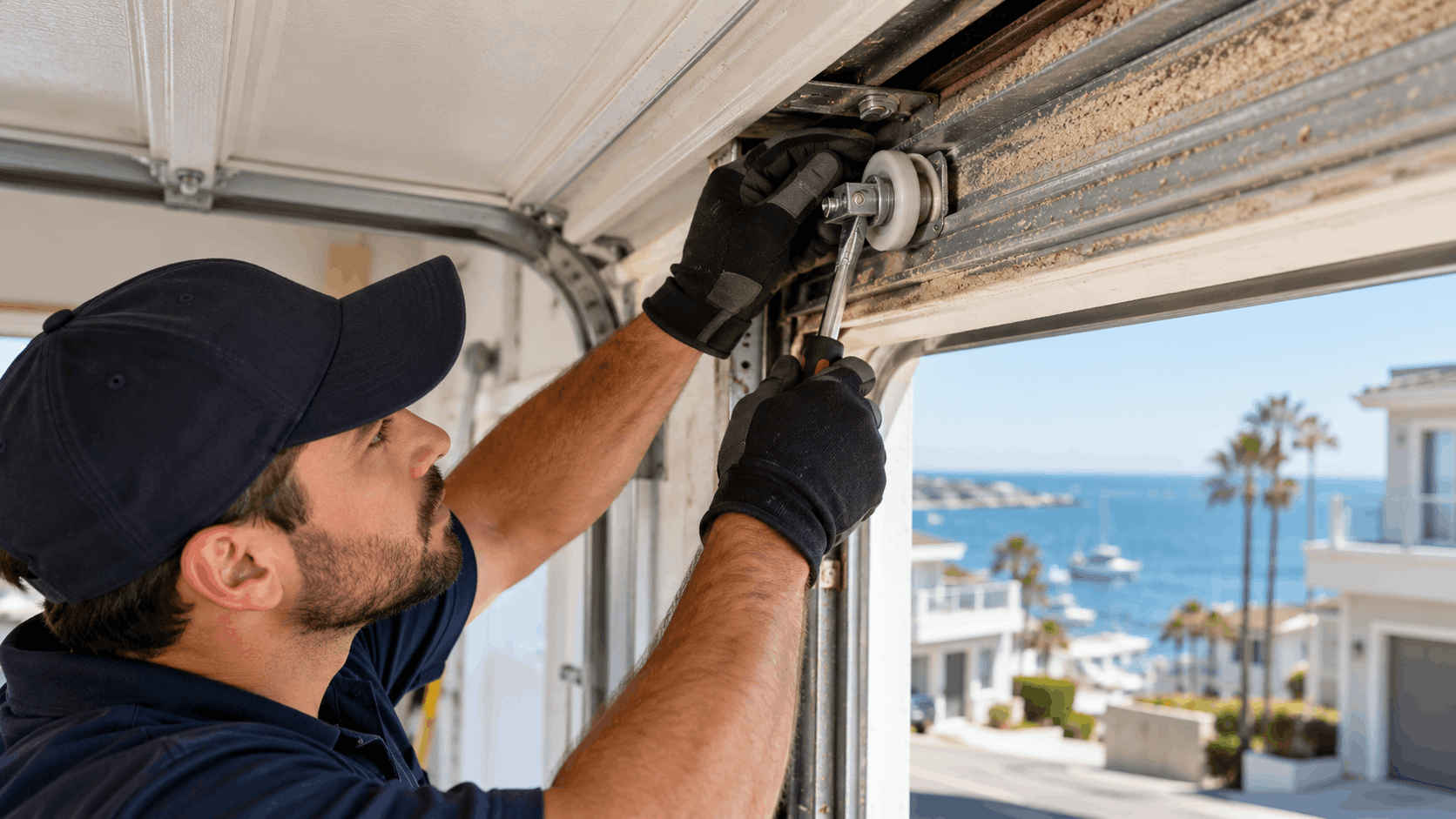
The Balboa Peninsula is a narrow sand spit with the ocean on one side and Newport Harbor on the other, so blowing sand drifts into bottom tracks and settles against the bottom seal faster than it does anywhere inland. That grit scores roller wheels, packs into bearings, and coats photo-eye lenses. The result is a door that binds, a roller that no longer spins freely, and an opener that reads the resistance and reverses.
Why Sand Fouls Garage Door Tracks on the Balboa Peninsula?
Sand is not background detail here. On the Peninsula it is the primary mechanical cause behind a large share of binding doors and false reverses. The geography does the work: a thin strip of land surrounded by water, constant onshore wind, and garages that open straight onto alleys where drifting sand has nowhere to go but into the opening.
Once grit is in the bottom track, it behaves like grinding paste. Every open and close drags the roller wheels across it, and the door feels heavier than it should. The table below shows what each stage of sand intrusion does to the hardware.
| Where sand collects | What it does | What the owner notices |
|---|---|---|
| Bottom track | Rollers grind across grit, scoring the wheel surface | Door labors and sounds rough near the floor |
| Against the bottom seal | Grit packs in so the seal stops flattening to the slab | Light gap at the threshold, more sand gets in |
| Roller bearings | Fine sand works into bearings and they stop spinning freely | Squeal, jerky travel, flat spots forming |
| Photo-eye lens | Coats the lens and breaks or weakens the beam | Door reverses with no visible obstruction |
A Sand Spit Between Two Bodies of Water
The Peninsula is a long, narrow sand spit that encloses Newport Harbor, with the open ocean on the outside and the harbor on the inside. There is water on both sides and very little distance between them, so wind-carried sand is a daily fact of life rather than a storm-only event.
Onshore wind lifts fine sand off the beach and carries it inland across the lots. Because the housing is some of the densest in Orange County, that sand funnels between buildings and settles wherever it can. Garage openings at ground level are natural collection points.
Blowing sand does not need a big gust to cause trouble. A steady breeze over days is enough to build a drift at a garage threshold. Over a season, that drift becomes a layer in the bottom track that an owner never thinks to look at until the door starts acting up.
That is the root cause behind most Peninsula roller problems. It is not age or a defective part so much as the location itself feeding grit into the one place a roller has to travel.
How Sand Makes Rollers Bind and the Door Labor
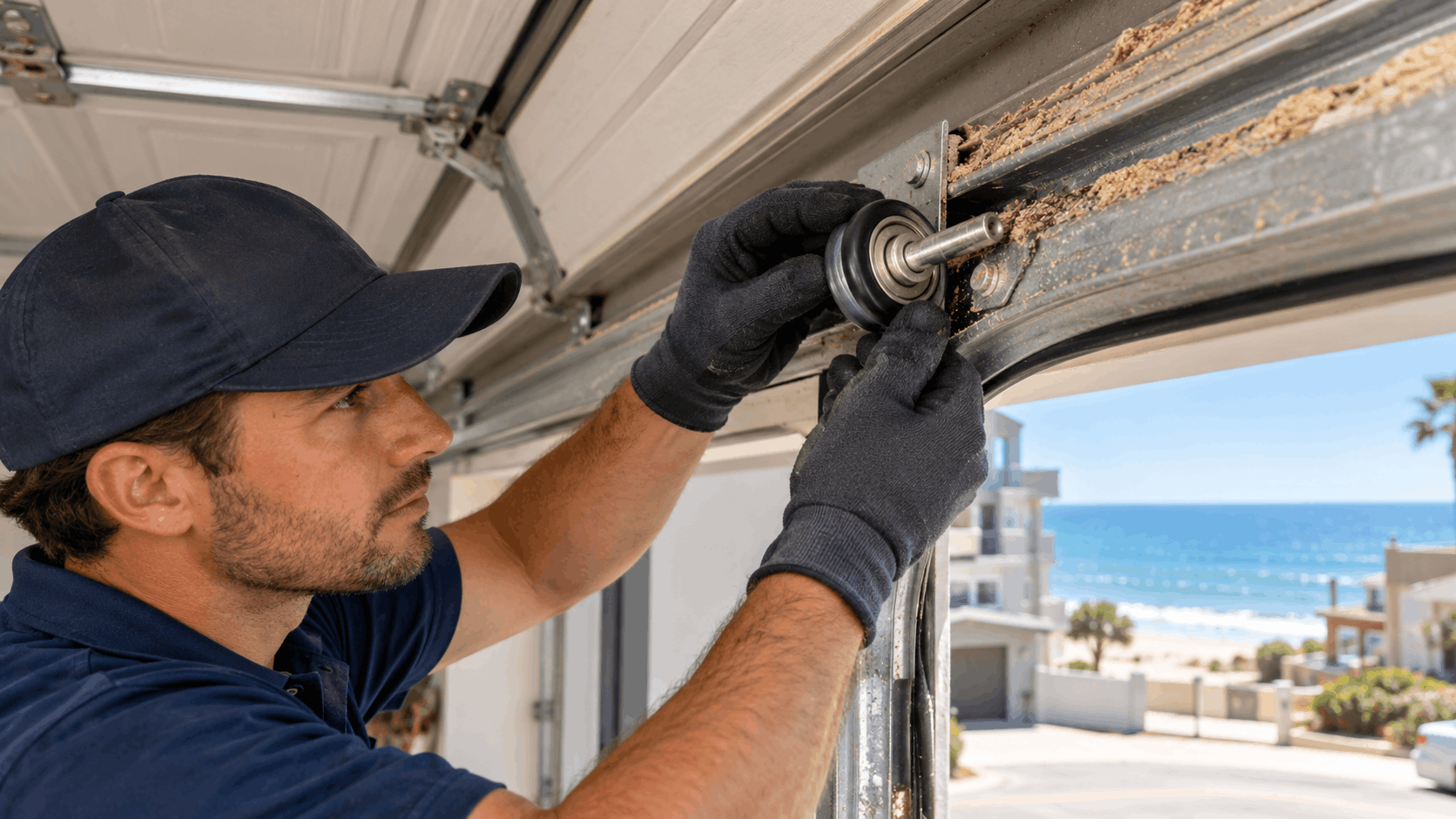
The mechanism is straightforward once you picture it. Sand settles in the bottom track where the lowest rollers ride. As the door moves, those rollers are forced to roll over and through the grit instead of on clean steel.
At first the wheels just sound gritty. Then the sand starts to score the roller surface and pack into the bearing, so the wheel no longer turns smoothly. A roller that should spin now drags, and the door has to be pushed harder to move.
The opener feels that extra load. Modern openers are built to stop and reverse when they meet resistance, which is a safety feature, not a fault. So a door that labors against sand-bound rollers will often reverse partway down, leaving the owner convinced something is broken when the real problem is grit.
Left alone, the binding gets worse. A scored wheel develops flat spots, the bearing seizes, and what began as a cleaning job becomes a roller and hardware replacement. Catching it early keeps the fix small.
The Alley-Facing Garages Along Balboa Boulevard
Most garages on the Peninsula are served by alleys, not street-facing driveways. Balboa Boulevard runs the length of the spit end to end, and the homes packed along it and the cross streets back onto narrow alleys where the garages live.
These are small garages. Single-bay and tandem layouts are common, openings are narrow, and headroom is often low. A narrow opening in a tight alley is exactly where wind-blown sand piles against the threshold, because there is no wide apron for it to scatter across.
Near West Balboa Boulevard, where cottages, duplexes and rebuilds sit shoulder to shoulder, the same drift conditions repeat garage after garage. The density that makes the Peninsula special is also what concentrates sand at each door.
That tight access shapes the repair too. A tech working one of these alley garages plans around limited room to maneuver, which is one more reason the sand problem gets solved properly in one visit rather than revisited.
When It Is the Sensor, Not the Rollers
Before anyone condemns a roller, the sensors get checked. Sand settles on the photo-eye lenses mounted low on each side of the opening, no higher than six inches off the floor, right in the path of drifting grit.
A coated or misaligned lens breaks the beam between the two eyes. When that beam is broken, the opener will not let the door close, and it reverses or refuses to move with nothing visible in the way. This is the single most common Peninsula call that turns out not to be a broken part at all.
The fix is often as simple as wiping the lenses and confirming alignment. If the beam is clear and the door still labors, then attention moves to the rollers and track. Checking the safety sensor alignment first saves owners from paying for hardware they did not need.
Photo-eye faults, misalignment and blocked beams are the most common cause of a door that reverses for no visible reason anywhere, and on a sand spit the odds of a dirty lens are higher still.
Get Your Free Quote
Tell us about your garage door and we'll get back to you within 30 to 60 minutes.
Signs Your Rollers Need Replacing, Not Just Cleaning
Not every sand problem means new rollers. Sometimes a clean track and a lens wipe put a door right. The trick is knowing when the wheels themselves are already damaged, because at that point cleaning alone will not hold.
Here is what to look and listen for before calling, and why each sign points toward replacement rather than a quick clean.
Grinding, Squealing and Jerky Travel
Sound is the first clue. A door with healthy rollers on a clean track runs smoothly and fairly quietly. Once wheels are scored by grit, you hear grinding and squealing as the door moves, especially near the floor where the sand collects.
Jerky, uneven travel is the companion sign. Instead of a steady glide, the door hesitates, catches, and lurches as bound rollers fight to turn. That stop-start motion is the hardware telling you the wheels are not rolling freely anymore.
A one-time blockage sounds different. If a pebble or clump of sand is in the track, you often get a single bump and then normal travel once it clears. Persistent grinding on every cycle points to the rollers, not a stray obstruction.
When the noise keeps coming back after cleaning, the wheel surfaces are the problem. That is the line between maintenance and replacement.
Flat Spots, Rust and Seized Bearings
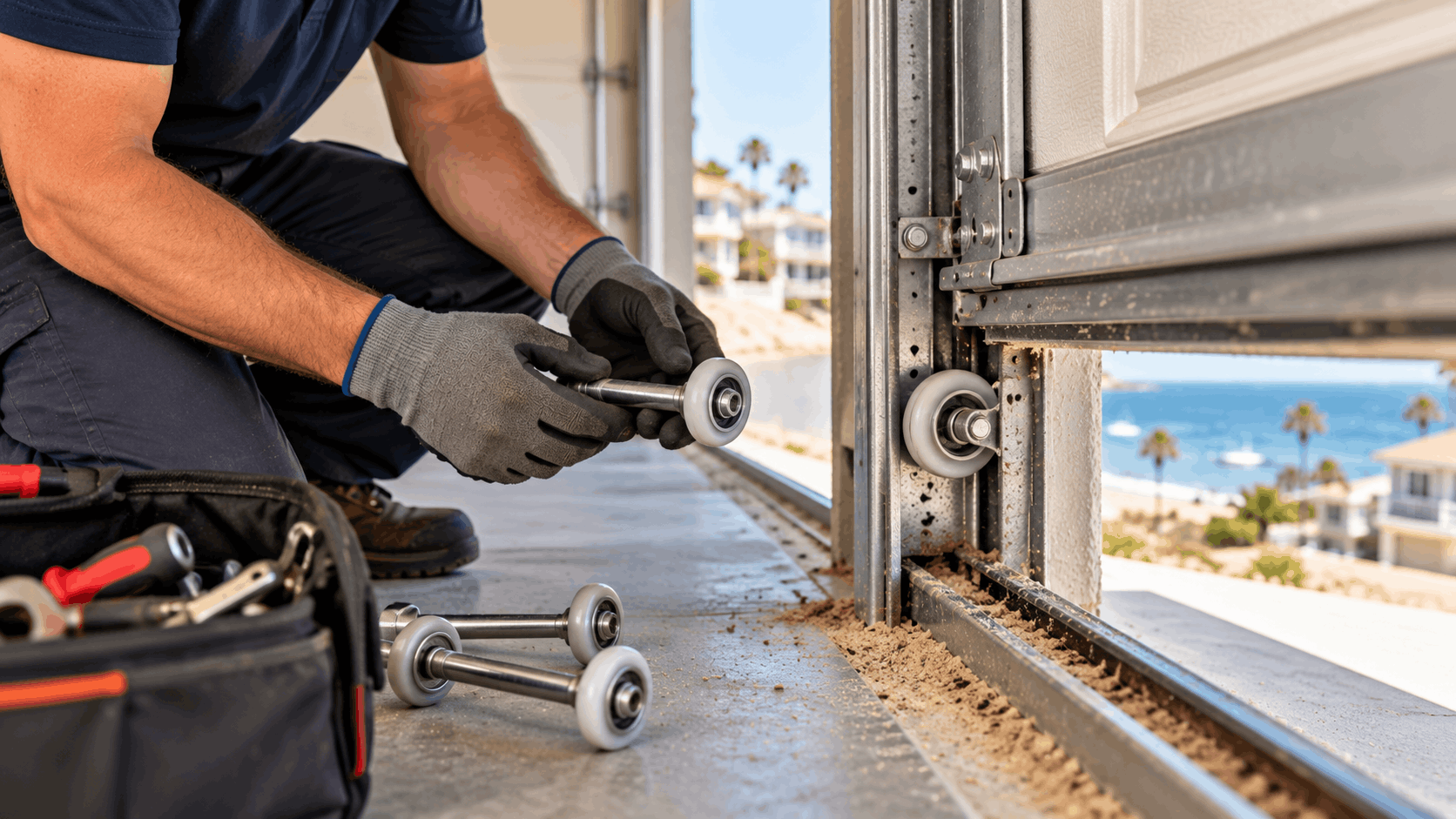
Visible damage confirms what the sounds suggest. Pull the door down partway and look at the roller wheels. Flat spots on what should be a round wheel mean the roller has been dragging instead of spinning, grinding itself down on grit.
Corroded stems are common this close to the water. The metal shaft that holds the wheel and seats into the hinge can rust, which stiffens the whole assembly. A rusty stem is a sign the roller has reached the end of its service life.
Seized bearings are the clearest signal. Spin a wheel by hand with the door disconnected and safely supported. A good roller turns freely. A seized one barely moves or grinds, because sand and corrosion have locked the bearing.
Any of these three means cleaning will not restore smooth travel. The wheel is damaged, and a new roller is the honest fix.
The Track Is Clean but the Problem Comes Back
Some owners clean the track, run the door, and watch the bind return within days. That is the telltale pattern of scored rollers. The track may be spotless, but the wheels themselves are already worn and rough from grinding against grit.
A scored wheel cannot roll smoothly even on clean steel. The surface that should glide now drags, so the door labors again almost immediately. No amount of cleaning fixes a wheel that is already chewed up.
This is where repeated cleaning stops being worth it. If a track has been cleared more than once and the problem keeps returning, the money is better spent on new rollers than on another round of the same temporary measure.
On the Peninsula this cycle plays out faster because the sand keeps coming back too. Replacing worn wheels and then keeping the track clean is what actually ends it.
Check Cables and Hinges at the Same Time
Rollers do not wear alone. Cables, hinges and bearings all take the same loads and the same coastal exposure, so they tend to reach the end of their life around the same time.
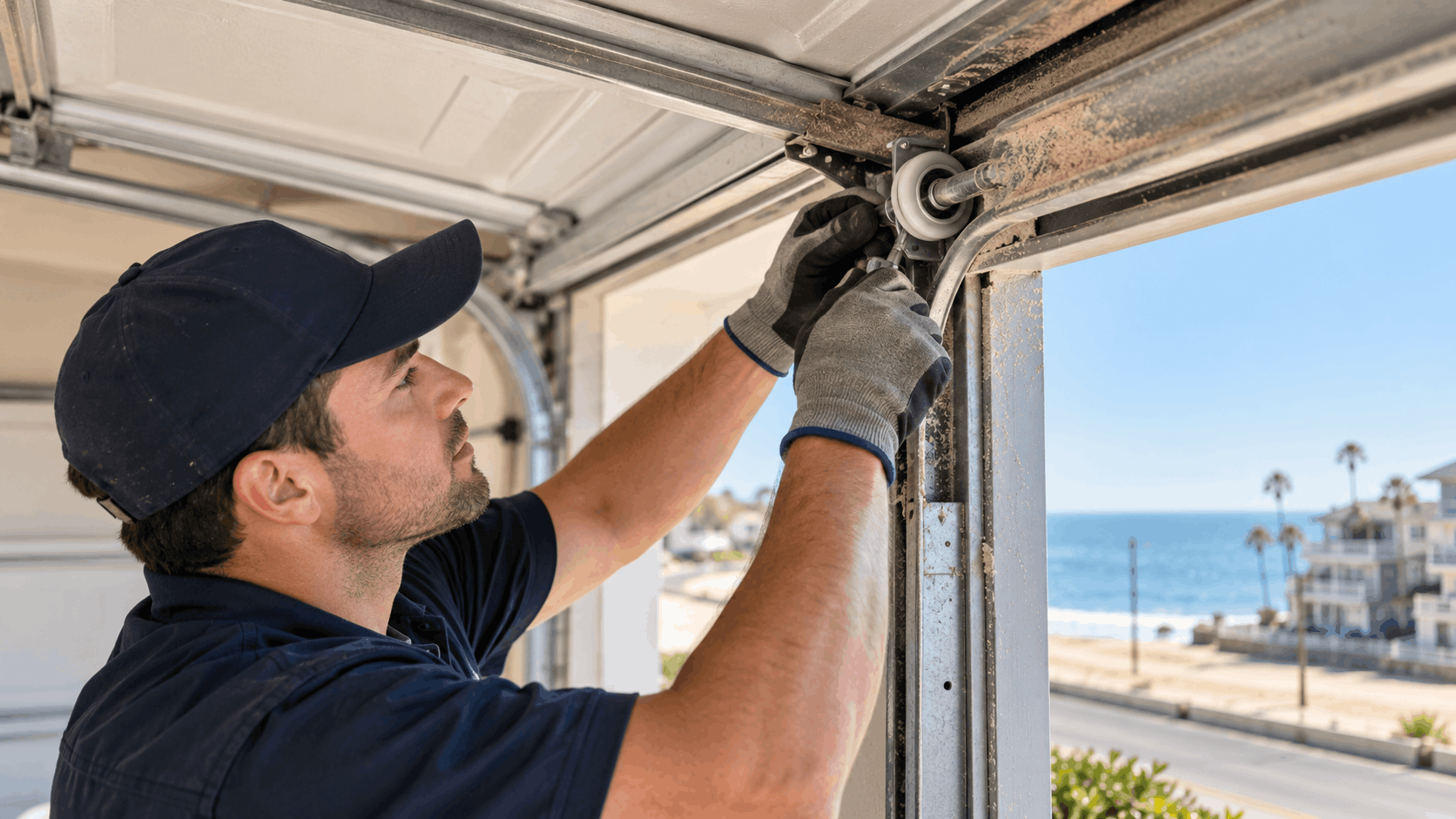
Replacing a roller without inspecting the cables is how a second failure follows weeks later. A frayed cable that was missed during a roller swap can snap soon after, and then the owner is paying for a second visit for a problem that could have been caught the first time.
Hinges that have rusted or cracked let the door flex and throw other rollers out of line. Checking them during a roller job keeps the whole assembly square. A quick look at the cables and drums at the same time is simply good practice here.
That is why a proper roller job on the Peninsula is an inspection of the moving hardware as a group, not a one-part swap.
Need Help in Irvine?
Urgent Garage Doors serves Irvine and all of Orange County.
Salt Air and Why Peninsula Hardware Corrodes
Sand gets into the tracks. Salt gets into the metal. With ocean on one side and harbor on the other, the air on the Peninsula carries salt all day, and that salt attacks every steel part on the door.
Corrosion does not care which part it reaches. Springs, cables, drums, rollers, hinges and fasteners all rust faster in salt air, which is why hardware choice matters more on this block than almost anywhere inland.
Ocean on One Side, Harbor on the Other
The constant salt-laden air is the defining coastal condition here. It settles on bare steel and draws moisture, and corrosion begins wherever a coating is thin or scratched.
Every steel component is exposed. Springs, cables, drums, rollers, hinges and fasteners all corrode in this environment, and corrosion brings each one to the end of its cycle rating earlier than the same part would reach inland.
That matters because springs and other parts are rated in cycles by the manufacturer, not in years. A standard torsion spring is commonly rated around 10,000 cycles, which is roughly seven years at four cycles a day. Corrosion does not change that rating, but it adds surface damage that can bring a part to failure before it would otherwise.
So the honest frame for coastal hardware is simple. Salt does not give parts a magic shorter lifespan number, it damages the metal so the part reaches the end of its rated life sooner. The answer is better materials and regular inspection.
Cables That Fray From the Inside
Cables near the water have a quiet failure mode. They fray from the inside before they snap, so the damage is often hidden inside the strands where a casual glance misses it.
By the time an outer strand shows, the cable may already be badly weakened. A cable that looks fine on the surface can still be close to breaking, which is why a hands-on inspection matters more than a quick look during any job down near the bottom brackets.
Steel bottom sections have their own coastal pattern. They rust upward from the base, because that is where water, salt and sand sit against the panel. A bottom section eaten from below is a common sight on older Peninsula doors.
All of this is why corrosion checks belong in a roller job here. The tech is already at the bottom of the door working near the cables and the bottom bracket, so inspecting those parts at the same time is efficient and prevents a return trip.
Choosing Rollers That Hold Up on the Coast
The right hardware pays off on a saltwater block. Galvanized and coated hardware resists corrosion far better than bare steel, and that coating is what buys a part its full rated life in this air.
Stainless fasteners are a sensible pick here because the small bolts and screws are often the first things to rust solid. A seized fastener turns a simple future repair into a fight, so stainless ones are worth the small upgrade.
Sealed-bearing nylon rollers are a strong choice for sand and salt together. The nylon wheel runs quietly, and the sealed bearing keeps grit and salt air out of the moving part that sand most wants to attack. Fewer entry points for sand means a longer-lasting roller.
None of this is an upsell on the Peninsula. The materials are justified by the mechanics of the location, which is a good reason to discuss them during a roller and hardware upgrade rather than defaulting to the cheapest wheel.
What Roller Replacement Actually Involves
Knowing what a tech does on site takes the mystery out of the visit. A roller replacement is a sequence: inspect, clean, swap, realign, and test. The springs are the one part that stays strictly off limits to owners, and for good reason.
Inspection, Track Cleaning and Lens Wiping
The first move is to clear sand from the bottom track. Until the grit is gone, there is no way to judge how the door really moves or whether the rollers alone are the problem.
Next comes wiping the photo-eye lenses and confirming the beam. Because a coated lens is such a common cause of false reverses here, this step often reveals that part of the trouble was never mechanical at all.
Then every roller, hinge and cable gets inspected before any part is swapped. The tech looks for flat spots, seized bearings, corroded stems, frayed cable strands and cracked hinges. That full picture decides what actually needs replacing.
Doing the inspection before the swap avoids two mistakes: replacing a good part and missing a bad one. On a sand spit, that careful look is what separates a lasting fix from a repeat call.
Swapping Rollers and Realigning the Track
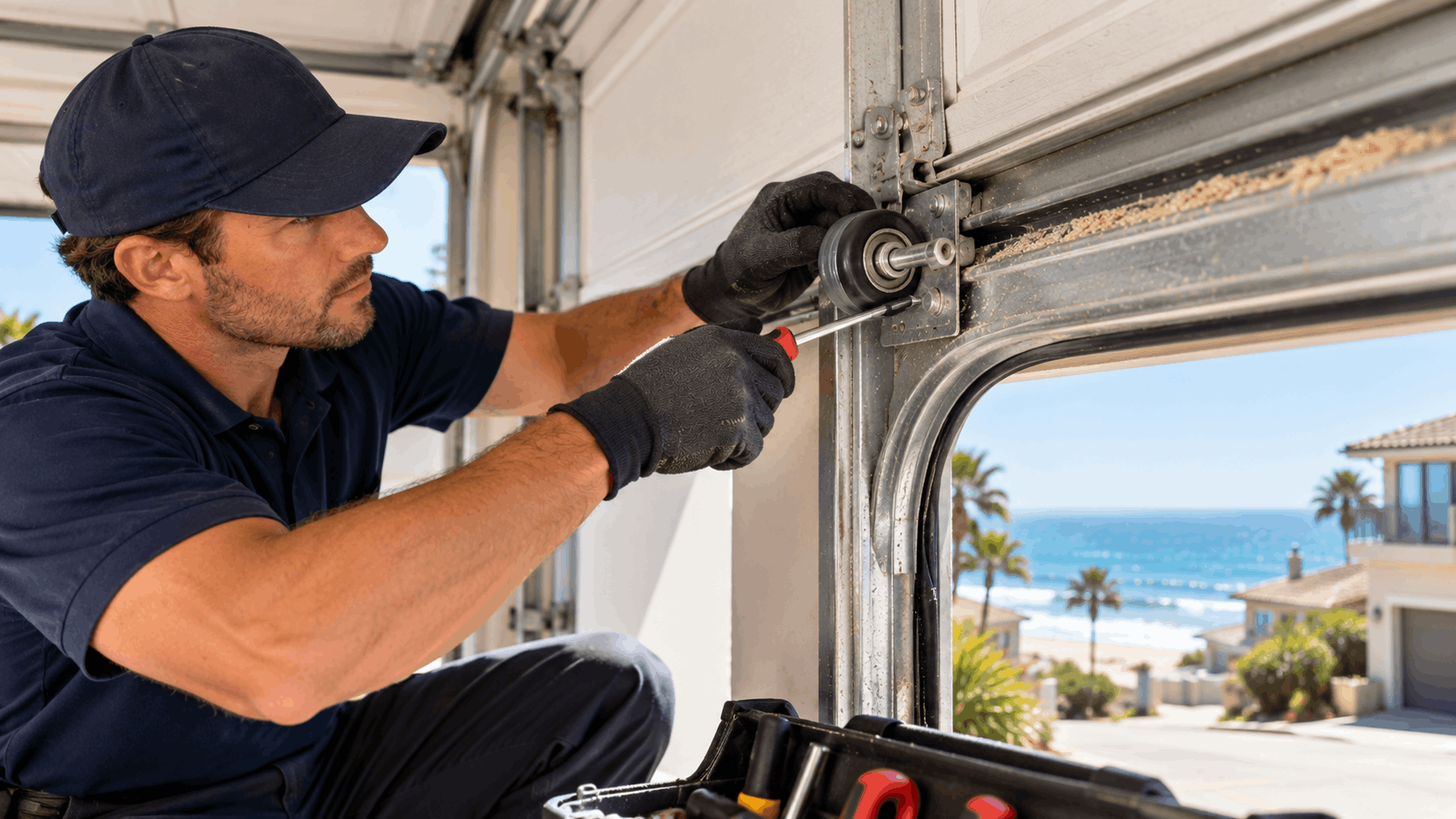
With the inspection done, worn rollers come out and new ones go in. Each roller is removed from its hinge, and a fresh wheel is seated so it spins freely in the track.
Sand buildup often pushes the bottom track slightly out of true over time, so realignment is part of the job. The tech checks that the track is straight and properly spaced from the door so the new rollers ride cleanly without rubbing.
A track that is even a little off will wear fresh rollers quickly, which defeats the purpose of the swap. Getting the track repair and realignment right is what makes the new hardware last.
If the door has drifted fully off track from sand and binding, that becomes an off-track repair, which resets the door into the tracks before new rollers go in.
Why Owners Should Never Touch the Springs
This is the hard safety line. A torsion spring stores enough energy to cause serious injury. It is wound tight under high tension and held by bars against a fixed cone, and it does not forgive mistakes.
Owners must never adjust, wind, unwind or replace a spring. Roller work near the bottom brackets sits close to that tensioned hardware, which is exactly why this part of the job belongs with a licensed tech who has the bars and the training to work around it safely.
The safe check an owner can do is the manufacturer's auto-reverse test, which involves no contact with the spring at all. Everything behind the tension stays with the professional.
Any work on the springs themselves, such as a torsion spring replacement, is a separate licensed job and never a do-it-yourself task.
Safety Checks Before the Job Is Done
The work is not finished until the safety systems are confirmed. Two quick tests prove the door is safe to use again after new rollers go in.
The 2x4 test checks contact reverse. A flat 2x4 laid across the opening under the door should make the door reverse within two seconds of touching it on the way down. If it does not reverse, the force settings or hardware need attention.
The photo-eye check confirms the non-contact system. With the door closing, breaking the beam should stop and reverse it. The beam must be aligned and unobstructed, which matters doubly on the Peninsula where sand coats lenses.
These checks are not optional extras. They are how the tech confirms the door meets the entrapment protection every modern opener must have before leaving the site. You can read how the U.S. Consumer Product Safety Commission frames those requirements at cpsc.gov.
What Roller and Track Repair Costs in Newport Beach
Owners want a number before they call, and fair enough. The figures below are typical Orange County ranges for the jobs tied to a sand-fouled door. They are ranges for the area, not a quote, and the real price for a specific garage is given in writing before work begins.
Typical Ranges for Rollers, Tracks and Hardware
For the core work on a sand problem, the typical area ranges are a quiet roller and hardware upgrade at $150 to $300, and track repair and realignment at $125 to $300. These cover replacing worn rollers and getting the track straight again.
If the door has come off its track from binding, off-track door repair runs $125 to $275 in the typical range. That resets the door before new rollers go in.
Safety sensor alignment and repair, which is often the real fix when a lens is coated with sand, runs $75 to $150. Door balancing and tension adjustment, if the door is out of balance, is also $75 to $150.
These are typical ranges for Newport Beach and the wider county, meant to set expectations. Where a job falls inside the range depends on the specific door and hardware.
What Adds to the Price on a Peninsula Garage
Coastal exposure sometimes turns up work beyond the rollers. Corroded cables are a frequent find near the water, and cable repair runs $150 to $300 in the typical range when a frayed cable needs replacing alongside the rollers.
Worn or rusted hinges may need attention too, and a steel bottom section rusting from the base is a bigger conversation that can lead toward panel replacement, which runs $250 to $800 per panel in the typical range.
Each of these is a separate line with its own range. They are not rolled into one combined figure, because the right answer depends on what the inspection actually finds on that door.
The point for a Peninsula owner is to expect that salt and sand can add corrosion work on top of the roller job, and to want that assessed honestly rather than guessed at.
Getting a Written Price Before Work Starts
A written price is available before work begins, and it is provided when the job calls for it or the customer asks. That lets an owner or a property manager approve the cost before any tools come out.
Separately, California Business and Professions Code section 7159 requires a written home improvement contract for any work over $500. That is a legal requirement, not a company policy, and it protects the customer.
The final price depends on the specific garage. Two doors on the same alley can need different work, because one has clean cables and sound hinges and the other has corrosion from years of salt air.
So the ranges above are the starting frame, and the written price for the actual door is what an owner relies on. Confirm the exact figure for your garage before the work is scheduled.
Need Help in Irvine?
Urgent Garage Doors serves Irvine and all of Orange County.
Keeping Sand Out After the Rollers Are Replaced
New rollers solve today's bind. Keeping sand out is what makes the fix last on a windy spit. A little routine care prevents more Peninsula service calls than any single part upgrade.
Regular Track Cleaning and Lens Wiping
Regular track cleaning and lens wiping stop more problems here than any component. Sand is always arriving, so clearing it before it packs in is the cheapest maintenance there is.
An owner can safely do the simple parts. Brush or vacuum the bottom track to clear loose sand, and wipe the photo-eye lenses on both sides with a soft cloth so the beam stays clear. These are no-tension tasks with no contact with the springs.
Doing this every few weeks during windy stretches keeps grit from building into the layer that scores rollers. It is a five-minute habit that protects a hundred-dollar repair.
What owners should not do is lubricate the track with heavy grease, which just catches more sand. A light dry lubricant on the rollers, if anything, is the coastal-friendly choice.
Bottom Seals and Weatherstripping Against Drifting Sand
The bottom seal is the first line against drifting sand, and sand defeats it from within. Grit packs into the seal so it stops flattening against the slab, which opens a gap and lets even more sand in.
Once a seal has lost its flex, replacing it restores the tight contact at the threshold. A fresh seal that seats cleanly against the slab keeps a drift from working its way under the door and into the track.
A weatherseal and insulation retrofit runs $150 to $400 in the typical range and helps hold sand out at the opening. It is a small job with an outsized effect on a sandy alley garage.
A weatherseal retrofit is one of the better-value preventive steps a Peninsula owner can take after a roller job, because it attacks the sand at the point of entry.
Twice-Yearly Inspection on a Saltwater Block
A twice-yearly inspection is justified on the mechanics here, not as an upsell. Salt air and blowing sand work on the hardware year round, so checking the moving parts twice a year catches corrosion and wear before they cause a failure.
Each preventive maintenance visit includes a written report of what was found and what is recommended. That gives an owner or property manager a clear record rather than a verbal summary, which matters when the person paying is not always the person at the property.
A preventive maintenance visit runs $99 to $149 in the typical range. For a door living between ocean and harbor, that is modest insurance against a bigger repair.
On a saltwater block, the inspection is where frayed cables, rusting fasteners and early roller wear get caught. Booking a preventive maintenance plan keeps the door ahead of the salt and sand.
Timing the Work Around Peninsula Parking and Coastal Rules
Scheduling on the Peninsula is a real part of the job. Summer parking limits decide when a work vehicle can even sit on the street, and the coastal zone shapes which jobs are simple and which need review.
Summer Parking Limits From May 15 to September 15
Parking on public streets in the restricted residential zone is limited from May 15 to September 15, when only vehicles displaying a valid permit may park, and permit holders still have to follow every other rule including the 72-hour ordinance.
For a service vehicle, the practical reading is plain: from mid-May to mid-September there is nowhere legitimate to sit on the Peninsula unless it is in the customer's own garage space or a permitted lot. That changes how jobs get booked.
So summer roller jobs get scheduled early in the morning, when access is easier and the work can be done quickly. Larger work that needs more time on site belongs in the off-season, from fall through spring.
Owners and managers planning a bigger door project are better off booking it outside the summer window. A quick roller fix can still happen in summer with an early slot.
When a Like-for-Like Repair Stays Simple
A roller and track repair in the existing opening is routine maintenance. It does not change the structure or the size of the opening, so it stays out of the longer permit process.
What draws coastal review is changing the opening size or altering the structure around it. Nearly every property in Newport Beach sits in the Coastal Zone, and the Peninsula is entirely coastal, so work touching exterior walls or openings is the kind of change that can require a Coastal Development Permit.
Replacing a door or hardware at the same dimensions is a different proposition from widening the opening. The second is what pulls a project into a longer path.
Permits are decided by the city with jurisdiction over the specific address, not by a single regional rule. Owners can check status with the city's Address Search Tool, and the Newport Beach Permit Center at 100 Civic Center Drive, 949-644-3309, confirms the position for a given job.
Licensed Work and Property Managers
Garage door work in California is licensed under classification C-61/D-28, Doors, Gates and Activating Devices. That scope covers sectional doors, rolling doors, spring systems, operators, control boards, safety sensors and activating devices. A license is verified free at cslb.ca.gov, where classification, status, bond and workers compensation are public record.
C-28 is Lock and Security Equipment and is not the garage door license, so this work is not C-28 and does not need a Class B general building license.
On the Peninsula, nearly half of Newport Beach homes are rented, so the caller is often a property manager handling turnover rather than the resident. A written report and a clear price matter even more when the person authorizing the work is not the one living behind the door.
That rental share also means fast, small jobs cluster around guest changeovers and the run-up to summer, and a manager with several properties becomes a repeat caller rather than a one-off.
Need Help in Irvine?
Urgent Garage Doors serves Irvine and all of Orange County.
How Urgent Garage Doors Handles Sand-Fouled Roller Jobs
When an owner or manager calls about a laboring, reversing door on the Peninsula, the approach is built around the sand problem rather than guessing at a broken part.
Diagnostic That Checks Sensors, Rollers and Cables
The diagnostic looks at the sensors, rollers, hinges and cables together. That order matters, because a coated photo-eye lens or a drift of sand in the track can mimic a broken part, and checking the sensors first keeps a sand problem from being misdiagnosed as a hardware failure.
Only after the full look does the plan get set. If the rollers are scored or the bearings have seized, they get replaced. If a cable is frayed from the inside, it gets flagged before it snaps.
A free on-site estimate is offered for new garage door installations, so an owner weighing a full door replacement can get an assessment without a charge for the visit.
The goal is one honest repair that fixes the real cause, not a parade of return trips for a problem that was never diagnosed properly the first time.
Truck Stock and Same-Visit Repairs
The trucks carry common torsion spring sizes and hardware, so many repairs are completed on the same visit. For a straightforward roller and track job, that often means the door is working again before the tech leaves.
Carrying stock matters on the Peninsula, where tight alleys and summer parking make a second trip costly. Finishing in one visit respects the access limits as much as the owner's time.
When corrosion turns up extra work, such as a cable or a bottom panel, the plan is confirmed before the added work goes ahead. Not every repair finishes in one visit, but a large share of roller jobs do.
On a new door install, removal and haul-away of the old door is included, so an owner is not left dealing with the old panels.
24/7 Response Across Orange County
Emergency calls are answered 24 hours a day, 7 days a week, every day of the year including holidays. A stuck door in an alley with one road on and off the Peninsula is not something that waits for business hours.
Response is 30 to 60 minutes anywhere in Orange County. The Peninsula is served from the Newport Beach service area out of the Irvine storefront at 76 Ashford.
That coverage includes the full Peninsula from McFadden Square near the Newport Pier down to Balboa Village by the Balboa Pavilion. Wherever the door sits on the spit, the team reaches it.
For an emergency repair on a door that will not open or close, that round-the-clock window keeps a trapped car from becoming an overnight problem.
Getting Your Peninsula Door Moving Again
A sand-fouled door gets a full diagnostic that checks the sensors, rollers, hinges and cables together, a written price before the work starts, and a 30 to 60 minute response anywhere in Orange County, with trucks stocked to finish most roller jobs on the same visit.
Call Urgent Garage Doors at (949) 529-7743 to book a roller and track repair for your Balboa Peninsula garage, or to schedule a twice-yearly inspection before the sand wins again.
Frequently Asked Questions
- Why does my garage door keep reversing on the Balboa Peninsula?
- On the Peninsula it is usually sand. Grit coats the photo-eye lenses low on each side of the opening and breaks the beam, so the door refuses to close with nothing visible in the way. Sand in the bottom track can also make the door labor until the opener reads the resistance and reverses. A tech checks the sensors and clears the track first before touching any hardware.
- Can I just clean the sand out instead of replacing rollers?
- Cleaning helps when the rollers are still sound. If the wheels are intact and the bearings spin freely, clearing the sand and wiping the lenses can put the door right. Once the wheels are scored or the bearings have seized from grinding against grit, cleaning alone will not stop the bind, because the damaged roller cannot roll smoothly even on clean steel. At that point replacement is the honest fix.
- How much does roller or track repair cost in Newport Beach?
- Typical Orange County ranges are a quiet roller and hardware upgrade at $150 to $300, track repair and realignment at $125 to $300, and off-track door repair at $125 to $275. These are typical area ranges rather than a quote. The final price depends on the specific garage and any corrosion work the inspection turns up, and a written price is available before work begins.
- How long does a roller replacement take?
- Many roller jobs are completed on the same visit because the trucks carry common hardware and spring sizes. A straightforward roller and track repair in an existing opening is usually quick. Added corrosion work, such as a frayed cable or a rusted bottom panel, can extend the job, and that extra work is confirmed before it goes ahead so there are no surprises.
- Should I replace the cables at the same time?
- Near the water it is worth inspecting them together. Cables within a few blocks of the ocean and harbor fray from the inside before they snap, so a cable can look fine on the surface while it is close to failing. Checking the cables during the roller job catches that hidden damage and avoids a second failure weeks later, which would mean another visit for a problem that could have been caught.
- What kind of rollers hold up best near the ocean?
- Galvanized and coated hardware resists salt-air corrosion far better than bare steel. Stainless fasteners are a good pick because small bolts and screws seize first in this air. Sealed-bearing nylon rollers run quietly and keep sand and salt out of the bearing, which is the part grit most wants to attack. Those choices are justified by the mechanics of a saltwater block, not sold as an upgrade for its own sake.
- Can I replace a garage door spring myself?
- No. A torsion spring stores enough energy to cause serious injury and is wound with bars against a fixed cone. Owners should never adjust, wind, unwind or replace one. The safe check to do yourself is the auto-reverse test: lay a flat 2x4 on the floor in the door's path, confirm the door reverses on contact, and make sure the photo-eye beam is aligned and unobstructed. Leave the spring work to a licensed tech.
- Do I need a permit for roller or track repair on the Peninsula?
- A like-for-like roller and track repair in the existing opening is routine maintenance. Changing the opening size or altering the structure around it is what can draw coastal review, since the Peninsula sits entirely in the Coastal Zone and that kind of work can require a Coastal Development Permit. The city with jurisdiction confirms the position for a specific address, and the Newport Beach Permit Center at 100 Civic Center Drive, 949-644-3309, can confirm it.
- When is the best time to book Peninsula garage work?
- Summer parking limits run from May 15 to September 15 in the restricted residential zone, when only permit vehicles can park on public streets. During that window a work vehicle has nowhere legitimate to sit unless it is in your garage space or a permitted lot, so jobs get booked early in the morning. Larger work fits better in the off-season from fall through spring when access is easier.
- Does Urgent Garage Doors serve the Balboa Peninsula at night or on holidays?
- Yes. Emergency calls are answered 24 hours a day, 7 days a week, every day of the year including holidays. Response is 30 to 60 minutes anywhere in Orange County, with the Peninsula served from the Irvine storefront at 76 Ashford. With one road on and off the spit, a stuck door in an alley is treated as the urgent problem it is.
Licensed garage door repair professionals serving Irvine and Orange County.
Licensed in California · License #1055150
Why trust Urgent Garage Doors?
Founded in 2017, Urgent Garage Doors is a licensed and insured garage door services serving Irvine and Orange County. All content is reviewed by our licensed technicians.

Need Help in Irvine?
Urgent Garage Doors serves Irvine and all of Orange County.
Related Articles
Garage Door Roller Replacement Cost OC: Steel vs Nylon Pricing Difference
Compare steel vs nylon garage door roller replacement costs in Orange County, including pricing, lifespan, noise, rust, and which choice fits your Irvine home.
New Garage Door Cost in Balboa Peninsula for Narrow Lots and Tandem Garages
What a new garage door costs on the Balboa Peninsula for narrow and tandem garages, including custom widths, low-headroom kits, salt air hardware and SB 969 battery backup.
Turtle Rock Garage Door Seals and Tracks Against Canyon Wind Off Bommer Canyon
Ridgeline wind off Bommer Canyon drives dust into Turtle Rock garage door seals and tracks. Here is why seals fail, how tracks drift on hillside lots, and how we fix it.