Garage Door Service for Newport Beach Property Managers and Vacation Rental Operators
Key Takeaways
- Nearly half of Newport Beach homes are rented (47.9 percent), so on those properties a manager or operator authorizes and pays for the door work, not the resident.
- Access decides the job: Peninsula alleys with no off-street parking and the guard gates at Big Canyon, Pelican Hill, Pelican Crest, and Crystal Cove must be arranged before the day.
- Exterior door replacements in Big Canyon, Harbor View, and Newport Coast associations under the Davis-Stirling Act typically need architectural review of style, panel design, color, and hardware.
- The City of Newport Beach building division confirms permits per address; a permit also removes the under-$1,000 unlicensed-work exemption raised by AB 2622 effective January 1, 2025.
- Garage door work is licensed under CSLB C-61/D-28, not C-28, and SB 969 requires battery backup on every residential opener sold or installed since July 1, 2019.
- Managers can safely run the 2x4 auto-reverse, photo-eye beam, and balance tests, but nobody on site should ever touch a torsion spring.
- High-use rental doors reach the roughly 10,000-cycle spring rating faster, and springs, cables, rollers, and sensors should be checked together to avoid a second failure.
- Urgent Garage Doors (CSLB #1055150, (949) 529-7743) offers 24/7 emergency service with a 30 to 60 minute Orange County response, free install estimates, and written maintenance reports.
In This Article
It is a summer Saturday on the Balboa Peninsula. A renter pulls into a narrow alley behind a 1960s duplex, hits the remote, and nothing happens. The door sits half open, the car is blocking the alley, and luggage is stacked on the sand-dusted concrete. The renter does not call a garage door company. They call the property manager, who is three miles away fielding two other turnovers.
That scene plays out across Newport Beach more than most people realize, and it changes who makes the decision, who schedules the crew, and who pays the bill. On a rental, the person living behind the door is rarely the person who authorizes the repair. The chain runs through a manager or an owner, and in the gated hillside communities it runs through a guard gate and an association file too.
Why Garage Door Calls Land on the Manager, Not the Resident, in Newport Beach?
In most cities, a broken garage door is the homeowner's problem and the homeowner's phone call. Newport Beach works differently because so much of its housing is rented, managed, or turned over to short-term guests. The result is a split between who lives with the door and who controls the fix, and that split shapes how fast anything gets done.
A property manager sits inside a chain of approval. The resident or guest reports the fault, the manager verifies it, the owner may need to sign off on the cost, and only then does a crew get dispatched. A vacation rental operator works on an even tighter clock, because an empty slot between guests is the only window to get the work done. Newport Beach's village mix, from dense Peninsula lots to guard-gated estates, adds its own access layer on top of that.
| Who lives there | Who calls | Who authorizes | Who pays |
|---|---|---|---|
| Owner-occupant | Owner | Owner | Owner |
| Long-term renter | Renter to manager | Manager or owner | Owner |
| Vacation guest | Guest to operator | Rental operator | Operator or owner |
| Vacant between guests | Operator or cleaner | Operator | Operator or owner |
Nearly Half of Newport Beach Homes Are Rented
The owner-occupied housing rate in Newport Beach is 52.1 percent, which means 47.9 percent of homes here are rented. On nearly half the properties in the city, the person behind the door does not own it. When a door fails on one of those homes, the resident reaches for a landlord or a property manager, not a contractor.
That rented share decides who schedules the work and who signs off on it. A renter cannot authorize spending on an owner's door, and a good manager will not dispatch a crew without confirming the cost path first. So the repair runs through a manager who has to verify the fault, line up access, and often get an owner's approval before a truck rolls.
For a manager, that means keeping a reliable contractor on file matters more than it does for a one-time homeowner. The same doors, the same openers, and the same springs come up again and again across a managed portfolio. A crew that already knows the building stock across Newport Beach saves a round of explanation on every call.
It also means billing and documentation carry weight. An owner who is not on site wants a clear record of what failed and what was done, which is where a written report after the visit earns its place in a managed relationship.
The Caller Is Often a Property Manager, Especially on the Peninsula
Balboa Peninsula housing turns over constantly between owners, long-term renters, and summer visitors. The 1920s and 1930s cottages, the 1960s duplexes, and the contemporary three-story rebuilds sit on small lots, and many of them rotate through managers and rental platforms. The person calling about a failed door there is as likely to be a property manager as a homeowner.
That turnover pattern changes how a crew plans a visit. A manager coordinating several Peninsula units needs a contractor who can confirm a window, stage a truck in a tight alley, and bill back to the right account. The resident on site at the time of the repair may be a short-term guest who knows nothing about the door's history.
Summer is the pinch point. Occupancy climbs, doors cycle harder, and the alleys fill with cars and foot traffic. A manager juggling check-ins across the Newport Beach villages benefits from a single point of contact who can move between properties without relearning each one.
Access and billing have to be arranged up front in this setting. The manager holds the keys, the gate codes where they exist, and the schedule, so the crew works to the manager's calendar rather than a resident's.
Vacation Turnovers Leave No Margin for a Stuck Door
For a short-term rental operator, a door that will not open or close between a checkout and a check-in is a direct hit. It can trap a departing guest's car, strand incoming luggage in the alley, or leave a unit insecure right as new guests arrive. There is no slack in a turnover to wait a day for a repair.
The pressure is sharper than a standard home for a simple reason: the home is occupied by paying guests on a fixed calendar. A homeowner can live with a cranky door for a weekend. An operator cannot hand a guest a garage that will not close, especially where the garage is the only secure parking on the lot.
That is why a fast, confirmed arrival window matters more here. A same-day garage door repair during a turnover can be the difference between a clean handoff and a canceled booking. Operators plan maintenance around vacancy windows precisely because the occupied windows have no room for downtime.
The smart move is to flag a door that is acting up before it fails outright, so the fix lands in a gap rather than mid-stay. A door that reverses for no reason or sounds rough is a warning worth acting on between guests.
Get Your Free Quote
Tell us about your garage door and we'll get back to you within 30 to 60 minutes.
Access Decides the Quote: Peninsula Alleys to Newport Coast Gates
Newport Beach is several different jobs under one city name, and the access decides the quote. The same door swap plays out one way in a Peninsula alley and another way behind a Newport Coast guard gate. Managers who plan around access get more done in a single visit and avoid the wasted trips that someone always ends up paying for.
Physical access, how a truck stages and how a crew moves hardware, is only half of it. Administrative access, who authorizes the visit and whose records sit on file at the gate, is the other half. Both change the timing, and both are easier to solve before the day than at the curb.
Balboa Peninsula and Newport Island: Alleys and No Off-Street Parking
The Peninsula is a narrow sand spit between the ocean and the harbor, holding some of the densest housing in Orange County. Alleys serve most of the garages, and there is almost no off-street parking beyond the garage itself. Newport Island, just off the Peninsula, runs its own parking regime on top of that.
Tight alley access changes how a truck stages and how long a swap takes. A crew often cannot park directly in front of the door, so materials get carried in and the old door gets carried out past whatever else is sharing the alley. In summer those alleys are busy, and a staging plan agreed in advance keeps a job from stalling.
The housing stock adds its own wrinkles. A 1960s duplex may run extension springs and older hardware, while a contemporary rebuild carries a heavier sectional door and a different opener. A crew that knows the Peninsula arrives ready for either rather than guessing.
For managers, the practical takeaway is to tell the crew what they are walking into: alley width, where a truck can stage, and when the alley is clear enough to work. That one conversation turns a tight-access job into a routine one.
Guard-Gated Communities: Big Canyon, Pelican Hill, Pelican Crest, Crystal Cove
Newport Coast is the hillside quarter at the south-eastern end of the city, annexed in 2002 and built largely from the 1990s onward. It holds guard-gated communities including Pelican Hill, Pelican Crest, and Crystal Cove, with custom estates on view lots, motor courts, and three and four-car garages. Big Canyon is guard gated as well, with contractor access controlled at the gate.
In these communities the homeowner usually has to authorize the visit in advance. The gate will not wave a crew through on the strength of a work order alone. Some associations also keep approved-vendor or insurance records that must be on file before a contractor is cleared to enter.
The work itself sits at the high end. Newport Coast runs oversized and custom doors, engineered springs, jackshaft openers, and made-to-order panels rather than off-the-shelf products. A custom garage door design and install in one of these motor courts is a different project from a Peninsula swap, and it needs to be planned as one.
Managers handling an estate here should treat the gate and the garage as a single logistics problem. The door cannot be fixed if the crew never gets past the guardhouse.
Arranging the Gate Before the Day, So Nobody Pays for a Wasted Morning
Gates are arranged before the day, not at the curb. A crew turned away at a gate is a wasted morning, and somebody pays for it, whether that is the operator losing a turnover window or the owner covering a second trip. The fix is a short checklist that a manager runs before the appointment.
First, confirm the homeowner or authorized party has cleared the visit with the gate. Second, check whether the association needs vendor or insurance records on file, and get them submitted ahead of time. Third, line up the resident or guest schedule so the crew is not working around a check-in.
For a managed portfolio, it helps to keep a standing record of each community's access rules. The gate process at one Newport Coast association is not the process at Big Canyon, and a manager who tracks the differences avoids relearning them under pressure.
A contractor whose license, bond, and workers compensation are public record makes the vendor-file step easy, because the association can verify everything it needs at cslb.ca.gov before the crew arrives.
Balboa Island and the Inland Tracts
Balboa Island is reached by a single bridge from Marine Avenue or the small car ferry, which shapes how a crew times a visit and moves materials. It is not gated, but the access route is limited, so a job gets planned around the bridge and the island's own parking reality rather than open street frontage.
The inland tracts are a simpler picture. Eastbluff, Westcliff, Dover Shores, and Harbor View are ordinary detached family housing with driveways, along with the streets around Fashion Island and the back bay. A crew can usually stage a truck on the driveway and work without the alley or gate constraints found elsewhere in the city.
That does not mean the hardware is simpler, only that the logistics are. A Harbor View door still gets the same inspection of springs, cables, rollers, and sensors as any other, and the inland communities carry their own association rules on exterior changes, covered further on.
For managers, the inland tracts are the properties where a standard driveway swap behaves like a standard job. The variables that slow a Peninsula or Newport Coast visit are mostly absent.
Need Help in Irvine?
Urgent Garage Doors serves Irvine and all of Orange County.
Association Approval for Exterior Door Changes
A garage door is a street-facing exterior change, and in Newport Beach's HOA communities that often means architectural review before a replacement goes in. A repair is a different matter, but a manager planning a new door should build the review into the timeline rather than treating it as a formality at the end.
The review is not optional in the communities that require it, and skipping it can mean tearing out a non-compliant door. The way to stay out of that trap is to confirm the current process with the association early, while the door is still being specified, not after it has been ordered.
Which Communities Operate Under Architectural Standards
Big Canyon, the Harbor View communities, and the Newport Coast associations operate under the Davis-Stirling Act with their own architectural standards. That is the California law governing common interest developments and the architectural review process that comes with them. A garage door facing the street falls squarely inside what those standards control.
Because the door is visible from the street or a shared drive, an association treats a replacement as an exterior modification subject to review. The homeowner, or the manager acting for the owner, submits the proposed door for approval before it is installed. In the guard-gated Newport Coast communities, design review is built into how each community operates.
This is separate from the city permit question covered later. An association approval does not substitute for a city building permit where one applies, and a city permit does not satisfy the association. A manager may need to clear both tracks for the same door.
The honest guidance is to treat any exterior door change in these communities as a reviewed change by default, then confirm the specifics with the association for the exact property.
What Review Typically Covers
Architectural review for a garage door typically covers style, panel design, color, and visible hardware. The association is protecting the look of the streetscape, so it cares about how the door reads from the curb and whether it matches the community's standards.
That is why an operator cannot simply order any door off the shelf in these communities. A design that would be fine anywhere else may not meet the panel or color standard for a Newport Coast motor court or a Harbor View street. Picking the door and clearing the review have to happen together.
Hardware that shows, handles, decorative straps, window inserts, is part of the review too. A carriage-house look that an owner likes still has to fit the standard, which is one reason custom and made-to-order panels are common in the higher-value villages.
For a manager, the move is to get the association's approved options or guidelines in hand before specifying the door, so the chosen product clears review the first time.
Build Review Time Into the Replacement Schedule
Review can add weeks to a replacement, and that time belongs in the schedule from the start. A manager who assumes a door can go in next week may find the association has not met yet to approve it. On a rental with a booking calendar, that gap matters.
The review timeline varies by association, so the right step is to confirm the current process directly rather than assuming last year's timing still holds. Submission requirements, meeting cadence, and turnaround all sit with the association, and they can change.
Plan the order around the approval, not the other way around. Lining up the door specification, the association submission, and the city permit question in parallel keeps a replacement from stalling at the last step.
And again, association approval does not replace a city permit where one applies. Both are confirmed for the specific address before the door is ordered.
Permits, Licensing and the Rules That Govern Rental Properties
Beyond gates and associations, a set of California rules governs who can do the work, when a permit is needed, and what every residential opener on a rental has to include. Managers do not have to memorize the statutes, but knowing the shape of them keeps a job legal and keeps an owner protected.
Three things matter most: who confirms permits, what license the work requires, and the specific laws that apply to residential openers. Each one has a clear answer, and each one has a version that circulates wrong.
Permits Are Confirmed by the City of Newport Beach for the Specific Address
The City of Newport Beach building division handles permits, plan check, and inspections, and it is known for thorough plan check. Whether a given job needs a permit is decided by that division for the specific address, not by a single county-wide rule.
As a general matter, altering the opening or the header, structural work, is what tends to trigger a permit. A like-for-like replacement that alters no structure generally does not. But the city with jurisdiction confirms the position for the job, and a manager should get that confirmation rather than relying on a rule of thumb.
This matters twice over. Needing a permit does not only add a step; it also removes the under-$1,000 unlicensed-work exemption described below. So a job that looked small can change category the moment a permit enters the picture.
For managers, the practical path is to call the building division with the address and the scope before scheduling structural work. On a straight door swap, confirm the position too, because the city is the authority either way.
The License Is C-61/D-28, Not C-28
Garage door work in California is licensed under CSLB classification C-61/D-28, Doors, Gates and Activating Devices. That scope covers sectional and rolling doors, torsion and extension spring systems, operators, control boards, safety sensors, and activating devices. It is the correct classification to look for on any garage door contractor.
A common mix-up is C-28, which is Lock and Security Equipment. C-28 is not the garage door license, and garage door work is not a Class B general building license job either. A manager vetting a contractor should hold out for C-61/D-28 specifically.
Any license is verified free at cslb.ca.gov, where the license number, classification, status, bond, and workers compensation are all public record. That verification is worth running before a crew is added to an association vendor file or sent to a managed property.
Urgent Garage Doors holds California license CSLB #1055150, which a manager or an association can look up in a minute to confirm the classification and standing.
The $1,000 Unlicensed-Work Exemption and Why It Rarely Helps a Rental
Assembly Bill 2622 raised the unlicensed-work exemption in Business and Professions Code section 7048 from $500 to $1,000, effective January 1, 2025. A lot of older advice still prints $500, so the current figure is $1,000 in combined labor, materials, and other costs.
The exemption fails, at any value, in two situations that come up on rentals. It fails if the work requires a building permit of any kind, and it fails if the person doing the work employs anyone on the job. A job also cannot be split into sub-$1,000 slices to slip under the line.
For a managed property, those conditions mean the exemption rarely helps. Managers hire crews, owners expect licensed work, and anything structural pulls a permit, all of which push the job back to a licensed contractor. The sensible default on a rental is to use a licensed crew and not rely on the exemption at all.
A separate rule is often confused with this one. Business and Professions Code section 7159 requires a written home improvement contract for work over $500. That is a contract requirement, not a licensing threshold, and the two are different rules at different figures.
SB 969 Battery Backup Applies to Every Replacement Opener
SB 969 has required battery backup on every residential automatic garage door opener manufactured for sale, sold, offered for sale, or installed in California since July 1, 2019. Violations carry a $1,000 civil penalty, and a replacement residential door may not be connected to an opener that does not comply.
This is a statewide, residential rule. It is not a fire-zone rule, not a city rule, and not an association rule. It traces to deaths in the 2017 Northern California wildfires, where people could not open garage doors during power cuts, but it applies everywhere in the state regardless of fire risk.
For a rental, the plain consequence is that any replacement opener includes a battery backup that runs when the grid goes down. It is not an optional upgrade tier a manager can decline; it is a legal requirement baked into the install. A battery backup installation is part of compliant replacement work.
It does not force an owner to upgrade an opener that is simply sitting there working. The requirement attaches when an opener is sold or installed, so it is the replacement moment that triggers it on a rental.
Entrapment Protection and Safety Checks on Rental Properties
Safety is where a manager can do real good with almost no tools. A few checks between guests catch the faults that strand a car or, worse, create a hazard. There is also one part on every door that nobody on site should touch, and knowing which part that is keeps everyone safe.
The checks below are the ones a manager or cleaner can run safely. The repairs that follow a failed check belong to a licensed crew.
The Auto-Reverse and Photo-Eye Checks a Manager Can Run
Two safe tests tell a manager whether a door's safety systems are working. For the auto-reverse check, lay a flat 2x4 on the floor in the door's path and run the door down; it must reverse within two seconds of contacting the wood. For the photo-eye check, break the beam with an object while the door is closing; it must stop and reverse.
The photo eyes are the sensors mounted on each side of the opening, no higher than six inches off the floor. They are the most common cause of a door that reverses for no visible reason, usually from faults, misalignment, or a blocked beam. On a rental, that often means a guest's bag or a broom bumped a sensor out of line.
A door that reverses randomly between guests is almost always a sensor issue, and it is a quick fix for a crew. A safety sensor alignment and repair restores the beam and stops the phantom reversals.
If a door fails either test, flag it. A door that does not reverse on contact or does not respond to a broken beam is not safe to leave in service, and it needs a crew rather than a workaround.
Why an Older Opener on a Rental Should Be Flagged
California required openers to be manufactured with an automatic reverse device and sensor under AB 3600 in 1990. The federal requirement covers openers manufactured for the United States after January 1, 1993, built to the UL 325 standard. Those are the dates that matter, and figures like 1995 or 2011 are simply wrong.
An opener made before 1993 predates the federal entrapment-protection mandate. It may run, but it lacks the external entrapment protection every modern opener has. On a rental where strangers cycle through and children may be present, that gap is worth taking seriously.
The manufacturer position, LiftMaster for example, is that pre-1993 openers should be replaced rather than repaired. A manager who inherits an old opener on a managed property should flag it for evaluation rather than keep patching it.
Replacing it also folds in the SB 969 battery backup requirement, so an older unit swapped out comes back compliant. Pairing the safety upgrade with the legal requirement makes the replacement a single clean step.
Springs Are the One Thing Nobody On Site Should Touch
A torsion spring stores enough energy to cause serious injury and releases it instantly if a winding bar slips. This is the one part on a garage door that no manager, handyman, cleaner, or guest should ever adjust, wind, unwind, or replace. The risk is immediate and severe.
It is tempting, on a tight turnover, to let a handy person take a quick look at a spring to save a service call. That temptation is exactly where people get hurt. The energy in a wound spring does not care how confident the person holding the bar is.
The correct response to any spring issue is to call a licensed crew with the right winding bars, the right replacement spring, and the training to install it. A torsion spring replacement is routine work for a trained technician and dangerous work for anyone else.
So the rule on a rental is simple: run the safe checks, and hand anything involving the springs to the crew. That line keeps staff and guests out of harm's way.
Need Help in Irvine?
Urgent Garage Doors serves Irvine and all of Orange County.
What Wears Out First on a High-Use Rental Door
A rental door cycles far more than a typical home's, and that drives a different maintenance rhythm. The parts wear in a predictable order, and understanding that order lets an operator plan around use rather than wait for a breakdown mid-stay.
Each cause below connects to a fix. The point is not to list parts but to show what fails first on a hard-worked door and what the repair actually solves.
Spring Cycle Ratings and Heavy Daily Use
Standard residential springs are commonly rated around 10,000 cycles, where one cycle is a single full open and close. At about four openings a day, that works out to roughly seven years. On a door used as the main entrance or cycled several times daily, which describes a lot of rentals, the spring reaches its rating far sooner.
That math is why a rental door and a typical home door are not on the same schedule. A vacation unit where guests come and go all day can run through cycles in a fraction of the time a single-family home takes. Planning maintenance around actual use, not the calendar, is the honest approach.
High-cycle springs are available where duty is heavy or the door is unusually heavy. For an operator whose door never stops moving in summer, a higher-rated spring can stretch the interval between replacements and reduce the odds of a failure during a booking.
Springs are sized to the actual weight and height of the door, so they are matched to the specific door rather than pulled from a generic stock. That matching is part of why spring work belongs to a licensed crew with the right parts on the truck.
Cables, Rollers and Hardware Wear Alongside Springs
Springs do not wear in isolation. Cables, drums, rollers, hinges, and bearings wear alongside them, all driven by the same cycle count. On a high-use door, these components age together even though the spring is the part that usually fails first and loudest.
Replacing a spring without inspecting the cables is how a second failure follows weeks later. A frayed cable that was ignored during a spring job will snap on its own schedule, and the door goes down again, often during another turnover. That is the callback no operator wants.
This is exactly why a rental operator wants everything checked in one visit rather than a string of separate calls. When a crew is already at the door for a spring, inspecting the cables, rollers, and hinges catches the next failure before it strands a guest.
A single thorough visit costs less in the end than two or three reactive ones. On a managed portfolio, that difference adds up fast across the year.
Why Coastal Air and Alley Debris Shape the Work Near the Water
Near the harbor and the ocean, salt air brings corrosion. That corrosion does not invent a new failure mode; it brings a spring to the end of its cycle rating earlier by attacking the metal from the surface. A cable or spring within a few blocks of the water can show rust and pitting that a dry inland part would not.
The Peninsula alleys add a second mechanism. Wind carries dust, sand, and plant debris into the tracks, seals, and photo-eye lenses. Debris coats a sensor lens and breaks the beam, which is one source of the random reversals covered earlier. Grit packs into a seal so it stops flattening against the slab.
The fix follows the mechanism. Inspection catches corrosion before it causes a failure, cleaning clears the sensor lenses and tracks, and matched replacement parts restore a seal or a spring to spec. A weatherseal retrofit brings back the barrier against the alley grit that packed out the old one.
None of this means a part fails on a fixed multiplier near the water. It means the local conditions do real, specific things, and regular inspection is how an operator stays ahead of them on a coastal rental.
Balance Test Between Guests
The balance test tells an operator whether the door is carrying its own weight. Disconnect the opener with the release cord, raise the door by hand to about waist height, and let go. A correctly balanced door stays put rather than falling or rising.
A door that will not hold position is a spring problem, not an opener problem. The springs counterbalance the door's weight, and when they weaken, the door becomes too heavy for them to hold. No amount of opener work fixes that, because the opener is not the part that failed.
This is a safe test for a manager to run between guests, because it does not involve touching the springs themselves, only the release cord and the door. It takes a minute and gives a clear reading on whether the door is heading toward a spring failure.
When a door fails the balance test, flag it for a licensed crew and keep hands off the springs. A door balancing and tension adjustment, or a spring replacement where the spring is spent, restores the balance safely.
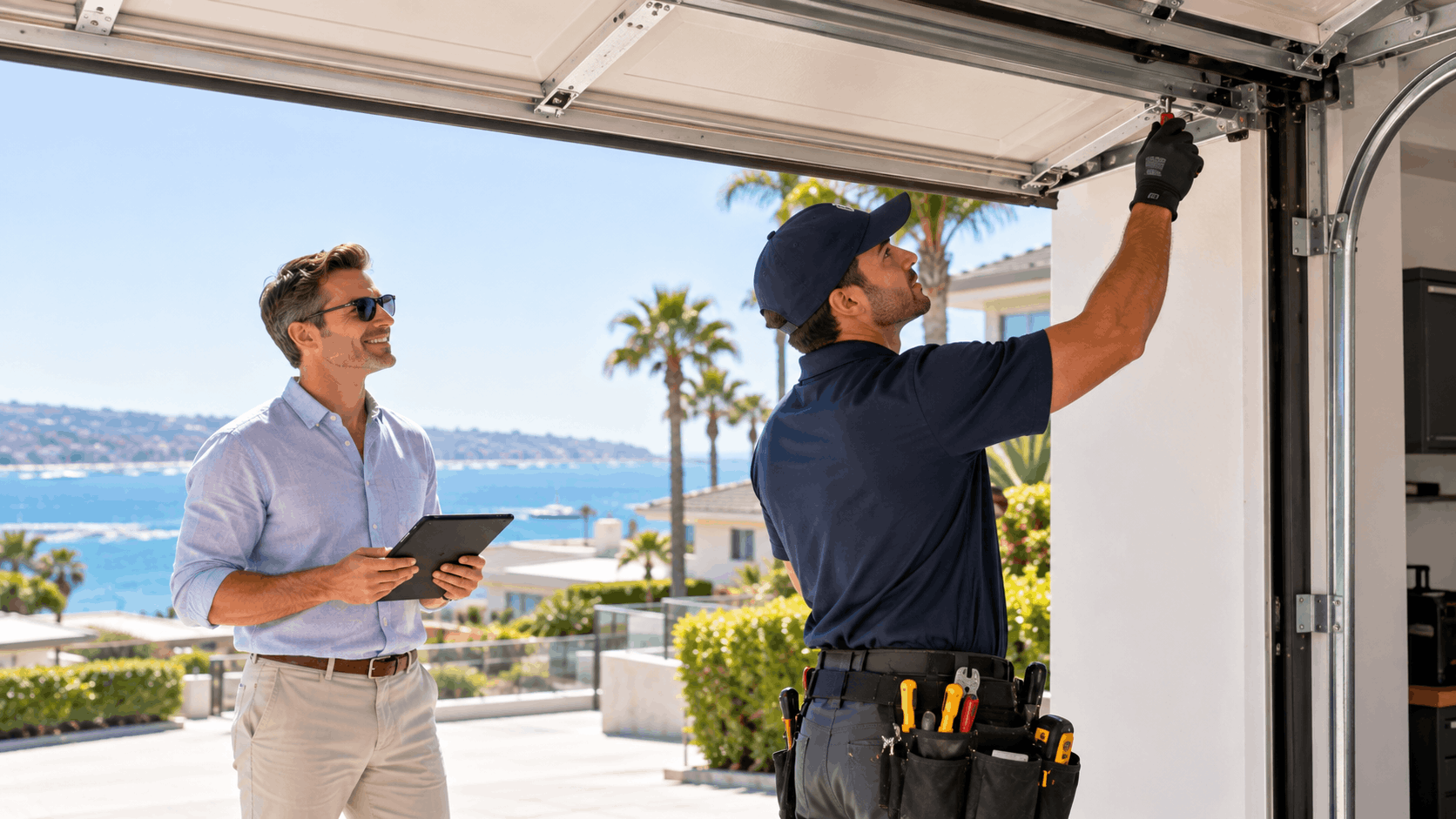
What the Work Costs for Rental Properties in Newport Beach?
Budgeting a turnover means knowing the typical ranges before the call. The figures below are typical market ranges for garage door work in Orange County, not a quote from the business. The actual price for a specific garage depends on that garage and is given in writing before work begins.
| Common rental call | Typical Orange County range |
|---|---|
| Emergency repair | $150 to $350 |
| Same-day repair | $150 to $350 |
| Door that will not open or close | $85 to $250 |
| Off-track door repair | $125 to $275 |
| Torsion spring replacement | $150 to $300 |
| Cable repair | $150 to $300 |
| Opener installation | $250 to $600 |
| Battery backup installation | $200 to $400 |
| Preventive maintenance visit | $99 to $149 per visit |
Emergency and Same-Day Repairs
These are the calls that interrupt a turnover. Emergency repair runs $150 to $350 and same-day repair runs $150 to $350. A door that will not open or close runs $85 to $250, and off-track door repair runs $125 to $275.
On a rental, the off-track call shows up when a roller jumps the track, often after a cable or spring issue goes unaddressed. An off-track door repair gets the door back on its tracks and checks what pushed it off in the first place.
These ranges are the ones to keep in a turnover budget, because they cover the faults most likely to strand a car or leave a unit insecure between guests. They are typical area ranges, not fixed prices.
The specific cost depends on the door and what failed, which is why a written price before work begins keeps an owner's reimbursement clean.
Springs, Cables and Common Mechanical Fixes
For the mechanical fixes that keep a hard-worked door running: torsion spring replacement runs $150 to $300, extension spring replacement runs $150 to $250, and cable repair runs $150 to $300. Door balancing and tension adjustment runs $75 to $150, and safety sensor alignment and repair runs $75 to $150.
Trucks carry common torsion spring sizes, so a spring replacement is often completed on the same visit rather than waiting on a part. On a turnover clock, that same-visit completion is worth as much as the price itself.
Pairing a spring job with a cable inspection, as covered earlier, keeps the second failure from arriving weeks later. Doing both in one visit sits well within these ranges and avoids a second service fee.
An extension spring replacement is the right call on the older Peninsula duplexes that still run extension systems rather than torsion.
Openers, Battery Backup and Programming
On the opener side: opener installation runs $250 to $600, with belt drive costing more than chain drive. Opener repair runs $75 to $200. Smart Wi-Fi opener and MyQ setup runs $150 to $300, battery backup installation runs $200 to $400, and keypad and remote programming runs $45 to $85.
A belt drive is worth the difference on a unit with living space above the garage, because it runs quieter than a chain. A smart Wi-Fi opener and MyQ setup lets an operator see and control the door remotely, which fits a managed rental where nobody on site owns the door.
On a replacement opener, the SB 969 battery backup is a legal requirement, not an extra tier. It is part of a compliant install rather than an upsell, so a manager should expect it folded into any opener replacement on a residential rental.
Keypad and remote programming is the small job that keeps a rental usable between guests, resetting codes so a previous guest cannot return.
New Doors and Custom Work in the High-Value Villages
For new doors installed: a sectional runs $800 to $2,500, insulated steel runs $900 to $2,500, a carriage-house door runs $1,200 to $4,500, a modern glass door runs $1,800 to $4,500, and custom projects run $1,800 to $6,500+.
Newport Coast sits at the higher end of these ranges. The oversized and made-to-order doors, engineered springs, and jackshaft openers common in Pelican Hill, Pelican Crest, and Crystal Cove are custom work, not off-the-shelf products, so they land toward the top of the custom range.
A jackshaft opener, which mounts on the wall and drives the torsion bar, is common where headroom is limited or storage fills the ceiling, both frequent in these estate garages. That choice is part of why a Newport Coast install costs more than a Peninsula swap.
An insulated steel door matters most where the garage is conditioned or shares a wall with living space, which applies to some of the higher-end rebuilds. Removing and hauling away the old door is included in a new installation.
Need Help in Irvine?
Urgent Garage Doors serves Irvine and all of Orange County.
How Urgent Garage Doors Handles a Rental Property Call
A manager or operator needs a process they can count on, not a sales pitch. Here is how the work actually runs, drawn from what the company does: the crew, the response window, the written price, and the record a maintenance visit leaves behind.
24/7 Emergency Service and a 30 to 60 Minute Response
Urgent Garage Doors takes emergency calls and responds 24 hours a day, 7 days a week, every day of the year including holidays. Response is 30 to 60 minutes anywhere in Orange County.
That window is built for the turnover pressure described earlier. A door that fails between a checkout and a check-in gets a crew moving within the hour rather than waiting for the next business day.
For a gated property, that fast response still depends on the gate being arranged in advance. The crew can reach Newport Coast quickly, but only if authorization and vendor records are already on file.
Based in Irvine at 76 Ashford, the company covers the full span of Orange County villages, from the Peninsula alleys to the hillside estates.
Licensed, Insured on Record, and Brand-Agnostic
The company holds California license CSLB #1055150, verifiable free at cslb.ca.gov. Classification, status, bond, and workers compensation are all public record, which is exactly what a gated community needs to clear a vendor file before a crew arrives.
The crew works on all garage door brands, including LiftMaster, Chamberlain, Genie, Craftsman, Clopay, Amarr, Wayne Dalton, and CHI. Across a managed portfolio, that brand coverage means one contactor handles the mixed hardware found from a 1960s duplex to a custom Newport Coast door.
The Google Local Services listing carries the Google Guarantee badge. For a manager vetting a contractor on behalf of an owner, that public record and verification simplify the due diligence.
A contractor whose standing an association can confirm in a minute is a contractor who gets through the gate on the scheduled day.
Written Price, Free Estimates and Maintenance Reports
A written price is available before work begins, provided when the job calls for it or the customer asks. Separately, Business and Professions Code section 7159 requires a written home improvement contract for work over $500, which is a legal requirement rather than a company policy.
For new installations, the company offers a free on-site estimate, and removing and hauling away the old door is included in a new door installation. On a rental replacement, that means the old door leaves with the crew rather than sitting in the alley.
Each preventive maintenance visit includes a written report of what was found and what is recommended. For a manager, that report is a record to hand the owner, documenting the door's condition and the next steps across a managed portfolio.
A preventive maintenance plan keyed to actual use is how an operator stays ahead of the spring and cable wear that a high-use door builds up.
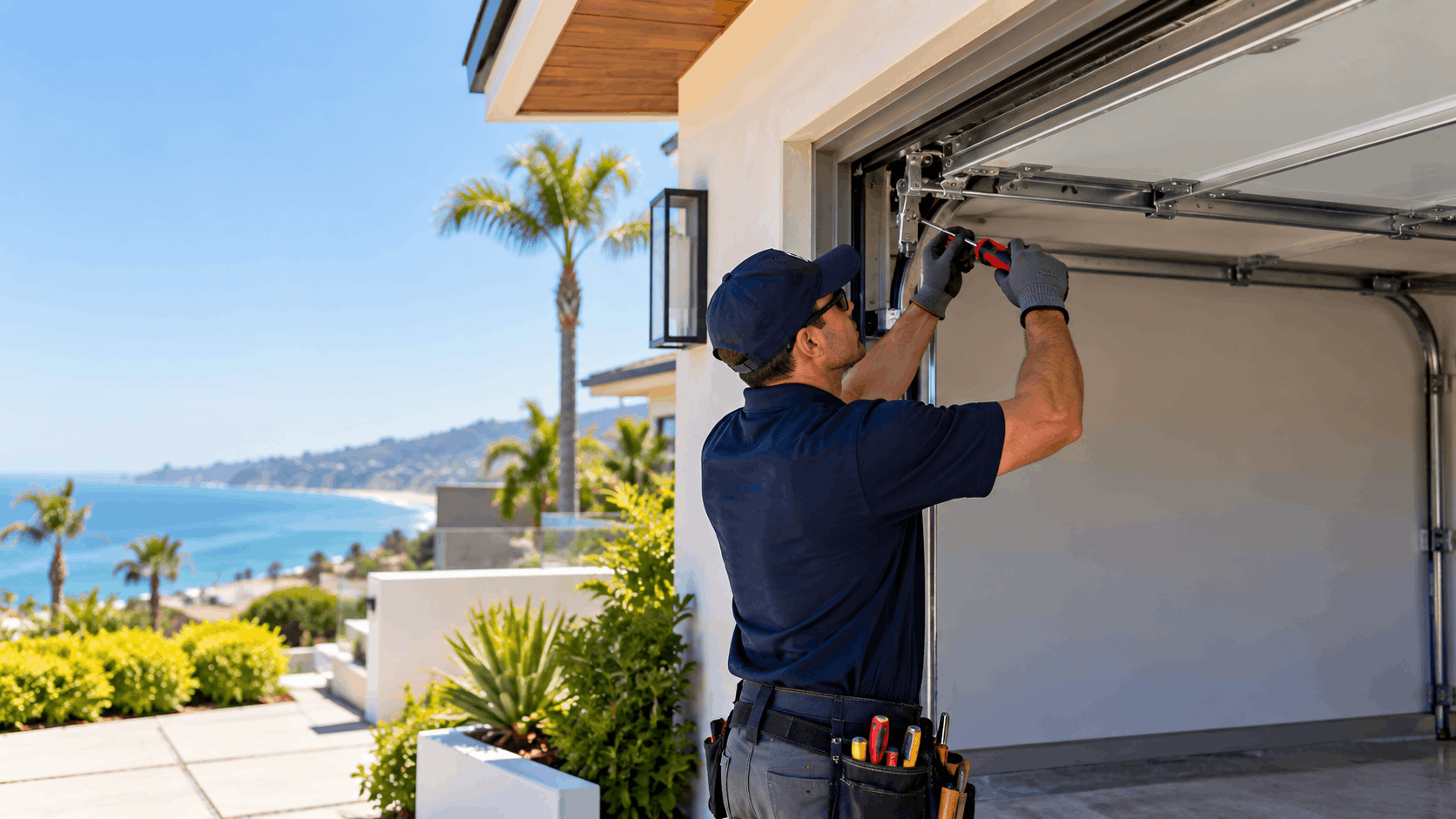
Keeping Rental Doors Running Across Newport Beach
Every job starts with a diagnosis of what actually failed, a written price before the work begins, and a crew whose license you can confirm at cslb.ca.gov. For a stuck door during a turnover, emergency service runs 24/7 with a 30 to 60 minute response across Orange County.
Call Urgent Garage Doors at (949) 529-7743 to schedule a visit or set up maintenance on a managed property. A manager or operator can line up the gate access, the written price, and the turnover window in one call.
Frequently Asked Questions
- How fast can a crew reach a Newport Beach rental during a turnover?
- Urgent Garage Doors runs 24/7 emergency service, every day of the year including holidays, with a 30 to 60 minute response anywhere in Orange County. That covers the Peninsula, Balboa Island, the inland tracts, and Newport Coast. For a gated community like Big Canyon or a Newport Coast association, the visit still needs authorization arranged in advance at the gate, so clear that step before the appointment to keep the fast response from stalling at the guardhouse.
- Does the garage door at a rental need the architectural committee's approval to replace?
- In Big Canyon, the Harbor View communities, and the Newport Coast associations, all operating under the Davis-Stirling Act, an exterior door change typically needs architectural review. That review covers style, panel design, color, and visible hardware, because the door reads from the street. Confirm the current process with the association before ordering, since it can add weeks to a replacement. Association approval does not replace a city permit where one applies.
- Do I need a city permit to replace a garage door on my rental?
- The City of Newport Beach building division confirms the position for the specific address, and it is known for thorough plan check. A structural change such as altering the opening or header generally triggers a permit, while a like-for-like swap altering no structure generally does not. Confirm with the building division before scheduling. A permit also removes the under-$1,000 unlicensed-work exemption, which is one more reason to use a licensed crew.
- Does a replacement opener on a rental have to have battery backup?
- Yes. SB 969 has required battery backup on every residential automatic garage door opener sold or installed in California since July 1, 2019, with a $1,000 civil penalty for violations. It applies statewide to residential openers, not just fire zones, and a replacement door may not be connected to a non-compliant opener. On a rental, that means any opener replacement includes the battery backup as a legal requirement, not an optional upgrade.
- How often should a high-use rental door be serviced?
- Springs are rated in cycles, commonly around 10,000, where one cycle is a full open and close. At four openings a day that is roughly seven years, but a rental door used as the main entrance or cycled several times daily reaches that rating sooner. Plan inspections around actual use rather than the calendar, and have the springs, cables, rollers, and sensors checked together so a worn part is caught before it fails mid-booking.
- What license should I check before hiring a garage door contractor?
- Look for CSLB classification C-61/D-28, Doors, Gates and Activating Devices, which covers sectional and rolling doors, spring systems, operators, control boards, safety sensors, and activating devices. C-28 is Lock and Security Equipment and is not the garage door license, so do not accept it as a substitute. Any license is verified free at cslb.ca.gov, where classification, status, bond, and workers compensation are all public record.
- Can a handyman adjust the springs between guests to save a service call?
- No. A torsion spring stores enough energy to cause serious injury and releases it instantly if a winding bar slips. Nobody should adjust, wind, unwind, or replace one without the right training and tools, no matter how tight the turnover window is. The safe tests a manager can run are the auto-reverse 2x4 check, the photo-eye beam check, and the balance test. Anything touching the springs goes to a licensed crew.
- How do I handle gate access for a garage door crew at Newport Coast or Big Canyon?
- In these guard-gated communities, the homeowner usually has to authorize the visit in advance, and some associations keep approved-vendor or insurance records that must be on file first. A crew turned away at a gate is a wasted morning somebody pays for. Before the appointment, confirm the authorization is cleared with the gate, get any vendor or insurance records submitted, and line up the resident or guest schedule so the crew is not working around a check-in.
- What does a garage door repair cost at a Newport Beach rental?
- Typical Orange County ranges for common rental calls: emergency repair $150 to $350, same-day repair $150 to $350, a door that will not open or close $85 to $250, off-track door repair $125 to $275, and torsion spring replacement $150 to $300. These are typical area ranges, not a quote. The actual price depends on the specific garage and what failed, and a written price is available before work begins.
- Is the old door hauled away when a new one is installed?
- Yes. Removing and hauling away the old door is included in a new door installation, so it leaves with the crew rather than sitting in a Peninsula alley or an estate motor court. Free on-site estimates are available for new installs, which lets an operator or manager get a written price and the door specification settled before committing, including any association review and the SB 969-compliant opener where one is part of the job.
Licensed garage door repair professionals serving Irvine and Orange County.
Licensed in California · License #1055150
Why trust Urgent Garage Doors?
Founded in 2017, Urgent Garage Doors is a licensed and insured garage door services serving Irvine and Orange County. All content is reviewed by our licensed technicians.

Need Help in Irvine?
Urgent Garage Doors serves Irvine and all of Orange County.
Related Articles
Emergency Garage Door Repair in Newport Coast: Same-Day Service for Pelican Hill and Crystal Cove
A local guide to emergency garage door repair in Newport Coast, covering common failures, same-day service for Pelican Hill and Crystal Cove, costs, and prevention.
Garage Door Service for Tustin Property Managers and HOA Boards
A guide for Tustin property managers and HOA boards on garage door ownership, Davis-Stirling review, permits by address, SB 969, licensing and typical OC price ranges.
Garage Door Won't Open in Newport Beach: Same-Day Emergency Service
A garage door that won't open in Newport Beach usually means a broken spring, opener failure, or salt-air rust. Learn the causes, safety checks, costs, and same-day fixes.