Maintenance
Turtle Rock Garage Door Seals and Tracks Against Canyon Wind Off Bommer Canyon
Key Takeaways
- Ridgeline wind off Bommer Canyon Open Space Preserve drives dust and plant debris into garage door seals and tracks, worst on Turtle Rock's upper streets.
- A garage door seal is three parts: the bottom seal in its retainer, side and top weatherstripping, and sometimes a threshold seal on a settled hillside slab.
- Track misalignment in Turtle Rock traces to decades of settling on graded hillside lots plus packed canyon debris grinding the rollers.
- Most phantom door reversals come from dust-coated photo eyes mounted low near the floor; cleaning and realigning the lenses clears them.
- Owners can safely run the photo-eye check, the 2x4 auto-reverse test, and the balance test, but must never touch a torsion spring.
- Doors and openers on the earliest Turtle Rock tracts predate the January 1, 1993 federal entrapment-protection mandate; the manufacturer position is to replace a pre-1993 opener.
- Turtle Rock was added to the 2025 Fire Hazard Severity Zone map effective July 23, 2025, so door materials and seals become code questions on permitted projects in mapped zones.
- A new residential opener in California includes battery backup under SB 969, and garage door work is licensed under C-61/D-28; Urgent Garage Doors holds license #1055150.
In This Article
The upper streets of Turtle Rock take the wind head-on. Homes that back onto Bommer Canyon Open Space Preserve sit in the path of steady ridgeline gusts, and that wind carries dust and dry plant debris straight into garage door seals and tracks. Owners along these graded hillside lots notice it first at the bottom of the door, where a gap appears that was never there before, or where the door starts pulling to one side as it closes.
We work these streets in ZIP code 92603 often enough to know the pattern. The wind is not the whole story. It is the wind plus the terraced ground, plus the age of the door, plus decades of settling on hillside lots that were graded into the San Joaquin Hills. Put those together and you get seals that stop sealing and tracks that drift out of true.
Why Bommer Canyon Wind Is Hard on Turtle Rock Garage Doors?
Turtle Rock was the first hillside village on the Irvine Ranch, with homes wrapped around the terraced San Joaquin Hills and arranged so the hilltops stay open. That layout is part of what makes the village beautiful, and it is also why the wind behaves the way it does. Streets climb and curve along the ridgeline, and the upper lots sit exposed to gusts that roll off the open space to the south and east.
Canyon wind is not a gentle breeze here. It is a constant on the upper streets, and it does not just push on the door. It carries fine dust and dry plant matter picked up off Bommer Canyon and the surrounding preserve, and it drives that material into every gap it can find. That is the mechanism behind most of the seal and track complaints we see in Turtle Rock.
Open Space Exposure and the Debris It Carries
Many Turtle Rock homes back directly onto Bommer Canyon Open Space Preserve, which was part of the old Irvine Ranch cattle camp. That backyard boundary is a feature for the view and the trails, but it also means the door faces raw open terrain rather than another house that would block the wind.
What blows off that open space is a mix of fine dust, dry grass, seed pods, and leaf litter. On a windy afternoon, that material rides the gusts right up to the garage. It settles in the tracks, packs into the bottom seal, and coats the low-mounted photo-eye lenses near the floor.
Wildlife adds to it. Small animals and insects move between the preserve and the yards, and they leave nesting material and debris in the corners of tracks and along the base of the door. None of this is dramatic on any single day, but it accumulates, and accumulation is what defeats a seal.
The practical result is a door that looks fine from the street but no longer closes clean at the bottom. Owners tell us they sweep the garage and still find a film of dust inside within days. That is the canyon wind doing exactly what it does, and the seal is the part standing in its way.
Ridgeline Wind on the Upper Streets
The upper streets of Turtle Rock face steady pressure that the lower streets never see. Ridgeline wind pushes against the face of the door and, more importantly, against the bottom seal and the side weatherstripping. A door lower in the village might close and stay sealed for years. A door up on the ridge is under load every windy day.
That steady pressure works the seal harder. Every gust flexes the bottom seal and the vinyl stops along the jambs, and over time that flexing combined with grit wears the material down faster than it would on a sheltered lot. The seal that would last on a flat interior street gives out sooner up here.
Wind also finds the weakest gap and exploits it. If the weatherstripping along one side is slightly loose or the top seal has pulled away a fraction, the ridgeline gust drives air and debris straight through that opening. What starts as a minor gap becomes an obvious draft and a dust trail across the garage floor.
This is why we treat upper-street homes differently from lower ones. The exposure is real and measurable in how fast seals degrade, so the fix has to account for the load the door actually carries rather than a one-size approach.
Terraced Hillside Lots and Driveway Grade
Turtle Rock sits on terraced ground in the San Joaquin Hills, so driveway grade varies sharply street to street. One home has a driveway that runs nearly level to the door. The next has a noticeable slope up or down to the slab. That grade changes everything about how wind and water reach the base of the door.
On a sloped driveway, wind funnels along the grade and concentrates at the low corner of the opening. Water does the same during rain, running toward whichever corner sits lowest. Debris collects where the grade directs it, which is why one corner of a door on a hillside lot often carries more packed grit than the other three.
The slope also affects how the bottom seal meets the slab. A door built to close against a level floor may leave a gap on a slab that pitches away, and the seal has to stretch to fill it. That uneven contact is a weak point the canyon wind attacks directly.
Understanding the grade of a specific lot is the first thing our team looks at on these streets. The maintenance work we do in Turtle Rock starts with reading how the driveway and slab shape the problem before touching a single part.
Get Your Free Quote
Tell us about your garage door and we'll get back to you fast.
The Parts of a Garage Door Seal and What Each One Does
Before an owner can understand why a door leaks air and dust, it helps to know the pieces that are supposed to keep it out. A garage door seal is not one part. It is a system of three separate elements working together around the frame, and canyon wind tests each one differently.
Here is how the three main pieces break down and what each blocks:
| Seal Component | Where It Sits | What It Blocks |
|---|---|---|
| Bottom seal | Along the base of the bottom panel, held in a retainer | Ground-level wind, water, dust, and debris under the door |
| Side weatherstripping | Vinyl stops along both jambs | Wind and debris driven at the sides of the frame |
| Top seal | Across the top of the opening where the door meets the header | Air and debris entering over the top panel |
The Bottom Seal and Its Retainer
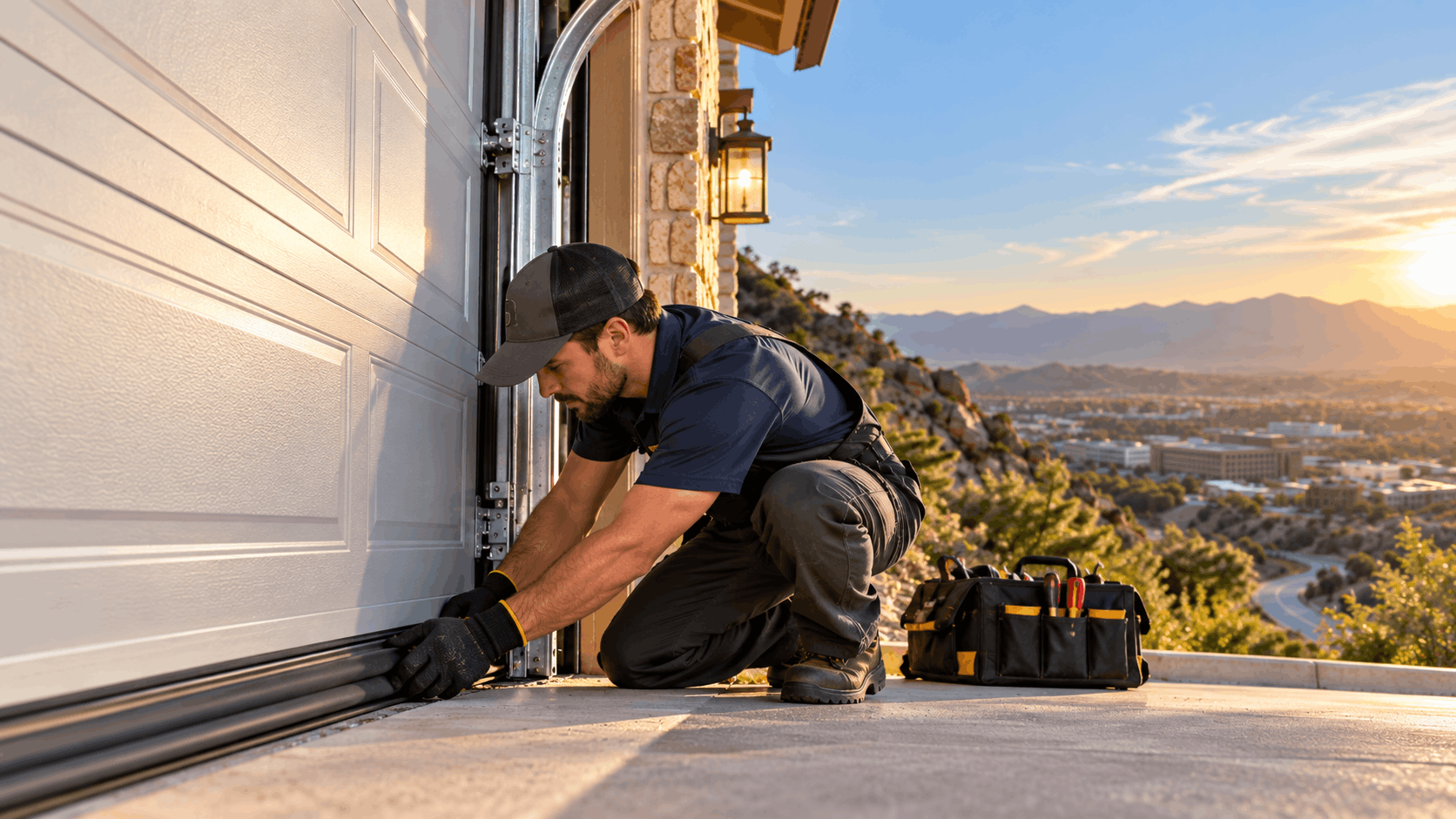
The bottom seal is the flexible strip that runs along the base of the door. It rides in a metal or vinyl retainer, a channel fixed to the bottom panel that holds the seal in place. When the door closes, the seal is supposed to compress and flatten against the slab, filling any small gap left by an uneven floor.
That flattening is what canyon grit takes away. When wind-driven dust and fine particles pack into the seal and the retainer, the material stiffens. A stiff seal cannot flex to match the slab, so instead of flattening into the low spots it bridges over them and leaves gaps.
Over time the seal also wears thin at the contact edge. The steady pressure of ridgeline wind, combined with abrasive grit, grinds the flexible lip until it no longer reaches the floor at all. At that point the door can look closed while a visible line of daylight shows underneath.
The retainer matters as much as the seal itself. If grit corrodes or deforms the channel, a fresh seal will not seat correctly. Our team checks both together, because replacing the seal without a sound retainer just repeats the failure in a few months.
Side and Top Weatherstripping
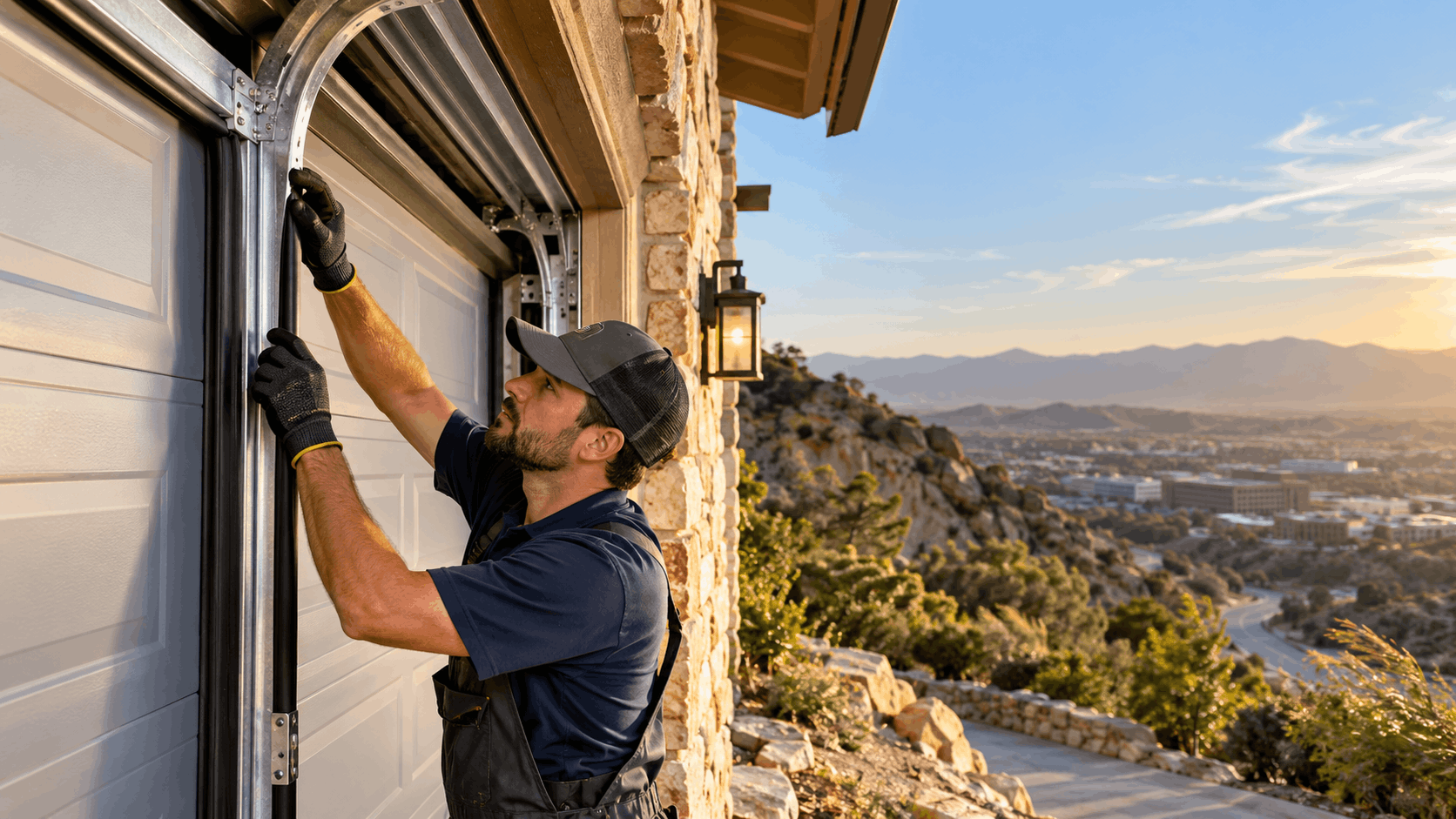
Along both jambs run vinyl stops, and across the top sits a strip that closes the gap between the door and the header. Together this weatherstripping seals the frame, and on a Turtle Rock ridge home it is the first line the wind hits. Gusts drive straight at the sides and top of the door and probe for any gap.
Side weatherstripping fails when it pulls away from the jamb or when the flexible lip hardens and cracks. Sun exposure on a hillside home, combined with the constant flex from wind, dries the vinyl out over the years. Once it cracks, debris drives through the opening and collects along the inside of the frame.
The top seal has a similar story. It has to bridge the gap where the curved top of the door meets the header, and that gap changes slightly as the door settles and the frame shifts. A top seal that fit when installed can leave a draft path years later on a settling lot.
When we reseal a door here, all three elements get evaluated as a set. Replacing only the bottom seal while cracked side stops stay in place leaves the wind an open route, so the whole frame gets addressed together.
Threshold Seals on Graded Driveways
Sometimes the door seal alone cannot close the gap. On a sloped or settled slab, the floor itself may pitch enough that even a fresh bottom seal leaves an opening at one corner. That is where a threshold seal comes in, a raised strip bonded to the floor that the door closes against.
A threshold seal works well on Turtle Rock's graded lots when the problem is the slab, not the door. If the floor has settled and the low corner lets wind and water under, a threshold raises the contact point and gives the bottom seal something firm to press against. It also helps keep driven rain from running under the door on a downhill driveway.
A threshold is not always the answer, though. If the door seal is simply worn or packed with grit, a new seal fixes it and a threshold adds nothing. And on a driveway that slopes toward the garage, a poorly placed threshold can trap water inside rather than block it, so placement matters.
Our team decides between a new seal, a threshold, or both by looking at the specific slab and grade. The goal is a tight close that accounts for how that particular lot settled, not a generic part swapped in blind.
Need Help in Irvine?
Urgent Garage Doors serves Irvine and all of Orange County.
How Tracks Drift Out of Alignment on Hillside Lots
Track alignment is a recurring issue in Turtle Rock, and the reason ties directly to the ground the village sits on. These are graded hillside lots, cut and filled into the San Joaquin Hills decades ago, and graded ground settles. When it settles, the garage frame shifts a fraction, and the tracks bolted to that frame follow.
Owners rarely describe it as a track problem. They say the door catches, or it sounds rough, or it started pulling crooked. Those symptoms usually trace back to a track that is no longer plumb and rollers fighting to stay in a channel that has drifted.
Settling Over Decades of Graded Terrain
A door's balance and track alignment are affected by settling on graded hillside lots over the decades since Turtle Rock was built. The village went up from the late 1960s onward, so many of these frames have had fifty years or more to settle. Fill compacts, footings shift a hair, and the wood or steel framing moves with it.
The movement is small, often a fraction of an inch, but garage door tracks are precision guides. They are set plumb and parallel when installed, and they rely on staying that way. A frame that shifts even slightly pulls one track out of plumb relative to the other, and the door no longer travels straight up its channels.
When the tracks drift, the door binds. The rollers on one side press harder against the track than the other, and the door works against itself every cycle. That extra friction shows up as a door that hesitates, jerks, or pulls to one side as it moves.
Because the settling is gradual, owners often do not connect a crooked door to the ground under the house. But on these terraced lots it is the most common root cause, and truing the tracks back to plumb is what actually resolves it.
Debris in the Track Rollers
Canyon dust and dry plant matter do not stop at the seal. They collect in the tracks themselves and work into the roller channels. As the door cycles, the rollers grind against that packed debris, and the smooth ride the door is supposed to have turns rough.
That grinding has a sound. Owners describe a scraping or gritty noise as the door moves, sometimes a squeal, sometimes a crunch at the same point in the travel. What they are hearing is the roller dragging through material that should not be in the track.
The debris does more than make noise. It forces the rollers to ride unevenly, which pushes the door toward binding and pulling to one side. Left long enough, it wears the rollers and the track surface, turning a cleaning job into a parts-replacement job.
On upper-street homes that back onto the open space, this builds up faster than anywhere else in the village. Regular clearing of the tracks is one of the highest-value things an owner on these lots can do, and it is part of every service visit we run here.
Signs the Track, Not the Opener, Is the Problem
It is easy to blame the opener when a door misbehaves, but many of these faults are mechanical. A few signs point clearly to the track rather than the electronics. Uneven gaps between the door and the frame as it closes, a door that catches at the same spot every time, and scraping sounds are all track signs.
The same-spot catch is the clearest tell. An opener fault tends to be inconsistent or tied to the sensors, but a door that binds at the identical point in its travel every cycle is hitting a physical obstruction or a bent section of track. That is mechanical, not electronic.
Uneven gaps are another giveaway. If the door sits tight against the frame on one side and shows a gap on the other, the tracks are out of parallel. The door is trying to close square against a frame that is no longer square to it.
When the diagnosis points to the track, our track repair and realignment service addresses it directly. Reading the symptom correctly saves an owner from replacing an opener that was never the problem.
Why Photo-Eye Reversals Trace Back to Canyon Dust
A door that reverses for no visible reason frustrates owners more than almost anything. The most common cause is the photo eyes, the safety sensors mounted low on each side of the opening. Blocked beams, misalignment, and dirty lenses account for most of these phantom reversals.
The sensors sit no higher than six inches off the floor, right where canyon debris settles. Blown dust off the open space coats the lenses, and once the coating is thick enough the beam cannot pass cleanly between the two units. The opener reads a broken beam as an obstruction and refuses to close, or reverses partway down.
Misalignment adds to it. If a sensor gets bumped, or the frame shifts as the lot settles, the two eyes no longer point straight at each other. A beam that is even slightly off target behaves like a blocked one, and the door reverses with nothing actually in the way.
This is why our safety-sensor work always starts with cleaning and realigning before anything else. Many reversals on these dusty upper streets clear up the moment the lenses are wiped and the beam is squared, and our safety sensor alignment repair covers exactly that.
What Owners Can Check Themselves Before Calling
There are safe checks any Turtle Rock owner can run to understand their door before picking up the phone. None of them involve the springs, and that line is firm. These checks help an owner describe the problem accurately and sometimes fix a simple fault on their own.
The three that matter most are the photo-eye check, the 2x4 auto-reverse test, and the balance test. Each tells you something specific about the door, and together they separate a minor issue from one that needs a technician.
Clearing and Checking the Photo Eyes
The photo eyes mount no higher than six inches off the floor on each side of the opening. Because they sit that low, they are directly in the path of the dust and debris the canyon wind drives across the garage floor. Cleaning them is the single most effective thing an owner can do for a door that reverses on its own.
Start by wiping each lens gently with a soft, dry cloth. A coating of fine dust is often invisible until you look closely, and even a light film can break the beam. Both eyes need cleaning, since the beam runs between them and either one can cause the fault.
Next, check the alignment. Most sensors have a small indicator light that glows steady when the beam is aligned and unobstructed, and blinks or goes dark when it is not. If the light is not steady after cleaning, one eye may have been bumped out of position and needs a small adjustment to point straight at its partner.
Also look for anything sitting in the beam path. A stored box, a trash bin, even tall debris blown against the frame can break the beam. Clearing the path and wiping the lenses resolves the most common false reversal we see on these streets.
The 2x4 Auto-Reverse Test
The 2x4 test checks that the door reverses on contact, which every modern opener must do. Lay a flat two-by-four across the opening under the door, on the floor in the door's path. Then close the door with the opener.
When the bottom of the door contacts the board, it must reverse within two seconds. That is the contact-reverse behavior the door is required to have, and it is what protects anything, or anyone, in the door's path. A door that stops and heads back up passes.
A fail is a door that keeps pressing down on the board, hesitates too long, or does not reverse at all. That is a safety fault and it needs a technician, because the force settings or the mechanism are not working as they must. Do not keep using a door that fails this test as if nothing is wrong.
Run this test a couple of times a year, and after any repair. It takes a minute and it confirms the most important safety function the door has. If it fails, stop and call rather than adjusting anything yourself.
The Balance Test and Why Springs Are Off Limits
The balance test tells you whether the door is properly counterweighted by its springs. Pull the release cord to disconnect the opener, then lift the door by hand to about waist height and let go. A balanced door stays put where you leave it.
If the door falls closed or drifts upward on its own, it is out of balance, and that is a spring problem. The springs carry the weight of the door, and when they weaken or fail the door no longer holds position. This is a clear signal to call, not to tinker.
Here is the firm line: a torsion spring stores enough energy to cause serious injury, and it is wound under high tension with bars against a fixed cone. Owners must never adjust, wind, unwind, or replace one. There is no safe home version of that job, and the consequences of getting it wrong are severe.
If the balance test fails, our spring and cable repair team handles it with the right tools and training. Reconnect the opener with the release cord after the test, and leave the spring work to someone equipped for it.
How We Reseal and Realign a Turtle Rock Door
When our team arrives for a reseal and realignment on a Turtle Rock door, every step ties back to the canyon-wind problem it solves. We do not swap parts at random. We read how the wind, the grade, and the settling have worked on this specific door, then repair to match.
The work moves in a logical order: seal the frame, true the tracks, clean and align the sensors, and flag anything wearing toward failure. Here is how each step addresses what the ridgeline and the open space do to a door here.
Replacing Seals Matched to the Door and Slab
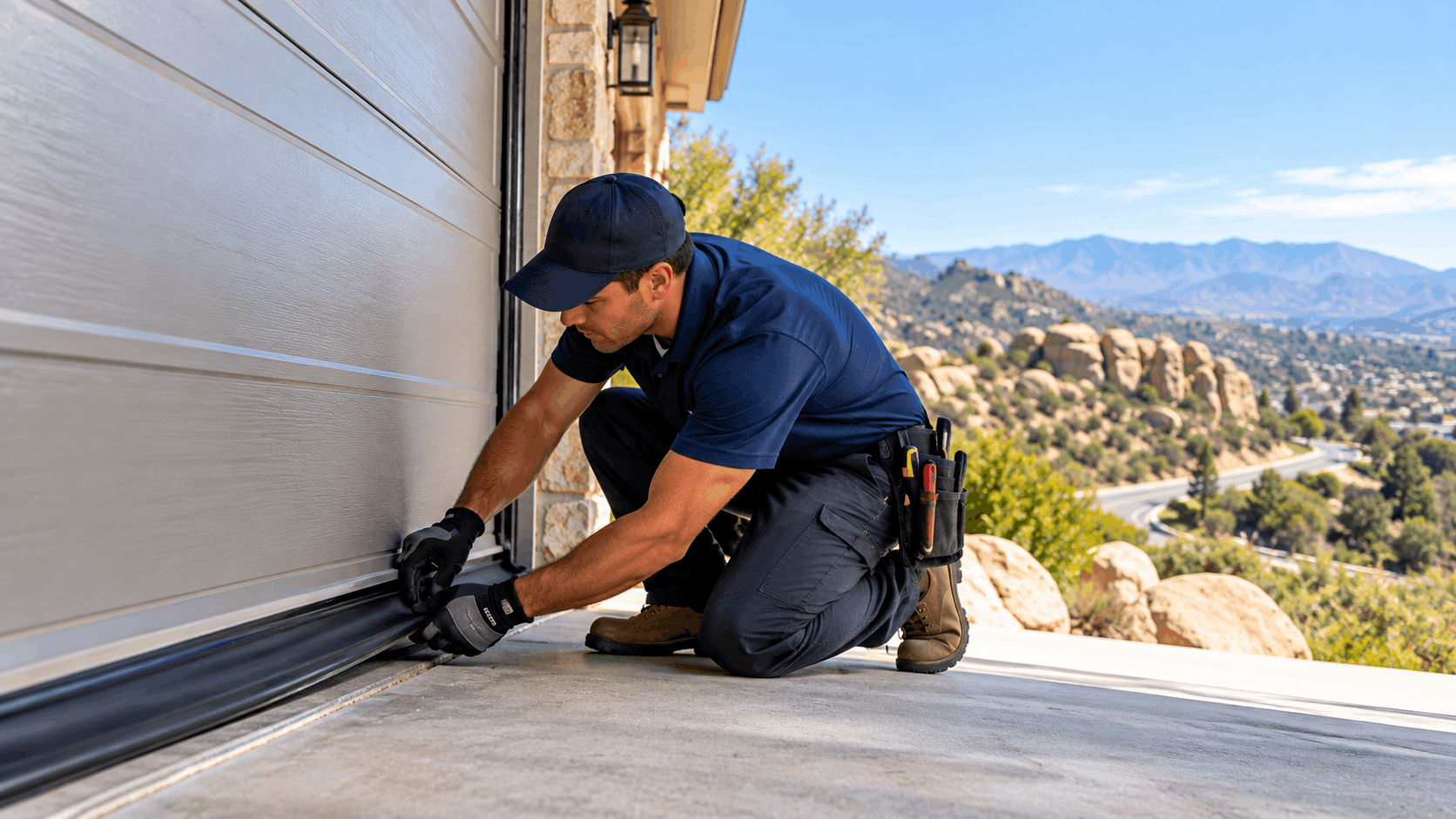
We replace the bottom seal, the retainer, and the side and top weatherstripping to fit the actual door and the slope of the slab. Generic seals cut to a standard length do not account for a hillside slab that pitches toward one corner. We match the seal to the floor it has to meet.
The point of matching is that the seal flattens against an uneven floor. When the bottom seal compresses fully into the low spots of a settled slab, wind stops driving grit underneath. A seal that bridges the gaps instead of filling them is a seal that will leak again in a season.
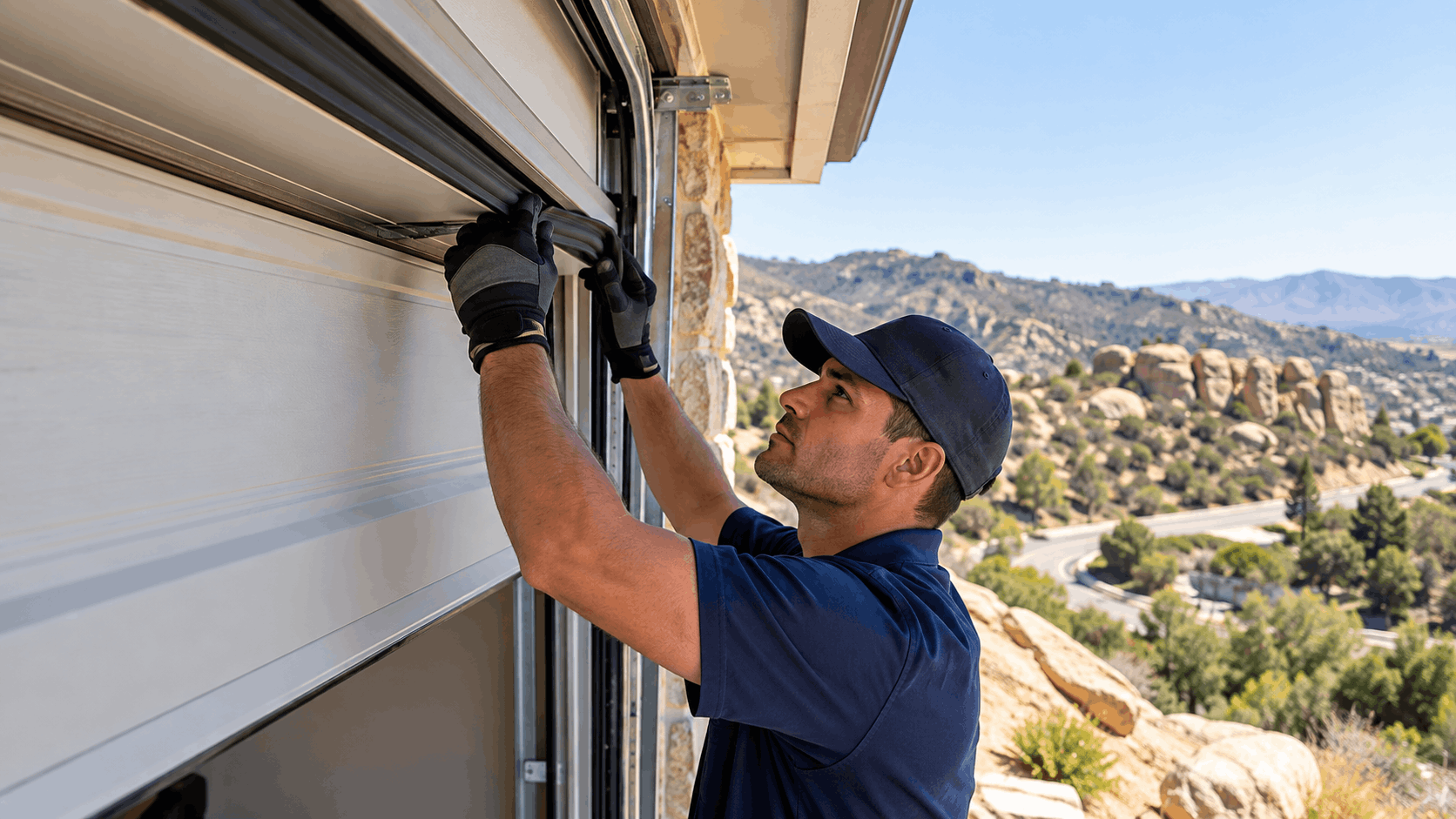
On the frame, we fit side and top weatherstripping that seats tight to the jambs and header. Ridgeline wind finds any loose edge, so the vinyl has to press firmly along its whole length. Where the frame has shifted with settling, we adjust the fit rather than force a standard part.
The weatherseal and insulation retrofit work we do here is built around the reality that no two Turtle Rock slabs are the same. Matching the seal to the door and the grade is what makes the repair hold.
Realigning Tracks and Inspecting Rollers
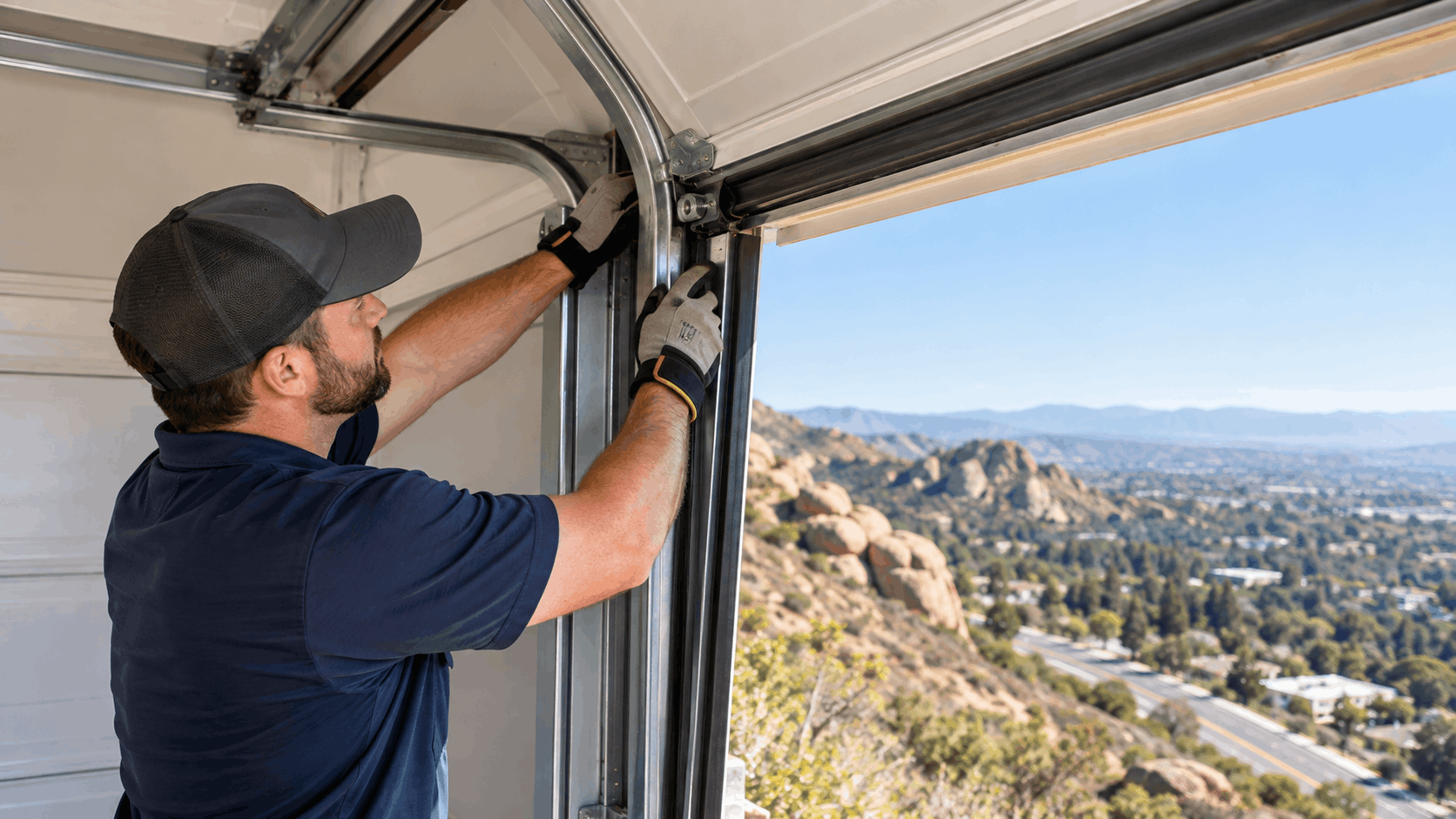
We true the tracks back to plumb and parallel, correcting the drift that decades of settling introduced. That means checking each track against a level, loosening the mounts, bringing the track back to true, and securing it so the door travels straight. A door that runs plumb stops binding and stops pulling to one side.
While the tracks are open, we clear the packed debris that canyon wind drove into them. Dust, grit, and dry plant matter get removed from the channels so the rollers ride clean. Clearing the track is as much a part of the fix as truing it, because debris undoes the alignment fast.
We also check the rollers, hinges, and bearings, which wear alongside each other. A door that has been binding has worn its rollers unevenly, and replacing worn rollers while the tracks are being trued gives the door a fresh, smooth ride. Hinges and bearings get the same inspection.
Cables get inspected at the same time for a simple reason: they wear on the same schedule as the rest of the hardware, and a frayed cable is a failure waiting to happen. Truing the tracks without noticing a failing cable would leave the owner with a second problem right behind the first.
Realigning and Cleaning the Photo Eyes
We realign and clean the photo eyes, then confirm the contact reverse. On these dusty upper streets, the sensors are almost always coated and often slightly off target, so cleaning the lenses and squaring the beam resolves the phantom reversals owners describe.
Alignment is a precise job. The two eyes have to point straight at each other with the beam unbroken, and we adjust each unit until the indicator confirms a steady, clear beam. A sensor knocked loose by a bump or by frame movement gets brought back to true.
After the sensors, we confirm the door meets its auto-reverse behavior. That means verifying the contact reverse with the door reversing on obstruction as it must. The sensors and the contact reverse are two separate safety systems, and both have to work.
The result is a door that stops reversing on its own and closes reliably. On homes backing onto the open space, we often recommend a wipe-down schedule so the lenses stay clear between visits, since the canyon will coat them again.
When Wear Points to a Bigger Job
Cables, drums, and bearings wear together, and replacing one part while ignoring a frayed cable is how a second failure follows weeks later. We flag what is at the end of its life instead of patching around it. An honest assessment saves an owner a repeat call.
Cables in particular deserve attention on an older Turtle Rock door. They run under tension every cycle, and a cable that has started to fray will keep fraying until it snaps. Catching it during a track job means addressing it once, not twice.
Drums and bearings are the same story. The drum guides the cable, and a worn drum chews through cables faster. A failing bearing lets the torsion shaft wobble, which throws off the whole system. These parts are interconnected, and wear in one accelerates wear in the others.
When we see this cluster of wear, we tell the owner plainly what is near the end and what has life left. The cable repair work gets bundled with the track and seal job where it makes sense, so the door comes back to full health in one visit rather than piecemeal.
Need Help in Irvine?
Urgent Garage Doors serves Irvine and all of Orange County.
Older Tracts, Older Doors: What Build Era Means Here
Turtle Rock was built across multiple decades, from the late 1960s through 1995, so tract matters more here than village. Two homes a few streets apart can have doors and openers from entirely different eras, with different hardware and different safety features. Knowing the build era of a specific tract tells us a lot about what is behind the finish.
Many early homes have been extensively remodeled while original systems remain behind the finish. An updated interior is no guide to the age of the door, the opener, or the springs. We have opened plenty of garages in beautifully remodeled homes to find hardware that predates the safety mandates entirely.
Broadmoor and the Late-1960s Ranch Homes
Broadmoor is one of the earliest tracts in Turtle Rock, with homes dating to the late 1960s and early 1970s. They were built in the California ranch style of the era, with single-story layouts, post-and-beam construction, and large lots on hilly terrain. It is the part of Turtle Rock where single-story homes are common.
These ranch homes carry the oldest garage hardware in the village. A door or opener original to a Broadmoor home is over fifty years old, and while the house may have been remodeled inside, the garage systems often were not. Original door hardware behind a remodeled front is a common find here.
The large lots and hilly terrain of Broadmoor also mean these homes have had decades to settle on graded ground. The frame shift and track drift we described earlier are most pronounced on the oldest tracts, simply because they have had the most time to move.
When we work a Broadmoor home, we expect to find aged hardware and we inspect accordingly. A door this old often benefits from more than a seal swap, and we lay out honestly what is worth repairing and what has reached the end.
The Hills, Terraces, Highlands Garden, and the Summit
The majority of the village was built through the 1970s and 1980s, including the Hills, the Terraces, and Highlands Garden. These tracts introduced Mediterranean and transitional styles alongside the original ranch aesthetic. The Summit tract was completed in 1995, making it one of the newest parts of the village.
Across this range of build dates, the garage hardware varies widely. A door from a 1970s tract is a different animal from one in the Summit, and the opener technology spans the shift from pre-safety-mandate units to the modern sensor-equipped systems. Tract and build year tell us which to expect.
The remodel factor is strongest here. Many of these homes have been updated repeatedly over the decades, and a gorgeous renovation can sit over a garage door that has never been touched. A remodeled interior is no guide to the age of the door, the opener, or the springs, so we judge the hardware on its own.
For owners weighing a full replacement rather than a repair, our installation team matches a new door and the right springs to the actual weight and height of the door, which matters when a heavier replacement material needs springs sized to it.
Pre-1993 Openers on the Earliest Streets
Doors and openers from the late 1960s and 1970s tracts predate the January 1, 1993 federal requirement for external entrapment protection. That means an original opener on the earliest Turtle Rock streets was never built with the photo-eye safety system that every modern opener must have. It relies on contact reverse alone, if it reverses at all.
California actually led on this. AB 3600, passed in 1990, required openers to be manufactured with an automatic reverse device and sensor, and federal law followed for openers manufactured for the United States after 1993. So the honest line for an old opener is simple: units made before 1993 predate the federal entrapment-protection mandate.
The manufacturer position on these old units is that pre-1993 openers should be replaced rather than repaired. They lack the external entrapment protection that has driven child entrapment deaths and serious injuries to near zero since the mandate took effect. That is not a minor gap.
When we find one of these openers on an early Turtle Rock street, we explain the age and the safety situation plainly. An opener replacement brings the door up to current safety standards, and in California a new residential opener comes with battery backup built in.
Approvals, Permits, and Fire Zone Rules in Turtle Rock
A seal or door job in Turtle Rock sits inside a few layers of rules: the association that may govern the street, the City of Irvine permit position, and the fire hazard zone status that changed in 2025. None of these are a single village-wide answer, so the honest guidance is to confirm for the specific address.
We walk owners through all three before work starts, because the answers shape what is possible and how the job proceeds. Here is how each one applies in this village.
Which Association Governs Your Street
Turtle Rock has multiple associations organized by tract rather than one village-wide body. Turtle Rock Pointe, the Summit, and other tracts each carry their own CC&Rs and dues, and some single-family tracts in Turtle Rock have no association at all. The governing body changes street by street.
That makes the first step on any job here establishing which association, if any, governs the specific address. Most Orange County master-planned communities treat a garage door as a street-facing exterior modification requiring written architectural approval before installation, so where an association exists, approval usually comes first.
It is worth noting that Turtle Rock, Turtle Rock Crest, and Turtle Ridge are three different places on the same ridgeline with different financing and association structures. A customer who says Turtle Ridge is not describing Turtle Rock, and the association path differs accordingly.
Approval from a master association does not substitute for a city building permit where one applies. The two are separate tracks, and a job may need both, one, or neither depending on the work and the street. We help owners identify which applies to their address.
The City of Irvine Permit Position
The City of Irvine generally requires a building permit to erect, construct, enlarge, alter, repair, move, improve, remove, convert, or demolish a building or structure. But the city lists an exemption for replacement windows and doors having the same dimension as those being replaced and not requiring any change to the structural frame or opening size.
That exemption has a condition attached. Such replacements must still conform to all technical codes and city, county, and state ordinances on weatherproofing, security, and energy efficiency. A like-for-like door swap generally falls under the exemption, while structural work such as widening the opening or altering the header is what typically triggers a permit.
The building department is the authority on any given job. The city advises confirming the position with them, and we point owners to the Permit Processing Center and the Development Assistance Counter for a definitive answer on their specific project.
There is an added reason to confirm. Needing a permit also removes the under-$1,000 unlicensed-work exemption, so whether a permit applies matters for more than one reason. For anything beyond a straightforward swap, checking with the building department first is the right move.
Turtle Rock in the 2025 Fire Hazard Severity Zone Map
In March 2025 the California Office of the State Fire Marshal released its updated Fire Hazard Severity Zone map, and Irvine adopted it by ordinance in June 2025, effective July 23, 2025. The update expanded fire hazard zones into Turtle Rock, which puts the village in a different position from Woodbridge, Northwood, and University Park, which the city does not name.
For a garage door, this matters because a door is an exterior opening in a wildfire exposure path. On a permitted project in a mapped zone, the door materials, the seal at the bottom, and the gaps around the frame become code questions rather than preferences. The answer depends on the address, the zone class, and the permit application date.
The timing rule is specific. New construction or major renovation with a permit application dated after July 23, 2025 must comply with the requirements where the project sits in a 2025 mapped area. Projects submitted before that date remain subject to the earlier 2012 map areas.
Buildings in Very High zones must be built using fire-resistive features under California Building Code Chapter 7A and California Residential Code section R327. Owners can check their own address through the OSFM Fire Hazard Severity Zone viewer and the Orange County Fire Authority to see exactly which zone class applies. You can find the state fire marshal resources through CAL FIRE's Office of the State Fire Marshal.
Battery Backup and the License That Covers This Work
A replacement residential garage door opener installed in California on or after July 1, 2019 must have a battery backup designed to operate during an electrical outage. That comes from SB 969, passed after deaths in the 2017 Northern California wildfires where people could not open garage doors during power cuts. It carries a $1,000 civil penalty, and it is statewide and residential.
So an owner replacing an opener in Turtle Rock is getting a battery backup unit as a matter of law, not as an optional upgrade. It is not a fire-zone rule or an association rule. It is SB 969, and it applies whether or not the home sits in a mapped zone. Our battery backup installation handles this as part of any qualifying opener job.
Garage door work in California is licensed by the Contractors State License Board under classification C-61/D-28, Doors, Gates and Activating Devices. That scope covers sectional and rolling doors, torsion and extension spring systems, operators, control boards, safety sensors, and activating devices. C-28 is Lock and Security Equipment and is not the garage door license.
A license can be verified free at cslb.ca.gov, where the classification, status, bond, and workers compensation are all public record. Urgent Garage Doors holds California license #1055150. You can confirm any contractor's standing at the Contractors State License Board.
Need Help in Irvine?
Urgent Garage Doors serves Irvine and all of Orange County.
Keeping Seals and Tracks Working Through Windy Months
A good repair lasts longer with a little upkeep, and on the canyon-facing streets of Turtle Rock that upkeep is specific. The wind that caused the problem does not stop after the fix, so the maintenance is about staying ahead of the debris and catching a failing seal before it lets the weather in.
None of this involves touching a spring or anything under tension. It is cleaning, looking, and knowing when to call. Done regularly, it stretches the life of a reseal and realignment considerably.
Clearing Debris From Tracks and Sensor Lenses
Regularly clearing canyon dust from the tracks and wiping the photo-eye lenses prevents binding and false reversals. On an upper-street home that backs onto the open space, this is worth doing more often than a sheltered interior lot, because the debris load is simply higher.
For the tracks, a brush or cloth to clear loose dust and plant matter from the channels keeps the rollers riding clean. Look for buildup in the corners and at the bottom of the vertical tracks, where debris settles first. Catching it before it packs down keeps the door from starting to bind.
For the sensors, a soft dry cloth over each lens clears the coating that causes phantom reversals. Check the indicator lights afterward to confirm the beam is steady. On these dusty streets, a quick wipe every few weeks during the windy months saves a lot of frustration with a door that reverses for no reason.
While you are at it, glance at the whole track for anything bent or loose. Catching a small misalignment early means a minor adjustment rather than a bigger job later. Our preventive maintenance plan builds this kind of check into a schedule for owners who would rather not track it themselves.
Checking the Bottom Seal Against an Uneven Slab
On a settled hillside slab the bottom seal can stop touching in one corner. The grade and decades of settling mean the floor is rarely perfectly level, and the low corner is where a seal fails first. A quick check tells you whether the seal is still doing its job.
The easiest test is to look for daylight under the closed door. With the door shut, step inside during the day and look along the bottom. If you see a line of light at any point, the seal is not touching there, and wind and debris are getting through that gap.
Pay closest attention to the corners, especially the low corner on a sloped slab. A seal can look fine across the middle and still leave a gap where the floor pitches away. That corner gap is the exact spot canyon wind exploits.
If you find daylight, it means either the seal is worn or packed, or the slab has settled enough that a threshold is needed. Either way it is a call rather than a fix to force yourself, since matching the seal to the slab is what makes it hold.
Spring Cycle Life and Heavy Daily Use
A standard torsion spring is commonly rated around 10,000 cycles, where one cycle is a full open and close. At four cycles a day, that works out to roughly seven years. Age plus cycle rating tells the real story of how much life a spring has left, not a guess based on how the door looks.
On a door used as the main entrance, the spring reaches that limit sooner. A household that comes and goes through the garage several times a day burns through cycles fast, and a spring rated for seven years at four cycles hits the wall earlier under heavier use. Many Turtle Rock homes use the garage as the primary way in and out.
Where duty is heavy, high-cycle springs are available and rated higher, so a door that cycles constantly can be set up to last longer between replacements. Springs are also sized to the actual weight and height of the door, so a heavier replacement door needs springs matched to it rather than a reused set.
The important thing is that spring life is math, not mystery, and it is never a home repair. When the balance test fails or a spring reaches its cycle life, our torsion spring replacement handles it safely with springs sized to the door.
Getting Your Turtle Rock Door Sealed and Running Straight
The canyon-facing streets of Turtle Rock ask more of a garage door than most. Ridgeline wind off Bommer Canyon drives dust and debris into seals and tracks, terraced hillside lots settle and pull tracks out of true, and doors on the earliest tracts often predate the safety standards that came with the 1993 federal mandate. Reading which of these applies to a specific door is the whole job.
Our approach is straightforward. We diagnose the door against the real conditions on your street, give you a written price before any work starts, and stand behind the repair with a warranty. Our team responds within a 30 to 60 minute window, and every reseal is matched to your door and slab while every track realignment includes a full inspection of the rollers, hinges, bearings, and cables that wear together.
If your Turtle Rock door is letting in dust, catching as it closes, or reversing for no reason you can see, reach out to Urgent Garage Doors. Call or contact our team to schedule a diagnostic, and we will tell you plainly what the door needs and what it does not.
Frequently Asked Questions
- Why does wind off Bommer Canyon keep blowing debris under my garage door?
- Homes backing onto Bommer Canyon Open Space Preserve face constant ridgeline wind that drives dust and dry plant matter straight at the door. That wind carries material off the open space and packs it into the bottom seal. Once the seal stiffens with grit or wears thin, it stops flattening against the slab, and every gust pushes more debris through the gap it leaves. A matched replacement seal that flattens to your slab is the fix.
- Why does my garage door reverse on its own with nothing in the way?
- The most common cause is the photo eyes, the safety sensors mounted no higher than six inches off the floor on each side of the opening. Canyon dust blown off the open space coats those low lenses, and a coated or misaligned sensor breaks the beam, which the opener reads as an obstruction. Wiping both lenses with a soft cloth and confirming the indicator lights are steady clears most of these phantom reversals on Turtle Rock's dusty upper streets.
- How do I know if it is a track problem or an opener problem?
- Run the balance test first: pull the release cord, lift the door to waist height, and see if it holds. If the door catches at the same spot every cycle, shows uneven gaps against the frame, or makes a scraping sound as it moves, that points to a track fault, likely from settling or packed debris. An opener issue tends to be electronic and inconsistent, often tied to the sensors rather than a physical catch at one point.
- Can I replace the bottom seal myself?
- The bottom seal and its retainer are owner-reachable, but the replacement must match the door and the slope of your slab, which is why a poorly fitted seal on a settled hillside lot keeps leaking. The bigger point is the springs: a torsion spring stores enough energy to cause serious injury and is wound under high tension, so it must never be touched. Seal work is fine to attempt; anything involving the springs is not.
- Do I need a permit to replace my garage door in Turtle Rock?
- The City of Irvine lists an exemption for replacing a door of the same dimension with no change to the structural frame or opening size, though the work must still meet weatherproofing, security, and energy rules. Structural changes such as widening the opening or altering the header generally trigger a permit. The building department is the authority, so confirm the position for your specific address through the city's Permit Processing Center or Development Assistance Counter.
- Does the 2025 fire hazard map change what door I can install?
- Turtle Rock was added to the updated Fire Hazard Severity Zone map, effective July 23, 2025. On a permitted project in a mapped zone, the door materials, the bottom seal, and the gaps around the frame become code questions rather than preferences, since the door is an exterior opening in a wildfire exposure path. The exact requirements depend on your address, the zone class, and the permit application date, which you can check through the OSFM viewer or the building department.
- Which association has to approve work on my Turtle Rock street?
- Turtle Rock has multiple associations organized by tract rather than one village-wide body, and some single-family tracts have no association at all. Turtle Rock Pointe, the Summit, and others each carry their own CC&Rs. The governing body changes street by street, so the first step on any job is confirming which association, if any, covers your specific address, and whether written architectural approval is needed before installation.
- My opener is from the 1970s. Is it still safe?
- Openers from the earliest Turtle Rock tracts predate the January 1, 1993 federal entrapment-protection mandate, so they were never built with the external photo-eye safety system every modern opener must have. The manufacturer position is that a pre-1993 opener should be replaced rather than repaired. A new opener brings the door up to current safety standards, and in California it includes battery backup under SB 969 as a matter of law.
- How long should my garage door springs last on a hillside home?
- A standard torsion spring is commonly rated around 10,000 cycles, which is roughly seven years at four cycles a day. On a door used as the main entrance, where the household cycles it several times daily, that limit comes sooner. Age plus the cycle rating tells the real story rather than how the door looks. For heavy daily use, high-cycle springs rated higher are available and sized to the actual weight of the door.
- How does Urgent Garage Doors handle a seal and track job?
- We start with a diagnostic that reads how the wind, the grade, and decades of settling have worked on your specific door. Then we give you a written price before any work begins, so there are no surprises. Our response window is 30 to 60 minutes, and the repair carries a warranty. Every reseal matches the door and slab, and every track realignment includes an inspection of rollers, hinges, bearings, and cables.
U
Licensed garage door repair professionals serving Irvine and Orange County.
Licensed in California · License #1055150
Why trust Urgent Garage Doors?
Founded in 2017, Urgent Garage Doors is a licensed and insured garage door services serving Irvine and Orange County. All content is reviewed by our licensed technicians.

Need Help in Irvine?
Urgent Garage Doors serves Irvine and all of Orange County.
Related Articles
How-To Guides
Garage Door Replacement in Woodbridge and Turtle Rock Irvine: Village Standards and HOA Approvals
A local guide to garage door replacement in Woodbridge and Turtle Rock Irvine, covering village standards, HOA approvals, city permits, door choices, and real cost ranges.
Tips & Advice
Shady Canyon Garage Door Service: Custom Estate Doors and Authorized Repair
A local expert guide to custom estate garage doors and authorized repair in Shady Canyon, covering materials, repairs, HOA rules, and maintenance for Irvine's heavy custom doors.
Tips & Advice
Turtle Rock Irvine Garage Door Repair: Why HOA Approval Affects Color and Style
Learn why Turtle Rock Irvine garage door repair often involves HOA approval, how color and style rules work, and how to stay compliant before you fix or replace your door.