Cost Guides
New Garage Door Cost in Balboa Peninsula for Narrow Lots and Tandem Garages
Key Takeaways
- Typical Orange County ranges apply: sectional $800-$2,500, insulated steel $900-$2,500, carriage-house $1,200-$4,500, custom $1,800-$6,500+, presented as market ranges not a quote.
- Narrow Peninsula openings often need custom-width doors and low-headroom track kits, pushing jobs toward the upper end of their range.
- Belt drives suit garages under living space and jackshaft openers fit low-headroom or storage-filled garages common on the Peninsula.
- SB 969 requires battery backup on any residential opener installed or replaced since July 1 2019, with a $1,000 civil penalty, and it is built into a compliant opener rather than sold as an upgrade.
- Salt air corrodes springs and cables from the inside and blowing sand binds tracks and blocks photo-eye lenses, justifying galvanized hardware, stainless fasteners and regular cleaning.
- Springs are sized to the new door's weight and cannot be reused with a heavier panel; cables should be inspected at the same time.
- Permits are confirmed per address, coastal review can apply when the opening changes, and summer parking rules from May 15 to September 15 affect scheduling.
- Garage door work is licensed under C-61/D-28, not C-28, and the unlicensed-work exemption is now $1,000 and disappears if a permit is required or anyone is employed.
In This Article
Picture a narrow alley off Balboa Boulevard, a single-bay garage tucked under a three-story rebuild, and an owner staring at a door that finally quit. The first question is almost always the same: what will a replacement run on a lot this tight? For most Peninsula owners, a sectional garage door replacement runs $800 to $2,500, an insulated steel door $900 to $2,500, a carriage-house door $1,200 to $4,500, a modern glass door $1,800 to $4,500, and a fully custom project $1,800 to $6,500 or more. Those are typical market ranges for Orange County, not a fixed quote.
Where your door lands inside its range depends on things specific to this sand spit between the ocean and the harbor. Peninsula openings are often narrower than stock sizes, headroom is frequently low, and alley access limits how hardware installs. Those realities nudge a job toward the upper end of its range rather than the floor.
Below, we walk through what drives the final figure here: custom widths, low-headroom track kits, opener choice, the battery backup the law now requires, and how salt air and blowing sand shape the parts you should buy. We also cover coastal review, summer parking and licensing, because each one touches timing or cost.
What a New Garage Door Costs on the Balboa Peninsula?
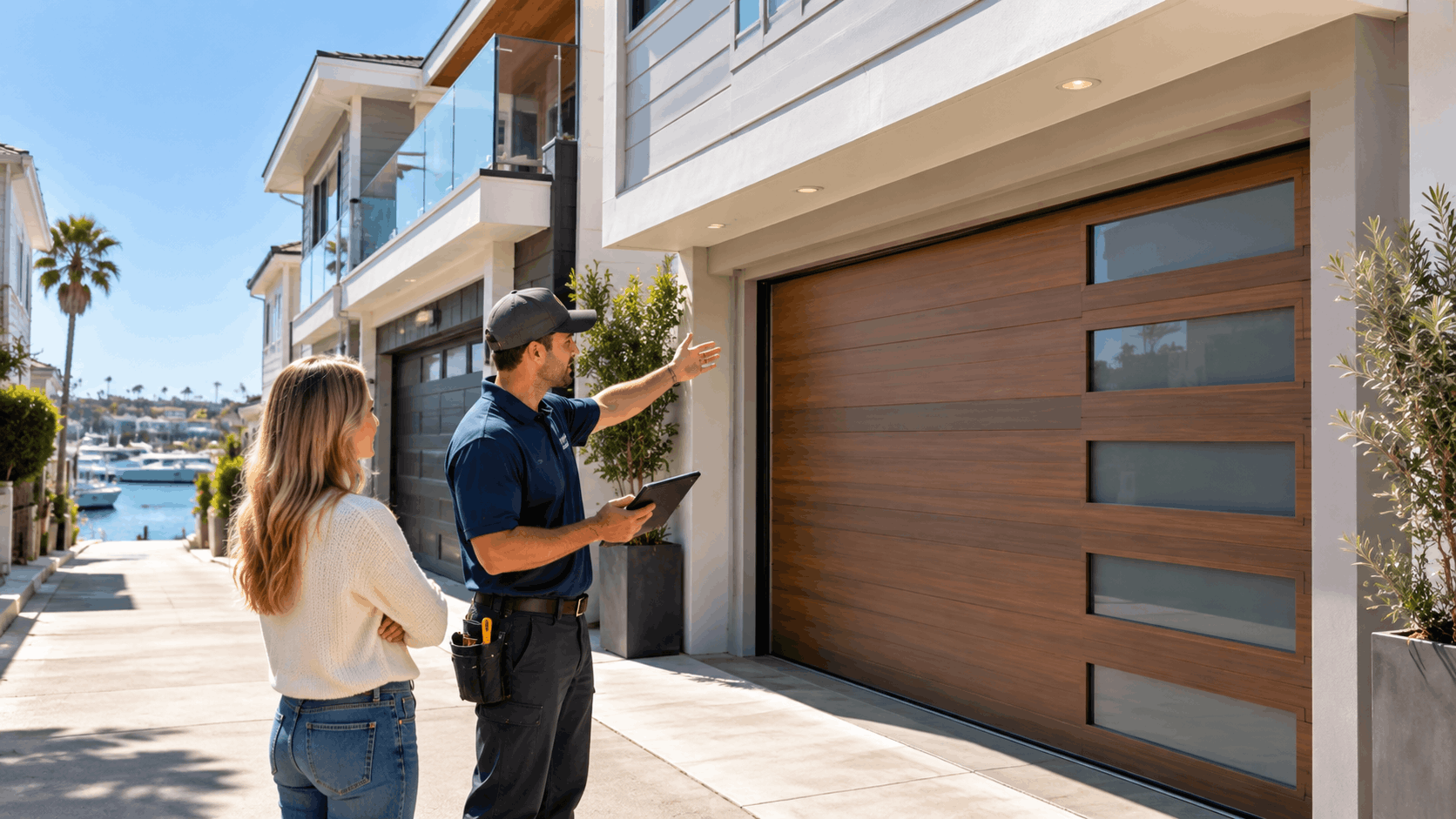
The garage door cost on the Balboa Peninsula follows the same Orange County price range any homeowner would see, but the mix of doors and hardware here skews higher. These are market ranges, not a quote from our team. The actual price for a specific garage depends on that garage and is given in writing before work begins.
The reason the Peninsula often sits toward the top of a range is physical. Lots are small, openings are narrow, headroom is often low, and alley access is tight. A stock-width panel that drops straight into a standard suburban opening frequently will not fit here, so a custom-width door and specialty track hardware enter the picture. Those add to the parts cost before anyone installs a thing.
| Door Type | Typical Orange County Range |
|---|---|
| Sectional garage door replacement | $800 to $2,500 |
| Insulated steel garage door | $900 to $2,500 |
| Carriage-house garage door | $1,200 to $4,500 |
| Modern glass garage door | $1,800 to $4,500 |
| Custom garage door projects | $1,800 to $6,500+ |
Typical Price Ranges for a New Door
A straightforward sectional replacement is the most common starting point, and it runs $800 to $2,500 as a typical area range. This is the standard layered panel door most Peninsula garages use, and the spread reflects material, insulation and width. A plain single-bay door in a stock size sits low in that band, while a wider or custom panel climbs toward the top.
An insulated steel garage door runs $900 to $2,500 and adds an R-value core, which matters most where a garage shares a wall or ceiling with living space. On the Peninsula, three-story rebuilds often put a bedroom directly over the garage, so insulation earns its place there. A carriage-house garage door, with its swing-door look on sectional hardware, runs $1,200 to $4,500.
At the higher end, a modern glass garage door runs $1,800 to $4,500 and a custom project runs $1,800 to $6,500 or more. These are typical ranges for the area, not a promise for your door. The figure for any specific garage depends on its size, material and the hardware it needs, which is why we measure and price before ordering.
Owners weighing design options can review the full lineup on our garage door installation page, including sectional, insulated steel and carriage-house garage door builds.
Why Narrow and Tandem Garages Land Higher in the Range
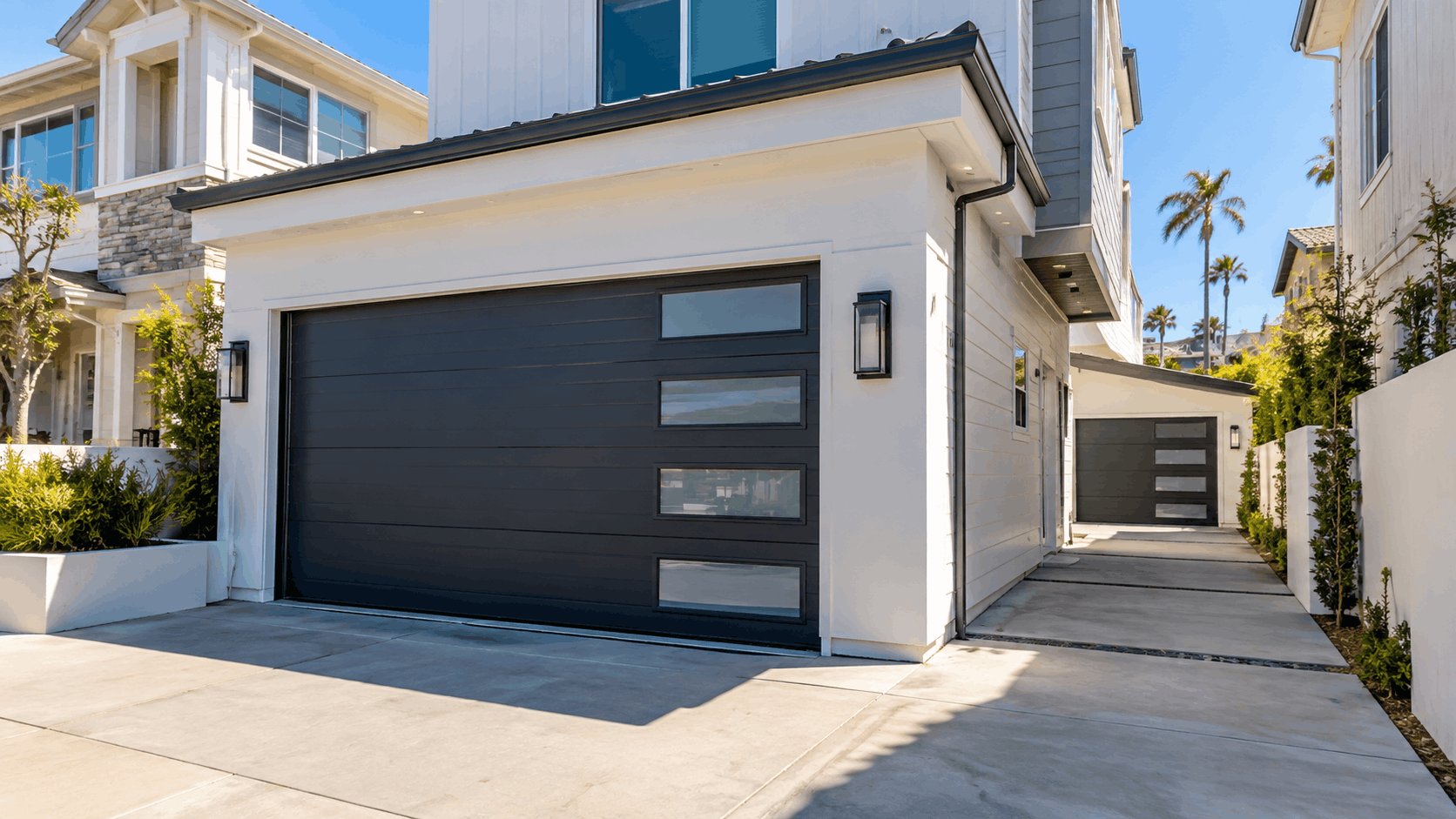
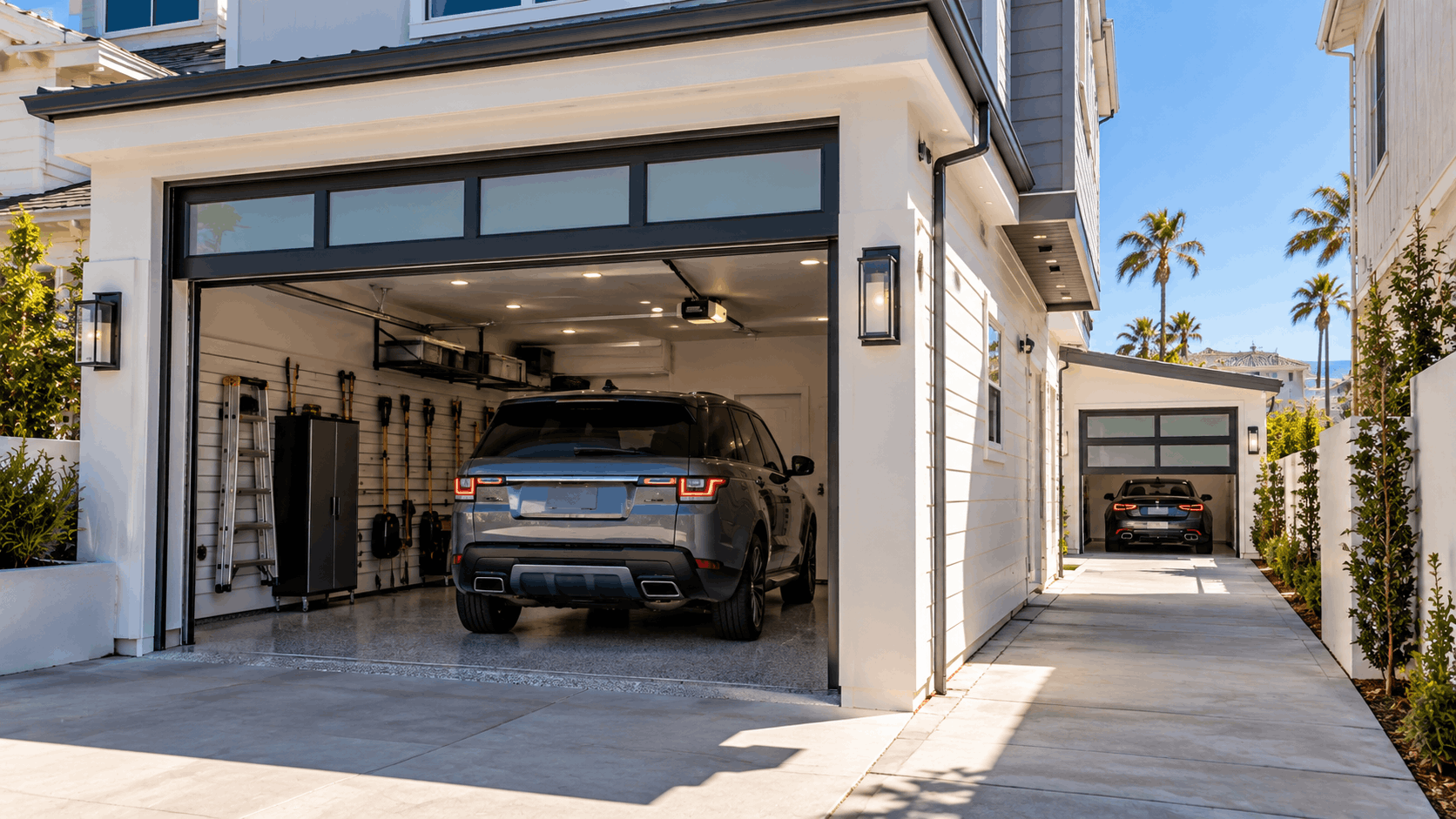
Peninsula garages were built to the lots they sit on, and those lots are small. Single-bay and tandem layouts are common, openings are narrow, and headroom is often low. That combination means a custom-width door and a low-headroom track kit are routine here, not rare exceptions, and both push a job up within its range.
A custom-width panel costs more than a stock door because it is built to the opening rather than pulled from a standard size. When the measured opening falls between the common widths a manufacturer stocks, the door has to be ordered to fit, and that specification adds to the base price. There is no way around it when the opening will not accept a standard panel.
Low-headroom hardware adds a second layer. When the ceiling leaves little room above the door, the standard track geometry will not work, so a low-headroom track kit reroutes the door into the available space. That kit is extra parts and extra labor, and on a tandem garage with limited depth the install takes more care. The result is a job that lands in the upper half of its range more often than a suburban tract garage would.
None of this is upselling. It is what the garage physically requires. The honest read is that a narrow or tandem Peninsula garage rarely prices at the bottom of its range, and planning for the middle to upper band avoids surprise.
What the Price Does and Does Not Include
The door panel is one line item. The opener, springs, hardware and battery backup are often separate, and owners who budget only for the panel are sometimes caught off guard. A new door frequently calls for new springs because the spring must be matched to the door's actual weight, and reusing old hardware near the water is rarely wise.
Opener installation runs $250 to $600, with belt drive costing more than chain. If the existing opener is old or non-compliant, it gets replaced, and the battery backup the law now requires is built into that compliant unit rather than sold as an add-on tier. Battery backup installation on its own runs $200 to $400.
Spring work is its own cost. Torsion spring replacement runs $150 to $300 and extension spring replacement $150 to $250, while cable repair runs $150 to $300. We cover each of these in detail in the parts section further down, so you can see how the add-ons build on top of the door panel itself. The full picture is the panel plus the hardware the specific garage needs.
Get Your Free Quote
Tell us about your garage door and we'll get back to you fast.
How Narrow Lots and Tandem Layouts Change the Price
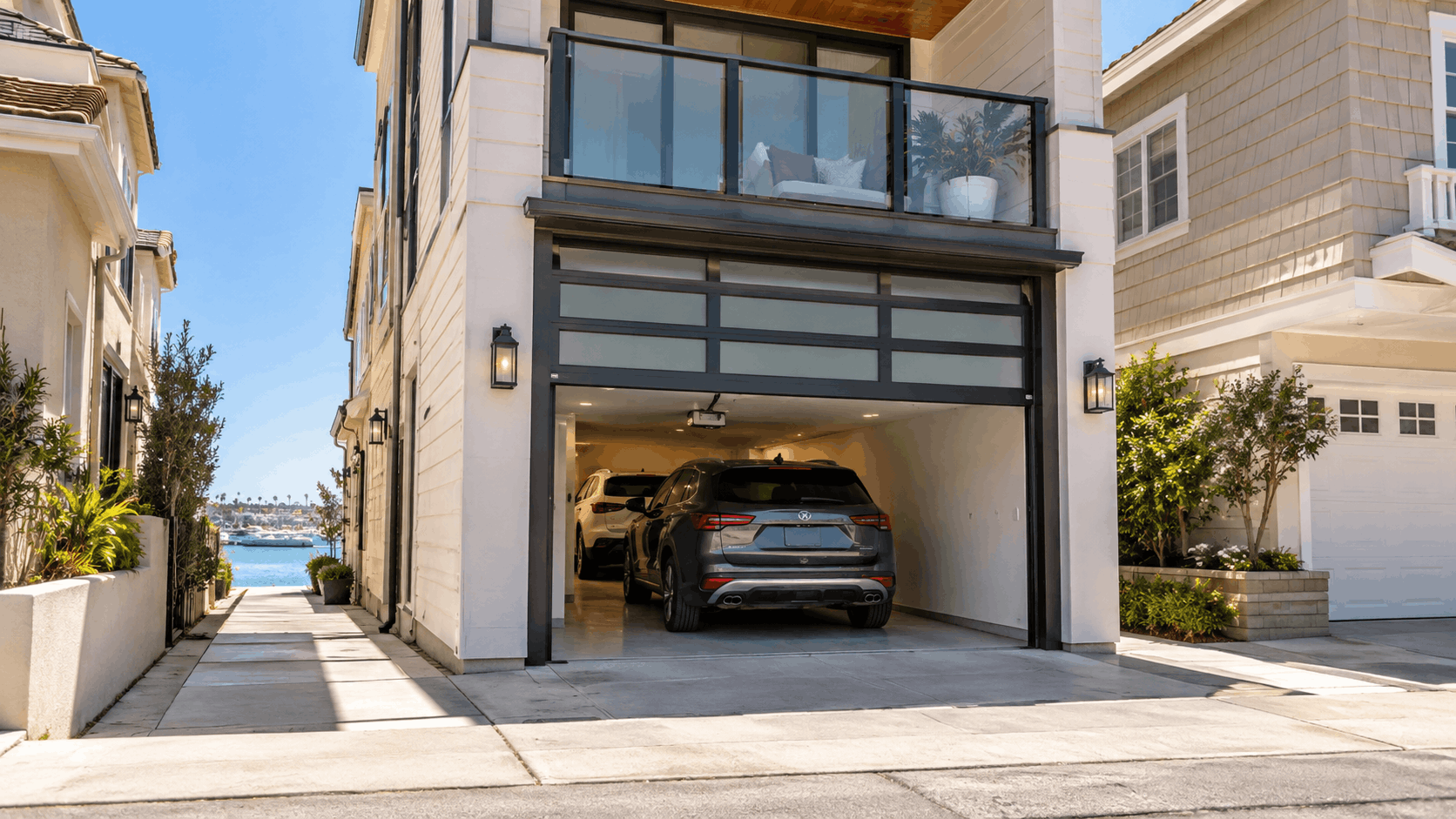
Peninsula garages are a product of their lots. The sand spit between the ocean and the harbor holds some of the densest housing in Orange County, with alleys serving most garages and almost no off-street parking beyond the garage itself. Small single-bay and tandem layouts, narrow openings, low headroom and tight alley access all shape the hardware a door needs and the labor to install it.
Each of those physical limits connects to a cost. A narrow opening means a custom-width door. Low headroom means a low-headroom track kit. Tight alley access and tandem depth mean the install takes longer and the opener choice narrows. Walk a block off Balboa Boulevard near McFadden Square or Balboa Village and you see the pattern repeat: garages built for 1920s and 1930s cottages or 1960s duplexes, now serving modern vehicles.
Custom-Width Doors for Narrow Openings
Many Peninsula openings are narrower than the standard widths manufacturers stock. A stock door built for a typical suburban garage simply will not fit an opening sized for a 1920s cottage or a tight duplex bay. When that happens, a custom-width panel is often the only real option, and it carries a higher price than a shelf-stock door.
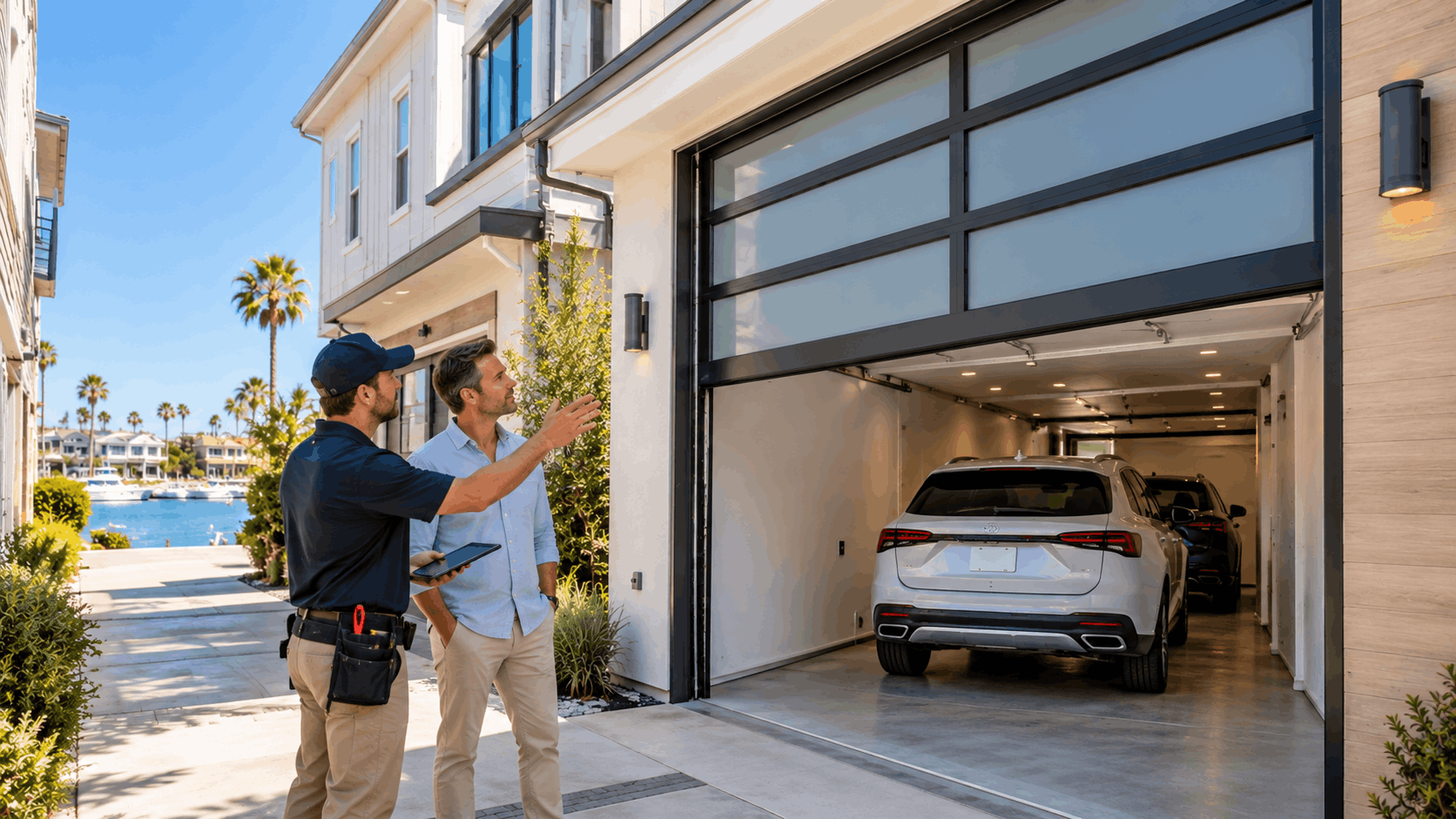
The opening size has to be measured exactly before anything is ordered, because a door built to the wrong dimension is scrap. We measure the actual rough opening, the headroom and the side room, then specify a panel that fits. On the Peninsula that specification lands outside stock sizes often enough that we treat custom width as the default assumption until a measurement proves otherwise.
The cost difference reflects the build, not a markup. A custom-width door is manufactured to the opening, so it sits higher in its range than a standard panel of the same material would. For a sectional garage door replacement on a narrow opening, expect the price to track the upper portion of the $800 to $2,500 band rather than the floor.
This is why a generic online price rarely matches a Peninsula garage. The number assumes a standard opening, and these openings are frequently anything but standard.
Low-Headroom Track Kits When Ceiling Space Is Tight
Headroom is the vertical space above the door opening where the track and the door travel when the door opens. Older Peninsula garages often have very little of it, because the structures were built close to the available height and never meant for modern overhead hardware. When headroom is tight, the standard track geometry has nowhere to go.
A low-headroom track kit solves this by reconfiguring how the door rolls back into the garage, fitting it into a few inches of space a standard kit cannot use. Here it is a routine solution rather than a special case. We expect to reach for it on a large share of older garages along the alleys, and we check the clearance before specifying any door.
The kit adds parts and labor to the job. It is more hardware than a standard installation and it demands more care to set up correctly, so it nudges the total upward. The payoff is a door that opens fully and travels cleanly in a garage that would otherwise have no workable option.
Skipping this step is not possible when the headroom demands it. A standard kit in a low-headroom garage either will not install or will bind, so the low-headroom track is part of the real cost of a correct job in these spaces.
Tandem and Single-Bay Layouts Behind the Alley
Most Peninsula garages open onto an alley rather than a street, and that access shapes the work. A tandem garage runs one car deep behind another, and a single-bay is just that, one narrow opening. Both layouts limit how a door and opener can be positioned and how a crew can move during the install.
Alley access means the work vehicle and the materials have to fit a tight lane, and the door has to install from inside a cramped footprint. There is no sprawling driveway to stage parts on. That constraint shows up as labor, because careful work in a tight space takes longer than the same job in an open two-car garage.
Tandem depth also affects opener placement. A long, narrow bay changes where the operator mounts and how the rail or torsion bar runs, which steers the opener choice toward units suited to the geometry. We plan the hardware around the layout rather than forcing a standard setup into a space that fights it.
The practical result is that two garages with identical doors can price differently based on access and layout alone. A clean single-bay off a wide alley installs faster than a tandem buried behind a narrow lane, and the labor reflects that difference.
Need Help in Irvine?
Urgent Garage Doors serves Irvine and all of Orange County.
Opener Type and Why It Matters on the Peninsula
Opener drive types come in three forms: chain, belt and jackshaft. Chain is the traditional workhorse, belt runs quieter, and jackshaft mounts on the wall and drives the torsion bar directly instead of using an overhead rail. On the Peninsula, belt and jackshaft openers are the sensible defaults for reasons tied to how these garages are built.
Opener installation runs $250 to $600, with belt drive costing more than chain. A smart Wi-Fi opener with MyQ setup runs $150 to $300, and keypad and remote programming runs $45 to $85. Those add-ons matter here because of the heavy short-term rental turnover, where codes and remotes change between guests. You can see the full opener lineup on our opener and smart access page.
Belt Drives for Garages Under Living Space
Three-story rebuilds on original Peninsula lots often put the garage directly under a bedroom or living room. When the opener sits below where people sleep, noise becomes a genuine issue, not a preference. A chain drive rattles and hums through the floor, and in a garage under living space that carries into the room above.
A belt drive runs the door on a reinforced belt instead of a metal chain, which cuts the noise and vibration substantially. For garages beneath living space, it is the quiet default we recommend, and the difference is obvious the first time the door cycles at night. The smoother operation also tends to be gentler on the hardware over time.
Opener installation runs $250 to $600, and belt drive sits toward the higher part of that range because it costs more than chain. On the Peninsula, where so many garages share structure with bedrooms above, that extra cost is usually money well spent. We walk owners through the trade-off during the opener installation consultation.
Where a garage stands alone with no room above it, chain remains a fine, lower-cost choice. The decision comes down to what sits over the ceiling, which is exactly the question Peninsula rebuilds force.
Jackshaft Openers Where Headroom or Ceiling Storage Is Limited
A jackshaft opener mounts on the wall beside the door and drives the torsion bar directly, leaving the ceiling clear. On the Peninsula, where headroom is often limited and ceiling space is frequently used for storage, that wall-mounted design is a routine fix rather than a premium novelty.
Because it drives the torsion bar instead of a rail running the length of the ceiling, a jackshaft frees up overhead space entirely. In a low-headroom garage where a standard rail opener would not fit cleanly, the jackshaft sidesteps the problem by never using the ceiling at all. That makes it a natural partner for a low-headroom track kit on the tightest garages.
It also suits garages where the owner stores kayaks, paddleboards or seasonal gear overhead, which is common on a peninsula surrounded by water. Keeping the ceiling open means that storage stays usable and the opener stays out of the way. The torsion bar connection delivers smooth, strong operation without the overhead hardware.
We specify a jackshaft when the measurements call for it, and on older alley garages they call for it often. The unit costs more than a basic rail opener, but in a garage where nothing else fits well, it is the correct tool.
Smart Controls, Keypads and Remotes
A smart opener connects to Wi-Fi so an owner or property manager can open, close and check the door from a phone. Smart Wi-Fi opener and MyQ setup runs $150 to $300. On the Peninsula, with one of the largest short-term rental populations in the county, this feature earns its keep on changeover days when a manager needs to let a cleaner or guest in without driving over.
Keypad and remote programming runs $45 to $85, and it is a small job with outsized importance for rental turnover. Codes get changed between guests, remotes get replaced when they walk off, and a door has to be made operable before a booking starts. Those small, fast jobs cluster on changeover days and in the run-up to summer.
For a property manager running several Peninsula units, smart access and keypad control turn a string of in-person visits into remote management. That is a practical saving on a sand spit where summer parking makes every drive-over a chore. We handle smart Wi-Fi opener and MyQ setup and keypad and remote programming as part of a new install or on their own.
For owner-occupiers, the same features add convenience: a keypad for the kids, a phone alert if the door was left open, and remotes matched to the new opener. The cost is modest against the daily use.
Battery Backup Is Required by Law, Not an Upgrade
California SB 969 requires every residential automatic garage door opener installed in the state on or after July 1 2019 to have a battery backup that operates during an electrical outage. This is not an optional upgrade or a premium tier. It is the law, and it applies to any replacement opener that goes in with a new door.
The law carries weight on the Peninsula for a reason you feel the moment the grid drops. This is a narrow sand spit with effectively one road in and out, and a power cut with a dead opener leaves a car trapped in an alley. The battery backup keeps the door working when the power does not.
What SB 969 Requires When You Replace a Door
SB 969 (Dodd, Chapter 621, Statutes of 2018) requires battery backup on every residential opener sold or installed in California since July 1 2019, and it carries a $1,000 civil penalty for violations. Since that date, a replacement residential garage door may not be installed connected to an opener that does not comply.
In plain terms, when you replace a Peninsula door, the opener it connects to has to have working battery backup. If the existing opener lacks it, the replacement includes a compliant unit. This is a statewide residential rule, and it is attributed to SB 969, not to the energy code or any local ordinance.
The law was passed after people died in the 2017 Northern California wildfires because they could not open their garage doors during power cuts. That is the purpose behind it: evacuation when the grid fails. It does not force an owner to replace an opener that is simply sitting there working, but it does apply the moment a door is replaced.
So an owner budgeting for a new door should count a compliant opener into the plan if the current one does not meet the standard. It is part of a lawful installation, not a line item you can decline.
Why It Matters on a Peninsula With One Way Out
The Balboa Peninsula runs end to end on Balboa Boulevard and is entered from Newport Boulevard (State Route 55) and Pacific Coast Highway (State Route 1). That is the road network. It is long, narrow and packed, with alleys serving the garages and little room to maneuver.
When the power goes out and an opener has no backup, the door stays shut and the car stays inside. On a dense spit with limited exits, a stuck car in an alley is more than an inconvenience during an emergency. The battery backup the law requires keeps the door operable through a grid failure so the vehicle can leave.
This is exactly the scenario SB 969 was written for. A power cut and a dead opener are the conditions that trapped people in 2017, and the Peninsula's geometry makes the risk concrete. One way out and a heavy door no one can lift by hand is a bad combination.
For Peninsula owners, the law and the geography point the same direction. A compliant opener with battery backup is the baseline for a safe install here, not an extra.
The Cost of Battery Backup Installation
Battery backup installation runs $200 to $400. When it comes as part of a compliant replacement opener, it is built into that unit rather than priced as a separate tier you add on top. The compliant opener is simply the opener that goes in with a new door.
If an owner keeps a working opener that predates the requirement but wants to add backup, that standalone battery backup installation falls in the $200 to $400 range. More often, a door replacement brings a new compliant opener, so the backup is included in the opener install rather than billed twice.
Owners sometimes ask whether they can skip it to save money. The honest answer is no, not on a new install, because the law prohibits connecting a replacement door to a non-compliant opener. The $1,000 civil penalty makes cutting that corner a poor trade.
The upside is that the feature doing the legal work is also the feature that gets your car out during an outage. On the Peninsula, that is value, not just compliance.
Salt Air and Blowing Sand Change What You Should Buy
Two local conditions drive hardware choices here more than anywhere inland: salt air and blowing sand. The Peninsula sits with the ocean on one side and the harbor on the other, so the air carries salt constantly. The beach sends sand drifting into tracks and onto sensors. Both shape what you should buy and what the job costs.
These are not background details on the Peninsula. They are primary mechanical causes of failure, and they justify specific hardware on the mechanics alone. Understanding what each condition does to the parts explains why galvanized hardware, stainless fasteners and regular cleaning belong on this list.
Why Cables and Springs Corrode Near the Water
Constant salt-laden air corrodes metal. On the Peninsula, with water on both sides, springs, cables, drums, rollers, hinges and fasteners corrode faster than the same parts would inland. The salt gets into every exposed metal surface and works on it continuously.
Cables are the quiet danger, because they fray from the inside before they snap. Corrosion attacks the strands within the cable where you cannot see it, so a cable that looks fine on the surface can be well on its way to failing. By the time the fraying shows, the cable is already compromised, which is why near-water cables deserve a closer look than a quick glance.
Steel door bottom sections rust upward from the base, where the metal meets the damp air closest to the ground. That rust climbs from the bottom edge over time. The honest frame for springs is that corrosion brings a spring to the end of its cycle rating earlier than it would reach it in dry inland air, because a corroded spring is a weakened spring.
This is why we recommend a twice-yearly inspection on Peninsula garages. Catching a fraying cable or a corroding spring before it fails is the difference between planned work and an emergency call. Our spring and cable repair service is built around exactly these conditions.
Galvanized and Coated Hardware, Stainless Fasteners
Because salt air works on bare metal, galvanized and coated hardware and stainless fasteners are justified here on the mechanics, not as an upsell. Galvanized parts carry a zinc coating that resists corrosion, coated hardware adds a protective layer, and stainless fasteners hold up against salt far better than plain steel.
These materials cost more than standard parts, so they add to the hardware cost on a new install. That is a real line item, but on the Peninsula it buys genuine durability rather than a cosmetic upgrade. A galvanized spring and stainless bolts stand up to the salt-laden air in a way plain steel will not.
We specify corrosion-resistant hardware on Peninsula jobs as a matter of course, because the alternative is parts that start corroding the day they go in. The modest extra cost up front saves a second trip when standard hardware fails early in this environment.
For owners weighing the budget, this is one place where paying a little more is the mechanically sound choice. The salt does not negotiate, and the hardware that resists it lasts the way it should.
Sand in Tracks, Seals and Photo-Eye Lenses
Blowing sand drifts into the bottom tracks and accumulates against the bottom seal. When that happens, the rollers bind, the door labors, and the opener registers the resistance and reverses. A door that struggles to close on the Peninsula is very often fighting sand in the track, not a broken part.
Sand also settles on the photo-eye lenses, the safety sensors mounted low on each side of the opening. A coated lens breaks or weakens the beam, and the door refuses to close with no visible obstruction. This is the single most common Peninsula service call that turns out not to be a broken part at all, just grit on a lens.
The fix is often simple: clean the tracks and wipe the lenses. Regular track cleaning and lens wiping prevent more Peninsula service calls than any component upgrade. An owner can do a lot of this themselves, and it keeps a working door working. When the beam truly needs attention, our safety sensor alignment and repair service handles it.
Grit packing into a seal also stops it from flattening against the slab, which lets more sand in and starts the cycle again. Keeping the bottom seal clear is part of keeping the door sealed and quiet.
Need Help in Irvine?
Urgent Garage Doors serves Irvine and all of Orange County.
Springs, Cables and the Parts That Set the Final Figure
A new door rarely arrives alone. The springs that lift it and the cables that guide it often need replacement at the same time, and those parts set a meaningful part of the final figure. Understanding cycle rating helps an owner plan for replacement timing instead of guessing at a lifespan.
Torsion spring replacement runs $150 to $300, extension spring replacement $150 to $250, and cable repair $150 to $300. Springs store enormous energy and are never an owner job, so the safe test to run yourself is the auto-reverse check, not any adjustment to the spring itself.
Springs Sized to the New Door's Weight
Springs are sized to the actual weight and height of the door. A heavier replacement material needs springs matched to it, not a reuse of the old set. If you move from a light single-layer door to an insulated steel panel, the old springs are simply the wrong size and will not balance the heavier door.
Torsion spring replacement runs $150 to $300, and extension spring replacement runs $150 to $250. The two systems work differently: torsion springs mount on a bar above the door and wind under tension, while extension springs stretch along the tracks. Which one your garage uses depends on the setup, and the new springs are matched to the new door's weight either way.
Reusing old springs with a heavier door is a mistake that shows up fast. An undersized spring cannot balance the door, so the opener strains, the door moves poorly, and the hardware wears early. Matching the spring to the door is basic to a correct install, which is why we never carry over an old set with a new, heavier panel.
A torsion spring stores enough energy to cause serious injury and is wound with bars against a fixed cone, so this is work for a trained installer. Our torsion spring replacement handles the sizing and the winding safely.
Cycle Rating and How Long Springs Last Here
A torsion spring is rated in cycles by the manufacturer, with one cycle being one full open and close. A standard spring is commonly rated around 10,000 cycles. That number, not a guess, tells you how long a spring should last.
A door cycled four times a day reaches 10,000 cycles in roughly seven years. On a Peninsula garage that serves as the main entrance, with the door going up and down many times daily, that math arrives sooner. A rental property with constant turnover cycles even more.
High-cycle springs are rated higher and cost more, but they suit a door that cycles often. For a main-entrance door or a busy rental, paying for a high-cycle spring up front means fewer replacements over the years. We match the spring rating to how the door is actually used rather than defaulting to the standard spring everywhere.
Near the water, corrosion brings a spring to the end of its cycle rating earlier, so the salt shortens the real-world life of even a correctly rated spring. That is one more reason the twice-yearly inspection pays off here, catching a spring before it fails mid-cycle.
Why Cables Get Inspected at the Same Time
Cables, drums, rollers, hinges and bearings all wear alongside springs. Replacing a spring without inspecting the cables is how a second failure follows weeks later, because the same age and the same salt air that tired the spring have been working on the cable too.
Cable repair runs $150 to $300. On the Peninsula, where cables fray from the inside before they snap, the inspection matters more than usual. A cable that looks intact can be corroded within, so checking it while the hardware is already apart is good practice and saves a return trip.
The drums the cables wind onto, the rollers in the tracks, and the hinges between panels all wear on a similar schedule. When we replace springs, we look at the whole lifting system rather than swapping one part and calling it done. That is how a single visit fixes the door instead of starting a chain of follow-up calls.
For owners, the takeaway is simple: budget for the inspection, not just the one obvious part. Our garage door cable repair looks at the full set so a fresh spring does not get undone by an old cable.
Permits, Coastal Review and Parking That Affect Timing and Cost
The Peninsula sits entirely in the Coastal Zone, and that layer, plus city permitting and summer parking rules, shapes when work happens and whether a job gets more complicated. Each point below touches either timing or cost, so they belong in a cost planning conversation.
- Coastal review can apply. Work touching exterior walls or openings is the kind of change that draws coastal review.
- Permits are confirmed per address. The city with jurisdiction decides, not a single regional rule.
- Summer parking is restricted. From May 15 to September 15, only permit holders may park in the restricted residential zone.
When Coastal Review Comes Into Play
Nearly every property in Newport Beach sits in the Coastal Zone, and the Peninsula is entirely coastal. Work in the Coastal Zone can require a Coastal Development Permit before or concurrent with a building permit, and work touching exterior walls or openings is the kind of change that draws coastal review.
The distinction that matters is the opening size. Replacing a door in an existing opening at the same dimensions is a different proposition from changing the opening size or altering the structure around it. It is the second that can pull a project into the longer Coastal Development Permit process. A straight like-for-like swap in the same opening is a simpler path than widening the opening.
Owners check status with the Newport Beach Address Search Tool, and city staff guide them through documentation. The Permit Center is at 100 Civic Center Drive, 949-644-3309. Confirming the coastal position for a specific address before planning the work avoids a surprise that stretches the timeline.
For most door replacements that keep the existing opening, the coastal layer is manageable. It is the jobs that change the structure around the opening that need the longer runway, and knowing which category a job falls into up front sets realistic expectations on timing.
Building Permits Are Confirmed Per Address
Whether a replacement needs a building permit is decided by the city with jurisdiction for the specific address, not by a single county-wide rule. Permits are a local call, so the authority on any given Peninsula job is the city building department for that address. We tell owners to confirm the position for their address rather than assuming.
Needing a permit of any kind also changes the licensing picture. Under AB 2622, the unlicensed-work exemption fails at any value if the work requires a building permit. So a permit does more than add a step; it removes the under-$1,000 exemption entirely and means licensed work is required regardless of the dollar figure.
Newport Beach does not list a same-size door replacement as permit-exempt work, so the honest position is to confirm rather than assume no permit is needed. The city with jurisdiction gives the answer for the specific job, and that answer can affect both timing and who is allowed to do the work.
For an owner, the practical step is a quick call to the Permit Center before scheduling. It settles both the permit question and the licensing question in one conversation.
Summer Parking Rules and When Work Gets Booked
Parking on public streets in the restricted residential zone is limited from May 15 to September 15 each year, when only vehicles displaying a valid permit may park. Permit holders must still comply with all other parking regulations, including the 72-hour ordinance. For a service business, the practical reading is direct.
From mid-May to mid-September, a work vehicle has nowhere legitimate to sit on the Peninsula unless it is in the customer's own garage space or a permitted lot. That constraint shapes scheduling. Summer jobs get booked early in the morning when the crew can work before the day fills up, and larger work belongs in the off-season.
Off-season, from fall through spring, a work vehicle can be positioned without the permit restriction, so bigger installs are easier to stage. An owner planning a full door replacement on a tight alley lot often does best to schedule it outside the summer window when access is simpler.
This is not a cost line, but it is a timing reality that affects when a Peninsula job can realistically happen. Planning around the May 15 to September 15 window keeps a project from stalling on parking.
Licensing and Who Is Allowed to Do the Work
Before hiring anyone for a new door, an owner should know the correct license classification and the rules around unlicensed work. These bear directly on the cost decision, because the threshold that allows unlicensed work is lower than many people think and disappears entirely under common conditions.
Garage door work in California is licensed by the Contractors State License Board, and the correct classification is C-61/D-28. A license is verified free at cslb.ca.gov, where classification, status, bond and workers compensation are all public record. Urgent Garage Doors holds California license #1055150.
The Correct License Is C-61/D-28
California garage door work is licensed under classification C-61/D-28, Doors, Gates and Activating Devices, a subclassification of the C-61 Limited Specialty category. The scope covers installing, modifying and repairing all types of doors, including sectional and rolling doors, torsion and extension spring systems, operators, control boards, safety sensors and activating devices.
That is the license to look for on a garage door job. It covers exactly the work a new door install involves, from the spring systems to the opener to the safety sensors. When a contractor holds C-61/D-28, their license matches the work.
C-28 is a different classification entirely. C-28 is Lock and Security Equipment, and it is not the garage door license. Garage door work is also not a job that requires a Class B general building license. If someone describes garage door work as C-28 or as needing a general building license, that is a signal to look closer.
Verifying is free and quick. At cslb.ca.gov an owner can confirm the classification, status, bond and workers compensation for any license. Urgent Garage Doors holds California license #1055150, and you can check it there yourself.
The $1,000 Threshold and When It Disappears
Assembly Bill 2622 rewrote Business and Professions Code section 7048 effective January 1 2025, raising the unlicensed-work exemption from $500 to $1,000 in combined labor, materials and other costs. A great deal of older advice still prints $500, but the current figure is $1,000.
The exemption also fails at any value under two conditions. If the work requires a building permit of any kind, the exemption is gone regardless of the dollar amount. If the person employs anyone on the job, it is gone as well. And a job cannot be split into sub-$1,000 slices to stay under the threshold.
For a new door on the Peninsula, those conditions matter. Most door replacements with proper springs, hardware and a compliant opener exceed $1,000, and any job that needs a permit removes the exemption entirely. So in practice, a real door replacement here is licensed work.
The takeaway for an owner is to treat a new door as a licensed job and verify the license before hiring. The $1,000 threshold rarely covers a complete door installation on a tight Peninsula lot.
Written Contract Over $500 and Verifying a License
A separate rule is often confused with the licensing threshold. Business and Professions Code section 7159 requires a written home improvement contract for work over $500. That is a contract requirement, not a licensing threshold, and the two are different rules at different figures.
So a new door job will typically require a written home improvement contract under section 7159, since it runs well over $500. That written contract protects the owner by putting the scope and price on paper. It is a legal requirement, not a company favor.
Verifying a license is free and worth the minute it takes. At cslb.ca.gov, classification, status, bond and workers compensation are all public record. An owner can confirm a contractor holds C-61/D-28 in good standing before any work starts. Urgent Garage Doors holds California license #1055150.
Between the correct classification, the $1,000 licensing rule, and the written contract over $500, an owner has a clear checklist before hiring. Confirm the license, confirm the work is licensed, and get the contract in writing.
Need Help in Irvine?
Urgent Garage Doors serves Irvine and all of Orange County.
How Our Team Handles a New Door on the Peninsula
A new door on a narrow alley lot starts with measurement and ends with a correctly balanced, compliant installation. Our team at Urgent Garage Doors approaches a Peninsula job knowing the openings are often narrow, the headroom is often low, and the salt and sand are always working on the hardware.
We measure the opening and headroom, match the springs to the new door's weight, confirm battery backup compliance, and provide a written price before work begins. We work on all brands, including LiftMaster, Chamberlain, Genie, Craftsman, Clopay, Amarr, Wayne Dalton and CHI.
Measuring the Opening, Headroom and Alley Access
The first step on any Peninsula job is measuring the actual opening, the headroom and the alley access. These garages rarely match a standard size, so we measure before anything is ordered. A door built to the wrong dimension helps no one.
From those measurements we specify the right solution: a custom-width door for a narrow opening, a low-headroom track kit where the ceiling is tight, or a jackshaft opener where headroom is limited or overhead storage is in use. Each choice follows directly from what the measurements show, so the hardware fits the garage rather than fighting it.
Alley access factors in too, because how a crew and materials fit the lane affects how the install runs. We plan the work around the real footprint, which on a tandem bay behind a narrow alley takes more thought than an open two-car garage. Getting this right up front avoids the delays that come from ordering the wrong parts.
By the time we order anything, the door, the track hardware and the opener are matched to the specific garage. That is the only way to install correctly in spaces this tight.
A Written Price Before Work Begins
A written price is available before work begins, given when the job calls for it or the customer asks. For a new door, that means an owner can see the figure for the door, the springs, the hardware and the opener before anyone starts. The actual price for a specific garage depends on that garage, and it is put in writing.
We work on all garage door brands, so a Peninsula owner is not limited by what they already have. Whether the existing opener is a LiftMaster, Chamberlain, Genie, Craftsman, Clopay, Amarr, Wayne Dalton or CHI, we can service, replace or match it. That range matters in a neighborhood where housing turns over constantly and garages carry hardware from many different eras.
The written price also pairs with the legal requirement for a written home improvement contract on work over $500, which nearly every full door job exceeds. So the paperwork that protects the owner is part of how the job is set up, not an afterthought.
Owners who want to understand the pricing before committing can review our garage door installation options and ask for a written figure on their specific garage.
Emergency Response and Service Across Orange County
Urgent Garage Doors takes emergency calls and responds 24 hours a day, 7 days a week, every day of the year including holidays. Emergency response is 30 to 60 minutes anywhere in Orange County, so a stuck door in a Peninsula alley does not mean waiting a day for help.
The company was founded in 2017 and is based at 76 Ashford, Irvine, CA 92618. Its Google Local Services listing carries the Google Guarantee badge. For Peninsula owners, that means a local Orange County team rather than a distant dispatcher, with coverage that reaches the alleys off Balboa Boulevard.
A dead opener during a power cut or a door off its track before a summer rental turnover is exactly the kind of call the 24/7 emergency garage door repair service exists for. On a peninsula with one way out, fast response is not a luxury.
Whether the job is a new door, a spring failure or an urgent repair, the service runs across Orange County with the same response window. The Peninsula is squarely inside that coverage.
Getting Your Peninsula Door Replaced
A new door on a narrow alley lot comes down to measuring the opening and headroom, matching springs to the door's weight, and installing a compliant opener with the battery backup the law requires. Call Urgent Garage Doors at (949) 529-7743 for a written price on your specific garage before any work begins. You can also reach our team through the contact page or review coverage on our Newport Beach service area.
Frequently Asked Questions
- How much does a new garage door cost on the Balboa Peninsula?
- Typical Orange County ranges apply: a sectional replacement runs $800 to $2,500, an insulated steel door $900 to $2,500, a carriage-house door $1,200 to $4,500, and a custom project $1,800 to $6,500 or more. These are market ranges, not a quote. Narrow and tandem Peninsula garages often need custom-width or low-headroom work, which pushes a job toward the upper end. The actual price for a specific garage is given in writing before work begins.
- Why does a custom-width door cost more than a standard one?
- Many Peninsula openings are narrower than the stock sizes manufacturers carry, so a standard door will not fit. When the measured opening falls outside those stock widths, a custom-width panel is often the only option, and it is built to the opening rather than pulled from a shelf. That build-to-fit specification costs more and pushes the price toward the upper end of its range. We measure the opening exactly before ordering anything.
- Do I have to get a battery backup opener with a new door?
- Yes. Under California SB 969, any residential opener installed or replaced in the state since July 1 2019 must have a battery backup that works during a power outage. It is a legal requirement, not an optional tier, and violations carry a $1,000 civil penalty. A replacement door may not be connected to a non-compliant opener. If your current opener lacks backup, the replacement includes a compliant unit as part of a lawful install.
- What opener works best in a low-headroom tandem garage?
- A jackshaft opener mounted at the torsion bar is the routine fix where headroom is limited or ceiling storage is in use, because it drives the door from the wall and leaves the ceiling clear. On the Peninsula, where garages are tight and overhead space often holds kayaks or gear, this suits many older alley garages. Belt drives are the quiet default for garages under living space, which matters on three-story rebuilds with a bedroom above the garage.
- Does replacing a garage door need a permit on the Peninsula?
- Whether a permit is required is decided by the city with jurisdiction for the specific address, not by a single regional rule, and Newport Beach does not list a same-size swap as permit-exempt. Work that changes the opening size can also draw coastal review, since the entire Peninsula sits in the Coastal Zone. Confirm the position for your address with the Newport Beach Permit Center at 100 Civic Center Drive, 949-644-3309, before scheduling.
- Why do garage doors near the water bind and corrode?
- With the ocean on one side and the harbor on the other, salt-laden air corrodes springs, cables and fasteners faster than inland, and cables fray from the inside before they snap. Blowing sand drifts into the bottom tracks and against the seal, so rollers bind and the door labors. Galvanized and coated hardware with stainless fasteners stand up to the salt, and regular track cleaning plus lens wiping keep sand from stopping the door.
- Can I reuse my old springs with a new door?
- No. Springs are sized to the actual weight and height of the door, so a heavier replacement material needs springs matched to it rather than a reuse of the old set. An undersized spring cannot balance a heavier door, which strains the opener and wears the hardware early. Cables should be inspected at the same time, because near the water they fray from the inside, and replacing a spring without checking the cable invites a second failure weeks later.
- When is the best time to schedule installation on the Peninsula?
- From May 15 to September 15, street parking in the restricted residential zone is permit-only, so a work vehicle has nowhere legitimate to sit unless it is in the customer's garage space or a permitted lot. That means summer jobs get booked early in the morning, and larger work belongs in the off-season when a crew can position a vehicle without the permit restriction. A full door replacement on a tight alley lot is often easier to stage outside the summer window.
- What license should a garage door installer hold in California?
- The correct classification is C-61/D-28, Doors, Gates and Activating Devices, which covers spring systems, operators, control boards and safety sensors. C-28 is Lock and Security Equipment and is not the garage door license, and the work does not require a Class B general building license. Verify any license free at cslb.ca.gov, where classification, status, bond and workers compensation are public record. Urgent Garage Doors holds California license #1055150.
- Can I get a written price before work starts?
- Yes. A written price is available before work begins, given when the job calls for it or the customer asks, so you can see the figure for the door, springs, hardware and opener before anyone starts. California Business and Professions Code section 7159 also requires a written home improvement contract for work over $500, which nearly every full door job exceeds. That contract puts the scope and price on paper and protects you as the owner.
U
Licensed garage door repair professionals serving Irvine and Orange County.
Licensed in California · License #1055150
Why trust Urgent Garage Doors?
Founded in 2017, Urgent Garage Doors is a licensed and insured garage door services serving Irvine and Orange County. All content is reviewed by our licensed technicians.

Need Help in Irvine?
Urgent Garage Doors serves Irvine and all of Orange County.
Related Articles
Cost Guides
Garage Door Off Track Repair Cost OC: 30 to 60 Minute vs Standard Response Pricing
Off track garage door repair in OC costs $150-$250 for a standard re-track. Learn what raises the price and how 30 to 60 minute rush and standard scheduling differ.
Cost Guides
Garage Door Opener Replacement Cost OC: LiftMaster vs Genie vs Chamberlain Pricing
Real garage door opener replacement cost in Orange County compared across LiftMaster, Genie, and Chamberlain, with installed pricing, features, and brand advice.