Garage Door Track Realignment on Big Canyon Sloped Driveways
Key Takeaways
- A door that binds at one spot or sits crooked at the floor in Big Canyon is usually track drift from fifty years of settling on graded canyon ground, not a broken part.
- Replacing rollers or springs on a door with crooked track leaves the bind in place; the real fix is resetting the vertical and horizontal track to true.
- The balance test separates a spring problem from a track problem: disconnect the opener, raise the door to waist height, and a balanced door stays put.
- Track repair and realignment typically runs $125 to $300 in Orange County and off-track door repair $125 to $275, with the actual price given in writing before work begins.
- Big Canyon is guard gated under Davis-Stirling, so the homeowner arranges contractor gate access in advance and a door replacement, unlike a realignment, typically needs association review.
- Garage door work is licensed under C-61/D-28, verifiable free at cslb.ca.gov; Urgent Garage Doors holds California license #1055150.
- Golf-frontage ball strikes can dent a panel and throw the door off track, so the alignment check and the single-panel-replacement question go together on course-facing homes.
- Urgent Garage Doors responds 24/7 within 30 to 60 minutes across Orange County from its Irvine storefront and carries common torsion springs on the truck.
In This Article
A Big Canyon homeowner backs out of the garage on a Tuesday morning, and the door catches at the same spot it caught last week. It moves fine for the first few feet, then it hesitates, grinds, and hangs crooked above the opening. The door is not broken. It is fighting track that has drifted out of true after five decades of ground movement on a sloped canyon lot.
That hesitation is one of the most common things we see on homes off Jamboree Road, where driveways fall toward or away from the garage and the ground has settled for half a century. A door that binds at one point in its travel, or sits unevenly at the floor, usually points to alignment rather than a failed part. Swapping a roller or a spring on a door with crooked track leaves the real problem in place.
Why Track Goes Out of Alignment in Big Canyon?
Big Canyon opened in 1973 on ground once earmarked for a landfill, built out around the Big Canyon Country Club golf course by developers including Deane Development Company and Broadmoor Homes. The community sits on graded canyon ground framed by Jamboree Road, San Joaquin Hills Road, MacArthur Boulevard and Ford Road, directly east of Newport Center and Fashion Island. Graded ground moves over time, and that movement is the root of most track alignment problems here.
When the framing shifts, the brackets that hold the track shift with it. The vertical and horizontal track that should stay parallel and plumb drift out of line. A door that was perfectly square in 1975 can bind in 2025 without a single part breaking, because the rails it rides are no longer where they were installed.
The sloped driveway adds a second layer. Where the concrete falls toward or away from the opening, the floor line and the door's bottom edge stop meeting square, so the door reads as crooked at the ground. The table below sorts the common Big Canyon causes from what each one produces.
| Local condition | What it does to the door |
|---|---|
| Ground settling since 1973 | Shifts framing and track mounts, pulling vertical and horizontal track out of parallel |
| Driveway sloping toward the opening | Door sits unevenly at the floor; bottom seal touches on one side, gaps on the other |
| Fifty-year-old original hardware | Worn rollers and brackets let track drift further and bind harder |
| Golf-frontage ball strikes | Dented panel can throw the door off its track |
Fifty Years of Settling on Graded Canyon Ground
The entire neighborhood was cut and graded before the first homes went up, which is normal for a canyon development but matters decades later. Soil that was compacted during grading continues to move with seasonal moisture, and the structures on top move with it in small amounts. Over fifty years those small movements add up to real shifts in how a garage opening sits.
A garage door track is only as true as the framing it is bolted to. When a header or a jamb shifts even a fraction, the lag bolts and brackets holding the vertical track move too. The track no longer runs plumb, and the horizontal rails that carry the door back into the garage no longer sit level with each other.
This is why a door on an original 1970s Big Canyon garage can develop a bind with no obvious cause. Nothing snapped and nothing wore out overnight. The ground simply kept doing what graded ground does, and the track slowly fell out of line until the rollers started catching.
Because the cause is structural movement rather than a worn part, the fix is bringing the track back to true rather than replacing a component. That distinction decides whether the repair actually solves the problem or just resets a timer on the same bind.
What a Sloped Driveway Does to the Door's Travel
Harbor View and Big Canyon both sit on graded bluff and canyon ground, so driveways fall toward or away from the garage on many lots. When the driveway slopes toward the opening, the finished floor line tilts relative to the door, and the bottom edge of the door no longer meets the slab square. One corner reaches the floor before the other.
This shows up two ways. The door may bind at a single point in its travel as a roller is forced against a rail that is no longer parallel. Or it may close and sit crooked at the floor, with a visible gap on the low side where the seal cannot reach the concrete.
A sloped driveway toward the opening also loads the threshold and bottom seal in winter. The seal is doing real work holding back rain that runs down the drive toward the garage, and a worn or uneven seal lets water onto the floor. Owners often describe this as a water problem when it started as a settling and alignment problem.
The important point is that the door is not failing outright. It still opens and closes, which is why people live with it for months. It is the uneven travel and the gap at the floor that give the alignment issue away.
Why This Is a Realignment Job, Not a Parts Job
When a door binds on a settled Big Canyon lot, the instinct is to replace whatever seems stuck. New rollers, maybe a new spring. But if the track itself is crooked, new rollers will ride the same crooked path and catch in the same place within weeks.
A realignment addresses the actual cause. The track brackets are loosened, the rails are repositioned to run parallel and plumb again, and everything is resecured so the door travels straight. That is the correct response to drift from ground settling, and it is work covered under our track repair and realignment service.
Diagnosis matters here because a bind can masquerade as other faults. A door that drags can feel like a weak spring. A door that stops partway can feel like an opener problem. Pulling the door apart for parts without checking the track first is how a homeowner pays twice for the same complaint.
The honest diagnosis separates a track problem from a spring, roller or sensor fault before any part is ordered. On an older Big Canyon door, the realignment is usually paired with an inspection of the hardware riding that track, because worn rollers and hinges both cause and suffer from misalignment.
Get Your Free Quote
Tell us about your garage door and we'll get back to you within 30 to 60 minutes.
How to Tell Track Misalignment From Another Problem?
Before calling anyone out, an owner can narrow down what is wrong with a few safe checks. A track problem, a spring problem and a sensor problem each behave differently, and describing the right one on the phone saves a wrong diagnosis. The table below pairs the symptom with the likely cause.
| What you see or hear | Most likely cause |
|---|---|
| Door catches at the same spot every cycle | Bent or shifted track, loose bracket, or pinched gap |
| Door will not hold position when raised by hand | Spring problem, not opener or track |
| Door sits crooked and gaps at the floor on one side | Settling plus worn bottom seal and uneven floor line |
| Door reverses on closing with nothing in the way | Photo-eye misalignment or a blocked beam |
Binding at One Point in the Travel
A track bind has a signature. The door runs smoothly through most of its travel, then catches at the same spot every single cycle. You can almost set a watch by it, because the roller is hitting the same out-of-true section each time.
The catch often comes with a sound. A grinding, a scrape, or a thud as the roller forces past a bent rail or a spot where the gap between the roller and track has pinched tight. The door may shudder or lean slightly to one side at that point before continuing.
A loose bracket produces the same result. If one of the brackets holding the track has backed off over the years, the rail flexes under load at that point and the roller catches. This is extremely common on fifty-year-old hardware where the original fasteners have worked loose with vibration and settling.
If the catch is always at the same height and always makes the same noise, that points firmly at track rather than a spring or opener. A spring fault affects the whole lift, not one fixed point, which is the cleanest way to tell them apart.
Sitting Crooked or Gapping at the Floor
On a sloped Big Canyon driveway, the bottom seal often touches the slab on one side and leaves a visible gap on the other. The door looks like it is sitting at a slight angle when fully closed, because the floor line and the door's bottom edge are no longer parallel.
This is settling made visible. As the framing and track shift, the door's travel path tilts relative to the concrete, and the door comes to rest crooked. The seal, designed to flatten evenly against a level slab, cannot close a gap that is wider on one end.
In winter, that gap becomes a water problem. Rain running down a driveway that slopes toward the garage finds the low corner and comes under the door onto the floor. Owners near the bayfront side of these neighborhoods notice it most during the wet months.
Reading this correctly as a combined track and threshold issue matters. Replacing the seal alone on a door that sits crooked will not fully close the gap, because the door itself is not meeting the floor square. The realignment and the seal work together.
The Balance Test and the Auto-Reverse Check
The balance test is the single most useful check an owner can run to rule springs in or out. Pull the release cord to disconnect the opener, then raise the door by hand to about waist height and let go. A correctly balanced door stays put.
If the door falls or rises on its own, that is a spring problem, not an opener or track problem. The springs are no longer carrying the door's weight correctly, and that is work for a licensed technician. An owner must never adjust, wind, unwind or replace a torsion spring, which stores enough energy to cause serious injury.
The auto-reverse check tests the safety system. Lay a flat two-by-four across the floor in the door's path and run the door down. It must reverse within two seconds of contacting the wood. This confirms the contact-reverse function that every modern opener must have.
While you are there, look at the photo-eyes mounted low on each side of the opening, no higher than six inches off the floor. The beam between them should be aligned and unobstructed. These two tests, balance and auto-reverse, let an owner separate a spring fault from a track or sensor fault before the call.
When the Opener Reverses for No Visible Reason
A door that starts to close then reverses with nothing in the way frustrates a lot of Big Canyon homeowners. The most common cause is not the track at all. Photo-eye faults, misalignment and blocked beams are the usual reason a door reverses for no visible reason.
The two photo-eyes have to see each other across the opening. If one gets bumped, knocked out of line, or coated with dust and plant debris blown into the garage, the beam breaks and the opener reads it as an obstruction. A spider web or a leaf on the lens does the same thing.
This is different from a track bind. A sensor fault reverses the door before it reaches the floor, often from the same point, and clears when you realign or clean the eyes. A track bind causes the door to catch and labor mid-travel, not reverse cleanly. Our safety sensor alignment and repair service handles the eye side of this.
Knowing which one you have helps you describe it on the call. "It catches and grinds at one spot" points to track. "It starts down then goes back up on its own" points to the photo-eyes. Both are fixable, but they are different jobs.
Need Help in Irvine?
Urgent Garage Doors serves Irvine and all of Orange County.
What Track Realignment Actually Involves?
Realignment is more than bending a rail back by hand. Done properly it resets the track to true, inspects the hardware that rides it, addresses the seal where the driveway slopes, and confirms the door operates safely afterward. Understanding the steps shows why it is not a quick bend-and-go.
Resetting Vertical and Horizontal Track to True
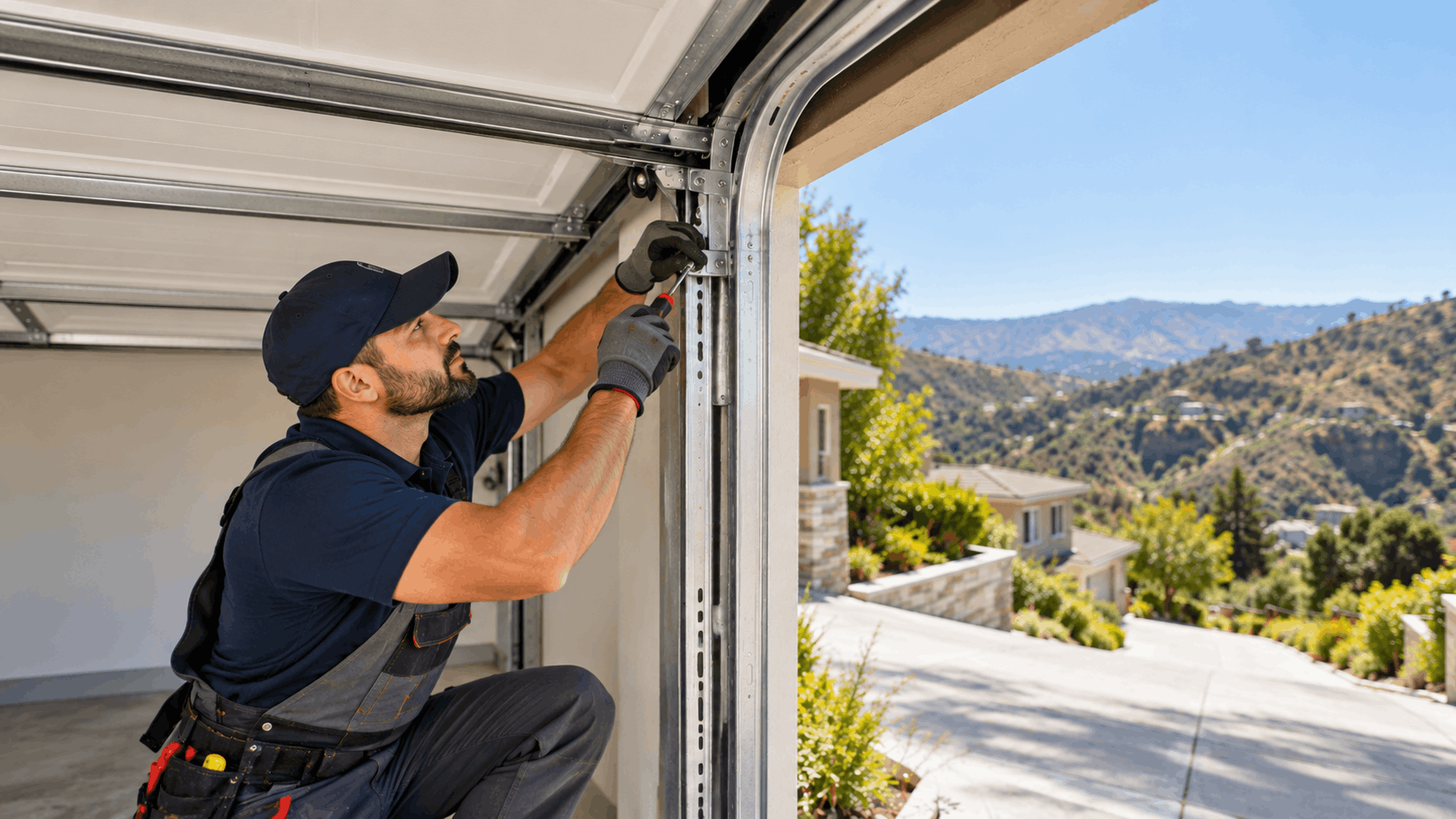
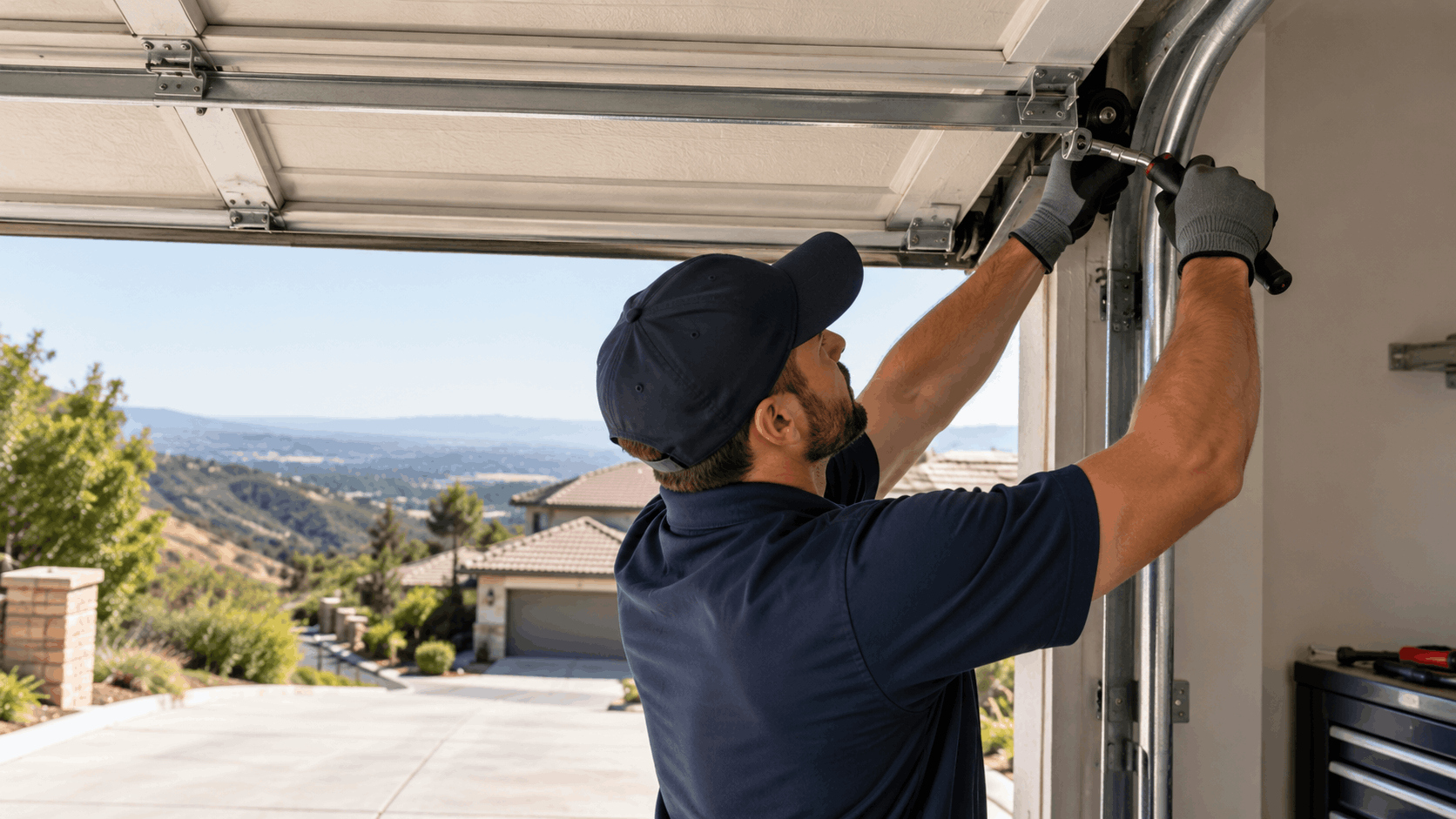
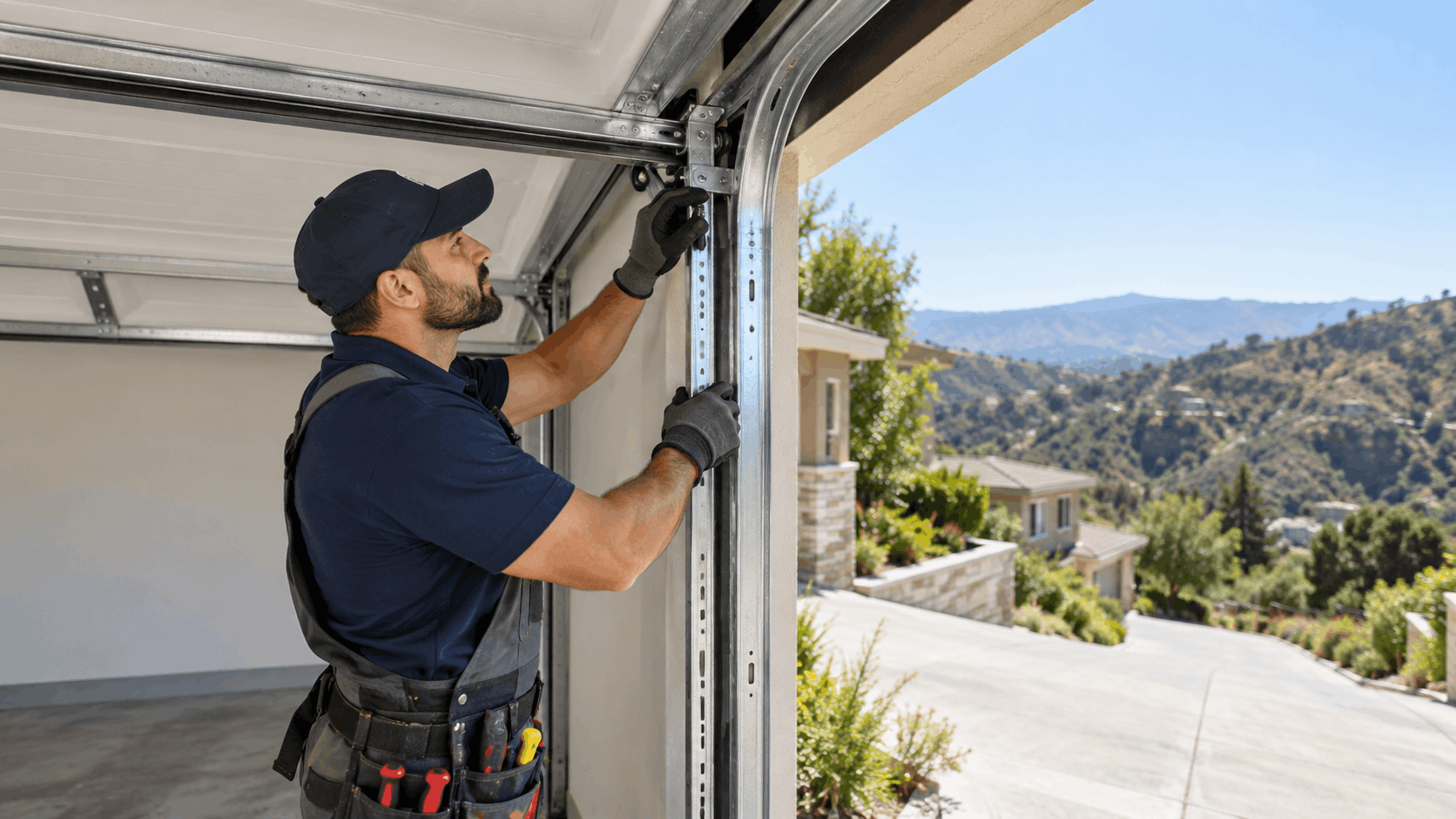
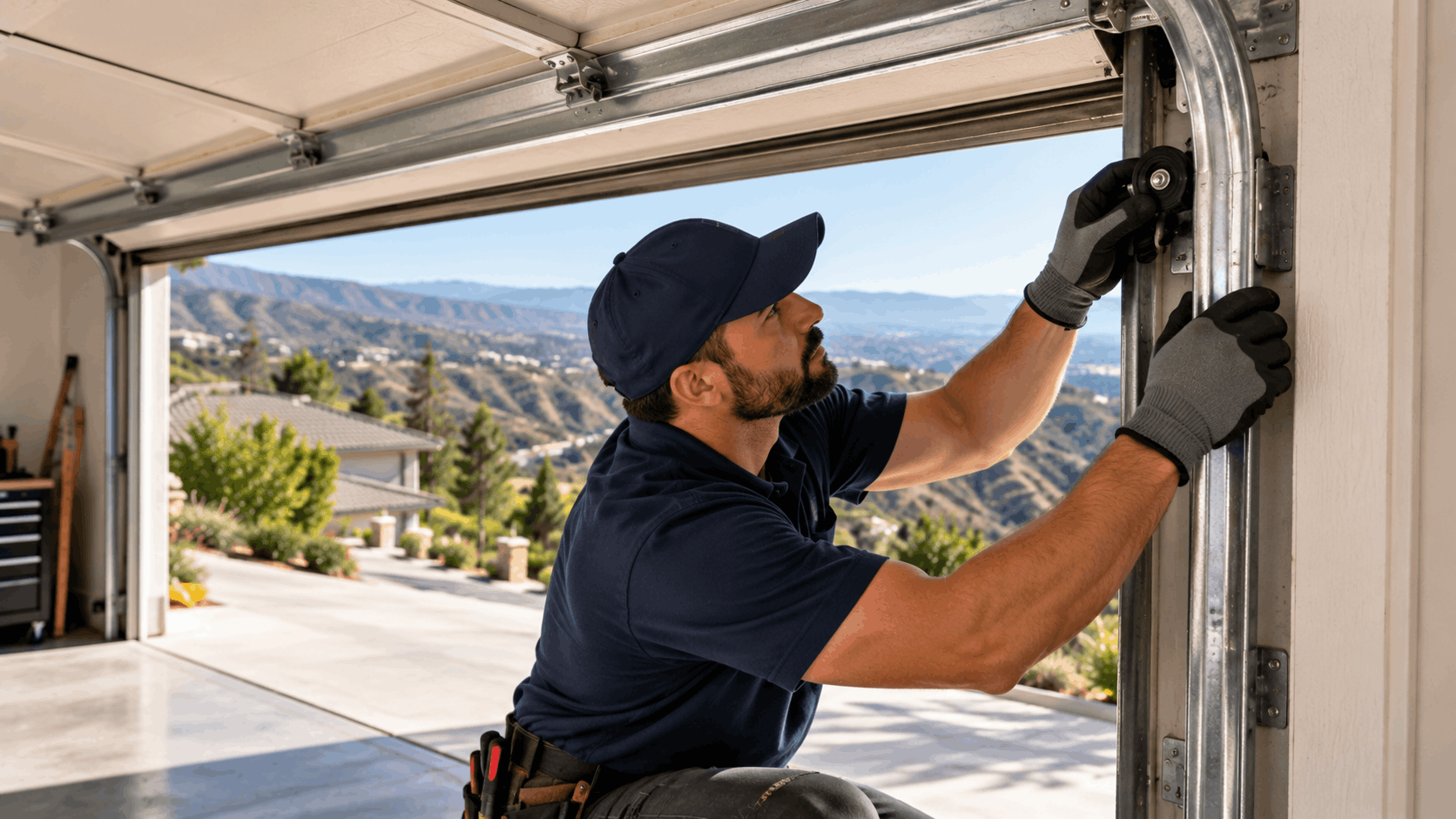
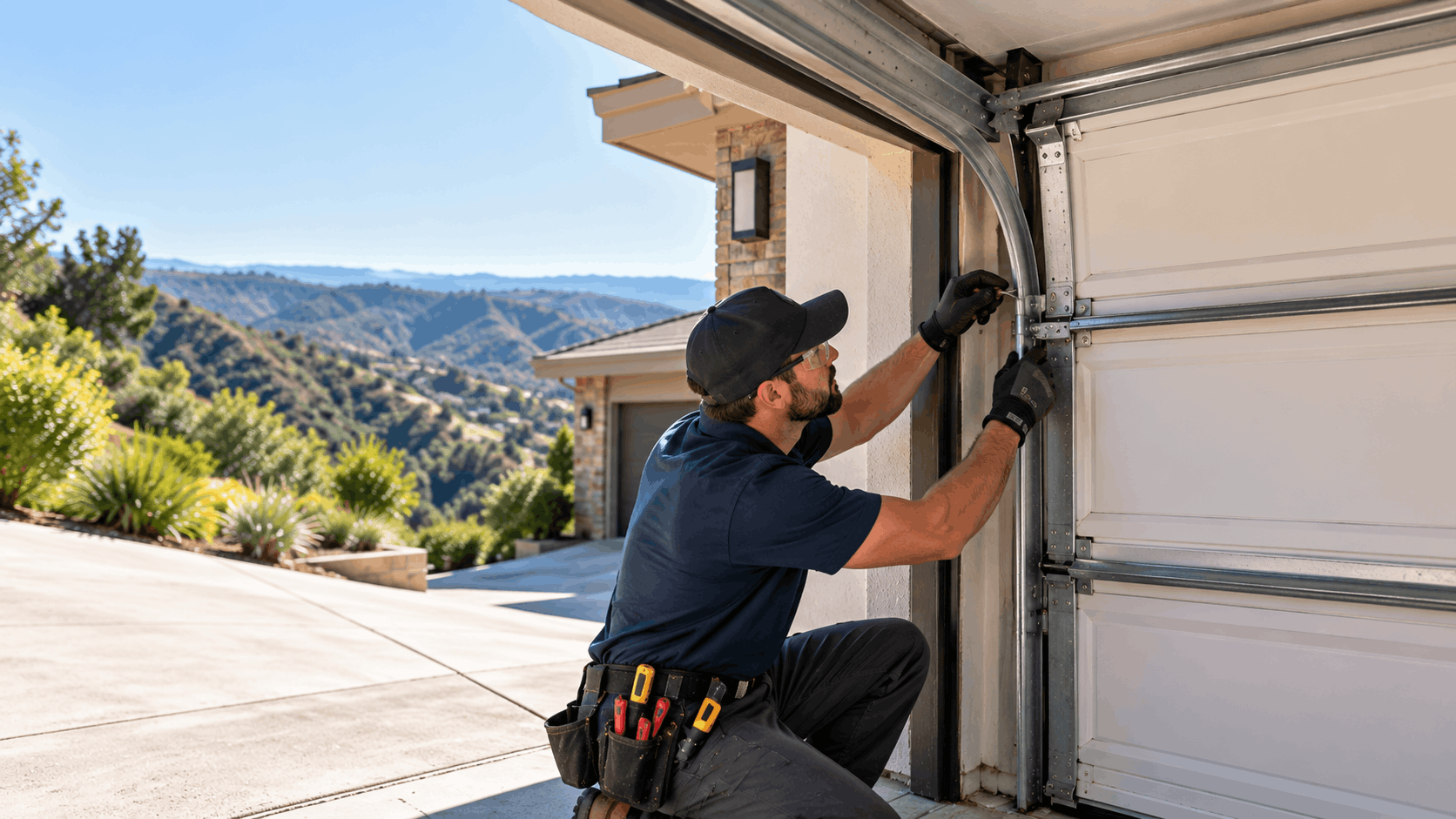
The core of the job is bringing the rails back to where they belong. The technician loosens the track brackets, repositions the vertical and horizontal track so they run parallel and plumb again, and resecures everything. This corrects the drift that decades of settling introduced.
Vertical track has to be plumb and the two sides have to be an even distance apart, or the door racks as it lifts. Horizontal track has to be level and carry the door back into the garage without the rollers binding. On a settled Big Canyon lot, one or both of these has usually wandered.
Where a rail is bent from a ball strike or an impact, it may be straightened or replaced depending on the damage. A sharply kinked rail cannot be trusted to hold alignment and is better swapped. The goal is a continuous, smooth path for every roller from floor to full open.
Resecuring into fifty-year-old framing sometimes means moving to sound wood or adding backing, because the original lag points may be worn. This is routine on original 1970s garages and is part of making the realignment hold rather than drift again in a season.
Checking Rollers, Hinges and Bearings at the Same Time
A door that has been binding on crooked track wears its own hardware. The rollers that have been forced against an out-of-true rail develop flat spots and worn stems, and the hinges that carry them flex and fatigue. Realigning the track without inspecting these leaves worn parts on a fresh alignment.
Rollers are checked for play, flat spots and worn bearings. A roller that wobbles on its stem or no longer spins freely gets replaced, because a bad roller will chew into the realigned track and start the bind again. Nylon rollers run quieter and are a common upgrade on homes with living space above the garage.
Hinges are checked for cracks and elongated holes where the hinge pin has worn. On a fifty-year-old door, hinges have cycled tens of thousands of times and the metal fatigues. A loose or cracked hinge lets a section sag and pulls the door out of line even with true track.
Cables, drums and bearings get a look at the same time. Replacing hardware without inspecting the cables is how a second failure follows weeks later, so the inspection covers the whole system that moves with the door, not just the piece that was catching.
Threshold and Bottom Seal Where the Driveway Slopes
Where a Big Canyon driveway slopes toward the opening, the threshold and bottom seal are doing real work in winter rain. A worn seal shows up as water on the garage floor after a storm, especially on the low corner where settling has dropped the door line.
Realigning the door brings the bottom edge back toward meeting the slab square, which lets a new seal flatten evenly across the whole width. A seal can only close the gap it was designed for, so getting the door to sit level again is what makes the seal effective.
A threshold seal bonded to the floor can be added where the slope pushes water hard against the door. This gives the bottom seal something to press against and keeps runoff out. Our weatherseal and insulation retrofit service covers this part of the job.
The combined fix is what solves the water complaint. Seal alone on a crooked door leaves a gap. Alignment alone on a worn seal still leaks. Addressing both closes the floor line evenly so the garage stays dry through the wet season.
Confirming Safe Operation After Adjustment
Once the track is true and the hardware checked, the door is cycled several times to confirm it runs smoothly through its full travel with no catch. A door that was binding should now lift and lower in one even motion.
The safety tests are rerun. The two-by-four auto-reverse check confirms the door reverses within two seconds of contacting an obstruction, and the photo-eye beam is confirmed aligned and unobstructed so the door reverses on a broken beam. These are the same checks any homeowner can run.
Entrapment protection is required on openers installed or replaced since January 1, 1993 under California Health and Safety Code section 19890. Many original Big Canyon openers predate that date and lack external photo-eye protection, which is worth noting where an old opener is involved in the work.
The door is left operating the way it should: straight travel, even floor line, working auto-reverse and aligned photo-eyes. Confirming all of this after adjustment is what separates a finished job from a door that will bind again next month.
Big Canyon Access, Approval and the Coastal Zone
A realignment in Big Canyon carries three practical layers that most jobs elsewhere do not: a guard gate, Davis-Stirling architectural review, and the Coastal Zone. Each touches the work differently, and a realignment inside the existing opening is treated differently from changing the door itself.
Guard-Gated Access and Contractor Authorization
Big Canyon is guard gated with contractor access controlled at the gate. That means the homeowner usually needs to authorize a visit in advance so the guard will let the technician through. The gate is arranged before the job, not sorted out on arrival.
Some associations keep approved vendor or insurance records, so a contractor may need to be on file before access is granted. This is worth checking when you book, because it can add a step if the vendor is not already listed with the association.
For the homeowner, the practical move is to call the gate or the management office ahead and provide the company name and the appointment window. A technician turned away at the gate because access was not arranged is a wasted trip on both sides.
This is simply how work gets done inside the guard-gated communities off Jamboree Road. We coordinate the gate arrangement with the homeowner when the appointment is booked so the visit goes smoothly.
Davis-Stirling Review When the Door Itself Changes
Big Canyon operates under California's Davis-Stirling Common Interest Development Act with its own architectural standards. An exterior change, including a new garage door, typically needs association review before installation, because the door is a street-facing exterior element.
A realignment that does not change the door's appearance is a different matter from replacing the door. Bringing the existing door back onto true track does not alter how the home looks from the street, so it is not the same as an exterior modification that draws architectural review.
The distinction matters most when a ball-struck panel or a discontinued door pushes the conversation toward replacement. At that point the exterior change may need board approval, and the CC&Rs decide whether the door is separate interest or association-maintained.
The first step for any owner is to establish which association governs the address and what its standards require. A door delivered and refused is an expensive mistake on a custom order, so confirming the approval path before ordering anything is the sensible sequence.
Where the Coastal Zone and Permits Come In
Nearly every parcel in Newport Beach sits in the Coastal Zone, and the boundary runs through this part of the city rather than around it. Work touching exterior walls or openings can draw coastal review and may require a Coastal Development Permit before or alongside a building permit.
A realignment inside the existing opening is a different matter from changing the opening size or altering the structure. Resetting track to true does not touch the exterior wall or the opening dimensions, so it sits apart from the work that triggers coastal review.
Permit position is decided by the city with jurisdiction over the specific address, not by a single regional rule. Owners can check their own parcel with the Newport Beach Address Search Tool, and the Newport Beach Permit Center is at 100 Civic Center Drive, 949-644-3309.
Structural work, such as widening an opening or altering the header, is generally what triggers a permit rather than a like-for-like realignment. The city confirms the position for a specific job, and needing a permit also changes the licensing picture, which is covered further down. More on garage door service in Newport Beach is available on our location page.
The Golf-Frontage and Age Factors in Big Canyon
Two local conditions shape a realignment visit in Big Canyon: homes fronting the country club course, and the original 1970s hardware that is now past its design life. Both change what a technician looks for when a door starts binding.
Ball Strikes on Course-Facing Doors
Homes fronting the Big Canyon course carry the familiar golf-frontage exposure. Stray ball strikes dent panels and break glass inserts, and a solid hit in the right spot does more than cosmetic damage.
A dented panel can throw the door off its track. The impact bends the panel edge or the stile that carries the roller, and the roller is pushed out of its rail. Suddenly a door that tracked fine is binding or hanging, and the cause traces back to a ball strike rather than settling.
This is why the alignment check and the panel question go together on course-facing homes. A technician who sees a bind near a dented section looks at the panel, not just the track, because straightening the track will not hold if the panel is pushing the roller out.
Where the door line is still manufactured, single-panel replacement is a real saving on an expensive Big Canyon door and worth establishing before quoting a full replacement. Condition documentation before work starts is sensible on high-value properties, especially where an insurance claim may follow the strike.
Original 1970s Track, Rollers and Hardware
Big Canyon was built largely in the 1960s and 1970s, and across the community the original track, rollers, hinges, cables and drums are past design life. Hardware that has cycled for fifty years is worn, and worn hardware is a direct cause of track drifting out of true.
Standard residential springs are commonly rated around 10,000 cycles, roughly seven to twelve years for a typical household. An original spring that was never replaced is decades past that rating, and the same age math applies to rollers, hinges and bearings that ride the track.
Early panel profiles from that era are often discontinued, which is why the single-panel-versus-replacement conversation comes up so often. If a section cannot be matched, a partial repair may not be possible, and that shapes the quote.
Because worn hardware both causes and worsens misalignment, a realignment on an original Big Canyon door is almost always paired with a hardware inspection. Resetting track beneath worn rollers just resets the clock on the same bind, so the two go together.
Old and New Side by Side on the Same Street
Extensive rebuilding across Big Canyon means an original 1970s garage can sit right beside a new custom home with an oversized opening. The realignment approach depends on the specific property, not the neighborhood, because the hardware can be completely different from one house to the next.
These are larger lots than the Newport islands, with real driveways and frequently three-car garages. A three-car door is heavier and wider, and its track carries more load, so alignment and roller condition matter even more than on a single door.
Oversized and taller openings common on rebuilt homes change the hardware picture. A taller door is heavier and may use a jackshaft opener mounted at the torsion bar rather than a ceiling rail, and the springs must be sized to the measured weight rather than a nominal size.
Because the housing stock runs from untouched 1970s originals to full custom rebuilds, we measure and inspect each door rather than assume. A custom door on a rebuilt Big Canyon home is handled through our custom garage door design and install service when replacement is the right call.
Need Help in Irvine?
Urgent Garage Doors serves Irvine and all of Orange County.
What Track Realignment Costs in Orange County?
Owners want a sense of the number before they call, so here are the typical Orange County ranges for alignment-related work. These are typical area ranges, never a quote or a fixed price from us. The actual price depends on the specific garage and is given in writing before work begins.
| Work | Typical Orange County range |
|---|---|
| Track repair and realignment | $125 to $300 |
| Off-track door repair | $125 to $275 |
| Door balancing and tension adjustment | $75 to $150 |
| Panel replacement | $250 to $800 per panel |
| Weatherseal and insulation retrofit | $150 to $400 |
| Quiet roller and hardware upgrade | $150 to $300 |
| Safety sensor alignment and repair | $75 to $150 |
Typical Ranges for Track and Off-Track Work
For the core job, track repair and realignment runs $125 to $300 in Orange County. This covers loosening, repositioning and resecuring the track so the rails run true again, which is the direct fix for drift caused by settling.
Off-track door repair runs $125 to $275. This is where one or more rollers have come out of the rail entirely, often after a ball strike or a hard bind, and the door has to be lifted back into the track and checked. Our off-track garage door repair service handles this.
Door balancing and tension adjustment runs $75 to $150. Where the realignment reveals the door is not sitting balanced, this brings the spring tension back so the door holds position and the opener is not fighting a heavy door.
These are typical ranges for the area and give a reader a sense of scale. The specific garage, its size and the condition of the hardware all move the final number, which is why a written price follows the on-site look.
Related Work That May Come Up
A realignment sometimes uncovers more, and the honest thing is to tell an owner what the adjacent work costs so there are no surprises. A ball-dented panel that threw the door off track may need panel replacement at $250 to $800 per panel.
Where the driveway slopes and the bottom seal is worn, a weatherseal and insulation retrofit runs $150 to $400. This is the seal work that closes the floor line and keeps winter rain off the garage floor, paired with the realignment.
Worn rollers found during the inspection may call for a quiet roller and hardware upgrade at $150 to $300. Upgrading to nylon rollers runs quieter and protects the freshly aligned track, which matters on Big Canyon homes with living space above the garage.
If the photo-eyes are out of line, safety sensor alignment and repair runs $75 to $150. Only the work the specific door needs is done, and each item is priced so the owner can decide what to include before anything starts.
Why the Written Contract Rule Applies
The actual price depends on the specific garage and is given in writing before work begins. A written price is available before the job starts, so a Big Canyon owner knows the number before any tools come out.
There is a legal layer too. California Business and Professions Code section 7159 requires a written home improvement contract for work over $500. That is a legal requirement, not a company policy, and it protects the homeowner.
This written contract rule is separate from licensing thresholds and should not be confused with them. It applies to the contract itself whenever the job crosses the $500 figure, regardless of who performs the work.
For a realignment that stays under that figure, a written price is still provided when the job calls for it or the customer asks. Either way, the number comes before the work, so there is no guessing at the end.
Licensing and Why It Matters for This Work
Garage door work in California is licensed, and in a guard-gated community that keeps vendor records, the license is something a homeowner can and should verify. Here is how the classification works and why a permit can change the licensing picture.
The C-61/D-28 Classification
Garage door work is licensed by the Contractors State License Board under classification C-61/D-28, Doors, Gates and Activating Devices. That scope covers sectional and rolling doors, torsion and extension spring systems, operators, control boards, safety sensors and activating devices.
This is the correct classification for a realignment, a spring job, an opener swap or a sensor repair. The track work, the roller inspection and the auto-reverse confirmation all fall under C-61/D-28, so a properly licensed garage door contractor is covered for the whole job.
C-28 is a different thing entirely. C-28 is Lock and Security Equipment, and it is not the garage door license. Garage door work is also not a Class B general building license job, so a contractor presenting either of those for door work is not showing the right classification.
Knowing the right classification lets a Big Canyon homeowner check that whoever is coming through the gate holds it. On a high-value custom door, that check is worth the two minutes it takes.
Verifying a License Before Anyone Enters the Gate
A license is verified free at cslb.ca.gov, where classification, status, bond and workers compensation are all public record. An owner can look up a contractor by license number and confirm the C-61/D-28 classification is active before booking.
This matters more in a guard-gated association that keeps approved vendor records, because the association may want the same verification on file. A contractor whose license checks out cleanly is easier to get through the Big Canyon gate.
The public record also shows the bond and workers compensation status, which protects the homeowner if something goes wrong on the job. Those details are there to be checked, and checking them is sensible on any estate-belt property.
Urgent Garage Doors holds California license #1055150, verifiable free at cslb.ca.gov. An owner can confirm it before the appointment and provide it to the gate if the association asks.
When a Permit Removes the Unlicensed-Work Exemption
The unlicensed-work exemption in Business and Professions Code section 7048 was raised from $500 to $1,000 by AB 2622, effective January 1, 2025. A good deal of older advice still prints $500, but the current figure is $1,000.
The exemption also fails, at any value, if the work requires a building permit of any kind, or if the person doing the work employs anyone on the job. A job cannot be split into smaller slices to stay under the figure either.
This connects directly to the permit question earlier in the article. If a Big Canyon project crosses into structural work that needs a permit, the unlicensed exemption is gone regardless of the dollar amount, so the work has to be done by a licensed contractor.
Permit position is decided by the city with jurisdiction over the address. For a straightforward realignment inside the existing opening, a permit is generally not what is at issue, but the city confirms the position for any given job.
Need Help in Irvine?
Urgent Garage Doors serves Irvine and all of Orange County.
How Urgent Garage Doors Handles a Realignment in Big Canyon
The working process for a Big Canyon realignment accounts for the gate, the diagnosis, the written price and the hardware on the truck. Here is how a visit actually runs.
Gate Arrangement and On-Site Diagnosis
The first step is arranging gate access in advance with the homeowner. Because Big Canyon controls contractor access at the guard gate, the appointment window and company name go to the gate or management office before the visit so the technician gets through without delay.
On site, the diagnosis comes before any work. The technician determines whether the problem is track alignment, worn rollers, a spring fault or a sensor issue, using the same balance and auto-reverse checks an owner can run, plus a hands-on look at the track and framing.
This matters because the symptoms overlap. A binding door can feel like several different faults, and pulling it apart for parts without the diagnosis is how a homeowner pays for the wrong fix. The inspection sorts the actual cause first.
On an original 1970s Big Canyon door, the diagnosis also covers the hardware riding the track, since worn rollers and hinges both cause and suffer from misalignment. The owner gets a clear picture of what the door needs before anything is decided.
Written Price and Truck Stock
A written price is available before work begins, so the Big Canyon owner sees the number before any tools come out. The price reflects the specific door and the specific work the inspection found.
The truck carries common torsion spring sizes, so where a spring replacement turns out to be part of the fix, it is often completed on the same visit. Not every replacement is finished first time, but carrying stock means many are. Spring work is covered under our torsion spring replacement service.
Urgent Garage Doors takes emergency calls and responds 24 hours a day, 7 days a week, every day of the year including holidays. Emergency response is 30 to 60 minutes anywhere in Orange County, with gate access arranged with the homeowner first on Big Canyon jobs.
The combination of a diagnosis, a written price and common parts on the truck means a Big Canyon realignment often moves from problem to fixed in a single visit, without a wait for parts on standard hardware.
Serving Big Canyon From the Irvine Storefront
Urgent Garage Doors works on all garage door brands, including LiftMaster, Chamberlain, Genie, Craftsman, Clopay, Amarr, Wayne Dalton and CHI. That range matters in Big Canyon, where a 1970s original and a new custom rebuild can sit on the same street with completely different hardware.
The company operates from its storefront at 76 Ashford, Irvine, CA 92618, serving Big Canyon and the rest of Newport Beach from there. The Irvine base keeps response times across Orange County tight.
Founded in 2017 with more than eight years of experience, the company carries the Google Guarantee badge on its Google Local Services listing. Full details on maintenance and upgrade services are on the service page.
Whether the job is a simple realignment inside an existing opening or a course-facing door with a dented panel, the approach is the same: diagnose the real cause, price it in writing, and fix it with the right hardware for that specific door.
Getting Your Big Canyon Door Running Straight Again
A binding or crooked door on a settled Big Canyon lot is almost always an alignment job rather than a broken part, and the fix is bringing the track back to true. If your door catches at the same spot or sits uneven at the floor, call Urgent Garage Doors at (949) 529-7743 to arrange a diagnosis and gate access with your homeowner.
The technician identifies whether it is track, rollers, a spring or the photo-eyes, gives you a written price before work begins, and carries common parts to finish standard jobs on the visit.
Frequently Asked Questions
- How do I know if my garage door needs track realignment or a new spring?
- Run the balance test. Disconnect the opener with the release cord, raise the door by hand to about waist height, and let go. A correctly balanced door stays put. If it falls or rises on its own, that is a spring problem for a licensed technician. If the door holds position but catches at one spot in its travel, that is usually a track problem, not a spring.
- Why does my door bind at the same spot every time it opens?
- A catch at the same point every cycle points to a shifted or bent section of track, or a loose bracket. On a sloped Big Canyon lot, fifty years of ground settling pulls the track mounts out of true, so the rails no longer run parallel. A roller riding that out-of-true spot forces past it and catches, often with a grinding or scraping sound at the same height each time.
- How much does track realignment cost in Orange County?
- Track repair and realignment typically runs $125 to $300 in Orange County, and off-track door repair runs $125 to $275. These are typical area ranges, not a quote. The actual price depends on the specific garage, its size and the condition of the hardware, and it is given to you in writing before any work begins.
- Can I realign the track myself?
- An owner should never adjust, wind, unwind or replace a torsion spring, which stores enough energy to cause serious injury. The safe checks are the two-by-four auto-reverse test and confirming the photo-eye beam is aligned and unobstructed. Track alignment interacts with spring tension and the roller path, so bringing the rails back to true safely is a job for a licensed C-61/D-28 technician rather than a do-it-yourself fix.
- Do I need HOA approval for track realignment in Big Canyon?
- A realignment that does not change the door's appearance differs from an exterior change like replacing the door. Big Canyon operates under the Davis-Stirling Act with its own architectural standards, and a new street-facing door typically needs association review. Bringing the existing door back onto true track does not alter how the home looks, but owners should establish which association governs the address and confirm its standards first.
- How do I get a contractor through the Big Canyon gate?
- Big Canyon is guard gated with contractor access controlled at the gate, so the homeowner usually authorizes the visit in advance by giving the guard or management office the company name and appointment window. Some associations keep approved vendor or insurance records, so the contractor may need to be on file first. The gate is arranged before the job, not sorted out on arrival, so coordinate it when you book.
- Why is there water on my garage floor after the door closes?
- Where a Big Canyon driveway slopes toward the opening, the door often sits crooked from settling, so the bottom seal touches on one side and gaps on the other. Rain running down the drive finds the low corner and comes under the door. Realigning the door so it meets the slab square, plus replacing the worn seal, closes the gap so the floor stays dry through the wet season.
- A golf ball dented my door. Does that affect the track?
- Yes. A dented panel can bend the edge or stile that carries a roller and push the door off its track, so the alignment and the panel question go together on course-facing Big Canyon homes. Where the door line is still manufactured, single-panel replacement is worth checking before quoting a full replacement. Panel replacement typically runs $250 to $800 per panel in Orange County.
- How fast can someone come out to Big Canyon?
- Urgent Garage Doors takes emergency calls 24 hours a day, 7 days a week, every day of the year including holidays, with a 30 to 60 minute response window across Orange County. For Big Canyon specifically, gate access is arranged with the homeowner first, so letting the guard know the company and appointment window ahead of time keeps the visit on schedule.
- Do I need a permit for garage door track realignment?
- Structural work, such as widening an opening or altering the header, is generally what triggers a building permit, rather than a realignment inside the existing opening. The city with jurisdiction over the address confirms the position for a specific job. In Newport Beach, work touching exterior walls or openings can also draw Coastal Zone review, while a realignment inside the existing opening is a different matter.
Licensed garage door repair professionals serving Irvine and Orange County.
Licensed in California · License #1055150
Why trust Urgent Garage Doors?
Founded in 2017, Urgent Garage Doors is a licensed and insured garage door services serving Irvine and Orange County. All content is reviewed by our licensed technicians.

Need Help in Irvine?
Urgent Garage Doors serves Irvine and all of Orange County.
Related Articles
Garage Door Off Track Repair Cost OC: 30 to 60 Minute vs Standard Response Pricing
Off track garage door repair in OC costs $150-$250 for a standard re-track. Learn what raises the price and how 30 to 60 minute rush and standard scheduling differ.
Long Sloped Driveways in Harbor View Hills and Garage Door Balance on a Grade
How a sloped driveway affects garage door balance in Harbor View Hills, what the springs really do, the safety tests any owner can run, and when to call a licensed tech.
Turtle Rock Garage Door Seals and Tracks Against Canyon Wind Off Bommer Canyon
Ridgeline wind off Bommer Canyon drives dust into Turtle Rock garage door seals and tracks. Here is why seals fail, how tracks drift on hillside lots, and how we fix it.