Long Sloped Driveways in Harbor View Hills and Garage Door Balance on a Grade
Key Takeaways
- A sloped driveway does not resize springs; balance comes from springs matched to the actual weight and height of the door, which on these hillside homes is often a heavier custom door.
- Run the balance test by disconnecting the opener and raising the door to waist height: if it will not hold position, that is a spring problem, not an opener problem.
- Standard residential springs are commonly rated around 10,000 cycles, roughly seven to twelve years, and coastal salt-air corrosion brings a spring to the end of that rating earlier.
- Never adjust, wind or replace a torsion spring yourself; it stores enough energy to cause serious injury and is a licensed C-61/D-28 technician's job.
- SB 969 requires a battery backup on residential openers sold or installed in California on or after July 1 2019, and a replacement door may not connect to a non-compliant opener.
- Newport Beach has its own building department, so the permit position is confirmed for the specific address, and structural work like widening an opening is generally what triggers a permit.
- Under the Davis-Stirling Act, architectural review covers door style, color and hardware in Harbor View Hills, and the sequence is approval first then order.
- Urgent Garage Doors offers free on-site estimates for new doors, carries common spring sizes for same-visit repairs, and responds 24/7 within 30 to 60 minutes across Orange County.
In This Article
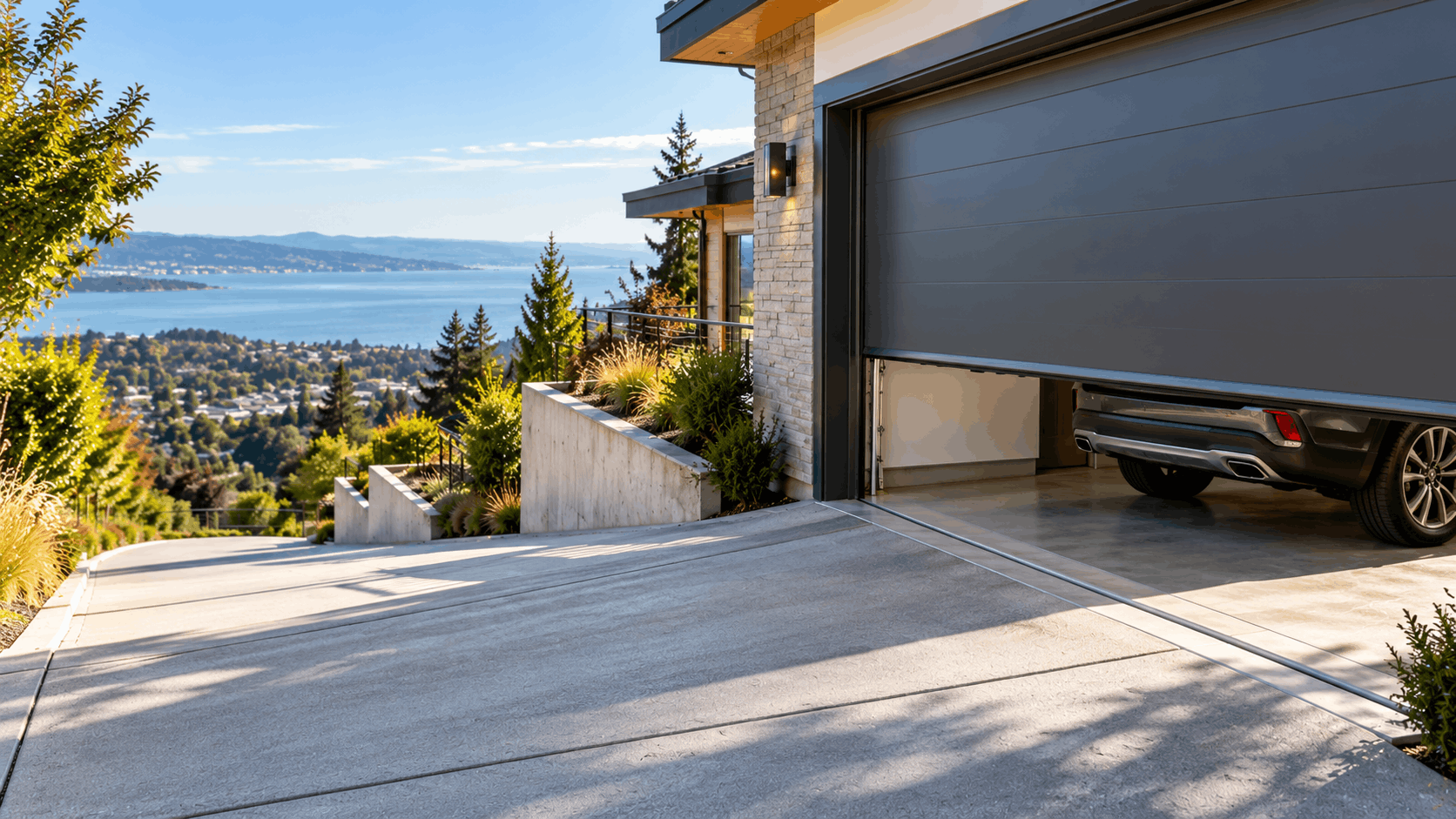
Picture a hillside home in Harbor View Hills, the lot climbing up above Corona del Mar with a long driveway running to a wide two or three-car garage. The views are the reason people buy here. The garage door is the thing that gets used a dozen times a day, and on a steep approach it can feel like it fights the grade every time it closes.
Owners often blame the slope when the door drops too fast, bangs the floor, or will not stay put halfway. The slope is not usually the real cause. What is really happening is a question of balance, and balance comes down to springs matched to the actual weight of the door. On these hillside houses the doors tend to be heavier and more custom than a flat-lot builder door, which is where the trouble starts.
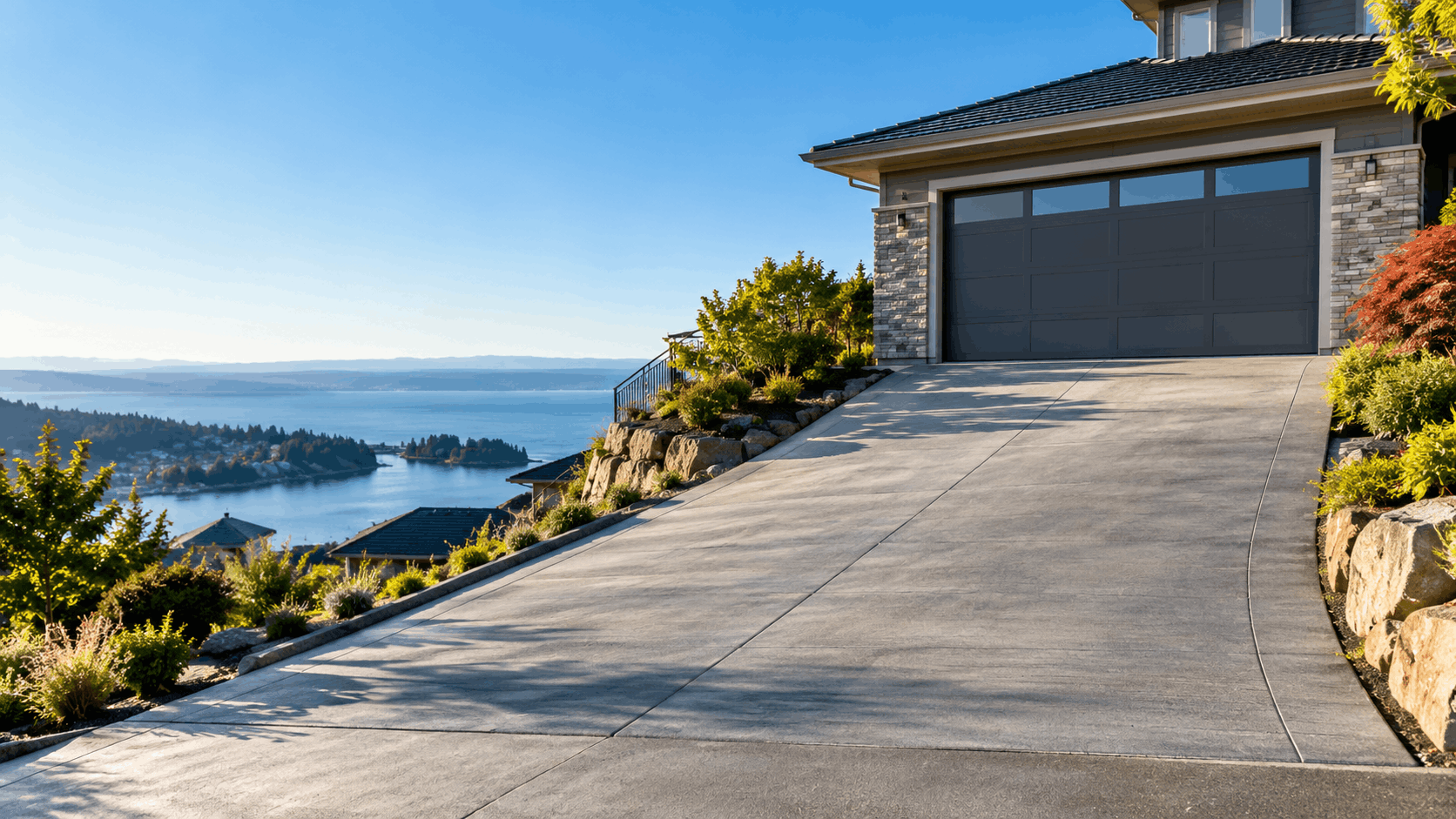
Why Sloped Driveways Change How a Garage Door Behaves?
A long sloped driveway does not reach up and grab the door, but it changes how the whole opening reads to the person standing in front of it. On a hillside lot the garage floor often sits at the top of a grade, and the approach, the drainage and the threshold are all built around that slope. When a door closes onto a floor that is pitched for runoff, a small misalignment at the bottom seal or the track becomes obvious fast.
The part that genuinely matters is garage door balance. Balance is carried by the springs, and springs are sized to the weight and height of the door. A hillside home with a wide opening and a heavier door needs a spring system that matches it. When that match is off, the door feels wrong on the grade even though the grade is not the cause.
Harbor View Hills sits in the belt of Irvine Company development that shaped this part of Newport from the early 1970s, on generous lots with wide openings. That combination of hillside ground and wide doors is why owners here notice balance issues that a flat-lot tract home never surfaces.
| What the owner sees | What is usually behind it |
|---|---|
| Door slams shut or drops fast | Springs under-sized for the door weight |
| Door will not hold halfway | Lost spring tension or a broken spring |
| Door rises on its own | Springs over-wound for the door |
| Bottom seal gaps on one side | Threshold pitch and track alignment on a graded floor |
| Door reverses for no clear reason | Photo-eye fault, not a balance problem |
What Balance Means on a Garage Door
Balance is simple to describe and easy to test. A correctly balanced door stays put at waist height when you disconnect the opener and lift it by hand. It does not fall, and it does not float back up. That stillness means the springs are carrying the full weight of the door.
The torsion spring does the heavy lifting. Mounted on a bar above the opening, it winds up with stored energy and acts as a counterbalance to the door's weight. The opener motor is only there to start the motion and guide the door. It is not built to haul the full weight, and when it is forced to, it burns out early.
When people say a door is heavy, what they usually mean is that the spring is no longer doing its share. A tired or broken spring hands the load to the motor, and the door becomes a chore. The fix is not a bigger opener. The fix is a spring system matched to what the door actually weighs.
On a graded driveway this matters more, not less. A door that is already slightly out of balance will drop harder onto a floor that pitches away for drainage, and the impact is rougher on panels, rollers and the bottom bracket over time.
How a Grade Affects the Door and Opening
Hillside ground changes the geometry around the opening more than it changes the door itself. On a grade, the garage floor is often set at the high point, with the driveway falling away toward the street. The threshold, the floor pitch for drainage and the way the bottom seal meets the slab are all shaped by that slope.
The garage opening on a Harbor View Hills home is frequently wide, because the lots are generous and many houses carry two and three-car openings. Wide openings put a long door section under load, and any small variation in track level or header condition shows up across that width.
Remodeled homes add another wrinkle. When an opening has been widened or a header altered during a remodel, the geometry no longer matches a flat-lot original. The door, the tracks and the springs all have to suit the opening as it exists now, not as the builder first framed it.
None of this resizes a spring. What it does is make correct installation and alignment harder to fudge. On a hillside lot with a wide, remodeled opening, there is less room for error in how the door is hung and tensioned.
Why This Shows Up in Harbor View Hills Specifically
Harbor View Hills is a formally adopted Newport Beach Planned Community on the slopes above Corona del Mar, built out in the early 1970s era that the Irvine Company shaped across this part of the city. Streets like San Miguel Drive, Newport Hills Drive East and West, and Spyglass Hill Road organize the district, and it is hillside ground throughout.
These are older houses that have been remodeled repeatedly. The pattern we see is a door, an opener and a set of springs that come from three different decades on the same home. An opener predating 1993 sits before the federal entrapment-protection mandate, while California has required an auto-reverse device and sensor since 1990.
Generous lots mean wide openings, and remodeling means openings that were widened at some point. That is exactly where springs sized for the previous door turn up still working a new or heavier one. The slope gets the blame because that is what the owner sees, but the spring match is the real story.
Because so many of these homes have layered improvements over fifty years, a balance call here is rarely just a balance call. It is often a chance to catch mismatched hardware before it fails on a wide, heavy door. For ongoing attention, our maintenance and upgrades work is built around exactly these older hillside systems.
Get Your Free Quote
Tell us about your garage door and we'll get back to you within 30 to 60 minutes.
Springs Sized to the Door, Not to the Driveway
Here is the mix-up worth clearing up first. The slope of your driveway does not change what springs your door needs. The weight of your door does. A steep approach makes a poorly balanced door more noticeable, but it does not add a single pound to the panels.
What does change spring sizing is the kind of door common on these hillside homes. A heavy wood-faced custom door weighs far more than a stock steel sectional, and the spring system has to be sized to that actual weight and height. Reusing an old set on a heavier door is how a door ends up fighting the motor.
Springs carry a cycle rating, and that rating is tied to the door weight and how often the door runs. Get the match right and the door glides. Get it wrong and the door is heavy, the opener strains, and the spring reaches the end of its life early. Our spring and cable repair work starts with weighing the door, not guessing.
Spring Cycle Ratings and What They Mean
A spring's life is measured in cycles, and one cycle is one full open and one close. Standard residential springs are commonly rated around 10,000 cycles. For a typical household that works out to roughly seven to twelve years of normal use.
That number drops fast where the garage is the main entrance and the door runs several times a day. On a busy Harbor View Hills home where the family comes and goes through the garage, a 10,000-cycle spring can be used up well inside that window. The duty cycle, meaning how hard the door is worked, is what sets the real spring life, not just the calendar.
Where duty is heavy or the door is unusually heavy, high-cycle springs are available. These are rated for more open-and-close cycles and are worth considering on a door that gets daily traffic or carries extra weight. They cost more up front and last longer where the usage justifies it.
The practical point is that cycle rating is a prediction, not a guarantee. Knowing the rating tells an owner roughly when to expect the spring to be near the end, so a replacement can be planned rather than discovered on a morning when the door will not open.
Heavy and Custom Doors on High-Value Homes
On these properties the garage door is an architectural element, not just a cover for a hole in the wall. Many are wood-faced, custom-sized, or a set of matched doors across a three or four-car garage. That look is part of the house, and it changes what the hardware has to do.
A custom door is heavier than a stock steel sectional, so it needs springs sized to it rather than a set carried over from a lighter door. The weight is the whole story here. Hang a heavy door on light springs and the motor does work it was never built for.
Many of these garages use a side-mount jackshaft opener, mounted on the wall and driving the torsion bar directly. These keep the ceiling clear, which matters where storage lives overhead or headroom is limited. They are a good fit for custom hillside garages, but they still depend on a correctly balanced door to work well.
A matched set across a multi-car garage adds one more thing to plan for. When one door in a matched set fails, the repair becomes a matching problem, because a single mismatched door stands out across the front of the house. Our custom garage door design and install work is set up around that kind of matched, heavier door.
Widened Openings and Mismatched Springs
Remodels are the norm on these fifty-year-old houses, and widening a garage opening is a common one. When an opening is widened for a new, larger door, the springs that come with the previous door often stay in place. That leaves a mismatched spring set working a door it was never sized for.
A widened opening changes the door size and usually the door weight. A wider door is a bigger, heavier panel assembly, and the counterbalance has to grow with it. Springs left from the old, narrower door simply cannot carry the new load correctly.
The same thing happens when an owner upgrades to a heavier material without changing the springs. Swapping a light steel door for a wood-faced one, and reusing the old spring set, is a setup for an unbalanced door and early failure. A new or heavier door must be matched to springs sized for it.
This is why a remodel is the moment to get the spring system right. The opening is already being touched, the door is being chosen, and the springs should be sized to the finished result. Matching at that stage is far cheaper than chasing a heavy-door problem afterward.
Why Springs Are Not a Homeowner Job
This is the one part of the door an owner should never touch. A torsion spring stores enough energy to cause serious injury, and it is wound under tension on a bar above the opening. That stored energy does not care that the door is sitting quietly.
Torsion springs are wound with steel bars against a fixed cone. If a bar slips or a cone lets go, the release is sudden and violent. Owners should never adjust, wind, unwind or replace one, no matter how straightforward a video makes it look. This is genuine torsion spring danger, not a cautious disclaimer.
The safety answer is to leave the winding and replacement to a licensed technician with the right tools and training. The energy involved is why this work sits under a specific contractor classification in California, which we cover further down.
So the rule is plain: do not DIY a spring. Owners can run the safety tests we describe below, which involve no winding and no tools against a loaded spring. Everything that touches the spring tension itself belongs to a professional.
Need Help in Irvine?
Urgent Garage Doors serves Irvine and all of Orange County.
Coastal Air and the Parts That Fail First on a Grade
Harbor View Hills hardware lives in coastal Newport air, with regular fog rolling up off the water. That salt air is hard on steel, and it goes after the exact parts that carry the door's weight and keep it balanced.
Corrosion attacks bare steel that is under tension or in motion. On a garage door that means the spring coils, the lift cables, the cable drums, the roller stems, the hinges and the bottom bracket. These are the load-bearing parts, and when they corrode, balance and safety both suffer.
On a sloped-driveway home the stakes are a little higher, because a heavier door dropping onto a graded floor is already working these parts hard. Add coastal corrosion and the failure tends to arrive sooner than the calendar would suggest.
| Part | What salt air does to it |
|---|---|
| Spring coils | Rust pitting that brings the spring to the end of its cycle rating earlier |
| Lift cables | Fraying at the drum, often from the inside out before it is visible |
| Cable drums | Surface corrosion that chews at the cable seating |
| Rollers and hinges | Seized stems and stiff pivots that drag on the track |
| Bottom bracket | Rust at a high-tension point near the cable attachment |
What Salt Air Does to Springs and Cables
Corrosion goes after bare steel under tension or in motion, and on a garage door that list is long. Spring coils, lift cables, cable drums, roller stems, hinges and the bottom bracket are all exposed, and all under load.
On the springs, the genuine coastal finding is rust pitting on the coils. Each pit is a stress point, and a coil under constant tension does not tolerate stress points well. The spring reaches the end of its working life while the calendar still says it should be fine.
On the lift cables, the finding is cable fraying at the drum. Cables near the water corrode where they wind onto the drum and flex, and the strands break down there first. Because this often starts inside the twist, the cable can look acceptable from a few feet away while it is already compromised.
That hidden quality is what makes rust pitting and frayed cable so dangerous on these homes. A cable that lets go on a heavy custom door is a sudden, hard failure. Catching fraying at the drum early, during a spring job or a maintenance visit, is how that gets avoided.
Corrosion and the Cycle Rating
The honest way to describe salt air is in terms of the cycle rating. A spring carries a manufacturer rating, commonly around 10,000 cycles for a standard spring. What corrosion does is bring the spring to the end of that rating earlier than clean, dry conditions would.
There is no reliable multiplier for this, and anyone quoting a precise one is guessing. We will not tell you a spring lasts exactly half as long a given distance from the water, because that number does not exist. What we can say is that rust pitting on coils under tension is a real spring failure driver near the coast.
The same logic applies to cables, rollers, hinges and the bottom bracket. Corrosion does not change how the part is rated. It shortens the real-world time before the part reaches the condition where it needs replacing.
For an owner, the takeaway is to plan maintenance around the coastal reality rather than the brochure life. A spring near the ocean is more likely to arrive at the end of its rating sooner, so checking it before it fails is the sensible move.
Materials and Maintenance That Hold Up Near the Water
The practical answers for coastal hillside homes are about materials and routine care. Galvanized springs or coated springs resist corrosion far better than bare steel, and on a home within reach of the fog line they are worth the small premium.
Stainless fasteners are the other material upgrade that pays off. The small bolts, brackets and hardware that hold everything together are often the first to rust and seize, and stainless pieces keep the assembly serviceable for longer.
Regular lubrication matters just as much. A proper spring lubricant keeps the coils moving against each other and slows the surface corrosion that leads to pitting. Rollers, hinges and bearings benefit from the same attention, done on a schedule rather than only when something squeaks.
None of this stops salt air, but it meaningfully extends how long the hardware stays sound. Our weatherseal and insulation retrofit work and routine lubrication visits are aimed squarely at keeping coastal hardware in service.
Inspect Cables Whenever a Spring Is Replaced
Springs do not wear alone. Cables, drums, rollers, hinges and bearings all wear alongside them, because they share the same loads and the same salt air. Treating a spring as a standalone part misses the system it belongs to.
Cable inspection is the one that catches people out. Replacing a spring without checking the cables is how a second failure follows weeks later. The new spring works fine, then a frayed cable that was ignored lets go and the owner is back to square one.
The drums deserve the same look. A corroded drum chews at even a new cable, so a fresh cable on a rough drum is a short-term fix. Checking the drum surface while the cable is off is quick and saves a return trip.
This is why we inspect the whole load path on a spring job. Finding a worn cable, a rough drum or a seized roller at the same visit prevents that second failure and keeps the door balanced for the long run. Our cable repair work is usually part of a proper spring job, not a separate call later.
The Safety Tests Every Harbor View Hills Owner Can Run
There are three checks any owner can run without tools against a loaded spring, and together they reveal both a balance problem and a safety problem. None of them involve touching the spring tension itself.
The balance test tells you whether the springs are carrying the door. The safety test with a board tells you whether the door reverses on contact. The photo-eye check tells you whether the non-contact sensors are working. Run all three a couple of times a year.
These tests are the honest first step before anyone picks up a phone. They often point straight at whether the problem is the springs, the sensors or the opener, which saves time and money. The auto-reverse checks are also the exact tests the manufacturers recommend.
The Balance Test and What It Tells You
Start with the opener disconnected. Pull the release cord, the handle hanging from the opener rail, which disengages the motor so you can move the door by hand. With the motor out of the picture, the door is resting entirely on its springs.
Now run the balance test. Raise the door to about waist height and let go. A correctly balanced door stays put. It does not slide down to the floor and it does not drift upward.
If the door drops or rises on its own, that is a spring problem, not an opener problem. The springs are either worn, broken, or sized wrong for the door, and no amount of opener work will fix it. This is the test that separates a motor issue from a spring issue in about thirty seconds.
When you are done, lift the door fully, reconnect the opener per the manufacturer's instructions, and confirm it re-engages. If the test showed the door will not hold position, that is the moment to call for door balancing and tension adjustment rather than trying to tension the spring yourself.
The Two-by-Four Test for Contact Reverse
The two-by-four test checks the door's contact reverse. Lay a 2x4 flat on the floor, across the opening, in the door's path. Then close the door with the opener.
When the bottom of the door hits the board, it must reverse within two seconds of contact. That is the contact reverse requirement, and it is one of the two ways a modern opener satisfies the safety standard. The door should sense the obstruction and back off.
On a wide, heavy custom door this test carries extra weight. A heavier door builds more momentum, so a reverse that is slow or weak is more likely to do damage. The two seconds window is the benchmark, and a door that pushes down on the board instead of reversing is a safety fault that needs attention now.
If the door fails this test, stop using the opener to close it until it is fixed. A door that will not reverse on contact is the exact hazard the entrapment-protection rules were written to prevent, and it is not something to leave for later.
The Photo-Eye Test and Common Faults
The photo-eye test checks the non-contact sensors, the two small eyes mounted on each side of the opening no higher than six inches off the floor. With the door closing, break the beam between them with an object. The door must stop and reverse.
If it does, the sensors are working. If the door keeps closing through a broken beam, the system is not protecting the opening and needs service right away. Our safety sensor alignment and repair work handles exactly this.
Here is the useful part for the owner who is frustrated. Photo-eye faults, misalignment and blocked beams are the most common cause of a door that reverses for no visible reason. The door stops halfway, backs up, and nothing is obviously in the way.
Near the coast, fog, dust and plant debris carried on the air settle on the sensor lenses and break the beam alignment. A knock from a car or a stray object can also nudge one eye out of line. Cleaning the lenses and checking that the sensors point straight at each other fixes a surprising share of mystery reversals.
What the Law Requires on a Newport Beach Garage Door?
A door or opener swap in Harbor View Hills runs into several pieces of California law, and getting the dates right matters. The rules cover entrapment protection, battery backup, licensing and permits, and they come from different statutes at different times.
These are not optional on a replacement. A new door connected to a non-compliant opener, or work done outside the licensing rules, creates real exposure. Here is how the pieces fit for a Newport Beach home.
Auto-Reverse and Entrapment Protection
California got here first. AB 3600 in 1990 required garage door openers to be manufactured with an automatic reverse device and sensor. The state did not wait for Washington.
The federal mandate followed. It covers openers manufactured after January 1 1993, which must conform to the entrapment-protection requirements built to the UL 325 standard. That standard is satisfied two ways at once, with contact reverse within two seconds of hitting an obstruction and a non-contact photo-eye system mounted low on each side of the opening.
That is why the dates matter on these older homes. A pre-1993 opener sits before the federal entrapment-protection mandate, and on a Harbor View Hills house remodeled across decades, an opener that old is a real possibility. It is not illegal to own, but it lacks the protection every modern opener carries, and the manufacturer position is to replace rather than repair it.
Compliance is confirmed by a UL listing mark or the required entrapment-protection label on the product. If an owner cannot find either, the opener is a candidate for replacement rather than another repair.
Battery Backup Is Required by SB 969
SB 969 is a separate and later law, and it must not be confused with the entrapment rules. It requires every residential automatic garage door opener sold or installed in California on or after July 1 2019 to have a battery backup that operates during an electrical outage.
The teeth are real. Violations carry a $1,000 civil penalty, and since that date a replacement residential garage door may not be installed connected to an opener that does not comply. If an owner is replacing a door in Harbor View Hills, the opener it connects to has to meet this.
On a hillside coastal property the value is easy to see. When a power outage coincides with an evacuation, a resident who cannot lift a heavy door by hand needs the opener to work without grid power. The law was passed after the 2017 Northern California wildfires for exactly that reason.
This is a legal requirement, not an upsell. A replacement opener in California includes a battery backup whether or not the owner asked for one. Our battery backup installation work is set up to keep a door compliant.
Licensing and the Unlicensed-Work Threshold
Garage door work in California is licensed under CSLB classification C-61/D-28, Doors, Gates and Activating Devices. That scope covers sectional and rolling doors, torsion and extension spring systems, operators, control boards, safety sensors and activating devices. It is not a lock classification and it is not a general building license.
Any license can be verified free at cslb.ca.gov, where the license number, classification, status, bond and workers compensation are all public record. Urgent Garage Doors holds California license #1055150, and an owner can confirm it there in a minute.
The unlicensed-work threshold changed recently. AB 2622 raised the exemption in Business and Professions Code section 7048 from $500 to $1,000 in combined labor, materials and other costs, effective January 1 2025. A lot of older advice still prints $500, but the current figure is $1,000.
The exemption also fails in two situations regardless of value. It fails if the work requires a building permit of any kind, and it fails if the person employs anyone on the job. A job also cannot be split into sub-$1,000 slices to slip under the line. Separately, a written home improvement contract is required for work over $500, which is a contract rule and a different figure, not a licensing threshold.
Permits in the City of Newport Beach
Newport Beach is its own incorporated city with its own building department, so permits, plan check and inspections all run through the City of Newport Beach. There is no single county-wide rule that answers it for every job.
Whether a door or opener replacement needs a permit is confirmed for the specific address. We will not tell you a like-for-like swap is automatically exempt, because the city with jurisdiction is the authority on that. Structural work, such as widening an opening or altering the header, is generally what triggers a permit rather than a straight door change.
There is a second reason this matters. Work that requires a building permit also loses the under-$1,000 unlicensed-work exemption, so a permit pulls the job firmly into licensed-contractor territory regardless of cost.
Newport Coast adds a wrinkle of its own. It was unincorporated county land for much of its development and its annexation into the city took effect on January 1 2002, which is why it can still feel administratively separate. For any address, confirm the permit position with the city before ordering a door.
Need Help in Irvine?
Urgent Garage Doors serves Irvine and all of Orange County.
Approval and Access Before Any Work Starts in Harbor View Hills
Design control here is stronger than almost anywhere else in the service area. Before a door is ordered, two things usually have to be sorted: architectural review and, where it applies, guard gate access. Getting the sequence right saves money and wasted appointments.
Association-governed communities operate under the Davis-Stirling Common Interest Development Act, which gives the architectural committee authority over how a street-facing door looks. On a hillside home at this price level, skipping that step is an expensive mistake.
Architectural Review Covers Style, Color and Hardware
Under the Davis-Stirling Act, architectural review covers door style, panel design, color and visible hardware. A garage door on these streets is a street-facing exterior element, and the committee has a say in how it reads from the curb.
The sequence is architectural approval first, then order. That order is not a formality. A door installed without approval can be required to come out at the owner's cost, and on a house at this price level that is a costly lesson to learn after the fact.
Because the review touches door style and color specifically, it pays to have the exact door, finish and hardware chosen before submitting. Approval tied to a specific design means the door you install is the door that was cleared, with no surprises at the end.
Written architectural approval from the association is also separate from a city building permit. One does not substitute for the other, so an owner may need both depending on the job. We help owners line up the door details so the submission goes in clean.
Guard-Gated Access and Delivery
Where a community is guard-gated, the job changes before it starts. Gate access for a technician and for a door delivery is arranged in advance, and the gate often requires vehicle and contractor details to let a crew through.
Working hours can be restricted by the association as well. A guard-gated street may limit when contractor vehicles can come and go, which affects scheduling for both the repair visit and the delivery of a large door.
Promising a same-day arrival without confirming gate access is how appointments get wasted. We confirm the gate requirements ahead of time so the crew is on the approved list and the delivery truck is expected.
For owners, the practical step is simple: let us know the community is gated and who to contact at the gate. That one piece of information keeps a hillside job on schedule instead of stalled at the entrance.
Lead Times on Custom Doors
Custom and matched doors common here carry long lead times. A wood-faced or custom-sized door is built to order, and that is not a same-week item no matter how urgent the situation feels.
The matched set issue compounds it. When one door in a matched set across a three or four-car garage fails, replacing it becomes a matching problem, and matching a custom finish can extend the timeline further.
The honest approach is to plan rather than expect a quick fix. An owner with a failing custom door is better served by a straight account of the lead time than by a promise no one can keep. For the permanent replacement, our garage door installation work starts the clock as early as possible.
In the meantime, if a spring or cable is the actual failure, that is usually a far faster repair than a full custom door order. Getting the door safe and operating while the replacement is built is often the right sequence on these homes.
What Balance Work and Related Repairs Cost
These are typical market ranges for garage door work in Orange County. They are presented as typical ranges for the area, not a quote and not a fixed price from us. The actual cost for a specific garage depends on that garage and is given in writing before work begins.
For balance on a grade, the jobs that come up most are balance adjustment, spring and cable work, and sometimes an opener or a new door on a heavy custom setup. Here are the ranges copied exactly.
| Job | Typical Orange County range |
|---|---|
| Door balancing and tension adjustment | $75 to $150 |
| Safety sensor alignment and repair | $75 to $150 |
| Torsion spring replacement | $150 to $300 |
| Extension spring replacement | $150 to $250 |
| Spring conversion | $150 to $350 |
| Cable repair | $150 to $300 |
| Opener installation | $250 to $600 |
| Battery backup installation | $200 to $400 |
| Carriage-house garage door | $1,200 to $4,500 |
| Custom garage door projects | $1,800 to $6,500+ |
Balancing, Tension and Sensor Alignment
The two smallest-ticket items on the list are often what a balance call needs. Door balancing and tension adjustment runs $75 to $150 as a typical range, and that is the work that corrects a door that drops or floats.
Sensor alignment and repair also runs $75 to $150. Given how often a mystery reversal traces back to a misaligned or dirty photo eye, this is frequently the fix for a door that reverses for no visible reason.
These ranges assume the underlying hardware is sound. If a balance check reveals a worn or broken spring, the job moves into spring replacement territory, because tensioning a failed spring is not a repair.
The point of running the balance test first is that it often tells you which of these smaller jobs applies before anyone is on site. A door that holds at waist height but reverses oddly points to sensors, while a door that drops points to springs.
Spring and Cable Replacement
Spring and cable work covers the load-bearing parts that corrosion attacks first. Torsion spring replacement runs $150 to $300 as a typical range, and that is the common fix on a door that has lost its counterbalance.
Extension spring replacement runs $150 to $250, and a spring conversion, moving a door from one spring system to another, runs $150 to $350. Which applies depends on how the door was originally set up and what suits it now.
Cable repair runs $150 to $300 as a typical range. Because cables wear alongside springs near the coast, this often sits in the same visit as a spring job rather than arriving as a separate call weeks later.
On a heavy custom door, the spring sizing has to match the door weight, which is why the written price follows weighing and inspecting the actual door rather than a flat rate. The range tells you the ballpark; the matched sizing sets the real figure.
Openers, Battery Backup and New Doors
Opener installation runs $250 to $600 as a typical range, with belt drive costing more than chain drive. Belt drives are quieter, which matters where there is living space above the garage, and jackshaft units suit the low-headroom custom garages common here.
Battery backup installation runs $200 to $400. On a replacement opener in California this is part of staying compliant with SB 969, not an optional add-on, so it belongs in the budget for any opener swap.
Where a heavy custom door cost is involved, the ranges climb. A carriage-house door runs $1,200 to $4,500, and custom garage door projects run $1,800 to $6,500 and up. These reflect built-to-order doors, matched sets and the heavier materials common on hillside homes.
Every one of these figures is a typical market range for the area, not a quote. The specific number for a given garage comes in writing before work begins, once we have seen the door and the opening.
Need Help in Irvine?
Urgent Garage Doors serves Irvine and all of Orange County.
How Urgent Garage Doors Handles a Balance Job in Newport Beach
Working a hillside Newport Beach door is a little different from a flat tract job, and Urgent Garage Doors approaches it that way. The diagnostic starts with the door itself, because balance is a spring-and-weight question before it is anything else.
We are based at 76 Ashford, Irvine, CA 92618, and work across Orange County on all garage door brands. Here is how a balance job on a Harbor View Hills home actually runs.
The On-Site Diagnostic and Written Price
For a new door installation we offer a free estimate on site. That means we come out, look at the opening, weigh what the door needs, and give you the numbers before anything is ordered.
A written price is available before work begins. On a balance or spring job, the diagnostic comes first, because the right figure depends on what the door actually weighs and what the inspection finds. That is why we weigh and check the door rather than quoting blind over the phone.
California law also requires a written home improvement contract for work over $500, which is a legal requirement and part of how a larger job is documented. It is a separate rule from the licensing threshold, and it protects both sides on bigger work.
On a custom hillside door the written price matters even more, because the spring sizing, the door weight and any matched-set details all feed into it. Getting it in writing up front means no surprises when the custom door arrives.
Truck Stock, Same-Visit Springs and Reports
Our trucks carry common torsion spring sizes, so a spring replacement is often completed on the same visit. For a door that has dropped its counterbalance, that can mean the repair happens the day we arrive rather than after a parts order.
We will not promise every replacement finishes the first time, because a custom or unusual spring may need to be sourced. But for the truck stock sizes that fit most doors, the same visit turnaround is the norm, not the exception.
Each preventive maintenance visit includes a written maintenance report of what was found and what is recommended. On a coastal hillside home, that report is where cable fraying at the drum, rust pitting on coils, or a sensor drifting out of line gets caught before it becomes a failure.
That report is also useful for planning. On a matched set with a long lead time, knowing a spring is near the end of its rating lets an owner schedule the work instead of being caught out. Our preventive maintenance plan is built around that kind of foresight.
Response, Access and Brands Served
We take emergency calls and respond 24/7 service, every day of the year including holidays. The response time window is 30 to 60 minutes anywhere in Orange County, so a door stuck open on a hillside home does not sit overnight.
On guard-gated streets, gate access is arranged in advance so the crew is on the approved list and a delivery is expected. That coordination is part of keeping a hillside appointment on schedule rather than stalled at the entrance.
We work on all major brands, including LiftMaster, Chamberlain, Genie, Craftsman, Clopay, Amarr, Wayne Dalton and CHI. Whatever is on the house now, we can service or replace it. For an urgent failure, our emergency garage door repair team is the right call.
When a new door goes in, removing and hauling away the old door is included in the installation. One less thing for the owner to deal with on a hillside lot with a long driveway.
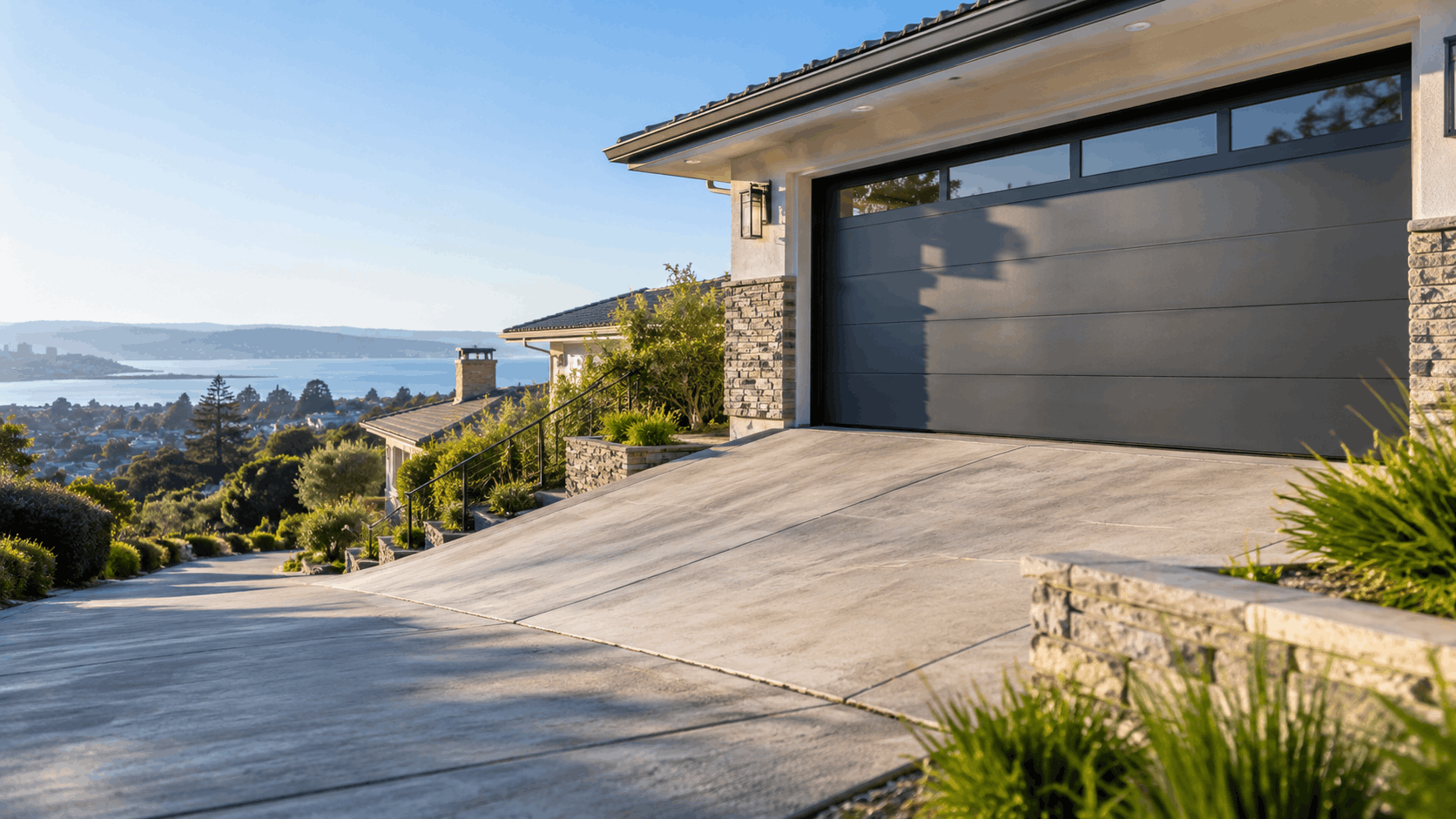
Get a Balanced Door on Your Hillside Harbor View Hills Home
If your door drops hard on the grade, will not hold halfway, or reverses for no clear reason, the diagnostic starts with weighing the door and checking the springs and cables, and the written price comes before work begins. On guard-gated streets we arrange access ahead of time, and our trucks carry common spring sizes so many repairs finish the same visit.
Call Urgent Garage Doors at (949) 529-7743 for a hillside balance check in Newport Beach, or reach us through our contact page to schedule. We cover Newport Beach around the clock.
Frequently Asked Questions
- Does a sloped driveway throw a garage door out of balance?
- No. The slope itself does not change spring sizing. Balance is set by springs matched to the actual weight and height of the door, and a steep driveway does not add weight to the panels. What does change the picture is the heavy custom door common on these hillside Harbor View Hills homes. A heavier door needs springs sized to it, and a mismatch there is what makes a door feel wrong on the grade.
- How do I test if my garage door is balanced?
- Disconnect the opener with the release cord, then raise the door to about waist height by hand and let go. A correctly balanced door stays put, neither falling nor floating up. If the door drops to the floor or rises on its own, that is a spring problem, not an opener problem, and no amount of opener work will fix it. When finished, reconnect the opener and confirm it re-engages before using it again.
- Why does my door reverse for no reason?
- Photo-eye faults, misalignment and blocked beams are the most common cause of a door that reverses for no visible reason. Run the photo-eye test: with the door closing, break the beam between the two low sensors with an object, and the door must stop and reverse. Near the coast, fog, dust and plant debris settle on the lenses and break the beam. Cleaning the lenses and checking that the eyes point straight at each other fixes many mystery reversals.
- Can I adjust the springs myself?
- No. A torsion spring stores enough energy to cause serious injury, and it is wound under tension with steel bars against a fixed cone. If a bar slips or a cone lets go, the release is sudden and violent. Owners should never adjust, wind, unwind or replace one, no matter how simple a video makes it look. The safe checks are the balance test, the two-by-four test and the photo-eye test, none of which touch the spring tension. Leave winding and replacement to a licensed technician.
- How long should my garage door springs last?
- Standard residential springs are commonly rated around 10,000 cycles, where one cycle is one open and one close. That works out to roughly seven to twelve years for a typical household, and less where the garage is the main entrance and the door runs several times a day. Near the water in Newport, salt-air corrosion brings a spring to the end of its cycle rating earlier, because rust pitting on coils under tension creates stress points. Galvanized springs and regular lubrication help it reach its full rating.
- Do I need a permit to replace my garage door in Newport Beach?
- Newport Beach is its own incorporated city with its own building department, so permits, plan check and inspections run through the city, and the permit position is confirmed for your specific address. Structural work such as widening the opening or altering the header is generally what triggers a permit rather than a straight door change. Work that needs a permit also loses the under-$1,000 unlicensed-work exemption. Confirm the position with the City of Newport Beach before ordering a door.
- Does my new opener have to have a battery backup?
- Yes. SB 969 requires every residential automatic garage door opener sold or installed in California on or after July 1 2019 to have a battery backup that operates during an electrical outage, with a $1,000 civil penalty for violations. Since that date a replacement residential garage door may not be installed connected to an opener that does not comply. On a hillside coastal property where a power cut can coincide with an evacuation, the value is clear. It is a legal requirement, not an optional upgrade.
- Do I need HOA approval before changing my door in Harbor View Hills?
- Yes, where the community is association-governed. Under the Davis-Stirling Act, architectural review covers door style, panel design, color and visible hardware, and a garage door is a street-facing exterior element. The sequence is approval first, then order. A door installed without approval can be required to come out at the owner's cost, which on a house at this price level is an expensive mistake. Written association approval is also separate from a city building permit, so you may need both.
- Can you replace a spring on the first visit?
- Often, yes. Our trucks carry common torsion spring sizes, so a spring replacement is frequently completed on the same visit we arrive. For the standard sizes that fit most doors, that same-day turnaround is the norm. We will not promise every job finishes the first time, because a custom or unusual spring on a heavy hillside door may need to be sourced. We also inspect the cables at the same time, since a frayed cable left behind is how a second failure follows weeks later.
- What license covers garage door work in California?
- Garage door work is licensed under CSLB classification C-61/D-28, Doors, Gates and Activating Devices. That scope covers sectional and rolling doors, torsion and extension spring systems, operators, control boards, safety sensors and activating devices. It is not C-28, which is Lock and Security Equipment, and it is not a general building license. Any license is verified free at cslb.ca.gov, where the number, classification, status, bond and workers compensation are public record. Urgent Garage Doors holds California license #1055150.
Licensed garage door repair professionals serving Irvine and Orange County.
Licensed in California · License #1055150
Why trust Urgent Garage Doors?
Founded in 2017, Urgent Garage Doors is a licensed and insured garage door services serving Irvine and Orange County. All content is reviewed by our licensed technicians.

Need Help in Irvine?
Urgent Garage Doors serves Irvine and all of Orange County.
Related Articles
Anaheim Hills Garage Door Repair: Hillside Foundation Settling Issues
Learn how hillside foundation settling causes garage door problems in Anaheim Hills, how to spot the warning signs, and the repair options that actually solve them.
Emergency Garage Door Repair in Newport Coast: Same-Day Service for Pelican Hill and Crystal Cove
A local guide to emergency garage door repair in Newport Coast, covering common failures, same-day service for Pelican Hill and Crystal Cove, costs, and prevention.
What a 24/7 Garage Door Company Actually Stocks on the Truck - Why Some Fixes Finish in One Visit
See exactly what a 24/7 garage door truck stocks - springs, cables, openers, and more - and why the right parts on board finish most Irvine repairs in one visit.