Garage Door Cable and Drum Replacement on Wide Dover Shores Doors
Key Takeaways
- On bay-front Dover Shores doors, salt-laden marine air corrodes cables, drums, roller stems and the bottom bracket first, so cables fray at the drum before they snap clean.
- Wide and matched three or four-car doors are heavier than stock steel sectionals, so cables and drums carry more load and wear sooner across the set.
- Cables, drums and the torsion spring are all under the spring's stored energy, so this is never a do-it-yourself repair; owners should only run the 2x4 auto-reverse, photo-eye and balance tests.
- Both cables are replaced as a pair, drums are inspected and swapped where pitted, and springs, rollers and bearings are checked together to prevent a second failure.
- Typical Orange County ranges: cable repair $150 to $300, off-track repair $125 to $275, door balancing $75 to $150, torsion spring replacement $150 to $300, presented as typical ranges with a written price before work begins.
- Dover Shores is association-governed under Davis-Stirling and sits in the City of Newport Beach, so access, any visible hardware change, and the permit position are confirmed for the specific address first.
- Galvanized or coated springs, galvanized cables, stainless fasteners and regular lubrication help coastal hardware reach its cycle rating near Upper Newport Bay.
- Urgent Garage Doors is licensed CSLB #1055150 (C-61/D-28), offers 24/7 emergency service with a 30 to 60 minute Orange County response, and confirms gate and association access before a waterfront appointment.
In This Article
In Dover Shores, a wide garage door often sits just a short walk from the water on Upper Newport Bay. These waterfront homes frequently carry a matched set of doors across a three or four-car garage, and when a cable slips off the drum, one side drops and the whole door hangs crooked in the opening. The owner pulls into the driveway on Polaris Drive or Galaxy Drive and sees a door that looks like it has been pulled sideways.
That crooked door is almost always a cable or drum problem, and on bay-front hardware it shows up sooner than it does inland. Salt-laden marine air with regular fog attacks bare steel that is under tension or in motion, and the lift cables and cable drums sit right in that firing line. The failure pattern is consistent enough that our team can often guess what we will find before we open the garage.
Why Cables and Drums Fail First on Dover Shores Doors?
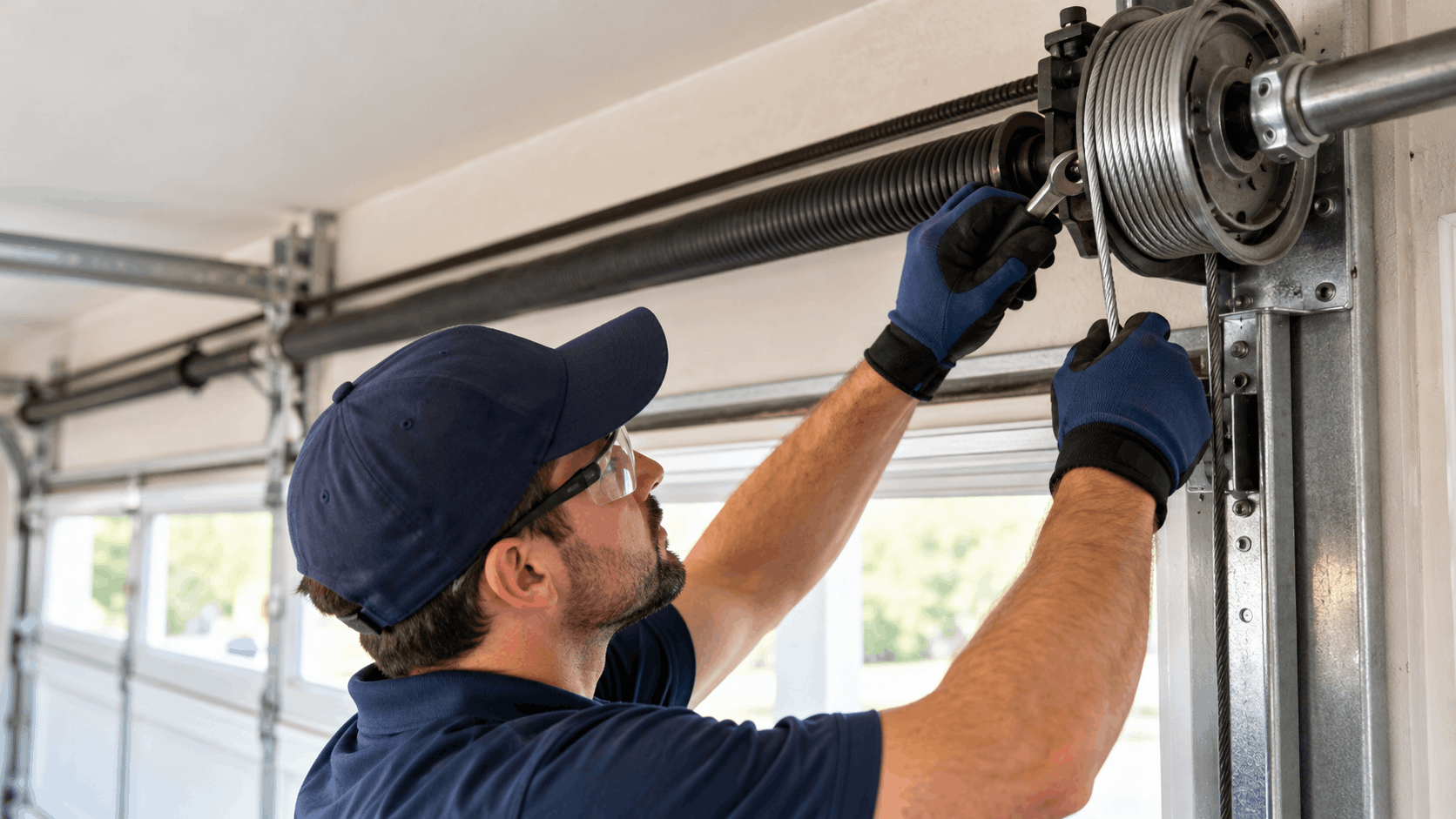
Dover Shores sits on the western shore of Upper Newport Bay, and that location decides a lot about how the hardware ages. Bay-front garages take salt air and damp continuously, and the failures show up first in the cables at the drum, the spring coils, and the roller stems. This is the most directly exposed hardware in the area we serve.
Two forces work together here. The first is salt air corrosion on bare steel. The second is weight, because the wide and often matched doors on these high-value homes are heavier than a stock steel sectional, so the garage door cable and the cable drum carry more load every cycle. Put corrosion and weight together and you get a part that reaches the end of its service earlier than the same part would in a dry, inland garage.
| Part | What the bay air does to it | How it shows up |
|---|---|---|
| Lift cables | Corrode under tension at the drum | Frayed strands, then a crooked door |
| Cable drums | Pit and roughen where cable wraps | Uneven winding, slipping |
| Roller stems | Rust in the stem and bearing | Grinding, dragging in the track |
| Bottom bracket | Rust pitting at the cable anchor | Visible rust, weak anchor point |
Salt Air on Bay-Front Hardware
Coastal Newport hardware lives in salt-laden marine air with regular fog, and that air does not treat every part the same. Corrosion goes after what is bare steel and under tension or in motion, because those are the surfaces where a protective layer breaks down fastest. On a garage door that means the parts doing the lifting.
The specific pieces at risk are the spring coils, the lift cables, the cable drums, the roller stems, the hinges, and the bottom bracket. Each of these is either loaded by the spring, moving through a cycle, or both. Marine air settles on them, and the corrosion starts on the surface and works its way in.
The lift cables sit under constant tension and wrap tightly around the drum, so they take the worst of it. A cable that would last for years in a dry garage in University Park faces a harder environment a few blocks from North Star Beach. That is why our spring and cable repair work in this part of Newport Beach so often centers on the cable and drum rather than the opener.
None of this means a precise number. There is no published multiplier that says a cable near the water lasts half as long at a given distance. What is true is that corrosion brings the end of a part's service forward, and the honest frame is to describe what the salt air does rather than invent how much faster it does it.
Cable Fraying at the Drum
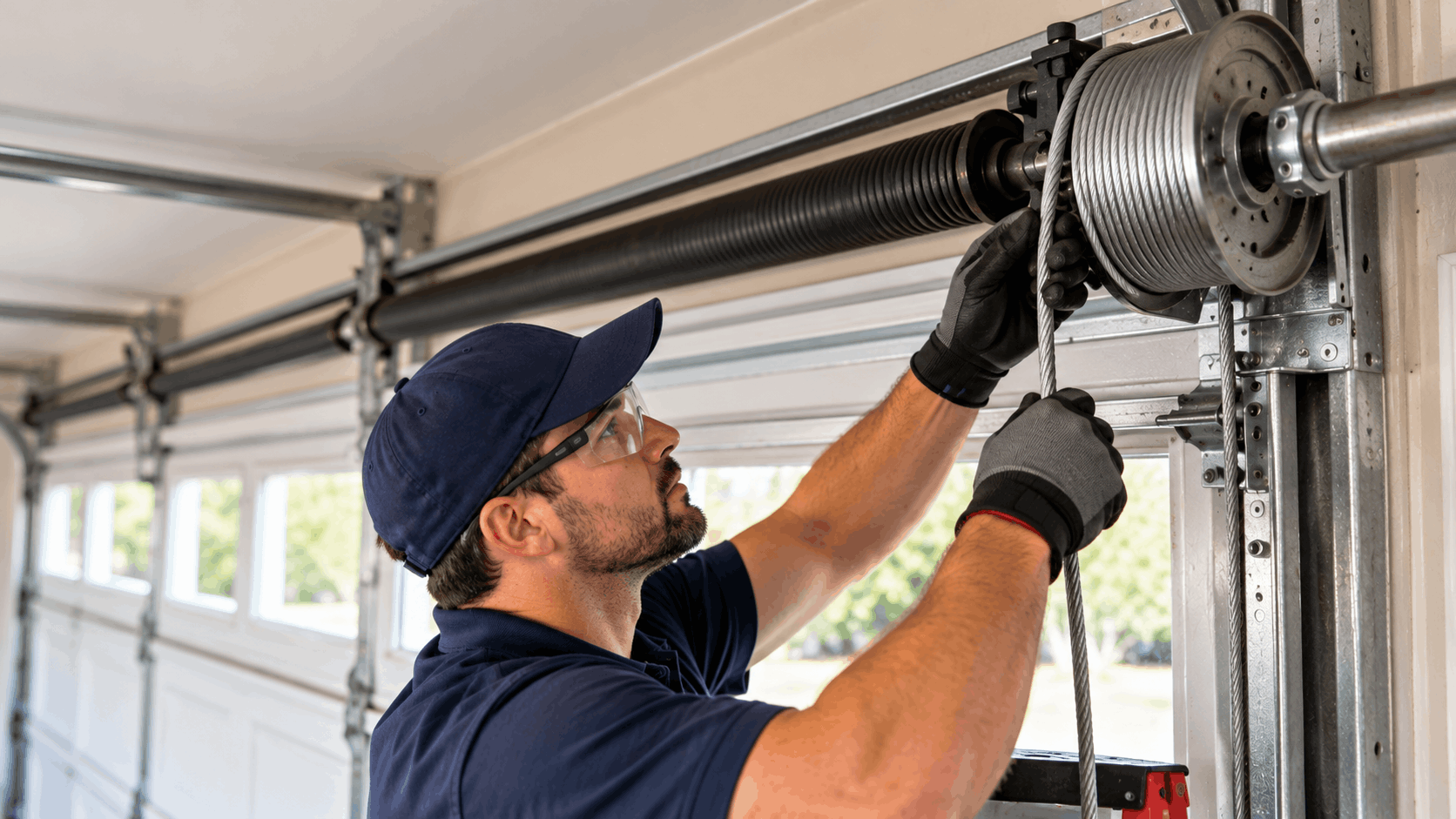
A healthy lift cable is a bundle of steel strands wound together. When that cable corrodes near the water, the strands start to break one at a time rather than the cable snapping clean all at once. The fraying usually begins right at the drum, where the cable wraps tightest and the tension is highest.
This is a genuine coastal finding, not a worst-case scenario. On homes near Dover Drive and the bluff streets like Polaris and Galaxy, cable fraying at the drum and rust-pitted coils are exactly what we find when a door starts acting up. The corrosion works from inside the strand bundle as much as on the surface, so a cable can look worn on the outside and be far weaker than it appears.
The danger of fraying is that it gives you a short warning before total failure. A few broken strands reduce the cable's strength, the remaining strands carry more load, and the failure speeds up from there. Catching the frayed strands early is the difference between a planned repair and a door that drops crooked with no notice.
Because the whole set of cables on a waterfront home has seen the same salt air and the same fog, fraying on one side means the other side is close behind. A cable that has started to fray is telling you the service life is running out, and it is a clear signal to get the hardware looked at.
Why Width Puts More Load on the Cables
On these high-value bay-front properties, a garage door is an architectural element. It is often wood-faced, custom-sized, or a set of matched doors across a three or four-car garage, sometimes paired with side-mount jackshaft openers to keep the ceiling clear. That changes the mechanical picture completely.
A wide, wood-faced or custom door is heavier than a stock steel sectional. More weight means the cables and the drums carry more load on every open and close. The same corrosion that would slowly weaken a light door's cables acts on a cable that is already working harder, so the wear shows up sooner across the whole set.
A matched set adds a second layer. When one door in a four-car garage fails, the owner is not just fixing one door, they are dealing with a matching problem, because the other doors have aged the same way under the same conditions. Springs have to be sized to the actual weight and height of the door, not guessed at from a standard chart.
This is why a heavier wide door needs a technician who weighs and measures rather than reaching for a one-size spring. The cable repair on a matched set is as much about getting the balance right across the whole run of doors as it is about swapping one failed part.
Spring and Cycle Rating Behind the Failure
Behind every cable and drum is the torsion spring, and the spring is rated in cycles. One cycle is one full open and close, and standard residential springs are commonly rated around 10,000 cycles. For a typical household that is roughly seven to twelve years, and far less where the garage is the main entrance and the door cycles several times a day.
Corrosion brings that rating forward. A spring that might reach its full 10,000 cycles in a dry garage can reach the end of its useful life earlier near the bay, because the salt air attacks the coils while they are under tension. The cycle rating is the design limit, and coastal conditions simply mean the spring meets its limit on the early side.
The important point is that springs do not fail alone. Cables, drums, rollers, hinges, and bearings all wear alongside the spring, because they are all part of the same loaded system doing the same cycles. Replacing a spring and ignoring a frayed cable, or a pitted drum, is how a second failure follows within weeks.
That is why our approach on a coastal door treats the spring, cables, and drums as one assembly. A torsion spring replacement near Upper Newport Bay is a chance to inspect everything the spring is connected to, so the fix lasts rather than buying a few weeks before the next part gives out.
Get Your Free Quote
Tell us about your garage door and we'll get back to you within 30 to 60 minutes.
Warning Signs a Cable or Drum Is Going
Most owners do not watch their cables. They notice something looks or sounds wrong and call. The language they use is plain, and each complaint maps to something specific happening at the drum or the cable. Learning to read these signs early lets an owner get ahead of a full failure.
The table below ties the common complaints to what is actually going on with the hardware. On a bay-front door, any of these is worth acting on quickly, because coastal corrosion does not reverse and a frayed cable only gets worse.
| What the owner notices | What is happening |
|---|---|
| Door hangs crooked | A cable has slipped off the drum or stretched |
| Frayed wire near the drum | Cable strands breaking from corrosion |
| Rust at the bottom bracket | Salt air pitting the cable anchor |
| Grinding or jerking | Worn drum or slack cable winding unevenly |
A Door That Hangs Crooked or Catches
The most obvious sign is a door that hangs crooked. When one cable slips off the drum or stretches, that side of the door drops, while the other side stays up. From the driveway the door looks tilted, like one corner is sagging toward the floor.
A crooked door often binds in the track too. One side is pulled down and out of line, so the rollers drag or catch instead of running smoothly. The owner may hear the door scrape or see it hesitate partway through its travel. This is a door that is no longer lifting evenly.
On a wide or matched door, a crooked panel is more than a cosmetic problem. The uneven load can pull on the opposite cable, the rollers, and the track, so a cable that came off on one side starts to put stress on parts across the whole door. What began as one slipped cable can turn into an off-track door if it is run that way.
Our advice is to stop using a crooked door and get it looked at. Running it only forces more parts out of alignment, and an off-track door repair is a bigger job than a simple cable swap caught early.
Fraying Strands and Rust at the Bottom Bracket
Owners can do a safe visual check without touching anything loaded. Look at the cable where it runs up to the drum and where it anchors at the bottom bracket. Frayed wire strands poking out of the cable are a clear warning, and rust pitting on the cable or the bracket tells you the salt air is doing its work.
The bottom bracket is a known trouble spot on bay-front hardware. It sits low, near the floor, where damp and salt collect, and it holds the cable anchor under full spring tension. Rust pitting here weakens the very point that keeps the cable attached, and that is a serious safety concern.
Frayed strands near the drum are the other thing to watch for. Because the cable wraps tightest at the drum, that is where corrosion and tension combine to break strands first. A cable that shows fraying there is past its reliable life and should be replaced before it fails completely.
These are look-only checks. An owner should never put a hand near a loaded cable, bracket, or spring, because the tension in the system can injure. Spotting the fraying and rust is useful, but the fix belongs to a technician who can release the tension safely.
Grinding, Slipping or a Loose Cable
Sound is the third warning. A worn drum or a cable that has gone slack often makes a grinding or grinding-then-slipping noise as the door moves. The drum surface roughens from corrosion, the cable no longer seats cleanly in the grooves, and the whole wind becomes uneven.
A loose or slack cable is easy to spot once you know what to look for. Instead of staying taut, the cable sags, and it may wrap over itself unevenly on the drum. When that happens the door can jerk as the slack is taken up suddenly, which puts a shock load on parts that are already corroded.
A slipping drum is dangerous because the drum is what translates the spring's stored energy into lifting the door evenly. If the drum is worn and the cable is slipping, the door is no longer being controlled the way it should be. That is a setup for a sudden drop on one side.
Grinding, slipping, or a visibly loose cable all mean the same thing on a coastal door: the hardware is wearing out and the balance is going. These are not noises to live with. Catching them early keeps a cable job from becoming a spring, cable, drum, and track job later.
Need Help in Irvine?
Urgent Garage Doors serves Irvine and all of Orange County.
Why This Is Not a DIY Repair?
It is tempting to treat a slipped cable as a quick fix, but the cables, drums, and torsion spring are all held under the spring's stored energy. That energy is what makes this work dangerous for a homeowner, and it is why cable and drum repair belongs to a trained technician with the right tools.
The safe rule is simple. An owner can run a few harmless tests and look for warning signs, but should never put a hand on a loaded cable, a drum, or a spring. The line between a safe check and a dangerous repair is the spring tension, and that line is not worth crossing.
The Torsion Spring Holds the Energy
A torsion spring stores enough energy to cause serious injury. It is mounted above the door and wound tight with steel bars against a fixed cone, holding the load that balances the door. That stored energy does not go away when the door is down, it is always there.
Winding and unwinding a torsion spring is done with winding bars, in careful steps, by someone who knows exactly how the tension releases. If a bar slips or the spring lets go, the force can break bones or worse. This is not a job for trial and error with household tools.
The rule we give every owner is plain: never adjust, wind, unwind, or replace a torsion spring yourself. There is no safe shortcut, and a spring that looks still and harmless is holding the full load of a heavy coastal door. The risk is entirely in that stored energy.
Because the spring is sized to the actual weight of the door, a heavier wide or matched Dover Shores door holds even more energy in its springs. That makes the danger greater, not smaller, on exactly the doors an owner might be most tempted to tackle themselves.
Cables and Drums Are Loaded Too
People sometimes think the cable is the safe part because it is just wire. It is not. The cables and drums carry the same spring load as everything else in the system, so working on them without releasing the tension correctly is just as dangerous as touching the spring.
A cable under full tension that is cut or released without control can whip. A drum that is unseated while loaded can spin. The bottom bracket, where the cable anchors, is under constant pull. All of these are live with the spring's energy until a technician releases the tension in the proper order.
This is why a technician handles the whole assembly rather than one piece at a time. The spring, cables, and drums are one connected system, and the safe way to work on any of them is to neutralize the tension first, then replace the parts, then re-tension in a controlled way.
Trying to swap a cable while the spring is still wound is the kind of mistake that sends people to the emergency room. The order of operations matters, and it starts with the spring every time. That sequence is what keeps the repair safe.
The Safe Tests an Owner Can Run
There are checks an owner can safely do, and they are worth knowing. The first is the auto-reverse test. Lay a flat 2x4 on the floor in the door's path and close the door. On contact the door must reverse within two seconds. If it does not, the safety system needs attention.
The second is the photo-eye check. The sensors sit near the floor on each side of the opening, no higher than six inches. With the door closing, break the beam with an object and the door must stop and reverse. Confirm the beam is aligned and the lenses are not blocked by dirt or salt film, since a misaligned or dirty photo-eye sensor is a common cause of a door reversing for no clear reason.
The third is the balance test, and it tells a cable or spring problem apart from an opener problem. Disconnect the opener with the release cord, raise the door to waist height by hand, and let go. A correctly balanced door stays put. A door that falls or rises is a spring problem, not an opener problem.
These three tests are safe because none of them require touching a loaded part. They let an owner gather useful information to share when they call. Anything beyond them, especially anything involving the cables, drums, or spring, is work for a technician.
How the Cable and Drum Replacement Works
Understanding the repair helps an owner see why it costs what it does and why it is done the way it is. The job is not just pulling off a bad cable and clipping on a new one. It is a controlled process of releasing tension, replacing parts as a set, inspecting what is connected, and rebalancing the door.
On a wide coastal door the care taken at each step is what separates a fix that lasts from one that fails again in a few weeks. The salt air means the technician is looking at the whole loaded system, not just the single part that failed.
Releasing Tension and Replacing Both Sides
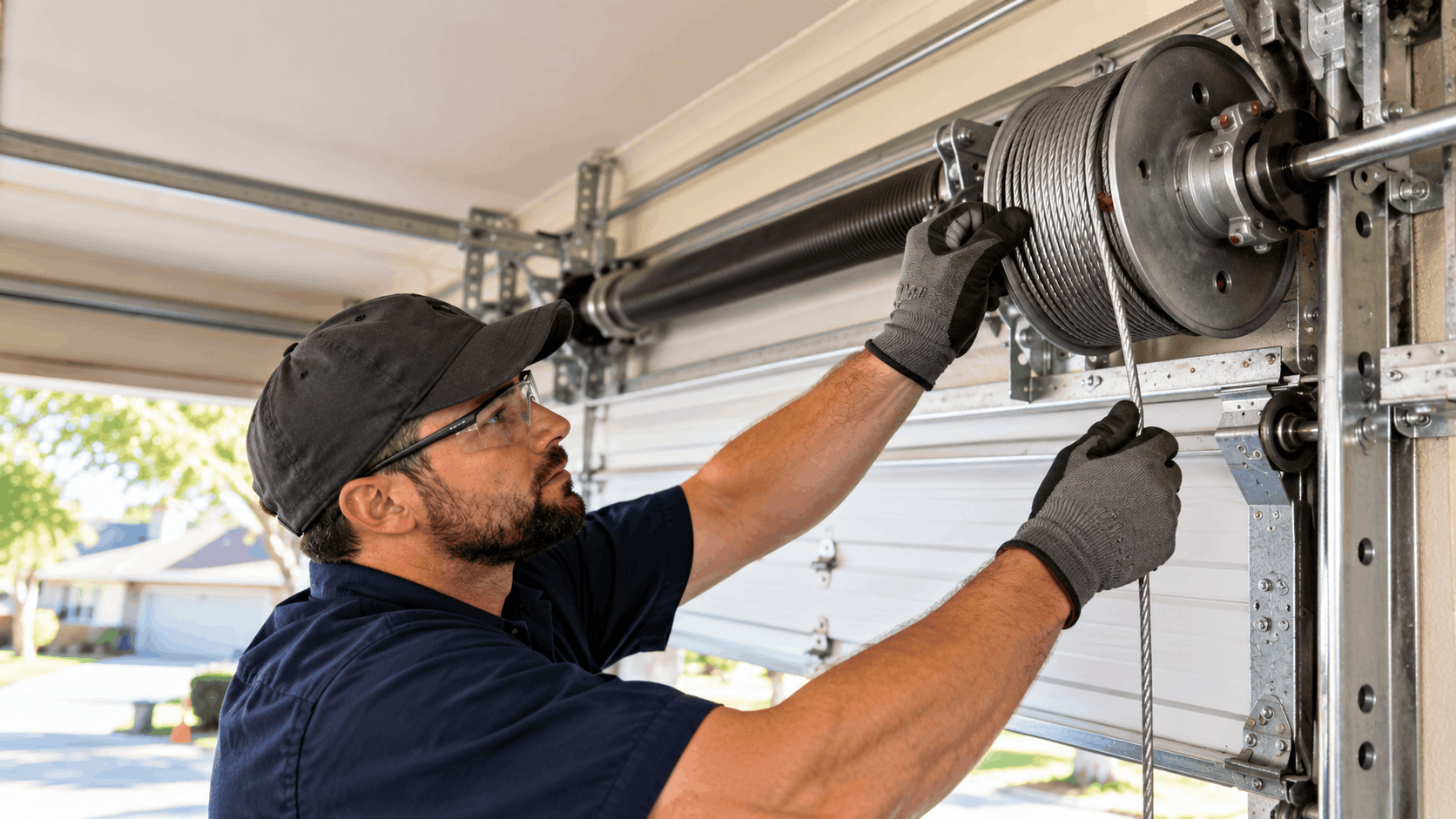
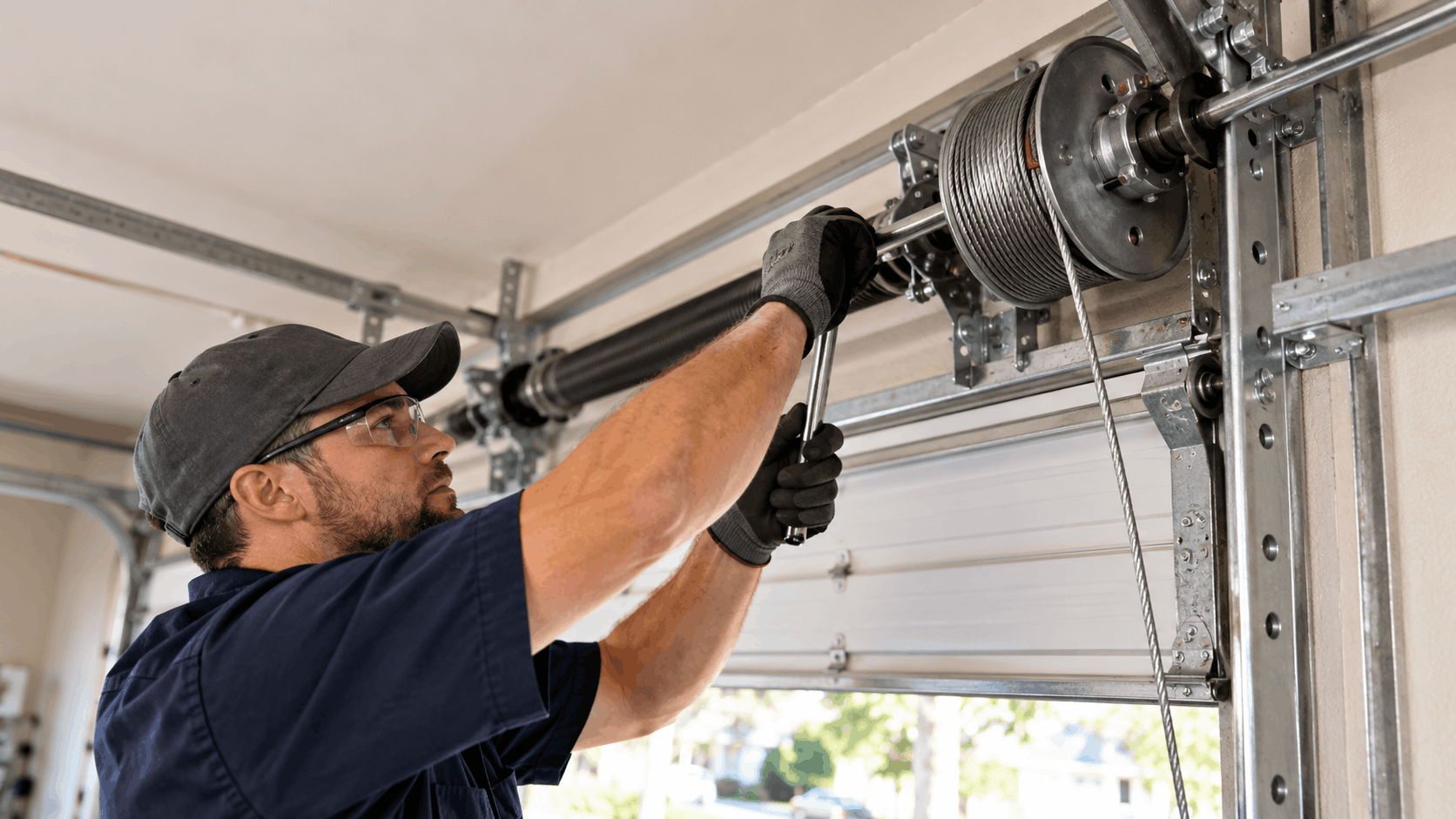
The repair starts by releasing the spring tension safely, using winding bars in the correct sequence so the energy comes off the system in a controlled way. Nothing on the cables or drums is touched until that tension is neutralized. This is the step that makes the rest of the work safe.
Both cables are then replaced as a pair, even if only one looks bad. The reason is simple: both cables on a bay-front door have seen the same salt air and the same number of cycles. Replacing one and leaving the other means the untouched cable is just as corroded and is the next thing to fail.
The drums are inspected at the same time. Where a drum is pitted from corrosion or worn where the cable rides, it is swapped out. A rough or pitted drum will chew up a brand new cable quickly, so matching new cables to good drums is part of doing the job once.
Doing both sides and checking both drums costs a little more up front than a single-cable patch, but it avoids a second service call within weeks. On a matched set of doors near the water, this pair-replacement approach is the only way to get an even, reliable result.
Inspecting Springs, Rollers and Bearings at the Same Time
Replacing a cable without inspecting the rest of the hardware is how a second failure follows weeks later. Everything in the lifting system has done the same cycles under the same salt air, so a technician checks the springs, rollers, hinges, bearings, and the bottom bracket while the tension is off.
The torsion spring is inspected for rust-pitted coils and signs it is near the end of its cycle rating. If it is close, replacing it now while the system is already apart saves a separate visit later. The spring and the cables are part of the same assembly, so it makes sense to address them together.
Rollers, hinges, and bearings are checked for rust in the stems and roughness in the movement. A corroded roller stem drags in the track and loads the cables unevenly, so a worn roller can be part of why a cable failed in the first place. Catching these during the same visit prevents the next problem.
The bottom bracket gets a close look because it anchors the cable under full tension and sits low where salt and damp collect. Rust pitting there is a safety issue. Inspecting the whole loaded system, not just the failed cable, is the difference between a repair and a patch.
Coastal-Grade Parts That Stand Up to Salt Air
Near Upper Newport Bay, the parts you install matter as much as the installation. The practical answers to marine air are galvanized or coated springs, galvanized cables and drums, and stainless fasteners. These resist corrosion far better than plain steel, so the hardware stands a better chance of reaching its cycle rating.
Galvanized cables have a zinc coating that slows the rust that attacks bare steel under tension. Galvanized or coated springs do the same for the coils. Stainless fasteners on the brackets and hardware avoid the rust bleed that plain bolts show within a season this close to the water.
Lubrication is the other half. Regular lubrication with a proper spring lubricant keeps the moving parts protected and helps the hardware run smoothly. The right lubricant is formulated for springs and cables, not a general spray that attracts grit and washes off.
Choosing coastal-grade parts is not an upgrade for show. On a bay-front home it is the practical choice that answers the exact conditions the hardware lives in. Our maintenance and upgrade work on these doors leans on corrosion-resistant parts because they are what the environment calls for.
Rebalancing the Door After New Cables
New cables and drums change the geometry of the lifting system, so the door has to be rebalanced and the tension checked once they are installed. The goal is for both sides to lift evenly and for the door to hold its position when the opener is released.
On a wide or matched door, rebalancing is especially important. A heavier door with any imbalance will drag the rollers, stress the new cables, and wear the drums unevenly. Getting the tension right across the set means the new parts are not fighting a door that lifts crooked.
The technician confirms the balance by hand, raising the door to waist height with the opener disconnected and checking that it stays put. A door that holds position is balanced correctly. One that drifts up or down needs the tension adjusted until it does. Our door balancing and tension adjustment is part of finishing a cable job properly.
Skipping the rebalance is a shortcut that undoes the repair. New cables on an unbalanced door simply start wearing the way the old ones did. The balance check is what lets the new coastal-grade parts actually last.
What It Costs in Dover Shores and Newport Beach?
Cost is one of the first questions owners ask, so here are the typical ranges for this work in Orange County. These are market ranges for the area, not a quote or a fixed price. The actual price for a specific garage depends on that garage, and it is given in writing before work begins.
The table below lays out the ranges most relevant to a cable and drum repair. A wide or coastal door with a matched set and heavier panels tends to sit toward the top of a range, because of the extra load, the custom sizing, and the matching work involved.
| Job | Typical Orange County range |
|---|---|
| Cable repair | $150 to $300 |
| Off-track door repair | $125 to $275 |
| Track repair and realignment | $125 to $300 |
| Door balancing and tension adjustment | $75 to $150 |
| Torsion spring replacement | $150 to $300 |
Typical Cable and Related Repair Ranges
For the core job, cable repair typically runs $150 to $300 in Orange County. That covers the common cable work an owner calls about, and on a bay-front door it usually includes replacing both cables as a pair rather than just the one that failed.
Related repairs that often come up alongside cables have their own ranges. Off-track door repair runs $125 to $275, and track repair and realignment runs $125 to $300. When a cable comes off and the door runs crooked, the track can need attention too, so these sometimes pair up.
Finishing work carries its own cost. Door balancing and tension adjustment runs $75 to $150, and it is what gets a wide door lifting evenly after new cables go on. If the spring is near the end of its life, a torsion spring replacement runs $150 to $300.
These are typical area ranges to set expectations, not a price for your specific door. The combination of parts your garage needs, and the written price for it, is confirmed before any work starts.
Why a Wide or Matched Door Can Cost More
A wide or matched door can land toward the top of a range for real mechanical reasons. These doors are heavier than a stock steel sectional, so they need springs sized to the actual weight and height of the door rather than a standard off-the-shelf set. Matching the spring to the door is more work than grabbing a common size.
The matched-set issue adds scope. When one door in a three or four-car garage fails, the owner is often looking at a matching problem, because the other doors have aged under the same salt air and the same cycles. Addressing the set together costs more than a single door but avoids repeat visits.
Heavier doors also wear their cables, drums, and rollers harder, so a thorough repair on a wide door may touch more parts than the minimum. That is not padding, it is the difference between fixing the failed cable and fixing the system that let it fail.
Custom and wood-faced doors on these high-value homes raise the stakes further, since the hardware has to match a heavier, non-standard door. The written price reflects what the specific door actually needs.
Getting the Price in Writing First
The actual price for a cable and drum repair depends on the specific garage, and it is given in writing before work begins. A written price lets an owner see the scope and the cost before any tools come out, which matters on a coastal door where the repair may reasonably include both cables, a drum, and a balance check.
California law backs this up. Business and Professions Code section 7159 requires a written home improvement contract for work over $500. That is a legal requirement, not a company favor, and it protects the homeowner on larger jobs.
For a cable repair that sits under that figure, a written price is still available before work begins when the job calls for it or the owner asks. Either way, the owner is not left guessing what the repair will cost.
Knowing the price in writing first also helps on a matched set, where the scope can grow. Seeing the full picture in writing lets the owner decide how to handle the set before anyone starts turning wrenches.
Need Help in Irvine?
Urgent Garage Doors serves Irvine and all of Orange County.
Access, Approval and Permits in Dover Shores
Waterfront work in Dover Shores comes with practical hurdles that have nothing to do with the hardware. Tight lots, gate access, association review, and city jurisdiction all shape how and when a job happens. These are settled before scheduling, because a missed detail here wastes an appointment.
Many properties here are association-governed with private beach and dock rights attached, which means door approval and contractor access are established before a crew is dispatched. Sorting this out first is part of how a waterfront job runs smoothly.
Tight Waterfront Lots and Dock Access
Dover Shores sits on the western shore of Upper Newport Bay, reached from Dover Drive, Irvine Avenue, Westcliff Drive, and 16th Street, with Polaris Drive and Galaxy Drive threading the bluff streets. Waterfront lots here have limited street frontage, and dock access competes with the garage for the available space.
That tight layout means technician access and any parts delivery need planning. There is not always room to park a truck right at the door, and a custom or matched door delivery needs a staging plan rather than a hope that everything fits. For a cable and drum repair the footprint is smaller, but access still has to be worked out.
Streets like Dover Drive, Polaris Drive, and Galaxy Drive each have their own parking and frontage realities. Knowing the area means arriving with a plan for where to work rather than figuring it out on the spot. That planning keeps the appointment on track.
On a bay-front lot, the difference between a smooth visit and a wasted one is often just whether the access was arranged in advance. We confirm that before scheduling the work.
Association Review Under Davis-Stirling
Many Dover Shores properties are association-governed under the Davis-Stirling Common Interest Development Act. Architectural review in these communities covers door style, panel design, color, and visible hardware, and design control here is stronger than almost anywhere in the service area.
A cable and drum repair is mechanical. It usually does not change the look of the door, so it generally does not trigger the same architectural review that replacing a door would. The cables, drums, and springs are behind and above the door, out of the street view the association is concerned with.
That said, access and any visible hardware change are cleared with the association first. If a repair would alter something the association can see, or if contractor access to a guard-gated or private area is needed, that is arranged before the work. The practical sequence in these communities is approval first, then the job.
Owners should confirm their specific association's rules, since each community sets its own. For a straightforward mechanical repair the path is usually simple, but checking first avoids any surprise on a property where design control is this strict.
City Jurisdiction and When a Permit Applies
Newport Beach is its own incorporated city with its own building department, so permits, plan check, and inspections run through the City of Newport Beach. Whether a door or opener repair needs a permit is confirmed for the specific address rather than assumed from a county-wide rule.
A like-for-like mechanical repair is a different thing from structural work such as widening an opening or altering a header, which is generally what triggers a permit. Still, the building department with jurisdiction is the authority on any given job, so the permit position is confirmed for the property.
There is a licensing reason this matters too. Work that requires a building permit of any kind loses the under-$1,000 unlicensed-work exemption in Business and Professions Code section 7048. That exemption was raised from $500 to $1,000 by AB 2622 effective January 1, 2025, and it also fails if the person employs anyone on the job.
For owners, the takeaway is to confirm the permit position for their specific Newport Beach address and let a licensed contractor handle the work. You can see our Newport Beach service area for how we cover the city.
Keeping Coastal Cables and Drums Lasting Longer
The salt air near Upper Newport Bay is not going anywhere, but good maintenance helps the hardware reach its cycle rating rather than falling short of it. The goal is not to claim a part will last a set number of years. It is to slow the corrosion that brings failure forward and to catch problems early.
The care that matters most on a bay-front door is simple and regular: lubrication, keeping salt off the moving parts, choosing corrosion-resistant hardware, and scheduling a maintenance visit that spots fraying before it becomes a failure.
Lubrication and Rinsing Salt Off Hardware
Regular lubrication with a proper spring lubricant is the single most useful thing an owner can do for coastal hardware. It keeps the springs, cables, rollers, and hinges protected and moving smoothly, which helps them reach their cycle rating instead of binding and wearing early.
Keeping salt and grit off the moving parts matters just as much. Salt-laden marine air and regular fog settle on bare steel and start the corrosion that attacks parts under tension and in motion. Wiping down the hardware and keeping it clean slows that process on the cables, drums, and bottom bracket.
The right product is a lubricant made for garage door springs and cables, applied where the research points: the coils, the cable, the rollers, the hinges, and the bearings. A general-purpose spray can attract grit and wash away, which is the opposite of what a coastal door needs.
None of this stops corrosion entirely a few blocks from the bay. What it does is give the hardware a fighting chance to last the cycles it was built for, rather than being cut short by salt and neglect.
Choosing Galvanized or Coated Parts
When parts are replaced, choosing galvanized or coated springs, galvanized cables, and stainless fasteners is the practical move this close to Upper Newport Bay. These materials resist the marine air far better than plain steel, so they stand up to the conditions that wear ordinary hardware out.
Galvanized cables carry a zinc coating that slows rust under tension, which is exactly where coastal cables fail. Coated springs protect the coils that hold the door's energy. Stainless fasteners avoid the rust streaks and seized bolts that plain hardware shows within a season near the water.
Spending a little more on corrosion-resistant parts up front usually pays off on a bay-front home, because it pushes back the next failure. It is the difference between replacing cables on the early side of their rating and getting closer to the full life the hardware is designed for.
This is why corrosion-resistant parts are the default we recommend here rather than an add-on. The environment calls for them, and they are the honest answer to the salt air question.
Preventive Maintenance and the Written Report
A preventive maintenance visit is where fraying at the drum and rust at the bottom bracket get caught early, before a cable snaps and a door drops crooked. On a coastal door, a regular check is the cheapest insurance against a sudden failure, and it runs $99 to $149 per visit in the area.
Each maintenance visit includes a written report of what was found and what is recommended. That report gives an owner a clear record of the hardware's condition, which is useful on a matched set where several doors age together and timing a replacement across the set matters.
The technician checks the cables for fraying, the drums for pitting, the springs for rust and cycle wear, and the rollers, hinges, bearings, and bottom bracket for the corrosion the bay air causes. Finding a frayed strand early turns an emergency into a planned, scheduled repair.
For owners near the water, putting the hardware on a regular preventive maintenance plan is the practical way to stay ahead of the coastal wear. The written report makes it easy to act on what the visit finds.
Need Help in Irvine?
Urgent Garage Doors serves Irvine and all of Orange County.
How Urgent Garage Doors Handles the Job
Knowing how the work is done matters as much as knowing what it costs. On a Dover Shores cable and drum repair, our team handles the license, the truck stock, the estimate, and the access the same careful way every time, because a waterfront, association-governed property has moving parts beyond the hardware.
Everything below is how the company actually works this job in Newport Beach, built on the specific facts of the business rather than general promises.
Licensed, Local and Verifiable
Urgent Garage Doors holds California license CSLB #1055150, under classification C-61/D-28, Doors, Gates and Activating Devices. That classification covers sectional and rolling doors, torsion and extension spring systems, operators, control boards, safety sensors, and activating devices, which is exactly the scope a cable and drum repair falls under.
Any license can be verified free at cslb.ca.gov, where the number, classification, status, bond, and workers compensation are all public record. An owner can confirm the standing before scheduling, which is worth doing on any contractor working loaded spring hardware.
The company works from a storefront at 76 Ashford, Irvine, CA 92618, and serves across Orange County, including the Newport Beach waterfront. Being local means knowing the bluff streets, the access realities, and the coastal conditions that shape this work. You can read more about our team and how we cover the area.
Working under the correct C-61/D-28 classification, with a verifiable license, is the baseline for doing this work legally and safely in California. It is not something to take on trust when it can be checked in a minute.
Truck Stock and Same-Visit Repairs
Our trucks carry common torsion spring sizes, so a spring replacement is often completed on the same visit rather than waiting for a parts run. That matters on a coastal door, where the cable repair and the spring inspection frequently happen together.
Carrying stock means that when a technician finds a spring near the end of its cycle rating alongside the frayed cables, the fix can often be done in one trip. That saves the owner a second appointment and gets the door back in service faster.
Not every replacement finishes on the first visit, especially on a wide or matched door that needs springs sized to a heavier custom panel, which may not be a common stock size. In those cases the right parts are ordered so the door is matched correctly rather than forced onto the wrong spring.
Stocking common sizes is about handling the usual repair efficiently while still doing custom work properly. The honest version is that many jobs finish same-visit, and the ones that need special parts are handled right rather than rushed.
Response Window and Written Price
Urgent Garage Doors takes emergency calls and responds 24 hours a day, 7 days a week, including holidays, with a 30 to 60 minute response window across Orange County. A door hanging crooked from a failed cable is exactly the kind of problem that cannot wait.
A written price is available before work begins, so an owner knows the cost and scope before any tools come out. On a cable and drum job that may reasonably include both cables, a drum, and a balance check, seeing the price in writing first keeps everything clear.
On a waterfront property, gate and association access is confirmed before a scheduled appointment. Promising an arrival without checking guard-gate access or association rules is how appointments get wasted, so that detail is settled ahead of the visit.
Between the response window, the written price, and the access planning, the aim is a repair that is fast, clear, and done without surprises on these demanding coastal lots.
Getting Your Dover Shores Door Back on Track
A crooked, cable-failed door on a bay-front home should not be run and should not be touched by hand, because the cables, drums, and spring are all under load. The safe move is a licensed technician who releases the tension correctly, replaces both cables, checks the drums and springs, and rebalances the door.
To schedule a cable and drum repair in Dover Shores, call Urgent Garage Doors at (949) 529-7743. We will confirm gate and association access, respond within the Orange County window, and give you the price in writing before the work starts.
Frequently Asked Questions
- How much does cable and drum replacement cost in Newport Beach?
- Cable repair typically runs $150 to $300 in Orange County, with related off-track door repair at $125 to $275 and door balancing and tension adjustment at $75 to $150. These are typical area ranges, not a fixed quote, and a wide or matched coastal door tends to sit toward the top. The actual price for your garage is given in writing before work begins.
- Why do garage door cables fray so fast near Upper Newport Bay?
- Salt-laden marine air with regular fog corrodes bare steel that is under tension, and the lift cables are under constant tension and wrap tightest at the drum. That combination breaks the cable's strands one at a time, so the cable frays at the drum before it snaps clean. On bay-front homes this is a genuine, recurring coastal finding rather than an unusual case.
- Can I replace a garage door cable myself?
- No. The cables and drums carry the full torsion spring load, and a torsion spring stores enough energy to cause serious injury. Working on a loaded cable, drum, or spring without releasing the tension in the correct order is dangerous, and an owner should never adjust, wind, unwind, or replace a spring or the loaded cables. A trained technician neutralizes the tension first, then does the repair safely.
- Should both cables be replaced if only one is frayed?
- Yes. Both cables have seen the same salt air and the same number of cycles, so the one that still looks fine is close behind the one that failed. Replacing cables as a pair avoids a second failure on the untouched side within weeks. On a bay-front door this pair replacement is the standard, reliable way to handle a cable job.
- Why do wide and matched Dover Shores doors need extra attention?
- Wide and matched doors on these high-value homes are heavier than a stock steel sectional, so they need springs sized to the actual weight and height of the door rather than a standard set. They also carry more load on the cables and drums. And when one door in a matched three or four-car set fails, it can become a matching problem across the whole run.
- Do I need association approval for a cable and drum repair?
- A mechanical cable and drum repair usually does not change the door's look, so it generally does not trigger the architectural review that a new door would. Under the Davis-Stirling Act, review covers door style, panel design, color, and visible hardware, so any visible change and the contractor access are cleared with the association first. Confirm your specific association's rules, since design control in Dover Shores is strict.
- Do I need a permit to replace cables and drums in Newport Beach?
- Newport Beach runs its own building department, so whether a permit applies is confirmed for the specific address rather than assumed. A like-for-like mechanical repair is different from structural work such as altering a header, which is what usually triggers a permit. Note that any job requiring a building permit loses the under-$1,000 unlicensed-work exemption in Business and Professions Code section 7048.
- What parts hold up best against salt air?
- Galvanized or coated springs, galvanized cables, and stainless fasteners stand up far better to marine air than plain steel, which is why they are the practical choice this close to Upper Newport Bay. Pairing them with regular lubrication using a proper spring lubricant keeps the moving parts protected. Together these help the hardware reach its cycle rating rather than being cut short by corrosion.
- How fast can a technician get to a Dover Shores address?
- Urgent Garage Doors offers 24/7 emergency service with a 30 to 60 minute response window across Orange County. On a waterfront property, gate and association access is confirmed before a scheduled appointment, because promising an arrival without clearing guard-gate access is how appointments get wasted. Settling that detail first keeps the visit on track for a tight Dover Shores lot.
- How do I tell a cable problem from a spring or opener problem?
- Run the balance test: disconnect the opener with the release cord, raise the door to waist height by hand, and let go. A correctly balanced door stays put, while a door that falls or rises is a spring problem rather than an opener problem. A slack or off-drum cable shows differently, as a door that hangs crooked with one side dropped.
Licensed garage door repair professionals serving Irvine and Orange County.
Licensed in California · License #1055150
Why trust Urgent Garage Doors?
Founded in 2017, Urgent Garage Doors is a licensed and insured garage door services serving Irvine and Orange County. All content is reviewed by our licensed technicians.

Need Help in Irvine?
Urgent Garage Doors serves Irvine and all of Orange County.
Related Articles
Garage Door Cable and Drum Replacement on Heavy Newport Coast Doors
How cable and drum replacement works on heavy Newport Coast estate doors: why coastal hardware fails, warning signs, costs, guard-gate access and the right California license.
Garage Door Cable Replacement Cost Orange County: Why Pricing Varies by Neighborhood
Garage door cable replacement cost in Orange County varies by neighborhood. Learn why prices differ, real cost ranges, and how to get a fair, accurate quote.
Spring Replacement on Custom and Wood Doors in OC - Why Heavy Doors Need Engineered Setups
Heavy custom and wood garage doors in OC need engineered spring setups, not standard swaps. Learn why weight matters, what proper systems include, and how our Irvine team measures every door.