High-Lift Track Conversions for Auto Shops: Clearing Vehicle Lifts in OC Service Bays
Key Takeaways
- Standard garage door tracks curve back low above the opening and block vehicles raised on two-post and four-post lifts.
- A high-lift conversion reroutes the door to rise straight up before curving, freeing 2 to 6 feet of extra overhead clearance depending on ceiling height.
- Conversions require custom track, specially grooved cable drums, and a re-engineered torsion spring system for safe operation.
- Measuring headroom, side room, backroom, and ceiling obstructions like beams and ducts is critical before ordering parts.
- Most single-bay conversions cost $1,500 to $3,500 before an opener, and high-lift setups often need a jackshaft or side-mount opener.
- The team serves auto shops across Irvine, Costa Mesa, Santa Ana, Tustin, and newer builds near the Great Park, with after-hours scheduling to cut downtime.
- High-cycle shop doors need monthly checks and twice-yearly professional service, with extra attention in coastal areas prone to rust.
In This Article
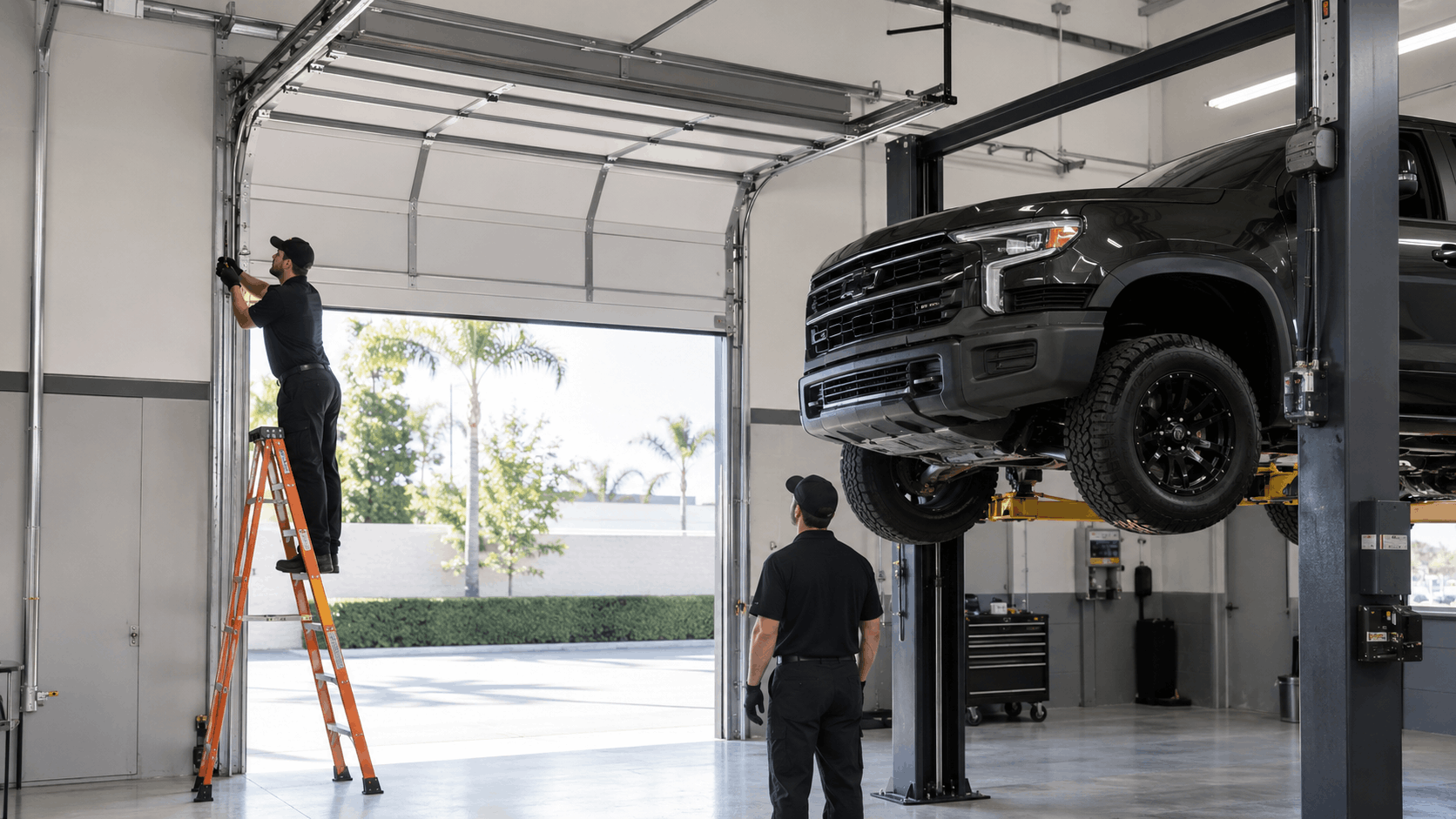
An auto shop owner off Barranca Parkway called us last spring with a problem we hear more than you would think. He had just paid for a brand-new two-post lift, bolted it to the slab, and raised a Tahoe up for a brake job. Then the garage door came down and stopped short, catching the roof rack. The door would not clear the truck, and the truck would not come down without moving the lift arms. His new bay was stuck.
This happens across Orange County more often than shop owners expect. A standard garage door track curls back into the ceiling right where a raised vehicle needs the most room. The lift works fine. The door works fine. They just cannot both use the same air at the same time.
The fix is a high-lift track conversion. It reroutes the door so it rises straight up before curving back, tucking the open door higher and tighter against the ceiling. In this guide, our team walks through why standard tracks block lifts, what a high-lift conversion changes, how to measure your service bay, and what the work costs across Irvine, Costa Mesa, Santa Ana, Tustin, and the newer builds near the Great Park.
Why Standard Garage Door Tracks Block Vehicle Lifts?
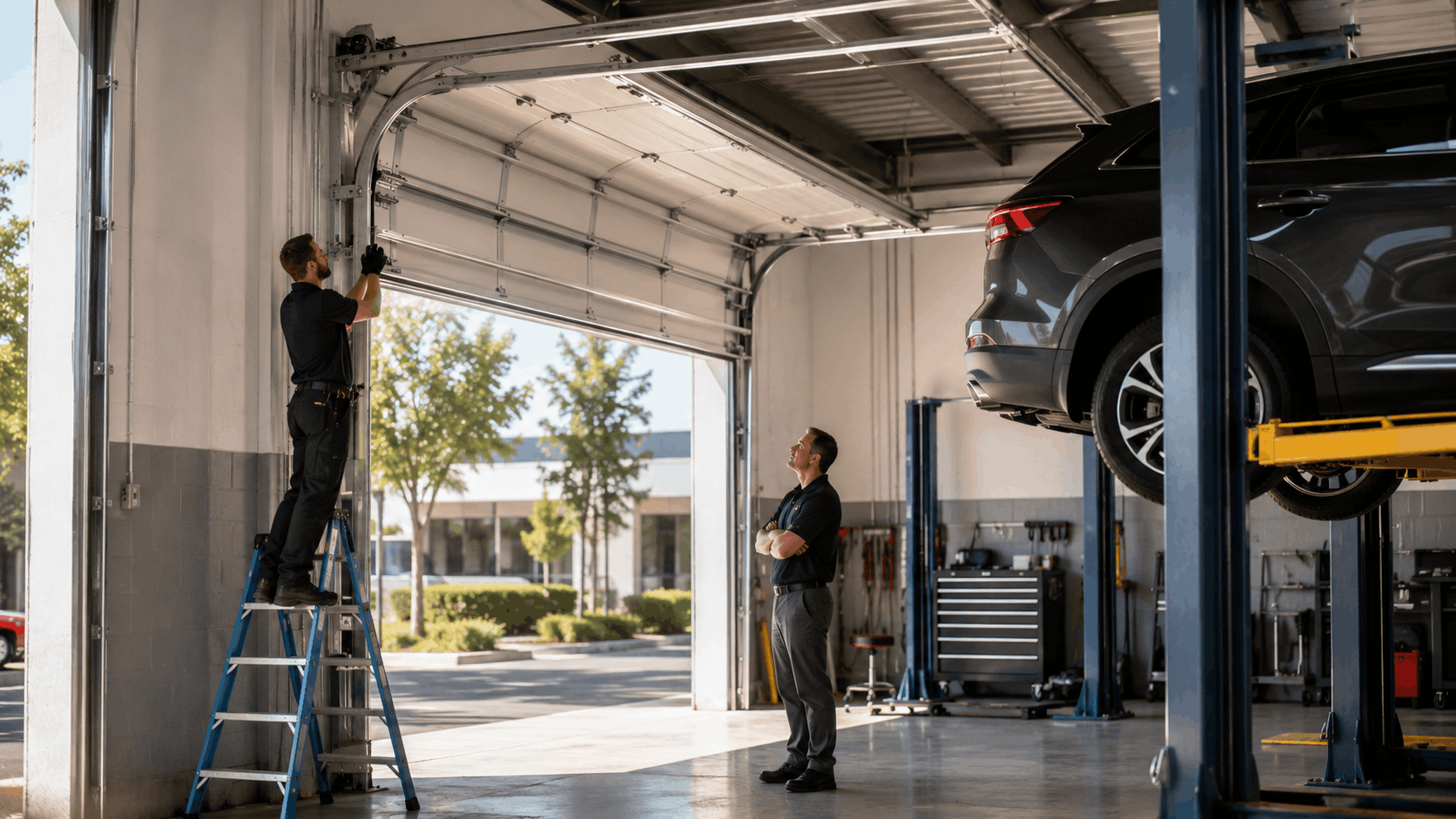
Most shop doors were installed for cars driving in and out at floor level, not for vehicles hoisted seven feet in the air. A standard lift track was never built with a service bay door in mind. So when a lift goes in, the conflict shows up fast.
How Standard-Lift Tracks Use Overhead Space
A standard door track runs up the wall, then curves back into a horizontal track that sits just above the door opening. That curve happens within the first foot or two above the header. The open door then rides flat along the ceiling, close to the opening.
The trouble is the door curve radius. On a standard-lift setup, the door starts bending backward almost as soon as it clears the top of the opening. That means the lowest part of the open door hangs right in the zone above your bay entrance.
For a home garage, that low curve is fine. Nothing tall is parked under it. In a service bay, that same curve is exactly where the top of a raised vehicle wants to be, and the two collide.
A raised car does not just need clearance at the opening. It needs clearance all the way back to where the lift sits. A standard track eats that overhead clearance before you even get the vehicle up.
The Clearance Math Behind Two-Post and Four-Post Lifts
Numbers make this easy to see. A typical two-post lift raises a vehicle so the tires sit around 5 to 6 feet off the floor at full height. Add the vehicle body, and the top of a sedan can reach 10 to 11 feet, while a truck or van pushes 12 feet or more.
Four-post lift clearance works a little differently since the runways add height under the tires. A car on a four-post lift often tops out between 11 and 13 feet depending on the lift and the vehicle. Shops need to clear the tallest vehicle they plan to service, not the average one.
Here is the part owners miss. A standard door with its low back curve might only leave 8 to 9 feet of usable clearance under the open door. That falls short of almost every raised-lift scenario.
The two-post lift height plus vehicle total is the real number to plan around. If your bay ceiling is 14 feet but your door only frees up 9 feet of that, the extra ceiling does you no good until the track changes.
Common Mistakes OC Shops Make Before Calling Us
A common error we see is ordering the lift before checking the door. A shop near the Irvine Business Complex bought two four-post lifts, installed them, and only then realized both bay doors blocked the raised runways. The lifts sat unused for weeks.
Another mistake is assuming any door will clear because the ceiling looks tall. Service bay planning has to account for the door path, not just the raw ceiling height. Tall ceilings mean nothing if the track pulls the door down into the clearance zone.
We also see shops in Santa Ana try to solve the problem by only opening the door partway. That leaves the door hanging in the opening, blocks light, and puts uneven strain on the springs. It is a workaround that wears hardware out fast.
Every lift installation error we fix traces back to the same root cause. The door and the lift were planned separately. Checking both together before anything gets bolted down saves thousands and weeks of downtime.
Get Your Free Quote
Tell us about your garage door and we'll get back to you within 30 to 60 minutes.
What a High-Lift Track Conversion Actually Is?
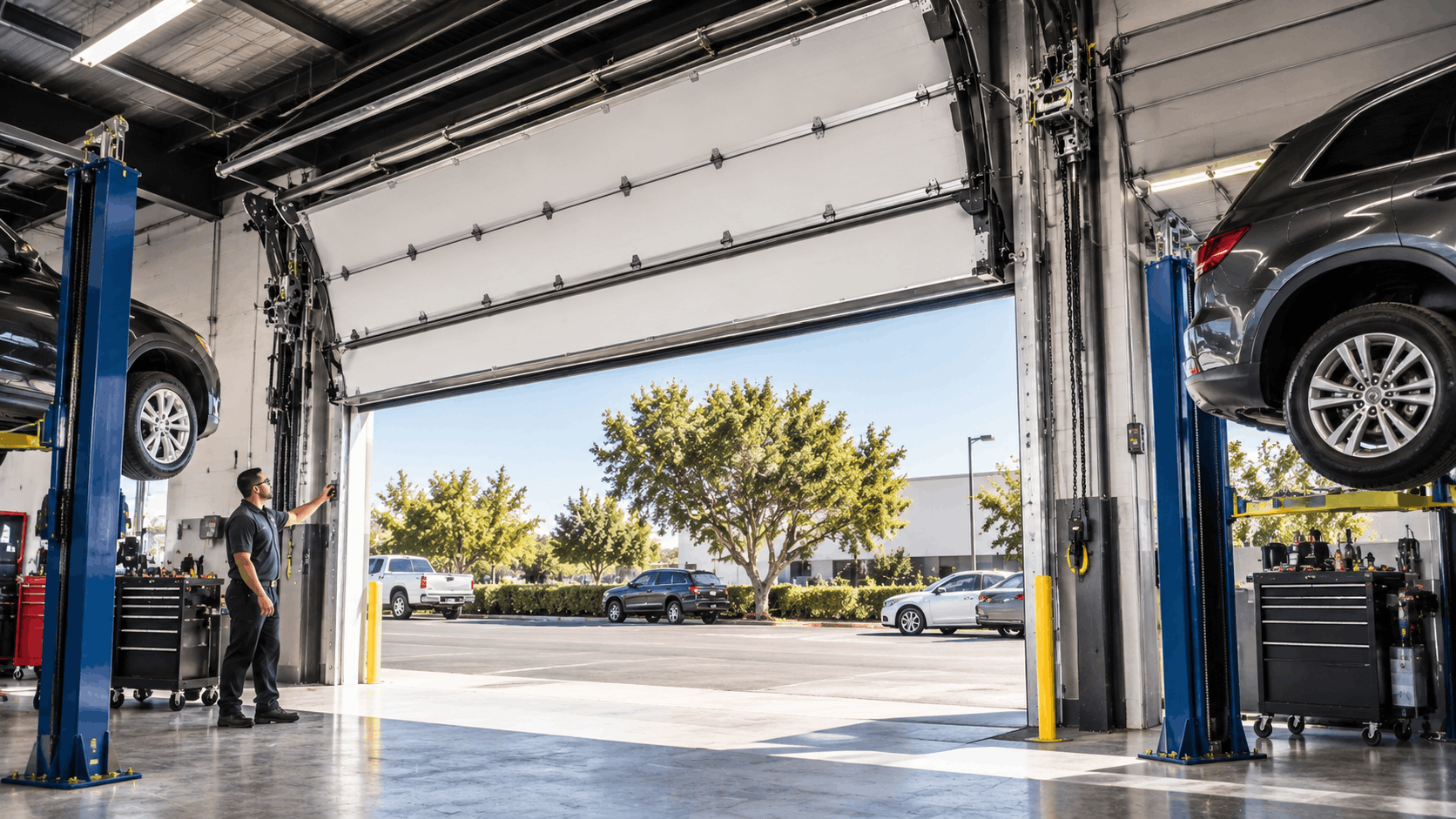
A high-lift conversion changes where the door goes when it opens. Instead of curving back low, the door climbs straight up first, then bends into the horizontal track much higher on the wall. That extra vertical rise is what clears your lift.
How High-Lift Tracks Change the Door Path
Picture the door opening. On a standard setup the track curves back a foot above the header. On a high-lift setup, we extend the vertical track several feet higher before the curve begins.
The vertical track extension is the core of the job. The door rides straight up past the point where a raised vehicle sits, then curves back near the ceiling above the danger zone. That reroute pushes the open door tighter to the ceiling and out of the way.
The track geometry does all the work here. By raising where the door bends, we free the entire vertical space between the header and the new curve. That is the space a lifted truck needs.
Think of it like teaching the door to stand up straighter before it lies down. The higher it stands before folding back, the more room underneath it stays open. That is why a high-lift garage door track solves what a standard one cannot.
Torsion Spring and Cable Drum Changes
You cannot just add taller track and call it done. When the door travels higher vertically, the counterbalance system has to be re-engineered to match. The springs and cables that hold the door's weight need to change with it.
A high-lift cable drum is grooved differently than a standard drum. It has a section machined for the extra vertical travel so the cable wraps correctly as the door rises straight up. The wrong drum will let the door bind or drop.
The torsion spring also has to be re-rated for the new lift geometry. Weight, travel, and drum size all feed into the spring calculation. Our team recalculates the counterbalance every time, because a spring sized for a standard door will not hold a converted one properly. You can read more about our torsion spring replacement and cable repair work.
This is why a conversion is not a bolt-on kit. It is a rebuild of the door's balance system, and it needs someone who understands spring math to get it right and safe.
How Much Extra Clearance a Conversion Adds
The headroom gain depends on how much ceiling you have above the opening. In a bay with a 12-foot ceiling and a 9-foot door, a conversion can often free up an extra 2 to 3 feet of usable clearance.
In taller bays with 14 to 16 feet of ceiling, the ceiling clearance you can recover jumps higher. Some shops gain 4 to 6 feet of vertical door travel, which clears almost any lifted vehicle. The taller the ceiling, the more room a conversion returns.
The rule of thumb is simple. The high-lift rise can be almost as tall as your available headroom minus a small buffer for the curve and hardware. More ceiling means more gain.
What matters is matching the gain to your lift needs. If your tallest raised vehicle hits 12 feet, we design the conversion to clear 12 feet plus a safety margin, not just the bare minimum.
High-Lift vs. Vertical-Lift Conversions
There are two ways to solve overhead clearance. A high-lift conversion keeps a horizontal track section but raises where the curve happens. A vertical lift setup runs the door straight up with no back curve at all.
The conversion comparison comes down to ceiling height. A vertical lift needs a ceiling nearly as tall as the door itself, since the whole door stacks straight up. That fits shops with very tall ceilings and open steel above.
A high-lift conversion fits the more common bay where you have some extra height but not a full door's worth. It gives you a big clearance boost without needing a warehouse-tall ceiling. Most OC service bays land in this range.
Our team picks the approach that matches your building. Older Irvine bays with 12-foot ceilings usually get high-lift. Newer builds near the Great Park with 16-plus-foot ceilings sometimes qualify for full vertical lift.
Need Help in Irvine?
Urgent Garage Doors serves Irvine and all of Orange County.
Measuring Your Service Bay for a Conversion
Before any parts get ordered, the bay has to be measured carefully. A good service bay measurement takes ten minutes and prevents expensive mistakes. Here is what shop owners can check themselves before we arrive.
Headroom and Ceiling Height Requirements
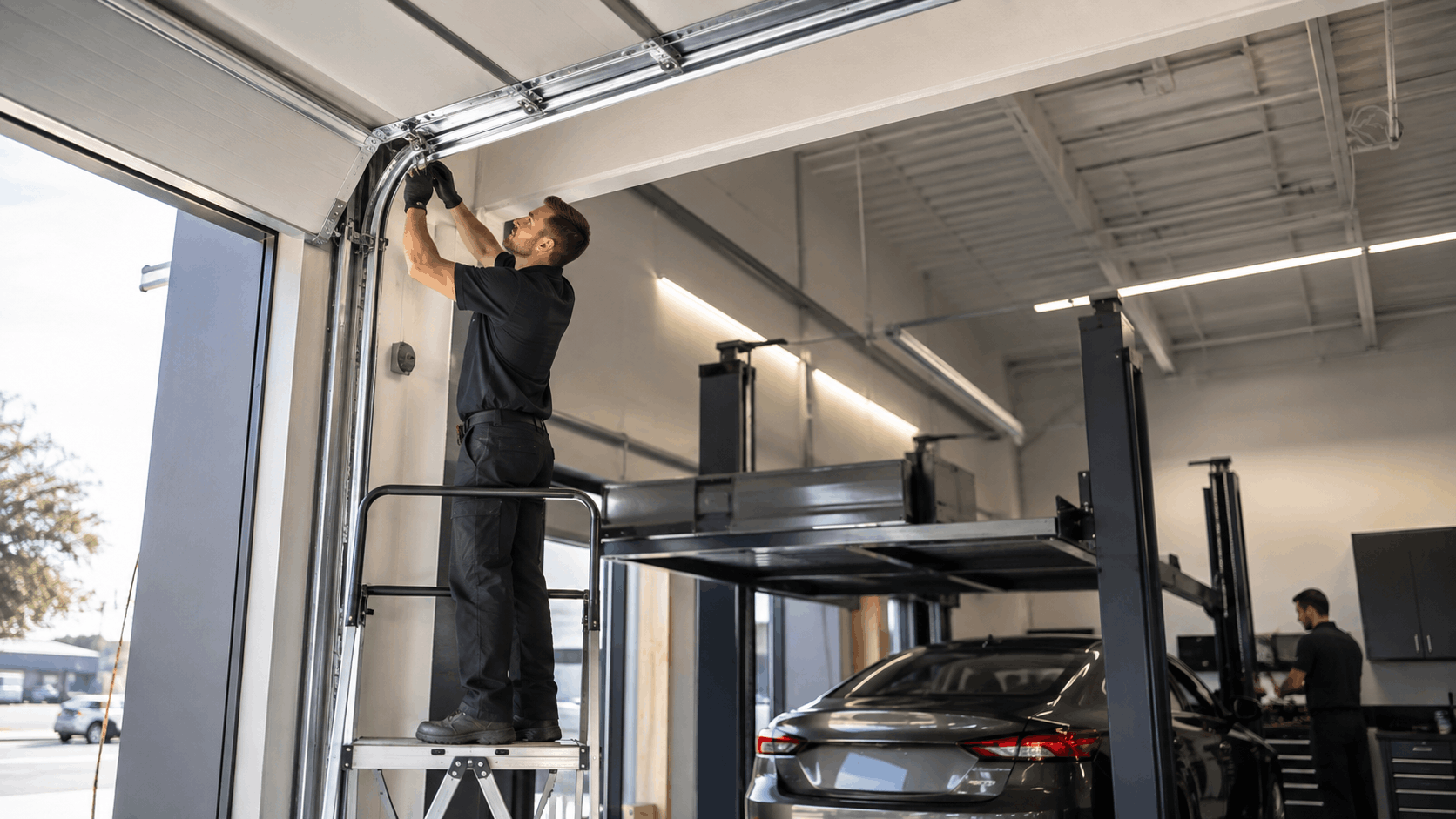
Headroom is the space between the top of the door opening and the ceiling or lowest obstruction. For a basic high-lift conversion, we look for a minimum of about 18 to 24 inches of headroom to start, though more is always better.
The real headroom requirement scales with how much lift you want. To gain 3 feet of extra door travel, you generally need at least 3 feet plus a few inches of clear ceiling above the opening. The math tracks closely to the clearance you want back.
Common shop ceiling heights in OC run from 12 feet in older units to 16 or 18 feet in newer builds. A 12-foot ceiling above a 10-foot door leaves about 2 feet to work with. A 16-foot ceiling above the same door leaves 6 feet, which is a much bigger conversion.
Measure from the finished floor to the ceiling, and from the top of the opening to the ceiling separately. Those two numbers tell us most of what we need to know.
Accounting for Lifts, Beams, and HVAC Ducts
The ceiling is rarely empty. Steel beams, light fixtures, sprinkler lines, and HVAC ducts all crowd the space the door track needs. Any ceiling obstruction can force a shorter high-lift or a rerouted track.
Older Irvine industrial buildings are the toughest cases. Many units built decades ago along Alton Parkway and near the Irvine Business Complex have low structural beams running across the ceiling. That low steel often sets the real limit, not the ceiling deck itself.
Ductwork is the sneaky one. A duct that hangs a foot below the ceiling can steal the exact space where the high-lift curve wants to go. We map every obstruction before designing the track path.
If a structural beam sits in the way, we sometimes route the horizontal track alongside it or adjust the curve point. Every bay is a little different, which is why a real look at the ceiling matters so much.
Side Room and Backroom Considerations
Track and hardware need space on the sides of the opening and behind it too. Side room is the wall space beside the door where the vertical track and spring assembly mount. High-lift setups often need a bit more side room than standard ones.
Backroom clearance is the depth behind the opening where the horizontal track and open door travel. This is where lift columns cause trouble. A two-post lift set close to the door can put a column right in the track path.
We measure the distance from the opening back to the first lift column carefully. If the column is too close, we either shift the track design or note that the lift may need repositioning. Catching this early avoids a nasty surprise on install day.
Side room also has to clear electrical panels, air lines, and shelving that shops mount near the door. A quick walk of the wall on both sides tells us what has to move, if anything.
When a Free On-Site Assessment Makes Sense
Measuring on paper only goes so far. An on-site assessment lets our team see the beams, ducts, lift placement, and wall conditions together. Guessing at these from a phone call leads to wrong parts orders.
During a bay inspection, we measure headroom, side room, and backroom, map every overhead obstruction, and check where the lift columns sit. We also look at the existing door and spring system to see what can be reused. You can reach our team to set one up.
We bring a raised-lift scenario into the plan too. If you tell us the tallest vehicle you service, we design the clearance around that real number, not a generic estimate.
For shops across Orange County, the on-site visit turns a rough idea into a firm plan and quote. It is the difference between a conversion that fits on the first try and one that needs rework.
Serving Auto Shops Across Orange County Service Areas
Our team works in service bays all over the county, and the buildings change a lot from one city to the next. Knowing the local building stock helps us plan conversions well. Here is where we see the most auto shop work.
Irvine Industrial Corridors and Older Bays
The Irvine Business Complex holds a dense cluster of auto shops, and many sit in units built in the 1980s and 1990s. These older bays often have tight overhead steel and 12-foot ceilings that make high-lift planning careful work.
Along Barranca Parkway and Alton Parkway, we service rows of independent repair shops and specialty garages. The buildings there tend to share a similar frame, with beams that cross the ceiling right above the door line. That steel usually decides how much lift we can add.
An Irvine auto shop in one of these corridors often benefits from a moderate high-lift rather than a full vertical setup. We work with the ceiling you have. Shops in nearby neighborhoods like Woodbridge and Turtle Rock call us for both commercial and residential door work.
Because we drive these corridors every week, we already know the typical ceiling heights and beam layouts. That local knowledge shortens the planning stage for shops near the complex.
Costa Mesa, Santa Ana, and Tustin Shops
The Tustin auto district off Newport Avenue and near Old Town holds a mix of older bays and newer builds. Many are classic repair shops with modest ceilings that suit high-lift conversions well.
Santa Ana service bay work often centers around the shops along Grand Avenue and the industrial pockets nearby. These buildings run older, and we frequently find low steel and mixed ceiling heights that call for custom track paths. Our Santa Ana service area keeps us busy year-round.
In Costa Mesa, shops near the South Coast Metro area and along Harbor Boulevard range from tidy modern units to weathered older bays. The coastal air here adds a rust factor we always plan around.
Across all three cities, the building types repeat enough that our team recognizes the challenges on arrival. We match the conversion to the bay instead of forcing one design everywhere.
Newer Developments Near the Great Park
The commercial builds around the Orange County Great Park tell a different story. These newer units come with taller ceilings, often 16 to 20 feet, and cleaner overhead framing. A modern service bay here gives us far more room to work.
With that height, some shops near the Great Park qualify for full vertical lift instead of just high-lift. The door can stack almost straight up, freeing the entire opening for the tallest vehicles.
Newer bays also tend to have better-organized ceilings, with ductwork and sprinkler lines routed to leave the door path clear. That makes conversions simpler and cleaner than in older units.
Whether your shop sits in a decades-old Irvine unit or a fresh build near the Great Park, we tailor the track design to the ceiling in front of us. The goal stays the same: clear the lift and keep the bay moving.
Need Help in Irvine?
Urgent Garage Doors serves Irvine and all of Orange County.
The Conversion Process From Quote to Finished Door
Shop owners want to know what the job looks like start to finish. The conversion process runs in clear stages, and we plan the installation timeline around keeping your bay open. Here is how it goes.
Assessment and Custom Track Ordering
It starts with the on-site measurement. Once we have your headroom, side room, backroom, and lift details, we turn those numbers into a custom track order. Most high-lift jobs use custom-cut track and specially grooved drums.
Because the parts are made to your bay, there is a parts lead time to plan for. Custom track and high-lift drums typically take a few days to a couple of weeks to arrive depending on the supplier and door size.
We order the right spring system at the same time, sized to the new geometry. Getting the spring, drum, and track spec correct on paper first prevents delays on install day.
Once the parts are confirmed, we schedule the install around your shop's calendar. You know the date and the window before we start.
Removing Old Track and Rebalancing Springs
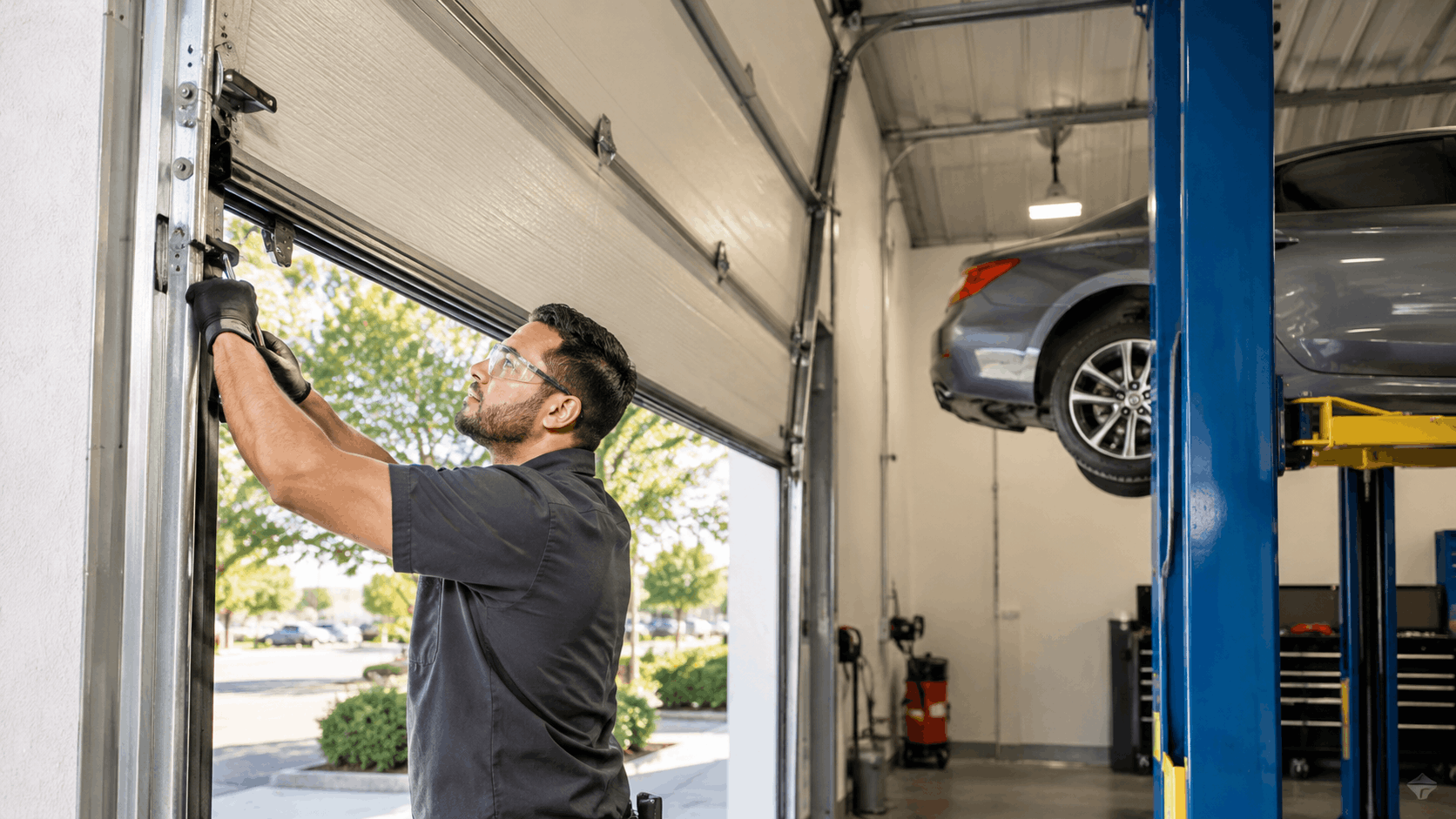
On install day, the first step is safely removing the old hardware. Track removal means taking down the standard vertical and horizontal track and detaching the existing spring assembly. Spring work is the highest-risk part of the job.
Torsion springs hold enormous stored energy. Our technicians follow strict safety steps to unwind and remove them without injury. This is not DIY territory, and the Consumer Product Safety Commission documents why garage door springs cause serious injuries when handled wrong.
With the old parts out, we mount the new high-lift track, install the grooved cable drums, and set the new torsion spring. Then comes the spring rebalance, where we tune the counterbalance so the door holds at any point and moves smoothly.
A properly rebalanced door feels light and stops where you leave it. If it slams down or creeps up, the spring is not tuned right, and we correct it before finishing.
Testing Clearance With the Lift Raised
The most important test happens with your lift in the picture. We run a clearance test by raising the lift to full height, ideally with a tall vehicle on it, then cycling the door. This is lift verification in the real world.
Measuring on paper is one thing. Watching the open door clear the top of a raised truck with room to spare is proof the design works. We want to see daylight between the door and the vehicle.
If clearance is tighter than planned, we adjust the track curve or hardware before we leave. Nobody should discover a clearance problem during a busy Monday morning.
Once the door clears the raised lift cleanly and cycles smoothly, the conversion is signed off. You walk away knowing the exact combination that works in your bay.
Keeping Shop Downtime to a Minimum
A closed bay costs money, so we plan around it. Most single-bay high-lift conversions take a single working day once parts are on hand, sometimes a bit longer for large commercial doors.
To cut shop downtime further, we offer after-hours install and weekend scheduling. Many shops prefer we work in the evening so the bay is ready when the crew clocks in the next morning.
For multi-bay shops, we can convert one bay at a time so the others keep running. You never have to shut the whole shop down.
Our team confirms the schedule with you in advance and sticks to the window. Predictable timing keeps your service calendar intact.
Costs, Openers, and Long-Term Value
Price is always part of the decision. A high-lift conversion cost depends on several factors, and the right opener matters too. Here is a clear breakdown of what to expect and why the investment pays off.
| Factor | Typical Range | What It Affects |
|---|---|---|
| Single-bay high-lift conversion | $1,500 - $3,500 | Base track, drums, spring rebuild |
| Custom oversized door | $3,500 - $6,000+ | Larger track, heavier springs |
| Jackshaft / side-mount opener | $500 - $1,200 | Required when track blocks center rail |
| New commercial door + conversion | $4,000 - $8,000+ | Full door replacement plus high-lift |
What Drives the Price of a Conversion
Door size is the biggest cost driver. A wider, taller service bay door needs longer track, larger drums, and heavier springs, all of which raise the conversion pricing. A single standard-width bay door sits at the lower end.
The spring system matters too. Doors that need a full torsion rebuild or a switch from extension to torsion cost more than ones where we reuse a compatible shaft. Our spring conversion upgrade work often ties into these jobs.
Custom hardware pushes price up when the ceiling forces an unusual track path. Beams, ducts, and tight backrooms sometimes call for special brackets or angled runs. Ballpark, most single service-bay conversions land between $1,500 and $3,500 before an opener.
We give a firm number after the on-site visit, not a vague range. That way you can budget the exact job for your bay.
Matching the Right Commercial Opener
High-lift setups often break a standard opener. A normal trolley opener runs on a center rail along the ceiling, and the high-lift track path frequently occupies that same space. When the rail cannot go where it needs to, the old opener has to change.
The usual answer is a jackshaft opener or side-mount opener. These mount on the wall beside the door and turn the torsion shaft directly, leaving the ceiling clear. They pair naturally with high-lift and vertical-lift doors.
A side-mount opener also frees overhead space you may want for the lift. Our opener installation team sets these up to match the converted door's travel.
If your current opener will not work after the conversion, we tell you upfront and quote the right replacement. No surprises when the door goes live.
How Clearing a Lift Pays Off
The return on investment shows up in bay productivity. A door that clears the lift means techs raise a vehicle, work, and lower it without ever fighting the door. That saved time adds up across dozens of jobs a week.
It also prevents damage. Shops that limp along with a half-open door or a lift that snags the door risk dented panels, bent tracks, and hurt roof racks. One damaged customer vehicle can cost more than the whole conversion.
A working lift-and-door combo also lets a shop take taller vehicles it had to turn away before. That is new revenue from work you could not do. For a busy shop, the conversion often pays for itself in a matter of months through throughput alone.
Need Help in Irvine?
Urgent Garage Doors serves Irvine and all of Orange County.
Maintenance and Safety for Converted Doors
A converted door in a busy shop opens far more than a home garage door. That heavy use calls for regular upkeep and honest safety checks. Here is how to keep a high-lift door running and protect your crew.
Routine Checks for High-Cycle Shop Doors
A high-cycle door in a service bay might open dozens of times a day. That puts more wear on springs, cables, rollers, and drums than a home door ever would. A short monthly inspection checklist catches trouble early.
Each month, look and listen. Check the cables for fraying near the drums, watch the door balance by opening it halfway to see if it holds, and listen for grinding or popping as it moves. Any of those signs means it is time for service.
Also check the rollers and hinges for wear, and make sure the track brackets are tight. Our maintenance and upgrade team can handle these checks if your staff is stretched thin.
A five-minute monthly walk-around beats a broken door on a busy afternoon. High-cycle hardware fails gradually, and the warning signs show up if you look for them.
Warning Signs a Converted Door Needs Service
Doors talk before they break. A loud bang, a new grinding noise, or a squeal that was not there yesterday all point to hardware trouble. Those door warning signs deserve a look before the door fails completely.
Sagging on one side or uneven movement usually means a cable or drum issue. If the door rises crooked or one side lags, stop using it. A spring failure or a slipped cable on a high-lift door can drop it hard.
If a spring breaks, you will often hear a sharp bang and the door will suddenly feel very heavy. Do not try to force it open. Call for emergency repair and keep people clear of the door.
Catching these signs early keeps a small fix from becoming a full replacement. When a converted door acts up, treat it as a stop-work item until a tech checks it.
Coastal Air and Rust in OC Shops
Salt air is hard on garage door hardware. Shops near Costa Mesa and the Newport-adjacent areas breathe humid, salty air that speeds up coastal corrosion on track and springs. Rust weakens the exact parts that hold the door's weight.
Track rust builds up where you might not notice it, along the vertical rails and inside the curves. Springs and cables corrode too, and a rusted cable can snap under high-cycle use. Shops in Eastside Costa Mesa see this often.
Protection is straightforward. Wipe down and lightly lubricate the springs and rollers on a regular schedule, keep the track clean, and choose galvanized or coated hardware when parts get replaced. Those steps slow rust considerably.
In coastal bays we recommend more frequent service intervals than inland. The salt never stops working, so the upkeep should not either.
Scheduling Preventive Service Around Business Hours
Nobody wants a tech blocking a bay during the morning rush. Preventive service can be scheduled early, late, or on slower days so it never disrupts your workflow. We plan visits around your busy hours, not ours.
A maintenance plan takes the guesswork out of it. We track your service intervals, remind you when a visit is due, and inspect springs, cables, drums, and balance on a set schedule. Our preventive maintenance plan is built for high-use commercial doors.
Regular service also extends the life of the expensive high-lift parts you paid to install. Catching a worn cable early costs far less than a snapped one that takes the door out of service.
For shops running many cycles a day, a plan keeps the door reliable and the bay open. It is the cheapest insurance a busy shop can buy.
Final Thoughts
A new lift is worthless if the garage door blocks it. A high-lift track conversion reroutes the door up and out of the way, clearing raised vehicles so your bay actually works the way you paid for. The job means custom track, new drums, a rebuilt spring system, and often a side-mount opener, all matched to your exact ceiling.
From the older bays near the Irvine Business Complex to the taller builds by the Great Park, our team measures each bay, designs the clearance around your tallest vehicle, and tests the door against a raised lift before we finish. We keep downtime short with after-hours scheduling and back the work with maintenance built for high-cycle doors.
If your shop in Irvine, Costa Mesa, Santa Ana, Tustin, or anywhere across Orange County has a lift that fights the door, contact our team for a free on-site assessment. Call us to book a visit and get a firm quote for your bay.
Frequently Asked Questions
- What is a high-lift garage door conversion?
- A high-lift conversion changes the door's travel path so it rises straight up higher before curving back into the ceiling. That extra vertical rise pushes the open door tighter to the ceiling and clears the space a raised vehicle needs. The job includes custom track, specially grooved cable drums, and a re-engineered torsion spring system sized to the new geometry, so it works safely in a service bay.
- How much ceiling height does a high-lift conversion need?
- A basic high-lift conversion needs at least 18 to 24 inches of headroom above the door opening to start, though more ceiling means more clearance gained. To free up 3 feet of extra door travel, you generally need about 3 feet of clear ceiling above the opening. Older Irvine bays with 12-foot ceilings get moderate conversions, while taller builds near the Great Park support much larger lifts.
- Will my existing garage door work with a conversion?
- Often yes. Many existing sectional doors can be reused if the panels are in good shape and the door is a standard type. We replace the track, drums, and springs while keeping the door sections when possible. If the door is damaged, badly worn, or a style that will not run on high-lift track, we recommend a new commercial door instead, and we confirm which route fits during the on-site visit.
- How much does a high-lift track conversion cost?
- Most single service-bay conversions run between $1,500 and $3,500 before an opener. Door size, the spring system, and custom hardware for tricky ceilings all affect the total. Oversized or custom doors can run $3,500 to $6,000 or more, and a jackshaft or side-mount opener adds $500 to $1,200. We give a firm price after measuring your bay rather than a guess over the phone.
- How long does the installation take?
- Once the custom parts arrive, most single-bay high-lift conversions finish in a single working day. Larger commercial doors or tricky ceilings can take a bit longer. Custom track and drums have a parts lead time of a few days to a couple of weeks before install day. We schedule the work around your shop and confirm the window in advance so you know exactly when your bay will be back in service.
- Do I need a new opener after a conversion?
- Often yes. A standard trolley opener runs on a center ceiling rail, and the high-lift track path usually takes that same space. When that happens, we switch you to a jackshaft or side-mount opener that mounts on the wall and turns the torsion shaft directly. It leaves the ceiling clear and pairs naturally with high-lift doors. We tell you upfront if your current opener will not work.
- Can the door clear both the lift and the vehicle on it?
- Yes, that is the whole point of the conversion. We design the clearance around the total height of your tallest vehicle plus the lift, not just the lift alone. A raised sedan can reach 10 to 11 feet and a truck 12 feet or more. We build the high-lift rise to clear that number with a safety margin, then verify it by testing the door against a raised vehicle.
- Do you service auto shops outside Irvine?
- Yes. Our team works with auto shops across Orange County, including Costa Mesa, Santa Ana, Tustin, Newport Beach, Lake Forest, Orange, Fullerton, and more. We know the building types in each area, from older low-steel bays in Santa Ana to modern tall-ceiling units near the Great Park. Wherever your shop sits in the county, we can come measure the bay and plan the right conversion.
- Can the work be done after business hours?
- Yes. We offer after-hours and weekend scheduling so your bay is ready when your crew arrives. Many shops prefer we install in the evening to avoid any lost work time. For multi-bay shops, we can convert one bay at a time so the rest stay open. We confirm the schedule ahead of time and hold to the window to keep your service calendar intact.
- How often should a converted shop door be serviced?
- High-cycle commercial doors that open dozens of times a day should be professionally serviced at least twice a year, and more often in coastal areas where salt air speeds corrosion. Between visits, run a quick monthly check of cables, balance, and noise. A maintenance plan tracks your intervals and inspects springs, cables, and drums on schedule, which extends the life of the high-lift parts you paid to install.
Licensed garage door repair professionals serving Irvine and Orange County.
Licensed in California · License #1055150
Why trust Urgent Garage Doors?
Founded in 2017, Urgent Garage Doors is a licensed and insured garage door services serving Irvine and Orange County. All content is reviewed by our licensed technicians.

Need Help in Irvine?
Urgent Garage Doors serves Irvine and all of Orange County.
Related Articles
Door Balancing Service Explained: What Tension Adjustment Fixes and the Half-Open Test
Learn what garage door balancing means, what tension adjustment fixes, and how the half-open test reveals hidden problems - explained by Irvine's local garage door pros.
Garage Door Off Track Anaheim: Emergency Repair Service Today
An off-track garage door in Anaheim needs fast, safe action. Learn the causes, what to do first, honest repair costs, and how our Irvine-based team responds same day.
Low-Headroom Garages in Older OC Homes: The Track Kits That Make Modern Doors Fit
Older Orange County homes often have low-headroom garages that block modern doors. Learn how low-clearance track kits, measuring tips, costs, and pro installation make a new door fit.