Low-Headroom Garages in Older OC Homes: The Track Kits That Make Modern Doors Fit
Key Takeaways
- Older OC homes built in the 1950s through 1970s often have under 6 inches of headroom above the garage door opening.
- A standard garage door needs 12 to 15 inches of headroom, while low-headroom kits can fit doors in as little as 4.5 to 6 inches.
- Measure from the top of the opening to the lowest ceiling obstruction, and check side room, backroom depth, and any beams or wiring.
- Rear-mount torsion kits suit heavy insulated doors, while extension spring kits work for lighter doors and tighter budgets.
- Do not confuse high-lift hardware (for tall ceilings) with low-headroom kits (for short ceilings).
- Most conversions cost $400 to $900 for the kit and labor, with a full new door running $1,200 to $3,000, and finish in a half day.
- Check HOA rules in communities like Woodbridge and Northwood before ordering a new door.
- Spring work is dangerous, so leave low-headroom installation and adjustment to trained professionals.
In This Article
A homeowner near Old Town Irvine calls us with the same worry every few weeks. They found the perfect new garage door online, ordered it, and then the installer showed up and shook his head. The ceiling above the opening was too low for standard tracks, and the whole project stalled.
This happens a lot in older Orange County homes. Garages built decades ago often left only a few inches of space above the door opening. A modern sectional door needs room to curve up and back, and when that room is not there, the door will not clear.
The good news is that low-headroom track kits solve this exact problem. They reposition the springs and rollers so a modern door can open in a very tight space. This guide covers why older OC garages run short on headroom, how to measure your own space, and which track kits make the fit work.

Why So Many Older OC Homes Have Low-Headroom Garages?
Older homes across Orange County share a common trait in the garage. Builders in past decades simply did not plan for the taller doors and bigger openers we use now.
Here are the main reasons a low headroom garage shows up so often in older homes:
- Framing standards were looser and ceilings sat lower
- Shallow header space above the opening was normal
- Later remodels ate into the space that was left
- Storage racks and ductwork were added over the door
Many Orange County garages from the mid-century era were never meant to hold the hardware we install today. That mismatch is what creates the headroom problem.
Mid-Century Construction Standards and Ceiling Heights
Homes framed in the 1950s through the 1970s followed different rules than we see now. Garage ceilings often sat at 7 feet or even a little lower, which left little room above the door track path.
Builders back then also framed shallow headers over the opening. A modern door needs a certain amount of flat space above the opening to travel back into the garage, and that space was rarely part of the plan.
The result is a garage where the ceiling height and the header space both work against a standard door. We see this constantly in tract homes built before Irvine grew into the city it is today.
When we inspect these garages, the first thing our team measures is the gap between the top of the opening and the lowest point of the ceiling. In older homes, that number often comes in far below what a normal kit requires.
Neighborhoods Where This Shows Up Most
Certain parts of Orange County are famous for this issue. Homes along El Camino Real and the older streets near Old Town Tustin were built when lower garages were standard. If you live in one of these areas, low headroom is a fair bet.
Older tracts in Santa Ana and Tustin show the same pattern. Many of these older tracts went up decades ago, and their garages were framed with tight clearances that modern doors struggle to fit. Our crews handle these homes across the county, including plenty of work in Santa Ana and Old Town Tustin.
In Irvine itself, University Park Irvine stands out. Built in the early days of the planned city, many University Park garages have less headroom than the newer villages nearby. We have converted dozens of these to modern doors with the right low-clearance hardware.
Newer areas like Portola Springs almost never have this problem, but the older core of the city does. Knowing which neighborhood a home sits in gives us a head start on what to expect.
How Much Headroom a Standard Door Actually Needs
A typical residential door on a standard track needs about 12 to 15 inches of space above the opening. That room lets the springs mount on a bar above the door and gives the rollers a path to curve upward.
When a garage has less than that, the standard hardware will not fit. Once you drop under 6 inches, you are firmly in low-headroom territory and need a special kit.
The headroom requirement is not a suggestion. Force a standard door into a space that is too tight and the panels will bind, the rollers will jump the track, and the opener will strain.
This is why measuring first matters so much. Knowing your real number tells you whether a standard install works or whether a low-clearance solution is the only safe path.
Remodels and Additions That Made It Worse
Sometimes the garage started with enough room, and later work took it away. A finished garage ceiling with drywall and insulation can drop the usable space by several inches.
Overhead storage rack systems are another common culprit. Homeowners bolt them right above the door opening, which blocks the exact space the tracks need to travel.
HVAC ducts and added lighting also creep into the headroom zone. We often find a duct run installed years after the home was built, sitting inches below the ceiling and right in the door's path.
When we plan a conversion, we account for every one of these obstacles. Sometimes a small adjustment to a light or bracket buys back enough room to make the job easier.
Get Your Free Quote
Tell us about your garage door and we'll get back to you within 30 to 60 minutes.
How to Measure Your Garage for Headroom
Before anyone can recommend a kit, you need real numbers. A quick set of measurements tells you what you are working with and saves time when you call us.
Learning to measure headroom takes only a few minutes. Getting accurate garage door measurements up front helps you avoid ordering a door that will not fit.
Measuring from the Opening to the Ceiling
Start at the top of the door opening. Use a tape measure to find the distance straight up to the lowest point of the ceiling or any object hanging below it.
Write that number down. This is your headroom, and it is the single most important measurement for a low-clearance job.
Check the measurement at both the left and right sides of the opening. Older garages settle over time, so the ceiling clearance is not always equal across the width.
If the two numbers differ by more than an inch, note that too. Uneven clearance changes how we set the tracks and level the door.
Checking Side Room and Backroom
Headroom is only part of the picture. You also need side room, which is the space between the edge of the opening and the wall on each side.
Most tracks need a few inches of side room to mount the vertical rails. Older garages built tight to a wall can run short here as well.
Then check the backroom depth, meaning how far the garage extends behind the opening. The horizontal tracks run back into that space, and low-headroom setups sometimes need extra depth.
Measure from the opening straight back to the rear wall or the nearest obstruction. If your garage is shallow, tell us early so we can plan the track length.
Spotting Obstructions Like Beams and Wiring
Older Irvine garages hide surprises above the door. A support beam running across the ceiling can block the track path even when the general clearance looks fine.
Look for anything mounted overhead: light fixtures, junction boxes, and exposed conduit. These obstructions often sit lower than the ceiling itself.
Electrical runs are common in homes built before modern code updates. We frequently find wiring stapled along the header where the new spring bar needs to go.
Note every obstacle you spot and roughly where it sits. A photo on your phone helps our team plan the layout before we ever arrive.
When Measurements Are Close to the Limit
Sometimes the numbers land right on the edge. If you measure exactly 4 to 6 inches, you are in the range where a kit can work but there is no room for error.
At that tight clearance, small details decide success. The door thickness, the roller size, and the exact bracket all matter.
This is when a professional measurement pays off. Our technician can confirm the real usable space and rule out anything a tape measure might miss.
We would rather check twice than install a door that binds on day one. A short visit protects you from a costly mistake.

Need Help in Irvine?
Urgent Garage Doors serves Irvine and all of Orange County.
What a Low-Headroom Track Kit Actually Does
A low headroom track kit changes how the door hardware sits above the opening. Instead of one path that curves up into a tall spring bar, it reroutes the motion into a tighter shape.
The whole point of a special garage door track setup is to let a modern sectional door open where a standard one cannot. Here is how the parts work together.
Double Track vs Single Track Design
A standard door uses a single curved track that lifts each panel up and back. In a low ceiling, that curve simply does not have room to form.
A double horizontal track solves this by adding a second rail. The rollers split between the two tracks so the door can lay flatter as it opens.
This altered roller path is the heart of most low-headroom kits. The top rollers ride one track while the lower rollers ride another, which keeps the panels closer to the ceiling.
The trade-off is a slightly different look overhead and a few more parts to maintain. In exchange, you get a modern door in a space that seemed impossible.
Where the Springs Get Moved
On a normal door, the torsion spring sits on a bar directly above the opening. That bar needs headroom, which is exactly what these garages lack.
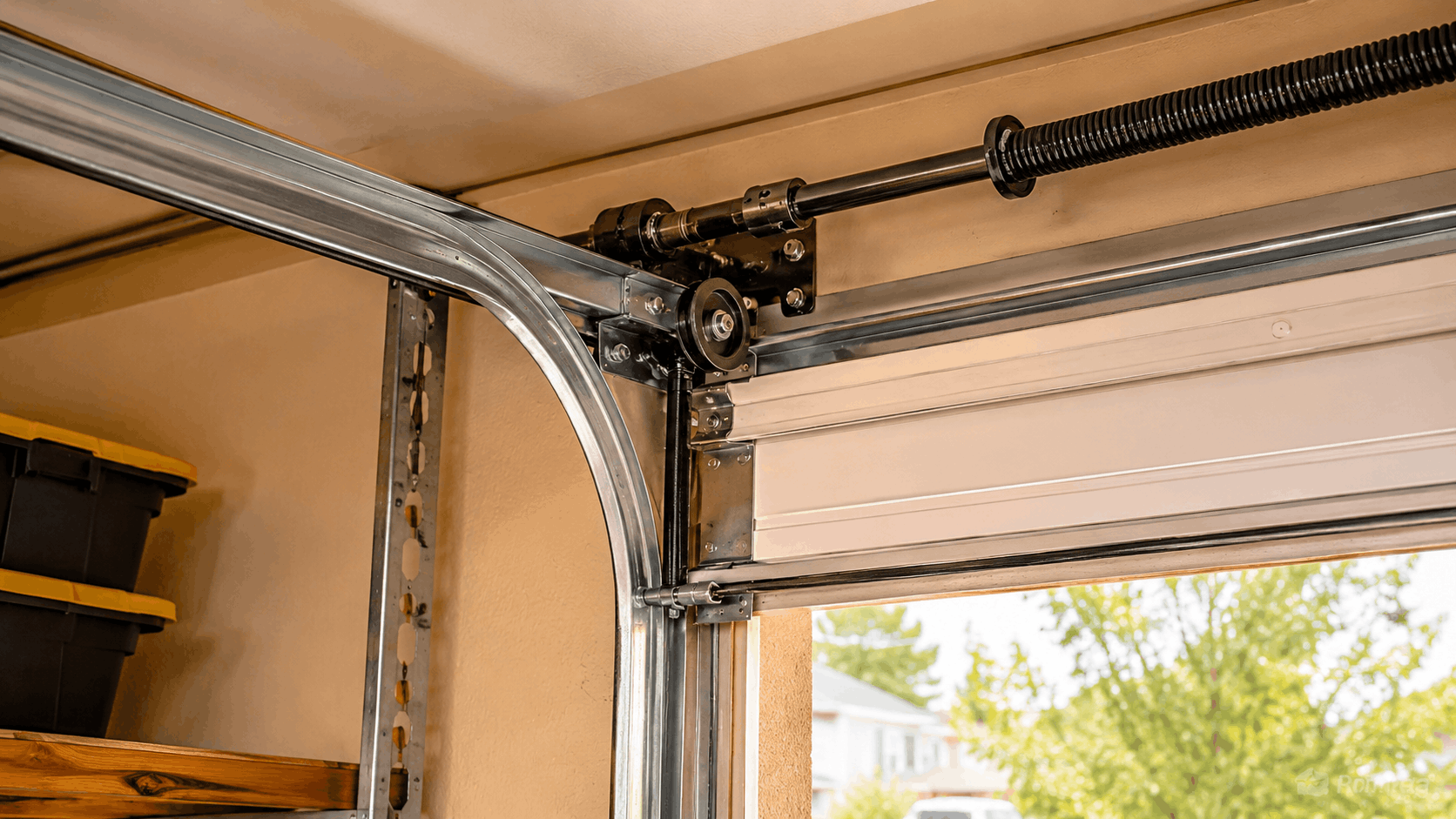
A rear mount torsion kit moves the spring assembly to the back end of the horizontal track. The cables run to the rear, and the spring does its work away from the tight header area.
This change in spring placement frees up the space right above the door. It is one of the most reliable ways to fit a heavy door in a low garage.
Because spring work is dangerous, our team handles the tension setup with proper tools. You can read more about how we approach torsion spring replacement and rear-mount conversions.
How the Door Panels Travel Differently
With a low-headroom kit, the door travel follows a flatter arc. The panels tip back sooner and ride nearly level under the ceiling.
This altered panel movement is normal and safe when the kit is set correctly. It just looks different from a standard door once it is fully open.
You may notice the door sits a bit lower against the ceiling when open. That is the design working as intended, keeping the panels within the tight space.
The opener attaches to the door in a spot suited to this travel path. We adjust the arm and travel limits so the motion stays smooth from top to bottom.
Clearance These Kits Can Achieve
The numbers surprise a lot of homeowners. A good low-headroom kit can fit a door in as little as 4.5 to 6 inches of headroom.
That minimum clearance depends on the door and the kit chosen. Lighter doors and thinner panels squeeze into smaller spaces.
The space savings come from moving the spring and splitting the roller path. Together they cut the required room by more than half compared to a standard setup.
We have installed modern doors in garages we thought were hopeless at first glance. With the right kit, very few spaces are truly out of reach.
Types of Low-Headroom Kits and When Each One Fits
Not every kit suits every garage. Choosing the right one depends on your door weight, budget, and how much clearance you have.
A low clearance kit comes in a few main types. The biggest choice is often torsion vs extension, and the table below breaks down the differences.
| Kit Type | Best For | Min Headroom | Door Weight |
|---|---|---|---|
| Rear-mount torsion | Heavy insulated doors | 4.5 in | High |
| Front-mount torsion | Medium doors | 6 in | Medium |
| Extension spring | Light single doors | 6 in | Low |
| High-lift (not low-headroom) | Tall ceilings only | Not for low ceilings | Varies |
Rear-Mount Torsion Kits
The rear-mount torsion setup is a common pick for heavy doors. It moves the torsion spring to the back of the horizontal track, well away from the tight header.
This kit handles an insulated door without strain. Insulated steel doors weigh more, and the torsion system carries that weight safely.
Homeowners who want a solid, quiet, energy-saving door usually end up here. It fits the smallest spaces and lasts the longest under regular use.
Our crews install these across older Irvine and OC garages every week. When someone wants a modern door in a very low garage, this is often the answer.
Front-Mount and Extension Spring Options
Not every door needs a torsion system. A simpler extension spring kit works well for lighter doors and tighter budgets.
Extension springs stretch along the horizontal tracks instead of coiling above the opening. For a lightweight door, this provides enough lift without the cost of a full torsion conversion.
These kits suit single-car doors and non-insulated panels best. They cost less up front and still open a door in a low space.
If you are weighing this option, our page on extension spring replacement explains how these systems work and hold up over time.
High-Lift vs Low-Headroom Confusion
People mix these two up all the time. A high lift setup is the opposite of low-headroom, and ordering the wrong one wastes money.
High-lift hardware is for garages with tall ceilings. It raises the door higher before it curves back, which is useful when you have plenty of overhead room.
A low-headroom conversion kit does the reverse. It fits doors into short spaces, not tall ones.
If someone tells you high-lift for a low ceiling, stop and double-check. We help customers sort this out so they buy the right hardware the first time.
Matching the Kit to Your Door Weight
The door weight drives the whole decision. A heavy insulated steel door demands a torsion kit with the correct spring rating.
Get the spring rating wrong and the door fights the opener or drifts on its own. Balance depends on matching springs to the exact weight of the panels.
Wood and thick insulated doors weigh the most. Aluminum and single-layer steel weigh far less and allow lighter hardware.
We weigh and calculate before choosing parts. This step keeps the door balanced, safe, and easy to open by hand if power ever fails.

Choosing a Modern Garage Door for a Tight OC Garage
Picking the door is the fun part, but it needs to match the kit. The right modern garage door looks great and works within your clearance limits.
Good door selection balances style, weight, and the demands of Orange County weather. Here is how we guide homeowners through it.
Panel Styles That Work in Low Spaces
A sectional door is the standard choice for low-headroom conversions. Its hinged panels handle the altered travel path better than any other style.
Most panel style options fit, from flush modern faces to raised traditional looks. The design mostly affects appearance, not the mechanics of the low-clearance kit.
Very thick or heavily textured panels can add weight and bulk. We steer buyers toward styles that keep the door slim enough for the tight arc.
Glass and aluminum modern doors work well too. If you like that clean look, our modern glass garage door options pair nicely with low-headroom hardware.
Insulation and Coastal Air Concerns
Homes near the coast face salt in the air. Around Newport Beach and Corona del Mar, that coastal air corrodes cheap hardware and thin panels fast.
An insulated door with quality steel and coated hardware holds up far better in these conditions. It also keeps the garage cooler during hot inland afternoons.
For homes in Big Canyon and along the Balboa Peninsula, material choice really matters. We recommend rust-resistant tracks and galvanized springs for anything near the water.
Our crews serve the coast often, from Big Canyon to Balboa Peninsula. We know which materials survive the salt.
Weight Limits and Track Compatibility
A beautiful heavy door and a low-clearance system can clash. There is a real balance between how much the door weighs and what the hardware can carry.
Every kit has a door weight ceiling. Push past it and the springs wear out early or the door refuses to stay put.
Track compatibility matters just as much. The tracks, rollers, and brackets all need to match the door and the kit as one system.
We check these numbers before ordering anything. That way the door you love and the space you have actually work together.
HOA and Design Rules to Check
Planned communities in Irvine have design rules. Before you buy, check the design guidelines for your neighborhood so the door gets approved.
The Woodbridge HOA and the Northwood associations both review garage door changes. Color, style, and window layout often need sign-off before install.
Getting approval first saves you from tearing out a door later. We can point you to the right paperwork based on your community.
Our team works throughout Woodbridge and knows how strict some boards can be. A quick check up front keeps the project smooth.
Need Help in Irvine?
Urgent Garage Doors serves Irvine and all of Orange County.
The Installation Process Step by Step
Knowing what to expect makes the day easier. A garage door installation with a low-headroom kit follows a clear set of steps.
A track conversion takes care and the right tools. The table below shows the general flow of a job.
| Step | What Happens | Typical Time |
|---|---|---|
| 1. Inspect framing | Check header and clearance | 20-30 min |
| 2. Remove old door | Take down panels and springs | 45-60 min |
| 3. Set new tracks | Mount low-clearance rails | 1-2 hrs |
| 4. Test and adjust | Balance and opener check | 30-45 min |
Inspecting the Existing Framing and Header
The job starts with a close look at the framing. Our header inspection confirms the wood above the opening can hold the new hardware.
Older homes sometimes have soft or cracked headers. We catch these during the framing check before any parts go up.
We also verify the clearance one more time against the door and kit specs. Measuring twice here prevents problems later.
If the framing needs reinforcement, we handle it as part of the plan. A solid header keeps the whole system safe for years.
Removing the Old Door and Hardware
Next comes safe door removal. We take the panels down one at a time and set them aside.
The old hardware comes off carefully, especially the springs. A spring under tension is dangerous, so this step demands trained hands.
We haul away the old door and parts so you are not left with a pile of scrap. The garage stays clean and clear for the new install.
This is also when we spot any hidden damage on the walls or floor. Fixing small issues now makes the new door sit better.
Setting the New Tracks and Springs
With the space clear, we mount the low-clearance tracks. Proper track mounting lines up the double rails so the rollers travel smoothly.
Then we install the spring assembly, often at the rear for a torsion kit. Setting the correct spring tension is what balances the door.
We tighten and adjust in careful stages. Too much tension or too little both cause problems, so we dial it in precisely.
Every bracket and roller gets checked as we go. A clean install now means fewer service calls down the road.
Testing Balance and Opener Fit
Once assembled, we test the door balance. A balanced door stays put when lifted halfway by hand.
We also check opener compatibility. Sometimes the existing opener works fine with the new travel path, and sometimes it needs replacing.
If a new opener is needed, our garage door opener installation team sets it up and programs the remotes. We match the opener to the door weight.
Before we leave, we run the door through several full cycles. You see it work smoothly before we call the job done.

Costs, Timelines, and What Affects the Price
Homeowners always want honest numbers. The low headroom kit cost varies with the door, the kit type, and any framing work.
The final garage door price depends on several factors. The table below gives realistic ranges for the Irvine area.
| Item | Typical Range | Notes |
|---|---|---|
| Low-headroom kit + labor | $400-$900 | Hardware only, existing door |
| New door + low-headroom kit | $1,200-$3,000 | Door style affects price |
| New opener | $300-$650 | If replacement needed |
| Framing repair | $150-$500 | Only if header needs work |
Typical Price Ranges for Conversion Kits
For the kit and labor alone, most jobs land between $400 and $900. That conversion cost assumes your current door stays in place.
The labor depends on how tight the space is and how many obstacles we work around. Simple garages cost less than complex ones with beams and ducts.
Add a new door and the total rises with the door you pick. A basic steel door adds less than a custom insulated model.
We give a firm quote before any work starts. You know the price up front with no surprises.
What Adds to the Bill
Certain extras raise the cost. An opener upgrade is common when the old unit cannot handle the new door's travel or weight.
Framing repair adds to the bill when the header is weak. In older homes, this comes up more than you might expect.
Heavier door upgrades also cost more. A thick insulated or custom door needs stronger springs and sometimes different tracks.
We flag these items during the inspection. That way any added cost is clear before we begin, not after.
How Long the Work Takes
Most conversions finish in a half day. The installation time runs roughly three to five hours for a standard job.
Many jobs are same day, meaning we arrive, install, and finish in one visit. Simple kits on sound framing go quickly.
Complex garages take longer. Framing repairs or tricky obstructions can stretch the work to a full day.
We tell you the expected timeline when we quote. You can plan your day around a clear window.
Why Urgent Garage Doors Handles Irvine's Older Garages
Our team has worked on hundreds of older garages across the county. From University Park to the tracts near Old Town Tustin, we know these homes well.
That Irvine garage service experience matters with low-headroom jobs. We have seen the odd beams, the finished ceilings, and the tight headers that trip up other crews.
Being a local pro means we bring the right kit the first time. No wasted trips, no ordering the wrong hardware.
We cover Irvine and the surrounding cities every day. You can reach our Irvine team for a look at your garage and a straight answer.
Need Help in Irvine?
Urgent Garage Doors serves Irvine and all of Orange County.
Maintenance and Safety for Low-Clearance Systems
A low-headroom system needs care like any garage door. Regular garage door maintenance keeps it running smoothly for years.
Safety is the top concern with these setups because of where the springs sit. Here is how to keep yours in good shape.
Keeping Rear-Mount Springs in Good Shape
The rear-mount spring assembly needs regular attention. Good spring maintenance starts with a visual check for rust or gaps in the coils.
Lubrication keeps the spring and cables moving freely. A light coat of proper garage door lube a couple of times a year goes a long way.
Because the spring sits at the back, dust and debris can gather there. Keeping the area clean helps the parts last.
Never adjust the spring yourself. We handle tension work during service so no one gets hurt.
Watching for Track Wear and Roller Issues
Double tracks take more stress than a single track. Over time track wear shows as dents, bends, or shiny worn spots.
Listen for grinding or clicking when the door moves. Those sounds often mean a roller is worn and needs roller replacement.
Misaligned tracks cause the door to bind or catch. Catching this early prevents a door that jumps off the rails.
Our track repair and realignment service handles both wear and alignment. A quick tune-up keeps everything smooth.
Seasonal Checks for OC Weather
Orange County weather affects hardware. Santa Ana winds blow dust into tracks and around springs, especially in fall.
Summer heat expands metal and can dry out lubrication. A mid-year check keeps things moving as temperatures climb.
Make a seasonal check part of your routine. Twice a year is enough for most homes to catch small problems.
After a big wind event, a quick look and wipe-down helps. Clearing grit before it grinds saves the rollers and tracks.
When to Call a Pro Instead of DIY
Some jobs are safe to do yourself, like cleaning and light lube. Spring work is not one of them.
The spring danger is real. A rear-mount torsion spring holds enough force to cause serious injury if it releases suddenly.
For any adjustment, balance issue, or cable problem, call for professional repair. The risk is not worth a DIY attempt.
Our team responds fast across Irvine and nearby cities. If something feels off, our emergency garage door repair crew can help.
Final Thoughts
Low-headroom garages are common in older Orange County homes, but they no longer block you from a modern door. The right track kit reroutes the springs and rollers so a new door fits a space that once seemed too tight.
Measure your headroom, check for obstructions, and match the kit to your door weight. When the numbers are close to the limit, let a pro confirm before you buy.
If you own an older home near University Park, Old Town Tustin, or anywhere across the county, our team can make a modern door fit. Call Urgent Garage Doors or contact us to schedule a look at your garage and get a straight quote.
Frequently Asked Questions
- What counts as a low-headroom garage?
- A garage counts as low-headroom when there are generally under 6 inches of space above the door opening. A standard door needs 12 to 15 inches for its springs and rollers. Once you drop below that threshold, and especially under 6 inches, standard hardware will not fit. At that point a special low-headroom track kit becomes the safe way to install a modern door.
- Can any modern garage door fit a low-clearance space?
- Most sectional doors can fit a low-clearance space with the right kit. The panels split their rollers between double tracks, which lets the door lay flatter under a low ceiling. That said, door weight and style matter. Very heavy or thick doors need a stronger torsion kit, and some bulky designs are harder to fit. We check the door against your clearance before recommending it.
- How much does a low-headroom track kit cost in Irvine?
- In the Irvine area, a low-headroom kit with labor usually runs $400 to $900 when your current door stays in place. Adding a new door pushes the total to roughly $1,200 to $3,000 depending on the style and material. A new opener or framing repair adds more. We provide a firm quote after inspecting your garage so you know the full price before work begins.
- Will my current garage door opener still work?
- Sometimes yes, sometimes no. If your existing opener has enough power for the new door and works with the altered travel path, we keep it. Heavier insulated doors or a very different travel arc may call for a replacement. We test opener compatibility during the install and let you know. If a new unit is needed, we handle the installation and program your remotes.
- How long does the conversion take?
- Most low-headroom conversions take a half day, roughly three to five hours. Many are finished same day in a single visit. Simple kits on sound framing go the fastest. Complex garages with beams, ducts, or framing repairs can stretch the work to a full day. We give you an expected timeline when we quote so you can plan around it.
- Is a low-headroom setup less reliable than a standard one?
- When installed correctly, a low-headroom setup is just as reliable as a standard one. It has a few extra parts, like the double track and rear-mount spring, but these hold up well with normal care. The lifespan matches a standard door as long as you keep the springs lubricated and watch for track wear. Proper installation and regular maintenance are what keep it dependable.
- Can I install a low-headroom kit myself?
- We strongly advise against it. These kits involve spring work, and a torsion or extension spring holds enough force to cause serious injury if it releases. Setting tension, balancing the door, and aligning double tracks all take training and the right tools. A mistake can hurt you or ruin the door. Professional installation protects you and gives you a door that works safely from day one.
- Do I need a permit for a garage door replacement in Irvine?
- A simple door and hardware swap often does not need a permit. However, if the work changes the framing or the header, the Irvine building department may require one. Structural changes and electrical work for a new opener can also trigger permit rules. We help you understand when a permit applies for your specific job so everything stays up to code.
- What if my HOA has strict door rules?
- Many planned communities review garage door changes. Boards in areas like Woodbridge and Northwood often require approval for color, style, and window layout before you install. Check your community's design guidelines and submit any paperwork first. Getting approval up front prevents having to change or remove a door later. We can point you toward the right requirements based on your neighborhood.
- How do I know if my garage really needs a special kit?
- Measure from the top of the door opening straight up to the lowest ceiling obstruction. If that number is under about 6 inches, you likely need a low-headroom kit. Also check for beams, ducts, or wiring that block the track path. When the measurement is close to the limit, have a technician confirm. We can measure your garage and tell you exactly what it needs.
Licensed garage door repair professionals serving Irvine and Orange County.
Licensed in California · License #1055150
Why trust Urgent Garage Doors?
Founded in 2017, Urgent Garage Doors is a licensed and insured garage door services serving Irvine and Orange County. All content is reviewed by our licensed technicians.

Need Help in Irvine?
Urgent Garage Doors serves Irvine and all of Orange County.
Related Articles

Garage Door Safety Sensors: How to Test and Fix Alignment in Your OC Home
Learn how to test and fix garage door safety sensor alignment issues in your Orange County home with this comprehensive guide covering troubleshooting, maintenance, and repair.

Garage Door Shaking or Jerking in Irvine: Rollers vs Tracks vs Springs
Learn to diagnose garage door shaking in Irvine - whether rollers, tracks, or springs cause the problem. Professional repair guidance, costs, and safety tips from local professionals.

Steel vs Wood vs Glass Garage Doors for Orange County Homes
Compare steel, wood, and glass garage doors for Orange County. Durability, maintenance, cost, and coastal considerations. Irvine to Newport Beach.