Opener Lifespan in Orange County: What 10-15 Years of Heat Cycles Does and the Replacement Signals
Key Takeaways
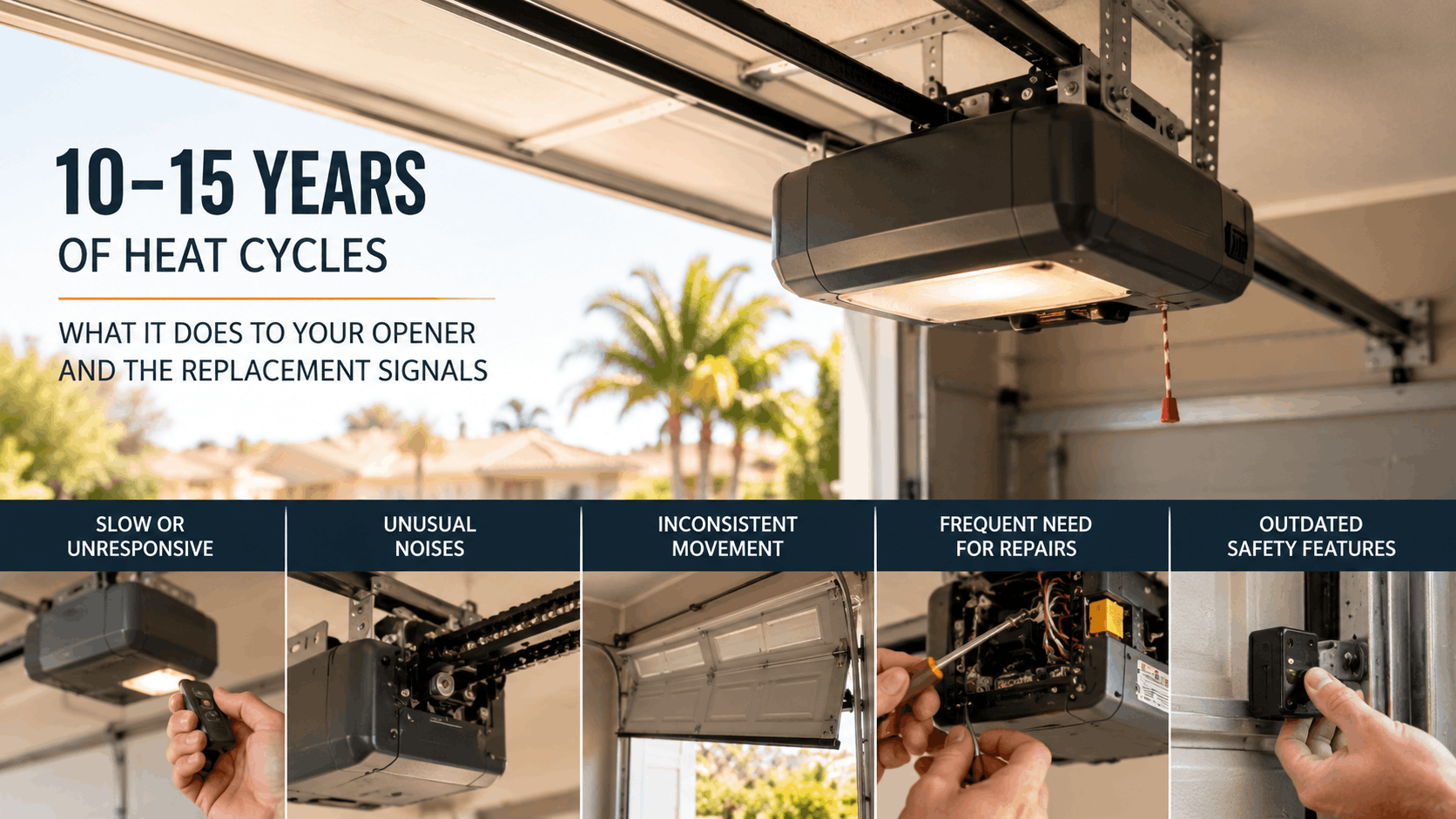
- Most garage door openers last 10-15 years, but Orange County heat and heavy daily use often push local units toward the lower end of that range.
- Repeated heat cycles wear down plastic motor gears, bake off lubricants, and crack circuit board solder joints over time.
- Early warning signs include grinding noises, slow or hesitant movement, intermittent remote failures, and the door reversing on hot afternoons.
- Two or three repairs on the same unit, discontinued parts, or missing modern safety features are clear signals to replace rather than repair.
- Keeping the garage cooler with insulation and ventilation, plus regular lubrication and door balancing, can add years of opener life.
- DC belt drive openers run cooler and quieter than old AC chain models, making them the best choice for hot Irvine garages.
- Battery backup is required on new California opener installations and keeps the door working during power outages.
- Urgent Garage Doors offers same-day diagnosis, honest repair-versus-replace advice, and warranty-backed installs across Orange County neighborhoods.
In This Article
It usually happens at the worst moment. A homeowner in Woodbridge backs the car out on a 95-degree August afternoon, hits the remote, and the garage door groans, hesitates, then quits halfway. After a summer of daily heat cycles, an opener that ran fine for a decade finally gives up. We get these calls all across Irvine once the temperatures climb.
The truth most people miss is that the heat did not break the opener overnight. It wore it down slowly, one hot day at a time, for years. Plastic gears, circuit boards, and grease inside the motor head all age sooner in a hot garage than they would in a cooler climate.
How Orange County Heat Affects Garage Door Openers?
Openers in cooler regions live an easy life compared to the ones we service here. In the Pacific Northwest, a garage might swing 15 degrees over a day. In Orange County, an attached garage can bake past 100 degrees in the afternoon and drop 30 degrees by night.
That daily swing is the problem. Heat cycles - the repeated warming and cooling of the parts inside the opener head - are what quietly age the motor and electronics. The Orange County climate is not extreme like the desert, but the steady summer stress adds up more than most homeowners expect.
- Longer hot seasons: Our warm stretch runs from May well into October, so openers get months of daily stress.
- Attached garages: Most Irvine homes share a wall with the living space, and the garage traps heat with little airflow.
- Afternoon sun: West-facing garage doors soak up direct sun during the hottest part of the day.
- Insulation gaps: Many older doors have no insulation, so the garage heats up like an oven.
What a Heat Cycle Actually Does to Motor Components
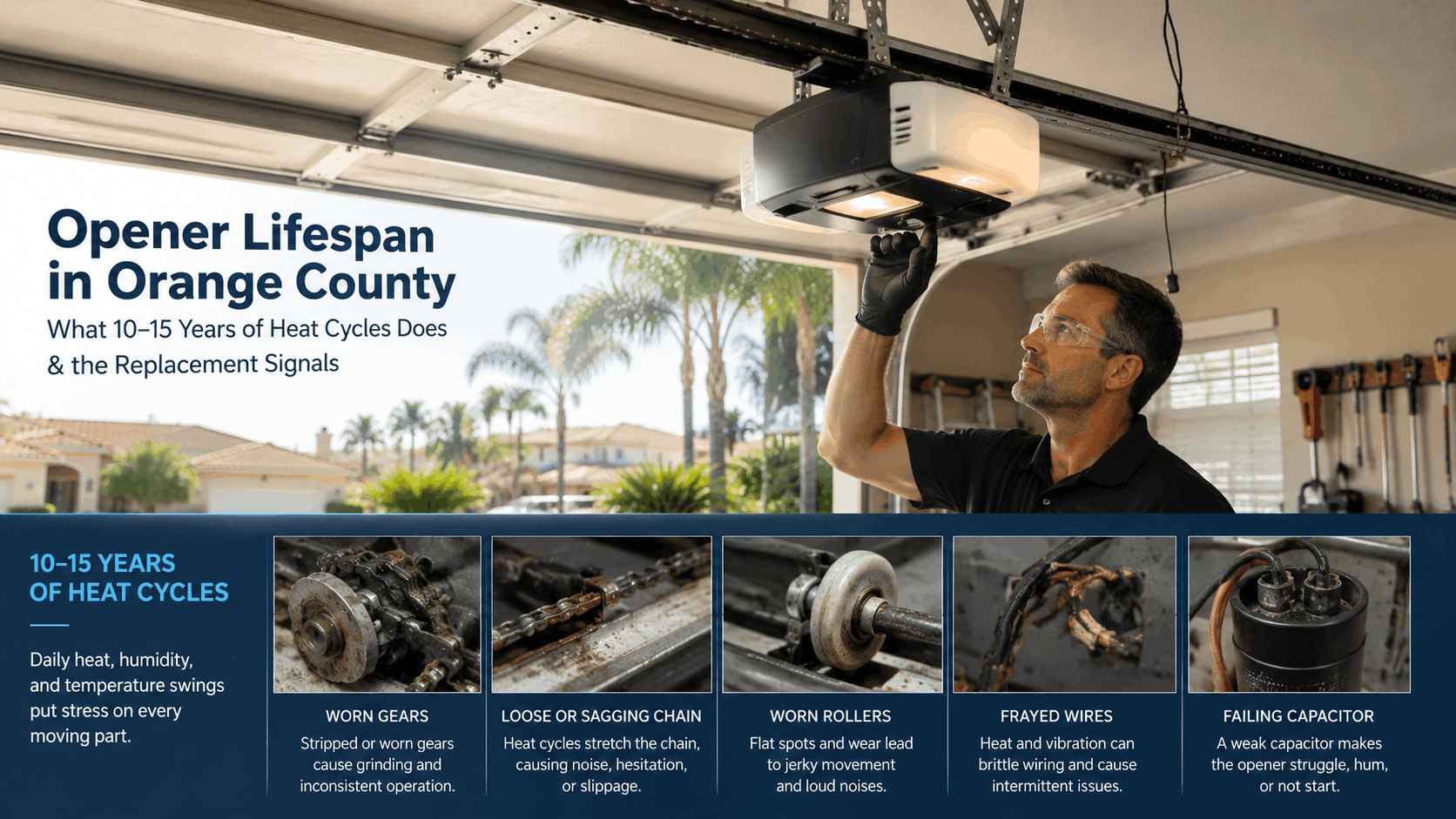
Inside every opener head sits a set of motor gears, a circuit board, and grease that keeps things moving. When the garage heats up, all of these parts expand. When it cools at night, they contract. Repeat that cycle a few thousand times and the wear starts to show.
Thermal expansion is hard on plastic. Most consumer openers use nylon or plastic drive gears because they run quietly and cost less. Heat makes those gears slightly soft, then cooling makes them brittle over the years, so the teeth wear down or strip much sooner than the maker intended.
The circuit board suffers too. Solder joints and small components expand and contract at different rates than the board itself. Over a decade of heat cycles, tiny cracks form in those joints, which is why so many older openers develop odd electrical glitches before they die outright.
Grease is the last casualty. The factory lubricant on the drive gear and rail thins out and bakes off in high heat. Once that grease is gone, metal and plastic grind together with no protection, and the motor has to work harder on every single cycle.
Why Garages in Irvine Get So Hot
Neighborhood layout matters more than people think. In parts of Woodbridge and Northwood, many homes were built with the garage facing west or southwest. Those doors take direct afternoon sun for hours, and the metal panels transfer that heat straight inside.
Attached garage temperature is the real killer. Because the garage is sealed to the house for energy efficiency, there is often very little ventilation. On a hot day, the trapped air can sit 15 to 25 degrees hotter than outside, with the opener hanging right up near the ceiling where heat collects.
We see this pattern in tract homes across Irvine. A garage with a single small vent, a dark-colored door, and no attic exhaust becomes a heat box by 3 p.m. The opener motor mounted at the peak of that space is sitting in the hottest air in the whole garage.
Homeowners in Woodbridge who need spring and cable service often ask why their opener wore out before a neighbor's. The answer is usually sun exposure and ventilation, not the brand of opener they bought.
The Difference Between Coastal and Inland Heat Stress
Not all heat stress is the same across Orange County. Near the coast, in areas closer to Newport Beach and the beach cities, coastal air brings humidity and salt. That salt air corrodes metal contacts, hinges, and springs, and moisture speeds up rust on the opener's internal hardware.
Inland heat behaves differently. In communities like Portola Springs, the air is drier and the daytime temperatures run higher. Dry inland heat bakes the grease out sooner and puts more thermal stress on plastic gears and boards, but it produces less corrosion than coastal salt exposure.
Both conditions shorten opener life, just through different paths. A coastal opener often fails from corroded contacts and rusted hardware, while an inland unit tends to fail from stripped gears and cracked solder joints. Knowing which stress your home faces helps predict what will wear out first.
Folks in Portola Springs looking at spring and cable repair deal with that dry inland heat, so we pay close attention to gear wear and lubrication when we inspect their systems.
Get Your Free Quote
Tell us about your garage door and we'll get back to you within 30 to 60 minutes.
Typical Opener Lifespan in Orange County Homes
Homeowners always want a number, so here it is: most garage door openers last 10 to 15 years. That range holds up well nationally, but local heat and heavy use push many Orange County openers toward the lower end of it.
Replacement timing depends on three things - the opener type, how hot the garage gets, and how many times the door cycles each day. A lightly used opener in a shaded garage might hit 18 years. A hard-working unit in a west-facing Irvine garage might tap out at 9.
The 10 to 15 Year Range Explained
The 10-15 year average comes from normal wear on the motor, gears, and electronics under typical use. Manufacturers design most residential openers around roughly 10,000 to 20,000 cycles of expected life. A cycle is one full open and one full close.
Do the math on daily cycles and the range makes sense. A family that opens the door four times a day runs about 1,460 cycles a year. At that pace, a 15,000-cycle opener would last around 10 years before the gears and motor reach their limit.
Heat compresses that timeline. When high garage temperatures wear out the grease and soften the gears, the opener may reach the end of its useful life well before it hits its rated cycle count. That is why we tell customers a decade is a realistic planning number here.
Regular care can push toward the top of that range. Openers that get an annual tune-up, fresh lubrication, and a balanced door consistently outlast neglected units by several years in our experience across Irvine.
How Drive Type Changes the Timeline
Chain drive openers are the old workhorses. They are durable and cheap, but the metal chain stretches over time and runs louder, and the vibration adds stress in a hot garage. Many chain units still reach 12 to 15 years if they are maintained.
Belt drive openers use a reinforced rubber belt instead of a chain. They run quieter and smoother, which reduces strain on the motor. In a hot garage, a quality belt drive with a DC motor often outlasts an older AC chain model because it generates less heat and vibration of its own.
Screw drive openers use a threaded steel rod to move the trolley. They have fewer moving parts, but the drive relies heavily on lubrication. In Orange County heat, the grease on a screw drive bakes off sooner, so these units can wear quickly if the lube is not refreshed.
When we handle a new opener installation, we usually steer heat-exposed garages toward a belt drive unit for exactly these reasons.
Cycle Count Versus Calendar Age
Two openers of the same age can be in totally different shape. Cycle count matters more than the calendar. A retired couple who leaves twice a day puts far less wear on an opener than a busy household with teenage drivers.
Usage frequency stacks up fast in a two-car home. Add parents commuting, kids driving to school and practice, and the door might cycle six to eight times a day. That is well over 2,000 cycles a year, which can retire an opener in seven or eight years even without heat.
We ask homeowners how often they really use the door before we recommend anything. A garage that doubles as the main entrance to the house often cycles more than the front door itself. That heavy use is the single biggest predictor of early opener failure.
If your household runs the door constantly, plan for replacement on the earlier side of the range and budget for it before the unit strands you.
Need Help in Irvine?
Urgent Garage Doors serves Irvine and all of Orange County.
Early Warning Signs an Opener Is Wearing Out
An opener rarely dies without warning. The failure builds for months or even years, and the small problems show up long before the total shutdown. Catching these warning signs early lets homeowners plan a replacement instead of scrambling during an emergency.
Most of the garage door problems we diagnose started as a noise or a hesitation the owner ignored. Paying attention to how the door behaves saves money and stress down the road.
Strange Noises and Grinding Sounds
Sound is the first clue. A healthy opener makes a steady, consistent hum. When you start hearing a grinding noise, that usually means the drive gear teeth are worn or the metal parts are rubbing without enough lubrication.
A stripped gear has its own signature. You hear the motor spinning and running, but the door does not move or moves only a little. That grinding-then-nothing sound almost always means the plastic drive gear inside the head has lost its teeth, a classic heat-related failure.
Clicking or rattling points to loose hardware or a struggling motor. Humming without much movement can mean the capacitor is failing. None of these sounds fix themselves, and each one is the opener telling you it is under strain.
If you catch odd noises early, an opener repair and troubleshooting visit can often pin down whether it is a cheap fix or a sign the unit is near its end.
Slow or Hesitant Movement
Speed changes tell a story. If the door used to open smoothly and now starts slowly or drags, the motor is working harder than it should. This often shows up worst on hot afternoons when heat has thinned the grease and softened the gears.
Door hesitation partway through the travel is another red flag. If the door pauses, jerks, or stutters as it moves, the opener is fighting resistance somewhere in the system. Sometimes that resistance is the opener, and sometimes it is an unbalanced door pulling on the motor.
Slow opening that gets worse as the day heats up is a telltale sign of a heat-stressed unit. The motor has less power to give when it is hot, so a marginal opener will limp along in the afternoon and run better in the cool morning.
When movement gets sluggish, it is worth checking both the opener and the door balance before deciding whether the motor itself is failing.
Intermittent Remote and Wall Button Failures
Few things frustrate homeowners more than a remote that works only sometimes. When the remote fires one day and does nothing the next, the culprit is often the aging circuit board inside the opener, not the remote battery.
Remote failure that comes and goes points to those cracked solder joints we mentioned earlier. Heat cycles break the tiny connections on the board, so the receiver picks up the signal inconsistently. Cold mornings might work while hot afternoons fail, or the reverse.
Wall button trouble tells the same tale. If both the remote and the hardwired wall button act up, the problem is inside the opener logic rather than in any single control. That is a strong signal the electronics are reaching the end.
Intermittent electrical faults rarely improve. Once a board starts glitching from heat damage, replacement of the board or the whole unit is usually the only lasting fix.
The Door Reversing for No Reason
A door that reverses on its own is unsettling and worth taking seriously. Sometimes the cause is dirty or misaligned safety sensors, which is an easy fix. Other times the cause is inside the opener itself.
Heat plays a role here. On hot afternoons, the photo-eye sensors and the opener's logic board can misread signals, telling the door to reverse when nothing is in the way. If the reversals cluster on the hottest days, heat-affected electronics are a likely suspect.
The door reversing can also mean the opener senses too much resistance, which loops back to door balance and spring tension. When the motor feels extra load, its safety logic assumes something is blocking the door and sends it back up.
We start with a safety sensor alignment check because that rules out the simple cause first. If the sensors are clean and aligned and the door still reverses, the logic board is likely the problem.
Clear Signals It Is Time to Replace, Not Repair
Repairs make sense up to a point. Past that point, pouring money into an aging opener is throwing good money after bad. Knowing where the repair vs replace line falls saves homeowners hundreds of dollars.
The decision usually comes down to a few clear signals. When you see these, replacement is almost always the smarter move over another round of repairs.
Repeated Repairs on the Same Unit
One repair is normal. A gear wears out, you replace it, and the opener runs for years more. That is a reasonable fix on a healthy unit that still has life left in it.
Repeat repairs change the math. Our rule of thumb is that two or three repairs on the same opener in a short span means the whole unit is wearing out. Fixing one worn part just shifts the strain to the next weakest part, which fails soon after.
The cost of repair adds up quickly. Two or three service visits with parts can approach the price of a brand-new opener with a warranty. At that point you are paying repair money for an old machine instead of buying reliability.
When we see a customer for the third fix on the same unit, we are honest about it. Spending on a new opener usually costs less over the next few years than nursing a dying one.
Parts No Longer Available
Openers do not last forever, and neither do their parts. Once a unit passes 12 to 15 years, manufacturers often stop making the boards and gears that fit it. Discontinued parts turn a simple repair into a scavenger hunt.
An old opener with a dead logic board is a common dead end. If the board is no longer produced and no aftermarket version exists, there is nothing to install. The only path forward is a new unit.
Even when a used part turns up online, it is a gamble. A salvaged board from another aging opener may fail within months, leaving you back where you started with more money spent. That is rarely worth it.
We keep track of which older models still have parts support. If your opener is one where parts have dried up, we will tell you plainly that repair is not a smart bet.
Missing Modern Safety Features
Safety standards have improved a lot over the years. Openers made before the mid-1990s may lack the photo eye sensors that stop the door from closing on a person, pet, or car. That is a serious safety gap.
Older units also predate rolling code security. A fixed-code opener uses the same signal every time, which is far easier for a thief to copy. Rolling code technology changes the code with every use, closing that door on garage break-ins. The Consumer Product Safety Commission has pushed these safety improvements for decades.
If your opener is old enough to lack these features, replacement is about more than convenience. A modern unit protects your family and your home in ways an aging one simply cannot.
We consider missing photo-eye sensors or fixed-code security a strong reason to replace rather than repair, regardless of how the motor sounds.
Need Help in Irvine?
Urgent Garage Doors serves Irvine and all of Orange County.
How to Extend Opener Life in a Hot Garage
Not every opener has to burn out early. A few practical steps can add years of life, especially in a garage that gets hot. Most of it comes down to keeping the garage cooler and reducing the load on the motor.
These are the same habits we recommend to customers who want the most out of their equipment. None of them are complicated, and they pay off over time.
Keeping the Garage Cooler in Summer
The single best thing you can do is lower the garage temperature. An insulated door makes a big difference because it blocks the heat that a bare metal door lets straight through. In hot, west-facing garages, garage insulation can drop the interior temperature by several degrees.
Ventilation helps too. Attic vents, a gable fan, or even a simple exhaust fan move hot air out instead of letting it pile up near the opener head at the ceiling. Better airflow keeps the motor and electronics running cooler.
For west-facing garages in places like Turtle Rock, reflective coverings on the door or windows cut down the afternoon solar load. Anything that reduces direct sun on the door lowers the heat that reaches the opener inside.
Homeowners in Turtle Rock who need spring and cable work often ask about cooling upgrades at the same time, and pairing insulation with an opener refresh is a smart combination.
Regular Lubrication and Hardware Checks
Lubrication is cheap insurance. When the rollers, hinges, springs, and drive chain are properly greased, the door moves with less resistance, and the motor works less on every cycle. A dry, squeaky door forces the opener to strain.
We recommend lubricating the moving parts a couple of times a year, more often in a hot garage where grease bakes off sooner. Use a proper garage door lubricant, not a general spray, because the right product holds up better in heat.
Hardware maintenance goes hand in hand with lubrication. Loose bolts, worn rollers, and tired hinges all add friction. Tightening the hardware and replacing worn rollers keeps the whole system moving freely and takes load off the opener.
A maintenance and upgrade service covers all of this in one visit, which is the easiest way to stay on top of it.
Balancing the Door to Reduce Motor Strain
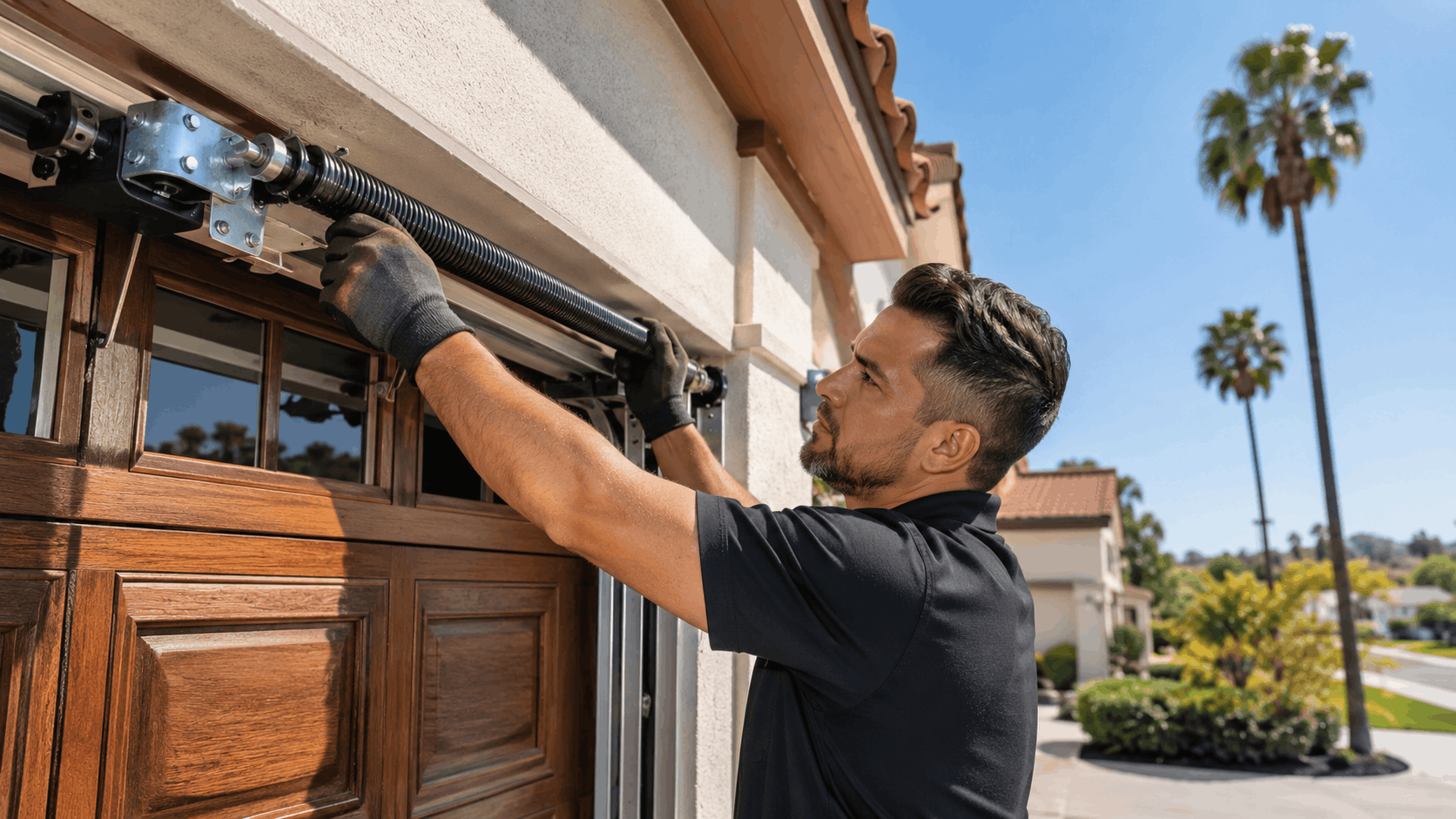
An unbalanced door is one of the more common reasons openers wear out early. The springs, not the opener, are supposed to carry the weight of the door. When spring tension is off, the motor ends up lifting weight it was never meant to lift.
The balance test is simple. Disconnect the opener, lift the door halfway by hand, and let go. A balanced door stays roughly in place. If it slams down or shoots up, the springs need adjustment.
A door that fails the balance test puts constant extra strain on the opener. Every cycle drains more from the motor, and in a hot garage that added load speeds up gear wear and overheating. Fixing the balance can add years to the opener's life.
Our team handles door balancing and tension adjustment as a routine service, and it is one of the highest-value things you can do for an aging opener.
Scheduling Yearly Professional Tune-Ups
An annual tune-up catches problems while they are still small. During a professional inspection, we check the gears, test the balance, lubricate the moving parts, and look for the early warning signs before they leave you stranded.
The value is in the timing. Finding a worn gear or a fraying cable during a planned visit is far cheaper and less stressful than dealing with it when the door quits on a busy morning. A tune-up turns surprise failures into scheduled fixes.
For homeowners in hot garages, once a year is the right cadence. Heat adds wear, so an annual check keeps the system healthy through each summer season.
A preventive maintenance plan makes this easy by putting the yearly inspection on a schedule so it never slips through the cracks.
Choosing a New Opener That Handles the Heat
When replacement time arrives, the model you pick makes a real difference in how long the next opener lasts. Some units simply handle Orange County heat better than others. Choosing well means fewer service calls down the road.
Here is what we steer homeowners toward when they need a new garage door opener that can take the summer.
DC Motors and Belt Drives for Longevity
Older AC chain drive openers run hot and loud. They work, but the motor generates its own heat and the chain adds vibration. In a garage that is already hot, that extra heat shortens the unit's life.
A DC motor runs cooler and draws less power. It also allows soft start and soft stop, which eases the door into motion instead of jerking it. That gentler operation reduces mechanical stress and helps the opener last longer.
Pair a DC motor with a belt drive opener and you get the best of both worlds. The reinforced belt runs quiet and smooth with almost no vibration, and the whole system produces less heat than an old chain unit. For hot Irvine garages, that combination consistently outlasts the alternatives.
This is why our default recommendation for a replacement opener in a heat-exposed garage is a DC belt drive model.
Battery Backup and Smart Features
Power outages happen, and a garage door you cannot open is a real headache during one. Battery backup keeps the opener working when the power is out, which matters during heat waves when the grid gets strained. In California, battery backup is also required on new residential opener installations.
Smart features add everyday convenience. A smart opener lets you check whether the door is closed from your phone and get alerts if it was left open. For families juggling busy schedules, that visibility is genuinely useful.
Smart connectivity also lets you grant access remotely, which is handy for deliveries or letting in a family member. It turns the opener from a simple motor into a controlled entry point for the home.
We set up smart WiFi opener and myQ configuration as part of installation so the features work right from day one.
Matching the Opener to Door Weight and Size
Not every opener fits every door. Horsepower and pull rating matter, especially for the heavier doors common in newer Irvine developments. An underpowered opener on a heavy door strains constantly and wears out fast.
Insulated steel and solid wood doors weigh far more than an old single-layer aluminum door. Door weight drives the horsepower you need. A half-horsepower unit may handle a light door fine but struggle badly under a heavy insulated one.
For most modern insulated doors, we recommend at least three-quarter horsepower, and often a full horsepower for larger or double doors. Matching the motor to the load means the opener runs within its comfort zone instead of maxing out on every cycle.
When we quote a new insulated steel door and opener together, we size the motor to the actual door so the whole system runs easy for years.
Need Help in Irvine?
Urgent Garage Doors serves Irvine and all of Orange County.
Why Irvine Homeowners Trust Urgent Garage Doors
Choosing who works on your garage matters as much as choosing the equipment. Urgent Garage Doors has spent years serving Irvine and the surrounding Orange County neighborhoods, and that local experience shows in every diagnosis we make.
We know these garages because we work in them every day. From opener replacement to full installs, our team brings hands-on knowledge of what local heat and use do to these systems.
Local Experience Across Orange County Neighborhoods
We have serviced openers from Great Park to Quail Hill to University Park, and everywhere in between. Each area has its own quirks - the newer builds near Great Park have heavy insulated doors, while some University Park homes have older systems that need special care.
That neighborhood-level knowledge speeds up our work. When we pull up to a home in Quail Hill, we already have a good idea of the door types, the common wear patterns, and the heat exposure that garage likely faces.
Local experience also means we know the HOA rules and building conditions across these communities. That helps us recommend solutions that fit both the home and the neighborhood standards.
Whether you are in central Irvine or one of the outer communities, our Irvine garage door team has almost certainly worked on a garage like yours.
Same-Day Diagnosis and Honest Recommendations
When an opener quits, waiting days for service is not an option. We offer same-day service for most opener problems so homeowners are not stuck with a door that will not move.
Our approach starts with an honest diagnosis. We test the opener, the door balance, and the sensors before we recommend anything. If a repair makes sense, we say so. If the unit is past saving, we tell you that too, with clear pricing either way.
We would rather earn a repeat customer with straight advice than push a replacement nobody needs. That honesty is why so many of our calls come from referrals across Irvine.
If your door will not budge, our same-day garage door repair gets a technician out fast to sort out what is wrong.
Quality Parts and Warranty-Backed Installs
The parts we install matter for how long the fix lasts. We use quality openers and components from trusted brands rather than the cheapest option, because a bargain part that fails in a year helps nobody.
Every new opener installation comes with warranty coverage. That protects your investment and gives you a clear path if anything goes wrong after we leave. We stand behind the work and the equipment.
Warranty-backed installs also mean we install to spec. Cutting corners voids coverage, so doing it right the first time is built into how we work.
You can reach our team through the contact page to ask about brands, warranty terms, or to book an install.
Final Thoughts
An opener in an Orange County garage lives a harder life than most people realize. Years of heat cycles wear down the gears, dry out the grease, and crack the electronics until a unit that should last 15 years quits at 10 or 11.
The good news is that the failure gives warning. Strange noises, slow movement, flaky remotes, and random reversals all signal that the end is near. Catch those signs early, keep the garage cooler, and stay on top of lubrication and balance, and you can push the opener toward the top of its lifespan.
When it is finally time to replace, a DC belt drive unit sized to your door will handle the heat far better than the old chain model it replaces. If your opener is showing its age, reach out to Urgent Garage Doors for an honest diagnosis and a clear recommendation. Call us or visit our contact page to schedule service across Irvine and Orange County.
Frequently Asked Questions
- How long should a garage door opener last in Orange County?
- Most garage door openers last 10 to 15 years, and that range holds true here. Local heat and heavy daily use tend to push Orange County openers toward the lower end, so a decade is a realistic planning number. A lightly used unit in a shaded, ventilated garage may reach the top of the range, while a hard-working opener in a hot, west-facing garage often taps out closer to nine or ten years.
- Can garage heat really damage an opener?
- Yes, heat is one of the biggest factors in early opener failure here. Repeated heat cycles expand and contract the plastic motor gears, causing them to soften and then crack over time. The high temperatures also bake the grease off the drive components and stress the circuit board, creating tiny cracks in solder joints. Over years of hot summers, this steady wear ages an opener sooner than it would in a cooler climate.
- What are the first signs my opener is failing?
- The earliest signs are usually noise and movement changes. Listen for grinding, humming, or clicking sounds that were not there before. Watch for the door opening slowly, hesitating, or jerking partway through its travel, especially on hot afternoons. Intermittent remote or wall button failures are another common early symptom, since a heat-damaged circuit board works some days and not others. Catching these signs early lets you plan a replacement instead of facing a surprise breakdown.
- Is it cheaper to repair or replace an old opener?
- It depends on the age and the number of repairs. One repair on a healthy opener under about ten years old is usually worth it. But if you have already paid for two or three fixes in a short span, or the unit is over 12 years old with hard-to-find parts, replacement often costs less over the next few years. A new opener also comes with a warranty and modern safety features the old one lacks.
- How much does opener replacement cost in Irvine?
- Opener replacement typically ranges from a few hundred dollars up to around a thousand, depending on the model and features. A basic chain drive sits at the low end, while a DC belt drive unit with battery backup and smart connectivity costs more. Door weight, horsepower needs, and any extra hardware also affect the total. We provide clear pricing before any work begins so there are no surprises on the bill.
- Which opener type lasts longest in hot garages?
- DC belt drive openers tend to hold up best in hot garages. The DC motor runs cooler than an older AC unit and offers soft start and soft stop, which reduces mechanical stress. The reinforced belt runs quiet and smooth with far less vibration than a metal chain. Together, these features generate less heat and wear, so a quality DC belt drive typically outlasts an older AC chain model in Orange County conditions.
- Does an insulated garage door help my opener last longer?
- Yes, insulation makes a real difference. An insulated door blocks much of the heat that a bare metal door lets straight through, which can lower the garage temperature by several degrees. A cooler garage means less thermal stress on the opener's gears, grease, and electronics, so those parts wear more slowly. In hot, west-facing garages, pairing an insulated door with attic ventilation is one of the best ways to extend opener life.
- How often should an opener be serviced?
- We recommend a professional tune-up once a year, especially in a hot garage where wear builds up sooner. A yearly inspection includes checking the gears, testing the door balance, lubricating the moving parts, aligning the safety sensors, and looking for early warning signs of failure. Catching a worn part during a planned visit is far cheaper and less stressful than dealing with a total breakdown at the worst possible moment.
- Why does my door reverse on hot afternoons?
- Heat can cause false reversals in a couple of ways. The photo-eye safety sensors and the opener's logic board can misread signals when they get hot, telling the door to reverse when nothing is in the way. Heat can also thin the grease and increase resistance in the door, which makes the opener sense too much load and reverse as a safety measure. If reversals cluster on the hottest days, heat-affected electronics or door balance are the likely causes.
- Can Urgent Garage Doors replace my opener the same day?
- In most cases, yes. We stock the common opener models homeowners need, so for standard replacements we can often diagnose and install the same day across Irvine. Complex jobs or special-order units may take a bit longer, but we will tell you upfront what to expect. Reach out to our team early in the day for the best chance of same-day service when your opener quits.
Licensed garage door repair professionals serving Irvine and Orange County.
Licensed in California · License #1055150
Why trust Urgent Garage Doors?
Founded in 2017, Urgent Garage Doors is a licensed and insured garage door services serving Irvine and Orange County. All content is reviewed by our licensed technicians.

Need Help in Irvine?
Urgent Garage Doors serves Irvine and all of Orange County.
Related Articles
How to Extend Garage Door Spring Life in Orange County Heat
Learn how Orange County heat wears down garage door springs and get practical tips to extend their life, from lubrication and cooling to when to repair or replace.
Garage Door Cable Replacement Cost Orange County: Why Pricing Varies by Neighborhood
Garage door cable replacement cost in Orange County varies by neighborhood. Learn why prices differ, real cost ranges, and how to get a fair, accurate quote.
Garage Door Sensor Repair Cost Orange County: Photo Eye Replacement Pricing
Real garage door sensor repair costs in Orange County, plus photo eye replacement pricing, warning signs, DIY checks, and how to pick an honest Irvine repair team.