Opener Repair vs Replacement: Logic Boards, Gear Kits, and Capacitors Priced Against a New Unit
Key Takeaways
- A humming motor with a still door usually points to a stripped gear or a bad capacitor, two of a common and affordable repairs.
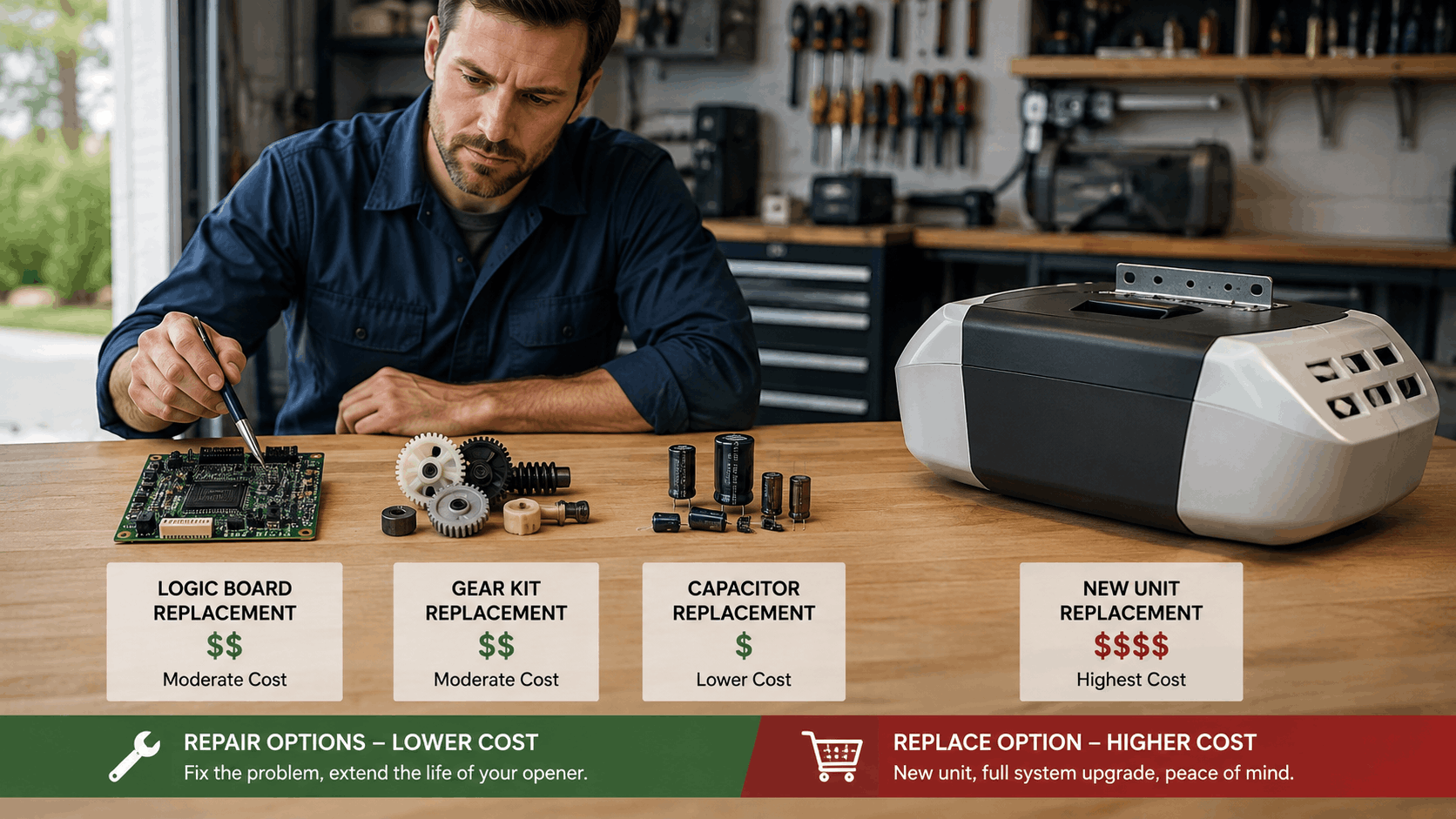
- Capacitor swaps run about $75-$150, gear kits $85-$200, and logic board replacements $150-$350 installed in the Irvine area.
- Use the 50 percent rule: if a repair costs more than half a new installed unit, replacement usually makes better sense.
- Opener age matters - units under eight years old are worth repairing, while those past 12 years with multiple failures should be replaced.
- California law requires battery backup on all new residential garage door openers, which is built into modern compliant units.
- Local conditions like coastal humidity in Portola Springs, summer heat along Culver Drive, and aging openers in Northwood affect wear patterns.
- Capacitor and logic board work carry real electric shock risk and should be left to a trained technician.
- Many opener repairs, including capacitors, gears, and sensors, can be completed same-day across Irvine neighborhoods.
In This Article
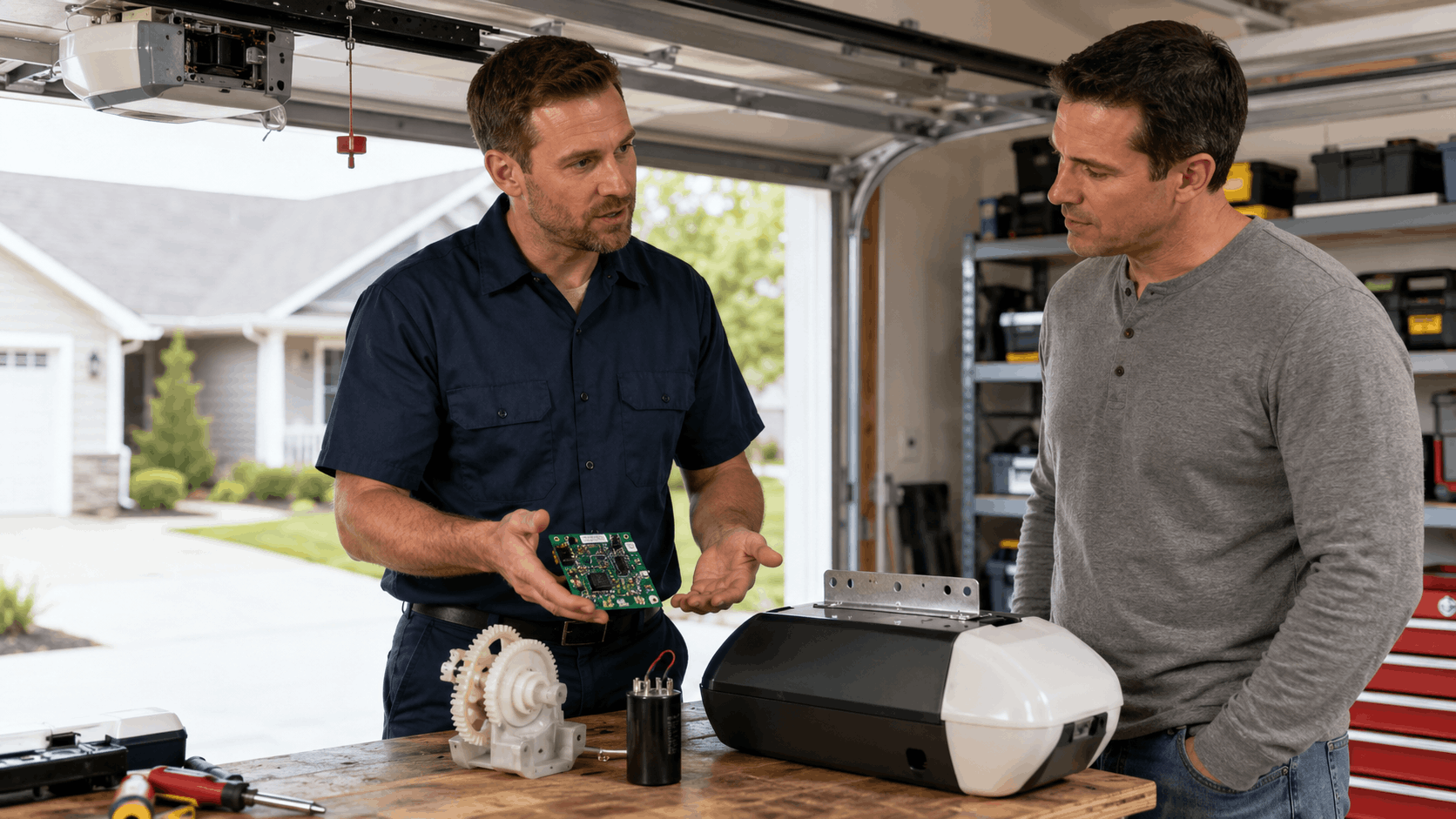
It usually happens on the worst possible morning. An Irvine homeowner near Woodbridge is already running late, hits the wall button, and the garage door just sits there. Maybe the motor hums. Maybe a light blinks. Maybe nothing happens at all, and the car is trapped inside while the school drop-off clock keeps ticking.
Our team gets these calls every week from all over the city. The first question is almost always the same: do I fix this thing, or do I finally replace it? That is a fair question, and the honest answer depends on which part failed and how much it costs against a brand new unit.
How to Tell If Your Opener Is Failing or Just Acting Up?
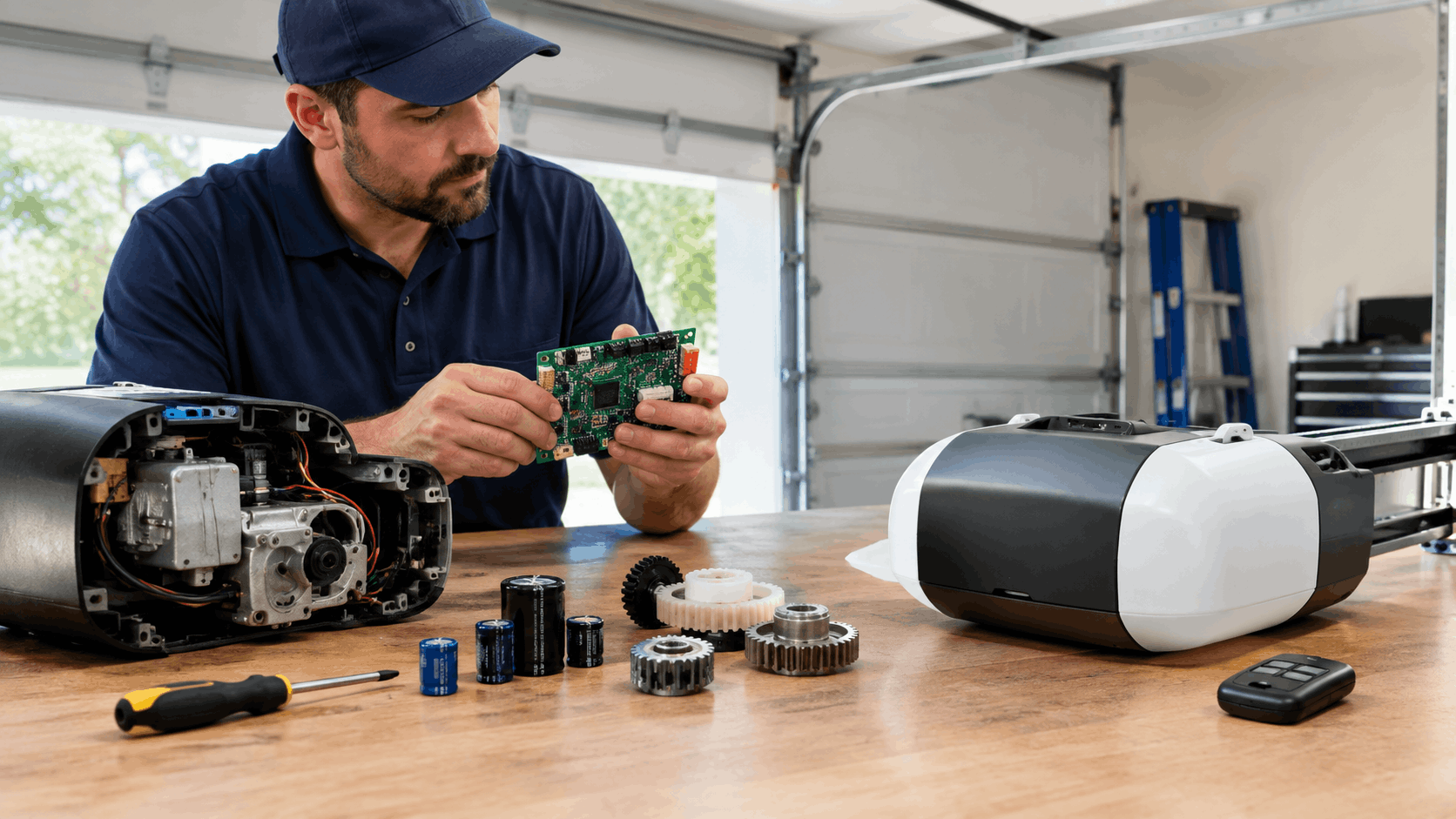
Not every hiccup means the opener is dying. Sometimes a quick garage door opener repair gets you years more life. Other times the symptoms point to a unit on its last legs. Learning to read the difference saves money and stress.
Below is a quick reference our technicians use when a customer describes what their opener is doing. It helps sort a cheap fix from a bigger problem before anyone spends a dime.
| Symptom | Likely Cause | Repair or Replace? |
|---|---|---|
| Motor hums, door won't move | Stripped gear or bad capacitor | Usually repair |
| Erratic behavior, random reversing | Failing logic board | Depends on age |
| Grinding metal noise | Worn gears or trolley | Repair |
| No response at all, no lights | Power or board failure | Diagnose first |
| Slow, loud operation on a 15+ year unit | General wear | Often replace |
Common Symptoms Homeowners Describe
A common complaint we hear is a motor humming but the door won't open. Folks describe it as the opener "trying" but never actually pulling the door up. That grinding noise or humming with no movement almost always traces back to a worn part inside the unit, not the door itself.
Another frequent one is the door that starts up, then reverses back down for no clear reason. People often think the opener is possessed. In reality, a safety sensor, a logic board glitch, or a spring problem is using the door's own safety system to protect it.
We also hear about openers that work fine one day and refuse the next. That intermittent behavior frustrates people because it is hard to show a technician. Writing down when it happens - cold mornings, hot afternoons, after a power flicker - gives us clues that speed up the diagnosis.
Some homeowners just report a new sound. A clunk, a squeal, or a rattle that was not there last month. Sounds matter, and a fresh noise is often the earliest warning that a part is starting to give out before it fails completely.
What the Noises and Lights Are Telling You
Modern openers talk to you through their lights. A steady blinking light on the motor head usually points to a specific fault code. On many brands, a certain number of flashes signals a sensor issue, while a different pattern points to a logic board or wiring fault.
A rapid clicking sound with no door movement often means the opener is getting power but the motor cannot turn. That points toward a capacitor or a seized motor. Our opener diagnostics start by matching the sound to the likely failed component.
Grinding is almost always mechanical. It tells us gears, the drive screw, or the trolley are worn. A high electrical buzz, on the other hand, leans toward the capacitor or motor windings. Learning which is which keeps a homeowner from replacing the wrong part.
When lights flash but the door stays put, the sensors near the floor are a common culprit. A quick check of the safety sensor alignment often clears a fault that looks far more serious than it is.
When It's the Opener vs the Door Itself
Here is a truth that surprises people: a lot of "opener" problems are really door problems. A broken spring makes the door so heavy the opener physically cannot lift it. The motor strains, hums, and gives up, so the opener takes the blame.
An off track door does the same thing. When the rollers jump the rail, the door binds and the opener cannot move it smoothly. Forcing it only damages the motor and gears, turning a spring or track repair into a much bigger bill.
This is why a real inspection matters. Before condemning any opener, our team disconnects the door and lifts it by hand. If the door is heavy or fights back, the problem is a spring or cable issue, not the opener at all.
Getting this diagnosis right is the difference between a $200 spring fix and a needless $500 opener replacement. We would rather find the cheaper real cause than sell someone a unit they did not need.
Age of the Unit and Why It Matters
A typical garage door opener lasts about 10 to 15 years. Some push past that with good care, and others quit early after hard use or power problems. Age is one of the biggest factors in the repair-or-replace math.
An old garage door opener at year 14 is a poor candidate for an expensive repair. Fixing one worn part often just means another fails a few months later. At that point the money is better spent on a new unit with a fresh warranty.
Newer units, say five to eight years old, usually deserve the repair. The rest of the machine has plenty of life left, so replacing a single failed part restores full function for a reasonable cost. Replacement age is a guideline, not a hard rule.
We also look at whether replacement parts are still made for the model. When a brand stops supporting an older opener, even a simple repair gets harder and pricier, which tips the decision toward a new install.
Get Your Free Quote
Tell us about your garage door and we'll get back to you within 30 to 60 minutes.
Logic Board Repairs: What They Cost and When They're Worth It
The logic board is the brain of the opener. When it fails, the machine does strange things - or nothing at all. A logic board replacement is one of the more involved repairs we handle, so it pays to understand the cost.
Here is a snapshot of what board work typically runs in the Irvine area, along with what drives the price up or down.
| Item | Typical Range | Notes |
|---|---|---|
| Logic board part only | $70 - $200 | Varies by brand |
| Board + labor installed | $150 - $350 | Common total |
| Obsolete or premium brands | $300 - $450+ | Limited availability |
What a Logic Board Does
The control board manages every function the opener performs. It reads the remote, listens to the wall button, watches the safety sensors, and tells the motor when to start and stop. Think of it as the traffic controller for the whole system.
When the logic board works right, everything feels automatic. Press a button, the door moves, the light turns on, the safety reverse works. All of that coordination runs through the opener electronics on that single board.
When the board starts failing, that coordination breaks down. The opener might ignore the remote, run the light at random, or reverse without cause. Because the board touches everything, a bad one causes symptoms that look like several different problems at once.
That is what makes board diagnosis tricky. Erratic, inconsistent behavior across multiple functions is the classic signature of a logic board on its way out, and it takes some testing to confirm.
Why Logic Boards Fail in Irvine Homes
Power surges are the number one board killer we see. A summer grid spike or a lightning-adjacent storm can fry the sensitive circuit board in an instant. Homes on older electrical service are more exposed to this.
Coastal humidity plays a part too. The marine layer that drifts inland toward Irvine carries moisture that settles on electronics over the years. That slow corrosion causes circuit board failure long before the mechanical parts wear out, especially in garages closer to the coast.
Pests are the surprise culprit. In older garages around University Park and Northwood, we find rodents that chew wiring and nest near the warm motor head. Damaged wiring confuses the board and can short it out entirely.
Heat is the fourth factor. Garages that bake all summer stress every electronic component. Over enough cycles, the constant heat and humidity swing wears the board's solder joints and capacitors down until it quits.
Typical Price Range for Board Replacement
For common brands, a logic board cost lands between $150 and $350 installed. The part itself is often $70 to $200, and the rest is labor and testing. That range covers the openers in the majority of Irvine homes.
Brand availability moves the number. Popular models with widely stocked parts sit at the low end. Discontinued units or premium brands with hard-to-find boards can push repair pricing past $400 once sourcing time is added.
Labor is usually modest because swapping a board is quick for a trained technician. The real cost is the part. We always price the exact board for your model before starting, so there are no surprises on the board replacement price.
If a board is genuinely obsolete, we tell the homeowner plainly. Sometimes chasing a rare part costs more than a whole new opener, and we would rather have that honest conversation up front.
When a Board Repair Makes Sense
A board repair is a smart, cost effective repair when the opener is otherwise healthy and under about eight years old. Replacing the brain of a solid machine restores full function for far less than a new unit.
The repair decision gets harder on older openers. If a 13-year-old unit needs a $300 board, that money buys most of a new opener with a warranty. In that case, replacement usually wins the opener value math.
We also weigh what else is aging. If the gears are worn and the board just failed, fixing only the board leaves other failures waiting. Stacking repairs on an old unit rarely pays off.
Our rule of thumb is simple. On a newer opener, fix the board. On an older one with other issues, put the repair money toward a new opener installation instead.
Need Help in Irvine?
Urgent Garage Doors serves Irvine and all of Orange County.
Gear Kits: The Common Fix We See
If we had to name the single most frequent opener repair in Irvine, it would be the gear kit. Those plastic gears inside the motor head wear down, and when they strip, the door stops moving even though the motor runs.
The good news is that gear kit replacement is usually affordable and quick. Here is what to watch for and what it costs.
Signs of a Stripped or Worn Gear
The tell-tale sign of a stripped gear is a humming motor with a still door. You press the button, the motor spins and buzzes, but the door does not move an inch. The gear that should transfer that spin to the drive is chewed up.
Another clue is plastic shavings on the garage floor below the motor head. Those little white or gray flakes are ground-up gear teeth. Finding them under the opener is a near-certain sign of stripped gear symptoms.
Sometimes the door moves partway then stops or slips. That happens when the gear is worn but not fully gone. The remaining teeth grab intermittently, so the door lurches and stalls instead of running smooth.
You may also hear a grinding or clunking right at the motor head during operation. That sound is the worn gear skipping. Once you hear it, the full failure is usually not far behind.
Why Gears Wear Out
Most opener gears are plastic by design. They are meant to be the sacrificial part that breaks first, protecting the pricier motor. So some gear wear over years of normal use is expected and normal.
A heavy door speeds things up. When springs weaken, the door gets harder to lift, and the opener strains against that extra weight every cycle. That added load grinds the plastic gears down much sooner than normal.
Lack of lubrication is another big cause. The gears and drive need proper grease to run smoothly. When that dries out, friction chews the teeth. Irvine's dry summer heat bakes the old grease off sooner, which is why we see a wave of stripped gears each summer.
Age and cycle count matter too. A door that opens and closes 10 times a day wears its gears out much sooner than one used five times. Busy family homes near the school zones burn through gears sooner than quiet ones.
Gear Kit Cost and Labor Time
A gear kit cost typically runs $85 to $200 installed for common opener brands. The gear kit part is inexpensive, often under $50, so most of the repair price is skilled labor and testing.
Labor time is short. A technician who knows the model can pull the motor head apart, swap the gears, re-grease everything, and reassemble in about 45 minutes to 90 minutes. Most gear jobs are done same-day in a single visit.
Because the parts are cheap and the job is fast, a gear kit is one of the better value repairs on the list. On a healthy opener under 10 years old, it is almost always worth doing rather than replacing the unit.
We also re-check the door balance during a gear job. If a heavy door caused the wear, we address the door balance and spring tension so the new gears do not strip out again.
Plastic vs Metal Gear Options
Plastic gears are the factory standard for a reason. They cost less, run quieter, and act as a fuse that fails before the motor does. For most homeowners, a quality plastic gear kit is the right replacement choice.
Metal gears exist and offer more durability. They resist stripping under heavy loads and last longer in high-cycle situations. Some commercial or very heavy residential doors benefit from the extra strength.
The tradeoff is that metal gears remove the protective fuse effect. If the door jams, a metal gear may transfer that stress into the motor itself, causing a costlier failure. They also run a bit louder.
For the typical Irvine home, we usually recommend matching the factory plastic gear or a good aftermarket equivalent. We only steer toward metal when the door weight or usage genuinely calls for the extra gear durability.
Capacitor Replacement: A Small Part with a Big Job
The capacitor is a small cylinder inside the motor head that does a big job. When it fails, the opener often makes noise but cannot start the motor. It is also usually the cheapest fix on this entire list.
What the Capacitor Does
The capacitor stores an electrical charge and releases it in a burst. That burst gives the opener motor the jolt it needs to start turning from a dead stop. Without it, the motor has no kick to get going.
Think of it like the starter on a car. The motor may be perfectly fine, but if there is nothing to spin it up, it just sits and hums. The capacitor provides that initial push on every single cycle.
Once the motor is running, it can carry itself. But that first moment of motor start is where the capacitor earns its keep. A weak or dead one leaves the motor stalled at the starting line.
Because it is such a small opener motor component, people are often surprised that something this cheap can shut the whole system down. But it is a common and very fixable failure.
Symptoms of a Bad Capacitor
The classic bad capacitor symptom is a motor that hums or buzzes but will not start. It sounds a lot like a stripped gear, which is why a proper diagnosis matters before ordering parts.
A buzzing motor that struggles to start, especially in cold or after sitting, points toward the capacitor losing its charge capacity. Some units start on the second or third try as the failing capacitor barely manages a weak jolt.
A burning smell is a serious warning sign. A failed capacitor can overheat, and that acrid electrical smell means it may have shorted or vented. If you smell burning, cut power to the opener and call for service.
You might also see a bulged or leaking capacitor if you look inside the motor head. A swollen top or oily residue confirms it is done. That said, testing it safely is a job for a technician, not a curious homeowner.
Cost of a Capacitor Swap
A capacitor cost is the lightest on the list. The part itself is often $10 to $30, and installed with labor the total usually lands around $75 to $150. For many homeowners this is the cheap repair they were hoping for.
Because the part is so inexpensive, nearly all of the opener repair price is the technician's time and skill to diagnose and safely install it. But even with labor, it stays budget-friendly compared to gears or boards.
When a capacitor is the only issue on an otherwise good opener, this repair is a clear win. It brings a dead-sounding unit back to life for the price of a nice dinner out.
The catch is that the humming symptom overlaps with stripped gears. That is exactly why we test before quoting, so you do not pay for a capacitor when the real problem is a gear, or the reverse.
Safety Warnings About DIY Capacitor Work
Here is the serious part. A capacitor stores an electrical charge even after the opener is unplugged. That stored charge can deliver a painful and dangerous electric shock if you touch the terminals wrong.
This is not like changing a light bulb. Discharging a capacitor safely requires the right method and respect for the risk. Every year people get hurt trying to swap one without knowing this, and it is not worth the danger.
Our DIY warning is straightforward: leave capacitor work to a pro. The part is cheap and the labor is reasonable, so the money you might save doing it yourself is not worth a trip to the ER.
The same caution applies to logic board work, where mains voltage is present. For anything touching the electronics inside the motor head, professional opener repair and troubleshooting is the safe path.
The Cost of a Brand New Opener
Sometimes replacement is simply the better move. Knowing what a new garage door opener costs in the Irvine area lets you weigh it against the repair. Here is the full picture, unit and install included.
Price Ranges by Opener Type
Chain drive openers are the budget choice, usually $250 to $450 installed. They are reliable and strong but louder, which matters if a bedroom sits above the garage. For detached garages, the noise is a non-issue.
Belt drive openers run about $350 to $600 installed. They trade the metal chain for a rubber belt, so they run much quieter and smoother. This is the most popular pick for attached garages in Irvine's newer homes.
Direct drive and jackshaft-style openers land at the higher end, roughly $450 to $800 installed. They have the fewest moving parts and the quietest operation, and wall-mount jackshaft units free up ceiling space. The opener price range widens with smart features added.
Every home is different, so these are starting ranges. Door weight, existing wiring, and the features you choose all shift the final number. A professional installation quote pins it down exactly.
Installation and Disposal Costs
Installation labor is usually bundled into the prices above, but it helps to know what it covers. Mounting the new unit, wiring the sensors, programming remotes, and testing the safety reverse all take skilled time.
Removing and hauling away the old opener is part of the job too. Old opener disposal is often included in our install, though some outfits charge a small separate fee. We fold it in so there is no surprise line item.
If the old wiring or mounting bracket needs work, that can add modest labor fees. Older garages sometimes need a fresh outlet or reinforced mount, which we flag before starting so the quote stays honest.
All in, most Irvine homeowners see a single installed price that covers the unit, labor, disposal, and basic programming. That bundled number is the one to compare against a repair.
Smart Features Worth Paying For
A smart opener adds real convenience for busy families. Wi-Fi control lets you open, close, and check the door status from your phone anywhere. No more driving back to see if you left it open.
App access also sends alerts when the door opens, which parents near the Irvine school zones appreciate. You get a ping when the kids get home and a warning if the door was left up overnight.
Battery backup is another feature worth having, and in California it is not optional at all: SB 969 has required it on every residential opener sold or installed since 1 July 2019. A unit with battery backup keeps working during the power outages that hit during summer heat waves and winter storms.
If smart access appeals to you, our team handles smart Wi-Fi opener and MyQ setup so the app, alerts, and remotes all work together from day one.
California Battery Backup Rules
The rule is Senate Bill 969, and it has applied since 1 July 2019: every residential automatic garage door opener sold or installed in California must include a battery backup designed to work during an outage. A violation carries a $1,000 civil penalty, and a replacement door may not be connected to an opener that does not comply. The rule came from the 2017 Northern California wildfires, when power failures trapped people behind doors they could not lift. Every new opener sold and installed in the state must comply.
For buyers, this means a brand new opener will include a battery backup system by default. It slightly raises the base price compared to older non-backup units, but it is not optional and it is genuinely useful during outages.
You can read the specifics of the requirement through the California Energy Commission and related state building code resources. The short version is that compliant openers are now the standard.
Our installs always meet the current California code, so homeowners never have to worry about buying a unit that falls short of the opener requirements. Compliance is built into what we sell.
Need Help in Irvine?
Urgent Garage Doors serves Irvine and all of Orange County.
Repair vs Replace: Running the Numbers
Now for the decision itself. The repair vs replace choice comes down to a clear cost comparison. With the price ranges above, any Irvine homeowner can run the numbers and make a confident opener decision.
| Scenario | Repair Cost | Best Move |
|---|---|---|
| Capacitor on 6-year-old unit | $75 - $150 | Repair |
| Gear kit on 8-year-old unit | $85 - $200 | Repair |
| Logic board on 13-year-old unit | $300+ | Replace |
| Board + gears on 12-year-old unit | $400+ | Replace |
The 50 Percent Rule
The simplest guideline is the 50 percent rule. If a repair costs more than 50 percent of the price of a new unit installed, replacement usually wins. It is the same logic mechanics use on old cars.
Say a new opener runs $400 installed. A repair over about $200 crosses that repair threshold. At that point, spending a little more on a fresh unit with a warranty makes better long-term sense than sinking money into an aging machine.
The rule works because it captures replacement value. A repair only buys you the remaining life of an old unit, while a new opener resets the clock entirely. The closer the repair gets to 50 percent of the new price, the worse that trade looks.
It is a guideline, not gospel. A minor repair on a nearly new opener is a no-brainer fix. But when the numbers get close, the 50 percent rule points most people the right direction.
Factoring in Reliability and Warranty
Cost is not the only number that matters. A new opener comes with a warranty, often several years on parts and the motor. That coverage protects you from paying again if something fails early.
Reliability has real value too. An old unit that just needed one repair is statistically likely to need another soon. The rest of its parts are the same age as the one that just failed.
A new opener means fewer future repairs and fewer surprise mornings with a stuck door. When you factor in the repair calls you avoid over the next several years, replacement often pencils out better than the sticker prices alone suggest.
The opener warranty also covers the labor on many issues during its term. That peace against future repair bills is worth including in your math, especially on a unit already past the 10-year mark.
When Multiple Parts Fail at Once
Stacked repairs are the clearest signal to replace. When a technician finds a bad logic board plus worn gears on the same visit, fixing both often costs more than a whole new unit.
Multiple part failure usually means the opener is simply worn out. One component failing can be bad luck. Two or three failing together points to a machine that has reached the end of its service life.
We see this most on units 12 years and older. The board fails, we open it up, and the gears are already chewed and the capacitor is weak. Chasing each part one at a time just delays the inevitable replace opener decision.
In these cases we lay out both totals plainly. Almost always, the combined repair cost is close enough to a new install that starting fresh is the smarter spend.
Energy Use and Noise as Hidden Factors
Older openers hide costs that do not show up on a repair quote. They run louder, which matters a lot in Irvine's dense neighborhoods where garages sit close to bedrooms and neighbors.
A quiet opener with a belt drive and modern motor is dramatically softer than a 15-year-old chain unit. For families with a bedroom over the garage, that noise reduction alone can justify an upgrade.
Energy efficiency is another quiet factor. Newer motors and standby modes draw less power than older units that idle inefficiently. Over years, a more efficient opener trims a little off the electric bill.
These are not huge dollars, but they tilt a close decision. When repair and replace costs sit near each other, the comfort of a quiet, efficient unit often makes replacement the more satisfying choice.
Local Conditions That Affect Openers in Irvine
Openers do not wear the same everywhere. Irvine's mix of neighborhoods, climate, and home ages creates specific patterns we see on the job every week. Local conditions matter more than most homeowners realize.
Older Homes in Northwood and University Park
The established neighborhoods of Northwood and University Park have some of the oldest garages in the city. Many still run the original opener that came with the home decades ago.
These older openers are prime candidates for updates. Parts get harder to find, the units run loud, and they lack modern safety and battery backup features. When one fails here, replacement often makes more sense than a repair.
We also see more pest-related wiring damage and worn gears in these garages simply due to age. The mechanical parts have logged tens of thousands of cycles, so multiple failures on one visit are common.
For homeowners in these areas weighing an upgrade, our maintenance and upgrade services can extend the life of a good door while modernizing the opener that drives it.
Coastal Air and Newer Builds in Great Park and Portola Springs
The newer communities around Great Park and Portola Springs deal with a different issue. Coastal air and marine layer humidity drift inland and settle on opener electronics over time.
That moisture speeds up corrosion on logic boards and connections. Even in newer homes, we find boards aging sooner than the mechanical parts because of the salt-tinged humidity in the morning air.
These HOA communities also set standards for garage appearance and sometimes opener features. Battery backup and quiet operation are common expectations in these newer builds, which shapes what homeowners choose when replacing.
Residents in Portola Springs can find neighborhood-specific help through our Portola Springs garage door service, tuned to the local homes and HOA expectations there.
Summer Heat Along Culver Drive and Jamboree Road
Garages along the main corridors like Culver Drive and Jamboree Road get hot in summer. West-facing and unshaded garages can climb well past comfortable temperatures during peak afternoon heat.
That heat is hard on capacitors. Electrical components hate high temperatures, and a capacitor already weakening will often fail first on the hottest days of the year. We see a clear spike in capacitor calls each summer.
Heat also bakes the grease off gears sooner, leading to the stripped-gear humming we described earlier. The dry summer combined with a hot garage is a one-two punch on the mechanical parts.
Keeping the opener lubricated and having it checked before summer helps. A quick service visit ahead of the heat can catch a weak capacitor before it strands your car in the garage on a 95-degree afternoon.
HOA Rules and Permit Considerations
Many Irvine communities are governed by HOAs with rules about garage doors and equipment. While openers themselves are usually inside the garage and less regulated, related door changes often need HOA approval.
The city building department also has guidelines, and SB 969 drives the battery backup requirement on new openers. A reputable installer handles these details so your new unit meets code and community standards.
You can check general permit and code information through the City of Irvine resources. For most opener swaps the process is simple, but larger door projects may involve more steps.
Our team knows the local Irvine HOA patterns and building department expectations. We make sure any install we do lines up with both, so homeowners avoid compliance headaches down the road.
Need Help in Irvine?
Urgent Garage Doors serves Irvine and all of Orange County.
How Our Team Handles Opener Repairs and Replacements
When you call us, the goal is to solve the real problem, not to sell the biggest ticket. Our opener repair service across Irvine starts with an honest look and clear options.
The Inspection and Honest Quote Process
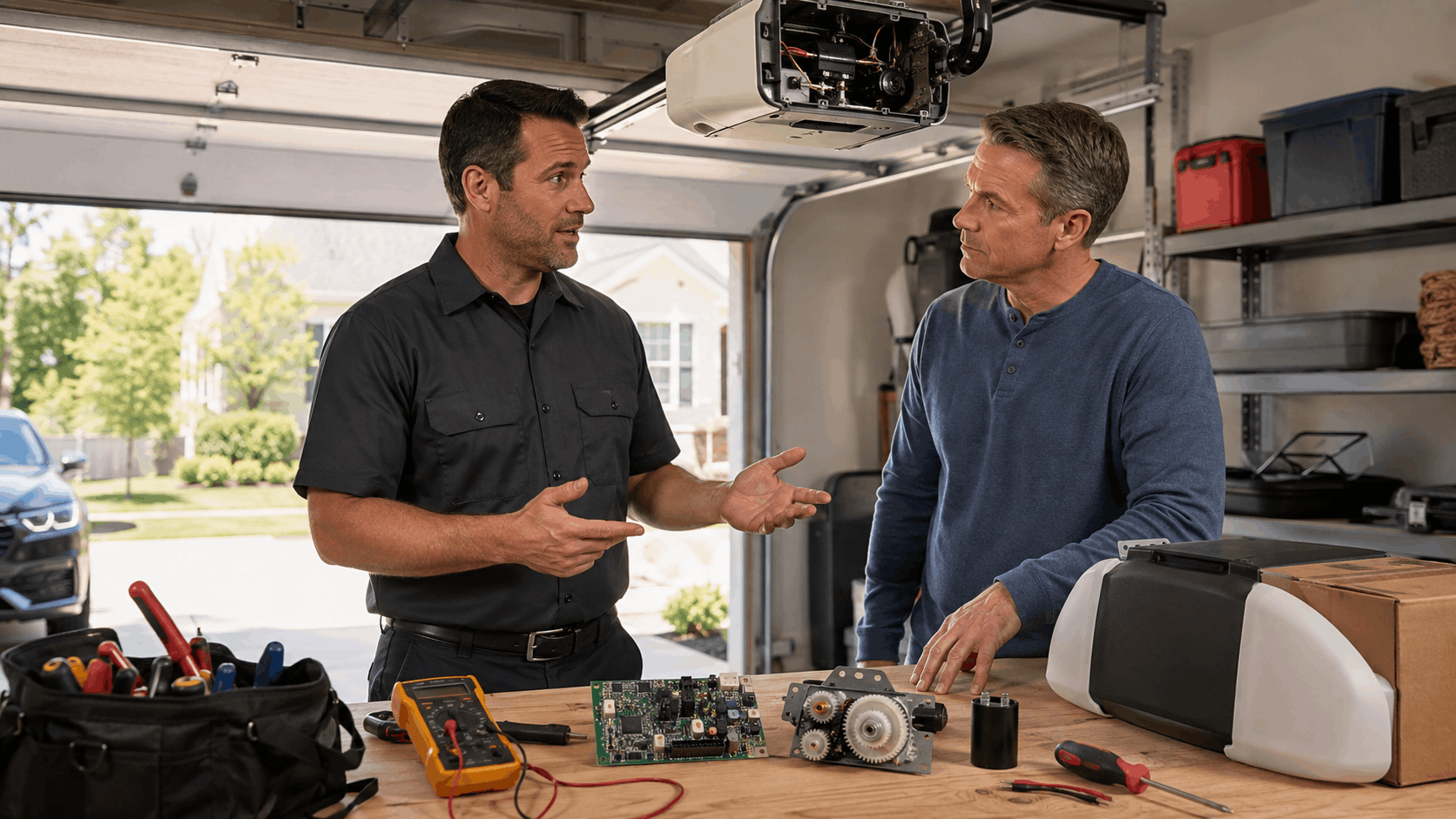
Every visit starts with a real inspection. We disconnect the door, test the balance, check the springs, and run the opener through its cycle. That tells us whether the fault is the opener or the door itself.
Only after we know the true cause do we talk price. We show the homeowner what failed, explain the repair and replace options, and give an honest quote for each. No pressure, no scare tactics.
If a $100 capacitor solves it, we say so, even when a new opener would be a bigger sale. Building trust with Irvine neighbors matters more to us than a single invoice.
When replacement genuinely makes more sense, we explain exactly why with the numbers in front of you. The diagnosis drives the recommendation, not the other way around.
Same-Day Repairs Across Irvine
A stuck garage door is not something most people can wait a week on. That is why we offer same day repair across Irvine neighborhoods whenever our schedule allows.
From Woodbridge to Turtle Rock to the newer Great Park villages, our fast response keeps travel times short. Being a local service means we are usually not far from your door when you call.
Common repairs - capacitors, gears, sensors, and many boards - we complete in a single visit because we carry the common parts on the truck. That gets your door working again the same day.
For urgent situations like a car trapped inside, our same-day garage door repair line prioritizes getting you moving again quickly.
Parts and Brands We Work With
We service and install the major opener brands common in Irvine homes, including LiftMaster, Chamberlain, Genie, and others. Working across brands means we can repair what you have or match a new unit to your needs.
For repairs, we use quality parts - proper gear kits, correct-rated capacitors, and genuine or high-grade equivalent logic boards. Cheap parts fail fast, so we stock trusted brands that last.
When it comes to new installs, we help homeowners pick the right drive type and feature set for their garage. Belt drive for quiet attached garages, smart features for busy families, and always code-compliant battery backup.
Because we know these brands well, our diagnosis is quick and our repairs stick. Familiarity with the equipment translates directly into fewer callbacks and longer-lasting fixes.
Warranty and Follow-Up Support
Our work comes with a warranty. Repairs are backed so that if a part we installed fails within the covered period, we make it right without another charge for that repair.
New opener installs carry both the manufacturer warranty and our labor warranty. That layered coverage means the unit and the installation are both protected for years after we drive away.
Follow-up matters to us. If something feels off after a visit, a quick call brings us back to check it. We would rather fix a small issue than leave a neighbor unhappy.
That warranty is part of why so many Irvine homeowners call us again and refer us to friends. Standing behind the work is how a local company earns a lasting reputation. You can always reach us through our contact page.
Final Thoughts
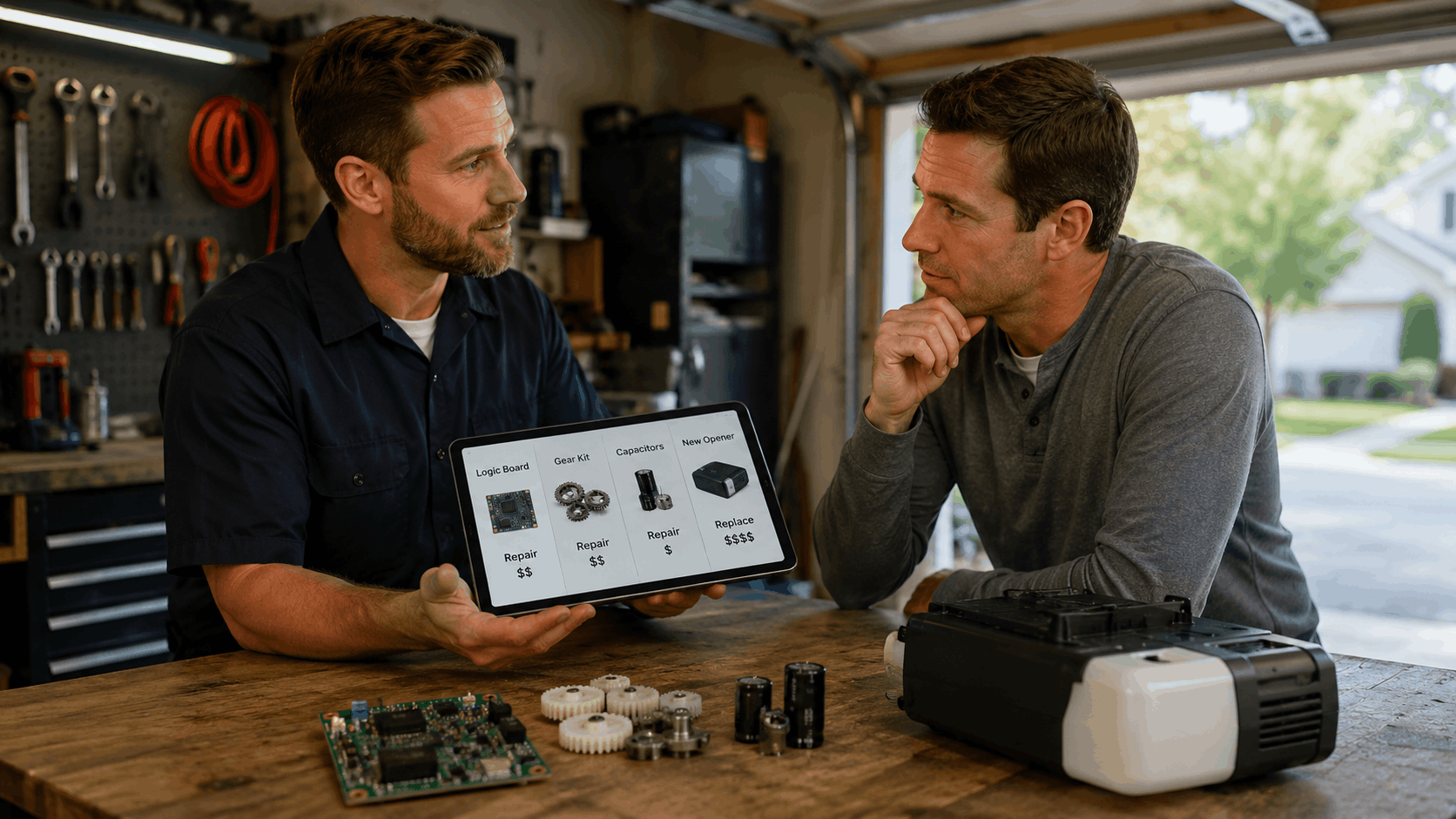
The repair-versus-replace question is not as hard as it feels at 7 a.m. with a stuck door. Match the symptom to the part, price the repair, and compare it against a new unit using the 50 percent rule.
Capacitors are cheap, gear kits are affordable, and logic boards land in the middle. On a newer opener, fixing one part is smart. On an older unit with multiple failures, a new opener with a warranty and battery backup usually wins.
If your opener is grinding, humming, or refusing to cooperate anywhere in Irvine, our team is ready with an honest inspection and clear options. Call us or reach out through our contact page for a same-day look and a straight answer on repair or replacement.
Frequently Asked Questions
- How do I know if my opener needs repair or replacement?
- Start with the symptom and the age of the unit. A cheap fix like a capacitor or gear kit on an opener under eight years old is worth repairing. Use the 50 percent rule: if the repair costs more than half a new installed unit, or if multiple parts have failed, replacement usually wins. An honest inspection confirms which path saves you the most.
- How much does it cost to replace a logic board?
- For common opener brands in Irvine, a logic board replacement runs about $150 to $350 installed, including parts and labor. The board itself is often $70 to $200. Obsolete or premium brands with hard-to-find boards can push the total past $400. On an older unit, that price often makes a new opener the smarter buy instead.
- Why is my motor humming but the door won't move?
- A humming motor with a still door almost always means one of two things: a stripped gear or a bad capacitor. If you see plastic shavings under the motor head, it is likely the gears. If the motor buzzes and strains, it may be the capacitor failing to give the motor its starting jolt. A quick test tells us which.
- Is a capacitor repair cheaper than buying a new opener?
- Yes, by a wide margin. A capacitor swap usually costs about $75 to $150 installed, while a new opener runs several hundred dollars. On an otherwise healthy opener, replacing a bad capacitor is the most budget-friendly fix available. It is only not worth it when the opener is very old or has other failing parts alongside it.
- How long does a garage door opener last?
- A typical garage door opener lasts about 10 to 15 years. Heavy daily use, an unbalanced or heavy door, power surges, and hot humid garages all shorten that lifespan. Well-maintained units with occasional lubrication and balance checks reach the top of that range. Once an opener passes 12 years and starts failing parts, replacement usually makes more sense than repairs.
- Do new openers in California need a battery backup?
- Yes. Senate Bill 969 has required battery backup on every residential garage door opener sold or installed in California since 1 July 2019, with a $1,000 civil penalty for a violation. An opener already in service can stay; the requirement applies when one is sold or installed. The rule exists so people can still open their doors during power outages, which became a serious safety issue during wildfire seasons. Any new opener we sell and install includes a compliant battery backup system, so buyers are covered by code automatically.
- Can I fix my garage door opener myself?
- Some tasks are safe, like replacing remote batteries, cleaning safety sensors, or lubricating a chain. Capacitor and logic board work are not. A capacitor stores a dangerous electrical charge even when unplugged, and board work involves mains voltage. Those repairs carry a real shock risk, so we recommend leaving anything inside the motor head to a trained technician.
- How fast can someone repair my opener in Irvine?
- In most cases, same day. We carry common parts like capacitors, gear kits, and sensors on the truck, so many repairs finish in a single visit. Response windows vary with the day's schedule and your location, but our local coverage across Irvine neighborhoods keeps travel times short. For trapped cars, we prioritize emergency same-day calls.
- Will a new opener work with my existing garage door?
- Usually, yes, as long as the opener is rated for your door's weight and type. Heavier doors need a stronger motor, and sectional doors work with standard openers while some specialty doors need specific units. We check the door weight, balance, and track before installing so the new opener matches and lifts the door safely.
- Does opener replacement come with a warranty?
- Yes. New openers carry a manufacturer warranty, often several years on the motor and parts, and we back the installation with our own labor warranty. That combined coverage protects both the unit and the work. If something fails during the covered period, a quick call brings us back to make it right at no extra charge for that issue.
Licensed garage door repair professionals serving Irvine and Orange County.
Licensed in California · License #1055150
Why trust Urgent Garage Doors?
Founded in 2017, Urgent Garage Doors is a licensed and insured garage door services serving Irvine and Orange County. All content is reviewed by our licensed technicians.

Need Help in Irvine?
Urgent Garage Doors serves Irvine and all of Orange County.
Related Articles
Garage Door Opener Replacement Cost OC: LiftMaster vs Genie vs Chamberlain Pricing
Real garage door opener replacement cost in Orange County compared across LiftMaster, Genie, and Chamberlain, with installed pricing, features, and brand advice.
Garage Door Sensor Repair Cost Orange County: Photo Eye Replacement Pricing
Real garage door sensor repair costs in Orange County, plus photo eye replacement pricing, warning signs, DIY checks, and how to pick an honest Irvine repair team.
What Opener Installation Costs in Orange County - Unit, Labor, Rails, and Haul-Away Itemized
A clear, itemized breakdown of opener installation costs in Orange County - covering the unit, labor, rails, and haul-away so Irvine homeowners know exactly what they pay for.