Quiet Garage Door Openers for Tustin Townhomes With Shared Walls
Key Takeaways
- Attached and semi-attached townhomes in Peppertree and Laurelwood share walls and ceilings with living space, so opener noise and vibration travel into the neighbor's unit.
- Belt drives are quieter than chain drives and suit rooms above the garage, while wall-mounted jackshaft units keep the motor off shared ceiling joists.
- Many original openers in these 1970s-era districts are noisy chain drives, usually replaced rather than reinstalled in shared-wall homes.
- Quiet nylon rollers, tightened hinges and bearings, and good vibration isolation at the mounting cut the noise the motor does not make.
- On association-governed Davis-Stirling streets, confirm door ownership and review rules before ordering, since a door fitted without approval can be removed at the owner's cost.
- SB 969 requires battery backup on every residential opener sold or installed in California since July 1 2019, so it comes standard on a new install, not as a paid upgrade.
- Opener installation typically runs $250 to $600 in Orange County, with smart Wi-Fi and MyQ setup $150 to $300 and quiet roller upgrades $150 to $300.
- North Tustin is unincorporated, so its permits are county permits, not City of Tustin ones; confirm the permit position for the specific address.
In This Article
Picture a townhome owner in Peppertree or Laurelwood, coffee in hand, hearing the neighbor's garage opener grind to life at 6 a.m. The metal-on-metal rattle of an old chain drive travels straight through the shared wall and into the bedroom next door. In an attached or semi-attached home, that noise is not just the neighbor's problem. It is the whole building's problem.
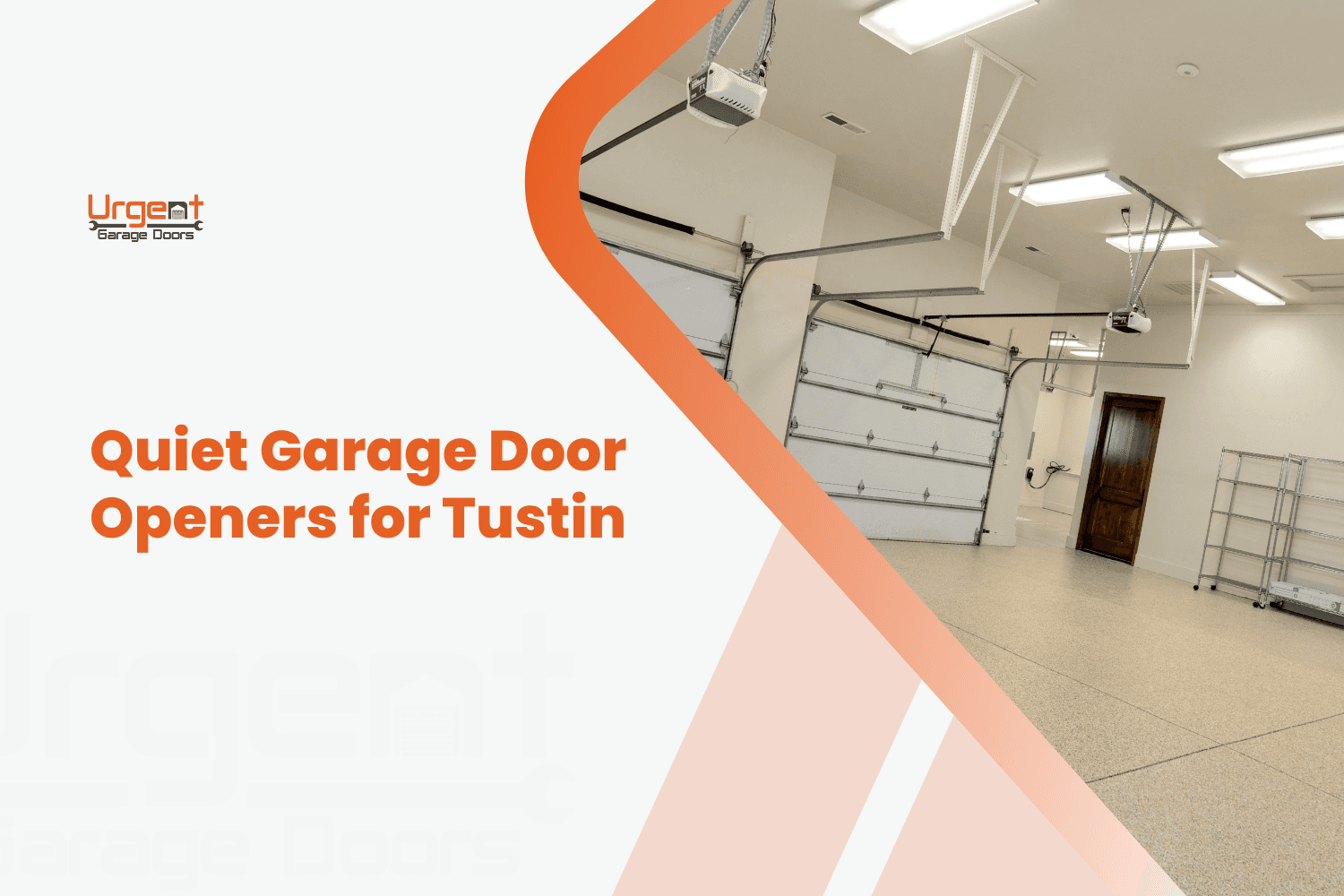
These Tustin districts were built with garages that share a wall or a ceiling with living space. Peppertree and Laurelwood homes sit close together by design, and Laurelwood is a 1973 master-planned district listed in the city's own historic resources survey. When the original openers from that era are still running, the quietest thing in the garage is often the car.
Why Opener Noise Is a Bigger Deal in Shared-Wall Tustin Homes?
In a detached house, a loud opener bothers the people inside and nobody else. In an attached townhome, the same opener broadcasts into a neighbor's bedroom or living room. That is the difference that makes shared wall garage noise worth solving properly instead of living with it.
The build in Peppertree and Laurelwood puts the garage up against or underneath living space. A townhome opener that rattles sends sound through the framing the two units have in common. When one owner upgrades to a quieter unit, the whole party wall gets quieter, which is why this is a neighbor-friendly fix as much as a personal one.
An attached garage changes the math on every opener decision. The drive type, the mounting and the hardware all matter more than they would in a standalone garage down the driveway. Owners here have real control over the noise, and the choices below are where that control lives.
How Noise Travels Through Attached Garage Framing
Sound moves two ways out of a garage. There is airborne noise, the whir and clatter you hear standing next to the opener, and there is structure-borne vibration, which travels through the studs, joists and mounting brackets into the next room. In a detached garage the structure-borne path dies at the exterior wall. In an attached unit it keeps going into living space.
When a garage shares a wall or ceiling with a bedroom, the motor and drive transfer vibration directly into the framing. The ceiling joists that carry the opener rail in your unit are often the same framing members tied to the structure next door. Every time the motor runs, that vibration finds a path.
The two things an owner can change are the drive type and the mounting. A quieter drive produces less vibration at the source, and better isolation at the mounting points stops what vibration there is from reaching the shared structure. Those two levers do most of the work on a noise complaint.
Motor noise is only part of the picture. The rail, the rollers and the door panels all add to what the neighbor hears, which is why a full fix looks at the whole system and not just the box on the ceiling.
Peppertree and Laurelwood: Attached and Semi-Attached Product
Peppertree and Laurelwood are attached and semi-attached product, which is the plain reason a loud opener in one unit reaches the neighbor. These are not detached homes with a buffer of air and soil between them. The walls and ceilings are shared, so the acoustics of one garage belong to two households.
Laurelwood is a 1973 master-planned district included in the city's historic resources survey, bounded by Tustin Ranch Road, Walnut Avenue, the Santa Ana Freeway and an irrigation channel. That era of construction came with the opener technology of its day, and a lot of those homes still have hardware that reflects it.
Because these are semi-attached and attached homes, ownership of the door is the first question on any job. The owner needs to know whether they or the association controls the door and opener before anyone schedules work, and we will come back to that under the association section.
When we service an opener in one of these districts, we treat the shared-wall situation as part of the diagnosis, not an afterthought. A quiet result for the owner has to be a quiet result for the person on the other side of the wall too. For broader care across these streets, our maintenance and upgrades service covers the hardware that carries sound along with the opener itself.
Older Chain Drives Are the Usual Culprit
Many original openers in these 1970s-era districts are chain drives, which are the noisiest type on the market. The chain is a metal loop that pulls the trolley along the rail, and metal links riding over a metal sprocket make the rattle that defines the type. That rattle is exactly the sound that carries through a party wall.
Age makes it worse. A chain stretches and loosens over decades of use, the sprocket teeth wear, and the whole assembly gets louder as the slack grows. An opener that was merely noisy when new becomes a genuine nuisance by the time it is forty or fifty years old.
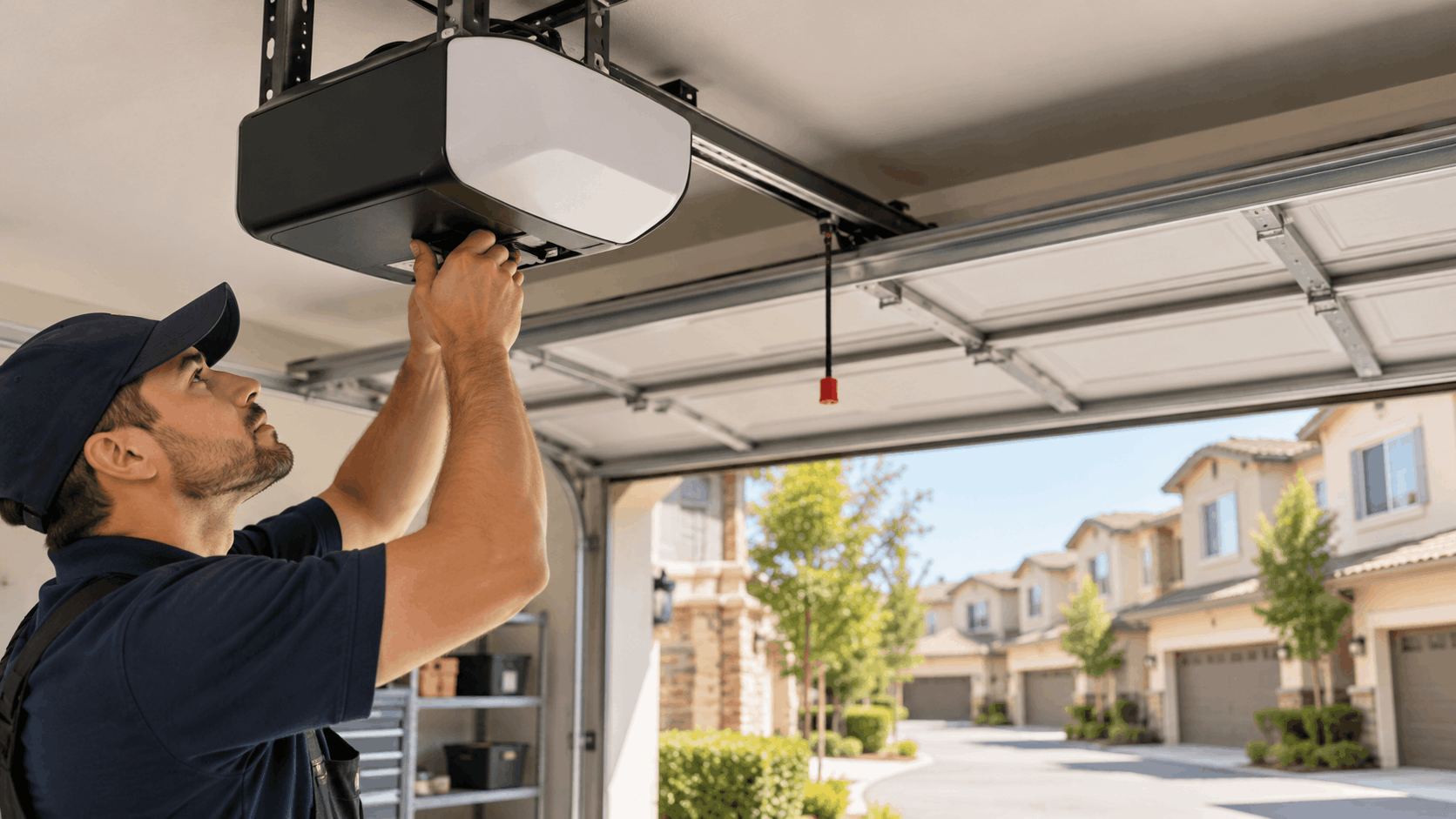
The fix is a quieter drive. Swapping a tired chain drive for a belt or a jackshaft unit removes the metal-on-metal rattle at the source, which is the single biggest change an owner in these homes can make. Our opener installation service handles that swap, including the newer safety and battery requirements a modern unit has to meet.
Replacing an old chain drive also brings the opener into line with current law and modern safety features, which an opener from the 1970s predates entirely. That is a double benefit: quieter and safer, in one visit.
Get Your Free Quote
Tell us about your garage door and we'll get back to you within 30 to 60 minutes.
Quiet Opener Drive Types Compared for Townhomes
There are three drive types on the market, and in a shared-wall home the choice between them is mostly a choice about noise. Here is how each one behaves when living space sits over or beside the garage, and why one of them is usually the wrong fit for these districts.
The three types are chain, belt and jackshaft. Each moves the door a different way, and each one produces a different amount of noise and vibration as it works. For a townhome with a neighbor on the other side of the wall, that difference is the whole decision.
A quiet opener is not a single product, it is a combination of the right drive and the right installation. The drive type sets the floor for how quiet the unit can be, and the install determines how much of that quiet actually reaches the neighbor.
Belt Drive: The Quiet Choice for Rooms Above the Garage
A belt drive works like a chain drive but replaces the metal chain with a reinforced rubber belt. The belt glides over the sprocket instead of clattering across it, so the loudest part of a chain opener simply is not there. For a shared-wall home, that is the point.
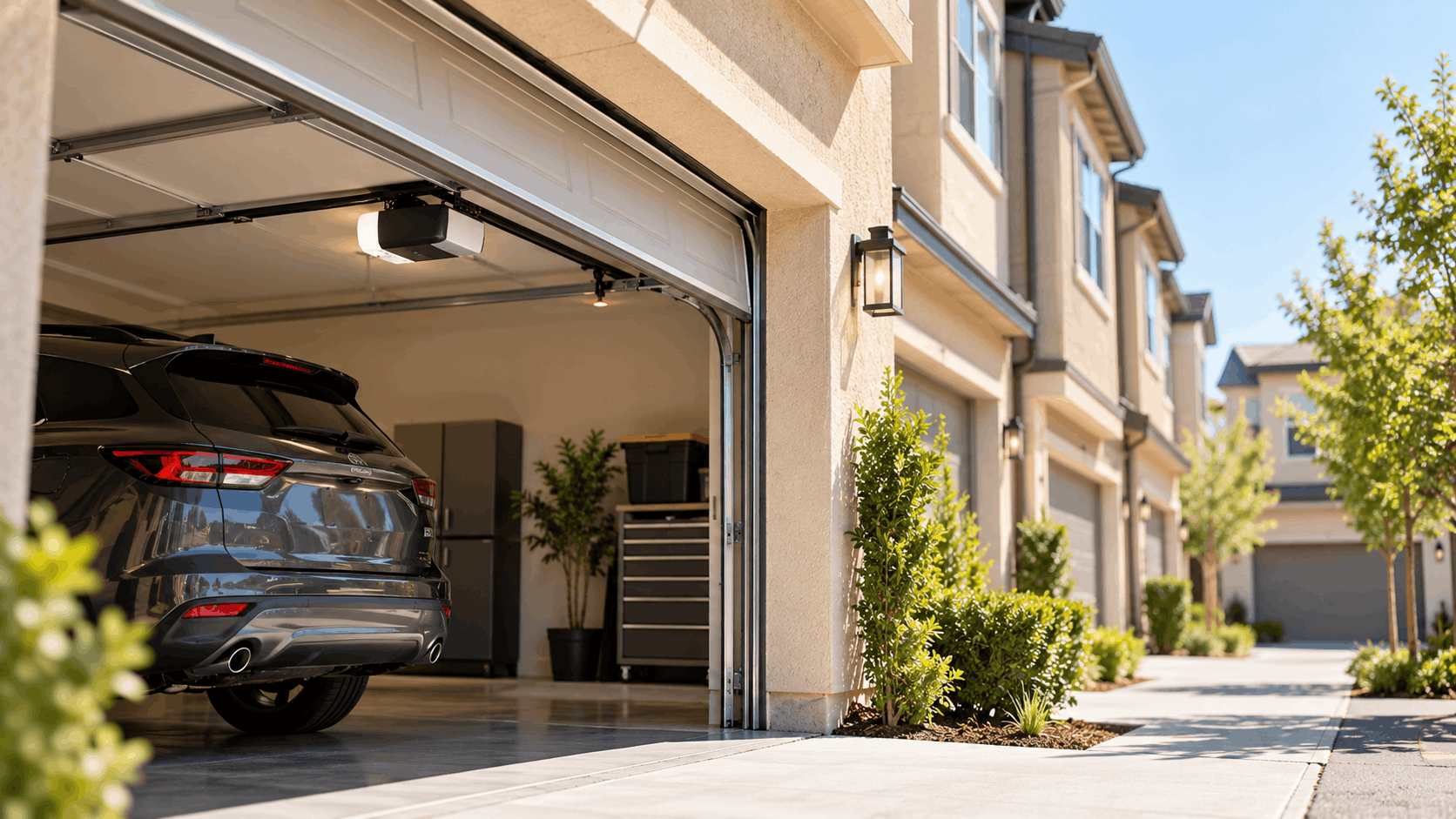
Belt drives are quieter than chain drives, which makes them the pick where a room sits above the garage. Plenty of townhomes in these districts have a bedroom over the parking, and a belt drive keeps the opener from announcing every departure to whoever is sleeping upstairs or next door.
The quiet operation comes from two things at once: less vibration transferred into the rail and no metal-on-metal contact to broadcast through the framing. Combined with good mounting, a belt drive is the most common answer we recommend for an attached unit with living space overhead.
For owners who want the full set of modern features, a belt drive pairs naturally with smart controls and the battery backup that California law now requires. Our opener and smart access service covers the belt-drive install from diagnosis through programming.
Jackshaft (Wall-Mounted) for Tight Headroom and Ceiling Storage
A jackshaft opener is different from the rail-and-trolley types. It mounts on the wall beside the door and drives the torsion bar directly, so there is no motor sitting on the ceiling and no long rail running the depth of the garage. In a townhome, that layout has real advantages.
It is the unit to use where headroom is limited or storage occupies the ceiling. A lot of townhome garages are tight on vertical space or have overhead racks full of bins and seasonal gear, and a jackshaft leaves that ceiling clear because the motor never goes up there.
For shared-wall noise, keeping the motor off the ceiling matters. The ceiling joists in an attached unit are often tied to the neighbor's structure, so a ceiling-mounted motor has a direct vibration path into the next home. A wall-mounted jackshaft keeps the motor off those shared joists, which cuts one of the main routes for structure-borne noise.
Jackshaft units cost more than a basic chain drive, but in the right garage, tight on headroom, loaded ceiling, shared joists above, they solve several problems in one piece of hardware.
Chain Drive: Why It Is the Wrong Fit for Attached Walls
Chain drives are the loudest type, and that single fact makes them the least suited to a shared-wall home. In a detached garage down a long driveway, a chain drive is a reasonable budget choice. Against a party wall with a neighbor's bedroom on the far side, it is the problem, not the solution.
The noise comes from the chain itself, and no amount of adjustment turns a chain drive into a quiet opener. You can tighten and lubricate it and shave off some of the rattle, but the type has a noise floor that a belt or jackshaft sits well below. For an attached unit, that floor is too high.
Because of that, chain drives are usually replaced rather than reinstalled in these districts. When an old chain unit fails in a Peppertree or Laurelwood garage, the sensible move is almost always a belt or jackshaft rather than another chain. Our opener repair and troubleshooting service helps owners weigh a repair against a quieter replacement.
There is a second reason to replace rather than reinstall. Any opener old enough to be a worn-out chain drive predates current safety and battery law, so swapping it is the chance to meet those requirements as well as the noise goal.
Smart Wi-Fi and MyQ Control for Quieter Daily Use
A smart Wi-Fi opener adds phone control on top of a quiet drive. With MyQ setup, an owner can see whether the door is open and close it from a phone, which removes trips back and forth to the garage and the extra opener cycles that go with them.
In a shared-wall home, fewer cycles mean fewer chances for the opener to disturb the neighbor. If you can confirm from the kitchen that the door is already closed, you are not running the opener again at an awkward hour just to check.
Smart control also helps households with multiple drivers coordinate without leaving the door open. Everyone can see the door status, so it is not left running or sitting open while someone decides who is closing it. That is a small thing, but in close quarters it reduces noise and worry at once.
Smart Wi-Fi and MyQ work alongside the quiet drive, not instead of it. The belt or jackshaft keeps the hardware quiet, and the app keeps the daily use tidy. Our smart Wi-Fi opener and MyQ setup service handles the connection and programming.
Need Help in Irvine?
Urgent Garage Doors serves Irvine and all of Orange County.
Hardware Upgrades That Cut Noise Beyond the Motor
The opener gets the blame, but it is only part of the noise. Rollers, hinges and mounting hardware carry sound into the structure just as the motor does, and in a shared-wall home every one of those paths reaches the neighbor. A quiet drive on worn hardware is a half-finished job.
Noise reduction in an attached unit means treating the whole door as a system. The motor is the loudest single part on an old chain unit, but once that is replaced, the rolling and grinding of tired hardware becomes the next thing the neighbor notices.
The good news is that these parts are straightforward to upgrade, and the work pays off directly in how the door sounds from the other side of the wall. Here is where the hidden noise lives.
Quiet Roller and Hardware Upgrades
Rollers ride in the track as the door moves, and worn metal rollers are a steady source of rolling and grinding noise. Swapping them for quieter nylon rollers takes out that sound, because nylon running in the track is far softer than metal on metal. It is one of the most effective single upgrades for noise.
Hinges and bearings are the other chatter points. Over time a hinge loosens and a bearing dries out, and both start to rattle and squeak as the door cycles. Tightening or replacing them removes that noise and keeps the door moving in a straight, smooth line.
For a shared-wall home, these upgrades matter because they target exactly the sounds the neighbor hears. The motor runs for a few seconds, but the rollers and hinges are in contact the entire time the door moves, so smoothing them out changes the character of the whole cycle.
Our quiet roller and hardware upgrade is a common companion to a new belt or jackshaft opener, and together they get a townhome door as quiet as the hardware allows.
Why Worn Cables, Rollers and Bearings Get Louder Over Time
Cables, drums, rollers, hinges and bearings all wear alongside the springs. They are a set of moving parts under load every single cycle, and none of them lasts forever. As they wear, they develop play, and play turns into rattle and vibration that was not there when the door was new.
A worn bearing is a good example. When the bearing surface roughens, the drum it carries no longer turns smoothly, and the roughness shows up as a low grinding sound and extra vibration through the framing. The same logic applies to a frayed cable or a sloppy hinge: looseness anywhere in the system becomes noise.
When any of these parts is being serviced, the cables should be inspected at the same time. Replacing a spring or a roller without checking the cables is how a second failure follows weeks later, because the cables carry the same loads and age on the same schedule. A single visit that looks at the whole set avoids a repeat call.
Our cable repair service handles that inspection and replacement, which keeps both the noise and the risk of a return failure down.
Isolating Vibration From the Shared Structure
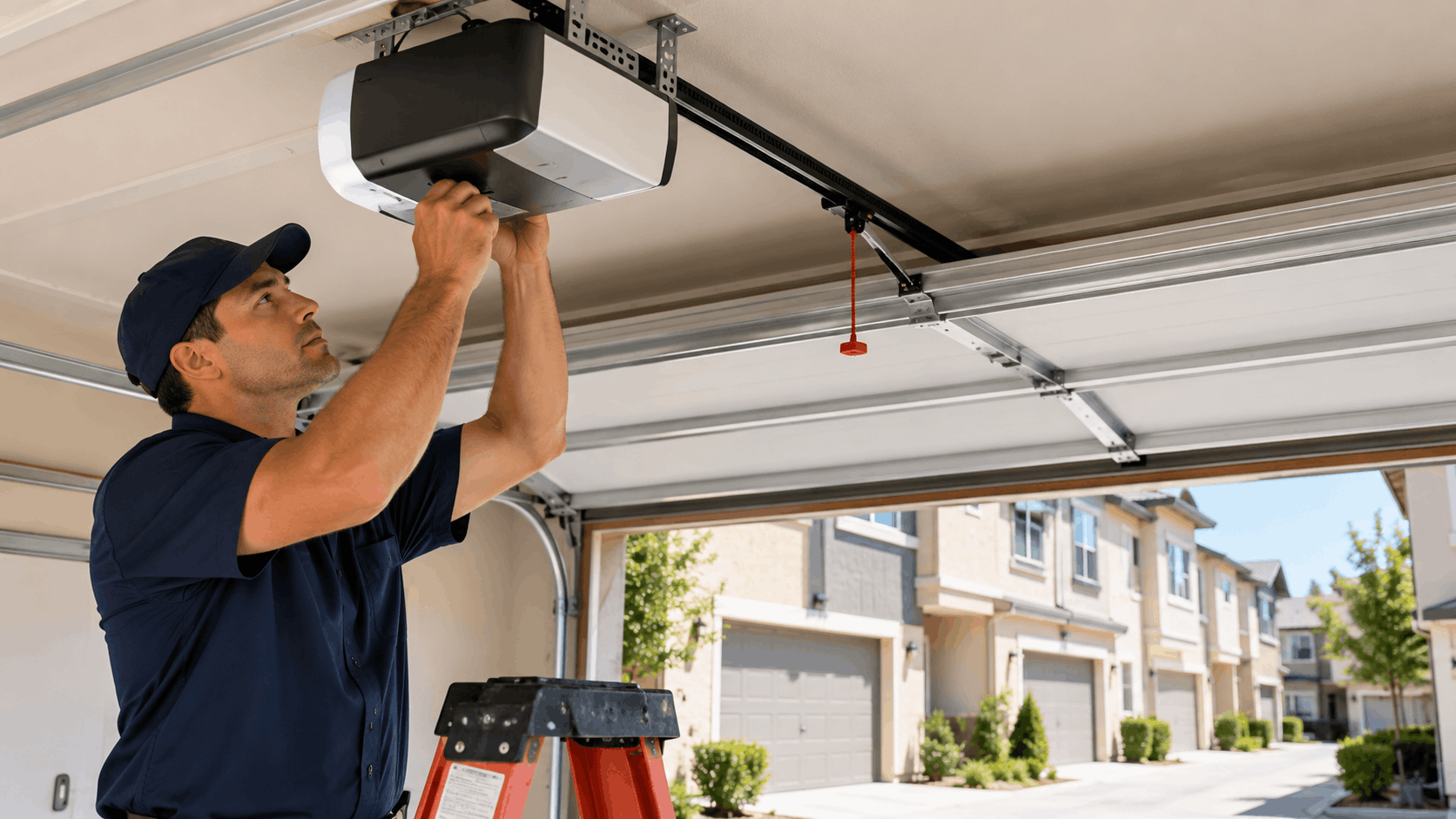
How the opener is mounted decides how much of its vibration reaches the party wall or shared ceiling. A unit bolted hard to the joists passes vibration straight into the framing. Good mounting breaks that direct path so less energy transfers into the structure the two units share.
Vibration isolation at the mounting points is one of the quieter parts of a quiet-opener install, but in an attached home it is one of the most useful. The drive type sets how much vibration the motor makes, and the mounting decides how much of it travels. Both have to be right for the neighbor to feel the difference.
A jackshaft helps here by design, because it keeps the motor off the ceiling joists entirely. For rail-mounted belt drives, the isolation happens at the ceiling bracket and the header mount, where the right hardware dampens what reaches the shared ceiling.
When we plan a quiet opener for a Peppertree or Laurelwood unit, the mounting is part of the conversation from the start. A good drive mounted badly still sends vibration next door, so the two decisions go together.
HOA and Davis-Stirling Approval Before You Buy
Many Tustin townhome streets are association-governed, and that changes the order of operations. On these homes, approval comes before the order, not after the door is already on the truck. Skipping that step can cost an owner the whole job over again.
Association-governed streets operate under California's Davis-Stirling Common Interest Development Act, which sets the framework for architectural review in common interest developments. The review exists to keep the exterior of the community consistent, and a street-facing garage door is squarely the kind of thing it covers.
Here is what review looks at, who owns the door in an attached unit, and why confirming the rule first saves an owner money and weeks of delay.
What Architectural Review Covers on Townhome Streets
Architectural review under Davis-Stirling typically covers door style, panel design, color and visible hardware. These are the elements that show from the street and shape how the community looks, so the association has an interest in approving them before anything is installed.
An opener swap is a different matter from a door face change. The opener lives behind the door, out of sight, so replacing a chain drive with a quiet belt or jackshaft generally does not change anything the review is concerned with. The door style, color and panels all stay the same.
That distinction matters for a noise upgrade. An owner who only wants a quieter opener is usually changing hardware the association does not regulate, while an owner replacing the whole door enters the full review process. Knowing which project you have tells you how much approval work is ahead.
Even so, the safe move is to check. Some associations have rules that reach further than others, and the only way to know what yours covers is to ask before you order anything.
Who Owns the Door in Attached and Semi-Attached Units
In Peppertree and Laurelwood, ownership of the door is the first question on any job. These are attached and semi-attached homes, and in that kind of development the line between what the owner controls and what the association controls is not always obvious from the driveway.
The door and opener might be the owner's responsibility, or they might fall under the association's maintenance obligations, depending on how the community's governing documents are written. That answer decides who authorizes the work and who pays for it, so it has to come first.
An owner who schedules a replacement without settling this can run into a dispute over who had the right to change the door in the first place. Confirming ownership up front avoids that, and it is a quick question for the association or the property manager to answer.
Because 51.2 percent of homes in the city of Tustin are rented, there is also a good chance the person living in a unit is not the one who authorizes the work. A renter calls the landlord or property manager about a failed door, and on those properties the owner or manager is the one who signs off on a quiet opener upgrade.
Confirm the Rule With Your Association First
Owners should confirm current review requirements and timelines with their association before placing an order. A door fitted without approval can be required to come out at the owner's cost, which turns a straightforward upgrade into an expensive redo. That risk is entirely avoidable by asking first.
Review can add several weeks to the timeline, so it pays to start early if a full door replacement is on the table. For an opener-only swap behind an unchanged door, the review is often a non-issue, but the owner still wants to confirm that rather than assume it.
Timelines and requirements change, so the association is the authority on its own current rules. The visible hardware question in particular, handles, decorative straps, anything that shows, is one associations watch closely, and it is worth clearing before the hardware is on the door.
When an owner brings us a project in an association-governed district, we work within whatever the association has approved. The approval is the owner's to secure, and once it is in hand, the install moves forward cleanly.
Battery Backup Is the Law on Every New Opener
Every residential opener sold or installed in California since July 1 2019 must have battery backup. This is a legal requirement under state law, not an optional add-on and not a premium tier a company sells you. On a new quiet opener install, it is already part of the unit.
Owners sometimes expect battery backup to appear as a line item they can decline. It cannot be declined on a new install in California, because the law requires it on the opener itself. Understanding that up front keeps the cost conversation honest.
Here is what the law actually says, why it exists, and how it sits alongside the older auto-reverse and sensor requirements that a modern opener also meets.
What SB 969 Requires and Why It Passed
SB 969 (Dodd, Chapter 621, Statutes of 2018) requires battery backup on residential openers manufactured for sale, sold, offered for sale or installed in California on or after July 1 2019. The penalty for a violation is a $1,000 civil penalty, which is written into the law.
The law passed in response to the 2017 Northern California wildfires, where residents could not open their garage doors during power outages and could not evacuate. A motorized door with no backup power is dead weight when the grid is down, and a heavy door is hard to lift by hand.
Battery backup answers that directly. When utility power fails, the backup lets the opener still raise and lower the door, so a resident can get a vehicle out during an evacuation or any other outage. That is the purpose the Legislature had in mind.
SB 969 applies statewide and to residential openers. It is not a fire-zone rule, not a city rule and not an association rule, and it is a separate law from the energy code and from the older entrapment-protection requirements. It stands on its own.
It Comes Standard, Not as a Paid Upgrade
Because the law requires it, a replacement opener in California already includes battery backup whether or not the owner asked for it. It is built into any new quiet opener install, not bolted on as an extra tier. The belt or jackshaft unit we install arrives compliant.
This is worth stating plainly because battery backup is sometimes presented elsewhere as a feature to upsell. On a new residential install in this state, it is simply the law, so there is no version of the job that legally leaves it out.
The practical upshot is that a Tustin townhome owner upgrading from an old chain drive gets power-outage operation as part of the deal. During the next grid interruption, the door still works, which matters more in a shared-wall building where lifting a heavy door in a tight garage is no small thing.
Where an existing compliant opener needs its backup added or serviced separately, that is its own small job, covered under our battery backup installation service. On a brand-new install, though, it is already in the box.
Entrapment Protection and Auto-Reverse on Modern Openers
California required auto-reverse and an external entrapment protection device under AB 3600 (Polanco, Chapter 1336, Statutes of 1990). The state was ahead of the country on this, and Congress followed for openers manufactured for the United States after January 1 1993, built to the UL 325 standard.
Auto-reverse means the door stops and reverses when it contacts an obstruction. The external device is the pair of photo eyes mounted on each side of the opening, no higher than six inches off the floor, that reverse the door when something breaks the beam. Together they are two layers of protection against entrapment.
A new quiet opener meets both requirements as a matter of course. When we replace an old chain drive, the modern unit brings these safety systems with it, which an opener from the 1970s predates entirely. That is one more reason replacing beats repairing on a unit that old.
For owners curious about the standards themselves, the U.S. Consumer Product Safety Commission publishes the federal entrapment-protection rules, and the sensors are kept working through our safety sensor alignment and repair service.
Need Help in Irvine?
Urgent Garage Doors serves Irvine and all of Orange County.
What a Quiet Opener and Upgrades Cost in Orange County?
Cost is usually the deciding factor, so here are the typical Orange County ranges for the pieces of a quiet opener job. These are typical market ranges for the area, not a quote, and the actual price for a specific garage is given in writing before work begins.
The figures below cover the opener install itself, smart setup, battery backup where added separately, and the quiet hardware that handles the noise the motor does not. A full quiet-opener project usually combines several of these lines.
| Job | Typical Orange County range |
|---|---|
| Opener installation (belt costs more than chain) | $250 to $600 |
| Smart Wi-Fi opener and MyQ setup | $150 to $300 |
| Keypad and remote programming | $45 to $85 |
| Battery backup installation | $200 to $400 |
| Quiet roller and hardware upgrade | $150 to $300 |
| Opener repair | $75 to $200 |
Opener Installation and Smart Setup Ranges
Opener installation runs $250 to $600, and belt drive costs more than chain drive. For a shared-wall home that difference is money well spent, because the belt is the quiet choice and the chain is the one you are trying to get away from. The range reflects the unit and the complexity of the install.
Smart Wi-Fi opener and MyQ setup runs $150 to $300. That covers connecting the opener to the home network and configuring phone control, which is the piece that lets an owner check and close the door remotely and skip extra cycles.
Keypad and remote programming runs $45 to $85. This is the small line that pairs the exterior keypad and the handheld remotes to the new unit, so the household can get in without a phone when they want to.
These are typical area ranges, and the written price for a specific garage comes before any work starts. The final number depends on the unit chosen and what the install involves in that particular garage.
Battery Backup and Quiet Hardware Ranges
Battery backup installation runs $200 to $400 where it is added separately to an existing compliant opener. On a new opener install in California, battery backup is required by law and is already part of the unit, so it is not a separate line on that job. It only shows as its own cost when retrofitted to a door that already has a qualifying opener.
Quiet roller and hardware upgrade runs $150 to $300. This is the swap to quieter nylon rollers and the attention to hinges and bearings that takes out the rolling and grinding noise the motor does not make. In an attached unit, this is often the second half of a real noise fix.
Pairing a belt or jackshaft opener with a hardware upgrade is the combination that gets a townhome door genuinely quiet. The opener handles the motor noise and the hardware handles the mechanical noise, and both reach the neighbor through the shared framing.
As always, these are typical ranges for Orange County, and the specific price is written down before the work begins. What a given garage needs depends on the condition of the existing hardware.
Repair vs Replace for an Old Chain Drive
Opener repair runs $75 to $200, and for a newer unit with a single failed part, a repair often makes sense. A bad capacitor, a worn gear or a failed logic board can be the whole problem, and fixing it is cheaper than a full replacement.
The calculus changes for an old chain drive. If the unit is decades old, loud by design and failing, pouring repair money into it buys a quieter future than before but still leaves a chain drive against a shared wall. For that case, replacement with a quiet belt or jackshaft is usually the better spend.
Pre-1993 openers predate the federal entrapment mandate and lack the safety features every modern opener has. The manufacturer position on these, LiftMaster for example, is that they should be replaced rather than repaired. That tips the scale decisively toward a new unit on the oldest openers in these districts.
When we diagnose an opener, we lay out the repair cost against the replacement cost so the owner can decide with the real numbers in front of them. On a 1970s chain drive in a shared-wall home, the quiet, compliant replacement usually wins.
Simple Safety Checks a Townhome Owner Can Run
A quiet opener still has to be a safe opener. These are the checks any owner can run themselves to confirm the door reverses properly, plus the one part they must never touch. Running them tells you whether a quiet door is also working as it should.
None of these tests requires tools beyond a flat board, and all of them take a couple of minutes. They are the same checks we run as part of a service visit, and an owner doing them between visits catches problems early.
The Photo-Eye and Two-by-Four Auto-Reverse Tests
The photo-eye test is simple. With the door closing, break the beam between the two sensors with an object, and the door must stop and reverse. The photo eyes sit on each side of the opening no higher than six inches off the floor, so a foot or a broom handle through the beam does the job.
The two-by-four test checks the contact reverse. Lay a flat 2x4 across the opening under the door, and on closing the door must reverse within two seconds of touching it. This confirms the door senses a physical obstruction and backs off rather than pushing through.
Both tests should pass every time. If the door does not reverse on the beam break or does not back off the board within two seconds, the opener needs service before it is trusted around people or pets. These are pass-fail checks, not close-enough ones.
In a shared-wall home with families on both sides, these tests matter as much as the noise does. A quiet door that fails to reverse is not a good trade.
Why a Door Reverses for No Visible Reason
Photo-eye faults, misalignment and blocked beams are the most common cause of a door that reverses for no visible reason. When the beam between the two sensors is broken or the eyes are not pointed at each other, the opener reads it as an obstruction and refuses to close, or reverses partway.
A dusty or bumped sensor is a frequent offender. A bag brushing the sensor, a cobweb across the lens, or a bracket knocked out of line all break the beam, and the door responds by reversing. The fix is usually cleaning the lenses and nudging the eyes back into alignment.
In a townhome garage where storage and cars share a tight space, the sensors are easy to bump. If a door that worked yesterday starts reversing today, the photo eyes are the first thing to check before assuming the opener has a bigger problem.
When cleaning and realignment do not fix it, the sensors or wiring may need service, which our safety sensor alignment and repair service handles.
Leave the Springs Alone
A torsion spring stores enough energy to cause serious injury and releases it instantly if a winding bar slips. For that reason, an owner should never adjust, wind, unwind or replace one. This is the single part of the door that is not a do-it-yourself job, no matter how handy the owner is.
The balance test is a diagnostic only, not a repair. With the opener disconnected by the release cord, raise the door to waist height and let go. A correctly balanced door stays put. One that falls or rises has a spring problem, and that tells you to call a technician, not to touch the spring yourself.
A door that will not hold position is a spring issue, not an opener issue, and no amount of opener work fixes it. That is a useful thing to know, because it points the repair in the right direction before anyone opens a toolbox.
Spring work belongs to a trained technician with the right bars and clamps. Our torsion spring replacement service handles it safely, including matching the spring to the actual weight of the door.
Need Help in Irvine?
Urgent Garage Doors serves Irvine and all of Orange County.
How Urgent Garage Doors Handles a Quiet Opener Job in Tustin
When an owner in Tustin calls about a loud opener, the work follows a clear path: a diagnostic of the whole system, a written price before any work, and an install that accounts for the shared-wall situation. Here is how the Tustin opener install goes.
We serve both the city of Tustin and the unincorporated community of North Tustin, which matters because the two have different permit authorities. The quiet opener service is the same across both, and our Tustin service page covers the full area.
On-Site Diagnostic and Written Price Before Work
The visit starts with a look at the whole door, not just the opener. We check the drive type, the condition of the rollers, hinges, cables and bearings, and the shared-wall situation that shapes how the noise travels. That full picture is what tells us whether a quiet opener alone solves the problem or whether the hardware needs attention too.
A written price is available before work begins. The owner sees what the job costs before anyone starts, so there are no surprises once the work is underway. For a new door install, we also offer a free on-site estimate.
For a shared-wall home, the diagnostic pays off because the fix is often a combination. A belt or jackshaft handles the motor, a roller and hardware upgrade handles the mechanical noise, and good mounting handles the vibration. Seeing all of it at once lets us price the real solution rather than a partial one.
Removing and hauling away the old door is included on a new door installation, so an owner replacing a full door is not left with the old one to dispose of.
Truck Stock, 24/7 Response and Service Area
We offer 24/7 emergency service, every day of the year, with a 30 to 60 minute response window across Orange County. When an opener fails and the car is stuck inside, that response matters, and it covers Tustin city addresses and North Tustin alike.
Our trucks carry common torsion spring sizes, so a spring replacement is often completed on the same visit rather than after a parts order. That keeps a lot of jobs to a single trip, though we never promise every replacement finishes on the first visit, because some doors need parts a truck does not stock.
The service area reaches across Orange County from our Irvine base, and Tustin is a short drive. Whether the address is in Central Tustin, Tustin Ranch, Tustin Legacy, or one of the older districts like Peppertree and Laurelwood, the same team and the same stock reach it.
For urgent failures, our 24/7 emergency repair service is the right call.
Licensing, Brands and Verification
Garage door work in California is licensed under CSLB classification C-61/D-28, Doors, Gates and Activating Devices. That classification covers sectional and rolling doors, torsion and extension spring systems, operators, control boards, safety sensors and activating devices. C-28 is Lock and Security Equipment and is not the garage door license.
Urgent Garage Doors holds California license #1055150, which anyone can verify free at cslb.ca.gov, where the classification, status, bond and workers compensation are all public record. Checking a license before hiring is good practice on any home job.
The team works on all garage door brands, including LiftMaster, Chamberlain, Genie, Craftsman, Clopay, Amarr, Wayne Dalton and CHI. Whatever opener is on the ceiling now, we can service it or replace it with a quieter unit that meets current law.
Founded in 2017 with more than eight years of experience, the company carries the Google Guarantee badge on its Google Local Services listing. For a quiet opener in a shared-wall Tustin home, that is a licensed, verifiable team that knows these districts.
Getting a Quieter Opener Into Your Tustin Townhome
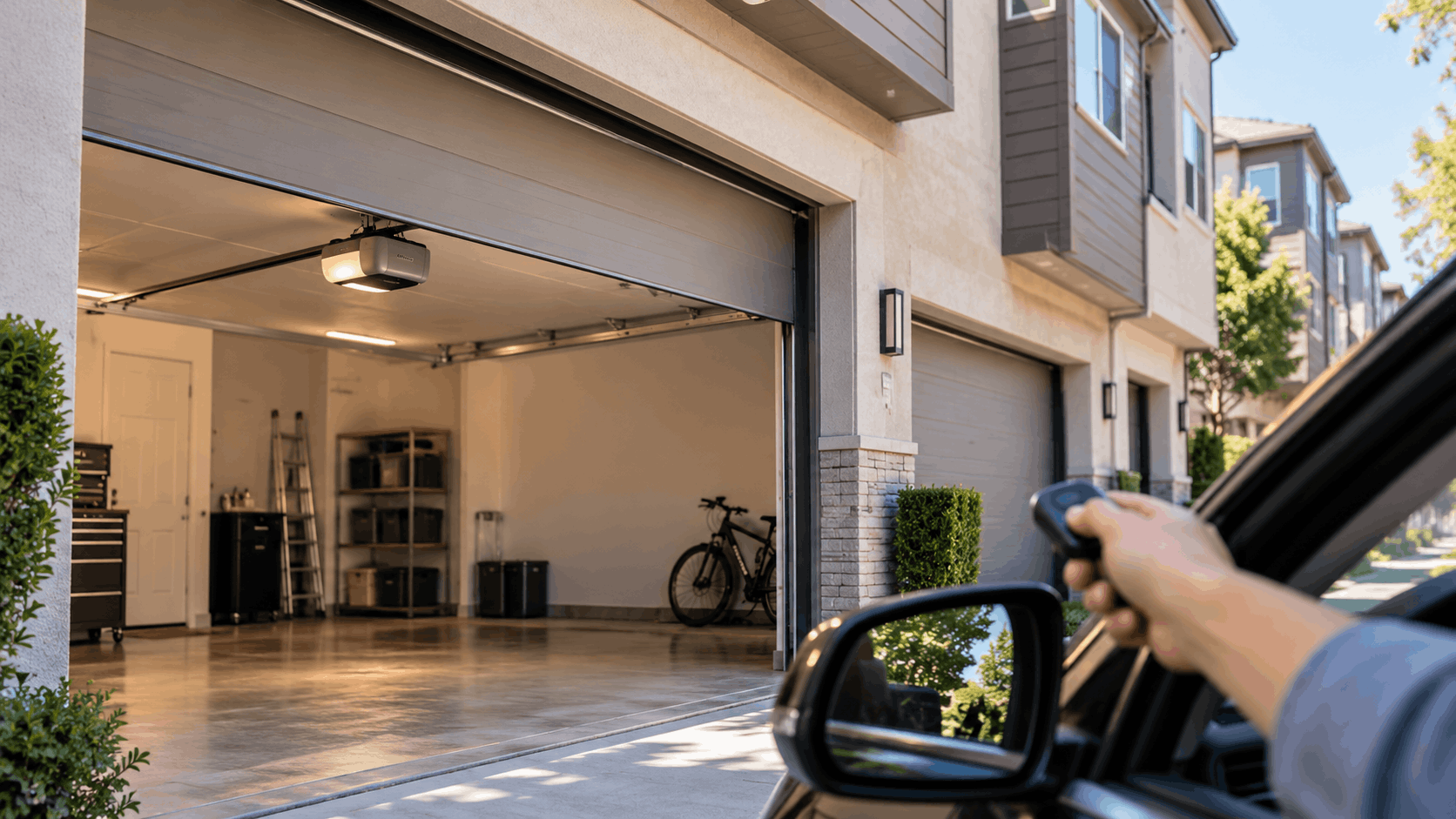
If a loud opener is carrying through the shared wall in your Peppertree, Laurelwood or other Tustin townhome, the path forward is a diagnostic of the whole door, a written price before any work starts, and an install matched to your shared-wall layout.
Call Urgent Garage Doors at (949) 529-7743 to set up a visit. We will look at the drive type, the hardware and the mounting, confirm what your home needs, and put the price in writing before the work begins.
Frequently Asked Questions
- What is the quietest type of garage door opener for a townhome?
- Belt drives are quieter than chain drives and suit a room above the garage, which is common in townhomes with a bedroom over the parking. The belt replaces the metal chain, so the loudest part is gone. Jackshaft wall-mounted units are the other quiet choice, fitting tight headroom and loaded ceilings, and they keep the motor off the ceiling joists shared with a neighbor's unit.
- Why does my neighbor's garage opener sound so loud through the wall?
- Attached and semi-attached townhomes in districts like Peppertree and Laurelwood share walls or ceilings with living space. Motor and chain noise vibrates through the common framing into the next unit, so the opener you hear is really broadcasting through the structure the two homes share. An older chain drive is usually the cause, because its metal-on-metal rattle carries straight through a party wall and gets louder as the chain stretches with age.
- Do I need HOA approval to replace my opener in a Tustin townhome?
- On association-governed streets under the Davis-Stirling Act, review typically covers door style, panel design, color and visible hardware. An opener swap behind an unchanged door is often outside that, since the opener is not visible, but a full door replacement enters review. Ownership of the door is also the first question in attached units. Confirm the rule and who controls the door with your association before you order anything.
- How much does a quiet garage door opener cost to install?
- Opener installation runs $250 to $600 in Orange County, and belt drive costs more than chain drive, which is worth it for a shared wall. Smart Wi-Fi opener and MyQ setup runs $150 to $300 on top of that. These are typical area ranges, not a quote. A written price for the specific garage is available before any work begins, based on the unit chosen and the install.
- Is battery backup included with a new opener in California?
- Yes. SB 969 requires battery backup on every residential opener sold or installed in California since July 1 2019, with a $1,000 civil penalty for violations. It comes standard on a new install, not as a paid upgrade, and a replacement door may not be connected to a non-compliant opener. Where battery backup is added separately to an existing compliant opener, that installation runs $200 to $400.
- Can I just make my old chain drive quieter instead of replacing it?
- A quiet roller and hardware upgrade, which runs $150 to $300, can reduce some of the rolling and grinding noise, and lubrication and tightening help too. But a chain drive remains the loudest type, and no adjustment brings it down to belt or jackshaft levels. For a shared wall, a belt or jackshaft opener is the fuller fix, and on a pre-1993 unit, replacement is the right call anyway.
- Do I need a permit to replace a garage door opener in Tustin?
- The city or county with jurisdiction over the specific address confirms the permit position for that job. For a city of Tustin address, that is the City of Tustin, Planning Division 714-573-3140. North Tustin is an unincorporated community, so its permits are county permits through Orange County, not City of Tustin ones. Getting that wrong means a permit that does not cover the address, so always confirm for the exact property.
- What is the right contractor license for garage door work in California?
- Garage door work is licensed under CSLB classification C-61/D-28, Doors, Gates and Activating Devices. That covers sectional and rolling doors, spring systems, operators, control boards, safety sensors and activating devices. C-28 is Lock and Security Equipment and is not the garage door license, and this work does not require a Class B general building license. Any license can be verified free at cslb.ca.gov, where classification, status, bond and workers compensation are public record.
- Will a quiet opener work with my smart phone?
- Yes. Smart Wi-Fi openers with MyQ setup let an owner check whether the door is open and close it from a phone, which also cuts extra trips to the garage and the opener cycles that disturb a neighbor. Setup runs $150 to $300 as a typical Orange County range. It works alongside a quiet belt or jackshaft drive, so the hardware stays quiet and the daily use stays tidy.
- Can Urgent Garage Doors replace an opener the same day?
- Often, yes. The company offers 24/7 emergency service with a 30 to 60 minute response across Orange County, including Tustin city addresses and North Tustin, and carries common parts on its trucks. A written price is available before work begins. Some jobs need a specific unit or part that is not stocked on the truck, so same-day completion is common but not promised on every single job.
Licensed garage door repair professionals serving Irvine and Orange County.
Licensed in California · License #1055150
Why trust Urgent Garage Doors?
Founded in 2017, Urgent Garage Doors is a licensed and insured garage door services serving Irvine and Orange County. All content is reviewed by our licensed technicians.

Need Help in Irvine?
Urgent Garage Doors serves Irvine and all of Orange County.
Related Articles
Best Garage Door Openers for Orange County Homes in 2025
Top garage door openers for Orange County in 2025. Belt vs chain, smart features, battery backup. LiftMaster, Chamberlain, Genie. Irvine to coastal OC.

Emergency Garage Door Repair in Irvine Villages: Gate Codes, Association Quiet Hours, and Our Protocol
How Urgent Garage Doors handles emergency garage door repair in Irvine's gated villages, from gate codes and guard lists to HOA quiet hours and our step-by-step repair protocol.
What Our Tustin Garage Door Calls Show About Old Town, the Ranch and Legacy
What our Tustin garage door calls reveal district by district, from Old Town approvals and North Tustin county permits to high-wear Tustin Ranch springs and the state rules behind every opener swap.