Tips & Advice
Broken Garage Door Spring Mission Viejo: Same-Day Replacement
Key Takeaways
- A loud bang, a two-inch gap in the coil, and a door too heavy to lift are the clearest signs of a broken garage door spring.
- Springs last about 7 to 12 years or 10000 cycles, and coastal air, cold mornings, and busy household use in Mission Viejo speed up the wear.
- Torsion springs mount above the door while extension springs run along the tracks, and knowing which you have helps guide the repair.
- Never run or force a door with a broken spring, since it burns out openers and bends tracks, turning a small fix into a costly one.
- Single spring replacements typically cost $200 to $350 and dual jobs $300 to $500, with door size and spring quality affecting the total.
- Replacing both springs on a dual system at once avoids a second breakdown and keeps the door balanced.
- Spring repair is dangerous DIY due to stored tension, so it calls for trained techs with proper winding bars and clamps.
- Urgent Garage Doors dispatches from Irvine and reaches Mission Viejo neighborhoods the same day for broken spring calls.
In This Article
A homeowner near Lake Mission Viejo settles in for a quiet evening, then hears a sharp bang from the garage that sounds like a gunshot or a heavy shelf collapsing. The next morning, the garage door refuses to budge. The opener hums and strains, but the door barely lifts an inch before giving up.
That loud bang is one of the most common calls our team gets. In almost every case, the culprit is a broken garage door spring. A snapped spring turns a simple daily task into a stuck door, a trapped car, and a scramble to figure out what to do next.
How to Tell a Garage Door Spring Is Broken
Most homeowners near Mission Viejo do not think about their garage springs until one breaks. The springs do the heavy lifting every time the door goes up or down, so when one fails, the whole system stops working right. Learning the signs of a broken spring helps a family act fast instead of forcing a door that is already damaged.
A broken garage door spring shows itself through sound, sight, and how the door moves. Here are the common signs to watch for:
- A loud bang from the garage, often mistaken for something falling
- A visible gap in the coiled spring above the door
- A door that feels far too heavy to lift by hand
- An opener that strains, stops halfway, or reverses
- A door that hangs crooked or moves in a jerky way
The Loud Bang and Sudden Failure
The most dramatic sign is the sound. When a spring snapped, it releases all its stored tension at once, and that energy makes a sharp crack that echoes through the house. Many Mission Viejo homeowners near quiet streets off Marguerite Parkway have called us convinced a gunshot went off or a heavy item crashed to the floor.
The bang usually happens when nobody is even using the door. Springs often break in the early morning cold or late at night when the metal contracts. A homeowner may hear the loud bang garage noise and find nothing broken inside the house, only to discover the stuck door the next time they try to leave.
The suddenness catches people off guard. One day the door works fine, and the next it will not move at all. That instant failure is normal for springs, since they hold constant tension and give out the moment the metal fatigue reaches its limit.
If a household hears that bang, checking the garage first is smart. A snapped spring is rarely a quiet, gradual thing. It announces itself, and recognizing that sound saves time when calling for a repair.
A Visible Gap in the Torsion Spring
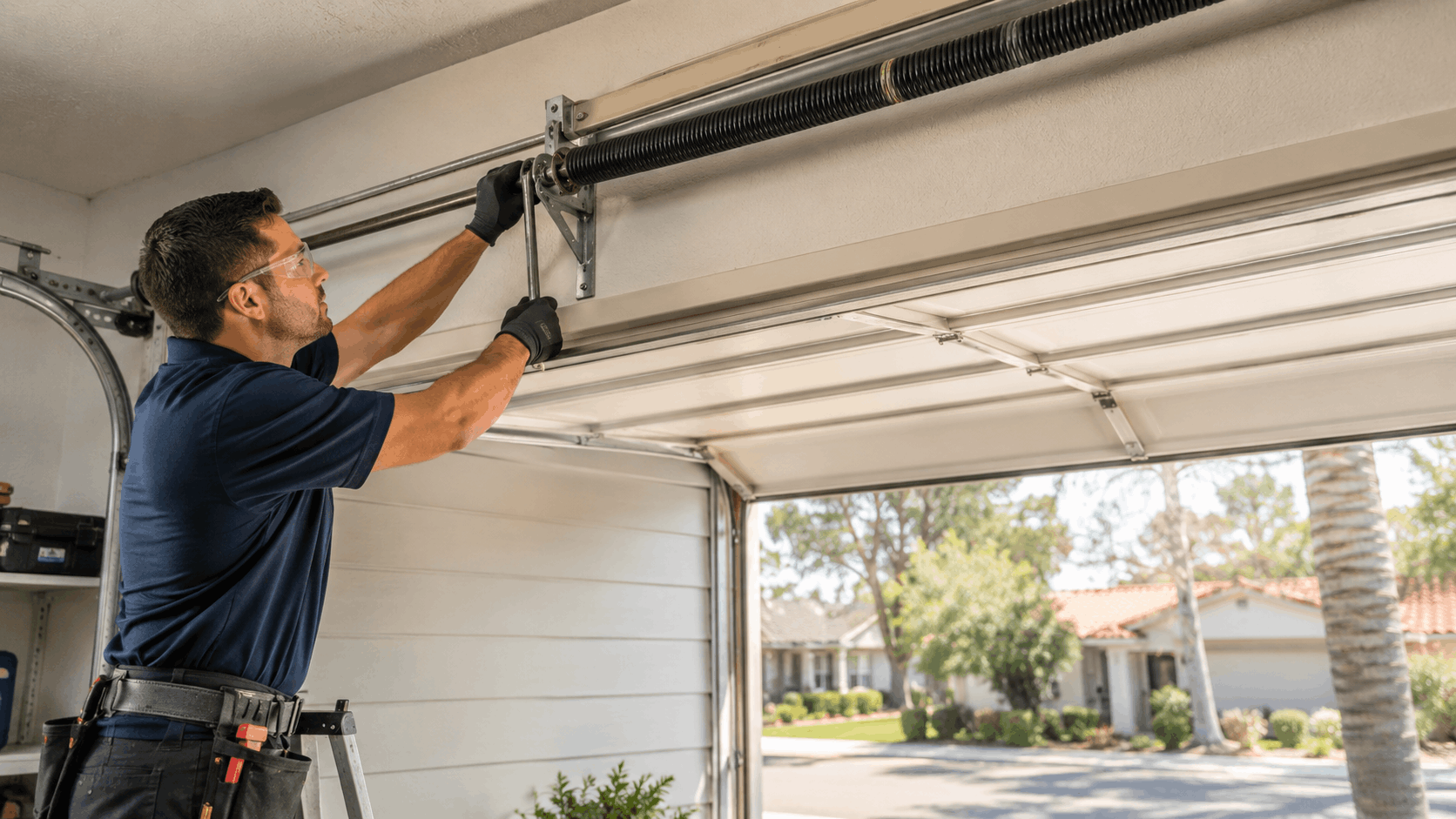
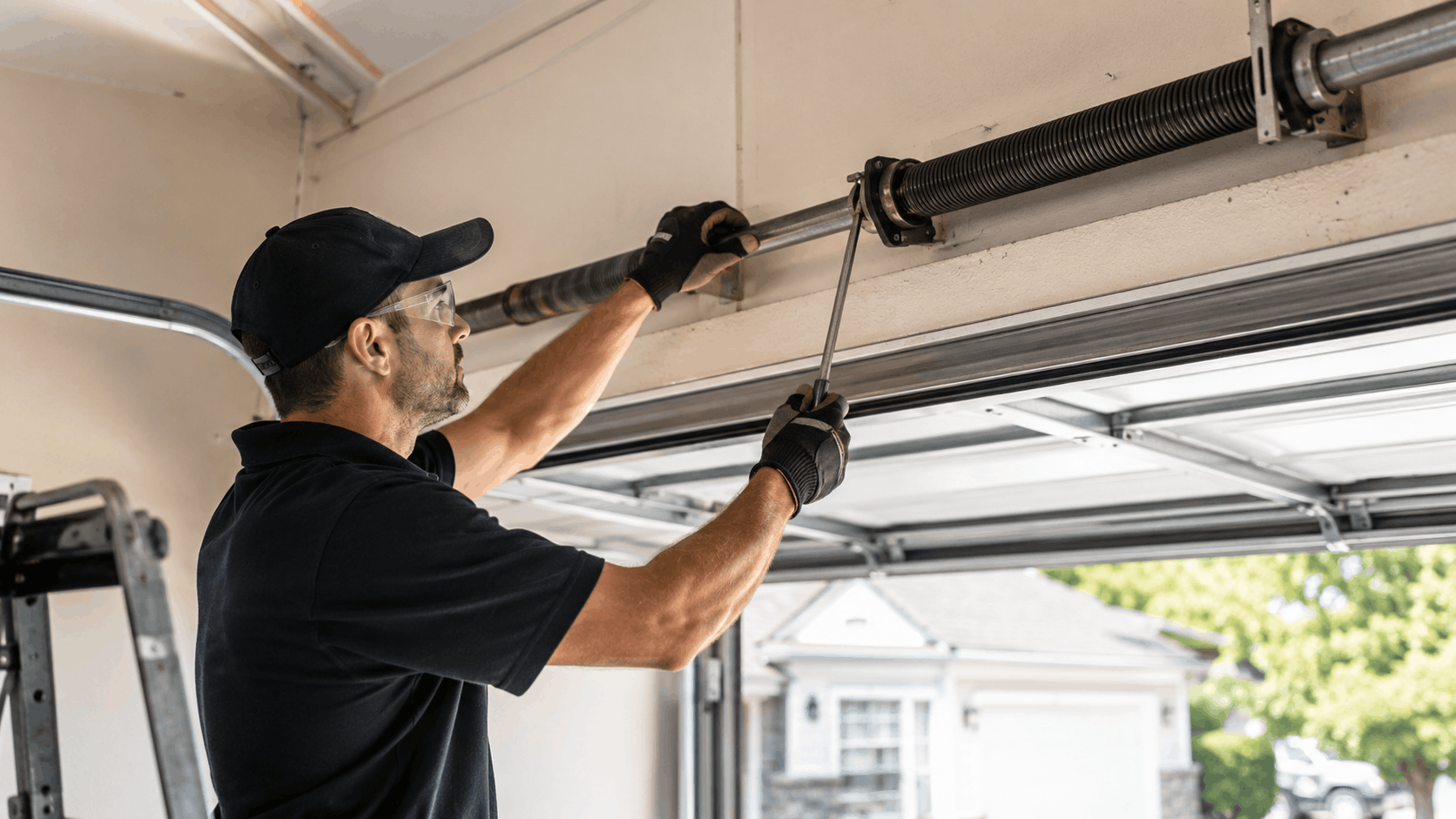
The clearest visual sign sits right above the door. A healthy torsion spring is a tight, continuous coil wound around a metal bar. When it breaks, the two ends separate and leave a gap that usually measures about two inches wide.
To check, a homeowner can look up at the bar mounted above the door opening while the door is closed. A torsion spring gap that shows daylight or a clear break in the coil confirms the problem. This is the single most reliable way to spot a broken torsion spring without any tools.
The coil break happens because the spring bends and unwinds thousands of times over its life. Eventually a weak spot forms, and the metal separates. The gap is simply the point where the two halves pulled apart after the tension released.
Some doors run two torsion springs side by side. If one shows a gap and the other looks intact, both should still be inspected. A spring that broke often means its twin is close behind, since they age at the same rate under the same load.
The Door Feels Heavy or Won't Open
Springs carry the weight of the door so the opener and a person can lift it easily. A typical two-car garage door weighs between 150 and 250 pounds. When the spring fails, all that weight lands on the opener and the homeowner.
The result is a door that won't open or feels like dead weight. A person trying to lift it by hand meets stiff resistance and may only raise it a few inches before it slams back down. This heavy garage door feeling is a strong sign the spring is done.
The opener struggles too. Openers are built to guide a balanced door, not haul the full load alone. Many will strain, groan, stop partway, or reverse when they sense the extra weight. Some burn out their motors trying.
Forcing the issue only makes things worse. If a door feels far heavier than usual or the opener cannot lift it, the safe move is to stop and leave the door closed until a technician arrives. Our team handles doors that will not open or close across Mission Viejo every week.
Crooked or Jerky Movement
Sometimes a door still moves, but not the way it should. A crooked garage door that lifts higher on one side than the other points to a spring or cable problem. This uneven movement means one side lost its support.
Jerky, stuttering travel is another warning. Instead of a smooth glide, the door hitches, jumps, or pauses as it moves. That rough motion signals that the springs are no longer sharing the load evenly, or that a cable has slipped off its drum.
A door hanging at an angle is also a safety hazard. It can jam in the tracks, pull cables loose, or fall off track entirely. Running a door in this condition risks turning a spring repair into a much bigger fix.
When a door shows crooked or jerky behavior, the springs and cables both deserve a look. Our crew checks the full system during a visit, since spring failure and cable damage often show up together. Catching uneven movement early keeps the repair simple.
Get Your Free Quote
Tell us about your garage door and we'll get back to you fast.
Why Garage Door Springs Break in Mission Viejo
When a spring breaks, most homeowners want to know why it happened to them. The honest answer is that springs are wear parts with a limited lifespan, and several local conditions speed that wear along. Knowing why springs break helps a family plan ahead and choose better replacements.
Here are the main reasons garage door spring wear leads to failure in Mission Viejo:
- Normal aging from thousands of open-and-close cycles
- Rust from salt-tinged coastal air drifting inland
- Older homes still running original single springs
- Cold morning temperature swings and skipped lubrication
Normal Wear and Cycle Count
Every spring has a rated life measured in cycles. One cycle is a single open and a single close. Most standard springs are rated for about 10000 cycles, which works out to roughly 7 to 12 years of average use.
Busy households burn through cycles fast. A family near Mission Viejo High School with teenagers, two working parents, and daily errands can open and close the door six or more times a day. At that pace, a 10000 cycle spring may wear out in as little as five years.
The spring lifespan depends heavily on how often the door runs. A home that uses the garage as the main entrance sees far more cycles than one where the door only opens on weekends. This is why two identical springs installed the same day can fail years apart.
Normal wear is not a defect. It is the expected end of a working part. When a spring reaches its cycle limit, the metal simply gives out, which is why planning for replacement around the 7 to 10 year mark makes sense for active households.
Coastal Air and Rust
Mission Viejo sits inland, but the ocean is close enough that salt-tinged air drifts over the hills and settles across the valley. That coastal air corrosion is gentle but constant, and it works on exposed metal over the years.
Rust on springs is a real problem here. Salt in the air speeds up oxidation, and a rusted spring loses strength faster than a clean one. The rust also creates rough spots on the coil that grind against each other, wearing the metal down with every cycle.
Older homes near Oso Creek and lower-lying areas tend to hold more moisture, which makes rust worse. A garage that stays damp or lacks good airflow gives corrosion more time to work. Springs in these spots often fail earlier than the rated cycle count would suggest.
A light coat of proper lubricant slows rust down, but it cannot stop it forever. When we replace springs in coastal-influenced neighborhoods, we often recommend coated or higher-grade springs that resist corrosion better. Our spring and cable repair team sees rust-related breaks across Mission Viejo year-round.
Older Homes and Original Hardware
Mission Viejo has many established neighborhoods with homes built decades ago. Areas like Deane Homes and Aegean Hills feature houses that, in some cases, still run their original garage door hardware.
Older home springs are often single-spring setups. A single spring carries the entire door load alone, so it wears faster and fails more suddenly than a balanced pair. When that one spring goes, the door is completely stuck.
Original hardware also tends to be lower cycle-rated than modern options. Builder-grade springs from the 1980s and 1990s were chosen to keep costs down, not to last a lifetime. Many are well past their intended service life today.
When we replace springs in these older homes, we often suggest upgrading to a dual-spring system with higher cycle ratings. It costs a little more upfront but adds years of reliable service. Homeowners in Aegean Hills especially benefit from this upgrade.
Temperature Swings and Poor Maintenance
Metal reacts to temperature. On cold Mission Viejo mornings, the steel in a spring contracts and grows more brittle, which is why so many springs snap in the early hours when the garage is coldest.
The temperature stress adds up over the years. Each warm afternoon and cold morning cycle expands and contracts the metal slightly. Combined with the constant winding and unwinding, this speeds up the fatigue that eventually breaks the spring.
Lack of maintenance makes it worse. Springs need a light coat of lubricant a couple of times a year to reduce friction and slow rust. Most homeowners never think to do this, so the springs run dry and wear faster.
A simple maintenance routine extends spring life noticeably. Our preventive maintenance plan covers lubrication, balance checks, and hardware inspection so small issues get caught before they turn into a snapped spring on a cold morning.
Need Help in Irvine?
Urgent Garage Doors serves Irvine and all of Orange County.
Torsion vs. Extension Springs: Know What You Have
Not all garage door springs are the same. Knowing which type a door uses helps a homeowner understand the repair and talk clearly with a technician. There are two main systems, and the difference comes down to where the springs sit and how they store energy.
Here is a quick comparison of the two spring types:
| Feature | Torsion Spring | Extension Spring |
|---|---|---|
| Location | Above the door on a metal bar | Along the side tracks |
| How it works | Twists and stores torque | Stretches and pulls |
| Common on | Newer homes, heavier doors | Older two-car garages |
| Lifespan | Generally longer | Generally shorter |
| Safety | Contained on the bar | Can fly loose if no safety cable |
Torsion Springs Above the Door
Torsion springs are the more modern setup. They mount on a horizontal metal bar that runs across the wall just above the door opening. As the door closes, the spring winds tighter and stores torque, then releases it to help lift the door back up.
The torsion spring location makes it easy to spot. A homeowner looking up at the closed door will see the bar and the coiled spring wrapped around it. Most newer Mission Viejo homes, including many in planned communities, use this above door spring design.
Torsion systems handle heavier doors well and tend to last longer than extension springs. They also move the door more smoothly and evenly, since the force is centered above the opening rather than pulled from the sides.
When a torsion spring breaks, replacement requires specific tools and training to safely release and rewind the tension. This is not a job for household tools. Our torsion spring replacement service handles the full process safely.
Extension Springs Along the Tracks
Extension springs work differently. Instead of twisting, they stretch. These long springs run parallel to the horizontal tracks on either side of the door and pull to counterbalance the weight as the door moves.
The side track spring design is common in older two-car garages across Mission Viejo. If a homeowner looks along the tracks and sees long springs stretching and contracting as the door moves, that is an extension spring system.
Extension springs need a safety cable running through them. Without one, a broken extension spring can fly across the garage with dangerous force. Older installations sometimes lack these cables, which makes a break more hazardous.
These springs generally wear out sooner than torsion springs and can put uneven load on the door. When we handle extension spring replacement, we always check that safety cables are in place and the system is balanced correctly.
Single vs. Dual Spring Systems
Doors can run one spring or two. A single spring setup uses one spring to carry the full door weight. It works, but when that single spring fails, the door is completely stuck with no backup.
A dual spring system splits the load across two springs. If one breaks, the second still holds some weight, which can keep the door from crashing down and often gives a warning before total failure. The balance is also smoother, which reduces wear on the opener.
Upgrading a single spring to a dual setup makes sense on heavier doors, especially insulated steel or solid wood models common in newer Mission Viejo homes. The extra spring shares the strain and extends the life of the whole system.
Homeowners with older single-spring doors often ask about this during a repair. Our spring conversion upgrade converts single systems to dual for better balance and longer service life.
Matching the Right Spring Size
Spring size is not one-size-fits-all. The correct spring depends on the door weight, height, and how the door is built. A spring that is too weak or too strong for the door causes problems from day one.
Getting the door weight match right matters. An undersized spring works too hard and wears out early. An oversized spring makes the door hard to close and stresses the opener in the other direction. Both lead to early failure and repeat repairs.
Technicians measure the door and calculate the exact spring specs needed. This includes wire size, inside diameter, and length, all matched to the door weight. Guessing or buying a generic spring online almost always misses the mark.
Correct sizing is one of the biggest reasons to have a pro handle the job. A properly sized spring balances the door so it feels weightless by hand and travels smoothly under the opener. That balance is what makes a repair last.
Why Same-Day Spring Replacement Matters
A broken spring is not just an inconvenience. Left unfixed, it creates real risks for a home and family. Same-day spring replacement solves the problem before it turns into something bigger and more expensive.
Here is why waiting on a broken spring is a bad idea, and why fast emergency garage repair pays off.
Security and Access Concerns
A garage door is a main entry point to the home. When a spring breaks, the door can get stuck open or refuse to close, leaving the garage exposed. For families near busy Marguerite Parkway, an open garage overnight is a real worry.
An open door gives anyone a clear view of cars, tools, bikes, and whatever else is stored inside. It also offers a path into the house through the interior garage door, which is often less secure than a front entry.
A door stuck open cannot be secured by hand because the broken spring makes it too heavy to pull down and latch. The homeowner is stuck with an open garage until help arrives. That is why fast garage security matters after a spring breaks.
Same-day service closes that gap quickly. Getting the door working and locked the same day keeps the home protected instead of leaving it open to the neighborhood overnight. Our emergency garage door repair team responds fast for exactly this reason.
Preventing Further Damage
The biggest mistake homeowners make is forcing a door with a broken spring. When the opener or a person tries to muscle the door up, other parts take the strain and start to fail.
Forcing the door can cause opener damage. The motor is built to move a balanced door, not haul 200 pounds alone. Pushing it past its limit burns out gears and motors, turning a spring repair into a spring plus opener replacement.
Cables and tracks suffer too. The extra force can snap cables, pull them off the drums, or create bent tracks that throw the door off its path. Each of these adds parts and labor to the final bill.
Fixing the spring quickly, before anyone forces the door, keeps the repair contained to just the spring. That is far cheaper than replacing a chain of damaged parts. Leaving the door closed and calling for help protects the whole system.
Getting Back to Daily Life Fast
For most Mission Viejo households, the garage is how the day starts. Cars parked inside need to get out for the morning commute, and a stuck door throws the whole schedule off.
Families commuting down the 5 or the 241 toward work cannot wait days for a repair. A trapped car means scrambling for another way out, moving vehicles around, or missing appointments entirely.
Fast repair gets life back to normal the same day. Instead of rearranging schedules around a broken door, the family gets the garage working again within hours. That convenience is a big part of why same-day service is worth it.
The garage also holds gear for school, sports, and errands. Getting it accessible again quickly keeps daily routines on track. Our same-day garage door repair keeps Mission Viejo families moving.
Our Same-Day Response from Irvine
Urgent Garage Doors runs its operation from nearby Irvine, which puts our crew a short drive from Mission Viejo. That location lets us reach spring calls across the city the same day they come in.
Our trucks carry the common spring sizes, winding tools, cables, and hardware needed to finish most jobs in one visit. There is no waiting days for parts to ship. The technician arrives ready to complete the replacement on the spot.
The Irvine dispatch also means we know the roads. Our crew travels the 5 and the 241 daily and knows the fastest routes into Mission Viejo neighborhoods, so a same-day call gets there without delay.
When a homeowner calls about a broken spring, our goal is to get someone out that day. Fast response is the whole point of an emergency service, and our proximity makes it possible across Mission Viejo.
What Happens During a Spring Replacement Visit
Homeowners often feel unsure about what a repair visit involves. Knowing the steps ahead of time builds trust and takes the mystery out of the process. Here is how a typical spring replacement visit goes from start to finish.
Inspection and Safety Check
The visit starts with a full look at the door. The technician measures the door height and estimates its weight, then confirms the spring type, whether torsion or extension, and how many springs the system uses.
The door inspection goes beyond just the broken spring. The tech checks the cables for fraying, the rollers for wear, the tracks for damage, and the opener for signs of strain. This catches related problems before they become the next emergency.
The safety check also confirms the door is stable enough to work on. A door hanging off track or with damaged cables needs extra care. Identifying these issues upfront keeps the repair safe for both the tech and the home.
This first step sets the plan. Once the tech knows the exact spring specs and the condition of the surrounding parts, they can recommend the right replacement and quote an accurate price before any work begins.
Removing the Broken Spring Safely
Even a broken spring can hold residual tension, and the surrounding parts are under load. Removing it safely requires controlling that spring tension throughout the process.
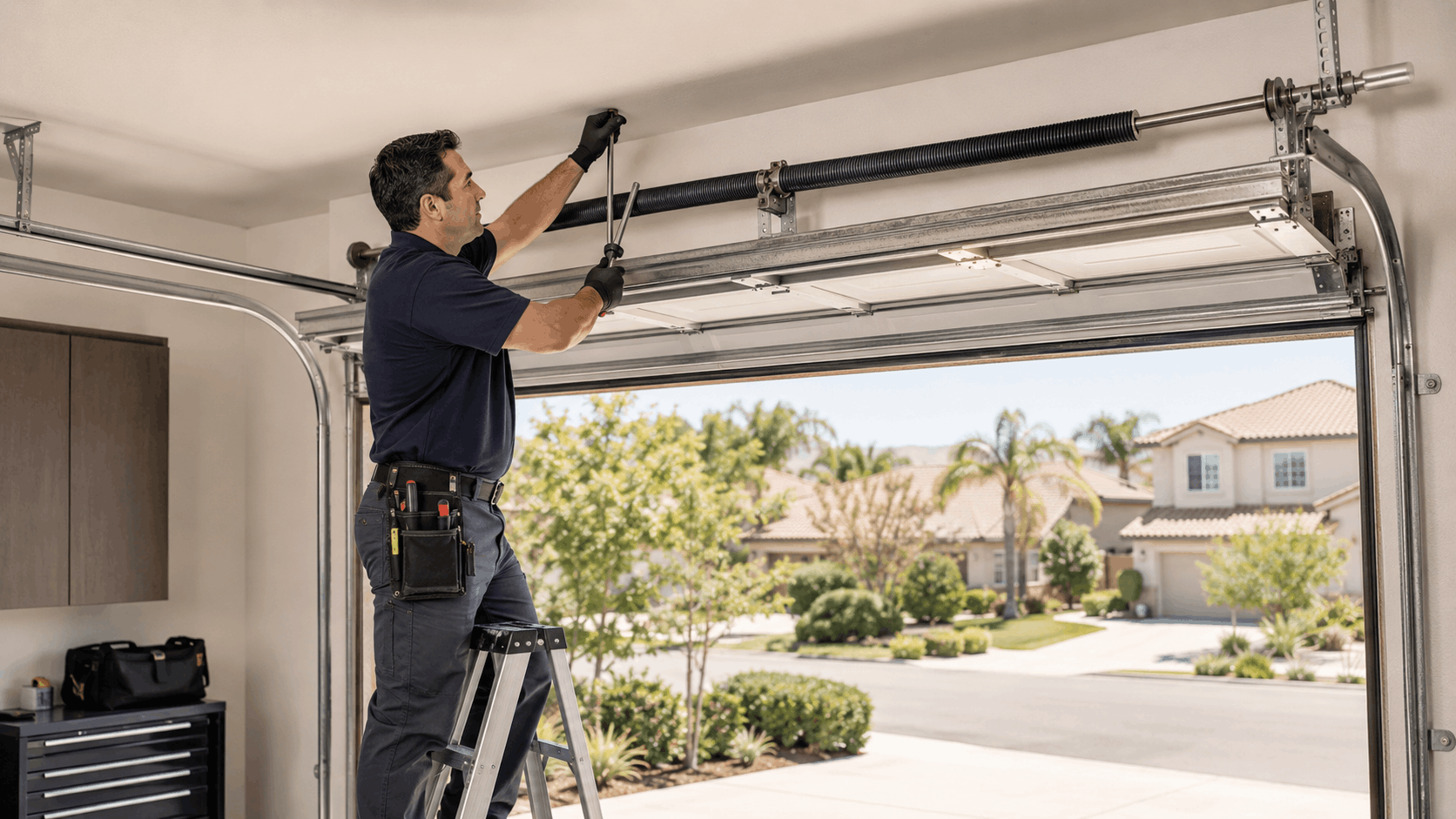
The technician first secures the door in place, usually with clamps on the track, so it cannot fall or shift. Then they carefully release any remaining tension from the springs using proper winding bars before unbolting the old spring from the bar.
This safe removal is exactly where homeowner DIY attempts go wrong. Without the right tools and technique, a spring or winding bar can slip and cause serious injury. Trained techs follow a set sequence that keeps the tension controlled at every step.
Once the old spring is off, the tech inspects the center bearing, the drums, and the mounting hardware. Worn parts get flagged so everything works well with the new spring. Skipping this step often shortens the life of the replacement.
Installing and Balancing the New Spring
With the old spring removed, the correctly sized new spring goes on the bar. The spring installation includes mounting the spring, reconnecting the cables, and threading everything into position.
Then comes the winding. The technician winds the spring to the exact tension the door weight requires, using winding bars and counting the turns precisely. Too few turns leaves the door heavy, and too many makes it hard to close.
Door balance is the goal. After winding, the tech tests the balance by lifting the door halfway by hand. A properly balanced door stays put at any point without drifting up or down. That neutral balance means the spring is doing its job right.
Balancing is a skill that comes from experience. Getting it right protects the opener, extends the spring life, and makes the door feel light and smooth. Our door balancing and tension adjustment service dials this in on every job.
Testing the Door and Opener
The final stage is testing. The technician runs the door through several full cycles to confirm smooth, even travel with no hitching, jerking, or crooked movement.
Door testing also includes the opener. The tech checks the force settings so the opener uses the right amount of power, and confirms the auto-reverse safety features work. A door that is properly balanced lets the opener run with less strain.
A manual lift check finishes the balance confirmation. The tech disconnects the opener and lifts the door by hand to make sure it moves freely and holds its position. This proves the spring tension is set correctly.
Only after everything passes does the crew wrap up. The homeowner gets a working, balanced door and any recommendations for keeping it that way. Clear testing at the end is how a repair earns trust.
Need Help in Irvine?
Urgent Garage Doors serves Irvine and all of Orange County.
Cost of Broken Spring Replacement in Mission Viejo
Price is one of the first questions homeowners ask, and vague answers help no one. Here are honest ranges for spring replacement cost in Mission Viejo, plus the factors that move the total up or down.
| Service | Typical Price Range |
|---|---|
| Single torsion spring replacement | $200 - $350 |
| Dual torsion spring replacement | $300 - $500 |
| Extension spring replacement (pair) | $180 - $350 |
| Spring plus cable replacement | $350 - $600 |
| High-cycle spring upgrade | Add $50 - $150 |
Typical Price Ranges
Most single spring replacements fall in the $200 to $350 range, covering both parts and labor. A dual spring job runs higher, usually $300 to $500, since it uses two springs and more labor.
The parts and labor split varies. Springs themselves are moderately priced, but the labor reflects the skill and safety involved. Winding a spring correctly and balancing the door takes training that a low quote often skips.
Extension spring jobs sit a bit lower on average, though they are usually replaced in pairs. The price range depends on the spring grade and whether safety cables also need installing.
These ranges cover standard residential doors in Mission Viejo. Oversized doors, custom setups, or jobs needing extra parts land at the higher end. A technician confirms the exact price after inspecting the door.
What Raises or Lowers the Cost
Several cost factors shift the final number. Door size is a big one. A larger, heavier door needs stronger springs and more careful balancing, which raises both parts and labor costs.
Spring quality matters too. A basic 10000 cycle spring costs less than a high-cycle spring rated for 20000 or more cycles. The higher-grade spring costs more upfront but lasts far longer, which many homeowners find worth it.
Extra parts add to the total. If the cables are frayed, the drums are worn, or the bearings need replacing, those items increase the price. Catching them during the same visit is cheaper than a second trip later.
The spring type also plays in. Torsion systems and extension systems price differently, and converting from one to another adds hardware and labor. An accurate quote reflects the actual condition of the whole door.
Why Two Springs Now Saves Money Later
On a dual spring door, when one spring breaks, the other is usually the same age and close to failing. Replacing just the broken one means the second spring often snaps within months.
Choosing to replace both springs at once avoids a second service call. The labor to install the pair together is only slightly more than doing one, since the tech is already there with the tools out.
Paying for one more spring now saves the full cost of another visit later. That is a real way to save on repairs. Most technicians recommend replacing both on a dual system for this exact reason.
The other benefit is balance. Two fresh springs of the same age and rating share the load evenly, which protects the opener and gives smoother travel. Mixing an old and new spring throws that balance off.
Warranty and Long-Term Value
Cheap springs can cost more over time. A bargain spring with a short cycle rating may break again in a few years, meaning another repair and another bill.
Higher-cycle springs offer better long-term value. A spring rated for 20000 or 30000 cycles lasts far longer under daily use, which matters for busy Mission Viejo households that open the door many times a day.
A spring warranty adds protection. Quality replacements often come with coverage that repairs or replaces the spring if it fails early. That backing is something a cheap online spring rarely includes.
When we quote a job, we explain the difference between a basic spring and a high-cycle option with warranty. For most homes, spending a little more upfront means years of trouble-free service and fewer repair calls down the road.
Why Homeowners Should Not Fix Springs Themselves
Garage springs look simple, so some homeowners are tempted to fix them alone to save money. This is one repair where DIY spring danger is very real. Here is why garage spring safety calls for a professional.
The Stored Tension Risk
A wound torsion spring holds a tremendous amount of energy. That stored force is what lifts a 200-pound door, and it does not go away just because the spring looks still.
The spring tension danger comes when that force releases the wrong way. If a winding bar slips or a spring lets go unexpectedly, it can whip around with enough power to break bones, knock out teeth, or worse.
Emergency rooms see garage spring injuries every year from DIY attempts gone wrong. The injury risk is not exaggerated. This is a real hazard that professional training exists specifically to manage.
Trained technicians control this tension with the right tools and a set procedure. They know exactly how to wind and unwind a spring so the energy stays contained. That safety margin is worth the cost of a pro.
Wrong Parts Make It Worse
Buying a spring online seems easy, but picking the wrong spring size is a common and costly mistake. Springs must match the door weight, height, and build precisely.
A mismatched spring throws off the balance. Too weak, and the door stays heavy and wears the spring out fast. Too strong, and the door slams shut or refuses to stay down. Either way, DIY mistakes lead to repeat failures.
Homeowners often guess at specs like wire size and diameter, which are hard to read without experience. An order that looks close on a website can be completely wrong for the actual door.
A technician measures and calculates the exact spring needed. That precision is what makes a repair balanced and long-lasting. Guessing wrong means paying twice, once for the wrong part and again for the correct fix.
Special Tools You Do Not Have
Spring work needs specific tools that most homeowners do not own. Winding bars are the main one, sized to fit the spring cones and long enough to control the tension safely.
Proper tools also include locking pliers, track clamps, and the right sockets for the hardware. Each has a purpose in keeping the door secured and the spring controlled during the swap.
Substituting household tools is dangerous. A screwdriver or the wrong-size bar can slip out of the winding cone under tension, sending the spring and the tool flying. The tools exist because the job demands them.
Professional crews carry these tools on every truck along with backup sizes. That readiness is part of why a technician finishes the job safely and correctly in one visit, something a homeowner without the gear cannot match.
When to Call the Pros
Some signs make it clear a homeowner should stop and call a professional. A visible gap in the coil, a door too heavy to lift, or a loud bang from the garage all point to a broken spring that needs expert hands.
Any time the repair involves winding or unwinding a torsion spring, that is the moment to call a technician. The same goes for extension springs without safety cables, which can fly loose during a repair.
If the door is off track, the cables are frayed, or the opener is straining, those problems compound the spring issue and need professional attention. Trying to sort them out alone risks injury and more damage.
The safe rule is simple: when in doubt, call. A garage door technician handles the tension, sizing, and balance safely. Reach out to our team and leave the dangerous part to the pros.
Serving Mission Viejo Neighborhoods and Beyond
Good local service means knowing the city, not just the name on the map. Our crew works Mission Viejo garage service calls across the whole city and knows its neighborhoods, schools, and routes. Here is how our local garage door repair coverage plays out.
Neighborhoods We Cover Often
We handle spring calls across many Mission Viejo communities. Aegean Hills, Deane Homes, and Madrid del Lago all see regular visits from our crew, along with the neighborhoods ringing Lake Mission Viejo.
Each area has its own quirks. Older sections like Deane Homes often run original single-spring setups that fail sooner, while lakeside communities deal with more moisture and rust. Knowing these patterns helps us arrive ready with the right parts.
The homes near Lake Mission Viejo especially benefit from corrosion-resistant springs given the added humidity. We keep those options on the truck for these calls. Our Finisterra on the Lake spring service covers this lakeside area often.
Working these neighborhoods week after week gives our crew real knowledge of local homes. That familiarity means faster diagnosis and repairs matched to each area's common issues.
Homes Near Schools and Parks
Family neighborhoods run their garage doors hard. Homes near Mission Viejo High School and the parks off La Paz Road open and close the door many times a day between school runs, sports, and errands.
All that use burns through spring cycles quickly. A family home near La Paz Road can wear out a standard spring years faster than a quieter household. These are the homes where high-cycle springs pay off the most.
We get frequent calls from these busy family areas. The heavy daily use means springs reach their limit on schedule, and often a bit early. Recommending durable replacements here saves families from repeat breakdowns.
Knowing which neighborhoods run their doors hardest helps us advise homeowners well. A busy family home deserves a spring built to keep up with the daily grind.
Quick Routes from Our Irvine Base
Our Irvine base sits close to Mission Viejo, and our crew knows the fastest way there. The trip from Irvine to Mission Viejo runs down the 5 and the 241, both of which our technicians travel regularly.
Knowing these routes matters for same-day service. Instead of guessing at traffic or taking slow surface streets, our crew picks the quickest path and arrives while the same-day window is still open.
The short distance is a real advantage. Being based in nearby Irvine rather than far across the county means we can respond to Mission Viejo spring calls fast, often within hours of a call. Learn more about our team and coverage.
Same-day routes and stocked trucks work together. A fast drive means nothing if the tech lacks parts, so we combine both to finish most Mission Viejo spring jobs in one trip.
HOA and Community Standards
Many Mission Viejo communities are planned developments with HOA guidelines. These rules often cover garage door appearance, hardware, and color to keep the neighborhood looking consistent.
Our crew respects these community standards. When a repair or upgrade might affect the door's look, we work within the HOA rules so homeowners avoid violations or fines.
For spring replacements, the internal hardware usually stays hidden, so HOA concerns are minimal. But when a job touches visible parts or a homeowner considers a full door installation, we help match community requirements.
Knowing local HOA expectations is part of serving Mission Viejo well. It saves homeowners the hassle of redoing work that does not meet neighborhood standards.
Need Help in Irvine?
Urgent Garage Doors serves Irvine and all of Orange County.
Final Thoughts
A broken garage door spring stops daily life fast, but it does not have to stay a problem for long. Spotting the signs early, avoiding the urge to force the door, and calling for same-day help keeps the repair simple and safe.
Springs are wear parts that fail on their own schedule, sped along by Mission Viejo's coastal air, older hardware, and cold mornings. Choosing quality replacements and replacing both springs on a dual system saves money and hassle down the road.
Our Urgent Garage Doors crew dispatches from Irvine and reaches Mission Viejo the same day for spring calls. If a spring has snapped or the door will not lift, contact our team for fast, safe same-day replacement. Call today and get the door working again before the day is out.
Frequently Asked Questions
How do I know if my garage door spring is broken?
Watch for three main signs. Many homeowners first hear a loud bang from the garage, similar to a gunshot or something heavy falling. Next, look above the closed door for a visible gap of about two inches in the coiled torsion spring. Finally, try lifting the door by hand. If it feels far too heavy or the opener strains and stops, a broken spring is the likely cause.
Can I still use my garage door with a broken spring?
No, it should stay closed until a technician arrives. Running the door with a broken spring forces the opener to haul the full door weight alone, which burns out the motor and gears. It also strains cables and tracks, which can snap or bend them. What starts as a simple spring repair can turn into a much bigger and costlier fix if the door is used.
How long does same-day spring replacement take?
Most spring replacements take about 45 minutes to two hours. A straightforward single torsion spring swap on a standard door falls at the shorter end. Dual spring systems, extension spring setups, or jobs that also need cables or drums replaced take longer. The technician inspects the door first, then handles the tension release, installation, balancing, and testing before wrapping up.
How much does a broken spring replacement cost in Mission Viejo?
A single spring replacement typically runs $200 to $350, while a dual spring job falls around $300 to $500. The final price depends on the door size, the spring quality, and whether cables, drums, or other parts also need replacing. High-cycle springs cost a bit more upfront but last longer. A technician confirms the exact price after inspecting the door.
Should I replace one spring or both?
On a dual spring system, replacing both at once is the smart choice. When one spring breaks, the other is the same age and usually close to failing itself. Doing both together avoids a second service call within months and keeps the door balanced with two springs of matching age and rating. The extra labor to install the pair is small compared to a separate visit later.
How long do garage door springs last?
Most standard springs last about 7 to 12 years, or roughly 10000 cycles. One cycle is a single open and close. Busy Mission Viejo households that use the garage as the main entrance may run through those cycles in five years or less. Lighter use stretches the lifespan longer. Coastal air, rust, and skipped maintenance all shorten the working life of a spring.
Is it safe to replace a torsion spring myself?
No, it is not safe for most homeowners. A wound torsion spring holds enough stored energy to cause serious injury if it releases the wrong way. The job requires proper winding bars, clamps, and a precise technique to control that tension. Household tools slip under load and can send the spring or bar flying. Trained technicians manage this force safely, which is why professional help is the right call.
Do you offer emergency spring service in Mission Viejo?
Yes. Urgent Garage Doors dispatches from nearby Irvine and reaches Mission Viejo neighborhoods the same day for broken spring calls. Our trucks carry common spring sizes and the tools needed to finish most jobs in one visit. We travel the 5 and the 241 daily and know the fastest routes into areas like Aegean Hills, Deane Homes, and the communities around Lake Mission Viejo.
What causes garage door springs to break so often?
Several things combine. Normal wear from thousands of open-and-close cycles is the main cause, as springs are rated for a limited number of cycles. Salt-tinged coastal air drifting inland speeds up rust on the metal. Cold Mission Viejo mornings make the steel brittle and prone to snapping. Skipped lubrication adds friction that wears the coil faster. Older homes with original single springs also fail sooner.
Does a new spring come with a warranty?
Quality spring replacements usually come with warranty coverage that repairs or replaces the spring if it fails early. The length and terms depend on the spring grade. Higher-cycle springs rated for 20000 or more cycles typically offer longer protection than basic springs. That coverage is one reason a quality replacement beats a cheap online spring, which rarely includes any backing at all.
Frequently Asked Questions
- How do I know if my garage door spring is broken?
- Watch for three main signs. Many homeowners first hear a loud bang from the garage, similar to a gunshot or something heavy falling. Next, look above the closed door for a visible gap of about two inches in the coiled torsion spring. Finally, try lifting the door by hand. If it feels far too heavy or the opener strains and stops, a broken spring is the likely cause.
- Can I still use my garage door with a broken spring?
- No, it should stay closed until a technician arrives. Running the door with a broken spring forces the opener to haul the full door weight alone, which burns out the motor and gears. It also strains cables and tracks, which can snap or bend them. What starts as a simple spring repair can turn into a much bigger and costlier fix if the door is used.
- How long does same-day spring replacement take?
- Most spring replacements take about 45 minutes to two hours. A straightforward single torsion spring swap on a standard door falls at the shorter end. Dual spring systems, extension spring setups, or jobs that also need cables or drums replaced take longer. The technician inspects the door first, then handles the tension release, installation, balancing, and testing before wrapping up.
- How much does a broken spring replacement cost in Mission Viejo?
- A single spring replacement typically runs $200 to $350, while a dual spring job falls around $300 to $500. The final price depends on the door size, the spring quality, and whether cables, drums, or other parts also need replacing. High-cycle springs cost a bit more upfront but last longer. A technician confirms the exact price after inspecting the door.
- Should I replace one spring or both?
- On a dual spring system, replacing both at once is the smart choice. When one spring breaks, the other is the same age and usually close to failing itself. Doing both together avoids a second service call within months and keeps the door balanced with two springs of matching age and rating. The extra labor to install the pair is small compared to a separate visit later.
- How long do garage door springs last?
- Most standard springs last about 7 to 12 years, or roughly 10000 cycles. One cycle is a single open and close. Busy Mission Viejo households that use the garage as the main entrance may run through those cycles in five years or less. Lighter use stretches the lifespan longer. Coastal air, rust, and skipped maintenance all shorten the working life of a spring.
- Is it safe to replace a torsion spring myself?
- No, it is not safe for most homeowners. A wound torsion spring holds enough stored energy to cause serious injury if it releases the wrong way. The job requires proper winding bars, clamps, and a precise technique to control that tension. Household tools slip under load and can send the spring or bar flying. Trained technicians manage this force safely, which is why professional help is the right call.
- Do you offer emergency spring service in Mission Viejo?
- Yes. Urgent Garage Doors dispatches from nearby Irvine and reaches Mission Viejo neighborhoods the same day for broken spring calls. Our trucks carry common spring sizes and the tools needed to finish most jobs in one visit. We travel the 5 and the 241 daily and know the fastest routes into areas like Aegean Hills, Deane Homes, and the communities around Lake Mission Viejo.
- What causes garage door springs to break so often?
- Several things combine. Normal wear from thousands of open-and-close cycles is the main cause, as springs are rated for a limited number of cycles. Salt-tinged coastal air drifting inland speeds up rust on the metal. Cold Mission Viejo mornings make the steel brittle and prone to snapping. Skipped lubrication adds friction that wears the coil faster. Older homes with original single springs also fail sooner.
- Does a new spring come with a warranty?
- Quality spring replacements usually come with warranty coverage that repairs or replaces the spring if it fails early. The length and terms depend on the spring grade. Higher-cycle springs rated for 20000 or more cycles typically offer longer protection than basic springs. That coverage is one reason a quality replacement beats a cheap online spring, which rarely includes any backing at all.
U
Licensed garage door repair professionals serving Irvine and Orange County.
Licensed in California · License #1055150
Why trust Urgent Garage Doors?
Founded in 2017, Urgent Garage Doors is a licensed and insured garage door services serving Irvine and Orange County. All content is reviewed by our licensed technicians.

Need Help in Irvine?
Urgent Garage Doors serves Irvine and all of Orange County.
Related Articles
Tips & Advice
Garage Door Won't Open in Newport Beach: Same-Day Emergency Service
A garage door that won't open in Newport Beach usually means a broken spring, opener failure, or salt-air rust. Learn the causes, safety checks, costs, and same-day fixes.
Cost Guides
Mission Viejo Garage Door Service: 1980s-90s Spring Replacement Pricing
Honest pricing and expert advice on garage door spring replacement for 1980s-90s Mission Viejo homes, covering spring types, costs, local factors, and safety.
Tips & Advice
Rancho Mission Viejo Garage Door Repair: New Master-Planned Community Service
Garage door repair guide for Rancho Mission Viejo homeowners - common new-build problems, HOA rules, maintenance tips, costs, and same-day service across Esencia, Sendero, and Rienda.