Cost Guides
Commercial Door Downtime Math: What a Stuck Door Costs an OC Business Per Hour and the Case for Priority Service
Key Takeaways
- A single stuck commercial door stalls an entire operation, not just one entrance, and the cost is measurable.
- Calculate hourly downtime with a simple formula: idle labor plus lost revenue plus idle equipment.
- Downtime cost ranges from under 100 dollars an hour for quiet gates to 800 to 1,500 dollars an hour for busy Spectrum-area warehouses.
- Most stuck doors come from broken springs, off-track rollers, worn operators, or coastal corrosion.
- Priority service pays off whenever saved downtime hours times your hourly cost beat the rush fee.
- Preventive maintenance and alert staff catch most failures before they stop the business.
- Keeping a trusted local repair team on call shortens outages and turns emergencies into scheduled work.
- Urgent Garage Doors offers fast, same-day and 24/7 commercial repair across Irvine and nearby OC cities.
In This Article
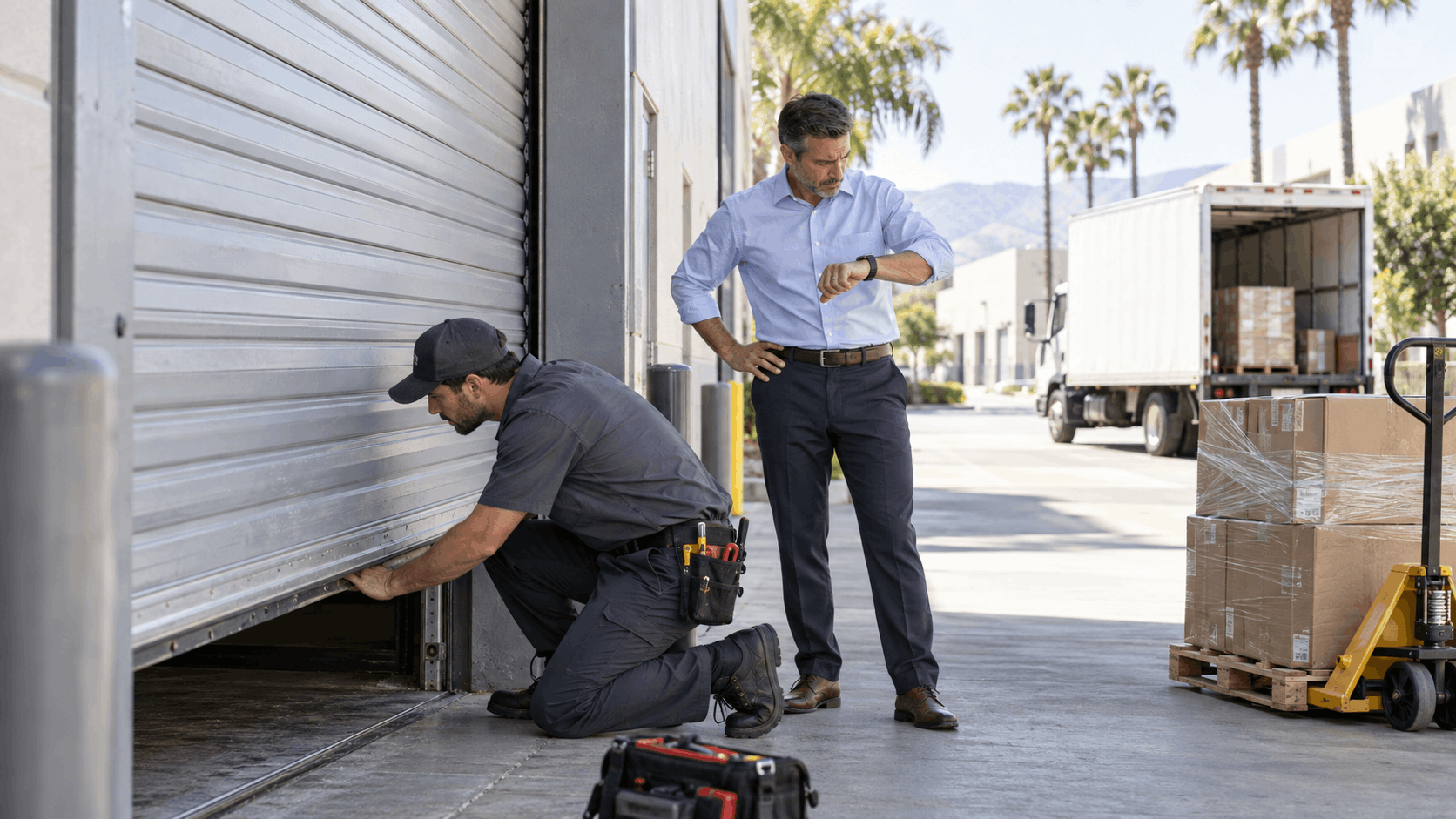
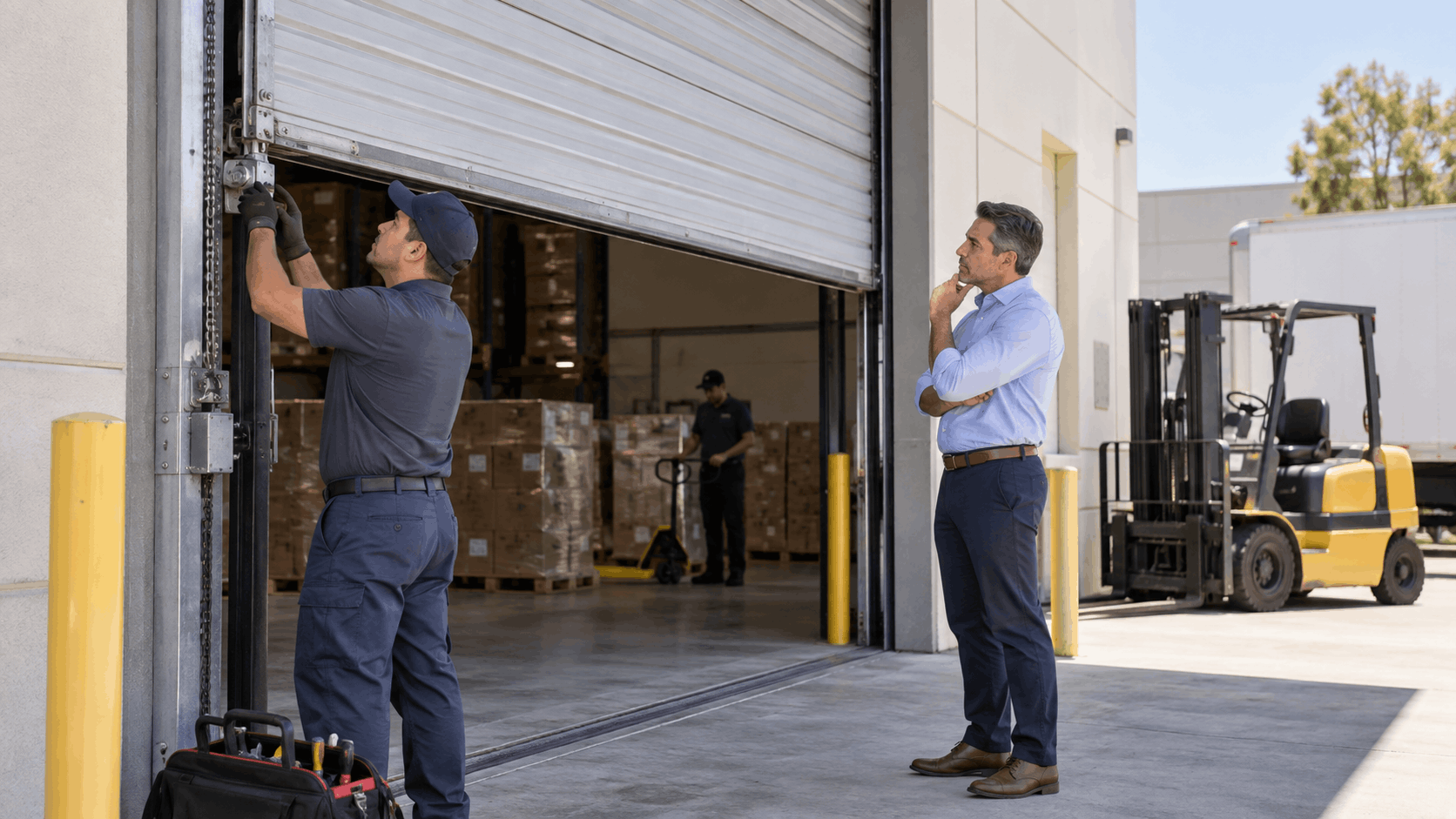
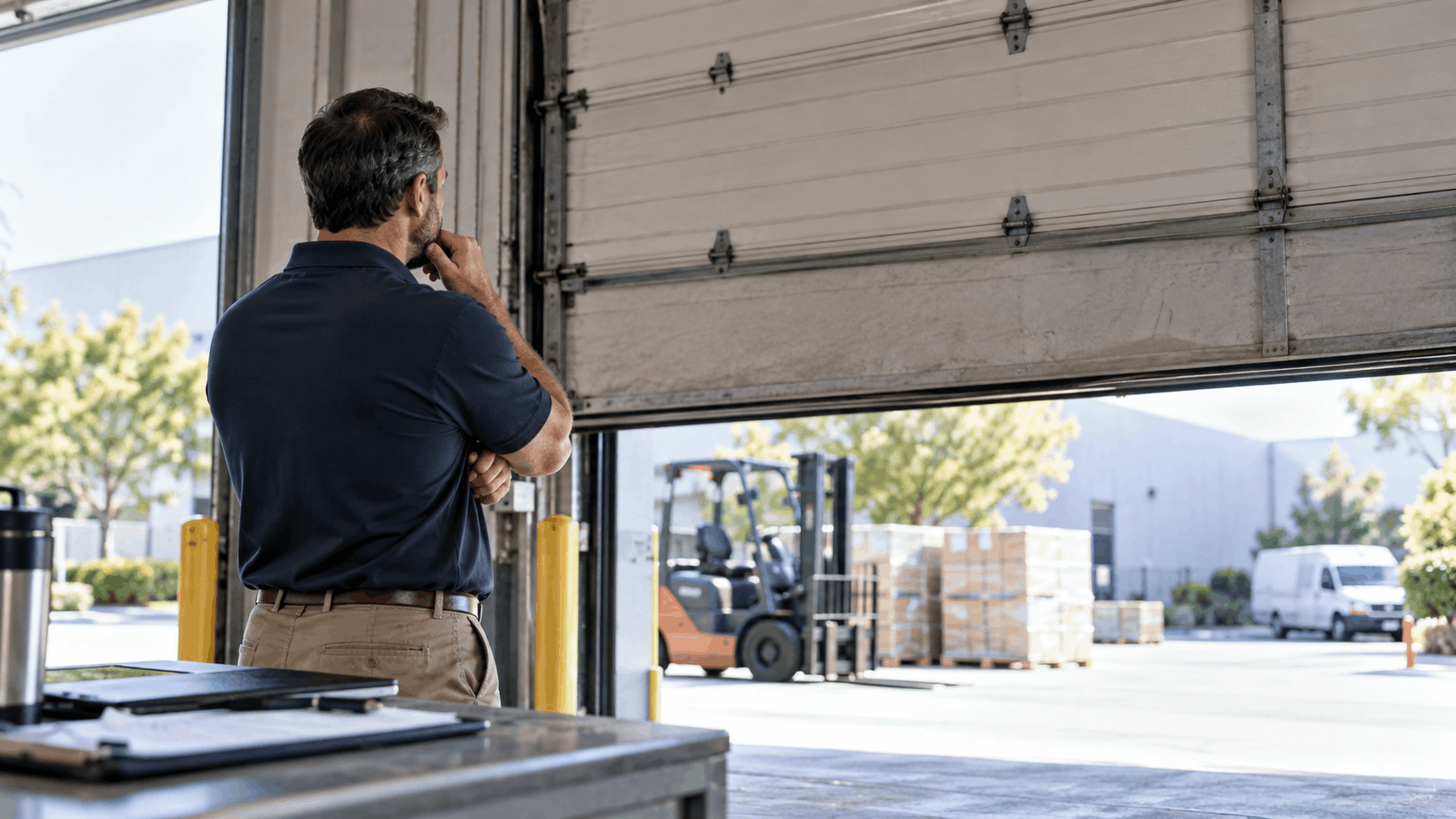
It is 7:40 on a Tuesday morning at a distribution warehouse just off Alton Parkway near the Irvine Spectrum. Two delivery trucks idle at the dock while the crew stares at a loading dock door that will not budge halfway up. The forklift sits parked. The receiving manager is on the phone with a carrier that is now running behind schedule.
That single stuck door is doing more than blocking one bay. It is holding up an entire morning of shipping, receiving, and staff who are being paid to stand around. And every minute it stays down, real money leaves the building.
Why a Stuck Commercial Door Is More Than an Inconvenience?
When a commercial door jams, most owners think about the one entrance that is blocked. The bigger problem is what that entrance connects to. A single stuck garage door can freeze an entire workflow, from the truck at the dock to the customer waiting at the counter.
Commercial door downtime is not a minor annoyance you shrug off until someone gets around to it. It creates real business disruption that touches labor, revenue, safety, and reputation all at once. The good news is that this cost is measurable, and once you can measure it, you can decide what fast service is worth.
The Hidden Ripple Effect on Daily Operations
A loading dock is a chokepoint. When one door goes down, trucks cannot back in, pallets cannot move, and staged product has nowhere to go. The operations delay does not stay at that one bay. It backs up down the line to every task that depends on goods flowing in and out.
We have seen a single stuck door at a Spectrum-area warehouse push a morning's receiving schedule back by three hours. Drivers on tight routes cannot wait, so they leave and reschedule, which pushes the problem into the next day. Meanwhile the outbound side stalls because staging space fills up with product that should already be gone.
Foot traffic feels it too. In mixed-use buildings, a jammed rolling grille at a service entrance can force employees and vendors to reroute through the front, creating congestion and confusion. One failed door quietly turns into a full-site slowdown that most owners never budgeted for.
The point is simple. A door is not an isolated part. It is the valve that controls the pace of the whole operation, and when it sticks, everything behind it slows to match.
Security and Safety Risks While a Door Is Down
A door stuck in the open position is an open invitation. Inventory, tools, and equipment sit exposed to anyone who walks by, and after hours that becomes a serious security risk. For businesses storing high-value goods near the Airport Area, an open bay overnight is a theft waiting to happen.
Weather adds to the problem. An open door lets heat, dust, and marine moisture pour in, which can damage sensitive product and drive up cooling costs on a hot Orange County afternoon. What starts as a mechanical failure turns into an exposure problem within hours.
Then there is fire code. Many commercial doors double as designated exits or fire separations. A door stuck shut can block a required egress path, and a door stuck open can defeat a fire barrier the building depends on. Both situations put people at risk and can put you out of compliance with local building department requirements.
Door safety is not something to improvise around. If a door will not open or close correctly, the safe move is to stop using that area and get it addressed before someone gets hurt or the building is left unprotected.
How Downtime Hurts Customer Trust
Customers remember when you cannot serve them. An auto shop with a jammed bay door has to turn away paying jobs, and those drivers do not always come back. A retailer whose back delivery door is stuck may miss a restock and end up with empty shelves during peak hours.
Missed deliveries hit hardest. When a carrier arrives and cannot unload, that shipment gets rescheduled or returned, and the customer waiting on that product hears an excuse instead of a delivery. Do that twice and you have taught a client to look elsewhere.
Customer trust is slow to build and fast to lose. A restaurant that cannot take in a produce delivery may run out of menu items by dinner service, and diners notice. Word travels quickly in tight commercial corridors where the same vendors and customers circulate daily.
Reputation damage does not show up on an invoice, but it is one of the most expensive parts of downtime. Every turned-away delivery or delayed order chips at the relationships that keep a local business running.
Get Your Free Quote
Tell us about your garage door and we'll get back to you fast.
The Downtime Math: Calculating Cost Per Hour
Owners often feel that a stuck door is costing them, but few have put a number on it. Once you do, the decision to call for fast help gets a lot clearer. The downtime cost per hour is not a mystery. It is a short calculation you can run on the back of a receipt.
Below is a simple cost calculation framework, plus the categories most people forget. Add these up and you will have a realistic hourly figure for lost revenue and wasted spend during any door outage.
The Basic Formula Any Owner Can Use
Here is a downtime formula that works for almost any business. Take your idle labor cost per hour, add the revenue you lose per hour while the door is down, then add the value of any equipment or space sitting unused. The sum is your hourly cost.
Written out, it looks like this: Idle Labor + Lost Revenue + Idle Equipment = Hourly Downtime Cost. Each piece is easy to estimate from numbers you already track, like payroll and average daily sales.
For example, a small operation with four idle workers at 28 dollars an hour loaded cost, losing 300 dollars an hour in sales, with a 100 dollar per hour value on stalled equipment, sits at roughly 512 dollars an hour. That is before any of the hidden costs we cover below.
Run this once and keep the number handy. When a door fails, you will know instantly whether waiting six hours for a standard appointment is a smart choice or an expensive one.
Labor Costs of Idle Workers
Idle labor is the fastest-adding cost because you keep paying it whether work happens or not. A crew that cannot load, receive, or serve is still on the clock, still drawing wages and burdening your payroll. That is pure payroll waste with nothing produced in return.
Consider a warehouse with a six-person morning crew. At a loaded cost of around 30 dollars an hour each, that is 180 dollars an hour in wages spent on people who physically cannot do their jobs. Over a three-hour outage, that is 540 dollars gone before you count a single lost sale.
Smaller shops feel it too. An auto shop with two technicians unable to reach the lifts behind a stuck bay door burns their billable time, which is often 100 dollars an hour or more per tech in lost shop revenue. The wage is only half the sting.
The lesson is that idle labor is a meter running the whole time. It rewards any fix that gets people working again sooner, which is exactly what priority service is built to do.
Lost Sales and Missed Shipments
Some downtime costs you can never recover. When a truck cannot load and misses its route window, that shipment is delayed and sometimes canceled. The revenue tied to it may simply never come back.
Lost sales work the same way for customer-facing businesses. If shoppers cannot get through a stuck security grille or a delivery cannot restock the floor, those sales walk to a competitor. You do not get a second chance at that morning's traffic.
Shipment delays also carry a tail. A missed outbound truck can trigger late-delivery penalties from a retail partner, and a missed inbound load can leave you short on product for days. One stuck door can ripple into a week of catch-up.
When we help clients estimate this, we ask a simple question: what does an average hour of business generate here? That figure, applied to the outage window, is the lost revenue you should weigh against the cost of a faster repair.
The Costs Owners Forget to Count
The obvious costs are only part of the picture. Hidden costs pile up quietly and often exceed the labor and sales figures. Spoilage is a big one for any business handling food, flowers, or temperature-sensitive goods, since an open or non-functioning cold-side door can ruin inventory in a single afternoon.
Overtime is another. When a door outage pushes work into the evening, crews often stay late to catch up, and that overtime pay is a direct downtime cost you would not have paid otherwise. The stuck door in the morning becomes a payroll spike that night.
Then come penalty fees and energy loss. Late shipments can trigger contract penalties, and a door stuck open bleeds conditioned air, spiking utility bills. Add wear on other equipment forced to work harder, and the true hourly cost climbs well past the basic formula.
Counting these forgotten costs is what separates a rough guess from a real number. When owners include spoilage, overtime, and penalties, the case for a quick, correct repair usually makes itself.
Need Help in Irvine?
Urgent Garage Doors serves Irvine and all of Orange County.
Downtime Cost by Business Type in Orange County
Not every stuck door costs the same. A gate at a quiet office park is a different story than a high-cycle dock door moving freight all day. The hourly loss depends heavily on the type of Orange County business and where it sits.
Below are common local examples and how their industry downtime cost tends to stack up. If you run an Irvine commercial operation, one of these profiles probably looks familiar.
Warehouses and Distribution Centers Near the Spectrum
The warehouse corridors around the Irvine Spectrum and along Alton Parkway run on volume. A single dock handles dozens of trucks a day, and each stalled truck can represent hundreds of dollars in idle labor, missed freight, and carrier fees. A warehouse door failure here is one of the most expensive outages in the county.
High-volume operations often run tight appointment windows with carriers. When a loading dock door jams, a driver may wait 20 minutes then leave for the next stop, taking your inbound goods with them. Rescheduling can cost a full day of product availability.
For a busy distribution center, we regularly see effective downtime costs north of 800 to 1,500 dollars per hour once idle crews, delayed freight, and penalty exposure are added up. At those numbers, even a half-day wait for repair is a serious hit. A properly specified commercial overhead door and fast repair coverage are worth every dollar here.
These are also the doors that cycle the most, which means they wear fastest. High use plus high cost per hour is exactly why Spectrum-area warehouses benefit most from priority response and preventive care.
Auto Shops and Service Bays Along Barranca Parkway
Auto shops live and die by bay access. Along Barranca Parkway and the surrounding Irvine industrial pockets, a jammed service bay door can lock a car onto a lift or block the next job from pulling in. Every hour that bay is unusable is billable time lost.
A single service bay often generates 100 to 150 dollars an hour in labor revenue when busy. With two or three bays out of commission behind a stuck door, a shop can lose 300 to 450 dollars an hour, plus the goodwill of customers told to come back later.
There is also a practical trap. A vehicle can get stranded inside a bay when the door will not open, meaning that customer cannot get their car back and the tech cannot start the next one. The backup compounds through the day.
For auto shops, an door that will not open or close is an emergency, not a maintenance item. Getting that bay moving again quickly is the whole difference between a normal day and a lost one.
Restaurants and Retail in Airport Area and Diamond Jamboree
Food and retail businesses around Diamond Jamboree and the Airport Area depend on quiet, reliable flow through back doors and rolling grilles. A restaurant delivery door that will not open can stop a produce or protein drop cold, and a kitchen cannot serve what it never received.
Retail rolling doors and security grilles carry their own risk. If a grille will not lift, the store cannot open on time, and every closed hour during peak traffic is direct lost revenue. If it will not close, the location cannot secure its inventory at night.
For a busy restaurant, a missed morning delivery can knock several menu items out for the day, frustrating diners and denting the average ticket. For retail, a two-hour late open at Diamond Jamboree during a weekend can easily cost several hundred dollars in sales.
These doors are smaller than dock doors but no less important to the business. Keeping them serviced and getting fast help when they stick protects both revenue and the customer experience.
Office Parks and Flex Space in the Irvine Business Complex
The office parks and flex buildings around the Irvine Business Complex share doors and gates among many tenants. A stuck parking gate can trap or block dozens of employees and visitors, creating a bottleneck that affects every business in the building at once.
Tenant loading doors in flex space matter too. A small distributor or e-commerce tenant relying on a single roll-up door has no backup when it fails. Their whole operation pauses until the door works again.
Shared infrastructure spreads the pain. One failed gate means multiple companies filing complaints to property management, and multiple crews delayed getting to their spaces. The per-hour cost is harder to pin to one tenant but very real across the building.
For multi-tenant properties, reliable gate and door function is part of keeping tenants happy. Property managers near the Business Complex often keep a repair partner on call precisely because one stuck gate affects so many people.
Common Reasons Commercial Doors Get Stuck
After years working on commercial doors across Orange County, we see the same failures again and again. Knowing what causes a stuck door helps you spot trouble early and understand why some fixes take longer than others.
Most commercial door failure traces back to a handful of parts under heavy load. Here are the causes behind the majority of the garage door repair calls we run for local businesses.
Broken Springs and Snapped Cables
Springs do the heavy lifting on any overhead door, and on commercial units they work hard. A torsion spring is rated for a set number of cycles, and high-use doors burn through those cycles fast. When a spring snaps, the door often becomes too heavy to move and stops dead.
Cables work alongside the springs to guide and balance the door. A frayed or snapped cable can send a door crooked or lock it in place, and it can be dangerous to force. This is not a fix to improvise with a warehouse crew.
On high-cycle commercial doors, we often recommend upgraded springs rated for the door's real daily use. Our torsion spring replacement and cable repair work restores balance and safe movement quickly.
A broken spring is one of the most common reasons a busy door goes down without warning. Regular inspection catches worn springs before they fail at the worst possible moment.
Bent Tracks and Off-Track Rollers
Commercial doors take a beating from the equipment around them. A forklift bump or a truck backing in too far can bend a track or knock the door off its rollers. Once a door is off-track, it binds and refuses to move smoothly.
Bent track is common in tight loading areas where machinery and doors share close quarters. Even a small dent in the track can throw a roller out of line and jam the door mid-cycle. The door may look fine until it seizes halfway.
Roller damage builds up too. Worn or cracked rollers ride rough and eventually pop out of the track under load. When that happens, forcing the door usually makes the damage worse and costs more to fix.
Our off-track door repair gets these doors realigned and rolling again. Catching a bent track early keeps a minor bump from becoming a full failure.
Motor and Opener Burnout
Heavy commercial doors need heavy-duty operators, and even those wear out. A commercial opener running dozens or hundreds of cycles a day builds heat and strain over the years. Eventually the motor stalls, hums without moving, or quits mid-cycle.
Operator failure often shows warning signs first. The door may open slower, hesitate, or reverse for no reason. Those symptoms are the operator telling you it is near the end, and ignoring them usually leads to a full stop at a busy hour.
Electrical issues, worn gears, and failing logic boards all play a part in motor failure. Some are quick fixes and some call for a new operator sized for the door's real workload. Getting the diagnosis right matters.
Our team handles opener repair and troubleshooting for commercial units, and we can spec a properly rated replacement when an old operator is beyond saving.
Coastal Air and Weather Wear in OC
Orange County's climate is easy on people but hard on hardware. Buildings closer to the coast in Newport Beach, Costa Mesa, and Huntington Beach deal with salty marine air that speeds up coastal corrosion on springs, tracks, fasteners, and cables.
That rust weakens parts faster than owners expect. A spring or cable that might last years inland can fail sooner near the water because corrosion eats at the metal. Regular hardware checks matter more in these zones.
Heat cycles add wear too. Doors baking in afternoon sun expand and contract, loosening fasteners and stressing components over time. Combined with daily use, that thermal cycling accelerates general weather wear.
For coastal and inland properties alike, protective hardware and routine service slow this decay. We often suggest corrosion-resistant components and periodic lubrication for businesses fighting hardware rust in the salt air.
The Case for Priority Service Over Standard Repair
Once you know your hourly downtime cost, the choice between waiting and calling for priority service becomes a math problem, not a guess. Fast response is not about panic. It is about spending a little to save a lot when the meter is running.
Priority service and emergency door repair exist because some outages are too expensive to sit through. Here is how to weigh a faster fix against a standard appointment.
How Response Time Directly Cuts Your Loss
Every hour a door stays down is another hour of your calculated downtime cost. If your operation loses 600 dollars an hour, cutting a repair wait from six hours to two saves you roughly 2,400 dollars. A priority fee that costs a fraction of that is easy math.
Response time is the lever you control. You cannot always prevent a failure, but you can decide how fast someone arrives to fix it. That decision alone often determines whether a stuck door costs hundreds or thousands.
We stock our trucks and route calls so we can reach Irvine commercial clients quickly. Faster arrival means faster diagnosis, and faster diagnosis means your crew gets back to work sooner. The downtime savings show up immediately on your books.
The higher your hourly cost, the more every saved hour is worth. For high-volume operations, shaving even a couple of hours off the outage pays for priority service many times over.
When Standard Scheduling Makes Sense
Not every door needs an emergency call. A low-traffic door, a cosmetic dent, or a minor issue that does not stop the business can wait for a standard repair appointment. There is no reason to pay a rush fee for something that is not costing you anything right now.
A rear door that gets used twice a day, or a spare bay that is not in the rotation, can often hold until the next available slot. Being honest about which doors are non-urgent saves money and lets us reserve fast response for the outages that truly hurt.
The test is simple. If the stuck door is stopping revenue, labor, or shipments, treat it as urgent. If it is an inconvenience you can work around safely, standard scheduling is the sensible choice.
We will tell you straight which category your situation falls into. Sometimes the right advice is that it can wait, and we would rather save you money than sell you speed you do not need.
What Priority Service Includes
Priority service is built for speed without cutting corners. It means faster dispatch, trucks stocked with common commercial parts, and same-day repair whenever the problem allows. The goal is to arrive ready to fix it, not just to look at it.
Stocked parts matter more than people realize. Carrying springs, cables, rollers, and common operator components means we can often complete the repair in one visit instead of ordering parts and coming back. That is the difference between a two-hour outage and a two-day one.
Fast dispatch is the other half. When you call, we prioritize the route so a technician heads your way quickly. Our same-day garage door repair and 24/7 emergency repair keep Irvine businesses moving.
The whole package is about getting you operational again with the least lost time. For a business bleeding hundreds an hour, that speed is the product.
The Break-Even Point for Your Business
There is a clear break-even point where priority service always pays. Compare the priority fee to your hourly downtime cost, then estimate how many hours faster the repair happens. If the saved hours times your hourly cost beats the fee, priority wins.
Run a quick cost benefit check. Say priority service adds 150 dollars and gets you fixed four hours sooner, while your downtime runs 500 dollars an hour. That is 2,000 dollars saved against a 150 dollar fee, a clear yes.
For very low-cost doors, the math can point the other way, and standard scheduling wins. The number tells you honestly which choice serves your bottom line best.
Once owners see their break-even figure, the decision stops feeling like a gamble. For most active commercial doors in Orange County, the hourly cost is high enough that priority service is the smart call almost every time.
Need Help in Irvine?
Urgent Garage Doors serves Irvine and all of Orange County.
How to Reduce Downtime Before It Happens
The cheapest downtime is the kind that never happens. Most commercial door failures give warning before they quit, and a little preventive maintenance goes a long way toward catching problems early. Here is how to reduce downtime and keep repairs short when they do come.
Good commercial door care is a mix of scheduled inspections, alert staff, and a repair partner who knows your property. Do these three things and stuck doors become rare instead of routine.
Scheduled Maintenance Plans That Catch Problems Early
Routine inspections find worn parts before they break. A technician checking spring condition, cable wear, track alignment, and operator health can flag a failing component while the door still works. Replacing a tired spring on your schedule beats replacing it during a rush hour crisis.
A maintenance plan puts these checks on a calendar so nothing gets forgotten. For high-cycle commercial doors, we recommend inspections several times a year, since heavy use wears parts faster than a typical home door.
These visits also cover the small stuff that causes big problems, like loose fasteners, dry rollers, and drifting sensor alignment. Our preventive maintenance plan keeps commercial doors tuned and reliable.
The return on a maintenance plan is fewer surprise breakdowns and less emergency spending. For any business where a stuck door costs real money, that trade is an easy one to make.
Warning Signs Staff Should Watch For
Your crew is your early warning system if they know what to listen for. Grinding, squealing, or banging sounds are warning signs that hardware is wearing or misaligned. New door noise usually means something needs attention before it fails.
Slow or hesitant movement is another red flag. A door that opens sluggishly, jerks, or stops partway is telling you the operator or springs are struggling. Reporting that early can turn a full failure into a quick tune-up.
Visible gaps, sagging, or a door that looks crooked in its tracks point to balance or track problems. So does a door that will not stay put when stopped halfway. These are signs of tension or roller issues worth checking fast.
Train staff to report these symptoms the moment they notice them, not after the door quits. A five-minute heads-up can save hours of downtime later.
Keeping a Trusted Local Repair Team on Call
When a door does fail, having a repair team that already knows your property saves time. A partner familiar with your doors, operators, and layout can diagnose faster and often arrives with the right parts already on the truck. Our emergency garage door repair coverage keeps that help close by.
A local on-call relationship also means you skip the scramble of finding help mid-crisis. You already have the number, they already have your history, and the repair starts sooner. That familiarity is worth real money during an outage.
Knowing your equipment also helps with planning. A team that has serviced your doors can tell you which components are aging and budget replacements before they fail. That turns emergencies into scheduled work.
For Irvine businesses, keeping a trusted local team on call is one of the simplest ways to keep downtime short and predictable. You can always reach our team to set that up.
Why Irvine Businesses Call Urgent Garage Doors First
When a commercial door goes down, Orange County businesses need help that arrives fast and fixes it right. Our team works these streets every day, so we know the properties, the traffic, and what commercial operations need to keep moving.
Here is what sets our local response apart for Irvine commercial repair and the surrounding cities.
Fast Coverage Across Irvine and Nearby Cities
Central Irvine puts us minutes from the Spectrum, the Airport Area, and the Business Complex, so our arrival times to local commercial doors are short. When every hour counts, that drive time is part of what we sell.
Our service area reaches well beyond Irvine too. We cover Tustin, Costa Mesa, and Lake Forest with the same fast response, since a stuck door in a neighboring city costs just as much.
Knowing the local routes helps us dodge the worst of the traffic between calls. We route technicians efficiently so a busy morning does not turn into an afternoon wait.
Fast arrival is the first step in cutting downtime. Everything else in the repair only starts once we are on site, so we make that happen quickly.
Commercial-Grade Repairs Done Right the First Time
Commercial doors are not oversized home doors. Heavy rolling doors, high-cycle springs, and industrial operators need experience and the right parts to fix correctly. Our team works on these units regularly and knows their quirks.
Doing the commercial repair right the first time matters more here than anywhere. A rushed patch that fails again next week doubles your downtime and your cost. We fix the actual cause so the door stays working.
We match parts to your door's real workload, spec-ing high-cycle springs and properly rated operators for doors that run all day. That quality work extends the life of the repair and reduces repeat failures.
Whether it is a snapped spring on a dock door or a burned-out operator on a rolling grille, we bring the tools and parts to finish the job in one visit whenever possible.
Clear Pricing and Honest Timelines
Nobody likes surprises on an invoice. We give upfront pricing before work begins, so you know what the repair costs and can weigh it against your downtime. No mystery charges after the fact.
We also give honest estimates on timelines. If a part needs ordering or a repair will take longer, we tell you straight so you can plan around it. A realistic window beats a false promise every time.
That honesty extends to whether you even need priority service. If your door can wait, we will say so. If it is costing you money by the hour, we will get there fast.
Clear pricing and straight timelines are how we build long relationships with local businesses. You can learn more about our team and how we work.
Need Help in Irvine?
Urgent Garage Doors serves Irvine and all of Orange County.
Final Thoughts
A stuck commercial door is not just a maintenance ticket. It is a running cost that hits labor, revenue, safety, and customer trust all at once. Once you calculate your hourly downtime figure, the value of fast, correct repair becomes obvious.
The smartest move is to prevent failures with routine service and to keep a trusted local team on call for when problems do hit. For Orange County businesses, that combination keeps doors moving and losses small.
If a commercial door is slowing your operation, or you want a maintenance plan to head off the next failure, our team is ready to help. Contact Urgent Garage Doors for a consultation, upfront pricing, and fast response across Irvine and nearby cities.
Frequently Asked Questions
How much does commercial door downtime cost per hour?
It varies widely by business type. A quiet office gate might cost under 100 dollars an hour, while a busy distribution center near the Spectrum can lose 800 to 1,500 dollars an hour once idle labor, missed freight, and penalty fees are added. Factors that push it higher include high foot traffic, tight delivery windows, perishable goods, and large crews standing idle during the outage.
How fast can a stuck commercial door be repaired?
Many common failures, like broken springs, off-track rollers, or a stalled operator, can be handled same-day when a stocked truck arrives quickly. Simple repairs often take one to three hours on site. Bigger jobs that need a special part or a new operator may run longer, but we tell you the realistic window upfront so you can plan your operation around it.
Is priority service worth the extra cost?
Usually, yes, for any door that is actively costing you money. Compare the priority fee to your hourly downtime cost. If your operation loses 500 dollars an hour and priority service gets you fixed four hours sooner, that is 2,000 dollars saved against a modest fee. For low-traffic doors that are not stopping business, standard scheduling is the cheaper choice.
What are the most common causes of a stuck commercial door?
The top causes we see are broken torsion springs and snapped cables, doors knocked off their tracks by forklift or truck contact, and worn-out operators that stall mid-cycle. Coastal corrosion and general weather wear speed up several of these failures. Most give warning signs first, which is why routine inspection catches so many problems before the door quits.
Can I keep operating with a partly stuck door?
It is not worth the risk. A door stuck open leaves your building exposed to theft and weather, and a door stuck shut can block a required fire exit. Forcing a jammed door can also make the damage worse and injure staff. The safe move is to stop using that entrance, secure the area, and call for repair.
How often should commercial doors be serviced?
Frequency depends on how many cycles the door runs each day. Low-use doors may only need service once or twice a year, while high-cycle dock doors and rolling grilles benefit from inspections three to four times a year. Heavy daily use wears springs, cables, and operators faster, so a maintenance plan matched to your cycle count keeps failures rare.
Do you service commercial doors outside Irvine?
Yes. From central Irvine we cover Tustin, Costa Mesa, Lake Forest, Santa Ana, Newport Beach, Huntington Beach, Aliso Viejo, and other nearby Orange County cities for commercial calls. A stuck door costs the same wherever it is, so we bring the same fast response and stocked trucks across our full service area.
What should staff do the moment a door gets stuck?
Stop using the door right away and do not force it. Clear people and equipment away from it, especially if a spring or cable looks broken, since those are under high tension. Secure the area to protect inventory if the door is stuck open, then call for repair with details on what the door was doing when it failed so we arrive prepared.
How do I lower my long-term repair costs?
A maintenance plan is the most reliable way. Routine inspections catch worn springs, frayed cables, and drifting alignment before they cause a breakdown, which turns expensive emergencies into scheduled, lower-cost work. Fewer surprise failures also means less overtime and lost revenue, so the plan often pays for itself over a year of use.
Do you offer emergency service after hours?
Yes. Commercial doors do not only fail during business hours, so we offer 24/7 emergency response for urgent commercial calls. If a door goes down overnight, at an early morning dock, or on a weekend, our team can dispatch a stocked truck to get you secured and operational again as fast as possible.
For more resources on commercial door safety and workplace standards, business owners can review guidance from OSHA, fire code information from the NFPA, and door industry standards from the DASMA.
Frequently Asked Questions
- How much does commercial door downtime cost per hour?
- It varies widely by business type. A quiet office gate might cost under 100 dollars an hour, while a busy distribution center near the Spectrum can lose 800 to 1,500 dollars an hour once idle labor, missed freight, and penalty fees are added. Factors that push it higher include high foot traffic, tight delivery windows, perishable goods, and large crews standing idle during the outage.
- How fast can a stuck commercial door be repaired?
- Many common failures, like broken springs, off-track rollers, or a stalled operator, can be handled same-day when a stocked truck arrives quickly. Simple repairs often take one to three hours on site. Bigger jobs that need a special part or a new operator may run longer, but we tell you the realistic window upfront so you can plan your operation around it.
- Is priority service worth the extra cost?
- Usually, yes, for any door that is actively costing you money. Compare the priority fee to your hourly downtime cost. If your operation loses 500 dollars an hour and priority service gets you fixed four hours sooner, that is 2,000 dollars saved against a modest fee. For low-traffic doors that are not stopping business, standard scheduling is the cheaper choice.
- What are the most common causes of a stuck commercial door?
- The top causes we see are broken torsion springs and snapped cables, doors knocked off their tracks by forklift or truck contact, and worn-out operators that stall mid-cycle. Coastal corrosion and general weather wear speed up several of these failures. Most give warning signs first, which is why routine inspection catches so many problems before the door quits.
- Can I keep operating with a partly stuck door?
- It is not worth the risk. A door stuck open leaves your building exposed to theft and weather, and a door stuck shut can block a required fire exit. Forcing a jammed door can also make the damage worse and injure staff. The safe move is to stop using that entrance, secure the area, and call for repair.
- How often should commercial doors be serviced?
- Frequency depends on how many cycles the door runs each day. Low-use doors may only need service once or twice a year, while high-cycle dock doors and rolling grilles benefit from inspections three to four times a year. Heavy daily use wears springs, cables, and operators faster, so a maintenance plan matched to your cycle count keeps failures rare.
- Do you service commercial doors outside Irvine?
- Yes. From central Irvine we cover Tustin, Costa Mesa, Lake Forest, Santa Ana, Newport Beach, Huntington Beach, Aliso Viejo, and other nearby Orange County cities for commercial calls. A stuck door costs the same wherever it is, so we bring the same fast response and stocked trucks across our full service area.
- What should staff do the moment a door gets stuck?
- Stop using the door right away and do not force it. Clear people and equipment away from it, especially if a spring or cable looks broken, since those are under high tension. Secure the area to protect inventory if the door is stuck open, then call for repair with details on what the door was doing when it failed so we arrive prepared.
- How do I lower my long-term repair costs?
- A maintenance plan is the most reliable way. Routine inspections catch worn springs, frayed cables, and drifting alignment before they cause a breakdown, which turns expensive emergencies into scheduled, lower-cost work. Fewer surprise failures also means less overtime and lost revenue, so the plan often pays for itself over a year of use.
- Do you offer emergency service after hours?
- Yes. Commercial doors do not only fail during business hours, so we offer 24/7 emergency response for urgent commercial calls. If a door goes down overnight, at an early morning dock, or on a weekend, our team can dispatch a stocked truck to get you secured and operational again as fast as possible. For more resources on commercial door safety and workplace standards, business owners can review guidance from OSHA , fire code information from the NFPA , and door industry standards from the DASMA .
U
Licensed garage door repair professionals serving Irvine and Orange County.
Licensed in California · License #1055150
Why trust Urgent Garage Doors?
Founded in 2017, Urgent Garage Doors is a licensed and insured garage door services serving Irvine and Orange County. All content is reviewed by our licensed technicians.

Need Help in Irvine?
Urgent Garage Doors serves Irvine and all of Orange County.
Related Articles
Cost Guides
Emergency Garage Door Repair Cost OC: After-Hours Pricing Breakdown by City
A local breakdown of emergency garage door repair costs across Orange County, including after-hours pricing by city, what drives the numbers, and how to stay safe.
Safety & Prevention
Garage Door Stuck Open in OC: Emergency Service Coverage Map
A garage door stuck open in OC? See our emergency coverage map, honest response times across Orange County, repair costs, and safe steps to take before help arrives.
Cost Guides
Northpark Irvine Garage Door Service: 1990s-Era Spring Replacement Costs
What 1990s-era garage door springs cost to replace in Northpark Irvine, why they fail, warning signs to watch for, and how to choose an honest local service.