How-To Guides
How to Verify a California Garage Door Contractor - CSLB License Lookup Step by Step
Key Takeaways
- The CSLB license lookup is a free online tool that confirms a California contractor's status, bond, insurance, and complaint history in minutes.
- Most garage door companies should hold a C-61 / D-28 specialty license; a B general license applies mainly to larger construction projects.
- California requires a licensed contractor for any job over 500 dollars, which covers nearly all garage door repairs and installs.
- Only trust an active license; expired or suspended status signals unresolved problems and real risk to the homeowner.
- Watch for red flags like cash-only demands, deposits over 10 percent or 1,000 dollars, missing license numbers, and high-pressure same-day deals.
- Round out your homework with local reviews, written proof of insurance, permit questions, and a verifiable Orange County address.
- Save or screenshot the license results with the date before signing any contract.
- Urgent Garage Doors is licensed, bonded, and insured, serving Irvine neighborhoods like Woodbridge, Northwood, and Turtle Rock.
In This Article
A homeowner off Yale Loop in Woodbridge called us last spring after nearly writing a check to a stranger who showed up in an unmarked van. The guy quoted a cash-only price for a new opener, promised same-day work, and could not name his license number when asked. She paused, did a two-minute search online, and found no record of him at all. That short pause saved her from a costly headache.
Stories like that happen more than most people think. Irvine has plenty of honest contractors, but it also attracts fly-by-night installers who bank on homeowners being in a rush. A broken spring or a stuck door feels like an emergency, and that pressure is exactly what a bad actor uses against you.

Why a Valid CSLB License Matters for Garage Door Work?
The Contractors State License Board, or CSLB, is the state agency that licenses and oversees contractors across California. A valid contractor license is proof that the person or company met the state's requirements for experience, testing, and financial responsibility. For a garage door contractor, that license is the first thing separating a real business from a gamble.
When a licensed pro works on your door, you have a paper trail and a state agency behind you if something goes wrong. Hire someone unlicensed and you are largely on your own if the job fails or someone gets hurt. That difference matters most on the exact day a spring snaps or a panel buckles.
What the CSLB Actually Regulates
The Contractors State License Board issues licenses, sets the rules contractors must follow, and investigates complaints from homeowners. It tracks who is qualified to work, what type of work they can legally perform, and whether they carry the bonds and insurance the state requires. Every legitimate contractor in California falls under its authority.
Garage door work sits inside specific license classes. Most companies operate under a C-61 / D-28 specialty license, which covers doors, gates, and the devices that open them. That classification tells you the state recognized this contractor as trained for exactly this type of job, not a generalist dabbling in something outside their lane.
The board also keeps a public record of each license so homeowners can look it up for free. That record shows the status, the bond, the workers' compensation coverage, and any disciplinary history. It is the single best source of truth about who you are about to hire.
Because the CSLB updates these records as things change, a lookup reflects the contractor's standing on that day. A license that was fine a year ago could be suspended now. Checking at the moment you hire is what protects you.
The Legal Line: When a License Is Required
California law says any job where the combined labor and materials total 500 dollars or more requires a licensed contractor. That license threshold sounds high until you price out real garage door work. A single torsion spring replacement, a new opener, or a panel swap almost always crosses that line.
Most full door installs run into the thousands, so there is no gray area there at all. Even many repairs, once you add parts and labor, land well past 500 dollars. In practice, nearly all garage door repairs and installs in Irvine legally require a licensed contractor.
The unlicensed contractor law exists to protect homeowners from unqualified work on jobs that carry real risk. Garage doors involve high-tension springs and heavy moving panels, which is precisely why the state does not want amateurs handling paid work of this size. Hiring below the line for a tiny fix is one thing, but a spring or opener job is not that.
If a contractor tells you the license does not matter for your job, treat that as a warning. On anything over 500 dollars, it absolutely does, and a real pro knows it.
Risks of Hiring an Unlicensed Installer in Irvine
The biggest unlicensed risk is that you have almost no recourse when the work goes bad. If an unlicensed installer botches a spring or leaves your door off track, the state has limited power to help you, and small claims may be your only path. That is a rough spot to be in near neighborhoods like Woodbridge and Northwood where door systems get daily heavy use.
Then there is homeowner liability. If an unlicensed worker gets injured on your property and carries no workers' compensation, you could be on the hook for medical costs. A licensed and insured contractor shifts that risk off your shoulders where it belongs.
Safety is the other piece. Garage door springs store enormous force, and a wrong move can cause serious injury or damage. An unlicensed installer who skips proper tensioning or cuts corners on hardware leaves a hazard behind long after they cash your check.
Finally, unlicensed work often voids manufacturer warranties on doors and openers. You pay for a premium product, then lose the coverage because the installer was not qualified to touch it. Homeowners around Northwood have learned that lesson the hard way.
How a License Ties Into Bonds and Insurance
A valid California license does not stand alone. Active contractors must carry a contractor bond, which in most cases is a 25,000 dollar bond that gives homeowners a way to recover money for certain kinds of bad work. That bond is part of what the license verifies.
Contractors with employees also must carry workers' compensation coverage. That protects the crew and, by extension, you as the property owner if someone is hurt on the job. When you check a license, you can confirm this coverage is current rather than taking someone's word for it.
These protections are the practical reason licensing matters beyond a piece of paper. A bond and workers' comp turn an abstract credential into real financial backup. If a job goes wrong, you have somewhere to turn.
An unlicensed installer offers none of this. No bond, often no insurance, and no state record means every risk falls on the homeowner. That imbalance is why we always tell neighbors to confirm the license before work starts.
Get Your Free Quote
Tell us about your garage door and we'll get back to you fast.
The Right License Classification for Garage Door Contractors
Not every contractor license covers garage door work. California breaks licenses into classifications, and each one maps to a type of trade. Knowing which class a garage door pro should hold turns a vague check into a sharp one, because the wrong class is itself a warning sign.
When a homeowner understands the right garage door license class, a mismatch jumps off the page. A plumber's license on a company quoting your door install is a red flag you can spot in seconds. Here is what to look for.
D-28 Doors, Gates, and Activating Devices
The classification most garage door companies operate under is the D-28, which covers doors, gates, and activating devices. This specialty license allows a contractor to install, repair, and service garage doors and the openers that run them. It is the class built specifically for this trade.
A specialty contractor holding a D-28 has demonstrated experience in exactly the work you are hiring for. That includes springs, cables, tracks, panels, and opener systems. When you see D-28 on a license lookup for a garage door company, you are looking at the right credential.
This is the class we point homeowners toward first. If a company presents itself as a garage door specialist, the D-28 is what backs that claim up. Anything else deserves a closer look and a direct question about scope.
Some larger firms also hold related classes, but for pure garage door work the D-28 is the standard. It is the fastest way to confirm a specialist is truly specialized.
General B License and When It Applies
A general building contractor holds a B general license, which covers projects involving two or more unrelated trades. There are cases where a general contractor legitimately handles garage door work as part of a larger job. A full remodel or new construction that includes a new garage door is a common example.
In those situations, the B license is appropriate because the door is one piece of a broader project. A general contractor may install the door alongside framing, electrical, and other work under one roof. That is within their lawful scope.
For a standalone garage door repair or replacement, though, most homeowners are better served by a D-28 specialist. The specialist does this work every day and knows the quirks of local door systems. A generalist may subcontract the actual door work anyway.
Either license can be valid depending on the job. The point is to match the class to the work in front of you and ask questions when the fit seems off.
Classification Red Flags to Watch
The clearest red flag is a wrong classification for the job at hand. If a lookup shows a plumbing, landscaping, or unrelated class on a company quoting your door, they may be working outside their scope of work. That is a legal and quality problem rolled into one.
Operating outside a license class is not a minor paperwork issue. It means the contractor was never vetted by the state for the work they are selling you. The bond and testing tied to their actual class do not cover garage doors.
Another warning sign is a company that dodges the question entirely. A real pro will tell you their license number and class without hesitation. Vague answers or a quick subject change usually mean there is something to hide.
Always match the class to the work. A garage door job should tie to a D-28 or, in the right context, a B general license. Anything else earns extra scrutiny before you sign.
How Urgent Garage Doors Fits This Standard
Our Irvine-based team holds the proper classification for the garage door work we perform. That means when a neighbor runs our license through the CSLB lookup, the class matches the service. We want homeowners to check, because passing that check is the whole point.
We handle repair, spring work, opener installs, and new doors across Orange County homes as a licensed contractor. From garage door installation in Woodbridge to work in Turtle Rock and Portola Springs, the credential stays the same. One standard, applied everywhere we work.
Being a proper Irvine garage door specialist is not just a label for us. It is reflected in the license class, the bond, and the insurance a homeowner can verify in minutes. We built the business to stand up to that scrutiny.
If a company asks you to skip the license check, ask why. We would rather you look us up and hire with confidence.
Need Help in Irvine?
Urgent Garage Doors serves Irvine and all of Orange County.
Step-by-Step: Running a CSLB License Lookup
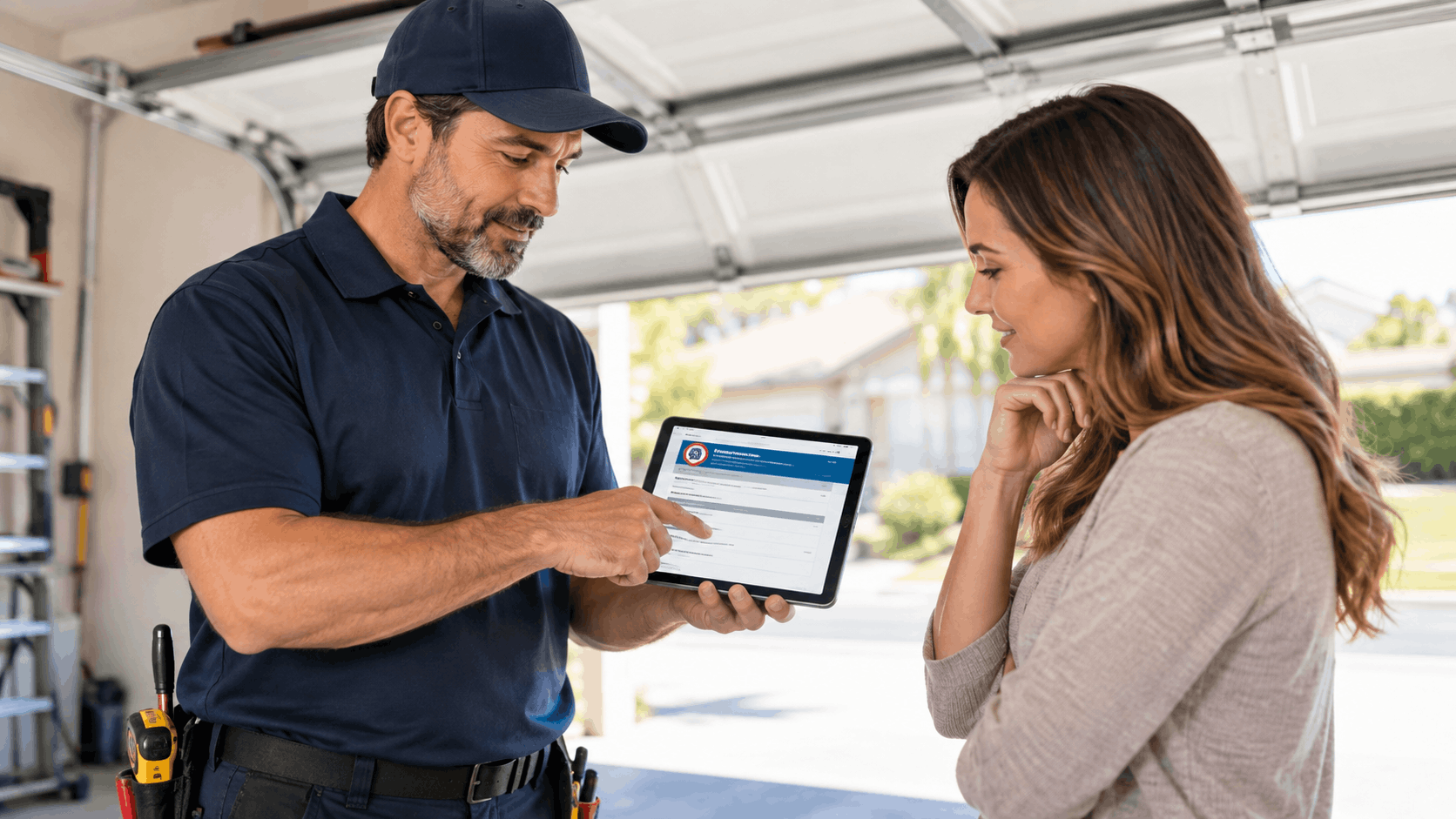
The CSLB license lookup is free, public, and fast. Anyone in Irvine can run a license check from a phone in a few minutes. Here is how to verify a contractor from start to finish.
| Step | Action | What You Confirm |
|---|---|---|
| 1 | Visit the official CSLB website | You are on the real state site |
| 2 | Search by license number, name, or business | You find the correct record |
| 3 | Confirm address and personnel | The record matches your contractor |
| 4 | Save or screenshot the results | You have a dated record before signing |
Step 1: Visit the Official CSLB Website
Start at the official CSLB website, which is the state agency's own site. Type the address directly rather than clicking an ad, because copycat third-party sites try to mimic the real thing. Some of those sites charge fees or show outdated data, and neither helps you.
The official lookup is always free. If a page asks for payment to see a contractor's license status, you are in the wrong place. Back out and go straight to the state source.
Look for the government domain and the board's branding. A quick glance at the web address tells you whether you landed on the genuine site. When in doubt, search for the Contractors State License Board by name and use the top official result.
Getting this first step right matters, because a fake site can feed you wrong information on purpose. The real lookup is the foundation of everything that follows.
Step 2: Search by License Number, Name, or Business
The lookup offers three ways to search: by license number, by personnel name, or by business name. A license number search is the fastest and most exact if the contractor gave you their number. Type it in and the record loads directly.
When you only have a company name, use the business name search. It may return more than one result, so read carefully to find the exact match. Watch for slight spelling differences that could point to a different company.
The personnel name search helps when you know the owner or qualifier but not the business. This is useful if a contractor operates under a personal name. Cross-checking two of these searches gives you extra confidence you found the right record.
Take a moment to confirm you pulled up the correct entity. Similar names are common, and you want the license that actually belongs to the person quoting your job.
Step 3: Confirm the Business Address and Personnel
Once the record loads, check the business address and the listed license holder against the person in front of you. The name on the quote, the business on the invoice, and the license record should all line up. A mismatch here is worth a direct question.
Some scammers borrow a real license number that belongs to a different company. If the address or owner on the record does not match your contractor, that is a serious red flag. The license may be legitimate, but not for the person using it.
Look at the personnel section to see who qualifies the license. That name should connect to the business you are hiring. When everything matches, you can move forward with more trust.
This step catches one of the most common tricks in the trade. A number that checks out means little if it belongs to someone else entirely.
Step 4: Save or Screenshot the Results
Before you sign any contract, save or screenshot the results page. Good record keeping gives you a dated snapshot of the license status at the moment you hired. If a dispute ever comes up, that record supports your side.
Capture the full page, including the license number, status, bond, and insurance details. Note the date you checked. A quick photo on your phone is enough, and email it to yourself so it is timestamped.
Keep this alongside your written contract and estimate. Together they form a clear file on the job. Homeowners rarely need it, but the ones who do are grateful they kept it.
This small habit costs nothing and protects you later. A license can change status after you hire, and your dated record shows what you saw at the time.
How to Read the License Details Page
Pulling up the record is only half the job. The CSLB results page packs several fields, and each one tells you something about your hiring decision. Reading the license details correctly is what turns a lookup into real protection.
Here is how to make sense of the license status, bond, history, and complaint sections. Once you know what each line means, the page reads like a report card.
License Status: Active, Expired, or Suspended
The license status is the first thing to check. An active license means the contractor is in good standing and legally allowed to work. That is the only status a homeowner should trust for a paid job.
An expired license means the contractor let their credential lapse. They are not currently licensed to perform work over the 500 dollar threshold, even if they were fine in the past. Hiring on an expired license carries the same risks as hiring unlicensed.
A suspended license is a stronger warning. It usually points to an unresolved bond issue, a tax problem, or an open complaint the contractor has not cleared. We advise steering clear of any suspended license until it is resolved.
Read this field first every time. If it does not say active, stop and ask questions before going further.
Bond and Workers' Comp Information
The page shows the contractor bond amount and its status. Confirm the bond is active and posted at the required level, typically 25,000 dollars. That bond is part of your safety net if certain work goes wrong.
Next, check the workers' comp status. If the contractor has employees, they should carry current workers' compensation coverage. An active policy shown here protects you from liability if a worker is injured at your home.
Some sole operators file an exemption instead of carrying workers' comp. That can be legitimate, but it means no crew should show up to do the work. If several workers arrive on an exemption, ask about their coverage.
Matching the bond and insurance to the job in front of you closes a common gap. These details are easy to skim past, so slow down and read them.
Issue Date and License History
The issue date shows how long the license has existed. A longer license history is not everything, but years of continuous good standing suggest a stable operation. A brand-new license is not a problem by itself, just a data point.
Look for reissue dates or gaps in the record. A license that lapsed and came back, or one that changed hands, tells part of the story. Combined with the status, this history rounds out your picture of the contractor.
Longevity paired with a clean record is a good sign. It means the contractor has run this business under the same credential for years without losing standing. That kind of track record is hard to fake.
Use the history as context, not a single verdict. Read it alongside the status and any complaints for the full view.
Disciplinary Actions and Complaints
The page notes any disciplinary action, citations, or legal issues tied to the license. This section is where past violations show up. A clean record here is what you want to see.
If a complaint history appears, read the details and weigh them fairly. One resolved issue from years ago carries less weight than a pattern of recent problems. Repeated citations for abandoned jobs or shoddy work are a real concern.
Some records show that the contractor addressed and closed an issue. That is different from an open, unresolved action. Context matters, so read rather than react to a single line.
When the disciplinary section is blank and the status is active, you have a strong record. That combination is exactly what a careful homeowner is looking for.

Red Flags That Signal an Unlicensed or Risky Contractor
Beyond the lookup, certain behaviors give away a risky contractor before you even open the CSLB site. Irvine homeowners run into these contractor red flags when a garage door company is cutting corners or hiding something. Spotting them early saves money and stress.
None of these signs alone proves a scam, but several together should stop you cold. Here are the patterns we see most.
Cash-Only Demands and Large Upfront Deposits
A cash-only demand is one of the oldest scam signs in the trade. Cash leaves no paper trail, which is exactly why a shady contractor prefers it. A legitimate pro accepts normal payment methods and gives you a receipt.
California also limits deposits. The deposit rule caps what a contractor can ask upfront at 10 percent of the job or 1,000 dollars, whichever is less. A demand for half the job in cash before any work starts violates that rule.
Large upfront money puts the risk on you. If the contractor vanishes after taking a big deposit, recovering it is difficult. The deposit cap exists to keep that from happening.
When someone pushes for cash and a big deposit together, treat it as a bright warning. Real contractors work within the rules because they plan to be around tomorrow.
No License Number on Ads or Trucks
California advertising rules require licensed contractors to display their license number. That means the number should appear on ads, business cards, and often the truck. A missing number is a quiet hint that something is off.
Take a second to look for the license number before you call. If a flyer or website for a garage door company shows no number anywhere, ask for it directly. A hesitation to share it tells you plenty.
Legitimate contractors are proud of their credential and put it out front. They know homeowners check, and they want to pass. A blank where the number should be is a reason to slow down.
Once you have the number, run it through the lookup. The number on the ad should match the record and the person quoting your job.
Vague Estimates and No Written Contract
Every legitimate job should come with a clear written contract and a detailed estimate. A vague verbal price with no paperwork leaves you exposed. Homeowners near Turtle Rock and University Park should never let work start without it in writing.
A good estimate lists the parts, the labor, and the total. It spells out what is and is not included. That clarity prevents surprise charges once the truck is in your driveway.
The written contract protects both sides. It sets the scope, the price, and the timeline, and it gives you something to point to if the work does not match the promise. Skipping it is a favor to no one but a bad contractor.
If a company resists putting things in writing, that is your answer. Ask for the contract before any tools come out.
Pressure Tactics and Same-Day Only Deals
High-pressure sales are designed to rob you of verification time. A contractor who insists the deal is only good today is trying to rush you past the license check. That urgency is a tactic, not a favor.
Real garage door problems can feel urgent, and same-day service is often genuinely available for true emergencies. The difference is that an honest pro still lets you confirm their license first. Speed and verification are not enemies.
Watch for scare tactics too, like claims that your door is dangerous and must be replaced this second. Sometimes it is true, but a trustworthy contractor will show you why. Pressure without proof is a red flag.
Give yourself a few minutes to check. A contractor worth hiring will still be there after you look them up.
Need Help in Irvine?
Urgent Garage Doors serves Irvine and all of Orange County.
Extra Verification Steps Beyond the License Lookup
The license check is your foundation, but a few extra steps round out your homework. These help you verify a contractor as a whole business, not just a credential. Do them before you let anyone touch your garage door.
A background check on reputation, insurance, permits, and location fills in the gaps the lookup cannot. Here is how to finish the job.
Check Reviews and Local Reputation
Read local reviews from real Irvine neighbors, not just a star rating. Look for detailed comments about specific jobs, response times, and how the company handled problems. Consistent local work is a good sign of a stable reputation.
Pay attention to how a company responds to less-than-perfect reviews. A professional, fair response says a lot about how they treat customers. Defensiveness or silence tells its own story.
Watch for a pattern of jobs in your area. A contractor who regularly works in Woodbridge, Northwood, and the Great Park area knows local homes. That familiarity often shows up in smoother installs.
Reviews are not the whole picture, but they add real texture. Combined with a clean license, they build a fuller sense of who you are hiring.
Confirm Proof of Insurance in Writing
Ask for proof of insurance in writing, specifically a certificate of insurance. This document confirms the contractor carries liability coverage that protects your property. A real business provides it without fuss.
Liability coverage matters if something is damaged during the job. Say a panel install goes wrong and dents your car or wall. Insurance covers that, while an uninsured contractor may leave you paying.
You can call the insurer listed on the certificate to confirm the policy is active. Most homeowners never need to go that far, but the option is there. Even asking for the certificate weeds out weak operators.
Pair this with the workers' comp you saw on the license lookup. Together they cover both injury and property risk on your job.
Ask About Permits for New Installs
Some garage door projects require a permit from the Irvine building department. Structural changes, such as widening an opening or altering framing, often need one. A simple spring or opener repair usually does not.
A contractor who knows local rules can tell you whether your project needs a permit. That knowledge is a sign they work in the area regularly. Vague answers about permits suggest they may not.
Permits protect you by putting the work through inspection. It confirms the change meets code and is documented for your home's records. Skipping a required permit can cause problems when you sell.
For a straightforward replacement, permits are often not needed. When in doubt, ask, and expect a clear answer from a real local pro.
Match the Company to a Real Local Address
A verifiable Orange County address beats a company with only a cell number. A real physical location signals a business that plans to stick around and stand behind its work. It also gives you somewhere to turn if there is a problem.
Cross-check the local address against the one on the CSLB record. They should match or clearly connect. A company that only exists as a phone number is harder to hold accountable.
Local presence often means faster response too. A team based in the area reaches your Irvine home quicker than an operation running from far away. That matters when a door is stuck and your car is trapped inside.
Put the address, the license, and the reviews together. A company that checks out on all three is one you can hire with confidence.

Why Irvine Homeowners Trust Urgent Garage Doors
After learning how to verify contractors, homeowners want a company that passes every check they just ran. That is the standard we hold ourselves to. Our Irvine garage door service is built to be verified, not just advertised.
We serve Irvine and the surrounding neighborhoods as a licensed garage door contractor, and we welcome the scrutiny. Here is what sets our team apart.
Fully Licensed, Bonded, and Insured
Urgent Garage Doors is fully licensed, bonded, and insured. We meet every CSLB standard readers just learned to check for, from an active license to a posted bond and current insurance. Run the lookup and see for yourself.
Being CSLB compliant is not a marketing line for us. It is the baseline that lets a homeowner hire us without worry. The credentials line up with the work, every time.
Our license class matches the garage door services we provide. That means no scope mismatches and no surprises on the record. What you see on the lookup is exactly what you get in your driveway.
We keep our bond and insurance current because they protect you. When a contractor takes those obligations seriously, homeowners feel the difference in how the whole job is handled.
Services Across Irvine and Nearby Neighborhoods
We handle the full range of garage door work across the area. That includes garage door repair, spring replacement, opener installation, and new door work. Whatever your door needs, our team covers it.
Our service reaches Woodbridge, Northwood, and the Great Park communities, along with Turtle Rock and Portola Springs. From a broken cable to a full new door install, we show up ready. Local coverage means shorter waits for Irvine homeowners.
Need a smart opener set up or a noisy door quieted down? We handle opener installation and upgrades along with everyday repairs. One team for the whole system.
Whether it is an emergency or a planned upgrade, our range means you rarely need a second company. We fix what is broken and improve what is worn.
Local Knowledge of Irvine Homes and HOAs
Irvine homes often come with HOA requirements that shape which doors are allowed. Many communities have rules on color, style, and materials, and a wrong choice means a rejection letter. We know how to work within those guidelines.
Local weather plays a role too. Coastal-influenced air and steady sun affect how doors and hardware age, especially in neighborhoods closer to the ocean side of town. We steer homeowners toward finishes and materials that hold up here.
Because we work across Irvine communities every week, we recognize the common door setups in each area. That familiarity speeds up diagnosis and helps us recommend the right fix. Experience with local homes saves you time.
When a door choice has to clear an HOA and survive the climate, local knowledge is worth a lot. We bring both to every consultation.
Fast Response and Clear Written Estimates
We respond fast because a stuck door often traps a car and a schedule. For true emergencies, our same-day repair options get a technician to your home quickly. Speed matters when your morning depends on that door.
Every job comes with a clear written estimate. You see the parts, the labor, and the total before we start. No vague pricing and no surprise add-ons once the work begins.
That transparent quoting process is part of how we build trust with Orange County homeowners. You know what you are paying and why. If the scope changes, we talk it through first.
Fast response and honest estimates go together. We move quickly without cutting the corners that protect you.
Need Help in Irvine?
Urgent Garage Doors serves Irvine and all of Orange County.
Final Thoughts
Verifying a garage door contractor takes minutes and can save you thousands. Confirm the CSLB license is active, check that the class matches the work, read the bond and insurance details, and watch for the red flags that give away a bad actor. A dated screenshot before you sign seals the deal.
Irvine homeowners deserve to hire with confidence, not cross their fingers. When a company welcomes your license check, that is a good sign in itself. If you want a licensed, bonded, and insured team that passes every step in this guide, reach out to us. Contact Urgent Garage Doors for a clear written estimate and fast service across Irvine and Orange County.

Frequently Asked Questions
What is a CSLB license lookup?
A CSLB license lookup is a free online tool from the Contractors State License Board that lets anyone confirm a contractor's status in California. You search by license number, name, or business, and the results show whether the license is active, the bond, the insurance, and any disciplinary history. It is the quickest way for an Irvine homeowner to verify a garage door contractor before hiring.
How do I find a garage door contractor's license number?
Check the company's website, ads, business card, or the side of their truck, since California requires licensed contractors to display the number. If you cannot find it, simply ask the contractor directly before they start work. A legitimate pro shares it without hesitation. Once you have the number, run it through the CSLB lookup to confirm it matches the business and the person quoting your job.
What license class should a garage door company have in California?
Most garage door companies operate under the C-61 / D-28 classification, which covers doors, gates, and activating devices. That specialty class is built for exactly this trade. A B general license can also apply when garage door work is part of a larger construction project involving multiple trades. For a standalone repair or replacement, the D-28 is the class you want to see.
Is it illegal to hire an unlicensed garage door contractor?
California law requires a licensed contractor for any job where labor and materials total 500 dollars or more, which covers nearly all garage door work. Hiring unlicensed on a job over that threshold puts you at risk with little recourse if the work fails, and you may face liability if a worker is hurt. It is far safer to confirm licensing before any paid work begins.
How much can a contractor ask for as a deposit in California?
California law caps home improvement deposits at 10 percent of the contract price or 1,000 dollars, whichever is less. A contractor who demands half the job upfront, especially in cash, is violating that rule. The deposit limit protects homeowners from losing large sums to a contractor who might not finish. Treat any oversized deposit demand as a warning sign.
What does a suspended license mean?
A suspended license usually means the contractor has an unresolved issue, such as a lapsed bond, a tax problem, or an open complaint they have not cleared. While suspended, the contractor is not in good standing to perform work. We advise homeowners to avoid hiring anyone with a suspended license until the record shows the issue is resolved and the license is active again.
Do garage door installs in Irvine need a permit?
It depends on the scope of work. Structural changes, like widening the opening or altering framing, may require a permit from the Irvine building department. Simple repairs and straightforward door replacements usually do not. A contractor familiar with local rules can tell you whether your specific project needs one, and a clear answer is a sign they work in the area regularly.
How long does a CSLB license lookup take?
The search takes only a few minutes online. You visit the official CSLB site, enter the license number or business name, and read the results. Even confirming the address, bond, insurance, and complaint history rarely takes more than five minutes. That small time investment is well worth it before signing any contract or letting a contractor start work on your garage door.
Can I check for complaints against a contractor?
Yes. Disciplinary actions, citations, and legal issues appear on the license details page of the CSLB lookup. If a contractor has a history of violations, it shows up there. Read the details and weigh them fairly, since one resolved issue from years ago differs from a pattern of recent problems. A blank disciplinary section alongside an active license is what you want to see.
Is Urgent Garage Doors licensed in California?
Yes. Urgent Garage Doors is licensed, bonded, and insured, and we serve Irvine and nearby neighborhoods including Woodbridge, Northwood, Turtle Rock, and the Great Park communities. We meet the CSLB standards this guide walks through, so homeowners can run the lookup and hire with confidence. Reach out for a written estimate and fast, professional service across Orange County.
Frequently Asked Questions
- What is a CSLB license lookup?
- A CSLB license lookup is a free online tool from the Contractors State License Board that lets anyone confirm a contractor's status in California. You search by license number, name, or business, and the results show whether the license is active, the bond, the insurance, and any disciplinary history. It is the quickest way for an Irvine homeowner to verify a garage door contractor before hiring.
- How do I find a garage door contractor's license number?
- Check the company's website, ads, business card, or the side of their truck, since California requires licensed contractors to display the number. If you cannot find it, simply ask the contractor directly before they start work. A legitimate pro shares it without hesitation. Once you have the number, run it through the CSLB lookup to confirm it matches the business and the person quoting your job.
- What license class should a garage door company have in California?
- Most garage door companies operate under the C-61 / D-28 classification, which covers doors, gates, and activating devices. That specialty class is built for exactly this trade. A B general license can also apply when garage door work is part of a larger construction project involving multiple trades. For a standalone repair or replacement, the D-28 is the class you want to see.
- Is it illegal to hire an unlicensed garage door contractor?
- California law requires a licensed contractor for any job where labor and materials total 500 dollars or more, which covers nearly all garage door work. Hiring unlicensed on a job over that threshold puts you at risk with little recourse if the work fails, and you may face liability if a worker is hurt. It is far safer to confirm licensing before any paid work begins.
- How much can a contractor ask for as a deposit in California?
- California law caps home improvement deposits at 10 percent of the contract price or 1,000 dollars, whichever is less. A contractor who demands half the job upfront, especially in cash, is violating that rule. The deposit limit protects homeowners from losing large sums to a contractor who might not finish. Treat any oversized deposit demand as a warning sign.
- What does a suspended license mean?
- A suspended license usually means the contractor has an unresolved issue, such as a lapsed bond, a tax problem, or an open complaint they have not cleared. While suspended, the contractor is not in good standing to perform work. We advise homeowners to avoid hiring anyone with a suspended license until the record shows the issue is resolved and the license is active again.
- Do garage door installs in Irvine need a permit?
- It depends on the scope of work. Structural changes, like widening the opening or altering framing, may require a permit from the Irvine building department. Simple repairs and straightforward door replacements usually do not. A contractor familiar with local rules can tell you whether your specific project needs one, and a clear answer is a sign they work in the area regularly.
- How long does a CSLB license lookup take?
- The search takes only a few minutes online. You visit the official CSLB site, enter the license number or business name, and read the results. Even confirming the address, bond, insurance, and complaint history rarely takes more than five minutes. That small time investment is well worth it before signing any contract or letting a contractor start work on your garage door.
- Can I check for complaints against a contractor?
- Yes. Disciplinary actions, citations, and legal issues appear on the license details page of the CSLB lookup. If a contractor has a history of violations, it shows up there. Read the details and weigh them fairly, since one resolved issue from years ago differs from a pattern of recent problems. A blank disciplinary section alongside an active license is what you want to see.
- Is Urgent Garage Doors licensed in California?
- Yes. Urgent Garage Doors is licensed, bonded, and insured, and we serve Irvine and nearby neighborhoods including Woodbridge, Northwood, Turtle Rock, and the Great Park communities. We meet the CSLB standards this guide walks through, so homeowners can run the lookup and hire with confidence. Reach out for a written estimate and fast, professional service across Orange County.
U
Licensed garage door repair professionals serving Irvine and Orange County.
Licensed in California · License #1055150
Why trust Urgent Garage Doors?
Founded in 2017, Urgent Garage Doors is a licensed and insured garage door services serving Irvine and Orange County. All content is reviewed by our licensed technicians.

Need Help in Irvine?
Urgent Garage Doors serves Irvine and all of Orange County.
Related Articles
How-To Guides
CSLB Contractor Verification for OC Garage Door Companies
Learn how to verify a garage door contractor's CSLB license in Orange County, spot red flags, and hire a licensed, bonded pro in Irvine with confidence.

How-To Guides
Licensed Garage Door Contractor California Verification: How to Confirm Before Hiring
Learn how Irvine homeowners can verify a licensed garage door contractor in California, from CSLB lookups to bonding, insurance, and local red flags before hiring.
How-To Guides
Orange County HOA Garage Door Approval Process: Step-by-Step Guide
A step-by-step guide to the Orange County HOA garage door approval process for Irvine homeowners, covering rules, timelines, rejection reasons, and how to get approved the first time.