Maintenance
Crystal Cove Garage Door Repair: Salt Air Specialists for Oceanfront Homes
Key Takeaways
- Salt fog and blown sand corrode garage door springs, rollers, and tracks far faster on oceanfront homes than on inland Irvine properties.
- Watch for grinding noises, visible rust, sticking or reversing doors, and peeling paint as early signs of salt damage.
- Aluminum, fiberglass, and coated or galvanized hardware resist coastal corrosion much better than plain steel.
- Nylon rollers with sealed bearings and marine-grade weather seals cut noise and keep salt out of the garage.
- Garage door openers fail faster near the water, so sealed belt-drive units with battery backup suit coastal beach homes.
- A monthly fresh water rinse, regular silicone lubrication, and twice-yearly professional tune-ups extend a coastal door's life.
- Urgent Garage Doors reaches Crystal Cove and Newport Coast from Irvine in about 20 to 30 minutes for same-day service.
In This Article
A Crystal Cove homeowner walks out to grab the morning paper and notices something new on the garage door. There is a reddish streak running down from the springs, and when the door lifts, it lets out a grinding sound it never made before. After one season of ocean wind and heavy marine layer, the hardware has started to fight back.
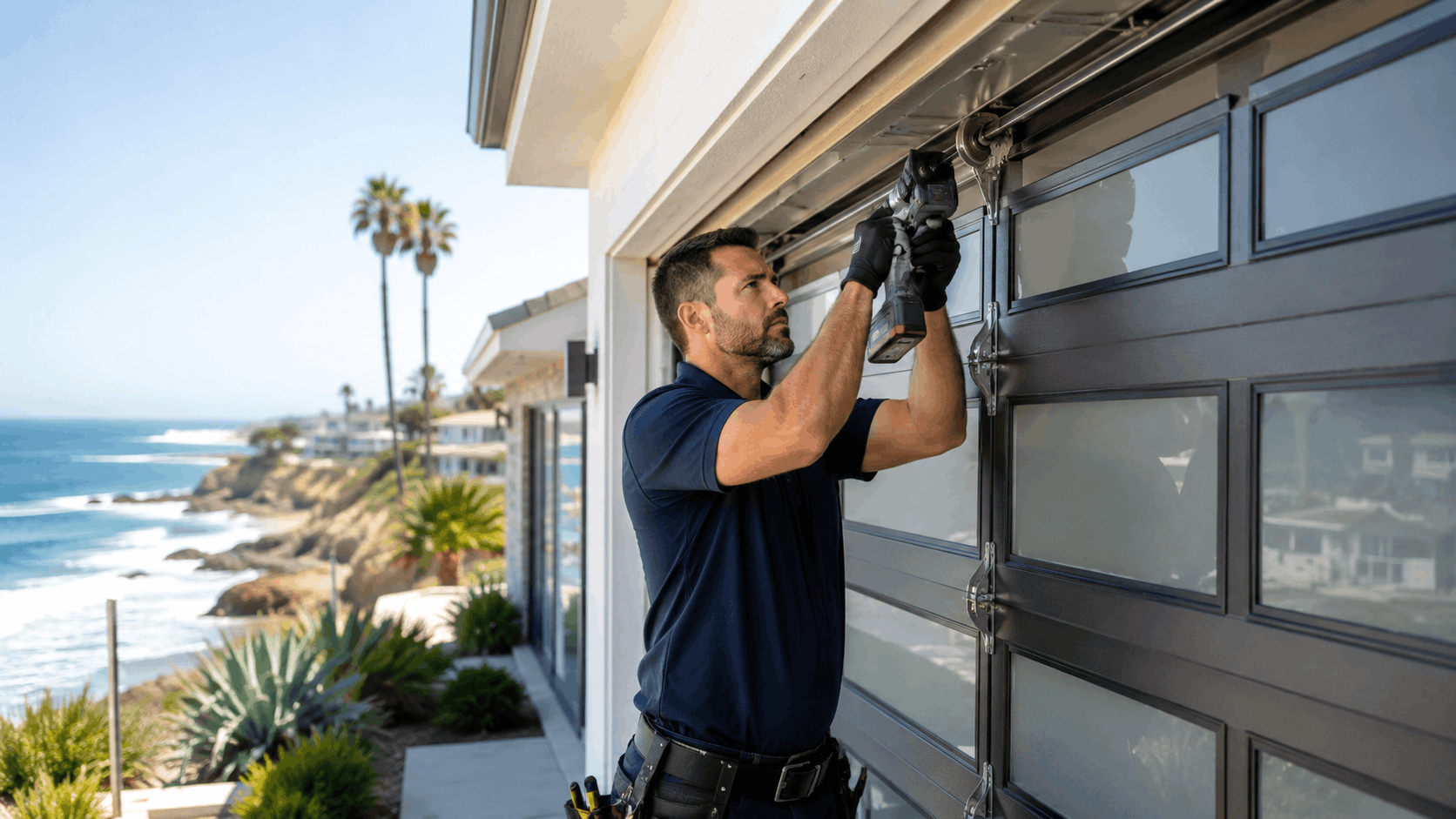
This is a story our team hears every week from homes near the shoreline. Salt air does not treat coastal garage doors the same way inland air treats homes in Woodbury or Northwood. The moisture, the fog, and the blown sand all speed up wear on metal parts that would last years longer a few miles inland.
Why Salt Air Is Hard on Crystal Cove Garage Doors
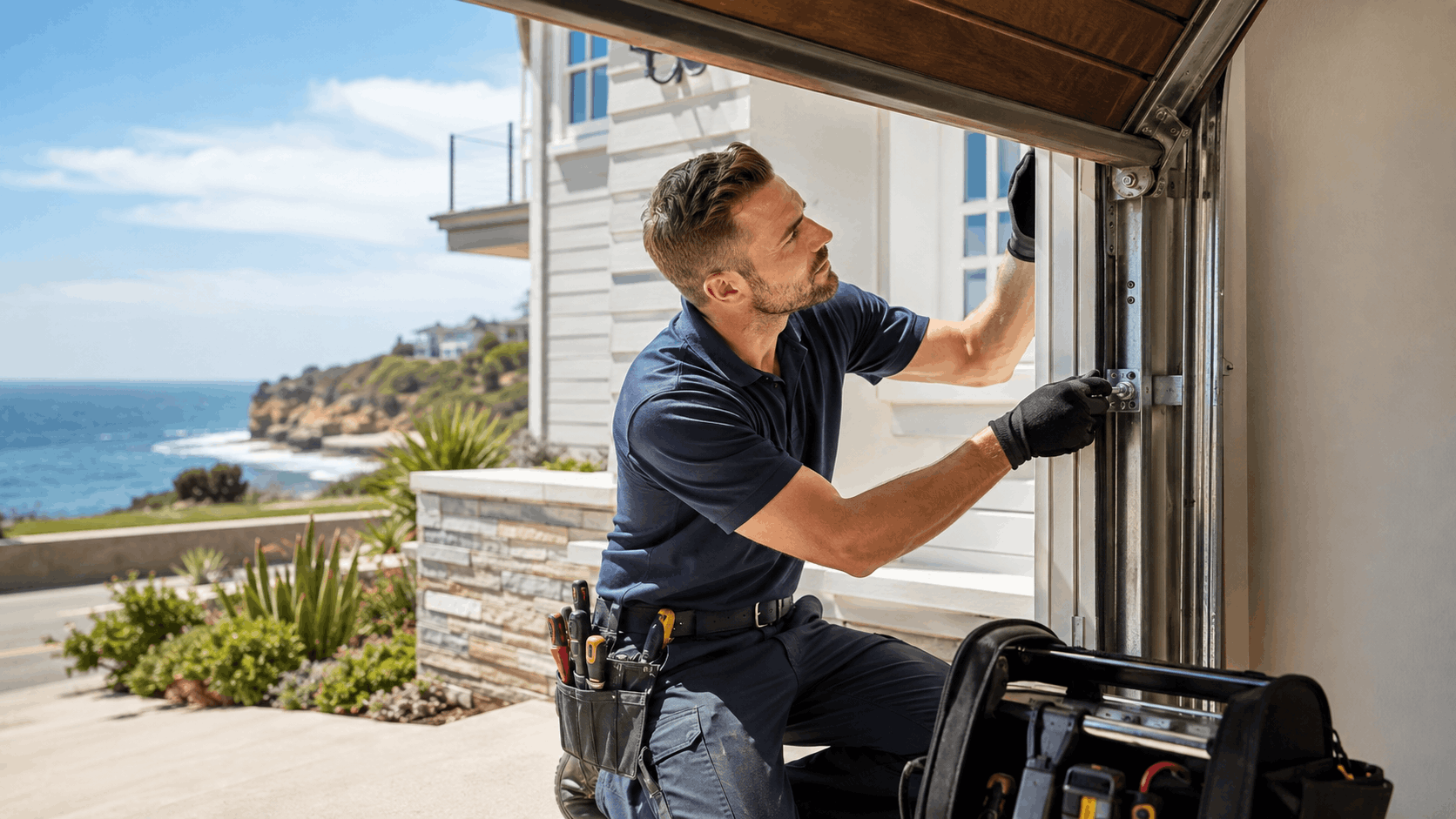
Salt air corrosion is a chemistry problem, not just a weather problem. When ocean water evaporates, it leaves tiny salt particles floating in the air. Those particles land on your garage door and pull moisture out of the air, keeping metal wet longer than it should be.
A coastal garage door faces this attack every single day. Homes along Pacific Coast Highway and the shoreline bluffs get the worst of it because there is nothing between them and the water. For oceanfront homes, the door is often the largest metal object taking that hit.
- Salt speeds up the natural rusting process of steel
- Fog keeps parts damp for hours at a time
- Wind drives salt into small gaps and seams
- Sand grinds away protective coatings
How Ocean Moisture Attacks Metal Parts
Salt fog is the quiet troublemaker here. It rolls in overnight and settles on springs, hinges, and tracks while everyone sleeps. By morning the metal hardware has been sitting in a thin, salty film for hours.
Rust starts where the protective coating is thinnest or already scratched. On a garage door, that means the wound spots on torsion springs, the pivot points of hinges, and the inside curves of the tracks. Once a small rust spot forms, it spreads and eats deeper into the steel.
Pitting is the next stage, and it is worse than surface rust. The metal develops tiny craters that weaken the part from the inside. A spring that looks only lightly rusted on the outside can be badly pitted where the coils touch, which is exactly where it needs to be strong.
This is why unprotected steel struggles so much near the water. Standard hardware that lasts a decade inland can start failing in two or three years on an oceanfront home. The metal never gets a chance to fully dry out.
Wind and Sand Wear Near the Shoreline
Coastal wind does more than just feel nice on the patio. It carries fine sand and salt crystals that act like sandpaper on your door. Every gust wears a little more off the finish and the moving parts.
Rollers take the brunt of this abuse. Sand works into the bearings and the roller stems, grinding away the smooth surfaces that let the door glide. A roller that should spin freely starts to drag, chatter, and wear out early.
Weather seals suffer too. The rubber and vinyl strips along the bottom and sides of the door get brittle from sun and salt, then wind-driven sand chews at the edges. Once a seal cracks, salt air pours straight into the garage and attacks everything inside.
Homes facing directly at the water see this fastest. On the bluff-facing streets around Crystal Cove, the constant onshore breeze means the door never gets a break. That steady wear is why coastal doors need more frequent checks than inland ones.
Why Crystal Cove Doors Age Faster Than Inland Irvine Homes
The difference in corrosion rate between the coast and inland Irvine is bigger than most people expect. A home in Woodbridge or up in Portola Springs sits several miles from the water, and that distance changes everything. By the time salt air reaches those neighborhoods, most of the salt has already dropped out.
Crystal Cove sits right on the edge of the Pacific. There is no buffer zone, no distance to dilute the salt. The same door model installed at an oceanfront home and an inland Irvine home will not wear at the same speed, even by a long shot.
We see this clearly in our service records. A door near Turtle Rock might go five or six years between spring replacements. A comparable door in Crystal Cove often needs attention well before that.
Humidity plays a part too. The marine layer keeps coastal homes damp deep into the morning, while inland areas dry out faster under the sun. More hours of dampness means more hours of active corrosion on every metal part.
Common Damage Patterns We See on Coastal Doors
After years of coastal calls, our team can almost predict what we will find before we open the truck. Frozen rollers top the list. Salt and sand seize the bearings until the roller stops turning and just skids along the track.
Seized hinges are close behind. The pivot pins rust in place, so the door panels cannot flex the way they should as the door rounds the top curve. That stiffness puts extra strain on the springs and the opener.
Panel damage shows up as flaking paint, bubbling, and rust bleeding through from the inside out. On steel doors, the corrosion often starts on the back side where you cannot see it, then works through to the face. By the time it shows outside, the panel is usually well along.
We also find rusted-through cables and springs that snap without warning. These are safety issues, not just cosmetic ones. Catching these patterns early is the whole point of regular coastal service.
Get Your Free Quote
Tell us about your garage door and we'll get back to you fast.
Warning Signs Your Coastal Garage Door Needs Attention
Most garage door failures give warning first. The trick is knowing what to watch and listen for. On a coastal home, these garage door warning signs show up faster and matter more, because salt damage moves quickly once it starts.
- New grinding or squealing during operation
- Visible rust on springs, tracks, or fasteners
- Doors that stick, sag, or reverse for no clear reason
- Peeling paint or swelling on wood panels
Grinding, Squealing, and Uneven Movement
A healthy door runs smooth and fairly quiet. When you start hearing a grinding noise or a high squeal, something is dragging that should be gliding. Near the water, worn rollers are the usual culprit because sand and salt destroy their bearings.
Uneven movement is another red flag. If one side of the door lifts faster than the other, or the door jerks partway up, the balance is off. Corrosion on one spring or a sticky roller on one side throws the whole door out of sync.
These noises tend to appear sooner on marine-exposed doors. Inland, a roller might squeak for months before it fails. On the coast, the same roller can go from a light squeal to fully seized in weeks once salt gets into it.
Do not just spray oil on the noise and forget it. A grinding door on the coast usually means a part is already worn beyond a quick fix. Our quiet roller hardware upgrade replaces those worn rollers with sealed units that resist the salt.
Visible Rust on Springs, Tracks, and Fasteners
Rust spots are the clearest sign salt is winning. Look first at the torsion spring above the door and the tracks on each side. These are the parts most exposed to salt fog, so they rust first.
There is a difference between surface rust and structural damage. Light surface rust looks like a reddish film and can sometimes be cleaned and treated. Track rust or spring rust that has flaked into layers or left pits has gone deeper and usually means the part is compromised.
Fasteners deserve a close look too. The bolts and screws holding brackets and hinges rust from the head inward. A rusted fastener can shear off under load, letting a bracket slip and throwing the door off track.
If you see a torsion spring with rust flaking off in sheets, stop using the door and call us. A corroded spring under high tension can snap suddenly. Our torsion spring replacement service handles these safely with the right coated parts for coastal homes.
Doors That Stick, Sag, or Reverse
When corrosion builds up, the door stops moving cleanly. Door sticking happens when rusted rollers bind in the track or a seized hinge fights the panel movement. You might notice you have to help the door along or that it hesitates at the same spot.
Sagging is a balance problem. As springs weaken from corrosion, they lose the tension that holds the door's weight. The door starts drooping in the middle or drifting down on its own when stopped partway.
Reversing is often a safety sensor issue made worse by salt. The photo-eye sensors near the floor can corrode at their connections, sending bad signals to the opener. The opener reads the confusion as an obstacle and reverses the door for no real reason.
All three of these throw off the door balance and stress the whole system. Ignoring them means the opener works harder and wears faster. A quick door balancing and tension adjustment often catches these before they turn into a bigger repair.
Peeling Paint and Warped Wood Panels
Crystal Cove has plenty of higher-end doors, including custom wood designs. Salt and humidity are brutal on these finishes. Peeling paint is the first cosmetic warning, and it means moisture has gotten under the coating.
Once the finish blisters, water reaches the material underneath. On steel, that starts rust. On wood doors, the moisture soaks in and swells the panels, leading to warped panels that no longer sit flat or seal well.
Warped wood does more than look bad. Swollen panels can bind in the frame, throw off the door's fit, and let more salt air leak into the garage. That turns a paint problem into a moving-parts problem.
These premium doors are worth protecting. Refinishing on a coastal schedule and catching blisters early saves the panel. When a panel is too far gone, our panel replacement service can swap the damaged section while matching the rest of the door.
Need Help in Irvine?
Urgent Garage Doors serves Irvine and all of Orange County.
Rust-Resistant Materials for Oceanfront Homes
The best defense against salt is choosing materials built for it from the start. A rust-resistant garage door costs a bit more up front, but it lasts far longer on the coast. Picking the right coastal materials means fewer repairs and less rust to fight.
Galvanized and Stainless Steel Hardware
Standard steel hardware is the first thing to fail near the ocean. Galvanized hardware changes that. The zinc coating on galvanized springs and brackets takes the corrosion hit before the steel underneath ever gets touched.
Stainless steel goes a step further for fasteners and small parts. It holds up against salt fog for years where plain steel bolts rust in months. On an oceanfront home, coated hardware throughout the door is worth every penny.
We recommend galvanized or coated springs on nearly every coastal job. The tension parts are the ones you least want failing, and salt attacks them hard. Coated springs simply last longer under those conditions.
When we do a spring and cable repair at a Crystal Cove home, we default to corrosion-resistant hardware. Reusing the same plain steel parts that just failed makes no sense by the water.
Aluminum and Fiberglass Door Options
For the door itself, aluminum and fiberglass are strong coastal choices. An aluminum door does not rust the way steel does, and its clean, modern look fits many Crystal Cove homes beautifully. Aluminum with large glass panels is popular along the bluffs.
Fiberglass is another material with strong corrosion resistance. It shrugs off salt fog entirely and can be finished to look like wood without the swelling problem. For a beach home that wants a warm look with less upkeep, fiberglass is worth a look.
Both materials pair well with the ocean setting. They resist the salt that eats steel and hold their finish longer in the marine layer. The trade-off is usually cost and, for aluminum, a slightly less insulating panel.
Our team helps homeowners weigh these options during a garage door installation. The right pick depends on your home's exposure, style, and how much upkeep you want to take on.
Nylon Rollers and Sealed Bearings
Metal rollers are a poor match for the coast. Their bearings pack with sand and rust until they seize. Nylon rollers solve most of that problem because the wheel itself does not corrode.
Sealed bearings are the other half of the upgrade. A sealed bearing keeps salt and sand out of the moving parts, so the roller keeps spinning smoothly for years. This also means much quieter operation, which owners near quiet coastal streets appreciate.
These parts are low maintenance by design. You do not have to fight rust on a roller that cannot rust. They still need the occasional wipe and light lube, but they outlast metal rollers by a wide margin on the coast.
Swapping metal rollers for nylon ones with sealed bearings is one of the highest-value coastal upgrades we offer. It cuts noise and cuts down the frozen-roller calls we see so often near the water.
Marine-Grade Weather Seals and Finishes
The weather seal is your door's front line against salt fog. A good marine-grade seal along the bottom and sides keeps that salty air out of the garage. Cheap seals crack fast in the sun and salt, so quality matters here.
Protective coatings on the door face and hardware add another layer of defense. A proper marine-grade finish resists the blistering and peeling that ruins ordinary paint by the water. These coatings are made to handle constant salt exposure.
Keeping salt off the door and out of the garage protects everything inside. Your car, your stored belongings, and the opener all last longer in a garage that stays sealed against the marine layer. A good seal pays off in many ways.
Our weatherseal and insulation retrofit updates old, cracked seals with coastal-grade material. It is one of the simpler upgrades and one of the most useful for oceanfront homes.
Our Repair Process for Crystal Cove Homes
When you call our Irvine team for a coastal service call, we follow a clear process. We know salt damage hides in places a quick glance misses, so we check thoroughly. Here at Urgent Garage Doors, our goal is to fix the root cause, not just the symptom.
| Step | What Happens | Typical Time |
|---|---|---|
| Corrosion Inspection | Full check of springs, cables, rollers, tracks, and panels | 20-30 min |
| Parts Replacement | Swap rusted springs, cables, and rollers for coated parts | 1-2 hours |
| Track and Panel Work | Realign or replace tracks, repair damaged panels | 1-2 hours |
| Final Balance and Test | Adjust tension, test safety features, confirm smooth run | 20-30 min |
The On-Site Corrosion Inspection
Every coastal call starts with a full corrosion check. We do not just look at the part that failed. We inspect the whole system because salt attacks everything at once, and a hidden rusted cable can fail right after we leave if we miss it.
Our diagnosis covers the springs, cables, rollers, hinges, tracks, and panels. We look for surface rust, pitting, seized parts, and worn coatings. We also test the door's balance and the opener's response to catch problems you may not have noticed yet.
On the coast, this inspection matters more than anywhere else. A door that seems fine on the surface can have deep corrosion in the springs or cables. Finding that early prevents a sudden failure later.
We walk the homeowner through what we find. You get a clear picture of what is safe, what needs attention now, and what can wait. No surprises and no pressure.
Spring, Cable, and Roller Replacement
Spring replacement is the most common coastal repair we handle. Rusted springs lose strength and can snap under tension, so we replace them rather than trying to clean and reuse corroded ones. On the coast, cleaning a badly rusted spring just delays the inevitable.
Cable repair follows the same logic. A frayed or rusted cable is a safety risk that only gets worse. We swap corroded cables for new ones and pair them with coated hardware whenever the setting calls for it. Our garage door cable repair service handles this properly.
The roller swap rounds out the usual coastal fix. We pull seized metal rollers and install nylon rollers with sealed bearings. This alone transforms how quietly and smoothly the door runs.
Why replace instead of clean? Because salt corrosion weakens metal from the inside. A part that looks salvageable often is not, and a failed spring or cable near the water is not worth the risk to your safety.
Track Realignment and Panel Fixes
Corroded tracks bend and pit over time. When a track is only slightly out of line, we can straighten it and clean the running surface. When rust has eaten into the metal, replacement is the safer call.
Track alignment matters because a door rides those tracks hundreds of times a year. Even a small bend causes binding, noise, and extra wear on rollers. Our track repair and realignment service gets the door running true again.
Panel repair depends on how far the damage has spread. A single dented or lightly rusted panel can sometimes be repaired or replaced on its own. On sectional doors, we can often swap one panel and match it to the rest.
When corrosion has spread across several panels, a full door replacement may make more sense than piecemeal fixes. We give an honest read on which path saves you money over the long run. Every door adjustment ends with a full balance and safety test.
How Fast We Reach the Coast From Irvine
Our base in Irvine puts us close to the coast. A run down to Crystal Cove or Newport Coast usually takes 20 to 30 minutes depending on traffic. We head down MacArthur or Jamboree toward Coast Highway for most coastal calls.
Same-day service is realistic for most coastal jobs. If your door will not open in the morning, we can often be there that afternoon. For true emergencies, our same-day garage door repair team moves fast.
We cover the whole coastal stretch, from Crystal Cove up through Newport Coast and Corona del Mar. Knowing the routes and the gated entries down there saves time when the clock matters.
Response time is one reason coastal homeowners keep us on speed dial. A broken spring or off-track door does not wait, and neither do we. Our emergency garage door repair service is built for exactly these calls.
Protecting Garage Door Openers From Salt Air
The door is only half the system. The garage door opener suffers in coastal air too, and its electronics are more delicate than the metal parts. Salt air protection for the opener is often overlooked until the motor quits.
Why Openers Fail Faster Near the Water
Openers are full of electronics that hate moisture. The circuit board, the gears, and the wiring all sit inside a housing that is not sealed against humid ocean air. Over time, salt and moisture creep in and cause trouble.
Moisture damage on a circuit board shows up as corrosion on the contacts and solder points. This causes glitches, dropped signals, and eventually a dead board. On the coast, an opener that should last 12 to 15 years often falls short of that.
The gears and drive parts suffer too. Salt-laden air can corrode the gear housing and dry out lubricants faster. An opener that grinds or hesitates may be feeling the effects of coastal moisture inside.
Opener failure near the water is rarely just bad luck. It is the salt air working on the electronics day after day. Choosing and protecting the right unit makes a real difference.
Sensor and Wiring Corrosion Issues
The photo-eye sensors at the base of the door are especially exposed. They sit low, near the salt-heavy air and any moisture on the garage floor. Their connections corrode, and once they do, the sensors misread.
A corroded photo-eye sensor causes false reversals. The door starts down, the sensor sends a bad signal, and the opener stops and reverses as if something is in the way. Homeowners often think the opener is broken when the real issue is a corroded sensor connection.
Wiring corrosion shows up as dead spots and intermittent faults. Salt attacks the copper at connection points, raising resistance and breaking the circuit. The door may work sometimes and refuse other times, which is maddening to diagnose without experience.
Our team knows to check these connections first on coastal calls. A safety sensor alignment and repair often clears up the phantom reversals that salt causes. Clean, protected connections keep the safety system honest.
Choosing Openers Built for Coastal Conditions
Not all openers handle the coast equally. A belt drive unit runs quieter and has fewer exposed metal parts than a chain drive, which helps near the water. The sealed housing on better units keeps more salt air out of the electronics.
Look for openers rated for humidity or coastal use. A sealed opener with protected boards and quality wiring holds up far better in the marine layer. Spending a little more here saves an early replacement.
We often recommend belt drive units for oceanfront homes for both durability and quiet. The smooth, quiet run suits the calm coastal setting, and the design resists the wear that salt causes.
Our garage door opener installation team helps pick a coastal-rated unit that fits your door and your home. The right opener choice up front means fewer failures down the road.
Backup Power and Smart Features for Beach Homes
Many Crystal Cove homes are part-time or vacation properties. Smart features make a real difference there. A smart opener with app control lets owners check and operate the door from anywhere, which matters when you are away for weeks.
Battery backup is another feature worth having. Coastal storms and winter weather can knock out power, and a battery backup keeps the door working when the grid is down. You never want to be locked out or stuck in during a storm.
App alerts tell you if the door was left open or opened while you were away. For a vacation home, that peace of knowing is worth a lot. You can close the door remotely without driving over.
Our smart WiFi opener and MyQ setup gives beach homeowners that remote control and monitoring. For part-time coastal owners, it is one of the more useful upgrades available.
Need Help in Irvine?
Urgent Garage Doors serves Irvine and all of Orange County.
A Maintenance Schedule for Oceanfront Garage Doors
The best way to fight salt is steady upkeep. Good garage door maintenance stretches the life of every part on a coastal door. A simple coastal upkeep routine keeps salt buildup from taking hold and saves you from bigger repairs.
Monthly Rinsing and Cleaning Steps
A fresh water rinse is the single best habit for a coastal door. Once a month, hose down the door, the tracks, and the visible hardware with plain water. This washes away the salt that would otherwise sit and corrode.
Cleaning the tracks matters too. Wipe out any sand or grit that collects in the tracks, since that debris grinds at the rollers. A rag and a little water go a long way here.
Salt removal is about frequency, not intensity. You do not need harsh chemicals. Regular fresh water rinsing keeps the salt load down between professional visits, which is what protects the metal over time.
Pay attention to the low spots where salt and moisture collect. The bottom of the tracks and the base of the door hold salt longest. A quick monthly rinse of these areas prevents a lot of rust.
Lubricating Springs, Rollers, and Hinges
Lubrication keeps the moving parts working and adds a thin barrier against moisture. On the coast, a silicone spray is a good choice because it repels water and does not attract as much dust and sand as heavy grease.
Apply lube to the springs, rollers, and hinges every couple of months. That is more often than an inland door needs, but salt air dries out lubricant faster. Hinge care in particular prevents the seizing we see so often near the water.
Wipe off excess lube after applying. Too much product attracts sand, which turns into grinding paste. A light, even coat is what you want on each moving part.
Do not lube the tracks themselves. The rollers should roll, not slide, so a slick track can actually cause problems. Focus the lubrication on the pivot points and roller stems.
Seasonal Checks After Storms and Fog Season
Beyond the monthly routine, coastal doors need seasonal check-ups tied to the weather. Winter storms drive salt and rain hard against the door, so a check after a big storm catches any new damage. Look for shifted brackets, new rust, and damaged seals.
The heavy marine layer months deserve extra attention too. Long stretches of morning fog keep the door damp for hours, speeding corrosion. A closer look during and after fog season helps you catch rust before it spreads.
Storm damage is not always obvious. Wind can loosen fasteners or push the door slightly off track without an obvious sign. A seasonal walk-around lets you spot these small issues early.
Note anything that changed since your last check. New noises, new rust spots, or a door that runs differently all point to something worth addressing. Catching it seasonally beats waiting for a breakdown.
When to Book a Professional Tune-Up
Even with good home care, coastal doors need professional eyes twice a year. A tune-up lets a technician catch corrosion inside the springs and cables that you cannot see. Twice-yearly service is our standard recommendation for oceanfront homes.
Professional service goes deeper than a rinse and a spray. We check spring tension, cable condition, bearing wear, and opener health. We find the early corrosion that leads to failures and address it before it strands you.
Preventive maintenance saves money over time. Replacing a worn roller on schedule costs far less than the repairs that follow when a seized roller throws the door off track. Regular service pays for itself on the coast.
Our preventive maintenance plan keeps Crystal Cove doors on a coastal schedule. We handle the twice-yearly checks so you do not have to track it yourself. It is the simplest way to make a coastal door last.
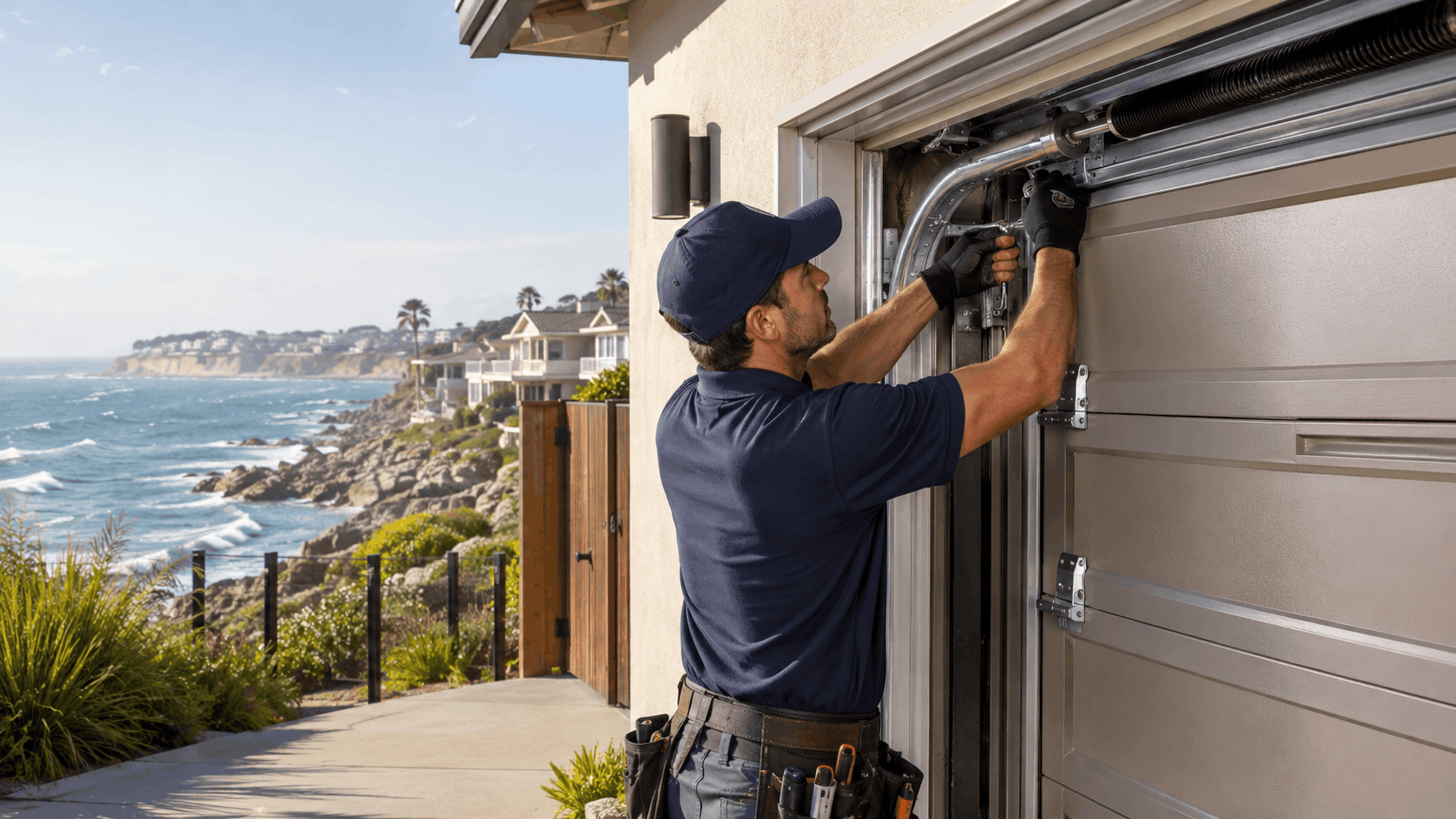
Serving Crystal Cove and the Surrounding Coast
Our team knows this stretch of coast well. From the bluff homes to the gated communities, we have worked on doors up and down the Irvine coastline. Reliable local garage door service means knowing the coastal neighborhoods, not just the addresses.
| Area | Common Door Challenge | Service Access |
|---|---|---|
| Crystal Cove bluffs | Direct ocean exposure, heavy salt | Same-day from Irvine |
| Newport Coast | Gated communities, HOA rules | Same-day, gate coordination |
| Corona del Mar | Mixed older and newer doors | Same-day from Irvine |
| PCH-facing homes | Wind and salt fog wear | Priority coastal routing |
Homes Along Pacific Coast Highway and Coast Highway Bluffs
Homes along Pacific Coast Highway and the bluffs face the harshest conditions we see. There is nothing between these bluff homes and the open ocean. The salt fog rolls straight in and settles on every metal part.
Ocean exposure at this level means faster wear on everything. Springs, rollers, and seals on these homes age quickest of all. We build our recommendations around that reality, defaulting to coated hardware and marine-grade seals.
Wind is a constant factor on the bluffs. The onshore breeze drives salt into seams and grinds sand into moving parts. Doors here need more frequent checks than almost any other in our service area.
We plan coastal routes with these homes in mind. When a bluff-facing door fails, quick response keeps the exposure from getting worse. These are the homes where preventive care pays off most.
Gated Communities and HOA Requirements
Much of the coast sits inside gated communities with their own rules. We work within these gates every week and know how to coordinate access with guards and management. That keeps your service call smooth and on schedule.
HOA rules often dictate door color and style. Many coastal communities require doors to match a set palette or design. Our team handles these requirements, so a replacement or panel swap matches the approved look.
Door style match matters for approval and resale. We help homeowners choose doors and finishes that clear the HOA and still hold up to the salt. A door that looks right and lasts is the goal.
We handle the paperwork side too when needed. Some communities want approval before work begins, and we know how that process runs. Working within HOA rules is part of coastal service here.
Nearby Areas We Cover From Our Irvine Base
Our Irvine base lets us serve the whole coastal corner efficiently. Newport Coast and Corona del Mar are quick runs from our shop. We also cover the Irvine communities that sit closer to the coast.
Beyond the immediate coast, we serve Newport Beach neighborhoods like Big Canyon and Balboa Peninsula. These homes deal with their own salt exposure, and we handle spring, cable, and opener work throughout.
We reach inland Irvine communities too, from Portola Springs to Woodbridge. Whether the home is oceanfront or a few miles in, our Irvine team covers it. The coast just needs a different approach than the inland streets.
Knowing every route down to the water saves time. When you call, we already know the fastest way to your street. That local knowledge is what lets us promise same-day service on the coast.
The Historic Cottages and Modern Estates of Crystal Cove
Crystal Cove is a mix of history and new luxury. The historic cottages near the beach have their own character and their own door needs, often older-style and modest in size. These charming homes still face the full force of the salt air.
The luxury estates on the hill above are a different story. Many feature custom doors, large glass panels, and premium finishes. These doors need materials that protect that investment against the coast.
Custom doors call for careful material choices. On an estate door with fine finishes, we lean toward aluminum, fiberglass, or heavily coated steel to fight the salt. A custom garage door design and install lets us match the home's look with coastal-grade durability.
Whether it is a small historic cottage or a large modern estate, the salt does not discriminate. Both need the right materials and steady upkeep. We tailor the fix to the home while always planning for the ocean air.
Need Help in Irvine?
Urgent Garage Doors serves Irvine and all of Orange County.
Final Thoughts
Salt air is relentless on Crystal Cove garage doors, but the damage is manageable with the right approach. Choosing rust-resistant materials, watching for early warning signs, and keeping a steady maintenance routine all add years to a coastal door.
The homes that last longest are the ones where owners rinse regularly, book professional tune-ups twice a year, and act on the first signs of rust. Our Irvine team is close by and ready to help with any of it.
If your oceanfront door is grinding, rusting, or acting up, reach out to Urgent Garage Doors. Call us or contact our team for a coastal inspection or consultation. We know these streets and these conditions, and we will get your door running right.
Frequently Asked Questions
How often should oceanfront garage doors be serviced?
Oceanfront doors should get professional service at least twice a year, compared to once a year for inland homes. Salt fog corrodes springs, cables, and rollers much faster near the water, so more frequent checks catch problems early. Between visits, a monthly fresh water rinse helps a lot. Twice-yearly tune-ups find hidden corrosion before it causes a sudden failure.
Why does my garage door rust so quickly in Crystal Cove?
Crystal Cove sits right on the Pacific with no buffer from the salt. When ocean water evaporates, it leaves salt particles that land on your door and pull moisture from the air, keeping metal wet for hours. The marine layer adds more damp time each morning. That constant salt-fog exposure speeds corrosion far beyond what inland Irvine homes ever see.
What garage door material lasts longest near the ocean?
Aluminum and fiberglass hold up best because they do not rust the way steel does. Aluminum resists salt and suits modern coastal looks, while fiberglass shrugs off fog and can mimic wood without swelling. If you prefer steel, choose a heavily galvanized or coated version. Whatever the door, pairing it with stainless or coated hardware makes the biggest difference on the coast.
How much does coastal garage door repair usually cost?
Costs vary with the repair and the parts. A roller swap or seal replacement often runs on the lower end, while spring or cable replacement costs more, especially with coated coastal hardware. Panel repairs and track work land in the middle. Full opener replacement is the larger job. We give a clear quote after inspection, and coastal-grade parts add a bit but last far longer.
Can rusted springs and cables be saved or must they be replaced?
Light surface rust on a spring can sometimes be cleaned and treated, but pitted or flaking springs and cables should be replaced. Salt corrosion weakens metal from the inside, so a part that looks passable may fail under tension. Springs and cables carry heavy loads and are a safety risk when corroded. Near the water, replacing with coated parts is almost always the safer choice.
Do salt-air conditions affect garage door openers too?
Yes, salt and moisture reach the opener's electronics and shorten its life. Circuit boards corrode at the contacts, gears wear faster, and photo-eye sensors develop connection problems that cause false reversals. A coastal opener typically fails sooner than an inland one. Choosing a sealed belt drive unit rated for humidity helps it hold up in the marine air.
How fast can your team reach Crystal Cove from Irvine?
From our Irvine base, we usually reach Crystal Cove or Newport Coast in about 20 to 30 minutes, depending on traffic. We take MacArthur or Jamboree down toward Coast Highway for most coastal calls. Same-day service is realistic for most jobs, and we offer priority routing for true emergencies like a broken spring or an off-track door.
Can I rinse the salt off my door myself?
Yes, a monthly fresh water rinse of the door, tracks, and visible hardware is a great DIY habit. Use plain water and a soft rag, and clear any sand from the tracks. Avoid harsh chemicals and do not spray directly into the opener or sensors. Leave spring tension, cable work, and anything under high tension to a technician for safety.
Will you match my HOA color and design rules?
Yes, we work within gated coastal communities and their HOA requirements every week. We help you pick a door color, style, and finish that meets the approved palette while standing up to salt air. When a community needs approval before work, we know that process. Matching the required look and coastal durability is part of how we serve these neighborhoods.
Is it worth upgrading to rust-resistant hardware?
For oceanfront homes, yes. Coated and stainless hardware costs a bit more up front but lasts far longer than plain steel that can fail in two or three years by the water. Fewer repairs, fewer sudden failures, and a longer door life make the upgrade pay off. On the coast, spending on corrosion-resistant parts saves money over time.
Frequently Asked Questions
- How often should oceanfront garage doors be serviced?
- Oceanfront doors should get professional service at least twice a year, compared to once a year for inland homes. Salt fog corrodes springs, cables, and rollers much faster near the water, so more frequent checks catch problems early. Between visits, a monthly fresh water rinse helps a lot. Twice-yearly tune-ups find hidden corrosion before it causes a sudden failure.
- Why does my garage door rust so quickly in Crystal Cove?
- Crystal Cove sits right on the Pacific with no buffer from the salt. When ocean water evaporates, it leaves salt particles that land on your door and pull moisture from the air, keeping metal wet for hours. The marine layer adds more damp time each morning. That constant salt-fog exposure speeds corrosion far beyond what inland Irvine homes ever see.
- What garage door material lasts longest near the ocean?
- Aluminum and fiberglass hold up best because they do not rust the way steel does. Aluminum resists salt and suits modern coastal looks, while fiberglass shrugs off fog and can mimic wood without swelling. If you prefer steel, choose a heavily galvanized or coated version. Whatever the door, pairing it with stainless or coated hardware makes the biggest difference on the coast.
- How much does coastal garage door repair usually cost?
- Costs vary with the repair and the parts. A roller swap or seal replacement often runs on the lower end, while spring or cable replacement costs more, especially with coated coastal hardware. Panel repairs and track work land in the middle. Full opener replacement is the larger job. We give a clear quote after inspection, and coastal-grade parts add a bit but last far longer.
- Can rusted springs and cables be saved or must they be replaced?
- Light surface rust on a spring can sometimes be cleaned and treated, but pitted or flaking springs and cables should be replaced. Salt corrosion weakens metal from the inside, so a part that looks passable may fail under tension. Springs and cables carry heavy loads and are a safety risk when corroded. Near the water, replacing with coated parts is almost always the safer choice.
- Do salt-air conditions affect garage door openers too?
- Yes, salt and moisture reach the opener's electronics and shorten its life. Circuit boards corrode at the contacts, gears wear faster, and photo-eye sensors develop connection problems that cause false reversals. A coastal opener typically fails sooner than an inland one. Choosing a sealed belt drive unit rated for humidity helps it hold up in the marine air.
- How fast can your team reach Crystal Cove from Irvine?
- From our Irvine base, we usually reach Crystal Cove or Newport Coast in about 20 to 30 minutes, depending on traffic. We take MacArthur or Jamboree down toward Coast Highway for most coastal calls. Same-day service is realistic for most jobs, and we offer priority routing for true emergencies like a broken spring or an off-track door.
- Can I rinse the salt off my door myself?
- Yes, a monthly fresh water rinse of the door, tracks, and visible hardware is a great DIY habit. Use plain water and a soft rag, and clear any sand from the tracks. Avoid harsh chemicals and do not spray directly into the opener or sensors. Leave spring tension, cable work, and anything under high tension to a technician for safety.
- Will you match my HOA color and design rules?
- Yes, we work within gated coastal communities and their HOA requirements every week. We help you pick a door color, style, and finish that meets the approved palette while standing up to salt air. When a community needs approval before work, we know that process. Matching the required look and coastal durability is part of how we serve these neighborhoods.
- Is it worth upgrading to rust-resistant hardware?
- For oceanfront homes, yes. Coated and stainless hardware costs a bit more up front but lasts far longer than plain steel that can fail in two or three years by the water. Fewer repairs, fewer sudden failures, and a longer door life make the upgrade pay off. On the coast, spending on corrosion-resistant parts saves money over time.
U
Licensed garage door repair professionals serving Irvine and Orange County.
Licensed in California · License #1055150
Why trust Urgent Garage Doors?
Founded in 2017, Urgent Garage Doors is a licensed and insured garage door services serving Irvine and Orange County. All content is reviewed by our licensed technicians.

Need Help in Irvine?
Urgent Garage Doors serves Irvine and all of Orange County.
Related Articles
Maintenance
Aliso Viejo Garage Door Repair: Tract Home Common Failures
Aliso Viejo tract homes built in the 1990s and 2000s hit the same garage door failures at once. Learn the common problems and how our Irvine team helps.
Tips & Advice
Emergency Garage Door Repair in Newport Coast: Same-Day Service for Pelican Hill and Crystal Cove
A local guide to emergency garage door repair in Newport Coast, covering common failures, same-day service for Pelican Hill and Crystal Cove, costs, and prevention.

Maintenance
Talega San Clemente Garage Door Repair: Coastal Salt Air Damage Specialists
Salt air corrodes garage doors fast in Talega, San Clemente. Learn the warning signs, parts that fail first, repair steps, and prevention from coastal specialists.