Extension to Torsion Spring Conversion in OC - Why the Upgrade Matters and What It Costs
Key Takeaways
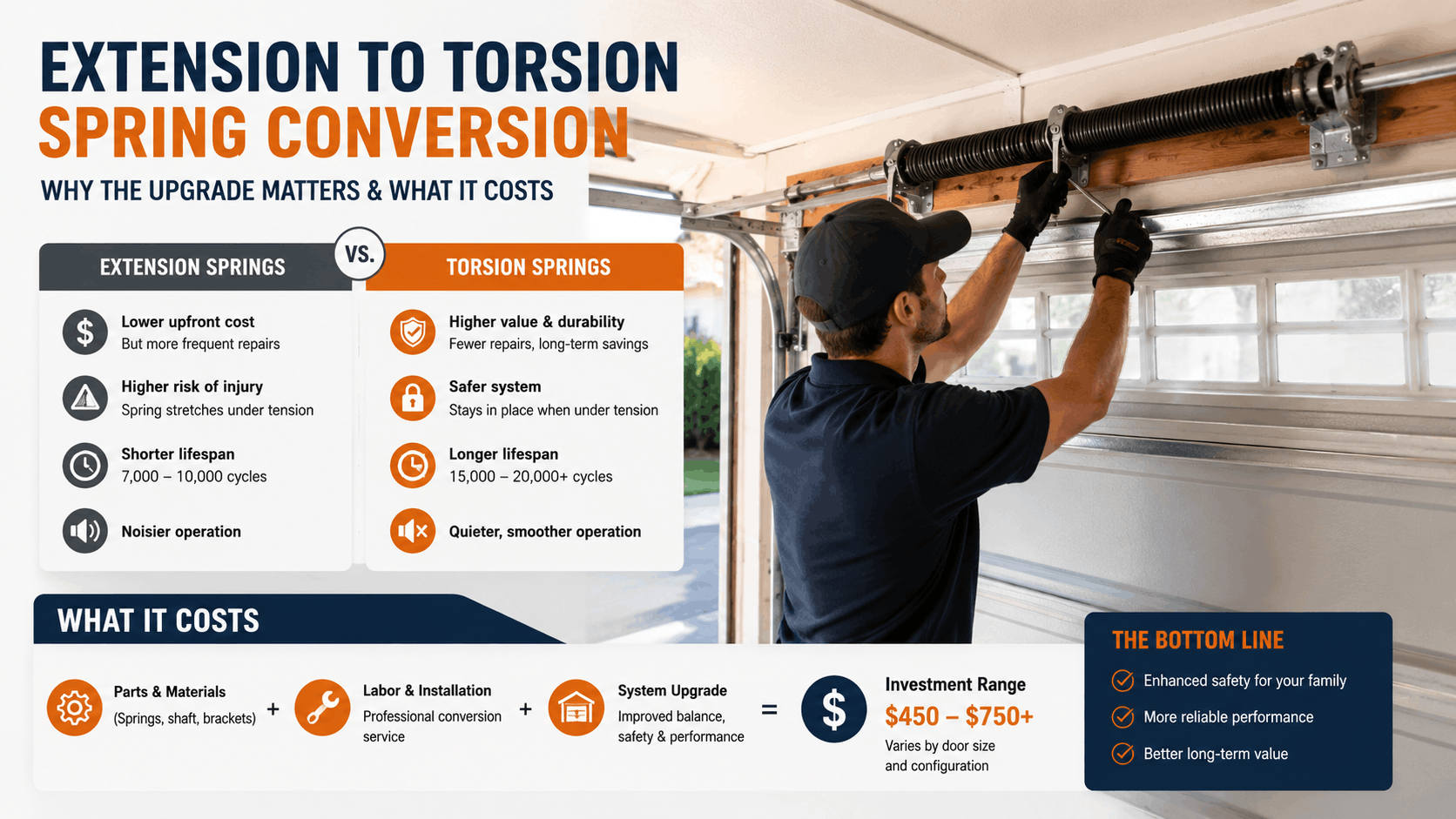
- Extension springs stretch along the tracks while torsion springs twist on a bar, and torsion spreads door weight far more evenly.
- Torsion springs are safer because they stay contained on the bar instead of flying loose when they break.
- Torsion springs last 15,000 to 30,000+ cycles versus 7,000 to 10,000 for extension springs, meaning fewer repairs over time.
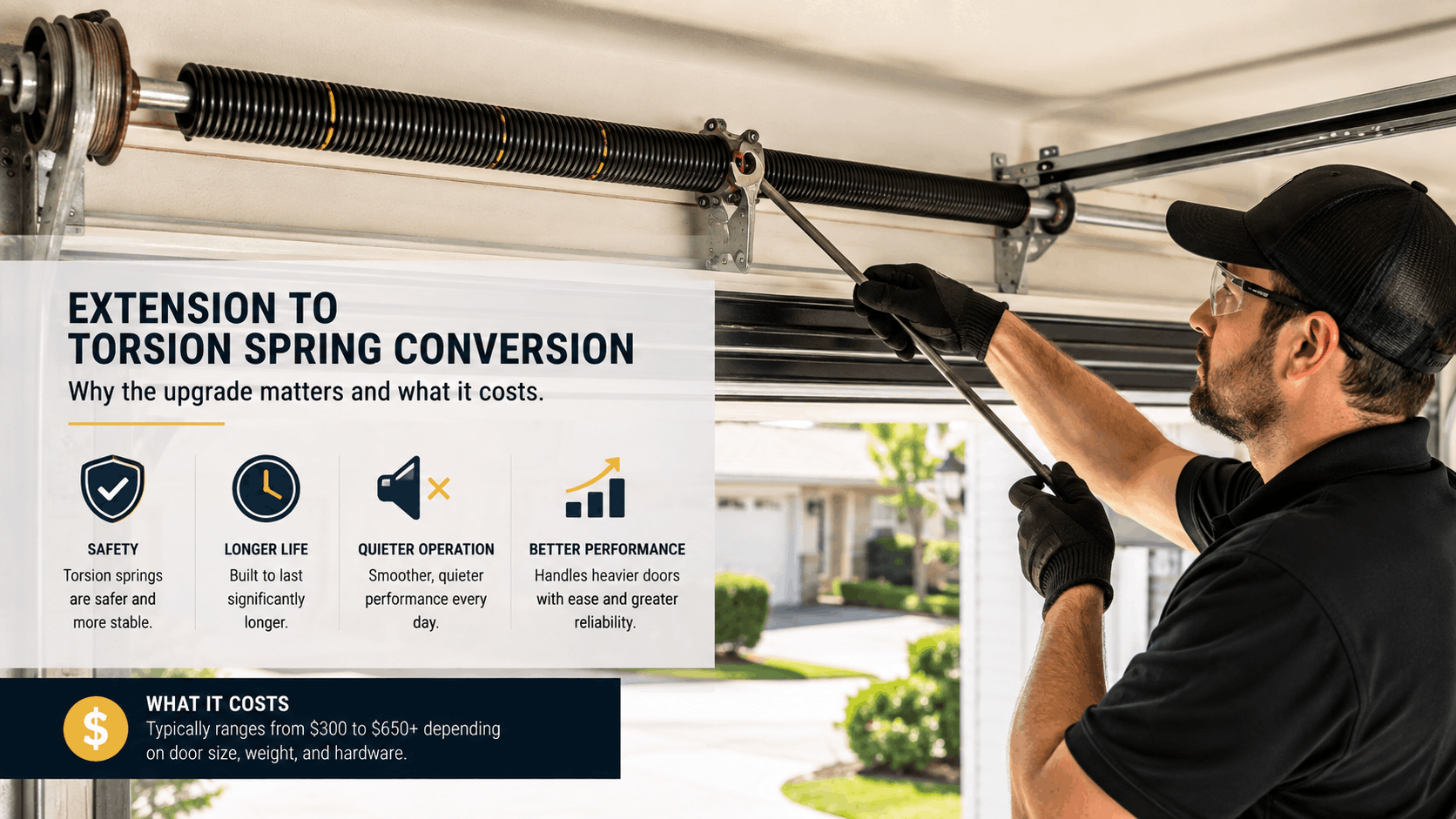
- A conversion in the Irvine area typically runs $300 to $450 for a single door and $400 to $650 for a double door.
- One-time conversion cost usually beats replacing worn extension springs every few years over the life of the door.
- Most garages qualify, and low-headroom kits handle tight older Irvine garages that lack standard clearance.
- Coastal OC air speeds corrosion, so coated hardware and yearly tune-ups help springs reach full lifespan.
- Never attempt DIY torsion spring winding, since stored energy makes it a serious injury risk best left to trained techs.
In This Article
Last spring, a homeowner near Woodbridge called us minutes after hearing a loud bang from the garage. She thought someone had broken in. What actually happened was an extension spring snapping under tension, sending metal flying across the parking bay. Nobody was hurt, but the garage door hung crooked and would not budge.
That call is common across Orange County. Older tract homes still run on extension springs that wear out and fail, sometimes violently. More and more homeowners are converting to torsion springs for the safety, quieter operation, and longer life those systems bring.
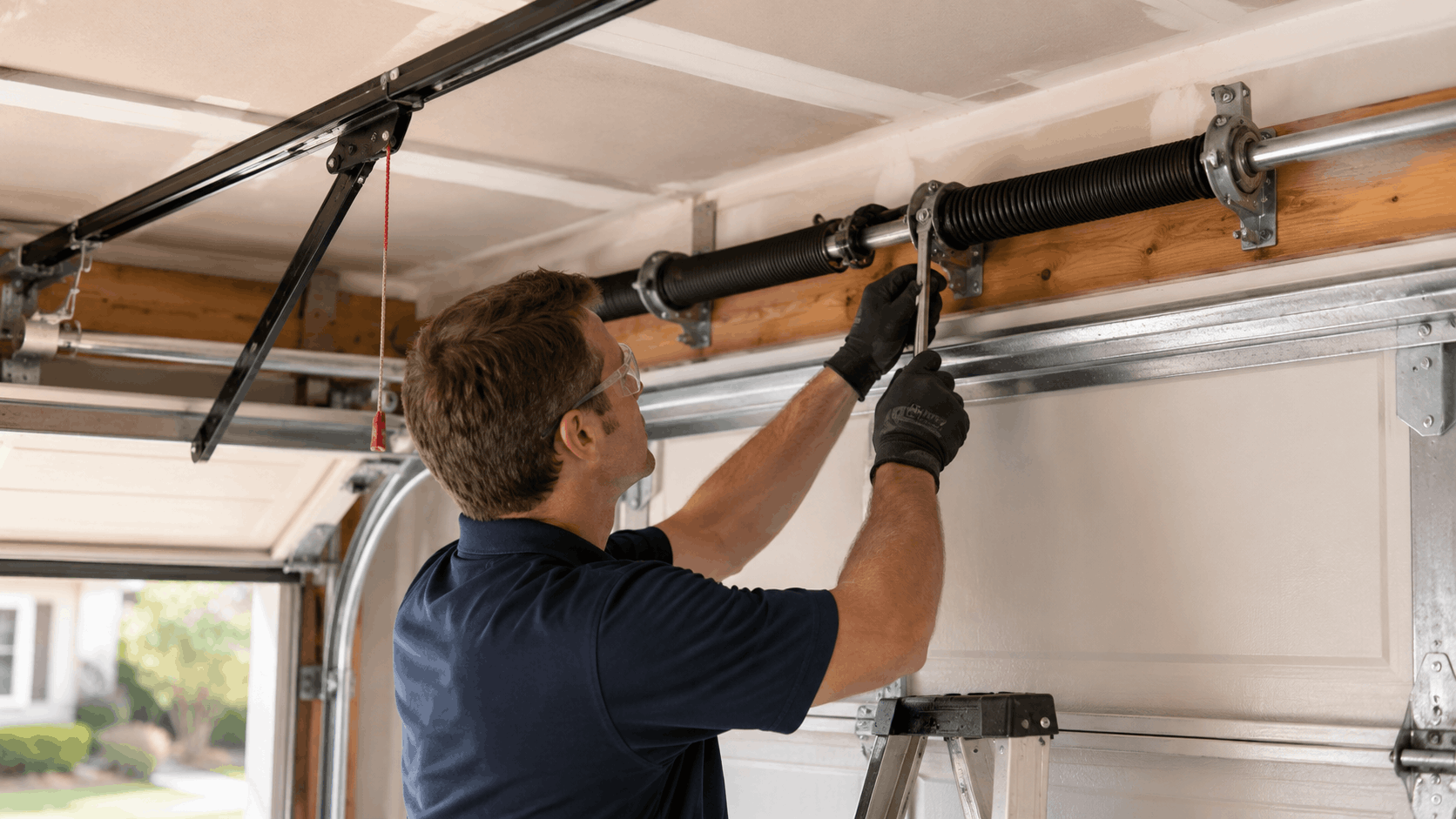
Extension Springs vs. Torsion Springs: The Basics
Before deciding on any upgrade, it helps to know what is holding your door up right now. Both spring types do the same job, which is counterbalancing the weight of the door so your opener and your arms do not carry the full load. They just go about it in very different ways.
The garage door spring is the single most worked part of the whole system. Every open and close puts it through a full cycle. That constant work is why springs are the part we replace most often on Irvine homes.
| Feature | Extension Springs | Torsion Springs |
|---|---|---|
| Location | Along both horizontal tracks | On a bar above the door |
| Action | Stretch and contract | Twist and unwind |
| Weight balance | Uneven, side loaded | Even across the door |
| Typical cycle rating | 7,000 to 10,000 | 15,000 to 30,000+ |
| Safety when broken | Can fly loose | Contained on the bar |
How Extension Springs Work
Extension springs run along the upper horizontal parts of your garage door tracks, one on each side. When the door closes, the springs stretch out and store energy. When you open the door, they contract and pull that energy back to help lift the weight.
You can usually spot them as long coiled springs stretched parallel to the ceiling. They connect to pulleys and cables that route the tension down to the bottom of the door. It is a simple, low-cost design that has been around for decades.
Many of the older homes we service in Irvine, especially builds from the 1970s and 1980s, still run this setup. Neighborhoods with original garage hardware often have extension springs that are well past their useful life. When one side stretches out sooner than the other, the door starts pulling crooked and binding in the tracks.
The design works, but it has a weak point. Because the spring is under heavy stretch and sits out in the open, a failure tends to release energy fast and in an unpredictable direction.
How Torsion Springs Work
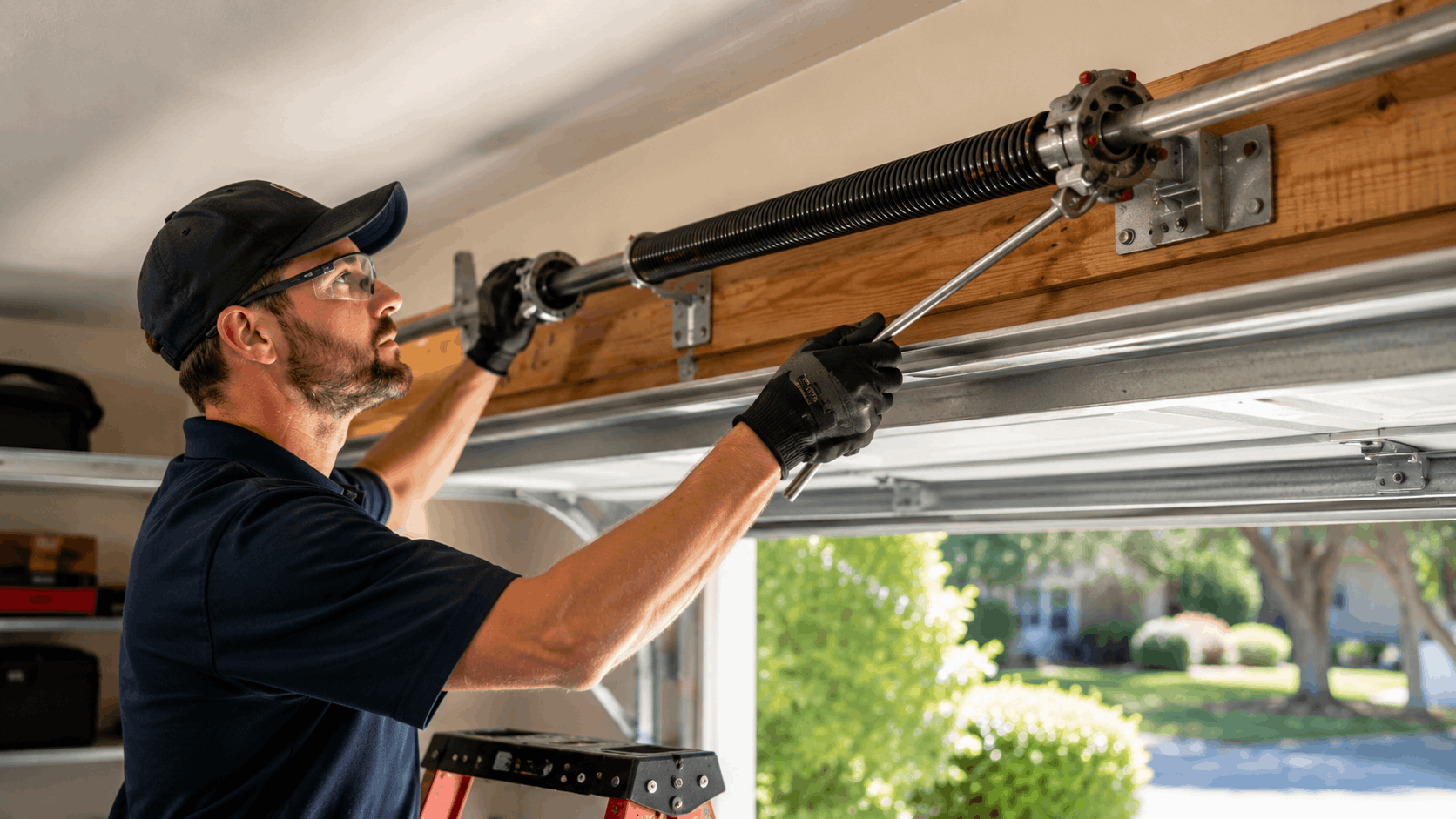
A torsion spring sits on a metal torsion bar mounted horizontally above the door opening. Instead of stretching, it twists. When the door goes down, the spring winds up tight and stores torque. When the door rises, it unwinds and turns the bar, which pulls the cables and lifts the door.
Because the force runs through a central bar and drums on each end, the lifting effort spreads evenly across the whole door. That even pull is why torsion doors sit level, open smoother, and put less strain on the opener motor.
The winding is done to a precise number of turns based on the door weight and height. Get the turns right and the door feels almost weightless by hand. Our techs handle this calibration on every torsion spring replacement so the balance is dialed in from day one.
The other big win is containment. If a torsion spring breaks, it stays on the bar rather than launching across the garage. That single fact is why so many OC homeowners feel better with this system over their cars and kids.
How to Tell Which System You Have
Spring identification takes about ten seconds from inside your garage. Stand facing the door from the inside and look up. If you see a metal bar running across the top of the door with one or two springs wound around it, you have torsion springs.
If instead you see long springs stretched along the ceiling above each horizontal track, running front to back, those are extension springs. They will usually have a cable and pulley at each end.
A quick garage door inspection like this also lets you eyeball rust, gaps in the coils, or a spring that already looks separated. If you spot a visible gap in the coil of any spring, stop using the door and call a tech. A broken spring can make the door drop without warning.
If you are unsure what you are looking at, snap a photo and send it over. We can identify the setup fast and tell you whether a conversion even makes sense for your door.
Why This Matters for OC Homes
The spring type in your garage often ties directly to when your home was built. Established Irvine neighborhoods like Northwood and El Camino Real have plenty of original garages, and many of those still carry the extension springs installed decades ago.
Garage door age matters because parts wear on a schedule. A spring installed in the 1980s has been through tens of thousands of cycles, often well past its rated life. If your springs have never been touched, they are living on borrowed time.
Newer builds trend toward torsion systems because door styles have grown heavier and builders spec sturdier hardware. So the older your Irvine home, the more likely you are a conversion candidate.
Knowing your starting point helps you plan. If you are already dealing with a snapped spring, the smart move is often to upgrade rather than replace like for like.
Get Your Free Quote
Tell us about your garage door and we'll get back to you within 30 to 60 minutes.
Why Homeowners in Orange County Are Making the Switch
A spring conversion is not just swapping one part for another. It changes how the whole door behaves. Once families see the difference, most wish they had done it sooner.
Here are the main reasons homeowners across OC choose the garage door upgrade:
- Fewer surprise failures and safer operation
- Springs that last two to three times longer
- A quieter, smoother door
- Better support for heavy modern doors
- Less strain on the opener motor
Safety Concerns With Extension Springs
The biggest driver behind conversions is spring failure. When an extension spring under full stretch snaps, it can whip loose with real force. That is the loud bang our Woodbridge customer heard.
Safety cables help by running through the center of each extension spring, catching the broken piece so it cannot fly across the garage. We strongly recommend them on any extension setup that stays in place. But they are a bandage, not a cure.
Safety cables contain the spring after it breaks. They do nothing to stop the break itself, and they do not fix the uneven, side-loaded design. A door can still slam down if the spring goes and a cable is worn or missing.
Torsion springs remove that whole risk category. The spring is captured on the bar, so a failure is contained by design rather than by an add-on part. For garages where kids play or cars park close, that peace matters.
Longer Lifespan and Fewer Repairs
Springs are rated in cycles, and one cycle is a full open plus a full close. A standard extension spring carries a cycle rating around 7,000 to 10,000. A quality torsion spring runs 15,000 to 30,000 or more.
For a busy Irvine family opening the door six to eight times a day, that difference is huge. Extension springs might last four to six years under that load. A high-cycle torsion setup can push past fifteen years.
Fewer failures means fewer service calls, less downtime, and less money spent over the life of the door. The math almost always favors the longer-lasting spring lifespan of a torsion system.
It also means fewer of those stressful mornings where the door will not open and someone is late for work. Reliability is a real benefit families feel every day.
Smoother, Quieter Operation
Extension springs pull from the sides, which can make a door move in a jerky, uneven way. You often hear a twang or a bounce as the springs stretch and release. In a quiet HOA community where garages face the street, that noise stands out.
A quiet garage door is one of the first things homeowners notice after a conversion. Torsion springs deliver a steady, balanced lift, so the door glides instead of lurching.
Pairing the conversion with a quiet roller hardware upgrade takes the noise down even further. Nylon rollers and a balanced torsion bar together make for smooth operation that barely registers indoors.
For early risers and late-night arrivals, a silent door keeps the whole household happier. It also keeps you on the good side of neighbors sharing a wall or a driveway.
Better Support for Heavier Doors
Door styles have gotten heavier. Insulated steel, solid wood, and custom carriage designs all weigh far more than the thin single-layer doors of decades past. A heavy garage door needs balanced support that extension springs struggle to provide.
Torsion systems are sized to the exact weight of the door, so they handle the load evenly and hold the door in place at any height. That is why nearly every new heavy door ships designed for a torsion setup.
If you have upgraded to an insulated door or plan to during a new door installation, the springs need to match. Trying to lift a heavy door with old extension springs wears everything out sooner.
Newer Irvine builds around Great Park and Portola Springs often come with these heavier doors from the start. Matching the spring system to the door weight keeps the whole assembly running right.
Need Help in Irvine?
Urgent Garage Doors serves Irvine and all of Orange County.
What the Conversion Costs in Irvine and Nearby Areas
Cost is the first question most homeowners ask, and it is a fair one. The good news is a conversion is a one-time expense that pays off over years. Below are honest ranges from jobs we do across the OC market.
The conversion cost depends on your door and hardware, but the garage door spring price sits in a predictable band for most homes.
| Door Type | Typical Conversion Cost | What Is Included |
|---|---|---|
| Single door | $300 - $450 | One torsion spring, bar, brackets, labor |
| Double door | $400 - $650 | Two springs, bar, drums, cables, labor |
| Heavy or custom door | $550 - $850+ | High-cycle springs, heavy hardware, labor |
Typical Price Range for a Conversion
For a standard single-car door, most conversions land between $300 and $450 for parts and labor. That includes the torsion bar, one spring, mounting brackets, and the winding work.
A double door usually runs $400 to $650 because it needs two springs, longer bar, and often new cables and drums. The spring cost itself is a smaller share than many expect. Much of the installation price is the skilled labor and hardware.
These are ballpark figures for the Irvine area. A quick look at your door lets us give an exact quote with no surprises. We would rather over-explain the price than leave you guessing.
Prices can shift with the market and with the grade of spring you choose. Asking for a high-cycle spring costs a bit more up front but stretches the years between service calls.
What Affects the Final Price
Door weight is the biggest factor. A light aluminum door needs a smaller spring than a solid wood carriage door, and the heavier the door, the more robust the hardware.
Single versus double garage door matters too, since a double door needs two springs and a longer torsion tube. The condition of your existing cables, rollers, and tracks can add to the job if they need replacing at the same time.
Older homes sometimes need extra bracket work where the wall framing is not standard. If we find worn parts during the visit, we point them out and let you decide. Nothing gets added without your say-so.
The final number is really about your specific door, not a one-size figure. That is why we measure and weigh before quoting.
Comparing Conversion Cost to Repeated Repairs
Think about the repair cost of extension springs over time. If a set lasts five years and runs $200 to $300 per replacement, three replacements over fifteen years adds up to $600 to $900.
A single torsion conversion in that same window often costs less than those repeated fixes and lasts the full stretch. That is real long-term savings, not just a sales line.
You also skip the hidden costs of downtime, emergency calls, and the wear that a failing spring puts on your opener. Those add up in ways that never show on a single invoice.
When we lay out the numbers side by side, most homeowners see the conversion as the cheaper path over the life of the door. The one-time spend beats the drip of ongoing repairs.
Why Cheap Quotes Can Cost More Later
A rock-bottom quote usually means low-cycle springs and a rushed install. A cheap spring rated for 7,000 cycles fails years before a quality one, so you pay again sooner.
Quality parts should include high-cycle springs, sturdy end bearing plates, and correctly sized cables and drums. Cutting corners on any of those shortens the life of the whole system.
The low bid risk also shows up in the winding. A spring wound to the wrong turn count leaves the door unbalanced, which strains the opener and wears the tracks. We have re-done plenty of budget installs that failed within a year.
Paying a fair price once for proper parts and a clean install beats paying twice. Ask any bidder exactly what spring cycle rating they are quoting.
What Happens During the Conversion Process
Knowing the installation process ahead of time takes the mystery out of the visit. A standard spring replacement conversion is a same-day job for most doors. Here is how our team runs it.
Inspection and Measurement
The job starts with weighing the door and taking measurements. We disconnect the opener and lift the door by hand to gauge its true weight, since spring sizing depends on that number.
Next comes door measurement of height and width, plus the header space above the opening. The torsion bar and springs need that space to mount correctly, so we confirm the clearance before touching anything.
We also check the tracks, rollers, cables, and the wall framing where the center bracket will attach. This tells us if any extra work is needed for a solid install.
Only after this check do we finalize the exact spring specs. Getting the measurements right here is what makes the finished door feel balanced.
Removing the Old Extension Hardware
Extension hardware removal is done under careful tension control. The old springs still hold stored energy, so we secure the door and release that tension safely before removing anything.
We take out the extension springs, the pulleys, and the old cables one piece at a time. Safety cables, if present, come out too since the new system will not use them.
This is the step where DIY attempts go wrong most often. Releasing a stretched spring without proper control is how people get hurt. Our techs use clamps and locking pliers to keep the door and hardware stable throughout.
With the old parts clear, the track and header are prepped for the new mounting brackets. A clean removal sets up a clean install.
Installing the Torsion System
Now the new system goes up. We mount the center bracket to the header, slide the torsion tube across, and set the end bearing plates on each side. The cable drums attach to the ends of the bar.
The springs go onto the torsion tube, and the cables run from the drums down to the bottom brackets of the door. Everything gets squared and tightened before any winding begins.
Then comes spring winding, the most precise part. We wind each spring to the exact number of quarter turns the door weight calls for, using proper winding bars. Too few turns and the door feels heavy, too many and it flies up.
Once wound and locked, the setscrews are torqued down so the springs grip the bar securely. This is the heart of the conversion done right.
Testing and Balancing the Door
With the system installed, we run a full balance test. The door should hold steady at knee height, waist height, and shoulder height without drifting up or down.
A properly balanced door lifts with light effort by hand and stays put wherever you leave it. If it drifts, we adjust the winding until the door balance is spot on. Our door balancing and tension adjustment work is part of every conversion.
Then we reconnect the opener and run the safety test, cycling the door several times and checking the auto-reverse. We make sure the sensors and travel limits work with the newly balanced door.
Before we leave, we show you how the door moves and answer any questions. You should feel confident the job is finished correctly.
Need Help in Irvine?
Urgent Garage Doors serves Irvine and all of Orange County.
Is Your Garage Set Up for a Torsion Conversion?
Most garages handle a conversion easily, but a few need special attention. The main thing to check is headroom clearance above the door. A quick look tells us whether a standard garage conversion works or if we reach for a specialty kit.
Checking Headroom Above the Door
A standard torsion setup needs about 10 to 12 inches of headroom between the top of the open door and the ceiling. That space holds the torsion bar, springs, and brackets.
Many Irvine tract homes have plenty of clearance, but some older garages with low ceilings or storage platforms run tight. If space is limited, we measure carefully before recommending a system.
Do not assume tight headroom rules you out. There are proven solutions for cramped garages, which we cover below.
If you want to check yourself, measure from the top edge of the raised door up to the lowest thing on the ceiling. Send us that number and we can tell you your options.
Condition of Tracks and Rollers
The conversion is a good time to look at your garage door tracks and rollers. Bent tracks or worn rollers make even a perfect spring system run rough.
If rollers are cracked or the tracks show dents and gaps, we flag them during the visit. Replacing tired rollers with nylon ones makes a noticeable difference in noise and smoothness.
Sometimes a door that binds is not just a spring issue but a track alignment problem. Our track repair and realignment service handles that in the same trip when needed.
Fixing these small things during the conversion saves a second service call later. It also protects your new springs from extra strain.
Door Weight and Material
Door material drives the spring sizing. A thin steel door needs a lighter spring than an insulated or solid wood door, and getting this right is what makes the door balance well.
We weigh the door rather than guessing from the look. Two doors that appear similar can weigh very differently depending on insulation and construction.
If your door is very light and cheap, we will tell you honestly whether the conversion is worth it or whether a fuller upgrade makes more sense. Sometimes pairing a new door with a torsion system is the smarter spend.
Matching the right spring to the exact door weight is what separates a good install from an average one. This is where measuring pays off.
Low-Headroom Torsion Options
Tight garage? A low headroom kit solves it. These use a special torsion mount that fits the springs into a smaller vertical space, sometimes mounting the bar toward the back of the tracks.
These torsion options let homeowners with cramped ceilings still get the safety and smoothness of a torsion system. We keep the parts on the truck for common configurations.
Some older garages in Irvine with finished ceilings or added storage benefit from these kits. No one gets ruled out just because the ceiling sits low.
We assess the space, pick the right kit, and install it the same way we would a standard system. The result feels identical to the homeowner, smooth and quiet.
Why Local Experience Matters in Orange County
Garage work is not one-size across every home. Knowing the local housing stock and the OC climate helps us get the Irvine garage door service right the first time. That local experience shows up in the small details.
Older vs. Newer Home Layouts Around Irvine
Garages in established areas like University Park often have original hardware, tighter framing, and extension springs from the first build. We know what to expect when we pull into those driveways.
Newer builds in Great Park and Portola Springs come with heavier doors and more headroom, which changes the spring specs we bring. Homes in Portola Springs often already run torsion but may need high-cycle upgrades.
Because we work both the old and new sides of Irvine, we carry parts for either situation. That saves trips and gets your door back to normal sooner.
Knowing the neighborhood layout means fewer surprises on the job. We plan the right hardware before we knock on the door.
Coastal Air and Rust Along the OC Corridor
Salty ocean air speeds up coastal corrosion on springs, cables, and hardware. Homes closer to the coast see rust set in years sooner than inland ones.
Rust prevention matters when we spec parts for those areas. We favor coated or galvanized hardware that stands up better to the marine air moving inland.
Even in Irvine, which sits a few miles from the water, the corridor along the 405 catches enough ocean moisture to wear parts sooner. We factor that into our recommendations.
A little foresight on materials means your conversion lasts as long as it should, even with salt in the air.
HOA Rules and Community Standards
Many Irvine communities have HOA garage rules that expect doors to look clean and run quietly. A jerky, noisy extension door can draw complaints.
A torsion conversion helps meet those community standards by making the door quieter and better maintained. Neighbors notice the difference, and so do HOA inspectors.
We know the general expectations across the master-planned villages and keep installs neat and code-conscious. A tidy job reflects well on your home.
If your HOA has specific hardware or appearance rules, let us know and we work within them. Keeping you compliant is part of the service.
Fast Response Across the Area
Our local response covers neighborhoods off the 5, the 405, and the 133. That routing lets us reach most of the Irvine service area quickly.
When a spring snaps and the door traps a car inside, speed matters. Our same-day garage door repair gets a tech out fast so you are not stranded.
We also serve nearby cities across OC, from the coast to the inland hills, with the same quick turnaround. Being local is what makes that possible.
Whether it is a planned conversion or an urgent break, a nearby team beats a company driving in from far off. Local means help is close by.
Need Help in Irvine?
Urgent Garage Doors serves Irvine and all of Orange County.
How to Get the Most Life Out of Your New Torsion Springs
A conversion is an investment, and a little spring maintenance keeps it paying off for years. Basic garage door care takes minutes and prevents most early failures.
Simple Lubrication Routine
Lubrication is the single best habit for spring care. Every few months, apply a garage-door-specific lithium or silicone spray to the springs, bearings, and rollers.
Avoid heavy grease and never use WD-40 as a lubricant, since it attracts dust and dries out. A light coat that clings without dripping is what you want.
Wipe off excess and cycle the door a few times to work the product in. This keeps the coils moving smoothly and cuts down on noise.
For coastal homes, more frequent light coats help fight the salt air. It is a five-minute job that adds real years.
Signs Something Is Wearing Out
Learn the warning signs of spring wear. A grinding or squealing sound, a door that suddenly feels heavy, or one that opens unevenly all point to trouble.
If the door jerks or hesitates on the way up, the balance may be off. A visible gap in a spring coil means it has already broken and the door should not be used.
Catching these early lets us do a small fix before it becomes a full failure. Ignoring them tends to end with a door stuck shut at the worst time.
Trust your senses. A door that sounds or feels different than usual is telling you something.
Scheduling Yearly Tune-Ups
An annual tune-up keeps the whole system in shape. During a garage door inspection we check spring tension, tighten hardware, test the balance, and re-lube everything.
Homes near the coast benefit from checks more than once a year because of the heavier corrosion. Inland Irvine homes usually do fine with a yearly visit.
Our preventive maintenance plan makes this easy by scheduling the visits for you. It catches small issues before they cost real money.
Think of it like an oil change for your garage door. Small regular care beats big surprise repairs.
What to Avoid With Torsion Systems
The biggest DIY risk is trying to adjust or wind a torsion spring yourself. These springs hold enormous stored energy, and a slip can cause serious injury.
Spring safety means leaving the winding bars to a trained tech. Homemade tools and guesswork are how people end up in the ER.
Also avoid forcing a stuck door. If it will not move, something is wrong, and pushing it can bend tracks or damage the springs further.
When in doubt, stop and call. A quick service visit costs far less than a hospital trip or a bigger repair.
Final Thoughts
Converting from extension to torsion springs is one of the best upgrades a homeowner can make for safety, quiet, and long-term reliability. It removes the risk of a flying spring, cuts the noise, and doubles or triples how long your springs last.
For older homes across Irvine and the surrounding OC neighborhoods, the switch often costs less over time than replacing worn extension springs again and again. The math and the safety both point the same direction.
If you heard a bang, feel a heavy door, or just want to move off an aging extension system, our team is ready to help. Call Urgent Garage Doors or reach out for a consultation and we will assess your door and give you an honest quote. You can also learn more about our spring conversion upgrade service anytime.
Frequently Asked Questions
- What is the difference between extension and torsion springs?
- Extension springs stretch and contract along the horizontal tracks above your door, storing energy by pulling tight. Torsion springs sit on a bar above the opening and store energy by twisting. In the extension vs torsion comparison, torsion spreads the door weight more evenly, runs quieter, and stays contained if it breaks. Extension is the older, simpler design found in many original Irvine garages.
- How much does an extension to torsion conversion cost in OC?
- Most single-door conversions run $300 to $450, and double doors land around $400 to $650 including parts and labor. Heavy or custom doors can reach $850 or more with high-cycle springs. The conversion cost depends on door weight, whether cables and rollers need replacing, and the spring grade you choose. We measure and weigh your door first, then give an exact quote with no surprises.
- Is the upgrade really worth the money?
- For most homes, yes. The upgrade value comes from real safety gains, since torsion springs stay on the bar instead of flying loose. You also get springs that last two to three times longer, a quieter door, and less strain on your opener. Over fifteen years, one conversion often costs less than repeatedly replacing extension springs, so it saves money while improving safety.
- How long does the conversion take?
- A standard single or double door conversion usually takes about two to three hours. That installation time covers weighing the door, removing the old extension hardware, mounting the torsion bar and springs, winding to the correct turns, and balance testing. Doors that need new cables, rollers, or track work take a bit longer. Most jobs are finished the same day in a single visit.
- Are torsion springs safer than extension springs?
- Yes, torsion springs are considered safer. The main spring safety benefit is containment, since a torsion spring stays wound on its bar even if it breaks. An extension spring under stretch can whip loose and fly across the garage when it snaps. Safety cables help contain extension springs but do not stop the break itself, while torsion is safe by design.
- Can any garage handle a torsion conversion?
- Most garages can, and headroom is the main factor. A standard torsion system needs about 10 to 12 inches of clearance above the open door. If your garage has less, low-clearance kits mount the springs in a smaller space so the conversion still works. Very few garages are truly ruled out. We measure your headroom and pick the right setup for your space.
- How long do torsion springs last?
- Torsion springs are rated by cycles, with quality ones running 15,000 to 30,000 or more. One cycle is a full open and close. For an average family opening the door several times a day, that spring lifespan works out to roughly ten to fifteen years or longer. Heavy daily use shortens it, while lighter use and regular lubrication stretch it out.
- Should I try to convert the springs myself?
- No. DIY safety is a serious concern with torsion springs because they hold enormous stored energy. Winding or unwinding them with the wrong tools can cause severe injuries. This job needs a trained tech with proper winding bars and tension control. According to the U.S. Consumer Product Safety Commission , garage door springs are among the more dangerous home hardware, so leave the work to professionals.
- Do coastal OC homes need conversions more often?
- Coastal homes deal with more hardware wear because salty ocean air drives coastal corrosion. Springs, cables, and bearings rust sooner near the water than they do inland. That does not always mean more conversions, but it does mean more frequent maintenance and sometimes earlier part replacement. Using coated or galvanized hardware and lubricating more often helps coastal homes get full life from their springs.
- How do I know if my springs are about to fail?
- Watch for warning signs of failing springs. Grinding or squealing noises, a door that suddenly feels heavy, jerky movement, or a door that will not stay open all point to trouble. A visible gap in a spring coil means it has already broken. If you notice any of these, stop using the door and call a tech before it fails completely and traps your car inside. For more on spring safety standards and door balance testing, the Door and Access Systems Manufacturers Association publishes helpful guidance for homeowners. You can also review general garage door safety tips from the National Safety Council .
Licensed garage door repair professionals serving Irvine and Orange County.
Licensed in California · License #1055150
Why trust Urgent Garage Doors?
Founded in 2017, Urgent Garage Doors is a licensed and insured garage door services serving Irvine and Orange County. All content is reviewed by our licensed technicians.

Need Help in Irvine?
Urgent Garage Doors serves Irvine and all of Orange County.
Related Articles
Garage Door Spring Replacement Cost Irvine: Single vs Double Torsion Pricing
Compare single vs double torsion spring replacement costs in Irvine, from honest price ranges to warning signs, DIY dangers, and how to spot a fair quote.
New Garage Doors in Portola Springs and Great Park: Builder-Grade Upgrades on 2015+ Construction
Why builder-grade garage doors on 2015+ Portola Springs and Great Park homes wear out early, plus upgrade options, HOA rules, insulation, smart openers, and real local costs.
Northpark Irvine Garage Door Service: 1990s-Era Spring Replacement Costs
What 1990s-era garage door springs cost to replace in Northpark Irvine, why they fail, warning signs to watch for, and how to choose an honest local service.